Publication Name: Chicago Illustrated
Publisher: Otto Jevne and Peter Almini
Letter Press Author: James W. Sheahan
Artist: Louis Kurz
Lithographer: Chicago Lithographing Company, Louis Kurz, Otto Knirsch, and Edward Carqueville
Process: Two, Three and Four Colors
Dates Published: January 1866 to January 1867
Issued: Monthly, Four Illustrations per Month, Wrapped in a Letter Press Cover
Size: 11½ x 14¾
Subscription Price: $1.50 Per Number.
- Bailey’s Chicago City Directory for 1867
Chicago Lithographing Co., (Louis Kurz, Ed. Carqqueville, Jevne & Almini,) 152 and 154 Clark.
Jevne & Almini (Otto Jevne and Peter M. Almini,) artists’ and painters’ materials, 152 and 154 Clark.
Kurz, Louis, with Chicago Lithographing Co., h 258 Oak
Carqqueville, Edward, with Chicago Lithographing Co., h 90 W. Erie
Chicago Tribune, January 12, 1866
Chicago Illustrated.—The first number of this work contains views of our most public buildings and thoroughfares will be issued in a few days, by the enterprising publishers Jevne & Almini, and will contain views of the Chamber of Commerce, Second Presbyterian Church, Tremont House and Lake Park, including the Great Central Depot, with letter-press descriptions by J. W. Sheahan, Esq., accompanying each view. Canvassers are already in the field, and are meeting with great success in obtaining subscriptions. The work is very well gotten up, and will be perused with pleasure by all who are interested in the rise and progress of our Western metropolis. A subscription book may be found at the Art Emporium, Nos. 152 and 154 Clark; street, where also the work may be inspected.
Chicago Evening Post, February 9, 1866
Chicago Illustrated — Messrs. Jevne & Almini of 152 and 154 South Clark street have commenced the publication of a very valuable work entitled “Chicago Illustrated” The first number is before us and contains four really fine engravings of the Chamber of Commerce the Tremont House the Great Central Depot Grounds and the Second Presbyterian Church The engravings are all excellently executed and surpass anything of the kind ever done in this city A letter press description accompanies each engraving written by James W Sheahan Esq. This work will be issued in monthly parts and will be completed in about twenty-five numbers Each number will contain four engravings. Everyone who feels a pride in our great city and who takes an interest in its prosperity should subscribe for this work which is useful aud valuable and will be an ornament to any library.
Chicago Tribune, February 11, 1866
Chicago Illustrated.—The first number of this valuable work is now issued by Messrs. Jevne & Almini, of the Art Emporium, Nos. 152 and 154 South Clark street. It is a beautiful specimen of workmanship, and the whole collection will constitute a collection of lithographs of which every Chicago resident may well be proud. The first number contains views of the Chamber of Commerce, the Tremont House, the Second Presbyterian Church, and the Great Central Depot and grounds, executed in the highest style of the art. All the prominent buildings of the city will be given in future numbers.
Chicago Tribune, March 24, 1866
Chicago Illustrated.—The second number of this work, by Jevne and Almini, Nos. 162 and 151 Clark street, is just issued. It contains sketches of the Custom House, the Wabash Avenue M. E., a review of the river below Rush street bridge, which are all in a very creditable style of the art. The letter press descriptions by J. W. Sheahan, Esq., are concise and comprehensive. “Chicago Illustrated” will, when finished, be one of the most valuable works ever issued in the West.
Chicago Tribune, August 17, 1866
Chicago Illustrated.—The fifth part of this excellent work, published by Jevne & Almini, is just issued, its appearance having been delayed somewhat by the difficulty in procuring the required paper. The views in this number embrace “LaSalle street from the Court House,” the Museum, St. Paul’s Church, and Lake street bridge. The descriptions are, as usual, terse and pithy.
Chicago Tribune, November 18, 1866
Chicago Illustrated.—Numbers Seven and Eight of Jevne & Almini’s publication of Chicago have just been issued. There is a regular improvement in the execution of the pictures, and the points of interest are selected with much discrimination. In the illustrations in these numbers we notice the Chicago University, the North Presbyterian Church, Lake street from State east, the Briggs House, the juncture of Chicago River, Douglas Monument, the The Sherman House and the Second Baptist Church, The lithography of this work is very fine, and is a credit to the company. The work now embraces thirty-two pictures of as many public buildings, business points, and familiar street scenes.
The next number will contain a view of the Chicago Stock Yards. The letter press of this publication is written by Mr. J. W. Sheahan. Single copies or full sets of the work can be had at Jevne & Almini’s, 152 and 154 South Clark street,
Chicago Evening Post, March 7, 1867
Chicago Illustrated.—Messrs. Jevne & Almini have just issued Nos. 8 and 9 of Chicago Illustrated. The eighth number contains lithographic views of the Crib, Plymouth Church, the Soldiers’ Home, and the corner of South Water and Clark streets. In the ninth number are views of the Union Stock Tards, the Hough House, the First Congregational Church, and the Illinois Central Round House. These drawings are most admirably executed. The street scenes especially are most life-like. The figures and the groupings are really artistic, and afford us pictures of life in the streets as well as of stores and churches. The series of illustrations will give a conception of the present appearance of the city perfectly truthful, and ten times more vivid than any written description could be.
Chicago Tribune, October 13, 1867
Chicago Illustrated.—There is not much that is new in the line of art. The Opera House Gallery has received a few pictures and is expecting more. Mrs. Green has leased Jevne & Almini’s Gallery, and will open a large collection there shortly, among them Bierstadt’s last picture, “The Domes of Yo Semite,” of which I wrote you a while in the Hub. And, speaking of J and A, reminds me that Nos. 12 and 13 of their Chicago Illustrated are just out, full of exquisite lithographs of city views. The work, when finished, will be a credit to Chicago.
Part 1 — January 1866
Chamber of Commerce
Tremont House
Second Presbyterian Church
Great Central Depot
Part 2 — February 1866
The Post Office Building
Wabash Avenue Methodist Church
Rush Street Bridge
Michigan Avenue from Park Row
Part 3 — March 1866
The Opera House
Twelfth Street Bridge
Church of the Holy Family (Jesuite Church)
The Lake View House
Part 4 — April 1866
Courthouse
Cor. State & Washington Streets
Trinity Church
Chicago Harbor
Part 5 — May 1866
LaSalle Street from Courthouse Square
Col. Wood’s Museum
Universalist Church
Lake Street Bridge
Part 6 — June 1866
Chicago University
Sherman House
North Presbyterian Church
Corner Lake & State Streets
Part 7 — July 1866
Douglas Monument
Briggs House
Second Baptist Church
Junction of the Chicago River
Part 8 — August 1866
The Chicago “Crib”
Plymouth Congregational Church
Soldiers’ Home
Corner South Water and Clark Streets
Part 9 — September 1866
Union Stock Yards
Hough House
First Congregational Church
Illinois Central Round House
Part 10 — October 1866
Great Fire on Lake Street
Third Presbyterian Church
McVicker’s Theatre
Michigan Avenue from the Lake
Part 11 — November 1866
M.S. & N.I.R.R. and C.R.I. & P.R.R. Depot
Centenary Methodist Episcopal Church
Armory & Gas Works
Pittsburgh, Fort Wayne & Chicago Freight Depot
Part 12 — December 1866
Corner Lake Street and Wabash Avenue
Eighth Presbyterian Church
Corner Lake and Wells Streets
Park Row
Part 13 – January 1867
Chicago Water Works
First Baptist Church
Marine Bank Building
View from Van Buren Street Bridge
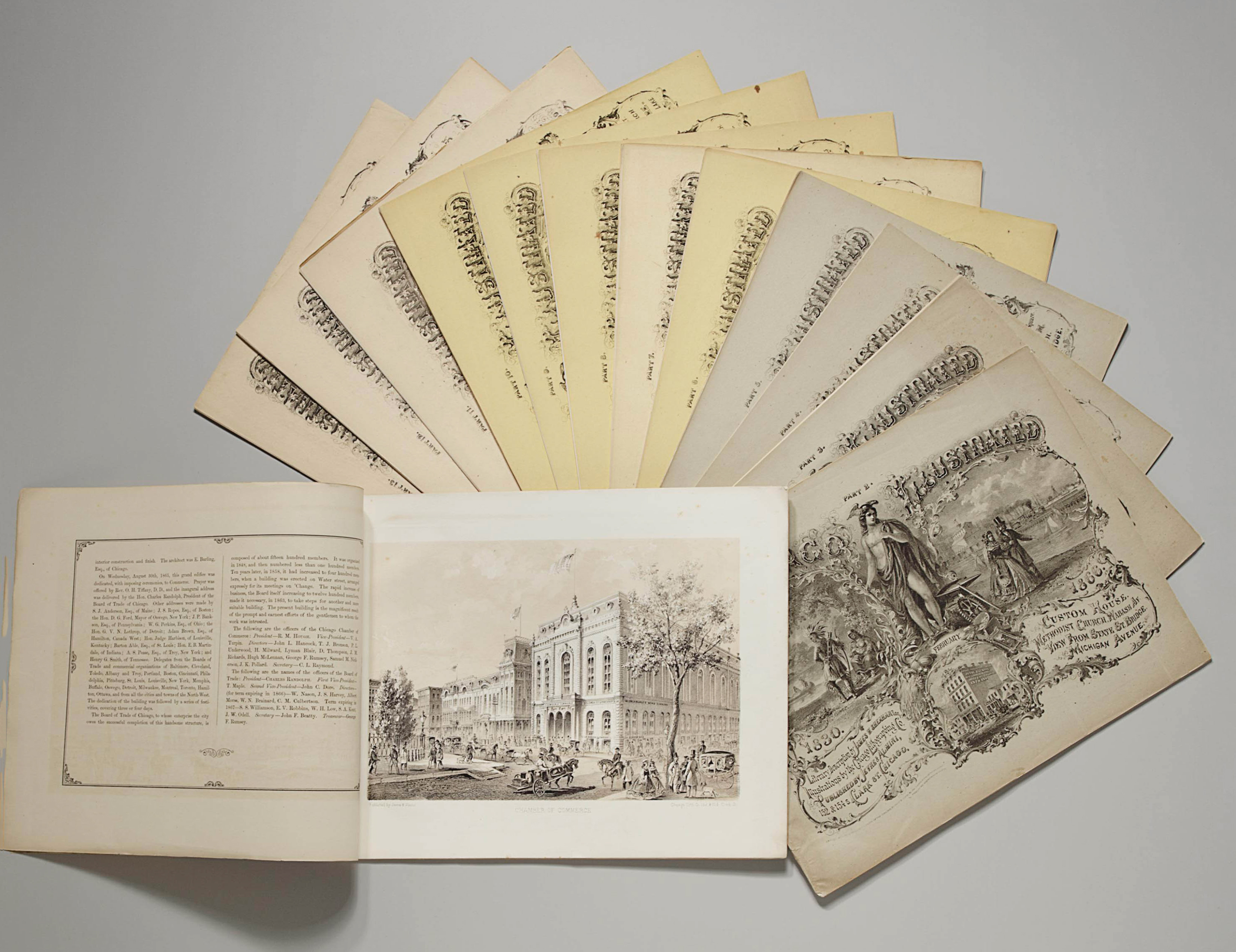
- Complete set of all 13 published issues of Chicago Illustrated. Part One (Chamber of Commerce) is shown opened. Morocco leather case.
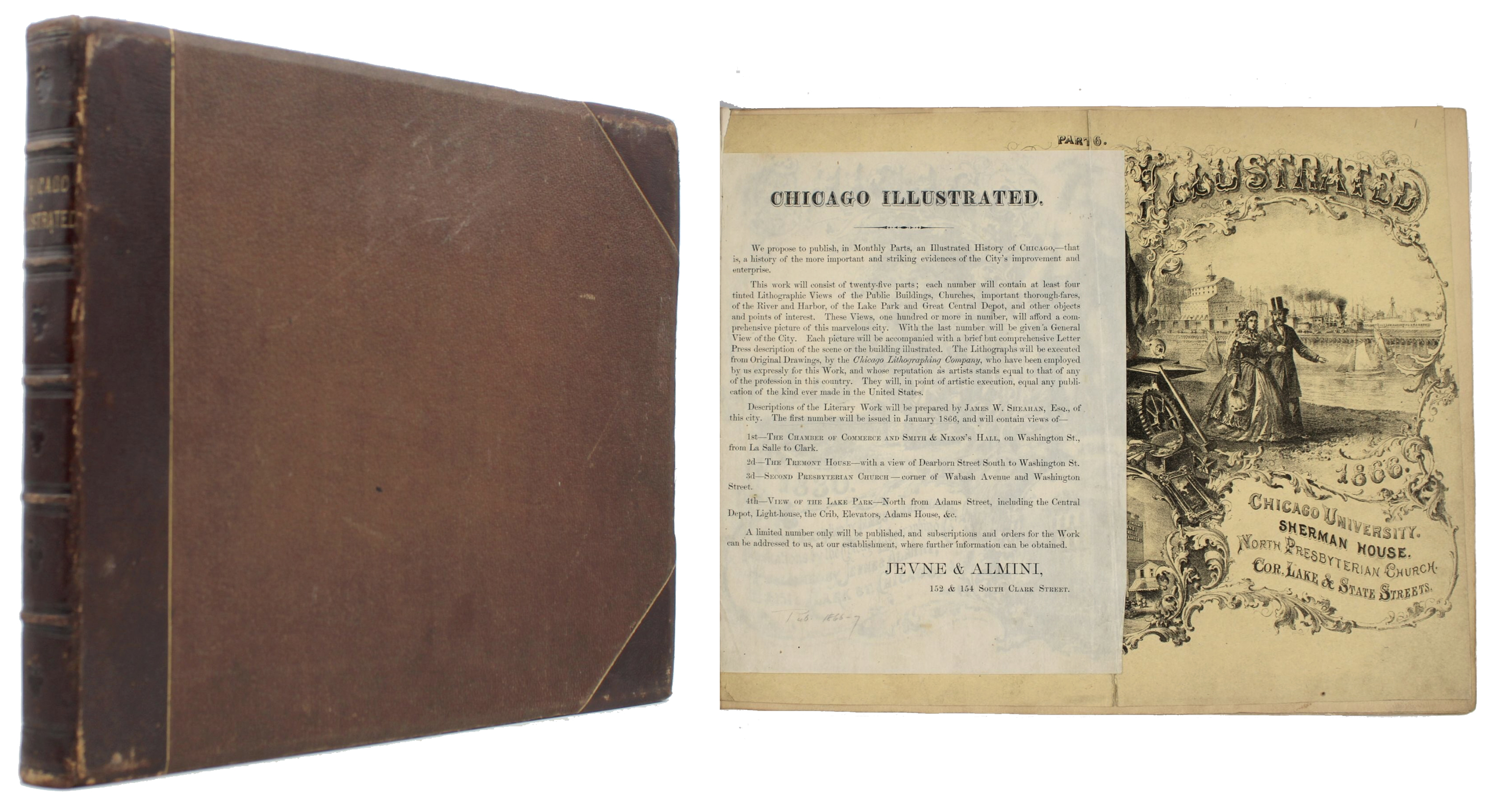
- Chicago Illustrated, 1867
Bound Version
Chicago Tribune, June 1, 1948
THE CITY INVISIBLE
For years the editor of this column has wondered how it happened that early Chicago-the city invisible that was swept away by the great fire of 1871—left such a rich record of its views and street scenes in the form of lithograph prints. The antiquarians have a habit of speaking of these pictures as the Jene and Almini prints without comment on their origin, altho they form a notable album, envied by other cities. We are delighted, there-fore, to find the story told in full in “Chicago History,” quarterly publication of the Histor Ical society, and will proceed to pass it on.
Otto Jevne, & Norwegian by birth, and Peter M. Almini, & native of Sweden, established themselves in Chicago as interior decorators in the 1850’s. Their specialty was fresco
painting, & craft they had learned before immigration, and their business flourished. In 1866 they announced a plan to publish & work called “Chicago Illustrated” in 25 monthly parts, each to contain at least four tinted lithographs of Chicago scenes, with descriptive text.
Citizens were invited to subscribe at a rate of $1.50 per number.
The project was continued faithfully and to general applause for 13 months, and then dropped. Apparently the subscription receipts did not cover expenses. But at any rate, 52 prints were issued, and they covered the major points, of interest. They form a valuable historical record of Chicago’s architecture and life at the close of the Civil war, and are also respected for their art values.
The artist who deserves recognition for these fine lithographs was Louis Kurz of the Chicago Lithographing Co., founded in 1863. He was an Austrian who had settled in Chicago in 1852, and had worked here as a “scenic artist,” which probably means that he designed and painted stage settings. (Many & more famous artist has done likewise.) After the fire he moved to Milwaukee, where he established an oleograph company. He returned to Chicago in 1878 and formed a partnership with Alexander Allison. The firm produced hundreds of chromo-lithographs.
The Jevne and Almini lithographs begot the Varin aquatints, whose art values are higher because of their fine use of delicate color. In 1926 Ernest Byfield, hotel director, a collector of the old prints, took 20 choice specimens abroad in the hope of getting them reproduced in aquatint. In London he was told that aquatint engraving was an extinct art, and so he went on to Paris. There he saw a fine new aquatint in a shop window, and his hopes re-vived. He found the artist, R. Varin, who immediately undertook the commission at & reasonable price-$400 per plate with 100 prints. His first subject was the lovely view of the old Chicago skyline, called “Michigan Avenue from Park Row.” In small letters below the title of this picture you will find the legend, “Engraved by R. Varin for Ernest Byfield.”
Chicago Illustrated, Limited Edition, 1952
 “If by a single example we desired to illustrate the rapid advance of this country beyond any other—if we were called upon to demonstrate the power of American institutions, the growth of American commerce, the irresistible energy of American people, the greatness of their industry and enterprise, their aptness in seizing upon natural advantages, and their diligence in securing them—we should unhesitatingly point to the city of Chicago.”
These were the words of the anonymous author of A Strangers’ and Tourists’ Guide to the City of Chicago, published in 1866. Grandiloquent they certainly were, yet with equal certainty they expressed the solid conviction of Chicago’s 250,000 inhabitants. And why not? Here, near the southern tip of Lake Michigan, was one of the wonders of the modern world. Thirty-three years earlier Chicago had been a loose cluster of a dozen families in the shelter of a frontier fort; now it was the fourth largest city of the United States. In 1848, for the first time, a primitive locomotive had careened on strap-iron tracks beyond its boundaries; now it was the railroad center of the nation, the nexus of 8,000 miles of railways. Here more grain was stored awaiting shipment by rail or water than anywhere else in the country, more pork packed, more lumber transshipped to the treeless prairies of the interior. The city’s jobbers, forwarding the products of eastern factories to the small towns of the Mississippi Valley, were building fortunes for themselves; its retailers were finding a ready market for wares which a few years earlier could have been sold only to the sybaritic inhabitants of long-settled communities.
From the beginning Chicagoans had been proud, even boastful, of their city. Visitors from abroad, publishing their impressions in the United States as well as in Europe, had helped to spread its fame. But theirs were verbal accounts. Pictorial records were few. In the 1850’s an occasional practitioner of the new art of photography took a few pictures, and in the early 1860’s an eastern artist, Edwin Whitefield, sketched seven views that were lithographed and distributed to a limited clientele, but it was not until 1866 that anyone made a systematic effort to record, in graphic form, busy, growing, flourishing and commanding city of Chicago.”
In the fall of 1865 Peter M. Almini and Otto Jevne, interior decorators, fresco painters, and proprietors of an artists’ supply store at 152 South Clark Street, announced that they would publish, under the title of Chicago Illustrated, a history of “the more important and striking evidences of the City’s improvement and enterprise.” The work was to appear in monthly installments, each part to consist of four tinted lithographie views of places of interest, together with a letterpress description. James W. Sheahan, then on the Chicago Tribune, would do the text; the lithographs would be the work of Louis Kurz of the Chicago Lithographing Company. Twenty-five parts were promised, and a “General View of the City” was to accompany the last number.
Part One, containing views of the Chamber of Commerce, the Tremont House, the Second Presbyterian Church, and the Great Central Depot, appeared in January, 1866. Twelve more parts followed at monthly intervals. Then the series stopped, probably for lack of popular support. We know only that many more copies of Chicago Illustrated were printed than were sold. Sometime after publication many of these extra copies were stripped of their paper covers and bound into single volumes. Thus the publication exists today in two forms—in the thirteen original parts, each with an ornamental paper cover, and as a bound book. In either form Chicago Illustrated is rare. The original subscribers paid $1.50 for each part; today the thirteen parts, in good condition, bring at least $1,000, while the bound volumes, much commoner and less desirable, command almost half that price.
Even though they were unable to complete their undertaking, Jevne and Almini, with their collaborators, covered the city well. The fifty-two views which they published included the principal public buildings, the most important hotels, several blocks of the business section, railroad stations, theaters, churches, bridges and stretches of the river, a few fine residences, the stock yards, the water works, and one or two suburban areas. To a remarkable extent, the pictures showed a new city. Few of the buildings chosen as subjects were more than a dozen years old, while quite a number appeared on the lithographer’s stone almost as soon as they were completed. Yet it was a city destined for a short life, for in little more than four years after the appearance of the last of the thirteen numbers most of it lay in ruins, while the few structures outside the area destroyed by the great fire of 1871 soon gave way to the new buildings demanded by a metropolis which doubled its population every few years.
Happily, Louis Kurz, a spirited artist, showed a city full of life. In his drawings conveyances of all kinds jostle each other on the streets—elegant coaches, omnibuses, horse cars, buggies, buck-boards, drays—while horsemen add to the confusion. The river swarms with tugs, barges, steamers, and sailing ships. Stubby engines with funnel-shaped stacks chug in and out of stations. Everywhere there are people, the women invariably in crinolines, the men in every garb from shirt sleeves to top hats. In fact, many of the prints have a marked genre quality. At the corner of Washington and State streets a hurdy-gurdy man grinds his organ for a group of youngsters; the Sherman House shares pictorial interest with a circus parade; immigrants, fresh from the Old Country, trudge along Lake street toward the Great Central Depot; even Indians cluster in front of McVicker’s Theatre. (We wish there had been room for the print of the Armory and Gas Works, showing several of Chicago’s guardians of the law escorting half-a-dozen femmes publiques to the lock-up). Thus Chicago Iustrated preserved for posterity not only the physical aspect of the pre-fire city but also the way of life of its inhabitants.
A few words about the men who produced this unusual pictorial record are in order. Otto Jevne was a Norwegian who came to Chicago in 1853; Peter M. Almini, Swedish-born, preceded him by one year. They formed their partnership in 1855 and worked together until 1871, when the fire burned them out. As fresco painters, they decorated many of the buildings shown in Chicago Iustrated. They also took an active interest in the artistic life of the city, and held many art exhibits in their place of business.
Louis Kurz was an Austrian by birth. For eight years after 1852, when he settled in Chicago, he worked as a “scenic artist,” and then turned to lithography. Until the fire of 1871 he was one of the owners of the Chicago Lithographing Company; later, as a member of the firm of Kurz and Allison, he won dubious immortality by turning out hundreds of the most garish chromolithographs that have ever been sold as “works of art.”
Of the four men who joined to produce Chicago Illustrated only James W. Sheahan was born in the United States—a fitting national distribution since nearly half of the people who lived in Chicago in 1866 were natives of European countries.
To select twelve of the original fifty-two Jevne and Almini prints to be reproduced has not been easy. The choice has fallen, in the main, on those places and scenes known not only to all Chicagoans, but also to the millions who frequently visit the city—La Salle Street, State Street, Michigan Avenue, a stretch of the river, the Water Tower, the Stock Yards. Fortunately, these views are usually of high quality artistically and much livelier in treatment than most of those excluded by the tyrannical limitation of number. Beautifully colored, they appeal more strongly than the faintly tinted originals. Together, they form a charming composite of a city on the verge of destruction—and rebirth.
Paul M. Angle
Chicago Historical Society
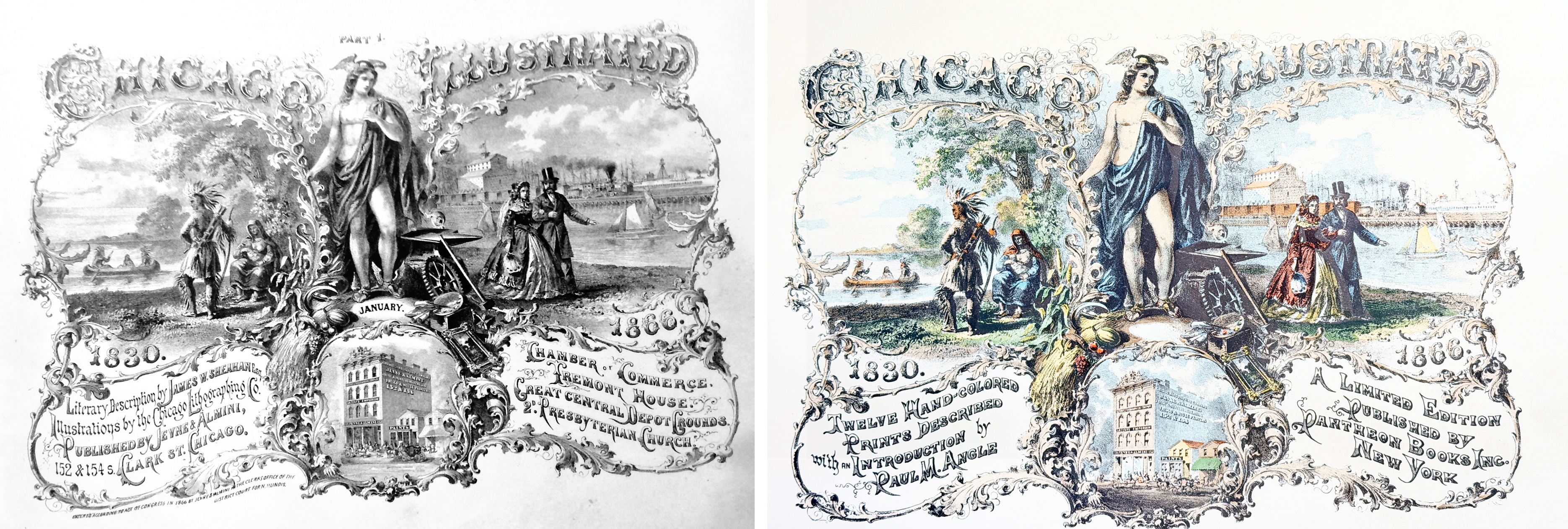
- LEFT: Original 1866 Cover Wrap for Part One.
RIGHT: 1952 Cover Wrap.
Chicago Tribune, November 9, 1952
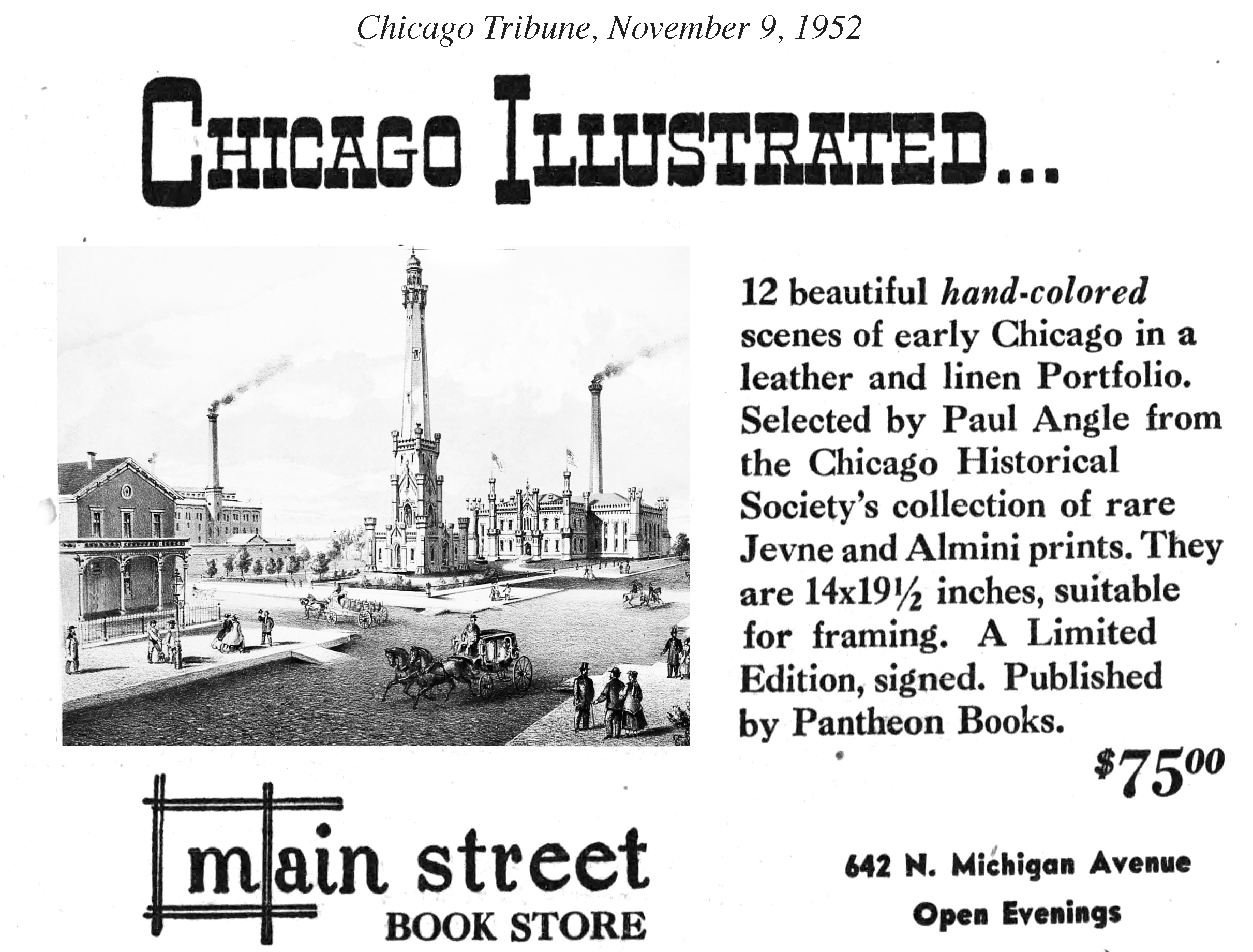 CHICAGO WATER TOWER.
One of the 12 hand colored prints from the 19th century portfolio, Chicago Illustrated, now a rarity, which have been reproduced in an outstanding de luxe edition by Pantheon Books. They are large sized, printed on heavy stock, ready for framing, and the set is priced at $75. There are an introduction and descriptive table of contents by Paul M. Angle, director of the Chicago Historical society.
Chicago Tribune, December 14, 1952
There are only 475 copies of the super art “book” of the year…. Actually it is not a book but a portfolio of 12 prints from the famous Chicago Illustrated of a century past…. Each of the prints is hand colored and is ready to be framed…. There is an introduction and a descriptive table of contents by Paul Angle, director of the Chicago Historical society, and you get pictures and words for (as the ads put it) “only” $75.
Antiques, January, 1953
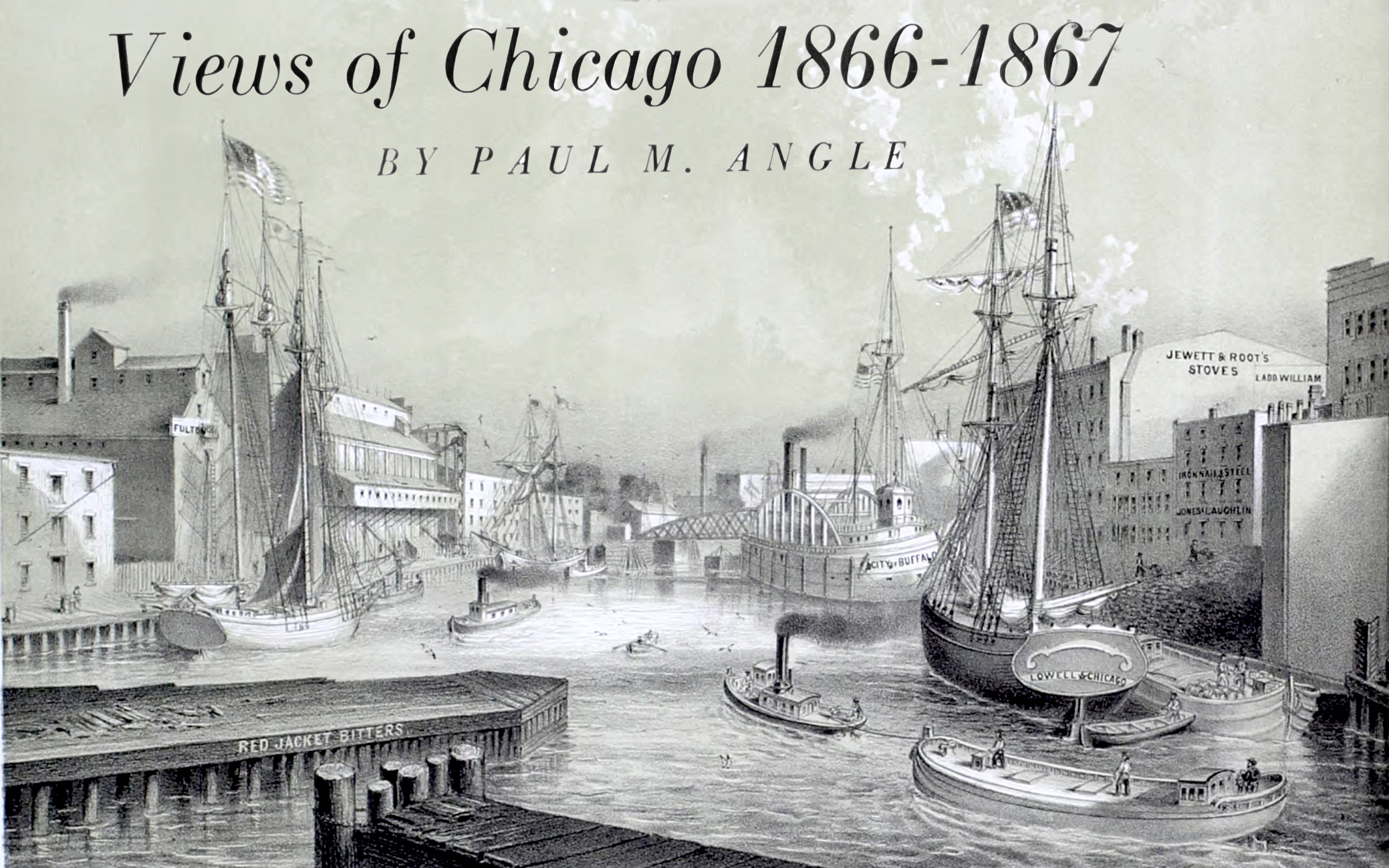
- Among early American prints, town views are of particular interest to collectors, and among town views the series described here is outstanding. Several items from a set in the Ryerson collection were illustrated in ANTIQUEs for February 1943. Two other complete sets and some duplicate prints are owned by the Chicago Historical Society, and from these the views illustrated here were selected by Mr. Angle, director of the Society.
The series of lithographs, Chicago Illustrated, by Jevne and Almini, is best described in the publishers announce-ment, which is even rarer than the publication itself:
- We propose to publish, in Monthly Parts, an Illustrated History of Chicago,-that is, a history of the more important and striking evidences of the City’s improvement and enterprise.
This work will consist of twenty-five parts; each number will contain at least four tinted Lithographic Views of the Public Buildings, Churches, important thoroughfares, of the River and Harbor, of the Lake Park and Great Central Depot, and other objects and points of interest. These Views, one hundred or more in number, will afford a comprehensive picture of this marvelous city. With the last number will be given a General View of the City. Each picture will be accompanied with a brief but comprehensive Letter Press description of the scene or the building illustrated. The Lithographs will be executed from Original Drawings, by the Chicago Lithographing Company, who have been employed by us expressly for this Work, and whose reputation as artists stands equal to that of any of the profession in this country. They will, in point of artistic execution, equal any publication of the kind ever made in the United States.
Descriptions of the Literary Work will be prepared by James W. Sheahan, Esq., of this city. The first number will be executed in January 1866.
A limited number only will be published, and subscriptions and orders for the Work can be addressed to us, at our establishment, where further information can be obtained.
From later prospectuses we learn that the lithographs were made from original drawings by Louis Kurz (1834-1921), of the Chicago Lithographing Company, and that the subscription price of each issue was $1.50. For thirteen months, beginning with January, 1866, Chicago Illustrated came out as promised. Each issue contained within its highly ornamented paper covers four beautifully executed lithographs and eight pages of descriptive text. Then the series stopped, probably because the publishers were losing more money than they could afford. Many more copies of Chicago Illustrated were printed than were sold. At some later date these extra copies were stripped of their paper covers and bound into single volumes, so that today the publication exists in thirteen original parts and also as a bound book.
Jevne and Almini were interior decorators whose specialty was fresco painting. Otto Jevne was a Norwegian by birth; Peter M. Almini was a native of Sweden. The former came to Chicago in 1853, the latter one year earlier. Both men had learned the fresco painter’s trade in their native countries, so their association in Chicago was a natural one. Examples of their skill were to be found in many of the city’s structures built between 1855, when their partnership was formed, and 1871, when the great Chicago fire burned them out. After the fire the partnership was not resumed, each man preferring to establish his own business.
The artistic merit of Chicago Illustrated was due largely to Jevne and Almini’s choice of a capable artist and lithographer. Louis Kurz was an Austrian who made his way to Chicago in 1852. For eight years he worked as a “scenic artist,” and then turned to lithography. In 1863 he joined with several others to form the Chicago Lithographing Company, which quickly made a name for itself. Like the Jevne and Almini partnership, the company came to an end in 1871. After the fire Kurz established the American Oleograph Company in Milwaukee, where he remained until 1878, when he moved the company to Chicago. Two years later he formed a partnership with Alexander Allison, and spent the last years of his lite turning out hundreds of gorgeously garish chromo-lithographs, by which the firm of Kurz and Allison is known today.
Although Chicago Illustrated lasted only half as long as its promoters intended, and came to comprise fifty-two plates instead of the one hundred or more originally promised, it stands as a remarkable achievement. The lithographs, measuring approximately 8½ by 12 inches without margins, depict much of the city as it appeared immediately after the Civil War. Here are the principal public buildings—the Post Office, the Court House, the Chamber of Commerce—the two great railroad stations, five of the hotels, a dozen or more churches, Crosby’s Opera House and McVicker’s Theater, the old Chicago University, the Douglas Monument, the Water Tower, and the Union Stock Yards. There are numerous street scenes, either by themselves or as settings for other pictures, and views of the bridges, the river, and the lake front. Animated in treatment, the lithographs show the river crowded with boats, the streets jammed with traffic, and many people in the costumes of the time.
The text hardly compares with the lithographs in interest, yet it has its merits. Sheahan, a veteran newspaper-man, disdained any literary effect, and confined himself strictly to facts. While such an approach does not make for absorbing reading, it is a godsend to the person who wants to know exactly where a particular building stood, when it was built, what it was made of, and how much it cost.
Chicago Illustrated is outstanding for several reasons: It was written, drawn, and published by Chicagoans, and it is the best source for the physical appearance of the city that the Great Fire destroyed in 1871. And it is rare enough to be worth a pretty penny without being completely unobtainable.

Leave a Reply