Studebaker Building I, Fine Arts Building
Life Span: 1886-Present
Location: 410 South Michigan Avenue
Architect: Solon Spencer Beman
- Lakeside Annual Directory of the City of Chicago, 1904
Fine Arts Bldg.,—203 to 207 Michigan av.
Inter Ocean, August 23, 1885
The Studebaker Brothers’ Manufacturing Company were granted a permit to build a very fine business structure, which they will occupy as a carriage repository and salesroom. The new edifice will be at Nos. 103 to 107 Michigan avenue, and will be 105 feet front by 172 feet deep, 112 feet high, or eight ordinary stories and basement. It will cost $150,000.
Chicago tribune, October 27, 1885
PROUD OF CHICAGO.
There are no people more loyal to the city in which they live than the denizens of Chicago. They love to expatiate on its fine buildings, boulevards, and parks, and they have many other things to be proud of. It has become headquarters for almost all kinds of businessdry goods, pork and beef packing, wheat corners, and manufactures. Among the latter may be mentioned carriage industry.
New York has supplied the West for many years. Now Chicago is preparing to supply New York and the East as well as the West. This any one will admit that examines the immense eight-story stone-front building now being erected by the Studebaker Bros. on Michigan boulevard. It will be a monument to the commercial enterprise of the “Garden City.”
Chicago Tribune, November 7, 1886
The great Studebaker Building on Michigan avenue, below Van Buren street, is nearing completion. It will be recognized as one of the chief landmarks of the city, worthy at once of Chicago and of the great manufacturing house of which it will be representative. The error of a lady the other day in mistaking the building for the American Institute of Art, situated just to the north, was quite natural, for certainly those immense shafts of polished granite at the entrance to the Studebaker Building are the most artistic things on all Michigan avenue.
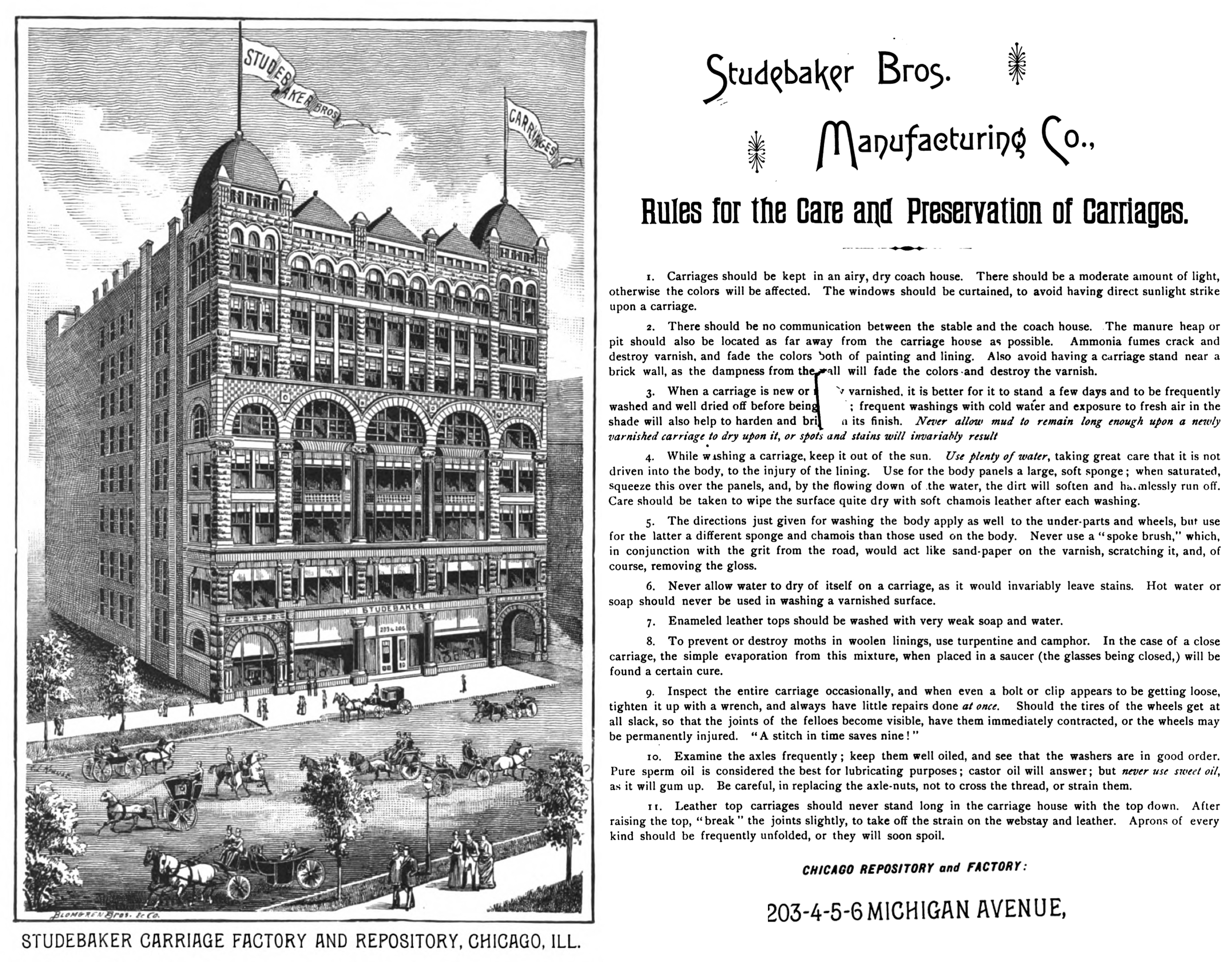
- Studebaker Building
1885
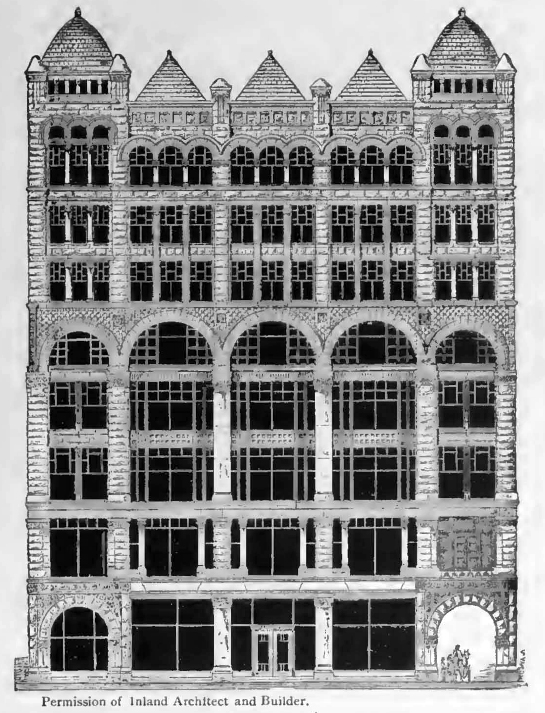
- Studebaker Building
Architectural Drawing
1886
Here are a few of the carriages they produced. These were all painted by the prolific turn-of-the-century magazine illustrator, C. Gray-Parker.
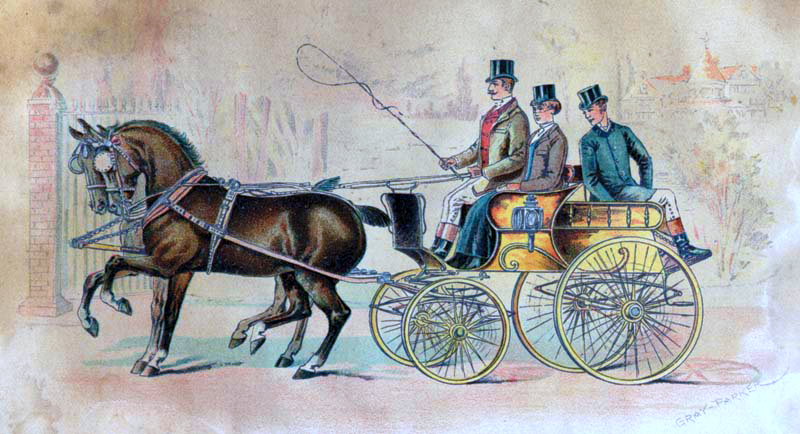
- Studebaker Hunting Trap

Studebaker Tandem Cart
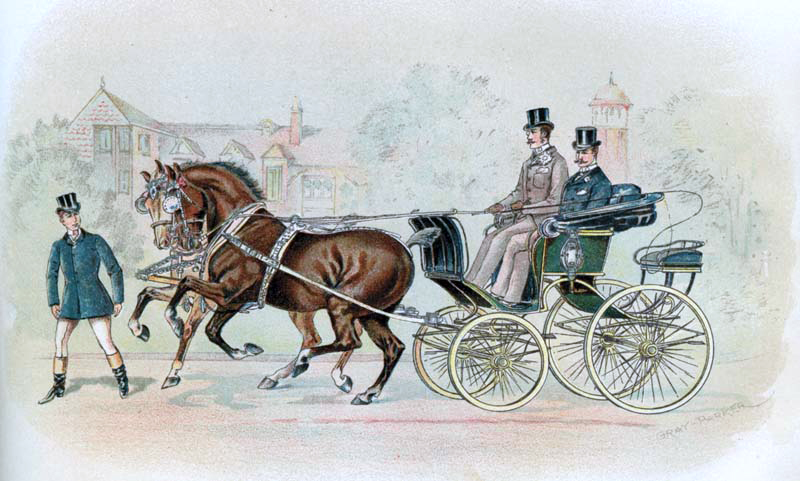
- Studebaker Spider Phaeton
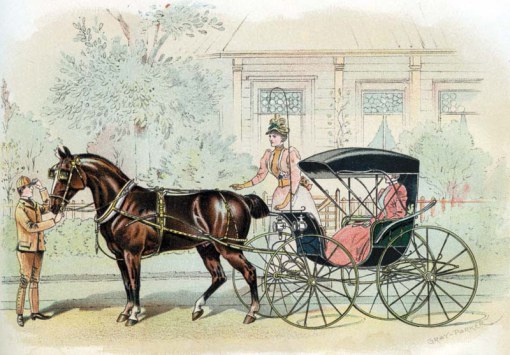
- Studebaker Queen Phaeton

- Studebaker Goddard Buggy
Chicago Chronicle, April 20, 1896
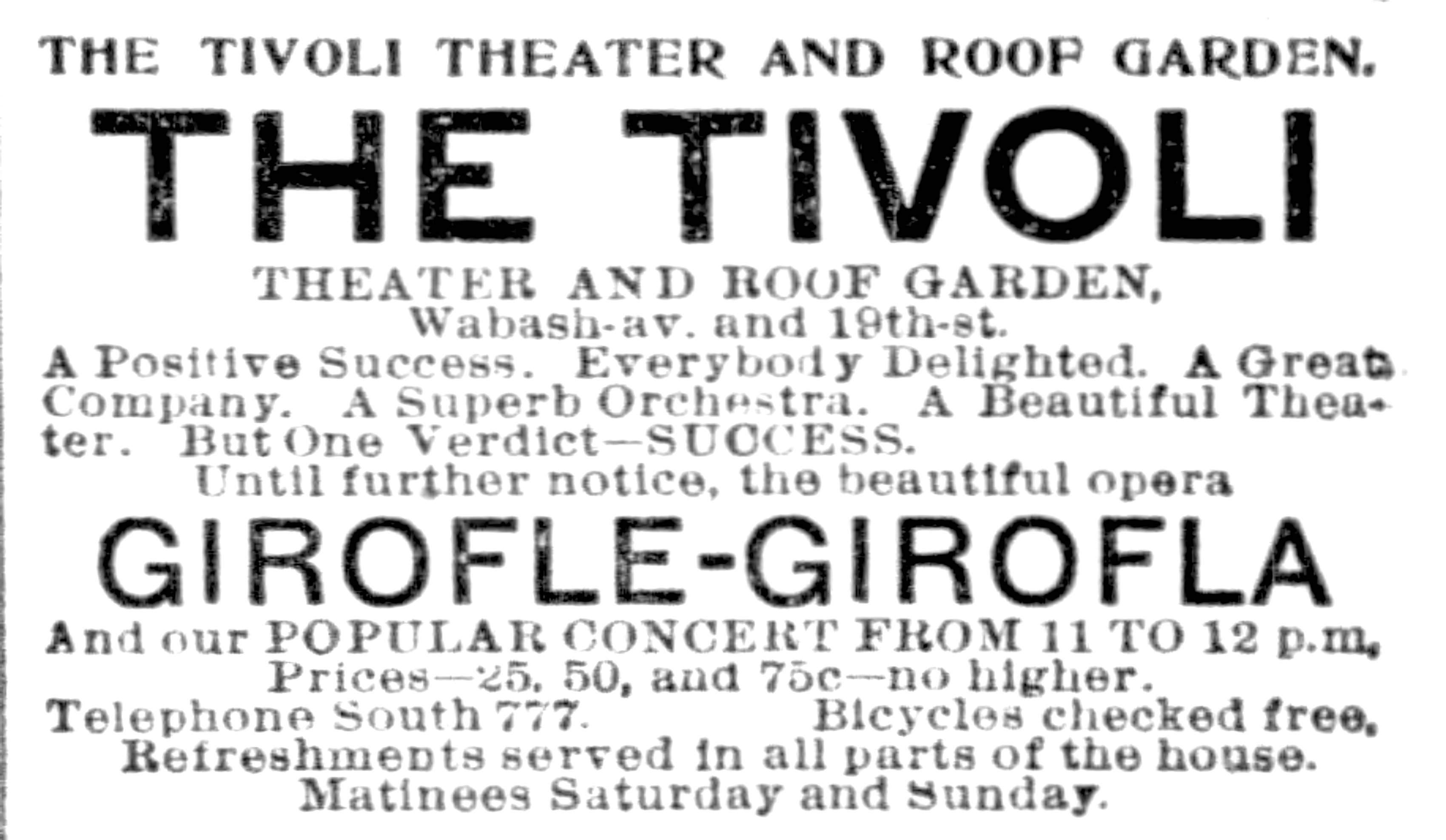
 Unless something unforseen happens before autumn is fairly here, Chicago will have acquired a new theater of novel design and unprecedented splendor. It will be located in the Studebaker building, on Michigan avenue, adjoining the Auditorium. In addition to the theater proper there will be a magnificent roof garden, and this part of the enterprise, it is hoped, will be ready for the public by the time the hot weather is properly due. The theater will be of novel design In many ways, and it is the intention of the gentlemen who will build it to make it to Chicago what Koster & Blal’s and Ham-merstein’s Olympia are to New York, name-ly, a vaudeville theater where everything-the artists, the equipments and the prices-shall be absolutely first-class. To do this will take a pile of money. The men behind this scheme know this and they are ready to spend money in a fashion which will make most theatrical managers stare.
So many vaudeville theaters have been built–on paper–and so many schemes for amusement palaces have been inflated with wind till they burst that the public in general and Chicago’s theatrical colony in par-ticular, are inclined to be suspicious of all such stories as this. But there is evidence of a tangible nature that this project will be put through in a hurry if the people who have it in hand decide -and they have practically so decided that their plans are feasible.
Studebaker Interested.
Several weeks ago William Studebaker sent an architect to New York to make a careful examination of the best vaudeville theaters in that city, and especially the newly opened Olympia, belonging to Oscar Hammerstein, and the famous resort of Koster & Bial, which was originally designed for other purposes and called the Manhattan opera-house. The architect returned with a budget of statistles and a portfolio of plans. Then he made, under Mr. Studebaker’s direction, a very minute survey of the Studebaker building on Michigan avenue, with a view to discovering whether any insuperable objection to its economical conversion into a theater existed. His report on this point was handed to Mr. Studebaker last week, and it was entirely favorable to the theatrical project. As for the roof garden, which had been a pet idea of Mr. Studebaker for years, nothing was found to prevent the transformation of the huge space on top of the building into any sort of pleasure resort desired at once. The roof of a building, as high as the Studebaker overlooking Michigan avenue, the Lake Front park and the lake itself, possesses most of the desirable qualifications of a garden in the air.
Decides To Go Ahead.
Consequently by the middle of last week Mr. Studebaker had practically decided to go ahead as soon as possible with his roof garden, and to arrange for the erection of the vaudeville theater in time to make a good start next season. Before the plans for the new theater are drawn up the architect will visit Toledo, where there is a theater, called the Valentine, about the beauty and convenience of which actors and managers are forever raving. In the construction of the theater Mr. Studebaker, it is understood, wishes to so arrange its lines that if the vaudeville idea should fail to prove attractive it may be converted to legitimate dramatic uses at once. The present substantial structure will in all probability be retained in so far as the outside walls are concerned. In the adaptation of the building to its new purpose it is supposed $500,000 could easily be spent, and Mr. Studebaker is on record as saying that if the theater is built it will be the flnest in every way Chicago has ever known.
While William Studebaker does not contemplate managing the theater or roof garden, he will be the general director of both, and those who know him well declare that he is admirably qualifled for the work. He is an ardent lover of the theater, a familiar flgure in the foyers and the warm friend of numberless actors and managers. Personally he is one of the most popular men of his age and standing in this city. If youth, brains, pluck and large means are all that is needed in this theatrical enterprise, Willam Studebaker is the man of men to carry it through. The Studebaker carriage repository is to be moved to a new location on Wabash avenue shortly.
In The Hotel Centers.
The new theater will be in the heart of the hotel district, from which it has been proven elsewhere a large number, if not the majority, of the patrons of a first-class vaudeville house are drawn. It is a trifle remote at present, as the Auditorium has been found to be, from the north and west side theater-going population, but the elevated loop will within a year or so, it is thought, remedy this. There is no doubt that a better location could not be found from an advertising point of view. If it is the pleasure of the managers to do so it may be made a blazing beacon on the lake front, which strangers will flock to see. Electric illumination could be used with splendid effect, and Mr. Stude baker has already considered a number of plans to this end. The demand for such a theater-a high-priced vaudeville house, where liguid refreshments and the accompanying cigar may be enjoyed with the stage entertainment ought to be strong in a city which contains so many men who have enjoyed just such places in the east and across the water. Many managers have expressed their belief that such a theater would be as popular and profitable here after the people got to understand fully its attractions as a number of them have proved in New York.
The tightness of money since the panic of 1893 has prevented several schemes for a theater of a vaudeville character from gong through. Recently it was stated that a syndicate had been formed to convert the First Regiment armory on Jackson street into & vaudeville house and that Koster & Bial of New York were said to be involved in the project. Nothing has been heard of thig scheme lately, and it is generally supposed to have died of inanition, like so many of its predecessors.
Mr. Studebaker Confirms It.
William Studebaker, when seen last night at the Auditorium hotel, professed considerable surprise that the news of his contemplated theatrical project had leaked out.
“I do not care to say much about the matter,” he declared, “as everything is not yet in shape, but I will not deny that the story is true. S S. Beeman, who is well known on account of his work in connection with the Auditorium hotel, 1s the principal designer, but there are other architects associated with him. The building at 202-206 Michigan avenue will have to be entirely reconstructed for the purpose to which we intend to put it. It will be just as high as the building ordinance will permit. The seating capacity of the roof garden and theater will be 2,000 people each. The interior decorations will be of the best, and the stage attractions wil be drawn from the cream of both Europe and America. We hardly expect the building will be ready for occupancy before next May, though it may be completed sooner.”
Chicago Tribune, November 12, 1897
 South Bend. Ill., Nov. 11.—It is announced that the Studebaker Buildings on Michigan boulevard, Chicago, are to be immediately remodeled and transformed into a music hall and studio building of modern description, which will be ready for occupancy before May 1 next.
At a meeting of the Board of Directors of Studebaker Bros. Manufacturing company, held this week at their offices in this city, this course was definitely decided upon, and Frederick S. Fish, general counsel of the company, was authorized to draw the necessary contracts preliminary to entering upon the work.
The Studebaker Buildings in Michigan boulevard in Chicago have a frontage of nearly 150 feet fronting the waters of Lake Michigan, and overlooking the new Lake-Front Park, and extending from the Chicago club to the Auditorium.
Plan of Remodeling.
The interior is to be entirely rebuilt at an estimated cost of between $300,000 and $400,000, according to plans proposed by Charles C. Curtiss of Chicago, with whom negotiations have been pending for some months past, and which contemplate a building containing two music halls, both on the ground floor, the larger having a seating capacity of about 1,500, and the other, for chamber music concerts and piano and Bong recitals, of about half that size.
The upper part of the building is to be subdivided into offices and studios for musicians, artists, publishers, architects, association rooms, etc., and the ground floor will contain stores suitable for piano or other warerooms.
S. S. Beman is the architect and the property is to be under the management of Mr. Curtiss.
Charles C. Curtiss, who is mentioned in the telegram, when seen last evening at his home, 50 Astor street, confirmed the report from South Bend, and said in addition that nothing now stood in the way of beginning work upon the structure immediately. According to the plans in his possession there will be something like 250 offices and studios in the building, besides the two music halls, and he estimates that the whole structure, when completed, will represent an investment of not less than $1,250,000.
“I am free to say,” said Mr. Curtiss, when shown the telegram, “that these are the facts. We will begin work remodeling the structure early next week, probably on Monday. We have implicity confidence in the enterprise and think that it will make the location the musical center of the city. There are now on Michigan avenue, not far distant from the place, the Public Library and the Art Institute, and the Auditorium is at our very door. These have indicated the tendency, and it is but natural that artists and musicians should desire a neighborhood that is so quiet and beautiful a;id at the same time near the business center. The advance of the elevated railway along Wabash avenue has aided in this, end now we feel that there can be no doubt of the success of such a structure as is contemplated here.
About the Music Halls.
“The details of the plans have not been wholly completed. But the principal features of the innovation will, of course, be the two halls, as described. These will both be on the ground floor, the entrance to the larger hall being at the south end and the entrance to the other at the extreme northern end of the Michigan avenue front. These halls will be elaborately furnished and decorated, but in just what style I am not in a position now to say. The whole building will be reconstructed so as to make it fireproof.
“The halls, naturally, are to be one of our greatest cares. We have not yet decided what we will call them, but some name will be chosen which is not wholly local in its significance. We have no doubt they will prove of inestimable value in artistic circles. There are very few halls in the city that can be used for the same purpose, and there are no halls adaptable to recitals and chamber concerts that are on the ground Hoor. This fact will be greatly to its advantage.
“But our first endeavor will be to prepare the offices and studios for occupancy before May 1. We have now a great many ap plications for them, and some of the music schools have turned to us. We will put these portions of the building in readiness first, and when this is done will begin work upon the halls so as to have them ready by another season.”
Inter Ocean, August 7, 1898
The New Music Hall.
The monumental Studebaker building on Michigan boulevard, now known as the Fine Arts building, tenanted by musicians, painters, sculptors, and representatives of the allied arts, furnishes a new art center which Chicago may worthily regard with pride. Charles C. Curtiss, who has promoted the enterprise judiciously and artistically and has been liberally aided in all regards by Hon. Frederick S. Fish, who has represented the interests of the Studebaker company, deserves great credit. Aside from the fine accommodations for the artists, the beautiful parlors for the Women’s club and various literary clubs, the music halls command attention as a most inviting place for public assemblies. The large hall opens directly into the marble foyer on the first floor, and the work and plans as far as it has progressed indicate a remarkably handsome auditorium. The lines indicate a commodious structure, on the plan of European opera-houses, in the loggias surmounted by great Corinthian columns with elaborate capitols. At the rear of the hall are two spacious balconies, broad promenades extending around the hall from both these projections.
The ceiling is very elaborate in its plastic decoration, likewise the proscenium arch that spans the stage. The stage is thirty-two feet deep and fifty-seven feet in width, and will be completely stocked with scenery, and will have, in addition, a large three-manual pipe organ. The decorative designs (in old ivory, red, and gold) under consideration are extremely rich, befitting the fine architectural outlines. This half, like the building, is absolutely fireproof, has ample exits, and will have opera chairs for 1,600. On the same property, in the rear of the fine building occupied by the Chicago Musical college, is a smaller concert college hall, that will be equally handsome in design and rich in furnishings. It has only one balcony, and will seat 700 people. It has a completely equipped stage, 27×22 feet, and a two-manual pipe organ. These halls, beautiful in design and complete in every detail, furnish a valuable addition to Chicago’s already large facilities for holding entertainments.
1922 Chicago Central Business and Office Guide
The Fine Arts Building, fronting Lake Michigan between Van Buren and Congress Streets is the most prominent feature of the finest block of buildings in the entire city, including the buildings of the Chicago Club, the Auditorium Hotel and the Congress Hotel. It is the center of the highest artistic, literary and educational interests of the city, and contains three auditoriums, which are considered superior in elegance of architecture, decorations and appointments to any heretofore constructed.
Among its tenants may be mentioned: The Chicago Woman’s Club, The Cordon, the Musician’s Club, the Chicago Literary Club, the Public School Art Society, the Daughters of the American Revolution, the Chicago Artists’ Association, the Chicago Woman’s Musical Club, the Young Fortnightly, The Wednesday Club, the Alliance Francaise, Albert Ronllier’s Galleries and the following Arts and Crafts shops:
The Artists’ Guild, Christia M. Reade (jewelry, etc), The Piccadilly (tea room), Ackerman & Son (art galleries), Miss Jeannette Pratt (jewelry, etc). James Winn (jewelry), The T. C. Shop, The Aeolian Company, Grosvenor, Lapham & Co., A. B. Chase Pianos, Ralph Fletcher Seymour (books), Elizabeth Henson (lamp shades), The Anna Morgan Studios (dramatic art), W. K. Cowan (furniture and art galleries) The Homer Studios (interior decorating) Edmund C. Hamilton (interior decorating), The Kalo Shop, W. C. Moulton (interior decorator) The Grace Hickox Studios (dramatic art), Page & Shaw (candies), Cercle Francais, fernand de Gueldre (photographer), and other artistic and educational concerns, for which it has become the recognized headquarters.
Also the Studebaker Theatre, seating 1,330. The Playhouse, seating 630, Recital Hall, seating 425, connected with the Auditorium banquet room.
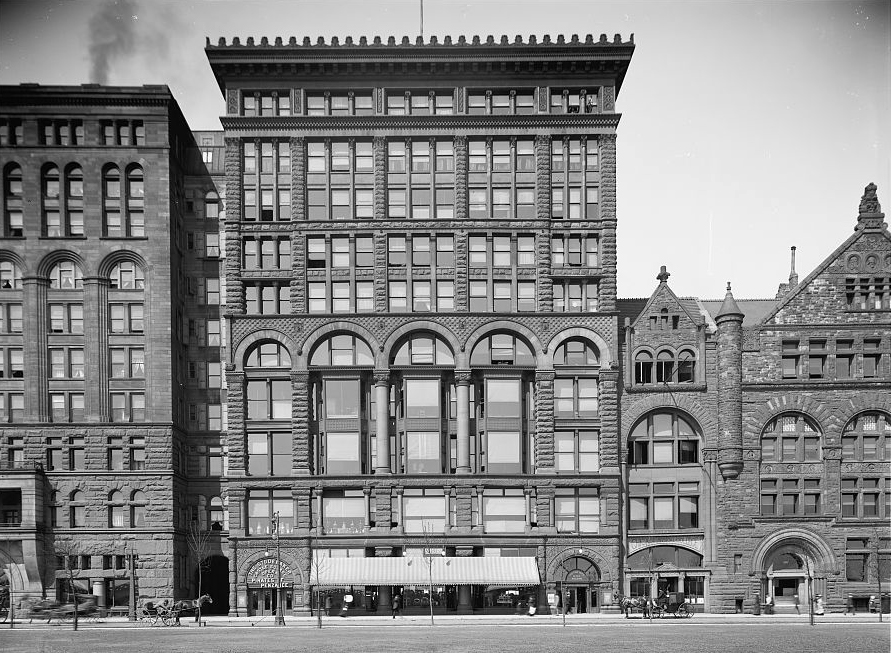
- Studebaker Building, 1900
Chicago Tribune, February 23, 1916
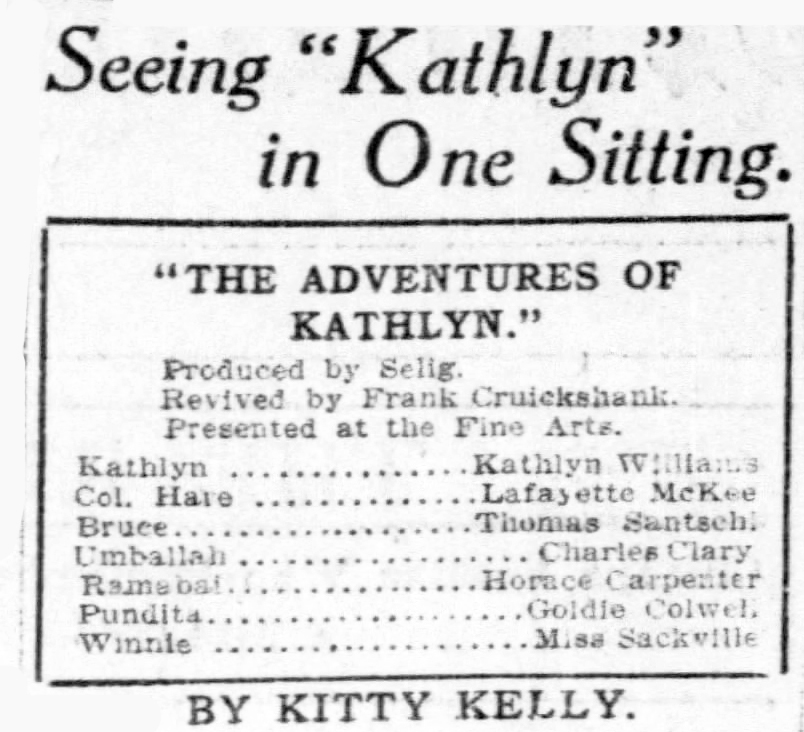
“Kathlyn” has come back. Kathlyn who went adventuring amongst disguises and jungles along in the years 1913 and 1914. Her serial ways have been reduced to two hours’ performance, which is supposed to chronicle the highlights of her Amazonian adventures, minus the padding that existed in the prolongation of the suspense her ways with the wilderness were supposed to excite.
This is the acorn from which the mighty oak of serials sprung, the seed sowed by The Tribune, the Selig company, Harold MacGrath, and Gilson Willets, in these three years has spread into a husky serial crop, with perils and palpitations rising to their climax and now giving way toward the real story serial, to be manifested in the upcoming Billie Burke continued photoplay
As such an honored sample of originals “Kathlyn” is especially worthy of attention. Considering the great leap of picture progress occurring within just the year, the photoplay accomplishments of “Kathlyn” are remarkable. It is characterized by excellent photography and it moves briskly to one point or another, though little things like logic and plausibility are lacking as ingredients.
The closeups of the animals are interesting and effective, but they don’t strike specially active thrills a-travel down one’s vertebrae. Of course, fashion in thrills has changed. Since “Kathlyn’s” pristine day we have had more of them and more serious ones, till now we are accustomed to enduring tumbles from skyscrapers and seeing people jump from aeroplanes to moving trains and other little feats of that sort with scarcely the w. k. flicker of an eyelash. So when Kathlyn registers wild fear in one section and then in the next we see some lions placidly traveling across the screen, pulses don’t pulse particularly extra fast. But fashions never do stay the same.
Kathlyn herself as heroine is a most put upon lady. She never has time, robed in a diaphanous negligee, to take tea on a chaise-lounge. No, she has ever to be up and hustling from one disguise into another, getting crowned, escaping, helping someone else to escape, being recaptured, busily and repeatedly before “the curse of inheriting the crown of Allaha” has been removed from her family and she has a chance for the pink tinted silhouette kiss of finale.
As reminiscence of a very important step in picture procedure, “Kathlyn” is thoroughly worth seeing. Moreover, in these days of advertised “sirens” and generally flaunted film wickedness it is a rare relief for its absolute respectability. There isn’t a thing to offend the nicest minded.
Frankly, there are situations to provoke a smile from present day sophisticated seers, but the seers enjoy the smiling. The houseful yesterday was alert with comment. Apparently a pleasant time was had by all.
Chicago Tribune, February 26, 1916

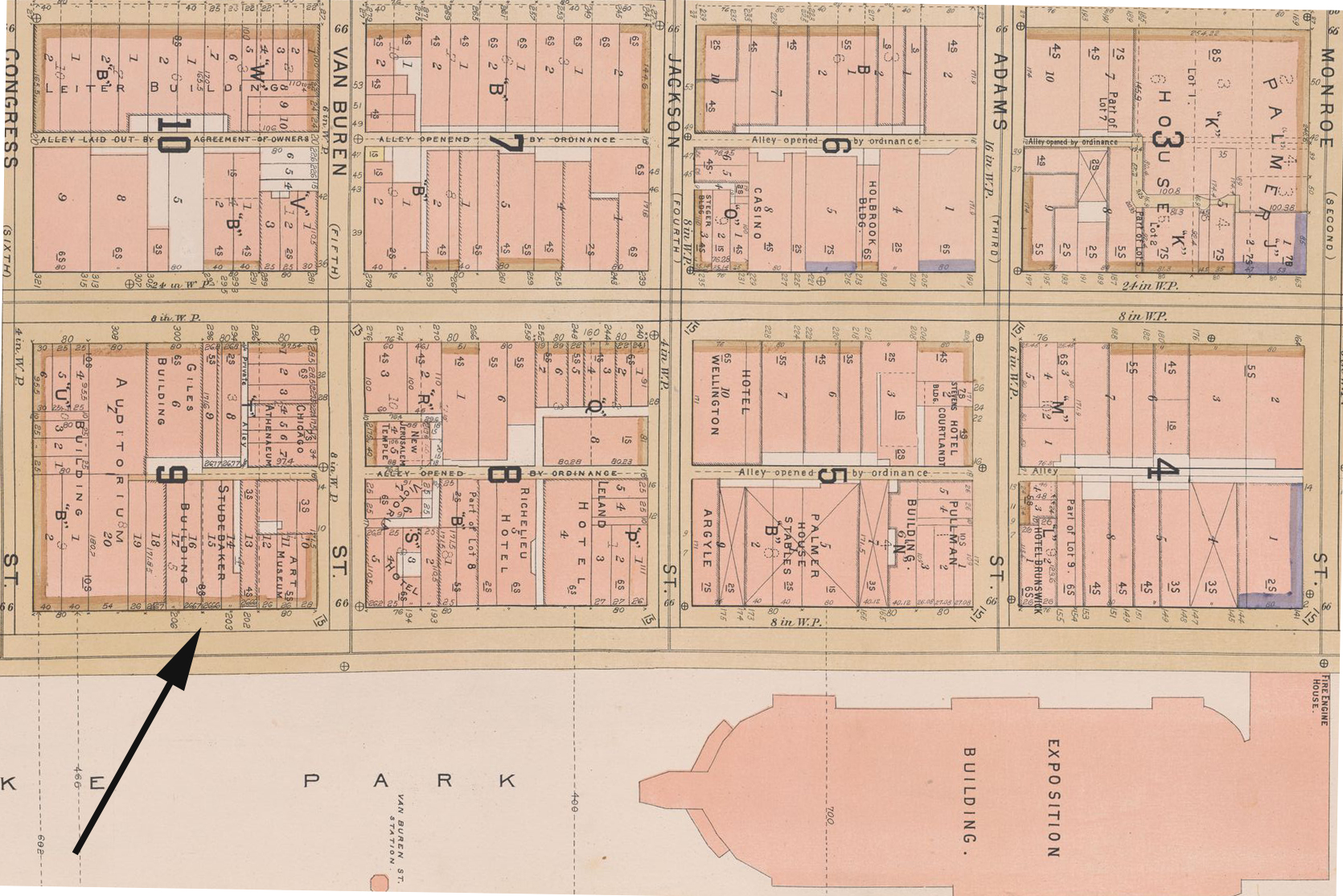
- Studebaker Building
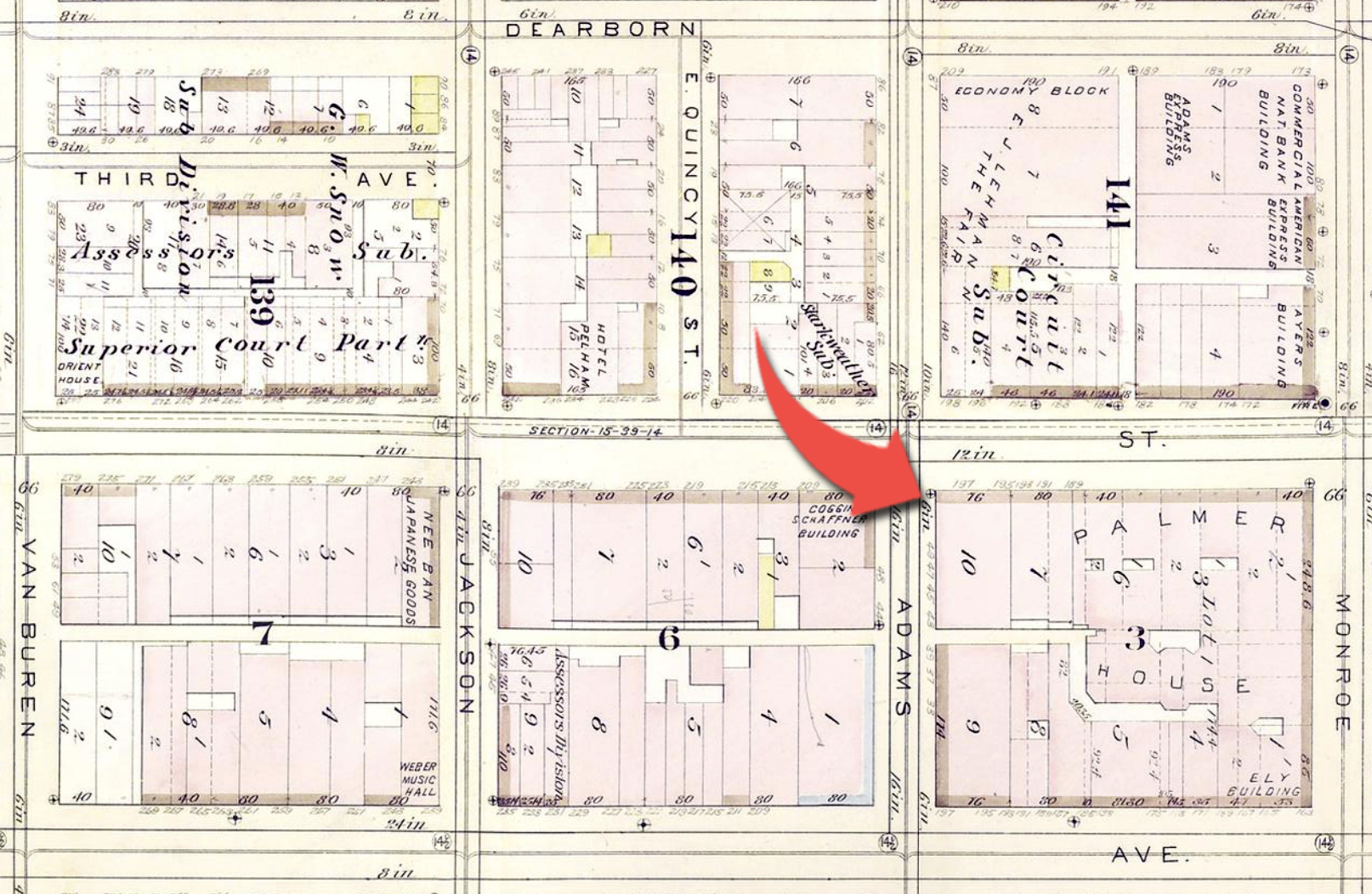
Greeley Carlsom Street Atlas of Chicago
1891
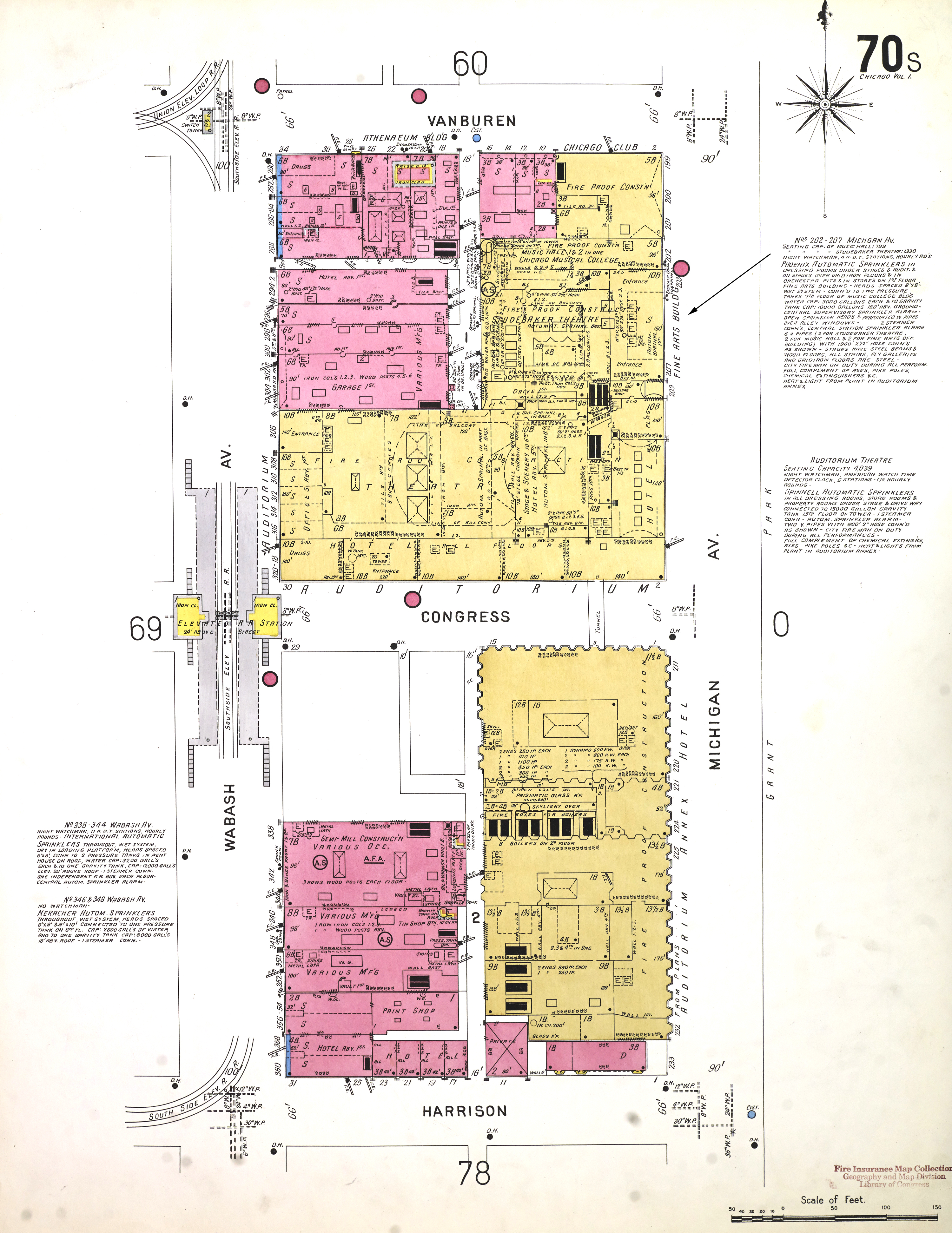
- Fine Arts Building
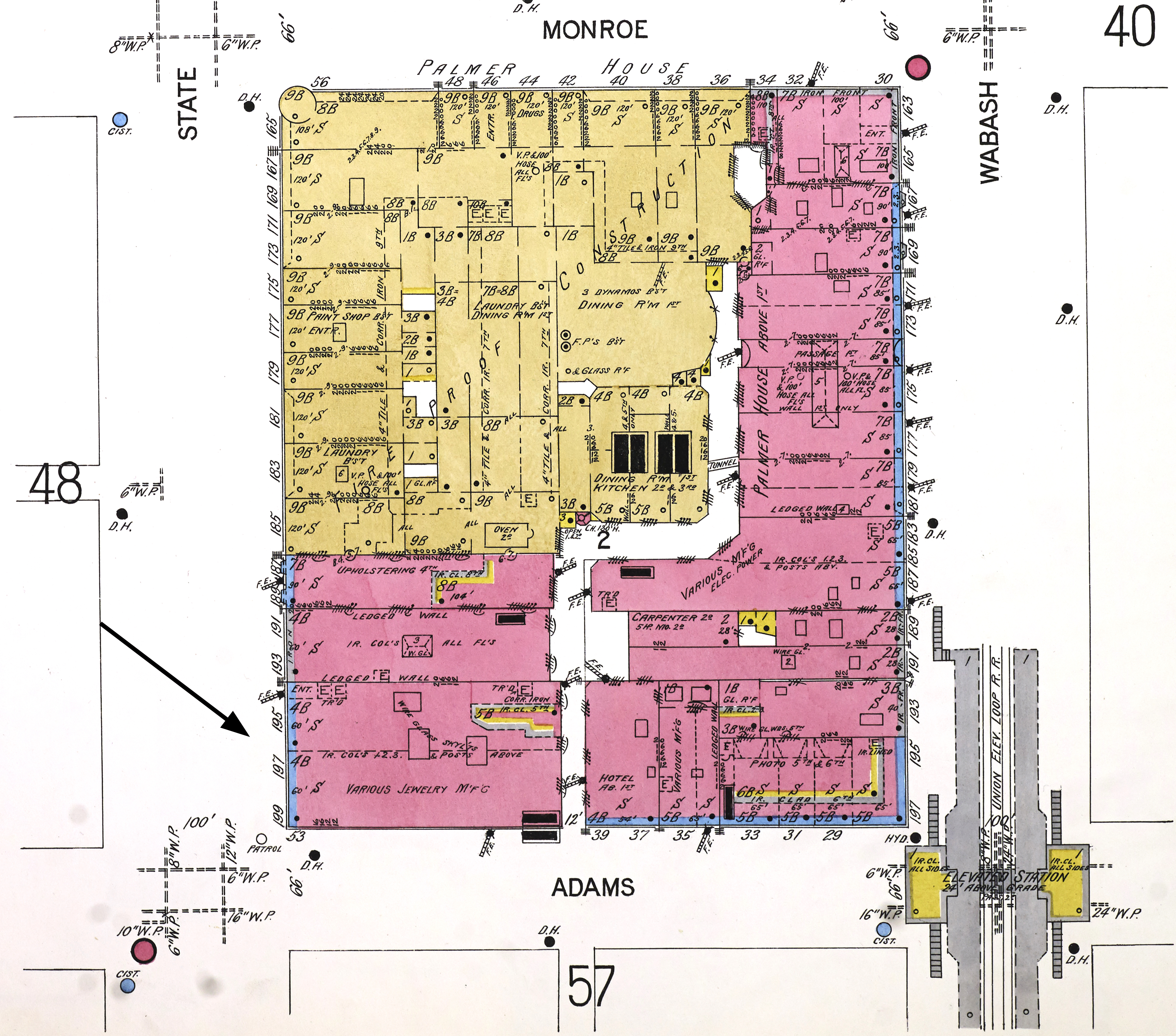
Sanborn Fire Map
1906
Currently, true to its name, it houses artists’ lofts, art galleries, theatre, dance and recording studios, interior design firms, musical instrument makers, and other businesses associated with the arts. It also holds offices of the Daughters of the American Revolution, the Jazz Institute of Chicago, the Grant Park Conservancy, the World Federalist Association, the Chicago Youth Symphony, the Boitsov Classical Ballet School and Company, and the venerable Artist’s Cafe, known to generations of late-night diners. It was designated a Chicago Landmark on June 7, 1978.





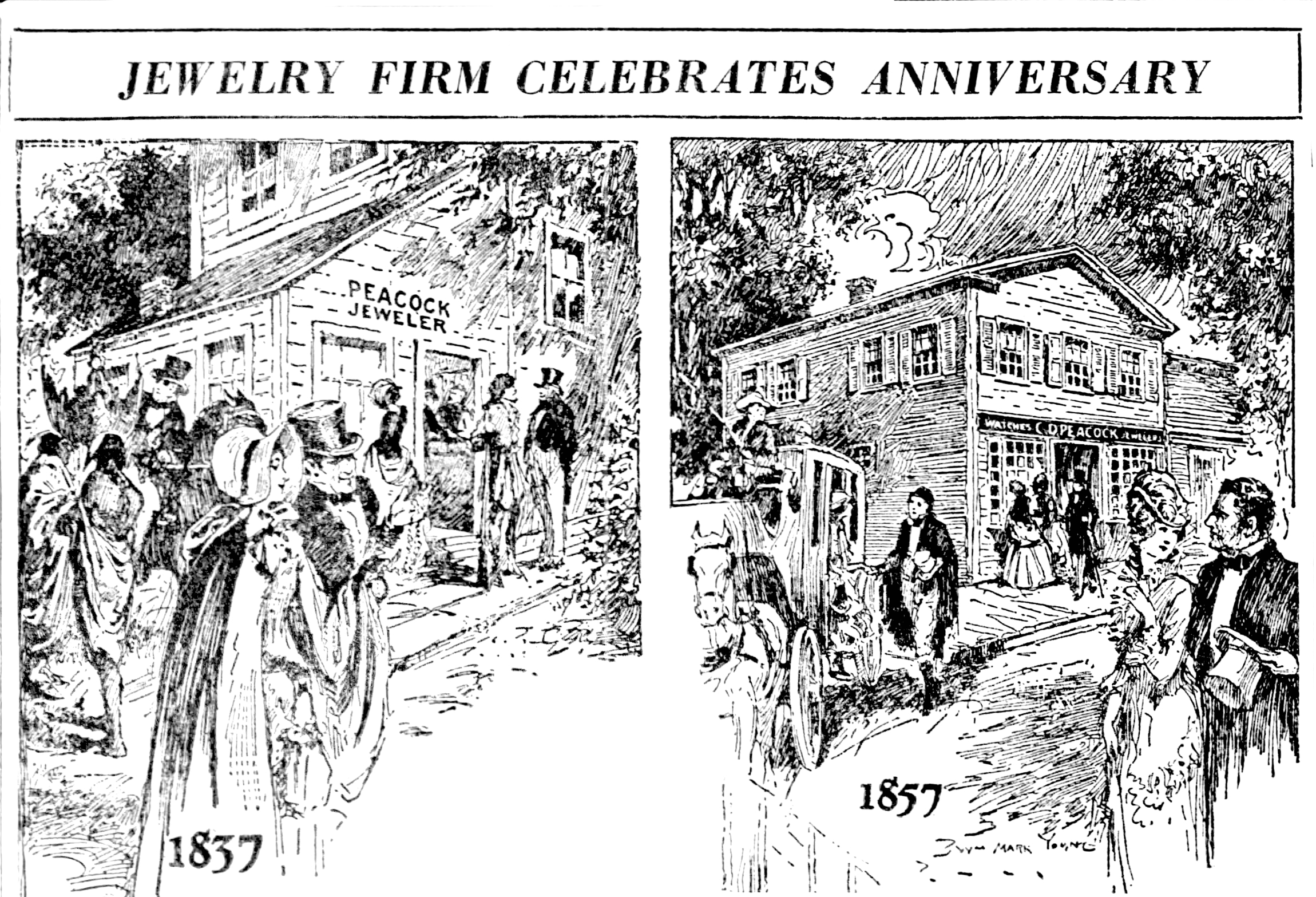
 Within the next few days a contract will be signed whereby Charles D. Peacock, tho jeweler, will lease from Marshall Field, for a period of ninety-nine years, the property at the northeast corner of State and Madison streets, at an annual rental of $50,000 without revaluation.





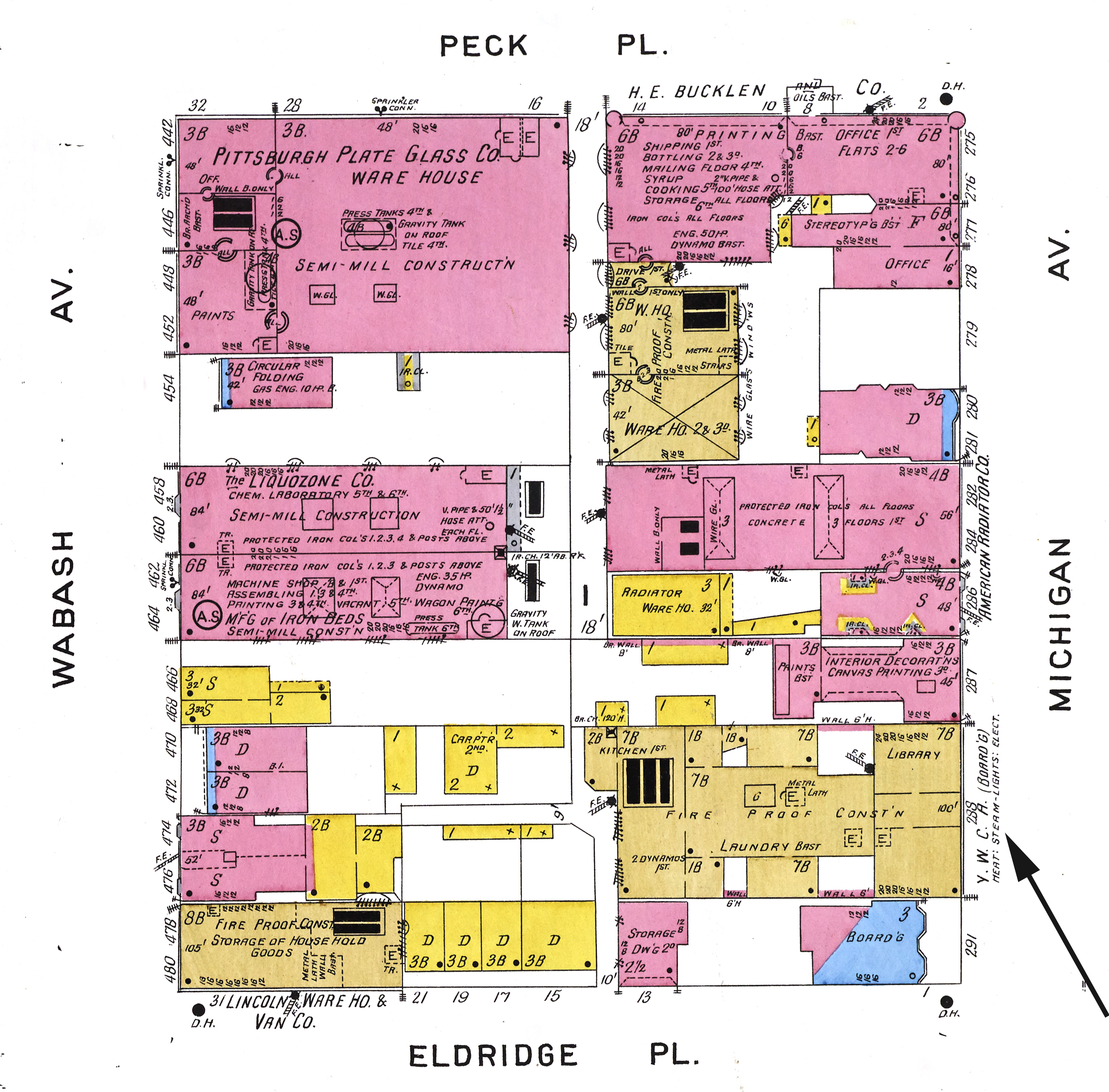
 The corner-stone of the new Young Women’s Christian Association Building—the home to shelter hundreds of stranger-girls in the days to come—was laid yesterday afternoon with interesting exercises. Mrs. Leander Stone, the President of the association, placed the box in its resting place, having spoken these words: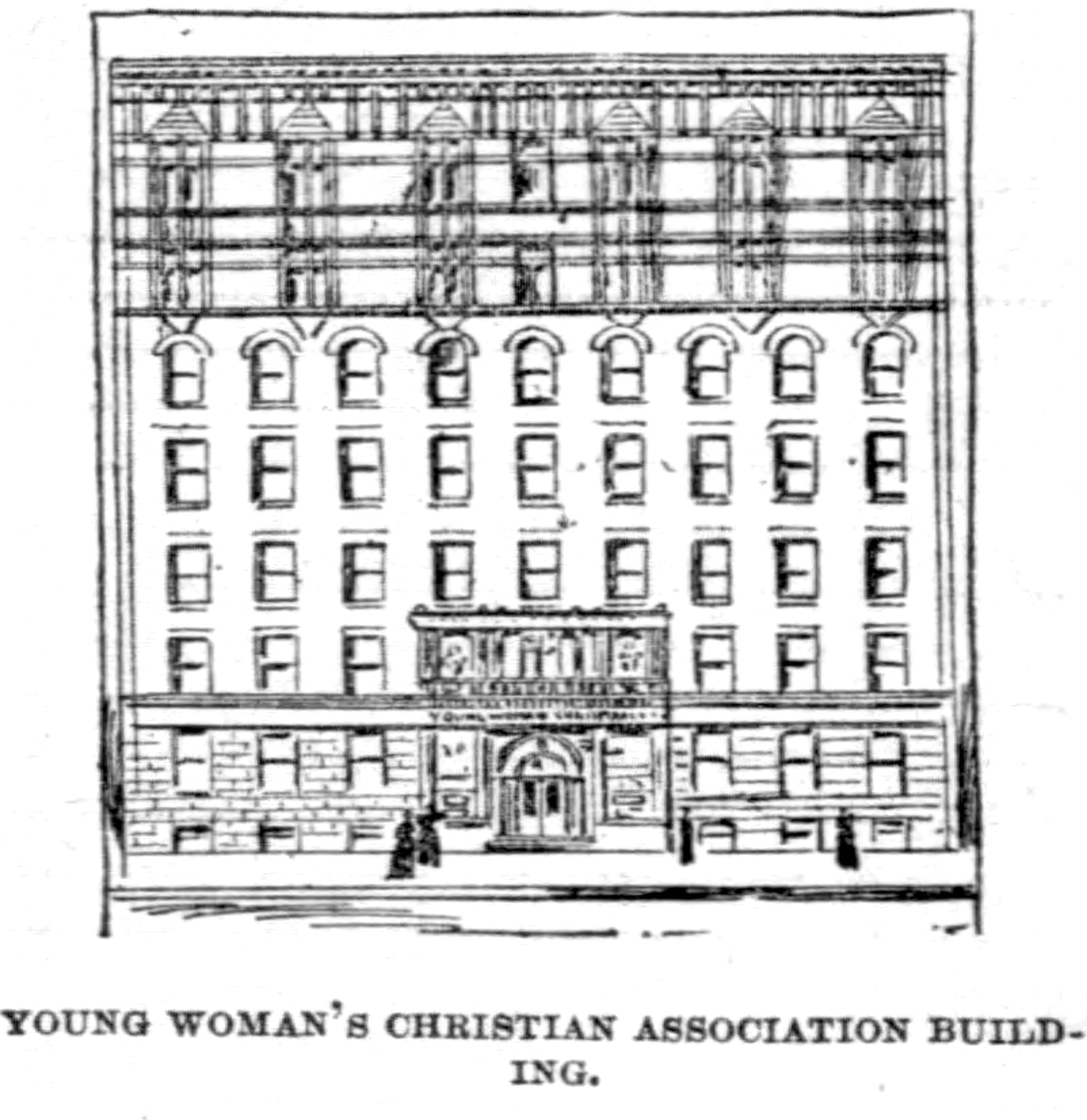
 Far, far from the home of the lonesome boys the Young Men’s Christian Association building on La Salle street is the home of the lonesome girls, the fine new building of the Young Women’s Christian association at 288 Michigan avenue. The new home of this association was christened last night with “frappe” that aided not in keeping out the chill of the outer air. Today it will be thrown open to the general public and a continuous reception will be held. After that the 100 young women who are at present taking advantage of the opportunities of the association will be allowed to rest in quiet.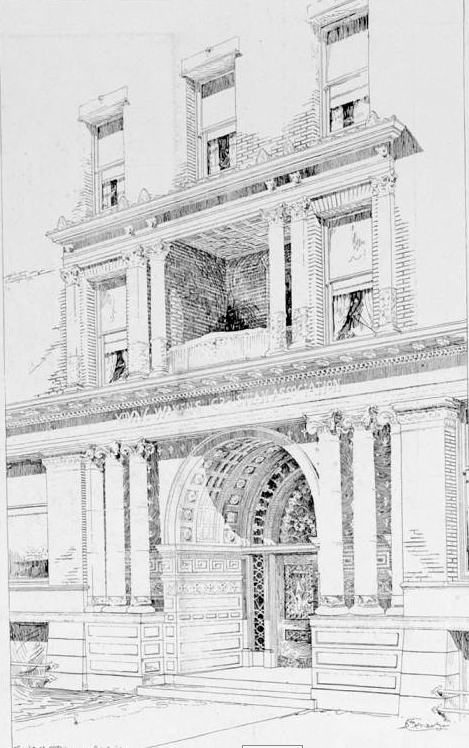
 By Genevieve Forbes Herrick.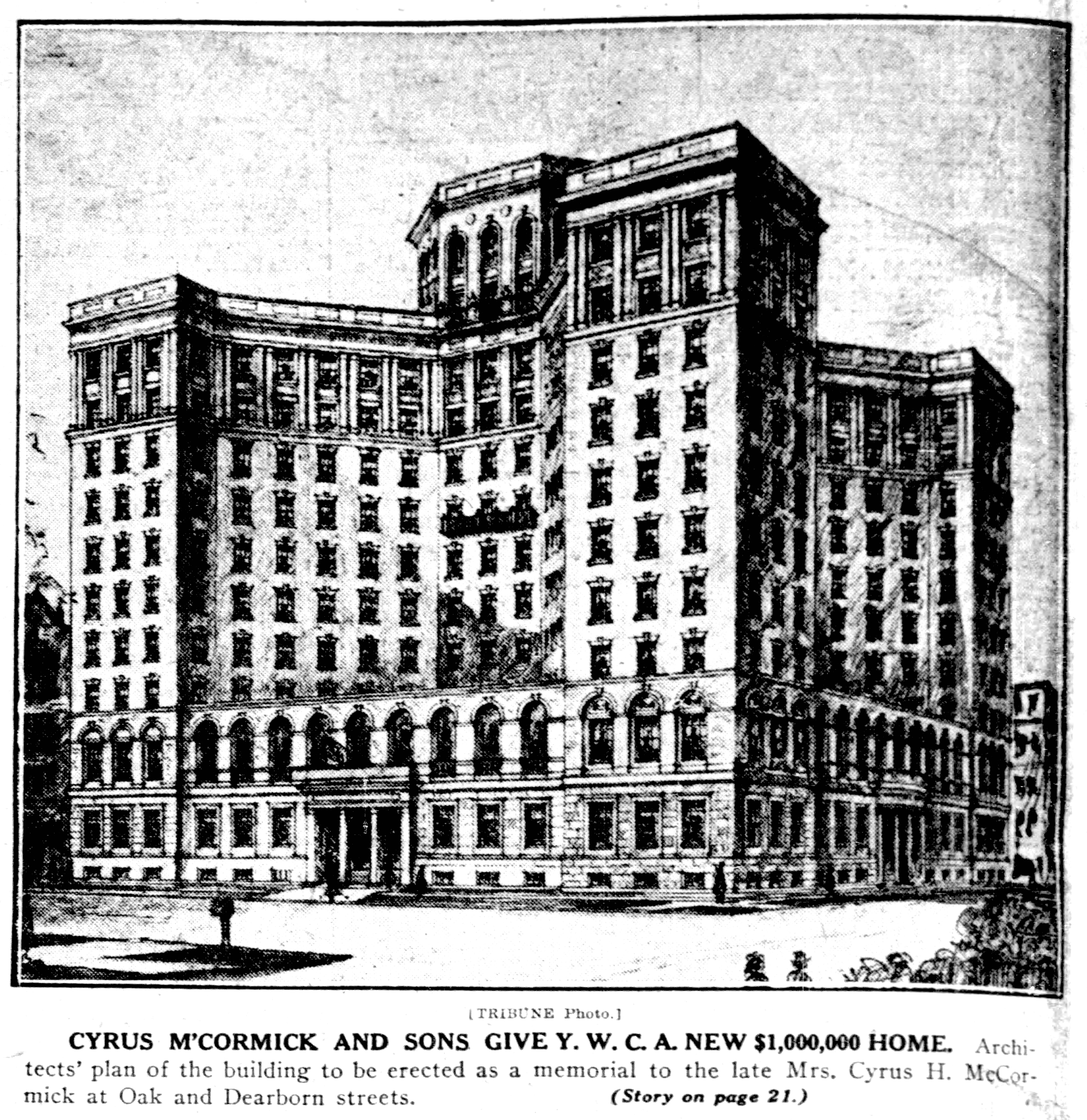

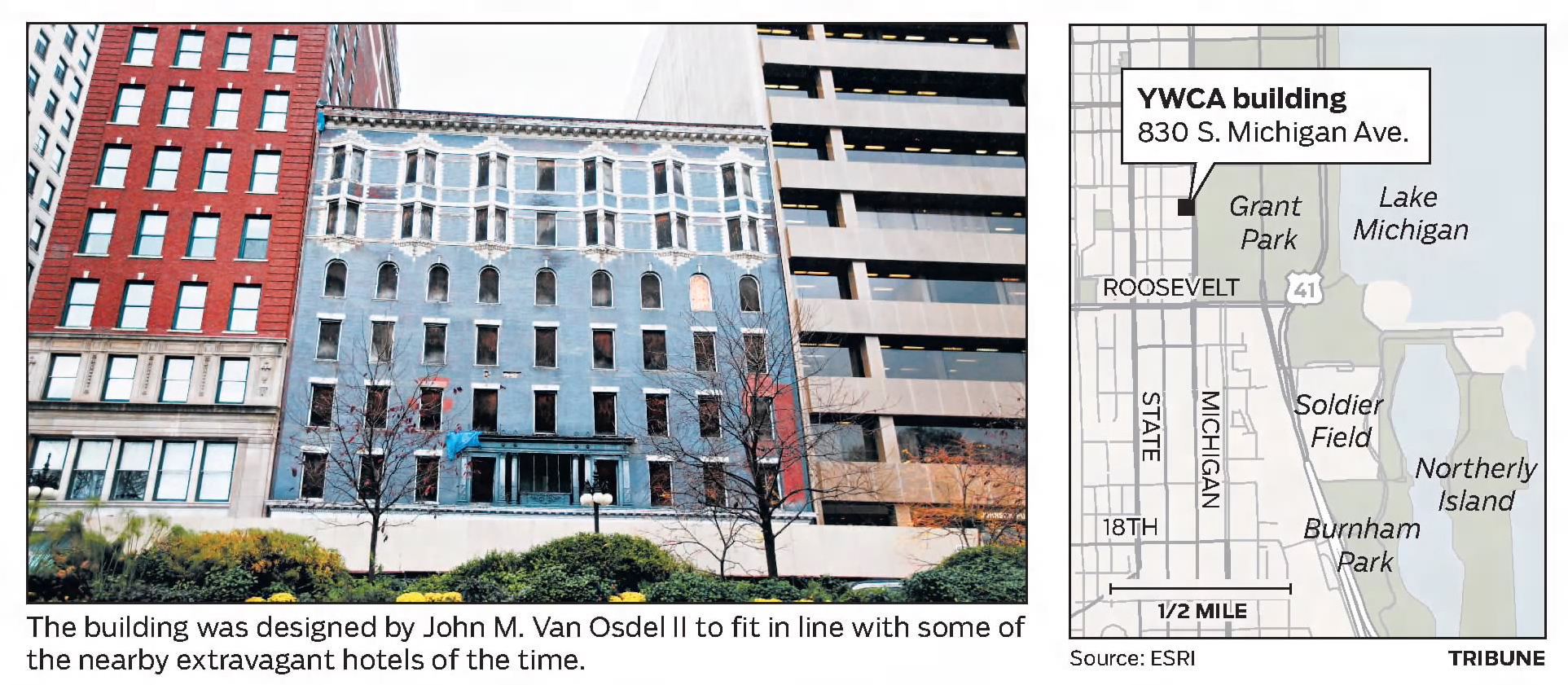
 If South Michigan Avenue’s so-called Streetwall, a strip of historic buildings on the western border of Grant Park, must be weaker, at least maintain its impressive facade, a preservationist and residents say.