Vaudeville Theaters of Chicago
Haymarket Theatre
Life Span: 1887-1950
Location: Madison Street near Halsted Street
Architect: John J. Flanders
- Lakeside Business Directory of the City of Chicago, 1899
Haymarket Theatre 167 W. Madison
Lakeside Annual Directory of the City of Chicago, 1904
Haymarket Theatre,—167 W. Madison
Lakeside Business Directory of the City of Chicago, 1907
Haymarket Theatre 167 W. Madison
Chicago Tribune, December 18, 1887
The New Haymarket, a Handsome House. to Be Opened Soon-The Highest Bidder” a Clever Play, and Sothern a Clever Player—Bernhardt’s Realism—”Bellman ” & Success-Hard Luck of the American Opera Company-War Songs.
Playgoers, and especially those living on he West Side, will be surprised Christmas Eve when the doors are opened of the Haymarket Theatre on Madison street, near Halsted. It is the largest theatre in Chicago and reminds one strongly in its breadth and roominess of the Boston Theatre. It has 2,500 seats, which, with standing room, will make it capable of accommodating 3,200 persons. The finishing touches are now being put on tne decorations of the interior, and the visitor may obtain a very good idea of how it will look when compieted. A wide entrance on Madison street leads one into a salon, circular and high vaulted. The tone of coloring is light gold. In the centre is a fountain, with an aquarium and flower-receptacle, the whole being surrounded by divans. To the left is a grand stair-case. Entering the theatre one finds that the scheme of color is India red and copper, the shades growing lighter toward the come, as in McVicker’s Theatre. There are three gaileries, which give the house an imposing appearance. The lowest is called the balcony, the second the family circle, and the last Olympian light the gallery. The three are drawn very near to the stage. Prices on the first floor will be 75 cents and $1; all seats on the second, 50 cents: on the third, 25; and the fourth, 15. There
are fourteen boxes, seven on either side. The curtain, which is painted by Mr. Ernest Albert, formerly of the Chicago Opera House, harmonizes with the general plan of decoration. It shows a pleasant landscape, and is simple and unconventional. It is surmounted by an allegorical representation of music. The entire house is lit by electricity, all the galleries being fringed with bunches of incandescent burners. Mr. W. J. Davis. who is well known in Chicago theatricals. having managed at different times the Grand and the Columbia, has a lease of the Haymarket for ten years. He proposes throwing the house open next Thursday night to the inspection of the members of the theatrical profession and the press. Saturday, Dec. 24, it will be opened to the public, Mr. Thomas V. Keene appearing that night in “Richard I.”
Chicago Tribune, December 23, 1887
THE THEATRES
It was a great night for Manager Will J. Davis at the new Haymarket Theatre, which he threw open last evening to the inspection of invited guests. Nearly 500 persons connected with the press and the theatrical profession were present and viewed the latest acquisition to the number of handsome theatres that Chicago already possesses. Mr. Thomas W. Keene, who will open the new theatre Saturday night, and his manager, Mr. Ariel Barnay, were among those in attendance. The interior of the theatre was ablaze with electric lights. which showed off to advantage the scheme of coloring, a deep India red, ligbtening gradually from the boxes and carpets of the main floor until it reaches the dome bove four tiers of seats The grand salon, wich is highly dec-orated, was a particular point of interest. In is centre is a combination of flower-receptacle, aquarium, and fountain, surrounded by divans. Above it is the balcony salon, like the lower one circular and spacious, and decorated with harmonized shades of the prevailing color. The view of the auditorium from the lower boxes is especially striking, the fringes of incandescent burners on the three galleries making dazzling display, while the proscenium arch is crowned with a no less brilliant crescent.
À description of the theatre in such details as interest the public was given in The Tribune of last Sunday, but some figures in regard to the seating capacity may be added. The parquet has 710 chairs on the floor and forty seats in the eight boxes. The balcony contains 506 chairs and twenty-four seats in the boxes, six in number. There are 472 chairs in the family circle. Every seat on these three floors is reserved, those in the parquet and balcony being richly upholstered in a plush that corresponds with the decorations of the house. The family circle chairs are of bent mahogany. The gallery is seated with benehes, and will accommodate between 700 and 800. The house has ten exits on Meridian street, and twenty on Madison. The opinion was generally expressed last evening that the Haymarket was a theatre of which playgoers on the West Side might be proud, as in attractiveness and dimensions it ranks with the first-class places of amusement of Chicago.
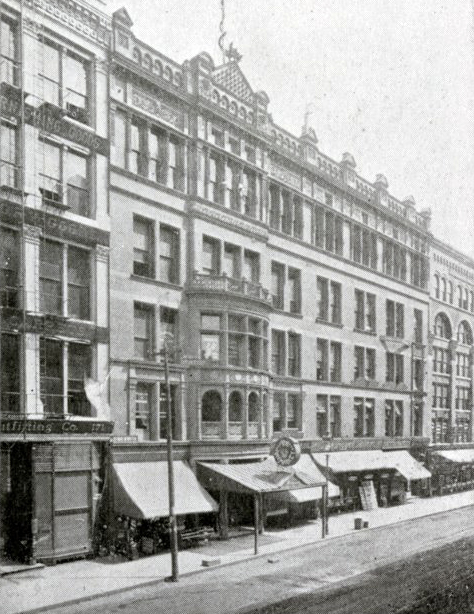
- Haymarket Theater
Standard Guide to Chicago For the Year 1891, John Flinn, 1891
Haymarket Theatre.—Located on the north side of West Madison street, between Halsted and Union streets. West Side. Take West Madison street cable line.
Will J. Davis, manager. This is one of the newest and one of the handsomest and largest houses in the city. Its seating capacity is 2,475; stage, 48 by 90 feet. Since its opening, in 1889, it has been recognized as a first class place of amusement and has attracted a large proportion of the better class of West Side theatre-goers, who formerly patronized South Side houses. Its interior is modern and beautiful in design and finish. The auditorium is so arranged that there is a perfect and unobstructed view of the stage from every seat. Its manager, Mr. Davis, has, during his lifetime almost, catered to the amusement-seeking people of Chicago; has won their confidence by keeping all houses entrusted to his care on a high plane, and has achieved a phenomenal popularity for “The Haymarket.” The theatre is constantly presenting attractions of a meritorious and a high order. Admission, 15, 25, 50, 75 cents and $1; Davis’ Turkish chairs, $1.50; boxes, $5 to $10.
Rand, McNally & Co.’s Bird’s-Eye Views and Guide to Chicago, 1893
The Haymarket Theater is the leading West Side place of amusement, and is reached by the long cross-town cars, as well as by the swift Madison cable. It stands in the most cosmopolitan district of Chicago, is very large, seating 2,400 persons, and its brilliancy at night adds sensibly to the splendor of the street. Admission falls as low as 15 cents and rises as high as $1.50. Will J. Davis, the originator and proprietor, is a native of Chicago, and a man of wide experience. It may be added that the Haymarket Theater has no connection, either in name or location, with the riots of 1886.
Chicago Tribune, November 19, 1896
LEASE OF THE HAYMARKET THEATER.
Charles E. Kohl and George Castle Take the West Side Playhouse for Seven Years.
The Haymarket Theater on the West Side was leased for seven years yesterday by Charles E. Kohl and George Castle of Kohl, Middleton & Castle.
The house will be opened on Dec. 7 under the management of Jay Rial as a high-class continuous vaudeville theater.
The Haymarket is the largest of the West Side theaters. It has been under the management of Will J. Davis for a number of years.
Chicago Tribune, February 7, 1904
Manager Charles E. Kohl, 53 Clark street, of Kohl & Castle, states that plans have been made for improvements to cost about $40,000, to be made in the Haymarket theater, 167 West Madison street. Mr. Kohl will not go ahead with this improvement, however, until he has seen the owner of the building in regard to paying part of the expenses.
The Haymarket Theatre opened in 1887 as a legitimate playhouse with seating for 2,475 on the orchestra floor, boxes, and three balconies. The Haymarket stood on Madison Street near Halsted Street on the near West Side. By 1896, the Haymarket had become a vaudeville house (though vaudeville acts periodically appeared at the Haymarket from its earliest years in addition to live theater).
From 1916 until 1932, the theater was one of Chicago’s best-known burlesque houses (along with the Rialto in the South Loop). In 1916, with the closure of the third balcony, seating was reduced to 2200. (The owners closed the balcony because they claimed the girls doing their acts on stage couldn’t be seen from that distance). From 1932 until late 1948, the theater was a second-run movie house. By 1945, according to the Film Daily Yearbook, seating was further reduced to 998.
The Haymarket Theatre closed in 1949, and was condemned, as it was in the way of construction of what is today the Kennedy Expressway (I-90). In spring of 1950, the once grandiose theater was razed.

- >Haymarket Theater
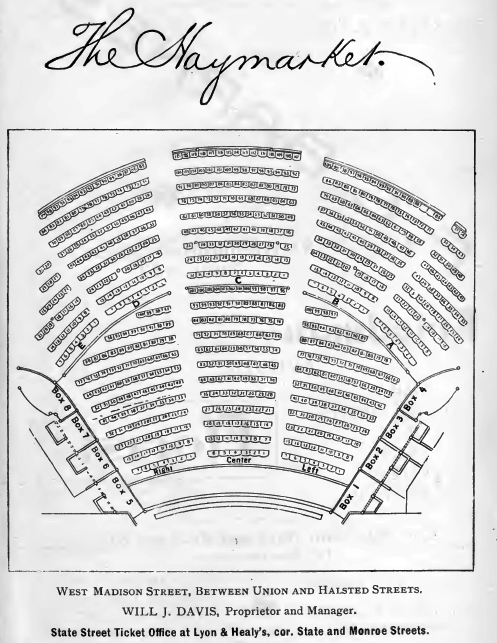
- >Haymarket Theater
Seat Plan
1894

Leave a Reply