VAUDEVILLE THEATERS.
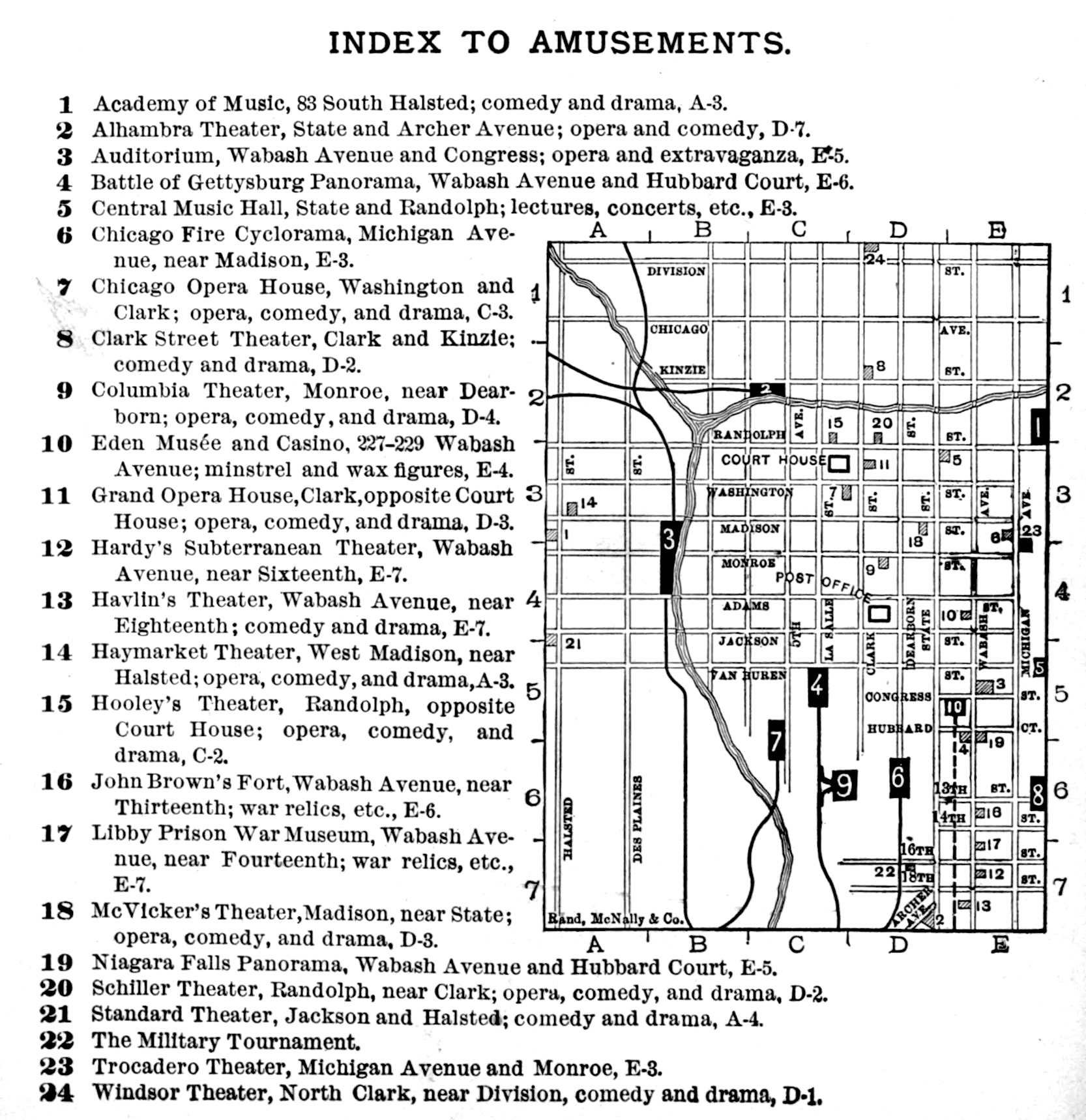
Academy of Music, Halsted near Madison
Adelphi Theatre, Haverly’s—NW cor Dearborn and Monroe
Aiken’s Theater II—NW corner of Wabash Avenue and Congress Street
Alhambra—State and Archer
Baker’s Theater, Havlin’s (1889), Tivoli (1896), Adelphi (1898), Columbus (1901), Wabash (1914)—18th and Wabash
Bryan Hall, Hooley’s Opera House I—Clark between
Central Music Hall—SE cor State and Randolph
Central Opera House Block—SW cor Washington and Clark
Crosby’s Opera House—Washington between Dearborn and State
Dearborn Street Opera House—Dearborn between Madison and Washington
Dearborn Theatre—Dearborn between Madison and Washington
First Academy of Music—124 Washington
First Olympic—Clark and Monroe
Globe Theater, Lyceum Theatre, Irwin’s Theater, Glickman’s Theater, Howard’s Theater, Irwin’s Theater—Desplaines, between Washington and Madison
Great Northern Theater, Lyric Theater—Dearborn, Jackson and Quincy
Halsted Street Opera House—NW cor. Halsted and Harrison
Hamlin’s Coliseum, Hamlin’s Theater, Grand Opera House, Cohan’s Grand Opera House, Four Cohans, RKO’s Grand House—Clark, between Washington and Randolph
Haverly’s Theater, Columbia Theater, Iroquois Club—SW Corner of Dearborn and Monroe
Haymarket Theater—Madison Street near Halsted Street
Hershey’s Hall, Madison Hall, Sam T. Jack’s Burlesque House—20-24 Madison
Hooley’s Theater II, Powers’ Theatre—Randolph, between Clark and La Salle
Illinois Theater—Jackson, between Wabash and Michigan
Iroquois Theater, Colonial Theater—Randolph between State and Dearborn
Kingsbury Block, Kingsbury Hall, Chicago Museum, Col. Wood’s Museum, Aiken’s Museum—Randolph, bet. Clark and Dearborn
Kingsbury Hall, New Chicago Theatre (1875), Metropolitan (1878), Olympic Theatre (1879), Apollo Theater (1928-Rebuilt)—Randolph between Clark and Dearborn
Kohl & Middleton, Kohl & Castle—Clark between Monroe and Madison and State street, south of VanBuren
McCormick Hall, Chicago Museum, The Casino, H. R. Jacob’s Clark Street Theatre, Imperial Music Hall, Star Theater, Victoria Theater, New American Theater, and Sydney J. Euson’s Theatre—NE cor Clark and Kinzie
McVicker’s I & II—Madison, west of State
McVicker’s III—Madison, west of State
McVicker’s IV—Madison, west of State
McVicker’s V—Madison, west of State
Meyer’s Opera House—Monroe
North’s National Amphitheater—Monroe near Wells
People’s Theater, Hopkins Theater, Folly Theater, State-Congress Theatre—State, between Harrison and Congress
Rice Theater I—Randolph east of Dearborn
Rice Theater II—Dearborn Street, between Randolph and Washington
Schiller Theater, Randolph Street Theater (1897), Dearborn (1898) and Garrick Theater (1903)—Randolph between Dearborn and Clark
The Standard, Hopkins’ Theater, Bijou—SW corner Halsted and Jackson
Windsor Theatre, New Windsor Theater, The Lincoln—Clark between Division and Goethe
Rand, McNally & Co.’s Bird’s-Eye Views and Guide to Chicago, 1893
Chicago Tribune, February 7, 1909
THEATER PRODUCING CENTER OF THE COUNTRY.
With more than forty theaters Chicago is today one of the most important theatrical cities in the world. That it is rapidly becoming the producing center of the United States is conceded by the big New York managers who are looking to this city for opportunities for theatrical investments. Time was when the New York stamp of approval was imperative in determining the success of any attraction en: tour, but this is no longer the rule. A successful Chicago production is now regarded by theatrical managers as an asset more valuable than any encomiums New York may bestow.
The result of this confidence in the stability of Chicago theatrically has been a gradual growth from year to year of the number of theaters, nearly all of which have been or are controlled or managed by eastern managers. Even now new theaters are being constructed and before the end of the current year at least two fine new playhouses will have been dedicated, both of them managed and controlled by prominent theatrical men whose faith in the theatrical future of Chicago is evidenced by investments reaching high figures.
History of Drama Romance.
The history of the drama in Chicago is romantic. It had its beginning in 1837, when Messrs. Dean & McKinley of the Eagle Street theater, Buffalo, N. Y., asked for a license to open a theater ” for a term of one or more months as business might warrant.” Although the license was granted, there is no record that Dean & McKinley availed themselves of the privilege to open a play-house. A few months later, on Oct. 17, 1837, a similar application for a license was flies by Messrs. Isherwood & McKenzie, who, on obtaining permit from the city council, transformed the old Sauganash hotel at the southeast corner of Lake and Market streets Into a theater, and here before the close of that month, on a date of which there is no record, the first dramatic performance in Chicago was given before an audience composed largely of halt breeds, workingmen and soldiers of the garrison at Fort Dearborn. Even the name of the opening attraction is lost, but as “The Idiot Witness,” “The Stranger,” and “The Carpenter of Rouen ” were given early in the season it is likely to have been one of the three plays named.
In the following year the same company returned to Chicago and began another engagement, which proved to be more successful than the preceding one. In this company were Joseph Jefferson, then a boy of 9 years, with his father and mother. They played at the Rialto, a rude frame building at 8 and 10 Dearborn street. The engagement was indifferently successful.
Until 1842 theatricals in Chicago languished. Dan Marble was seen here on Aug 30 of that year in “Black Eyed Susan” and “Forest Rose.” In the fall of 1845 the Chapman building, at the southwest corner of Fifth avenue and Randolph street, was converted into a theater. In 1845 the Commercial building at 73 Lake street was converted into a museum by Henry Fuller. Concerts were given from time to time in the Saloon building, while minstrelsy and ventriloqual entertainments ruled at Market hall.
Rice’s Theater Opened in 1848.
The opening of Rice’s theater on the south side of Randolph street, between Dearborn and State, on June 29. 1848, marked the real beginning of the drama in Chicago. The population of the city at that time was 17,000, and prosperity in all branches of trade made the venture profitable. In the stock company introduced by Manager John B. Rice was excellent material and the attractions during the following winter included such famous stars as Dan Marble, Mrs. John Drew,, James E. Murdock, Eliza Logan Julla Dean, Barney Williams, and many others. The drama was successfully exploited for three years. when opera was essayed. On July 29, 1850, after the second performance of “La Sonnambula” Rice’s theater was destroyed by fire at a loss of $4,000 with $2,000 insurance.
The theater was rebuilt and reopened Feb. 3, 1851, with a triple bill, including “Love in Humble Life,” “Captain of the Watch,” and “The Dumb Bell.” Mr. and Mrs. J. H. McVicker were members of this company, as was also Mrs. John Gilbert, the latter dancing a redowa between the plays. During the next few years at this house many notable theatrical stars who were to achieve fame in later years, made their initial bows to Chicago audiences.
North’s amphitheater, located on Monroe street, near Wells, was opened in 1856 with a stock company which included J. H. Wallack, Mr. and Mrs. Edwin Thorne, and others. Within the next three years at this playhouse Maggie Mitchell, Dion Boucicault, and William E. Burton appeared. The house was subsequently known as the National theater. and after a troubled career it was demolished in 1864 to make room for a business block.
McVicker’s Built in 1857.
James H. McVicker built and opened his theater on its present site in 1857. It was remodeled in 1864 and rebuilt in 1871. It had been running only a few months when It was destroyed by the great fire. It was again rebuilt and reopened Aug. 15, 1872, at a cost of $200.000. The house was remodeled in 1885 at an expense of $145.000, and on Aug. 26. 1890, it was destroyed by fire. It was again rebuilt, and on March 31, 1892, reopened with the Jefferson-Florence company in “The Rivals.” Every foreign actor of note who has visited Chicago within the last forty years has been seen on its stage.
Col. Kingsbury’s famous hall on Randolph street, which subsequently became Wood’s museum and later was known as Aiken’s theater, was erected in 1862. Bryan hall occupied the present site of the Grand opera house on Clark street, and was erected in 1860. The hall was secured by R. M. Hooley in 1870, and he transformed it into Hooley’s opera house, opening it Jan. 2, 1871, with Hooler’s minstrels. Crosby’s opera house, on Washington street, between State and Dearborn. was opened April 20, 1865, by the Gray Italian opera company in “Il Trovatore.” It was a famous place of amusement and just before the fire of 1871 had been refitted at great expense.
Hooley’s theater, now known as Powers’. on Randolph street, near La Salle, was opened Oct. 17. 1872. In 1876 It was known for a brief period as Haverly’s, but subsequently it passed into the hands of its original possessor, who conducted it until his death in 1893. The theater was acquired by Harry J. Powers from the Hooley estate in 1898.
Ellen Terry Names the Columbia.
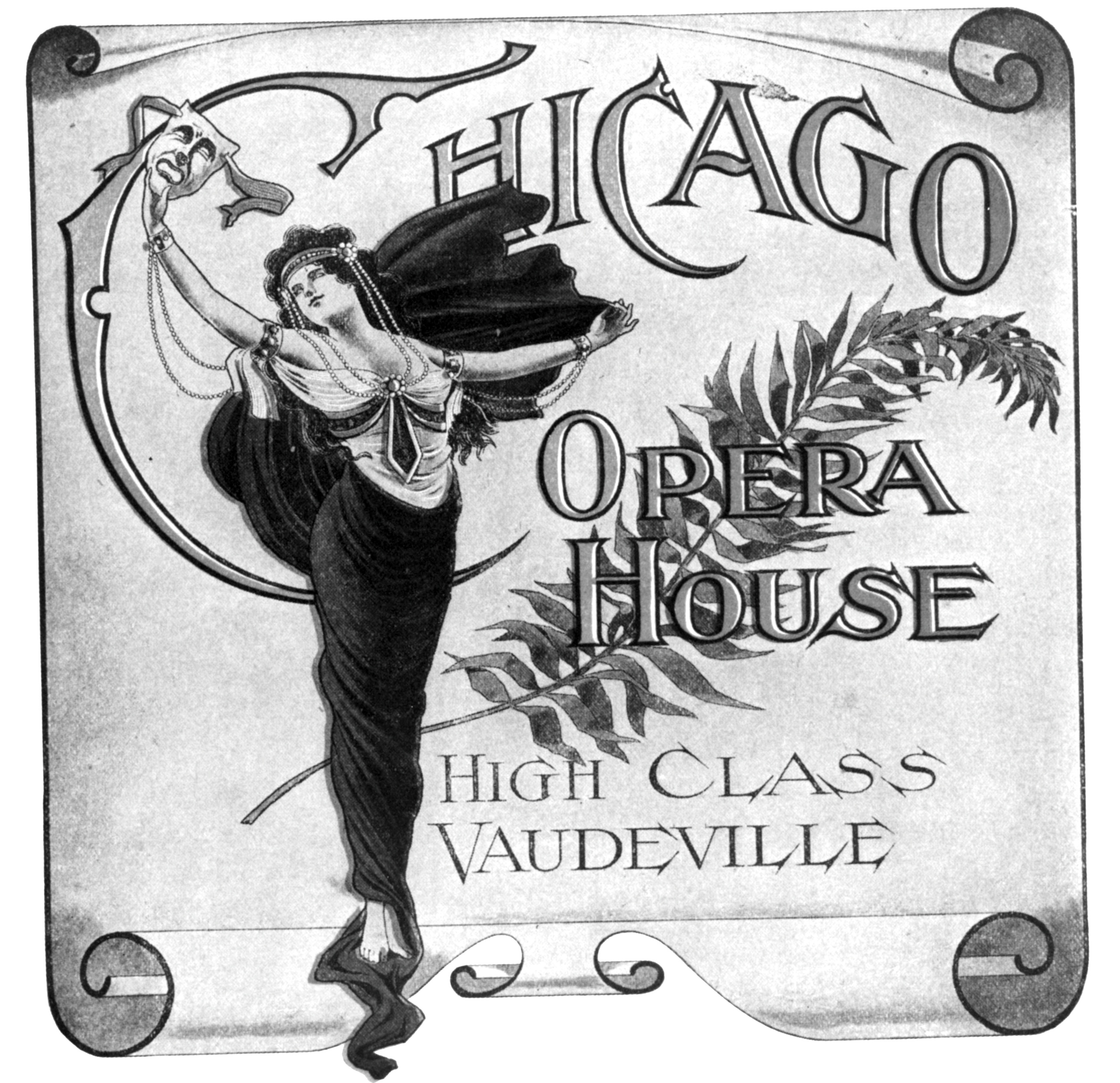
The Columbia theater, so named by Ellen Terry in 1885 was built in 1880, and was known as Haverly’s theater. It was destroyed by fire March 30, 1900. The Grand opera house. formerly the Coliseum and Hamlin’s theater, was opened in September, 1880. The Bijou, formerly the Standard, was opened Dec. 31. 1883, with Fay Templeton as the star. The Halsted Street opera house, near the Bijou, was opened in 1882. The Chicago opera house, the first fireproof theater in Chicago, was opened Aug 18, 1885, under the management of the late David Henderson, and for ten years was known as the greatest producing house of extravaganza in the United States. It passed under control of Messrs. Kohl & Castle, Dec. 22 1895, who conducted it as a vaudeville house until early in 1908, when it was devoted to the drama.
The first Olympic theater in Chicago was opened at the corner of Clark and Monroe street, July 18, 1868. In 1885 another theater of the same name was erected near the northeast corner of Clark and Randolph streets, where for years it was conducted by Messrs. Kohl & Castle as a vaudeville house. In the summer of 1908 the lease was acquired by J. J. Murdock, who now conducts it as a first class music hall.
During the period following the fire of 1871 the tide of theatricals in Chicago ebbed and flowed ceaselessly. Numerous theaters were erected and of these many have been swept out of existence by the inexorable march of improvements. But in the years following the birth of the twentieth century the erection of new theaters has progressed prodigiously. Among the theaters which twenty years ago were doing a flourishing business, but which now are memories, may be mentioned Myers’ opera house, Havlin’s theater, Sam T. Jack’s opera house, Clark Street theater, Halsted Street opera house, Lincoln theater, Gaiety, Madison Street opera house, Princess opera house, Grenier’s Garden theater, Metropolitan hall, Adelphi theater, and Harrigan & Hart’s Variety theater.
Imposing List of Theaters.
The theaters of today are for the greater part prosperous and they add to the importance of Chicago as a theatrical center second to none in the country. Classified, they are as follows:
- Comedy—Chicago Opera house, Garrick, Powers’, Illinois, Studebaker.
Musical comedy—Colonial, Princess, La Salle, Whitney Opera house, Garden theater, Pekin.
Drama—McVicker’s, Great Northern, Grand Opera house.
Melodrama—Bijou, Alhambra, Columbus, Criterion, Academy.
Stock—Marlowe, People’s, College, Calumet, Thirty-first Street, Bush Temple, National.
Vaudeville—Majestic, Haymarket, Star, Olympic Music hall, Virginia, Vaudette.
Opera—International, Auditorium.
Burlesque—Folly, Euson’s, Trocadero, Empire, Star and Garter.
Music—Orchestra hall, Steinway hall.
Chicago Great Producing Center.
With Its unexampled facilities for making grand productions of every description, it is not surprising that Chicago should be a great theatrical market. Many of the best known plays and
spectacles known to the theatergoing public were first presented in Chicago and during the current year many more will be made.
Chicago is the headquarters for the largest vaudeville interests in the United States and the main booking offices for the field of burlesque are located here. There are scores of theatrical booking agents who provide traveling organizations with time at theaters in all parts of the country. It is estimated that more than 200 traveling theatrical companies enter upon their road careers each season from Chicago. All of these companies, or “road shows,” are outfitted here and thousands of dollars are annually spent with costumers, wig makers, and dealers in theatrical supplies, scenery. etc. Employment in these lines is given to thousands of persons.
The theatrical importance of Chicago constantly is attracting new investments in the way of theaters. Within the last two years several important playhouses have erected at heavy outlay for sites, buildings, and furnishings. The Princess theater was completed last year and is devoted to musical comedy. The College theater, a stock house. said to be one of the finest in the country, and which was built by the Paulist Fathers, is doing big business on the north side The newest theater is the National, at Halsted and Sixty-third street, which was opened Dec. 31, 1908. Plans for other playhouses within the loop have been completed and operations thereon will begin this spring. The Star and Garter, devoted to burlesque and the Empire, also a burlesque theater, both on the west side were opened last year and are enjoying profitable returns.

Leave a Reply