Fourth Presbyterian Church I.
Life Span: 1873-1912
Location: Rush and Superior Streets
Architect: O. Neff
- Edwards’ Annual Directory in the City of Chicago, for 1873
Fourth Presbyterian Church.—Rebuilding.
Lakeside Annual Directory of the City of Chicago, 1874
Fourth Presbyterian Church—Cor. Rush and Superior.
Lakeside Annual Directory of the City of Chicago, 1880
Fourth Presbyterian Church—Rush Cor. Superior.
Chicago Tribune, November 12, 1871
Presbyterian.
The Fourth Presbyterian Church has rented the beautiful room called Standard Hall, for a regular morning service. The will be called together the latter part of this month, the pastor being out of the city at present on a begging excursion for a new church.
Chicago Tribune, November 22, 1871
Presbyterian.
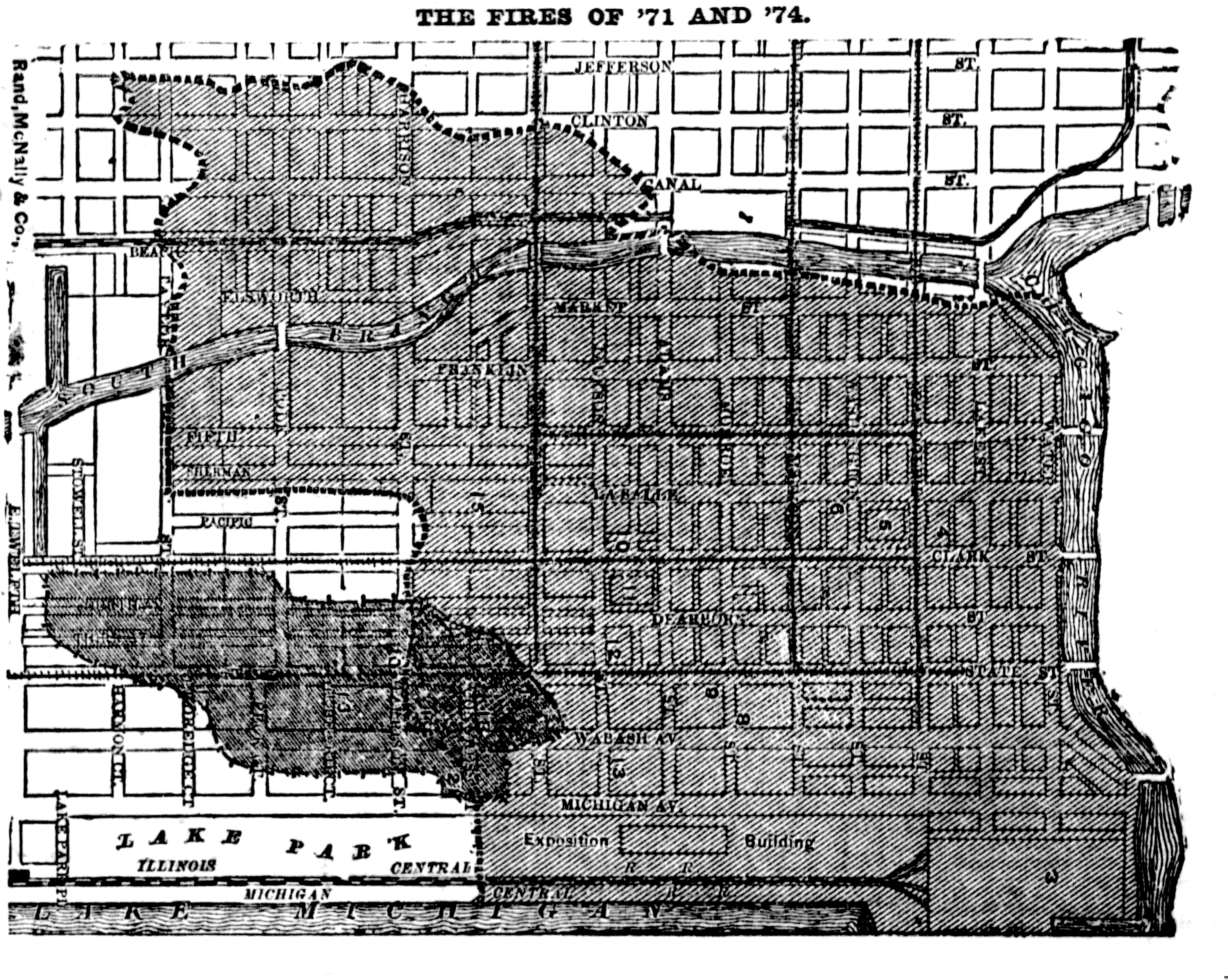
Rev. Mr. Swing’s church, the Fourth or North. was a fine brick structure with an amazingly high steeple. It was familiarly known to North Side residents as McCormick chapel, because the McCormick family were its patrons. The pastor is an able divine, but owing to the want of genius in the printers, he had to have his name printed out, because the rascally compositors could never hit on the right patronymic. Here it is Rev. David S-w-i-n-g. This used to be rendered “Ling” and “Ting” and “Jing” and “Sewing,” and fifty other things impossible to reproduce. The reverend gentleman keeps quite a museum composed of his nicknames. Well. Mr. Swing’s church suffered to the extent of at least, $65,000, the insurance of which return barely $15,000. A mission chapel on Erie street, a wooden building valued at $8,000, which belonged to the Second and Fourth churches, was also destroyed, inflicting a still heavier loss on the congregation.
It may be remarked en passant that the Fourth Presbyterian is making strong efforts to rise from its ashes. An appeal has been issued for subscriptions, and the work of rebuilding will commence
Chicago Evening Mail, December 31, 1873
The Fourth Presbyterian.
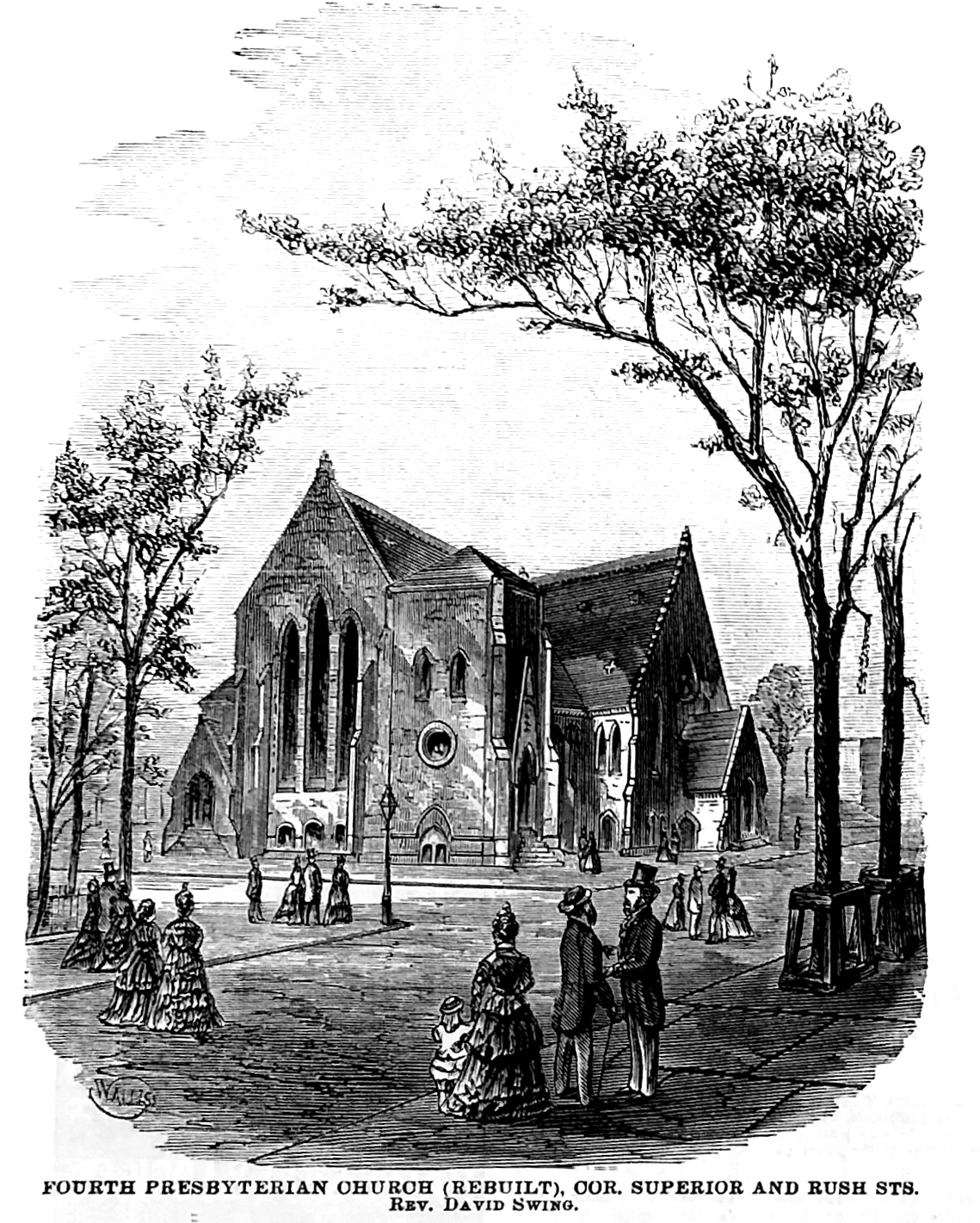
Prof. Swing’s new church building, the Fourth Presbyterian, is nearly completed, and the congregation will be meeting there instead of in McVicker’s Theater. The new edifice is a plain Gothic structure of white stone, located at the corner of Rush and Superior streets, and will seat 1,000 persons. The Total cost was about $175.000.
The sale and renting of pews occurred last evening. Among those who purchased permanent pews are a number of prominent citizens, at prices ranging from $1,400 to $100. Fifty-five were thus sold, and more than half of the seating accommodation remaining was rented.
The Land Owner, February, 1874
Chicago Tribune, January 4, 1874
 Opening of the Fourth Presbyterian Church.
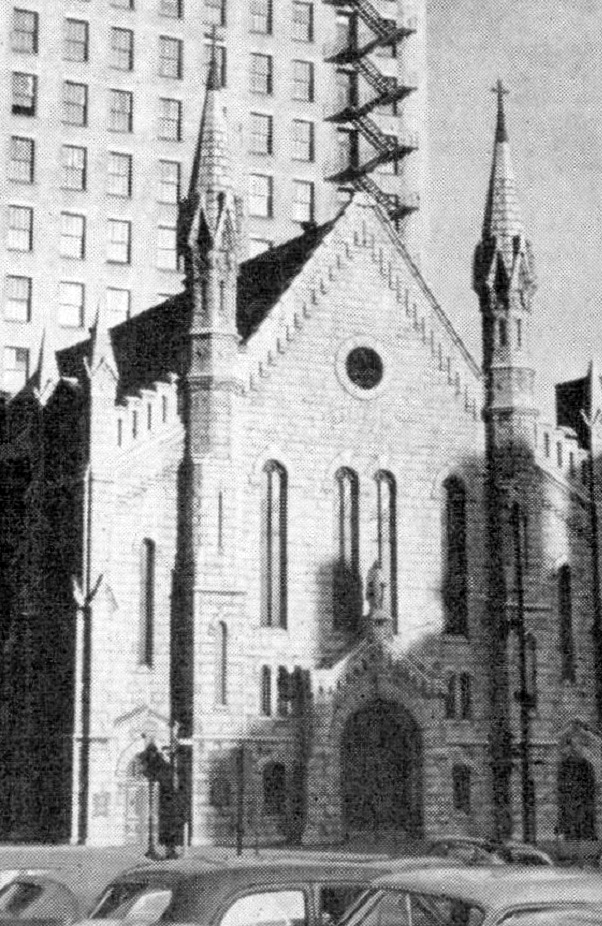
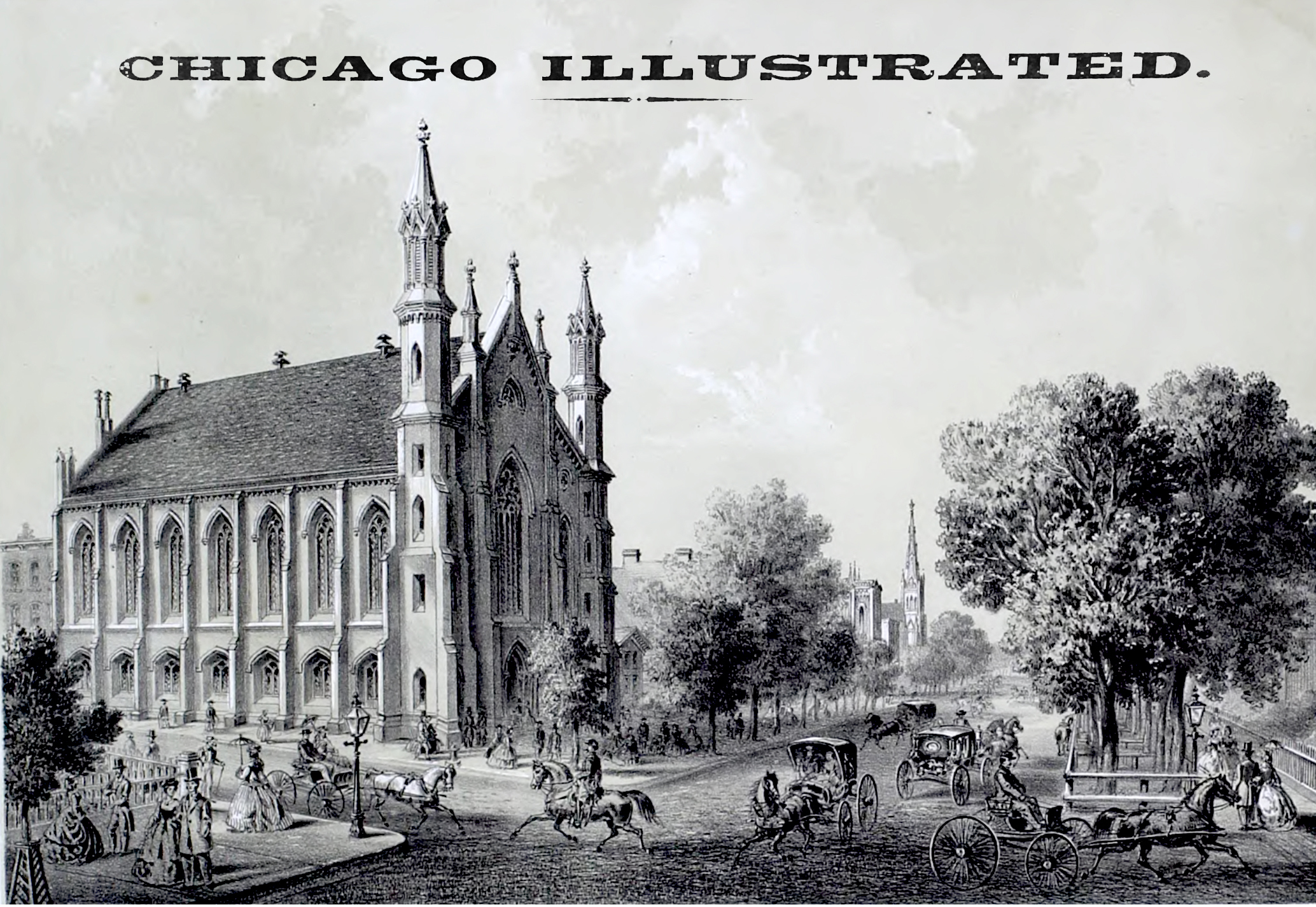
The Fourth Presbyterian Church, recently completed, at the corner of Rush and Superiors streets, is built in the early English style of architecture, and is of Athens stone, rock-faced, with chiseled edges, with dressings of the same material. The plan is a Latin cross, the transepts extending but little beyond the walls of the church. The northern end is terminated by five sides of an octagon, containing the organ. On the southeast corner of the building is the tower, which is to be surmounted by a stone spire, rising 150 feet from the ground to the point, and in which is the principal entrance to the auditorium. There are, besides the principal tower entrance, two porch entrances to the auditorium. The whole width of the nave is 60 feet, and the depth 120 feet. The distance across the transepts is 81 feet by 48 in width.
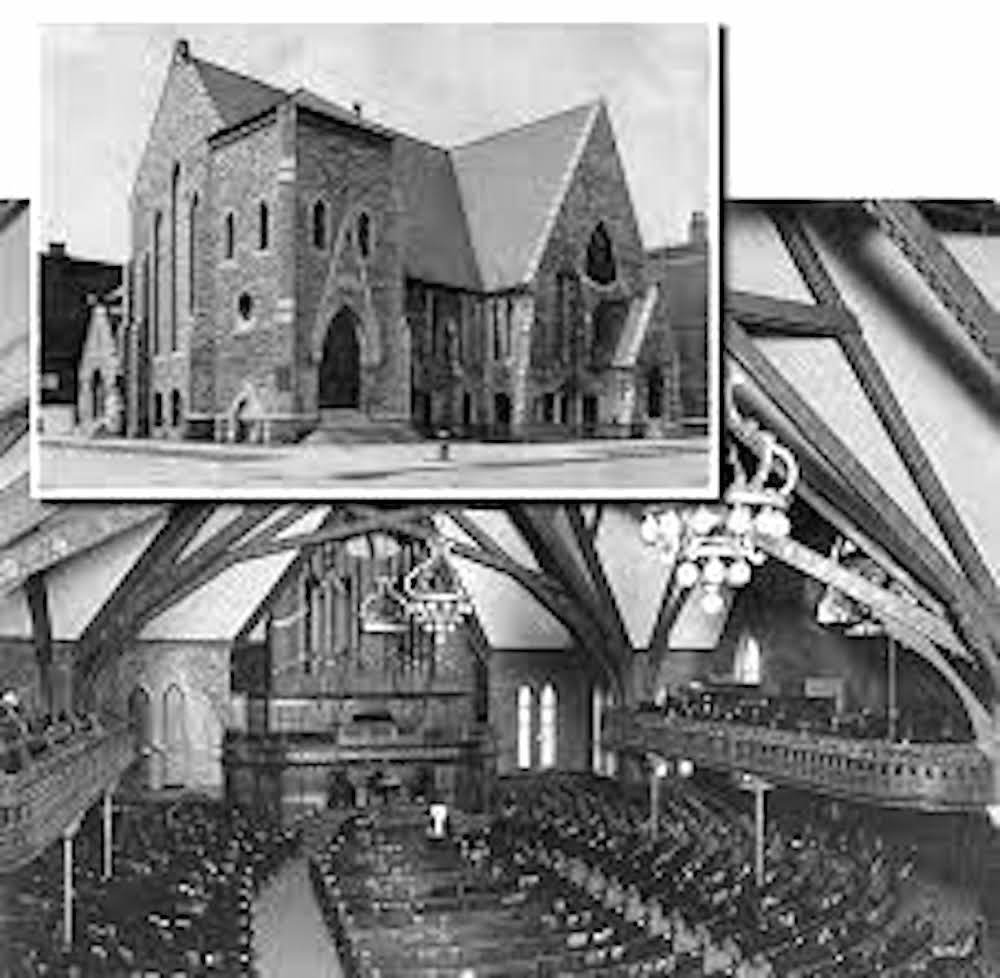
On entering the vestibule through the tower, there are two entrances to the audience-room. This occupies the entire main story of the building. It has a seating capacity of 1,200. The seats are arranged in semi-circular order facing towards the north. The pulpit is situated on the north side of the edifice. It is raised four steps above the floor of the nave, and back of it is placed the organ, separated from the pulpit by a beautifully constructed and tastefully carved panel-work of a semi-circular shape. At the south end of the nave, is a gallery. The material of which the pulpit, the seats, and the gallery are made is black-walnut. In the finish of the interior, solidity, beauty, and durability have been happily combined. The roof is open clear to the ridge-pole, exposing to view all the timbers. The trefoil windows in the transept have been made to accommodate themselves to the form of the gables. There is no display with ornamentation, but the simple majesty of the interior, leads a charm which greater elaboration would fail to produce.
In the basement of the building, occupying the entire space of the transept, is the Sunday-school room, with two separate entrances from the east side, and connected with two spacious class-rooms by large sash sliding-doors. The pastor’s study is also on this floor, and is entered from the hall to the Sunday-school room. Immediately adjoining the west class-room is a ladies’ parlor. A private entrance on the north side of the church leads to the kitchen. The entire cost of the church with all its appurtenances is about $80,000. It was built after the plans of O. Neff, architect. At the request of the Building Committee, Bauer & Loebuitz, architects of the city, superintended the work, after the church was roofed.
Although this is a model of a convenient church-edifice, it is a matter of some doubt whether it will accommodate all who desire to hear the pastor regularly. The Society deserve great praise for what they have done in this work, but it must be a matter of regret that the accommodations are not on a larger scale. This portion of the city is rapidly filling up, and the time will no doubt soon come when Prof. Swing will find his new church too limited in its capacity.
History of the Church.
The Fourth Presbyterian Church appears on horizon as a double star, both of which were of the first magnitude, to wit, the North Presbyterian and the Westminster Church (Dearborn, corner Ontario), the former being Old and the latter New School. These two churches were consolidated just before the fire, and the name assumed was the “Fourth Church.” The Rev. D. C. Marquis, pastor of the North Church, having received a call to the Central Church, of Baltimore, at the time of the consolidation, Prof. Swing, who was at the same time pastor of the Westminster, received and accepted a call from the newly-united churches. The new Society under his administration consisted of four hundred members, was rapidly growing, and was prosperous in all respects, when the great fire came and swept everything away, leaving with homes only two or three families, residing in the South Division. Under these sad circumstances, however, neither pastor nor people were willing to yield to despondency, but at once rallied Services were announced in Standard Hall, and the house was soon overflowing. McVicker’s Theatre was secured, and this has been filled almost every Sunday for the last fourteen months. The new church edifice on the corner of Rush and Superior streets, was planned and is now complete. The congregation has become of the largest in the country. One of the pleasant episodes in the history of the church is the services held in the theatre. They have been truly spiritual pleasures to the thousands who have attended. At the closing meeting last Sunday, hundreds could not obtain admission, and those who did, will never forget the occasion.
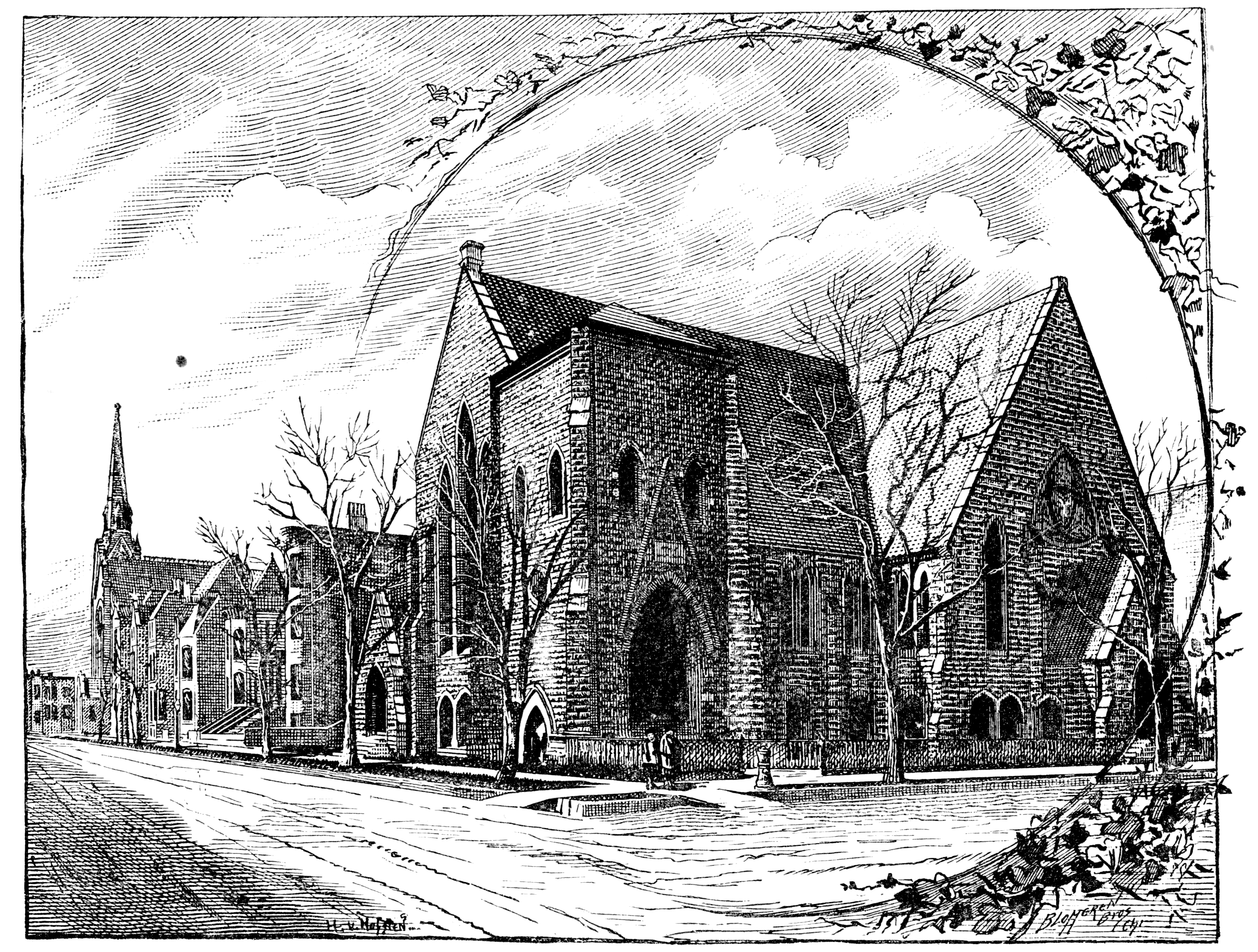
- Fourth Presbyterian Church
1885
Chicago Tribune, June 7, 1914
The old Fourth Presbyterian church, Superior and Rush streets, will be torn down this week and the stone taken for the building of the Bohemian Hubbard Memorial church, Lawndale avenue, near Twenty-sixth street. of which the Rev. Vaclav Vanek is pastor. The Bohemian church is in affiliation with the Fourth Presbyterian church, which recently moved into its new structure on Lincoln parkway and Chestnut street.
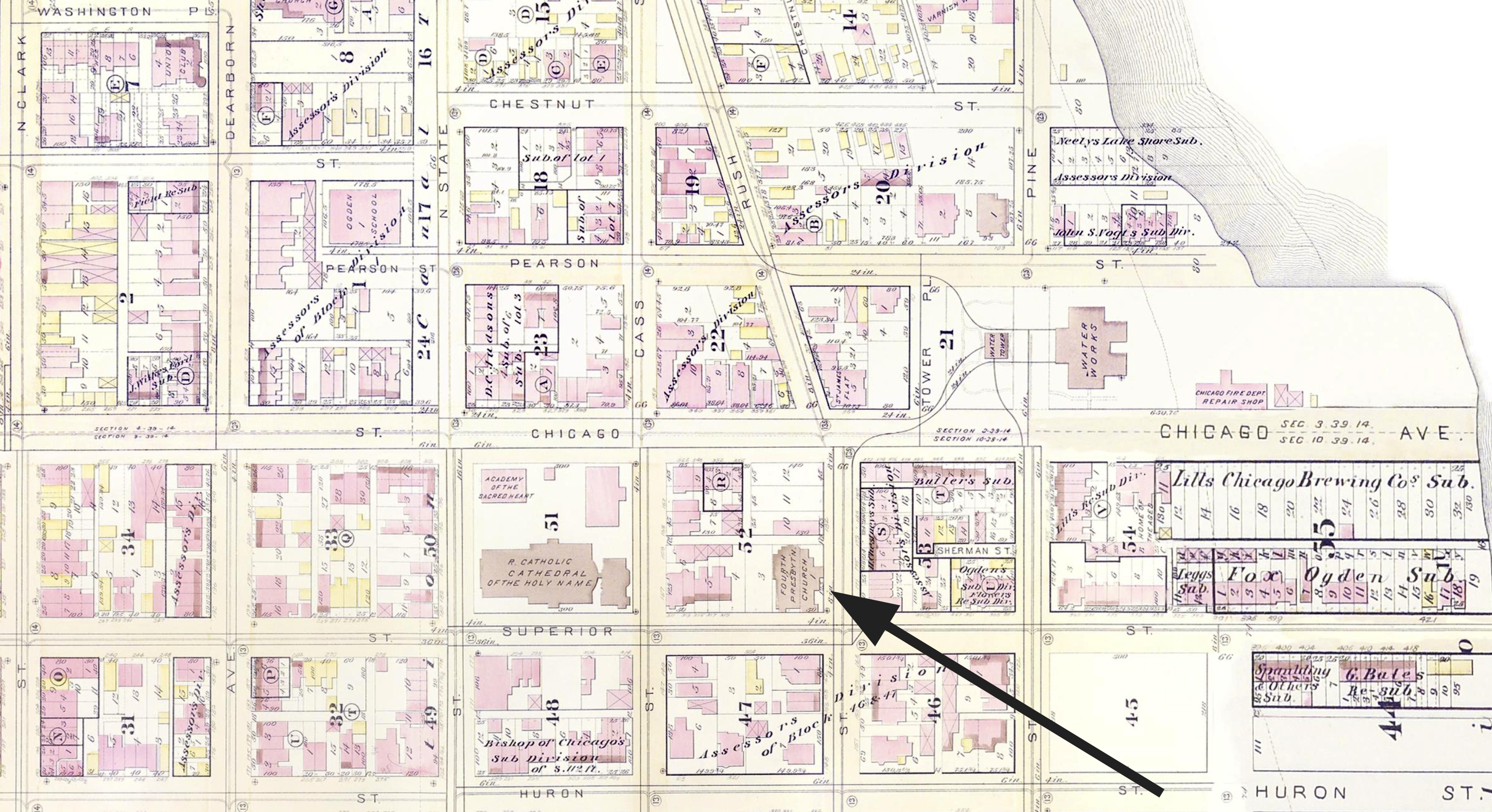
- Fourth Presbyterian Church I
Sanborn Fire Insurance Map
1886
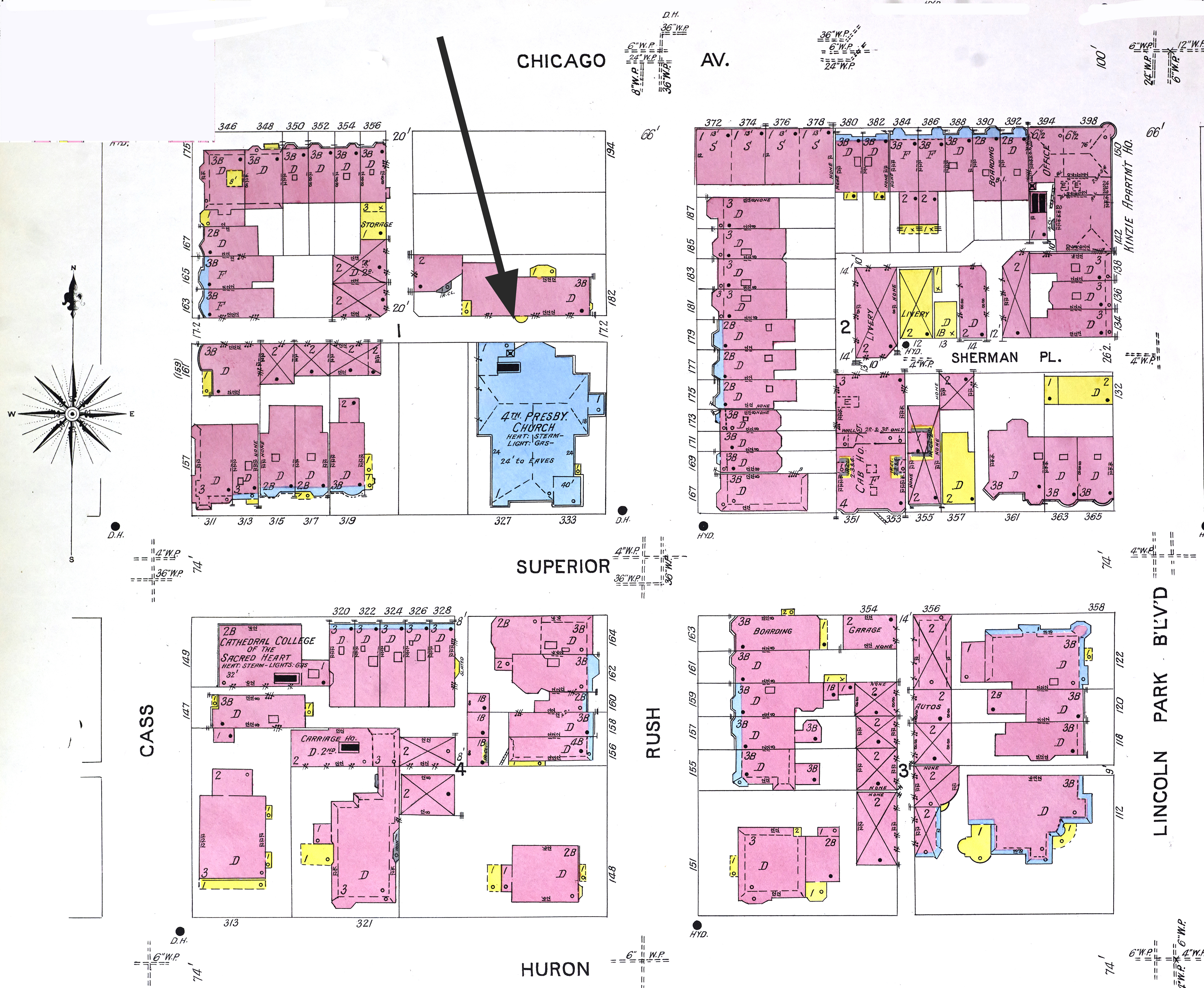
- Fourth Presbyterian Church I
Sanborn Fire Insurance Map
1906
 BUSINESS BLOCKS.

 Now that the beautiful sanctuary of the Wabash Avenue Episcopal Society has reached completion—a completion at once wonderfully happy in its success, and remarkable in having been carried steadily forward through a season disastrous to many, and placing a heavy drag upon enterprises, public and private, it will interest a large share of our readers if we refer to it in more detail than we have yet done.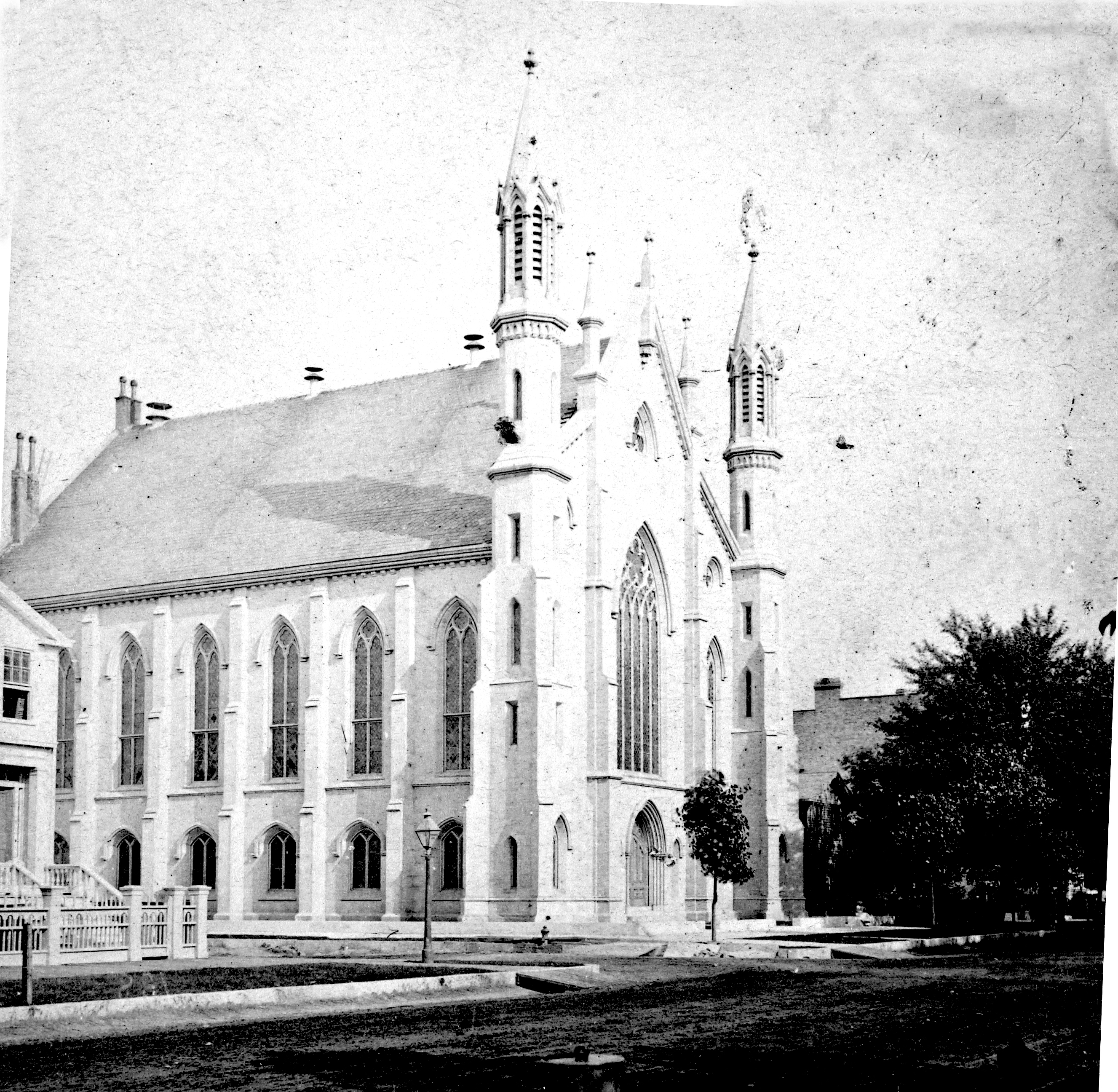


 The use of churches for postal purposes is not new in the history of our government. The most notable instance of this character is in New York, where the old Dutch Church, on Nassau street, has served as a Post Office for nearly twenty-five years. The epistolary business of the great metropolis is somewhat confined within this diminutive shell, but it will manage to creep on until the new building in the City Hall Park is completed. The postal business of Chicago is second only to that of New York. Even in the on Dearborn street it was considerably hampered by limited quarters. In Burlington Hall, whither the Post Office was moved after the fire, to the disagreeable apace and inconvenient appointments was added the disadvantage of remoteness from the centres of trade and population. Another removal, and a change which will be decidedly for the better, is not far in the future.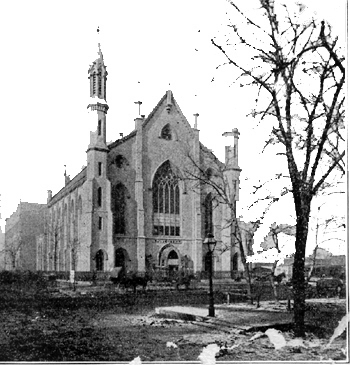
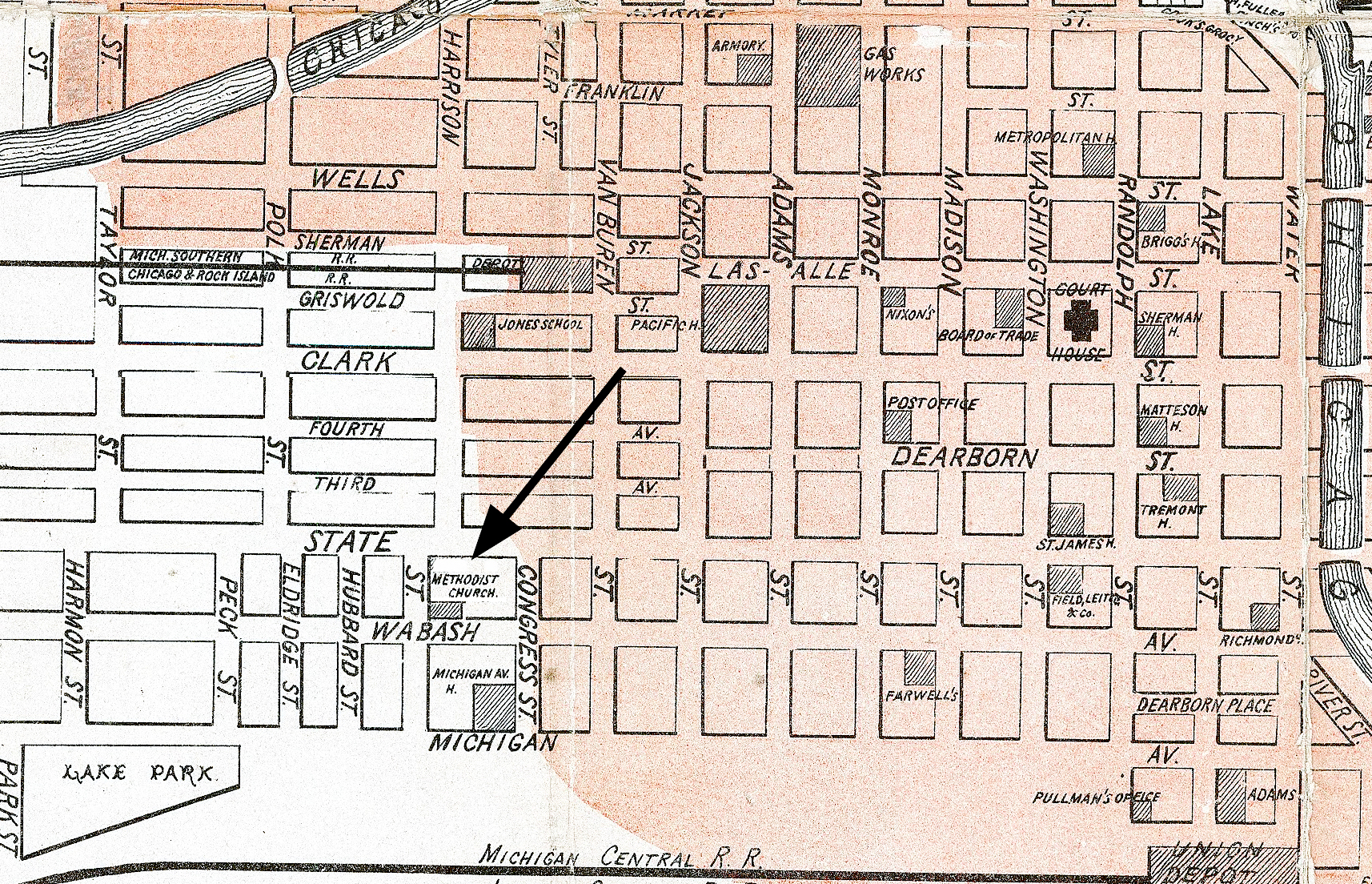

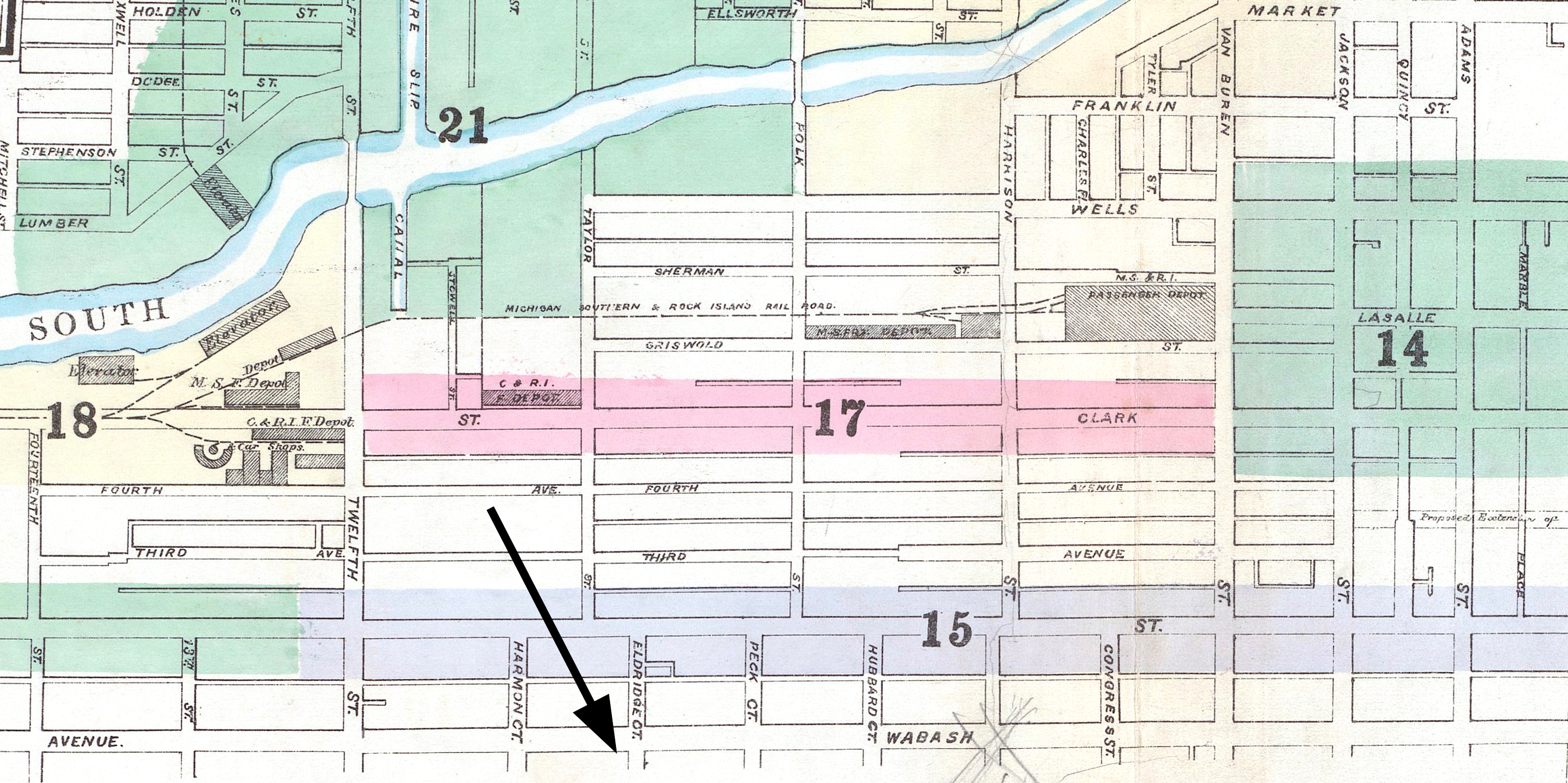
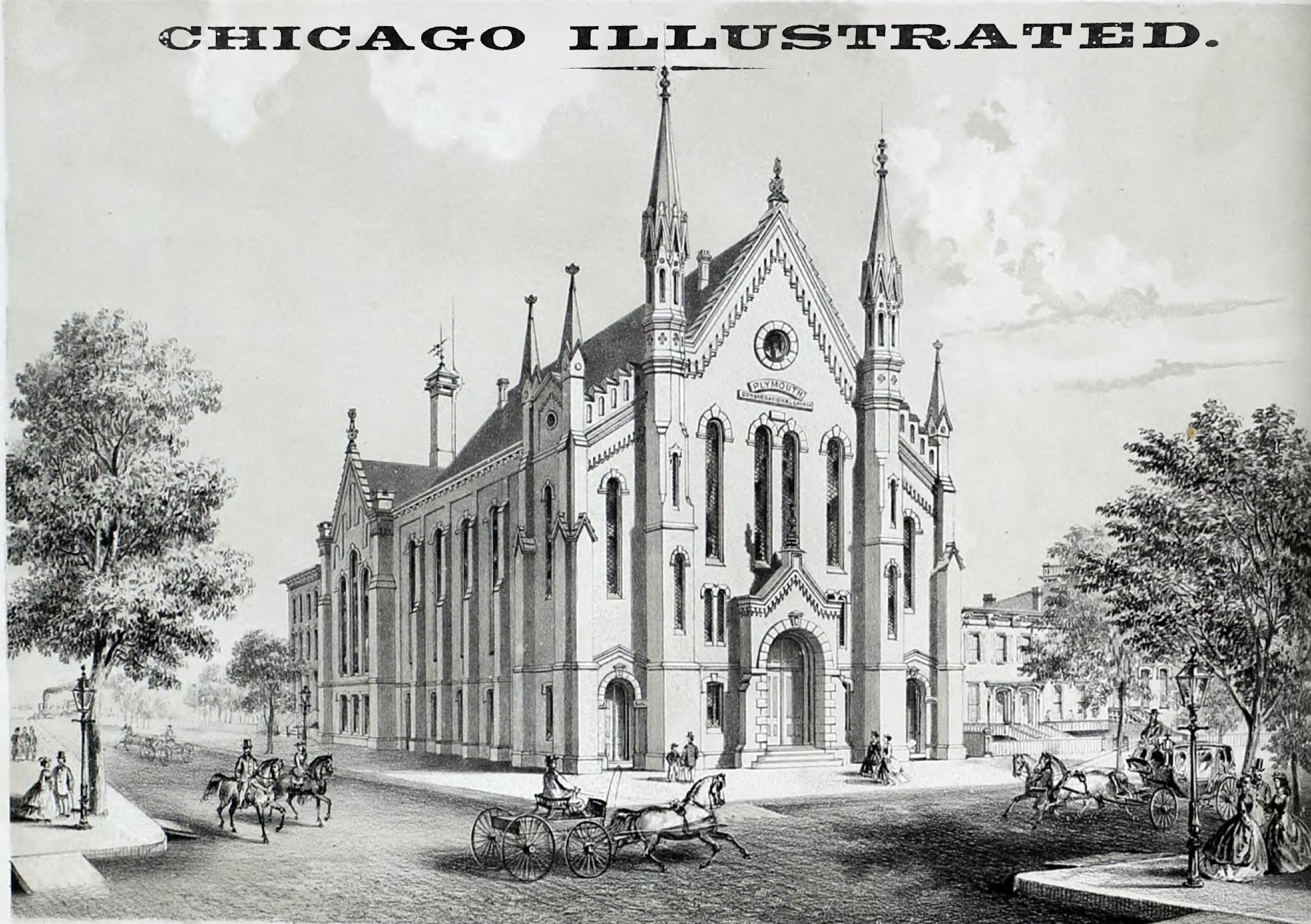
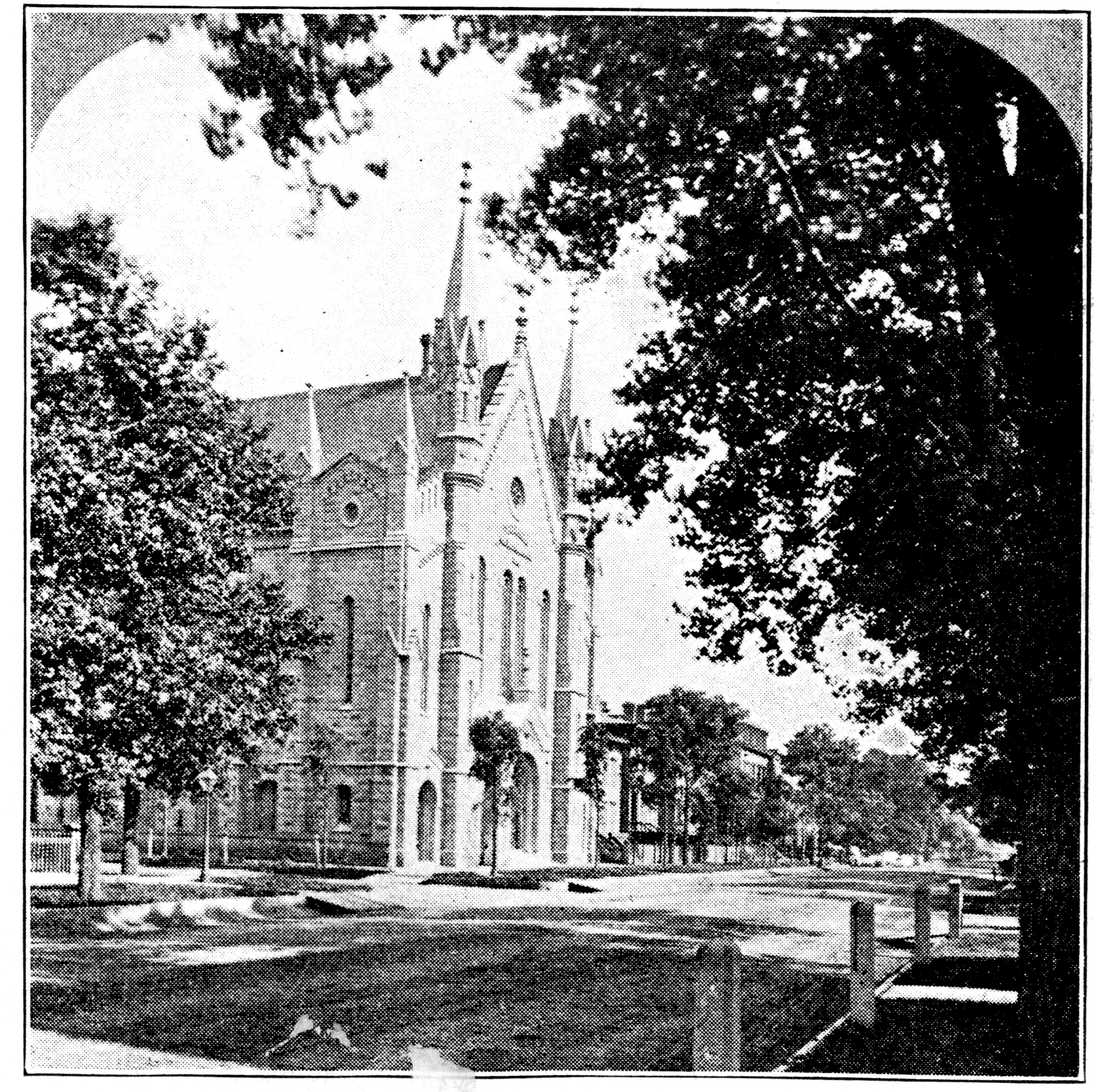
 Yesterday wan the occasion of a ceremony most interesting to the society of Plymouth Congregational Church and thelr friende among the religious community. A very good and satisfactory mile-stone of church progress 18 a corner stone of its new and adequate place of worship. In this instance the last term Is applicable to the enterprise «tone material portion 1s just initiated. The new church structure, whose corner stone was laid with highly interesting and appropriate exercises yesterday afternoon, will be adequate to the demands of Plymouth, and to the present age of church building in this city. The site bas been well chosen on our street of churches, Wabash avenue, on the corner of Eldridge Court, far enough south to be surrounded by and the best resident portion of our city, without danger of being disturbed by the vicinity of tall business blocks for at least twenty years. It will not do to predicate more than that upon the growth of our business center southward. Some of the churches that had thought themselves far enough from trade are being strongly elbowed by wholesale groceries and liquors, and the tendency will grow yearly. This fact has indeed modified a former view of the Plymouth Church committee, who have sold their first selected site on Jackson street for the certainly more eligible one for church purposes, whereon their building enterprise is now auspiciously begun.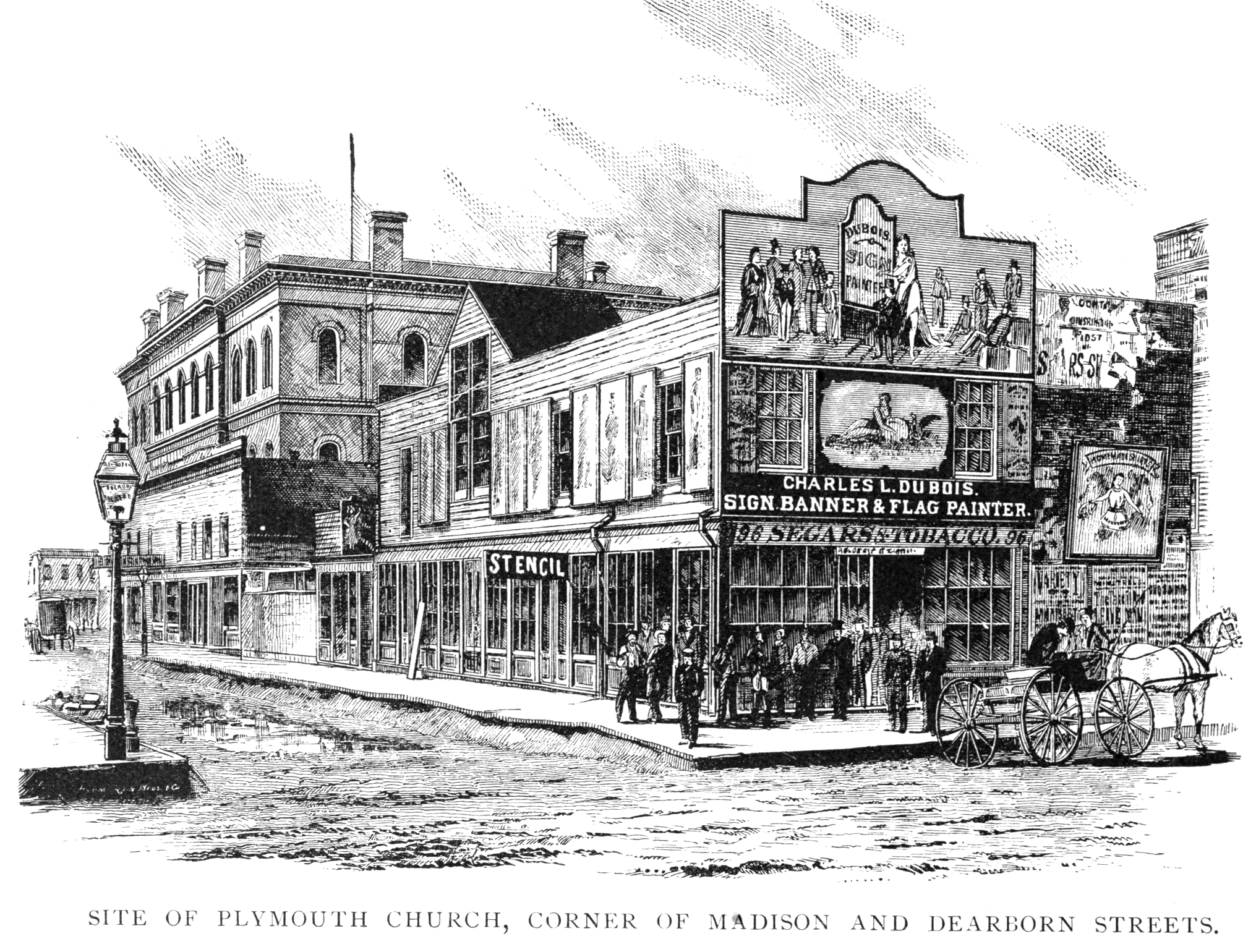

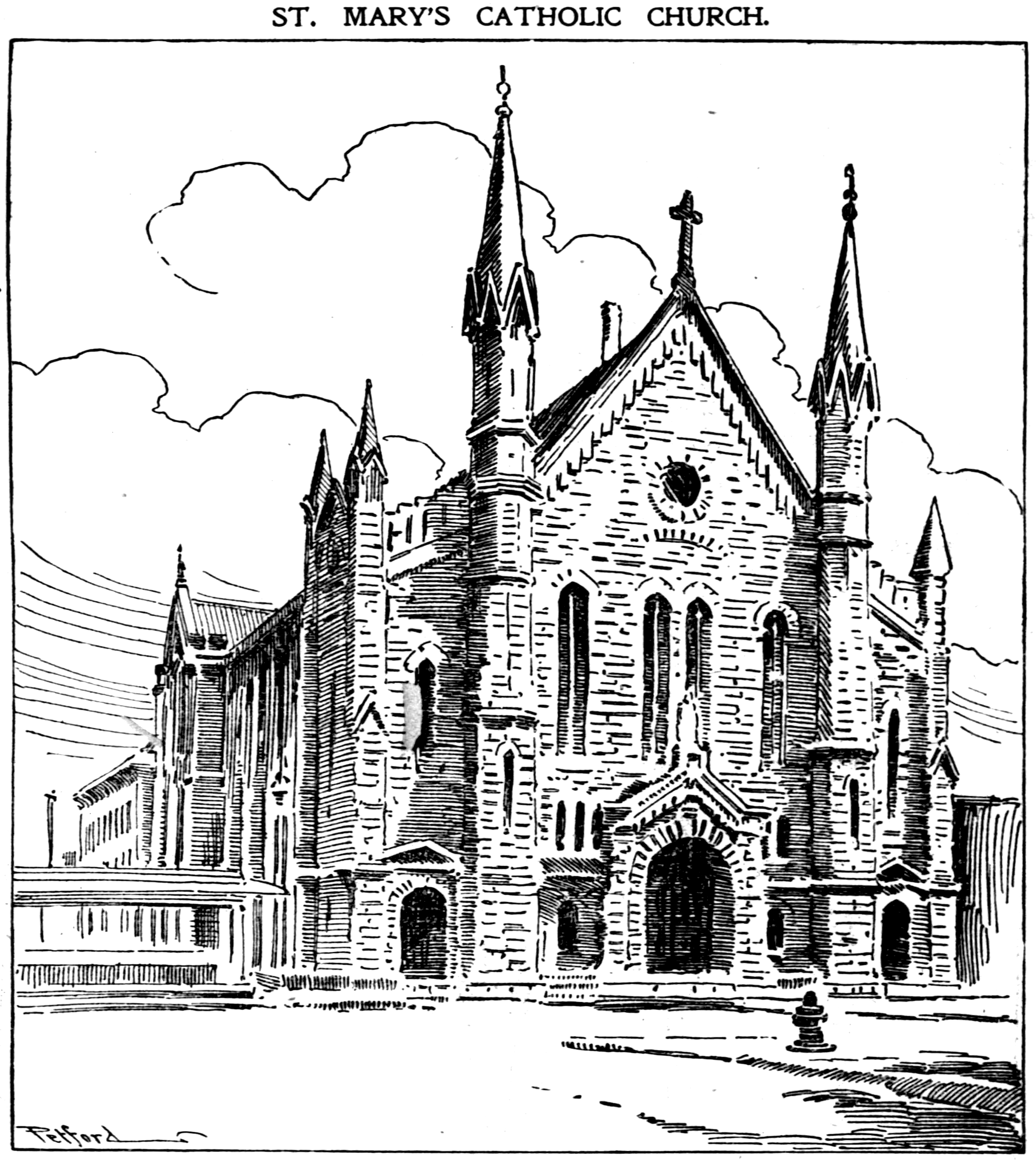
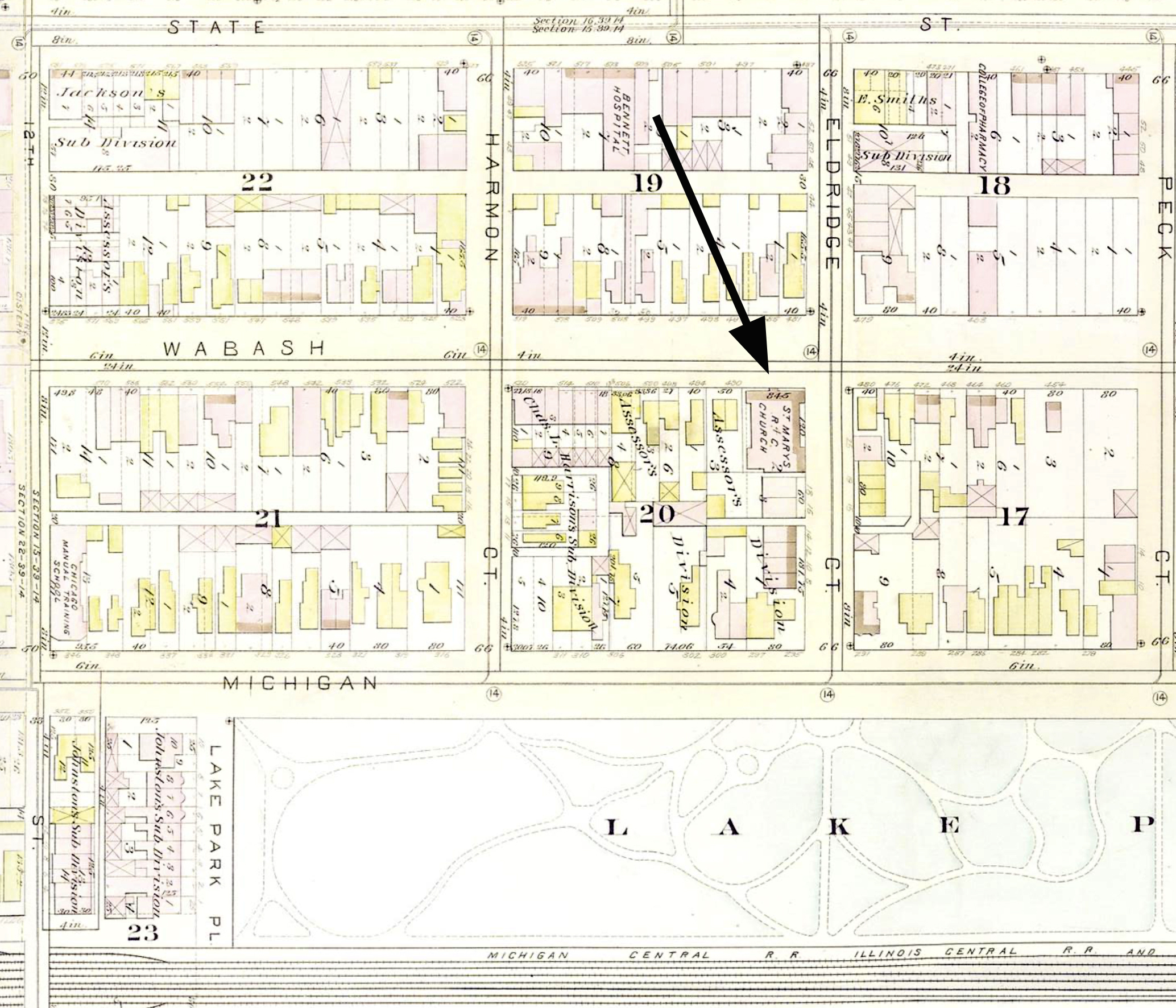
 St. Mary’s church. at the corner of Eldridge court and Wabash avenue, is the house of worship of the oldest Catholic congregation and parish in Chicago. No church in the world has a congregation like it. Of the 3,000 people who attend mass there on Sunday not more than 500 live in the parish. Practically the entire membership is transient.