Vaudeville Theaters of Chicago
Globe Theater, Lyceum Theatre, Irwin’s Theater, Glickman’s Theater, Howard’s Theater, Irwin’s Theater
Life Span:1870-1905
Location: Desplaines street, Between Washington and Madison streets
Architect:
- Edwards’ Annual Directory in the City of Chicago, for 1871
Globe Theatre, Redden & Dratt, proprs. Desplaines, bet. Madison and Washington
Edwards’ Annual Directory in the City of Chicago, for 1873
Globe Theatre, 54 and 56 S. Desplaines
Lakeside Annual Directory of the City of Chicago, 1880
Lyceum Theater, Lord & Engle, props. 56 S. Desplaines
Lakeside Annual Directory of the City of Chicago, 1884
Lyceum Theatre, Thomas L. Grenier, prop. 54 S. Desplaines
Lakeside Business Directory of the City of Chicago, 1899
Howard’s Theatre, 56 S. Desplaines
Lakeside Annual Directory of the City of Chicago, 1904
Glickman’s Theatre Ellis F Glickman prop 56 S Desplaines
Chicago Tribune, October 16, 1870
The West Side Theatre.
The work upon Mr. D. R. Allen Theatre on Desplaines street is rapidly approaching completion. It will probably be finished and ready for opening early in the ensuing month. The roof is about done, and the work on the stage is now in active progress. Present appearances indicate that it will be one of the best arranged theatres in the city. Mr. Allen is now busy organizing his company, and expects to open about the 7th with a well-selected dramatic corps. There is every reason to anticipate for the new theatre a successful career.
Chicago Tribune, November 22, 1870
OPENING OF THE GLOBE THEATRE.
The new Globe Theatre was opened last evening. under the most promising auspices, and with a manifestation of enthusiasm on the part of the audience that must have in some measure rewarded Mr. Allen for many anxious days of toll and trouble. The house was overflowing, crowded in every part, and large numbers had to torn away from the door, unable to obtain seats.

The new theatre presents, since its completion, a very handsome, tasteful, and comfortable appearance. The dress circle is supplied with cushioned chairs, in place of sofas, to which they are superior in point of comfort, although it is somewhat of an innovation. The decorations or the auditorium are simple, but in great good taste, and the scenic artist, Mr. James Howard Rogers, has put forth his entire artistic skill in the getting up of the scenes, all of which are real excellence. In the drop curtain Mr. Rogers has boldly departed from the eternal Lake of Como with its dreadfully Italian sky, etc.; and has drawn his inspiration from home. The picture represents the progress of civilization. It is a beautiful Western scene, composed of lake and mountains, a railroad tram—the emblem of advancing civilization—crossing a bridge, and away westward, the Indian, with his bow and arrows, receding before it, and following his own setting sun. At the foot of the curtain appears the inscription “Westward the course of empire its night.”
The general aspect of the auditorium is neat and elegant. It is well warmed, and well lighted, and every seat in the house, from the front of the parquette to the remotest corner of the upper circle, commands a perfect view of the stage. The siege itself is one of the most capacious in the city, and, to judge from the admirable way in which everything moved on me opening night, it is evidently supplied with all the requisite facilities.
It was characteristic of Mr. Allen, and of the indomitable perseverance and enterprise he has manifested in pushing through this enterprise to a successful completion in the face of so many obstacles, that he opened his theatre without the customary flourish of trumpets in the shape of speech-making. The curtain rose at the appointed time, and the play commenced. This showed independence and good taste, and the result soon proved that the new theatre could well afford to stand upon its merits without any preliminary craving of the indulgence of its patrons; for a better stock company than that which Mr. Alien has selected, is not to be seen in any other theatre in the city at present.
Chicago Tribune, October 9, 1872
THE DRAMA
was the first to recover from the effects of the fire. Colonel Wood, of the old Museum on Randolph street, secured the Globe Theatre, on Desplaines street, an old wooden shell which had run through various vicissitudes of fortune, and had succeeded in speedily wrecking every manager who took hold of it, Mr. Allen, formerly of the Museum Company, being the last who went under. Colonel Wood, after announcing a grand renovation, which was only a renovation on paper, got the larger number of his old Museum Company together, and opened the Globe on the 21st of October, only thirteen days after the fire, with the plays of “Won at Last,” and “Who’s Who?” the latter of which asked a very significant question for those days, when it was exceedingly difficult for anyone to tell who or what he was. The Globe, however, did not make a very brilliant start, and only began to be successful with the production of “Divorce,” which had a handsome run. From that time to the present its record is familiar. Its programmes presents a curious medley of entertainment, made up of sensational dramas of the most sanguinary description, the conventional Irish dramas, with stars of the third and fourth magnitude, a crippled season of German opera which eventuated in a most dismal fiasco, Sunday night concerts which were failures, the spectacular drama filled in with a ballet of tenth-rate coryphees and atrocious Amazons from Archer, Milwaukee and Blue Island avenues, minstrel shows of a poor order, &c., & c. It has presented nothing from the night it was opened until the present worthy of patronage. It is fortunate that the Globe has not had the monopoly of dramatic amusement. Other and stronger competitors entered the field and compelled it to resort to the lower order of attractions, condition and have finally reduced it to about the same condition into which it had fallen before the fire, and he will be a risky future invests risky his money in the Globe.
Inter Ocean, June 12, 1880
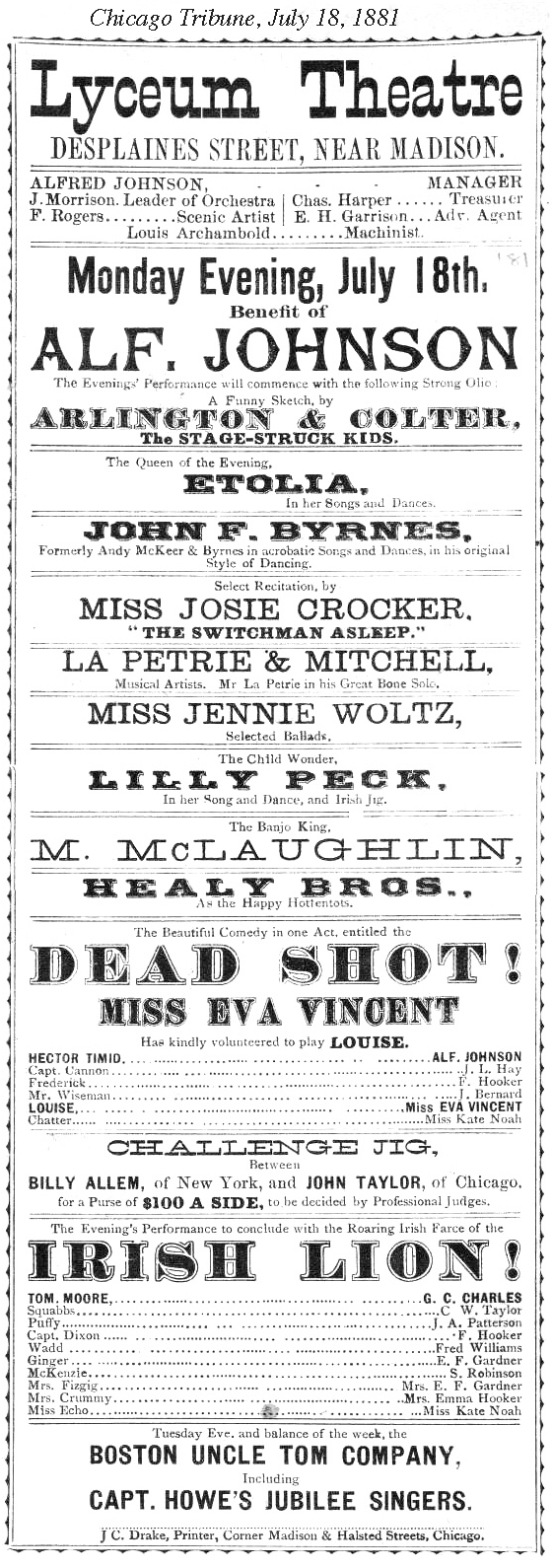
ABOUT THE LYCEUM,
Two or three weeks ago we mentioned the fact that Robert Fox intended taking the Lyceum and reconstructing it for next season. The papers were to have been signed yesterday. Whether or not the transaction was consummated we are not informed. It seems at this time very ill-advised for anybody to undertake the construction of a first-class theater in that locality. It certainly could not be made profitable under existing cireumstances, and the chances are very much against the ancoess of any such experiment even in a comparative degree. Under the careful and honorable inanagement of Mr. Lord the place for the past year has been made to more than pay expenses. But the location and surroundings have militated strongly against building the theater into the grade of respectability Mr. Lord hoped to establish. There 1s room but for one first-class, full-fledged variety theater in that vicinity, and that has long been firmly planted in the regard of the West Siders. The Lyceum is off the direct line of travel, has questionable associates, and it is extremely doubtful if it could be run with advantage on a more extensive scale. Left as it now is, in point of size, with a few interior and exterior improvements and embellishments, the Lyceum can be run with partial success, as it has been recently. A more elaborate expenditure would, we imagine, be money misplaced. Besides this. it
seems that ??. Fox is also interested with Mr. Maxwell in the construction of the new theater to be built on the North Side. There is a constituency to be reached in that direction, so that a clientele could be worked up in short time. It will not interfere with another similar theater, and will not, therefore, have the trouble of overcoming obstacles in the way of prejudice or preference. Unless Mr. Fox desires to have a West and North Side theater for the exchange of attractions, he will find little to encourage him on the West Side.
Inter Ocean, August 28, 1880
Next Saturday evening Fox’s New Lyceum Theater will be opened. The interior of this house has been handsomely fitted up, completely transformed, and made into a first-class variety house. The programme for the opening will comprise an olio, in which will appear Charles Greer, Nellie Waters, Trudell and Rowen, and the Ronaldos, and a dramatic performance of play entitled “High, Low, Jack, and Game.” The parts in this piece are to be taken by J. Winston Murray, Alice Placide, Ed Barrett, W. H. Danvers, Sallie Mason, J. W. Sheppard, Charles.
Chicago Daily Telegraph, September 5, 1880
FOX’S WEST SIDE THEATRE.
The old Lyceum Theatre on Desplaines street opened last night to a crowded house, made up for the most part, of those curious to see how far Mr. Fox, the new manager, had carried out his promises in regard to a complete change in the house. That gentleman claims to have expended several thousand dollars in enlarging the auditorium and frescoing the house. Besides this, the seating capacity of the theatre has been considerably augmented, there now being 270 orchestra chairs, 538 parquette, and 812 gallery seats. The latter are admirably arranged, and the stage is in full sight of every chair in the house. The dome has been changed in its form, and adorned with appropriate pictures, and the curtain, representing a Swiss mountain scene, and painted by Mr. Skiff, the scenic artist, is a good piece of work. The stage has been carried back quite a distance, and proportionately broadened, and four, tastefully arranged private boxes put in, the handsome trappings of which were designed by Mr. G. A. Torrey, of Carson, Pirie & Co.s’. The exterior has been somewhat changed, and altogether the theatre is a credit to the taste of the proprietor who is sanguine that a first-class theatre, such as he proposes to run, will be a success in the portion of the city where his new venture is located.
The initial entertainmet had the merit of being varied and complete. A drama, song and dance, and acrobatic feats seemed to please the patrons of the house, and “Money and Misery,” with Miss Alice Placide in the leading role, and an olio made up of a dozen or more specialty repertoires, rounded an evening of enthusiastic pleasure on the part of the large audience, audience, and seemed to guarantee future success for Fox’s Theatre it its entertainments are kept up to the grade of the one given last night.
Chicago Tribune, September 27, 1903
Old Lyceum Theater Plans.
There have been various wild reports circulated about the old Lyceum theater lately, but the latest, that the theater will be transformed into a music hall, is the wildest of all. The real proposal is curious enough In its way to make fantastic ideas unnecessary. There is so much waste space in the construction of the Lyceum theater as it now exists that the shareholders are considering the proposal to pull down the theater and erect two new theaters in its place. One would have a stage and seating accommodation the same as at present, while the other would be a small theater which the Lyceum company would rent to a tenant; but the whole thing as yet is only in the proposal stage.
Chicago Tribune, January 5, 1899
HOWARD’S THEATER IS CLOSED.
Notice States Miss Van Tassell’s Disagreement with ” The Volunteer ” Manager Is the Cause.
Howard’s Theater in Desplaines street, near Madison, has been closed on account, it is said, of a disagreement between Cora Van Tassell, the star of “The Volunteer” company that has been playing at the theater, and her manager.
The disagreement occurred before the Monday matinée, and the crowd that had assembled for the holiday performance was given back its money, as the performance did not take place. Since that time the theater has been dark. The following notice is posted on the doors:
- Mr. Howard has decided to close Howard’s Theater until further notice, because “The Volunteer” company could not give performances as advertised, owing to a misunderstanding between Miss Van Tassell and her manager.
It is said that Miss Van Tassell wished Mr. Morgan to advance her some money, which he refused to do, as he said she already had overdrawn her account; and she refused to act until the money was forthcoming.
Mr. Morgan, the manager of the company, however, states that the cause of the trouble is the illness of Miss Van Tassell.
Inter Ocean, September 9, 1900
Irwin’s Theater
Irwin’s theater, first of burlesque houses to be opened on the West Side since the Empire burned and the Lyceum closed, in 1894, resunes this afternoon. The theater occupies the site of the old Lyceum, Desplaines street, near Madison, and the building has been almost wholly reconstructed, $16,000 having been spent in the process. Irwin’s Burlesquers will furnish the opening show. with Mildred Stoller as the star. Eulalie and Kerwin, dancers; the eight Cornellas, acrobats; Watson and Bernard, Fitzgibbons, McCoy, and Fitzgibbons, and other performers will figure in the olio, while two new burlettas will display the comedians and coryphees.
Chicago Tribune, August 23, 1903
Glickman’s theater
Glickman’s theater, for years the home of the Yiddish drama, but now transformed into a stock company house for plays in English, will be opened this afternoon. Glickman’s theater will begin its new career this afternoon under the management of Frank Dodge, representing the Crescent Amusement company, with Joseph Arthur’s “The Still Alarm” as the play. The company is headed by John Terris and Lucia Moore. Chief Musham has loaned a fully equipped fire engine and two white horses belonging to the Chicago fire department, to be used during the first week of its season. The management has returned the compliment by donating the receipts of Monday’s matinée to the firemen’s relief fund.
Chicago Tribune, January 20, 1904
MUCH WORK IN GLICKMAN’S.
Steel Curtain and Apparatus to Be Installed and Aisles Rearranged.
Glickman’s theater must spend $5,000 for improvements and alterations to conform to the new ordinance. A month or more will be required for the work. The building must be equipped with a steel curtain, a brick proscenium wall, sprinklers, flues, tire extinguishing apparatus, and a fire alarm. It must also reconstruct its stage and several aisles and exits.
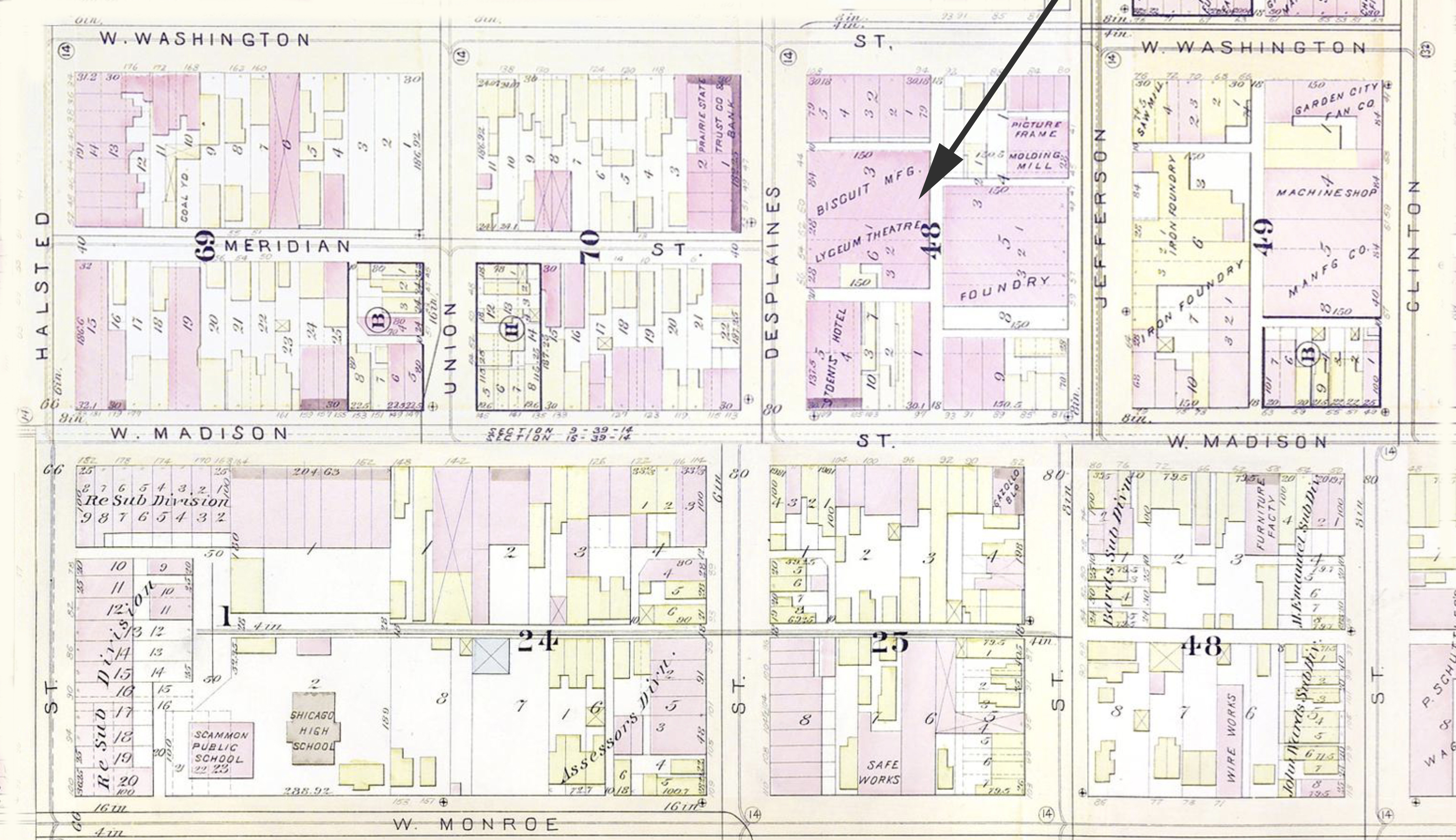
- Lyceum Theatre
Robinson Fire Insurance Map
1886
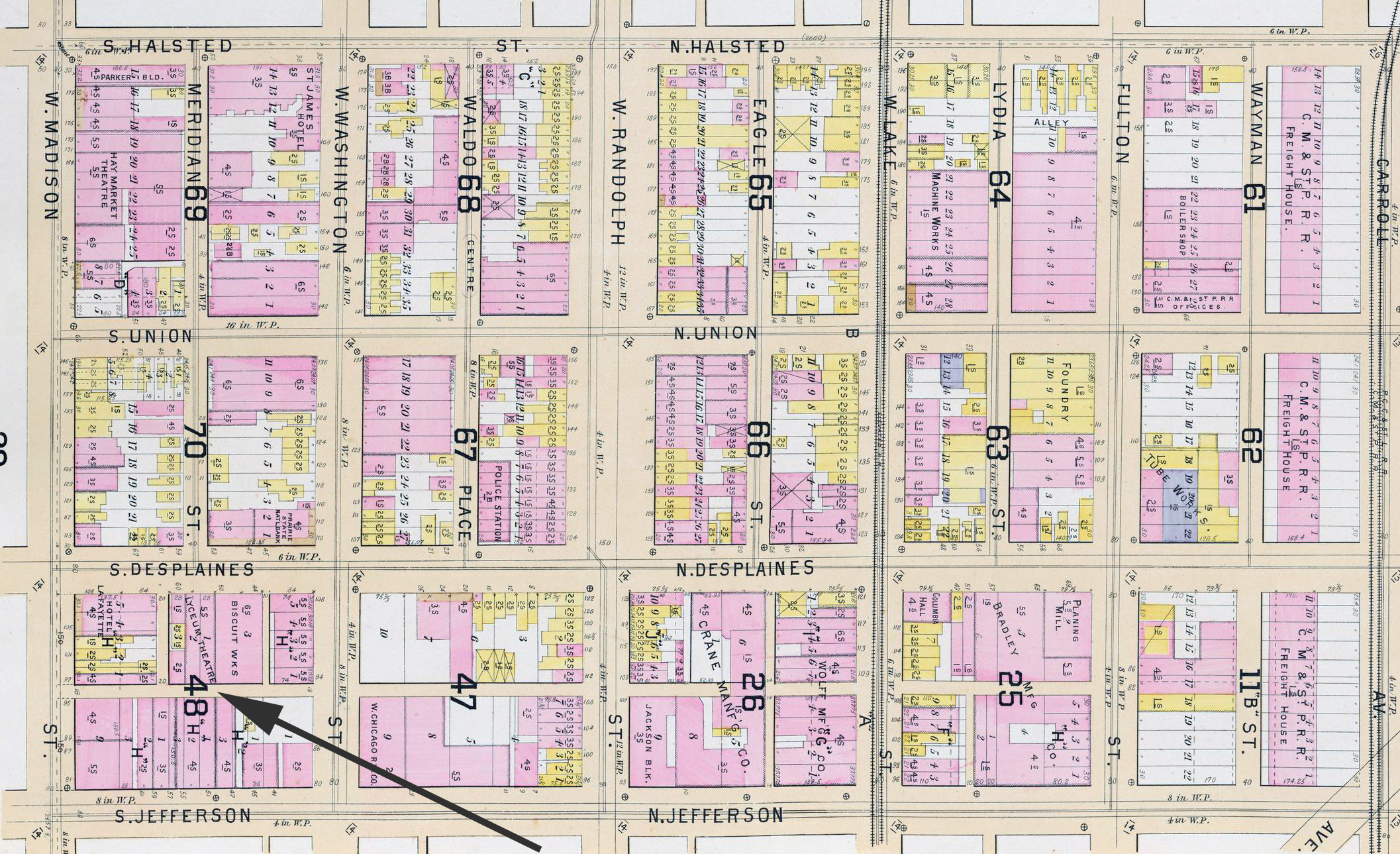
- Lyceum Theatre
Greeley-Carlson Atlas of Chicago
1891
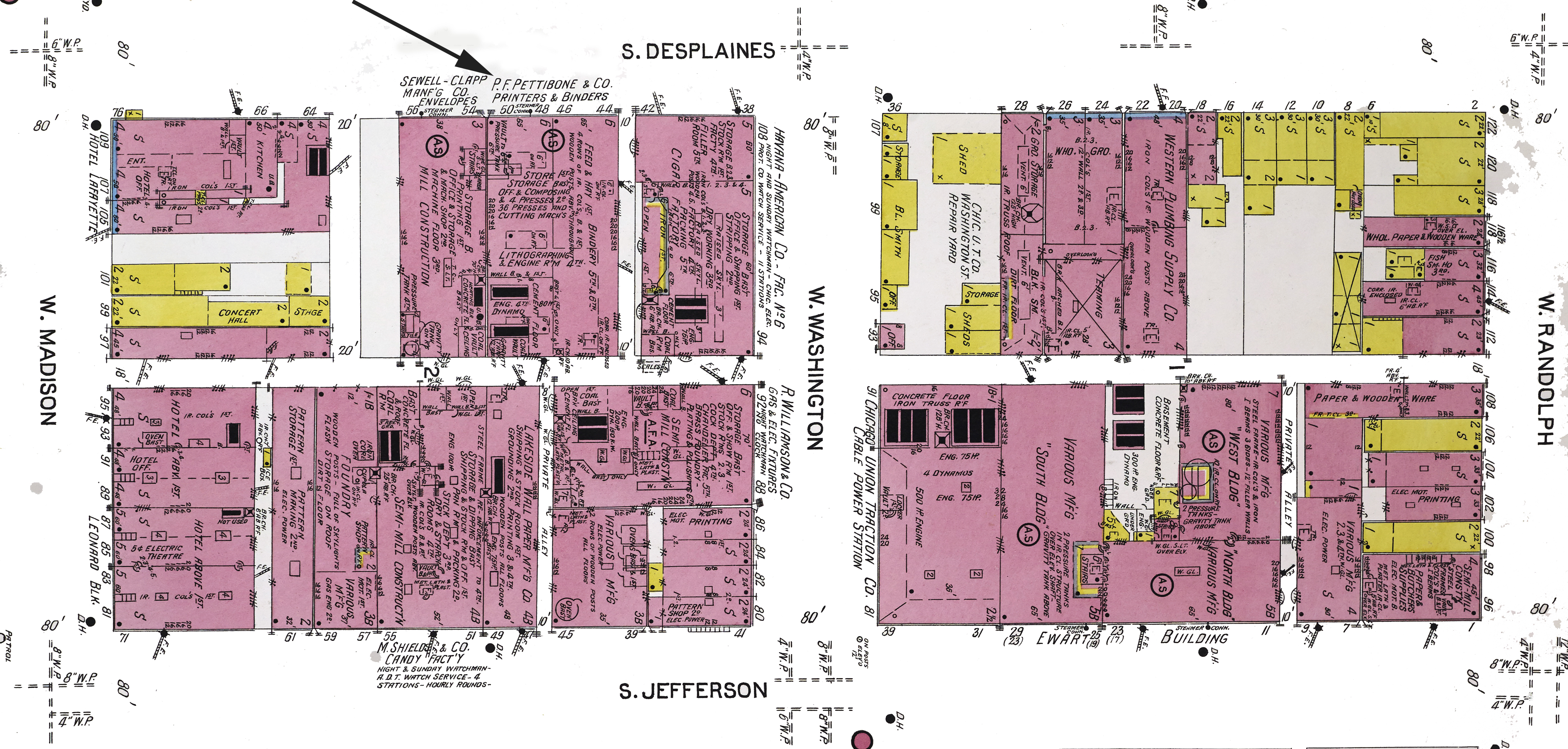
- P. F. Pettibone Printing Co
Sanborn Fire Insurance Map
1906

Leave a Reply