Vaudeville Theaters of Chicago
North’s Amphitheater
Life Span: 1854-1864
Location: South side of Monroe near Wells
Architect: Messrs. Levi J. North and Harry Turner
- D. B. Cooke & Co.’s City Directory for the Year 1859
North Levi J., amphitheatre, Monroe nr S. Wells bds City Hotel
Chicago Weekly Tribune, November 17, 1855
NORTH’s NATIONAL AMPHITHEATRE—A MAMMOTH BUILDING.—Those who have passed through Monroe street between Clark and Wells within the last month, have observed a large building in process of erection upon the south side. It is a wooden structure, with a fire proof roof, and is two stories high in front, extending on the street 90 feet, and running back with the same width and height 206 feet! It is now nearly finished, and has been built by Messrs. Levi J. North and Harry Turner for an amphitheatre on a stupendous scale, and entirely in advance of anything they have before attempted, and their names are associated with the greatest enterprises of equestrian exhibition of the last ten or fifteen years, and they stand unrivaled in their line.
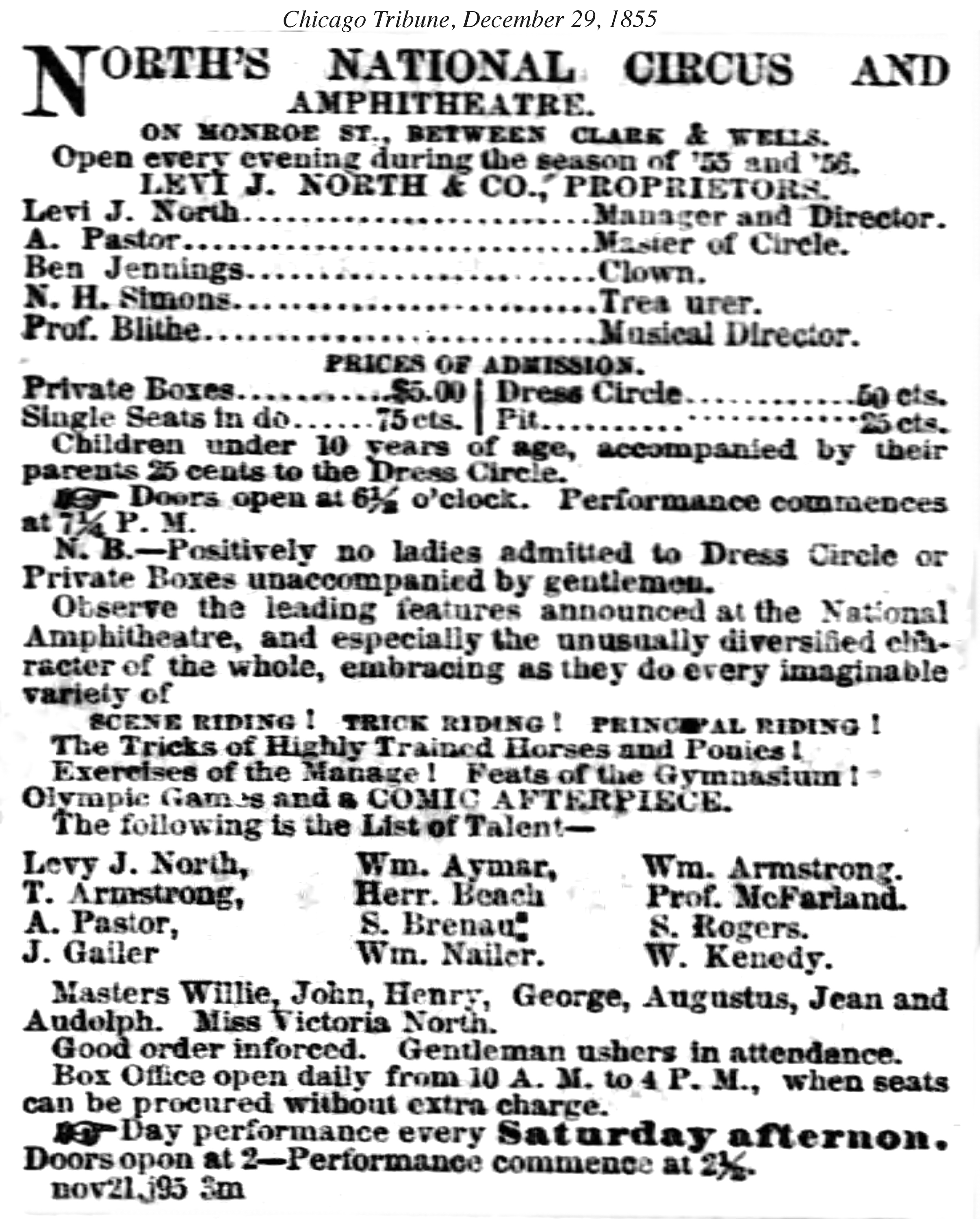
The amphitheatre will shortly be opened with a company embracing the best artistic talent of country. Mr. North is now absent looking through the cities of New York, Boston and Philadelphia in order to secure the best troupe which has ever been brought together, to inaugurate this mammoth enterprise. Mr. T. Toole is the business man of the establishment, and possesses every qualification for successful management of its affairs.
The sidewalks leading to the amphitheatre are 12 feet wide, and there is a good carriage way at all times. The main entrance is 18 feet wide, and two stairways, each 8 feet wide, lead to the boxes. The pit entrance is entirely removed from the main entrance, and is also 8 feet wide. The wisdom of these wide avenues will be well demonstrated after the amphitheatre is opened. The amphitheatre will comfortably seat 3,065 persons! The seats in the boxes are in nine tiers, and in the pit eighteen. There are six private boxes easily reached, elegantly fitted up, and capable of seating eight persons each. The ring is forty-two feet ten inches in diameter, and one hundred and twenty-five gas burners will shed their light over the performers. The sky-light is 80 by 22 feet, and the building will be well warmed and ventilated. Water is carried all through the building as a guard against accident by fire, and watchmen will always be kept on duty. The ceiling of the amphitheatre is canopied in Grecian style with the colors of the United States, England, France, and Russia, and when the room in lighted with gas the effect is superb.
In the front of the building is a saloon which should be dispensed with, and its large size, 90 feet by 25, and its magnificent appointments only render it the more to be deprecated. The accommodations for the company are in the rear of the building, as also stabling for the entire stud of horses-eighty-three in number.
The stud comprises some of the most highly trained and beautiful animals of the country. The opening of the Amphitheatre may be looked for in a few days, and certainly whatever may be the result, the proprietors have spared no effort to make it fully meet the wants of its patrons.
Chicago Tribune, August 4, 1856
THORNE’S NATIONAL THEATRE.—This is the opening night of Thorne’s National Theatre in the Amphitheatre Building. The performance commences with the Honeymoon. Mr. Thorne as the Duke and Nrr. Thorne as Juliana. This is to be followed by an interlude—”Star Spangled Banner,” “Hail Columbia” and the ” Marsellaise.” The after piece is Simpson & Co.
Chicago Tribune, February 9, 1857
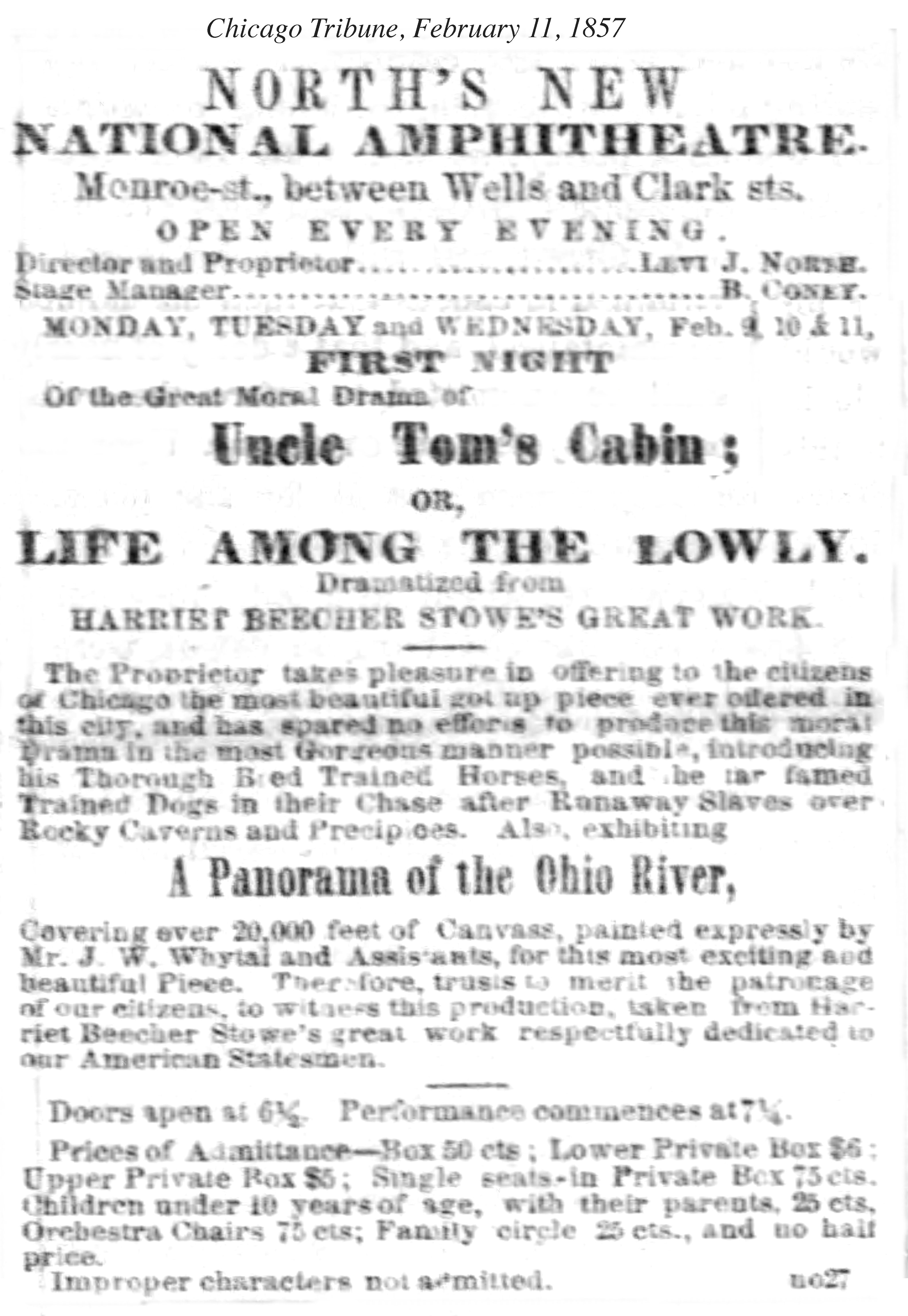
NORTH’S AMPHITEATER—Uncle Tom’s Cabin
The popular and exciting play of Uncle Tom’s Cabin is to be produced at the Amphitheater this evening. No pains or expense have been spared to bring the piece out in the best manner.
Chicago Tribune, February 13, 1857
AMPHITHEATRE.—The play of Uncle Tom’s Cabin, as produced at this place of amusement, attracts very large audiences. It will be performed every evening this week.
Western Railroad Gazette, February 14, 1857
At North’s Amphitheatre, Uncle Tom’s Cabin has been put on the stage in the finest kind of shape. Toole, North and the rest of them up there keep the ball rolling, and as fast as one all-absorbing attraction is withdrawn, another is substituted, and the excitement to go, hear and see is unabated. This play was first brought out in New York, and attracted crowded audiences at Purdy’s Theatre for over two hundred consecutive nights. We have seen it occasionally when performed there, and at Barnum’s, and we must confess that North has cast all former attempts in the shade. Cordelia Howard very beautifully personated the little Eva, but North’s angelic little daughter is Eva herself, and no one can look upon her sweet simplicity, grace and innocence with dry eyes. We believe this simple story has struck a more terrible blow at the institution of slavery than any legislation in or out of Congress before or since, and “Life Among the Lowly” has stamped Mrs. Stowe as a writer of unequalled dramatic power. Everybody should go and see this play at North’s, as another opportunity of seeing it to such advantage may never be offered again.
Chicago Tribune, April 15, 1859
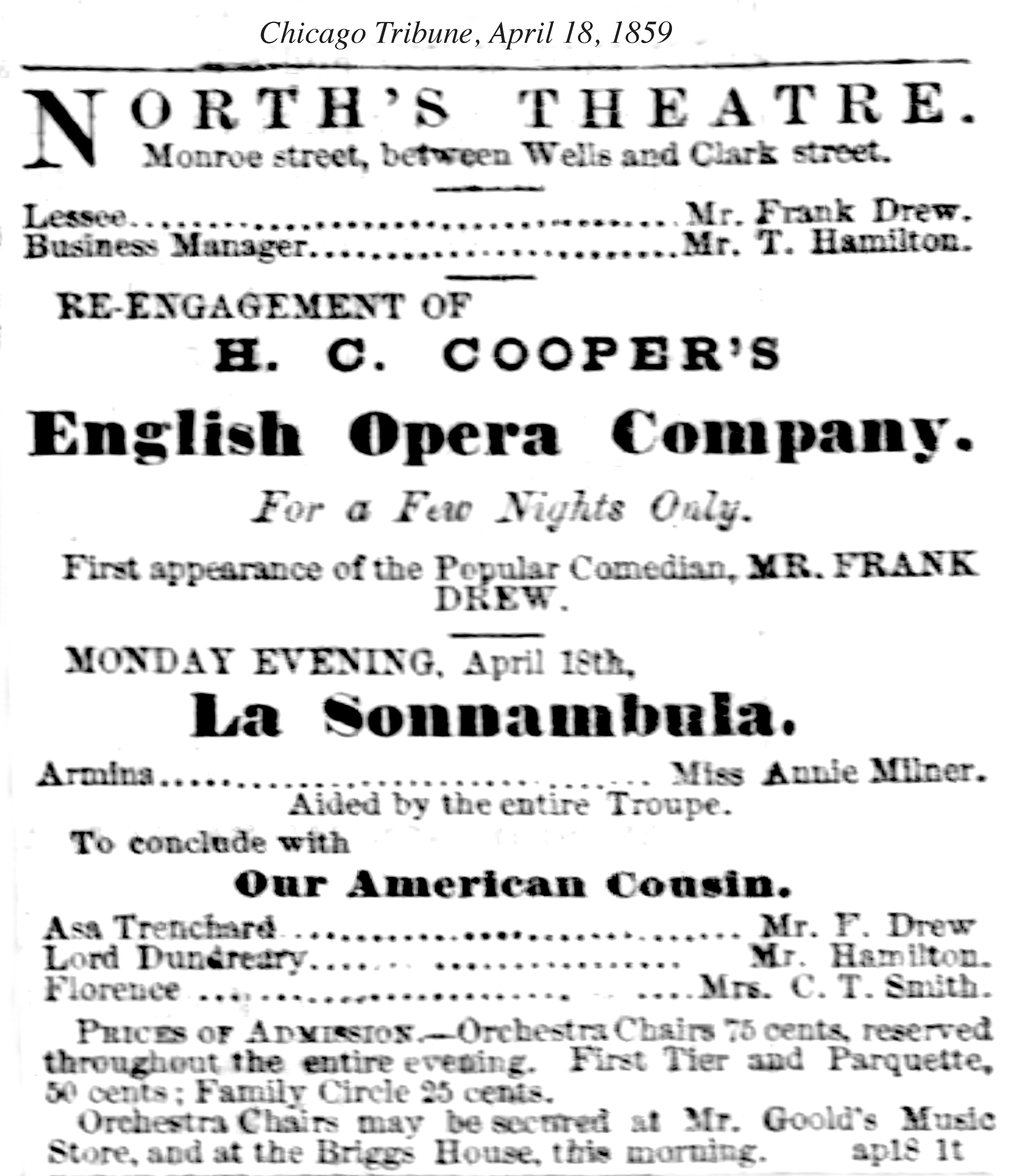
THE ENGLISH OPERA AT NORTH’s THEATRE.
Competent musical critics assure us that the English Opera Company at North’s Theatre are eminently worthy of patronage; that they sing with taste and correctness; that their pieces are well put on the stage; and that their action is appropriate and varied to suit the pieces in which they are engaged. They sing, however, in what is little better than a horse-stable, and to audiences, for the most part, that fail to appreciate the artistic excellence of their efforts. It is unfortunate for the Company and unfortunate for the music-loving public that the operas which these artists put on the stage, could not have been given in some hall, or some theatre into which that class of our citizens who support operas are willing to go. If any, however, are ready to make a small sacrifice of personal comfort, and to bestow on a house, which has no claim on public patronage, the favor of their presence, for the sake of hearing unexceptionable music, they will be well rewarded by going to North’s.
Old Monroe Street, Edwin F. Mack, 1914
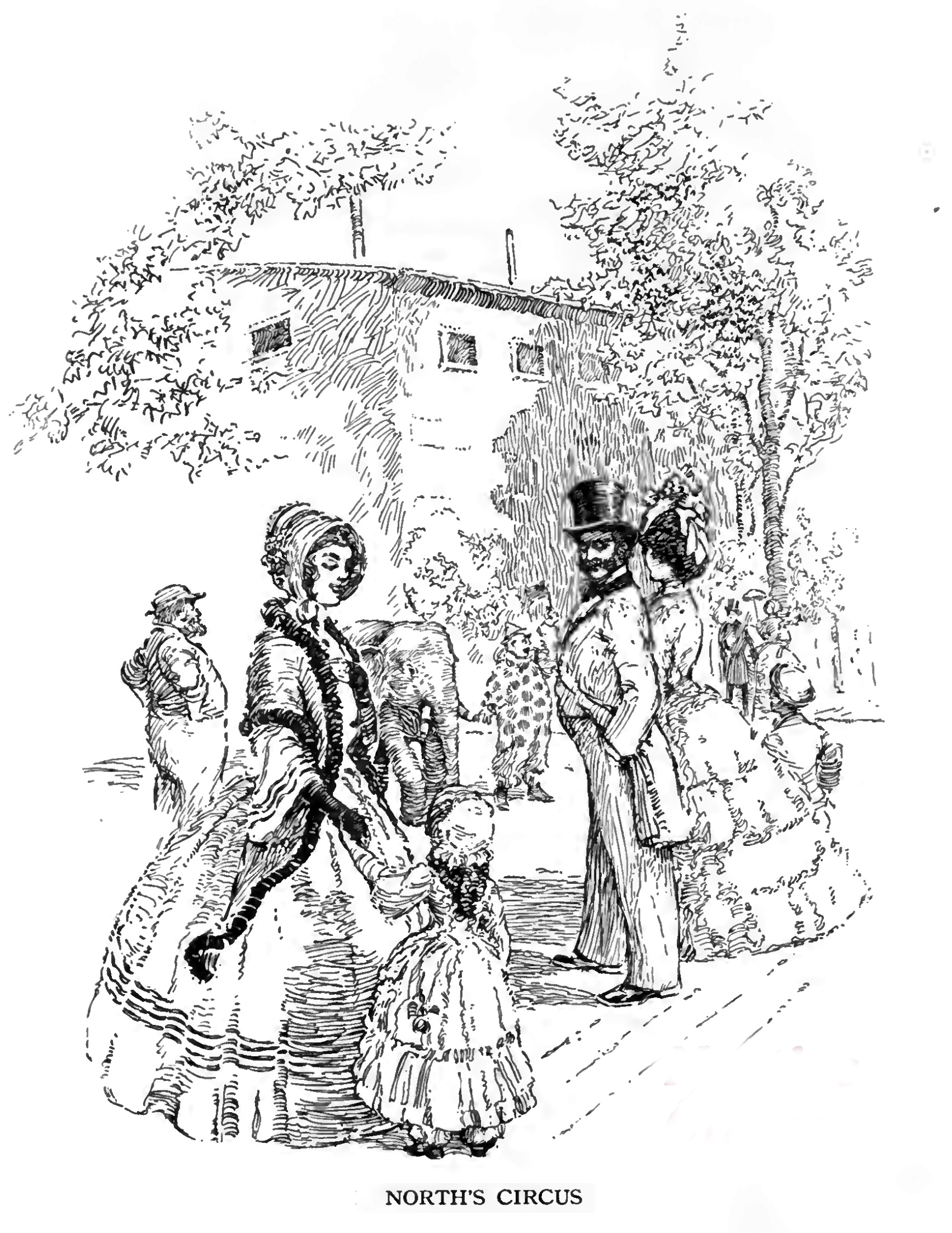
North’s Circus.
On April 4, 1855, North’s Circus came to the city, after performing on a vacant lot, Levi J. North and Harry Turner, the owners, erected a two-story frame theater on the south side of Monroe Street, east of Wells Street (Fifth Avenue). The building had 90 feet frontage on Monroe Street and was 206 feet deep.
It contained a performing ring 42 feet in diameter and seated 3,062 people. In the rear of the building there were stables for the horses used in connection with the performances.
In 1856 C. R. Thorne became manager, and changed the name to National Theater. He engaged a stock company, and the theater was fitted up for legitimate dramatic work.
In 1857 the place was re-adapted to equestrian and spectacular entertainments, but was soon again transformed into a legitimate theater, and was opened as such in 1857 by J. H. Wallack in Othello, Virginius and similar plays. Mr. and Mrs. John F. Drew appeared there in May, 1858.
The house ceased to be profitable in 1859, and, after many changes, was sold. The building was allowed to fall into disrepair, but was temporarily occupied in 1864 by two companies of soldiers while waiting to be paid off.
In 1868 the building was torn down and a brick business block erected in its place.

Leave a Reply