Vaudeville Theaters of Chicago
Peoples’ Theater, Hopkins Theater, Folly Theater, State-Congress Theatre
Life Span: 1884-1935
Location: State Street, between Harrison and Congress
Architect: NA
- Lakeside Annual Directory of the City of Chicago, 1885
Peoples’ Theatre, Jo. Baylies, prop. 339 State
A. N. Marquis & Co.’s Business Directory of Chicago, 1886-1887
People’s Theatre, Josiah Baylies, prop. and manager, 339 to 341 State
Lakeside Annual Directory of the City of Chicago, 1887
Peoples’ Theatre, Jo. Baylies, prop. 339 State
Lakeside Annual Directory of the City of Chicago, 1892
Peoples’ Theatre, Joshua Baylies, prop. 339 State
Lakeside Business Directory of the City of Chicago, 1899
Hopkins Theatre, John D. Hopkins mngr 337 State
Lakeside Business Directory of the City of Chicago, 1904
Hopkins Theatre, Empire circuit co directors 337 State
Lakeside Business Directory of the City of Chicago, 1906
Folly Theatre, Empire circuit co directors 337 State
Lakeside Business Directory of the City of Chicago, 1907
Folly Theatre, 337 State
Lakeside Business Directory of the City of Chicago, 1910
Folly Theatre, John A Fennessy mngr 337 State
Lakeside Annual Directory of the City of Chicago, 1911
Folly Theatre, John A Fennessy mngr 531 S State
Inter Ocean, July 6, 1884
Bayless and Kennedy are to have the new Peoples’ Theater building on State street. It will have a seating capacity of 1,200, and will be devoted to specialty entertainments It will be opened Sept 1.
Inter Ocean, September 22, 1884
The Peoples’ Theater on State street is now ready for its formal opening, which will occur next Saturday evening. The house is a handsome one, and it is the intention to give a good line of popular attractions at moderate prices.
Inter Ocean, February 11, 1895
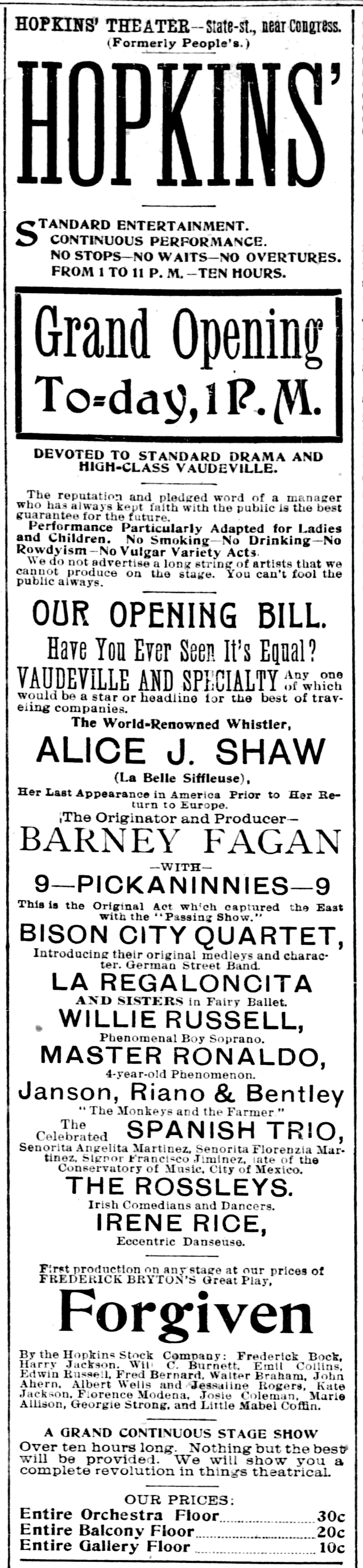
HOPKINS’ THEATER
Colonel J. D. Hopkins yesterday inaugurated his new amusement enterprise at the theater rechristened from his name,formerly the People’s The house has been renovated and redecorated, and is very bright and attractive. Colonel Hopkins, who has brought Pope’s Theater in St. Louis from an unprofitable place into one of popularity and large financial return, through the medium of a continuous show, has determined to try the same plan in this city, The patronage yesterday was more than the house could accommodate which augurs well for the new departure.
From the time the doors were open, at 1 o’clock, until late in the evening the crowd kept coming and going, the house perpetually being full and overflowing. Frederic Bryton’s four-act play, is the dramatic attraction. It is presented with new and appropriate scenery, and the capable stock company enlists Frederick Bock, Harry Jackson, C. Burnett, Emil Collins, Edwin Russell, Billy Robinson, Walter Braham, Jessaline Rogers, Kate Jackson, Florence Modena, little Edna Norman. Instead of the overtures between acts specialty 15 given and Colonel Hopkins’ large experience in this line induces tim 10 make these features of more than ordinary merit. These specialists are: Mrs. Alice J. Shaw, la belle Siffleuse: last appearance in America prior to her engagement in Berlin in April. Barney Fagin, the famous song and dance producer. with nine pickaninnies. La Regaloncita and sisters in their fairy ballet. Bison City Quartet, introducing their original medleys and characters; German street band. Janson, Riano, and Bentley, comedy act, “The Monkey and the Farmer.” Spanish Trio, Senorita Angelita Martinez, Senorita Florencia Martinez. Senor Francisco Jimenez. Master Willie Russell, phenomenal boy soprano. The Rossleys, Irish comedians and dancers. Miss Irene Rice, the favorite danseuse. The fact that specialties came between the acts of the play did not apparently militate against the enjoyment of the audience, for the actors were well received. Indeed. the entire show went with enthusiasm and eclat, and the continuous show was a continuous success.
National Hotel Register, November 10, 1919
State-Congress Theater
Following the great success of the State-Lake theater at the South end of the loop on Chicago’s main retail business thorougfare, there will be inaugurated on Saturday, November 22, the State-Congress theater, at the south end of the loop, on State street, just south of Congress. There will be continuous vaudeville from 11 to 11, with moving pictures interpersed. This will be a most pretentious theater, the old Gayety being transformed into a brand new playhouse, on which workmen have been busily engaged for weeks.
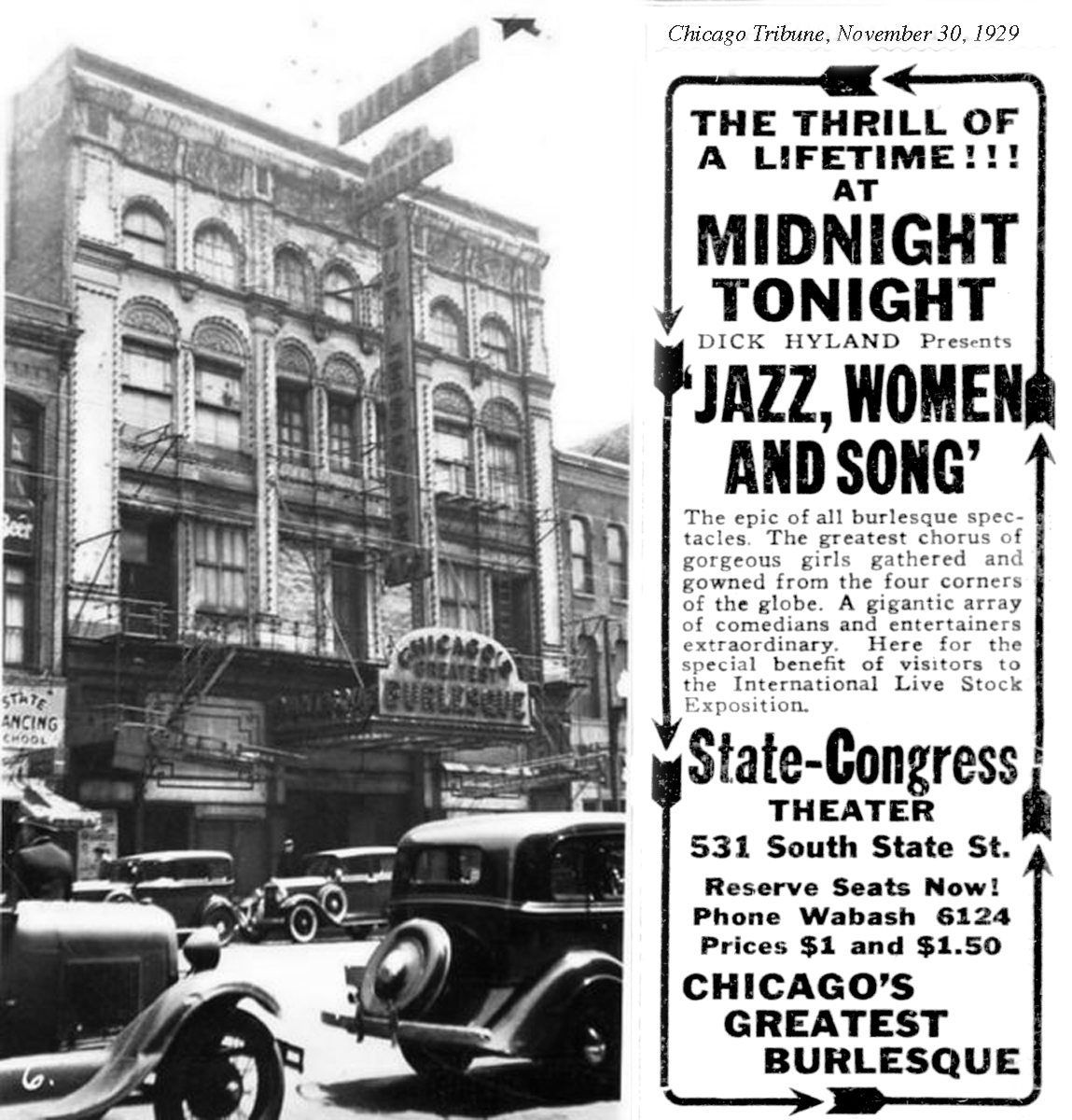
- State-Congress Theater
1929
Chicago Tribune, May 28, 1935
Obsolescence and mounting taxes decided the owners of the old State and Congress theater, for many years a burlesque house, at 527-35 South State street, to wreck the building. The land when cleared will be occupied as a gas station by Ben Bortz, who has leased it from the Chicago Title and Trust company, trustee. Harry C. Straus of Willoughby & Co. was the broker.
Chicago Tribune, June 9, 1935
Stage Landmark Becomes Parking Place.
The news that the State-Congress theater, former burlesque and minor cinema house on the southern fringe of the “loop,” is now being demolished to make a motor parking place will stir the memories of elder playgoers. The place was a sort of landmark of popular entertainment; its former title was the Hopkins, and in the 1890s under the vigorous management of Col. John Hopkins, it offered dramatic productions of some merit.
The Hopkins was a pioneer in the policy of continuous entertainment, now so prevalent. William Shaw, veteran theatrical man, writes to me on this point:
- I remember that Lillian Mortimer, a popular stock star, held forth there for a good while and that in its road show days the place housed a number of such on-their-way-up actors as Joseph Santley, then a boyish lead in ‘Billy the Kid.’
I know that for at least two seasons Col. Hopkins gave two full length performances daily of such dramas as ‘Quo Vadis,’ filling in all the before-and-after hours with vaudeville, and that by 5 p.m. the sidewalk would be jammed with persons waiting for the supper show and the night drama. His productions often were so elaborate that he shipped them around the country to other stock company owners.
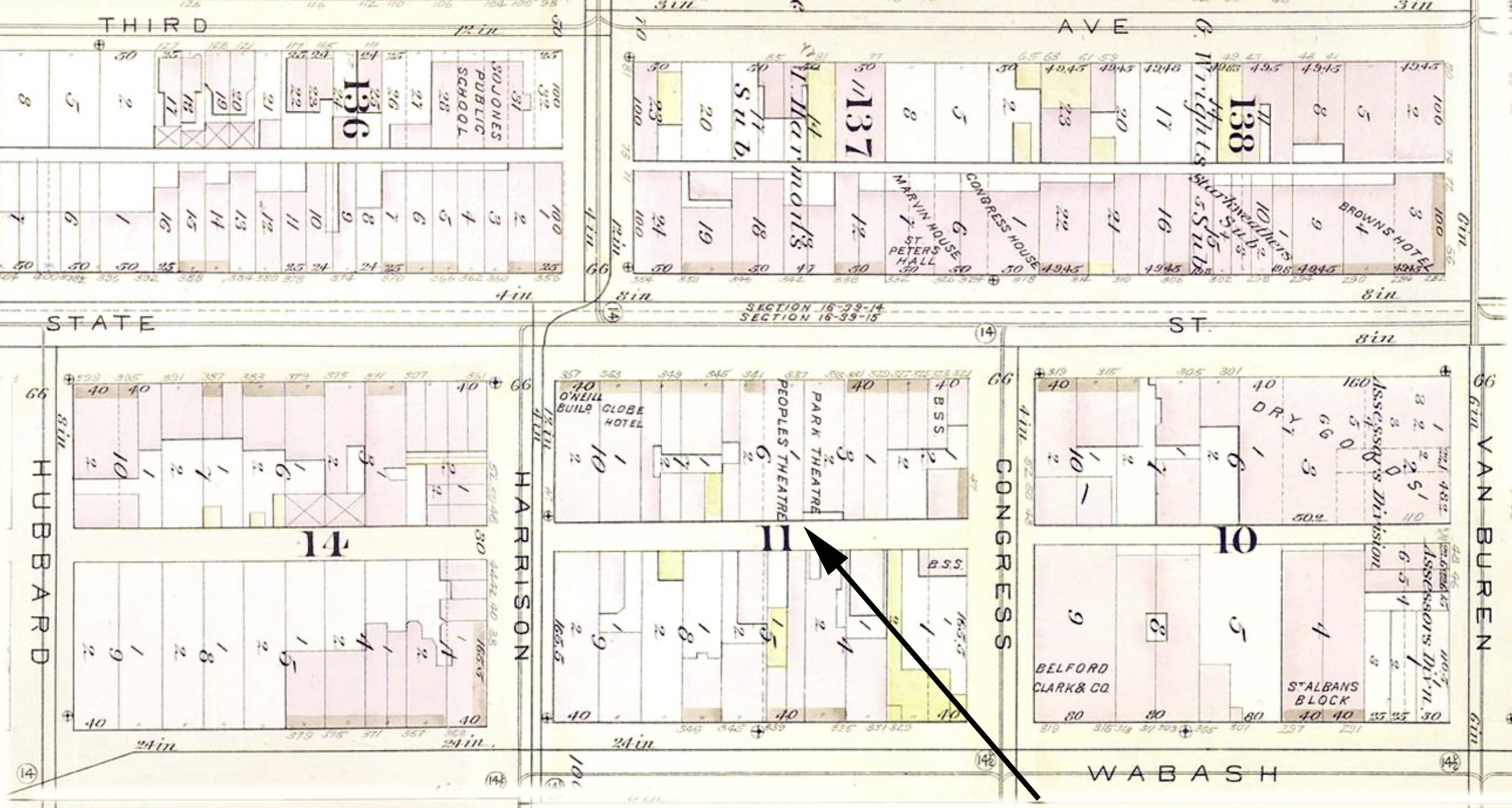
- Peoples’ Theater
Robinson Fire Insurance Map
1886
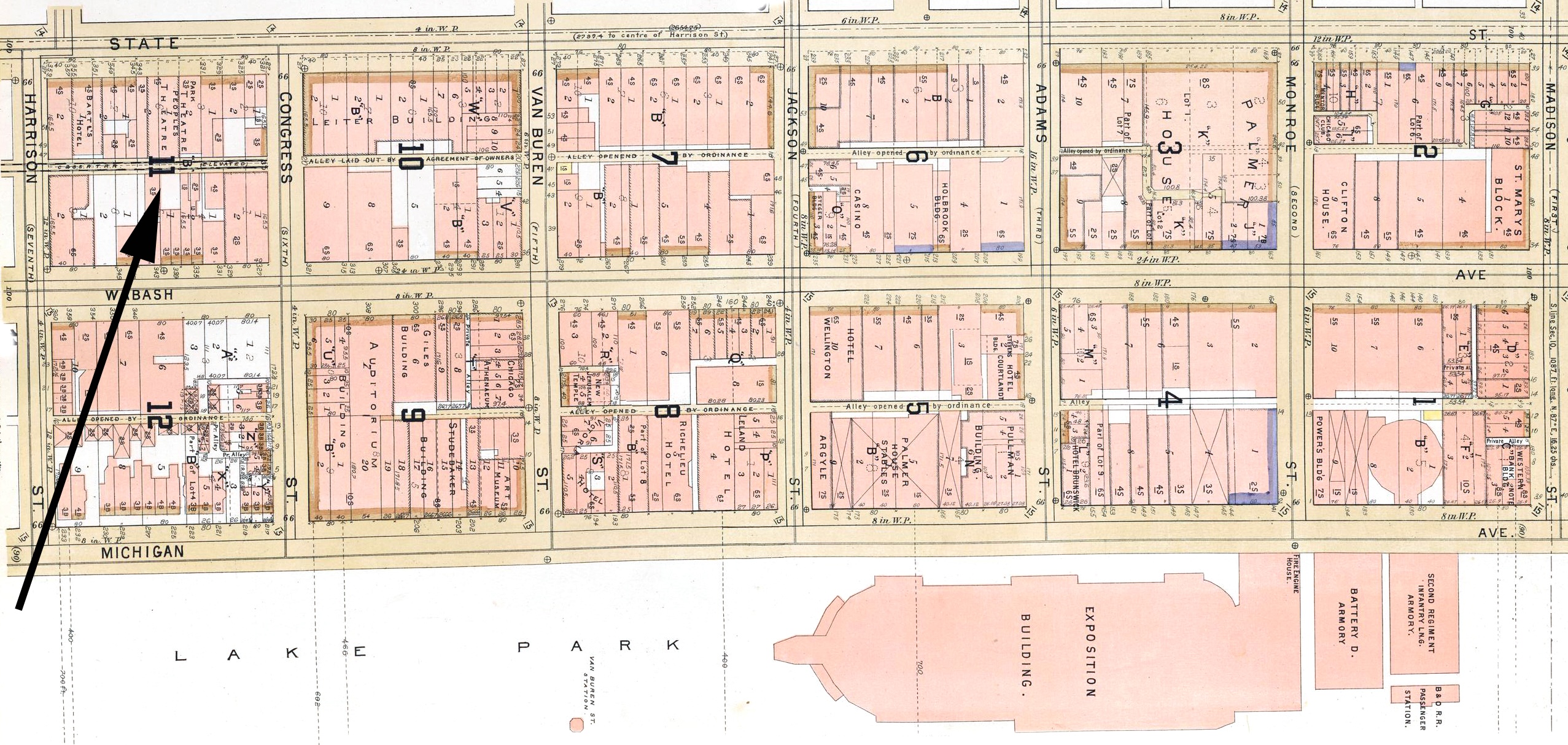
- Peoples’ Theater
Greeley-Carlson Atlas of Chicago
1891
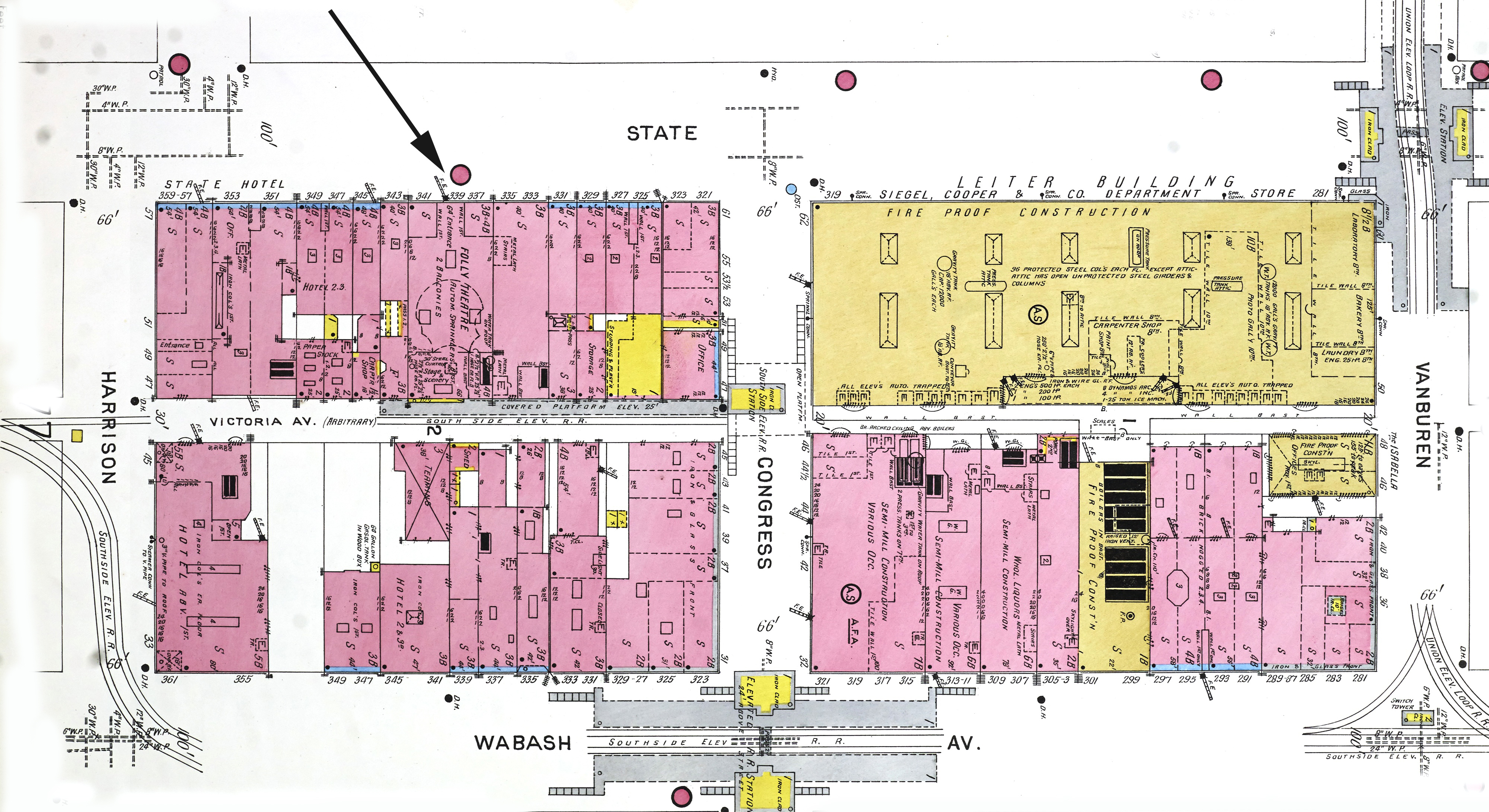
- Folly Theater
Sanborn Fire Insurance Map
1906
