Vaudeville Theaters of Chicago
The Standard, Hopkins’ Theater, Bijou
Life Span: 1883-TBD
Location: SW corner Halsted and Jackson
Architect: NA
- Lakeside Annual Directory of the City of Chicago, 1884
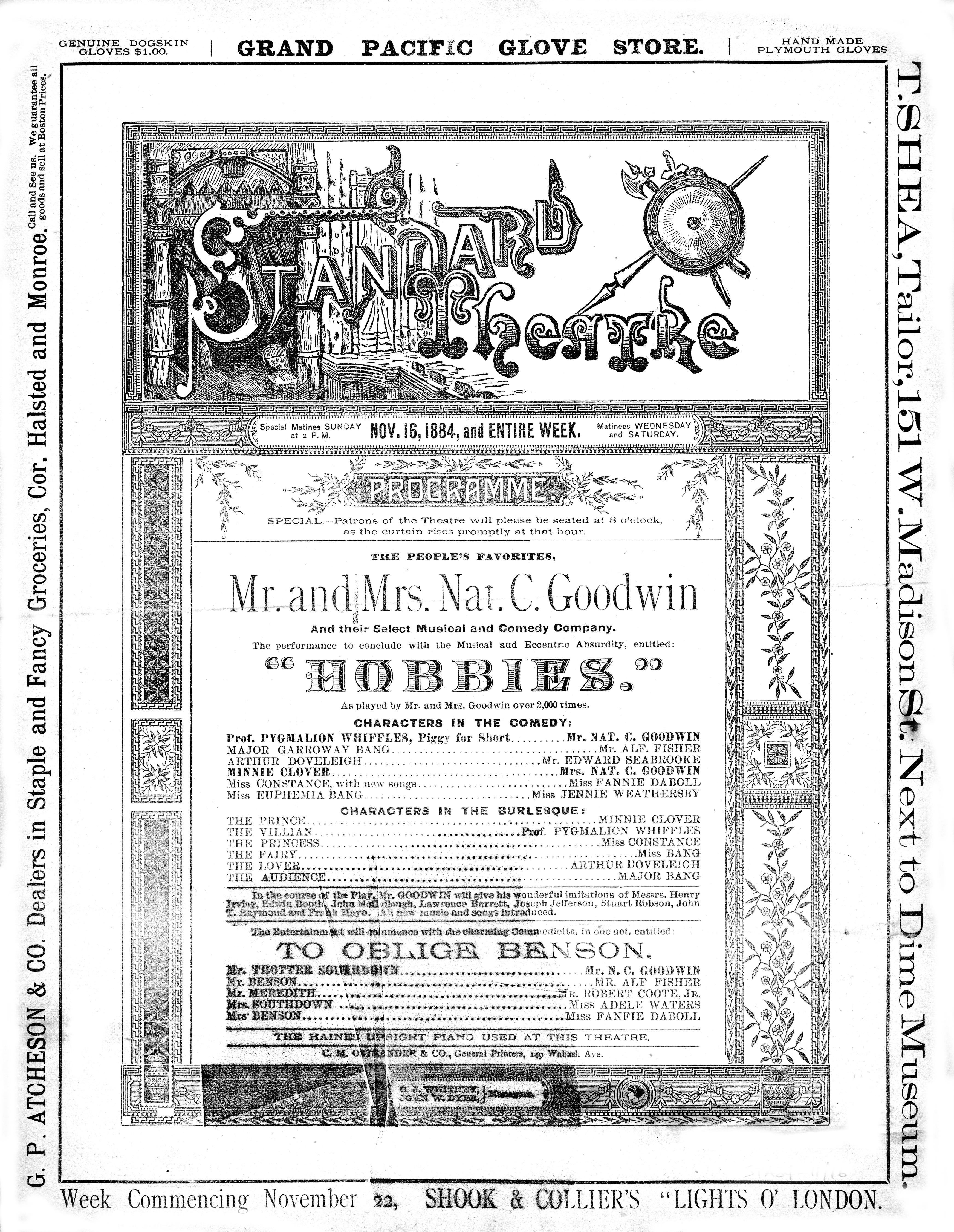
Standard Theatre, Whitney & Dyer, managers S. Halsted, sw. cor, Jackson,
A. N. Marquis & Co.’s Business Directory of Chicago, 1886-1887
Standard Theatre, Whitney & Dyer, props. S. Halsted, sw. cor, W. Jackson, T. 4164
Lakeside Business Directory of the City of Chicago, 1892
Standard Theatre 169 S. Halsted
Lakeside Business Directory of the City of Chicago, 1899
Bijou Theatre, 169 S. Halsted
Lakeside Annual Directory of the City of Chicago, 1904
Bijou Theatre, Geo Middleton prop 167 S. Halsted
Lakeside Business Directory of the City of Chicago, 1907
Bijou Theatre, 167 S. Halsted
Lakeside Annual Directory of the City of Chicago, 1911
Bijou Theatre, Geo Middleton prop 302 S. Halsted
Chicago Tribune, November 12, 1883
STANDARD THEATRE.
The New and Handsome Structure on the West Side.
The new opera-house at the corner of South Halsted and West Jackson streets is rapidly approaching completion and is beginning to assume a definite shape-both inside and out. This new temple of the art dramatic is to be distinguished as the standard Theatre The tendency of the auditorium is upward rather than elongated, so that the whole audience will be close to the stage. The front elevation is so far advanced that a tolerably accurate conception of its general appearance may be determined. It is composed of Zanesville pressed brick, with black joints, and is trimmed with handsomely relieved cut stone work, the first story being constructed entirely of iron. The upper story will be surmounted with a beautifully relieved pedimental feature, ornamented with balustrades, centre reliefs, etc. The architectural character of the face of the building is a combination of the Medieval, Queen Anne, and Eastlake styles, the result being very effective. A special feature of this front is a projecting porch from the second story covering the entire space over the sidewalk in front of the grand entrance. With this porch will be connected a jutting boot, or canvass cover, extending over the distance of the carriage-way as a protection to visitors in inclement weather. The upper portion of the porch will be illuminated inside by electricity, thus giving prominence to the name of the theatre and the surrounding panels, all of which will be filled with prismatic glass of various brilliant colors. The front columns of the porch will be utilized for lamp-posts. Beneath the porch is the circular-front band-balcony.
The entire auditorium will be heated by steam and ventilated by the use of what by is known as the Blackburn ventilating fans. By these means an entire change of atmosphere can be produced in the space of five or ten minutes. The stage is provided with mammoth smoke-ventilator for the rapid escape of all heated foul air created by the use of gun- powder, chemical light effects, etc., in spectacular plays and special stage illusions. One of the beauties of this system of heating and ventilating is that all possibilities of drafts or countercurrents will, it is conceived, be avoided.
This being the only theatre in this city located at the junction of two streets, considerably more than the usual number of exits have been provided. The stairways lead directly from square landings to square landings, so that all steps in a circular form are avoided. There will be no gallery. so called. The third floor will consist of one grand family circle. The first six rows of seats will be composed of opera chairs, the tickets for which will be sold at an advance of 5 or 10 cents, thus giving families of limited means the opportunity of special reserved seats at enjoying a very trilling extra cost. The rest of the family circle will be provided with the new patent folding seats upholstered backs, thus with affording unusual facilities for cleansing the floors.
The management are contemplating the use in the orchestra circle, the parquet circle, and dress circles, of the Keene chair, which folds in two ways. by which means the whole of these portions of the auditorium can be transformed in a moment almost into one vast series of aisles and exits, similar the seating of the auditorium in the Casino Theatre, New York. The balcony circle and balcony will be furnished with easy folding upholstered seats, provided with hat-racks. shawl-racks, foot-rests, etc.
The furniture of the auditorium, including carpets, upholstery, curtains, lambrequins, portières, etc., will be of the finest description in the market. The entire surface of the first floor will be laid with Wilton carpet and relieved with rugs of Turkish pattern. The second story will be carpeted with body Brussels, and the third, or family circle, will be covered with linoleum, using rubber on the steps.
One of the special features of ine auditorium will be the decorations, which are to be in the very latest style of the art. Light and dark shades of olive will be the predominating colors, abundantly relieved around the proscenium, the front treatment of the boxes, etc., with gold gilding, frosted bronzes. and other enriched imitations of metals; while in the background the work will be treated in a more subdued and modest line of colors. The under ceiling of the balcony, the entire outline of the foyer, and the grand entrance will be splendidly decorated and relieved with enrichments, panels, and reliefs. The effects sought to be arrived at are refinement in taste, harmony in color, and novelty in design.
The walls and ceiling oi the grand entrance will be covered with Lincrusta-Walton, a newly imported material from Europe which presents a carved surface similar to ancient Egyptian panel-work. The rails around the orchestra and the divisions of the first floor are to be of heavy silver-plated work, with beautifully ornamented posts. The spaces between the rails and the woodwork will be filled in with panels of basket-pattern brasswork. The rails of the boxes. balcony circle, etc., will be ornamented with banging drapery. There will also be a line of silver treatment on the face of the balcony and family circle, relieved with other gilded work to convey the idea of strength.
The panels of the celling will be relieved with broad figures in nicely tinted colors. The ribs, cornice, cove, brackets, and pendants will be adorned with stencil-work tigures and reliefs harmonizing with the general treatment of the auditorium.
The stage will be furnished with all the modern appliances and improvements for scenic effects, including four sets of the new adjustable grooves. There will be twenty-six sets of newly-painted scenery with set pieces, set houses. set rocks, raking-pieces, fly-drops, and all the usual accessories. Provision bas been made for the storing of scenery and properties on either the south of the west side of the stage. and the addition of extra dressing-rooms, if necessary.
The floor of the grand entrance will be laid with caustic tiles of a rich pattern, blue and white predominating, which will produce a very brilliant effect. The foyer stairs and landings will be covered with Wilton carpet.
According to present arrangements this place of amusement, which bids fair to be one of the handsomest in the city, will be opened under the management of Mr. C. J. Whitney, of Detroit, on either Christmas or New-Year’s Day.
Inter Ocean, January 1, 1884
NEW STANDARD THEATER.
Opening of the New Palace of Dramatic Art.
The new Standard Theater, corner, of Halsted and Jackson streets, was opened last evening by the Fay Templeton Opera Company, and the theater as well as the inaugural attraction and the quality of its audience seemed to justify the title, standard.
This theater has located in a new field, and time will have to testify as to its fertility. It presents a pleasing and imposing front, and has a commanding corner situation, leaving its four sides tree for facility of exit. If the exterior of the house is impressive the interior in its arrangement and decoration is second surprise, and more agreeable. The heavy oaken doors, the polished stairways with carved balustrades, the balcony and gallery with splendid sweep of compound curves, the proscenium with, forward support in a beautifully pillared arch touched with red bedaze and gold, and backed by stained glass, through which comes flashing intermittent light, are features of architectural harmony that cannot fail to win admiration. The decoration of the house is rich and restful as a summer dream—like the magic play of a golden thread in a woof of bine.
Mr. P. M. Almini, who conducted the decoration, has given artistic harmony of his colorings and added quality in unique design. The celling of the auditorium and balcony has a body ground of blue and 18 flecked with gold. No fanciful design or panel stripes distract the eye in this rich field of color. The walls furnish play above the osken-paneled dado for a rich but light stencil work in silver gray, making delicate contrast to the color ground work of the wall, which is the same the balcony ceiling, The ceiling is flat-paneled with ground color of rich gray, and each panel has titanic bird nest, and a bird of tropio splendor in plumage for its center piece. The frieze of the ceiling is made of peacock plumes, and, in contrast with the wall-work, its cornice of red bronze, and the rich relief and unique ornamentation of the work it borders, it is indeed striking and effective. Springing from large vases that ornament the curved walls beyond the line of boxes are flowers and vines, that spring up and blossom till they intertwine in the proscenium overhead. The boxes are semicircles in form, and are rich and complicated tin decoration and colorings. The columns about the upper boxes are wrapped in rich red plush, with lambrequins and drapings to match; the lower boxes have their qualifying color in bine with drapings to correspond. The balcony and gallery are silver railed, and their deep: carvings are colored in light and tipped with gold. The proscenium is pierced for stage doors that are hung with. portiers of old gold, banded with blue. The arch springing from over these doors has delicate decorative treatment in silver and gray, giving very harmonious bat decided contrast to the rich reds and beautiful bronzes enlisted in the work of the boxes.
The theater will seat 1,600, and the American Store and Stool Company, No. 270 and 272 Wabash avenue, supplied the seating arrangements, that told for freedom and open easily and expansively for comfort. The Ellacott patent self-adjusting chair, that comprises comfort 38 well as an ornamental appearance in its guilded framework. Messrs. Deckerman have given a rich upholstering in crimson and plush that corresponds with the carpetings and hangings of the house.
The auditorium is pleasing in all its provisions for comfort and allurements for the eye, and the stage is its very complete competitor. The delicate carve of the proscenium arch has a rich backing in a drop curtain that, together with all the complete and finished scenic equipments of the stage, was provided by Dosman & Landis. This well-known firm, that during the year past have supplied 175 opera-houses with scenery, have maintained a high artistic standard in this event. The drop cartain shows a marine that is framed in rich and elaborate hangings of silk, faced with lace. The stage has thirty full seta of scenery, complete with set pieces, etc., which, with ample stage for display, supplied with all the most recent mechanical effects, will afford rare facilities for striking stage effects.
Rand, McNally & Co.’s Bird’s-Eye Views and Guide to Chicago, 1893
The Standard Theater, at the corner of Jackson Boulevard and Halsted Street, is a large house, seating over 2,000 people; was erected in 1883. Light comedy and variety, with an occasional heavy tragedy, are its specialties. The admission is cheap, from 10 cents to $1 for the best seats.
Inter Ocean, January 28, 1894
V. K. Victor, who made a financial success of the Isabella Theater during the World’s Fair season, has taken the management of the Standard Theater, corner Jackson and Halsted streets. The house is well located, and is one of the prettiest in Chicago, and there is no reason why an active, earnest man as Mr. Victor is known to be cannot make it a paying affair. The management will offer vaudeville and burlesque attractions at popular prices. The opening performance was given Jan. 20, and the house was crowded. This afternoon there will be a few changes in the bill, though Florence Miller. the dancer, will continue to be the specialty feature. “Dreams: or Cupid’s Pastime.” will be the opening piece, and a Roman Gladiator march is announced as a novelty.
Chicago Chronicle, August 3, 1895
HOPKINS WEST SIDE HOUSE.
With a little speech-making and as much punch as anyone present desired the completion of the Standard theater’s transformation into the Hopkins’ theater was celebrated last night by Colonel John D. Hopkins and a good many of his friends. The new theater—for such it seems to be—has been prettily decorated, in white and gold principally, so that it lights up well and is a cheerful change from Halsted street, upon which it opens. Colonel Hopkins has spent money freely upon the quick restoration of the house, and in the eighteen days which the workmen have spent in it they have accomplished wonders. The auditorium retains its old lines, which apparently make it possible for anybody and everybody in the audience to see and hear all that goes on upon the stage. The seats in the parquet are comfortably upholstered in plush and have spring backs, while those upstairs are of rattan. There is a large balcony and a gallery above that running up to the ceiling almost. The ventilation seems to be good and the lighting, which is electric, is ample.
It is a theater to which the public will be inclined to take kindly for its own sake, and if Colonel Hopkins gives as good a variety performance there as he has in his State street house there is no reason why the same pleasant and profitable results shoula not be attained. The performance will be continuous, and a drama will be sandwiched in act by act between the vaudeville turns. The wayfarer on Halsted street will have no difficulty in locating the new theater, for an enormous electric sign, containing the one word “Hopkins,” blazes over the entrance, which is a few steps south of Jackson boulevard.
Inter Ocean, February 10, 1895
THE NEW HOPKINS THEATER
The new Hopkins Theater, entirely renovated and redecorated, opens tomorrow noon and will hereafter run daily from 1 to 11 p. m. on original lines. The performance will be a continuous one, and will comprise standard drama. and high-class vaudeville, and there will be no stops, waits, or overtures. The opening bill is a gigantic one, and can be readily surmised, after conning over this list of attractions, how John D. Hopkins even woke up St. Louis and injected a new idea into the heads of its Rip Van Winkle population. He simply gave them high priced amusement for mere bagatelle, and it is said the old managers, were left to take care of a choice array of vacant seats, while the walls of Hopkins’ (formerly Pope’s) Theater bulged at every performance. Will Manager Hopkins do the same in bustling Chicago, always ready to push on a good thing! His new theater will be run on original lines, and may “fill a long felt want.” A clean, clever, and interesting entertainment at nominal rates of admission will be a novelty in this house, and if Mr. Hopkins can keep up the gait set by his opening bill success is hardly a matter of doubt. The new order strives to be happy union of standard drama and high class vaudeville. and runs continuously from 1 to 11 p.m. every day, including Sunday.
Chicago Tribune, November 19, 1896
 Hopkins’ Theater is doing some excellent work in a quiet way for its patrons on the South Side. The house has had several things to contend with, not the least being its proximity to the old Park Theater of evil renown. As there are some who even yet do not know the difference between the two places of entertainment, it may be well to give emphasis to the fact that what was originally a low place of resort has been converted into a pleasant winter garden adjoining Hopkins’ Theater, while the house itself has become one of the most popular resorts for all who demand legitimate amusement.
The class of people that Hopkins’ Theater caters to is different from that which patronizes the more expensive houses, but it is none the less a class which asks for excellence of a certain nature. Col. Hopkins showed great discrimination when he determined to meet the growing demand for vaudeville by interspersing variety turns between the acts of drama; and the drama is of such a nature as the middle class loves. Nothing new. is as a rule attempted; but old plays which have stood the test of time are given a good representation by a stock company of no mean ability. The play for the present week, “A Sea of Ice,” by Kate Claxton, is well remembered by theater-goers of ten or fifteen years ago, and the piece gives excellent opportunities for spectacular effect. The company, as a rule, acts well, though there might be an improvement in the elocution of some of its members, who seem to have a difficulty in making themselves heard in the back of the house. The management has spared no pains to give an appropriate stage setting, and the dresses are in keeping.
The Vitascope is, of course, one of the main features of the entertain-ment, and many of the pictures are exceedingly realistic. Altogether the entertainment appeals to a large and varied portion of the community, and in doing so is to be commended highly.

Leave a Reply