Vaudeville Theaters of Chicago
Rice’s Theatre II
Life Span: 1851-1857
Location: Dearborn Street, between Randolph and Washington
Architect: John M. Van Osdel
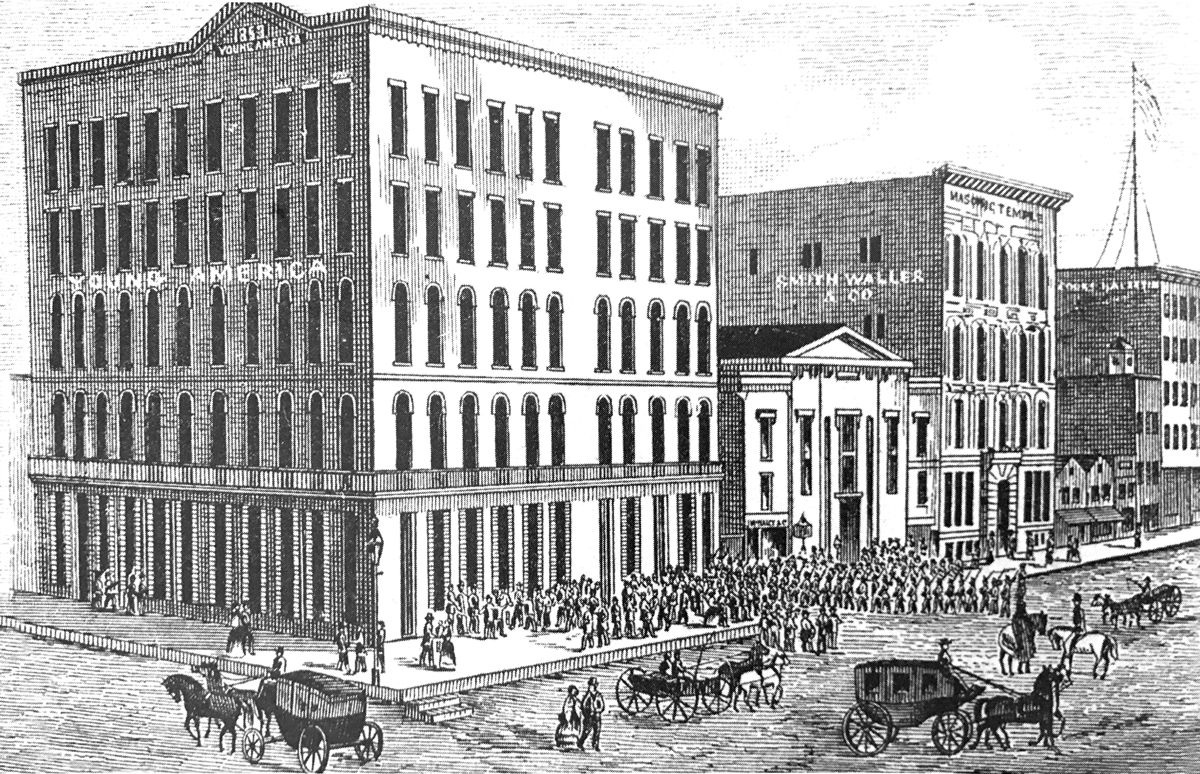
- The second Rice’s Theatre
Right of the Young America Hotel
The Chicago Daily Journal, October 29, 1850
New Theatre.
This fine structure is rapidly approaching completion and is planned after the most approved models for such buildings. Being one hundred feet in length, it gives ample ‘scope and verge’ for those who ‘strut their brief hour upon the stage.’ There will be three tiers of boxes, a Saloon, etc., etc. If the work progresses as begun, Mr. Rice will open about the First of January.
Chicago Tribune, December 28, 1850
J. B. Rice erected a brick Theater on Dearborn between Randolph and Washington streets. It fronts 80 feet on Dearborn and extends back 100 feet. Roof and ornamental cornices of galvanized iron. Cost $11,000.Vanosdel architect, C. & W. Price Masons, Updike & Sollet builders.
The Chicago Daily Journal, January 29, 1851
The Theatre.
The interior of this beautiful edifice is receiving the finishing touches. The scenery grows apace. Mountains rise, plains stretch away, palace turrets gleam, and forests rise as magically as “Birnam Wood came to Duficinane.” It is to be opened Monday next.
On February 3, 1851, Mr. Rice opened his second theater, which was built of brick at a cost of $11,000, on Dearborn Street, between Randolph and Washington. With a frontage of 80 feet and many improvements and conveniences, it was regarded as a great step in advance and was destined to be the home of the drama in Chicago for six years, during which period all the important stars of that early day visited the city, which at that time boasted a population of less than 5,000 souls. The theater was opened on the evening already mentioned. The stock company joined first in singing the Star Spangled Banner and then presented a triple bill: Love in Humble Life, Captain of the Watch, and The Dumb Belle.
It was transformed into a business house in 1861, having outlived its usefulness by several years.
The Chicago Daily Journal, October 24, 1853
The undersigned, acting in the name and on behalf of Mme. de Vries and Signor L. Arditi, (known by the name and style of the Artists Association) has the honor of calling the attention of the musical community and of the citizens of Chicago in general, to the fact that he has made an arrangement with Mr. Rice, the manager, to have the Italian Opera Troupe for two nights next week at the Chicago Theatre, to perform the opera in Three Acts, Lucia di Lammermoor, the chef doume of Donizetti, and the grand masterpiece of Bellini, Norma.
The undersigned respectfully begs leave to introduce to the citizens of Chicago in general the following unrivalled artists, who were received with the utmost enthusiasm and unbounded applause by the public of New York, Boston, Philadelphia, Washington, Richmond, Cincinnati, Louisville, and St. Louis:
- Prima Donna Signorina R. de Vries
Tenor Signer Pozzolini
Baritone Signor Toffanelli
Basso Signor Colletti
The public will find that every department is complete as well for the number as for the excellence of the performers.
A very effective chorus of ladies and gentlemen the best in the United States of America and desirable even in Europe.
The orchestra is composed of solo performers, and all professors of the highest standing over 40 in number, the whole under the magic direction of the most distinguished master and composer, Sig. L. Arditi, of European fame, and well known as one of the greatest living composers.
The undersigned feels confident that the citizens of Chicago will appreciate his efforts to produce before them an Italian Opera on a scale unrivalled, and that they will bestow upon them liberally their favors.
Sig. Poliani.
History of Chicago, A. T. Andreas, 1885
Rice’s Theatre.—Until 1857, Rice’s Theater was the attractive center of dramatic representation in Chicago. For ten years it had been the chief place of amusement in the city, and the popularity of Mr. and Mrs. Rice never waned for an instant. No man had done so much for the interest and amusement of the Chicago public as John B. Rice, and his constant increase in favor testified how deeply that public appreciated his labors. But in 1857, he and his wife determined to retire from the stage, and the theater passed under other management It also encountered the competition of its new rival, just erected by J. H. McVicker, and its end was not long in coming. For several years it led a fitful and unpopular existence, until, in 1861, it became manifest to Mr. Rice that it could no longer maintain its place as a theater. He then had it torn down, and on its site erected a handsome business block.
NOTES:
1 Chicago Daily Journal, 1844 – 1929 (newspaper was relaunched as the Chicago Daily Illustrated Times)
1 Chicago Democrat 1833 – 1861 (merged with Chicago Tribune)

Leave a Reply