Chicago Tribune, March 10, 1872
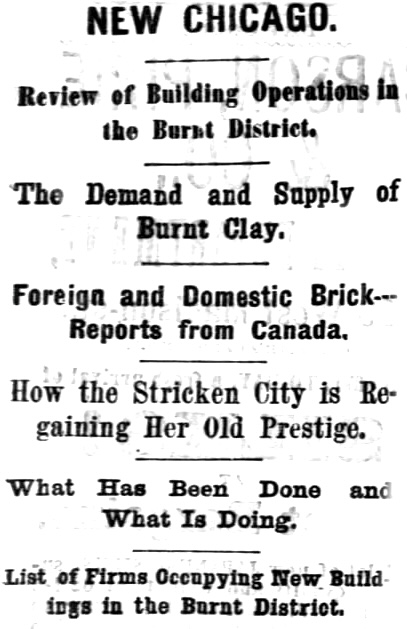 Building continued active during the past week, until the snow storm of Thursday entirely suspended operations. The feeling has generally been hopeful. The work accomplished begins to show itself perceptibly. A few weeks ago a person could have an uninterrupted view from the river to Harrison street. In whatever direction a person now looks the vision is soon bounded by high walls. Judging from external appearances, comparatively few people are much troubled to obtain funds for rebuilding. It material can be obtained readily, our city is to be rebuilt, and that soon.
Bricks.
The price of bricks remain at $16 per thousand, and there is no probability of any abatement before the 1st of May. Builders express fears of a short supply before the first kilns are ready for the market. The surplus bricks within a radius of a hundred wiles of the city have nearly all found their way here, and are in process of speedy consumption. The brick-making region of Wisconsin, as far as Milwaukee, is believed to be nearly drained. Some still remain in Sheboygan and vicinity, but the quantity is not great. There are some brick still to be had from the cities east, if transportation can be had by rail. But this is said to be impossible. There are 3,000,000 or 4,000,000 for sale at Cleveland, but the Lake Shore & Michigan Southern Railroad cannot furnish for them to Chicago, and if it could would not have a place to unload them; 2,000,000 have been offered by dealers in Monroe, Michigan, but there are the same insuperable obstacles in the way of their being brought. It is to be presumed that the Central Railroad is no better prepared to furnish transportation for this important building material than its rival. As a partial compensation, the old brick, which have passed through the conflagration, will be largely used. Experts say that they are better than much of the brick brought from the interior. They have certainly been put to the severest test to which building material was ever subjected. They are cleaned and sold at $10 per thonsand. Even the fragments are used, two or three pieces counting as one entire brick.

- Anecdote from “The Great Conflagration. Chicago: Its Past, Present and Future,” James W. Sheahan and George P. Upton, Associate Editors of The Chicago Daily Tribune, 1871
Canadian Brick.
The effect of the law before Congress, providing for a drawback upon building material used in the burnt district, has been exaggerated by sanguine persons. Experienced brick-makers, who have canvassed the field carefully, say that the Canada article cannot be brought to this port and delivered at the place of consumption for less than $13. Persons in the Chicago brick interest have lately returned from the expected sources of supply in the Dominion, and report that on account of the high prices of labor prevailing there, and the difference in the respective values of and gold brick cannot be made in currency Canada for less than $7 a thousand. Freights, they say, will rule at least $4, and other contingent expenses, necessary to bring the material into the hands of the consumer, will raise the final cost to the figure named. The writer is inclined to think this estimate exaggerated, but it does not seem from the below present outlook that the price can be brought below $10, at which figure our Chicago manufacturers are ready to contract for any amount desired. The specimens of common Canada brick shown in this market are superior, however, to the home-made article, and should command at least a dollar a thousand more. In spite of -Horta to obtain a supply, it is probably that wang writ be delayed in boilding by the of obtaining from any source the necessary amount of brick to carry on their operations.
A Contingency.
Everything being favorable, after the first kilns come in, in May, the supply will be abundant, and the wide competition will bring the material to the lowest rates possible, under the circumstances. But there is another contingency to be feared. The winter has been extremely dry and the manufacturers fear consequently a wet April, which would be highly injurious to the rebuilding of the city. Any cause of that kind affecting the interests of the brickmakers in this city would be sufficiently general in its nature to affect the whole region on which Chicago depends for its supply the coming season. All our manufacturers are prepared to commence operations with the first fair weather of spring. Their facilities for business have been of immensely increased. Frost and rain are fatal to their prosperity. Little can be done unless men the elements are favorable.
Our business men risen above their financial difficulties and are prepared to make Chicago greater than she has yet been in the shortest possible space of time. To men anxious to retrieve their fortunes and eager to effect the restoration of the city, the delay of month seems a great calamity. All that man can do has been done, and it only remains to be hoped that circumstances beyond their individual control will be favorable.
Prophetic.
Soon after the fire occurred it was not hard to find men who said that Chicago would never recover from the blow which she had received. Then these ill-boding prophets modified their predictions, allowing for the possibility of her recovery, but saying that it would take an indefinite period. A quarter of a century was the least time granted the stricken city to regain her old prestige. Gradually, as signs of life and energy began to develop the time was reduced to fifteen years, then to ten years. Within a few weeks many hopeful persons have ventured the assertion, that all the streets of the burnt South Side, and the portion of the North Side within a half mile of the Chicago River, would be built up continuously in five years. The writer goes a little farther and ventures to predict that within two years this part of the burnt district will be built up continuously, and, in most instances. more handsomely than before. The buildings will be stronger, more commodious, and specially better adapted to the multifarious business carried on within their walls. The prophecy is bold, and the consummation of it will be scarcely the less wonderful than the fire itself. Before the first of September the whole of Lake street east of the bridge, the whole of Wabash both avenue. fronts probably for the whole of Michigan avenue, the entire length of State street destroyed by the fire, all of Madison street, nearly all of Clark street will be built up, solidly and continuously. There may a few gaps on these streets, but it is improbable. There will doubtless be many buildings that are neither nor substantial, but the majority will combine both of these desirable qualities. The streets on the South Side not named will also be far advanced in the way of restoration.
What Has Been Done.
Any one who will take the pains to study what has been done, what is doing, and what is speedily to bo essayed, will, we think, agree with us nearly in our prediction. The greatest energy, thus far, has been shown in the quarter formerly devoted to the heavy trade. The vitality of this portion is essential to the life and prosperity Chicago. There is only one lot on River street that remains untouched. This la at the corner Dock street. The rest of the proporty bordering on it is already covered with buildings, most which are under roof, and a large part of which are already occupied. Laflin’s block of four stores, built of Milwaukee brick, is not yet finished to the roof, but two of the stores are already rented, and the others will be speedily. The entire building will be occupied before the 1st of May, The buildings, which are specially mentioned elsewhere, are far superior to thise which formerly occupied the same sites, both in external appearance, durability, and in interior accommodations. The improvements on Water street are also well advanced. Nearly the whole street is under contract for rebuilding, and many buildings are already occupied, as will be seen on referring to our list. Wabash and Michigan avenues, for several squares south of the river, show signs of extraordinary animation. Scarcely a foot of front on either of these streets is not in a way to be covered within a very a few little months. The buildings on Wabash avenue are a little nearer completion than those on Michigan avenue. Many of those on the north end of the former thoroughfare already occupied. Permits have been granted by the Board of Public Works to erect buildings to every lot on Lake street with a single exception. The prospects of the east end of Randolph street are favorable. From present appearances it is safe to say that a section of the burnt district, bounded by the South Branch, the river, the lake, Lake and Randolph streets, will be built up solidly by the 1st of May. By midsummer there will be a firm doing business in every warehouse within those limits. The eastern line of this section we mean to be three streets named following them from Lake street bridge to the lake in the order named.
Wholesale Grocery Trade.
The wholesale grocery has already gravitated to its proper place. are either already located. or soon will be located, within two squares of Water and River streets and Wabash avenue, The names of those already placed are given in our list. The advent these firms to a quarter so suitable for their business is sufficient to indicate the permanent position of the business. Many of them have shown great enterprise in putting up their own buildings during the inclement weather which followed soon after the fire. The new weather buildings are all superior to the old in strength and adaptation to the business. There were about forty firms dealing largely in groceries before the fire. Nearly all of these are doing business now in some part of the city. Twenty-five or thirty are in the burnt district, or will be within a month. The stocks carried are large and well assorted. The merchants are all in spirits. and declare themselves unable to see any diminution in the important branch of the trade in Chicago.
Getting Into the Burnt District.
Merchants feel sensitive especially about venturing into the burnt district, especially those doing a retail trade. For a year to come, at least, they hare their trials and tribulations. Our present article, however, will show how they are doing it, and the number already within that limit desolation, doing business in permanent buildings, will astonish the many of our readers. Those near the edge of the desert, and those convenient to street cars will experience the fewest obstacles to their trade. Already there are retail dry goods, crockery, and carpet stores on Madison street. Clothing houses, and all their branches of retail commerce will soon follow. Field & Leiter will be favorably situated as regards both the street railroad and the Madison street bridge. The retail dry goods business will be well represented on Monroe street by the handsome establishment of Messers. J. V. Farwell & Co., which is also convenient to the West Side. Those people so fortunate as to secure rooms in Coolbaugh’s building on Madison and Market streets, in Judge Farwell’s building on Market street, adjoining, or any of the buildings on Market street, will have, for the present, the advantage over their friends farther out in the burnt district who seem to be the coming season afloat in a sea of brick, mortar, and other building material.
The completion of a single block, however, insures its occupants a partial immunity from the discomforts and inconvenience of rebuilding. The region which we have mentioned in the vicinity of River, South Water, and Lake streets, Wabash and Michigan avenues, leaving the river at its back, on which it depends largely for the facilities of its trade, and having the prospect of soon receiving the finishing touches of the artisan, will be the first relieved from the disadvantages incident to reconstruction, It is to be hoped that the difficulties likely to attend the reopening trade on the South Side will deter no one from making the venture. The evils wili undoubtedly be of an aggravated nature during the summer. By fall it is probable that they will be considerably ameliorated, and gradually disappear with the completion of every new building.
Buildings Already Occupied.
The following list comprises all the brick buildings in the burnt district on the South Side actually in use for any legitimate business, with the names of nearly all the firms and individuals occupying them. The length of the list will surprise most persons who have not followed closely the various articles which we have published from time to time indicating the progress made in the work of resurrection. Nearly every building mentioned has been described in previous articles, but in a scattered and detached manner, which failed to give the casual reader a complete idea what was really being accomplished. The aim of these articles has always been to avoid mere rumors, and to make no statement not definitely assured.
State Street and Vicinity.
The four-story building of Mr. P. O’Neil, at the corner of State and Harrison streets, is occupied by himself on the first floor for a liquor store. The rear part is finished for an elegant bar, equal, it not superior, to any in this city before the fire. Platt, tailor, has a portion of the first floor. L P. Chase & Co., occupy the second floor. Various other parties will be in the building.
No 366 State street, a two-story brick building, is occupied by E. Williams, jeweller, M. Arenberg, stationer, and J. Baum with a stock of millinery goods for the wholesale trade.
The two-story brick, No. 299 State street,east side, built by Mr. Wilson, laundryman, is occupied by himself, and the firm of S. Kasprowitz. & Son, with a stock of cigars and leaf tobacco.
Just east of State street, on the south side of Van Buren, is the three-story brick building, erected by R. & L. Lancaster. It contains three divisions, W. T. Noble & Co., manufacturers of picture frames, looking glasses, etc., are already in it, with a fine stock of pictures, etc. Landhagen & Co., wholesale dealers in millinery goods, are on the second floor. The second floor of the west division is to be immediately occupied by Benjamin Lombard, agent of the National Life lnsurance Company, formerly in the block near the Custom House. The Real Estate Loan & Trust Company will occupy the first floor of the west division of the building in two or three weeks.
In this connection it is appropriate to mention the fact that Mr. Lombard, owns 200 feet on Dearborn street, at the corner of Van Buren, and will erect handsome buildings on it early in the spring.
In the two-story building on State street, east side, near Monroe, are Messrs. Barry & Cushing, painters and paint dealers; Tomlinson Brothers, shirt manufacturers; and Parkman & Andrews, hardware dealers. The building is not a showy one, but its owner showed considerable enterprise in putting it up, commencing almost immediately after the fire. Most of the parties occupying it have been in since Christmas, Adjoining this, on the north, is a building of the same pattern, erected by Dan Barclay, and occupied by himself. Wilks, range manufacturer, owns the middle building, and occupies a part of the upper story for his own business.
First National Bank.
The First National Bank has been for some time occupying the basement of its handsome building. at the corner of State and Washington streets. The main office, which has been refurbished elegantly after the same general pattern, is nearly ready for occupancy. The managers expect to be in it before the 1st of April. The vaults of the institution, which stood the fire so well that several other banks have been using them since that time, have been greatly strengthened and improved. One apartment, arranged especially as a safe deposit for papers, is lined with Pittsburgh wrought-iron, having flanges on each side two inches in projection, giving an entire thickness of four inches. An additional layer of brick has been placed in all the compartments of the vault, and the iron work hae received additional reinforcement. The stone work of the Washington street exterior wall is receiving its finishing touches. The outsides steps have been removed, and where the walls were flaked by the intense heat, they are being paired, and new stone neatly fitted on the original design being in all instances carefully preserved. The discolorations of this stone will be removed by some process of cleaning, and the building will, in a few weeks, look as fresh and new as when first transferred from the hands of the contractors to the corporation which owns it.

- First National Bank II
Under Construction in 1872.
Madison Street.
Hunt, Barbour & Co., dry goods men, last Thursday opened their store on Madison street, between Dearborn and Clark, to the public, with a stock of goods intended for the wholesale and retail trade. The firm deserves the credit of being the first to go into a permanent building in the burnt district on the South Side.
L. Nickerson, wholesale dealer in carpets, etc., has been occupying his two story brick building on Madison street, near La Salle, since about the 1st of January.
Directly opposite is the building which is being pat up by James Wadsworth. The first story only is enclosed, but is already occupied by a wholesale firm dealing in boots and shoes.
On Madison street, near Fifth avenue, James Egan is occupying a two-story brick building with a stock of liquors.
Watt & Johnson, tobacco manufacturers, are immediately back of Nickerson’s liquor store, on Arcade court.
Carson, Pirie & Co. have resumed the wholesale dry goods trade in a three-story brick building on the south side of Madison, near Franklin street.
Nearly opposite Field & Leiter’s immense establishment, which is already full of goods in every line of their business, is a two-story brick building, in the first story of which are Jameson & Morse, printers, and Garrettson & Barry, stencil-plate manufacturers.
The large four building on Madison street, South Side, near the bridge, containing four stores, is variously occupied. Nos. 268 and 270 are occupied by a stock of whiskeys and other liquors. Eddy, Harvey & Carter, wholesale dealers, have a large stock of hats, caps, etc., in No. 272. The remaining stores are used by Biddle & Boyd, dealers in cassimeres, and John Servis & Co., wholesale dealers in furnishing goods.
In the three-story brick building near the southeast corner of Madison and, Market streets are the Illinois Pneumatic Company and the Chicago Enamel Works.
Lake Street.
J. & A. Boskowitz, dealers in buffalo robes and raw lure, are in the two-story brick building built by Judge Goodrich, No. 246 Lake street.
The Garden City Manufacturing and Supply Company for Lumber, etc., have taken possession of a three-story brick building just east of the foregoing.
The three-story red brick building erected by E. Porter, Esq., at No. 207 Lake street, 18 used by the Union Hide and Leather Company, who have been in it since the 20th of December.
L. A. Cobb has rented his three-story brick building, No. 206 Lake street. to the Walter A. Wood Mowing and Reaping Machine Company, who have been in it for some time.
Next east of this is Fletcher’s building, used as a seed store by P. B. Messerole, who has been in it since the 1st of February.

- The Lumberman’s Exchange
South Water Street.
South Water Street.
No. 212 South Water street, a four-story building erected by Mr. Herder, is occupied by Best & Dickinson, with a stock of groceries and ship stores.
The Finney Brothers, ship chandlers, sailmakers, etc., occupy No. 214 South Water street.
J. D. Ryerson own and occupy, on the same street, a large building put up by themselves, being from No. 218 to No. 224 inclusive. with a stock of heavy iron and boiler-makers’ supplies.
Nos. 226 and 228, adjoining, are to be soon occupied by Gilbert, Hubbard & Co., ship chandlers.
The Lumberman’s Exchange, near the building just mentioned, is finished, but has no tenants as yet.
S. P. Platton & Co., wholesale dealers in fancy groceries, are in Hon. I. N. Arnold’s building, No. 39.
No. 139 was built by Henry S. Chase, of Boston, and has been for some time occupied by J. & H. Chapman, Chicago Bag Factory, dealers in all kinds of bags and bag material. The building is a three-story brick, erected on the old site.
A. S. Waltman, commission merchant, occupies, a portion of the two-story building erected by himself, Nos. 114 and 116 South Water streets.
The other occupants of this are building Schuabel & Case, jobbers of cigars; F. Rae & Son, hop and sage-pressers and a job printer. The building will be raised to four stories daring the coming season.
At the corner of State and South Water streets, J. H. Dunham has erected a large three story and basement brick building, which 18 occupied by J. H. Dunham & Co as a wholesale grocery. It is one of the pioneer buildings in that portion of the city, fire after having been commenced a days after the fire. On the 1st of January this firm moved in with a large stock of goods. The numbers are 4, 6, 8, and 10. The Hazard Powder Company have an office on State street
From a member of the firm we learn that John Dekoven is about erecting a large double store on the corner of Lake and State streets.
Also that David M. Bradley has leased a piece of ground 100×70 feet at the corner of Jackson street and Third avenue. The lease provides that the building shall be of brick, and three stories in height. Baker, Smith & Co, of New York, have taken 50 feet, and A. N. Kellogg, of the Railroad Gazette have taken the remainder.
The fine four-story brick building of H. H. Shufeldt, on the north side of South Water street, near Wabash avenue, was completed in December, and since the 1st of January has been occupied by Joel H. Dix & Co., dealers in foreign and domestic dried fruits, canned goods, and fancy groceries. L. Gould & Co., wooden-ware man, have been in it since the 1st of March. The building is one of the most substantial in that quarter of the city.
River Street.
No. 52 River street, a one-story brick building, to be built higher higher during the coming season, is occupied by Harmon, Messer & Co., wholesale grocers.
No. 50, by E. Hempstead, is occupied by No. W. J. Quan & Co. in the same way.
The handsomest building on the street is that of Wm. Numsen & Sons, Nos on 45 and 47. It is five stories high above the street, and has an iron front of handsome design, manufactured in Baltimore. It was put up in eight weeks, and has been occupied since the 15th of December by the owners, who are heavy dealers in canned goods, fruits, preserves, pickles, etc. Their business requires nearly the and entire building. W. H. Colvin a sugar broker, and L. W. Daniel, dealers in cigars, occupy a limited portion.
Hurlbut & Edsall, wholesale druggists, are in a four-story red brick building at the corner of Dock street.
Wm. M. Hoyt is to build at the foot of River street.
Ransom, wholesale dealer in stoves, is in a large four story red brick building on the west side of the street, near the river.
Sibley, Endicott & Co., wholesale grocers, are at the corner of Water and River streets.
Miscellaneous.
Laflin’s handsome block of Milwaukee brick, on the north side of River street, containing four stores, is not yet ready for occupancy. Two of them are already rented, one to Knowles. Cloyes & Co., spices, syrups, etc.. and the other to Gould Brothers, wholesale grocers.
Dan Hyde & Co., wholesale grocers, will soon be located in the vicinity of River street.
Heath & Milligan occupied their fine five-story building on Randolph street some weeks ago.
Opposite Ransom’s stove store is a large three story brick building used by Spaulding & Merrick, as a tobacco manufactory.
The large three-etory building of Matthew Laflin, on the corner of South Water street and Wabash avenue, is about completed, It contains four stores, several of which have been for some time occupied. The front has been changed from South Water street to Wabash avenue, giving the stores lets depth, but greater width, consequently a better adaptation to the grocery business. Willard & Co., wholesale grocers, occupy one of the stores. Another is occupied by Kellogg & Barret.
J. W. Doane & Co. have leased the Birch property, and are going to put up a four story block, fronting on Wabash avenue, to contain four stores. The Gray Brothers will occupy one, Franklin Mc Veigh another, and J. W. Doane & Co. another,—all wholesale grocers.
Wells, Faulkner & Co. will occupy one of McCormick’s buildings to be erected on South Water street, near Wabash avenue.

- Reed Block
Hibbard, Spencer, Bartlett Co Building
Hibbard & Spencer, hardware men, are to occupy J. of H. Reed’s new building, now in rapid erection at the corner of Wabash avenue and Lake street.
Doggett, Bassett & Hills, will go into a new, building on the southeast corner of Wabash avenue and Lake street.
Phelps, Dodge & Palmer, wholesale boots and shoes, already in their new four-story brick building, Nos. 48 and 50 Wabash avenue. The entire arrangements are perfect. The office is handsomely finished in black walnut.
The Sherman Brothers, proprietors of the Sherman House, are in the wholesale hat and cap business, in a handsome store Nos. 56 and 58. Wabash avenue. The interior is neatly finished, the second floor being supported, by handsome Corinthian columns.
About the 15th of March A. H. Kohn, wholesale clothier, occupy their own building, at the corner of Wabash avenue and Randolph street. It is one of the first erected in that locality. The size is 50×106 feet, and the material used in its construction is Milwaukee brick. The firm have occupied their present quarters for over two months.
M. Solz, wholesale boots and shoes, has a building just south.
West of Day’s, building, on Randolph street, and immediately adjoining it, is the building of Mrs. Sanford, in which is Philip Goldman, with a stock of boots and shoes.
J. B. Inderrieden has a stock of foreign and domestic prints, and fancy groceries, in a three-story building on Wells street, not far from Washington.
Ww. Archdeacon, pickler and preserver, formerly of South Water and Dearborn streets, has resumed business in a two-story brick building, Nos. 211 and 213 Randolph street, owned by Thompson & Templeton: Mr. A. commenced business in this location about the first of January.
Smith, Cleary & Enwright, dealers in Bourbon and Pennsylvania whiskies, are doing business in a two-story building, No. 52 Franklin street.
Walker, Oakley & Co., leather, dealers, are in building of similar description, just west of them.
The Hartford Insurance Company are under full headway in their new three-etery brick building on LaSalle street opposite the entrance to the tunnel. The building is of old brick but bas been painted, giving a handsome exterior appearance. The interior is neatly finished in imitations of various woods, and the second story is reached by a fine black walnut staircase. The upper appartments are neat without being showy.
W. & A. Keith & Co., wholesale dealers in hosiery, white goods, linens, etc., are in S. White’s building, Nos. 14 and 16 East Madison street; Mr. White himself occupies the second story with a stock of dental goods, the first named having the first floor and basement.
The two story brick building of Bowen Brothers. at the corner of Michigan avenue and Madison street, is one of the first built in the burnt district. It contains four stores, and is occupied by Enos Brown & Co, wool and woolen-mill supplies; Colladay, Trout & Co, commission merchants; Ira A. Bowen & Co, office; Richards, Shaw & Winslow, office; Granniss & Farwell, wholesale grocers, and Stettheimer & Wineman, wholesale dry goods.
Clark, Abbott & Co., dealers in machinists’ supplies, will occupy the three-story building now being put up by the National Bank of Commerce, as soon as it ie completed.
They have sub-let all the floors above the first to Little, Wetmore & Thompson, manufacturers and jobbers of clothing.
Ww. Newton is to re-erect his store in the old location, No. 54 Madison street. The front is to be of Milwaukee brick. The size on the ground is 30×100 feet. The height is to be four stories.
The only building on Washington street now occupied, besides the First National Bank, is a three story brick at the corner of Franklin street, in which H. Byrne has a stock of gas fixtures.
The Lewis House is the name of a small twos-tory house of public entertainment on Wabash, avenue, near Monroe street.
Potter Palmer’s three story brick building, on Monroe street, between Wabash avenue and State street, is rented by Allen & Mackey, who have occupied it for some time with a stock of carpets, and other articles common to that line of trade.
C. H. Beckwith & Co., wholesale grocers, are doing business in an unobtrusive one-story brick building on the south side of Madison street, east of Wabash avenue.
J. L. Smith & Co., tobacconists, are doing business under the same roof.
McKindley & Gilchrist, wholesale grocers, are doing business in a similar building, nearly opposite.
On and Near Monroe Street.
F. D. Cossitt & Co., wholesale grocers, are on Michigan avenue, south of Monroe street.
Williams, Muller & Olmstead, wholesale dealers in hats, caps, and furs, are in the same building.
Brinkworth’s building, on Monroe street, west of State, is at present occupied in the rear by himself, as a pork house.
Chapin & Gore, wholesale dealers in liquor, will occupy the store on the east side about the 1st of April.
Nixon’s building, on the corner of LaSalle and Monroe streets, which had a narrow escape from the fire, is full of tenants.
In the basement are Ogden, Sheldon, & Co., Real Estate Brokers and Capitalists; the Chicago Land Co.; Ogden, Scudder, & Floyd; Underwriters’ Agency, of New York; Continental Life Insurance Co., and J. M. Van Odel, Architect.
On the first floor are the offices of Peck estate, the Scandinavian Bank, and the Traders’ National Bank (temporary).
On the second floor are Snyder & Lee, Real Estate: Belden F. Culver, Lake Shore Real Estate; Cochrane & Milles, Architects, and Mr. Nixon’s offices, and several law offices.
On the third floor are Otto H. Matz, Architect; S. O. E. Bauman, Architect, and other rooms of Mr. Ogden.
On the fourth floor are Tilly, Longhurst & Folz, Architects, and several lawyers.

- Nixon’s Block after the Fire.
The three story brick building on the south side of Monroe, east of LaSalle street, is occupied by E. Hollister & Co., wholesale carpet dealers, and Frank Brothers, wholesale notions.
The United States Express Company have finished and are occupying their large and commodious stables on Monroe street, near Wells.
A full description of the new wholesale and retail dry goods establishment of Messrs. J. V. Farwell & Co., on Monroe street, near Franklin, has already been published in our columns.
The store just vacated by Farwell & Co., adjoining their new establishment, is already occupied by W. H. King & Co., with a large stock of clothing intended for the wholesale trade.
Market Street.
The Board of Trade Buuding, owned by Judge Farwell, contains the following tenants, all of whom rent rooms:
Commission men, Spruance, Preston Co.; Knight, Baker & Co.; J. A. Wheeler; John L. Ranny; Meadows & Ellison; Comstock, Pickering & Co.; L. L. Curtis; Eggleston, Hennis & Co.; J. W. Rogers. Jr. & Brother; Dawes, Pope & Co.; Gulver & Co.; Wm. Young & Co.; Trego, Kellogg & Co.; Mugridge & Peabody; Hoagland & Clark; B. F. Murpay & Ca.; Conley, Dwight & Co.: and Henry L. Gay, architect.
These firms sub let to others, and probably represent as many more firms and individuals, each doing a separate business.
On the east side of Market street, opposite Judge Farweil’s building, is a three story brick building, built and owned by themselves, are King Brothers, with a stock of hats and caps etc., for the wholesale trade.
Reid, Murdock & Fisher, wholesale grocers, occupy the four-story brick at the corner of Washington street.
Judge Farwell’s new building will soon have three or four hundred tenants.
On the east side of Market street, just north of Washington, is a one-story brick building, in which Graff & Co,, and the Onondaga Salt Company are doing business.
The large building at the corner of Market and Madison streets, owned by Mr. Coolbaugh, and called the Union Central Block, has daily working within its walls between four hundred and five hundred individuals.
In the basement is a large dining-room and restaurant, a barber, Osborne Co., wholesale liquor dealers; two offices, occupied by Conly & Glass; T. Baker, commission; a firm in the leather business Evane; Stillman & Co.’s wireworks; Ewing & Co., wholesale tobacco; Emerick, wholesale feathers, and one or two others.
The dock front is rented to Smith for sand and other material.
The first floor is used by the Union National Bank, which has a handsome room in the corner, the State Savings’ Institution, the Hibernian Banking Aesociation, the offices of the Baltimore, Michigan Central, and Grand Trunk, and North Shore Railroads; Egan & Co., insurance men; Murry Nelson & Co., elevator men; Millard & Decker, wholesale stationers; Rollo, insurance agent and Goldberg, banker.
The second floor is occupied by Fox & Howard, contractors; Julius White, agent Travellers’ Insurance Company; Munn & Scott, elevator men; Munn, Norton & Scott; Williams, Anderson & Co; Wallace & Henderson & D. H. Denton, commission men: Dwight F. Cameron, real estate; Chicago Dock Company; A. C.. Ducat, Home Insurance Company of New York, and othere; J. B, Dole & Co., commission ; N. Corwith, commission; President Dock Company; Holden & Co., David Kreigh, pork packer; B. M. Ford & Co., commission; R. A. Merserole, distiller; Dow, Quirk & Co.; Quirk & Co., commission and packers; H. Botsford & Co.; H. H. Brown, insurance, and the Chicago Life Insurance Company
On the third floor are John Souerby, E. G. Stales, James Baxter, real estate, a stencil cutter, and about forty law firms and lawyers. The building contains 70 rooms of different sizes above the first floor, all of them rented for business. Nearly every room in which any kind of business, the not legal, is transacted, is sub-let doubling the list of firms and individuals given.

- The Central Union Block
Northwest Corner Madison and Market Streets (Burnt District)
Erected in Sixty Days By Hon. W. F. Coolbaugh and Messrs. Wheeler & Powers.
The First Building Erected and Occupied After the Fire.
Jackson, Franklin, Van Buren, Etc.
The omnibus company occupy for their stables a handsome one story building of Milwaukee brick, about 100 feet square, situated on Franklin street, near Jackson.
M. M. Smith, wholesale dealer in liquors, occupies the east store in a two story block containing three divisions, situated on Jackson street, west of Franklin. The other two stores are as yet empty.
A. L. Brown has rebuilt his planing mill and sash and blind manufactory at the corner of Franklin and Van Buren streets. The building is 60×100 feet on the ground, and four stories in height. The basement is already occupied, and machinery is being put in on the other floors.
Boyd & Hill, coffin builders, have recommenced their lugubrious work in a two story, brick building, east of Franklin, and between VanBuren and Harrison streets.
P. Lomax is making soda-water in a three story brick building on Harrison street, between Franklin and Wells.
South Clark Street.
Business is rapidly entering the burnt district by way of South Clark street.
The two-story brick building, containing three stores, just south of Van Buren street, is partially occupied by Becker & Kopsel, manufacturers of trunks, and Louis Cohen, cigar-maker.
J. Aronheimer, importer of wines and brandies, occupies the basement and first floor of the large three-story brick building, No. 313 Clark street, just completed.
Wolf & Michall, in the same business, have the basement and two stories of the north half of DeHaven’s three-story brick building, No. 326. They use the second story as a billiard hall.
Kellogg & Jackson, wholesale and retail hardware dealers, occupy the basement and first floor of the south half.
In the second story of the same building are Perims, real estate agent, and Rindskop, Barbe & Co., clothing manufacturers.
The three-story building at the corner of Clark and Harrison streets, owned by Carter H. Harrison, containing four stores, is occupied by several retail dealers, as follows: T. Soeliner, hats and caps; Rochester Clothing House; Panoratz and Brothers, chinaware. dry goods; Brade & Shieben, crockery and chinaware.
Congress Street and Vicinity.
M. Liebenstein, paper bag manufacturer, is doing business in the second story of Oscar Field’s livery stable on Congrees street, between State street and Wabash avenue.
Charles G. & E. Prussing have rebuilt and are at work in the portion of their building fronting on Victoria avenue, a narrow street between State street and Wabash avenue, and Congress and Harrison streets. The part occupied is of brick, and four stories in height. They will soon occupy the front part of Nos. 337, 339, and 341 State street.
Webster & Co., wholesale dealers in foreign and domestic fruits, wines and liquors, are in a two story brick building, No. 20 Congress street.
No 3 Congress street is a three story brick building, variously used. The size is 30×75 feet on the ground. The first and third floors are occupied by Care & Savin, wholesale dealers in lamps, glassware, etc. The second story is occupied by Sayers, Gilmore & Co, wholesale dealers in tea and coffee, and by E. Burling & Co., architects.
Jonathan Young Scammon’s building, on Michigan avenue near Congress street, is occupied by Doggett, Bassett & Hille, wholesale dealers in boots and shoes, who have a space 30×60 feet, including the basement and fourth story.
The central portion of the building, 24×55 feet, is to be used by Mr. Scammon as a private residence.
The back part of this building is 40×44 on the ground. Of this the basement is occupied the Marine Company, and the fret floor by the Mechanics’ National Bank.
The upper stories will soon be ready for occupancy, and will be used by the Historical Society and the Academy of Sciences.
The three-story building on Scammon Court, 36×40 feet, is occupied by Beach & Barnard, and the Republican newspaper.
J. Y. Scammon’s building, at the southwest corner of Jackson street and Wabash avenue, is 50×100 feet on the ground, three stories in height, and containing two stores. The one on the south side is already occupied by C. M. Henderson & Co.. wholesale dealers in boots and shoes. The remainder of the building is finished but not rented.
On the northeast corner of the same streets is the three-story brick building erected by’ A. J. Averell, and nearly completed. It has been rented by Mahon, Daly & Co., and Webster Brothers, both firms wholesale dealers in millinery goods, who will occupy the whole of it for their business.
Buck & Rayner, druggists, will soon return to their old quarters in the new building at the corner of Madison and State streets.
Twymen, Mackey. & Devereux, paper hangings, curtains, etc., will have one of the stores in the same building, fronting on Madison street.
A clothing house will also go into the building as soon ae it is finiehed.
Boone Block, on Lasalle street, near Madison, is rapidly approaching, completion. It is now occupied by Jacob Weil, real estate, and by Dixon & Hamilton, and Faulkner & Clark, architects.
A fine new building on Adams street, occupying the site of the late Academy of Design Building, is now being erected for the owner, a block with a frontage of 80 feet on Adams street by 75 feet in depth, four stories and basement. The first story is to be of iron and plate glass, with a highly ornamented Cleveland stone front. It will be divided into two store rooms, 40×75 feet each. The stores and basements will be provided with one of Hall’s best fire and burgler-proof bank vaults. The building has already reached the second floor, and, when completed, May 1, 1872, will be an ornament to the street and locality..

- The Construction of the second Marine Bank building in 1872, northeast corner of LaSalle and Lake Street
Map of the Rebuilt Downtown; from New Chicago, 1872

A The Times Building, B Court-house Square, C Sherman House, D Michigan Southern Depot, E Post Office, F Aiken’s Theatre, G Pacific Hotel, H Government Building Square, I Greisheimer House, J City and County Offices, K Old Custom House, L Myers’ Opera House, M Potter Palmer’s Hotel, N McVicker’s Theatre, O Chamber of Commerce, P Federal Safe Depository, Q Briggs House, R Old Central Depot, S S. Central Elevators, T Gas Works, V First National Bank, W Hooley’s Opera House, X Ahern & Mackey, Z Inter-Ocean.
1 Martin’s Bank, 2 Wrenn & Brewster, 3 Traders National Bank, 4 Union National Bank, 5 Central National Bank, 6 New Building of Union National Bank, 7 "Old City Hotel Corner" , Page Bro. & Co., 8 Gowen Marble Co., 9 Jas. S. Kirk & Co., 10 Unknown Co., 11 John V. Farwell & Co., 12 Farrington & Schmahl Grocers, 13 Richards, Shaw & Winslow, 14 Bank of Chicago, 15 C. M. Henderson & Co., 16 M. D. Wells & Co., 17 Second National Bank, 18 National Bank of Commerce, 19 Lunt, Prescott & Kean, 20 Merchants National Bank, 21 Keith Bros. & Co., 22 Third Natioanl Bank, 23 Cook County National Bank, 24 Merchants Loan and Trust Co., 25 Jacob A. Wolford Liquors, 26 Doggett, Bassett & Hills Co. Shoe Mfrs, 27 Edward Ely, 28 E. F. Hollister & Co. 29, D. B. Fisk & Co., 30 Old Salamander Drug House, 31 Manufacturers National Bank, 32 Charles H. C– Insurance, 33 Henry Greensbaum & Co.’s Bank, 34 N. Matson & Co., 35 City National Bank, Edward Burnham Son & Co.

Leave a Reply