Many Chicagoans have noticed the bronze statue on top of the old Montgomery Ward headquarters building on West Chicago Avenue. It is Ward’s time-honored symbol, The Spirit of Progress, a female figure poised on her left foot, holding a torch high in her right hand and a caduceus, an ancient symbol of commerce, in the other, while she leans forward into the wind as though about to flight.
Actually, Spirit is the third of three similar statues which have graced a number of prominent Chicago buildings. The first, a gilded weather vane of Diana, goddess of the hunt, stood on the Agriculture Building at the 1893 World’s Columbian Exposition. The second, Progress Lighting the Way for Commerce, also a gilded weather vane, was made for Montgomery Ward’s Michigan Avenue Tower Building in 1900. The third and final reincarnation was created for the Montgomery Ward Administration Building on Chicago Avenue in 1928 and christened The Spirit of Progress.
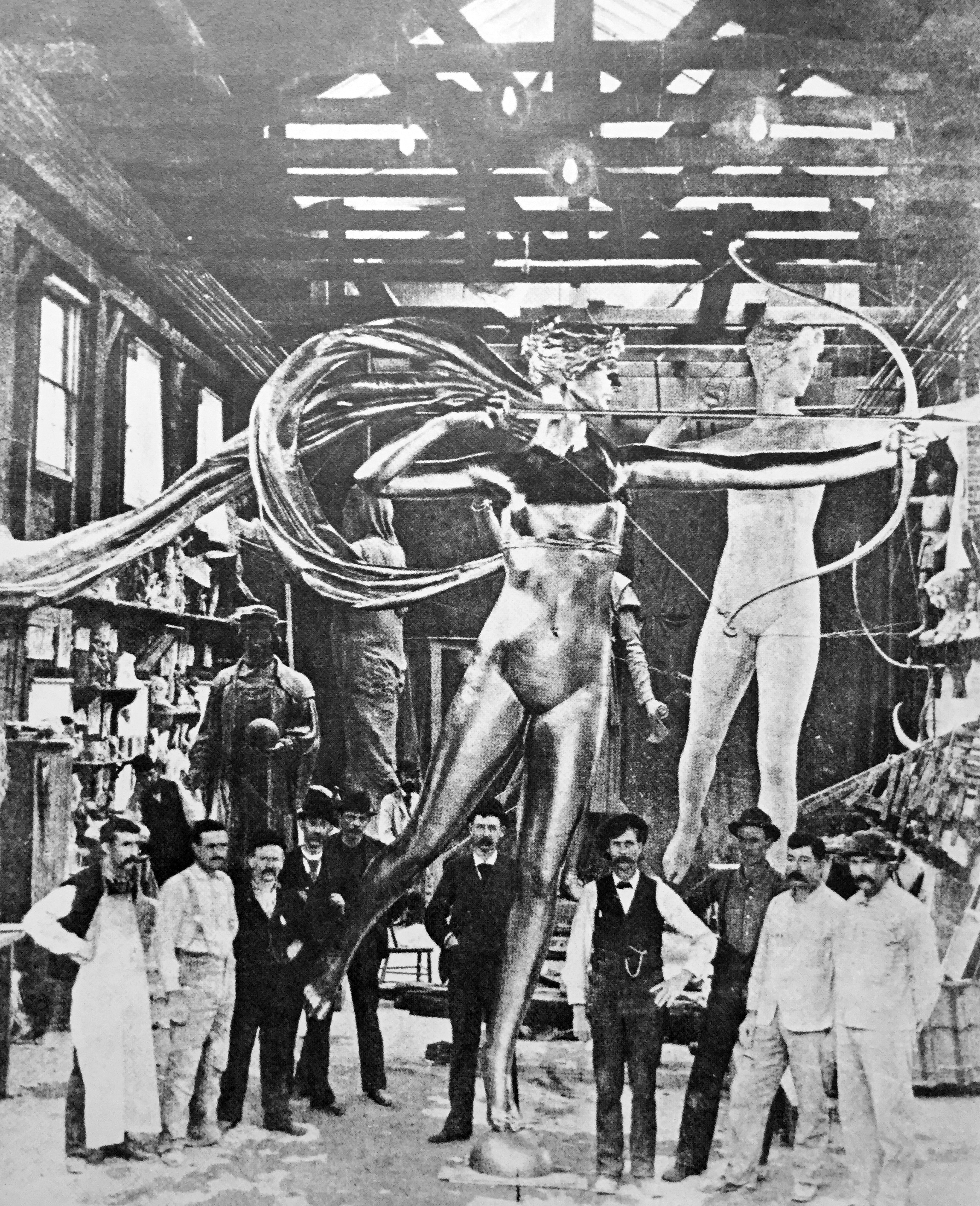
Diana I and II by Augustus Saint-Gaudens at the W. H. Mullins shop in Salem, Ohio.
Diana, Goddess of the Hunt
In 1891, Diana, Goddess of the Hunt was commissioned by New York’s Madison Square Garden’s architect, Stanford White to design a weather vane for the famous hall. He asked his friend, Augustus Saint-Gaudens, to design it. The tower at Madison Square Garden was modeled after La Giralda, the Bell Tower in Granada, Spain which also sported a weather vane called Faith.
Diana was fabricated at the W. H. Mullins shop in Salem, Ohio, she was 18 feet tall and weighed 1,800 pounds, yet she was perfectly balanced and could move gracefully with a light wind. She was made of many individually formed sections of 22-ounce sheet copper which were first machine-hammered over dies and then riveted together. Inside, the thin-skinned copper figure rested on a wrought iron skeleton, the same method that was used to construct the Statue of Liberty in 1883. Diana was covered with gold leaf.
Unfortunately, Diana did not rotate as planned because of its immense weight. Furthermore, both White and Saint-Gaudens realized that the gilded figure was somewhat awkward looking and was disproportionately large for the Madison Square Garden building. So the figure was removed about a year after its debut and a smaller, 13 foot Diana was installed. Madison Square Garden was demolished in 1925 and Diana II was placed in storage, awaiting completion of a new tower promised by New York University. But NYU could not raise the money to build.
In 1932, the Art Museum’s dynamic young director, Fiske Kimball, persuaded the New York Life Insurance Co., Diana’s owner, to give the sculpture to the Museum of Art in Philadelphia.
She was installed in 1932 at the top of the stairwell.
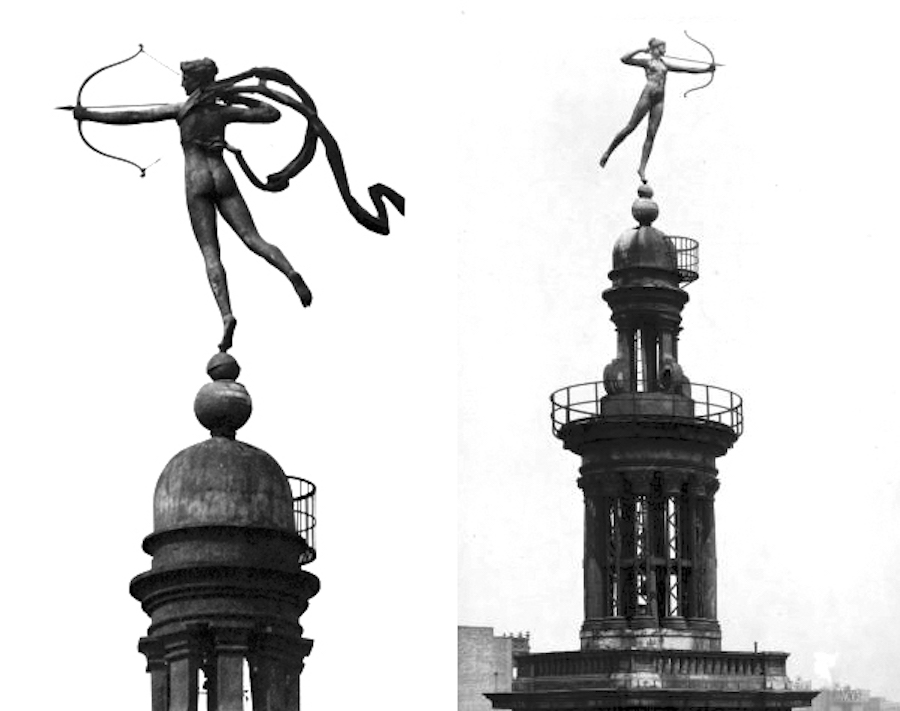
Diana I (Left) and Diana II on top of Madison Square Garden
Charles McKim, the architect for the Agriculture Building at the Columbian Exposition in Chicago, who was about to begin construction, thought that Diana I would be a perfect piece to top the dome. The exposition officials agreed, and in early 1892 the statue was purchased for $2,500 and sent to Mullins for refurbishing. Once in place, Diana I soon won the admiration of many fairgoers because of her beauty and her prominent position overlooking the Court of Honor in the heart of the exposition.
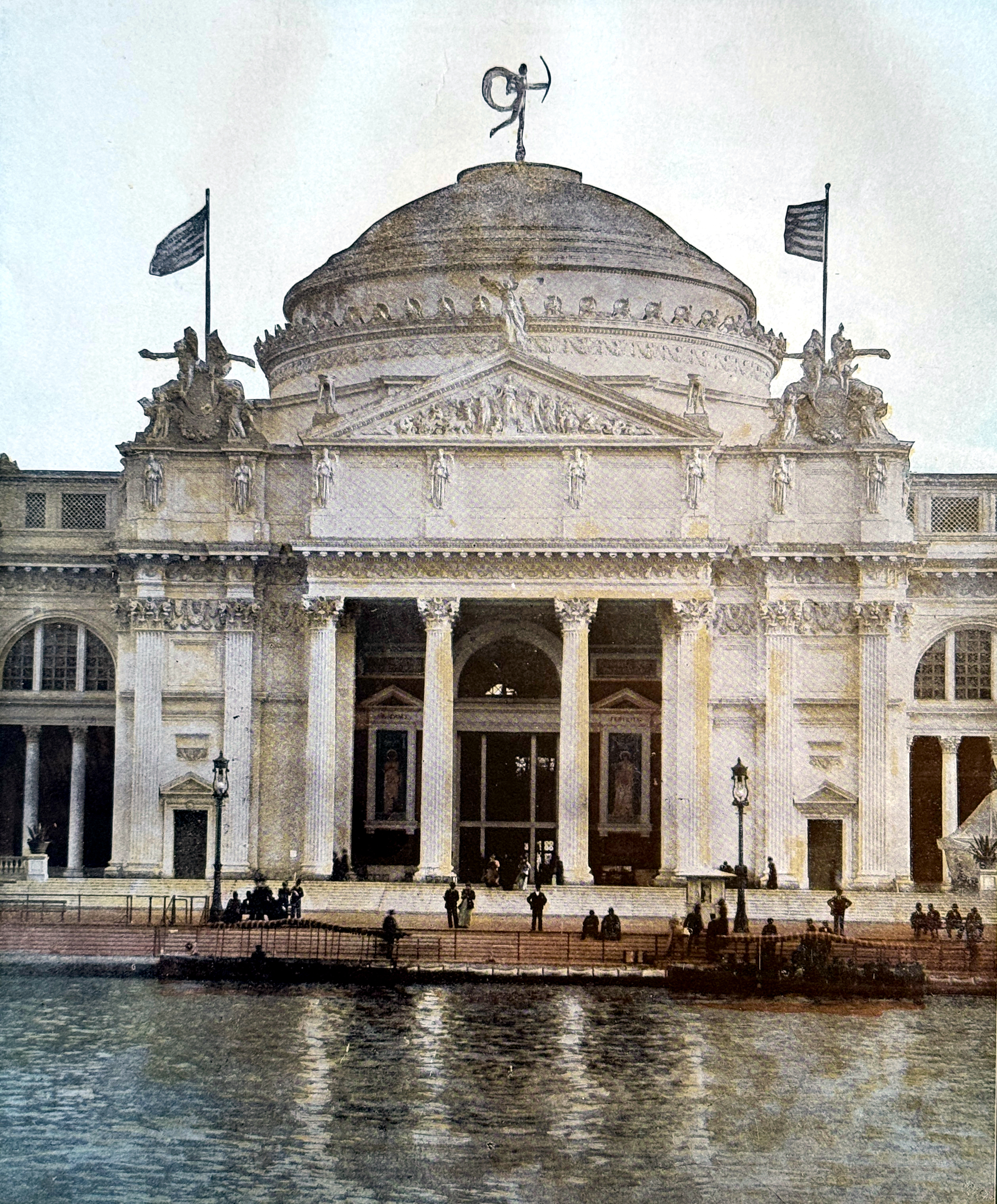
DOME OF AGRICULTURE BUILDING.—The agriculture department of the World’s Columbian Exposition was housed in a palace, for the great building devoted to the purpose was a magnificent structure, both as to dimensions and architectural character. The main building stood beside Lake Michigan its principal facade facing the grand basin in the Court of Honor, full opportunity being thus afforded for the display of its imposing features. The view above given is that of the principal entrance, with the landing for gondolas and electric launches in the immediate foreground. The style is the classic renaissance with Corinthian pillars fifty feet high and five feet in diameter. This entrance led through an opening sixty-four feet wide into a vestibule terminating in the rotunda one hundred feet in diameter, and surmounted by a mammoth glass dome one hundred and thirty feet high. Above the main entrance, as well as in the vestibule and on the domes of the corner pavilions, were groups of statuary illustrative of the building’s uses. Surmounting the main dome, as will be seen in the illustration, is the beautiful Diana statue by St. Gaudens, which adorned the tower of Madison Square Garden in New York and was brought to Chicago for its greater purpose. The pediment, which represented Ceres, was a work of almost equal beauty.
At first it seemed that Diana I was destroyed by a fire that swept the fairgrounds on January 9, 1894 as most of the structure was left in ruins. Fortunately, the Chicago Tribune reported the following day:
- The statue of Diana was not damaged as she had been removed about six weeks ago to the Columbian Museum.
This was not the whole story. Executives from Montgomery Ward toured the Agriculture Building and bought the statue and had it stored in the Columbian Museum (Fine Arts Building, now the Museum of Science & Industry) until their Tower Headquarters was built in 1899. It is uncertain whether Diana was sent back to Mullins and was refurbished or if a new statue was made from a new design.
Progress Lighting the Way for Commerce
Architects for the new Ward Tower, Richard E. Schmidt and Hugh Garden envisioned a statue-weather vane on top of their new structure. Schmidt hired John Massey Rhind a Scottish sculptor to design the final statue. For some reason, however, the statue of Progress is not mentioned in articles of his work, nor does it appear in the lengthy obituary published in a London newspaper on October 22, 1956. The reason for this might well be that Rhind only designed alterations to transform Diana, therefore he would not have been the sole creator of Progress.
The reincarnated weather vane was installed on the top of Montgomery Ward’s new Michigan Avenue tower headquarters on October 21, 1900. It was dubbed Progress Lighting the Way for Commerce by the Inter-Ocean.
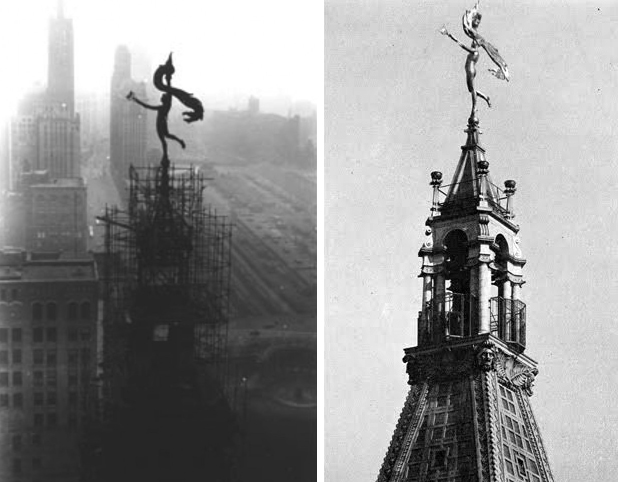
Progress Lighting the Way for Commerce on top of the Montgomery Ward Tower on Michigan Avenue. Photo on the left was taken during the dismantling in 1947.
The Chicago Tribune had acclaimed the new statue as “rivaling in beauty New York’s famous ‘Diana.'” And small wonder; with her torch held high some 390 feet above the street, the gleaming figure of Progress was visible over most of the city and far out into Lake Michigan. Lit by four electric beacons with 1,000 candlepower each, Progress actually did serve as a beacon in at least one instance. On September 18, 1918, Captain Ben Lipsner used these lights to guide his plane into Grant Park after making the first airmail flight between New York City and Chicago, in 9 hours and 13 minutes of stormy weather.
In 1908 Montgomery Ward sold the Tower Building and moved to more spacious headquarters on West Chicago Avenue. Although the Michigan Avenue building still stands, its 125-foot tower portion was removed in 1947 after being judged structurally unsafe. As for Progress, she also had to come down. On Saturday, April 26, 1947, workmen of the Speedway Wrecking Company erected a scaffold around the statue and began to dismantle her. On July 20, 1947 the Chicago Tribune, calling the figure “Diana,” reported that:
- The statue was cut into about 30 pieces before it was lowered. Most of the statue is at the company’s office, but some parts have been claimed by Chicagoans. Diana’s arm with outstretched spear came off at the shoulder, the head came off in one piece, and one leg below the knee. The requests for pieces of the metal for souvenirs was amazing. Some old-timers wanted the metal to make into ash trays, and others just wanted pieces of it as souvenirs. One of Chicago’s prominent citizens has, for some reason he kept to himself, requested the bust.
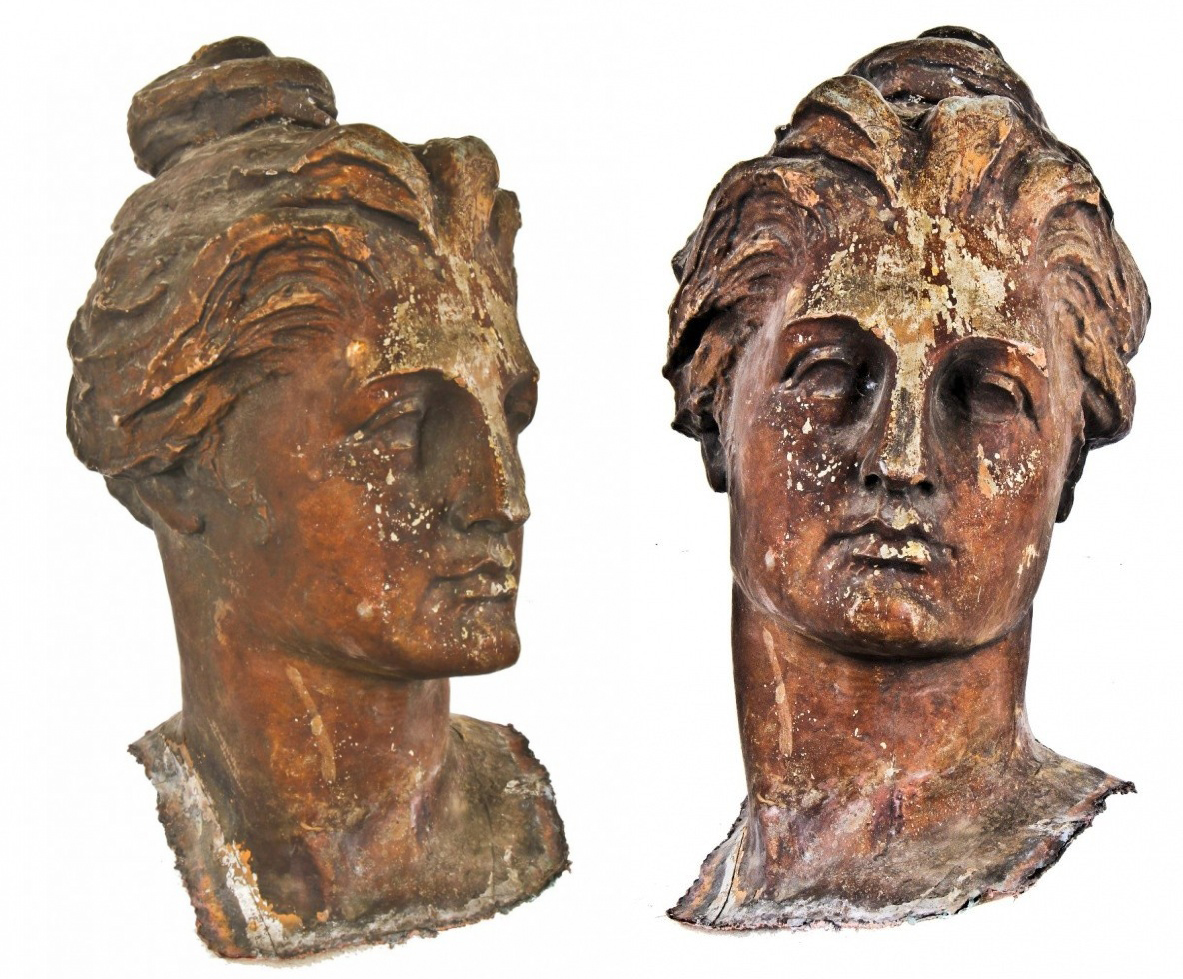
Progress’ head was auctioned off on November 4, 2014 at Leslie Hindman Auctioneers.
The Spirit of Progress
In 1922, the year of Ward’s fiftieth anniversary, Theodore F. Merseles, President of Montgomery Ward, presented the widows of A. Montgomery Ward and George R. Thorne with 15-inch bronze replicas of the Progress statue. The disposition of Mrs. Ward’s figurine is not known, but Mrs. Thorne’s statue was passed on to her great-grandson, Charles H. Thorne II.
In 1928, when construction had started on a new Administration Building on Chicago Avenue, Mersele’s successor, George B. Everitt, felt that the building shaould have a statue. He commissioned an artist to design one, and in September, 1929 The Spirit of Progress was placed atop the white stuccoed Art Deco tower.
Once completed, Spirit became the new corporate symbol, and the company commissioned copies to place on other Montgomery Ward buildings across the country. But President Everitt’s successor, Sewell Avery, was not quite taken to her. After he became president in 1952 Avery sought to have her removed. However, he dropped the plan when he found that it would cost $6,000 to dismantle her.
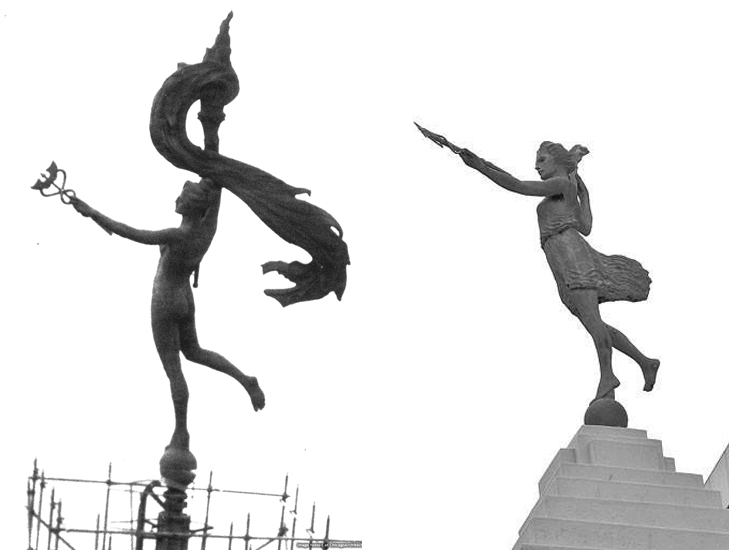
LEFT: Progress Lighting the Way for Commerce
RIGHT: Spirit of Progress
For years the identity of the artist was unknow, making the story of Spirit’s origin as much as a mystery as that of Progress. However, it is probable that Spirit was the work of sculpture-architect Joseph Conradi. In a letter to his grand-daughter, Grace Conradi Anderson of Addison, Illinois, Conradi’s second wife Anna wrote:
- Your grandfather Conradi was architect and sculptor at St. Alphonsus Church at Lincoln, Southport and Wellington Avenues, Chicago. Also, the tallest statuary, “Progress” is his work (I think it’s on Montgomery Ward building) can be seen from Lake Forest and afar.
Although there is no other documentary evidence to corroborate Mrs. Conradi’s conviction, the sculptor’s oldest son Leo also attributed the statue to his father. Just before his death in 1979 Leo told Mrs. Anderson that he remembered the day his father’s statue of The Spirit of Progress was placed on the Ward’s building.
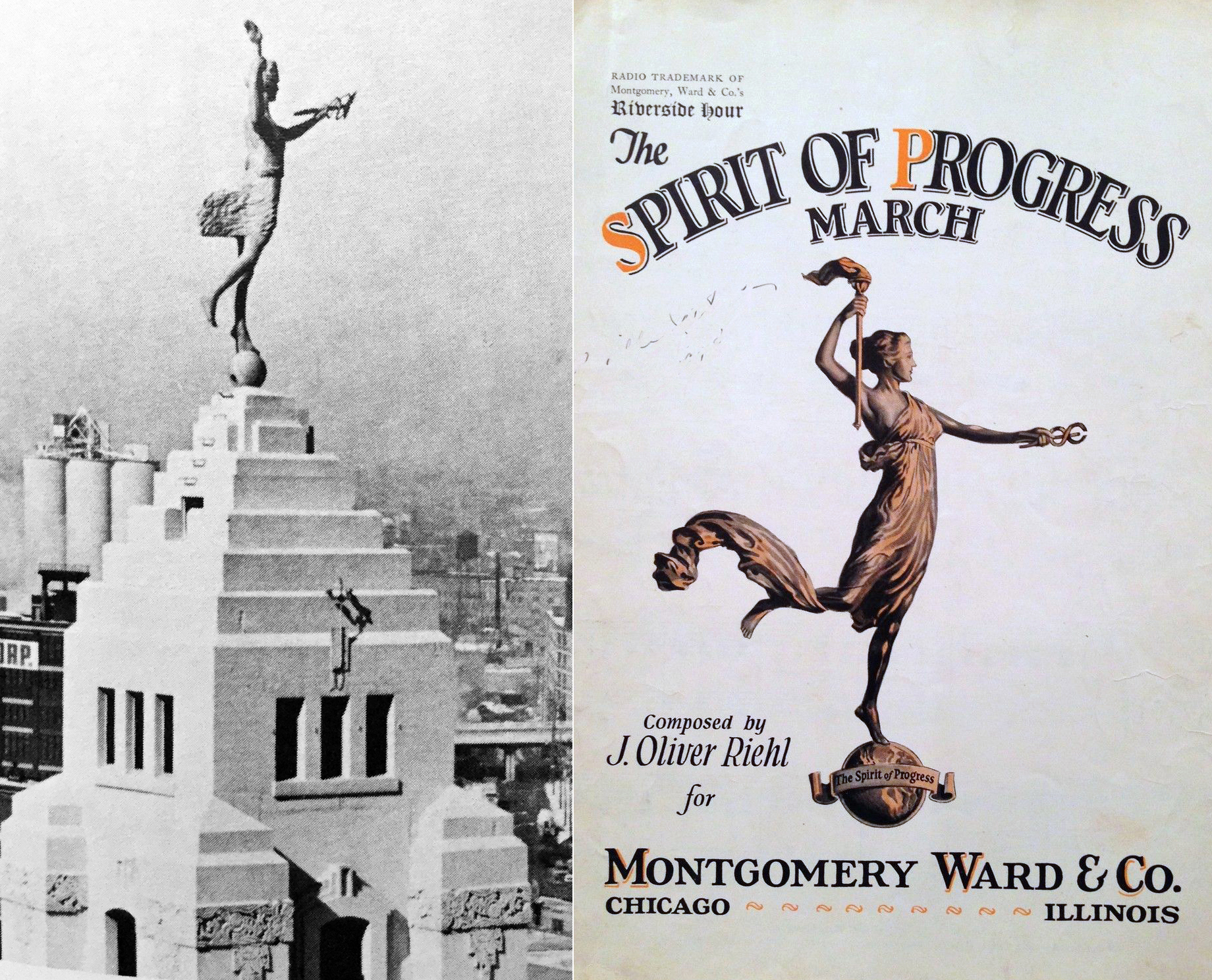
Spirit of Progress on top of Ward’s Administration Building on Chicago Avenue.
Sheet musc for Spirit of Progress March, composed in 1928, published before the final design of the statue was approved
Later reports include captions for photographs taken in 1929 by the foundry, American Bronze Company, and they list the artist as George Mulligan, son of sculptor Charles James Mulligan (1866–1916). The elder Mulligan studied at the Chicago Art Institute with Lorado Taft and his local works include Lincoln, The Railsplitter, The Independence Square Fountain and the William McKinley Monument.
Chicago Tribune. January 27, 1929
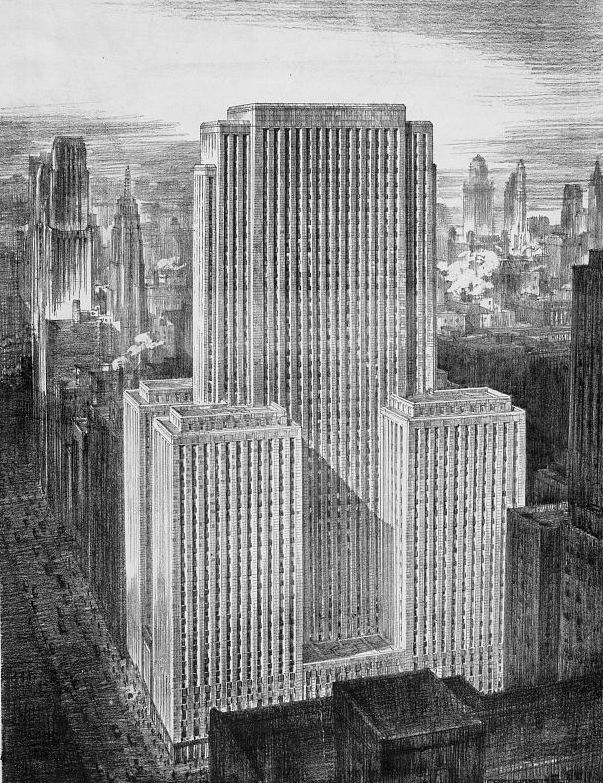
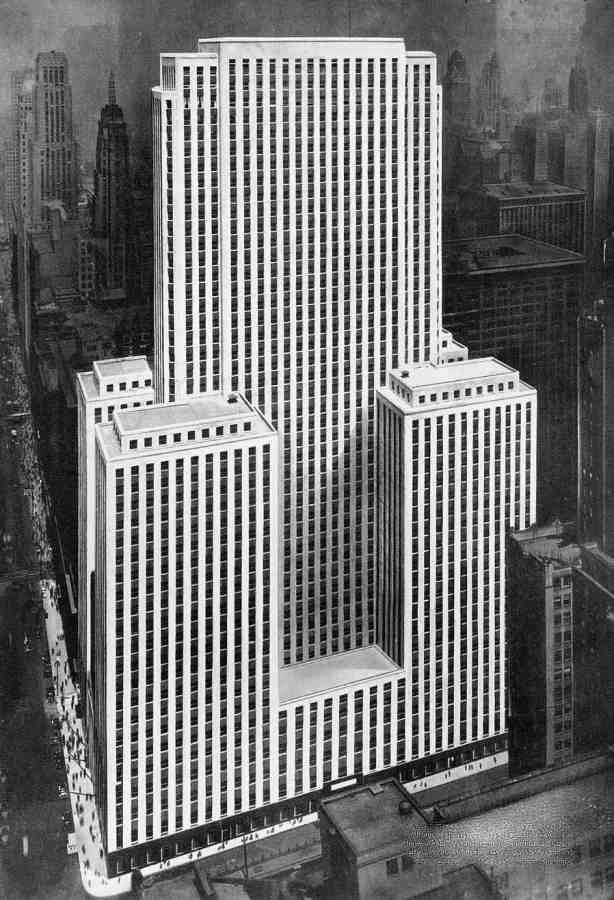
Foundations are now being installed for the eight administrative building being erected by the Larrabee Building corporation for Montgomery Ward & Co. at the southwest corner of Chicago avenue and street. This structure will occupy a site 160 x 320 feet which was purchased by the late A. Montgomery Ward at the time he bought the land for Ward’s present huge building, just across the street.
Designed by the construction department of the mail order firm, under the direction of W. H. McCaully, chief engineer, the new building will be of modernistic architecture. At one corner there will be a tower surmounted by a figure reminiscent of the statue atop the Tower building at Michigan and Madison-Ward’s home.
The new building will contain the executive, administrative and general offices and the clerical departments. The first floor will be for retail store purposes, replacing the establishment in the building the street. Clerical departments wil take up the second and third floors.
On the fourth floor there will be a large cafeteria for employees and for customers of the store. Executive departments of the chain store and retail store divisions will be found on the fifth story. The merchandise buying group will take up the sixth floor, while the catalog and general operating departments will be on the seventh. And, finally. the executives are to be located on the top floor where it’s presumed they’ll have walnut trimmed rooms, fireplaces, and the other perquisites of the “big shots.”
The building is to be of reinforced concrete construction. Financing is being accomplished by a $2.000,000 bond issue recently announced by Lawrence Stern & Co. and the First Trust and Savings bank. Winston & Co. were the real estate brokers in arranging the enterprise. The Wells Brothers Construction company has the contract.
Sources: Chicago History Magazine Summer 1982 Volume XI Number 2, Chicago Tribune, Scientific American.

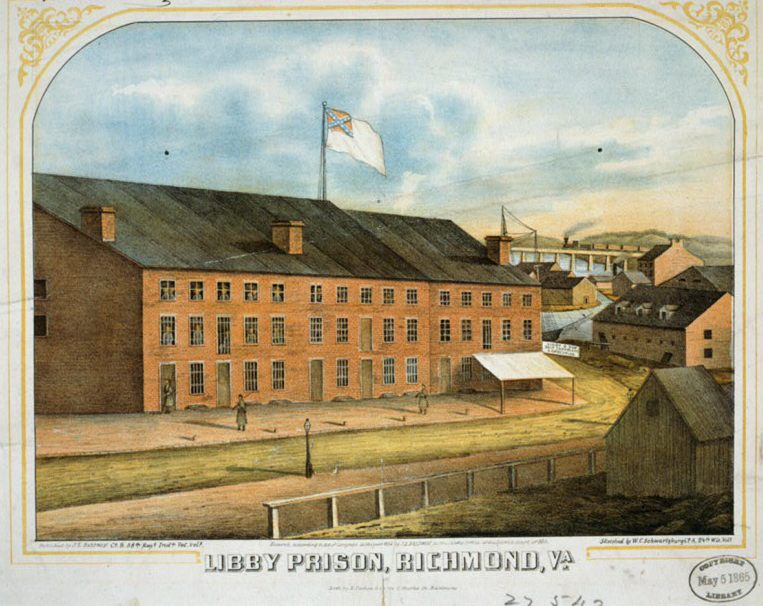
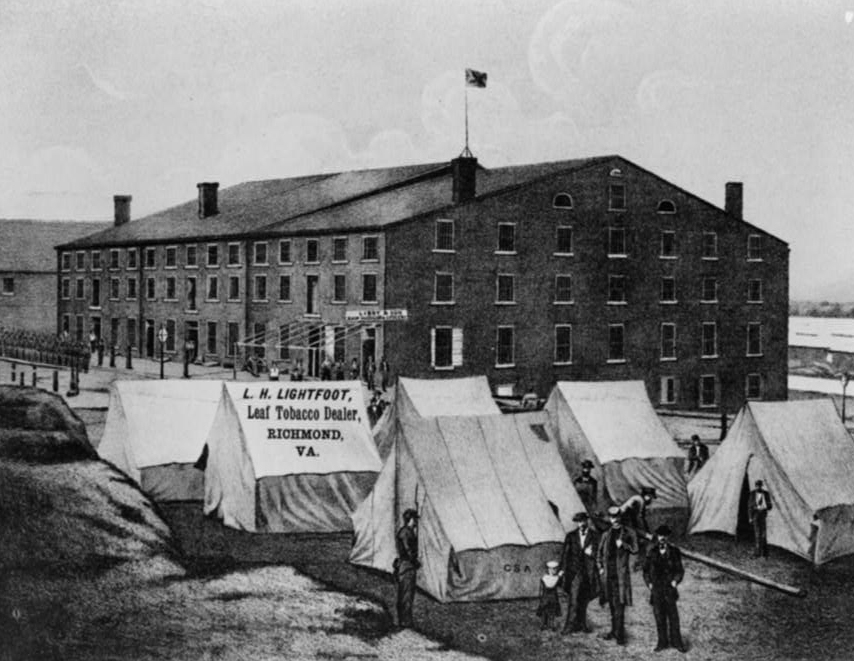
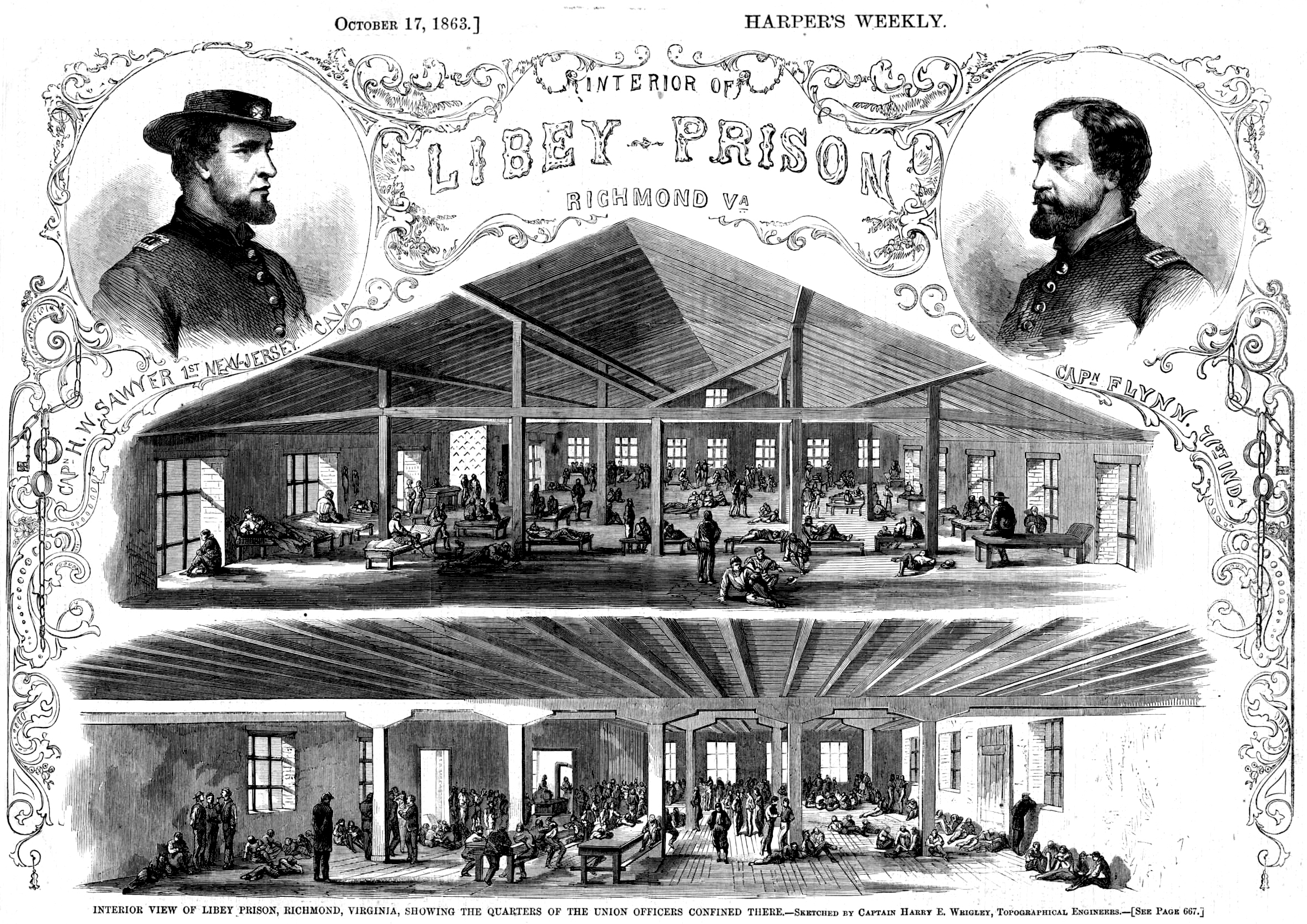
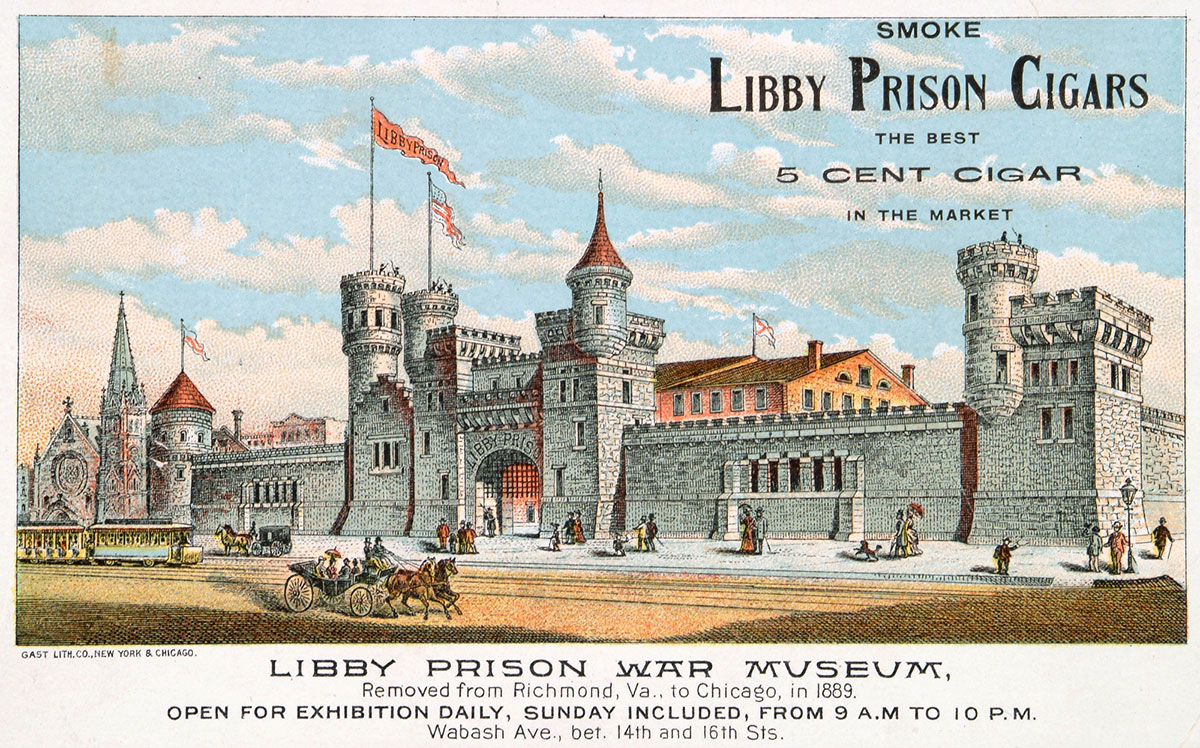
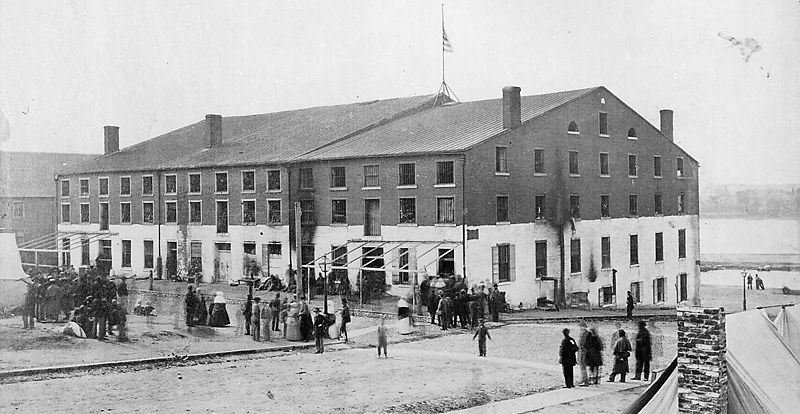
 Interest in the history and relics of the War of the Rebellion does not seem to lessen as the years roll by. Eastern book and magazine publishers find the dark days of ’61-65 mine productive of wealth; artists of more or less National repute have been impressed into the service to furnish the larger cities with cycloramas of the most important battles, and in numerous villages is to be found a “memorial hall” in which are displayed a company flag tattered and torn, half a dozen harmless shells covered with rust, a few mus-kets, and a sabre or two, all of which are reverently worshiped by the people of the neighborhood. A new departure in the line of relic-worship has been taken in this city, which is the headquarter of all the new departures which have achieved a National success in the last twenty-five years. Yesterday the preliminary steps were taken for the formation of a corporation whose object is the purchase and removal to this city of the famous Libby Prison of Richmond, Va. The gentlemen who figure as the Commissioners and who are instrumental in organizing and developing the scheme are Messrs. William H. Gray, Josiah Cratty, John A. Crawford, and Charles K. Miller. The company will have a capital of $100,000, and it is understood that all the stock has already been applied for. The history of the enterprise is best told in the words of Mr. William H. Gray, to whom is due the credit for its inception.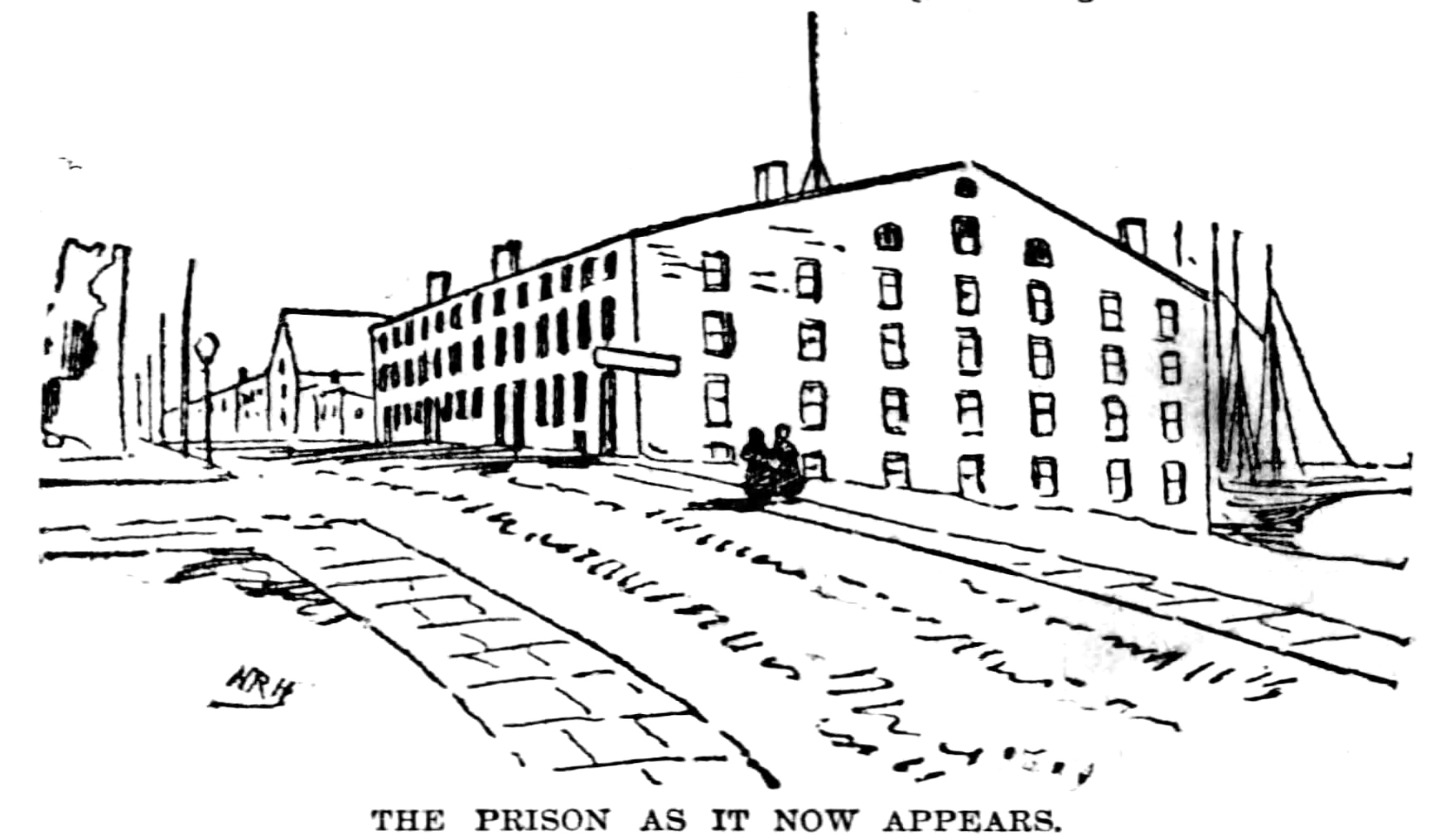
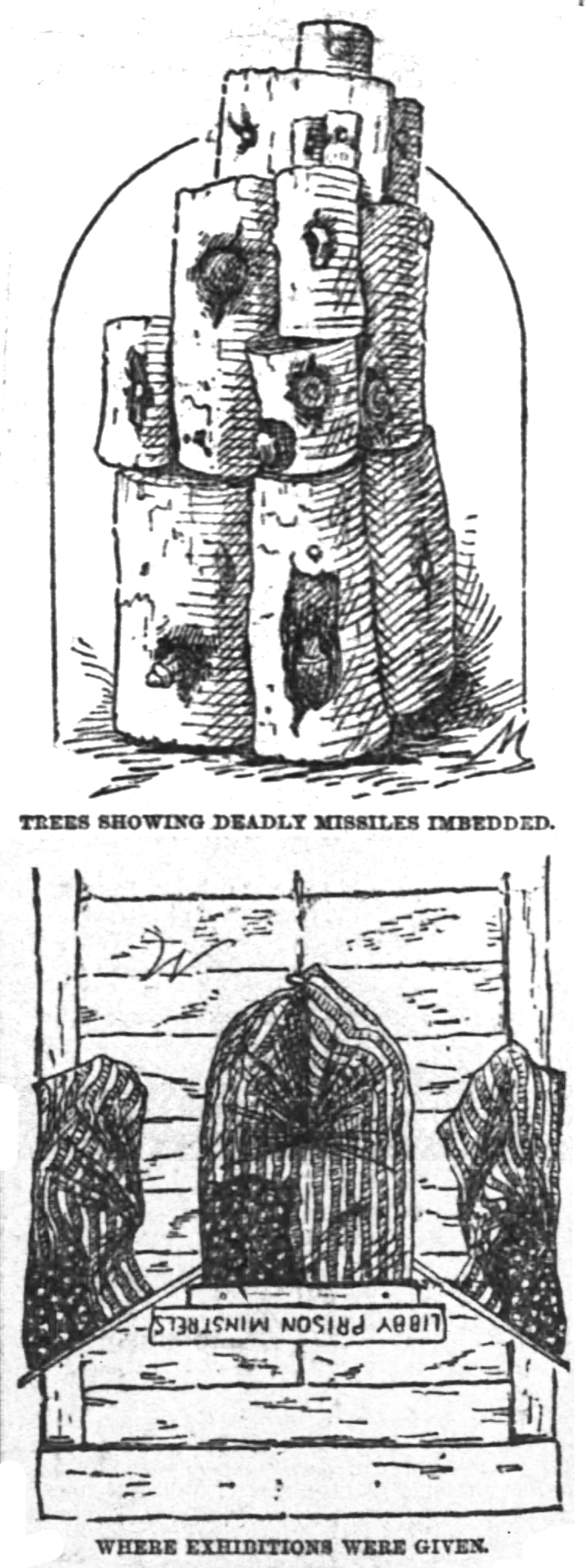
 No landmarks the civil war have associated with them more that repels than the Southern prisons. They have gone into history as prison hells, where the barbarous cruelties of the inquisition and the dungeons of the Tower and the Bastile failed to furnish adequate contrasting features to convey an idea of what men suffered—Andersonville, Saulsbury, Libby, Castle Thunder, and other names arouse more indignation than any other in American history, and they have no defenders. They excite hate in the North, and shame in the South. As landmarks merely, they had better be forgotten. Such was the feeling when it was proposed to bring the old Libby Prison to Chicago. But that feeling has given way to one of interest in the old building, as it is understood that this is here only to form the home for one of the most complete and interesting museums of the war in the country-a museum that knows no North and no South, but is of historical interest to all, because of the impartiality shown in the collection of relics of the civil war. Tho portraits of Lincoln and Jeff Davis, those of Grant and Lee, and the great military captains on both sides, hang upon the walls, and their letters, dispatches, and orders are in the cases.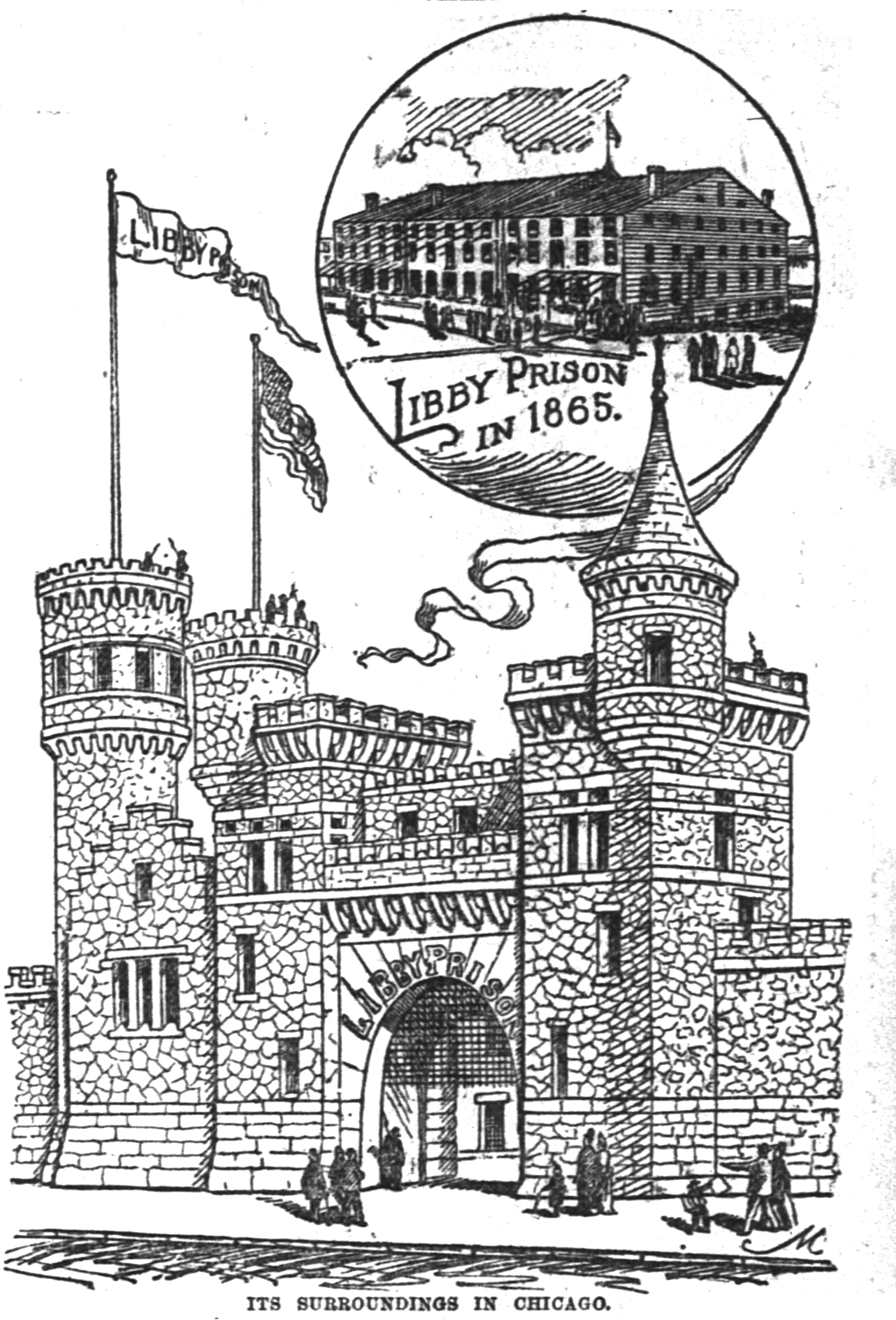
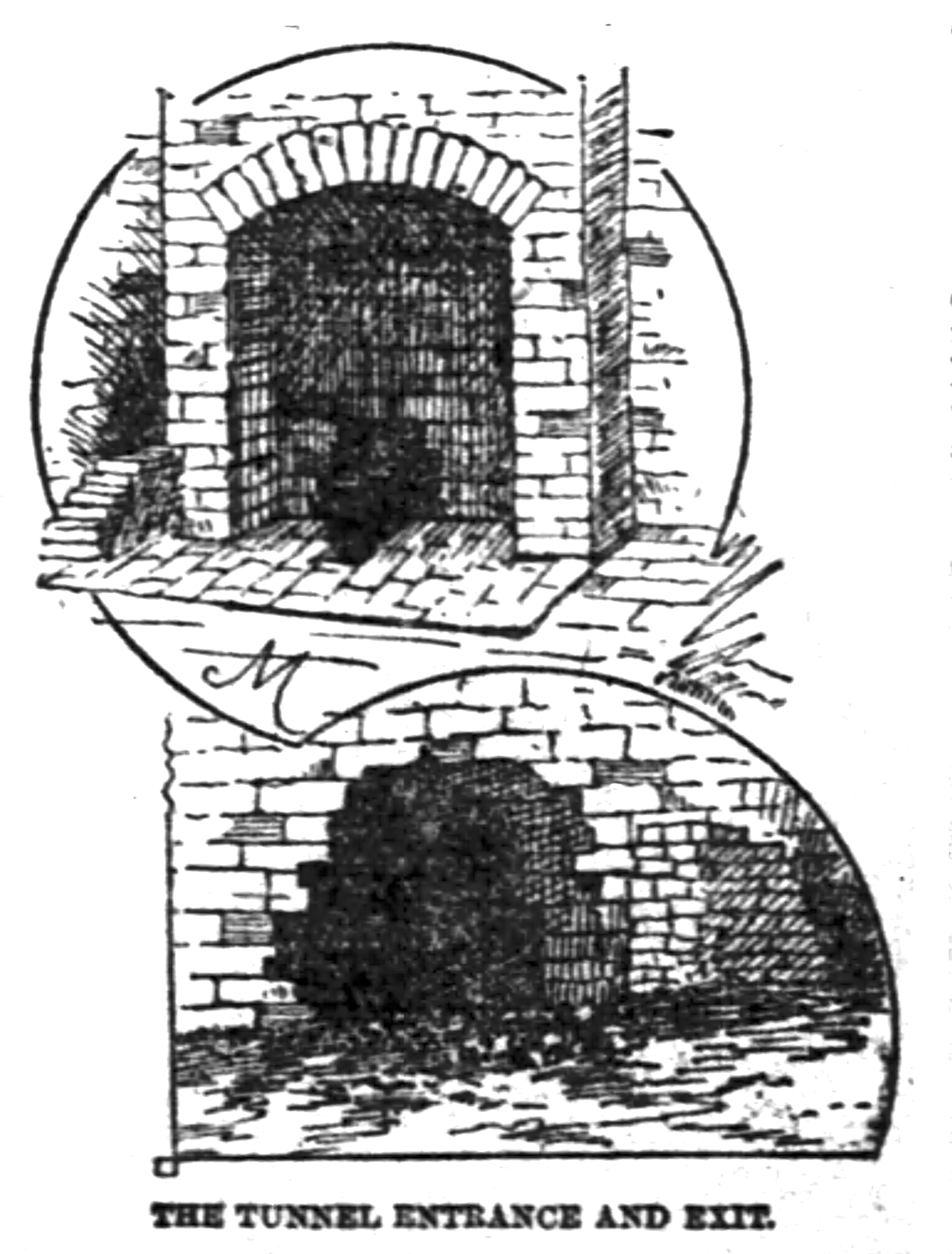
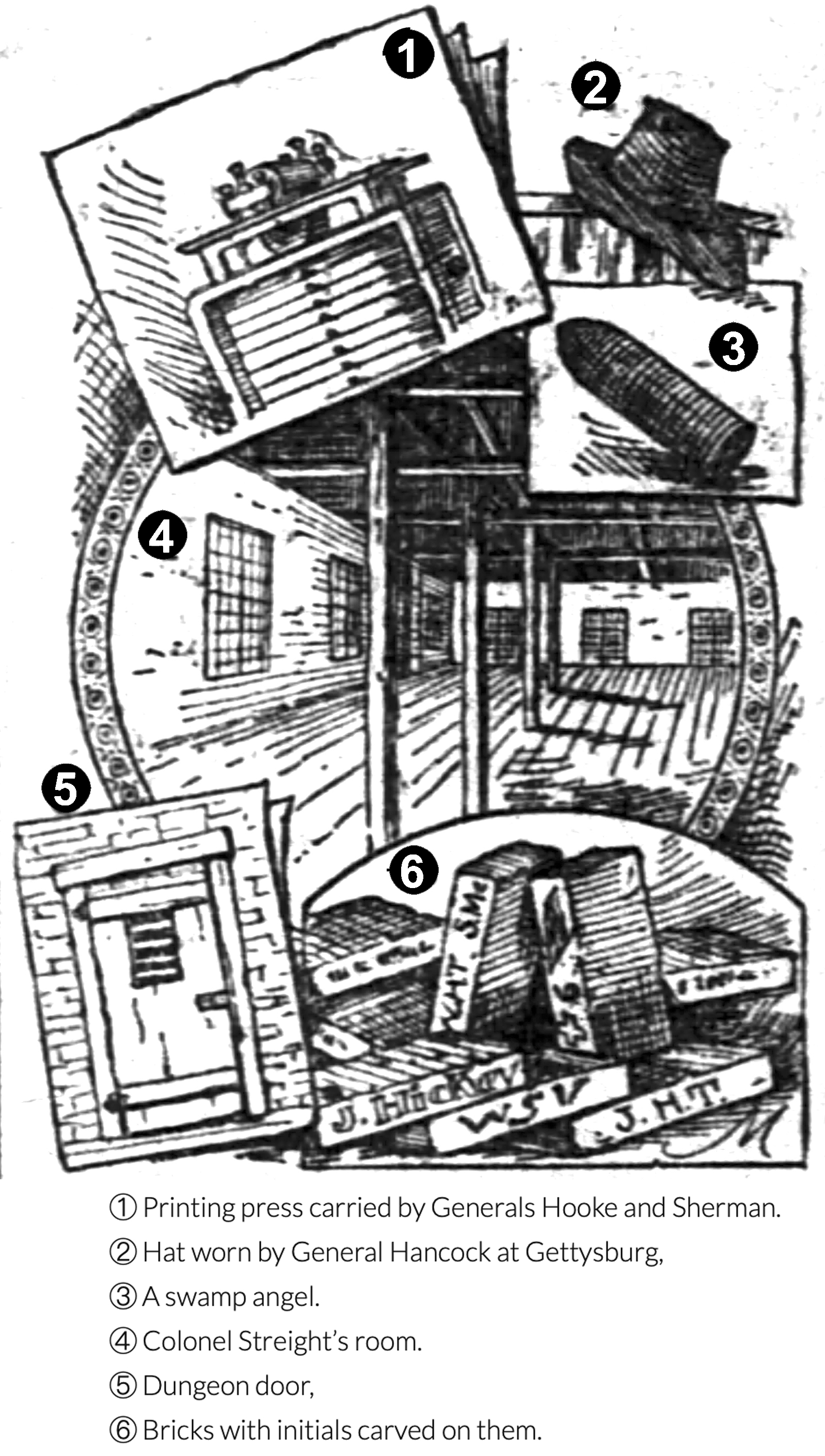
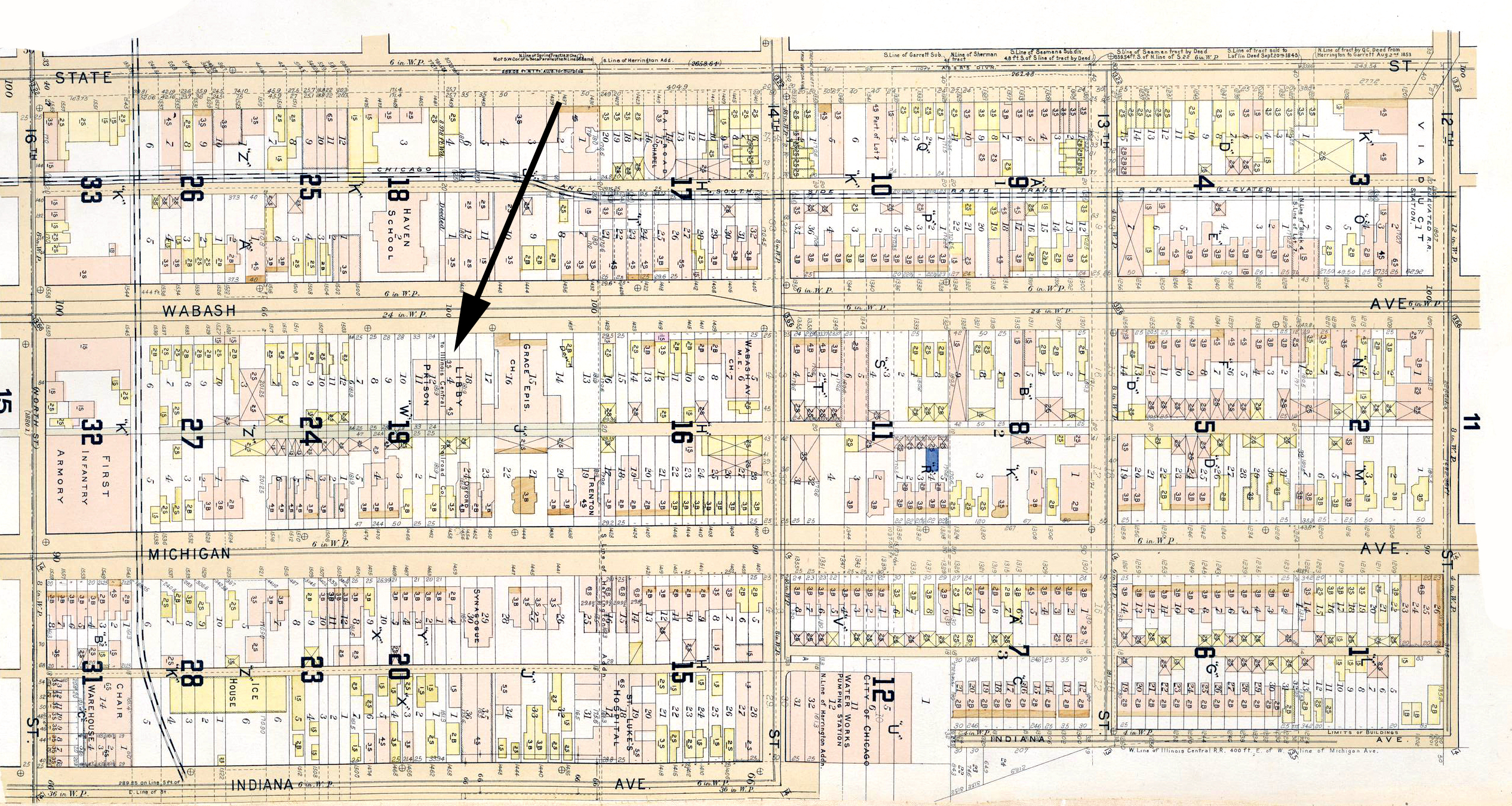
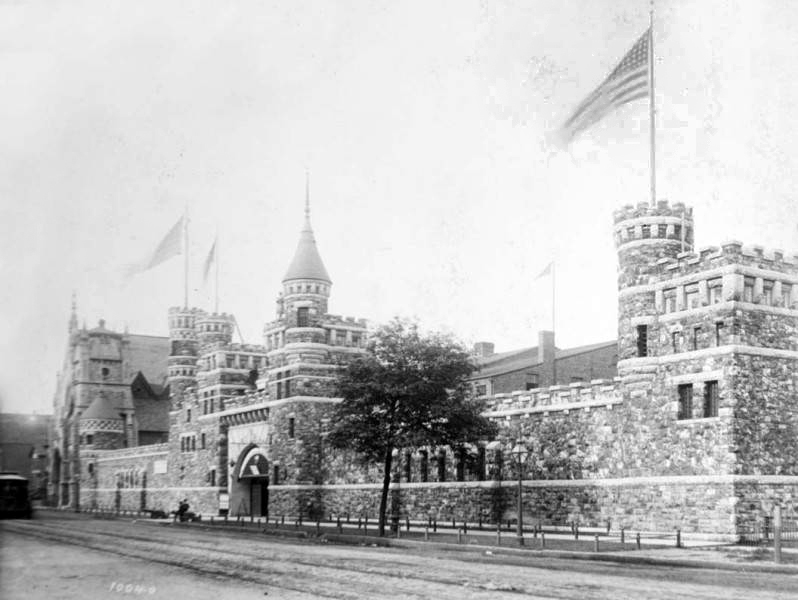
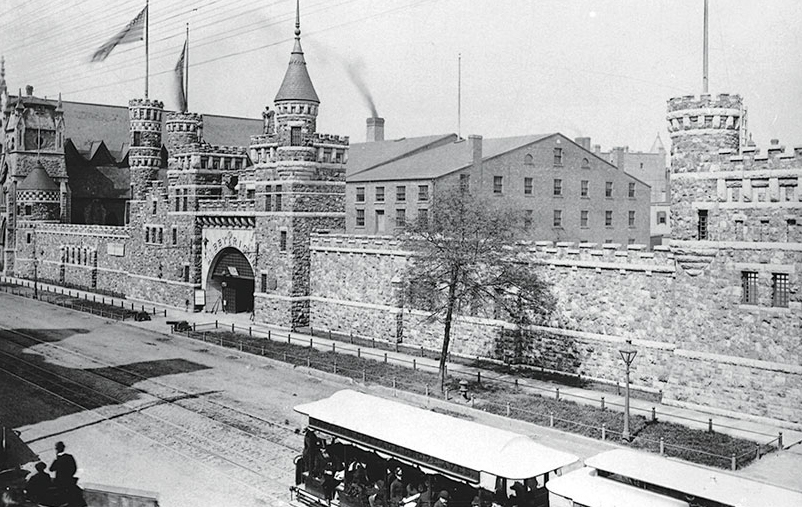
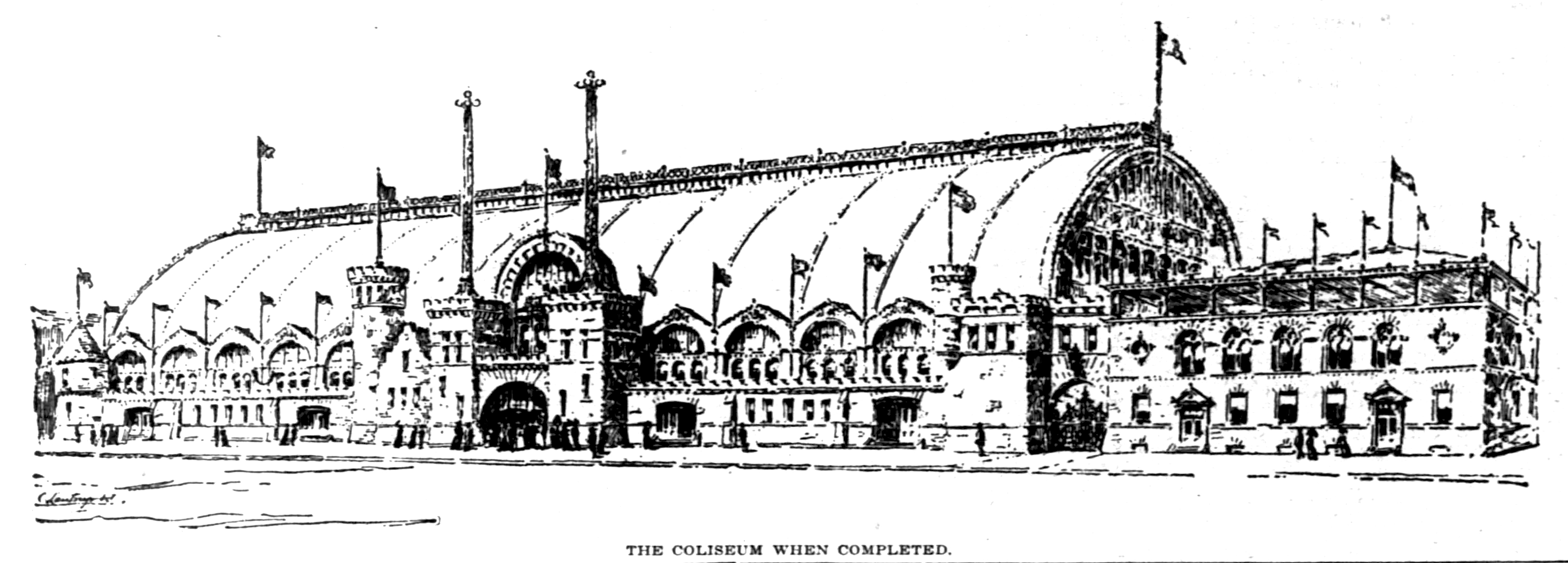
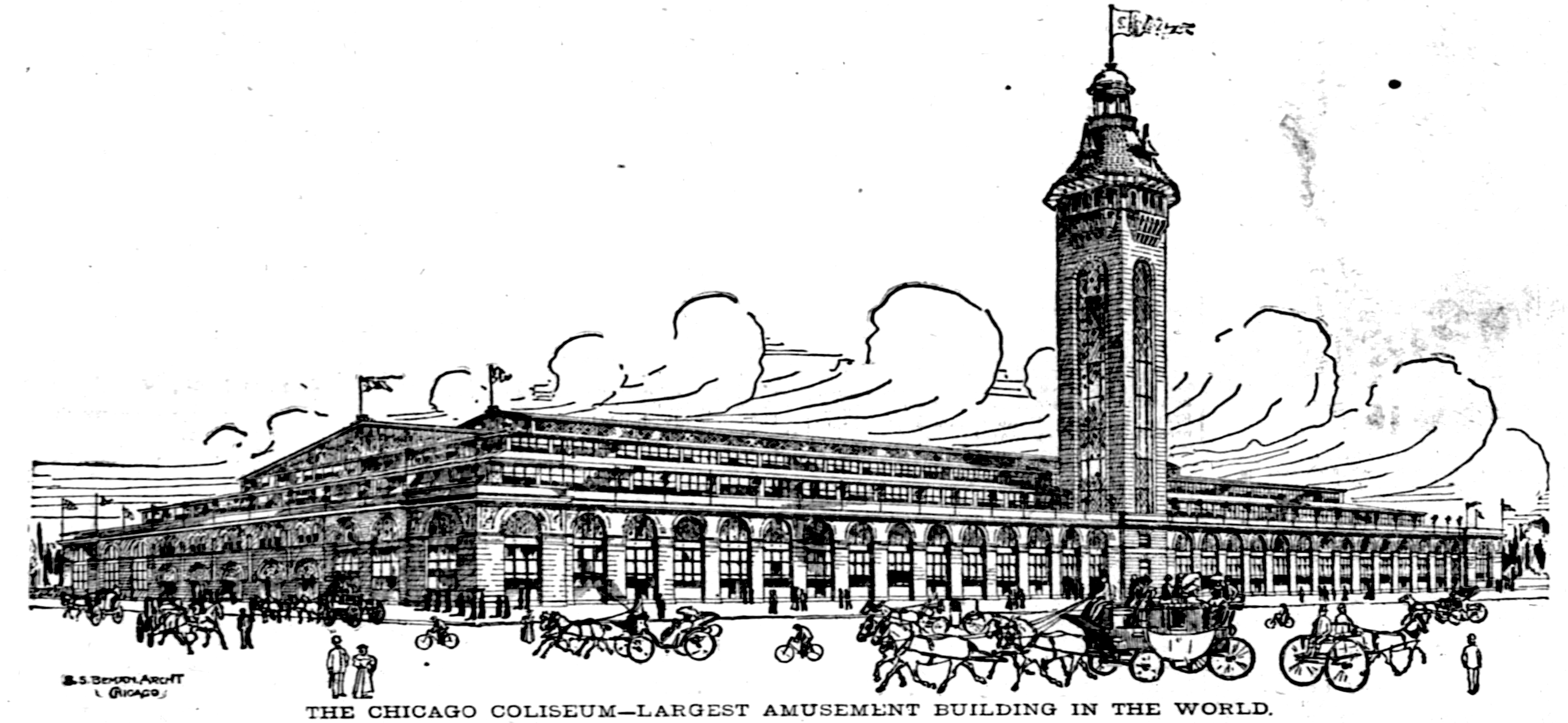
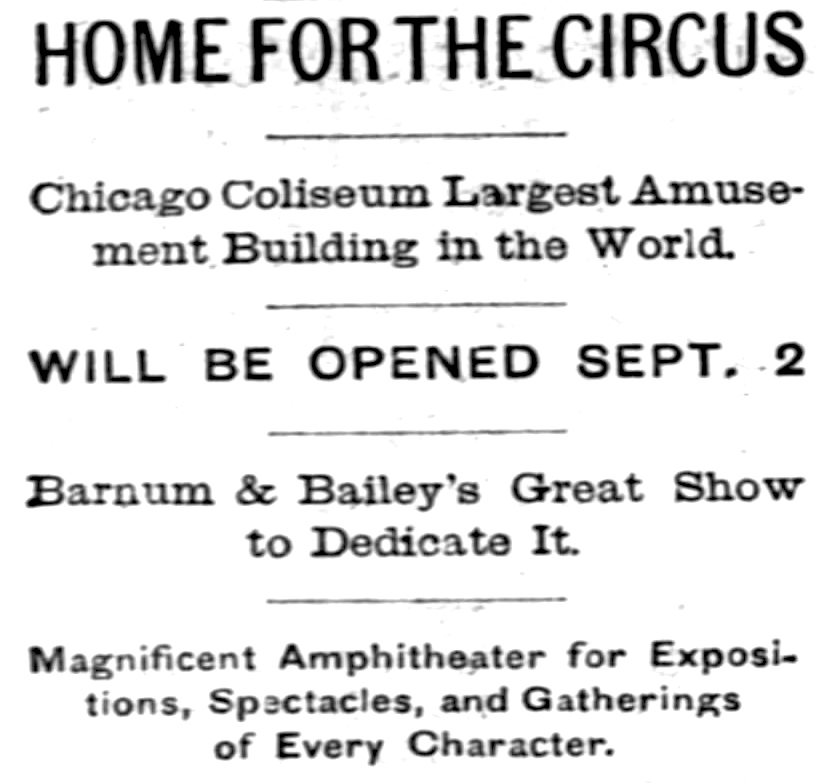 On Monday, the second day of the coming September, by far the greatest amusement building of modern times will be inaugurated by the “Greatest Show on Earth,” in this city, the only place where such a vast structural triumph could be so magically erected and so magnificently dedicated.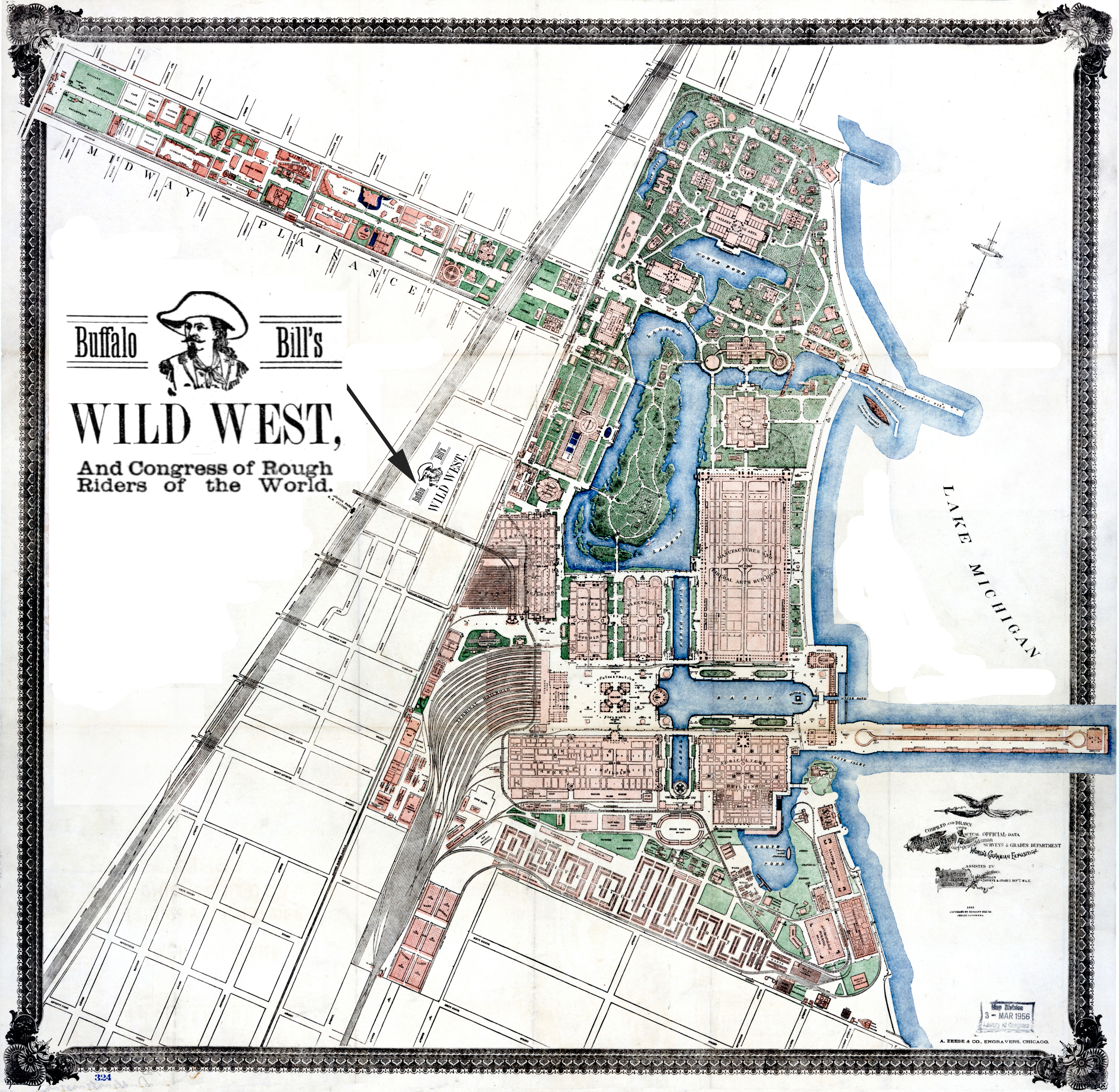
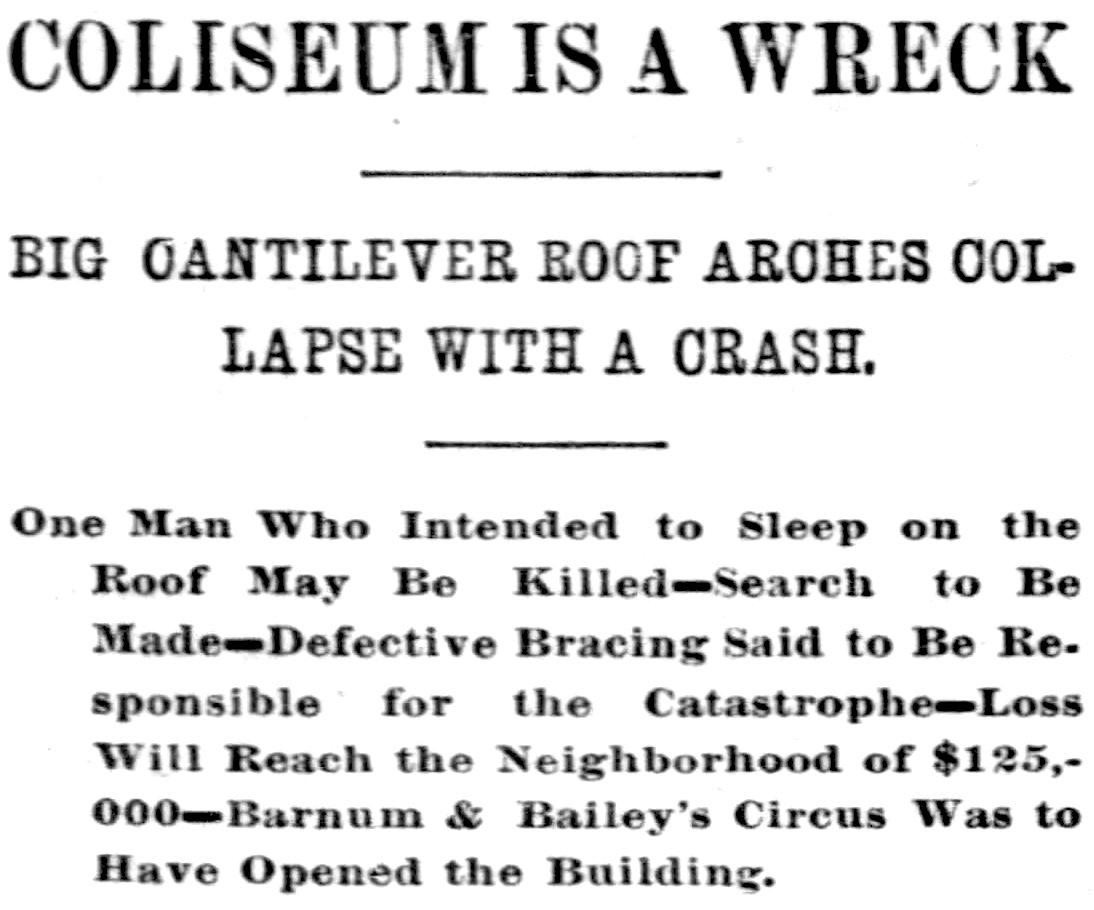 The mammoth Coliseum, in course of construction on the old site of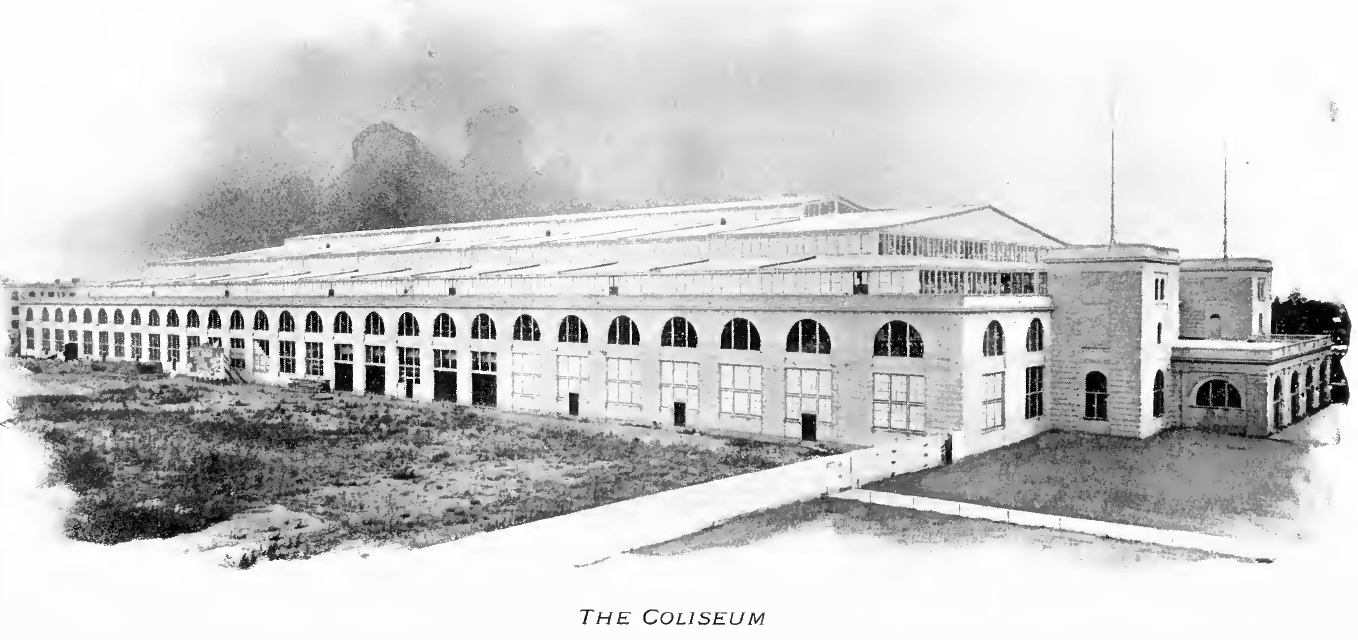
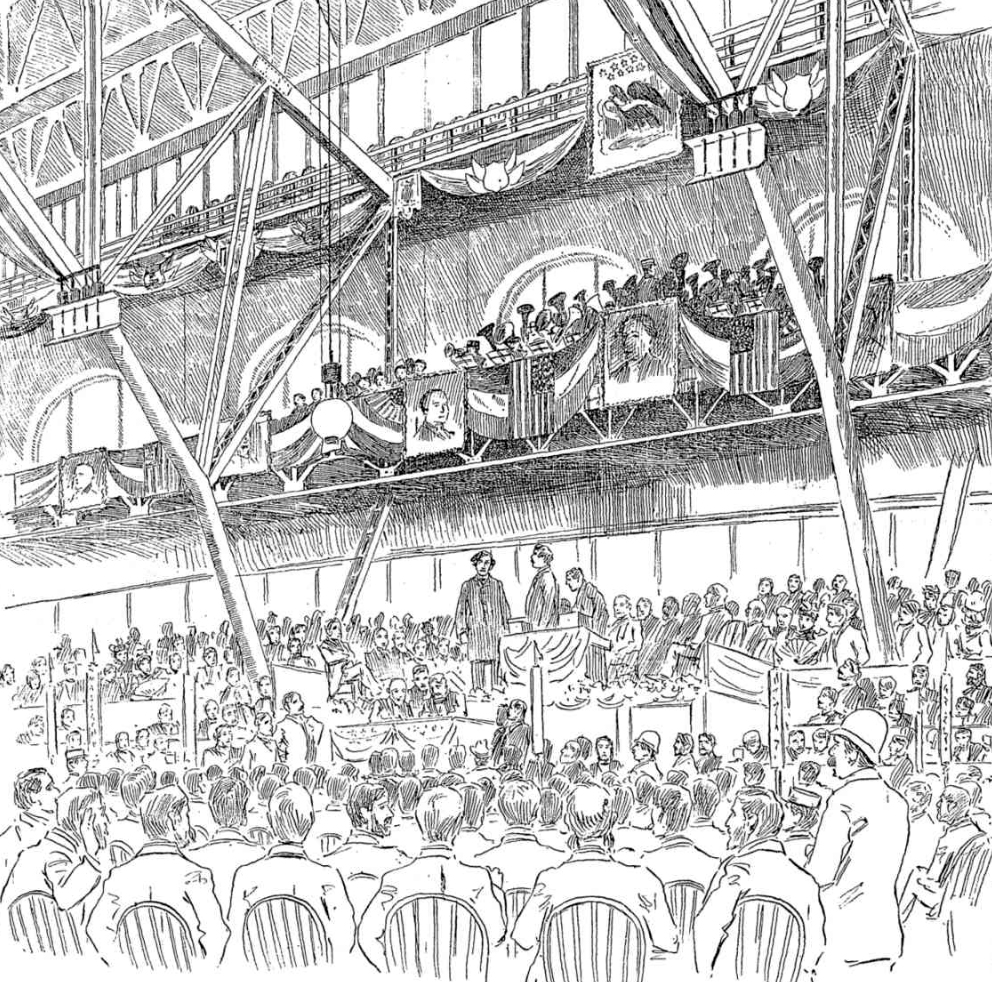
 The Chicago Coliseum, in which the democratic national convention will be called to order July 7, 1896, has assumed the outlines of a building. The ninth iron truss was placed last Thursday, and if the man in the Auditorium tower attends to his business the twelfth, and last, truss will be in place by the time The Sunday ChronicLe is before its readers. Fourteen feet, in height, of the brick walls are up, all around, and the material and laborers are waiting for the last iron truss. to be put in position and the filling in will follow, and without any unnecessary rush the structure will be finished by May 25. This will give a leeway of six weeks for convention purposes.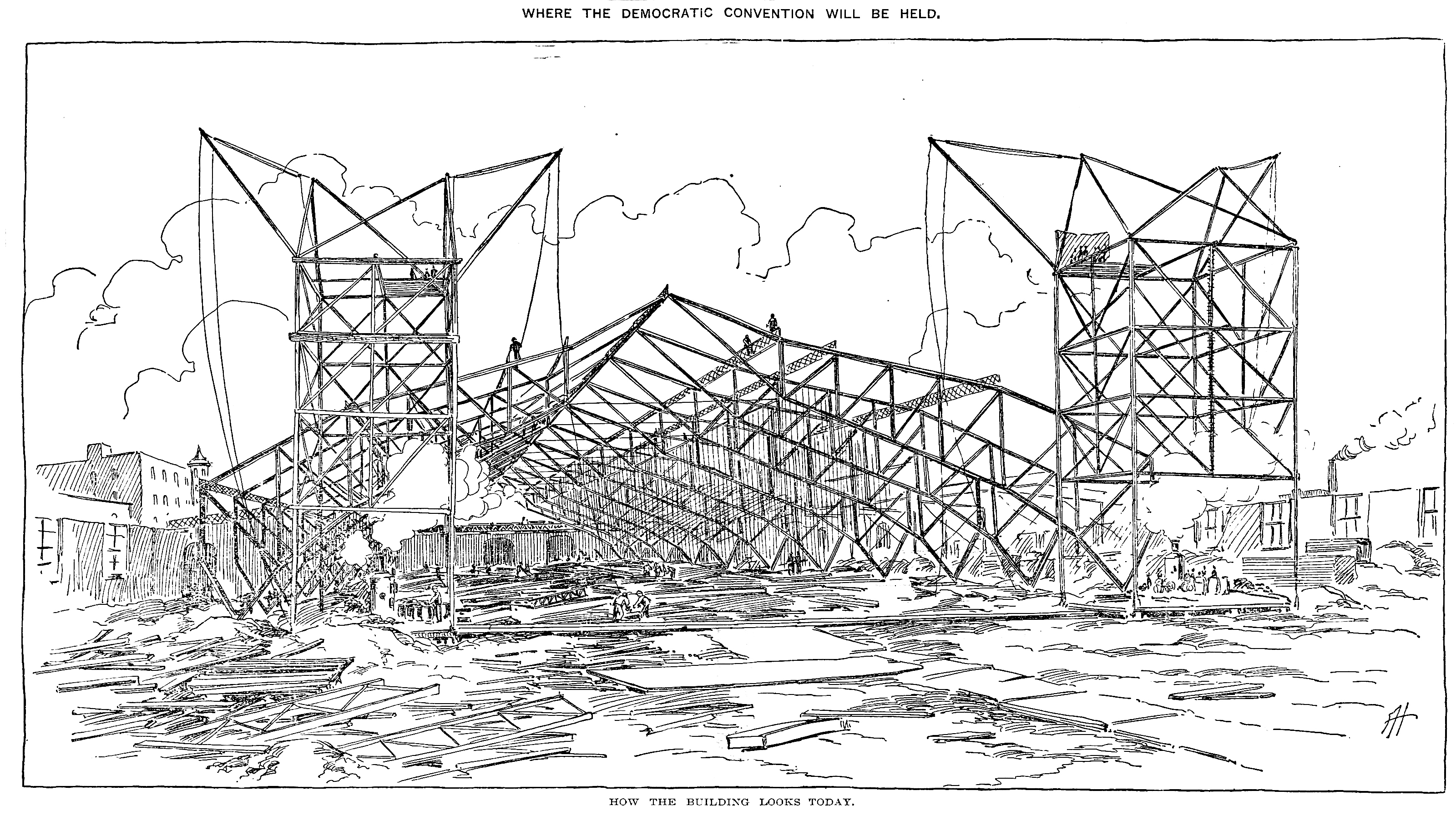
 From the Coliseum Building last night came fierce whoops and yelps, followed by the rattle of rifles and revolvers.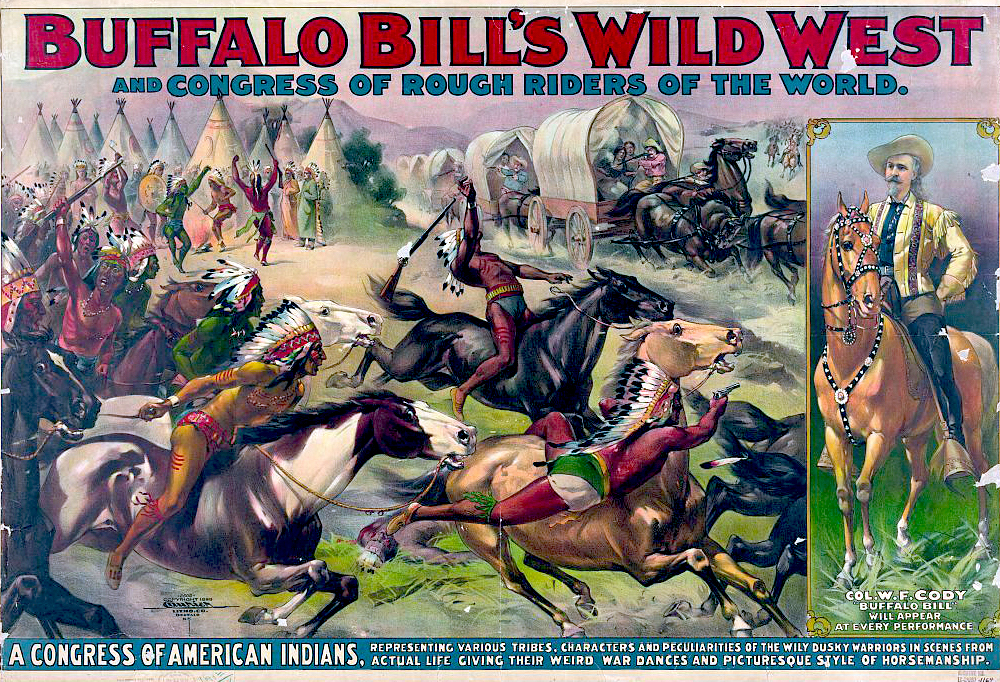
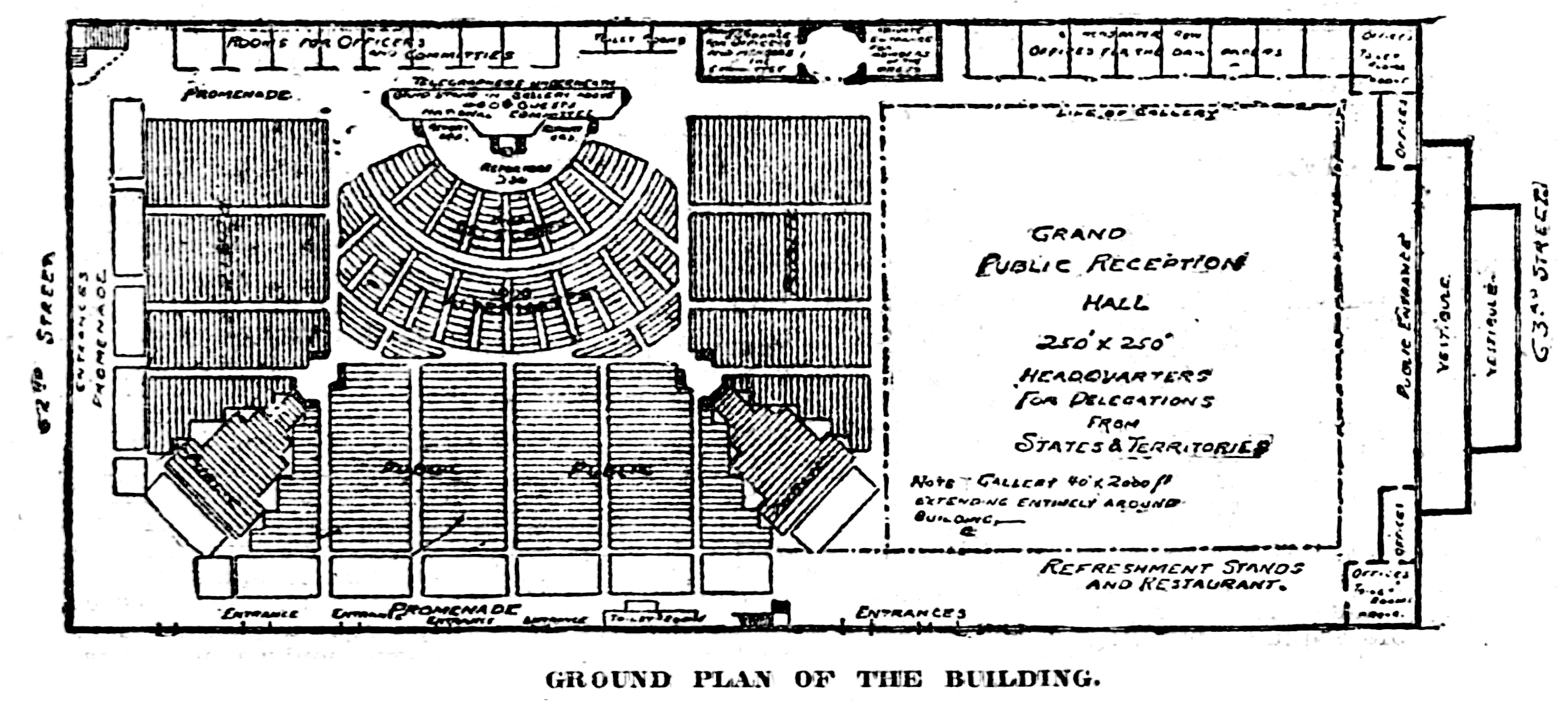
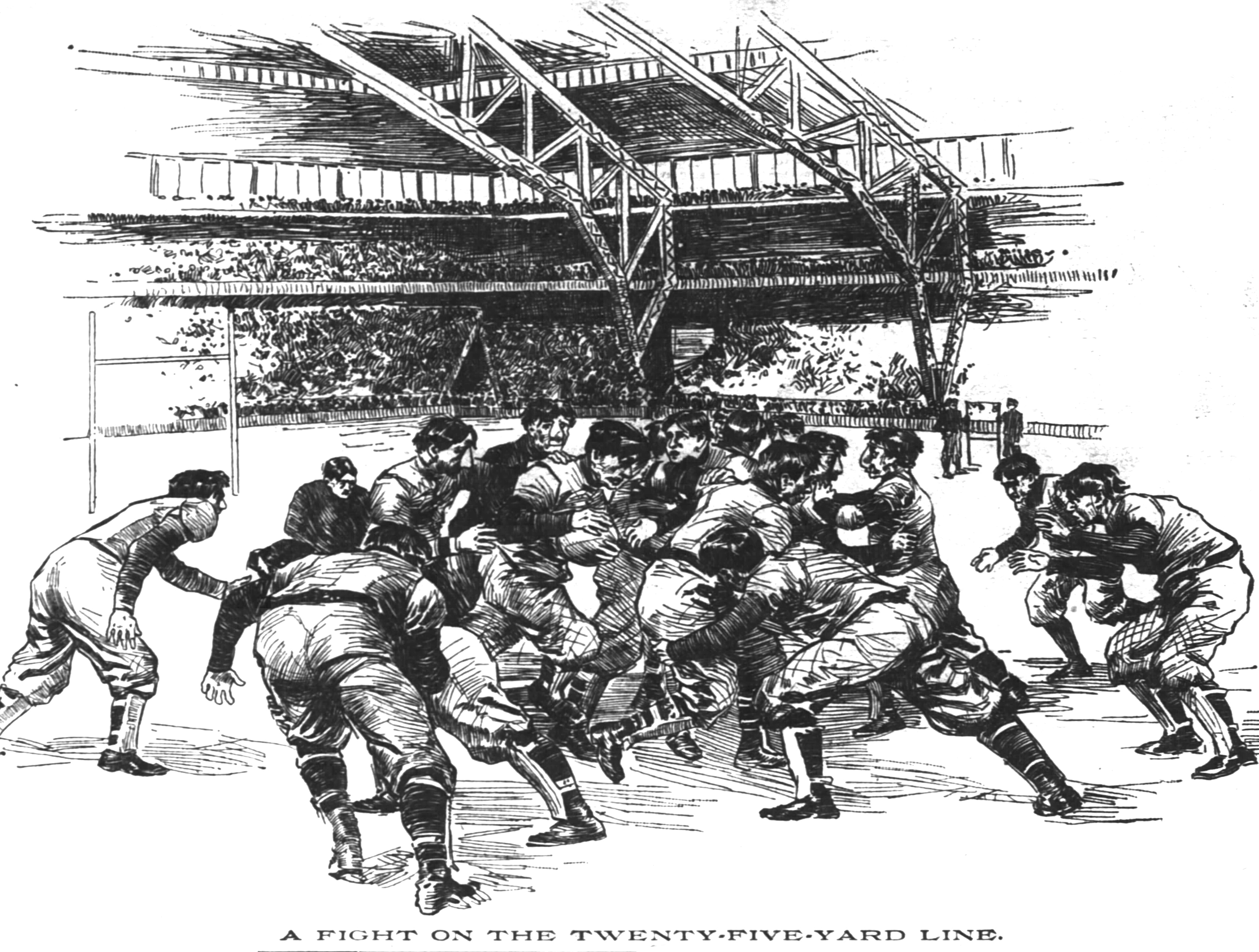
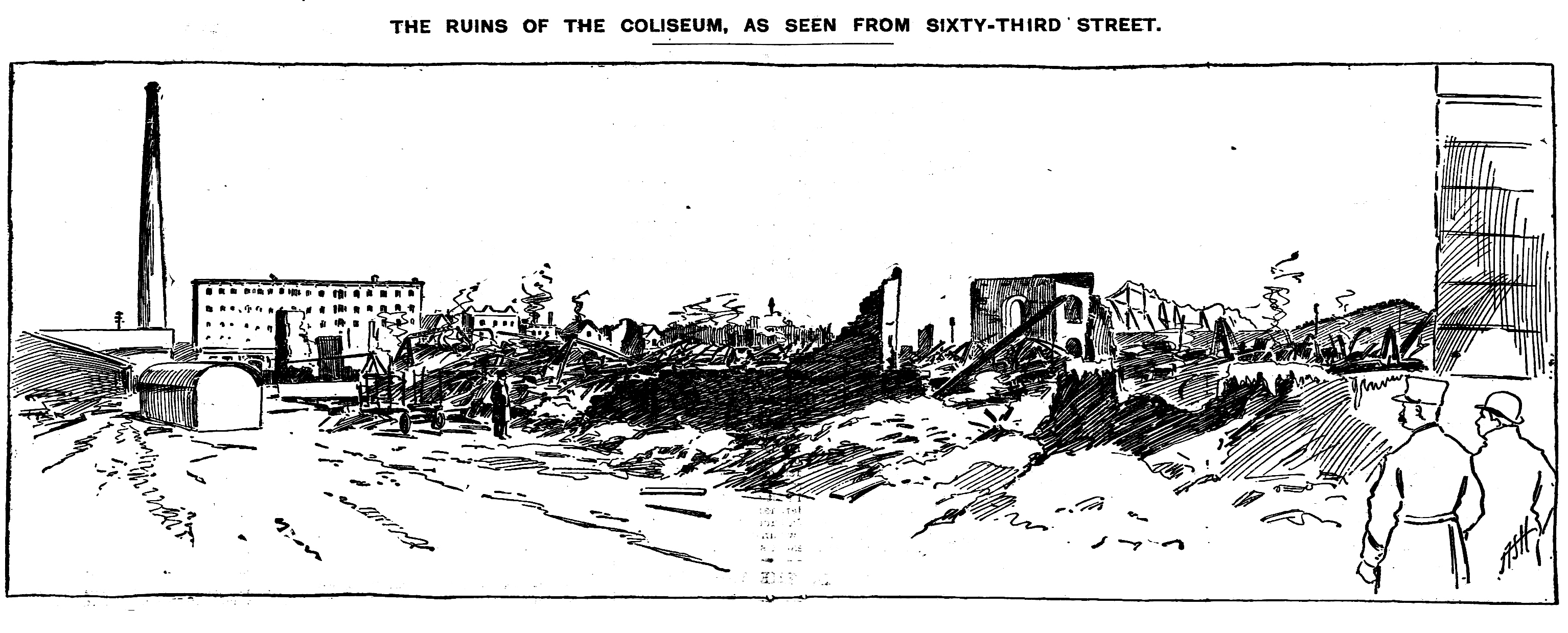
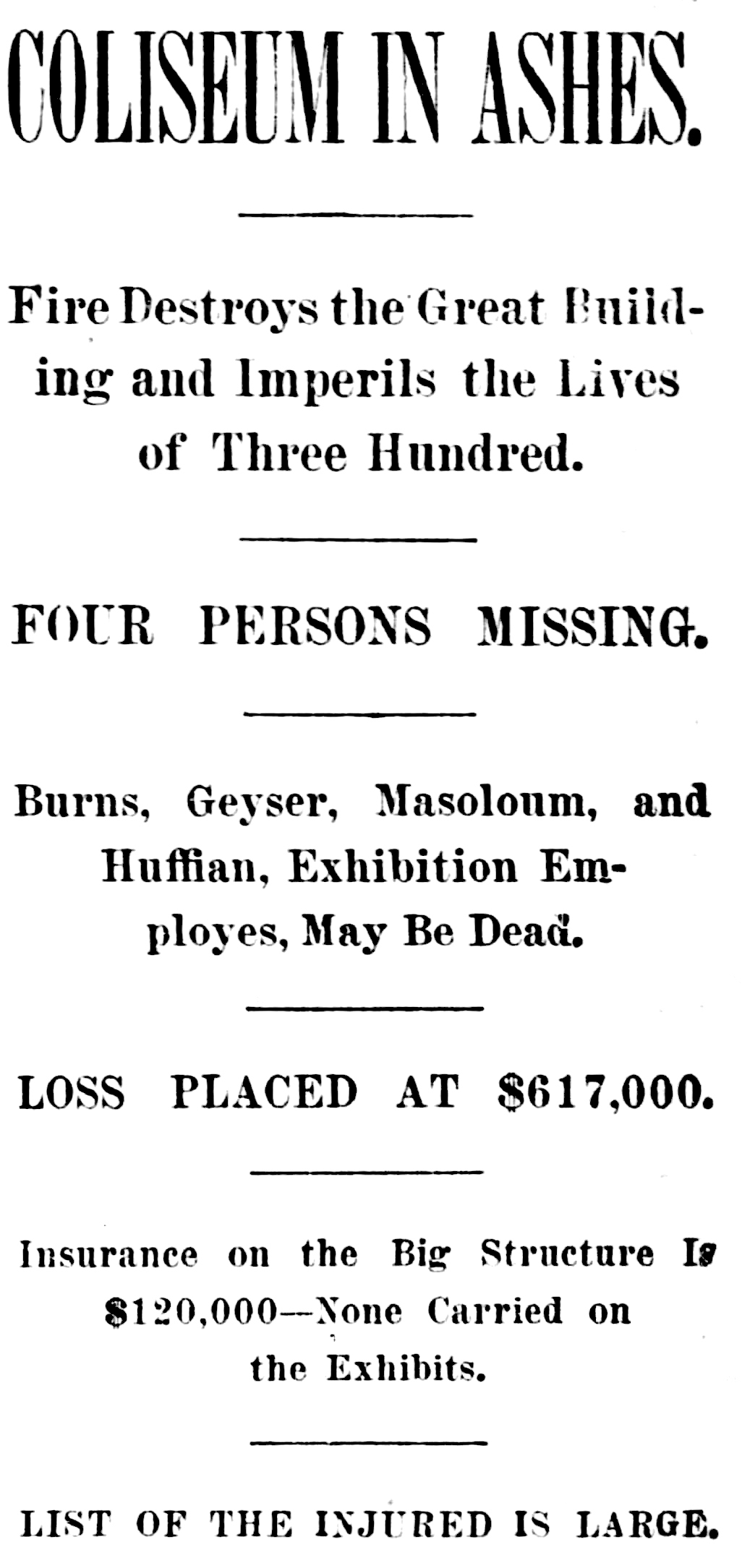 The Coliseum Building, in Sixty-third street, burned to the ground early last evening. Three hundred persons connected with the manufacturers’ carnival and winter fair were in the huge structure when the fire began. In attempting to save their personal effects many had narrow escapes from death. A large number were injured. A dozen persons were reported missing, but all who were known to be in the building at the time the fire started were accounted for by 10 o’clock except four. Those of whom nothing could be learned and who are believed to have perished are: