Marshall Field III—September 28, 1893 -November 8, 1956
Chicago Tribune, January 28, 1906
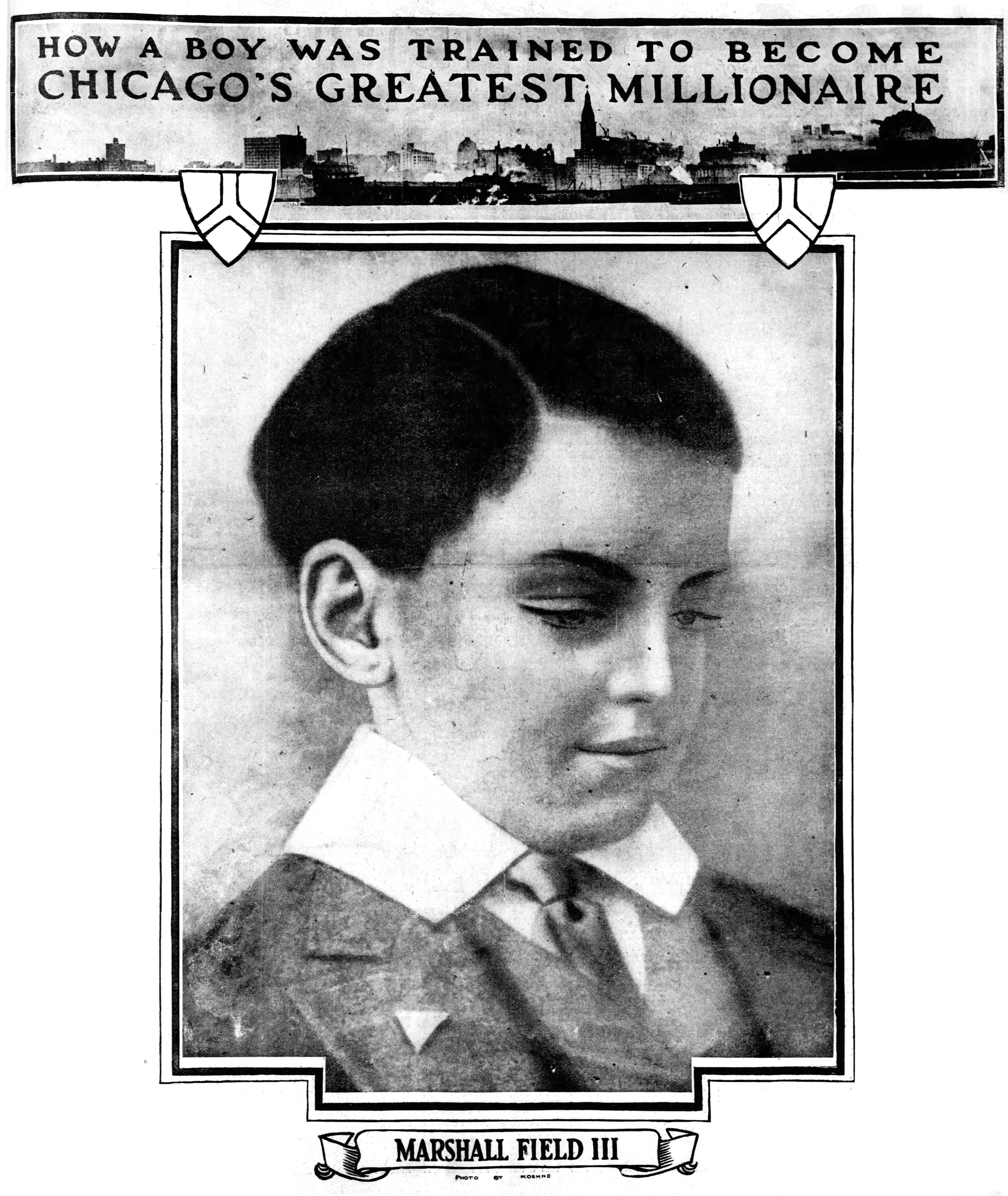 A frail, slender body, composed mostly of nerves; a classic, thoughtful face, set above well built shoulders; a splendidly molded forehead, a forceful mouth; clear, grave eyes, deep set; a distinguished little figure; a natural reserve that may prove to be the symbol inner power—that is the lad of 12 years who is destined to become Chicago’s foremost millionaire, the sole bearer of the name of Marshall Field. With the passing of the head of the house of Marshall Field and the tragic death of his son, Marshall Field II, on Nov. 27, this slight figure has become weighted down with the inheritance of a great, untarnished name and a fortune too vast to be measured by a mental picture.
Immense Burden to Be Borne.
Marshall Field-the boy-is the first born of the second Marshall Field and Mrs. Albertine Huck Field. Six weeks ago he was known as Marshall Field III. From heir presumptive he has become in that brief period the heir apparent and lineal head of the richest house in the middle west.
From now until he reaches his majority this boy will be trained, mentally and physically, for the work of controlling $200,000,000 and conducting the business of the largest mercantile house in the world. He will be fitted to fill the place of power in the financial world made vacant by the death of his distinguished grandfather in much the same way that Frederick William, the crown prince, is being fitted to step into the place of power in the world politic when it shall be made vacant through the death of his father, the German emperor.
Frederick William is being trained to command troops; young Field will be trained to command civilians; Frederick William is being fitted to master the world problems that beset a growing political empire; Field will be fitted to master the business and financial problems of an expanding mercantile principality.
Ill Starred in Early Life.
The grandson and bearer of the name of the world’s foremost merchant was born in Chicago, and the first twelve years of his lite seem to have been ill starred. He has been a sickly child. But those who know the lad have hoped that this discouraging circumstance has boded well for the boy. They have recalled that Julius Caesar, Napoleon, Alexander Pope, and many other of the world’s foremost characters were hard to rear, were sickly in babyhood and frail in boyhood, and in some cases throughout their lives. And there seems to be a firm foundation for the hope. Though young Field’s horoscope has not been cast, though none has attempted to foretell his future through any of the avenues of prophecy or clairvoyance, the 12 year old boy bears the unmistakable stamp of promised genius.
Though he never has attended a school, for the last six years the lad almost constantly has been under the tutorage of some distinguished professor. Even during the long stays abroad while his father was in search of health, young Field and his books were inseparable friends. The mind of the boy is unusually active. He seems possessed of the same quickness of perception and understanding that marked the elder Field a man of distinetion.
Strikingly Like His Grandfather.
Marshall Field—the new Marshall Field—in many ways is the counterpart of his grandfather. His face is the Field face in every line. While he bears a faint resemblance to. his father, his likeness to his grandfather is striking. A photograph of young Marshall Field as he is today recalls to the mind of the old residents of Conway, Mass., the face of the lad “Marsh,” who worked on a farm at the outskirts of the quaint little town.
In the makeup of Marshall Field the boy there is combined with the characteristics of the Field family the stability: of the splendid German type represented in the long line of the lad’s maternal ancestors. For whatever of physical strength young Field may find himself endowed with in later life he will be indebted to his mother, the daughter of Louis Huck.
The boy’s father, Marshall Field Jr., was a victim of ill health during his entire life. The father’s physique probably was inherited from his mother, Mrs. Nannie Scott Field, the first Mrs. Marshall Field.
Boy’s Life One Long Tragedy.
Tracing out the life of young Marshall Field is much like enumerating the critical scenes in a tragedy. The boy’s babyhood was much like the babyhood of anybody else. His boyhood has been different. There was an exceptionally strong attachment between this lad and his father and grandfather. Each was devoted to the other. Marshall Field, the grandfather, was intensely interested in the boy, for he was the first born of his only son. As the infant grew into toddling babyhood and the baby into a pratting, destructive youngster, the grandfather’s affection for the child increased. He frequently played at some queer little game with his grandson and was said never to be so happy as when forgetting business cares and worries, he would accept the lad’s challenge to romp with him.
The boy grew to the age at which parents begin to think seriously of their children’s future. A tutor was engaged to teach the ad his alphabet. Young Marshall mastered his letters with remarkable aptitude. Then came the addition tables and the subtraction, and all the kindred branches of study. Then came a series of illnesses. The love of the grandfather for the boy was heightened by the several attacks of serious illness suffered by the child.
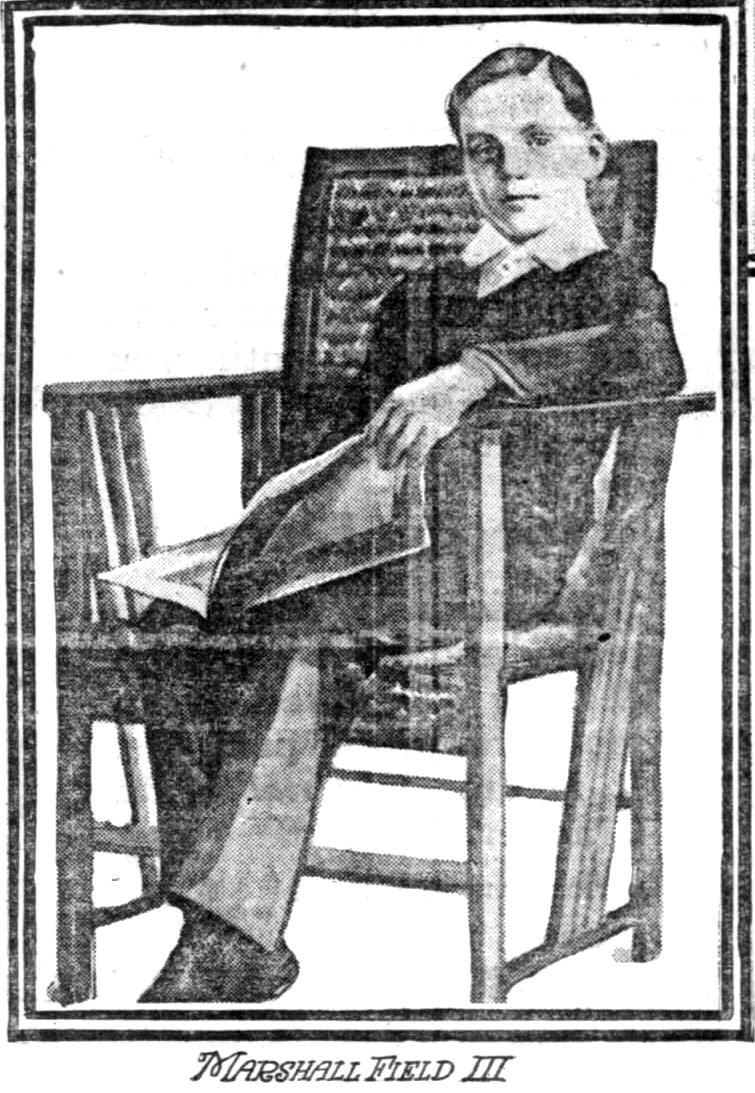
Trained by Famous Grandfather.
During all this time young Field’s education was not neglected. He did not mind being kept at his books, either, for, from the time he was given his first picture books, young Marshall has been fond of them.
Traveling so much, Marshall Field made few boyhood friends, but he and Henry naturally became great chums, depending almost entirely upon one another for their amusement. Three years ago Gwendolin came into the world, and the boys welcomed the little sister into their companionship. The three are fastest friends.
During Gwendolin’s babyhood the family spent most of the time in Chicago, and during this period young Marshall and his grandfather were brought into daily contact. The lad was old enough to be companionable, and the head of the house of Field and his lineal heir had many a long talk together. Two years ago Mr. and Mrs. Field Jr. went abroad again, taking the three children with them. It was shortly after their return, after a year’s absence. that the boy Marshall had the most serious Illness of his life. It followed a fall from a horse, and was thought to have been the direct result of the accident. While riding with his father he was thrown from a horse and nearly killed. Dr. Charles McBurney, the famous specialist, was sent for, and worked for weeks to save his life, and after lingering long at death’s door the child began to recover. Then inflammatory rheumatism set in, and the boy became worse. For a time it was felt he could not possibly survive. Dr. Frank Billings and Dr. Robert H. Babcock worked over him almost constantly.
For weeks Marshall Field Jr. watched at the bedside of the pale and diminutive patient. Mrs. Field, the mother, was a devout nurse, and the grandfather was in constant communication with the house and often spent hours at the boy’s bedside. Only Jan 21 of last year, a year lacking only a few days before the quick succession of such events left him sole bearer of the great name, Marshall Field’s condition was pronounced almost hopeless. They feared his heart would fail him, so great was the lad’s weakness. Stimulants were administered. The boy’s life hung by the barest thread. Then he rallied. At death’s door twice, and twice almost miraculously saved, Marshall Field is not yet strong.
After the last, long, and trying iliness Marshall Field was taken to Lakewood, N. J. His grandfather accompanied him on the trip. In a few days the father and mother and Henry and Gwendolin joined them. After a stay of a few weeks in Lakewood, Mr. and Mrs. Field salled for Italy with their children. Under cloudless skies the little fellow slowly regained his strength.
Then followed the return home and the series of tragedies that culminated in the death of the man who carved the name Marshall Field in its high place.
Such has been the life of the boy Field—a life beset by the cruelest ogres that a vivid child imagination is able to picture—the ogres of ill Health, of Death, of Grief.
Not of “Spoiled Son” Type.
The boy Field has a personality, strongly developed. He is reserved in manner, earnest in speech, he has his grandfather’s active dislike for display; he is retiring, sensible; he is not of the “spoiled rich man’s son” type.
Masculinity was not left out of his makeup. Marshall Field is a manly lad and the blows of misfortune have magnified his manhood. He has been philosophical in the face of all his griefs. Devoted to outdoor sports of all kinds, the boy’s physical disabilities have prevented him from indulging his natural likes to any great extent. But he has not complained He has been patient.
The lad has a strong fondness for horses. He is a horseman of no mean ability for a boy of his age. He plays tennis and baseball, but his enfeebled health has denied excesses in any of the sports that sweeten childhood. Now and then he has played in a game to his great delight. Usually he takes his physical exercise with dumbbells or chest weights He seems to appreciate the necessity of building up a strong physical foundation upon which he may draw strength and force in later years of business confinement. He is popular with other boys, with the new companions he has cultivated since the departure of Henry for the Boston school. He is popular with the men who knew him as his grandfather’s companion, and he has made hosts of friends among the employés of the great Field establishments.
Plans for Business Training.
As a first step in giving the boy Field the training he will need to fit him for the direction of the enormous. enterprises founded by his grandfather young Marshall will be sent to Mrs. Fay’s school as soon as his health will permit. He is now looking forward to entering the school at the beginning of the next term, and if nothing arises to defeat the plan his ambition will be gratified.
Probably he will be called Marshall Field III during the rest of his boyhood and before he finally accepts as his own name Marshall Field he will have been given the best available educational opportunities calculated to fit him for the performance of the herculean task of preserving and enlarging the enormous fortune amassed by his grandfather and the larger task of conducting the Field mercantile establishments. His greatest, most difficult, most hopeless task will be to make himself such a man that all his life he will not be known as “the grandson of Marshall Field.” If he ever should become just plain Marshall Field all his ambitions should have been achieved. For to become plain Marshall Field will mean that he has mounted the ladder to a higher place than Marshall Field, the grandfather.
Great Foundation for Career.
Before Marshall Field Ill. takes up the reins he will have been equipped so far as is possible through the forces of education to accomplish this end. He will be given a firm foundation upon which to build the structure of his life. To know his mother’s characteristics is to know this—to know that nothing will be neglected in the work of building the foundation. To appreciate young Field’s heritage is to believe that he will build well upon the foundation.
Young Field cannot have helped but become inoculated with the ideas held by his distinguished grandfather; he cannot have helped but become inoculated with the spirit of the man. He will have the record of his grandfather’s achievements to bolster him up. He will begin at the bottom of the ladder not like other men. He will begin with the positive assurance that he will reach the top. He will begin where most men stop with a fortune.
There is much promise in young Field’s 12 years. He was the joy of his grandfather’s heart. His grandfather spent much of his time with him. He took the boy about with him frequently, through the great stores and warehouses. He talked to the lad as he would have talked to a man. He tried to impress upon the lad the principles of business and life that he himself held so dear. It years burn away most all of what the elder Field told the younger, something will remain—maybe just impressions.
Before Marshall Field the boy becomes Marshall Field the man it is intended that he shall master every detail of the great business left by his grandfather. Then will the task of preserving untarnished the name he bears fall upon his shoulders.
The Day Book, April 12, 1916
 Will Marshall Field III. ever go into business life and shape out a career as a merchant?
In both financial and department store circles this question is talked about a good deal these days.
There is much guessing on why the 22-year-old who classes up as Chicago’s richest young man should stay away from the one town on earth where his name, is in everybody’s mouth and is the one name most widely celebrated by newspapers and signs on walls and wagons.
What are the reasons behind that young man quitting his apartment on the most picturesque part of the Lake Shore drive and going bag and baggage down to North Carolina to ride polo ponies and play golf?
Here’s the town where his grandfather built a department store that now calls itself “the cathedral of the stores.” Here’s the only town with a Marshall Field museum and a Marshall Field choral society. Here’s the own town where his money has with almost dominant control of public utilities, downtown land sites, street cars, light and power systems, newspapers.
And yet the young man whose voice could be the most powerful single voice in this situation—if he so chose—spends all his time far away from the roaring workaday world where his business interests are located.
On his return from England, where his boyhood and youth were lived, the word was given out that Marshall Field III. was getting ready to buckle down to work. Under the guidance of Arthur D. Jones, trustee of the Field estate, he was to learn business and eventually would take his place as a man among men, listening to reports on his affairs, rendering decisions and personally sitting on directorates and shaping policies.
He went to probate court the day he was 21 years old and signed the papers necessary to his retention of control of Chicago’s largest estate. Then he married a New York girl, took rooms at the Blackstone, played golf at Owentsia. Then the couple took an apartment at 1200 Lake Shore drive, with eleven servants of the retinue situated in other rooms immediately outside.
But keeping a house like this wasn’t a go. The couple went back to the Blackstone. Then came the jump to Aiken, North Carolina, where ground is broken and the start made on a big country place that will overshadow all the bungalows and lodges in the neighborhood.
People watching this situation are talking. The question most often asked is whether Marshall III. will ever land with two feet in the business game, taking his place as a man among men.
The Day Book, April 17, 1917
WILL MARSHALL FIELD III. ENLIST?
By Carl Sandburg
If the report proves true that Mr. Marshall Field III. is coming on to Chicago this week and enlist in the First Illinois cavalry his action is expected to stimulate recruiting among other young men who. up to date in their pale lavender lives have existed only in the rose glow of a granddad’s fame and glory.
At the present time Marshall Field III. is physically and mentally a sort of nobody who travels on his grandfather’s name and money. The general theory is that if he hadn’t picked the world’s greatest merchant’s loins to spring from he would on natural form and ability be selling sox at the well-known wages paid by Marshall Field & Co. and without bonus payment at New Year’s in war time with record-breaking profits.
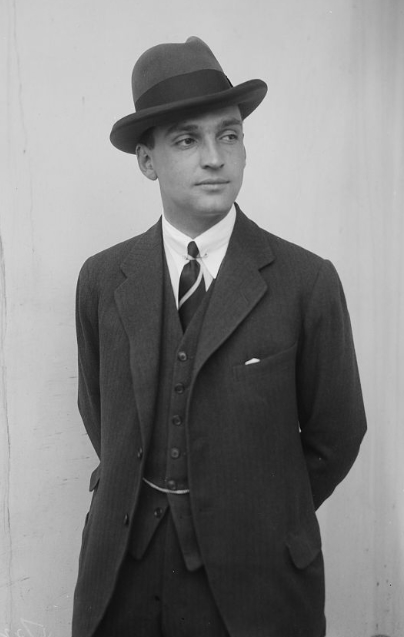
I am writing the truth about this kid because I hope he enlists and curries his own horse and handles a shovel like any honest-to-Pete cavalryman fighting as a private soldier in the American army.
If this Field boy goes in and the officers of the First cavalry play no favorites, it will be a good thing for Chicago. This is so because the Field boy is just about the most powerful single individual in this city if he chooses to exercise the power he holds as titular and economic head of the biggest retail and wholesale stores in Chicago, with control in Commonwealth Edison, Surface Lines, Illinois Central, Illinois Steel.
Let this boy learn how to stand on his own legs, knock around among rough men, eating pork and beans and listening to smutty stories and rollicking hi-yi songs, thrown into the guardhouse if he gets drunk or shoots off his mouth, scrubbing his accoutrements, making his bed on the ground or on stone and wooden floors of barracks, washing his own shirt, battling against vermin that lay eggs under the armpits of all who get into active service—let this young Marshall Field III. go up against this game without special favors from commissioned officers and non-coms—and then he may come back to State street, take things in his own hands and run the vast Marshall Field shebang all by himself.’ I’m not afraid of the results. I haven’t a doubt but Chauncey Keep, Arthur D. Jones, John G. Shedd and the trustees and caretakers of this young commercial prince have a deep affection for him because of their veneration for his granddad.
If the lad goes into the First Illinois cavalry and learns to work and fight, it is a sure thing the trustees and caretakers will be glad of it. They would like to see him travel on the prowess of his own loins instead of his grandfather’s. When Marshall Field III. sings “My Country, ‘Tis of Thee” with the accent on “MY.” he is singing true to form, because he is chief designated heir to an estate of $350,000,000 at 50 years of age, and a big share of the country, will be his. The American flag is the flag of HIS country in a real sense. Furthermore, inasmuch as Marshall Field III. & Co., manufacturing wholesalers, have textile mills in France and England—and Marshall Field III. was educated from boyhood to young manhood in England—he is the one young man in all Chicago whom the forces of destiny ought to shove into o the First Illinois cavalry. And right after him should come his younger brother, Henry Field.
If they should perish as cannon fodder they would have consolation not known to the millions and millions. Their wives and children would be safe against material want.
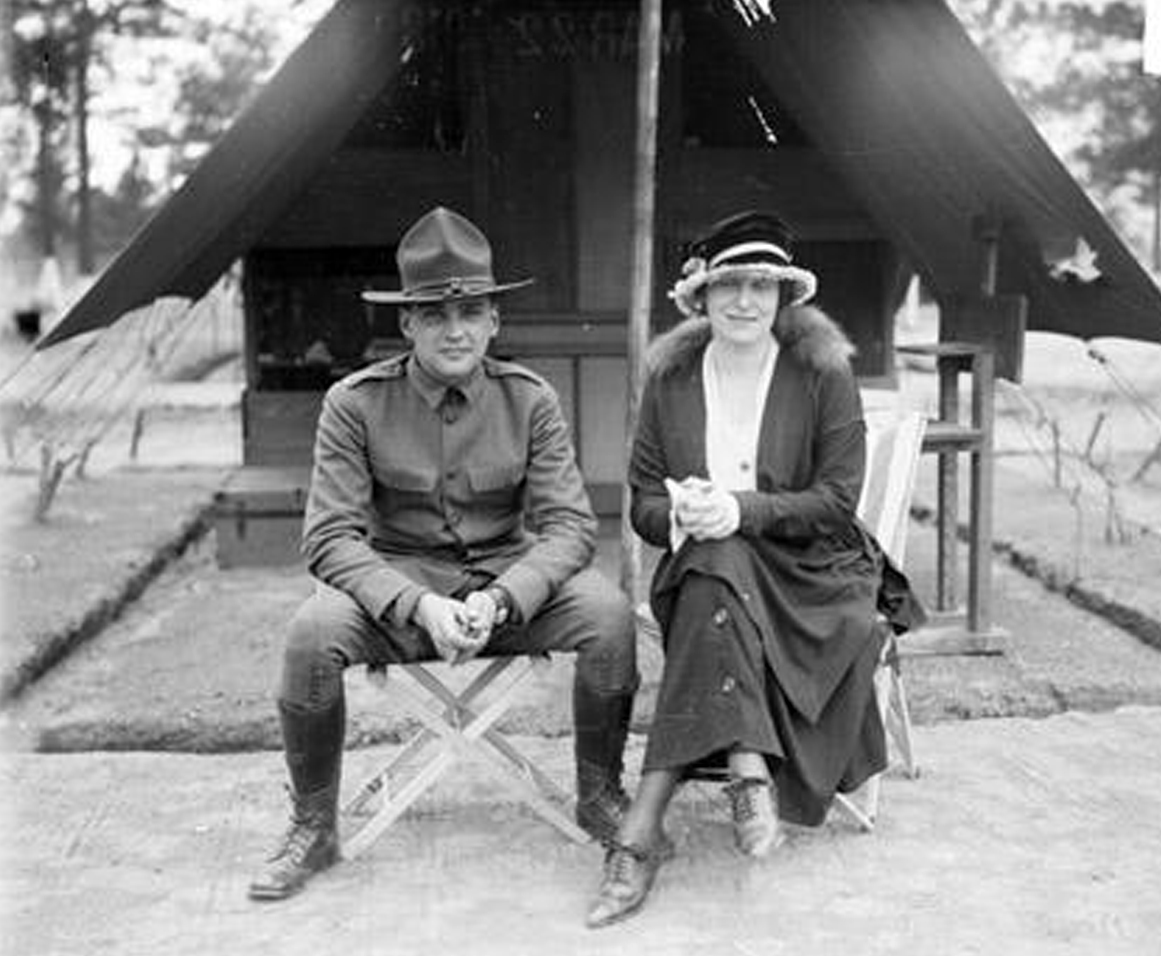
- Lieutenant and Mrs. Marshall Field, III, Camp Logan in Houston, Texas, 1918.
The Day Book, April 21, 1917
WAR NOTES
By Carl Sandburg
While the war lasts there is going to be more or less discussion of Marshall Field Ill.., who is now a private in the First Illinois cavalry. And after the war there will be more discussion along with pictures of him as a trooper serving the nation. Reporters and editors irresistibly feel the play of big news and big human interest around this boy. While democracy shrinks away from giving the spotlight, to a unit in this situation, the fact remains that Marshall Field III. is the most spectacular private in the armies oI the United States and his conduct from day to day draws curious scrutiny from all men and women of thought.
Many of us would like to see the curtain drawn and no more mention made of Marshall Field III. during and after the war. We would like to respect his wishes that his name be not printed. And we all hand it to him for the modesty and discretion with which he spoke Thursday just before he faced the flashlights of the camera squad. He said he didn’t see what all the fuss was about and in a quiet, smiling way that everybody liked he said his only kick so far in the service is against the quartermaster who gave him pants that are too tight a fit in the seat.
Chicago Tribune, September 29, 1938
MARSHALL FIELD III. IS 45; HIS BIRTHDAY PRESENT: 100 MILLION
A birthday present estimated as high as $100,000,000 was handed to Marshall Field III. yesterday in the offices of his grandfather’s estate in the Field building. It was Field’s 45th birthday. The gift, the accrued interest on his grandfather’s estate, was turned over to him under terms of the will of the elder Field, who died in 1906. When Field is 50 he will receive the principal of the estate, one of the world’s greatest and said to be worth $500,000,000. Field lives on his Long Island estate with his third wife, the former Mrs. Ruth Pruyn Phipps.
Chicago Sun, December 4, 1941
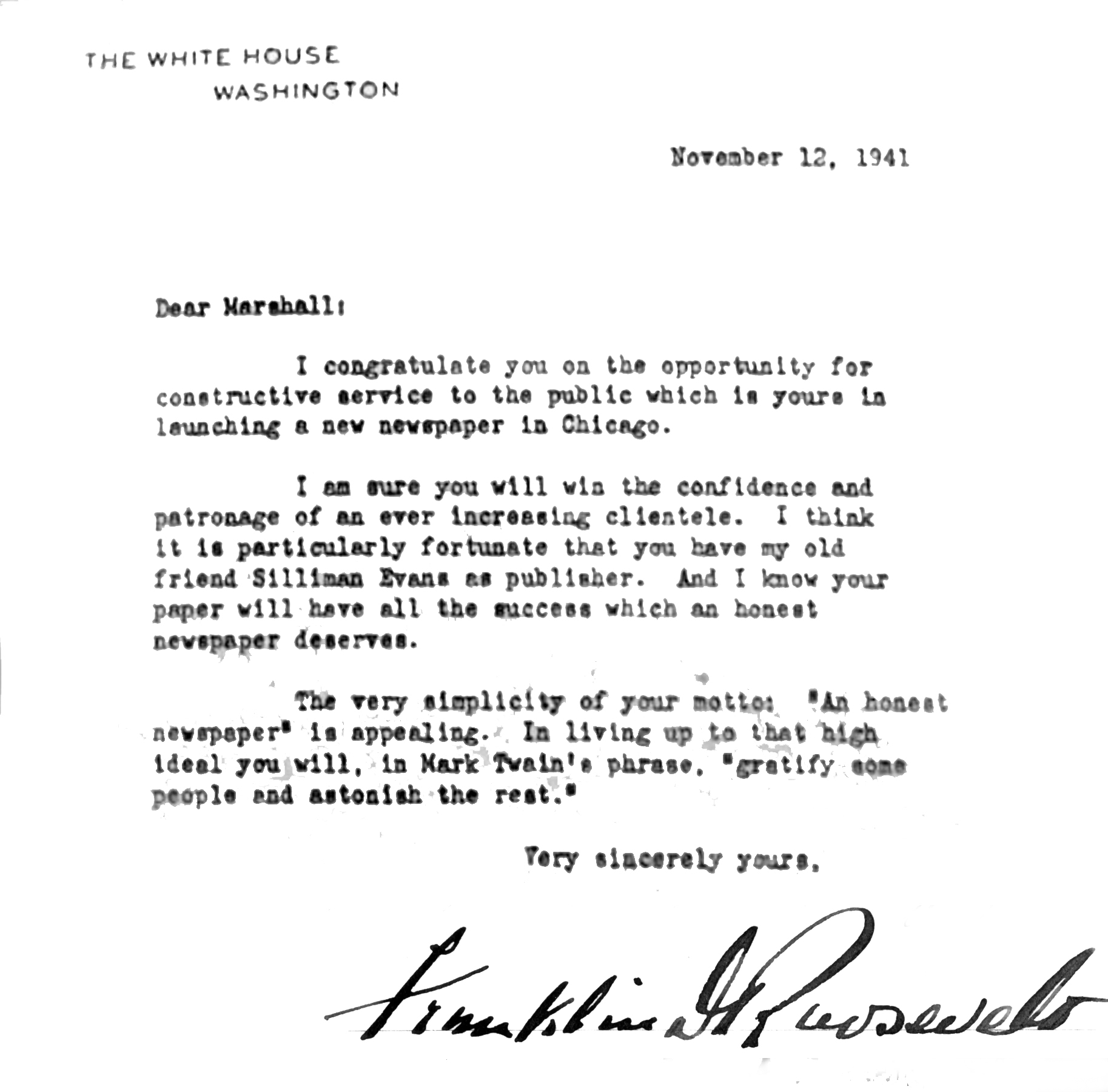
Chicago Tribune and Chicago Sun, December 4, 1941
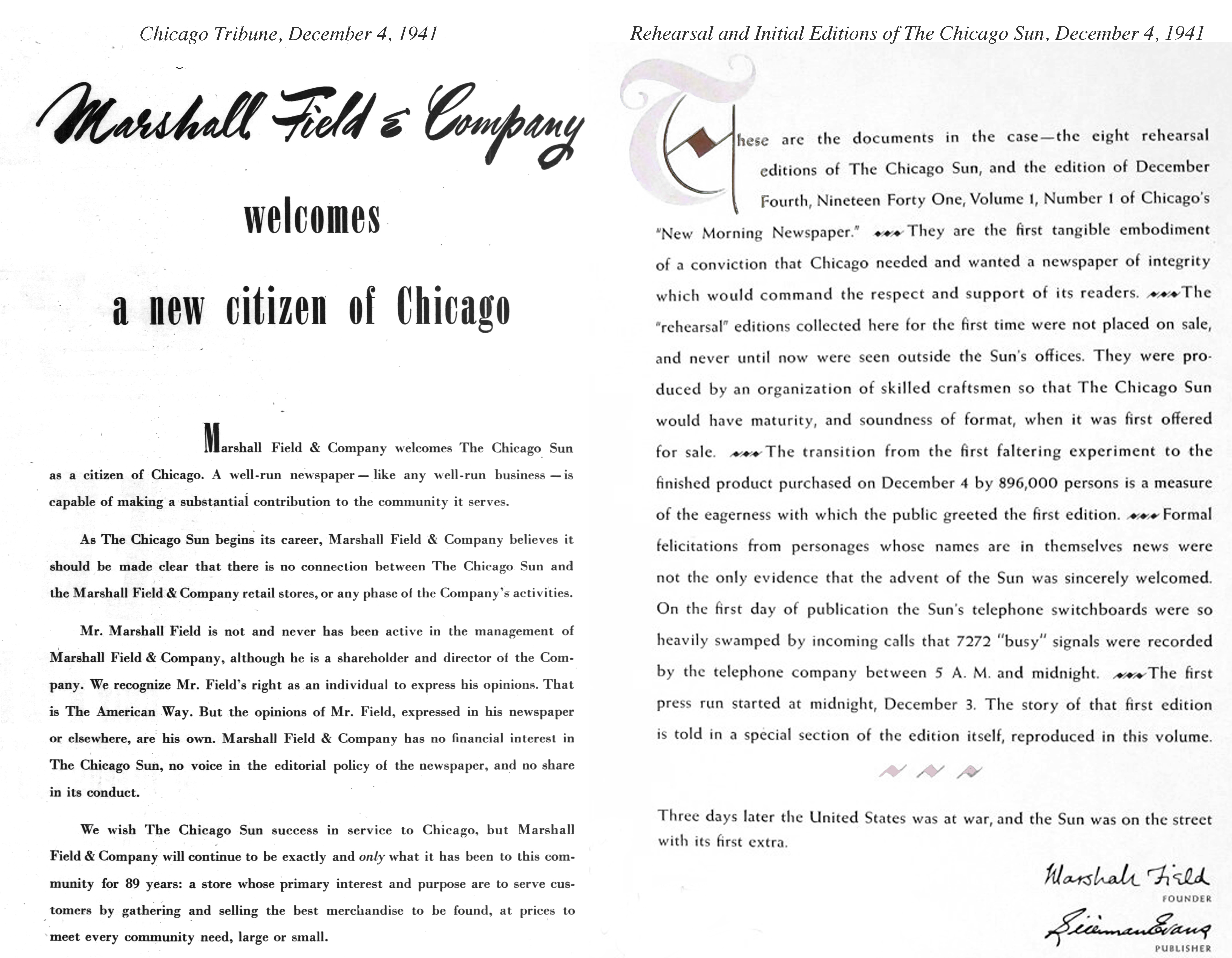
- LEFT: Marshall Field & Co. Advertisement confirming the affiliation of Marshall Field III. and his newly acquired Sun to the Company; Chicago Tribune, December 4, 1941.
RIGHT: Cover Letter from Marshall Field III of a Special Edition of the Chicago Sun Including Rehearsal and Initial Editions of the Chicago Sun produced during November, 1942.
The Daily Worker, December 6, 1941
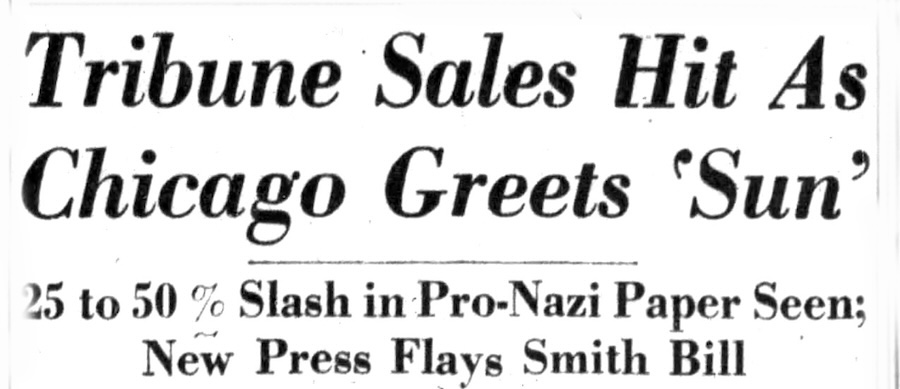 By Carl Harris
A slash of 25 to 50 percent in the circulation of the pro-Nazi Chicago Tribune was indicated here today, as Chicago’s new morning paper, The Sun, settled into stride.
The new paper sold more than 800,000 copies today, breaking through the morning monopoly held by the paper of Col. Robert R. McCormick, arch appeaser.1
A check of the newsstands revealed that the Tribune has suffered its drop in the biggest circulation outlying neighborhoods, and particularly in working class areas, where the Tribune is thoroughly despised.
A drastic slash in the sales of the Colonel’s sheet was felt on the South Side, in the Negro community.
The clamoring demand for the new paper, which has a pro-Roosevelt slant, was seen here as the explanation for the fact that the Tribune has not resorted to the anticipated “rough stuff.” However, stand keepers predicted that the Tribune’s goon squads will “cut loose” before long in an effort to win back the paper’s dwindling circulation.
The Tribune is known to be especially concerned with losses in out-of-town sales in the five-state area which the pro-Hitler publisher considers as his private “Duke-dom.”
In Gary, mainly steel workers populated by workers, Tribune circulation managers sought to keep the Chicago Sun off the news stands. The possibility is that the new paper will have to install its own stands.
On the eve of the appearance of the new paper, founder of which is Marshall Field, the Tribune aroused national indignation by exposing a confidential government report on defense plans.
This climaxed a string of similar disclosures by Tribune agents many of which have been considered as acts of enemy espionage.
Turner Catledge, Chicago Sun’s Washington correspondent, wrote today that “all departments concerned with the armed defense of the United States” were investigating the leak through which the Tribune was able to secure this in-formation, considered highly important to the Nazis.
‘Sun’ Flays Smith Bill
The new paper, which has come out strongly behind the Roosevelt program, today indicated its labor policy in an editorial on the Smith anti-strike bill. The paper charged that the measure would allow employers to challenge every past, present or future decision of the Labor Board merely by charging Communism against a union officer. It would open the most conservative union in the country to destruction if a federal judge found that failure to discover secret communist connection in one person constituted negligence.
“The provision regarding a person convicted of a felony would have the same effect. Besides its ostensible legitimate purpose, it would enable enemies to destroy a union by planting or finding one ex-convict among its officers.”
Pointing to the bill’s clause which forbids mass picketing, the editorial stated: “Who does not know that in mass production industries a strike without mass picketing is broken before it starts?”
Nationwide sentiment against the Nazi-dominated Tribune was indicated by the flood of greetings sent to the Sun, many of which carried pointed barbs against the Tribune.
Chicago Tribune, July 24, 1947
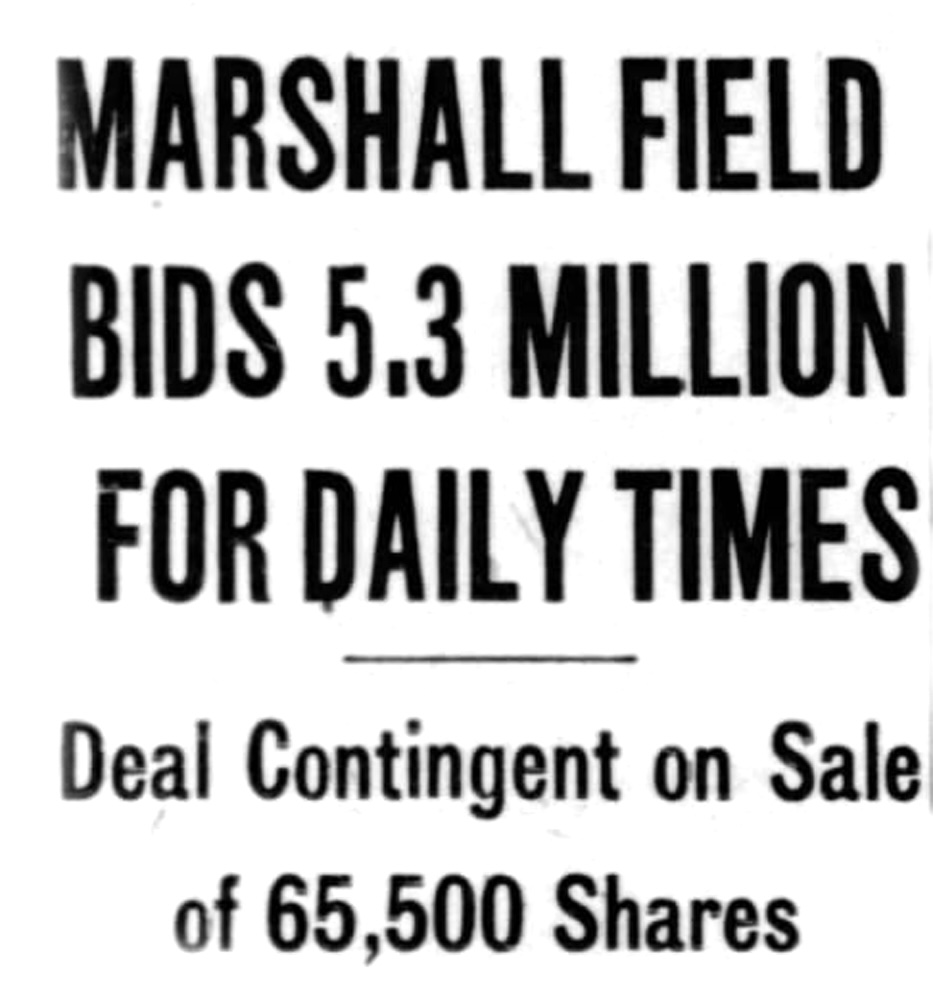 An offer to purchase the entire capital stock of the Chicago Times, Inc., publisher of the Daily Times, at $5,339,000, or $60 a share, was made yesterday by Marshall Field, publisher of the Chicago Sun.
The offer is contingent upon its acceptance by holders of 65,500 Times shares by Aug. 25. There are 88,977 Times shares outstanding.
Richard J. Finnegan, president and publisher of the Times, and two of his associates have agreed to the price offered by Field, and are transmitting the proposal to other shareholders, of whom there are 488. Besides Finnegan those listed as agreeing to the offer are James A. Griffin Jr., second vice president, and Robert Walshaw, secretary and treasurer of the publishing company. Griffin is a son-in-law of the late S. E. Thomason, publisher of the Times until his death in 1944.
Sale Believed Assured
It was believed that sufficient stockholders to assure transfer of control were prepared to accept the offer.
The price offered by Field for the stock is greatly in excess of those quoted recently in the open market. In recent weeks the stock has been quoted by securities brokers between $28 and $38 a share. The latter price was bid for the stock yesterday, but no transactions were reported. Last year the stock sold as low as $17 a share.
Field has made several offers for the Times, the first in 1941 before he launched his unprofitable morning newspaper (PM). The continued expense of the morning venture and its recent shrinkage in advertising lineage were said to be factors in his move to purchase the afternoon tabloid.
Plan Tabloid Form for Sun
Field said last night that if he acquires control of the Times he will continue to publish the Sun as a morning newspaper in tabloid size. Each paper will have its own staff, he said. Finnegan will remain as editor and publisher of the Times and will have the additional title of executive vice president of the Sun.
“I will, of course, remain as editor and publisher of the Sun,” Field said.
With the acquisition of the Times, Field is expected to transfer publication of the Sun to the Times plant at 211 Wacker dr. The transfer will be made by Oct. 1 under present plans. The contract under which the Sun now uses the facilities of the Chicago Daily News can be voided on 30 days notice.
Building Project Still Alive
Three weeks ago Field announced the acquisition of a site for a publishing plant at Wabash av. and the north bank of the Chicago river. It was indicated yesterday that he would go ahead with plans for the building, which is expected eventually to become the plant for both newspapers. The lease under which the Times now occupies five upper floors and three basements of the building at 211 Wacker dr. expires in mid-1952. The building is owned by Central Life Insurance company.
Field also owns the block bounded by the river, Madison, Market, and Monroe sts., which he assembled as a newspaper plant site, then abandoned building plans.
Put 20 to 25 Million in Papers
Field is estimated to have put between 20 and 25 million dollars in his publishing ventures in the last six years. He recently raised 18 million dollars by mortgaging the Field building before transferring it to a charitable foundation.
In announcing his offer of $60 a share for Times stock, Field put no limit on the number of shares he would purchase. It was reported, however, that he had made an agreement to buy 6,000 shares held by International Paper company. International Paper also owns $2,500,000 of debentures of Chicago Times, Inc., maturing Dec. 1, 1949.
Field, late yesterday deposited with the American National Bank and Trust company a certified check for the full purchase price pending final action on his offer.
Chicago Tribune, September 12, 1943
 By Leland Forrester.
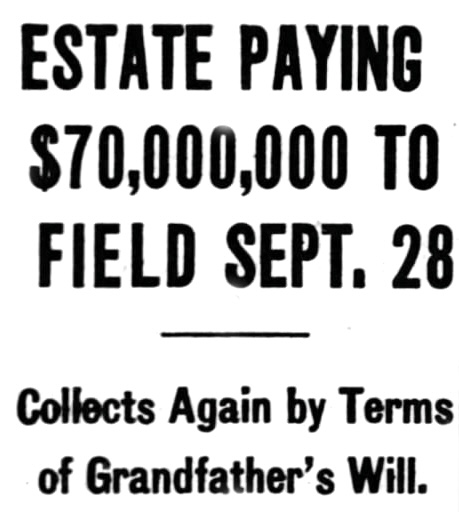
Marshall Field III. will receive between 70 million and 75 million dollars on his 50th birthday Sept. 28, when the last untransferred portion of the vast fortune of his mer. chant grandfather will be handed over to the heir after 37 years in trusteeship, representatives of the estate estimated yesterday.
Carl J. Weitzel, controler of the Marshall Field estate, said the residuary estate consists to a large extent of Chicago real estate, and that the estimate of its value was based on current appraisal figures.
Trustees of the estate said Marshall Field III. already has received about 93 million dollars from the estate since the original Field, founder of the Field store from which the riches stemmed, died in 1906. He is the only heir, his younger brother. Henry, having died July 8, 1917, with Henry’s share reverting to Marshall Field III. by court decree.
30% of Residue Liquid.
The estate residue represents the less liquid assets. It is understood that only about 30 per cent of the assets are liquid, the rest being such properties as loop or downtown sky. scrapers, theater and bank sites, apartment houses, and outlying
store and office buildings.
Among these are the 44 story Field building, 135 South La Salle street, built during the depression at a cost of 20 million dollars; the 38 story Pittsfield building, 55 East
Washington street, and the 22 story Conway bullding, 111 West Washington street.
Field received a large part of the liquid assets in 1938, under a provision of the founder’s will requiring a distribution of one-half of the net income accumulated when the grandson reached the age of 45. The heir was paid 46 million dollars then. The other half had been paid to him at various times previ-ously. Since 1938 Field III. also has been receiving the residuary estate’s income, estimated at $2,800,000 a year.
Virtually Free of Taxes.
The Field estate, often called the second largest fortune in America [Henry Ford’s is the biggest], and sometimes estimated as high as 500 million dollars, has played a part in the economic life of Chicago and has been a target for bitter discussions in congress because under the laws of 1906 it has passed to the heir virtually tax free. Had it been subject to the federal inheri. tance tax in effect when Field III. received the 46 million dollar payment in 1938, the government would have taken 70 per cent.
Congressmen and others assailed Field as a tax dodger not only because the vast fortune passed to him nearly intact, but also because of numerous activities which he conducted at losses which permitted him to get income tax deductions. Among these activities are his racing stables, his cattle raising on his palatial Long Island estate, and his publishing ventures, all of which have been conducted at a heavy loss.
Millions Lost on Two Sheets.
It is estimated that Field has been losing 4 million to 6 million dollars a year on the radical New York tab-loid, PM, and his Chicago paper combined. Congressmen have accused Field of inviting these losses to cut his income taxes, and have asserted that the effect is that taxpayers help foot the bill for his personal enterprises.
The English educated multimillionaire also has used some of his wealth for various philanthropic ac-tivities, which include a gift of a million dollars to the University of Chicago. His Long Island property, a replica of an English estate, is reputed to have cost millions. Thrice married, Field is said to have settled fabulous sums on two former wives, the second of whom was Eng-lish. His first wife, Evelyn Mar-shall, of New York, was said to have received an alimony commitment calling for payment of 1 million dollars a year when she divorced Field in Reno in 1930.
Fortune to Eastern Charity.
While Field’s principal gifts to Chicago, the city from which his fortune has come, have been the contribution to the university and his payment of the annual deficits of the Field museum founded by his grandfather, he is said to have given several millions to various charitable and philanthropic organizations in New York City.
Field’s principal connection with Marshall Field & Co., which oper ates the store and owns the Merchandise Mart, is as a director and minority stockholder. He is said to have persuaded the estate trustees to build the Marshall Field Garden apartments, a low rent project which later was sold as unsuccessful.
Chicago Tribune, August 31, 1944
Field Forms Corporation to Publish Paper
Formation of Field Enterprises, Inc., a Delaware corporation, take over properties used in the publication of the Chicago Sun, was disclosed yesterday by incorporation papers filed with the secretary of state at Dover, Del.
The new corporation is capitalized at $7,100,000, by 19,000 shares of no stock. All represented, of the stock is believed to be held by Marshall Field, who publishes the Sun as a personal enterprise. Incorporation of the publishing venture, which has incurred large losses, followed enactment by congress of a special amendment to the tax laws limiting the tax deduction individuals can take on the losses of their hobby ” enterprises. This provision, known as the Marshall Field amendment, was part of the revenue act passed early this year over President Roosevelt’s veto.
War Profits Offset Losses.
What properties, other than the facilities of the Sun, will be transferred to the new corporation was not disclosed by the incorporation papers which described the business of the company as “printing and publishing.” Since entering on his Chicago publishing venture Field has acquired two industrial plants, whose swollen war profits have helped absorb his publishing losses. To get full advantage of profits of the war plants Field has operated them as unincorporated businesses. As a result, the war plant profits have escaped taxation, being absorbed by the losses of Field’s publishing enterprises.
Under previous ownership the profits of the plants were subject corporation tax rates ranging up to 90 per cent and were taxed again when paid out in dividends to individual owners.
Field has been able to shift a large part of the cost of operating his unsuccessful publishing properties to the United States treasury. This figured prominently in the congressional debate which led to the enactment of the amendment aimed at Field and other wealthy individuals.
Tax Deduction Curbed.
Present law provides that an individual cannot deduct from other income the full operating loss of such an enterprise. The limitation applies when the operating loss has exceeded the gross income by more than $50,000 for five consecutive years. In such cases the deduction is limited to $50,000, plus the gross income from the business.
When the loss exceeded gross income for five consecutive years taxes would also be recomputed for the first four years and deficiency assessments made. Such deficiency assessments, however, would not be made for any year prior to last Jan. 1. By incorporating a business this year an individual escapes possible liability under this section.
United Press International, January 28, 1948
Field to Merge Chicago Papers
Chicago, Jan. 28 (UP).—The morning Chicago Sun and afternoon Chicago Times, owned by Marshall Field, announced today that they will merge into a 24-hour newspaper to be known as the Chicago Daily Sun and Times, effective Monday. Field purchased the Times, a tabloid, last Summer. Last Oct. 1 he moved the Sun, standard-sized paper, to the Times plant and converted it into a tabloid.
Chicago Tribune, December 4, 1945
ENCYCLOPEDIA FIRM BOUGHT BY MARSHALL FIELD
Purchase of the Quarrie corporation, 35 E. Wacker dr., publisher of World Book Encyclopedia and Childcraft, by Field Enterprises, Inc., for an undisclosed consideration, was announced jointly yesterday by Marshall Field III., president of Field Enterprises, and R. G. Lamberson, president of the Quarrie corporation. Editorial and executive management of the Quarrie corporation will continue in charge of Lamberson and the corporation’s present offices and other facilities will be maintained.
Chicago Tribune, November 9, 1956
FIELD, 63, DIES IN NEW YORK; SET RITES HERE
One of World’s Richest Men
Marshall Field III, multimillionaire philanthropist, grandson of the Chicago merchant who established “Marshall Field & Co., and founder of the Chicago Sun, died early yesterday in New York hospital. He was 63.
Mr. Field entered the hospital Oct. 21 and the following day underwent surgery for a brain tumor. He was one of the world’s wealthiest men, having inherited a virtually tax-free fortune estimated as high as $160,000,000, directly from his grandfather.
Wife at Bedside
His father died prior to the decease of his grandfather, and the estate of his brother Henry, who died in 1917, reverted to him. The only other heir to the original fortune, a sister, Gwendolyn, was provided for in another fund.
With Mr. Field when he died was his wife, the former Mrs. Ruth Pruyn Phipps. He also leaves his son, Marshall Jr., publisher of the Chicago Times, and four daughters, Mrs. Barbara Boggs, Mrs. Bettine Bruce, Mrs. Phyllis Samper, and Miss Fiona.
Rites in Two Cities
Services have been scheduled for 2:30 p. m. today in St. James Episcopal church in New York City, with a second service at 11 a. m. tomorrow in the Cathedral of St. James, Wabash av. and Huron st. Burial will be in Graceland cemetery.
Ushers for the Chicago services will be Joseph Carroll, Hughston M. McBain, Donald McKellar, John Pirie Jr., George Richardson, Adlai E. Stevenson, Russ Stewart; George B. Young, and Carl J, Weitzel. Ushers for the New York funeral will be Wolcott Blair, Dr. Charles N. Breed, Charles G. Cushing, Thomas K. Finletter, Russell Forgan, John Lincoln, Frederick S. Moseley Jr., Henry Parrish IT, George Richardson, A. Ronald Tree, Edward M. M. Warburg, James Warburg, Carl J. Weitzel, and Jobn F. Wharton.
Lauded by City Council
The Chicago city council yesterday passed a unanimous resolution of sympathy to Mr. Field’s family, which Mayor Daley signed as did all 50 aldermen.
McBain, chairman of Marshall Field & Co., commenting on Mr. Field’s active interest in and contribution to the business, said:
- He was a worthy member of a distinguished American family and our sympathies | go out to his survivors. He not only acted as an able steward to his inheritance and to his family traditions, but be added to them his own keenness of mind and independence of action.
He was a fine man and this city, his associates, and friends here mourn his death. Like his grandfather, Mr. Field was a leader in civic and cultural life of Chicago, and it was characteristic of him that this leadership and his contributions were virtually unknown to the public generally. He preferred the personal satisfaction of this service to any public recognition for himself, All of this that he accomplished in his own right constitutes his most fitting memorial.
The Field philanthropy which was closest to Chicagoans was the Chicago Museum of Natural History, which his grandfather founded with bequests totaling 9½ million dollars, and to which he contributed another 8 millions.
Born in Chicago
Mr. Field was born in Chicago on Sept. 28, 1893. He was the son of Marshall Field Jr. and Albertine Huck Field.
Marshall Field Jr. died on Nov. 27, 1905 and the elder Marshall Field died a few months later, in January of 1906.
Shortly after her husband’s death, Albertine Huck Field took her three children, Marshall III, Henry, and Gwendolyn to England, where Marshall Field III attended school at Eton and Cambridge, after which he returned here to take part in administration of his grandfather’s estate.
On Feb. 6, 1915, he married Evelyn Marshall in New York. Three children were born of this marriage—Marshall Jr., Barbara, and Bettine.
Decorated in World War I
Mr. Field enlisted as a private in the 1st Illinois cavalry in World War I. The unit later became the 122d field artillery of the 33d division. He fought in France in the St. Mihiel and Meuse-Argonne operations, and rose to the rank of captain. He was cited for bravery, and was released from the army on Feb. 20, 1919.
He entered the Chicago investment banking firm of Lee, Higginson & Co., later establishing his own firm of Field, & Co., a predecessor of Glore, Forgan & Co. In 1921 he moved to New York, and built a large estate at Lloyd’s Neck, Huntington, Long Island. He also engaged in horse breeding, and raced his horses both here and abroad.
His philanthropies benefited the University of Chicago, the museum, the Chicago Historical society, the Chicago Zoological society, Hull House, and St. Luke’s and Provident hospitals.
Active in Welfare Work
In New York he was president of the Philharmonic Symphony society and a director of the Metropolitan Opera association. He was active in child welfare work and in projects for the benefit of underprivileged races and groups. In World War II, he organized the United States committee for the care of European children.
Evelyn Marshall Field obtained a divorce in 1930, and in August of the same year, Mr. Field married Audrey James Coates. This marriage ended in divorce four years later.
On Jan, 15, 1936, Mr.Field married Mrs. Phipps. Two children were born of this marriage, Phyllis and Fiona.
His first venture into the publishing business was in 1940 when, with 17 other men of means, he underwrote the launching of a “liberal,” ad-less New York newspaper known as PM. The venture was unprofitable and Mr. Field later bought out the other stockholders. In June, 1948, the paper was sold. Sometime later it suspended publication.
Launched Sun in 1941
On Dec. 4, 1941, Mr. Field launched the Chicago Sun, a morning newspaper. This was followed in 1947 by his purchase of the Chicago Times. The two papers were merged as the Chicago Sun-Times. Mr. Field continued as publisher of the merged paper until 1950, when he turned its management over to his son, Marshall Field Jr.
In his later years, Mr. Field frequently spoke and wrote on the responsibilities of the rich. In a book entitled “Freedom is More than a Word,” published in 1943, he wrote:
- What private property monument of any of us enjoys represents the acquiescence of society in our private control of it. And like every privilege, it carries with it certain obligations.
In 1945, he became one of the founders of Roosevelt college in Chicago, and in 1955 he received the University of Chicago’s Rosenberger medal in recognition of his contributions to child welfare.
Chicago Tribune, January 6, 1956
Field Enterprises Buys Chicago Daily News.
Control of the Chicago Daily News was, sold Monday to Field Enterprises, Inc., owners of the Chicago Sun-Times. The price was estimated at 18 million dollars. Sale of the majority interest was at $50 a share.
Sale of the afternoon paper reduces the Chicago daily newspaper publishing field to two groups: The Tribune company, which publishes The Chicago Tribune and the Chicago American, and the new morning and afternoon operation of Field Enterprises.
NOTES:
1 In September, 1929, the Chicago Daily (Illustrated) Times published Chicago’s first tabloid newspaper. It then joined the other afternoon newspapers, The Evening American, The Evening Post, and The Chicago Daily News. The Chicago Tribune was the lone morning newspaper.
Historically, the Chicago Tribune under the leadership of Colonel Robert R. McCormick in the 1930s and early 1940s was known for its fierce isolationism, which sometimes manifested as giving a pass to dictators like Adolph Hitler due to a stronger hatred of communism (later McCarthyism) and President Franklin D. Roosevelt. Archives indicate that during the 1930s, the newspaper’s isolationist editorial line ran parallel to arguments that downplayed the threat of the Nazi regime. This was called the America First. America First’s National Chairman, Gen. Robert E. Wood (Vice President and Chairman of Sears, Roebuck and Co., 1928-1954), announced the dissolution of America First on December 11, 1941. On the same day, Congress declared war on Germany and Italy.
The re-use of the “America First” phrase by Donald Trump in the 2016 United States presidential election led to a look back at the America First Committee through the filter of contemporary events. This included views on the level of extremism found in the 1940–41 movement as well as analysis of whether the new Trump administration was isolationist in the same sense.

Leave a Reply