Wholesale District, Sears Tower Site
Life Span: 1880-1968
Location: Van Buren, Randolph, Wells and River
Architect: Various
- Lakeside Business Directory of the City of Chicago, 1899
Hart Bros., Men’s furng whol 242 Adams
Clement, Bane & Co Austin Clement pres; Levi B Bane sec and treas; clothing whol cor Adams and Franklin tel Main-1417
Willoughby Bldg.—Franklin nw. cor. Jackson
Heller L & Co (Leopold and Gustave Heller) jewelers whol 240 Franklin tel Main-5312
Rand, McNally’s Bird’s-Eye Views of Chicago, 1893
Within the Heavy Wholesale District.
No greater transformation ever befell a locality than the changes wrought by the Great Fire in the region of Chicago which is portrayed on the opposite page. On the night of October 8, 1871, there lived on these squares a closely settled colony of the very poor, the vicious, and the criminal. Franklin Street did not extend south of Madison. At Market Street, on the north side of Adams, were the gas-works. On the south side of Adams, the Armory Police Court Building had just received the finishing touches of an all-summer’s remodeling, whereby its walls had been lifted a story. Fifth Avenue was then Wells Street, and though it boasted the best buildings of the quarter, they were all low frame shops and sheds. Sidewalks were sometimes seven feet higher in one place than in another, and such grogshops as the Dew Drop Inn made the section notorious as well as disreputable. Into this “Conley’s Patch,” as it was called, ran the then terrible Quincy and Jackson streets, and it is not likely that there is in Chicago to-day a purlieu so low. Not a vestige of this former criminal life remains. Neither buildings, monuments, landmarks, nor topography hint of the old Chicago of Conley’s Patch. In its place are the trading-rooms and store-rooms of the leading wholesalers, who are now happily freed from the restrictions once laid on traffic in a narrower part of the city. On the left side of Monroe Street, at Franklin, is the site of Brother Moody’s Tabernacle, in 1876. The wholesale stores of Field, Farwell, Carson, Pirie, Scott & Co., Walker, and Phelps, Dodge & Palmer, and the office building of the Chicago, Burlington & Quincy are included in the scene.
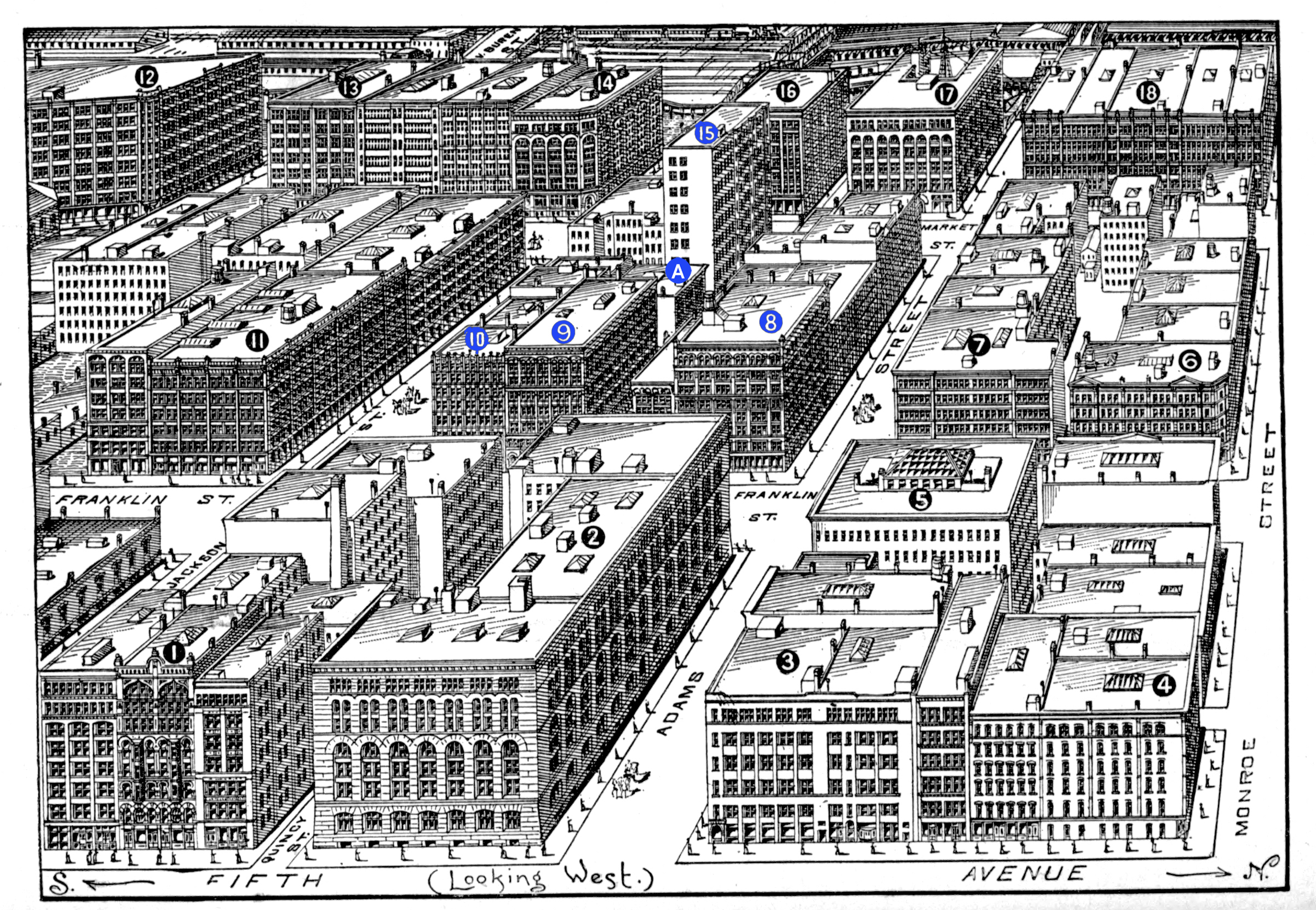
- Wholesale District.
Sears Tower site buildings in blue.
① The Owings Building,
At 232-236 Fifth Avenue, now owned by Mandel Bros., is 80 feet wide, 100 feet deep, and 120 feet high, with 7 stories and basement. The front is of cut-stone and steel. There is 1 passengerand 2 freight elevators. The occupants are wholesale jobbers. Erected in 1886.
② The Marshall Field & Co. Warehouse Building .
This structure one of the most impressive in the whole world is described in our chapter on “Notable High Buildings,” although the building is an exception in that category of edifices. While only partial attempts were made to fire-proof its interior, the outer walls have 110 equal for solidity in the city. Great monoliths of red granite compose the exterior to the cornice of the upper or seventh story. Inner partitions of iron, shutters of iron, and a well-disciplined watch, add to the security of the colossal house. It fronts on the south side of Adams 325 feet, on Franklin Street and Fifth Avenue 190 feet, and is 130 feet high, with 7 stories and basement. There are 13 elevators, 12 acres of floor space, and 1,800 employes. The visitor may enter and look about for a moment, beholding a wonderful hive of actual, time-saving trade. Erected in 1886.
③ Phelps, Dodge & Palmer Building
Fronts 80 feet on Adams Street and 180 feet on Fifth Avenue, at the northwest corner. It is 95 feet high, with 6 stories and basement; pressed-brick and terra-cotta exterior; 2 passenger elevators and 3 freight elevators. It is occupied by Phelps, Dodge & Palmer, wholesale jobbers and manufacturers of boots and shoes, and by wholesale jobbers of clothing. Erected in 1888 after a destructive fire.
④ The Williams Block
Fronts 180 feet on Fifth Avenue and 100 feet on Monroe Street, at the southwest corner. It is 95 feet high, with 6 stories and basement. There are 3 freight and 2 passenger elevators, brick and cut-stone exterior. The structure is occupied by wholesale jobbers of clothing and woolen goods. Erected in 1874.
⑤ The C. B. & Q. Railway Building:
Fronts 120 feet on Adams and 176 feet on Franklin Street, at the northeast corner. It is one of the fire-proof buildings of the new era, and has a fine quadrilateral interior court with balconies. It is 96 feet high, in 6 stories and basement. There are 65 offices and 3 passenger elevators, with about 400 occupants. The heavy walls are made of pressed brick with stone for trimmings. Here are the general offices of the ”Q. Erected in 1882, among the pioneers of the better buildings.
⑥ The Hoxie Building
Fronts 120 feet on Franklin Street and 40 feet on Monroe Street, at the southwest corner. It is 90 feet high, with 5 stories; cut-stone and iron exterior; 3 freight elevators. The structure is occupied by wholesale jobbers of clothing, and manufacturers’ agents. Erected in 1873.
⑦ Carson, Pirie, Scott & Co.’s Building
Fronts 160 feet on Franklin Street and 140 feet on Adams Street, at the northwest corner. It is 105 feet high, with 6 stories; cut-stone and iron exterior; occupied by the wholesale dry-goods house of Carson, Pirie, Scott & Co. Erected in 1875.
⑧ Mercantile Company Building
Leased by Clement, Bane & Confronts 125 feet on Franklin Street and 100 feet on Adams Street, at the southwest corner. It is 125 feet high, with 8 stories; cut-stone, brick, and terra-cotta exterior; 2 passenger and 3 freight elevators. It is occupied by wholesale jobbers of shoes, clothing, and dry goods. Erected in 1886.
Ⓐ The Garden City Warehouse
Situated at Nos. 180, 182 and 184 Quincy street, and 239, 241 and 243 Jackson street, two and a half blocks west of the Board of Trade, are in the whole sale quarter of the city and easily accessible from either freight-houses or docks. They are patronized by the leading business houses, and also by private parties, who find in the clean, dry and well-ventilated apartments excellent accommodations for their respective goods. Mr. Samuel M. Chase is the proprietor.
⑨ The Robert Law Building
Fronts 90 feet on Quincy Street and 80 feet on Franklin Street, at the southwest corner. It is 110 feet high, with 7 stories; rough-hewn stone and brick exterior; 1 passenger and 2 freight elevators. It is occupied by wholesale jobbers of clothing, boots, and shoes. Erected in 1887.
⑩ The Willoughby Building
Fronts 30 feet on Jackson and 75 feet on Franklin Street, at the northwest corner. It is 100 feet high, with 8 stories and basement; 1 passenger elevator; cut-stone and iron exterior. Occupied by wholesale jobbers and importers. Erected in 1887.
⑪ The Boddie Block
Fronts 120 feet on Franklin and 160 feet on Jackson Street, at the southwest corner. It is 95 feet high, with 6 stories; cut-stone, brick, and terra-cotta exterior. Erected in 1883; remodeled in 1893.
⑫ McCormick Block
This very conspicuous structure appears across the head of Market Street at Van Buren Street, because of the eastern division of the river. The building fronts 160 feet on Market Street and 95 feet on Van Buren Street, at thesouthwest corner. It is 100 feet high with 8 stories, and the walls are of cut-stone, brick, and terra-cotta. There are 2 freight and 1 passenger elevators. The occupants are wholesale jobbers and manufacturers of clothing. Erected in 1887.
⑬ The Chalmers Building
Fronts 75 feet on Van Buren Street and 50 feet on Market Street, at the northwest corner. It is 90 feet high, with 7 stories; cut-stone and brick exterior; 2 freight elevators, 1 passenger elevator. Occupied by wholesale jobbers of clothing. Erected in 1889.
⑭ The McCormick Building
Fronts 100 feet on Jackson Street and 80 feet on Market Street, at the southwest corner. It is 95 feet high, with 8 stories and basement; brick and terra-cotta exterior; passenger elevators, 4 freight elevators. Occupied by wholesale jobbers and importers. Erected in 1887.
⑮ The Yondorf Building
Fronts 40 feet on Market Street and 100 feet on Quincy Street, at the southeast corner. It is 135 feet high, with 10 stories; 1 passenger elevator and 2 freight elevators: brick and iron exterior. Occupied by wholesale jobbers of clothing. Erected in 1874; remodeled in 1892.
⑯ The Mallers Building.
Occupying a lot but 38 feet on La Salle by 59 on Quincy Street, is 12 stories and basement, or 175 feet high. It has 2 elevators and 200 occupants, who are of all classes of light business. It cost $275,000 in 1884, and was for awhile the highest office building in Chicago. It is all steel, pressed brick, and stone.
⑰ The Ryerson Building.
This magnificent structure, whose Norman arches of granite are the first architectural exhibit of Chicago to be seen by the visitor who arrives at the Union Passenger Station, and comes over the Adams Street bridge near by, resembles the Grand Central Station in its outer walls. The interior follows the plan of wooden pillars, adopted in Marshall Field’s wholesale store. The Adams Street front is on an incline of 152 feet, leading to the bridge on the south side of the street. The Market Street front is 166 feet. The building is 98 feet high, with 6 stories and basement. It is occupied as the wholesale dry-goods store of James H. Walker & Co., with 300 employes. There are 5 elevators.
⑱ The Farwell Block
Stands on Market, Adams, and Monroe streets and the river bank, presenting an imposing front from the Adams Street bridge. Its frontages are 180 feet on Adams and Monroe streets and 340 feet on Market Street and the river. The block is 95 feet high, with 6 stories; brick and cut-stone exterior. It is occupied by wholesale jobbers of clothing, hats and caps, and dry goods. There are 2 passenger and 6 freight elevators. Erected in 1886.
Rand, McNally’s Bird’s-Eye Views of Chicago, 1893
The Wholesale District, North on Market Street.
The view presented on the opposite page is especially notable and instructive on account of the presence of the river, and shows the facilities for loading and unloading that are offered to lake shipping. There are over 25 miles of similar dockage within the city limits, without reference to the Calumet River and Calumet Lake region for Chicago now has two harbors on Lake Michigan. The bridge at Madison Street is of the largest and late-t pattern, with steam motor. The Washington Street bridge has been but lately put where jt is, for the structure is an old one displaced from Madison Street. Beneath the bridge and the river runs the Washington Street tunnel, through which pass many millions of people annually, on the cars of the West and Northwest cables. The foreground of the picture is in the heart of the wholesale district. After the Great Fire, the heavy wholesale men moved hither from Lake Street.
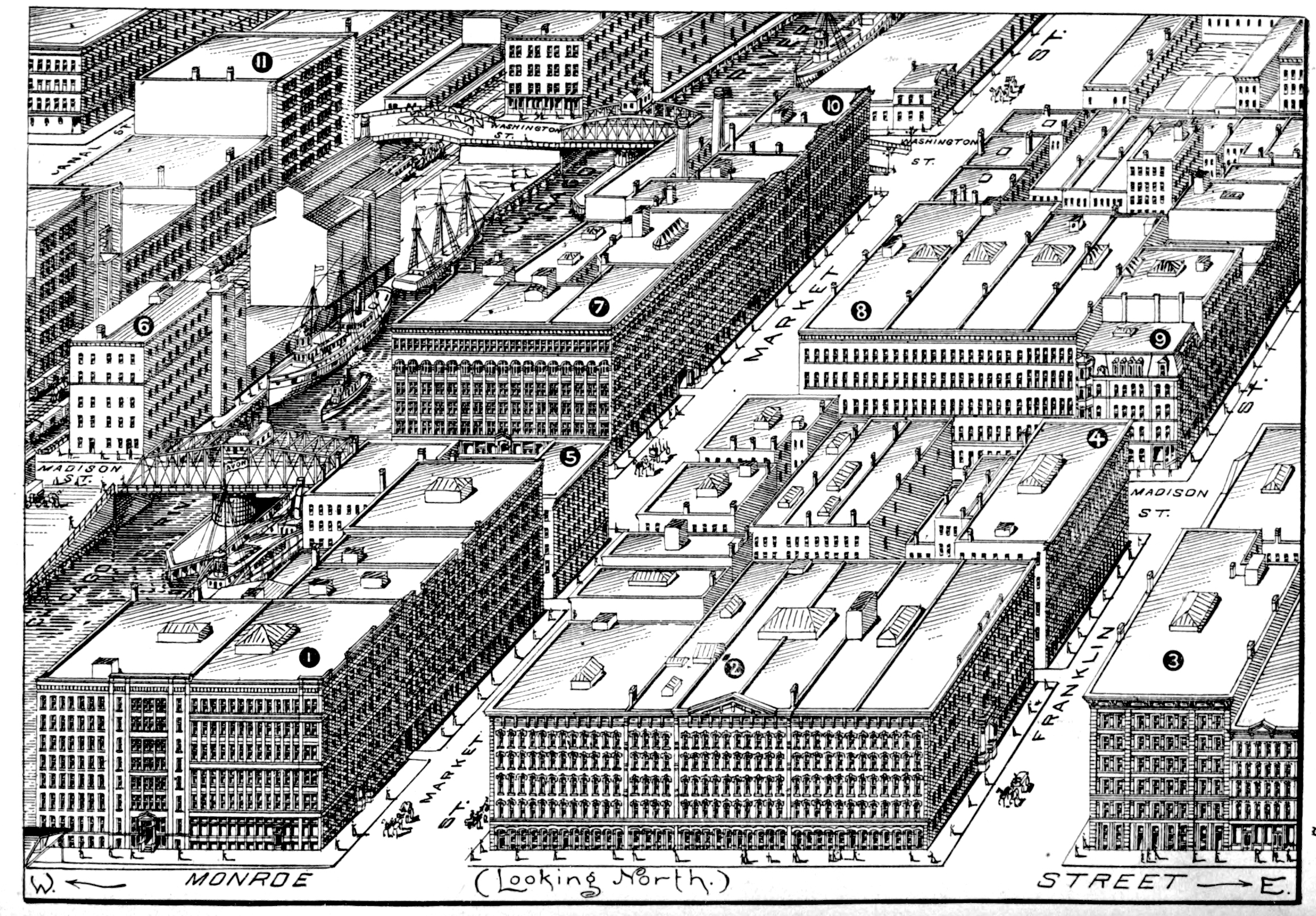
① The Jewett Building,
At the northwest corner of Market and Monroe streets, was an old-style 6-story structure, erected in 1883, 95 feet high, with 3 freight elevators. Its exterior is of brick and iron, and its great area may be understood by the statement that it has a frontage of 280 feet on Monroe and 100 on Market Street. It was partly occupied by the well-known wholesale clothing firm of Kohn Brothers, and partly as a warehouse. John M. Van Osdel was the architect. His records show that piles were used. A seventh story was added later. lt was later known as the Selz building.
② The Old Farwell Block
Is a still larger edifice of similar history, fronting the whole of the north side of Monroe Street between Franklin and Market. It was built after the Great Fire, to accommodate one of the two largest dry-goods houses in the West, and fronts 189 feet on Franklin, 330 on Monroe, and 120 on Market. It is a 5-story stone-front, 85 feet high, with 8 freight elevators, and, since its relinquishment by the Farwells, has been occupied by wholesale clothiers, wholesale dealers in hats and caps and boots and shoes, and manufacturers and manufacturers’ agents. The year of its erection was 1873.
③ The Field Building
At the northeast corner of Monroe and Franklin streets, is a 6-story stone-front of the old style, with 100 feet on Monroe and 185 on Franklin, 80 feet high. It has 3 freight elevators, and is occupied by wholesale clothiers and jewelers. It was erected in 1874, and is only one of very many similar Field buildings on the South Side.
④ The Commercial Trade Building
At the southwest corner of Madison and Franklin streets, is a striking piece of old-style architecture, the designer having secured many novel effects with the simple material at command. The frontages are 50 feet on Madison and 185 on Franklin, with a height of 90 feet in 5 stories and basement. The exterior is of brick and iron, showing long rows of arches at the sidewalk. One passenger elevator and 2 freight elevators. The occupants are the Ames Sword Co., and wholesalers of boots and shoes, jobbers, agents, and others. It was erected at the close of the panic times, in 1878.
⑤ The Mullen Building
At the southwest corner of Madison and Market streets, occupies 40 feet on Madison and 100 feet on Market, 75 feet high, 5 stories and basement, brick exterior, with iron beams, and follows generally the description of an old-fashioned city business block. It is occupied by wholesale jobbers and manufacturers’ agents. Erected in 1878.
⑥ The Norton Mill
At the west end on the north side of the Madison Street bridge, is 40 feet wide, 80 feet deep, and 60 feet high. It shows many cracks in its walls, yet sturdily defies the tooth of time. The elevator which is seen in its rear actually did collapse in 1892, with a large loss of grain.
⑦ The Central Union Block
At the northwest corner of Madison and Market streets, is one of Chicago’s most creditable structures. After the Great Fire a brick building was hastily erected, and here, on the river front, the Chicago Board of Trade held its daily sessions for several years. Here the celebrated Sturges corn corner broke. Market Street is in reality a plaza, and taking advantage of their opportunities, the owners of the ground, in 1890, erected a fine brick and stone edifice of 6 stories and basement, with 220 feet on Market and 180 feet facing an inclined surface along Madison Street going up to the bridge. There are 12 stores, 622 offices, and 4 passenger elevators, with about 1,900 occupants, who are engaged in various industries and trades. The Central Union is also mentioned in our chapter on “Notable High Buildings.”
⑧ The Old Marshall Field Wholesale Building
At the northeast corner of Madison and Market streets, was hurriedly erected in 1872, to serve the owner’s great dry goods houses, both wholesale and retail. On its site, before the Great Fire, stood the Garden City Hotel. The frontages are 240 feet on Madison and 180 on Market Street, and the 5-story building is remarkable for the number of its solid iron shutters, which have always been closed at the end of business hours. The value of the goods which have passed through this house would doubtless reach ten figures. It possessed the unusual convenience of a loading-place on Market Street, where traffic could never be engorged. The exterior is of the plainest brick. There are 4 freight elevators, and it is still largely uaed as a warehouse for the firm, which moved first its retail business to the splendid quarters at Washington and State streets, and after many years the wholesale to the granite structure at Adams Street and Fifth Avenue. A part of the old store is occupied by jobbers, manufacturers, and other denizens of the wholesale district.
⑨ The Abt & Fautl Building
At the northwest corner of Madison and Franklin streets, is a 4-story and basement structure with Mansard roof. It is a stone-front of 1874, with frontages of 80 feet on Madison and 25 on Franklin, 85 feet high. The building is occupied by wholesale jewelers, manufacturers, and manufacturers’ agents.
⑩ The Central Manufacturing Block
At the southwest corner of Washington and Market streets, is a long and high block, given over completely to machinery, and haunted by inventors and machinists of all kinds. It fronts 240 feet on Market and 60 feet on Washington, is 65 feet high, and has 6 floors in all. It was built in 1872.
⑪ The Woolensack Building
At the southeast corner of West Washington and South Canal streets, can be seen only from the rear, but is here mentioned because it was erected as lately as 1892. Its dimensions are 120 feet on Washington, 80 feet on South Canal; height, 95 feet, with 7 stories and basement. The exterior is brick, stone, and iron. There are 2 freight elevators. It is occupied by manufacturers.
SEARS TOWER SITE.
Chicago Tribune, July 28, 1970
 By Alvin Nagelberg
(Real Estate Editor)
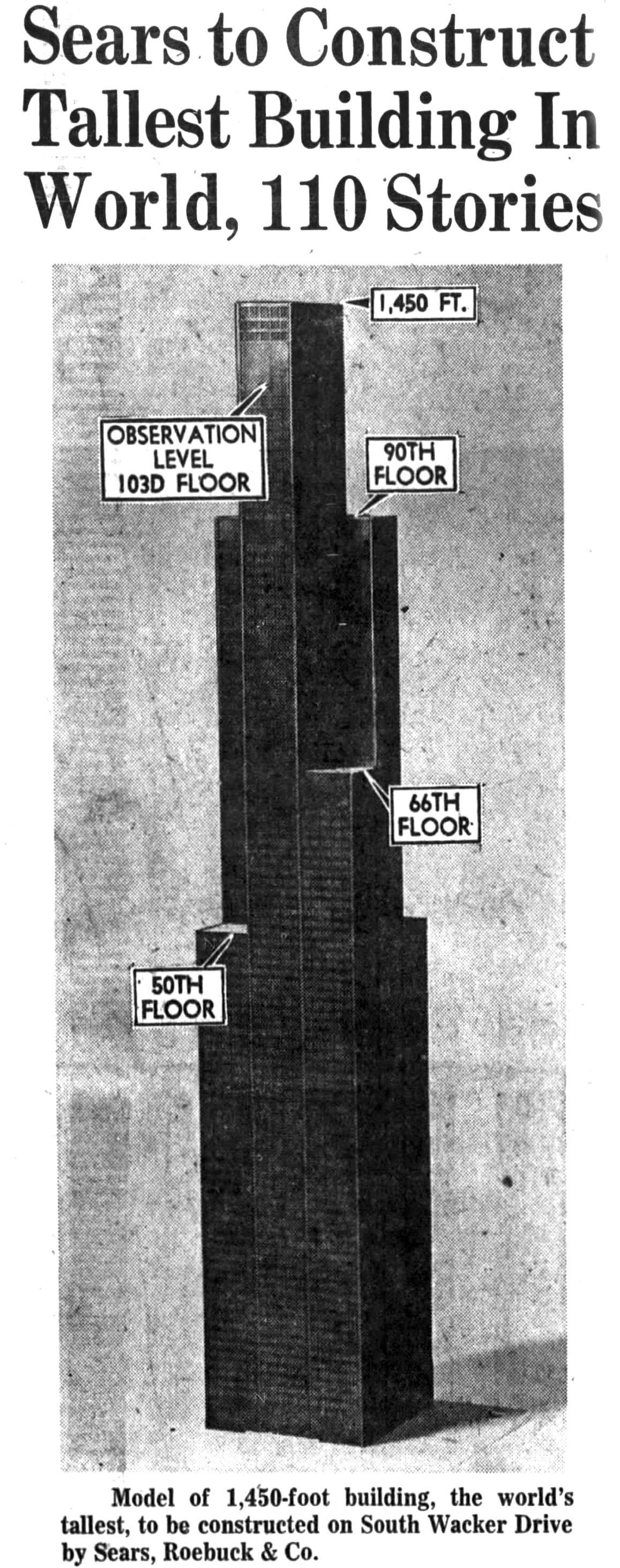
Sears, Roebuck & Co., the world’s largest retailer, said yesterday it will build the world’s tallest building—1,450 feet high with 110 stories – on South Wacker Drive be: tween Adams Street and Jackson Boulevard.
The $100 million building will have 4.4 million square feet of gross interior space, making it the world’s largest privately-owned office building. Work will start next week and be completed in 1974.
The Merchandise Mart has 4,023,000 gross square feet of space, but much of that is exhibit space for manufacturers.
The Sears building will be second in volume only to the Pentagon in Washington. It will be taller than the twin 110-story World Trade Center buildings in New York City, each of which is 1,350 feet high.
Gordon Metcalf, chairman and chief executive officer of Sears, said the building will be called Sears Tower. It follows the tradition established in naming its first mail order store building at Homan Avenue and Arthington Plaza the Tower building. Tower also is used as the brand name for several Sears products.
Set for FAA Maximum
Metcalf said the building will be as high as the Federal Aviation Administration would permit. It will reach almost as high as the tip of the television antennas on top the 100-story John Hancock Center, 875 N. Michigan Av.
Altho the building will have 109 stories on the Wacker Drive side of the tower, Metealf said officials should use the figure of 110 stories on the Franklin Street side as the official listing so that it would be as high as the World Trade Center buildings.
Metcalf said the building will be financed with company earnings. The giant retailer had sales of $8.9 billion last year and net income of $441 million.
He said sales are expected to increase by $1 billion a year.
Will Lease Remainder
The building will have 3.7 million square feet of net rentable space of which Sears will initially occupy less than 2 million square feet and lease the remainder to outside tenants.
About 16,500 persons are expected to work in the building. It will have only 150 parking spaces but officials expect less than 10 per cent of the employes will drive to work.
Mayor Daley told-the late afternoon press conference in the Sherman House: “On behalf of the people of Chicago, I want to thank Sears for the confidence they are showing in the future, in planning and designing the building which will adorn the west side.”
Restaurants Included
Mayor Daley said he was particularly enthusiastic because there has been concern about firms moving out of the city.
“I want to thank Sears again for the confidence they are showing the city,” he said.
The building will have boutique shops, restaurants and other service stores on the Franklin Street side.
Metcalf said the building will not have a Sears department store.
“We have one on State Street,” he said. “Besides we own that building.”
Diesel Construction, a division of Carl A. Morse, Inc., general contractor, will start
initial work on the building.
Sears Tower was designed by Skidmore, Owings & Merrill, Chicago architect. Bruce Graham, who also designed the Hancock Center, was one of the partners in charge.
The structure will rise in a series of setbacks—a modified “wedding cake” style used in many New York City buildings. There will be setbacks at the 50th, 66th, and 90th stories, creating various floor arrangements as the height increases.
At the 103d floor, 1,350 feet above the street, there will be an observation deck. It will be higher than the observatory of the Hancock Center.
The exterior of the Sears Tower will be sheathed in black aluminum and bronze tinted glass.
The Sears building will be on a two-block tract assembled by private developers over a five-year period starting in 1964.
A jumble of 15 grime blackened bulidings, similar to those which once stretched the length of North and
South Wacker Drive, had to be purchased from 100 owners.
Sears bought the site last year for an undisclosed sum.
Quincy Street bisected the tract between Franklin Street and Wacker Drive. To consolidate its holdings, Sears paid the city $2.7 million for the street.
Sears is moving into one of the fastest growing sections of the Chicago central city. Altho the redevelopment of both banks of the south branch of the Chicago River is already underway, real estate men say the Sears building is generating new enthusiasm for the area.
Sears will be across the river from Gateway Center which started the redevelopment movement in the early 1960s. Tishman Realty & Construction Co. has built two 20-story office buildings and has a 35-story tower under construction.
Chicago Tribune, July 29, 1970
THE SEARS TOWER AND CHICAGO’S FUTURE
Big decisions are not made carelessly by the officials of Sears, Roebuck & Co., which helps to explain why the company is the world’s largest retailer, with annual sales of about $9 billion. In planning a new headquarters they considered many possible sites. They might have chosen to move to a suburb, as their own subsidiary insurance* companies have done. They might have decided to go to New York, which has a fascination for some corporation, executives in spite of its manifest disadvantages.
Instead, Sears Roebuck and Co. will build its headquarters in downtown Chicago and it will be the world’s tallest building as well as the largest private building in the world. Only the Pentagon will be larger.
The announcement of plans for the building is good news for Chicago at a time when good news is scarce. Along with other big cities Chicago has an array of staggering problems. The only encouraging development for the inner city in recent years has been the renaissance of the downtown area, which has compensated in large measure for the loss of manufacturing industries to the suburbs.
The new 110-story Sears Tower is another big step in this renaissance. It will strengthen the city’s tax base. It will stimulate other building on the west side of the Loop. It will confirm Chicago’s position as one of the world’s great business centers.
The site chosen for the new tower is on Wacker Drive between Adams Street and Jackson Boulevard. No other place in the city is more convenient to transportation.
The commuter trains at Union and North Western stations are within easy walking distance. The projected Franklin Street subway, where the Lake Street-Dan Ryan subway trains will run, will be at the back door. The distributor subway under Monroe Street will be only a block away. The expressway system is close at hand.
The Tribune has had a lot to say on this page about the importance of developing Chicago’s mass transportation system. The Sears Tower illustrates what we have been talking about. Sears Roebuck & Co. is investing $100 million at a place which was chosen largely because of the availability of transportation.
The company’s decision also reflects confidence in the future of the city where Sears Roebuck was born and where it has thrived. The company has great plans for its future, based not on hopes but on hard business experience.
If the city’s future is to be secure it will continue to be hospitable to such business enterprises and to maintain a climate of order.

Leave a Reply