National Watch Co, Elgin National Watch Company (1874)
Life Span: 1864-1968
Location: Factory, Elgin, IL
Architect: Charles S. Moseley
- Halpin & Bailey’s City Directory for the Year 1863
NATIONAL WATCH CO INVESTORS AND OFFICERS.
Adams John, watchmaker, bds. Archer road
Carpenter Philo, office 203 Randolph, h. 292 W. Randolph
Culver Howard Z., (Culver, Page & Hoyne,) h. Loomis, bet. Tyler and W. Van Buren.
Dickerson Thomas S., (Vandervoort, Dickerson & Co.), tin plate, sheet iron and metal, 199 and 201 Randolph h. 600 Wabash av.
Farwell John V., (Cooley, Farwell & Co.,) h. 376 Wabash
Lawrence Benjamin F., Ballentine, Lawrence & Co., com. mers. 7 Board of Trade blk. h. Elgin
Ogden Mahlon D., (Ogden, Fleetwood & Co.) h. Lafayette pl., bet. N. Clark and Dearborn.
Raymond B. W., sec’y, treas. and gen’l agt. Elgin and State Line R.R. Co., office 210 S. Water, cor. Wells, h. 217 Wabash av.
Wheeler George M., auditor and general ticket agent, G. & C. U. R. R. h. Cottage Hill
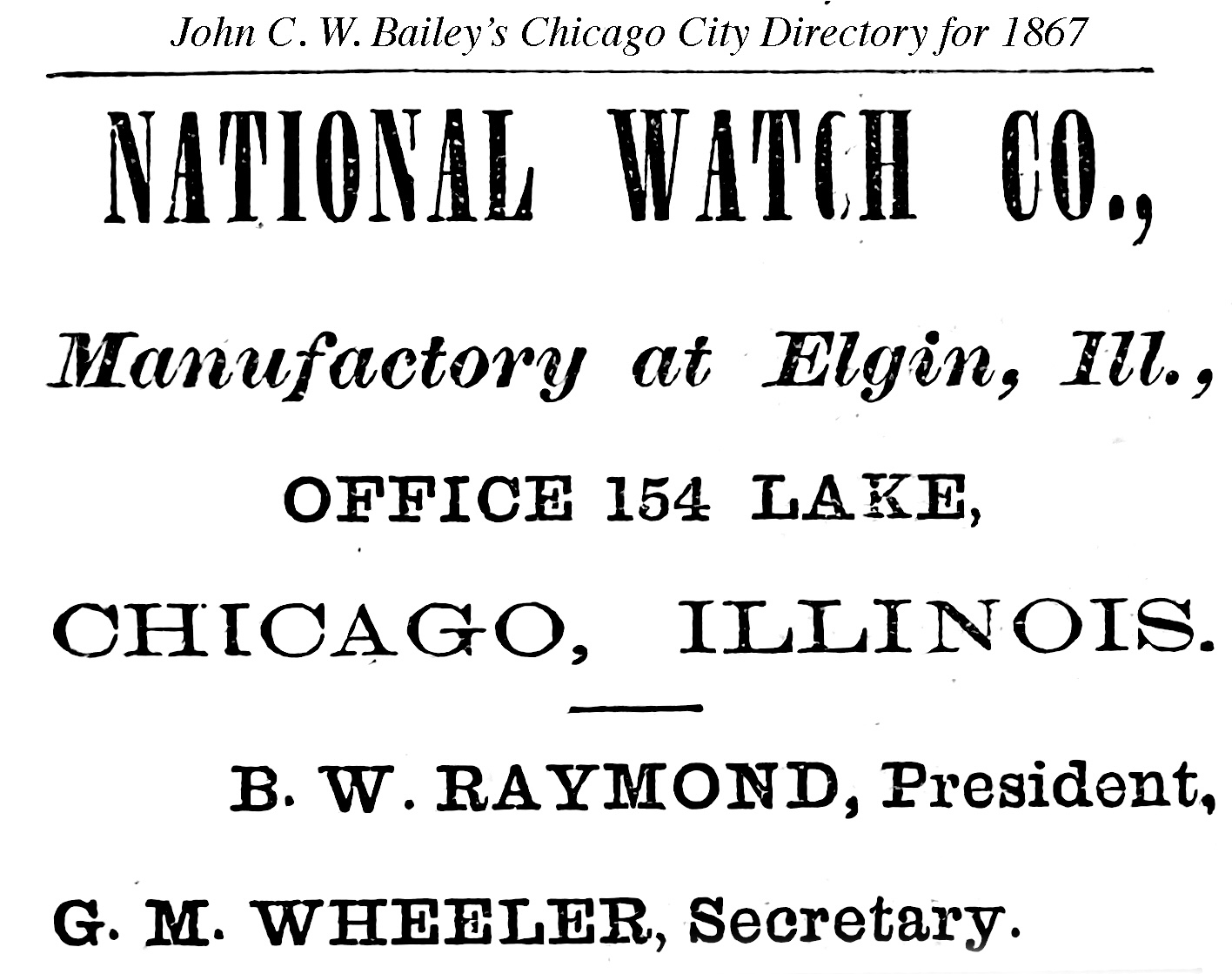
John C. W. Bailey’s Chicago City Directory for 1867
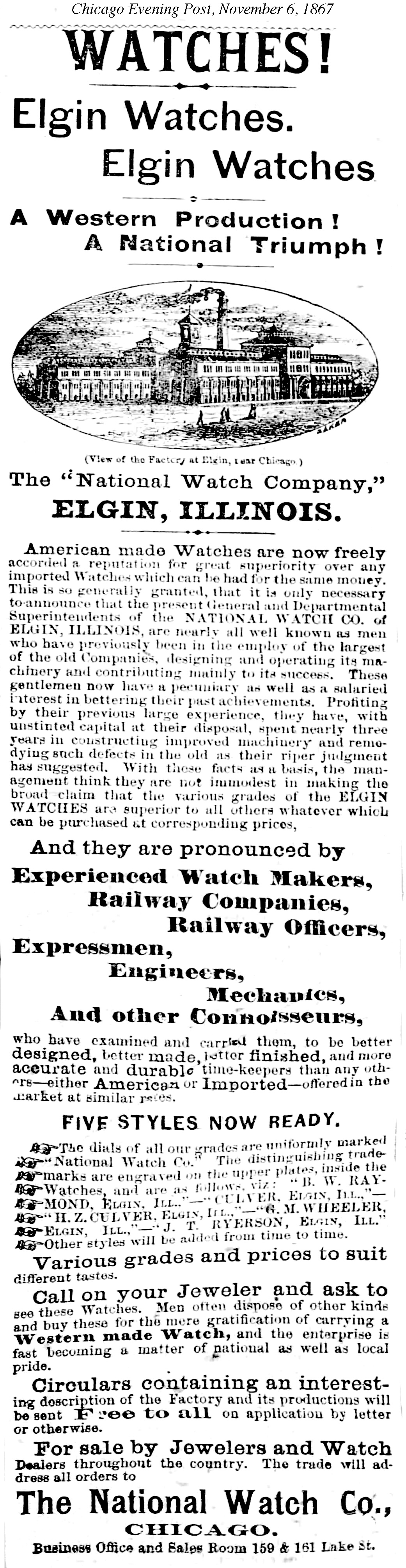
National Watch Co., B. W. Raymond, pres, G. M. Wheeler, sec, office 154 Lake. (See card Business Register.)
Raymond Benjamin W., prest National Watch Co., 9 154 Lake, h. 130 State
Wheeler George M., sec. National Watch Co office room 5, 154 Lake, res Elgin
Edwards’ Annual Directory in the City of Chicago, for 1870
National Watch Co T. M. Avery, pres. H. Z. Culver, vice pres. Thomas Reynolds, sec. office, LaSalle, sw. cor. Lake
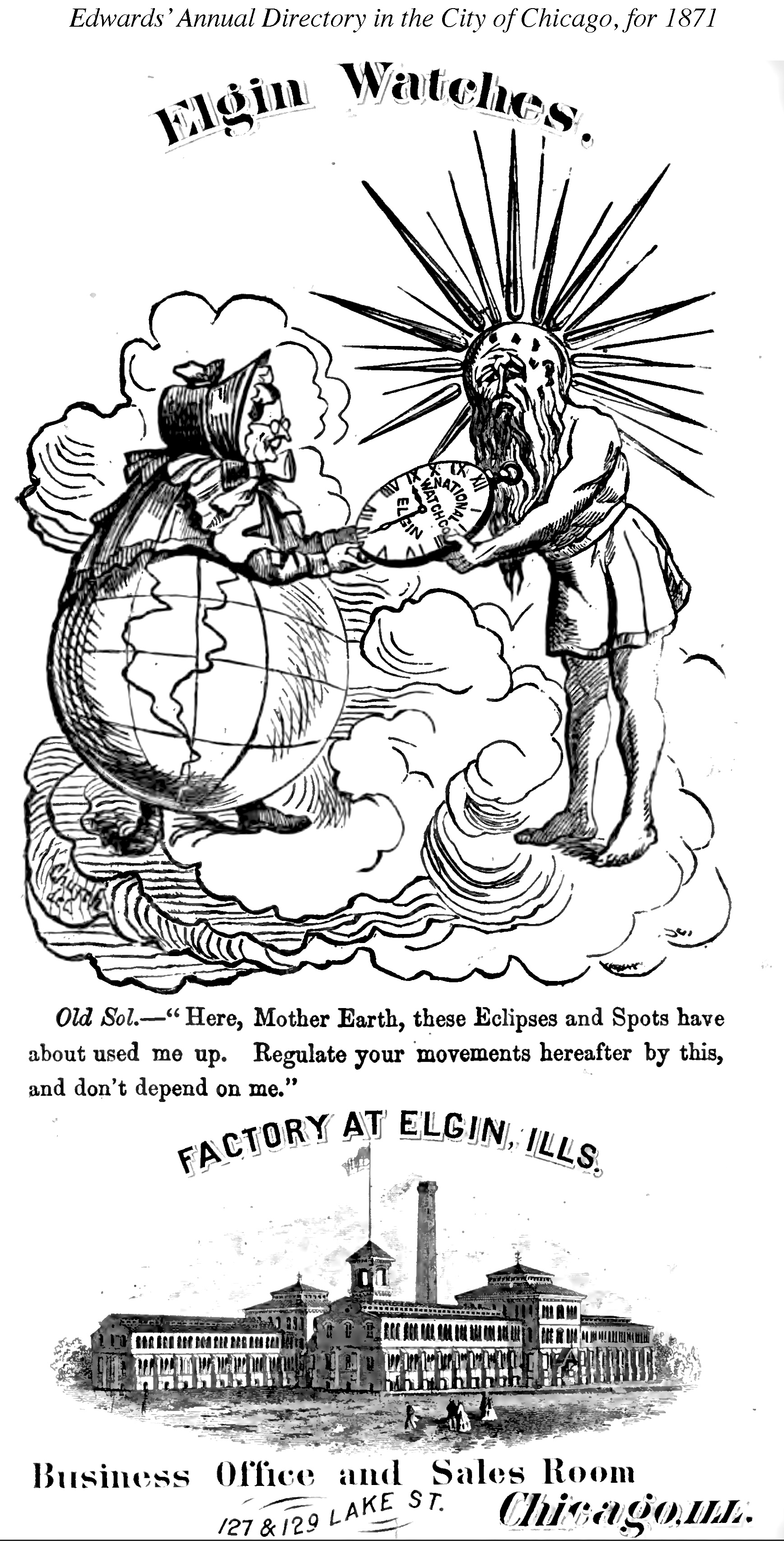
Edwards’ Annual Directory in the City of Chicago, for 1871
National Watch Co T. M. Avery, pres. Hiram Reynolds. sec. 127 and 129 Lake
Edwards’ Annual Directory in the City of Chicago, for 1873
National Watch Co T. M. Avery, pres. Hiram Reynolds, vice pres. Thomas Reynolds, sec. Washington, sw. cor. Green
Lakeside Annual Directory of the City of Chicago, 1876
Elgin National Watch Co., T. M. Avery, pres.; Hiram Reynolds, sec, 76 Monroe.
Lakeside Annual Directory of the City of Chicago, 1877
Elgin National Watch Co., T. M. Avery, pres.; George R. Noyes, sec.; room 1, 76 Monroe
Lakeside Annual Directory of the City of Chicago, 1880
Elgin National Watch Co., F. M. Avery, pres.; Elisha P. Whitehead, sec.; room 1, 76 Monroe
Lakeside Annual Directory of the City of Chicago, 1884
Elgin National Watch Co., Thomas M. Avery, pres.; Elisha P. Whitehead, sec.; room 1, 76 Monroe
Lakeside Annual Directory of the City of Chicago, 1904
Elgin National Watch Co., Charles H. Hulbyrd, pres; J. Raymond Perry sec.; 3d fl 131 Wabash av

Chicago Tribune, November 18, 1864
The National Watch Company, of this city, capital $200,000, have located their extensive works at Elgin, Kane county—big thing for that thriving little city, whose citizens in securing it prove that they know what’s o’clock.
Chicago Tribune, February 7, 1865
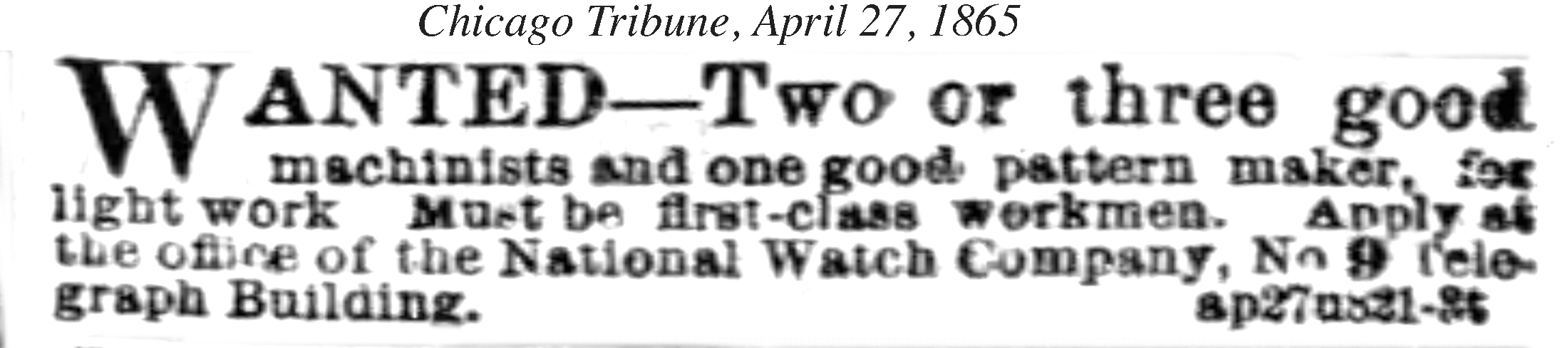
NATIONAL WATCH COMPANY.
Among the bills now before the General Assembly to become a law, is one incorporating the “National Watch Company.” The corporators are Benjamin W. Raymond, Joseph T. Ryerson, Philo Carpenter, Thomas S. Dickerson, Howard Z. Culver, George M. Wheeler, and Benjamin F. Lawrence. The factory of this company is to be located at Elgin, while the business headquarters will be at Chicago. The company, by the charter, will have power to manufacture, purchase and sell watches, clocks and jewelry. The watches are to be manufactured by the same description of machinery, material, etc., as have been employed by the “National Watch Company” of Massachusetts. In fact, some of the best workmen, including S. C. Bartlett, whose name is on many of the best Waltham watches, were formerly employed in that concern, are connected with this new company. The capital stock of the company is not to exceed $500,000, and I hear that about $200,000 have already been taken in $1,000 shares. This will prove a new and important interest, in the manufacturing economy of Chicago, and will, undoubtedly, prove abundantly successful.
Chicago Tribune, February 28, 1865
ILLINOIS LEGISLATURE
Record of Acts and Joint Resolutions Passed by the Twenty-Fourth General Assembly of the State of Illinois, and Approved by the Governor.
An Act to incorporate the National Watch Company.
Chicago Tribune, June 6, 1866
THE NATIONAL WATCH COMPANY.—The first annual meeting of the stockholders of the National Watch Company was held yesterday, at the office of the company, at room 5, No. 151 Lake street, for the purpose of receiving the annual report of the Board of Directors, and electing Directors and officers for the ensuing year. The President of the company, ex-officio Chairman of the Board of Directors submitted their first annual report, of which we give the following abstract:
The Company was organized in September, 1864, as the National Watch Company of Chicago, with a capital of $100,000, and stock subscribed to about that amount. Several of the best machinists and experts in the manufacture of watches at the East were engaged, and one of their number, Mr. C. H. Moseley, a designer and draughtsman of much experience, was appointed superintendent of the manufactory. As an inducement to the company to locate their works near their city, the citizens of Elgin, Ill. donated them twenty-two acres of land for the buildings and thirteen more acres for the residences of the principal employes. In accepting this site for the erection of their buildings in preference to Chicago, the company avoid the smoke and dust of a large city. A temporary building was put up for making the necessary machinery and implements suitable to manufacture still other machinery for the production of watches. A special charter was granted to the National Watch Company, and approved April 15, 1865, the capital stock of which was to consist of a sum not exceeding $500,000. The stock of the “National Watch Company of Chicago, Ill.,” was then transferred to the “National Watch Company,” and $49,000 more capital subscribed, aggregating $149,000, which has all been paid in and expended. The permanent Buildings have been erected, and are nearly finished. They are built in the most substantial manner of stone and brick, and rooted with slate and tin. The manufacture of watches is now begun. The Board of Directors have opened the subscription books for $100,000 additional stock, to be used in furnishing the buildings and for working capital. $40.000 of this has already been subscribed, leaving but $60,000 more to be taken. The Board congratulate the stockholders upon the success of the work so far, and anticipate a realization of their most sanguine anticipations.
The report was accepted and ordered to be filed. The Company ten proceeded to the election, by ballot, of a Board of Directors for the ensuing year, resulting in the election of B. W. Raymond, B. F. Lawrence, J. L. Ryerson, H. Z. Culver, T. S. Dickerson, G. M. Wheeler and T. M. Avery. The following gentlemen were elected officers for the ensuing year: B.W. Raymond, President; B. F. Lawrence, Vice President, and G. Wheeler, Secretary. The meeting then adjourned.
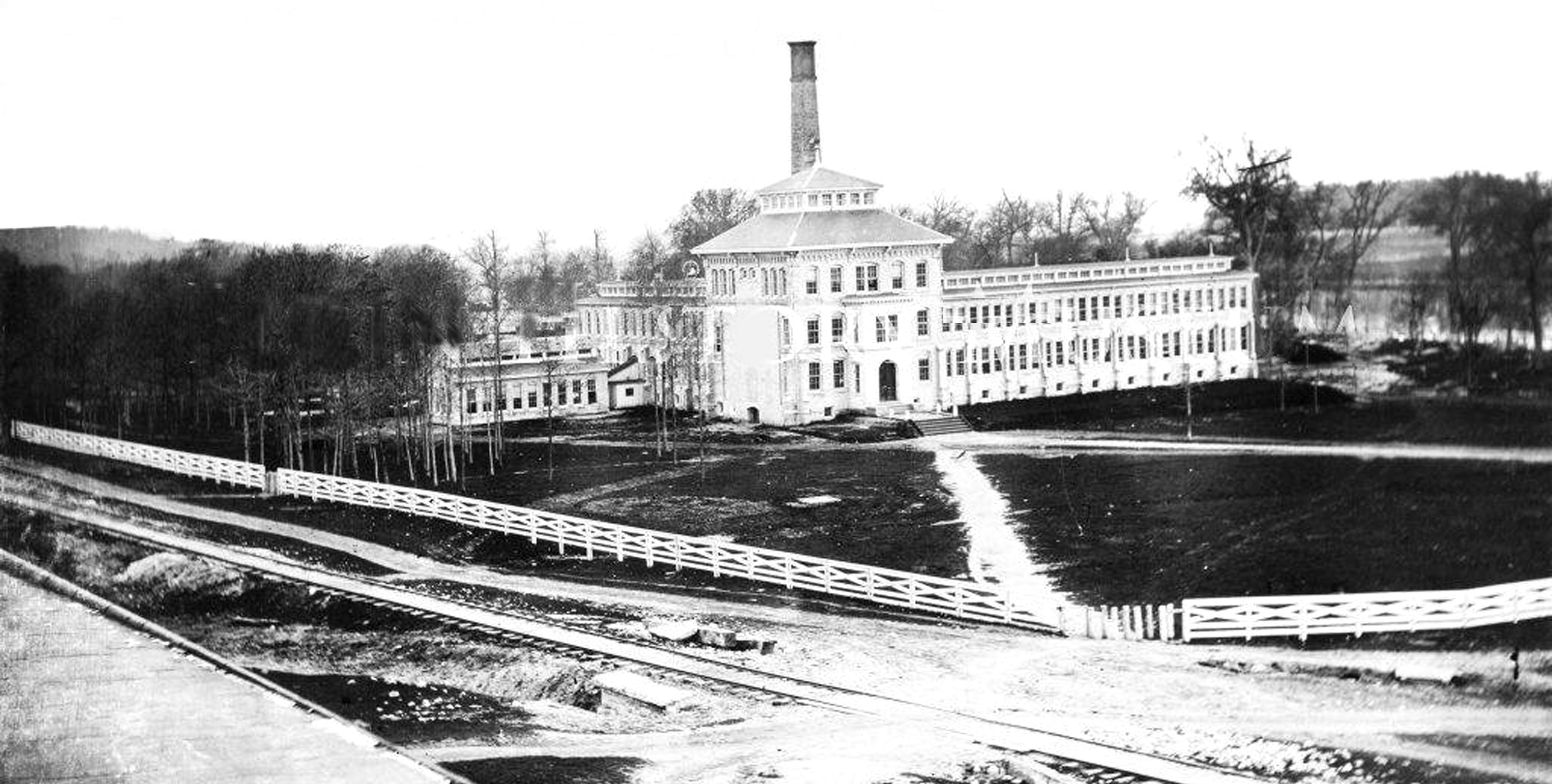
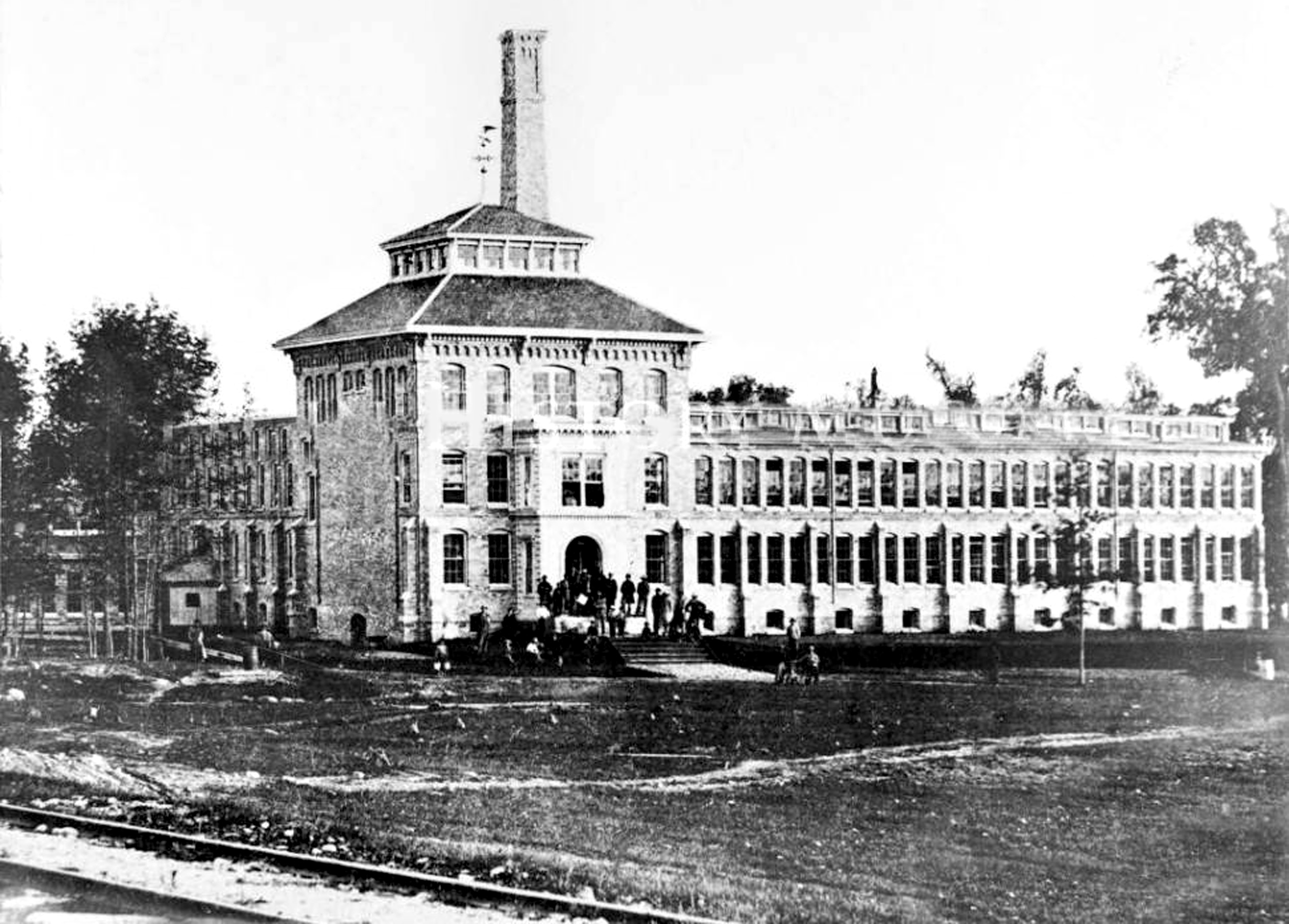
- National Watch Company view from the Southwest.
1866
Chicago Tribune, November 16, 1866
 A little more than two years ago a number of enterprising capitalists in this city, stimulated by the unqualified success which has attended the only watch manufactories in this country, at Waltham and Roxbury, Massachusetts, determined to transplant this lucrative branch of industry to this vicinity. For the purpose of establishing the new manufactory on an adequate basis, a company was formed, with a capital of $250,000, and, to insure the success of the enterprise by the employment of men of skill and experience to conduct it, inducements of sufficient magnitude were offered to some of the most talented and capable employes of the old Waltham Company, to bring them out here. Some time was spent, after the company had been formed and the necessary capital paid in, in selecting a place for the location of the factory. All the country towns for a long distance about Chicago, were explored with a view to finding some one where a healthful and beautiful site for the works and workmen’s cottages could be procured, and at the same time near a railway. The best place which could be found was at Elgin, and farther encouragement was offered for the selection of this place by the people of that town, who generously gave twenty-seven acres, in a beautiful location near the river bank, and just within the city limits, for the uses of the company, who still farther increased the extent of their land by the purchase of several acres more. The company was at this time organized with the following officers:
- President—B. W. Raymond, of Chicago.
Vice President—Philo Carpenter, Chicago,
Treasurer—Thomas S. Dickerson, Chicago,
Secretary—G. M. Wheeler, Chicago.
Additional Directors—H. C. Culver, Chicago; Joseph F. Ryerson, Chicago; B. F. Lawrence, Virgin.
The company having thus fixed the site for their future operations, in December, 1864, the skilled operatives from Waltham came on to take the enterprise in hand. There here eight or ten of these gentlemen; but the principal one, he on whom almost entirely depended the success of the undertaking, was Mr. Chas. S. Moseley a Massachusetts man, who has spent about fourteen years in watchmaking and the various processes connected with it and who. in his conduct of the arduous and responsible duties confided to him, has developed talents of a high order, more than realizing the high expectations of his ability entertained by the company.
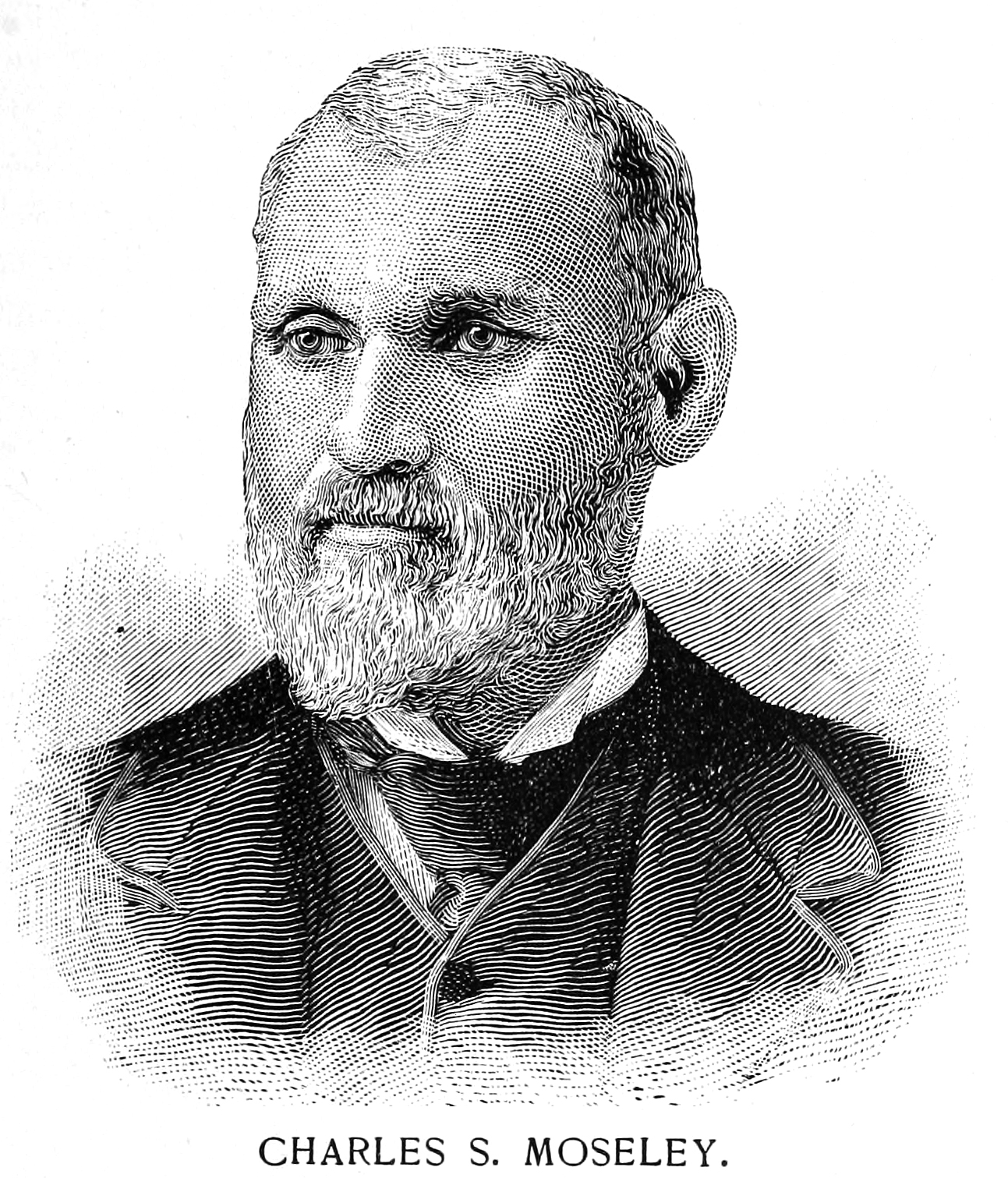
The buildings erected under Mr. Moseley’s direction were commodious, elegant and perfectly adapted to the uses for which they were designed. but as we will come to a description of them directly, more need not be said in this connection regarding them. While they were being put up the workmen were busily employed, in some wooden shops down in the centre of Elgin, making machinery for service in watch-making. The infinite care required in every portion of this work, and the limited conveniences at their disposal, prevented their waking very rapid progress—at least, it seemed as if a very large amount of work was put in a very small compass—still when the time came in more into the new house, they had quite a fair show of tools to earnest operations with. The work of making tools for this business seems, however. never to come to an end, and of to the present time there has been no cessation in in it. Little else, indeed has been close in this for a while. than to make machinery. From the first, however, the undertaking has been the air of a predestined success backed as it has been by wealth, talent and energy. and the postponement of practical results in the form of completed work has never shaken any one’s confidence in it. There has been a slight change in the officers of the company, the organization now standing:
- .President—B. W. Raymond.
Vice President—B. F. Lawrence.
Secretary and Treasury—G. M. Wheeler.
Directors—(Added to preceding) H. C. Calver, T. S. Dickerson. J. F. Ryerson, T. M. Avery.
General Superintendent—Charles S. Moseley.
Another noticeable change, is in the fact that from the original eight or ten hands, the number of employes in row increased to about seventy, and more are being added as rapidly us they can be procured. To accommodate these hands, the number of cottages have been erected by the company, for the married men, and a large boarding house, three stories high and 86×58 feet in extent, is now being put up for the single folks. The cottages are neat and comfortable and the boarding house resembles rather more an elegant mansion than what a boarding house is generally conceived to be.
Before sketching our visit to the factory, it may not be amiss to insert here some remarks relative to the quality of watch which it is proposed to manufacture here.
The American watches have already the gained the palm superiority over all others, as time-keepers, from the two facts, that are greatly simplified and consequently less liable to get out of repair than either the English or Swiss watches; and, that they are manufactured entirely by machinery, thus securing greater degree accuracy than could ever be attained by hand-work. English watch-makers are surprised to when they come here and see to what an extent we carry the application of machinery in this delicate and difficult business. As will be seen in our description of the process of watch-making there is nothing in the all the minutiae of the works of a watch which is not made here by machines constructed for the purpose, from the cutting of a thread on a screw, one four-hundreth of an inch in diameter, up to the stamping out of a dial plate. The results of this system stamping are, first, a cheapening of the cost; second, the perfect duplication of every part so that the repairing of any broken or worn out portion the works costs very little and may readily be effected. Ten thousand American watches of one be pattern, made by this system. are alike in every part, even to the ten- thousandth of an inch—all equally perfect. This is not the case with with the European watches, which are mainly made by hand, and in which part has to be fitted to a particular watch. Now a few words relative to the character of the watch itself. In this, as in all other pieces of delicate mechanism, the greater the degree of simplicity attained, the nearer is the approach to perfection—if the simplified machine does all that the complicate one is meant to do. The fusee and chain, so necessary. to the old-fashioned verge watch, have servatism retained in the lever watch, where they are not only useless, but an infinite cause of trouble, accident. and increased expense. This objectionable feature has of been entirely wiped out from the American watch and is also disused in the Swiss. Such universal success has attended time-keepers made on this principle that the old prejudice in favor of the fusee and chain as an “equalizer of the force,” is now generally removed in this country, and the American watch is recognized this as the best time-keeper in the world. So much for the watch. Let us now visit the factory where it is made in its most perfect form.
- National Watch Company
1866
Mr. Moseley commenced the arduous task of founding a watch-making establishment under greater disadvantages than ever before surrounded a design of such magnitude. It is comparatively easy to start an ordinary machine shop, a wool or cotton mill, or any other mechanical enterprise, where one has no more to do than order one’s machinery, all ready made, put up a house to place it in, and then of go to work. Far different were the requirements of the situation in which hold Moseley and his Yankee comrades found themselves, and the manner in which they met and overcame all obstacles, adds another leaf the imperishable laurels which Yankee genius and enterprise have won in a fair race against all the world. The first need was a suitable building, and here Moseley “came out as strong” as an architect. He knew precisely what kind of a building he wanted. and, under his active and intelligent supervision, his ideal was soon realized in a superb structure, the very of perfection of an edifice for the purpose for which it is designed. In addition to being in the highest degree practical, it possesses the advantage of that seeming complete all the while, and still capable of extension in proportion ever to the necessities of the business, without ever destroying its symmetry and beauty, or diminishing its perfect availability in every part. The design is that it shall, when finished, be in the form of an H. At present only about two-fifths are the complete or in other words the cross-stroke and half of the first down stroke of the H. This gives a main building forty feet of square, and two wings at right angles, each one hundred feet in length by twenty-seven in width. The office, the superintendent’s and secretary’s rooms are in the square building. In the wings, either watch-making or the making of tools to make other tools, making to tools, to make still other tools necessary to make watches, are carried on. In addition, there is also a one-story building, or rather a half-basement stuck on the middle of the cross-piece of the H, for the dial-house on one side and the engine-house on the other. So much for the house. The next thing to be done was to get the necessary tools into the house. Here the genius of Moseley became conspicuous. He could not buy any of the hundreds of machines wanted, except a heavy iron planing machine and a couple of large engine lathes. These would do for the coarsest work of building the necessary machinery, but nothing more. Everything required had to made under his direction, and as a single instance showing the immensity of the work before him, we may cite the labor required in one the one small particular. The teeth or cogs on the barrel of one of their watches are cut with what they denominate the “epicycloidal” curve, that form being, for various reasons, deemed the best. Perfect accuracy in cutting these teeth, even to the ten thousandth of an inch, is absolutely necessary. Merely to make the “cutter” or but with which they are the formed, half a dozen intricate machines, each of the most delicate and accurate mechanism are required. To make these machines as many more are needed, and every portion of all these had to be made here, patiently built up under almost as great disadvantages as Adam would have to make a watch in the Garden of Eden. To begin at the very beginning, the castings which they needed could not be got without made by themselves. They would not be accurate.—the sand in which they were made would be too coarse,— the metal would be variable, sometimes too hard, and again too soft. So as the letter A, in the long alphabet of their tribulations and necessities. Moseley and his comrades up an iron and brass foundry, bringing their sand in barrels from New York State and mixing their metals to suit themselves. Then they went at fishing up the castings made there, and putting them together in the beautiful machinery which now fills the building. For all this Mr. Moseley had not a drawing, a plan, a measurement, a model, other than existed in his memory. He remembered, thought out and improved upon machinery for every possible use in his business,—he made working drawings (as admirably finished as if he were naught but a draughtsman),—then he traced pattern drawings,—superintended the making of patterns,—directed the choice of materials, the modes of casting, the finishing,—everything in short, and never made a mistake. Rapidly the work went on urged by his restlessness energy. Fortune, as he ever does, smiled when her frowns were unneeded. and ere long the factory began to fill up with the finest machinery in the world, all however, or nearly all, machinery to make other machinery for use in watch-making.
Having given thus much of a general review of the earlier existence of this enterprise, let us sketch it as it appears at present to an unprofessional visitor, endeavoring in so doing to mystify our readers as little as possible with technical phrases, and at the same time give a tolerably minute description of the several processes of watch making.
One does not march straight into the secrets of this establishment as into a blacksmith’s shop or a rolling-mill. On passing the vestibule and entering the hall, one has to ring a bell, wait until a boy comes, undergo a leisurely inspection by the boy, tell the boy who one wishes to see, wait until the boy finds that individual, wait until the individual comes, and then, perhaps, one may be allowed to enter.
Inside everything is as neat and clean as a private house. The walls are white, the floors fairly polished, the machinery almost noiseless and free from oil and dust while the excellent arrangements for light and ventilation make the place as cheerful as one could imagine or wish.
The first room to our right as we enter is a hall 101 feet by 27, known as the machine shop, under charge of Mr. George Hunter and his assistant, Mr. E. Hancock, both formerly connected with the Waltham Watch Factory. Here thirty men are constantly employed making machinery, either for direct use in some of the various processes of watchmaking, or to make tools and machines for such use. Some thirty or forty lathes, turning and planing machines, etc., are in operation here all the while, yet the noise in not so great as would be made by half a dozen sewing machines, so perfect is everything. There is no rattle of loose machines, no jar of oily based ones, and most of the noise we hear comes from the network of rushing belts overhead. The heavier engines, the large planers for example, are based upon stone piers sunk to the depths of the foundations of the building, and the others are so firmly fixed and so accurately fitted and proportioned that one scarce realizes they are at work, if one does not see them. A noticeable feature in this department is the intensity of accuracy prevailing to everything and the ingenious arrangements for its maintenance. There are “chucks,” “chuck-gauges,” “scamers,” “drills,” “taps,” etc., all of the most delicate measurements, and there are duplicate “standard” pins, gauges, etc., of hardened steel, by which a variation of a thousandth of an inch, either by accident or wear in any part may be instantly detected. As instancing the nicety of these tools, it may be remarked that there are in this assortment “screw-taps” of all sizes from four one-hundredths of an inch in diameter up to 1,200 thousandths and it is actually by hundredths and thousandths that they are measured. To guard against injury or lose of any of these delicate and valuable tools, a record is kept of every one given out, and and what workman has taken it, so that each man is interested in taking care of what is confined to him, and the tools are not allowed to deteriorate in value. The advantages of this system must be readily apparent to any one having any knowledge of mechanics. It would be useless to go into any description here of machines which we shall find in actual operation in other parts of the building—besides we don’t feel quite sure of our ground in describing such unique, delicate and complicated contrivances and would much rather speak of the results achieved by them. Little things here are the most important and at the same time most puzzling. What, per example, can be more confusing to a non-professional than the “train-chuck,” a thing which has “two eccentrics in its face,” fifteen holes of various sizes scattered all over it and yet each one of these holes may successively be brought to the centre for purposes of drilling some one of the many holes in and about the works of a watch. It’s all very simple to tell one that “it’s set by gauges and the shifting is done by the two eccentrics”—it is eccentric all over, and looking at it one hopes, with the old woman looking at the magician’s tricks, “that there ain’t nuthin” wrong in it, after all.” One of the prettiest machines here is the “crank planer,” which will take a shaving of a hair, and one of the most generally useful a press, which, by means of an almost infinite series of punches and dies, stamps out centre, barrel, third, fourth and escape wheels, click springs, and a multitude of other portions of a watch.
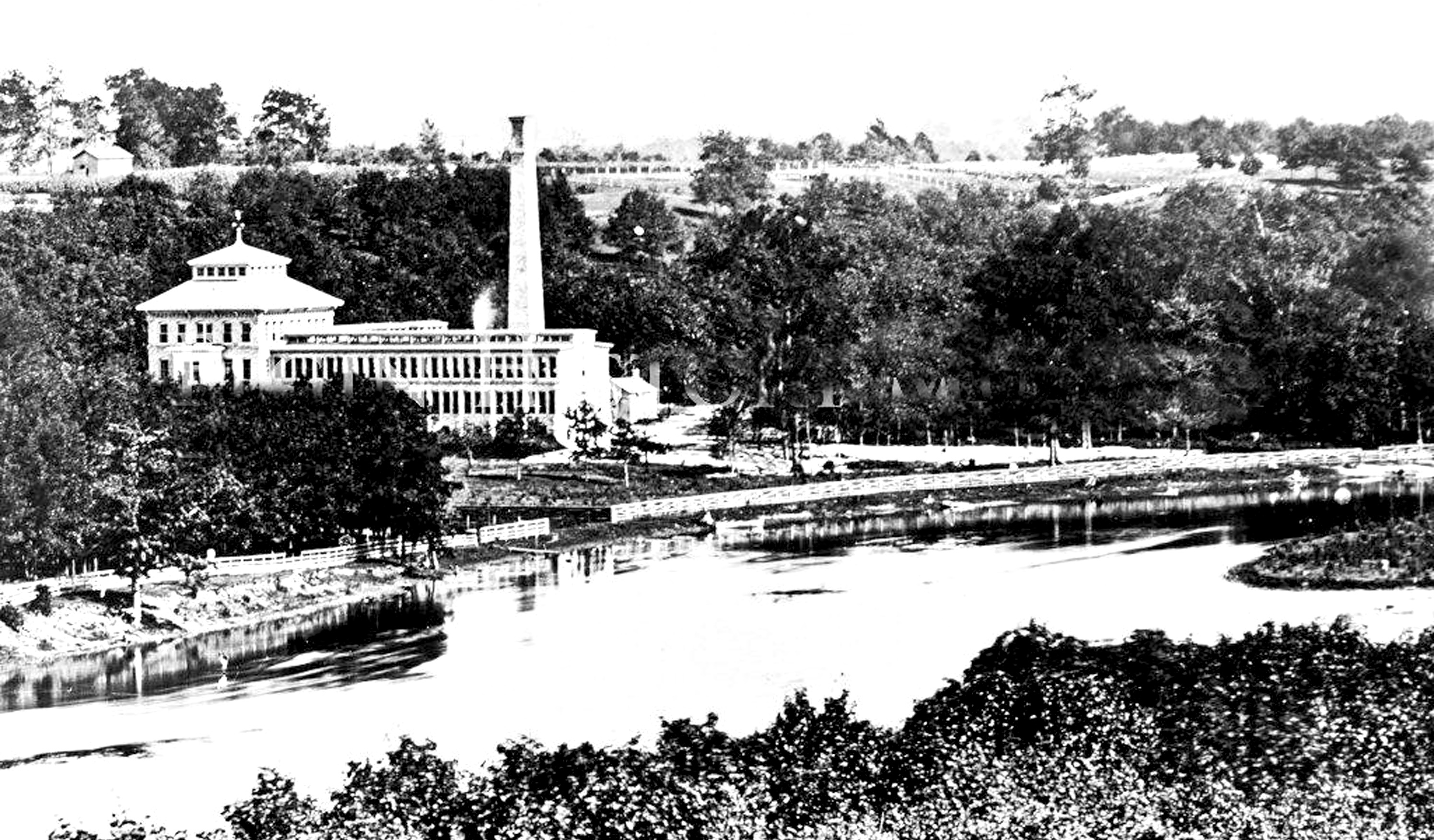
- National Watch Company
1866
From here, where the machinery and tools are made, let us move on to where they are used in the actual manufacture of watches. The first room we visit in this quest is the “movement” department, and, as one of the harmless eccentricities of the business, it may here be remarked that the “movement” is that part of a watch which does not move. It is screwed fast, therefore they call it the movement. It consists of the two “plates,” “bridges,” “potents” and “pillars.” Mr. P. S. Bartlett, an original Walthamite, is in charge here. Here one begins to admire the peculiar delicacy of the business. The two largest screws in a watch are made in this department. One is 123 twenty-five-hundredths of an inch in diameter;—the other is 112 twenty-five hundredths. These, it will be remembered, are are big screws;—the little ones are only 60 twenty-five hundredths in diameter. On these one can scarcely see the thread without an eye-glass. Very pretty little turning machines are at work here cutting out the sunken places on the “bridge” and ” plates” and reducing to regular thickness and smoothness the “potents,” and there are also curious “two-spindle” and “three-spindle” lathes for boring readily different sizes of holes in the plates, etc. Another very interesting machine in this department is that for making the female screws, or places for screws to be fastened in. This ingenious contrivance bores into a piece of metal, making a screw thread as it goes, and on reaching exactly the spot where it should stop, it reverses its action and unscrews itself out of the metal, finishing the “tap” in a fraction of’a second, and all simply by means of a cunning device for reversing the power from a straight to a crossed belt. Everything made here is tested by a gauge which measures down to the five-hundredths of an inch, close enough to register an unevenness in a sheet of tissue paper.
From this we will pass to the “wheels and pinions” or “train,” department, over the machine shop, which is under the superintendence of Mr. J. K. Bigelow another original Walthamite in whom there le much skill. One scarcely knows what to begin on here, what to look at or describe first. Quite a number of good looking girls are at work in the various processes of this department, but ours is strictly a business visit, so we make no note of them. As a gentle hint of the delicacy of the machinery and manipulations we are about to inspect, Mr. Bigelow exhibits first a gauge used here to test the accuracy of the completed work. It registers down to the one-thousandth of an inch—a silky hair from a convenient maiden’s head we find to be just four one-thousandths of an inch in thickness. The butt end of our lead pencil the thing utterly refuses—it does not recognize the existence of anything so big. Naturally we are curious to see what are the things which it is intended this gauge shall measure. The first we see of them is where a man is feeding to a sort of biting machine long pieces of wire, and it chews them up into short pieces,—little fragments of various lengths. These are “pinions” in their crude state. The wire of which they are made is of steel. Stubbs’ best, imported from Englaud. In a completed watch, of the kind now being made here, there me six “pinions” or axles for wheels, which are technically known as the “centre,” “third,” “fourth,” “escape,” “minute” and “cannon.” Another form into which the wire is worked, very much like a “pinion” in certain respects, is the “barrel arbor.” After being cut up, the fragments go through the operation of “centreing,” or, in plain English, being pointed. Then some are ground, or rather turned off, so as to have short, sharp points; others long, sharp points; some with shoulders and others without; entirely too great a diversity for us to describe, but all done by delicate little machines, almost automatic in their action, worked by patient, bright-eyed girls, whose fingers move so deftly that the changes in form seem almost magical, so rapid are they. Yet all is done with the most perfect accuracy. Some of the wire is cut off short, bored out and has cogs cut in it—ten cogs or teeth on a cylinder not larger than the barrel of an ordinary watch-key: These are to work, or “mash,” as the workmen term it, into the centre-wheel. Infinite are the care and nicety bestowed on these minute works. Nothing must vary the fraction of the thickness of a hair from the stipulated size and shape, or it is spoiled; and a great beauty about the machinery employed is that it will not spoil anything, even if the person managing it be unskilful or negligent. The delicate machines which make these pinions or cut the wheels, of which they form the axles, cease their cutting, grinding or whatever else they may be employed at, precisely at the right instant—a stroke too much or one too little is impossible—so all that they make are perfect facsimiles—one the exact model of all the rest. A very interesting process carried on here is the jewel cutting. It is done by Messrs. Hyde & Norval, both very experienced workmen, the former only recently from England and brought here especially for this work. The stones used for Jewels are “aqua marina,” “garnet,” “sapphire” and “ruby,” generally the first two named. The rough stones, as they are found, are sawn into thin. minute slabs by means of a gang saw, the revolving blades of which are of steel charged with diamond dust. These slabs are again cut either into long slender pencils for “pallet” stones or into square bits for jewels. As the former use requires little change in their form and little treatment other than polishing, by means of diamond dust, It is comparatively uninteresting. Jewel cutting is, however, full of interest. The workman uses a lathe and a series of tools, either rough diamonds or steel points charged with diamond dust. Taking up one of the small square or octagonal fragments, he fastens it firmly on the spindle of his lathe, by means of shellac gum. Ihen with a large rough diamond, set in a brass tool, he wears the jewel perfectly round. Next he gives it a convex form, flattens slightly the top of its convexity and drills a microscopical hole half way through. The stone must now be turned round, the hole bored through from the other side, a recess or little sloping made on the edge and then it must be polished to perfect level smoothness by rubbing it on a plate of glass. All this takes little more time to do than to describe, and it must needs be quick, for the completed jewels are only worth ten or twelve cents each, but it must become fearfully monotonous to those who practice it for months and years. Still another pretty operation in this department is the hardening of the wire of which the hair springs are formed. It has been the practice hitherto to import hair springs from Europe. but this company now only import the wire and from it make a quality of springs superior to any in the market. In a little room connected with this department we are shown the model watch for the style now being made here, a “full plate,” and we learn that the system on which the manufacture is carried on is to make by hand a perfect watch for a model and then to duplicate, as nearly ae possible, all its parts for the thousands of its fellows which may be required. The next watch which the company will make, will be the “Raymond” watch, named after the President of the National Watch Company, and the model for this is now in hand. As fast as new styles are demanded they will be got up, and as it is calculated that they will be able to make fifty watches per day when they get in successful operation, we may expect to see their stock ere long filling the market. But, to return to our tour of inspection.
From the intricacies of the “train” department we gladly escape to the large and airy room on this floor where Mr. C. Bagley is doing the jewel setting business, and very interesting we find his work. He has little hollow brass sockets, pounds of them, in which he is to place jewels and by the aid of a curiously contrived gauge lathe he does this almost as rapidly as one can count. In old times, and even yet in some large establishments, the work is done by hand, so we have no little curiosity to see how it is effected so rapidly here. First fastening his setting in a sort of chuck, he lays the jewel he is about to place in it on a narrow steel shelf up aloft on the machine. Then he brings up against it a jawlike gauge which determines exactly the size of the hole which that particular jewel requires to hold it, and before one can say or at least write “Jack Robinson,” a slender steel bit bas glided out, bored the hole and vanished into obscurity again, somewhere in the intervals of the machine. Its all very simple to tell one the bit is exactly half way from the jewel to the axle or hinge of the gauge, and as it cuts only on one side must necessarily make the hole just the size of the jewel—the principle is there, but one cannot help admiring and withal, a little wondering at the ingenuity of the thing. The jewel is placed in the setting, a burnisher rolls the brass down around the edge upon the sloping shoulder on the flat side of the jewel, and the work is complete. Still another process, however, these jewels have to go through. The holes through them have to be made uniform in size, and polished out with diamond dust. To determine the regularity, a peculiar gauge is used.—a thing with a long tapering steel needle, thinner than a hair at its extremity. This needle is pushed into the hole in a jewel, shoved back as far as it will go, and it registers, in twenty-five hundredths of an inch, just how large the hole is. No hole is too small for this thing to measure, if one could poke a hole in the edge of a shadow with a ray of sunlight, this gauge world tell the size of the aperture. Mr. Bagley is the cunning inventor of this thing, and it certainly entitles him to high rank as “a judge of small matters.”
The gilding coms are not yet in operation, so we have only one place more to see about the works. That is the “enameling and painting” department, one where we can admire without being puzzled. Mr. John Webb, an Englishman, who used to be employed in the Waltham Manufactory, is the presiding genius here. In this country there are several men who understand enameling. others who know how to “paint,” and some who possess the art of “sinking,” but they have all been taught by Mr. Webb, and he is probably the only one in the United States who practices and is a master in all the several branches of art connected with the production of a finished watch dial. He is at present instructing several men and girls here in the business, so that in the event of any accident to him, his art may not be lost. Let us, as closely as possible, describe the various processes carried on in this room. The dial plates are of pure copper. Each has three “teet” or pins?soldered firmly to it by a very simple, but ingenious process, and when this is done is ready for the enameler. The enamel, which costs about $6 per pound, is imported from England in great chunks, not unlike broad splashes (sic) of milky glass and is composed of a mixture of sand, nitre, white lead, borax, arsenic, iron and tin. To prepare it for use, it is finely powdered and kept in water. The enameler first lays on a coat of this paste, of powdered enamel and water, on the back of the dial plate, to prevent sudden heat or cold blistering or cracking the upper surface. Then, with a broad square ended knife he smoothly lays on the surface enamel, touching it from time to time on a smooth white cloth to draw the dampness, as much as possible, from the paste. It is then placed on the floor of the furnace where it dries, and from there is moved up to the oven where, at a white heat, the enamel melts and gives a perfectly smooth glassy surface. About sixty per hour may be baked in one oven. There are two ovens here, only one of which is used. The smooth enameled plate is how marked off at regular distances, and the figures and points are painted o with black enamel, which is afterward baked in. This painting is very delicate work, and the artist who executes it here, Mr. Wm. Mealand, has been brought over from England especially for this purpose. It is all done with the finest brushes, even the minute lettering of “National Watch Co. which appears on the face of each dial, in characters one-fourth the size in which this sketch is printed, is done by the brush. Great steadiness of hand, skill of touch and clearness of sight are of course required for this work, but two or three girls to whom the art is being taught here, give promise of becoming adepts in it at no very distant day. Just here it may be remarked that girls show great aptitude for the delicate and painstaking processes of watch-making in all its various departments, some of them, indeed, evincing extraordinary mechanical talent, and that it is now in contemplation to have one-half or even two-thirds of the entire force employed, when the factory is in full working order, from the softer sex. They don’t get tired of monotonous work so soon as men do, and if they could only be kept from thinking about their a sweethearts, would be perfect—as watchmakers.
In painting the figures on the dial the VI is not put on. A machine cuts out the enamel from a circle which covers this point and acids cut away the copper plate, leaving a round hole, The “second dial” is made in precisely the same way as the large dial—cut out in the same way, and is then cemented on the under side of the large plate, thus leaving the “second dial” sunk below the level of the rest of the face of the watch. On some cheap watches and on many Swiss watches this sunken portion of the plate is merely stamped, not cut out; but so fine a surface on the “second dial” can never be procured by this means as by that which we have described.
The process of putting the completed works of the watches together has not yet been begun here, so that we cannot describe it. In a few weeks, probably not more than a fortnight, this will be going on, and the first results of the energy and talent of the “National Watch Company” will be placed before the public.
The power used all through the factory is derived from a thirty-horse power engine, made in Fitchburg, Massachusetts, a very model of strength and beauty.
We have thus endeavored as briefly and at the the same time as clearly as possible to sketch the rise, progress and present condition of one of the most interesting and noteworthy of the many great manufacturing enterprises in this vicinity. We have nothing further to offer in connection with it than an expression of our own hope and confidence that the company will meet with that complete success for which they have striven and which they so well deserve. If talent, experience, and utmost care can ever produce infallible chronometers, that desirable end will be achieved by the “National Watch Company,” and we may expect ere long their time-piece will be indispensable to every man and family in the country to whom “time is an object,” who know that “time tries all,” or who have learned to “watch as well as pray.”
New York Tribune, March 26, 1868
By Albert D. Richardson
MAKING WATCHES IN ILLINOIS.
Making watches by steam, fifteen hundred a month, out on the prairies of Northern Tlinois! Bishop Berkley should have lived to see the day!
But before we tell how it came about, a glance at Western manufactures in general. Few of us comprehend their variety and growth. There are 1,500 woolen factories in the North-West, the most of them built within the last three years. Our best woolen goods are made on the far Pacific Coast. During the war California supplied the Government with its finest and most durable blankets. Miners in the mountains of Idaho, Montana, and Nevada seldom buy imported or Eastern goods when they can got those of California or Oregon manufacture. The great foundries and machine-shops of San Francisco, which turn out everything from a quartz mill to a locomotive, likewise have the preference over those of New-York, St. Louis, or Chicago.
For the West cares a great deal more about quality than price. Whether buying a dictionary or a steamship it needs no injunction to “get the best.” It Is lineally descended from the pioneer Cincinnati merchants who 60 years ago mobbed a Jew trader for introducing pennies and trying to circulate them. To this day it will have no coin so small as one cent; and its strongest phrase for meanness describes a man as “picayunish.”
Utah has many factories of many kinds. Colorado has a paper-mill running at Golden City, a promising manufacturing center, in the very shadow of the Rocky Mountains. Kansas, like her eider sister Utah, takes woolen goods and also agricultural implements. Minnesota, for a wonder has not yet harnessed the gentle Minnebaha to loom or saw; but sprightly Minneapolis is compelling the Falls of St. Anthony-the best water-power on our continent except Niagara-to drive her enormous tub, bucket. and woolen factories, and sawing, planing, and flouring mills.
South Bend. Indiana, also enjoying an admirable water-power, ships furniture and carriages all over the United States, and flouring-mills. mowers, reapers, and heavy wagons through the uttermost West, even to Oregon and Arizona.
St. Louis and Cincinnati manufacture largely, chiefly in iron, steel and brass. Steam engines, saw-mills, flouring-mills, and planing-mills are turned out in enormous numbers, and Cincinnati probably makes more furniture than any other town in the United States.
Chicago, which combines New-England ingenuity with New-York dash, produces all these articles, Yankee notions in general, and many thousand cases annually of boots and shoes, more popular because more durable than those shipped from the East. Near the city is a large clock factory. Until recently injured by fire, it turned out 150 clocks per day. Pine and whitewood for the cases abound in the Chicago lumber yards. Copper from Lake Superior and zinc from Northern Illinois furnish brass for the works. So audacious Chicago actually competes with Waterbury and Bristol even in the New-York market. And-wonder of wonders!—Connecticut already holds more than one household which rings its dinner-bell and goes to the train by an Illinois-made clock.
Four years ago a Chicago jeweler1 chanced to visit the American Watch Factory in Massachusetts. He became interested in its processes. He returned home and talked about them. Now Chicago believes profoundly that she can do anything which New England can, and many things which New England can’t. Her capitalists turned their attention to the subjeet. Young America—the Lake City contains no Old America—determined that watches must be made in Chicago.
Leading business men went heartily into the enterprise. It was up-hill work, but these gentlemen were accustomed to obstacles. One was B. W. Raymond, who 14 years before had inangurated Chicago’s first railway, which started for that Swiss-like town on the Upper Mississippi where Capt. Ulysses Grant was afterward clerk in a leather store.
At the outset a strong Chicago interest actually fought the railway, thinking it would injure retail trade by enabling country storekeepers to sell as cheap as city merchants! But the young company bought, on three years’ time, the “strap-rail” which the Baffalo and Attica Road had just thrown aside. Mr. Raymond and a friend named Turner came to New York to sell the company’s 12 per cent bonds. But just then Illinois was not even paying the interest on her State bonds; and Chicago was regarded as only a precocious swamp in the Western wilderness. Old capitalists invariably replied to their solicitations—”What! build a railroad out in those wilds? You must be crazy!”
It did seem chimerical; but a young community has the same generous, unquestioning faith in its future as a young man. After six weeks of hardest work, Raymond and Turner sold to a younger class of New-York merchants $30,000 worth of their bonds.
That gave the road a start. It leaped out 15 miles from the ague-stricken city, which then boasted 30,000 people. It stopped on the open prairie just after harvest. Instantly wheat wagons from all the country around swarmed to the daily trains like flies to a lump of sugar. Mr. Raymond and his friends strained their credit and spent their private fortunes to push the road ahead. The first year after 40 miles were completed, it divided 24 per cent on its cost. Land along the track soon rose from $3 to $50 an acre. The experiment was a success, and the system was begun which was to make Chicago a chief among American cities. Seventeen years ago she was the center of 42 miles of railway. Now she is the center of more than 5,000 miles.
In 1864, the lapse of half a generation had not dampened Mr. Raymond’s ardor. He and his associates went into the new enterprise with true Chicago zeal. They organized the National Watch Company with a paid-in capital of $150,000.
The first point was to secure good workmen. Several leading employés of the Eastern company gladly accepted their proposals, tempted by novelty and the larger remuneration which a new enterprise is compelled to offer.
Next, where should their factory be built! Watchmaking by machinery is not fond of the pavements: it finds visitors too plentiful, and the atmosphere too impure. It babbles of green fields. It seeks some cool, sequestered vale of life, free from dust and bores.
Elgin, a little city of 5,000 people on Fox River, 40 miles west of Chicago, had an excellent population, a healthful climate, pleasant surroundings, and the best water power in Illinois. Already it boasted several manufactories. Moreover, Elgin offered to the company, as a free gift, 35 acres of land, a mile from her business center, and subscribed for $30,000 of stock to secure the factory: and therein was Elgin wise in her day and generation. In November, 1864, the first blow was struck. Charles S. Moseley was placed in charge of the new establishment. He had been engaged in the nicest processes of watch making for ten years; was an inventor on instinct, and one of the very first machinists of the United States. Several skilled and efficient helpers also went with him from the East.
These gentlemen had no models, drawings, or measurements of the exquisite machines left behind. They had nothing to begin with save rough timber and crude metal. But, given half-a-dozen trained New England mechanies, a lumber-yard and a foundery, and you may have what you will, from a pen-knife to a ten-cylinder printing press. They constructed machinery and tools for making and repairing watches. With the benefit of ten years’ experience, they introduced many valuable and labor-saving improvements in these multifarious machines. While they invented and built, a spacious three-story factory of brick arose beside the shining river. The works were moved in, and finally, after two-and-a-half years of energetic labor, they completed their first watch in May, 1867.
Now, the manufactory swarms with busy life. It turns out sixty watches per day. To see all its curiostties would require weeks: but two hours will show the visitor enough to ponder on for the rest of his life. Alas for the weakness of words! If he could only descrobe what he sees it would be “a tale to hold children from play, and old men from their chimney corner.”
The works are driven by a steam engine of thirty-horse power. The machine shop, containing thirty workmen, is a mechanical museum. Here are whole generations of tools-not only the implement of to-day, but the father and grandfather used in its construction—and the size of each measured to the thousandth part of an inch.
No longer are manufactories the fithy prisons of twenty years ago. Even this room for rough, grimy labor is elegantly finished with black-walnut and butternut, and well lighted and ventilated, while the machinery runs with marvelous smoothness and quietness.
The name of the other rooms is legion, and their curious machines and processes are numberless. Watch wheels are struck out from thin plates of brass or steel with a punch, which leares their edges roand and smooth. Then a dozen in a pile, held together by an upright standard, which passes through the middle of each, are attacked by a furious little circular saw, which whizzes down the side of the pile, and then up again, cutting one tooth in each wheel as it passes.
Putting the watch together and enameling and painting the dial are the only work done by hand. Even the fine figures and second lines, and the inscription “NATIONAL WATCH COMPANY” are painted on by hand with a tiny brush. These delicate traceries seem to be work for a Lilliputian, or the dainty fingers of Queen Mac herself,
- In shape no bigger than an agate stone,
On the forefinger of an Alderman.
who hath been time out of mind the fairies’ watch-maker, but they are executed by brawny hands overlooked by bearded faces.
The jeweling department is the most wonderful of all. The best watch has fifteen jewels. Garnet, aqua marina, and ruby are chiefly used. They come from Persia, famous for rubies, jasper and chalcedony these many thousand years. But since the development of California we no longer despoil the gorgeous East of her gold; and before many years our barbaric pearl, too, will come from the Rocky Mountains, where many a settler’s wife can pick up a tumblerful of garnets within a dozen yards of her door.
First these precious stones are cut into thin plates. Here are miniature saw-mills which convert logs of ruby and garnet into planks exactly as the giant saw-mills of Puget Sound make huge pines and redwoods into boards. This atom of a circular saw, no larger than a pearl shirt button, though less terrible is just as relentless as the giant circular saw of our great lumber regions, eight feet in diameter, which has brought instant and horrible death to many a heedless workman venturing within reach of its two-inch teeth. These tiny cutters, like most little people, are very exact. They know just where to stop. They are wise saws and modern instances.
The jewel planks are sawed again, into long, square, slender joists which are afterward broken into cubes. One of these cubes is placed in a turning lathe, the workman presses the whirling stone with a diamond chisel when, presto! it is smoothly turned out exactly as a hub or spoke is turned in a wagon factory. Then a revolving microscopic drill bores the hole into it. This is polished by a steel wire charged with diamond dust which revolves one way while the jewel whirls the other. The two combined make 15,000 revolutions a minute! Job mourned that his days were swift as a weaver’s shuttle, but if they were swift as this watchmaker’s jewel his life must have been very fast indeed.
After the jewel is set its hole is measured by a register so minute that it will give the diameter of any hair of your head, or even the infinitessimal thread of a spider web if it is not less than the one-twenty-five-hundredth of an inch! Here are delicate sapphire knives used for cutting brass because they leave a polished surface. Here are pinions or axles barely visible to the naked eye, which the workman only handles with pincers and examines through a magnifying glass. They are made of wire, first fed to a hungry little wolf with muscles of iron and teeth of steel, which ravenously bites them off at proper lengths and then turned in ridiculously tiny lathes.
Here are scores and scores of the most minute and complicated machines, each containing wheels within wheels, to a distracting degree. They are wonderfully automatic. They seem to do their work with human intelligence—when one process is completed suddenly shifting to another quite opposite in nature. Some are actually startling, as if a new Frankenstein had produced a sentient being whom he could neither escape nor control.
Indeed the whole factory is bewildering. It is like an extravagant dream. The watch has a hundred parts. Its manufacture involves a thousand processes. Absolute exactness is indispensable. “The Emperor of Liliput, “says Gulliver, with a fine touch of humor, “is taller by the breadth of my nail than any of his court, which is enough to strike an awe into the beholder.” In one of these minute wheels or pinions a variation of the hundredth part of a nail’s breadth will “strike an awe” into the owner, if not into the beholder.
Here are tiny screws of hardened steel, as shapely and perfect as the piston of a steam engine. Each has in its head a furrow for the screw driver. Each contains seven well-defined threads (200 to an inch) but they are invisible to the naked eye. Indeed, without a magnifying glass, the screw itself looks like a mere filing of steel. A pound of steel in mass costs $1.35. A pound in these screws costs $1.500. But then there are 144,000 screws to the pound.”
It was my good fortune to go through the factory with Mr. Moseley himself. It is, perhaps, most wonderful of all to remember that this quiet, jovial, unharrassed gentleman, hardly in the prime of life, carries all these machines in lus head. The first cotton-mill in America was run by horse power. It was built by an ingemious mechanio who had worked in an English factory, and who constructed all the Amertean machinery without draw. ings or modela. In the midst of his work he forgot the form and function of one Indispensable piece. Tradition affirms that be shut himself in a little room and refused food, drink, or sleep for 43 hours until besieged memory was starved out and supplied the missing link.
If the Elgin factory were to burn tomorrow, we fancy the serene Moseley could reproduce every nice implement, every intricate bewildering machine, without losing a meal or an hour’s sleep. Yet in showing some of these creatures of his brain his eye lingers lovingly upon them, and he cannot conceal the genuine paternal feeling. Most of us are diffused Yankees. He de a concentrated Yankee. The European man seeks recreation in a new opera, a new salad, or a new dissipation. The American man finds relief from toil or idleness by sitting down and inventing something. Thus it is that our Government issues 20,000 patents yearly against 3,000 granted by the British government. Thus it is that most of us number among our acquaintances some lawyer, clergyman, or journalist, whose conscience is never easy unless he patents something at least once in three months. Thus it has been from Benjamin Franklin, who originated a cooking-stove, down to Abraham Lincoln, who patented a new steamboat. Nothing is more American than Samuel Colt, the runaway sailor boy, whittling out a model for his revolver, on shipboard, during the clear tropical nights—Elias Howe, sticking to his sewing-machine through years of poverty and discouragement, and loving it only less than he loved his country—Eli Whitney, frittering away half his life on the cotton-gin, and then growing rich by making improved muskets—Robert Fulton, hooted at as a madman for years, but conquering the world at last—and poor John Fitch, building steamers long before him, but because he lacked Fulton’s tact and persuasiveness, dying by his own hand a weary broken-hearted man.
The Elgin factory employs 250 persons, half of them women. The latter are chiefly farmers’ daughters. One rode alone in a buggy 30 miles to Elgin to find what so many of her American sisters are looking for—Opportunity. They receive from 90 cents to $1 35 per day. They show special capacity for the work, look tidy and cheerful, and find pleasant homes in the pleasant town.
The ten earn $2 per day and upward. Several heads of departments have a coöperative as well as a salaried interest—a wise introduction of this principle by the proprietors.
How skilled labor respects itself! These workmen dress tastefully, have noticeably intelligent faces, and gentlemanlike manners. They are respected socially and politically. One is an Aldernan of Elgin, and, incredible as it may seem to a New-Yorker, in the rural West one may be an Alderman and yet an honest man.
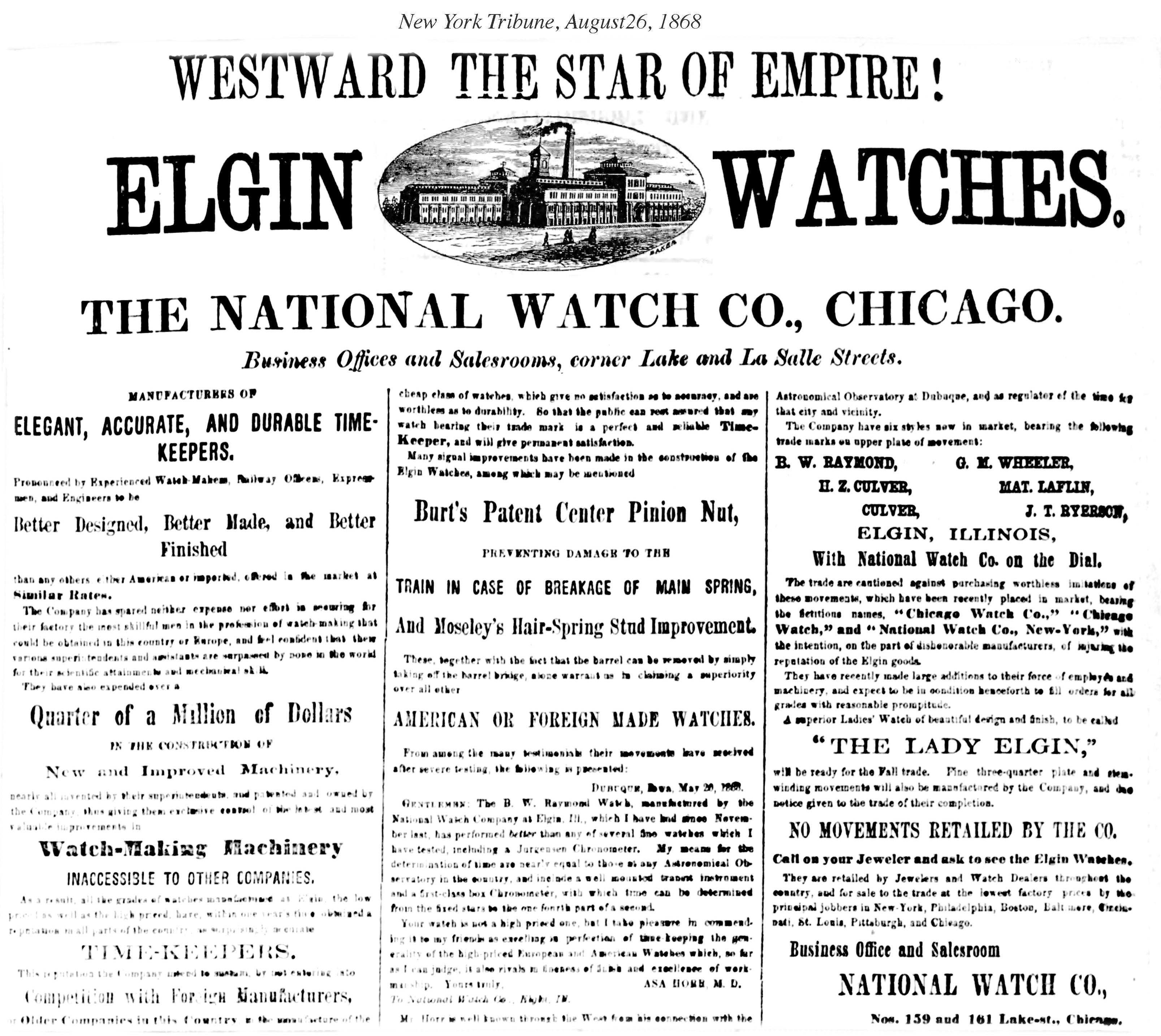
The company now employs a capital of half a million dollars. The managers and proprietors include B. W. Raymond, B. F. Lawrence, G. M. Wheeler, H. Z. Culver, H. H. Taylor, J. T. Ryerson, T. M. Avery, and other leading business men of Chicago. They make six different grades, of which the “B. W. Raymond” is the best. They sell only “movements,” leaving the local dealer to case the watch according to the purchaser’s taste. They propose to supply all reputable houses in the United States with their watches.
Do these watches keep time? That of course is the alpha and omega. We are confident that they do—from the character of the men, machinery, and workmen, and the testimony of disinterested dealers and railway engineers. Several dozen locomotives on the Pennsylvania Railway are already run by them and Western roads, with a just pride in the products of their own section are beginning to introduce them.
The London Illustrated News insists that watehes cannot be made successfully by machinery. The best answer to that theory lies in the fact that a hundred thousand watches are made annually in the United States, simply to supply the demand which their superiority and cheapness have created. They are rapidly driving all grades of foreign watches from our markets. At the beginning of this century there were few watches or clocks in America, and those were imported. The enormous “bull’s-eye” watch, or the wooden clock six or seven feet high, resembling nothing so much as a coffin standing on end, was a rare luxury. Sun-dials and hour glasses were chiefly used to mark the time. Now we supply the whole world with clocks, even to the Fslands of the Sea and the farthest In-dies. Ultimately we shall supply it with watches. In the long run, European hand-labor has no sort of chance against Yankee machinery, directed by Yankee brains.
But where will our watches be made! Thus far the Elgin Company have shipped more than half their work to the East. Capital is worth more in Illinois than in Massachusetts, but labor is as cheap, and living cheaper. If the North-West can compete successfully with New-England in making watches, she can in making anything else; and the Great Valley will become the center of manufactures as well as the seat of empire.—A. D. R.
Harper’s Monthly Magazine, July, 1869
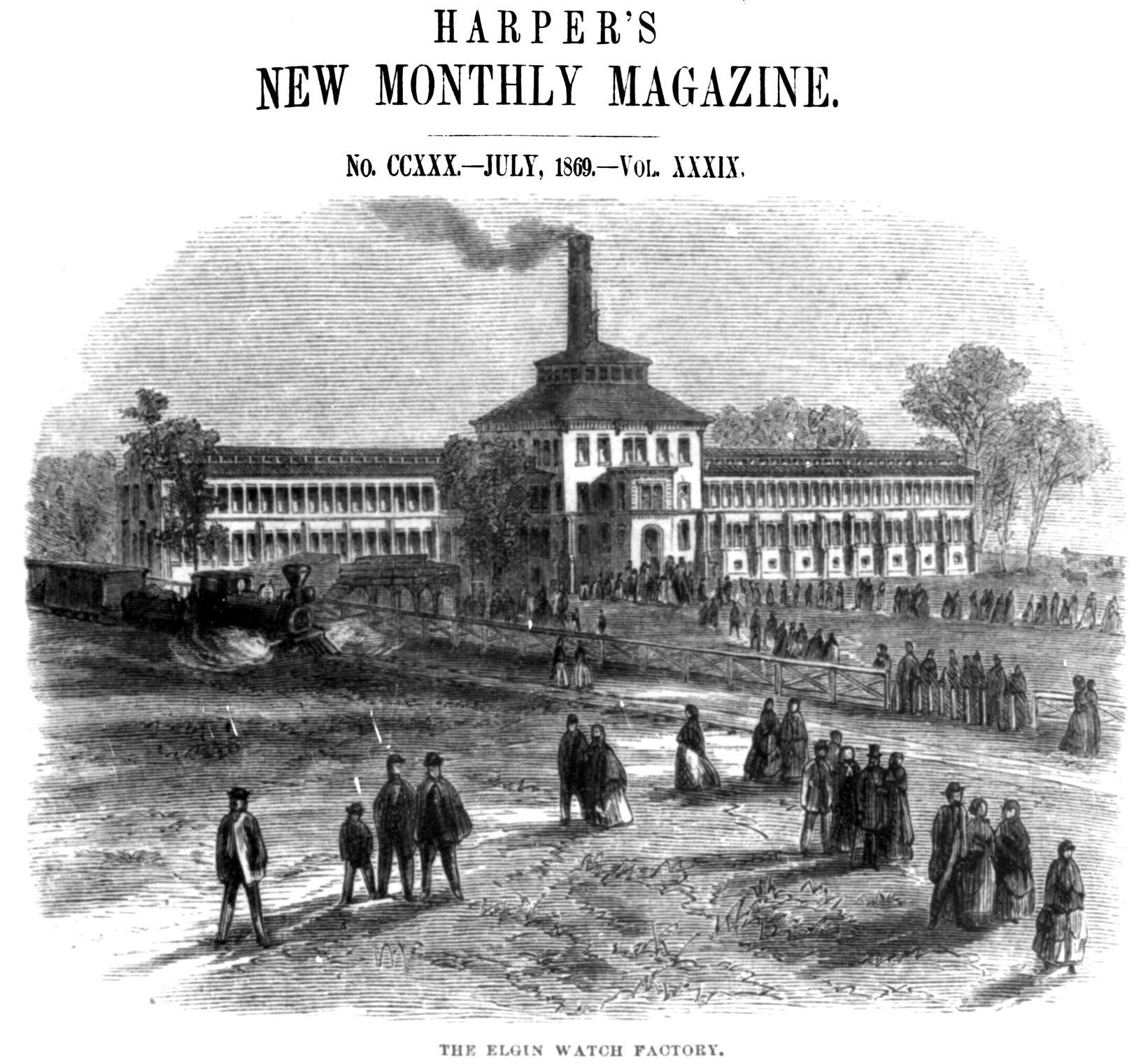
MAKING WATCHES BY MACHINERY.
Abridged to only include Elgin factory.
As we step aboard the Galena train at Chicago we observe the placard, “Pacific Express; does not Stop at Way Stations.” We ponder behind the locomotive for forty miles; then the brakeman ends our reverie by shouting “Elgin.”
Leaving the train, we gaze down upon a far-spreading little city, with court-house, academy, and churches upon commanding knolls, brick blocks and broad streets, cottages pleasantly shaded with oak, maple, and poplar, a woolen mill, a flouring mill, a butt-and-screw manufactory, and a milk-condensing establishment that ships its product to New York—all beside the bright river which cuts the town in twain, and is spanned by a gossamer iron bridge; and over the house-tops, a mile away, the tall chimney of the National Watch Factory.
In the spring of 1864 half a dozen active business men of Chicago, heard a fascinating description of the leading Massachusetts watch factory. To their willing ears it was a story with a moral, and this was the moral: “If Boston can make watches by machinery and largely supply the Northwest, Chicago can make watches by machinery and largely supply New England.” It was the genuine, audacious, self-reliant Western spirit. Practical workmen assured them that with the investment of a hundred thousand dollars in buildings and machinery they could begin to turn out watches. They added fifty per cent to this estimate for a margin, and with that blessed unconsciousness of the difficulties before them, without which no great enterprise would ever be undertaken, they organized the National Watch Company, and in November the work began.
After two years and a half spent in constructing the hundreds of intricate machines and erecting the buildings, in May, 1867, the first watch was completed. Not, however, until long after the first hundred and fifty thousand dollars was exhausted—that barely sufficed for a beginning. Before the enterprise was self-sustaining more than five hundred thousand dollars had been expended, and its owners and friends would doubtless have doubled that sum rather than permit it to fail.
The watch factory of twenty years ago—let pencil and graver fix its humble features ere the place which once knew it shall know it no more forever. The tiny building, with its sign, “John Smith, Watchmaker,” the single room, eight by ten, with its counter, showcase, and window hung with watches, and its one workman, who repaired fifty watches a year, and “made” two or three at odd times. Here and there one of these establishments yet exists, but it is as really a relic of antiquity as a hand-loom or a wooden plow.
The National Watch Factory at Elgin is a specimen of the great museums of machinery and bee-hives of workmen which have pushed it from its stool. The front, shown in our illustration, is two hundred and forty feet long, Several other wings are hidden in the rear. The cars of the Fox River Railway deliver material at the very door.
My first view of the factory yard was toward the close of the noon hour, when the employés were pouring back from dinner. It was a fair picture. On one side the gleaming river, with white and spotted cattle grazing upon its bank; on the other a grove of young oaks, their leaves falling from autumnal frosts; in the foreground scores of ruddy-cheeked girls sauntering back toward their work, while quiet artisans smoked their cigars and meerschaums upon the factory steps and a little platform where a band of operatives discourses music on Saturday afternoons in summer. A dozen young men were jumping, with dumb-bells in their hands, each trial calling out shouts of applause or merriment; and a score of boys playing base-ball as if their salvation depended upon it. Suddenly the great bell behind the factory struck for one o’clock, and the swarm of life poured into the building.
The employés are equally divided between the sexes. I never saw so many boys and girls in an Eastern manufactory. The working day is ten hours. Whenever the welcome bell proclaims the hour of noon, or six in the afternoon, these young people give a whoop like released school-children, and can hardly wait to put away tools and make benches tidy before they join the merry throng streaming homeward.
The average earnings of the girls are something over six dollars per week—in a few cases as high as twelve; those of the boys and men three dollars per day. Board for girls costs about three dollars per week; for men, from five dollars upward. “That little girl,” said the superintendent of the Steel Room to me, “can do any thing in this large department as well as any man in it;” and a number of similar cases were pointed out to me.
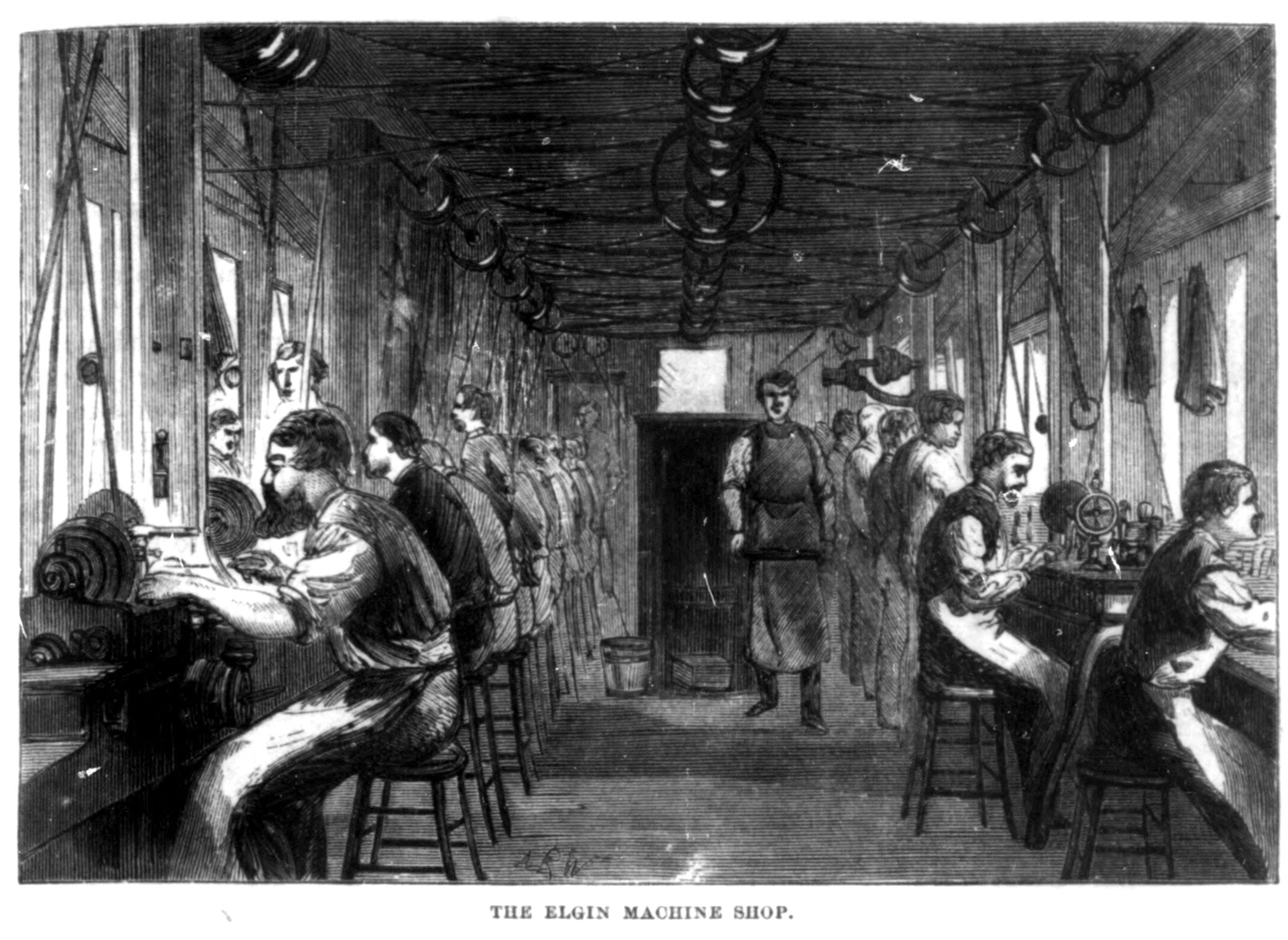
The Machine Shop—a hundred feet long, with thirty brawny, bare-armed workmen—is the letter A in the alphabet of the watch factory. Here all the tools and machines are manufactured and repaired. Their name is legion; their sizes are innumerable. They include machines which will take a shaving off a hair, and those which will slice up steel like apples; registers that will measure the twenty-five-hundredth of an inch, and registers that will measure a foot: drills for making holes invisible to the naked eye, and drills almost as large as crow-bars; and so on ad infinitum, I will not attempt to describe the “cams,” “taps,” “clamps,” “quills,” “reamers,” “eccentrics,” “chucks,” and “wigwags.” The one thing which strikes a novice is the wonderful accuracy and minuteness, the beautiful smoothness and polish of every thing. The finest jobs of ordinary machine-shops would be thrown aside here as utterly worthless.
The works of a watch, not counting the plates which form the shell or frame, are of brass and steel in nearly equal proportions. And, by-the-way, why is “brassy” a term of denunciation, and “as true as steel” the language of compliment, when brass may be made nearly as hard as steel, and will take almost as fine a temper? Steel is used in a watch wherever there is great. Strain upon some very slender part. But where there is much friction between two wheels one must be of brass and the other of steel. By some mysterious law of metals these will outlast two wheels of the hardest and most highly- polished steel twice over.
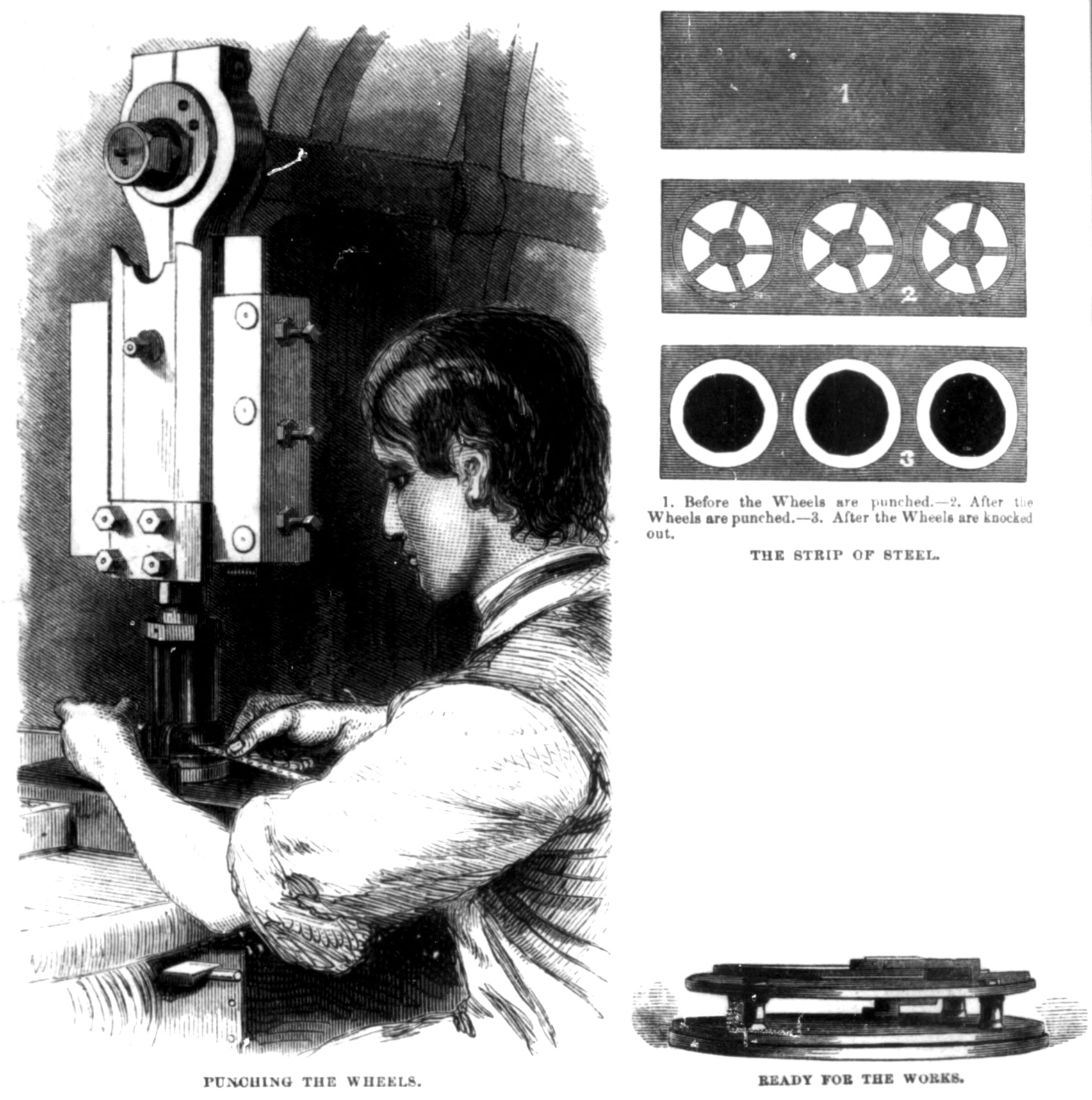
Great sheets of brass and steel are first received in the Punching Room, where an enormous pair of shears cuts them into ribbons. These are lengthened and thinned between a pair of steel rollers, which, if required, will leave them only one-four-thousandth of an inch thick. One of these ribbons is then passed slowly between the punch and die of a huge press, driven by a heavy wheel which a workman controls with his foot. The punch rises and falls with the motion of the wheel, coming down each time with a weight of twenty tons, and with a “click,” cutting out a perfect spoked wheel. The press is an enormous monster which bites out mouthfuls of steel but refuses to digest them. Like most monsters, however, it will do no damage if it is only fed. It leaves the wheels fast in the strip to be knocked out-by hand. With it a man can cut out ten thousand wheels in a single day.
Next we visit the Plate Room. The upper and lower brass plates are respectively the roof and floor of the watch. The upper one must have thirty-one holes bored in it, for pillars, pivots, and screws. A little girl cuts them with a needle-like drill, which revolves like lightning, and goes through the thick plate in a twinkling. Another girl, with a chisel whirling with equal rapidity, cuts away the ragged burs or edges left on the side where the drill comes out. This “countersinking,” which leaves a cup-like depression, is performed wherever a hole is drilled through brass, steel, or jewel.
The four pillars—the posts which are to bind roof and floor together—are made and inserted in the lower plate by a miraculous little contrivance, which a coffee saucer would cover. The punching machine is a behemoth, but this is a fairy. It seizes one end of a brass wire, and in eleven seconds measures off a pillar, turns it down to the required size, makes a screw-thread in each end, cuts it off, and screws one end into the lower plate so firmly that we can not unscrew it with a pair of pincers. But it keeps the workman’s feet busy, and his hands flying as if he played » lively tune upon the piano. He will easily make and insert two thousand pillars in a day. By hand he could hardly make two dozen.
When the brass pieces are finished, all belonging to one watch are stamped with the same number and put into one of ten little boxes hollowed out in a board like birds’-nests. The nests have yet many journeys to make before the eggs are hatched; but the shell or frame is now ready for the works. The upper plate is next engraved. Three men and four girls are kept busy tracing the elaborate scroll-work, and the inscription, B. W. Raymond, Elgin, Illinois, No. 41,280, or J. T. Ryerson, No. 41,290,” as the case may be. The different grades made here are Lady Elgin, B. W. Raymond, Mat Lafin, G. M. Wheeler, H. Z. Culver, H. H. Taylor, and J. T. Ryerson; but the numbering rans consecutively through all.
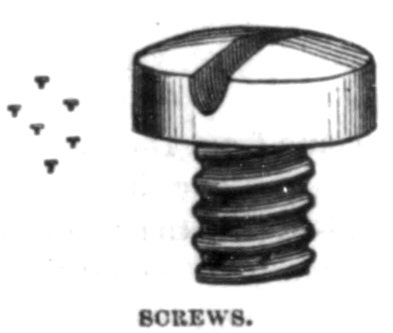
The screws in a watch number forty-four, or more than one-quarter of all its pieces. The Screw and Steel Department is one of the largest in the factory. Its magical little automats, run by nimble-fingered girls, convert shining steel wire into infinitesimal screws, pare down their heads, and cut slots in them for microscopic screw-drivers. They are polished to perfect smoothness, and then, like every other part of the watch, brought to “spring temper”—the temper of the sword-blade—by heating, which leaves them of a rich, deep blue. The illustration shows the screws of their actual size, and also one magnified 100 times each way, or 10,000 times the actual size.
Here are machines which will cat screws with five hundred threads to the inch; the finest used in the watch have two hundred and fifty. Even these threads are invisible to the naked eye, and it takes one hundred and forty-four thousand of the screws to weigh a pound. A pound of them is worth six pounds of pure gold. Lay one upon a piece of white paper, and it looks like the tiniest steel-filing. Only by placing it under a strong magnifier can we detect its threads and see that it is shining as a mirror, and as true and perfect as the driving-wheel of a locomotive.
Screws for the best compensation-balance are of gold. A ten-dollar piece will furnish material for six hundred and fifty of them. Themcompensation-balance comes from the Punching Room a solid piece of steel as large and heavy as a new penny, and inclosed in a rim of brass. It is ground down, worked out, and polished till it becomes a slender wheel—the outer rim brass, the inner rim and crossbar steel—lighter and thinner than a finger-ring. Through the double rim twenty-two holes are drilled for the screws. A chuck whirls the wheel around—as one would spin & penny upon the table—four thousand eight hundred times a minute, while a lad makes each hole by applying three tiny drills one after the other. He will bore one hundred wheels per day, or apply a drill oftener than once in six seconds from morning till night—to say nothing of the time consumed in fastening on and taking off the wheels and sharpening his drills. Screws of gold or brass are then put in, and the balance is completed. On this little part alone nearly eighty operations have been performed.
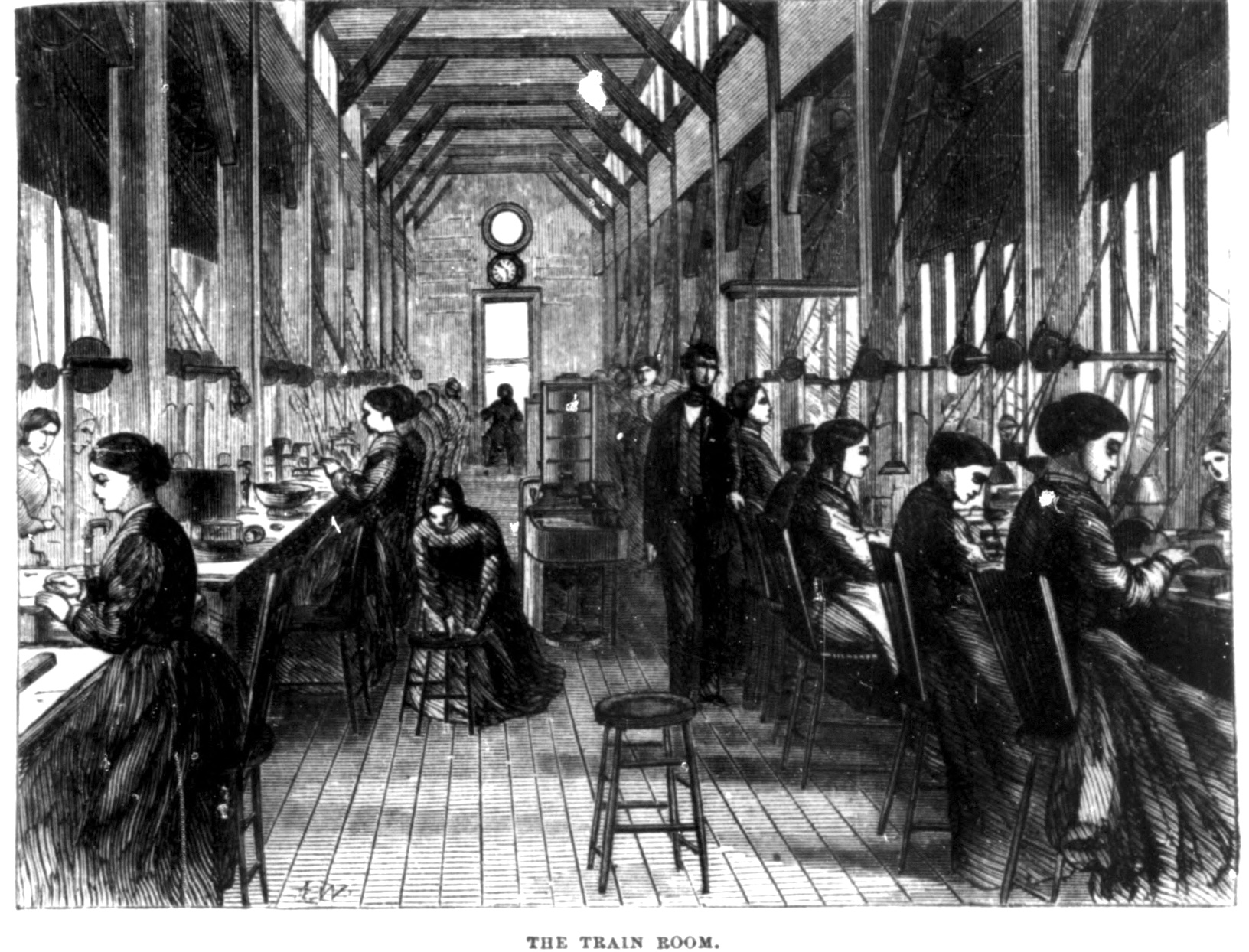
Next we step into the Train Room, the largest and pleasantest in the factory.Seventy-five persons with busy fingers sit at six rows of benches extending its entire length, each before some little machine, shaping, smoothing, pointing, grinding wheels, pinions, or pivots.
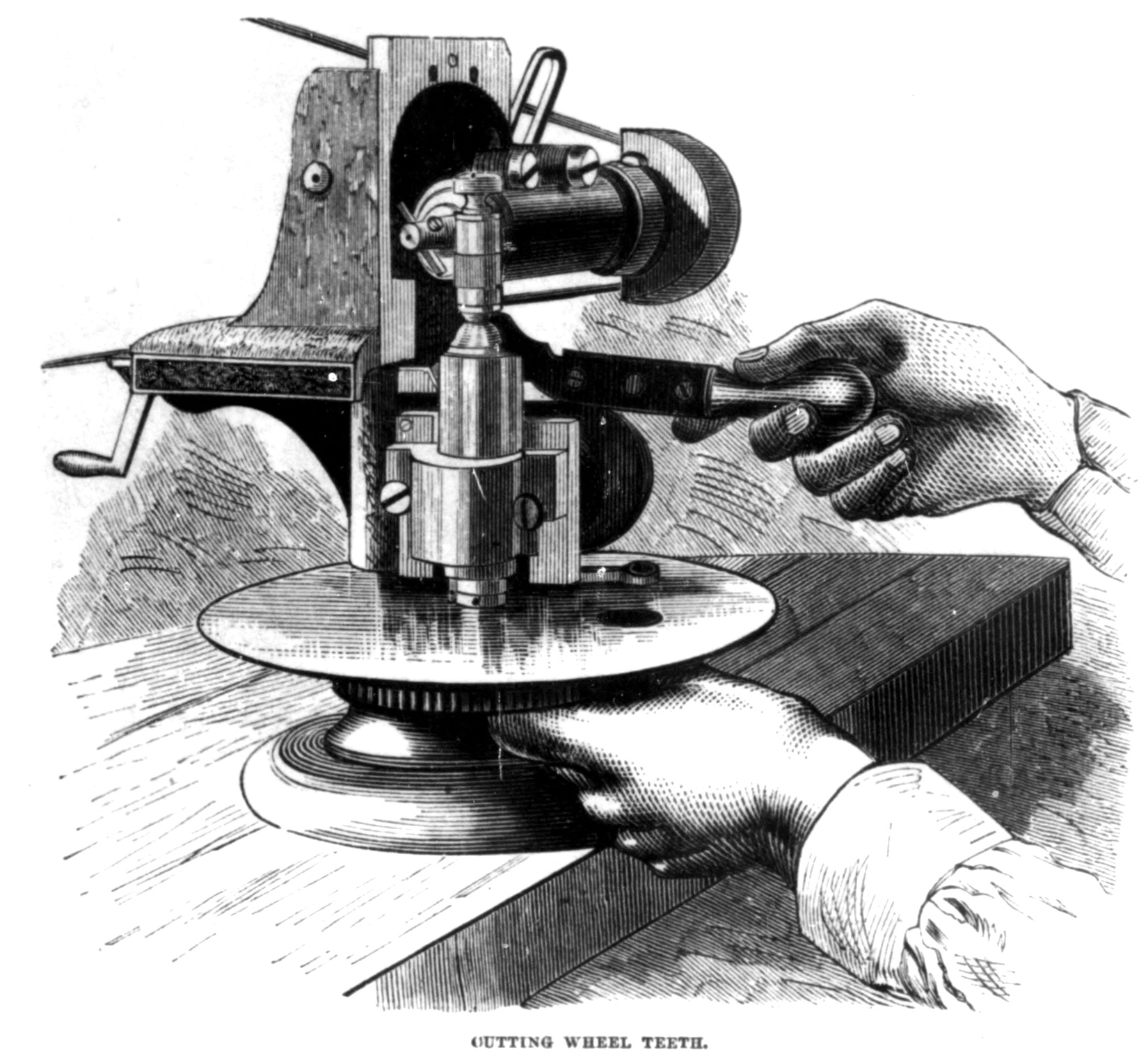
Cutting teeth in the wheels is done by piling up twenty or more, with an upright shaft passing through the centre of each, and turning a screw to hold them together. The girl in charge then lifts one handle of a little machine, and instantly a steel cutter like a shingle-nail, but with asharp point at one end, is brought against them, whirling so fast that it looks like a perfect wheel. Whizzing down the outer edge of the pile, it cuts a groove or furrow in each wheel. When it reaches the bottom she moves the other handle; the cutter flies up to the top, and runs whizzing down again. A single wheel has from sixty to eighty teeth, but the girl will finish twelve hundred wheels a day. The long, hooked teeth of the scape-wheel, and the horn shaped tooth of the ratchet, are cut with equal facility.
In the Escapement and Jeweling departments we first encounter precious stones, in which pivots of brass or steel will run for generations without any perceptible wearing. In the order of hardness they stand, diamond, sapphire, white or milky ruby, red ruby, garnet, aqua marine. In jewelry they are valued only for their color, in watch-making only for their hardness. Montana begins to supply garnets, but most precions stones come from India, Persia, or Brazil. They are always bought by the carat-the one-hundred-and-twentieth part of an ounce Troy-no matter how large the quantity. They are used not only for jeweling, but also for tools to cut other precious stones or hard metals with. Sapphire is the favorite, because it can be sharpened upon diamond, while a chisel of diamond—the hardest of al! known substances—must either be broken to give it a fresh edge, or sharpened slowly and laboriously against another diamond.
The Dutch are the most famous lapidists in the world. They sent workmen from Amsterdam to London to cut the great Koh-i-noor. They will divide a diamond weighing but one carat into two hundred and fifty little slabs, which look like fairy finger-nails. Inserted in brass handles they become ridicnlous little chisels, which might turn out wheels and axles for Queen Mab’s chariot. Diamond dust also, as white as snow, and finer than flour, has a hundred ases in the factory. An ounce costs five hundred dollars. Metal edges for cutting and surfaces for polishing are “charged” with it; that is, a little of the powder is firmly imbedded in them, and gives them a sharpness which nothing can resist.
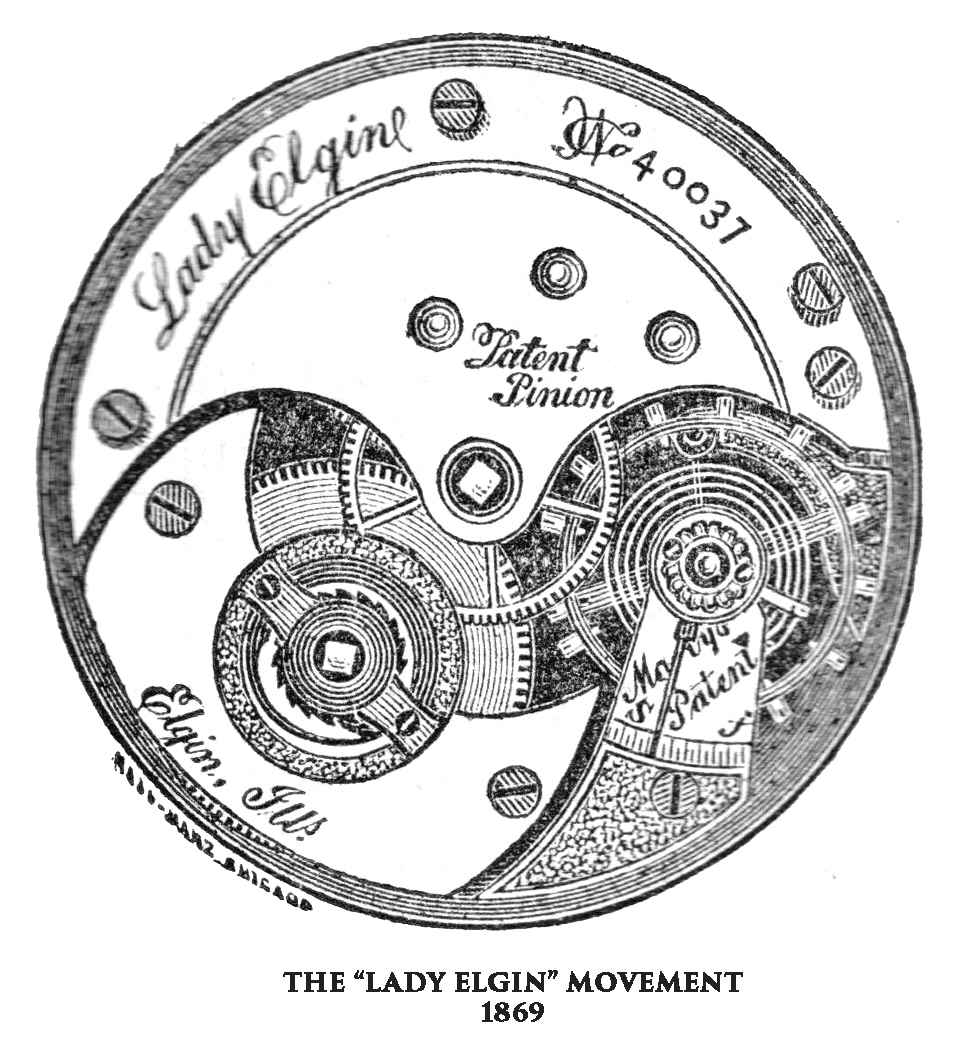
Some rare watches are jeweled with diamonds and sapphires, and many with rubies; but for all practical purposes garnets and aqua marines answer as well. The Lady Elgin, an exquisite little time-keeper, has fifteen jewels, all of ruby. Four of the fifteen in the B. W. Raymond are of ruby, the rest of aqua marine and garner. The precious stones are cut into planks, and then into joists, by circular saws, and afterward broken into cubes. Then each is turned out in a lathe, exactly as a bed-post is turned in a furniture factory. By this time it weighs less than one-eighty-thousandth of a pound Troy. It is afterward burnished into its setting—a little circular rim of brass. The hole is made through it with a diamond drill, barely visible to the naked eye, and polished with another wire which passes through it and whirls one way while the jew el whirls the other. The two make twenty-eight thousand revolutions a minute. Finally jewel and setting are inserted in a little depression of the watch-plate, which they exactly fill, and held in place by tiny screws of steel, whose deep blue contrasts plensantly with the bright gilding of the plate.
Every part of a watch must be absolutely accurate, but no part must fit perfectly. To run freely each pivot mnst have a little play, like a horse in harness; otherwise the least bit of dirt or expansion of metal would stop the delieate machinery. So every jewel-hole is left a little larger than the pivot which is to revolve in it for the “side-shake,” and every shaft or axle a little short for the “end shake.” The tiny gauges which measure all the parts make allowance for this—a bit of calculation which they perform with an ense and accuracy un known to poor human brains.
There is another danger to guard against. If the least grain of diamond dust is left in a jewel-hole it will imbed itself firmly in the steel pivot, and then act as a chisel, cutting away the jewel every time the pivot revolves. The new dust of ruby or garnet which this produces will act in the same way—” diamond cut diamond”—until the jewel is utterly ruined; so the utmost care is necessary to see that no particle of diamond dust remains in the watch.
After the jeweling is done the birds’-nest boxes go to the Finishing Room. In following, let us stop to glance at the Dial Department.
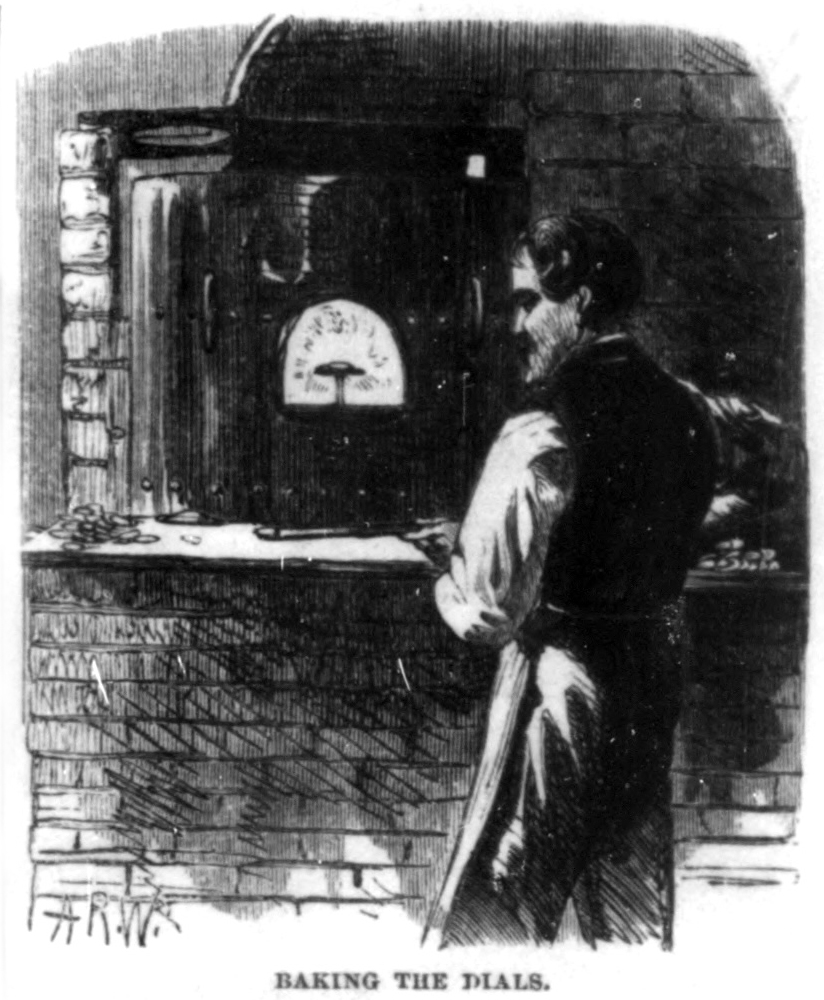
The dial, a plain circular plate of Lake Superior copper, no thicker than a silver three-cent piece, is first covered with a paste of fine white enamel, carefully spread on with a knife, to the thickness of three-one-hundredths of an inch. After it dries a little, a workman with a long pair of tongs places the dial flat upon a red-hot iron plate in the mouth of a glowing furnace, watching it closely and frequently turning it. The copper would melt but for the protecting enamel, and, at the end of a minute, when he takes it out it is as soft and plastic as molasses candy. The baking has “set” the enamel, but has left it rough, as if the dial face were marked with small-pox. After cooling it is ground smooth upon sandstone and emery, and then baked again.
Now it is ready for the painters. A girl draws six lines across its surfuce with a lead-pencil guided by a ruler, making ench point for the hours. Another with a pencil of black enamel traces coarsely the Roman letters from I to XII. A third finishes them at the ends to make them symmetrical. A fourth puts in the minute marks. Then the dial goes to an artist, who, holding it under a magnifier, paints the words “NATIONAL WATCH CO.” in black enamel with a fine camel’s-hair brush. The inscription measures three-fourths of an inch from left to right, and less than one-ninetieth of an inch up and down; but even then it is perfectly legible; and the swift, cunning fingers will paint it twice in five minutes.
“Is it not very trying to your eyes?”
“If I were to do it all day, or even for an hour steadily,” the painter replies, ” they would ache terribly. But I put the inscription on two dozen dials, and then rest my sight by painting on the figures, lines, and dots.”
“My father,” observes the superintendent of the room, who is looking over his shoulder, was an English dial painter. Once he traced the Lord’s Prayer with one of these camel’s-hair brushes on a surface one-eighth of an inch long by one-ninth of an inch wide. Half the wing of a common house-fly would cover it. It aged the old gentleman’s eyes twenty years for his work, but he could see objects at a distance just as well as ever.” One can only wonder that it did not strike him blind.
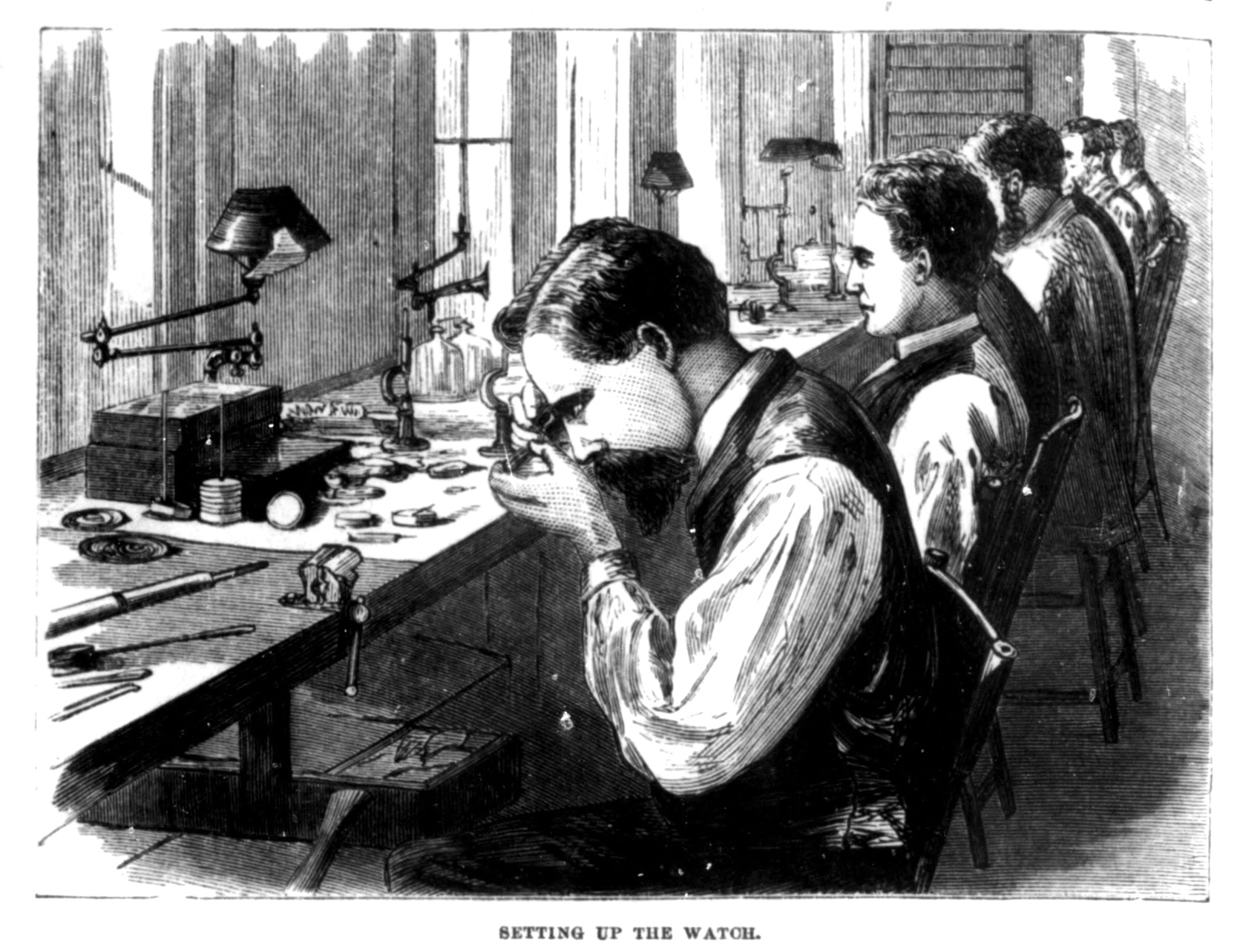
In the Finishing Room we find a drawer full of mainsprings, coiled so loosely that each is as large as a breakfast saucer. One drawn out straight will be two feet long. It is polished like a mirror, and tempered to a beautiful deep blue. A girl coils one to the diameter of a thimble, and then, rifling one of the birds’-nests, inserts the mainspring in its brass “barrel,” the head of which is held in by a groove like the head of a flour-barrel. This circular chamber, only seven-tenths of an inch across, contains the whole power of the watch. One end of the mainspring is fast to the shaft which passes through it, and by which it is turned; the other, as it uncoils, carries around the barrel, and so communicates motion to the train. She puts the parts together temporarily, inserting only screws enough to keep them in place. Her flying fingers sot up ninety watches and empty ninety birds’-nests every day. The latter go back to the Plate Room for more eggs and fresh incubations; here at least there are always birds in last year’s nests.
Hair-springs are made in the factory, of finest English steel, which comes upon spools like thread. To the naked eye it is as round as a hair, but under the microscope it becomes a flat steel ribbon. We insert this ribbon between the jaws of a fine gauge, and the dial-hand shows its diameter to be two twenty-five-hun-dredths of an inch. A hair plucked from a man’s head measures three twenty-five-hun-dredths—one from the head of a little girl at a neighboring bench two twenty-five-hun-dredths. Actually, however, the finest hair is twice as thick as the steel ribbon, for the hair compresses one-half between the metallic jaws of the gauge.
A hair-spring weighs only one-fifteen-thou-sandth of a pound Troy. In a straight line it is a foot long. With a pair of tweezers we draw one out in spiral form until it is six inches long; but it springs back into place, not bent a particle from its true coiling. It must be exquisitely tempered, for it is to spring back and forth eighteen thousand times an hour, perhaps for sereral generations. A pound of steel in the bar may cost one dollar; in hair-springs it is worth four thousand dollars.
After the watch has been run a few hours, to adjust the length of the hair-spring, it is “taken down,” and all the brass pieces sent to the Gilding Room. There each part is polished for electro-gilding. Gold coin in first rolled out into sheets, and then dissolved with acids. At some stages it looks like nauseating medicine, but when it goes into the battery the solution is as colorless as spring-water. But it is a deadly poison. A girl in this room was kept at home for three weeks with sores upon her hand caused by dipping it in the liquid.
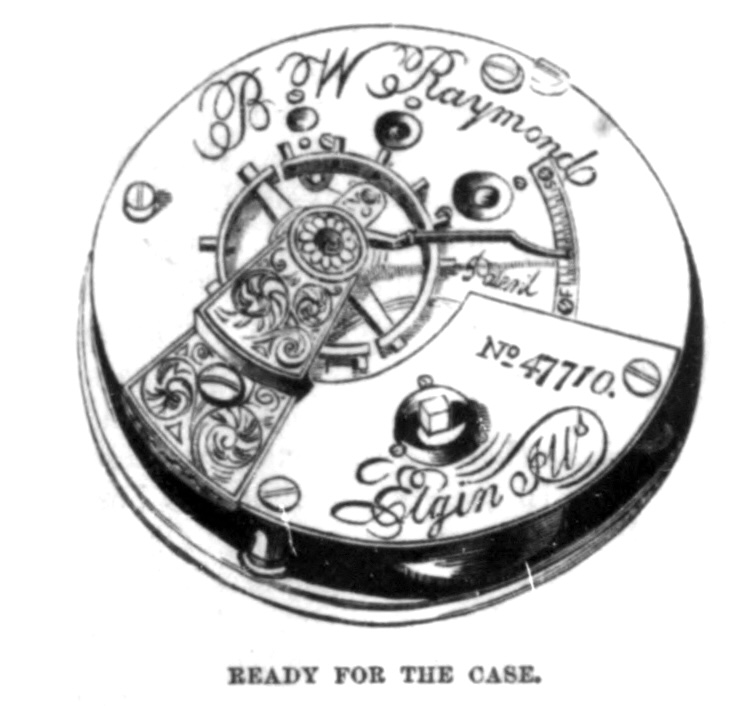
Twenty or thirty of the brass plates and wheels are hung by a copper wire in the inner ressel or porous cell of a galvanie battery, filled with this solution, and the silent electric current deposits the gold evenly upon their surfaces. Ordinarily they are left in it about six minutes: the quick, educated eye of the superintendent determines how long. A twenty-dollar gold piece will furnish him with heavy gilding for six hundred watches, but he could make it gild four thousand so that they would look equally well on first coming out; or he cold pat five hundred dollars upon a single one-leaving the gold an inch thick all over the works-and it would look no better. All the pieces come out clothed in yellow, shining gold, and are sent back to the Finishing Room, put together again, and then turned over to the “watchmakers”—the only persons in the factory necessarily familiar with all parts of the watch. A dozen sit in a row, in a very strong light, before a long bench strewn with their minute brushes, tweezers, magnifiers, and glass cases which cover small mountains of wheels and pinions. They insert the balance and hair-spring, see that every thing has been properly fitted, and put on the dial.
Then the watches, each in a little circular tin case, go in boxes of ten to the lynx-eyed Inspector, who scrutinizes every part for the slightest flaw or defect. Here is a box which has passed through his hands. Upon two watches are little slips of paper, one labeled Fork strikes potance”—a slight but needless friction; the other, “Fix the number”— the figures upon some one piece being wrong or illegible. About one-third are thus sent back to the “watchmakers,” after his rigid examination.
The last scene of all is the adjusting. In his quiet little room the Adjuster keeps the Equator and the North Pole always on hand and ready for use in large or small quantities. First he runs the watch eight hours in a little box heated by a spirit-lamp to one hundred and ten degrees Fahrenheit. Then ho runs it eight hours in a refrigerator, where the temperature is nearly at zero. It must keep time exactly alike under these two conditions. If he finds any variation he changes the position of the screws in the compensation-balance, or substitutes now ones, first carefully weighing them in a pair of tiny scales of his own contriving. When we ask him to show us the minutest weight they will indicate he places a bit of whisker upon one end, and adjusts the weight. The speck of hair weighs a trifle over the fifty-seven-millionth of a pound Troy.
The watch is next carefully adjusted to keep equal time in different positions. Then it is ready for the case. Its different parts are composed of one hundred and fifty-six pieces. The old watch, made by hand, contained eight hundred pieces, if we count each link of its chain as a separate part. Reducing the number four-fifths has correspondingly reduced its intricacy, friction, and difficulties of repairing.
The proprietors realized from the outset that they could only succeed by making good time-keepers. To that one result all their energy has been directed. Manufacturing upon this large scale involres the use of so much capital that after a fine watch is finished and running they can not keep it a year for adjusting and regulating, as jewelers used to do under the old method. Most of their watches have gone oat warm from the factory, but they have run with wonderful accurney. The very first half dozen used upon the Pennsylvania Railway were brought in by the engineers at the end of six days, and the greatest variation among them was eight seconds.
The railroad is the great critic. Nowhere else is a watch so severely tested; nowhere else is accuracy so absolutely essential. After careful trial, solely upon their own merits, the Elgin watches have been adopted as the standard upon several of our leading trunk lines. On the Pennsylvania Road alone more than a hundred locomotives are run by them, and they are in use among conductors and engineers upon every railway in the Northwest, and upon the great trans-continental line from Omaha to San Francisco. That is as it should be—the Pacific Railway trains run by American watches.
Several months ago a Swiss imitation, labeled “Chicago Watch Company,” began to appear in our markets. It looks well to unskilled eyes, but is so rough and cheap that the “movement” can be sold for five dollars after paying the import duty. And lately another imitation, bearing the same inscription, but manufactured in an Eastern factory, has made its appearance. Buyers who would be sure of avoiding these spurious watches should purchase only of some reputable and established jeweler, and never of unknown, irresponsible parties, however honeyed and seductive their advertisements. But this counterfeiting, both foreign and domestic, of an American product less than two years old, at least shows that the genuine article has won enviable reputation.
Two facts in the consumption of the Elgin watches are the shadows of coming events. First, fully half, thus far, have been sold in the East, and a large proportion of them in New England. Second, the Company are filling orders for India, which have come from London, without solicitation or advertising abroad. The prairies are beginning to manufacture for the Orient! What will this grow to in the near future, when three Pacific railways bring India, China, and Japan to our doors?
The Company make “movements” alone, dealing with the public only through local jewelers, whom they leave to case each watch according to the customer’s taste or fancy. Making cases—a business quite distinct from making watches—is done on a large scale by two or three houses in the United States, and on a small scale by a great many. Crystals cost the jeweler from two and a half to seventy-fire cents apiece. The finest are made in Europe; cheaper ones in New York and Pittsburg. Gold cases cost from fifty to one hundred and fifty dollars each; silver ones from six to thirty dollars; German silver about three dollars and fifty cents.
Thus we have followed the watch through its various stages until it is ready for the pocket. An expert jeweler working by hand might perhaps make a watch in three weeks. The Elgin factory, with less than for hundred and forty employés, turns out one hundred and twenty-five a day, or one every three days and a half for every worker in the establishment, including all the young boys and girls, the book-keepers and clerks. As eighteen is to three and a half so is machinery to hand-work. In watchmaking alone, within the last fifteen years, Americon inventiveness has increased the efficiency of human labor more than fivefold.
Increase in product always brings a still larger increase in demand. When Denison conceived the daring project of manufacturing three thousand watches a year, his sober friends fancied that he could never find purchasers. Since then our imports have increased enormously. In 1868 we bought two hundred and fifty thousand watches, costing four millions of dollars, from Switzerland alone. Abont one-fifth were gold; the rest silver. An enormous proportion were of the grades which sell without cases for from five to ten dollars each, and which as time-keepers are worth about the value of the powder it would take to blow them up. In addition to this foreign supply, one hundred thousand watches a year are now manufactured in the United States. Still the demand is so great that the Elgin factory is often two or three months behind its orders for the most popular grades. The same is doubtless true in other establishments. It will continue true in the time not far distant when a good watch in a silver case can be purchased any where for ten dollars, and when American factories are turning out a thousand watches a day, for the United States and Europe, and swarming Asia.
But no degree of familiarity can ever take the charm and interest from a great watch factory. It will always be a magician’s palace, which makes the story of Aladdin prosaic and commonplace.

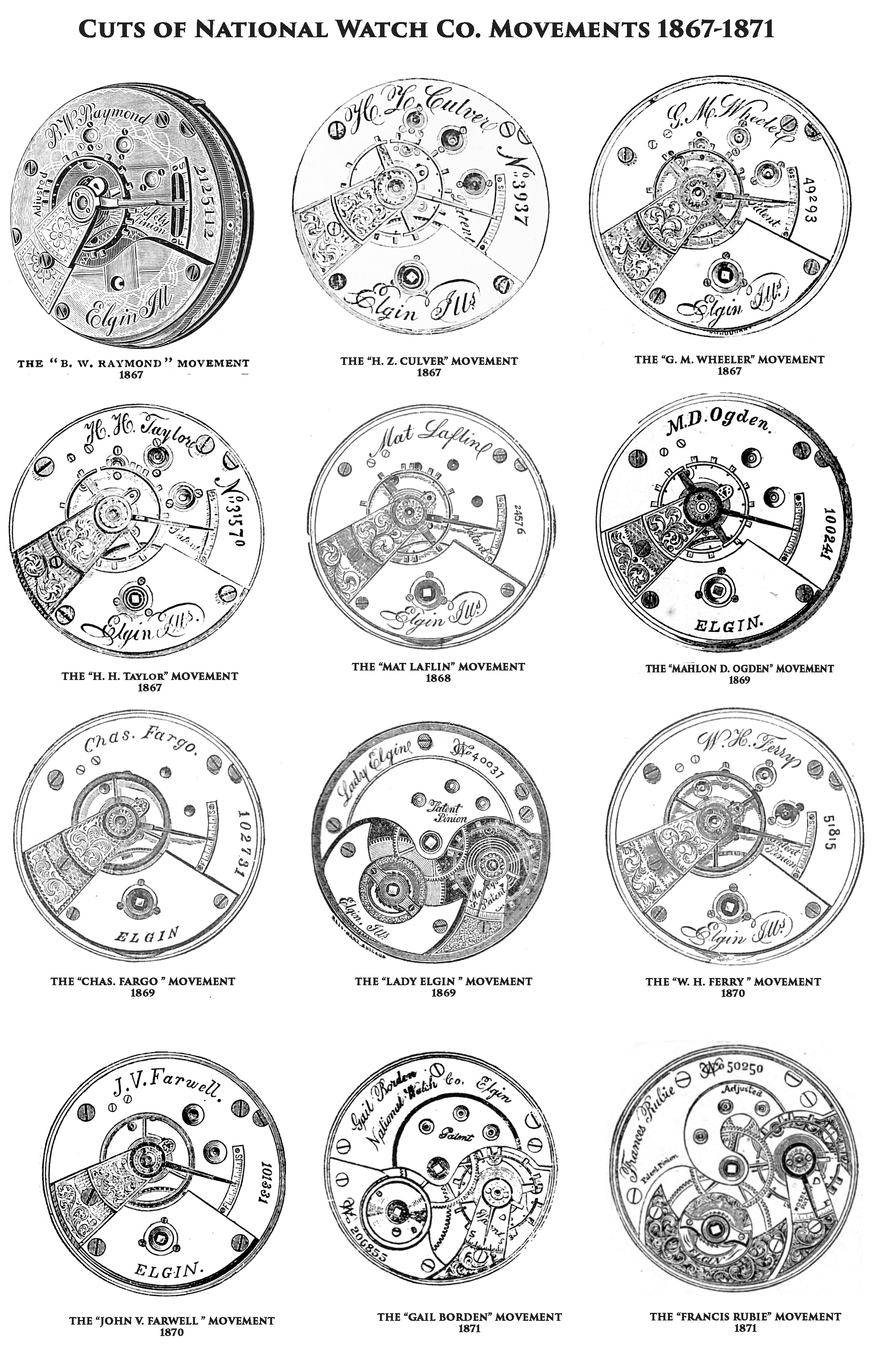
Western Rural, September 22, 1870
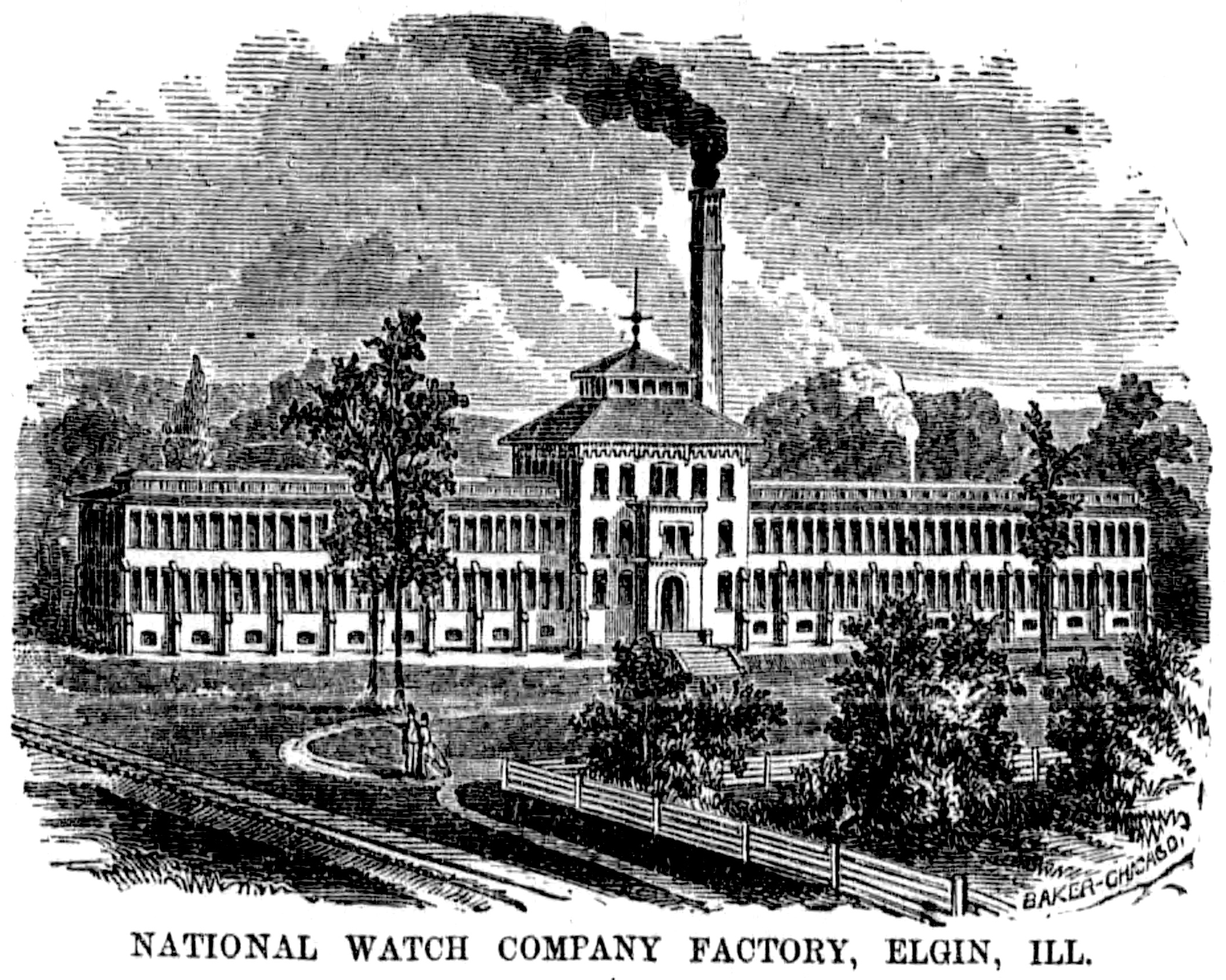
National Watch Factory, Elgin, Ill.
The above (right) engraving represents the National Watch Factory at Elgin Illinois,-an enterprise which had its origin with a few energetic and shrewd business men of Chicago In 1864. Two years were spent in erecting suitable buildings, and it was not until May 1867 that the first watch was turned out. Within the brief period intervening between that date and the present this Factory has achieved a reputation for its watches which is world-wide. The different grades of watehes made are the “Lady Elgin,” “B. W. Raymond,” “Mat Laflin,” “G. M. Wheeler,” “H. Z. Culver,” “H. H. Taylor,” and “J. T. Ryerson.”
The testimony as to the excellence of the watches here made is of the most pronounced and satisfactory character. No higher proof of their superior qualitles could be adduced than has been voluntarily furnished by many men, throughout the country, of the highest standing and influence.
A very interesting paper on Ancient and Modern Time Keepers, containing an interesting notice of the works of the National Watch Company, written by the late A, D. Richardson, may be had upon application to the Company, in person or by letter, at Elgin, or corner of Lake and LaSalle streets, Chicago, We give these watches as premiums.
The Merchants and Manufacturers of Chicago, John Wing & Co., 1873
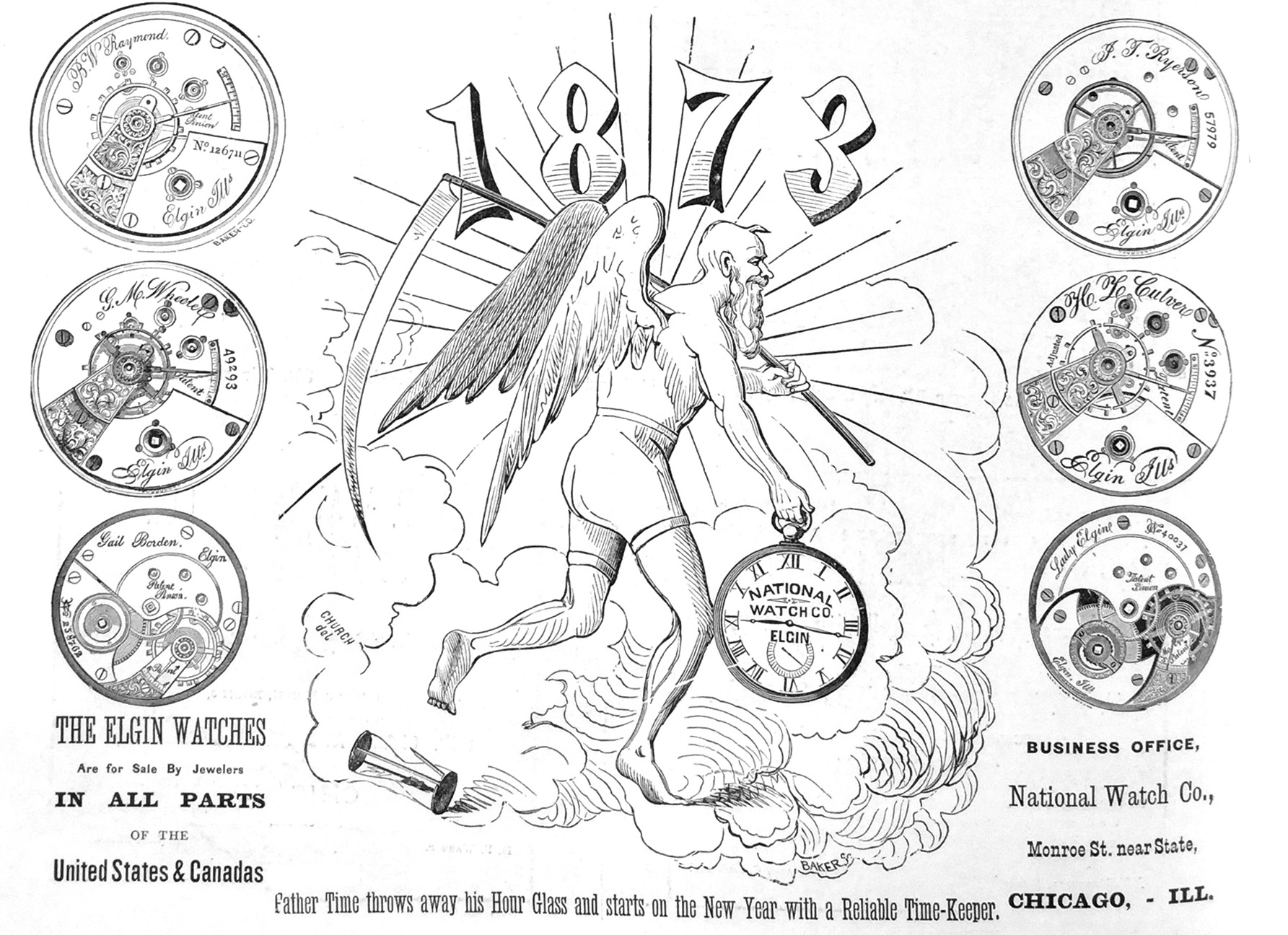
Chicago Tribune March 24, 1874
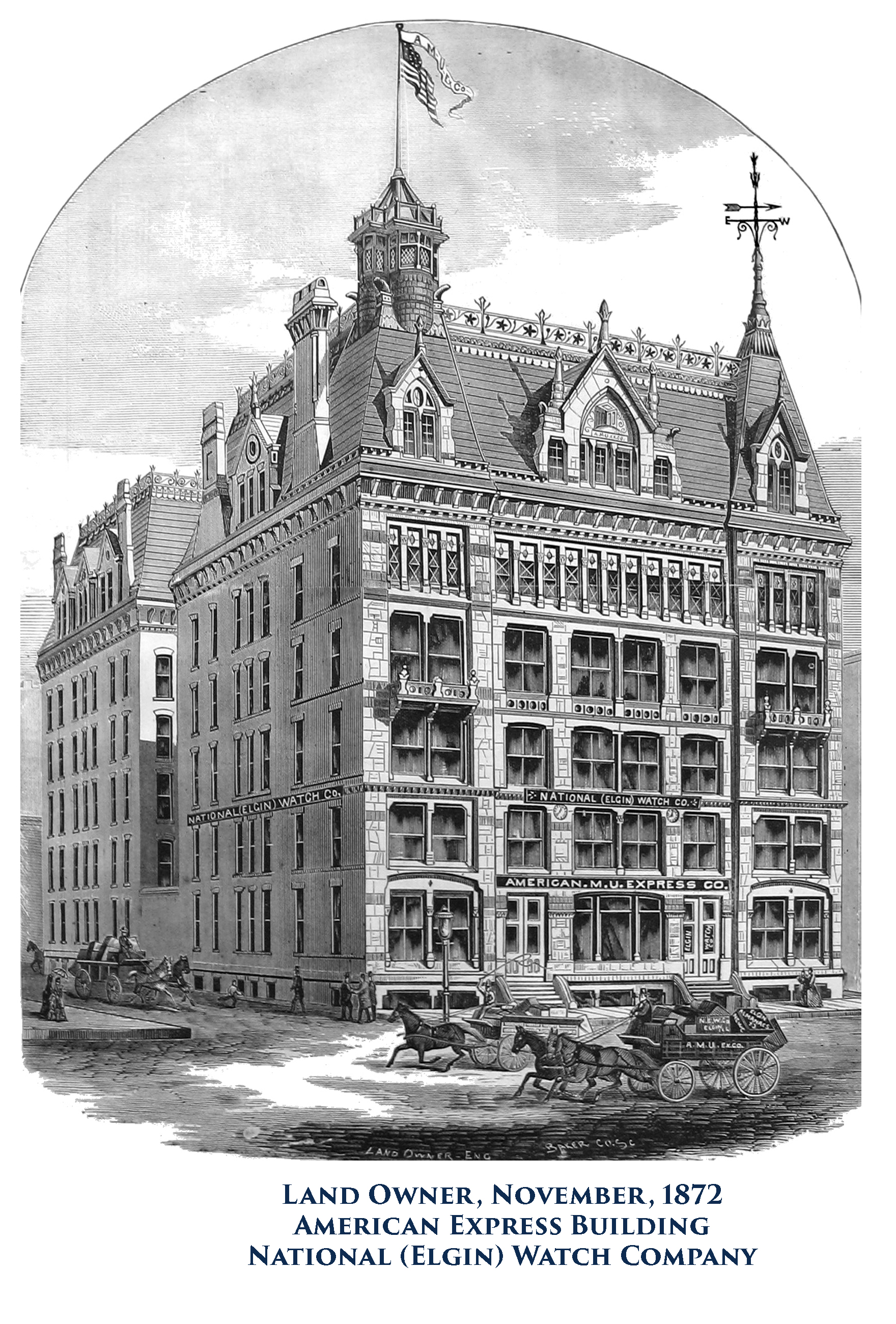
Let us commence with the ELGIN NATIONAL WATCH COMPANY, not because it is a home institution, but as they have obtained a national reputation for the reliability of the watches manufactured by them. They have been heard from in every part of the civilized world, and in all cases, although often subjected to the severest tests of changing climate and rough usage, wearers have expressed the highest commendation of their time-keeping qualities, adjustment, and durability. The stock of this Company, amounting to $1,500,000, is owned mostly by Chicago citizens, and all the Directors are also favorably known in connection with other branches of business in this city.
The splendid factory is situated at Elgin, occupying over three acres of ground, and only last year there has been added a new building at a cost of $75,000. From the general offices here, in the first story of the American Express Company’s building on Monroe street, near State, the trade is supplied with their delicate and accurate time-keepers. This branch is in the hands of Maj. D. W. Whittle, the General Agent of the Company, who has two sub-agents, one in the East, at No. 1 Maiden lane, New York, and the other in the extreme west, at San Francisco. The latter has several times visited the Sandwich Islands, China, and Japan, introducing there the Elgin watches, and even the King of the Sandwich Islands is wearing an Elgin watch bought at & jewelers shop in Honolulu. During the last year several hundred of their movements have been also exported to England, notwithstanding the high entry duties. The Company is said to have doubled the sales in California and the mining regions, since the introduction of a patent dust-excluder, the only one effectually closing the works. The Elgin National Watch Company manufactures sixteen different movements, ranging in price from $13.50 to $67.50, twelve of them being full plate movements, and four, named Dexterstreet, Gail Borden, Lady Elgin, and Francis Rubie, ladies’ watches.
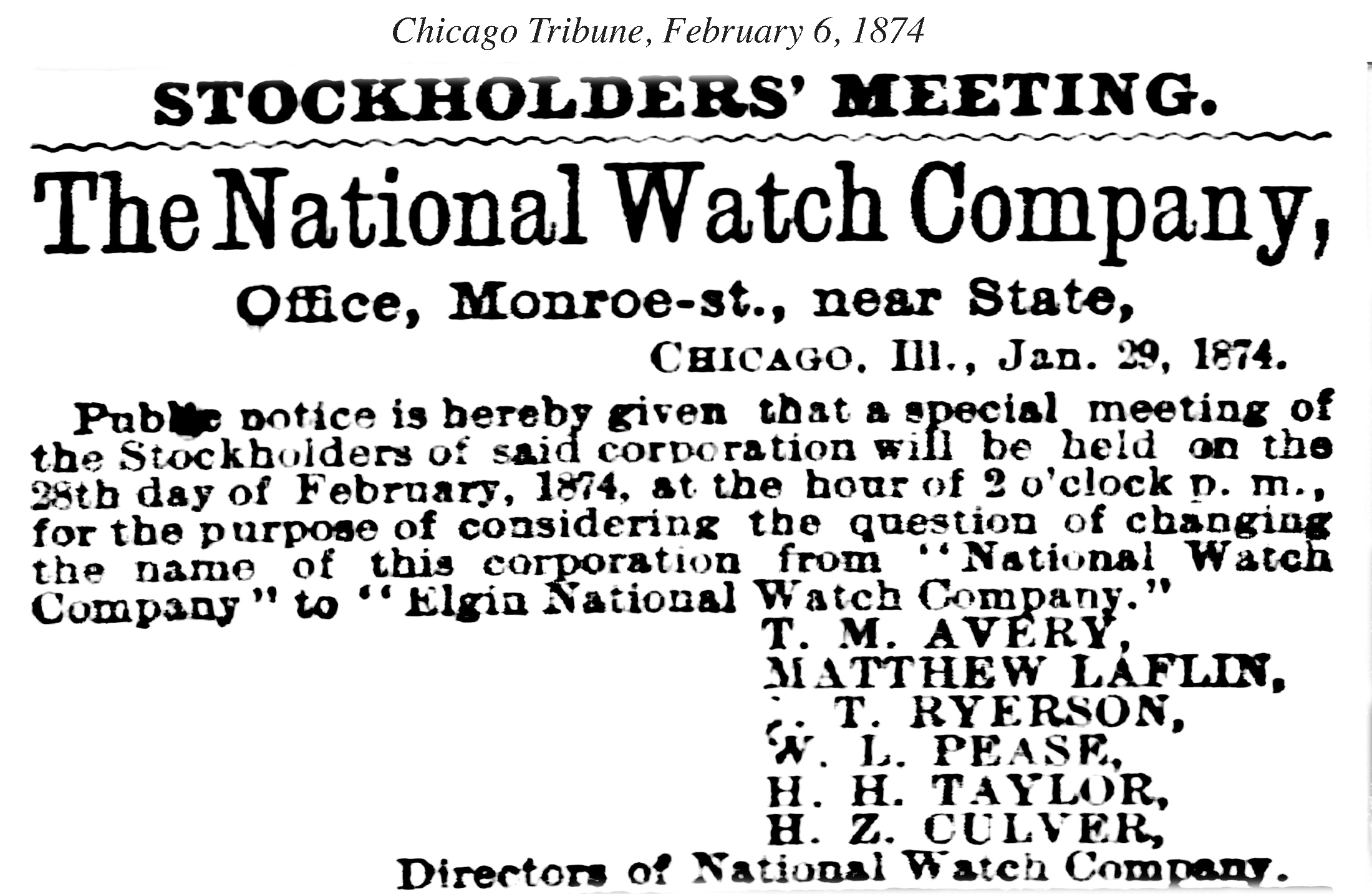
The yearly increase of the number of women engaged in business, mechanical, professional, and educational pursuits has created a demand among American women for watches that will keep time, Where heretofore ornamentation of caring and novelty of design have been considered sufficient to sell to them the most worthless class of Swiss timepieces.
The Ladies’ Watches of this factory now in market are as complete in beauty of finish and in time-keeping qualities as is possible for watches of similar grades and cost to be. In former years this Company has been annoyed by the sale of cheap imitations, made in Switzerland, which is stopped now by the law of Congress of March 3, 1871, affording protection from frauds of this character. During last year the Company found that s good many watches made by the International Watch Company, of Schaffhausen, were sold to confiding purchasers br the similarity of the name, and to stop this also they changed the name on Feb 28 from “National Watch Company” to “Elgin National Watch Company.”
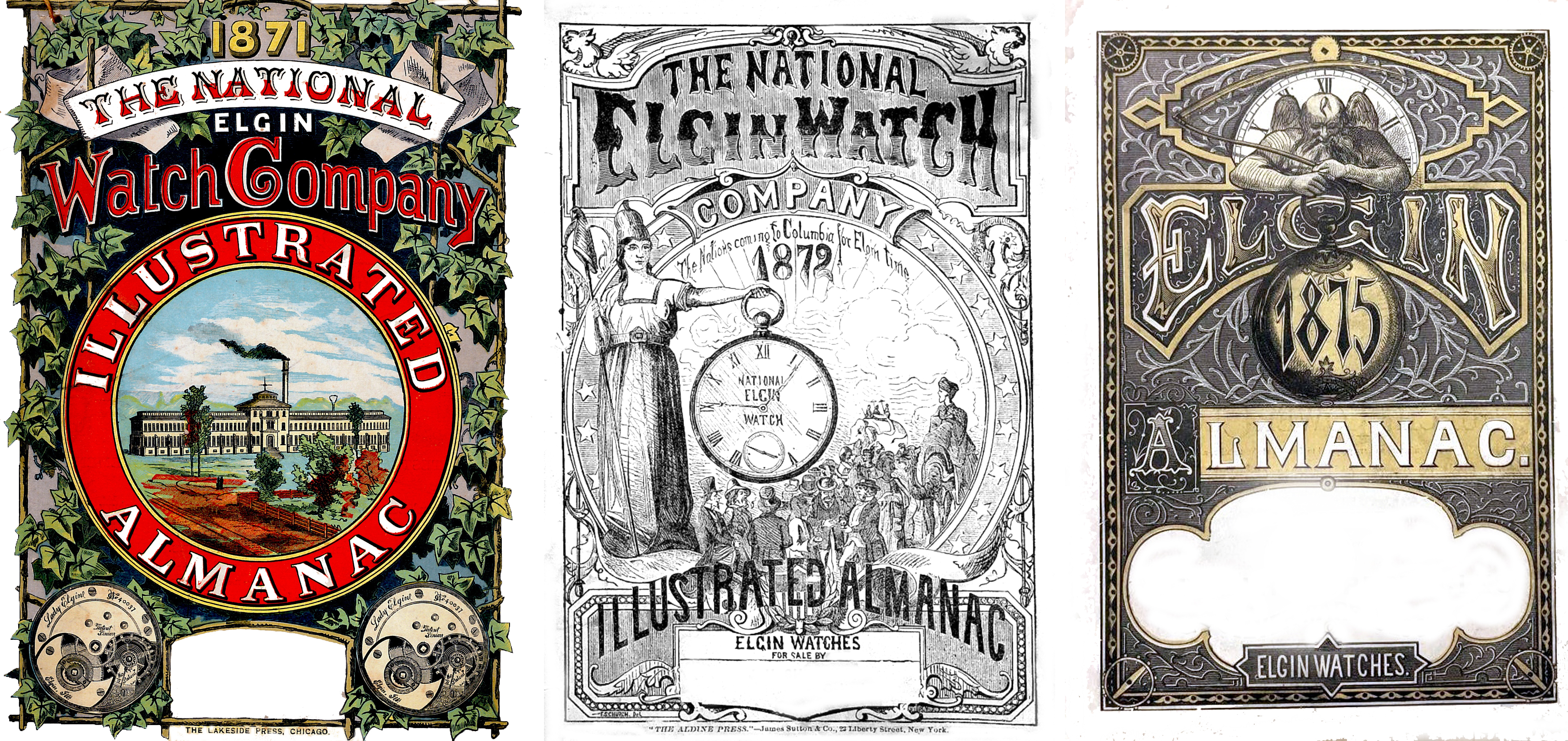
The Inter Ocean, January 19, 1890
Illinois Watch Case Works.
Elgin, IlL, Jan. 18.—Special Correspondence.
Elgin has taken a fresh start, and the probabilities are that ite growth will be steady and rapid. The latest acquisition is the Illinois Watch Case Works (Eppenstein & Co) from Chicago, which will be rechristened the Elgin Watch Case Works The factory will be located in the northeast part of the city, and employ at first 100 hands, mostly men. The company agrees to add at lest fifty men per year for three years. In conjunction with our noted watch factory this will give the city a still greater prominence in a most desirable way. It is expected to employ 700 hands within five years.
The Inter Ocean, January 26, 1890
Andrew Magnus has been awarded the contract for masonry on she works of the Illinois (Elgin) watch-case factory. The cost is to be $7,650. The building will be 180 feet in length, three stories in height As yet the contract for the carpentry has not been let. The factory will be built as rapidly as possible, as it is intended to ocenty it by May 1. It will be quite an addition to Elgin.
Standard Guide to Chicago for the Year 1891, John J. Flinn, 1891
Elgin National Watch Company.—Located at Elgin, I]I., 42 miles from this city. Take train at Wells Street depot, Wellsand Kinzie sts., via. Galena Division Chicago & North-Western railroad.
This is one of the most extensive as well as the most interesting industries carried on in Chicago or vicinity. Some idea of its character may be obtained at the outset, from the fact that three thousand hands are employed in the works: that a daily average of 1.800 watch movements are turned out, running in value from $4 to $90; and that 540,000 movements were turned out in 1890, the aggregate value of Twenty-six which was $3,500,000. Twenty-six years ago Patton S. Bartlett and Ira G. Blake, employés of the American Watch Company, of Waltham, paid a visit to Chicago, and while here conceived the idea of starting a great watch factory in the inviting fields of the growing West. They formed the acquaintance of J. C. Adams, of Elgin, a practical watchmaker, who became enthused with the idea. After some effort, a company was formed August 21, 1864, under the name of “The National Watch Company,” of Chicago, Ill., with a capital stock of $100,000. Through the influence of Mr. Benj. W. Raymond and Geo. B. Adams, the location of the factory was offered to Elgin, on condition that a tract of thirty-one acres of land be deeded to the company, and $25,000 worth of stock be subscribed by the city. After efforts to comply with these conditions had failed, four of Elgin’s citizens stepped to the front and fulfilled the requirements. They were S. Wilcox, W. T. Pease, H. Sherman and B. F. Lawrence. Thirteen of the original thirty-five acres lying east and south of the factory were set apart, and an acre lot was given by the company to each of the original seven Waltham men who came West in 1865, namely, Messrs. Hunter, Moseley, Hoyt, Bartlett, Mason, Hartwell, and Bigelow. The incorporators of “The National Watch Company” were: Benj. W. Raymond, Howard Z, Culver, Thos, S. Dickerson, Geo. M. Wheeler, Philo Carpenter, W. Robbins and Edw. H. Williams. In September, 1864, Mr. Wheeler and Mr. Adams went East to secure competent men to help start the factory on a practical basis. They were fortunate in securing Messrs. George Hunter, the present superintendent, to take charge of the machine department; John K. Bigelow, now in California, to take the formanship of the train department; P. S. Bartlett, now a retail and wholesale jeweler in Elgin, to superintend the plate and screw department; Otis Hoyt, now dead, as issistaut to Mr. Bigelow; Chas. D. Mason, now in California, to have charge of the escapement department; D. R. Hartwell, still in the company’s employ, to supervise the carpenter work, and Chas. S. Moseley, now in Dubuque, as superintendent. Mr. Raymond was the first president, and served until October 10, 1867, when he was succeeded by I. M. Avery, who has served in that capacity since. The organization of the National Watch Co. was completed February 15, 1865. In January, 1865, a wooden structure, three stories high, 30×60 feet, was erected on the Elgin water power, on the site now occupied by DuBois opera house. After countless obstacles had been overcome, the work of watch making was fairly begun in April, 1865. On April 25, 1865, the company surrendered its certificate of license and was reorganized under a special charter and an authorized capital of $500,000. The first board of directors was composed of Messrs. B. W. Raymond, H. Z. Culver, T. S. Dickerson, G. M. Wheeler, Philo Carpenter, Joseph T. Ryerson and Benjamin F. Lawrence. None of these gentlemen are now associated with, or interested in, the factory; Messrs. Raymond, Carpenter, Ryerson and Lawrence being dead.
The present factory, in its original, consisted of a three-story and basement structure 40×40, with a two-story and basement wing 27½x100 feet, and a two-story and basement wing 27½×86 feet extending south, with additional smaller buildings. In one of these was made the first watch ever built in Elgin. It was an 18-size (English) full plate, key-wind, with quick train and straight line escapement, arranged to set the hands at the back, as was common with three-quarter plate, English and key-wind watches of that day. This model is still a cherished treasure, carefully preserved in the archives of the company. This model was not adopted, but was changed to set on the face after the plan of full plate movements of that day, and with that alteration it was adopted, christened the “B. W. Raymond,” in honor of the president of the company, and put upon the market-the pioneer Elgin watch, the modest advance guard of a great industry. This watch emanated from a factory, then considered great, which had a floor area of about 23,000 square feet, and which, during the quarter century of the company’s existence, has increased to upwards of 196,000 square feet exclusive of the detached buildings. This pioneer Elgin watch was a four-hole, extra jeweled, adjusted movement, and was first delivered from the factory April 1, 1867. The next watch was the H. Z. Culver, which was first delivered from the tactory on July 16 of the same year. Following these movements came the Taylor, Wheeler, Laflin and Ryerson, all slow train movements, which were delivered between October, 1867, and January, 1868. This line of watches was extended later by several lower grades named the Ferry, Ogden, Farwell and Fargo. George P. Lord became manager in 1868, and continued as such till 1876, when this office was abolished. On the twentieth of May, 1869, the “Lady Elgin,” the first of the popular ten-size, key-wind, ladies’ movements, was put upon the market, and was followed by the “Francis Rubie” (Aug. 24, ’70), the “Gail Borden” (Sept. 8, ’71), and the “Dexter Street (Dec. 20, ’71). None of this line of movements is now manufactured. On June 28, 1873, the first stem-wind movements made by the Elgin company were delivered, and between this date and May 6, 1875, the Raymond, Culver, Taylor, Wheeler, Laflin and Ogden movements were all transformed into stem-winds.
The name of “Elgin” had become so inseparably linked to the products of the watch factory, they being generally and familiarly known as “Elgin watches” the world over, that on May 12, 1874, at a meeting ot the stock-holders, the name was changed by prefixing the word “Elgin,” and a new charter was then adopted. This charter is the one under which the factory now operates. In 1874-5 the company contemplated the establishment of a watch case factory in connection with the manufacture of movements, but this idea was afterwards abandoned. It was in March, 1875, that the factory first manufactured its own mainsprings. At present every part of the watch is manufactured at the Elgin factory, except the jewels, which are imported. In 1875 the name of the company was adopted for all new movements of every size and grade, the first of the series being issued June 16, 1875. Since that time thirty-three distinct grades of eighteen-size have been added to the line.
After the adoption of the “popular prices” by the Elgin Company in May, 1876, the home demand became so heavy, that the producing facilities of the factory were taxed beyond their capacity, and the entire line of three-quarter plate movements were discontinued, the London office of the company closed, and the goods practically withdrawn from the foreign market. Since the discontinuance of this line no new key-wind goods of any kind have been added to the product. The first nickel movement made by the company was delivered August 15, 1877. The_company has had but two presidents, Mr. Raymond and Mr. Avery. Mr. Lawrence was elected vice-president of the company at the time of its organization, and served as such until his death in December, 1871, when Mr. Culver was elected, and filled the position until June, 1884, when Mr. Scoville was elected. Mr. Wheeler was secretary from August, 1864, to January, 1868, when he was succeeded by Hiram Reynolds, who was followed by George R. Noyes in January, 1877, and at his death in July, 1879, Mr. Whitehead was elected, and served until June, 1004, when he was succeeded by Mr. Prall. Between September 29, 1875, and December, 29, 1876, the company added to its list of movements seven grades of ten-size, six of twelve-size and five of fourteen size three quarter plate key-winds. These movements were especially designed for the English market. but were sold to some extent in this country. Between March 28 and June 11, 1878, a line of eight-size stem-wind movements were put upon the market. Between November 1, 1878, and January 6, 1879, four grades of sixteen-size, three-quarter plate, stem-wind movements were produced. These embraced an entirely new feature in stem-wind movements, being interchangeable in hunting and open-face cases by placing the winding pinion at 12 or 3 o’clock. In February, 1880, this line was increased by two movements. The trade of the company increased so rapidly that the capital stock was increased in 1884 to $2,000,000. With two exceptions (being the two cheapest grades), the watches made by the Elgin Company have straight-line escapements, making 18,000 beats per hour, and all have fine trains. The company has since its organization made and put upon the market just 100 distinct grades of the various styles and sizes of their watches. Space does not permit us in this article to give a detailed description of the plant as it is to-day, much as we would like to do so. The motive power for the factory machinery is furnished by two 80 horse power automatic engines. The factory is heated throughout by steam and illuminated by electric light from the company’s own plant. An artesian well, 2,026 feet deep, furnishes the entire water supply. The many hundreds of busy hands and countless machines are busy ten hours a day, turning out a daily average of 1,800 watch movements. These watches range in value from $4 to $90. The officers of the company are—T. M. Avery, president; J. W. Scoville, vice-president; William G. Prall, secretary; T. M. Avery, George H. Lallin, O. S. A. Sprague, J. W. Scoville, Charles Fargo, M. C. Town, George N. Culver, directors; J. M. Cutter, general agent, with office at Chicago; E. J. Scofield, New York agent. The factory management is in the hands of the following efficient officers: Superintendent, George Hunter; W. H. Cloudman, first assistant superintendent; George D. Hunter, second assistant superintendent; Carlos H. Smith, cashier; McLaughlin, invoice clerk; C. C. Elliott, material clerk; W. C. Thiers, shipping clerk.
The Elgin Company was the first watch company in America to pay a dividend to the original stockholders. In less than six years from the time of its charter, the watch company had erected its buildings, manufactured its machinery, and placed on the market more than 42,000 watches. By April 1, 1872, five years after the first watch was turned out, the reputation of the “Elgin watches” was thoroughly established, and more than 125,000 had been marketed. The property of the company includes a twenty-two acre tract of land, the factory buildings and the following: A gas house, 52×180 feet; a generating house, 60x1l8 feet; a purifying house, 30×64 feet; a carpenters’ shop, 30×135 feet; the engine house and the pattern vault. In connection with the factory is the National House, a first-class hotel, for the accommodation of employes only. This house was opened in March, 1881, and on February 1, 1883, the new wing was dedicated. The Elgin Company have erected and equipped a magnificent gymnasium, which has recently been formally opened for the use of their employes and the town’s people. The building is built of stone, three stories in height, and some idea of its character may be gained from its cost—$40,000. The interior is handsomely finished. Oak is used in the halls, and Georgia pine in the rooms. The gymnasium room is on the upper floor. It is a perfectly lighted and exceedingly high room, 75 feet long by 45 wide. The outfit is as fine and complete as can be found in the country, and cost $1,500. There are $500 worth of mats on the floors alone. In its equipments, it is a model of completeness. Above this floor is a fine running gallery, thirty laps to the mile. It makes also a great visitors’ gallery. For evening work, the incandescent lamps make the hall as bright as day. The ventilation, too, is excellent. In front of the gymnasium are ladies’ and gentlemen’s dressing rooms and shower baths. The floor below the gymnasium contains an amusement hall for concerts, lectures and dances, of the same size as the gymnasium. There is a movable platform in one end. The floor is perfect, and a door communicates with the National House. In front are two reception rooms and lavatories. Below this is a splendid band room, library, lockers, lavatories and directors’ room. We do not know of another such building in connection with any manufacturing institution in the West. This great industrial institution is a glowing tribute to the ability and energy of its officers and their associates, as it also is to the ingenuity and superior workmanship of their operators.
Thomas M. Avery, president, as well as active business head, of the renowned Elgin National Watch Company, was born at Perryville, Madison county, N. I., in October, 1819, and consequently is nearly 72 years of age at the present time, though hale, hearty and as active as a boy. He was given a common-school education, and, at the age of ten years, he was sent to a polytechnic school at Chittenango, Madison county, N. Y., where he remained two years. He then moved to Cazenovia, N. Y., and remained there until he reached the age of fifteen years. At that time his father died, and, thrown upon his own resources, young Avery entered a general country store to earn his own living. He worked there until the death of his employer, after which he settled up the estate, and at the age of twenty he embarked in the general merchandise business on his own account. Mr. Avery continued this business successfully in Cazenovia, until March, 1851, when he came to Chicago, and entered the lumber business, buying and selling lumber in small lots. He remained in this business until 1875, amassing a comfortable fortune. In 1867 he was elected president of the Elgin National Watch Company, which office he consented to accept only temporarily, after considerable urging, and on condition that he should devote to its duties only such lime as he could spare from his own business. Subsequently he gave up the lumber interests, and devoted himself entirely to the Watch Company’s affairs, as he is now doing. He is one of the largest stockholders of the company, and his management has brought it into the front rank,
Elgin Watch Case Company.—Situated at Elgin, Ill., forty-two miles from Chicago. Take train at Wells St. Depot, Wells and Kinzie sts., North Side.
The factory of the Elgin Watch Case Company is beautifully situated on an eminence at the north end of Dundee ave. The building presents a commanding and picturesque appearance, being a three-story structure of brick, 200 feet long, with a wing seventy-five feet in length. It is nicely finished and fitted throughout with keen adaptability to the business and an eye to the comfort and convenience of all the operatives. It is supplied throughout with all modern conveniences, with ample fire protection on each floor. It is when the interior of this building is reached that some conception of the enterprise can be had. The eye at once catches the orderly and cleanly appearance of every department, notwithstanding the accumulations of so large a factory. On entering the basement of the building the forges and crucibles for melting the gold conveysome idea of the complicated machinery throughout the building. The machinery department, melting and rolling, twining, jointing, electro-plating, springing, polishing, engraving and finishing departments are each operated by experienced and competent workmen, and the shaping of each attachment of a watch case seems to be simply pastime to many engaged there.
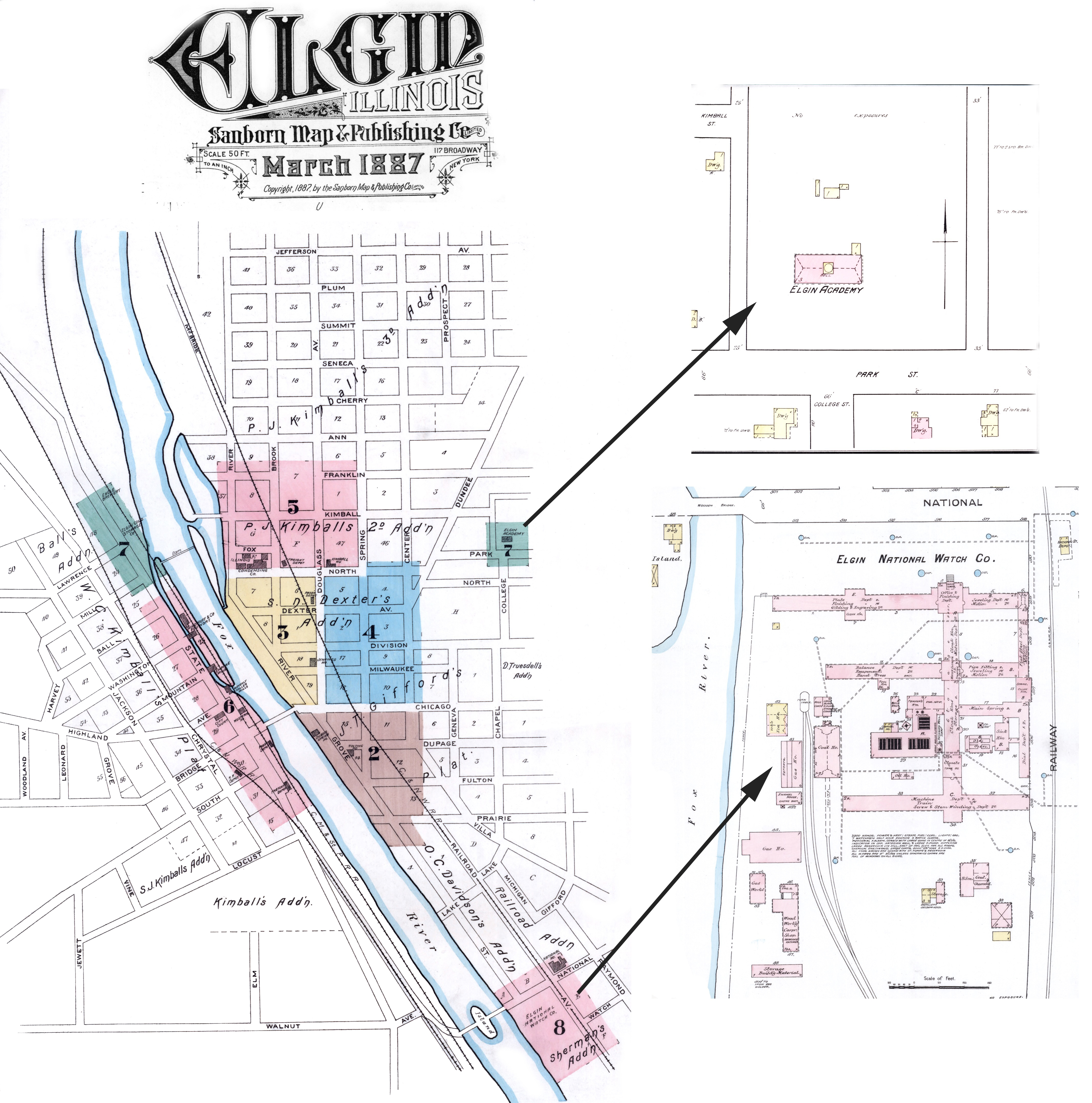
- Elgin National Watch Company
Sanborn Fire Insurance Map
1887
Chicago Tribune, December 22, 1892
Judge Horton decided finally yesterday that Mas E. Eppenstein, Sol. C. Eppenstein, and Thomas W. Duncan cannot use the name “The Elgin National Watch Case Company of Eigin, Illinois,” in conducting their business. The “Elgin National Watch Case Company ” secured an injunction restraining the parties from using the name, and in denying a notion to dissolve this instrument the court said:
- The protection of the public as well as the righte of the corporations or individuals is to be considered by the court. It is clearly in the interest of the public that no corporation should be authorized having the same name as a preexisting corporation, and also that no name should be assumed by a corporation similar to or liable to be mistaken for the name of any other corporation organized under the laws of this State. Putting the word “the” at the commencement of the name and the words “of Elgin, Illinois,” at the conclusion does not materially tend to prevent confusion.
The fact that defendants are so anxious and so persistent in their determination to adopt this or some similar name may be regarded as an evidence that they think it is valuable and desirable. If valuable and desirable, why?, Is it not reasonable to presume that it is, in part, at least, because the complainant, the Elgin National Watch company, had made it so, when connected with watches or parts thereof? When parties have, by their mode of doing business, built up, under a chosen name, a reputation which is of great value, they should be protected in the use of that name. The protection of the public in preventing any other persons from assuming a like or similar name is at the same time a protection of such parties. A trade name, like a trademark, may be of great value, and that value may have been entirely created by the parties who seek to be protected by its use.
The rule as to trade names applies to corporations the same as it does to individuals That confusion would follow if “The Elgin National Watch Case Company of Elgin, Ill., “should be incorporated and continue to transact business in that name seems to me certain. As to an evidence to my mind that such confusion world follow I may say that I found it necessary to write those several names down and thus impress them clearly upon my mind to prevent confusion in considering this case. That damage to the complainant would result seems to be more than probable.
An appeal was prayed.
The Eppensteins and Duncan control the Illinots Watch Case company, and tried some time ago to change the name of that concern to the Elgin Watch Case company. A mandamus suit was brought in the Supreme Court, and the attempt to adopt the name in question was defeated by that court. The Eppensteins and Duncan then attempted to organize a new corporation under the name “The Elgin Mational Watch Case company of Elgin, Ill.” This was also bitterly resisted by the Elgin National Watch Case company upon the ground that it was merely an attempt to trade upon the reputation of that company and to appropriate its good will. Leading watch dealers in Chicago and in various other cities to the number of over 100 testified that the name under which the Eppensteins were seeking to incorporate would cause great confusion in the watch trade and among purchasers.
Chicago Tribune, January 6, 1892
- The following article was in response to a January 2, 1892 Chicago Tribune article suggesting a strike of the workers of the Elgin National Watch Company was inevitable.
MR. AVERY’S SIDE OF THE CASE,
The President of the Elgin Watch Company Interviewed at Length.
Regarding the adjustment of the trouble with the watch-makers of the Elgin National Watch company President Avery said yesterday:
- There has been no strike nor any prospect of one at any time, and the newspaper reports to that effect have been gross exaggerations and falsifications. The following are the facts: In the department making our smallest movement, known as the naught size, there are eighteen operatives. Dee. 31 these men were notitied by the superintendent that there would be a reduction in wages averaging about 10 per cent. Friday, Jan. 1, a committee of three of the employés waited on the superintendent and presented a petition signed by the eighteen, protesting against the reduction, and asking that the old schedule remain.
Monday they received the company’s answer which was that they could not favorably consider their petition, and that there would be no change from the order of Dec. 31. The men are all at work as usual, and are able to earn from $3 to over $4 a day, When the men are first put to work on a new movement, as in the naught size, they are paid a little extra till they become expert, because we must have the required amount of product and are willing to stand the extra expense. After they become expert the extra pay is cut off, in order to make the schedule adjust itself evenly all around. This was the cause of the reduction in the present instance. It is true that we discharged two men on conclusive evidence furnished by a retailer that they had violated our rule prohibiting employés from engaging in the sale of our watches and thus becoming competitors of retail dealers.
As President of an institution which represents $5,500,000 invested capital, I have been greatly an-noved by these newspaper reports, which are doing the company not only a great injustice but an injury: and it seems to me they are inspired by malice from some quarter, the origin of which I would hke very much to know. The National Watch company of Elgin is proud of its attitude toward its employés, and claims with justice that it gives them as good treatment as any corporation in the country affords its men. The pay roll amounts to about $150,000 per month, and, take the men, women, boys, and girls, the average wages of each is $2.08 per day. We have a hotel near the factory where the employés are boarded at as near actual cost as possible, the weekly rate being $4 for males and $3 for females. There are electric lights and steam heat in each room and the table is equal to that of the Tremont, Sherman, or any other similar hotel in Chicago. The house also has baths, a barber shop, parlors, and billiard-rooms. Our gymnasium cost the company $40,000. Before the truck law went into effect we brought 6,000 tons of coal to Elgin and furnished it to our employés at exactly cost price. We maintain discipline at the factory as a matter of course. No concern of similar magnitude would dream of doing otherwise, but that discipline does not work a hardship on the employés. I have never heard them complain of harsh treatment.
The steady effort of the Elgin National Watch company is to lower prices of watches so as to put them within the reach of che masses. We have successfully fought our Swiss competitors and have proved we could furnish a better watch at cheaper rates than can possibly be done abroad. The invention of improved machinery from time to time hasin the nature of things tended to reduce the number of skilled laborers in certain departments, and has therefore involved the necessity of a reduction of wages in these departments. Simply as one instance I call to mind one department in which a boy. with the assistance of machinery. now does the work for the entire factory which was formerly done by a large number of skilled men. However. when there is such a change brought about by putting in new and improved machinery, the employés are given a chance to transfer themselves to other departments so that the scale of wages may be kept up. The figures I have given showing the average to be $2.08 per day for each employé demonstrates conclusively that our operatives are as well paid as any class of laboring people in the world. Girls who are in service in the vicinity earn only a few dollars per week and are compelled to put in long hours, often having to work late into the night. In the Elgin watch factory they learn to handle the machines after a few weeks and are put to work earning $1.25 to $1.50 per day and having shorter hours and their evenings to themselves.
Marshall Field & Co. Wholesale Jewelry Catalogue, 1894
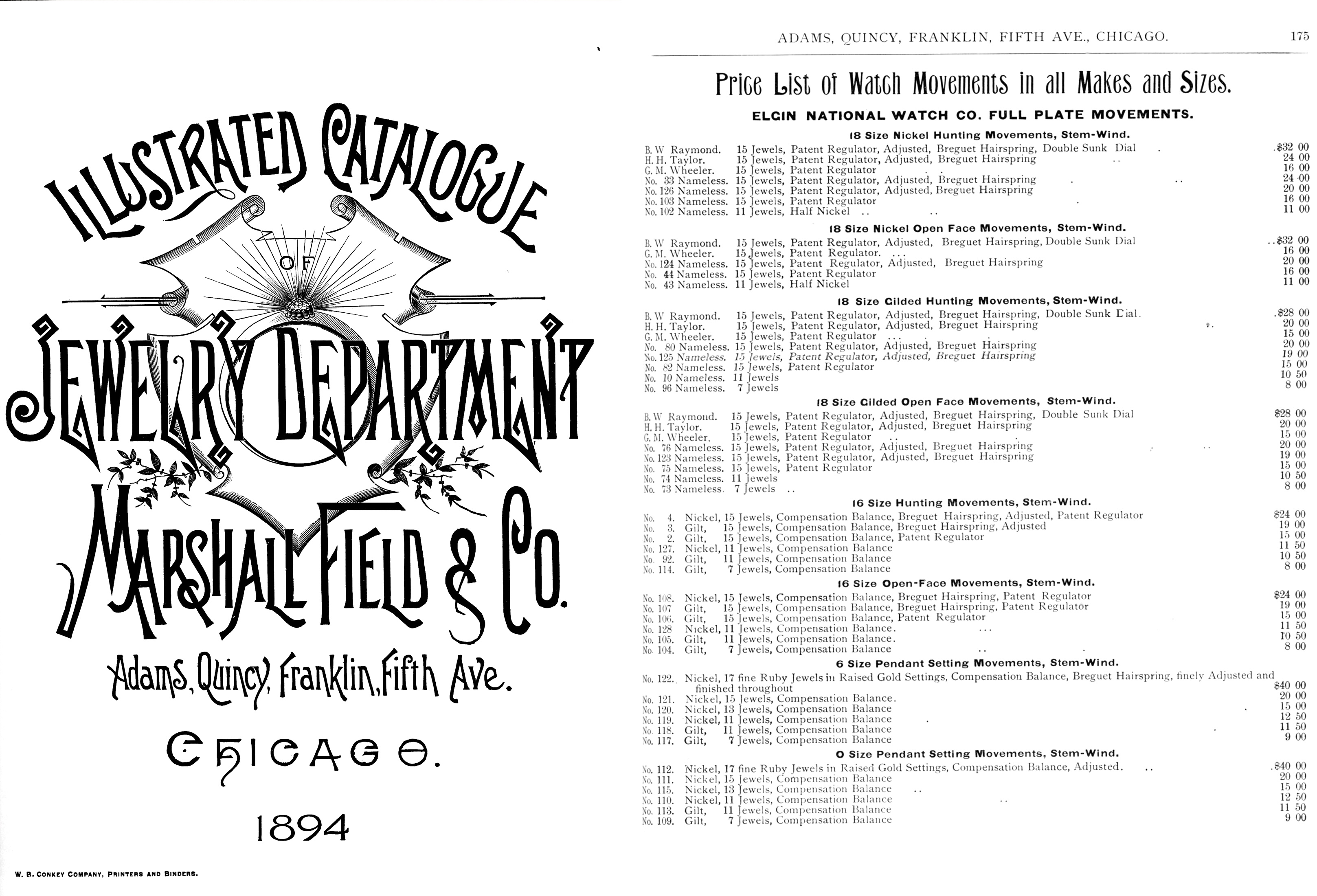
The Watch Factories of America, Past and Present, Henry G. Abbott, 1888
John Calvin Adams
As a watch factory organizer Mr.J. C. Adams has probably had more experience than any living man, and his name is familiar to every watchmaker and jeweler in this country. Mr. Adams was born in Preble, N. Y., October 7, 1834. His father was a prosperous farmer. When he was but two years of age his father sold his farm and removed to Syracuse, N. Y. In 1842 he gathered together his chattles and removed to what was then termed the far west, locating in Elgin, Ill. Mr. Adams served a five years’ apprenticeship to John H. Atkins, an old Liverpool watchmaker. After finishing his apprenticeship he was engaged as watchmaker by S. C. Spalding, of Janesville, Wis. After two years employment by Mr. Spalding, he again returned to Elgin and entered into partnership with G. B. Adams, the firm being known as G. B. & J. C. Adams. At the end of two years the partnership was dissolved and Mr. Adams went to Chicago and was employed in the watch department of Messrs. Hoard & Hoes. In 1861 he managed the watch department of W. H. & C. Miller, Chicago, and had an interest in that department. In 1862 he was appointed time keeper for the various railroads centering in Chicago.
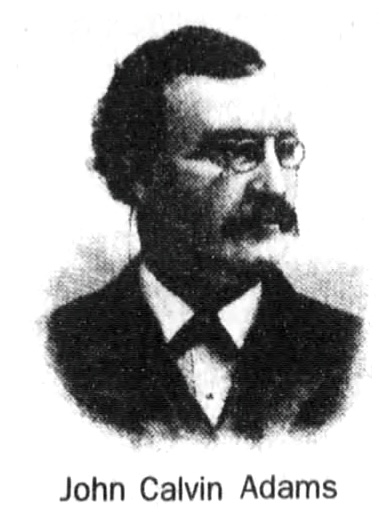
In the spring of 1864, Mr. Adams severed his connection with W. H. & C. Miller and together with Messrs. Chas. S. Moseley and P. S. Bartlett, organized the Elgin Watch Company. In 1869, together with Mr. Paul Cornell, he organized the Cornell Watch Company of Grand Crossing, Ill., and served for some time as general agent of that company. One of the movements made by this company was named in his honor.
In 1869, Mr. Adams, together with Springfield capitalists, organized the Illinois Watch Company at Springfield.
In 1874 he organized the Adams & Perry Watch Manufacturing Company, and became Secretary and General Manager of the company. He resigned his position in the fall of 1875.
In 1883 he entered the employ of the Independent Watch Company of Fredonia, N. Y. In 1885 he organized the Peoria Watch Company and continued with that company until April 14, 1888. He is the inventor and patentee of “The Adams System of Time Records” which is employed on nearly every western railroad.
Jewelers Circular—Weekly And Horological Review, July 28, 1897
Railroad Watch Inspection and Adams System of Time Records
Hundreds of watchmakers throughout the United States and Canada are engaged in inspecting watches for the various steam railways, and yet this is a comparatively new business, having been first put into practical operation in 1888. A short history of time inspection and telegraph time service may not, therefore, be devoid of all interest.
Prior to 1863 there was no such thing as a standard system of correct local time in Chicago or the west, and the same state of affairs undoubtedly existed in most of the cities of the United States. At this time the watch department of the firm of W. H. & C. Miller, Chicago (then the largest retail jewelry store west of New York city), was in charge of J. C. Adams, a practical watchmaker of many years’ experience. This house naturally had a very large railroad trade, and Mr. Adams became acquainted with officials, engineers, conductors, train despatchers and railway men in general.
Among the different roads running out of Chicago at that time was the Chicago & Galena Union Railway, now a part of the Galena Division of the Chicago & Northwestern Railway. Superintendent Williams, of this road, like the superintendents of all other roads at that time, was often sorely perplexed and greatly inconvenienced for want of a uniform system of time. Trains arrived ahead of time and behind time, and left in about the same fashion, and yet were just on time according to the conductors’ watches. All this was due to the fact that there was no standard or recognized system. Every watchmaker had his own time and he considered his chronometer correct and all others wrong. At that time there was but one transit instrument in Chicago, and that was owned by Francis Bradley, a real estate dealer and amateur astronomer. Much of the time then used was furnished by Mr. Bradley, and it was not as satisfactory as it might have been.
Superintendent Williams, of the Galena Railway, was very anxious that Mr. Adams should accept the position of official timekeeper for his road, and this Mr. Adams agreed to do, provided he could induce other Chicago railroads to co-operate, as the expenses of securing correct time were then very heavy. After several conferences with Superintendent Williams, Mr. Adams decided to experiment, and he made arrangements with Prof. James C. Watson, of Ann Arbor Observatory, to telegraph the time to him once a week. The Galena, the Alton, and other roads entered into the agreement, and in 1864 the correct time was telegraphed to each station on the Chicago & Galena Union Railway.
Correct time was one thing, and correct timekeepers another. It was no uncommon thing for a conductor to start from Chicago with his watch correct to the second and after making the run to Freeport and return to find that his watch was out six or seven minutes. Up to this time quick train watches were not made in this country and were not used to any extent even abroad. They were made in limited quantities in Switzerland and England, but were not at all popular. Mr. Adams decided that a quick train watch was what was needed for railway use and he accordingly entered into correspondence with James Hoddell, of London, and ordered 25 quick train watches with going barrels, as an experiment. These watches gave perfect satisfaction. W. J. Hunter, of Elgin, still carries one of these original Hoddell watches imported by Mr. Adams Mr. Adams took one of these watches to Waltham and tried to induce the American Waltham Watch Co. to make them. They declined, however, and he returned home and together with Charles S. Moseley, P. S. Bartlett and others organized the Elgin Wateh Company in 1864. The B. W. Raymond movement made by this company was the first watch made in America with a quick train.
Shortly after this the Dearborn Observatory was established in Chicago, and Mr. Adams made arrangements with the management and the Western Electric Co. for a complete series of tickers and wires for furnishing the correct time from the observatory clock. Each road had a branch wire and a ticker which gave seconds beats. On the 55th second of each minute the ticker stopped and the next tick was the 60th or even minute. This gave the correct time in seconds and minutes, and just before the hour on the 49th second of the 59th minute the ticker stopped and the next tick sounded tne hour.
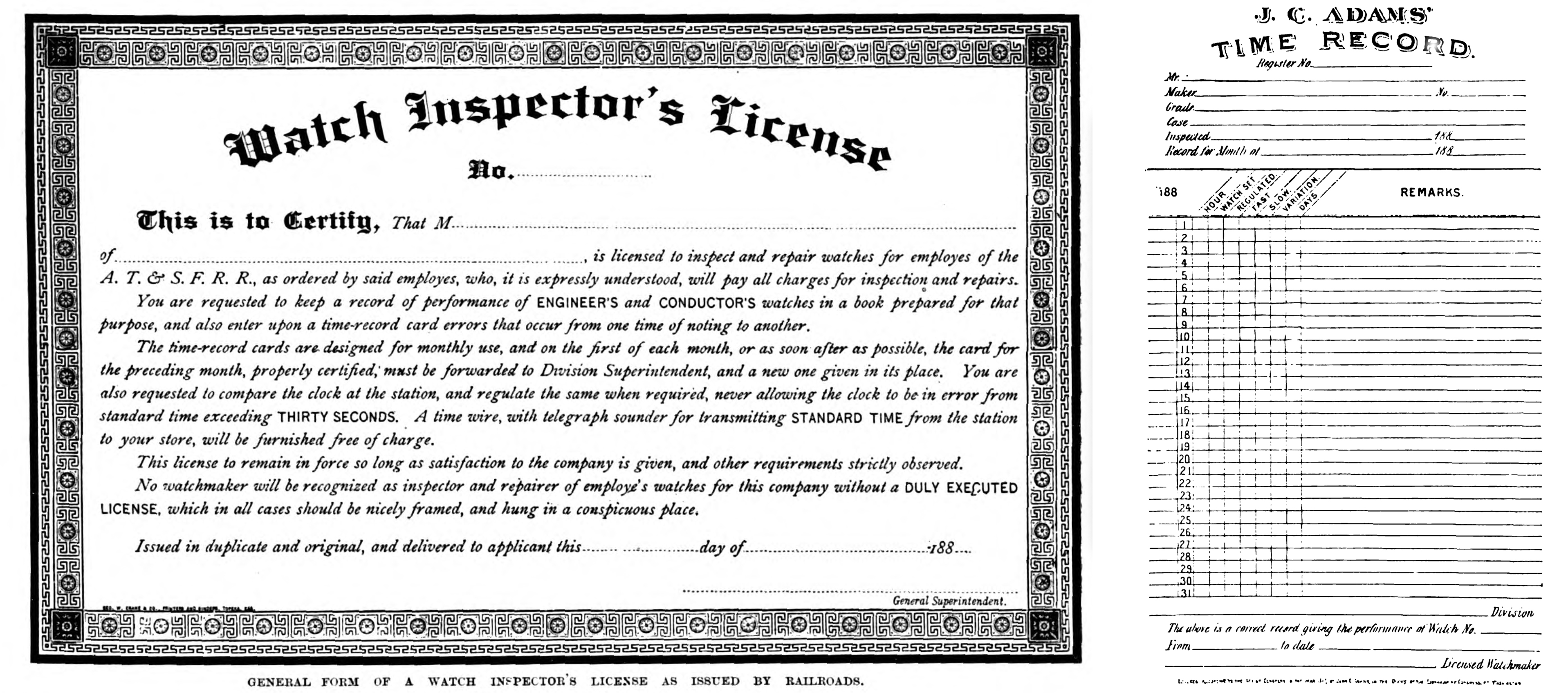
The Adams’ System of Time Records was put into operation in 1888, the first railroad to adopt it being the Atchison, Topeka & Santa Fe. The Denver & Rio Grande, Union Pacific, Southern Pacific and other roads then took it up. A license or certificate was issued to each watchmaker who was ap. pointed an inspector. He was also furnished with a record book and monthly report cards, similar to the one shown in the illustration. The inspector was furnished with time by a special wire from the depot clock to his own store, by means of which the regular ticker was operated. The rules of the different roads varied in some particulars, but generally speaking they were uniform. Every conductor. and engineer was compeled to bring his watch to the inspector for examination, and the necessary blanks were filled in by the appointed inspector and also recorded in his record book. At the end of each month the report cards were forwarded to the division superintendent and a new series of cards issued to the men.
Mr. Adams has permanently retired from the watch business, his last work in this line being the management of the Swiss horological exhibit at the World’s Columbian Exposition.
Chicago Tribune, November 28, 2000
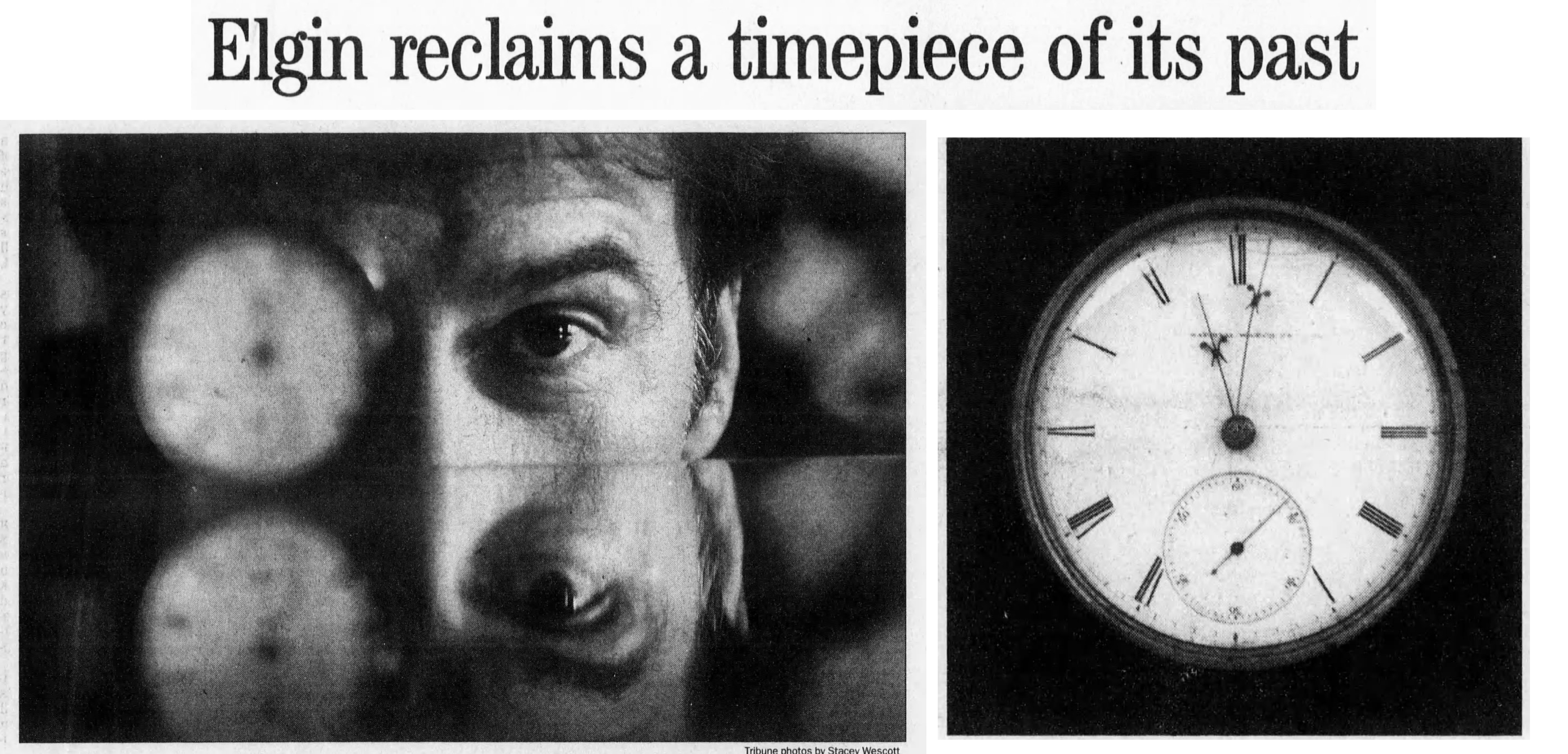
- Bill Briska, of the Elgin Historical Society, examines the 13th watch (right), made in 1867, produced by the Elgin National Watch Co.
By T. Shawn Taylor
Tribune Staff Writer
For years a rare timepiece, one of the first products of the famed Elgin National Watch Co., rested inside a shoebox, in a drawer, in a home in Texas.
And there it might have stayed, if its owner had taken it at face value.
“It looks like an old-time, clunky thing,” said Bill Briska, of the Elgin Historical Society. “The dial face is plain and yellowed with age. That’s not unusual of watches from this era.”
But Carol Adams had a hunch the old watch had more than sentimental value. When she contacted Briska, she discovered not only that her watch was the 13th manufactured by the company, but that its original owner-John Calvin Adams, her husband’s great-great-grandfather-helped organize the Elgin National Watch Co.’s original investors.
Now the porcelain-faced, jeweled pocket watch, produced in 1867, will return to the city that shares the watchmaker’s name, for display among the 70 Elgin watches at the historical society museum.
“Don’t we all have things sitting around the house that we just have because we, or our parents, just always had them?” said Adams. “We realized it would be more appreciated there (in Elgin) than here.”
The watch had been stored with cuff links and war pins left by a deceased relative in the Adams home in Katy, Texas, near Houston. Then, after coming across the watch recently, the family sought to learn more about its origin.
Carol Adams found the historical society’s web site and sent a photograph of the watch to Briska. He said he knew the minute he saw the photo that the watch had historical significance.
Adams said that upon learning about the watch’s history, the family thought it better to return it to its origins, where it would be more appreciated.
“Here … it likely would end up spending a few more decades in drawers or boxes, and maybe one day be lost forever,” she said.
Neither Adams nor the historical society would reveal the price the society paid for the watch, though Briska called it “very favorable.”
The Elgin company made more than 54 million watches from April 1867 until it succumbed to foreign competitors in 1969.
“They gave the first 15 or 20 watches off the line to initial investors and big shots,” Briska said.
That is how John Calvin Adams acquired his watch, Briska said. He is credited with pooling the initial investors to start the company. Among them was Benjamin W. Raymond, Chicago mayor in the 1840s, Briska said. Raymond later became president of the company.
But Adams never held a formal office with the company and, in fact, went on to found four competing watch companies in Chicago, Springfield, Peoria and Lancaster, Pa. Adams lived in Elgin between 1848 and 1851 and worked as an apprentice watchmaker. After his death in 1909, his watch went to his son, Edwin Frank Adams, who passed it to his son, Edwin Jr., who gave it to Thomas Edward, according to the Adams family.
Thomas Edward Adams had told family members that the watch had some connection to a well-known watch company but nothing more.
“Unfortunately, no one ever really got the story of John Calvin until the museum filled me in,” Carol Adams said.
Adams’ watch is without a chain and contains 15 jewels. A jeweled watch refers to the fact that the mechanical movements were set on jewels to hold them in place. Jewels had natural lubricating properties and wore better than metal on metal, Briska said.
“A good movement will last 100 years,” he said.
In the case of Adams’ watch, it’s lasted far longer. And so has the Elgin name. It is now owned by M.Z. Berger & Co. of New York, which uses it to label watches made over-seas.
Houston Chronicle, August 1, 1909
JOHN C. ADAMS DEAD.
He Was Founder of the Elgin National Watch Factory.
Special ta The Chronicle.
Galveston, Texas, July 31.—John C. Adams, father of E. F. Adams, assistant general passenger agent of the Santa Fe, died at noon today after a long illness. The funeral will take place from the residence of his son, 918 Winnie street.
The pallbearers will be: W. S. Keenan. A. C. Torbet, H. K. Rowley, Valery Austin, Dr. George H. Lee, M. Neumann and D. D. McDonald.
The deceased was 76 years of age. He as a native of Syracuse. N.Y., and for many years made his home in Chicago, retiring from active business about 14 years ago, since which time he has made his home off and on with son in Galveston.
Mr. Adams was the founder of the Elgin national watch factory at Elgin, Ill., who was widely known throughout this country and abroad as a watchmaker of international reputation. He was awarded medals and premiums for his work in this and other countries. During the World’s fair at Chicago he was selected by the Swiss government to take charge of the magnificent exhibition of the watch manufacturers. He enjoyed a wide circle of friends and here in Galveston his friends were legion.
Possessed of those many traits which go to make life worth living and endear one to his fellowman, Mr. Adams Was a grand old man, whose demise is greatly mourned.
Surviving are a son and daughter, F. Adams and Miss Nellie Adams of Galveston, and other relatives.
NOTES:
1This Chicago jeweler was John Calvin Adams. He was involved in the establishment of the following watch companies, National Watch Company (Elgin), Cornell Watch Company, Illinois Springfield Watch Company, Adams and Perry, Fredonia Watch Company and Peoria Watch Company.

Leave a Reply