Building Name(s): 128-130 Lake Street, U. S. Express, Culver, Page & Hoyne I
Address: 130 Lake, and 18, 20 and 22 Clark
Life Span: 1855/1871
Architect: F. & E. Baumann
- D. B. Cooke & Co.’s City Directory for the Year 1859
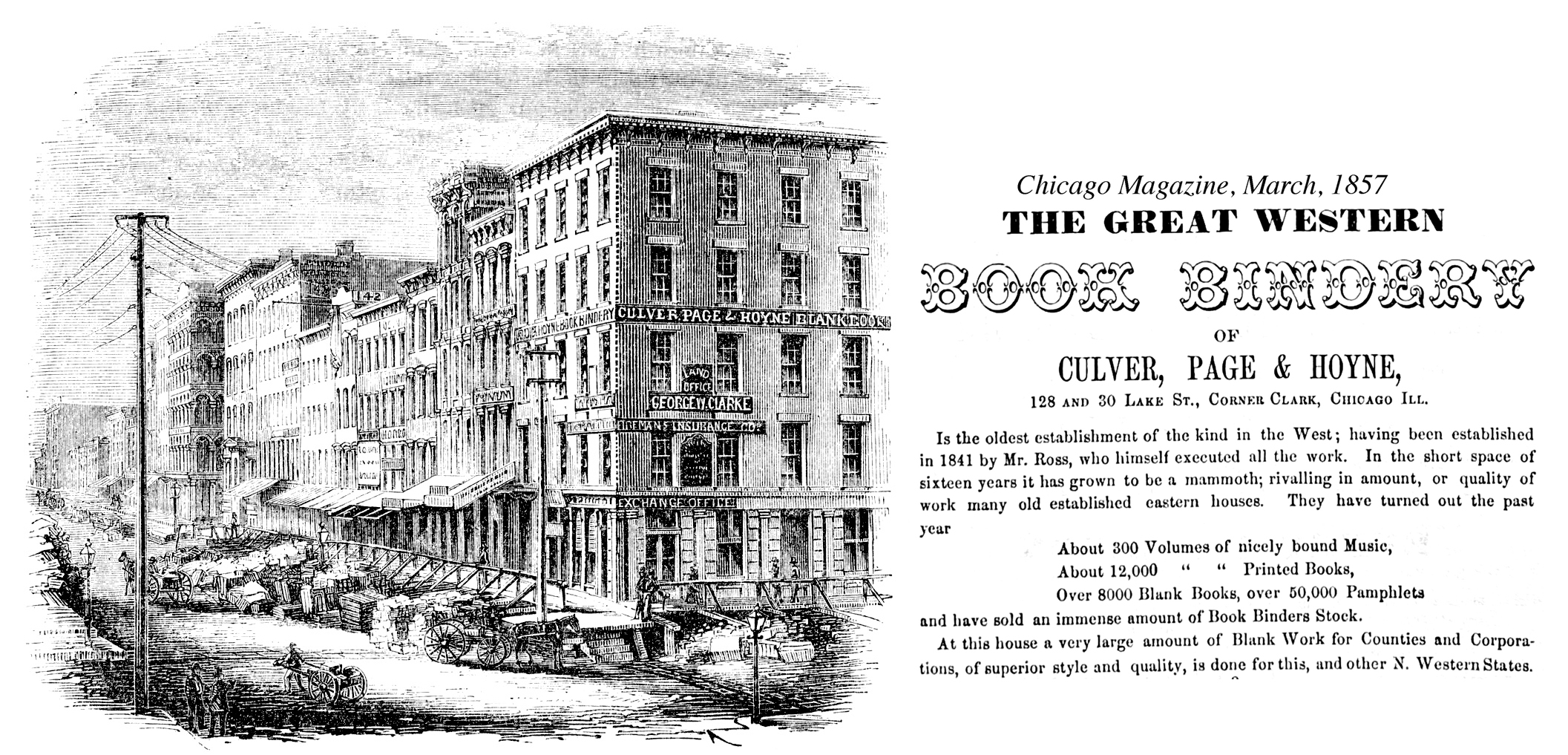
Culver, Page, Hoyne & Co. (Howard Z. Culver, Daniel W. Page and Michael A. Hoyne) blank book mnfrs, 128 and 130 Lake
Halpin & Bailey’s City Directory for the Year 1863
Culver, Page, Hoyne & Co. (Howard Z. Culver, Daniel W. Page and Michael A. Hoyne) bookbinders and stationers, 128 and 130 Lake
United States Express Company, 130 Lake.
Halpin’s Chicago City Directory for 1864
United States Express Company, Harvey D. Colvin, agt., 130 Lake and 20 Clark.
John C. W. Bailey’s Chicago City Directory for 1867
Culver, Page, Hoyne & Co. (Edward Z. Culver, Daniel W. Page and Michael A. Hoyne) blank book mnfrs, stationers and paper dealers, 128 and 130 Lake
United States Express Co., H. D. Colvin, gen. agt 130 Lake, and 18, 20 and 22 Clark.
Edwards’ Annual Directory in the City of Chicago, for 1870
Culver, Page, Hoyne & Co. (Howard Z. Culver, Daniel W. Page and Michael A. Hoyne) blank books, paper and stationery, 128 and 130 Lake
United States Express Co., H. D. Colvin, agt. 130 Lake, and 18 and 20 Clark, stables 203 Monroe.
Chicago Press & Tribune, March 29, 1860
The Great Building-Raising Contract.
The entire front of first class buildings on the north side of Lake street, between Lasalle and Clark streets is now rising to grade at the rate of about twelve inches per day. It will be at its full height by to-morrow night, when it will constitute a spectacle not many of our citizens may see again, if ever, a business block covering nearly one acre, and weighing over twenty-five thousand tons resting on six thousand screws, upon which it has made an upward journey of four feet and ten inches. Probably its parallel enterprise cannot be found the world over. It will be worth seeing tomorrow, and the contractors are, we learn, preparing to accommodate the public and give them an opportunity of looking and passing in among the forest of iron screws. Then we propose to say something more in detail regarding this notable and wonderful enterprise, to which we have often made reference.
Chicago Press & Tribune, April 2, 1860
The Great Building-Raising.
For the past week the marvel and the wonder of our citizens and visitors has been the spectacle of a solid front of first class business blocks, comprising the entire block on the North side of Lake street, between Clark and La Salle streets, a length of three hundred and twenty feet, being raised four feet by the almost resistless lifting force of six thousand screws.
The block comprises thirteen first class stores and a large, double marble structure, the Marine Bank building. Its sub-divisions are a five story marble front block of three stores; a four story block of three stores; a second four story block of three stores, and a five story block of four stores, at the corner of Clark street—these all presenting an unbroken front, in the heart of our city, and filled with occupants. It presents some of the best retail establishments in the city, and some of the heaviest stocks of Drugs, Dry Goods, &c. Its upper stories are full of offices, and contain millinery rooms, printing establishments, binderies, &c., &c., and yet, so admirably has the work been conducted, the ceaseless daily tide of pedestrians has not been impeded, but rather increased, from the novelty of the sight, and the merchants and others even speak of an improved trade, though they will welcome the completion of the work none the less.
This absence from annoyance to the merchants and the public, is due to the skill with which the contractors have hung the sidewalks to the block itself, and carried up the same with the rise of the building. The block has been raised four feet eight inches, the required height, in five days, ending with Friday last, and the masons are now busy putting in the permanent supports. The entire work will occupy about four weeks.
An estimate from a reliable source makes the entire weight thus raised to be about 35,000 tons. So carefully has it been done that not a pane of glass has been broken nor a crack in masonry appeared. The internal order of the block has prevailed undisturbed.
The contract was taken not jointly, but so carried out, by the several firms of Brown & Hollingsworth, Pullman & Moore, and Ely & Smith, and for an aggregate price of $17,000. That sum will be nearly doubled by the entire improvements contemplated on the block.
The process of raising, as indicated above, is by the screw, at six thousand of which three inches in diameter and of “three-eighths thread,” six hundred workmen have been employed, each man in charge of from eight to ten screws. A complete system of signals was kept in operation, and by these the workmen passed, each through his series, giving each screw one-quarter turn, then returning to repeat the same. Five days labor saw the immense weight rise through four feet and eight inches to where it now stands on temporary supports rapidly being replaced by permanent foundations.
The work, as it stands, is worth going miles to see, and has drawn the admiration of thousands within the week past. It is of a class of improvements peculiar to our city, in the change of grade adopted, and the block in question will stand as a marvel for years to come, a monument to this gigantic enterprise of our young city.
Probably only two cities on this continent will have a similar record Chicago, and—prospectively we learn—New Orleans, extensive portions of which it is said will be submitted to this process, to the improvement of the health and welfare of its citizens. We are it will be seen, educating men and firms here who will do the work of the Crescent City, but we are not ourselves quite done with them yet.
A sketch of this great work, and photographs have been taken for the London Illustrated News, also for our own Illustrated weeklies. A fine lithograph is also under progress, as a faithful souvenir of the work. The contractors deserve all praise for the skill and faithfulness with which they have brought the great undertaking so near its end.
Chicago Tribune, August 30, 1860
REMOVAL.—The United States Express Company have this day removed their office from No. 14 Dearborn street to 130 Lake and 20 South Clark streets, having a Lake and Clark street entrance. The entrance on Lake street will be considered the entrance for collection and small regarded package business. The entrance on Clark street will be regarded as the entrance for freight. However, should money be delivered Clark street or on Lake street, the Public with which we have done business for the past six years to could not be induced to believe that it is in our nature refuse it. Having been liberally sustained to our old stand we ask the public, well as our friends, to continue their liberality, and in return will promise as heretofore a faithful application to their interests, se well as to that of our Company, Office hours until further notice, from 7:30 A.M. to 7 P.M. M. D. Colvin Agent.
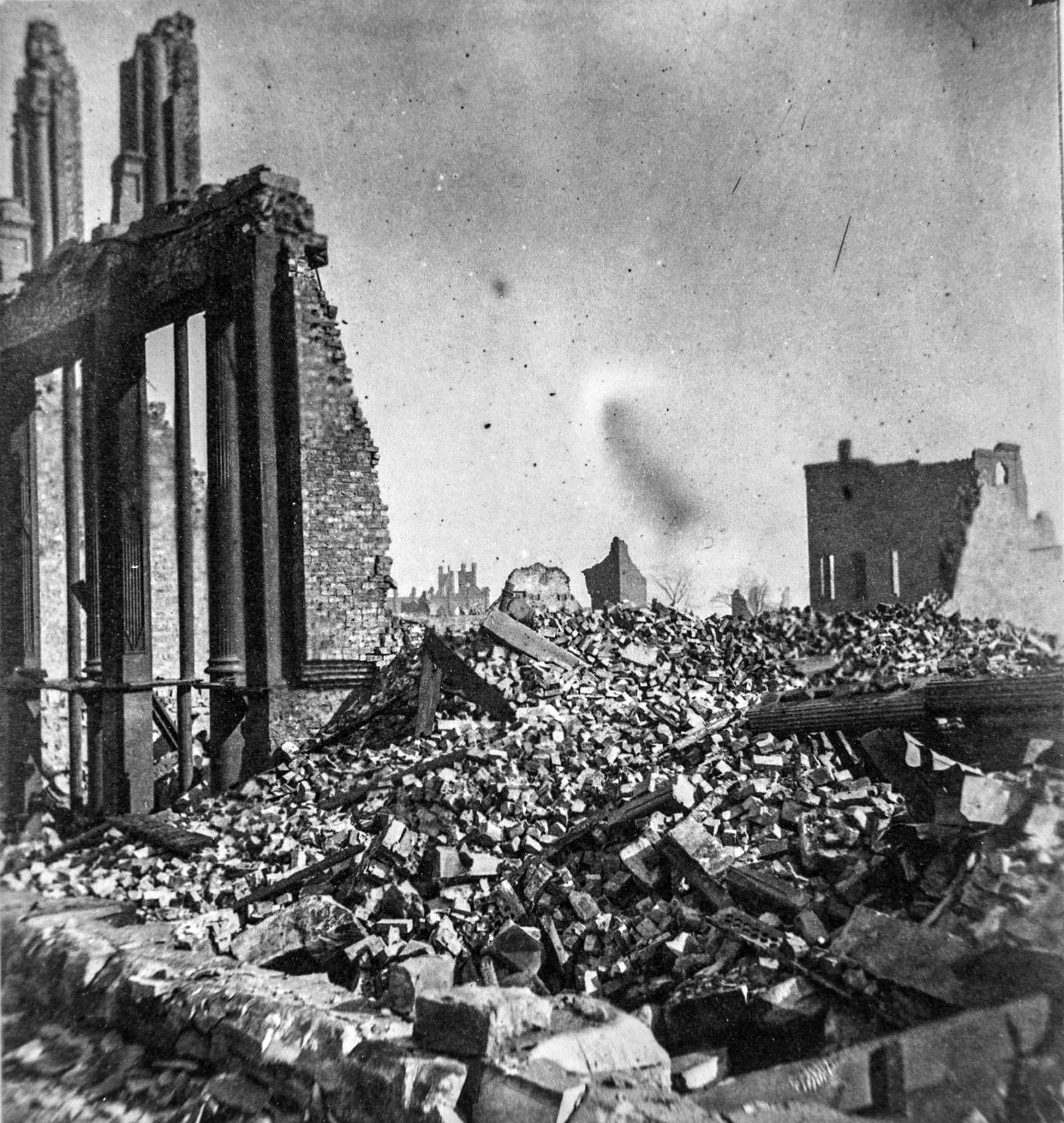
- Culver, Page & Hoyne Building
1871
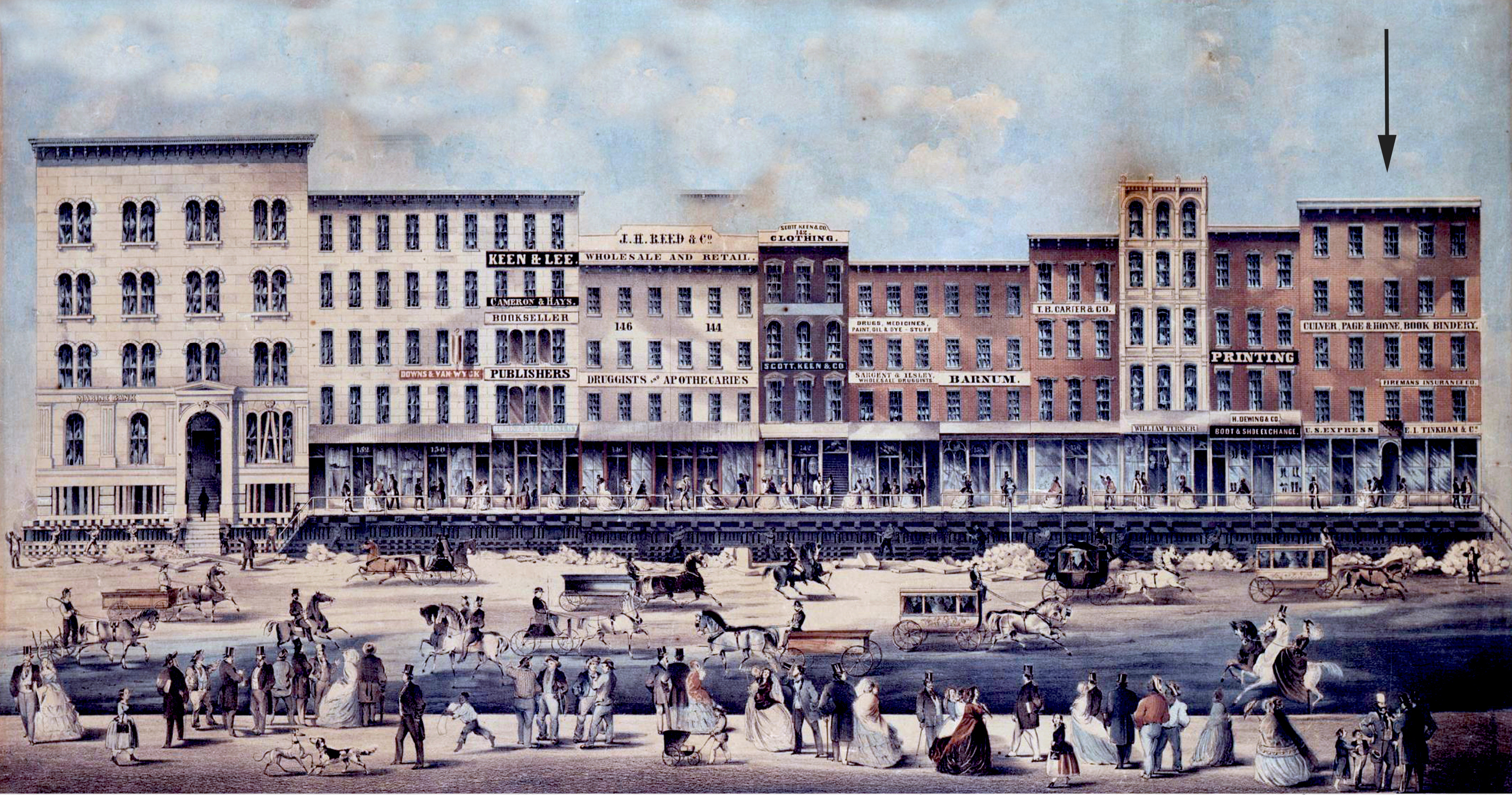
- 128-130 Lake Street
1860
- 128-130 Lake Street
1862
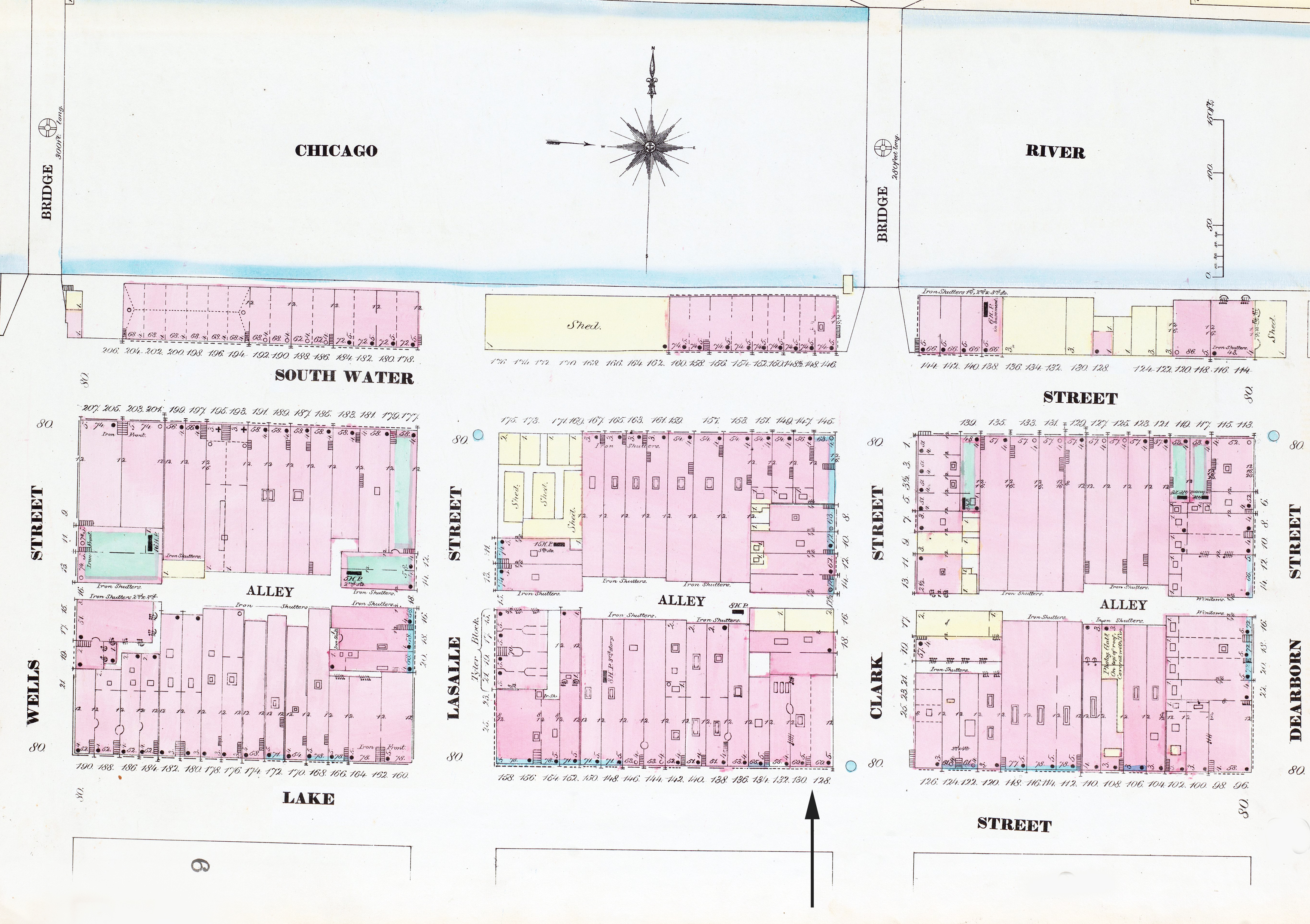
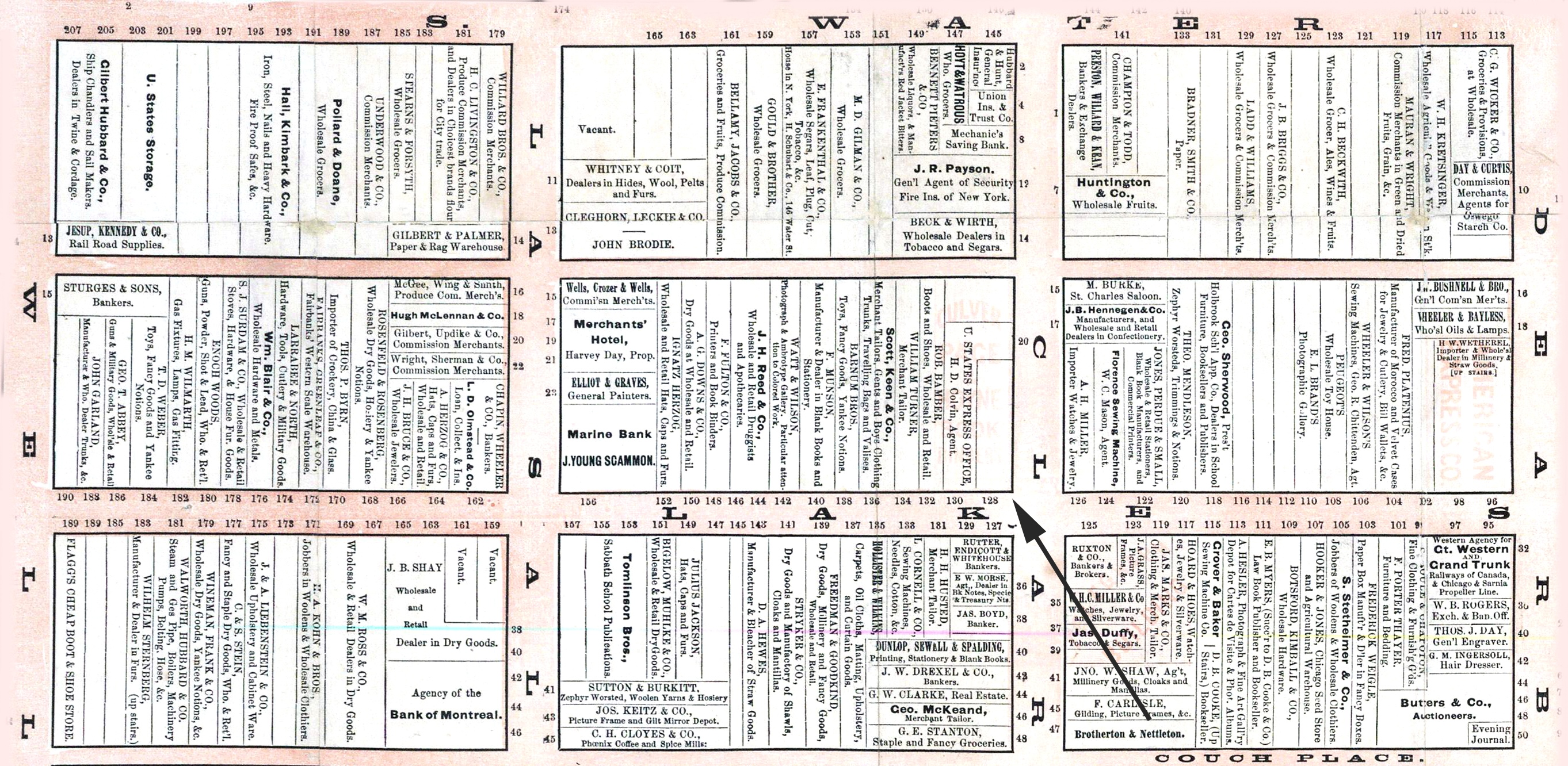
- 128-130 Lake Street
Sanborn Fire Insurance Map
1869
In 1883 Culver, Page & Hoyne Company was succeeded by the John Morris Company. John Morris Company sold out to the P. F. Pettibone Co. in 1894.
P.F. Pettibone markets the sale of Minute Books, Byron Weston record paper, and all kinds of Record Books to Cities, Counties and School Districts.

Leave a Reply