Chicago Evening Post—October 10, 1871
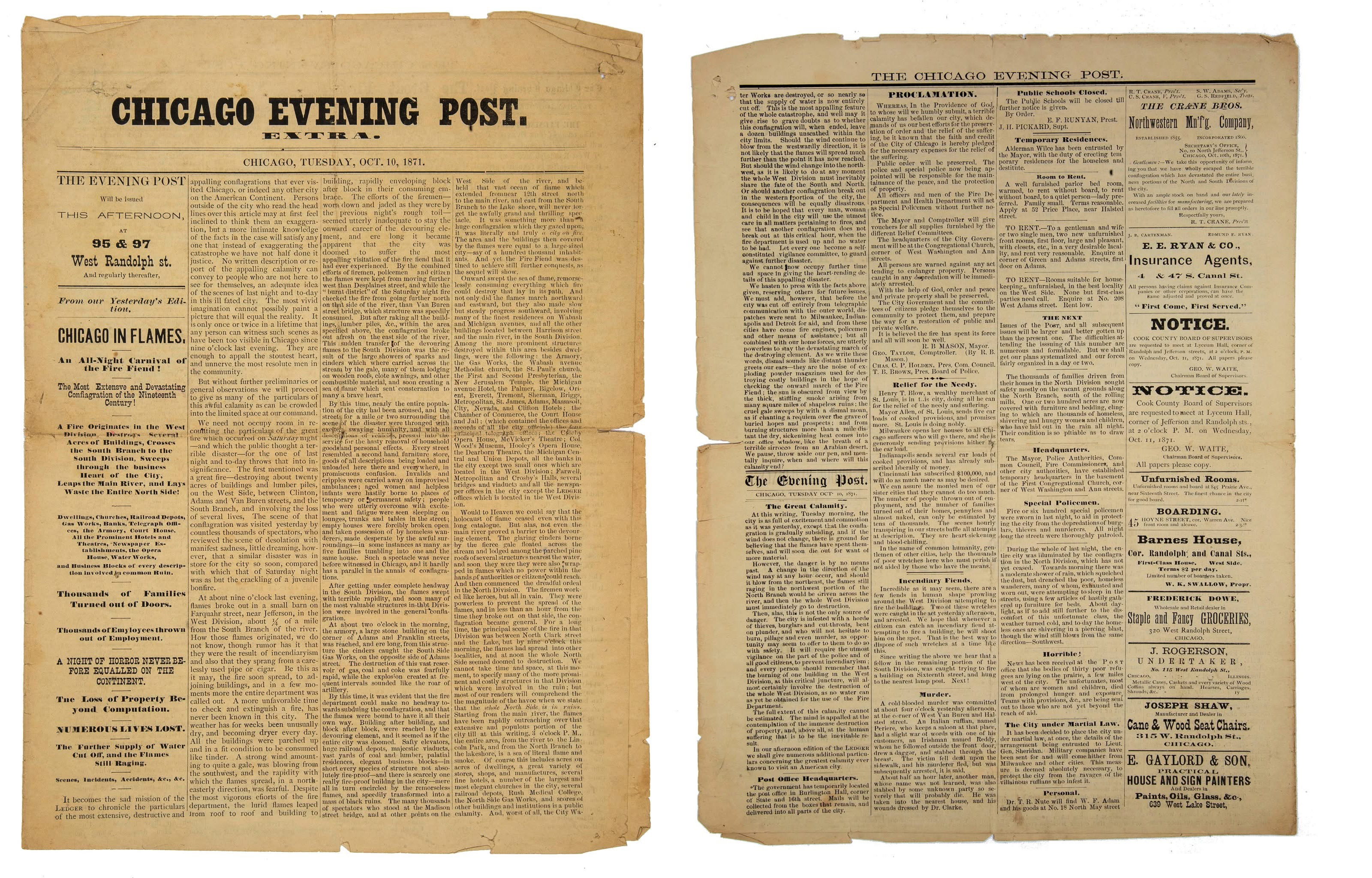
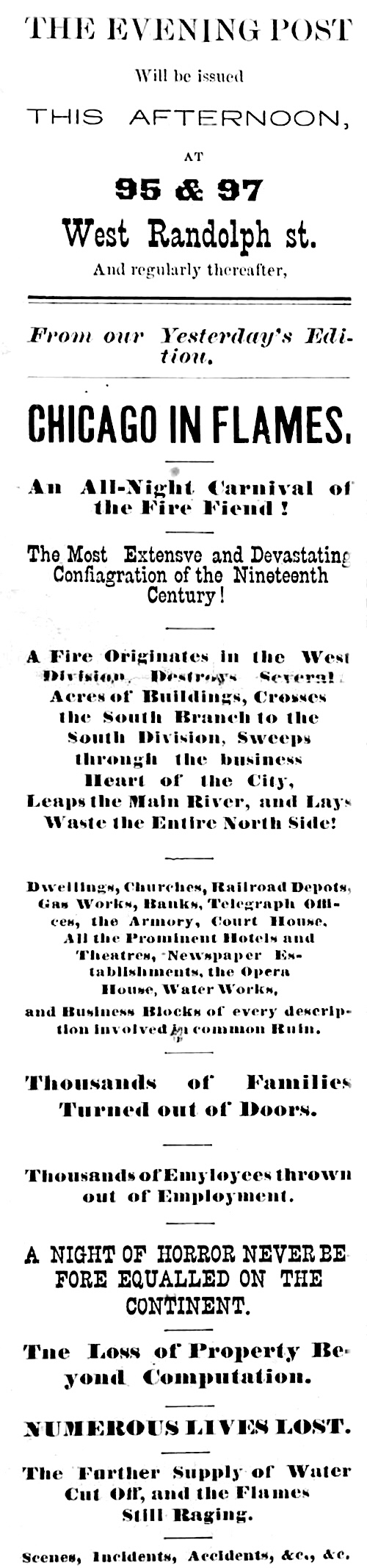 It becomes the sad mission of the Ledger to chronicle the particulars of the most extensive, destructive and appalling conflagrations that ever visited Chicago, or indeed any other city on the American Continent. Persons outside of the city who read the head lines over this article may at first feel inclined to think them an exaggeration, but a more intimate knowledge of the facts in the case will satisfy any one that instead of exaggerating the catastrophe we have not half done it justice. No written description or report of the appalling calamity can convey to people who are not here to see for themselves, an adequate idea of the scenes of last night and to-day in this ill fated city. The most vivid imagination cannot possibly paint a picture that will equal the reality. It is only once or twice in a lifetime that any person can witness such scenes as have been too visible in Chicago since nine o’clock last evening. They are enough to appall the stoutest heart, and unnerve the most resolute men in the community.
But without further preliminaries or general observations we will proceed to give as many of the particulars of this awful calamity as can be crowded into the limited space at our command.
We need not occupy room in recounting the particulars of the great fire which occurred on Saturday night—and which the public thought a terrible disaster—for the one of last night and to-day throws that into insignificance. The first mentioned was a great fire—destroying about twenty acres of buildings and lumber piles, ou the West Side, between Clinton, Adams and Van Buren streets, and the South Branch, and involving the loss of several lives. The scene of that conflagration was visited yesterday by countless thousands of spectators, who reviewed the scene of desolation with manifest sadness, little dreaming, however, that a similar disaster was in store for the city so soon, compared with which that of Saturday night was as but the crackling of a juvenile bonfire.
At about nine o’clock last evening. flames broke out in a small barn on Farquahr street, near Jefferson, in the West Division, about ¼ of a mile from the South Branch of the river. How those flames originated, we do not know, though rumor has it that hey were the result of incendiaryisn and also that they sprang from a carelessly used pipe or cigar. Be this as it may, the fire soon spread, to adjoining buildings, and in a few moments more the entire department was called out. A more unfavorable time to check and extinguish a fire, has never been known in this city. The weather has for weeks been unusually dry, and becoming dryer every day. the buildings were parched up and in a fit condition to be consumed like tinder. A strong wind amounting to quite a gale, was blowing from the southwest, and the rapidity with which the flames spread, in a north easterly direction, was fearful. Despite the most vigorous efforts of the fire department, the lurid flames leaped from roof to roof and building to building, rapidly enveloping block after block in their consuming embrace. The efforts of the firemen—worn down and jaded as they were by the previous night’s rough toil—seemed utterly inadequate to stay the onward career of the devouring element, and ere long it became apparent that the city was doomed to suffer the most appalling visitation of the fire fiend that it had ever experienced. By the combined efforts of firemen, policemen and citizen the flames were kept from moving further west than Desplaines street, and while the “burnt district” of the Saturday night fire checked the tire from going further north on that side of the river, than Van Buren street bridge, which structure was speedily consumed. But after raking all the buildings, lumber piles, &c., within the area specified above, the conflagration broke out afresh on the east side of the river. This sudden transfer of the devouring flames to the South Division was the result of the large showers of sparks and cinders which where carried across the stream by the gale, many of them lodging on wooden roofs, cloth awnings, and other combustible material, and soon creating a sea of flame which sent consternation to many a brave heart.
By this time, nearly the entire population of the city had been aroused, and the streets for a mile or two surrounding the scene of the disaster were thronged with excited swaying humanity, and with all descriptions of vehicles, pressed into the service for the hasty removal of household goods and personal effects. Every street resembled a second hand furniture store, goods of all descriptions being loaded and unloaded here there and everywhere, in promiscuous confusion. Invalids and cripples were carried away on improvised ambiances; aged women and helpless infants were hastily borne to places of temporary or permanent safety; people who were utterly overcome with excitement and fatigue were seen sleeping on lounges, trunks and tables in the street; empty houses were forcibly broken open and taken possession of by homeless wanderers, made desperate by the awful surroundings—in some instances as many as five families tumbling into one and the same house. Such a spectacle was never before witnessed in Chicago, and it hardly has a parallel in the annals of conflagrations.
After getting under complete headway in the South Division, the flames swept with terrible rapidity, and soon many of the most valuable structures in thot Division were involved in the general conflagration.
At about two o’clock in the morning, the armory, a large stone building on the corner Adams and Franklin streets, was reached, and ere long, from this structure the cinders caught the South Side Gas Works, on the opposite side of Adams street. The destruction of this vast reservoir of gas, coal and coke was fearfilly rapid, while the explosion created at frequent intervals sounded like the roar of artillery.
By this time, it was evident that the fire department could make no headway towards subduing the conflagration, and that the flames were bound to have it all their own way. Building after building, and block after block, were reached by the devouring element, and it seemed as if the entire city was doomed. Safty elevators, huge railroad depots, majestic viaducts, vast yards of coal and lumber, palatial residences, elegant business blocks—in short every species of structure not absolutely fire-proof-and there is scarcely one really fire-proof building in the city-mere all in turn encircled by the remorseless flames, and speedily transformed into a mass of black ruins. The many thousands of spectators who stood at the Madison street bridge, and at other points on the West Side of the river, and be that vast ocean of fume which extended from near 12th street north to the main river, and east from the South Branch to the Lake shore, will never forget the awfully grand and thrilling spectacle. It was something more than a huge conflagration which they gazed upon; it was literally and truly a city on fire. The aren and the buildings then covered by the flames were equal to a large-sized city—say of a hundred thousand inhabitants. And yet the Fire Fiend was destined to achieve still further conquests, as the sequel will show.
Onward swept the sea of tame, remorselessly consuming everything which fire could destroy that lay in its path. And not only did the flames march northward and eastward, but they also made slow but steady progress southward, involving many of the finest residences on Wabash and Michigan avenues, and all the other buildings located between Harrison street and the main river, in the South Division. Among the more prominent structures destroyed within this area besides dwellings, were the following: the Armory, the Gas Works, the Wabash avenue Methodist church, the St. Paul’s church, the First and Second Presbyterian, the New Jerusalem Temple, the Michigan avenue Hotel, the Palmer, Bigelow, Orient, Everett, Tremont, Sherman, Briggs, Metropolitan, St. James, Adams, Massasoit, City, Nevada, and Clifton Hotels; the Chamber of Commerce, the Court House and Jail: (which contained the offices and records of all the city officials) the four principal telegraph offices; the Crosby Opera House, McVicker’s Theatre; Col. Wood’s Museum, Hooley’s Opera House, the Dearborn Theatre, the Michigan Central and Union Depots, all the banks in the city except two small ones which are located in the West Division; Farwell, Metropolitan and Crosby’s Halls, several bridges and viaducts and all the newspaper offices in the city except the Ledger offices which is located in the West Division.
Would to Heaven we could say that the holocaust of flame ceased even with this long catalogue. But alas, not even the main river proved a barrier to the devouring element. The glaring cinders borne by the fierce gale floated across the stream and lodged among the parched pine roofs of several structures nearest the water, and soon they were they were also wrapped in flames which no power within the hands of authorities or citizens con reach. And then commenced the dreadful ordeal in the North Division. The firemen worked like heroes, but all in vain. They were powerless to prevent the spread of the flames, and in less than an hour from the time they broke out on that side, the conflagration became general. For a long time, the principal scene of the fire in that Division was between North Clark street and the Lake, but by nine o’clock this morning, the flames had spread into other localities, and at noon the whole North Side seemed doomed to destruction. We cannot take time and space, at this moment, to specify many of the more prominent and costly structures in that Division which were involved in the ruin; but most of our readers will comprehend the the magnitude of the havoc when we state that the whole North Side is in ruins. Starting from the main river, the flames have been rapidly outreaching over that extensive and populous portion of the city till at this writing, 3 o’clock P.M., the entire area, from the river to the Lincoln Park, and from the North Branch to the lakeshore, is a sea of literal flame and smoke. Of course this includes acres on acres of dwellings, a great variety of stores, shops, and manufactures, several fine hotels, a number of the largest and most elegant churches in the city, several railroad depots, Rush Medical College, the North Side Gas Works, and scores of other buildings and institutions isa public calamity. And, worst of all, the City Water Works are destroyed, or so nearly se that the supply of water is now entirely cut off. This is the most appalling feature of the whole catastrophe, and well may it give rise to grave doubts as to whether this conflagration will, when ended, leave a dozen buildings unscathed within the city limits. Should the wind continue to blow from the westwardly direction, it is not likely that the flames will spread much further than the point it has now reached. But should the wind change into the north-west, as it is likely to do at any moment the whole West Division must inevitably share the fate of the South and North. Or should another conflagration break out in the western portion of the city, the consequences will be equally disastrous. It is to be hoped that every and child in the city will man, woman and child in the city will use the utmost care in all matters pertaining to fires, and see that another conflagration does not break out at this critical hour, when the fire department is used up and no water to be had. Let every one become a self-constitated vigilance committee, to guard against further disaster.
We cannot now occupy further time and space in giving the heart-rending details of this appalling disaster.
We hasten to press with the facts above given, reserving others for future issues. We must add, however, that before the city was cut off entirely from telegraphic communication with the outer world, dispatches were sent to Milwaukee, Indianapolis and Detroit for aid, and from these cities have come fire engines, policemen and other means of assistance; but all combined with our home forces, are utterly powerless to stay the devastating march of the destroying element. As we write these words, dismal sounds like distant thunder greets our ears-they are the noise of exploding powder magazines used for destroying costly buildings in the hope of checking the onward march of the Fire Fiend; the sun is obscured from view by the thick, stifling smoke arising from many square miles of shapeless ruins; the cruel gale sweeps by with a dismal moan, as if chanting a requiem over the grave of buried hopes and prospects; and from burning structures more than a mile distant the dry, sickening heat comes into our office window, like the breath of a terrible sirrocco from an Arabian desert. We pause, throw aside our pen, and mentally inquire, when and where will this calamity end?
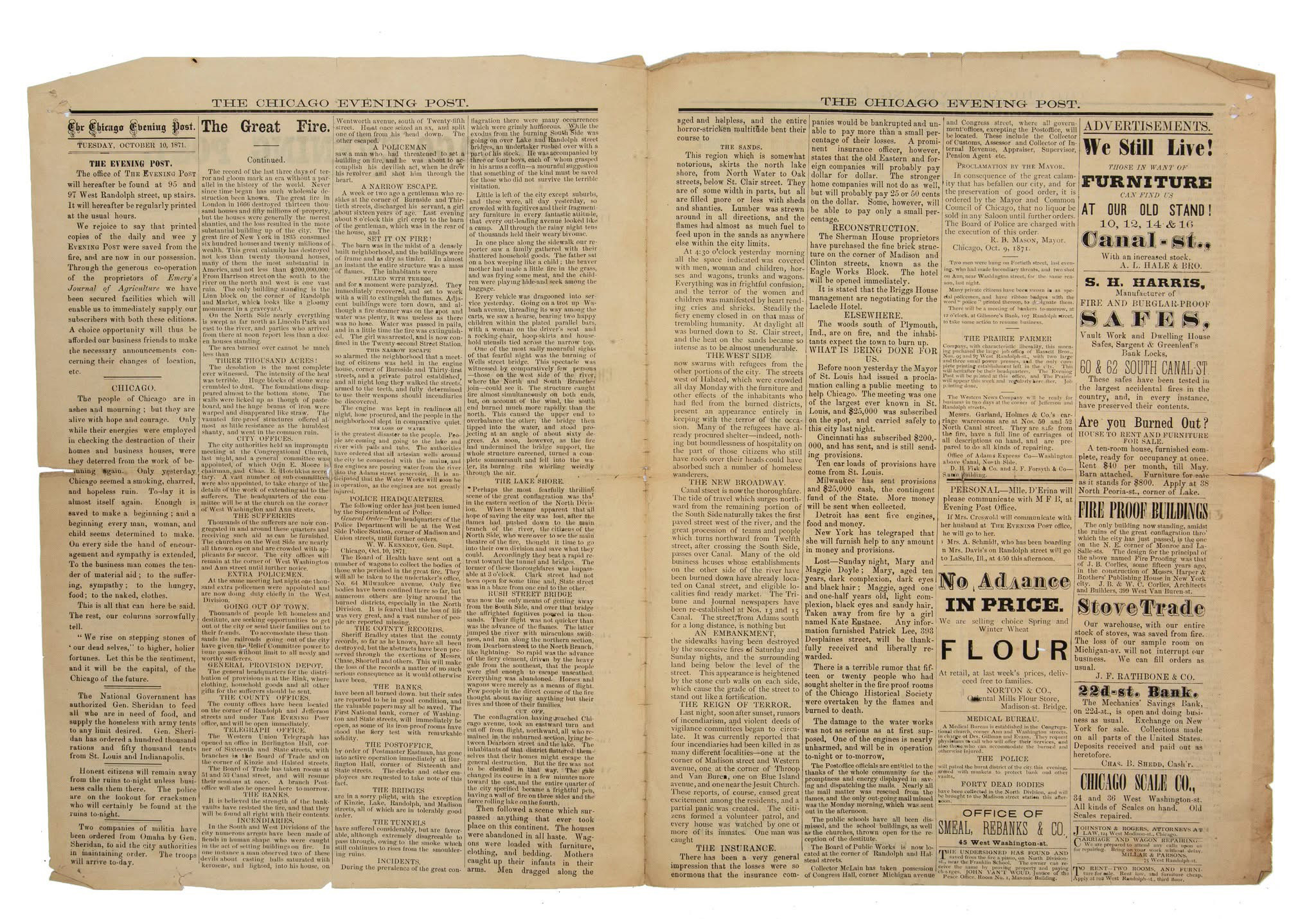
The Great Calamity.
At this writing, Tuesday morning, the city is as full of excitement and commotion as it was yesterday, except that the conflagration is gradually subsiding, and if the wind does not change, there is ground for believing that the flames have spent themselves, and will soon die out for want of more material.
However, the danger is by no means past. A change in the direction of the
wind may at any hour occur, and should it blow from the northeast, the flames still raging in the northwest portion of the North Branch would be driven across the river, and then the whole West Division must immediately go to destruction.
Then, alas, this is not the only source of danger. The city is infested with a horde of thieves, burglars and cut-throats, bent on plunder, and who will not hesitate to burn, pillage and even murder, as opportunity may seem to offer to them to do so with safety. It will require the utmost vigilance on the part of the police and of and every person should remember that the burning of one building in the West Division, at this critical juncture, will almost certainly involve the destruction of the whole West Division, as no water can as yet be obtained for the use of the Fire Department.
The full extent of this calamity cannot be estimated. The mind is appalled at the contemplation of the immense destruction of property, and, above all, at the human suffering that is to be the inevitable result.
In our afternoon edition of the Ledger we shall give numerous additional particulars concerning the greatest calamity ever known to visit an American city.
Post Office Headquarters.
The government has temporarily located the post office in Burlington Hall, corner of State and 16th street. Mails will be collected from the boxes that remain, and delivered into all parts of the city.
PROCLAMATION.
Whereas, In the Providence of God to whose will we humbly submit, a terrible calamity has befallen our city, which demands of us our best efforts for the preservation of order and the relief of the suffering, be it known that the faith and credit of the City of Chicago is hereby pledged for the necessary expenses for the relief of the suffering.
Public order will be preserved. The police and special police now being appointed will be responsible for the maintainance of the peace, and the protection of property.
All officers and men of the Fire Department and Health Department will act as Special Policemen without further notice.
The Mayor and Comptroller will give vouchers for all supplies furnished by the different Relief Committees.
The headquarters of the City Government will be at the Congregational Church, corner of West Washington and Ann streets.
All persons are warned against any act tending to endanger property. Persons
caught in any depredation will be immediately arrested.
With the help of God, order and peace and private property shall be preserved.
The City Government and the committees of citizens pledge themselves to the community to protect them, and prepare the way for a restoration of public and private welfare.
It is believed the fire has spent its force and all will soon be well.
R. B MASON, Mayor.
Geo. Taylor, Comptroller. (By R. B. Mason.)
Chas. C. P. Holden, Pres. Com. Council.
T. B. Brown, Pres. Board of Police.

As a generational member of a prominent Chicago family, long gone from that prairie town” , having witnessed 9/11 and 2 cat 5 hurricanes in the Caribbean, I read this in awe.