New Jerusalem Church
Life Span: 1862-1871
Location: Michigan and Adams
Architect: Sanford E. Loring, John M. Van Osdel
- Halpin’s Chicago City Directory for 1864
Chicago Society of the New Jerusalum. Adams street, between Wabash and Michigan avenues. Organized February, 1843. Church erected 1862.
John C. W. Bailey’s Chicago City Directory for 1867
New Jerusalem Swedenborgian Church, J. R. Hibbard, pastor, Adams, bet. Michigan and Wabash avs.
Edwards’ Annual Directory in the City of Chicago, for 1870
Chicago Society of the New Jerusalum—The Temple is located on Adams street near the Lake. Rev, J. R. Hibbard, pastor, residence, 70 Third avenue. Devine service 10:30 a.m. Sabbath school meets 9:45 a.m. Orlando Blackman, superintendent.
Chicago Daily Tribune, November 14, 1862
The New Jerusalem Church Organ.
The New Jerusalem Church, on Adams street, is a very beautiful little building, both inside and out. It is lighted up by nine stately windows of painted glass; most of floral designs. The reading desk and pulpit are of carved oak, and all the adornments of the church are of the same material, and the style gothic. The seats are also of oak, covered with crimson damaek, and each pew has the occupier’s name upon it, engraved on a neat plate.
During the last few days a very fine organ has been added to the attractions of the New Jerusalem worship; and the fame of it induced us to make a special visit for the purpose of testing its qualities. We were accompanied by Mr. Root, and Mr. McCurdy, of 86 Randolph street—a fine organ player. Both these gentlemen very courteously offered their services for the occasion.
We found the instrument all that report had stated concerning it. A little while ago it was listened to by a select company of artists, who were enthusiastic in their praises of it; and we can add our testimony to theirs that it is a very fine instrument.
The maker is Mr. Roberts, of New York, as we understand; a man not much known at present, but of whom both the church and the world will hear more, by and by. It is not a large organ, but it possesses great power, compass, and sweetness. It has twenty-eight stops, and two banks of keys. Its range is two octaves and a quarter. Its height twenty-two feet; width fifteen feet; depth, twelve feet. All the stops are full and rich. There is a melodis stop, solo, very sweet.
A fate stop, which is exquisitely clear, soft, and melodious. A viol di gamba, solo, broad, deep, and grand in its come; being an imitation of the violincello. The double, open dispason in the pedals is exceedingly rich. The full organ swell superb, and of great power. The choral stops are admirably voiced for singing purposes; and the touch and action are as that a fine player could ask.
Take it all in all, it is as good an instrument, for its site, as any to be found in the West.
Mr. McCurdy tested it in all its combinations, and executed upon it some of the best pieces from Mozart, Mendelssohn, and others, with great effect. The reader may be aware that the object of these combinatione is to produce an orchestral effect, a perfect harmony, and balancing of all the notes and chords, so that none shall be higher than the others. The traneitions from one series of continnations to that of another, was very striking and delightful, and the result wae an impression of great instrumental power, and capacity.
In the bands of a good player, such Mr. McCurdy assuredly is, there could be no end to the combinations and variations of twenty-eight stops. Indeed, they are literally endles—and must continually startle with new effects. We were particularly struck with the combination of the melodies, and the fifteenth of the great organ—with an accompaniment of softer stops in the swell—which was very brilliant and effective.
The Church of the New Jerusalem has reason to be proud of this besutiful addition to its sacred properties; and Chicago ought not to be sorry that another fine instrument has been contributed to its civilization.
Chicago Daily Tribune, November 15, 1862
New Jerusalem Temple—Adams street near Michigan avenue. The Temple of the Chicago Society of the New Jerusalem will be dedicated to the worship of the Lord God our Savior Jesus Christ, on next Sunday at 10½ a m. The Rev. Chauncey Giles, of Cincinnati, Ohio, is expected to preach in the Temple on Sunday evening, at 7½ o’clock, Nov. 14, 1862.
Chicago Daily Tribune, November 17, 1862
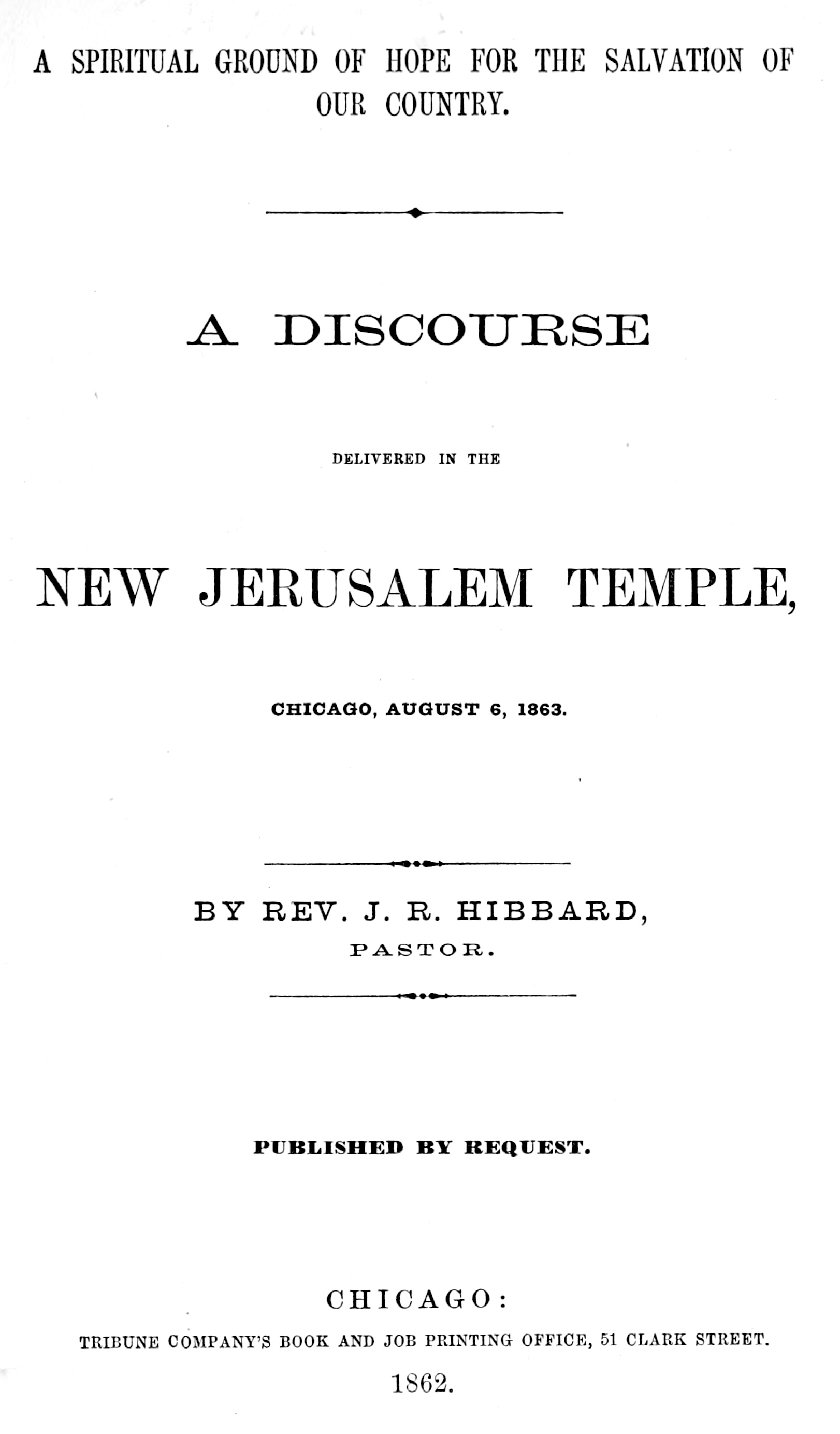
CHICAGO SOCIETY OF THE NEW JERUSALEM
Dedication of the New Temple. Description of the Edifice..
According to previous notice, the New Jerusalem Temple, situated on Adams street, near Michigan avenue, was dedicated yesterday morning. The services were conducted by the pastor, Rev. J. R. Hibbard, assisted by Rev. Chauncey Giles, of Cincinnati.
This society was organized in February, 1848, since which time it has worshipped at the church on Harrison street, near State. Under the pastoral charge of the Rev. Mr. Hibbard, the society has been greatly prospered, and now embraces about 150 adult members, and the Sabbath School has an average attendance of some fifty pupils.
The new Temple is Norman Gothic in style—the outer surface of rock-faced stone, the two columns and corners upon the front elevation being surmounted by cut-stone turrets. Above the front door is a tablet bearing the name of “The Chicago Society of the New Jerusalem.” Over this and surmounting the front window, is a tablet, bearing an inscription of an open Bible—the illuminated Word—with appropriate passages from the Old and New Testaments, engraved upon the open pages, in Greek and Hebrew, the whole surmounted by the Latin inscription-“Verbum Dominie manet in Eternum.” (The Word of the Lord endureth forever.)
The Temple is about sixty feet high, fifty feet width and seventy-six in depth, substautially built of stone, and covered with slate.
The audience chamber is finished in the same style of architecture—the windows and doors being surmounted by arches and centre arches. The altar and Tabernacle are of solid mahogany, the seats, doors and other woodwork oak-grained. At the side of the chancel is a recess for the organ, faced by an ornamental screen, consisting of a combination of columns, arches and quatre-foils, the whole surmounted by an o-g arch, terminating in a carved finiel. A similar space oa the opposite side of the chancel is occupied by the robing-room, with a corresponding finish. A new organ costing about $2,000 will be procured at an early day. The seats are roomy and comfortable, the entire church neatly carpeted and upholstered. The andience chamber has capacity for seating soma 350 persons. In the basement is a lecture and Sabbath school room, pastor’s study, library janitor’s room, &c. The whole building is heated by furnaces located in the cellar (which extends under the entire building.)
The Interior as well as the exterior of the building are neat and symetrical, and if stability of structure and convenience of arrangement has been the aim of the architect and builders, they have accomplished their end.
The Temple was deelgned by, and constructed under the superintendence of Mr. Sanford E. Loring, a student with J. M. Van Osdel, esq.—and is creditable to the skill of the designer. The stone work was done by R. J. & J. D. Morse. Carpenter work by Amos Grannis. Painting by Barry & Cushing.
The Temple cost about $17,000, and is all paid for. The society declined carrying the work forward faster than their means would justify—determined not to attempt to dedicate to the worship of God temple that was not their own.
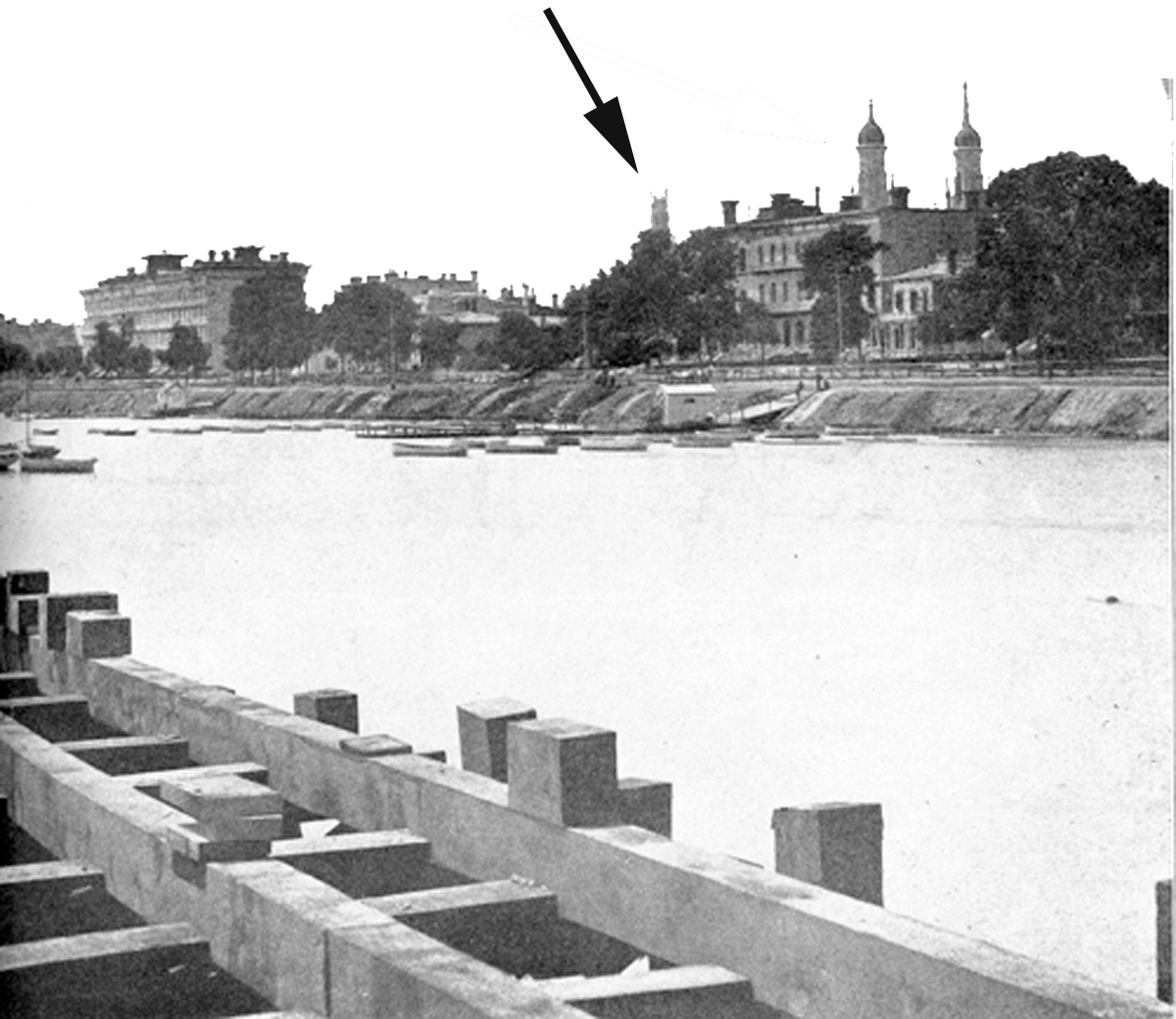
- Likely view of the New Jerusalem Temple. The Trinity Church (two towers) was located on Jackson, between Wabash and Michigan avenues. Photographer: Copelin and Melander

Leave a Reply