- Fergus’ Chicago City Directory, for the Year 1855
Chicago Tribune, Tribune Building, 51 to 55 Clark
D. B. Cooke & Co.’s City Directory for the Year 1859
Press and Tribune, 51 S. Clark (See card back cover)
Halpin & Bailey’s City Directory for the Year 1863
Chicago Tribune.—(Daily, Tri-Weekly and Weekly,)—Chicago Tribune Company, publishers; office 51 Clark street.
Halpin’s Chicago City Directory for 1864
Chicago Tribune, 51 Clark
Evans’s Block, Clark, ne cor Randolph

Chicago Tribune, August 22, 1864
 The development and progress of a city, if its monetary, mercantile, commercial, manufacturing, educational, moral and religious features, is pretty certainly and accurately measured by the character of its local journalism. The advancement and improvement of a town and its newspapers are fully sure to be in parallel lines, and neither will much outstrip or lag behind the other. This is the standard by which outsiders generally determine the character of a town. They are pretty sure to be an index and a reflex of each other.
What this city was when the issue of the first number of the Chicago Daily Tribune challenged the consideration and patronage of ite citizeus, the mouldering and decaying process of seventeen years has scarcely driven from their recollectios. In people it scarcely aumbered eisteen thousand, while in material development it stowed nothing like a empathetic force. To-day the footings of Its vital strength would yield at least 175,000, while its monetary and commercial weight shows a power away beyond its vital force; and we might add that its present educational, moral and religious advance falls not behind its monetary and commercial struggle. Seventeen years ago a comparative small, in the woods town, with no distinctive feature to mark it above its follows; to-day it stands acknowledged pre-eminent as the great grain, pork, beef and lumber market of the world, and we might add, also, railroad centre. The successive and rapid steps by which it has reached this pre-eminence, is but a history of the rise and progress of the Chicago Daily Tribune. Launched on the tide of experiment on the 10th of July, 1847, with less than four hundred subscribers, it now numbers hundreds where at that time it counted units and with a relative material progress in every other respect equal.
The accession to our establishment, which inaugurates its labors this morning, of one of R. M. Hoe’s latest improved eight-cylinder printing machines seems an appropriate period for a retrospective glance at the history of the Chicago Tribune. And in doing so, it would be a false modesty on our part, which we are not willing to assume, to attempt to conceal the pride and satisfaction we feel in the prosperity of which this improvement is a logical and visible token. Blowing one’s own horn is an amiable weakness, unless it happens to disturb the equation and sweet repose of one’s neighbors, and in our case we are quite sure none can be disturbed or offered, for at least one of their number has practiced the same weakness within a brief period
The Chicago Daily Tribune—by that name—commerced existence, in the third story of a building, on the corner of Lake and Lasalle streets—a single room answering the triple purpose of counting-room, editorial room and printing office,—on Thursday, June 10, 1847. Its originators were James Kelly, now a successful leather dealer at 243 Lake street; John E. Wheeler, now proprietor of the Dial at Kewanee, Henry county; and Jo K C. Forrest, at present Washington correspondent of the Chicago Tribune, the latter giving his attention more particularly to commercial matters, which, in large type, filled about one-quarter of a column of each issue. The dimensions of the Tribune were 22 by 36 inches, set in brevier type, advertisements in minion.
To Mr. Kelly belongs the credit of originating, or at least suggesting the publication. He was the owner of the Gem of the Prairie, a weekly literary journal, which he had a short time antecedent purchased of Mr. Thomas A. Stewart—afterwards and for several years, holding a proprietary and editorial interest in the Tribune. His idea was to start a daily, from which he could make up the weekly Gem, regarding the former as in a measure secondary to the latter in point of public interest, and as a financial measure. There was much consultation and discussion upon the feasibility of the project; probable receipts and expenses were closely estimated; the size of the city, (then comparatively a village,) and the fact that there were then two sickly dailies, striving to earn their bread, were not without their influence against the project. Still another, and the heaviest drawback was the fact that the parties possessed little or no capital. But amid all the discouragements the projectors determined to go ahead—to a certain degree by the idea that they might gain something, while it was evident that they had not much to lose. So much being fixed, the next matter in course was a name for the new journal. Many were suggested. Mr. Forrest proposed the name of Tribune, and it was at once accepted by the other partners. Mr. Wheeler, like many other of our Western editors and newspaper men, was a graduate from the office of the New York Tribune, and, of course, that fact influenced him in favor of that name.
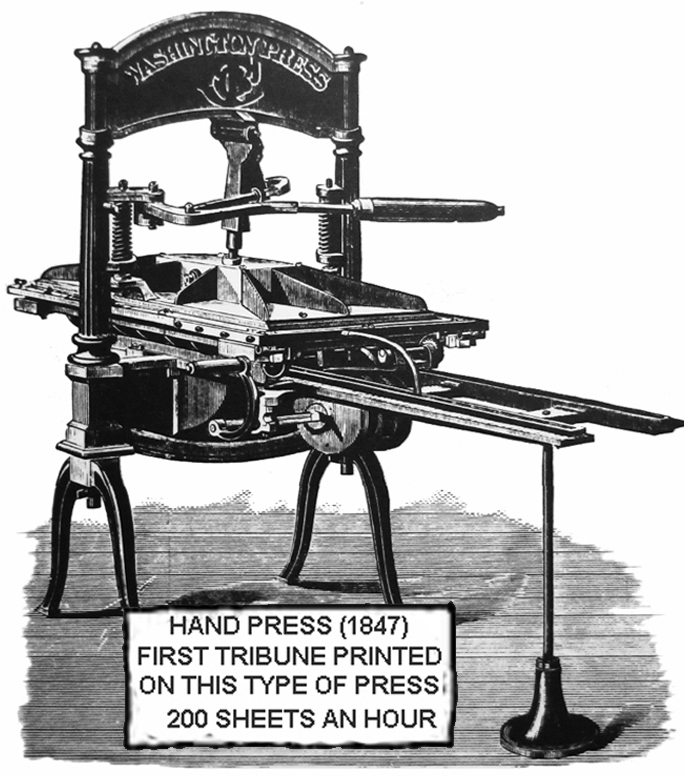
As we have already stated, the first edition of the Daily Tribune ever issued numbered four hundred copies It was “worked off” on a Washington hand press, one of the proprietors being the pressman. In politics it was Independent, with strong Free-Soil sympathies.
The editor’s salutatory says: “Our views, in all probability, will sometimes be coincident with the conservatives; sometimes we may be found in the ranks of the radicals; but may be found at all times be faithful to humanity—to the whole of humanity—without regard to race, sectional divisions, party lines, or parallels of latitude or longitude.” The motto under the editorial was:
- Men of thought! be up and stirring,
Night and day;
Sow the seed—withdraw the curtain:
Clear the way,
Men of action! aid and cheer them
As ye may.
The start was made not without many misgivings, and the discouragements seem to increase as time progressed. Mr. Kelly was almost immediately incapacitated for labor or business, by a serious affection of the eyes, and be was thus forced to withdraw from the concern on the 24th of July, just fourteen days after he had commenced an enterprise in which he felt a deep interest. Thomas A. Stewart, who a few weeks before had sold to Mr. Kelly the Gem of the Prairies, succeeded that gentleman, and he remained in that connection for about seven years.
On the 27th of September following, Mr. Forrest severed his connection, Messrs. Wheeler And Stewart remaining proprietors, the former gentleman being recognized as its editor. At this point a crisis in the history of the Tribune was reached; Mr. Forrest was quite sure it could not be sustained; hence his withdrawal Messrs. Wheeler and Stewart had their doubts; but finally concluded to continue it for a few weeks longer, under the influence of a Micawber-like hope that “something might turn up” to “clear the way” It is worthy of remembrance, that while the proprietors were greatly embarrassed by the want of means to meet these daily expenses, the public, and even the more particular friends of the proprietors, labored under the delusive impression that they were coining money.
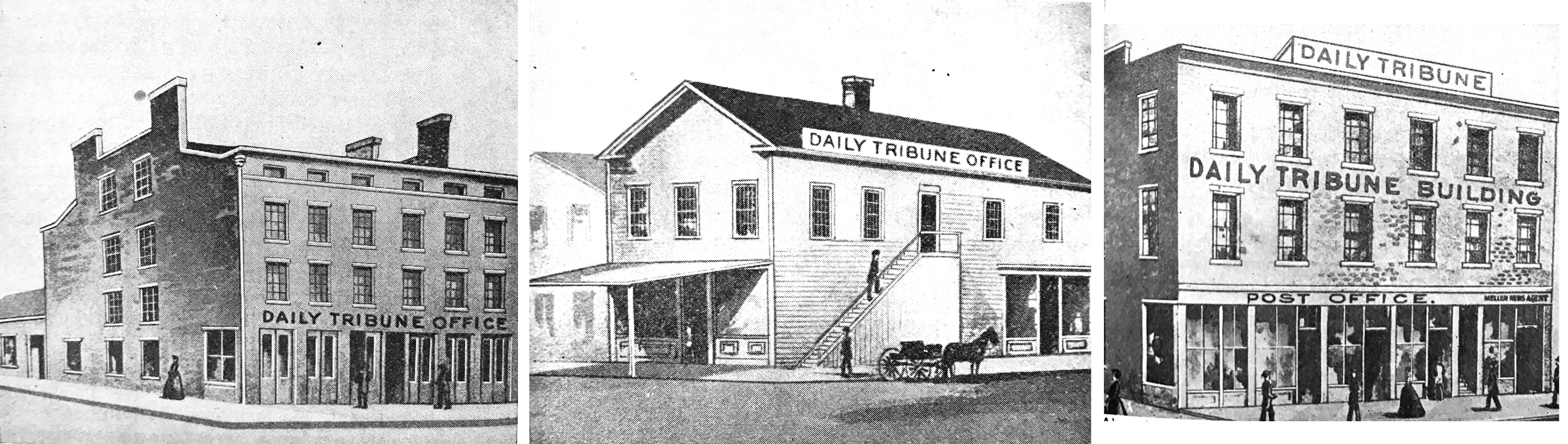
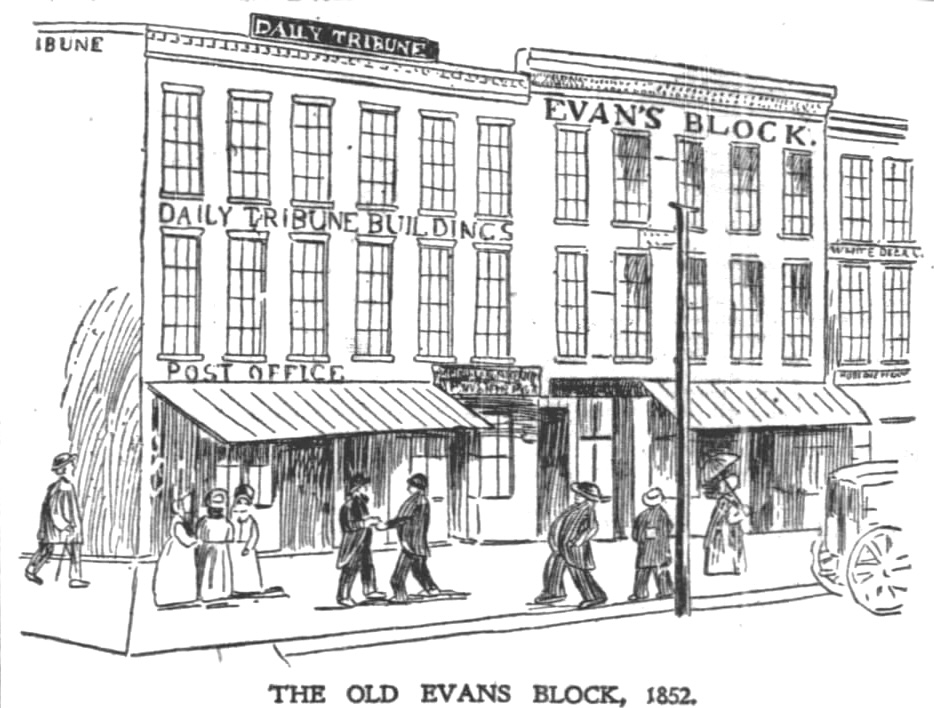
- In 1847, Lake and Lasalle, 3d story was the first rented home of the Tribune. Destroyed by fire on May 12, 1849. On May 14, 1849 moved temporarily to the NE corner of Clark and Randolph, above Gray’s store. On June 4, 1849, to the NW corner of Clark and Lake streets, concurrently to this article, was the location of the Second National Bank. Then to 173 Lake street, second floor of the Masonic Building. Finally, in 1852, the Tribune moved to the Evans Block at 53 Clark street, between Lake and Randolph streets, below was the Chicago Postoffice, which did a limited business, In 1869 they moved into their first owned building on the SE corner of Dearborn and Madison.
Railroads.
The day the Tribune was started, there was not a mile of railway within the radius of one hundred miles of Chicago. The nearest track was at Kalamazoo, then the western terminus of the Michigan Central, whence Chicago was reached by stage and steamers connecting with that road. At the time that corporation had hardly seriously discussed the feasibility of continuing their road to this city. New Buffalo was surely regarded as the western terminus; the idea then controlling the judgment of railroad men, and nearly all others, that it would be the height of absurdity, and sure to end in financial ruin, for railroads to attempt to compete with steamboats on a route where the latter could find navigable streams for their operations. At that time the corporation of the Galena and Chicago Union Railroad possessed a charter, and it was doing its utmost in urging upon the people subscriptions to the capital stock Mr. William B. Ogden, as now, was then President of the corporation, and his labors in endeavoring to achieve success were herculean They were directed by personal importunities to the people, and appeals through the press. In the latter, the Tribune was made the channel. In this connection we must relate a scene which occurred in the Tribune office, and which to this day is strongly impressed upon our memory, not withstanding the mystifications of time. It was on the 4th of August, 1847. The books for subscriptions to the capital stock of the G & C. U. R. R. were to be opened on the 10th last., at various points on the line of the contemplated road. Mr. Ogden came into the Tribune office, in company with several friends, for the purpose of making an appeal through its columns to the people interested to come forward and aid the work. He sat down to the editor’s pine table and commenced his work. After writing two or three pages, he arose and read them to his friends, and quite a large crowd who had gathered in the office. At the completion of the reading, the manuscript was passed to the compositors to be put in type. Mr. Ogden then sat down, and produced three more pages, with which he went through the same process, and thus he continued to do until the article, about one column and a half in length, was completed We cannot resist the temptation to give a few of the more prominent points which Mr. Ogden enforced in that article:
- One or two shillings or more per bushel would be added to the price of every bushel of wheat raised by the farmers on the route, and other products would be affected in like proportion. The facilities thus afforded would, as a consequence, double the value of every farm on the route of the road….The great increase of wealth and population along the route, so certain to result from the construction of the road, adding so greatly to the social advantages of the people and country through which and near which it would pass, and the increased comfort and relief from fatigue, exposure and expense, by being able to travel in a comfortable covered car, from the Fox, Rock or Mississippi Rivers to Chicago, in two to four or six hours, in all weathers, instead of occupying several days through deep mud, as is now often necessary, are considerations not to be forgotten by the public in determining them in their conclusions as to the amount to be subscribed for.
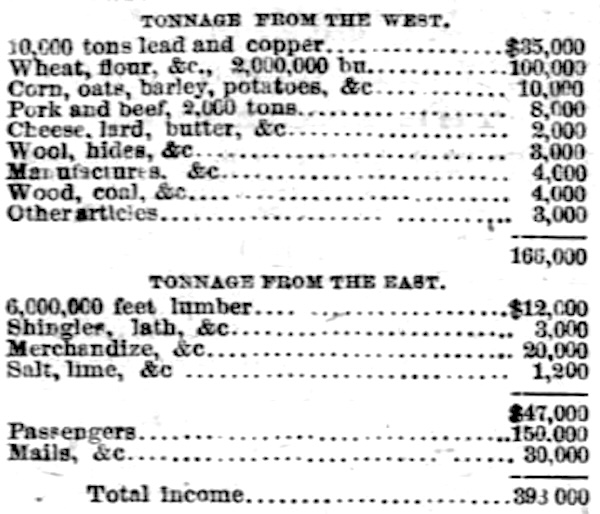
The more active participators in the efforts to put through the road were William B. Ogden, Walter L. Newberry, J. Young Scammon, Charles Walker, Thomas Dyer, John B. Turner, of this city, Thomas Drummond, (now Judge Drummond of this city),of Galena; Thomas J. Turner, of Freeport, &c. The estimated cost of the road was $2,648,000, or $14,558 per mile, single track, with bridges for a double track. The income of the road, for the first year, was estimated as follows:
This was the first introduction of the railroad eystem into Chicago. How it has spread, and what it has done for Chicago, is known to all. On the 21st of August, eleven days after, The Tribune published a congratulatory article, also, if we recollect aright, written by Mr. Ogden, stating that the corporation had met with a success beyond their anticipations, in the amount of subscriptions which had been received to the capital stock.
Compliment.
On the 23d of August, a beautiful top-sail schooner of 180 tons, was launched from the shipyard of Captain Allen, and she was christened Tribune. She was owned by G. F. Foster, J. N.
Davidson, G. M. Higginson and Capt. Reed, her commander. This was intended as a complimentary tribute to the character of the Tribune.1
Merchants’ Exchange.
On the 6th of September, the subject of a Merchants’ Exchange or Board of Trade was first discussed in the Tribune, the writer believing that the business of the city would justify the formation of such an organization or institution.
An incident at the period of which we are writing, one, and a prominent source of intelligence from the outside world, was St. Louis. The most attractive field of news was Mexico, as the war with that disturbed and unhappy country was then in full blast. The latest intelligence from that field of operations almost invariably came up the Mississippi to St. Louis, and thence up the Illinois river to La salle, and thence to Chicago by stage, the Illinois and Michigan Canal not having yet been completed. As bearing a significant relation to the above facts, an incident has been related to us by an old citizen, which will certainly be regarded by all who know the parties as characteristic if not true. It transpired about the time of the first appearance of the Chicago Tribune. Alfred Dutch and John Wentworth, published rival daily papers—Chicago Democrat and Chicago Commercial Advertiser. These rival editors displayed what was regarded then, as remarkable spirit and activity in their humble way in obtaining the latest intelligence from the war, which was always immediately given to the readers in extras. A gentleman who came up from St Louis one day, by river and stage, brought with him a paper from that city, containing late and important news from the seat of war. This gentleman was the friend of Mr. Dutch, and determined to make him the exclusive recipient of the news. His house, however, was not in the direction of Mr. Dutch’s office, and he handed the St. Louis paper to a friend, who was to pass that way, to give into Mr. Dutch’s hand. This friend had no personal acquaintance with the rival editors. At the hotel he met Mr. Wentworth and the latter suspecting he was a passenger from St. Louis, asked if such was not the fact, and if he had a late St. Louis paper. The gentleman responded that he was from that city, and had a late paper; and then asked him if he was Mr. Dutch The Colonel “smelt a mice,” and replied that he was that same man. The valuable, newspaper was handed him, and an extra Democrat soon made its appearance, which sold like bot cakes.
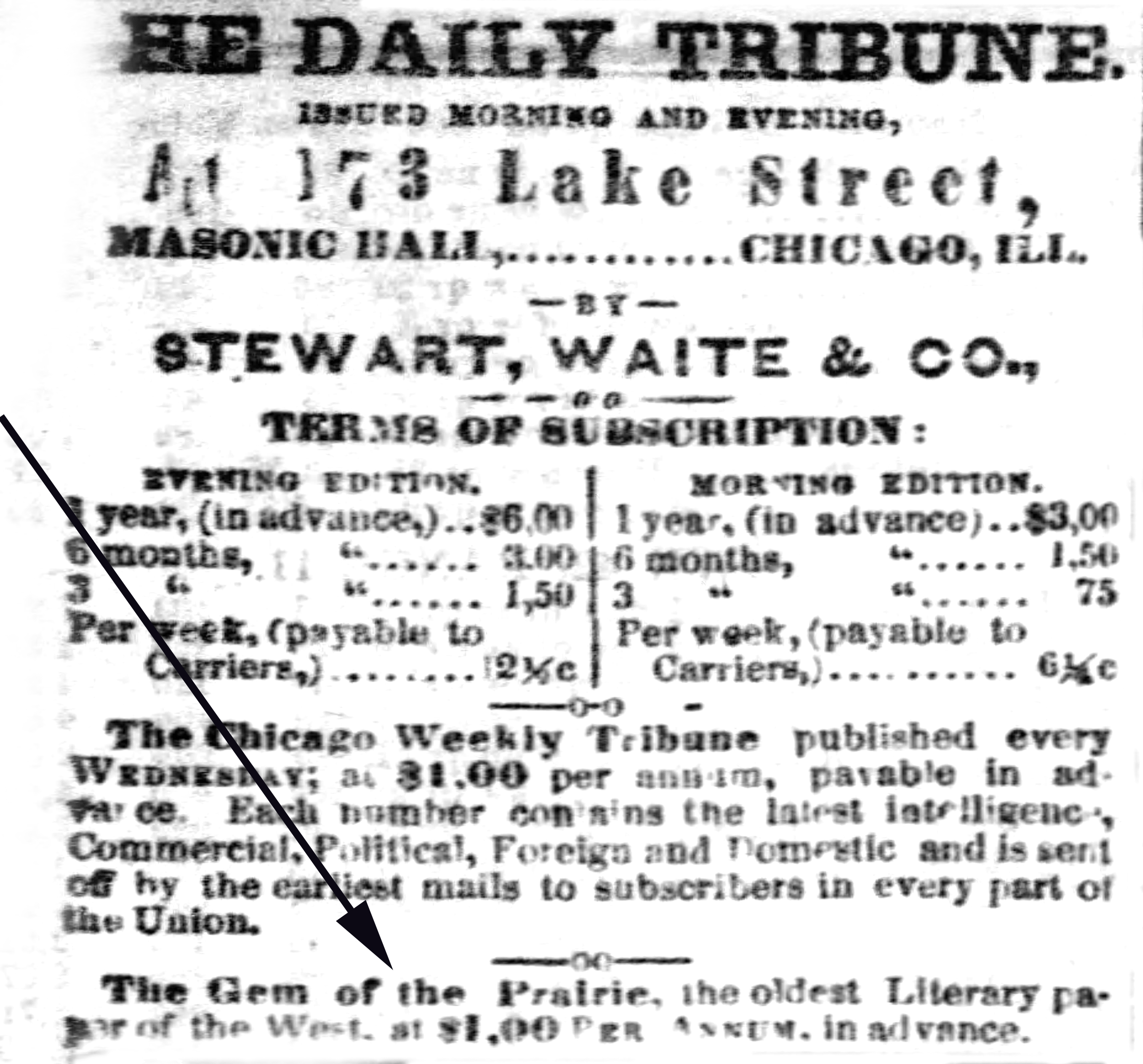
Gem of the Prairie.
From the commencement of the Daily Tribune, the Gem of the Prairie was made up from it, and was recognized as the weekly issue. It was then printed in folio form, same as the Daily Tribune, but on the 11th of December, it “made up” in quarto shape, and so continued until the Weekly Tribune took its place, of which more hereafter.
Big Purchase of Wheat.
The Daily Tribune, of Friday morning, September 24, records the purchase of five thousand and three hundred bushels of wheat, winter and spring, on the Wednesday previous. by the house of Raymond, Gibbs & Co., and characterizes it as the largest purchase ever made by a single house in one day in Chicago. The price ranged from 60 to 76 cents. Most of it was shipped the same day for the East.
Horse Racing.
On the 8th of October, an advertisement was sent to the Tribune, with the money to pay for it enclosed, giving notice of a horse race to take place, on a wager. The editor acknowledges the receipt of the money, and advertisement, but returns them to the sender, saying that “horse racing on the whole, is a bad business—that it neither aims at and accomplishes any good end, while the evils which attend it are great and manifest.”
Progress.
January 1, 1848, the editors of the Tribune congratulated their friends that although the Tribune, a little over six months previous, had been commenced mainly with a capital of Industry and Hope—” with occasional misgivings as to the result, and an abiding sense of the disproportion between our own capacities and the immense and never-ending work before us, and although the battle had but just begun, we have achieved such a measure of success as to keep us in working condition.”
First Telegrapoh.
The first magnetic telegraph line established in Chicago was the Erie and Michigan. It commenced working between Chicago and Milwaukee on the 17th of January, 1848. The following is the first dispatch sent over the line. It came from Milwaukee:
- Mr. Cramer sends his cordial greeting to his brethren of the press of Chicago, and hopes that as Milwaukee and Chicago are united in the same chain, the press may never forget that the cities of the Northwest are one in destiny, and should be one in feeling.
On the same day, the following dispatches passed between the two cities:
- Milwaukee, with her 14,000 inhabitants, sends greeting to her fair sister of Chicago, with her 17,000 and requeets her to clear the track to allow her to pass.
To this Chicago immediately replied:
- Chicago, with her 17,000 inhabitants, will soon have her railroad track east to the Atlantic, and west to the Mississippi, clear, so that the 14,000 citizens of their sister city can have every possible facility for passing.
On the 4th of February, the above line was extended to Michigan City. On that occasion the following dispatches passed between Milwaukee and the former took place:
- The old Milwaukeans send you their compliments, and hope Michigan City and Milwaukee may hereafter be as close together as lightning and steam can make them.
Michigan City to Milwaukee—May her “thousands of brick” enable her to distance all competition with her sister cities of the Lakes.
Telegraphic Dispatches.
The first telegraphic dispatch to the Tribune, from the East, came on the 22d of March, 1848, and contained the announcement of the Revolution in France, by which Louis Philip was dethroned.
Presidential Preferences.
On the 14th day of August, 1848. the Tribune hoisted the names of Martin Van Buren and Charles Francis Adams as candidates for President and Vice President, in opposition to Gen. Zachary Taylor and Millard Fillmore as the Whig candidates, and Lewis Cass and Wm. O. Butler, the Democratic candidates. The Van Buren ticket stood upon the platform of “Free Soil, Free Speech, Free Labor, and Free Men.”
New Partnership.
August 28, 1848, John L. Scripps, one of the present proprietors of the Chicago Tribune, purchased a third interest in the concern, and the firm was changed to Wheeler, Stewart & Scripps.
Telegraphic Enterprise.
December, 6th, 1848, the proprietors of the Tribune announce that they have made “such arrangements with the agents of O’Reilly’s telegraph line as will enable us to furnish the proceedings of Congress, and other news of importance, to our citizens daily,” and the hour of publication of the Tribune, was changed to 11 o’clock a. m.
Weekly Tribune.
Up to February lst, 1849, a weekly edition had been made up from the daily issue under the name of Gem of the Prairie. At this period a new weekly extra was commenced under the title of Weekly Tribune, and has been continued under that title to this day, with an indefinite life before it.
Largest Circulation.
On Friday, May 14th, the advertising of the List of Letters was awarded to the Daily Tribune as having the largest circulation. In fact, there was no competition. When we state that the circulation of the Tribune then was less than one thousand, some idea may be formed of the circulation of the three other daily papers then published here. The list of letters was published but once a month, and were required by law to have three successive insertions. The month’s list at that time numbered about one third the present weekly list, and embraced all the ‘drop letters.”
A Disaster.
May 12th, 1849, the office of the Daily Tribune was entirely destroyed by fire. Through the kindness of their brethren of the press of this city, they were enabled to resume on Thursday, the 14th, the location of the office being temporarily over the grocery store of J. H. Gray, north-east corner of Clark and Randolph streets. The fire was supposed to be the work of incendiaries, “political incendiaries,” the editors thought. There was an insurance of $2,100 on the office, which “amply covered the loss.” In connection with this disaster, it may not be out of place to state that the bookselling firm of Griggs, Bross & Co. presented the editors of the Tribune with a new copy of Webster’s querto Dictionary to take the place of the one lost. The Dictionary still occupies a place of honor on the table, somewhat dilapidated, but good for many more years’ service. We need hardly add that the Bross named in the above firm. is William Bross who now is and has been for the past twelve years “one of us.”
Another Renewal.
Above we stated that the Tribune, after the fire, was removed to the northeast corner of Clark and Randolph streets, as a temporary expedient. On the 4th of June following, it removed to the northwest corner of Lake and Clark streets, where now stands the building occupied by the Second National Bank, and various offices, etc., above.
New Type.
On the 15th July following its destruction by fire, the Tribune appeared in entirely new type, obtained through Robert Fergus, from New York, and presented a very tasteful appearance, especially when compared with the very shabby habiliments in which it paid its diurnal visits to its patrons from the time of its disaster up to this time. The editors then began to see their way more clearly, and considered themselves in the pathway which led to the broadway of success.
The Pacific Railroad.
Then, as now the Tribune took the lead in advocating, inaugurating, fostering and pushing forward all new enterprises looking to the advancement and prosperity of the Great Northwest. During the months of September and October, articles in favor of the great Pacific Railroad were published in its columns. During the time named a convention in favor of the measure was called and held at St. Louis. Meetings were held in this city in favor of the measure, in which our leading citizens tock an active part. Rev. Mr. Adam wrote a pamphlet in favor of the measure, which was esteemed very strong, and copies of it were circulated by subscription raised from citizens.
Another Removal.
May, 1850, the Tribune office was again removed to 173 Lake street, Masonic Building, 2d floor, the old quarters becoming too circumscribed for its uses.
Enlarged.
June 1, 1850, the Daily Tribune was enlarged by the addition of another column to each page, and the lengthening of the columrs to correspond. Its dimensions after the enlargement were 26 by 40. The editors in announcing the enlargement say:
- This change we have been compelled to adopt to accommodate the rapid increase of our advertising patronage, and to enable us to give mere space to news, commercial matters, and the various subjects of general concern. We deem it proper to say, that for pecuniary reasons alone, the Tribune has, so far, fallen much short of what we regard as the ideal of a newspaper in this age of unexampled progress. Meantime we shall, as heretofore, labor faithfully to that end.
Hotel Arrivals.
About the 20th of June, 1850, the Tribune commenced publishing a list of hotel arrivals. The names of several of the principal hotels at that time will sound strangely to a large majority of our citizens. First in importance, forming an opinion from the number of its guests, was the City Hotel, then as now, a popular resort. Next follows the New York House, Mansion House, American Temperance House, Baltic House, Merchants Exchange Hotel, &c. The modern Sherman, the Tremont, Briggs, Richmond, and Adams were then merely chaotic stone, brick and mortar. Even the architect of either had not commenced his labors.
Circulation.
On the 21st of August, 1849, a little over 14 months after it was started, the proprietors placed under its editorial head its aggregate circulation—daily and weekly editions—at 6,768. This figure was obtained by multiplying the daily issue by six, and adding thereto the circulation of the weekly, and on the occasion published a congratulatory article, in which the editors stated that “notwithstanding the commencement of the Tribune is of a more recent date that any of its contemporaries with which it was in competition, our circulation now surpasses them all.” The editors further say that they are determined to make it in every sense worthy of the city of Chicago and the great Northwest. For a year nothing was said in its columns in regard to the circulation, but on the 21st of July, 1850, the publication was resumed, and continued until Oct. 1851, as follows, daily:
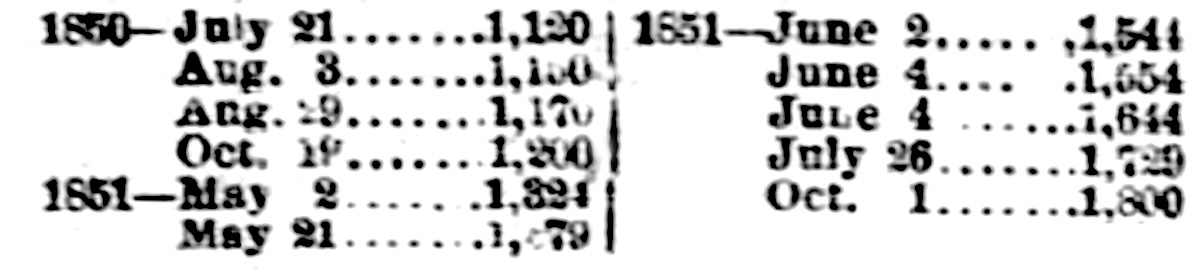
What was then considered a rapid increase of the circulation of the Tribune of course excited the envy and jealousy of its cotemporaries. John Wentworth, of the Daily Democrat, disputed the truth of the number circulated, and an angry dispute arose between the two papers. Finally Mr. Bross, mow of the Tribune, but at that time of the firm of Wight & Bross, proprietors of the Prairie Herald, who owned and ran the power press (of the Adams pattern) on which the Tribune was printed, certified, in an affidavit, to the truth of the claim.
Death of Gen. Taylor.
About the middle of July, in 1850, the death of President Taylor occurred. A meeting was called in this city, to express the sympathy and condolence of the people for the nation’s loss. At that meeting resolution was passed, requesting Abraham Lincoln, who was then in Chicago in attendance upon the Supreme Court, to deliver an eulogy upon the deceased patriot and statesman. The request was complied with, and the eulogy was delivered by Mr. Lincoln in the presence of a large and deeply interested audience The Tribune commended the eulogy in high terms. This event has nothing to do with the history of the Tribune; but it is a reminiscence which will interest our readers at this day.
First Annual Review.
The first annual Review of the Trade and Commerce of Chicago appeared in the Daily Tribune of December 27, 1850. The three great sources and avenues of the commerce of Chicago at that time, were the lake, the Illinois and Michigan canal, and the Galena and Chicago Union Railroad the western terminus then being Elgin. During that year the receipts and shipments of grain footed op as follows:
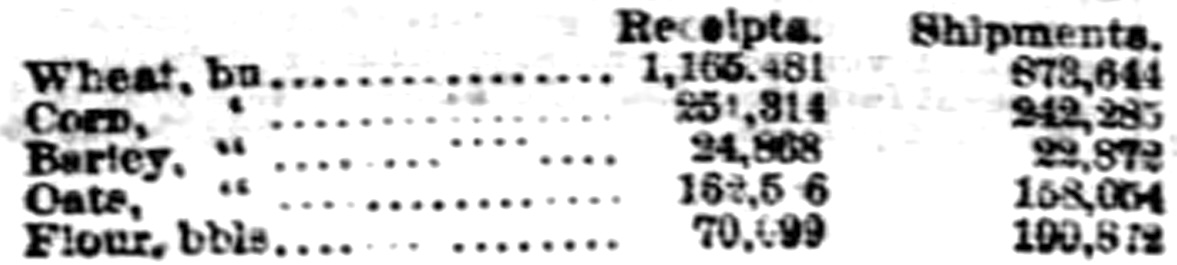
To-day the above transactions would hardly be considered a fair week’s business.
Mr. Wheeler Retires.
On the 1st day of July, 1851, Mr. John E. Wheeler, who was one of its originators, withdrew from the Tribune, much to the regret of his associates, having disposed of his interest to Mr. Thomas J. Waite, who assumed the business management of the concern, Messrs. Scripps and Stewart remaining as editors.
Mr. Scripps Retires.
From the retirement of Mr. Wheeler, as related above, until the June following, no change occurred in the management of the Tribune. On that day Mr. John L. Scripps sold his interest to a number of the leading Whigs of the city, who acted in behalf of General William Duance Wilson, now a well known and respected citizen of Iowa. Mr. Stewart took the position of local and commercial editor, these two departments, at that time scarcely affording sufficient labor for one man. To-day it takes nine persons to fill the two positions. General Wilson became the political editor.
Up to this time the Tribune had never in any way been committed to the policy of the Whig party, but had been, on the contrary a recognized organ of the Free Soil organization, as their principles were enunciated in the “Buffalo Platform,” upon which Van Buren and Adams were nominated for President and Vice President. Gen Wilson being a Whig, the Tribune under his management sustained the policy of that party; and it immediately hoisted the names of Gen. Winfield Scott for President and William A. Graham of North Carolina for Vice President. Mr. Waite continued as publisher of the Tribune, and the firm was styled Waite & Co.
New Type and Enlargement.
On the occasion of a change in the editorial department, as mentioned in the paragraph above, the Tribune was enlarged to the dimensions of 28 by 44. It also appeared on new and beautiful type, Brevier and Agate—from the foundry of John S. White, of New York. The Tribune at that time was universally acknowledged to be the handsomest paper in the West. The experiment of issuing a sheet of that size, and with the large amount of matter, at that time, when Chicago had just risen to the dignity of a city of 20,000 inhabitants, was regarded by all as an extremely hazardous one.
Change of Hour.
On the 26th of July, 1852, the hour of publication of the Tribune was changed from afternoon to morning. The price was raised from 12½ to 15 cents a week. A small afternoon issue took the place of the regular afternoon edition.
Death of Mr. Waite.
August 26th, 1852, Mr. Thomas Waite, one of the proprietors of the Tribune, and in charge of the publishing and business department, died, of cholera, aged 22 years. His death was sudden and unanticipated. His health had been somewhat impaired, and he was about, starting on a journey east to recuperate it, when he was suddenly stricken down, more immediately influenced by a long walk to his home, in a broiling sun, the day preceding his death. Mr. Waite was highly esteemed by his associates and all who knew him.
The Latest News.
On the 6th of October, 1862, the Tribune published a leading editorial, and re-published it daily for some time, which said that “without making any especial fuss about it, we have thus far been enabled to present our readers the latest news of the day, both foreign and domestic, as early as any of our city contemporaries; and sometimes twenty-four hours in advance of them. Finding that one line of telegraph could not be relied upon all for All the News received in this way, the Tribune was the first press in the city to Employ Another Line, and although it involves considerable additional expense, we do not regret it so long as our readers appreciate it, as we have the best evidence that they do.” The editors announce that they have suffered much for the lack of printing press facilities, but that they have secured the control of a power press until their new one arrives from the East.
Another Change.
After the death of Mr. Waite, until October 20th following, his name remained at its head as publisher of the Tribune. At that date Mr. Henry Fowler purchased the interest held by Mr. Waite’s heirs, and assumed the position of publisher and associate editor with Gen. Wilson.
War Against Wild Cat Banks.
Early in January, 1853, the Tribune commenced a crusade against the wild-cat currency, which was then largely circulated in this city and vicinity—particularly that issued by George Smith & Co. The war was a savage and acrimonious one. The Commercial Advertiser, published by Alfred Dutch, came to the rescue of the owners of the wild-cats, and charged the Tribune with being bought up by certain bankers, who were not in the “cat” business. A letter was sent by the publishers of the Tribune to the Advertiser denying the charge in emphatic terms. The latter published the letter, but reiterated the charge. The result was a libel suit against Mr. Dutch.
A Burglar!
Wednesday night, January 12, 1853, some person entered the press room and knocked one of the Tribune forms into pi. From the warm controversy going on between the Tribune and the wild-cat bankers, the inference was a logical one that the outrage was the work of the opposite par| ties in the controversy.
A reward was offered by the proprietors of the Tribune for the discovery of the perpetrator. The reward offered failing to bring detection, a number of the most respectable citizens joined in sending the proprietors of the Tribune one hundred dollars to be offered as an additibnal reward. In this letter to the publishers, they say:
- We feel that any attempt to intimidate the conductors of a free press, or to hinder or prevent the publication of a newspaper which is pursuing an honorable and manly course, should be promptly met and defeated by all good citizens, and none the less promptly because the attempt is made through the underhanded means of an assault upon the unoffending type.
The letter is signed by Edwin L. Larded, Edward I. Tinkham, H. G. Loomis, A. S. Sherman, Speer & Cooper, Edwin Hunt, Isaac N. Arnold, John H. Kinzie, A, N. Fullerton, T. W. Wadsworth, B. W. Raymond, Gurdon 8. Hubbard, Joseph F. Ryerson, John P. Chapin, J. B Doggett, W. H. Brown, J. H. Dunham, Williams & Avery, E. B. McCagg. C. L. Harmon. These names embraced members of both political parties.
Tri-Weekly.
In the early part of 1863 the publishers commenced the issue of a Tri weekly edition of the Tribune. It was of the same size as the daily. It has been continued until this hour, and has to-day a larger circulation than all three editions of the Tribune when it was started.
Gen. Wilson Retires.
Gen. Wilson retired from his connection with the Tribune on the 23d of March, 1853 He disposed of his interest to Henry Fowler Co. The means for the purchase of that interest were supplied by Timothy Wright, Esq., now residing in this city, and General (then Captain) J. D. Webster, now chief of staff to Gen. W. T. Sherman, and these two gentlemen became silent partners in the ownerahip of the establishment. The names of Henry Fowler and T. A. Stewart were taken from the editorial heeds of the paper and none other substituted.
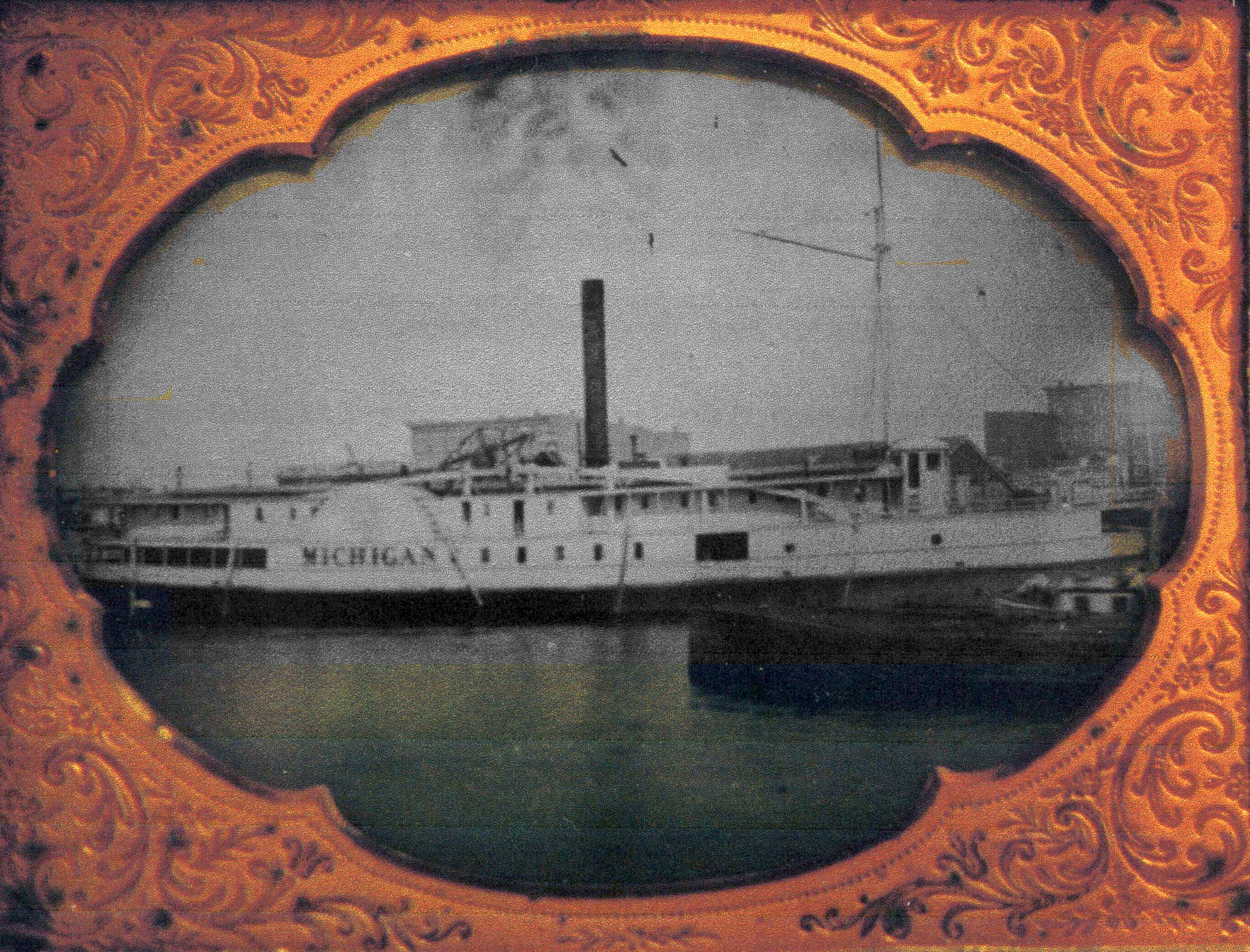
An Episode—Challenge.
During the autumn of 1853, the Pope’s Nuncio, Bendini, visited this country in a sort of ecclesiastical semi-official ambassadorial character. In company with Bishop Hughes, he toured through the Northwest via the lakes. Capt. Bigelow, of the U. S. steamer Michigan US 50156 (right), invited them to take a pleasure trip in his steamer, thus, as the Tribune said, “leaving the commercial marine of the lake without that assistance which the steamer was intended to afford.” In consequence of the strictures upon Capt. Bigelow’s conduct in the Tribune, that gentleman became very wroth, and finally dispatched his Lieutenant (Crossman) with a challenge to the editor (Mr. Stewart), to meet him in deadly strite, or in the language of the code duello, to demand such satisfaction as was recognized by gentleman of honor,” “that he was ready to fight as we might prescribe, and that if we desired to evade such an issue, by pleading the illegality of it, he was ready to proceed to any other State, or Canada, at any time; that should we refuse to settle the affair in that manner, he would attack us in the street, or elsewhere, and inflict such punishment as he deemed our offense deserved.” The editor replied to Lieutenant Crossman, that “the proposition to shoot Captain Bigelow, or to be shot by him, according to the rules governing gentlemen, was modestly and respectfully declined,” and that he “could adopt the alternative of attacking us on the street, or elsewhere, if be desired to do so; that we would neither seek to meet nor avoid him; and that we had never been whipped, and never expected to be.” The editor gave the captain a severe skinning, and then dropped him and that was the end of it.
Mr. Fowler Retires.
Mr. Fowler had only been nominally connected with the Tribune for more than a year previous to July 13, 1854, his health preventing his attendance upon the duties of his position. On that day his name was taken from the head of the paper as publisher, and T. A. Stewart’s substituted therefor, and the firm was styled “T. A. Stewart & Co., Publishers.”
Associate Press Dispatches.
On the 2d of November, 1854 an arrangement was entered into by the press of this city with the Associate Press of the Eastern cities, under which arrangement all the telegraphic dispatches which appeared ia the papers of the Eastern cities, would appear the same morning in our city papers, and thus the Associate Press system of dispatches were inaugurated in this city, and has been maintained up to this time.
Enlarged.
January 1, 1855, the then broad dimensions of the Daily Tribune were extended by adding a column to each page and lengthening the columns. The dimensions of the sheet when enlarged were 31 by 50 inches, being equal in size to the largest journals of the great metropolis. The enlargement became necessary in order that justice might be done both to advertisers and readers. In making this improvement, the editor gives a brief retrospective history of the enterprise:
- The Tribune was projected in April, 1847, and the prospectus was written and printed by the present senior proprietor and editor, who was at that time publisher and editor of the Gem of the Prairie, a weekly paper published in this city. The first number of the Tribune was issued June 10, 1847, and met with great favor, It was independent and outspoken on all political subjects, especially against Intemperance, Slavery and Land Monopoly, and was intended to meet the wants of a large portion of the citizens of the place, whose opinions on these subjects were well defined. It continued to occupy that position until June, 1852, when the proprietorship was changed, the paper greatly enlarged, and it became a supporter of the election of Gen. Scott. The conservative and negative tone which it assumed, in its new position, on all subjects except such as related directly to party, was evidently not satisfactory to the public, for a very large portion of its readers became alienated, and the subscription list was almost entirely changed within the year. In July, 1853, the publisher and proprietor was compelled to leave the city on account of ill health, brought upon him by the inordinate labor, mental and physical, which he was compelled to perform. The paper then passed to the present proprietors, and at once assumed a more positive character. Within three months, its subscription list had greatly charged, having lost several hundred saloon and Catholic subscribers, and obtained a greater number of a more desirable character. Experience, however, proved that while it is much easier to lessen than to increase the number of readers and supporters of a paper, the public will properly appreciate and sustain a journal that is independent in tone, and bold as an advocate of liberty and a conservator of public morality….. Since the change, now less than eighteen months, the circulation of the Tribune has increased Over Twelve Hundred copies, and its entire circulation, daily, is now Two Thousand Nine Hundred copies, and increasing more rapidly than at any other time since it was established.
First Train From Cairo.
On Tuesday, January 9, 1855, the first train of cars from Cairo, via Illinois Central and Chicago and Aurora (?) Railroads, reached this city. The time consumed in the trip was twenty-one and a half hours. Capt. C. Caldwell was the conductor.
Testimonial.
The Tribune, from the start, was an advocate of Temperance, no less so to-day than at any previous hour of its history. On the 22d of February, 1855, several temperance organizations in this city met and passed resolutions endorsing the course of the Tribune as an earnest supporter of their cause, We give the following as a specimen of the resolutions. It was passed unanimously by the Garden City Division, No. 429, Sons of Temperance:
- Resolved, That the noble stand taken upon the subject of temperance and a prohibitory law, by the Chicago Tribune, is such as meets the hearty approval and warmest sympathy of the members of this Division, and the continuance of a fearless defense of the right, will command our united approbation and support.
New Firm.
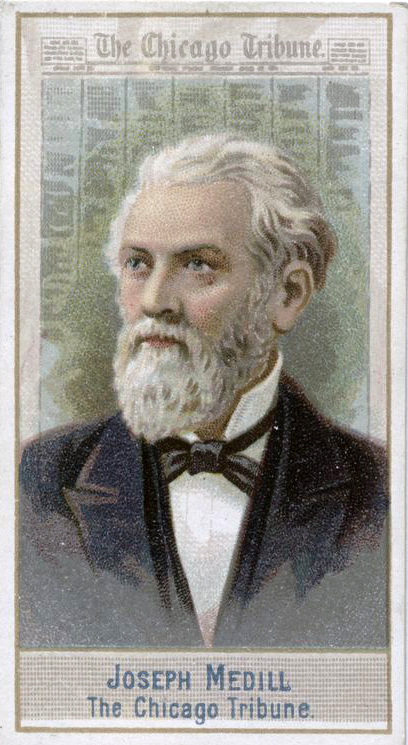
On the 18th of June, 1855, Mr. Timothy Wright, who had been a silent partner in the proprietorship of the Tribune, assumed a general partnership; and Mr. Joseph Medill, of Cleveland, Ohio, also purchased an interest in the establishment. The arm became Wright, Medill, & Co. Mr. Medill is still one of the Tribune Company.
Reduction In Size.
A change in the proprietorship of the Tribune seemed to afford an excellent opportunity to curtail the mammoth proportions which had been put upon it without a judicious regard to the necessities of the case. One column on each page was, consequently, eliminated. Even on its reduced proportions—30 by 46—it was considerably larger than the present size of the Tribune.
Mr. Stewart Retires.
Mr, T. A. Stewart, who had been a proprietor of the Tribune from the start, sold his interest on the 21st of July, 1855, to his associates, and retired. In his fare well Mr. S. says:
- The admonitions of a physical constitution which is almost broken down by the long and almost unceasing labors which have necessarily been imposed upon it, leave no alternative but to sever the connection. In rural pursuits, beyond and above toe life of responsibility and excitement which the conductor of permanent public journal must assume, “I hope to regain, to some extent at least, health and strength.” But Mr. Stewart’s hopes were never but partially realized. He sunk to his final rest a little lees than three years after he penned the closing sentence. Mr. Stewart’s former associates in parting with him said: “We part from our friend with regret For many years he has stood up and done battle for what he thought just and right with a fearless and vigorous pen, He has bowed to no man in office, and been swayed by no man out of office, nor has he hesitated to oppose any power, however backed, which seemed to bim to threaten a right home influence, or damage the cause of Freedom. His plume tss waved ever in the thickest of the fight, and be has measured distance with the boldest and strongest of the opposition.
New Type and a New Press.
During the summer of 1855, the apparel of the Tribune presented quite a “seedy” appearance, much to the annoyance of the publishers. On the 24th of September it donned a new and beautiful dress, from the foundry of J. Connor & Son, New York, electrotyped with copper, by the now famous Newton company, being the first “copper faced” type ever used in this city, or the State of Illinois. A new fast Hoe press (single cylinder) was also introduced, run with steam power. The Tribune had been worked on a Northrup press, which is a sort of stepping stone between a hand press and a cylinder press. The proprietors in their congratulation say: “We have the pleasure of informing the numerous friends and readers of the Tribune, that its present income is highly satisfactory; that its circulation is rapidly increasing; that its advertising was never so large as during the last quarter. The number of dailies now issued and sold is rising 3 000; tri-weeklies 500, and weeklies 4,500. In conclusion. the publishers tender their sincere thanks to the public,” &c..
New Editors.
On the same day that the Tribune appeared in new type, as printed above, DR. C. H. Ray and J. C. Vaughan, were announced under the editorial head as editors. Dr. Ray had really been the controlling editor of the paper since the March previous, but no public announcement had been made of the fact until this time.
Congratulations.
On Thursday morning, June 12, 1856, commenced the 10th volume or year of the Tribune. On that occasion the publishers issued a card of congratulation, in which they stated that the paper was never before in so flourishing a condition. During the past year, the daily circulation increased over 36 per cent, and was then gaining at the rate of 100 per week. The Tri-Weekly bad increased 55 per cent, and the Weekly more than 300 per cent. The financial basis was pronounced in a healthy condition.
Change of Firm.
On the 29th of August, 1856, a change in the firm name of the Tribune took place, from Wright, Medill & Co., to that of Vaughan, Ray & Medill. The change of firm involved no change of proprietors, although the names of Vaughan and Ray had never before been published to the world as occupying that position. The same parties continued in the firm, but it became necessary, in order to comply with the requirements of the law of “special partnerships,” under which the firm was arranged. Messrs. Wright and Webster had been silent partners in the Tribune for several years, but had not been active and working partners. Since the 9th day of June, 1855, Vaughan, Ray, and Medill had been conductors of the establishment, in its editorial and business departments. Mr. Alfred Cowles, at present one of the proprietors, and Secretary of the Tribune Company, and who had had charge of the finances of the office from the commencement of Ray, Medill, and Vaughan’s connection with the office, was at the same time taken into the firm. The following gentlemen then constituted the proprietors: Timothy Wright, J. D. Webster, Charles E. Ray, Joseph Medill, John C. Vaughan and Alfred Cowles. The finances of the Tribune, it was announced, were in a prosperous condition, and its income satisfactory to the proprietors.
Mr. Vaughan Goes Out.
Or the 26th of March 1857, Mr. John C. Vaughan, who had been connected with the Tribune for nearly two years, withdrew, in a brief card, in which he states that he goes into pursuits “promising to be more advantageous in a pecuniary way.” The title of the firm then became, Ray, Medill & Co., and from that time no change in the name of the firm took place until July 1, 1858, when the Tribune and Democratic Press were consolidated. Sometime between the dates named above, Messrs. Ray, Medill & Cowles purchased the interests of Timothy Wright and J. D. Webster, and at the date of the consolidation were exclusive proprietors of the Tribune.
Eleventh Volume.
At the commencement of the Eleventh volume, June 10, 1857, the proprietors stated that the Daily circulation was 4,000; the Tri-Weekly 800, and the Weekly 8,000. The editors say that the Tribune is an institution—a power in the land. Whatever may be the progress of Chicago and the West, it is bound to keep ‘neck and girth’ with their movement.” Has not this promise been faithfully fulfilled?
Cut Down.
Everybody recollects the finsncial disasters of the autumn of 1857. It affected newspapers as well as merchants, bankers, &c. Acting upon the theory of a judicious economy, on the 10th of November the dimensions of the Tribune were reduced one column on each page—it, in its curtailed proportions, representing 26 by 39 inches—not by any means a small sheet. From the fact of its great activity, rapid progress and immense business, no city suffered more severely from the disasters than Chicago, and scarcely a firm of any importance escaped embarrassments.
From this time until the consolidation, which took place on the 1st of July, 1858, no event of importance, affecting the position or character of the Tribune, occurred. Having brought the History of the Chicago Tribune up to that point, we must now go back a few years and give a bfrie history of the Democratic Press.
The Democratic Press was introduced to the public for its support on Thursday, September 16, 1852, under the editorial and proprietory control of John L. Scripps and William Bross. The Press announced itself a straight supporter of the Democratic party and its policy, and flew at its head the names of Franklin Pierce and William R. King for President sad Vice President; Joel A. Matteson and Gustavus Koerner for Governor and Lieutenant Governor. The editors in their salutatory, say:
- It is our intention to make it a reliable advocate of Democratic measures, and a firm supporter of the Democratic party—regarding the latter as the only instrumentality through which the former may be conducted to a triumphal issue. We shall appeal to men’s understanding rather than their prejudices, and all times labor to to accomplish our ends through fair and honorable means—neither distorting truth on the one hand, nor concealing it on the other. * * * * It is our intention to make the Democratic Press emphatically a newspaper.
Its dimensions were 24 by 34 inches, printed on brevier and agate. The office was located at 45 Clark street. We will here state that few changes took place in the management and conduct of the Press during its existence. Its history will therefore be brief.
Half Yearly Greeting.
Just six months after the inauguration of the Democratic Press, March 16, 1863, it was enlarged, by the addition of a column to each page, and a corresponding increase in the length of the columns, “to meet the constantly increasing demand which is being made upon the advertising columns of our paper.” The editors say: “Six months ago to-day we launched our little venture upon the open sea of experiment. We did so with the confident expectation of success, because we believed that in establishing another paper in Chicago, we were but meeting one of the wants of the city and the Northwest. * * * The result has been before the public. Instant in season and out of season, we have labored for six months with a devotion never exhibited save by those whose hands and minds move in conjunction with the best impulses of the heart. Our hearts have been in our work, therefore our work, though arduous, has seemed light. But notwithstanding we entered upon the enterprise with so much confidence, our sueceas has far transcended our expectations. The Democratic Press now stands side by side with the most prosperous papers of the city. Its subscription and advertising lists have nothing to fear from a ciose comparison with those of its most flourishing cotemporary.”
Second Volume.
September 16, 1854, the Democratic Press entered upon the second year of its existence. The editors say: “At no time since the establishment of the Press has the subscription lists of both our daily and weekly editions increased so rapidly as at present, and at no time has the pressure been so great upon our advertising columns.”
Political.
During the session of Congrees, which commenced in December, 1853, the famous Nebraska bill was introduced by Judge Douglas.
Until this time the Press had pot deviated in its allegiance to the Democratic party. But it did not hesitate to come out boldly and unequivocally in opposition to that famous measure, and soon became entirely estranged from its author and all who sustained him, and ever after maintained that position.
Press Enlarged.
March 27, 1854, one and a half years after its commencement, the Press was enlarged, for the third time, its new dimensions being 28 by 44 inches—the present size of the Daily Tribune. In their notice of the enlargement, the proprietors say: “Chicago is growing with a rapidity unparalleled by American cities, and we desire to keep pace with its growth in every respect. If industry, a liberal expenditure of money, and such abilities as it has pleased God to endow us with, can make our paper a fair exponent of the material and mutual interests of our city, it shall be done.” At the same time of the enlargement, a Tri-Weekly edition was commenced, in connection with the Daily. The size was the same as the Daily, and was afforded at $4 per annum.
Progress of Western Journalism.
On the 24th of August. 1854, the Democratic Press published a long article on the Progress of Western Journalism. We have space for only a few of the facts embodied in that article. At the date named there were published in Illinois: Dailies, 20; Tri-weeklies, 7; Weeklies, 124; Semi-monthlies, 1; Monthlies, 4; Bi monthlies, 1—total, 157. The total number publisned in the Mississippi Valley was estimated at 1,000. The Democratic Press was established September 16, 1852. It commenced with a list of something over one hundred subscribers to the Daily edition, and about two hundred and fifty to the Weekly. At the date indicated above, two years from its commencement, the Daily Press had a circulation of 2,064; and the Weekly edition 4,080. The local force employed on the paper at that time was: Editorial Staff, 4; Traveling and Local Correspondents, 5: with 40 others, in the various positions of foreman, compositors, pressmen, carriers, clerks, &c. The gas bills for the year footed up $409.64. The expenses per day were $121.11, per week $726.66, and per annum $37,786.32. The white paper used on the Press cost $29.43 per day, $176.58 per week,and $9,192.16 per year. These facts we give here, and may introduce when we get farther into this history by way of comparison.
New Firm.
On Monday, September, 1854, Bartin M. Spears purchased an interest in the Democratic Press, and the style of the firm was changed to Scripps, Bross & Spears, Mr. Spears’ labors being more particularly connected with the operating or mechanical department of the paper.
New Dress.
The habiliments, of the Democratic Press, along the first of April, 1855, bore somewhat a shabby and rusty appearance Therefore, on the 12th of April it appeared in new and beautiful garments—Minion and Agate—from the Type Foundry of White & Co. New York. The editors, on the occasion, say; “It is well with the Democratic Press. * * * The business of our establishment has more than donbled within the last twelve months. * * * Our books show the business of the establishment for the first three months of the year to be only a fraction short of $20,000, or at the rate of $80,000 per year.”
Railroad, Commercial and Manufacturing Statistics.
During the early part of the Fear 1856, the Press, as it had done every previous year of its existence, published several exhaustive articles, embodying the commercial, manufacturing and railroad statistics of Chicago. On the occasion of the presentation of the latter, on the 16th day of Februerv, the proprietors of the Press gave a brief review of their own operations, from the commencement of their enterprise. They say:
- The Democratic Press was first issued on the 16th day of September, 1852. Commencing with comparatively a small outlay of capital, and without a single name upon our subscription list, the Press has steadily gone forward, surmounting every obstacle and our general business is increasing every day * * * We have now in use 11 power presses, combining all the latest improvements, including one of Hoe’s Double Cylinder machines. * * * At the present time we have sixty-five men employed in the different departments of the establishment, and our current business is at the rate of about $100,000 per annum.
New Dress and a New Press.
Influenced by the somewhat shabby apparel in which the Press appeared before its patrons, on the 8th of May, 1857, it appeared in an entirely new dress. The type was obtained from the Chicago Type Foundry, and was in no way inferior in beauty of face, and quality of metal, to any ever purchased from the Atlantic Metropolis. The editors said: “This rapid growth and prosperity of Chicago and the Northwest are both reflected in the success of the Democratic Press establishment, and we are determined that nothing ball be Wanting on our part to make a proper return for a generous patronage.”
Volume VI.
On Wedneedsy, September 16, 1857, the VIth volume of the Press, was commenced. On that occasion, the editors published an article reporting progress. The tooting up of the books showed that the entire business of the office, for the past year, amounted to $111,508.16, an increase over the previous year of $27,109.22. At that time the concern had 10 power presses running. The editorial force consisted of six persons, and every thing else in proportion. The editors say in conclusion: “The results of our labors for the past live years have more than realized our most sanguine expectations.”
Reduced in Size.
The terrible financial disasters which swept over our country during the autumn of 1857, were no lees severe upon the daily journals than upon merchants, bankers and every other class of the community. Yielding to a necessity as imperative with the first as the other classes of sufferers, the Press, on the 6th day of November, 1857, curtailed its mammoth proportions by lopping off one column from each page, with a corresponding reduction in the length of the columns. This reduction in no manner circumscribed the news columns, but only the advertistug, the diminution of which seemed a necessity of the times.
From this date nothing of historic interest occurred in the condition, character or standing of the Democratic Press, until the 1st day of July, 1858, when it was consolidated with the Chicago Tribune. The history of the consolidation we shall now proceed to give, briefly, bringing it up to the hour of the present issue.

THE CONSOLIDATION.
Chicago Press and Tribune.
At the date mentioned in the precediug sentence, there were published in this city four daily papers, which, although at the time of starting, were controlled by varied political sentimente, though the chaotic and purifying influences of the times, had, in that respect, become almost entirely identical. True, personal differences, engendered by competition, in a business point of view, bed kept up an apparent antagonism, which frequently found expression in bitter words through the columns of each journal.
The financial and commercial disasters which opened their blighting influence upon the business world, in the autumn of 1857, was not without their subduing influences the proud-lipped and stiff necked jourupon nalists, who, in the more prosperous days, each considered himself abundantly able to paddle his own canoe. Two of the more uppish and influential ones, started originally with little or no capital, had improved their condition but slightly up to this hour, save in the fact of having accumulated extensive establishments, which had been paid for in part, and in part not. Those accumulations at the time they were made seemed necessary to keep pace with the great progress which bad blessed Chicago, but now they were a draw-back upon them, as it required the best efforts of judicious care, in the troublous times which then were upon us, to carry them through to a successful result. As we have before intimated, approaching the first of July, a truce was sounded between the proprietors of the Chicago Tribune and the Democratic Press, which resulted in the consolidation on the day named. The parties to the consolidation, and who became proprietors of the Press and Tribune, were Charles H. Ray, Joseph Medill and Alfred Cowles, on the part of the Tribune, and John L. Scripps, William Bross and Barton W. Spears on the part of the Press, and the combined firm took the style of the Press and Tribune Company. The Tribune was removed to 45 Clark street, the building occupied by the Press. The reasons, as set forth in the Tribune for the consolidation, were given at some length, from which we call a few extracts:
- There are too many Republican papers in Chicago. Four large dailies in the English language, and one in the German have literally glutted the newspaper market. It is not unjust to our city contemporaries to say that among these, the Tribune and the Press have held no second rank. In point of circulation they are about equal. To a certain extent they have been rivals and though both have liberally sustained their respective proprietors, by three years trial, have become convinced that neither can outdo the other; and that so long as they both live, neither can take that rank in the world of journalism which the importance of our city and the North rest, and its own merits, will justify the new paper—the Press and Tribune—in assuming. To put an end to the expensive rivalry which has heretofore been kept up; to lay the foundations deep and strong of a public journal, which will become one of the established institutions of Chicago; to enable us to combat more powerfully, and, we trust, more successfully, public abuses; to give us a wider influence in public affairs, in behalf of sound morality and a just Government, we have become parties to the arrangement announced above. We trust our readers will be satisfied with the change.
And in the first consolidated issue, on the day following, the editors say: “It is scarcely necessary to say anything to the former readers of the Press or the Tribune, as to the political course of the consolidated paper. The steady, zealous end consistent support which these journals have given to the great cardinal doctrines of the Republican party, is a sufficient earnest for the future.”
The Press and Tribune was enlarged over, the size of the previous issues by the addition of one column to each page, and by considerably lengthening the columns The consolidation embraced the idea of A morning and evening edition, and both were for a time issued, but the impossibility of obtaining telegraphic dispatches for our evening edition, owing to the monopoly which a rival establishment exercised over them, and which it refused to yield, the enterprise was finally relinquished, although it was a very decided success from the start.
An Assignment.
An important era in the history of the Press and Tribune occurred on the 8th day of November, 1858. We need not particularize the causes which led to the event which we are about to refer to briefly. We will only say that they are to be found in the financial and commercial disasters, which, commencing in the autumn of 1857, after the exhaustion of over a year, had experienced scarcely a perceptible abatement. At the date mentioned (November 8, 1858) the proprietors found themselves oppressed by matured pecuniary obligations, which, although at the time the establishment had never been so prosperous before, they found it impossible to meet. They felt that if time was given them every dollar of their obligations would be paid. They therefore called a meeting of their creditors, exposed to them the exact condition of their liabluties and assetts, and proposed to them that if an extension of three years was granted, they would pay dollar for dollar, with ten per cent interest. After consultation, this proposition was most generously acceded to by the creditors, although at that time there was an almost unparalleled scarcity of money, influenced by the panic which then overspread the land. Mr. Spears at this time disposed of his interest to the other partners and retired. The amount of indebtedness of the establishment was found to be a little upward of $65,000, while the firm possessed visible assets; in the shape of type presses, accounts, & c., which would considerably overtop their indebtedness, out which, if disposed at public sale, would at that time have been literally sacrificed. Hon. Van H. Higgins was chosen assignee of the establishment. Just twenty-one months from the date on which the assignment was made, every dollar owed by the Press and Tribune Company, with ten per cent interest, had been paid, and the bill books—receivable and payable—kicked out of the office, never, it is to be hoped, again to have an abiding place in the establishment. Not only this, but during the period named, every article purchased for the use of the establishment, every man’s salary, and every other item of running expenses, were promptly paid; and further, during the same period, the office was removed from 45 Clark street to its present location, at an expense of nearly $8,000, and new type for the Press and Tribune, obtained at a still further expense of $3,000; And thus when the Presidential campaign of 1860 had been fairly inaugurated the Tribune Company found themselves freed from every pecuniary obligation, ready to labor in behalf of Honest Abraham Lincoln, for the elevated position which he now holds.
“Chicago Tribune.”
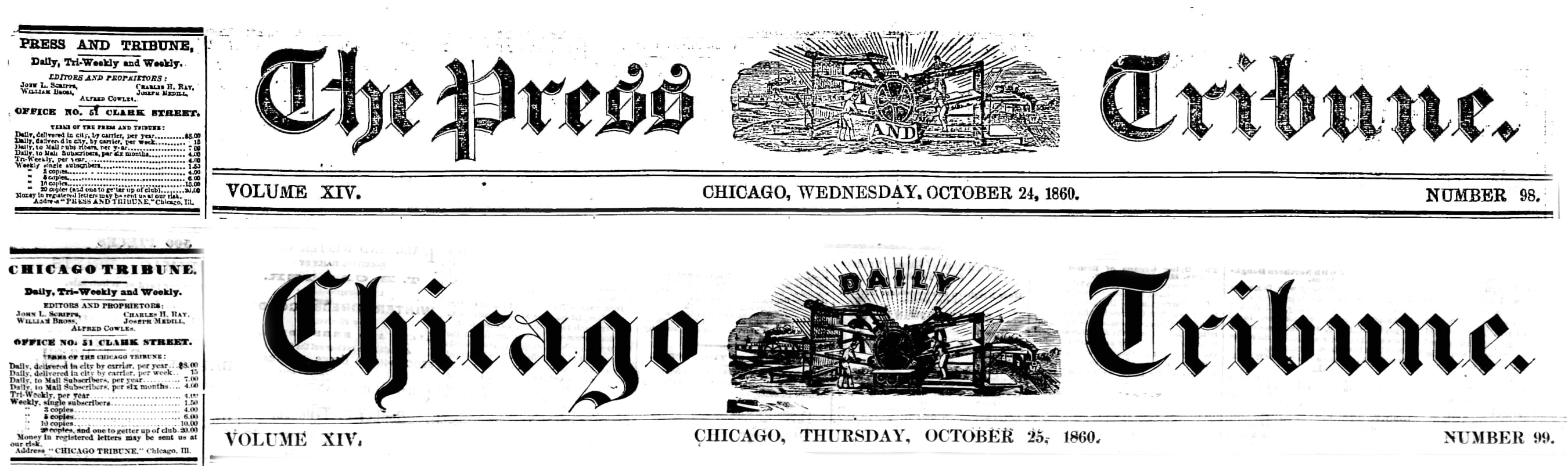
On the 25th of October, 1860, the Press and Tribune, on the occasion of appearing in a new dress, dropped a portion of its title, and thereafter took the name of Chicago Tribune. The design had been entertained from the consolidation, and the double name was only maintained to this time, in order to get its patrons thoroughly to understand that the two names simply indicated one journal.
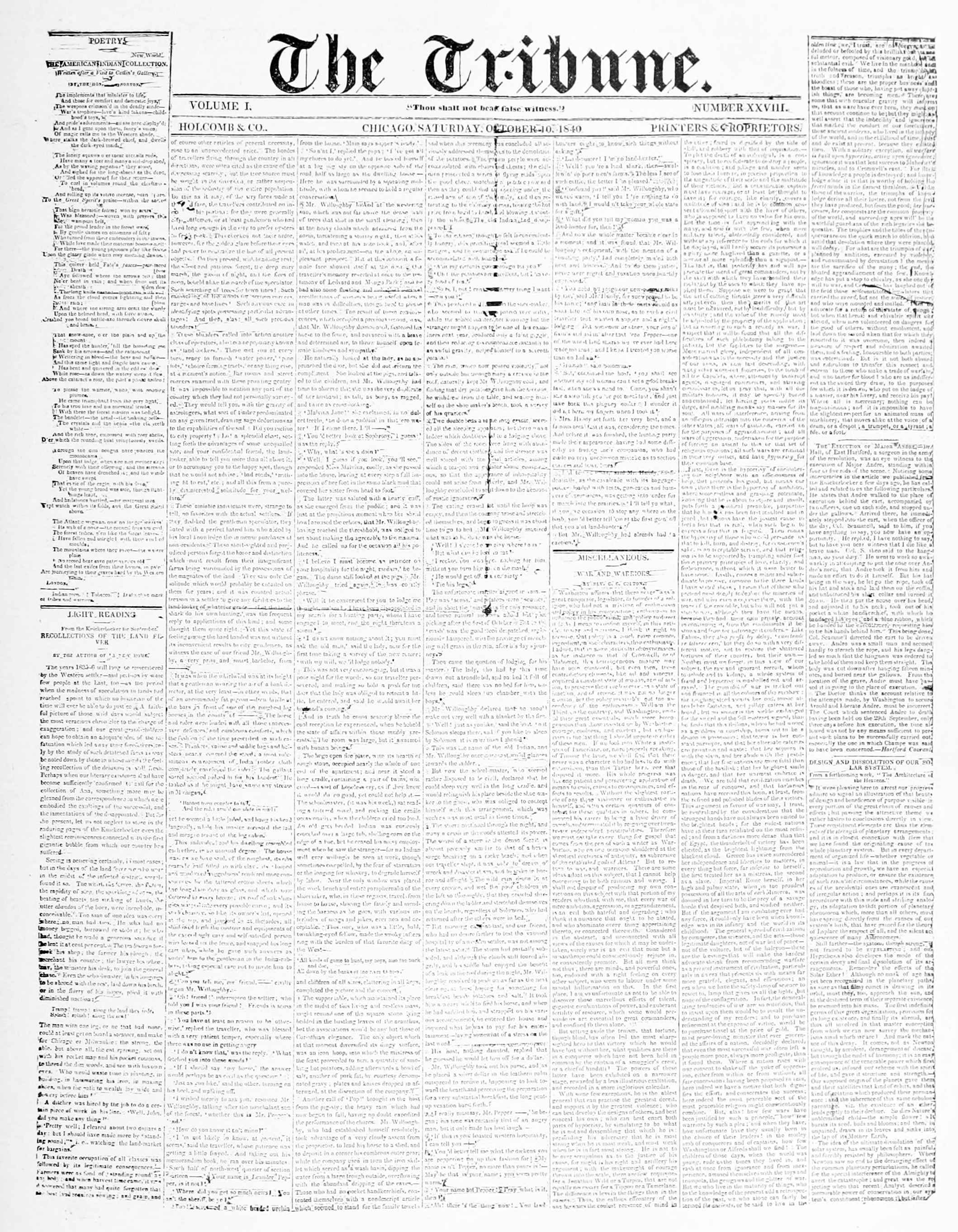
In this connection we consider ourselves boned to vindicate the truth of history. The idea is very general—almost universal—that the first Journal ever issued in the United States—or in the Old World either—under the name of. Tribune, was our New York namesake—by Horace Greeley (and Holcomb). This is a mistake. The honor of originating that name belongs to Chicago. Hon. E. G. Ryan, now of Milwaukee, established a journal under that name in this city about the year 1840. It was not long-lived; but it was the first newspaper ever known under that title. The New York Tribune was not started until April 10, 1841.
Incorporated.
During the session of the Legislature, in the winter of 1861, the Tribune Company was incorporated by that body, with a capital of $200,000. The then proprietors—John L. Scripps, Wm. Bross, Charles H. Ray, Joseph Medill and Alfred Cowles, to which was added William A Rand, became the stockholders. The company was organized by the election of John L. Skripps as President, and Alfred Cowles as secretary. With the exception of Dr. Ray, all bear the same relation now. Within a short period, several employees of the establishment have become small stockholders in the company, by purchase, The officers of the company for 1864 ere: President—John L. Scripps; Vice President—William Bross; Secretary and Treasurer—Alfred Cowles: Editorial Superintendent—Joseph Medill; Mechanical.Superintendent—William H. Rand.
A Four Cylinder Press.
During the early days of the year 1861, from the rapidly increasing circulation of the Tribune, which had then reached over 20,000 daily—it became painfully apparent that the capacity of the “double cylinder” press, which we were then using, was entirely inadequate to the task imposed upon it; and consequently an order was given to Hoe & Co. for one of their famous “four cylinder” machines. It was completed and put in operation about the 1st of July, 1861. Although the new prees was good for eight thousand an hour, we soon discovered that it was not up to the necessities of our rapidly increasing circulation. But impressed with the conviction that this war would be of short duration, and that its termination would greatly reduce the demand for the Tribune, we continued to impose our four cylinder duties begond its capacity until May last, when the order was given for the new Eight Cylinder Printing Machine which sends forth this printed sheet this morning. But of it, more hereafter.
Dr. Ray Retires.
From the inauguration of our four cylinder press until to day, nothing of moment has occurred in the history of the Tribune gave the retirement of Dr. Ray, which took in November last, to the extreme regret of his associates, who not only parted with a noble hearted, generous friend, but an associate whose capacity is not paled by comparison with the ablest of the land.
TO-DAY.
We will now speak of the Tribune today, and will begin with
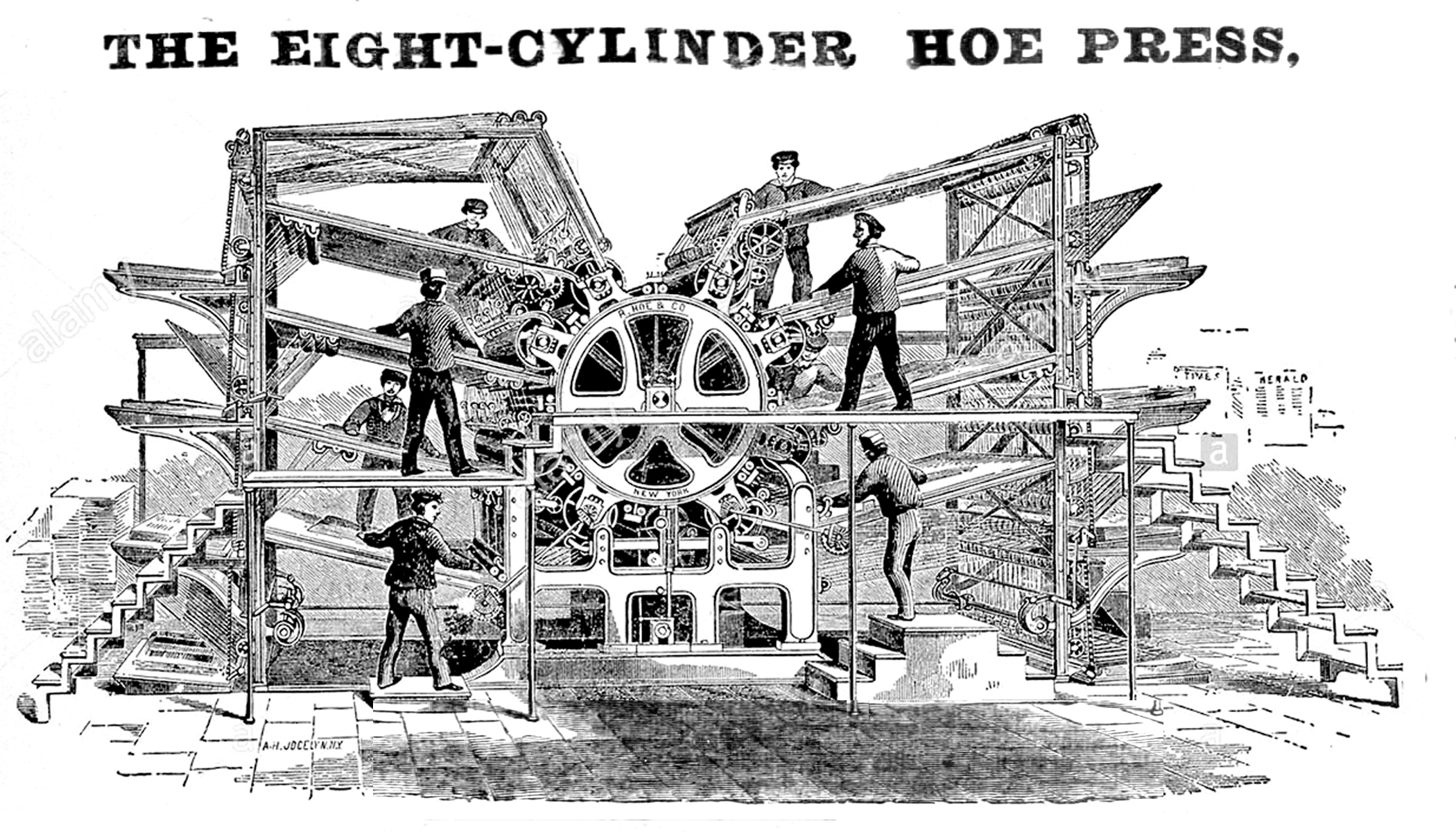
Our New Eight Cylinder Printing Machine.
It was reserved for Richard M Hoe, of New York, an American mechanic, to make the first successful type revolving press, ofter many costly and unsuccessful experiments, in 1847. Our new press proper is four feet five inches wide, twenty feet high, and the machine itself, independent of “flies,” is thirty-one feet six laches in length. The large central type cylinder on which the forms are placed is sixteen feet six inches in circumference. The eight cylinders, or drums, on which the paper revolves to receive the “impression” from the types, are each one-third that size, these smaller cylinders each making three revolutions to one of the central cylinder. The forms or pages constitute segments of the central circle, and occupy about one-fourth of the circumference, the remaining three-fourths being used as an ink-distributing surface. The estimated weight of the press proper is at least twenty-three tons. There are in it over ten thousand regular pieces. Twenty composition rollers, for the distribution of ink, are used upon it. There are one thousand yards of web tape to pass the sheets in to and away from the cylinders. Five hundred and forty two tape pullies, one hundred and eight gear wheels, one hundred and twenty-two steel springs, together with bolts, screws, nuts, rivets, pine and keys, are parts of this mammoth concern. There are two hundred and fifty “oil holes” in it. The machine and its balconies occupy a space forty feet in length and twenty feet in width, taking up in height two stories of a building in the rear. The floors about the press are laid on a frame work of iron, of which material, also, the stair-cases leading to the different parts of the machine are constructed. One may ascend and descend fifty-seven regular steps in examining the press, without touching the same one twice or coming in cortact with the machinery. Eight “feeders” are required, and twelve persons in all form a full complement for running the monster. The machine prints 16,800 sheets per hour, which capacity could be increased to twenty thousand. It runs with an astonishingly small amount of noise, and the motion is a miracle of beautiful mechanism. It is located in the neatest and most convenient press room in the United States.
The Process of Printing.
After the type is set up in the composing room, it is made up into forms (or pages) upon a convex surface, constructed of steel and brass, and called a “turtle.” The type, being divided into columns by rules running lengthwise, is held in place by being “locked up” with screws acting upon the ” side-stick” and “foot-stick.” The “turtle” is then lowered to the press and secured upon the central cylinder. The large cylinder being set in revolution, the form of types is carried successively to all the smaller or impression cylinders; on each of which a sheet of paper is introduced and receives the impression of the types as the form passes. To each impression-cylinder there is a board on which the sheets are laid, and from which they are “fed” to the machine, and also tapes to carry away the printed sheet and deposit it on the delivery board at the end of the press.This last process is entirely performed by the machine itself, without the aid of any attendant. One person is required at each impression-cylinder to supply or “feed” the sheets, which are taken at the proper moment by fingers or grippers, and, after being printed, are conveyed out. The ink is contained in a fountain beneath the main cylinder, and is conveyed by means of distributing rollers to that part of the surface of the main cylinder not occupied by the forms. This surface being lower than the types, passes by the impression-cylinders without touching them.
How Our Press Got Here.
When Col. Hoe announced that our press was finished and ready for shipment, we knew just the man with whom we could entrust the responsible duties of bringing it to us—it was no other than J. W. Smith, agent of the Merchants’ Dispatch fast freight line, How well he did his work, may be readily inferred from the fact that, notwithstanding the press weighs about 65,000 pounds, and occupied five large freight cars, it was delivered at our door the incredible short space of five days from New York, probably the best time ever made with the same class of freight. The route was the Hudson River, New York Central, Great Western, and Michigan Central Railways. Of course, Smith, and every one of the men, had some ambition and pride in the matter, and did their very best. On thorough examination, after its arrival, it «as ascertained that not a single box, bar or bolt was missing. The cost of the press, including transportation, putting up, &c., is very nearly $32,000. Tois new machine is placed in a building 20 by 40 feet, two stories, in the rear of our present press room, and is open to the inspection of all who may desire to view the monster It is very faithfully reproduced on paper in the cut which adorns the head of this article.
Folding Machines.
We have in the press room three of D. F. Bulkley’s Folding Machines, manufactured at Manchester, N. H. The combined capacity of the three folders is about 8,000 sheers per hour. It is a superior machine—the best, we thick, ever invented. It does its work with a speed, accuracy and neatness unapproached by any other machine.
Our Office.
We annex a few details, in order to give the outside world an interior view or the Tribune establishment.
At the Laboring Oar.
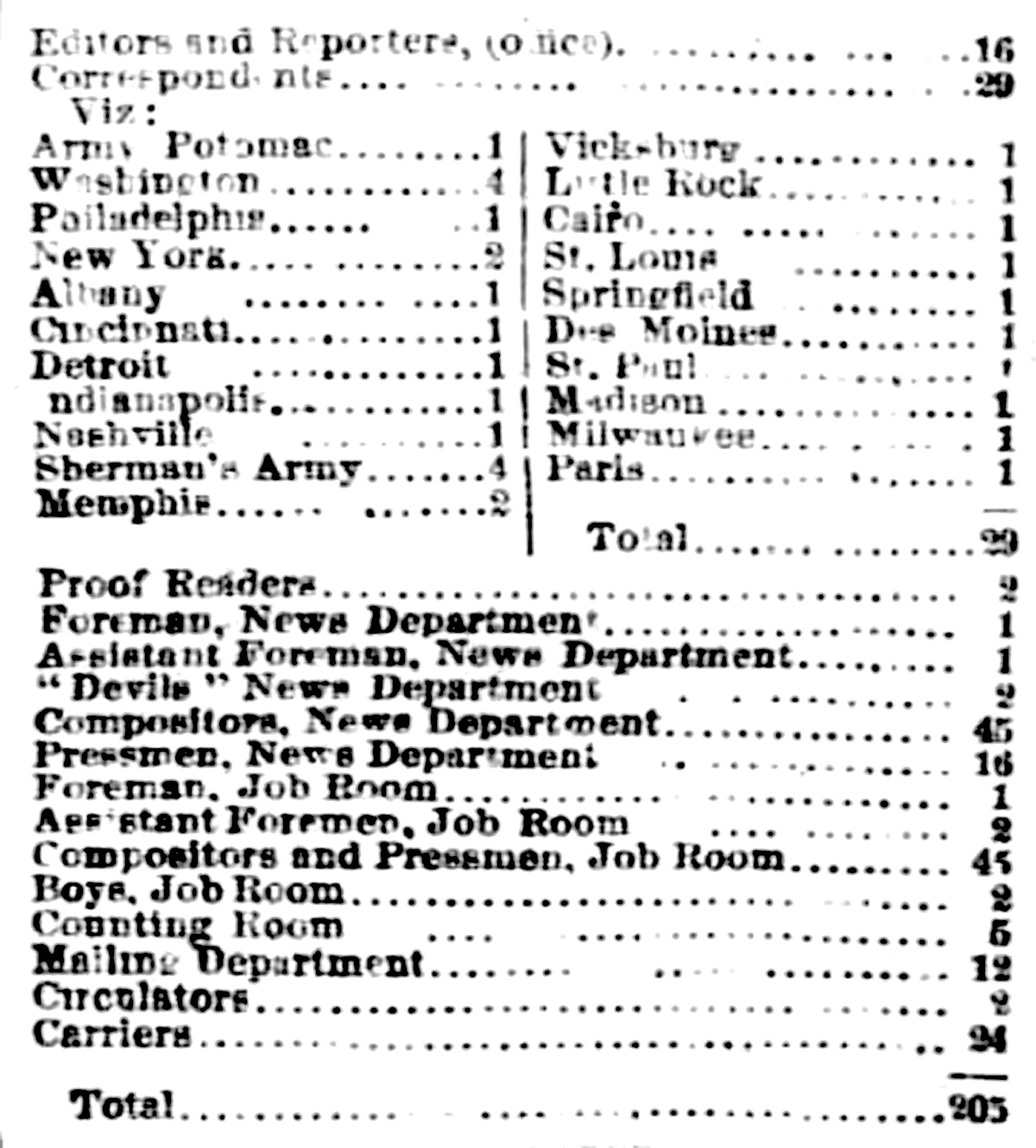
The entire force required to produce the Tribune daily, is enumerated in the table below. Their name is Legion:
White Paper.
The amount of newspaper used during the year, from July 1, 1863, to July 1, 1864, was little over 22,000 reams, or say 10,000,000 sheets. These sheets if spread out lengthwise, would reach 440,000,000 inches, pearly 37,000,000 feet, or over 7,000 miles—about one third the circumference of the earth. This amount is simply for the three editions of the Tribune, and includes no paper used in the job room. It. has been chiefly supplied to us by J. W. Butler & Co, of this city. but at times we have been obliged to resort to other manufacturers, the capacity of Messrs. Butler & Co.’s mill being not equal to to our necessities. In round figures, the amount of paper named has cost us $160,000 for the year. In 1860, the average price of news white paper was 9½ cents per lb. To-day it is 22 to 25.
Ink.
During the period named in the previous paragraph, we have consumed 22,978 lbs. of ink. This ink has been supplied us by C. H. Scriven, the popular advertising agent, who is by far the largest printers’ ink dealer in the Northwest. Three years ago we paid 14 cente a pound for news ink. To-day we are paying 32 cents.
Our Job Department.
We need hardly enumerate the facilities which our Job Department offers to the public. They are familiar to the public, who frequently place them under contribution. We may say they embrace 13 first-class presses, 400 different fonts of type and 50 master workmen.
Telegraphing.
In 1800, our ordinary expenses tor telegraphic dispatches were $25 per week, or say $1,200 per year. To-day they range from $200 to $250 per week, or about $12,000 per year. This is not all. The uses to which the telegraph is now employed in the way of special dispatches, necessitate the employment of numerous telegraphic correspondents, numbering with us usually about fifteen, at an expense of $10,000 or $12,000 additional.
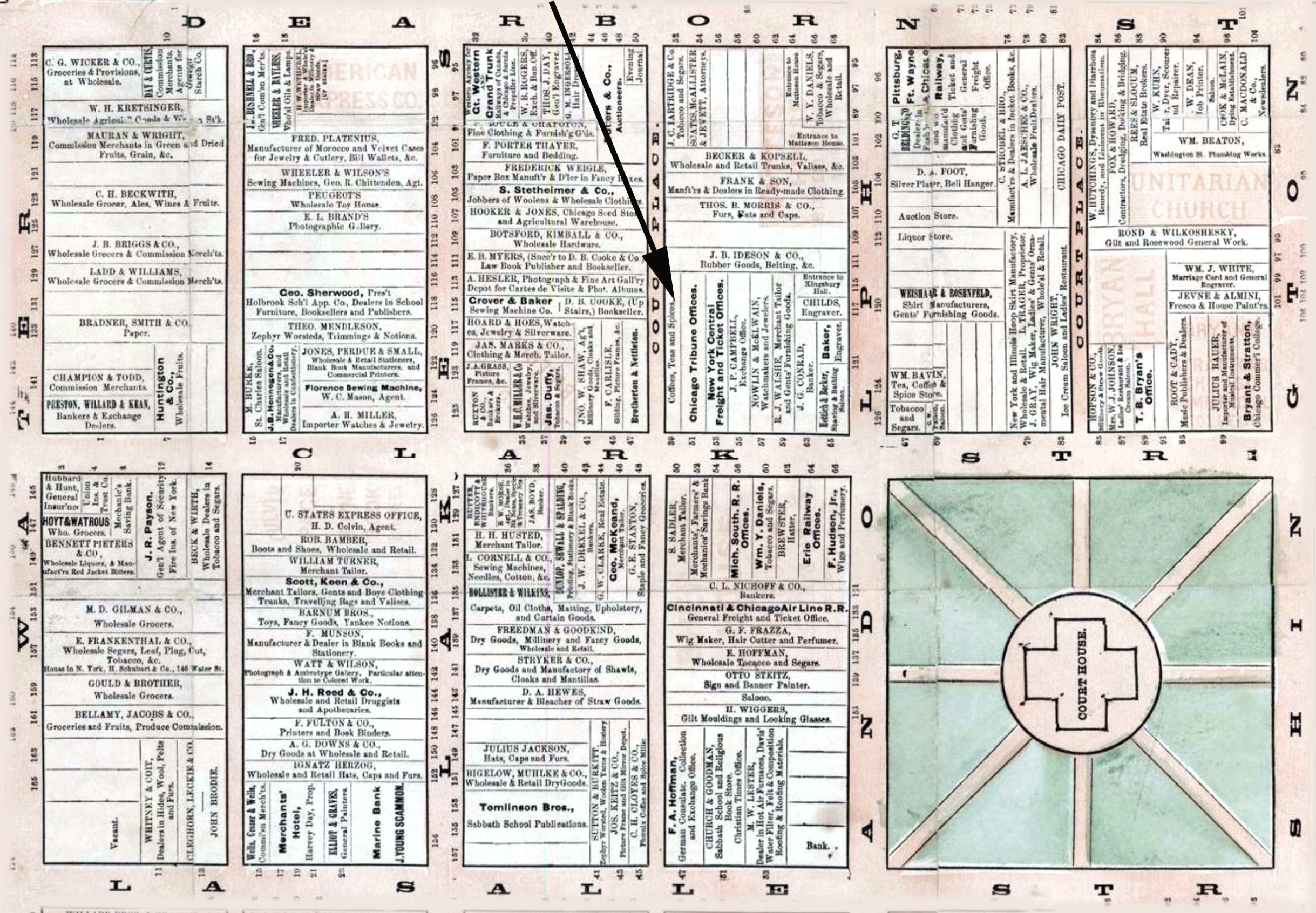
- Chicago Tribune Offices
51 Clark street
1862
NOTES.
1 The Tribune, launched August 23, 1847, built in Chicago. Original owner Tom J. or William Reed. Tonnage, 181, Length: 103′ 9″, Beam: 23′ 4″, Depth: 8′ 3″.
Final cargo was wheat. Final location was off Cathead Point, Leelamau Peninsula, MI, April 18, 1848. Foundered in storm with all 10 hands. November, 1849, wreck discovered near Grand Traverse Bay.

Leave a Reply