- D. B. Cooke & Co.’s City Directory for the Year 1859
AGENTS, ADVERTISING.
Gallagher John J., 155 Randolph
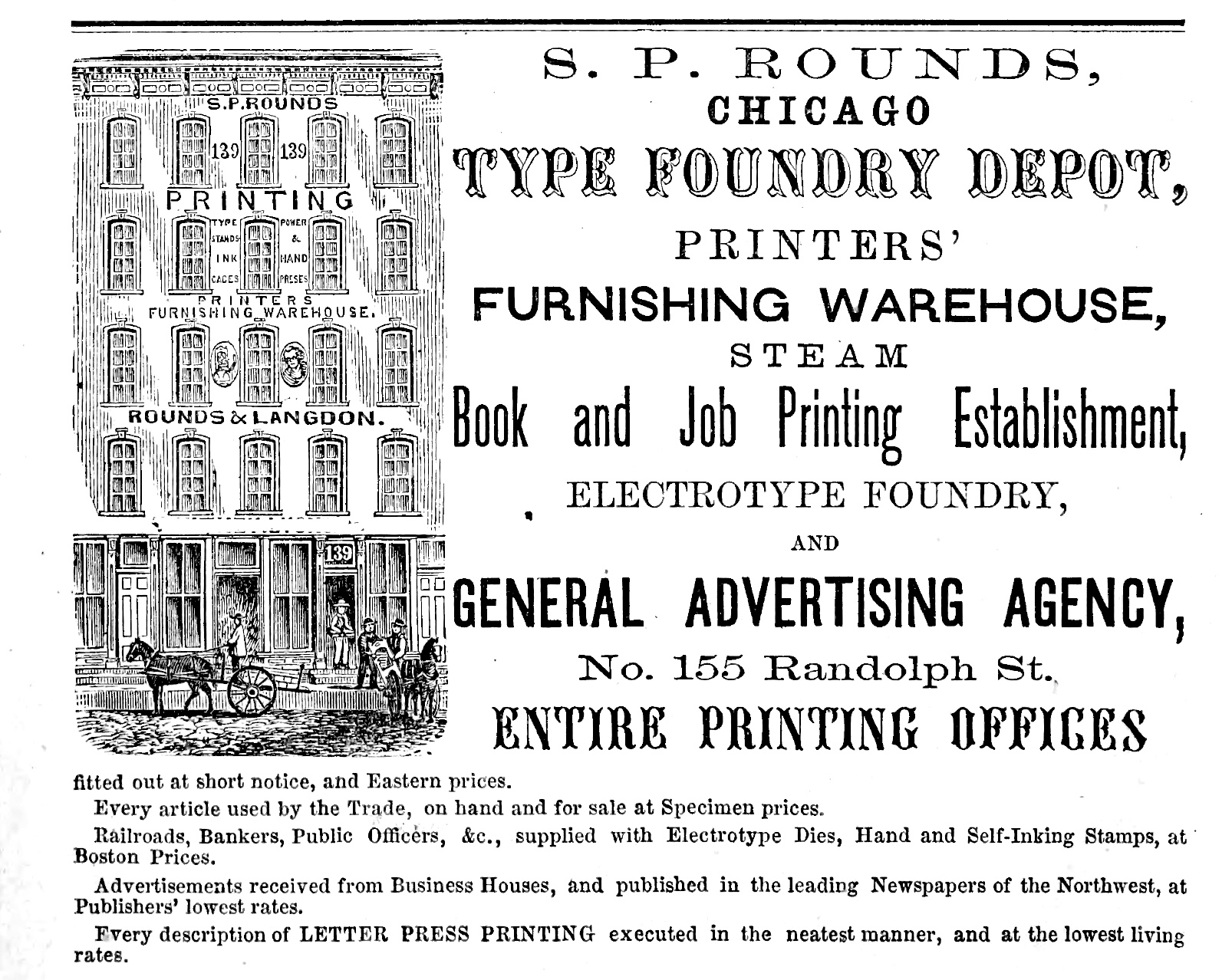
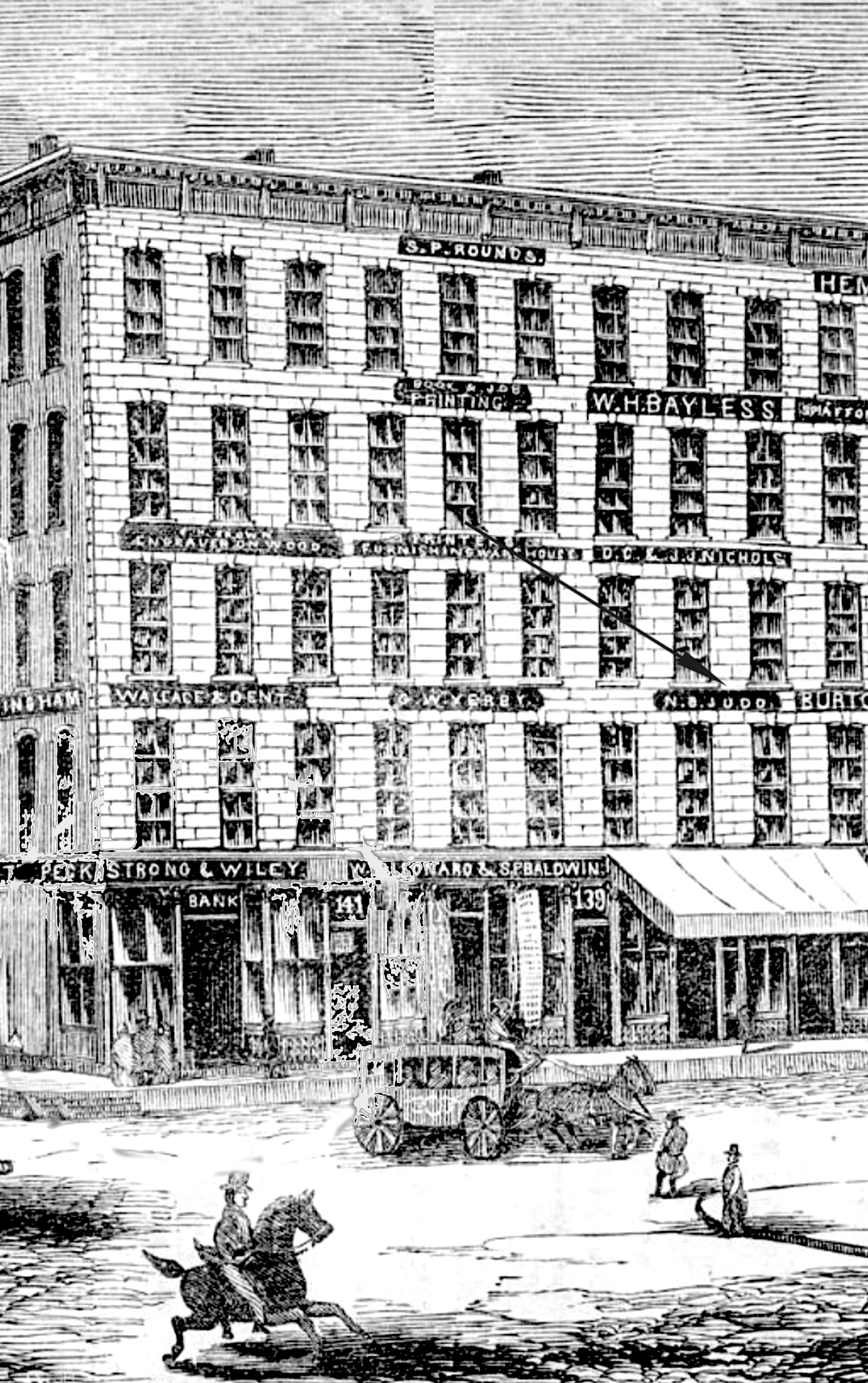
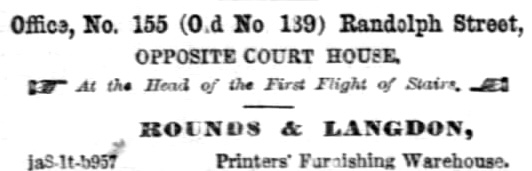
Rounds & Langdon, 155 Randolph
Scriven Charles H., 63 S. Dearborn (See advt p. 324
Halpin & Bailey’s City Directory for the Year 1863
AGENTS, ADVERTISING.
Bailey John C. W., 130 Clark.
Halpen T. M., 130 Clark, P.O. Box 4384.
O’Donoghue J. J. W., 51 Clark.
Scriven Charles H., 63 Dearborn
Spencer William S., 55 Clark.
Taylor Joseph R., 128 Clark.
Halpin’s Chicago City Directory for 1864
AGENTS, ADVERTISING.
Finley & Co., 84 Dearborn.
Halpen T. M., 73 Dearborn.
Kennedy R. V., Board Trade bldg.
O’Donoghue John J. W., 51 Clark.
Spencer William S., 55 Clark.
Scriven Charles H., 63 Dearborn
Taylor Joseph R., 128 Clark.
John C. W. Bailey’s Chicago City Directory for 1867
AGENTS, ADVERTISING.
Cook, Coburn & Co., room 11, Masonic Temple.
Schroeder William R., rooms 6 and 8, 53 Dearborn.
Wait Brothers, 126 Dearborn.
Edwards’ Annual Directory in the City of Chicago, for 1870
ADVERTISING AGENTS.
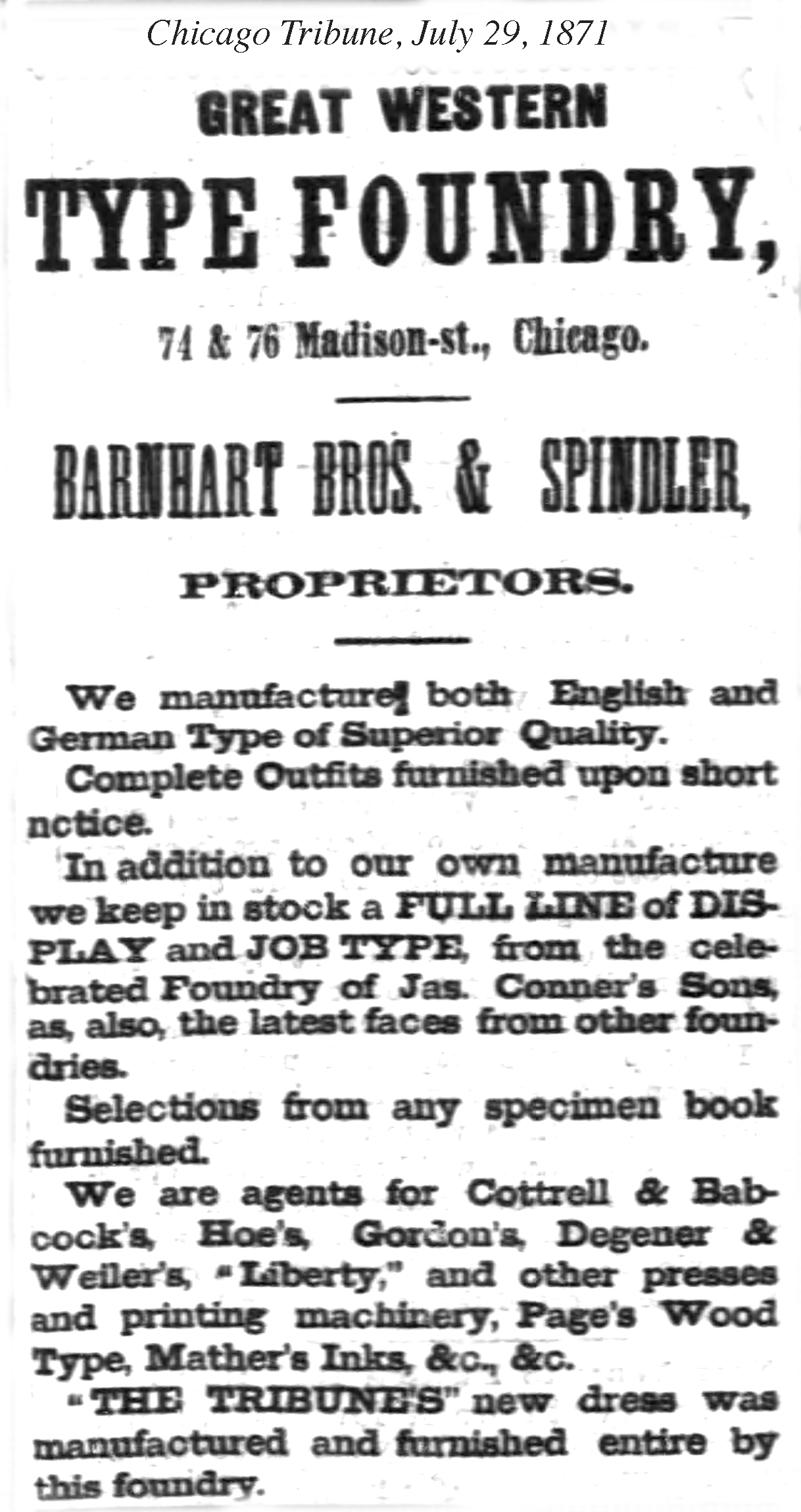
Barnhart Bros. & Co., 74 Madison
Bowles Thomas G. room 3 Tribune bldg.
Cook, Coburn & Co. 87 Dearborn
Great Western Type Foundry, H. Toepfer & Co. propr. 74 abnd 76 Madison
Hair & Richardson, room 12, 97 Clark
Hudson, Menet & Gay, 133 Dearborn
Lloyd Louis & Co. 126 Dearborn
O’Brian & Jones, 115 Madison
Richardson O. W. room 13, 97 Clark
Steele & Hitchcock, 10 Arcade ct.
Telegraph Bulletin Advertising Co., W. H. Frasier & Co. proprs. rooms 15 and 23, 137½ Madison
Thrall L. P. room 4, 66 Madison
Edwards’ Annual Directory in the City of Chicago, for 1871
ADVERTISING AGENTS.
Barnhart Bros. & Co., 74 and 76 Madison
Booth S. M. 133 Dearborn
Bowles Thomas G. room 4 Tribune bldg.
Cook, Coburn & Co. 87 Dearborn
Daniels John B. 23 Washington
Fraiser W. H. & Co. room 23 137½ Madison
Hair & Richardson, room 13, 97 Clark
Kellogg A. N. propr. Inside Track List. 110 and 112 Madison
Lloyd Louis & Co. 126 Dearborn
Morse, Hanna & Co. room 9, 145 Madison
Pathfinder Advertising Association, 115 Madison
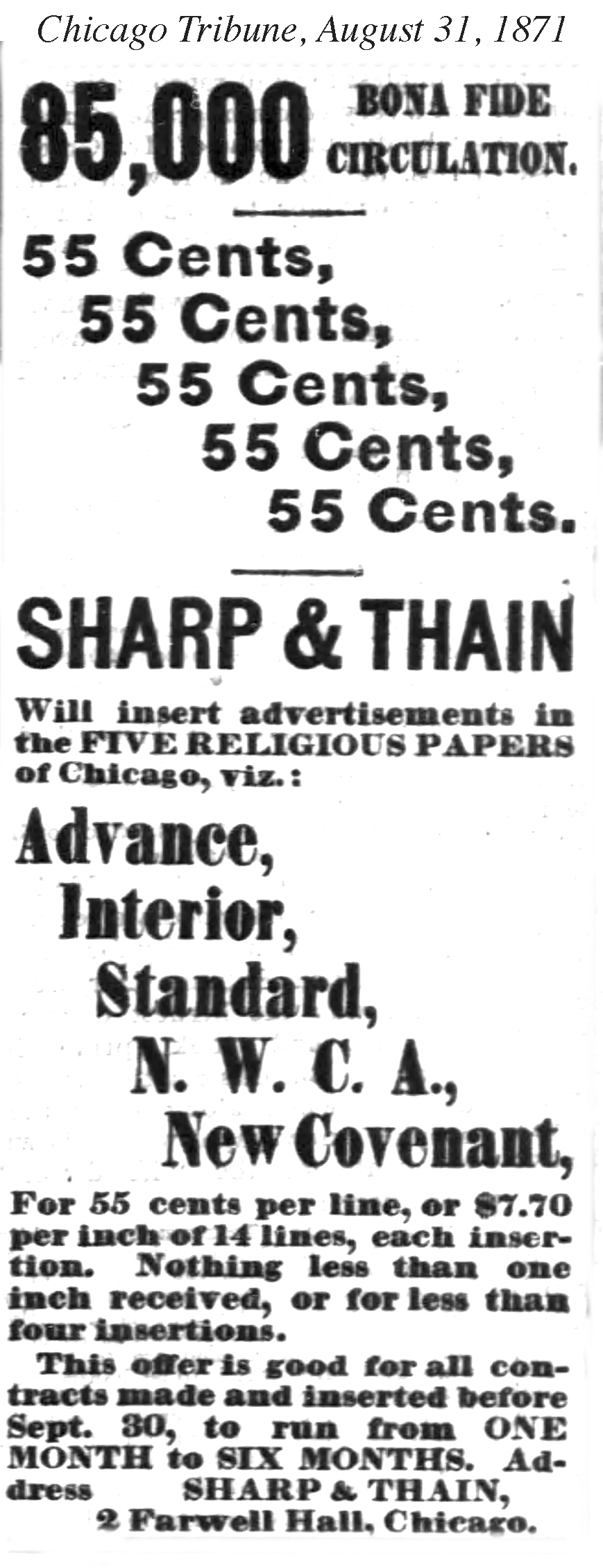
Sharp & Thain, room 2, 148 Madison
Chicago Tribune, January 8, 1859
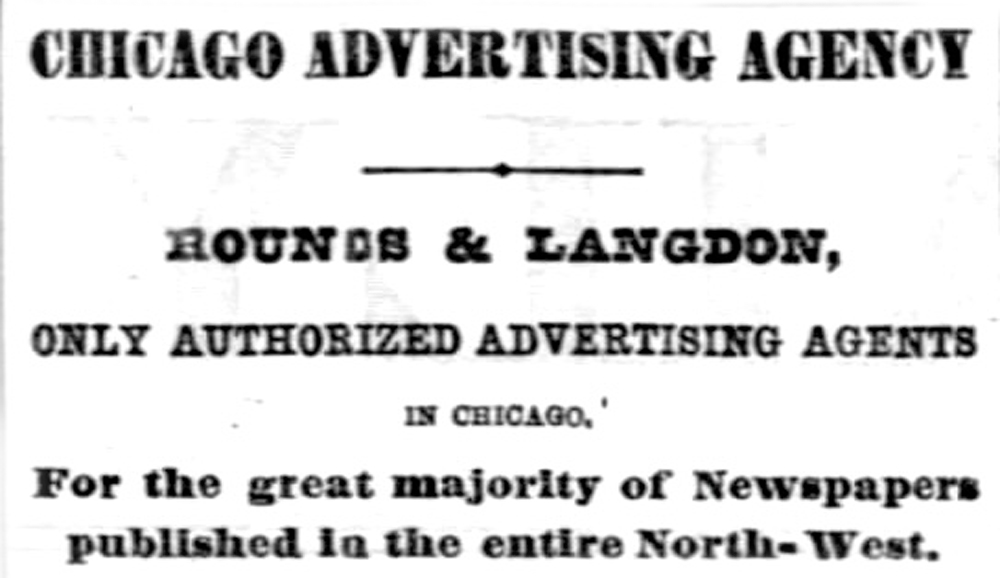
In connection with our Type Foundry and Printer’s Furnishing business, which we have carried on in this city for the past Ten Years, we have for a long time been solicited to establish a bona fide and regular Advertising Department.
The following is only a fair sample of hundreds of similar letters from Publishers in the West, and we publish them that the business men of Chicago, who advertise in Country Papers, may see the position we occupy in regard to the Press of the North West, and that through this agency alone can they reach the Country Newspapers and have the’t advertisements promptky attended to.
The Wisconsin Editorial Convention at its Second Annual Session in Madison, in October, passed a resolation condemning “the present system of General Advertising Agencies,” and appointed us their only authorized Advertising Agent a this point, to receive and contract for Chicago Advertisements.
- Office of Democrat, Flint, Mich., Saturday, Dec. 4, 1858 .
Messrs. Bounds & Langdon:
We are highly pleased that you have consented to stand between the Publishers of the Advertising Shark and gladly avail ourselves of the privilege tendered, of making you our agents in Chicago.
The Country Press seem to have been unfortunate enough to receive the attention of a class of scoundrels. who, having been broken up in swindling lottery and “girt” (?) enterprises by the authorities, take to acting as bogus “Advertising Agents.” It is high time the scoundrels were routed, root and branch, and we hope you will so use your influence as to induce Type Founders in the various cities of the Union to follow the example you have placed before them. By urging this matter upon the attention of Type Founders in other places, we feel sure you fill confer favor on a suffering country Press. The agency for advertising in the Country Press legitimately belongs to some branch of the craft, and there are none more worthy the trifling emoluments arising from it than the founder who is in constant communication With the Press, and who has and is entitled to far more confidence than the swindling scamp who crawls into some 7 x 9 garret, there to rob the printer of his hard earnings, and impose upon the Founder by pretending to supply the Trade with “every description of printing material” when in most cases the “Agent” could not tell a “shooting tick” from a barnyard shovel, and
is more familiar with the use of bogus jewelry than either, for of such is the pay we receive from a majority of the few than ever intend to pay.
Enclosed is the blank sent us, filled out, and we hope to hear that you have retained the entire agency of your city in this line. Yours, &c.,
Jenny & Peabody. DuQuois, Perry Co., Dec. 5, 1858.
A reliable Advertising Agency is what has long been needed in Chicago. I have suffered to a considerable extent through the rascality of Chicago Advertising Agents, and now I am heartily glad that two hones and well-known “typos”—such as you are, gentlemen,—have determined to see their fellow craftsmen righted.
Yours Respectfully,
Paul Watkins,
Ed. and Pub. “Mining Journal”
J. C. W. Bailey’s Illinois State Business Directory, 1860
Advertising Agency.—Rounds & Langdon.—One of the greatest misfortunes of the newspaper press is the irresponsible hands into which the business of Advertising Agencies has of late years fallen. There is not a newspaper published in the country whose account books do not show large amounts due from distant advertising agents, and which it is in vain to attempt to collect. Into such bad repute have these advertising agencies got that we have come to regard with suspicion every new firm proposing to transact this branch of business and have for some time past confined our transactions strictly to such old firms as we know to be honest and responsible.
We have been led into this train of remark by an announcement from Messrs. Rounds & Langdon, of Chicago. that they intend to open an advertising agency in connection with their newspaper furnishing business. Is has been our good fortune to be acquainted and transact business with these gentlemen for many years past, and it affords us great pleasure in improving this opportunity of endorsing them as upright, courteous, prompt, and faithful in all their business relations. They enjoy the confidence and esteem of all who know them, and the new business in which they are about to embark will prove a mutual advantage to their customers and themselves. We wish them abundant success, and hereby authorize them to act as the only advertising agents of the Transcript in Chicago.—Peoria Transcript.
The Cabinet.—This beautiful little visitor for the month of November is at hand. We have exhausted our stock of panegyric in praise of the Cabinet, and can only say that its present number is up to its predecessors.
Rounds & Langdon, its conductors, in obedience to a request of the Wisconsin Editorial Convention, have decided to act as Newspaper Agents for the city of Chicago. Accompanying the Cabinet a blank form is forwarded which publishers will sign and return. We have fixed ours up, and it is now on file at Chicago. Our connection with Newspaper Agents has been unprofitable to us. and we had about concluded to let them go to the gentleman with fancy feet and caudal appendage; but so great faith have we in Rounds & Landon, and such is our confidence in their regard for the true interests of the Western Press, that they can make for the Times any bargain which they see proper, and we will honor their contract by a prompt fulfillment,—North Iowa Times,
The Printers’ Cabinet.—This beautiful little sheet is again before us. Among other good things contained in it, is the announcement that the proprietors, Messrs. Rounds & Langdon, intend establishing an Advertising Agency in Chicago, for the benefit of the country Press. We hail this announcement with joy, for we are sick of the whole tribe of Agents that we have dealt with heretofore: but in the above-named gentlemen, country newspapers have friends that will deal honestly with them, success to them.—Effingham Pioneer.
Advertising Agency.—For a long time past the publishers of the Northwest have sadly felt the need of a reliable and trustworthy Agency, and in consequence thereof have suffered materially. We have been so often deceived, that we began to look upon all agencies who sent us favors with distrust. But this state of things promises no longer to exist, as our enterprising friends, Messrs. Rounds & Langdon, of Chicago, are about establishing an Advertising Agency which cannot fail to meet the wants of the printers of the Northwest. Their enterprising spirit, coupled with the necessary capital to insure prompt payment, will give them precedence.—Grundy Co. Herald.
The neatest paper which comes to our exchange table is the Printers Cabinet, of Rounds & Langdon, Chicago. It is an exquisite specimen of the art.
By the way these gentlemen, in addition to their business of keeping a warehouse of everything needed in s printing office, have volunteered to act as Advertising Agents for such newspapers as desire it. Our acquaintance with them satisfies us that they will prove an honorable exception to the general rule with such agencies, and we have set them down as our agents in Chicago.—Green Bay Advocate.
Messrs. Rounds & Langdon, the enterprising Type Founders of Chicago, have taken the initiative step whereby the whole of the present “Advertising Agency” swindle can be swept away.. They offer to act as Advertising Agents for Chicago for the Press of the whole country. Now we ail know them to be men of undoubted integrity, and there is not a publisher in Michigan but would sooner trust his business to them than to any of the numerous and irresponsible agents of that city. Let us all accept their proposition, binding ourselves to have no other agents. We will then effect a similar contract with the Cincinnati Type Foundry, Johnson of Philadelphia, and Bruce, or some well known established founder in New York, and we will save thousands of dollars to the Press of the state in one year. We have all suffered loss by swindling Advertising Agents: now let us compel foreign advertisers to do their business with our agents rather than theirs. Here 1s an opportunity for reform without combination or association, and so far as this paper is concerned, it will take no more advertisements through any agency but such Type Founder as is well established and known to be responsible,—Flint (Mich) Dem.
Messrs. Rounds & Langdon, of Chicago, purpose to establish a Newspaper Advertising Agency in Chicago, provided they find suitable encouragement from the country Press. For our part, we have entire confidence in the firm, and have filled up the blank sent us appointing them our agents for that city, and hope all the town papers will do likewise—Linn Co, Register.
An Excellent Idea.—At the solicitation of a number of newspaper publishers, Messrs. Rounds & Langdon, proprietors of the Chicago Type Foundry, have made arrangements to open an Advertising Agency in connection with their establishment. This will be good news to the craft and we will hear of no more dishonored advertising bills in Chicago.—Jonesboro’ Gazette.
Yielding to the expressed desire of the in general, we have opened, in addition to our Foundry business, a systematic advertising Agency, and shall here after make it a prominent part of our business.
We are prepared to make contracts with all business houses who are alive to the importance of judicious advertising, and who desire to advertise in one or a hundred Country papers, in any section of the entire Northwest, at satisfactory rates.
Parties can at all times find nearly every paper published in the West on file at our office, and can there receive information as to circulation, and the best means of placing their trade before the public.
Having dealt with almost every publisher in the entire Northwest, for the past ten years, we are fully posted as to who are responsible parties, and the circulation and business of most of the offices. This fact, in addition to our standing as business men, we trust is sufficient guaranty to Chicago Houses that their business will be done safely, promptly and reasonably.
The Printer’s Ink, December 13, 1905
 At the time of my first recollection of Chicago as an advertising field, one Charles H. Scriven had it all to himself. This was in 1865. He was a capable man I have always heard. The only time I ever saw him was at a sort of free lunch reception given by H. T. Helmbold in his Broadway store near the old Metropolitan Hotel in New York City. Mr. Scriven did not live very long after. If he has been as happy since as he appeared to be at the time I refer to, he has no kick coming against the fate that is his.
The next (second) agency to get a foot hold in Chicago was that established about the year 1865 by Carlos A. Cook (right), who had associated with him at various times E. A. Carr, C. E. Coburn, E. B. Mack and A. H. Taylor; Carr, Coburn & Mack having interests in the Chicago office, while Taylor had the management of a Cincinnati’s branch, established later, where he divided the patronage with honest old S. H. Parvin, of whom it may be said that no agent ever, deserved better of the newspapers than he did. An old associate and friend of Mr. Cook’s “has furnished the following historical data concerning him:
- Carlos Allen Cook was born June 23, 1828, in the town of Preston, New London County, Connecticut.
His years up to young manhood were spent on his father’s farm, and in his father’s woolen factory. Leaving these employments, he went to Lowell, Mass., and learned to be a druggist in the drug store of Dr. J. C. Ayer.
Then followed some years in travel, selling goods in thg provinces and States, and finally he had a drug store in Rock Island, Illinois.
In 1859 he was in the sewing machine business in Chicago and in 1862, he, in partnership with a relative, had a brewery in Peoria, Ill.
In 1863 he secured the agency of Dr. Roback’s Bitters, and coming back to Chicago, made his headquarters with the wholesale drug house of Fuller, Finch & Fuller, and, in addition to selling bitters, started an advertising agency under the name of C. A. Cook. There was but one other advertising agency in Chicago at this time, that of C. H. Scriven. Mr. Scriven died very soon, thus leaving Mr. Cook the only advertising agent in Chicago.
Later E. A. Carr was admitted, as a partner, and the firm became Cook, Carr & Co.
On Mr. Carr’s leaving the business, Mr. C. E. Coburn became a partner and the firm was then Cook, Coburn & Co. This was in 1864. Mr. Coburn remained in the business ten years and, on his retiring, the firm was again called C. A. Cook & Co. and so continued until Mr. Cook went out of the business in 1886 or about that date. Mr. Cook had no partner after Mr. C«burn left the firm.
A branch house was established in Cincinnati in 1866 under the firm name of Cook, Coburn; & Taylor, Mr. A. H. Taylor becoming a partner, but this branch agency was discontinued in 1871.
Mr. C. A. Cook died at his home in Chicago, September 27, 1898. Mr. C. E. Coburn is still—in 1905—in Chicago engaged in the insurance business.
Mr. A. H. Taylor is also in Chicago in the advertising business, being employed in the agency conducted by Theodore P. Roberts, who places most of the Sears, Roebuck & Co. advertising matter.
Mr. Cook’s family are all gone from Chicago except a son. It was of this young man that Mr. Cook used to tell that as a boy he developed artistic tendencies and, thinking perhaps he should be given an education on the line of his tastes, sought advice from a friend thought competent to give it and who, after listening to all the pros and cons, volunteered the information that if the boy was his own he would put some bricks in the seat of his trousers and let him sit down In the lake.
The firm of C A. Cook & Co. was unfortunate at the end of its career. The cause of its decline was the advertising of Lawrence & Martin, “Tolu Rock & Rye.” When that firm failed they owed C. A. Cook & Co. $69,000, entirely unsecured. After discontinuing as much advertising as possible the net loss was $47,000 and not a cent of it was ever paid. This was more than Mr. Cook could stand and. after ad justing matters as far as possible, an effort was made to continue business with but indifferent success; the agency made no money and younger men coming into the field and new ideas coming up the struggle was a hard one, and finally Mr. Cook ceased to be an advertising agent.
Mr. Richard S. Thain, the present editor of Agricultural Advertising, had a pretty close connection with Chicago agency matters in the late sixties and early seventies. Previous to its sale to Lord & Thomas, Mr. Thain was editor of Mahin’s Magazine. He took up the advertising business in 1868 and has been at it pretty steadily since. There are not many now in the business who have been engaged in it longer than he.
In a recent communication, Mr. Thain writes:
- In 1868, I was advertising manager of Western Rural, published in Chicago, and during that year, the firm or Sharp & Thain was organized. We remained together in business until 1871. The firm was dissolved after the Chicago fire. We did quite an extensive business—especially with religious papers. We purchased one column from The Interior, Advance, Northwestern Christian Advocate, New Covenant and the Episcopal paper that was published here. We usually kept from three to five columns filled with good advertisements. At that time, Field, Leiter & Company (now Marshall Field & Company advertised extensively in these publications, and it was my pleasure to meet Mr. Field nearly every Saturday afternoon at 1:30 o’clock and set copy for the following week. Before the Chicago fire, Mr. Field wrote his own advertisements, and he certainly knew how to write good ads—i, e., judging by the standard of the times, I had the pleasure of chatting time him not long ago regarding the old days of advertising, and find that he takes quite a lively personal interest in advertising at the present time.
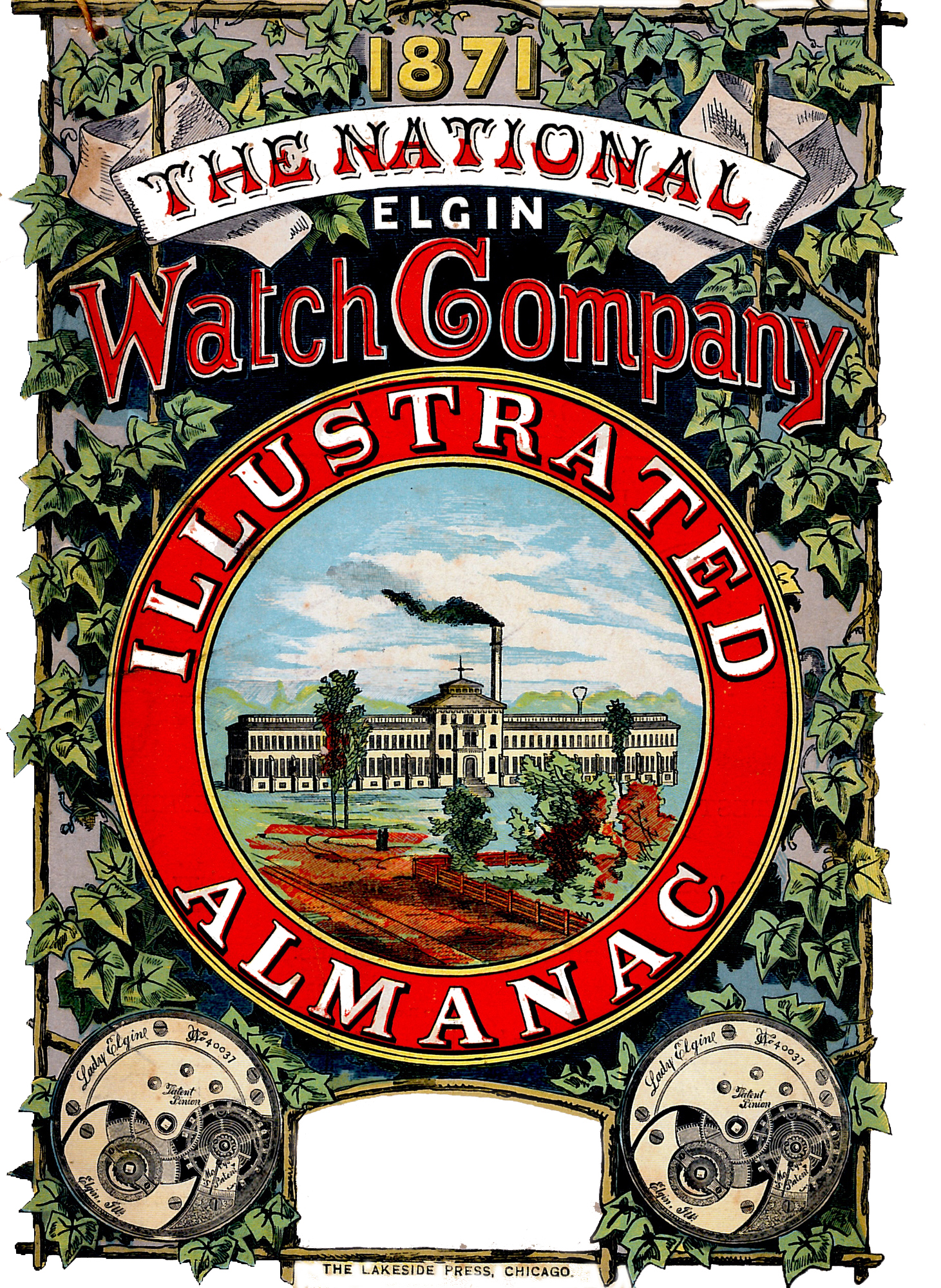
George W. Sharp, my old partner, was an Englishman of the pure John Bull breed. He used to keep me busy fixing up his quarrels with publishers. I got rather tired of this and when the Chicago fire occurred, I thought it a very opportune time to dissolve the partnership. I happened to be in New York City at this time, getting advertisements for the Elgin Almanac, October, 1871. Sharp & Thain were handling the advertising of the Elgin Watch Company, and they issued an Almanac to be handed out by the various jewelers throughout the United States. The issue was one million copies. We placed over $20,000 worth of advertising in the Almanac. The plates were ready, but were burned up in the great fire and when I went back to New York, I made a contract with James W. Sutton of the Aldine Press to get out the Almanac.
After the dissolution of Sharp & Thain, I went into business for a short time, with Wm. H. Fitch, of New York, who was, at that time, advertising manager of American Agriculturist. The firm name was Fitch & Thain. In 1872, I came back to Chicago, when the firm of Thain & Paine was organized. Inside of a year, I bought out Mr. Paine’s interest and merged the agency with the firm of Chandler, Lord & Company. Mr. H. H. Chandler is now the publisher of Farmers’ Review of this city; and Mr. D. M. Lord was head of the firm of Lord & Thomas for a number of years, up to the time of his retirement from the business two years ago. I sold out my interest in the firm of Chandler, Lord & Company, about ten months before they failed and after the organization of the firm of Lord & Thomas, I went to work for them in 1882 and was with them for seven years, occupying the position of what they termed their “right-hand” man.

- The extensive advertising agency of Cook, Coburn & Co., in the Kendall Building. Sketched during business hours. The ad agent was a space broker; ads were simple bulletins handed back and forth as commodities. Agencies operated like banks, with tellers (left), clients (center) and clerks (right). The clients paid a straight commission.

Leave a Reply