Kohl & Middleton, Kohl & Castle
Life Span: 1883-Various
Location: 150 Clark, between Monroe and Madison
State street, south of VanBuren
Architect: NA
- Lakeside Annual Directory of the City of Chicago, 1884
Kohl & Middleton (Charles E. Kohl and George Middleton) museum 152 Clark and 152 W Madison
Lakeside Annual Directory of the City of Chicago, 1885
Kohl & Middleton (Charles E. Kohl and George Middleton) museums 150 Clark and 150 W Madison
A. N. Marquis & Co.’s Business Directory of Chicago, 1886-1887
Kohl & Middleton, theatre and museum props. 51 and 150 S. Clark and 152 W Madison
Lakeside Annual Directory of the City of Chicago, 1892
Kohl & Middleton (Charles E. Kohl and George Middleton) museums 150 Clarks and 292 State and props. Olympic Theatre 51 Clark
Lakeside Business Directory of the City of Chicago, 1899
Kohl & Castle props Chicago opera house 118 Washington and Haymarket theatre 167 W Madison
Lakeside Annual Directory of the City of Chicago, 1904
Kohl & Castle Amusement Co props Chicago opera house 118 Washington Haymarket theatre 107 W Madison and Olympic theatre 53 W Clark h 2826 Michigan av
Lakeside Business Directory of the City of Chicago, 1907
Kohl & Castle Amusement Co props Chicago Opera house 118 Washington, Haymarket theatre 167 W Madison, Olympic theatre 53 Clark and Majestic theatre 75 Monroe
Lakeside Annual Directory of the City of Chicago, 1910
Kohl & Castle Amusement Co props Chicago opera house 118 Washington Haymarket theatre 724 W Madison and Majestic theatre 75 Monroe
Kohl Chas E pres Kohl & Castle amusement co 3d fl 75 Monroe h 2826 Michigan av
Kohl Chas E jr private sec 3d fl 75 Monroe h 2826 Michigan av
Lakeside Annual Directory of the City of Chicago, 1911
Kohl & Castle Amusement Co props Chicago opera house 109 W Washington Haymarket theatre 724 W Madison Majestic theatre 18 W Monroe and Olympic theatre 74 W Randolph
Chicago Tribune, October 16, 1882
A new museum has been started by Kohl & Middleton on West Madison street, near Halsted. It will be run on the plan of Bunnell’s, in New York.
Chicago Tribune, October 23, 1882
Kohl & Middleton’s Dime Museum, on West Madison street, near Halsted, opens today at 1 o’clock, and will be open from 1 to 10 p. m. daily thereafter.
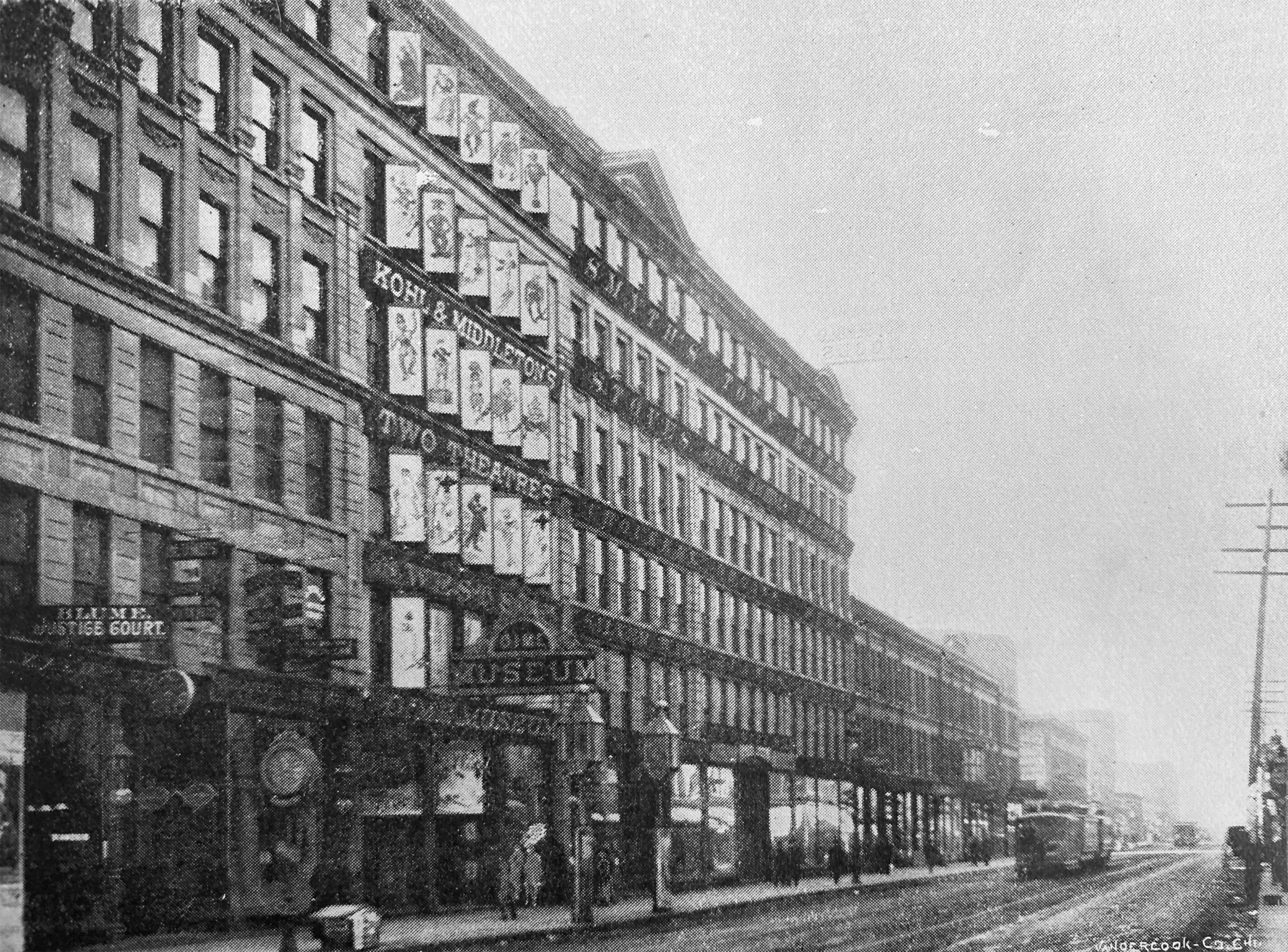
- Kohl & Middleton’s original location in the Smyth’s Block, Madison street near Halsted.
Chicago Tribune, December 15, 1882
Kohl & Middleton’s Museum.
Smyth’s Block, Madison street near Halsted. From 1 to 10 p.m.
Inter Ocean, October 21, 1883
KOHL & MIDDLETON.
Their New Museum.
Messrs. Kohl & Middleton have achieved s remarkable success in catering for the amusement of the Chicago public. Last year they opened a dime museum upon West Madison street It proved such a success that the proprietors were encouraged to establish a similar place of amusement upon South Clark street, which was recently opened and fully described in these columns They have concluded to abandon their various amusement enterprises and concentrate their energies upon Chicago. To this end they have just completed a fine large museum building upon West Madison street, near Halsted, which will be opened to tha public tomorrow noon. The building is a fine, roomy stone tront, whose interior elegance 1s quite as pleasing as its exterior solidity. The lobby and entrance way to the museum is walled and ceiled in cherry wood, whose carvings and elaborate facings are most pleasing to the eye. The room upon the ground floor, having the dimensions o 120 by 40 feet, is to serve as the theatorium, where hourly Vaudeville performances are to be given This cozy auditorium has pleasing and effective decorations, and contains 600 opera-chairs. The stage is twenty-four feet deep, well stocked with scenery, is flanked by pretty boxes, and presents a very pleasing vista from the auditorium. A broad, easy stair way leads to the second floor, that has the same dimensions as the apartment below. This room will be the headquarters of the living curiosities The surroundings are harmonious and attractive; the pillars running down the center of the room are decorated in maroon and gold. A heavy dado in maroon color runs all about the room, and the frieze is in lavender flecked with gold. There is a rear exit to the room; and the building is said to have met with the entire approval of the Fire Commissioners
The third floor is a large, airy area, in more simple style of decoration than the room below. It is to be devoted to a variety of curiosities, views, a “Punch and Judy show,” a stage for illusions, etc., Juke’s glass-blowers, etc.
This model museum will open its doors tr the public on Monday at 1 o’clock, to remain open with a varied list of unique curiosities every afternoon and evening thereafter. Among the many features of the show wi! be a band of native Nubians (the only ones in this country); Isaac Sprague, the living skeleton; Aki Air, the white Moor; Zumera, the Bayou Teche beauty. The theatorium will present a good complement of people in a varied programme.
Chicago Tribune, May 3, 1885
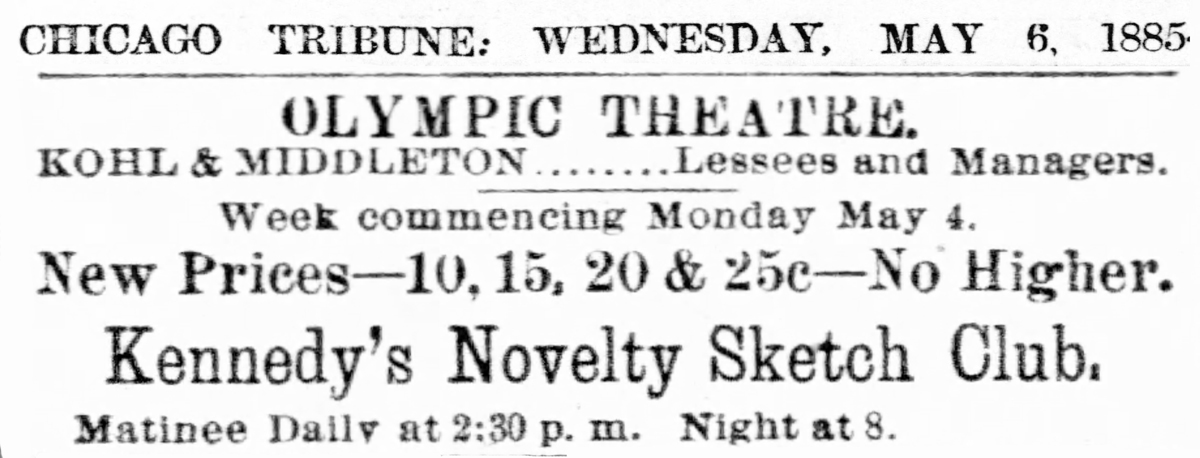
Kohl & Middleton’s Dime Museums—The features exhibited at the West-Side Museum last week will be transferred to the South-Side, owing to the closing of the first-mentioned place in order to to turn it into a summer pavilion. Capt. Townsend and the Ideal combination will be seen at the South-Side house.
New Dime Museum, Randolph street—Among the new curiosities advertised is the wonderful camel child, the turtle boy, the moss-haired woman from Constantinople, the Mexican wild boy, and other new features. On the stage, Williams’ All-Star specialty company.
Chicago Tribune, August 1, 1885
NEW CORPORATIONS. SPRINGFIELD, Ill., July 31.—Certificates of incorporation were issued today by the Secretary of State for the following new Chicago concerns: The Eden Musee of Chicago, to give exhibitions and musical entertainments, capital $200,000: incorporators, Charles Kohl. George Middleton, Frank Wade.
Inter Ocean, August 6, 1891
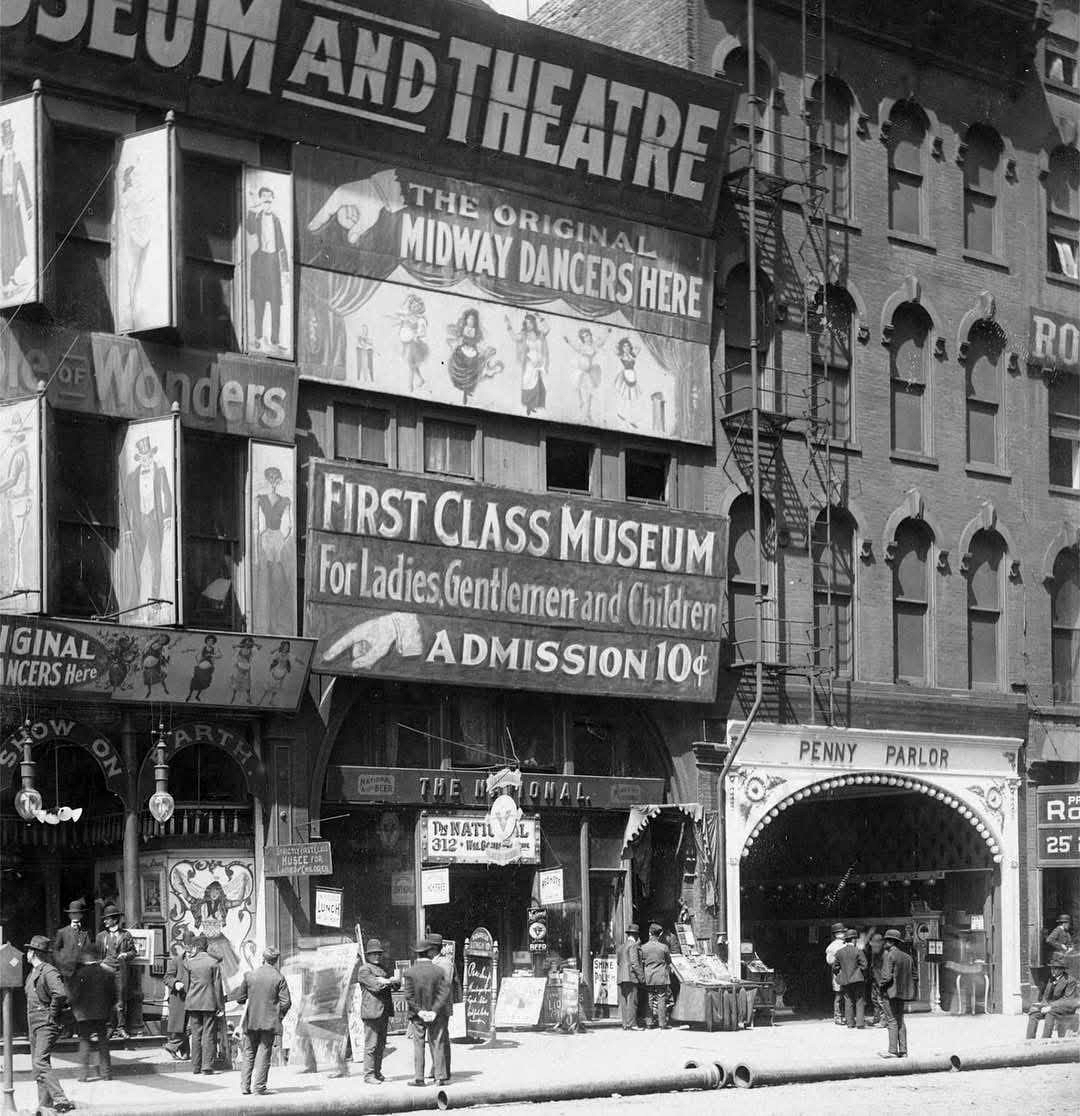
THE GLOBE DIME MUSEUM.
A few months ago Mesers. Kohl & Middleton secured a rather unattractive looking building, Nos. 293 and 294 State street, just south of Van Buren. In the interim it has been completely transformed and will be opened next Monday as the new Globe Dime Museum, The arrangement. of the building was such that for museum purposes it had to be practically rebuilt from the basement up, even to a new roof. This has been very successfully and substantially done at an outlay of $25,000. The hails are high and airy, the floors are of hard wood, broad, there are easy stairs, an excellent system of ventilation, and the ceilings are of thin pressed steel. The broad stairs lead to the second story. Here are three curiosity platforms of Moorish design, handsomely canopied, and two miniature stages with scenic fittings where specialists will perform or curious illusions will be exhibited. The third floor is similarly fitted up, save that a permanent stage will be given to the ever-popular Punch and Judy. The fourth floor has a large crystal cage for a snake-charmer and her pets, monkey cages, and quarters for the trained kangaroos and their young ones. This floor has quite a large stage, where bicycle riding monkeys and trained animals are to be the special performers. On all of these floors spore is a large permanent exhibit of illuminated pictures. This promises to be a feature of remarkable interest. There is a variety sacred and historic, and charmingly picturesque subjects, with an appeal to patriotism in realistic views of the great battles, and grim saturnine humor in a series of French pictures.
One might readily believe that no visitor could ask for more entertainment and sight-seeing for a dime than could be obtained in these three halls. But the chief feature is the theater, which occupies the entire lower floor, which has an area of 5,000 square feet. The walls are decorated in heavy hand-pressed relief work, the steel ceiling is pressed in fine designs and harmoniously colored in cool grays and gold. The hall has 300 opera chairs, and in the West end is a handsome stage with steel proscenium. It is 30×40, and is well stocked with scenery. The back of the stage consist of a series of doors that can be thrown open like the front of the house for emergency exits. The basement is filled up with comfortable dressing-rooms, and will furnish ample room for storage of effects.
Messrs. Kohl & Middleton propose to run this house without the objectionable museum human freak features, giving instead diverting entertainments, specialties, or illusions, and a regular stage performance, claiming that they will cater for the patronage of women and children. They certainly have the handsomest dime museum in the country, and the location is an excellent one.
Inter Ocean. August 16, 1891
Large crowds have visited Kohl & Middleton’s handsome new Globe Dime Museum, on State street near Van Buren, during its first week. In the light and airy curio halls this week will be seen George Moore and Fred Howe, the skeleton giant and fat man in burlesque boxing; Nero, the famous blind sculptor; the educated birds drilling like soldiers: and the wonderful bicycle riding monkeys for the last time. There are five floors of wonders, and in the Crystal Palace Theater Aldrich and Kingsley will head a splendid specialty company which will give pleasing hourly entertainments.
Chicago Tribune, September 27, 1891
Clark Street Museum—Mme. Vera P. Ava, who still persistently denies that she is Ann O’Delia Diss Debar, will remain another week at Kohl & Middleton’s Clark Street Dime Museum and she promises some startling revelations (which she will not reveal) to the public during her hourly levees. On account of the extreme heat she will leave off her famous blonde wig and appear as she is. There will be animate and inanimate wonders in the large curio halls of the museum and three hourly stage performances in the theaters.
Globe Dime Museum, on State street, near Van Buren—Here will be seen four floors of curios and freaks and a stage entertainment every hour in the Crystal Palace Theater. Miss Mattie Lee Price, the Georgia magnetic girl, has been reengaged for another week.
Standard Guide to Chicago For the Year 1891, John J. Flinn, 1891
Kohl & Middleton’s South Side Museum.—located at 146, 148, 150 and 152 South Clark St., near Madison. Kohl & Middleton, proprietors. This is what is popularly known as a dime museum. Stage performances are given almost hourly through the day. A visit to the place will reveal a curious collection of freaks, etc. Admission, 10 cents.
Chicago Tribune, November 29, 1895
CHICAGO OPERA-HOUSE IS LEASED.
Kohl & Middleton Take It and David Henderson Stays with Sindbad.
The Chicago Opera-House, which for ten years has been under the management of David Henderson, has been leased to Charles E. Kohl, George Middleton, and George Castle, who will assume charge of the playhouse Dee. 16, immediately after the present engagement of Mrs. Potter and Mr. Bellew.
It is understood the lease extends over a period of five years at an annual rental of $35,000. D. E. Sasseen, representative of Kohl & Middleton, last night said it was the intention of the new lessees to run strictly first-class attractions, and not continuous vaudeville, as was stated recently in a morning paper.
The deal by which the house passes into new hands was consummated on Wednesday night by W. D. Kerfoot, President of the Chicago Opera-House company.
Mr. Henderson will devote his time to the management of the Sindbad company, which is now playing through the South.
Chicago Chronicle, June 3, 1897
BIG VAUDEVILLE COMBINATION.
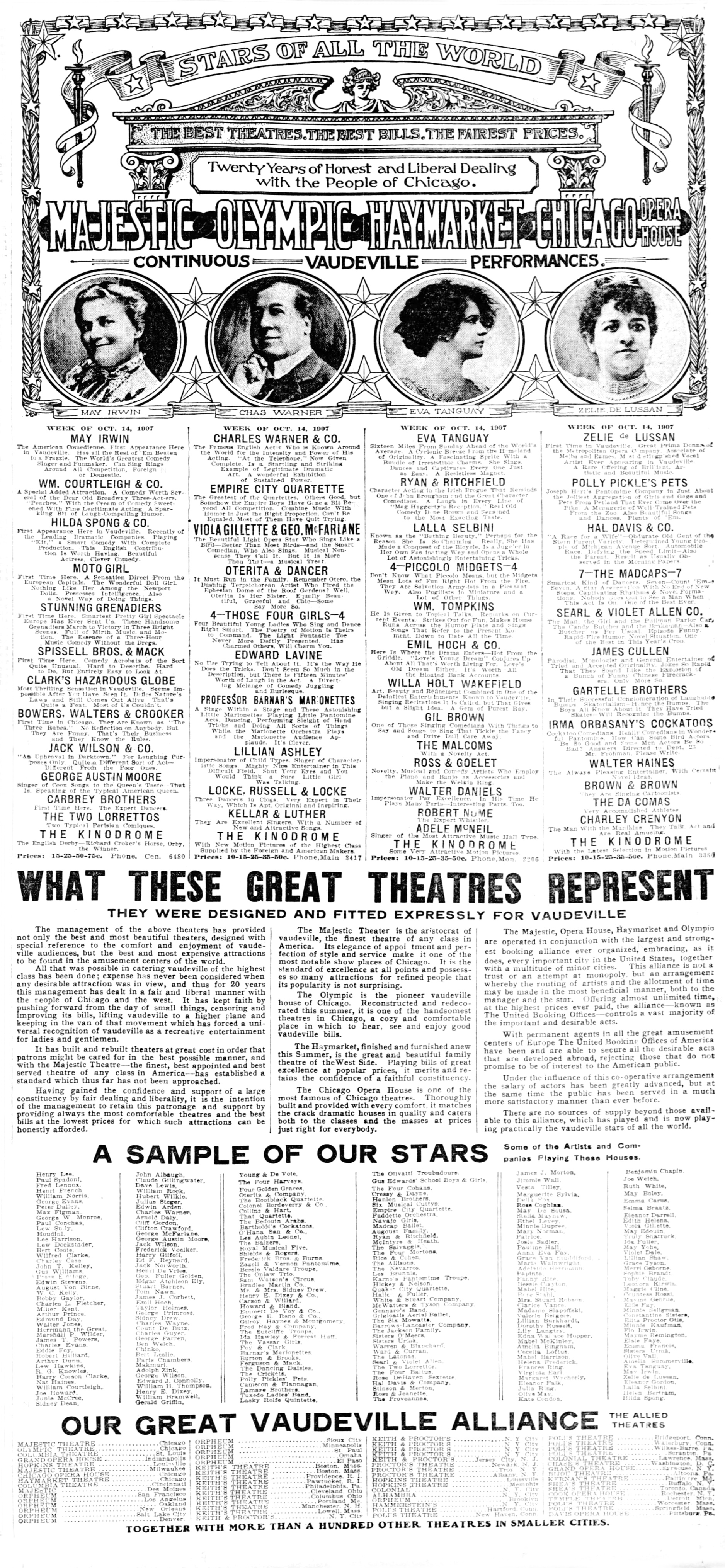
One of the most important events in local theatricals occurred yesterday in the alliance of Messrs. Kohl & Castle with John D. Hopkins and the Tristate Amusement Company, as a booking firm for vaudeville. Heretofore managers of the vaudeville theaters have booked attractions as individuals, a practice that was not always as satisfactory in general results as the new arrangement promises. Kohl & Castle are proprietors of the Olympic, the Haymarket and the Chicago opera-house in this city, and they likewise own theaters in Cincinnati and St. Louis. Colonel Hopkins owns the Hopkins theater in this city, the Grand opera-house in St. Louis and the Duquesne theater in Pittsburg.
The new alliance is jointly interested in theatrical properties in Cleveland, Milwaukee, Louisville, Indianapolis and San Francisco. Now that they have pooled issues they have over a dozen first-class theaters in which to book high-class specialty acts for at least twenty-four weeks out of the regular season of forty weeks. Outside managers who have heard of the prospective booking deal have been writing for attractions, and the indications are that specialists can arrange a “solid” season through this agency in more senses than one.
The new arrangement means that nearly all of the profitable territory west of Buffalo for vaudeville attractions will be controlled by this consolidation for a term of five years. It will simplify the handling of the better class of variety acts and be advantageous in giving the artists a full season in the west with sure financial returns. As for the public, it will profit also in getting a higher grade of attractions and the high-priced novelties from Europe that have been accustomed to confine their appearances to a single city in the east. George Castle will have entire charge of the booking and Colonel Hopkins will represent the interests of the consolidation as the traveling manager.
Chicago Chronicle, September 29, 1897
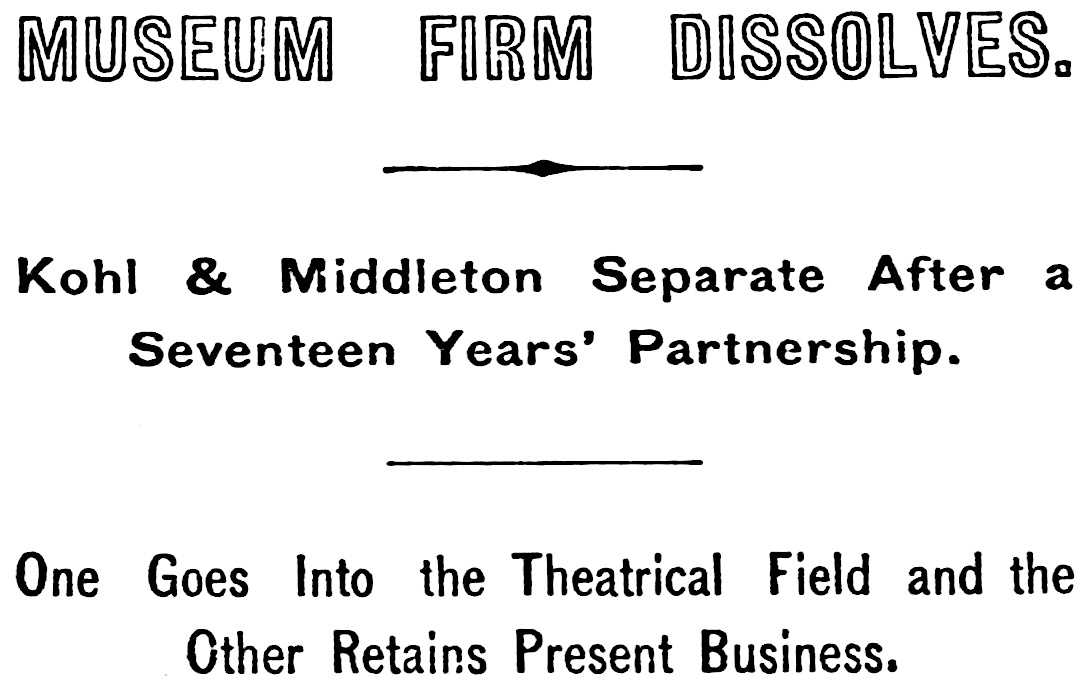 After operating museums in Chicago and a number of other cities for seventeen years the partnership of Kohl & Middleton was dissolved yesterday. Mr. Kohl will continue in the theatrical business, with Messrs. Castle and Hopkins as his business partners. Mr. Middieton is now the sole owner of the Clark street dime museum. He says he may start a syndicate and operate museums in Europe, but will continue his show in this city.
The announcement that the firm had been canceled caused a sensation in local theatrical circles. Few firms were better known than Kohl & Middleton. Charles E. Kohl was with George Middleton last evening and both men said that the change was made because Mr. Kohl intends to branch out in the vaudeville business.
Seventeen years ago Mr. Kohl was connected with O’Brien’s circus and Mr. Middleton was with Barnum’s. Both men conceived the idea of starting a museum. Mr. Middleton had many years’ experience in the business in New York and Brooklyn.
History of the Firm.
Both men came to Chicago and walked the for many days, seeking a location. At last they rented the first floor and basement in the John M. Smyth building in West Madison street, and later they rented four floors in the building. In the fall of 1883 they moved to the present site of the museum in Clark street.
After the establishment in the new location they started a museum in Milwaukee.
Here Jacob Litt was given his start by the two men. Next they went to Cincinnati.
Minneapolis, St. Paul and Cleveland. In the latter place the firm met its first failure and the only one. Before the world’s fair they opened the Globe museum in State street, which was closed in May to make room for the new theater there.
Relations Are Friendly.
Mr. Middleton said last night that his relations with Mr. Kohl were pleasant.
“Since we first started in business we never had a disagreement,” he said. “We made a success of the business and now Mr. Kohl wants to get out of the museum for the theatrical world. I am in love with the museum business and will stick to it. I may start a syndicate. I will say that our success was all due to newspaper advertising. We never posted a bill on a fence or a brick wall.
“If we made money one week we divided it then. If we lost we went down in ou: pockets and made up the loss weekly. The museum business today is better than it has been for years.”
Chicago Tribune, May 24, 1900
Vaudeville Alliance a Fact.
The vaudeville alliance is a fact and the agreement reached is that outlined in The Tribune on Monday morning. The result will be longer contracts and lower salaries to almost every class of vaudeville entertainers. Managers Kohl, Murdock, and Hopkins, who went from Chicago to attend the conference, have not returned, but information other than that contained in the telegraphic dispatches has been received from them. It appears that it took much argument to induce Manager Proctor to forget his rivalry with Manager Keith and to enter the combination. The meetings were not held in New York, but in Brooklyn, and every effort at secrecy was made. The sessions lasted from Saturday to late on Tuesday afternoon, and it is understood that the prospect of union seemed hopeless almost to the last. It is said several concessions were made to Mr. Proctor, and that he in turn agreed not to increase the number of his theaters. When the warfare was at its height the claim was made that Proctor would erect or lease theaters in Chicago, St. Louis, and Cincinnati.
Manager Kohl is said to have been the dominating figure in the conference and to have made the terms of peace between Keith and Proctor. He represented the Kohl & Castle theaters. Manager Murdock was in attendance to look after the interests of the Masonic Temple Theater, and Colonel Hopkins was there as a Kohl & Castle ally. Martin Beck represented the big Orpheum circuit, which takes in most of the vaudeville houses between Chicago and the Pacific, and Manager Myerfeld of San Francisco looked after the welfare of the remaining coast theaters.
Chicago Tribune, January 28, 1906
Chicago Tribune, October 28, 1907
Chicago Tribune, November 13, 1910
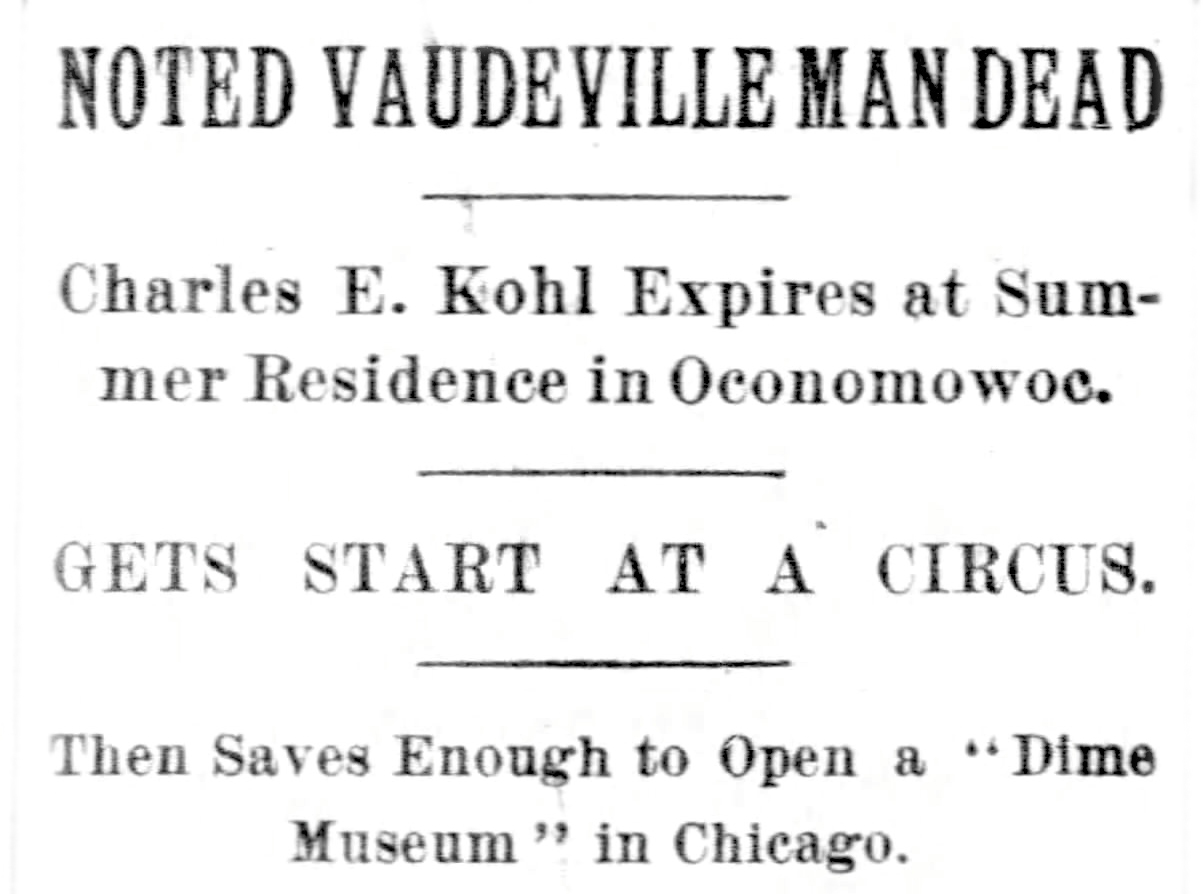 Charles E. Kohl, one of the most conspicuous figures in American vaudeville management, and one of the men accredited with raising that form of entertainment to its present plane, died at his summer residence in Oconomowoc, Wis., yesterday morning.
He was president of the Kohl & Castle Amusement company, and chairman of the United Booking agencies. His company is the eastern representative of the Orpheum circuit and the western representative of the United agencies. In Chicago he was interested at different times in the Majestic, Olympic. Haymarket, Star and Bijou theaters, and the Chicago Opera house.
Mr. Kohl’s health has been a cause for worry about a month, but his ailment was not considered serious until shortly before his death. He had been complaining of an attack of neuralgia, and it was the effect of this upon his heart that ended his life.
Planned to Go to California.
He spent the entire summer at his place near Lake LaBelle with his son, John P. Kohl, while his wife and daughters.
Caroline and Dorothy, were traveling in Europe. Upon their return they remained only a short time at the family residence, 2826 Michigan avenue, and then went to Oconomnowoc to urge Mr. Kohl to go to California for the winter. They reached there on Thursday. The only member of the family remaining in Chicago was Charles E. Kohl, the elder son, and a telegram called him to join the others early in the morning. The funeral will take place at 2:30 tomorrow afternoon.
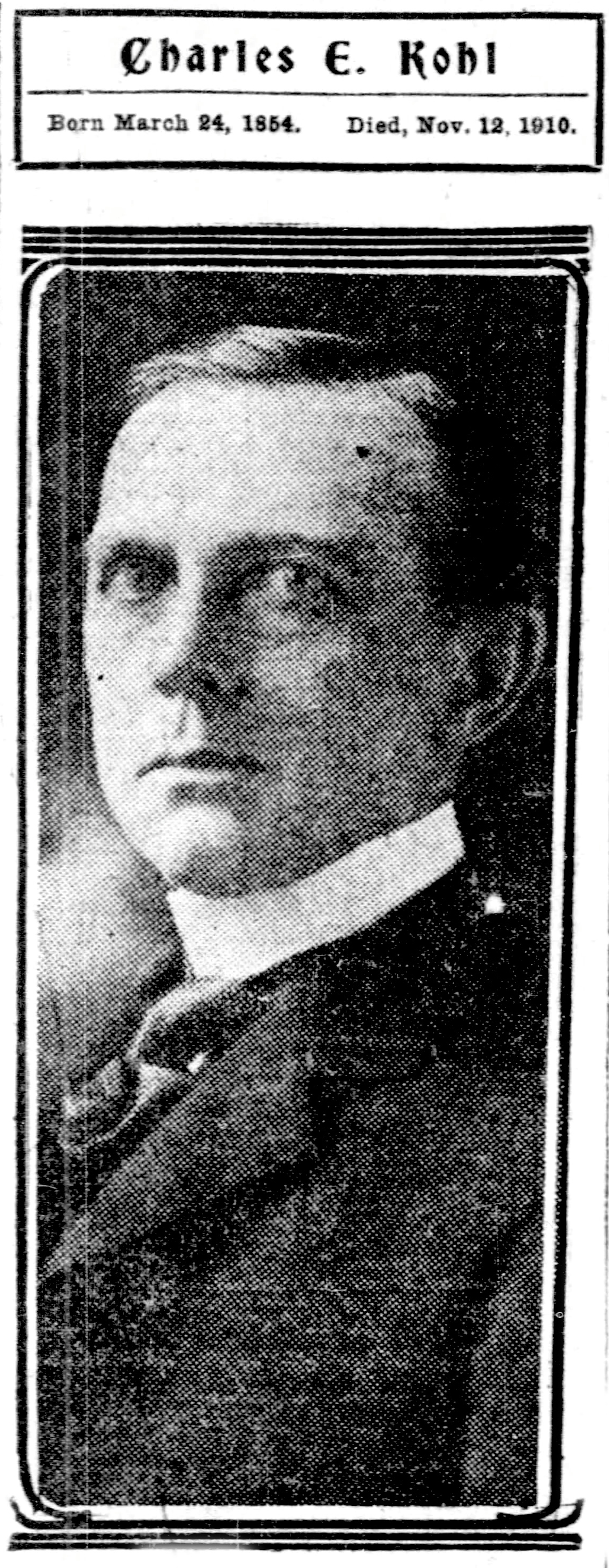
Mr. Kohl was 56 years old, being born at Brooklyn, N. Y., March 24, 1854. As a boy he started in the show business selling peanuts and popcorn with the Barnum & Bailey circus. His profits from this formed a nest egg which enabled him while still a young man to come to Chicago and open the old Kohl & Castle dime museum on west side of Clark street south of Madison.
It was one the first places of its kind, and proved to be such a money maker that before long Mr. Kohl and his partner, Castle, and George Middleton controlled trio of local vaudeville houses—the Olympic and Haymarket theaters, and the Chicago Opera house. At the same time this firm became interested in the booking business, and in a short time were recognized as vaudeville leaders throughout the country. Ambition Was “Model Theater.” Of all his enterprises his one hobby was to establish a vaudeville theater that for elegance and Anish could hold its own with any of the legitimate houses in the country. It was with this idea. that he opened the Majestic theater. Some time previous to the building of the Majestic the firm had become Kohl Castle by the retirement of George Middleton.
Somewhat later the Chicago Opera house was closed as a variety place, and then the Olympic. The firm is believed to retain its interests in the Academy of Music, the Star, and the Bijou theaters, whose performances principally are on the melodramatic order. The business of his firm was put on a permanent corporate basis last summer, when the United Booking Agencies was reorganized, with Mr. Kohl as president. This organization now controls all the prominent vaudeville bookings ‘ all the way to the Pacific coast.
Gets Start in a Circus.
The story is told that Mr. Kohl owed his real start in the museum and by that in the vaudeville business to a freak stunt in connection with a dime museum after he left the circus ticket wagon from which he was promoted after his experiences selling popcorn and peanuts. Kohl had a fat man named Craig he was anxious to advertise. To make it good after he had announced that Craig’s weight was too great for his ankles to support, Kohl had him brought town on an ore car and hoisted into a dray with 8 derrick. The procession that followed him to the museum led by a banner proclaiming the presence of the “Monster Master Mason” because of Craig’s membership in a secret society.
Chicago Tribune, August 18, 1911
 Mrs. Caroline Kohl yesterday bought the controlling interest in five Chicago theaters—the Majestic, the Olympic, the Chicago Opera house, the Academy of Music, and the Bijou The widow of Charles E. Kohl thus became the largest holder of theatrical property in Chicago.
She purchased the entire interest of George Middleton and George Castle in the Academy-Bijou company which operate the two weet side theaters. She also purchased all of Mr. Middleton’s other theatrical holdings.
Passing of Kohl & Castle.
The deal makes Mrs Kohl the most important woman theatrical manager in the country. It marks the passing of the firm of Kohl & Castle, which for many years controlled amusement places and theaters in Chicago.
She declined to state the amount involved in the transfer of the property, but said that Col. William Roche would serve as her general manager. Col. Roche was associated with the firm of Kohl & Castle for years. Ho will be Mrs. Kohl’s personal representativs. with offices in the Majestic Theater bullding.
Glover to Keep Position.
Lyman Glover, manager of the Majestle theater and general manager of the Kohl. Castle, and Middleton interests since the death of Mr. Kohl last November, will retain his present position, it is understood.
Mrs. Kohl’s purchases make it possible for her to carry out her husband’s ambition that the name should continue at the head of Chicago theatrical interests. He served as active director of his theaters.
The Superior Telegram, November 1, 1911
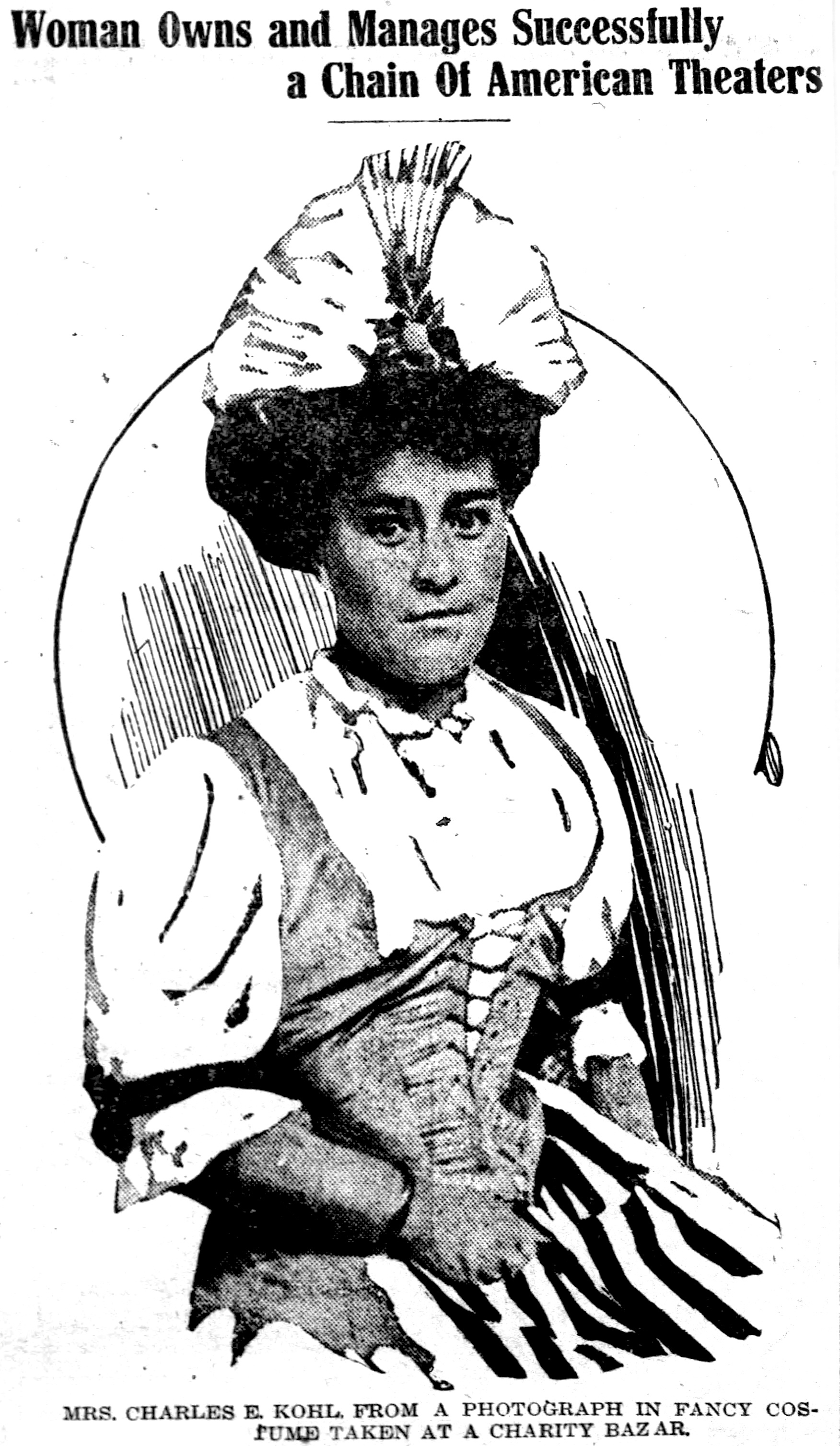 A Chicago woman, accustomed to years of the leisure that wealth makes possible, has slipped into emergency’s opening and proven her ability to handle big business interests. Mrs. Caroline Kohl, the business world now knows her, widow of Charles E. Kohl, is by many considered one of the greatest theatrical managers of recent years.
In August last Mrs. Kohl purchased the holdings of George Middleton and George Castle, her husband’s partners. She placed the name of Kohl at the head of Chicago theatricals and became the leading woman theatrical manager in the country, which, no doubt, means in the world.
When Mr. Kohl died a year ago his legacy to his family included an interest in five Chicago theaters. He had realized his greatest ambition-the establishment of a vaudeville house, which for smartness of style and up-to-dateness of equipment might be the equal of any “legitimate” house in the country. That was his reason for building the Majestic,
But there were two other ambitions in this theatrical man’s life. One was the desire to lift the vaudeville act to a plane of refinement where the old-time slur of disrespect night be taken from the name. This ambition he saw well on toward its goal. The third ambition was the full ownership of the five theaters in when he had an interest, that the name of Kohl might be kept at the head of Chicago theatricals. It was the last ambition that killed him before it was realized for the constant work at his desk had so drained his system of vitality that he was unable to resist an attack of pneumonia.
Mr. and Mrs. Kohl were great “pals.” When the day’s work was done it was to Mrs. Kohl that he turned to talk over all that had transpired. Her ideas on his various projects were heeded and while she took no public part in the family business. she was the silent partner, the direct force in his life. When he died she knew all his hopes and desires. These she had shared and in his death, memory and sentiment added their impetus to her efforts in the completion of the work which he had laid down.
In Mrs. Kohl’s business relations the word “manager” is used advisedly. She is a retiring, modest, almost timid woman, where publicity is concerned. Nothing is as far from her desires as appearing before the public in any capacity. She is a devoted mother to her two boys and two girls, now grown.
Her son, Charles E. Kohl, Jr., has stepped into his father’s place as the active head of the family’s theatrical interests. But the big plans of the concern have to be talked over with his mother before real action is taken. In the management of the chain of theaters, too, Mrs. Kohl has a chain of managers, but each one looks to her as his leader and respects her opinions.
Mrs. Kohl does not come from a theatrical family, although her sister, the present Mrs. Cheney of Boston is to be remembered by the theater-goers of a decade ago as the beautiful Julia Arthur.
Mrs. Kohl does not maintain an office in her theatrical company building. Her office she has established is in the family resident. It is a bit of her desire to keep in the public background.
She is a young woman as yet, Mr. Kohl was but 56 when he died, and with her cultivation, intelligence and reserve behind her extensive holdings, her influence for the uplifting of vaudeville should be far-reaching.
Chicago Tribune, November 29, 1911
A portrait of the late Charles E. Kohl has been hung in the lobby of the Majestic theater. It is by J. Irving Niles, and represents Mr. Kohl and his spaniel, Nick, on the terrace of his country place at Oconomowoc.
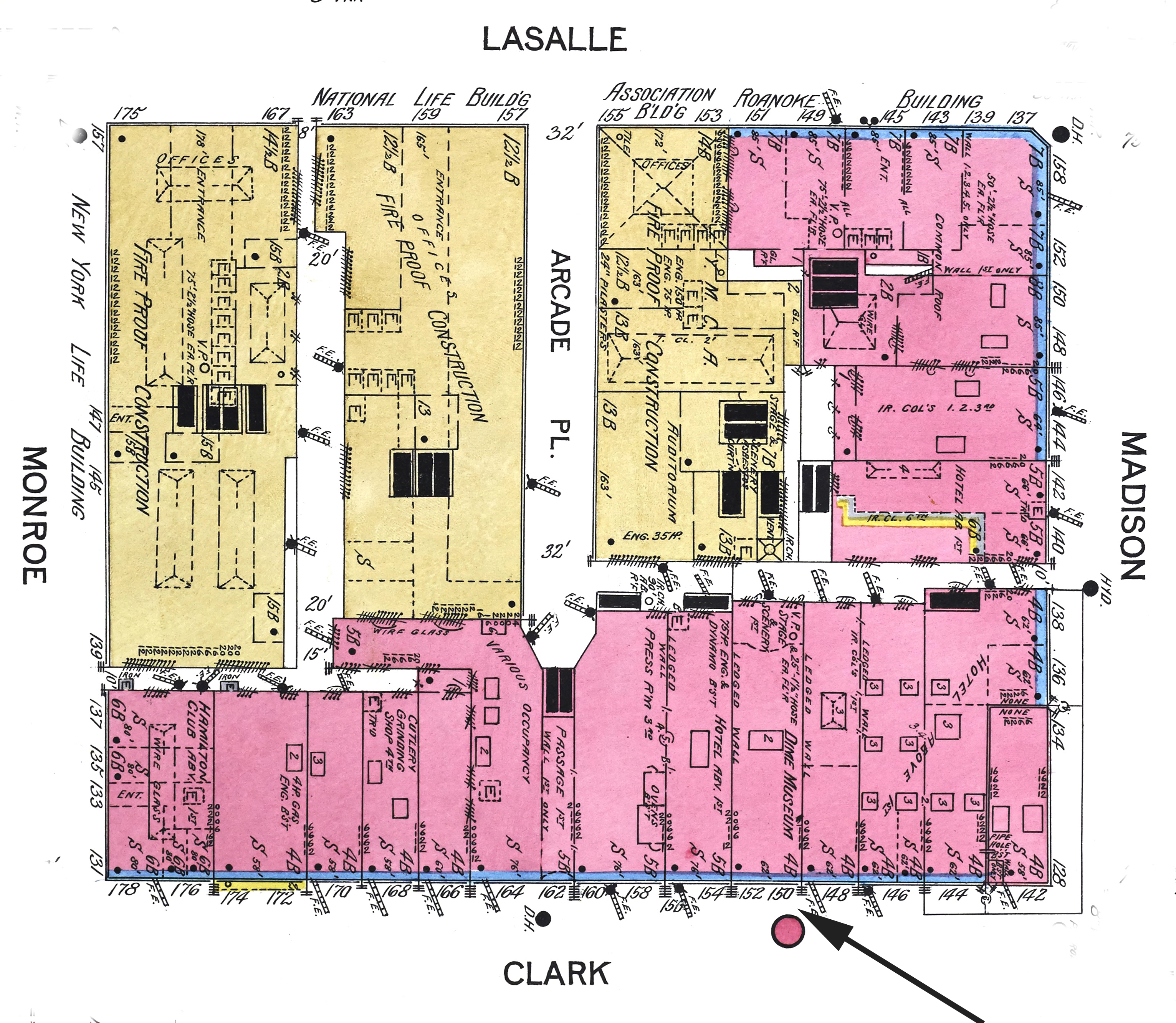
- Kohl & Middleton’s Theatre
150 Clark
Sanborn Fire Insurance Map
1906
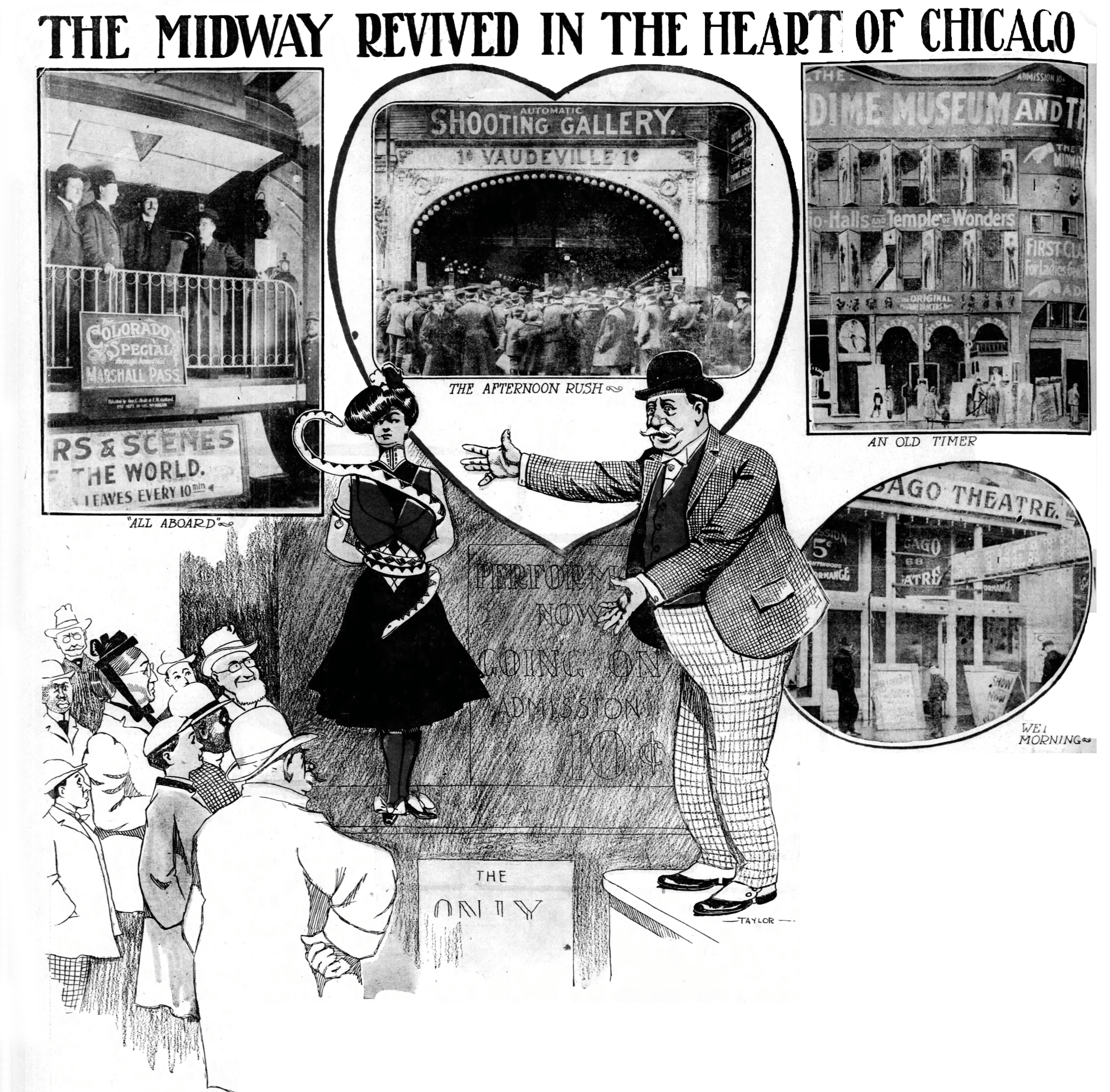
CHICAGO MIDWAY
- Lakeside Business Directory of the City of Chicago, 1899
Congress Museum Co. 344 State
Howard & Fallon, 299 Clark
Museum of Anatomy, 166 Clark
Wonderland Co. 150 Clark
World’s Museum of Anatomy, 318 State
Lakeside Annual Directory of the City of Chicago, 1904
Wonderland Co. 150 Clark
Davieson’s Museum, 166 Clark
Trocadero (The) 294 State
Williams D. & Co. 298 State
Chicago Tribune, January 28, 1906
Chicago’s downtown Midway is a collective eighth wonder of the world. As the Barnumizing first feature of the World’s Columbian exposition of 1893, it will have been years established and paying fortunes before the Field Columbian museum finds place in Grant park, two blocks to the east of this same downtown Chicago.
Barnumized and still Barnumizing, this Columbian Midway has moved upon the old levee resorts which once made Harrison street the dividing line between the upper and the nether worlds until its barking barkers, its penny arcades, its 5 cent theaters, its lights and sounds and frivolities have made another Coney island in a sea of city night.
Properly Van Buren street is the northern boundary of this downtown Midway, though encroachments have been made still northward into the retail district of this one of the widest shopping streets in the world—encroaching until the ground values below the floor of a penny arcade represent a fortune into the hundreds of thousands of dollars.
When the Field Columbian museum shall come to the lake front in Grant park it will be to rest its foundations in a priceless property that is the gift of the city. One penny arcade of the myriad Midway of State street may pay its cheerful $25,000 a year rental and set its cheerful barker to work in front to get from the cheerful crowds both rental and profits in copper coins, 100 to the dollar, saying nothing of the slot slug by the basketful.
It is a gay, frivolous island, this island of the Chicago Midway. On the north of it is the Sea of Business, so deep that sounding lead has never touched.bottom. On the east is the still, solemn Ocean of the Esthetic, unruffled by tide or storm. To the west lie the troubled waters of the Dead Sea of Vice, its shores strewn with shipwrecks and its heaving tides shriveling in the fierce heat of a sunlight of reformation. Southward for leagues stretches the Cosmopolitan ocean, with here and there its Sargossa seas, with flotsam from every phase of civilization.
In midafternoon the Island Midway wakes. In this winter season in all the surrounding seas there is summer of harvests in Midway island. The hoarse barker of the night be-fore, muffled to the chin, steps to his beaten round at the pavement edge, challenging all who pass, while he discourses after the style of the street faker.
My Lady of the Serpents poises in the glass pagoda in bare arms and tinseled skirts, hugging the huge python to her bare bosom or fondling the hideous, triangular heads of the rattlesnakes, which seem to spray her breast with darting tongues of venom. To right or left the Lady of the Cards builds her winning hand, whirls round and round to face all staring eyes-then wipes the colored figments white with the sweep of a tiny silken square. And the music blares, and the line at the ticket window lengthens and moves serpent-like through the swinging doors.
“Who enters here leave cares behind!” is the unwritten admonition of Midway island. Go, when you have left them; or go, if for a moment only you can hope to leave them there. But not to laugh or not to smile—these are the cardinal sins of Midway island for which there is no absolution.
In the Five Cent Theater.
There is a man sitting in front of you, close by the stove and fresh from the chill rain outside. In the semi-dark of the place you may see that even in January he has no overcoat. From the diffused light of
the blank, white curtain far in front you may see three huge wens—a trinity of deformity—protruding through his long black hair. They are grotesquely suggestive of the probability that some sign of the Three Balls in the street may have fallen upon his crown and left its imprint there.
But as he steams, and smiles, and turns to the grateful warmth of the stove you have no question if his 5 cents left at the ticket window of the 5 cent theater has been mnisspent. A warm stove, a good seat beside it, the strident music of a piano in march, waltz, and quickstep time, a white canvas screen upon which a spotlight glitters, twinkling of the rich promise of scenes to come—shall he not bask, and smile, and hold even a laugh in reserve?
When the piano is stilled and while the spotlight is focused and placed at length upon the square, the man in the rough rider suit, half reefed hat, and tinkling spurs mounts to the piano level. Sheets of music rustle, the canvas clouds with the picture machine announcement of a solo. “Dear Old Flag. Good-By.” a chord is struck—and the song is on.
“And dear-old-f-l-a-a-g-goooooood-bye-e-e-e!”
You can’t encore a finish like that, because the young chap can stay dead so much more affectingly, but there is a bit of volley firing in applause. Funny—the soloist in the 5 cent theater has got to be applauded, even if the manager has to do it out by the entrance; while the best thing that ever happened in a moving picture never gets anything but a laugh!
And the moving picture is funny enough for anybody. It is the flickering, sputtering reincarnation of Mr. and Mrs. Snizzlechook in efforty efforts to replace an incompetent servant girl with six or seven others who for several shocking reasons are a good deal more so.
“Shocking.” as here used, however. is in its Pickwickian sense absolutely. As far as morality is concerned it has the average Greek college play skinned to death.
Why, as to the matter of the proprieties, an example that was made of a carefully cooked up train robbery some time ago will serve to allay the doubts that may assail the average person who has been putting up the scalper’s 100 per cent raise on downtown $2 seats.
The moving picture man got his train, his bandits, the crawling over the tender scene. the hitting of the engineer over the head with a pick, the shooting of the fireman, the emergency brakes, and sand valve movements, the smashing of the express car door. and the lifelike sprinting of the passengers toward the tall timber—all of this was put on the twenty feet square of harmless cotton cloth—when Chief Collins butted in and closed the whole show ten times tighter than he ever closed a quiet club game anywhere else in the city! The inference of the whole movement was that if any theater-goer wanted to see a holdup he could go to a $2 house and let a real scalper go through him.
Quick Trip to Rockies.
Speaking of trains, there’s one in the Midway that would make your hair curl if you were smuggled into it blindfolded.
It is the observation car in the train with nothing at all doing at the rear end. It is one you can’t miss, either, from 8:30 o’clock in the morning till 10:30 o’clock at night.
Its run is the one way trip over a narrow gage railroad over Marshall’s Pass in the Rocky mountains.
You enter at the rear end. Inside you find yourself in a darkened day coach whose front end has been amputated just behind the water cooler. There’s a smell of train butcher oranges in the place and peanut shells crunch under your feet as you walk forward. The moving picture canvas is where the hole is, and there is a station and train and the perspectives of a street when the operator first begins to prepare for the get away. A cab dashes up to the station and somebody falls out of it, running. just as the bell rings; there is a sudden grinding of wheels, a snorting, bumpy feeling under you, the rear platform of the train in front of you skiddoos away with wildly excited excursionists of the Cook’s tour type waving handkerchiefs, and then, open ended, your coach pitches hard after it up a 4-11 grade.
Talk about travel! You never went anywhere in your life before at the rate of thirty-five miles an hour on a first class ticket at the flat rate of .0000153 cents a mile! The train boy hop skotches up and down the aisle, the flagman looks in occasionally with his red lantern, the cuts, grades, tunnels. whistle posts and the vistas of snowy heights and rocky gorges swirl into place under the roaring wheels, and then the Cook’s tourists, still waving handkerchiefs, disappear, not to be overhauled again. But it is presumed that they are still waving.
You don’t go down the other side of the pass. Instead, you pass out of the front end of the day coach. turn to the left and-bang!—a rifle shot in the penny vaudeville next door rings in your ears! You are in Chicago’s Midway again!
Live test at Night. And if it be 9 o’clock at night It is a pretty lively place in which to be.
Ordinarily things begin to get good at half past 8 o’clock. They are at the best at 9:33
o’clock, and after midnight the officer on the corner says there’s “nothin’ doin’.” At 10:30 o’clock most of the places are closed save as the chance lodging house, the restaurant. the saloon, and the pool and billiard rooms invite the chilly passerby.
Saturday night has a red letter designation. Sunday and Sunday night may be better. But it is the Midway, still.
You may pay 15 cents for an orchestra chair in the Midway theater where the stage properties are real, reserving a mental something as to the complexion of the leading lady. In the furthest seat in the balcony you will pay 50 cents and it will be a quarter in the gallery.
Do you want a better evidence of decency?
Singers are décoletté, of course, but after all there is nothing worse than the Dutch comedian in the white socks.
When the
broncho buster shoots up the terra firma just under the Dutch mimic’s feet you may wish it was a loaded gun, aimed four feet higher.
But after all, such is life.
No man can
expect to have everything his own way.
You may feel better when the leading lady comes out in front of the drop curtain and does some pale bust singing.-
When you have been looking on moving picture ladies for half an hour or so, the real thing is likely to show up unusually strong.
Always go to see the shadow ladies first.
But we digress.
We were speaking of the
leading lady with the real voice and the powdered bust.
She was singing.
Also she
was joshing the young man in the box who had brought a best girl with him.
The
young man was emburrassed and the young lady. plainly, was as mad as a wet hen. In perfect time and tone with the orchestra the singer refers to the time when the young man took her out to dinner and made it a double order of ” pork and.”
“O, ain’t he gra-a-nd! ” is the singer’s re-frain, over and over again, bending over the footlights until it looks as if she would fall into the box.
But she doesn’t, luckils, for ten stage cops could not prevent a hair pulling match if she The lady in the box is flaring mad!
She wasn’t invited there as a stage property!
Not on anybody’s life
But in an instant the singer has twittered away to the wings and the Dutch comedian interrupts the applause amid the stage properties behind the drop curtain.
High Art in Curtain.
Still ft’s not so bad to get the drop curtain out of the way.
It ought to be art.
The scene painter who
put it there went right after art where it lives, starting 250 yards north of the chloroform bowlder in Grant Park and painting without fear or favor as far south as the Park Row railway station.
The twirling
twist is in the tails of the windy looking lions at the Art institute entrance, after which anything but the bowlder goes; the bowider wasn’t there when the scene painter went after his effects.
The roadway in Michigan avenue itself is blocked from view by an omnibus that locks as if it didn’t care whether it caught the next train or not.
It is this bus which is
the real departure from art for art’s sake.
For instance It doesn’t look well, even south of Polk street, for one to refer in publie to
“bad breath and rotten teeth.” But this is just in front of the nose of the north licn at the Art institute’s steps! Madame Somebody’s ” slightly used gowns” oughtn’t to

Leave a Reply