Rumsey Mansion
Life Span: 1874-1950
Location: NE Corner Rush and Huron streets
Architect:
- Lakeside Annual Directory of the City of Chicago, 1876
Rumsey Julian S. (Rumsey Bros. & C0.) 70 LaSalle, house 313 Huron
Lakeside Annual Directory of the City of Chicago, 1880
Rumsey Julian S. (Rumsey Bros. & C0.) 15 Chamber commerce, house 313 Huron
Lakeside Annual Directory of the City of Chicago, 1904
Rumsey Julian M h. 313 Huron
Lakeside Annual Directory of the City of Chicago, 1911
Rumsey Julian M h 40 E Huron
Old Chicago Houses, John Drury, 1941
Mayor Rumsey’s Residence
Included in the Near North Side itinerary of the
W.P.A. tours to Chicago points of interest is a three-story residence of faded red brick at the northeast corner of Huron Street and Wabash Avenue. In a section of many such ancient houses this edifice is conspicuous because its architecture is obviously of an older era than most of the homes around it.
The man who built this house, lived in it for many years, reared his family here, and made it something of a social center in the 1870’s was Julian S. Rumsey, now best known in local history as the Civil War mayor of Chicago. His career, however, goes back much farther than that.
It was in 1835 that Rumsey, then a very young man, came to Chicago. His uncle, George W. Dole, was founder of New-berry and Dole, the city’s first storage, forwarding, and commission house. In 1847 Julian Rumsey and his brother, George F., became members of the firm of Newberry and Dole upon the retirement of Oliver Newberry, a Detroit shipowner. The Rumsey’s evidently were successful in this business, for by 1854 they had taken over the firm completely, and the new name was Rumsey Brothers and Company.
Julian and George Rumsey were central figures in a colorful incident involving a brass cannon from Fort Dearborn.
Prized as a historic relic, the cannon became a bone of contention between Whigs and Democrats during the exciting presidential campaign of 1840. In the midst of the struggle for its possession, the cannon disappeared. The Rumsey brothers, during the night, had hidden it in a bin of wheat in the Newberry and Dole warehouse.
After his marriage in 1848 to Martha Ann Turner, daughter of John B. Turner, who afterward became president of the Chicago and North Western Railway, Julian Rumsey built a two-story frame house on the site of the present mansion. This location disturbed Mr. Turner. He said the house was too far “out in the woods” and that Indians might be a source of trouble.
In her book, Recollections of a Pioneer’s Daughter, Eliza Voluntine Rumsey writes of this first Rumsey house:
- Father was mayor of the city in 1861 and many celebrities were at our house. Mr. Lincoln came, after his first nomination for President, and during that call wrote for Brother George the few lines, with his signature, that Nathaniel Wheeler now has. Mr. Lincoln also went upstairs to see the doll house.
Eleven children were born to the Rumseys in this frame house. The fire of 1871 destroyed the home, and in 1874 Rumsey built the present mansion on the same site at a cost of $40,000.
The following item appeared in a newspaper of the day:
- St. James Episcopal Industrial Society gave a pleasant affair this week in the handsome ballroom of the Julian Rumsey home, Cass and Huron streets. The worthy cause, the popularity of the Rumsey family and perhaps the desire to see this lovely new home brought a crowd of the élite.
Society leaders present at that gathering were Mr. and Mrs. Mahlon Ogden, N. K. Fairbank, L. Z. Leiter, John N. Jewett, and the Joseph T. Ryersons, “besides many other prominent people.” Although Julian Rumsey died in 1886, the house was occupied by members of the Rumsey family until 1922, when it was sold to Cyrus McCormick.
Eleven years ago the residence was taken over by Miss Annie Sara Bock, who had previously conducted a small res-taurant, the Southern Tea Shop, in an old dwelling at 745 Rush Street. Under the same name the venerable Rumsey residence today attracts people who not only appreciate the appetizing southern dishes offered here but who also enjoy its atmosphere of old-time elegance. For Miss Bock, whose hobby is the collecting of antiques, has outfitted her tea shop in almost the same manner as it was furnished when the Rumseys lived here.
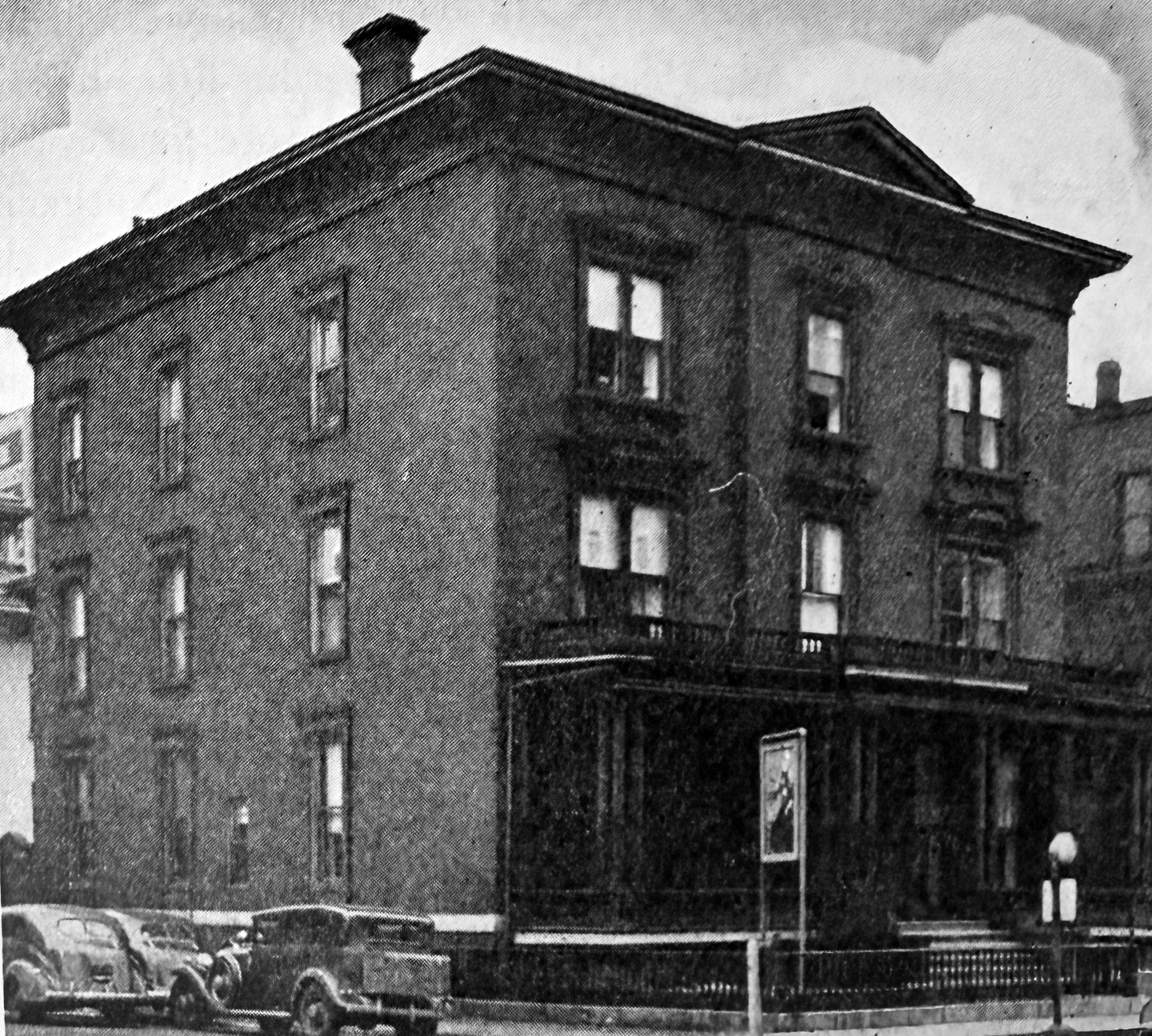
- Julian Rumsey Mansion
40 East Huron
1940
In the first-floor rooms of this house, handsome rooms of ample proportions and notable for their trim of burled wal-nut, high decorative ceilings, ornamental chandeliers, tall, narrow windows with inside folding shutters, fireplaces of marble and tile, and great gilded mirrors, the visitor finds furniture and objects of art dating from the era in which the residence was built. All these furnishings are tastefully arranged and well spaced, so that the visitor here does not have a feeling of stuffiness. This also is true of the reception hall, from which a richly carved grand staircase leads to the second floor. On this floor a number of Miss Bock’s friends—artists, writers, and professional people—live in private quarters.
One of these is Miss Herma Clark, whose “When Chicago Was Young” column in the Sunday edition of the Chicago Tribune is widely read and enjoyed. The writer of such a column, which deals with the personalities as well as fads and fancies of the late Victorian era in Chicago, could not live in a more appropriate dwelling. A book of hers, The Elegant Eighties, was recently published.
Chicago Tribune, April 21, 1886
 Julian S. Rumsey died yesterday morning at his residence, No. 313 Huron street. He was an old settler and an honored citizen. Over half a century of his active life was spent in Chicago. He saw the city grow up from an ambitious little town of less than 3,000 inhabitants to its present vast proportions, and he was one of the foremost of those who helped it forward and bad faith in its future. He served as Mayor, County Treasurer, President of the Board of Trade since its inception, and was more of the charter members. Whether in religious, political, social, or business circles, no man was more honored or any more entitled to respect than Julian S. Rumsey.
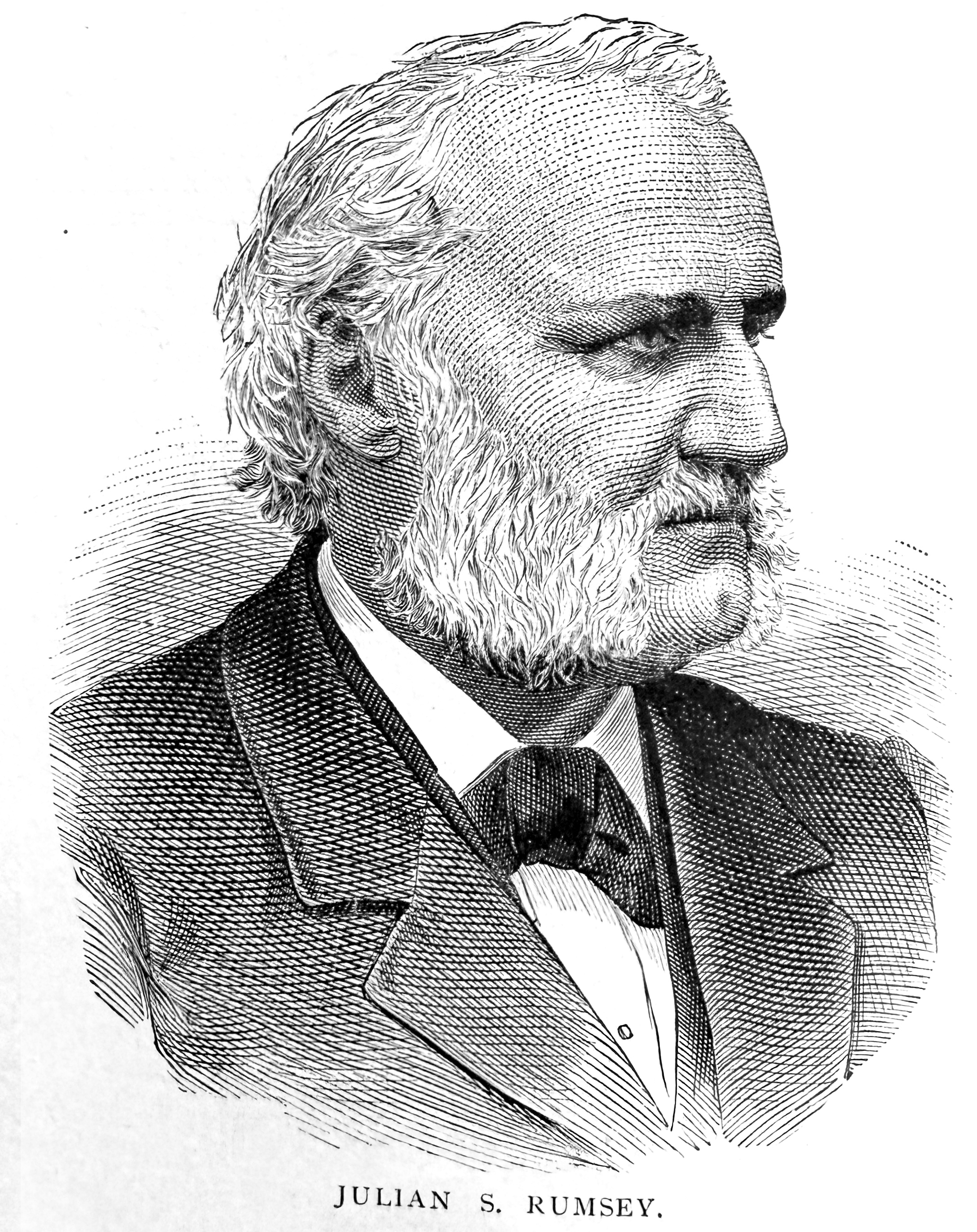
Mr. Rumsey was born in Batavia, N.Y., in 1821. He came to Chicago in 1835 when but a lad of 14, and began work as a clerk in the dry-goods store of his uncle, J. W. C. Coffin, on South Water street. Very soon afterwards he entered the service of Newberry & Dole, forwarding and commission agents, a firm that then and for many years afterward received and distributed the great bulk of the freight handled at this port. By this change young Rumsey had transferred relative his services from one relative to another, he being also being a nephew of George W. a Dole, the junior member of the firm. Mr. Dole came here in 1831 and was one of the incorporators of the original town. George Rumsey, Julian’s brother, worked for the same firm, and the two brothers were connected in business from then up until his death a few years ago. Early in the ’40’s firm was dissolved by the retirement of Newberry, who went to Detroit, and was re-established under the firm name of Dole, Rumsey & Co., with both the brothers as partners with Mr. Dole. The business of the firm up to this period had consisted almost solely in the handling and transfer of freight, but now it began to give special attention to the purchase of grain. The business was then conducted in a little warehouse on the North Side, just east of Rush street, and next to John Kinzie’s old store, where where he carried on his trade with the Indians. It was from this warehouse that Newberry & Dole, in September, 1839, sent out the first shipment of grain made from Chicago. The cargo consisted of 2.900 bushels, and was consigned to Black Rock, N. Y. The young Rumseys had to like beavers in this enterprise, helping first to unload it from the farmers’ wagons at the warehouse and then to have it weighed and carried in boxes on board the brig Osceola. In those days clerks had neither white hands nor wore pretty rings; each had to take his turn at hard manual labor when necessity arose. This system Julian Rumsey had reason to be thankful for on at least one occasion:
“It was just after the big fire,” says Mr. George M. How, who tells the story. “Mr. Rumsey was one of the unfortunate many who had been left houseless by that catastrophe. On that morning after the fire bad burned itself out and while the ruins were still smoking Mr. Rumsey and his tamily wandered over to the North Side to have a look at the site or their vanished house. Presently they were accosted by a stranger, who said: “Mr. Rumsey, my house is untouched; I want you and your tamily to come and live with me until you get a more suitable place. You did me a favor once and I don’t forget it, though you have forgotten me. Rumsey acknowledged having wholly forgotten the man. “So well you might, for it’s over thirty years ago. My schooner got stuck in a sandbank in the river, and you ran down from your place and pulled off your coat and worked as much as I did myself until we got her afloat again. Of course Rumsey and his family gladly accepted the proffered hospitality.”
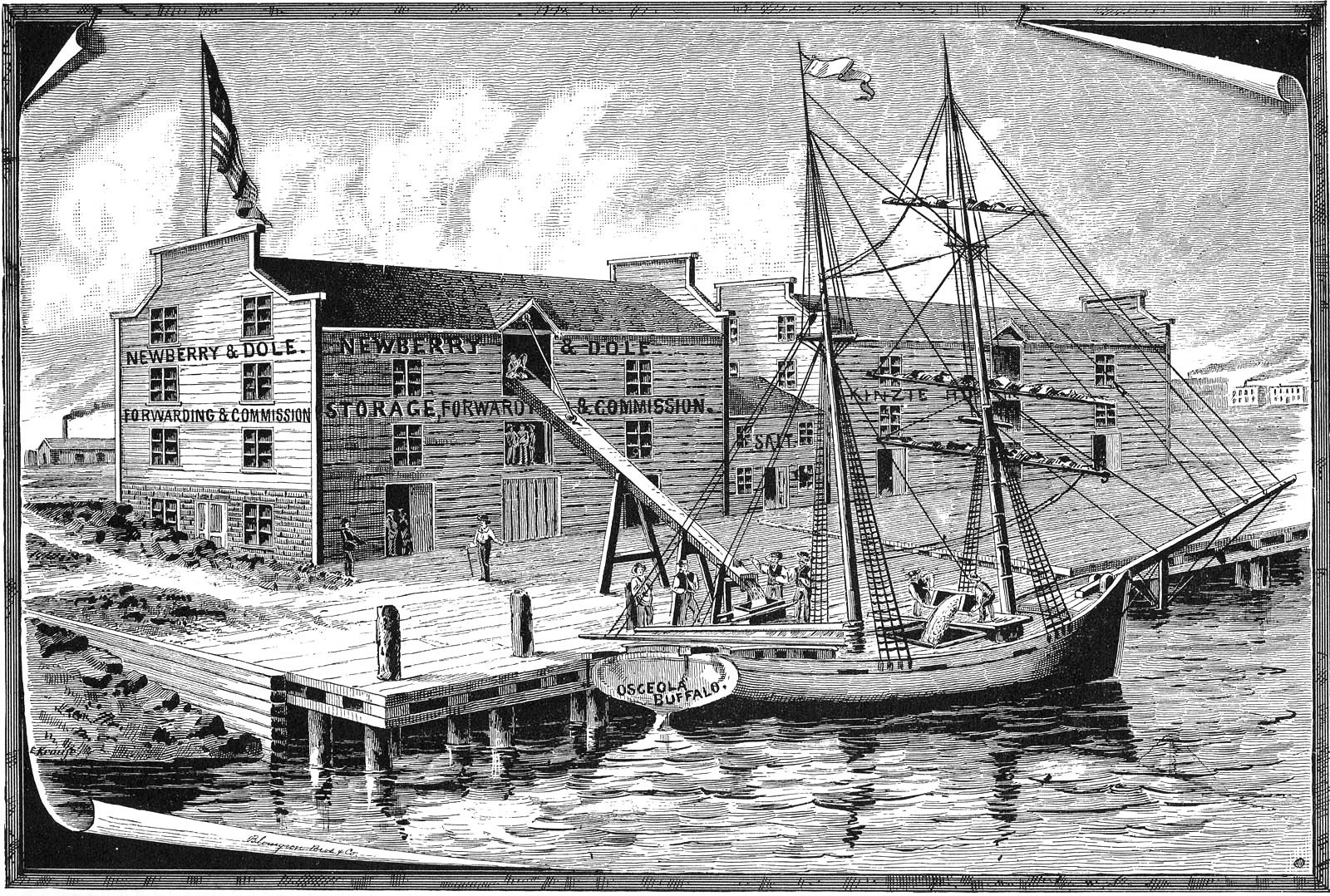
In 1852 Mr. Dole retired from the firm, which then changed its title to Rumsey Bros., and thenceforth devoted itself exclusively to the grain commission business. Subsequently the brothers admitted Henry Towner to partnership, when the firm name was changed to Rumsey Bros. & Co., a title it has borne ever since. Mr. Rumsey continued in the grain and commission business up to the time of his death.
He was one of the original charter members of the Board of Trade, and held his membership continuously up to the time of his death. The only surviving original charter member who has continued in membership that is now left is Marcus E. Stearns. At the organization of the Board of Trade in 1848 the membership fee was fixed at $5, and the brothers Rumsey bad many & laugh with old friends over the fact that George refused to join “because it was only a waste of money,” and blamed Julian for throwing away a $5 bill on such a scheme. That wasn’t the only time Julian was blamed for being too progressive. In 1859, when he was President of the Board of Trade, he persuaded the board management to enter into a contract for trading-rooms in the Newhouse Building. which was about to be erected on South Water street, near Fifth avenue. The contract was completed, the chief provision being that the board agreed to pay $1,250 a year, with a ten-year lease, for rooms built especially for its use. The more conservative members “kicked” at this “extravagance,” and Rumsey was blamed as the chief offender. Five years later Mr. Rumsey had the gratification of helping the same board to complete a ninety-nine year contract calling for $20,000 a year. This was even a bigger jump than the jump from its old Change-room to its present $2,000,000 building. Mr. Rumsey served as President of the board during 1858 and 1859, and it was during his Presidency and largely through his efforts that the new charter was obtained and the system of grain inspection and grad?ng established. He was thereafter known as the “Father of Grain Inspection.”
Mr. Rumsey always took an active interest in both local and National politics, but was never a wheel-horse politician nor an office-seeker. He was a politician because he was a citizen interested in the welfare of his city and of the Nation. In 1861, during the feverish period of the outbreak of the War, he was elected Mayor, and was one of the most active in the city in arousing enthusiasm on behaif of the Union. At the great mass-meeting in the old Metropolitan Hall a few days after the firing on Fort Sumter Mr. Rumsey delivered a brilliant and stirring oration. He was intimate with Lincoln, and was frequently in Springfield in consultation with him during that exciting time. He was an executive member of the first War finauce committee, and was a member of the State Republican Committee the same year. He subsequently filled the office of Cook County Treasurer for a term.
Mr Rumsey was married in 1848, and leaves a wife and nine grown-up children—three sons and six daughters. Four of the daughters are married. His wife is the daughter of Jonn B.
Turner, formerly President of the Northwestern Raiiroad, or, as it was then known, the Galena & Chicago Union Railroad. Mr. Rumsey has been in ratber poor health for the last four years, his trouble being of an asthmatic character. For the last tweive months his illness has been much more aggravated. He went to Colorado last summer and received some benefit in his asthmatic complaint, but suffered so much otherwise by the trip that it was on the whole a physical injury. When he came back the asthma got as bad as ever. Three weeks ago he became so ill as to be confined to his bed, and he gradually sank from that time until his release at 6 o’clock yesterday morning. The direct cause of death was progressive general paresis, a species of paralysis affecting the brain and respiratory organs.
Mr. Rumsey was an active member of the St. James Episcopal Society since 1848, and when the society was on the verge of financial ruin in 1870 he was one of the first and most active in saving it from disaster. He was a man of firm and conscientious religious faith, but never bigoted; be had a strong attachment for the Episcopalian Church and was a friend of all religious denominations. He was liberal in thought, charitable in purse, somewhat brusque in manner yet tender-hearted as a woman, honest and honorable in all things, and, in the words of a life-long acquaintance, “As true a friend as mortal man could have.” In all his career there was not a shadow of blemish upon his name.
The funeral will take place at St. James’ Episcopal Church Thursday afternoon, and the remains will be interred in Graceland. Mr. A. H. Burley, a friend of the family and a chum of Mr. Rumsey ever since their seboolboy days together, has taken charge of the funeral arrangements. Mr. Burley was in receipt of a letter from Mayor Harrison yesterday expressing regret at Mr. Rumsey’s death, and extending sympathy and consolation to the family, and inquiring if it would be agreeable to the family for the city officers to pay their respects and formally attend the funeral. The flag on the City-Hall was lowered to half-mast yesterday as a mark of respect.
The directors of the Board of Trade at their meeting yesterday decided to attend the funeral of Mr. Rumsey in a body, and appointed a committee to draw up appropriate resolutions.
Chicago Tribune, February 5, 1950
Another Landmark Razed
As this is written, another old north side mansion is being wrecked. This is the Rumsey house, 40 E. Huron st. It had been bought by the Catholic church, to be used for offices, but remodeling proved too costly, so it will be razed and a parking lot will occupy the space. The Rumsey house was built by Julian Rumsey in 1873, replacing house destroyed by the fire of 1871. Mr. Rumsey was mayor of Chicago in 1861. The beautiful home William B. Ogden, first mayor Chicago, stood in the block bounded by Rush, Ontario, Erie, and Wabash (then Cass st.). This house was destroyed by the fire of 1871.
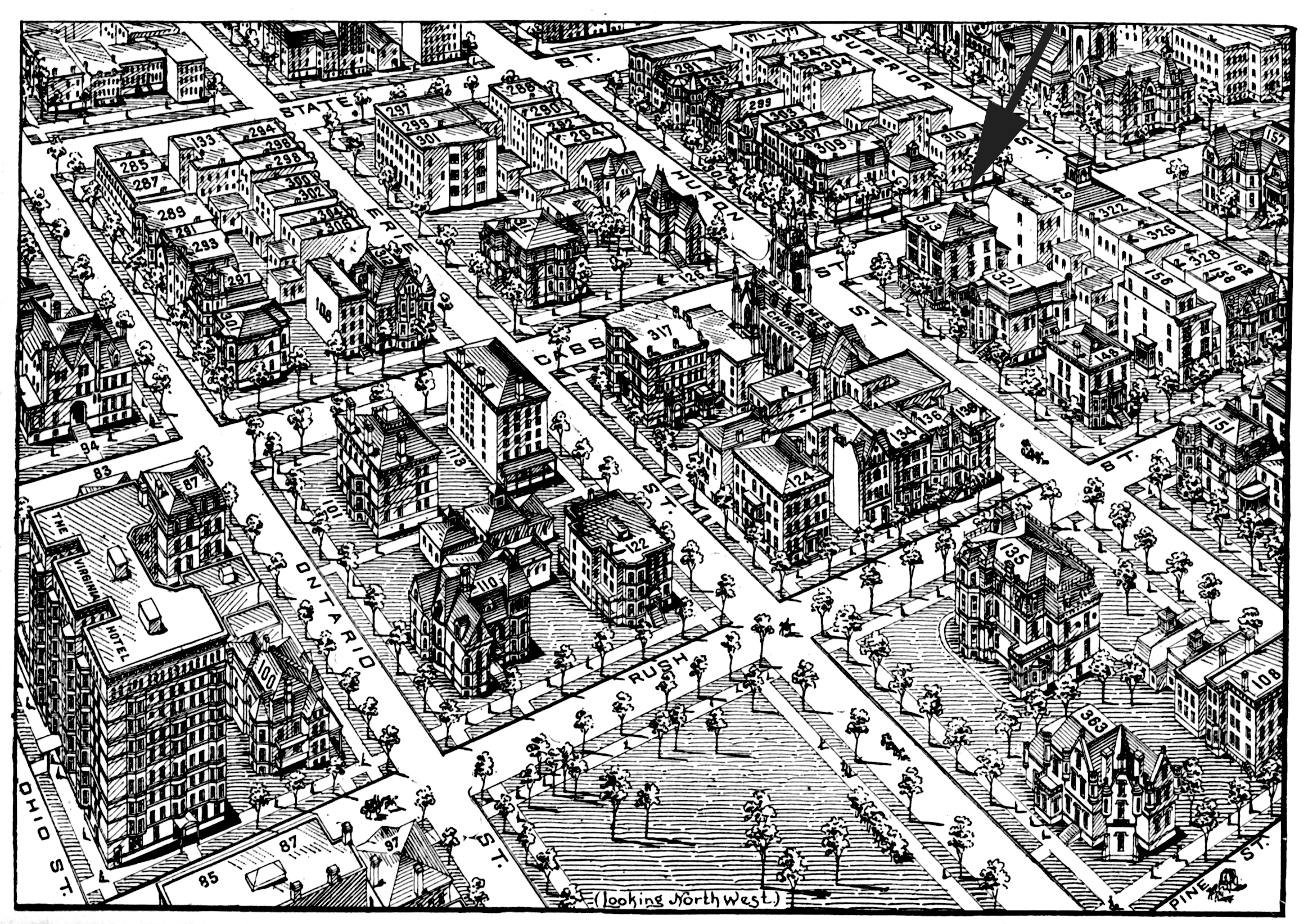
- Julian Rumsey Mansion
313 Ruron
Rand, McNally & Co.’s Bird’s-Eye Views of Chicago
1893
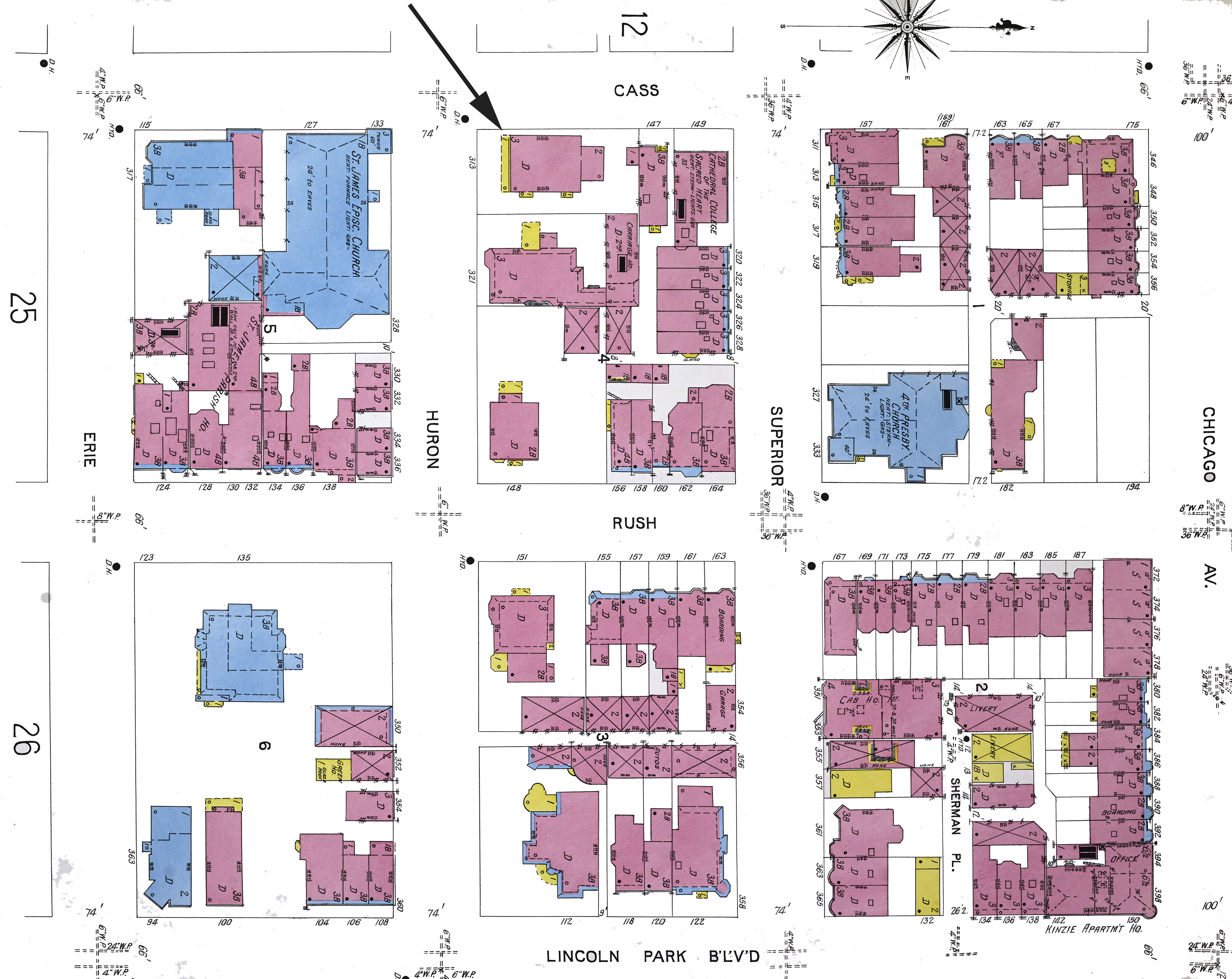
- Julian Rumsey Mansion
313 Huron
Sanborn Fire Insurance Map
1906

Leave a Reply