Oliver Bourne Green Mansion, Green Senior Center
Life Span: 1873-~1965
Location: NE corner Elm and LaSalle
1149 N. La Salle
Architect:
- Halpin’s Chicago City Directory for 1864
McLennan Hugh, com. mer., 18 LaSalle, r. 280 N. LaSalle
Green Oliver B., contractor, r. 142 N. Wells
Edwards’ Annual Directory in the City of Chicago, for 1866
Green Oliver B., contractor, room 4 Steel’s Building, r. 142 N. Wells
John C. W. Bailey’s Chicago City Directory for 1867
Green Oliver B., contractor 4 Steele’s bldg, h 403 N. LaSalle
Edwards’ Annual Directory in the City of Chicago, for 1869
Green Oliver B., dockbuilder and dredger 190 S. Water, r. 403 N. LaSalle
Edwards’ Annual Directory in the City of Chicago, for 1870
Green Oliver B., contractor 4 Steels’ bldg, h 403 N. LaSalle
Edwards’ Annual Directory in the City of Chicago, for 1871
Green O. B., contractor, r. 403 N. LaSalle
Green Oliver B., contractor, room 8, Steels’ Block,
Edwards’ Annual Directory in the City of Chicago, for 1873
Green Oliver B., contractor, S. Water, nw. cor. LaSalle, r. 403 N. LaSalle
Lakeside Annual Directory of the City of Chicago, 1876
Green Oliver B., dry docks 393 North Branch, house 403 N. LaSalle
Lakeside Annual Directory of the City of Chicago, 1880
Green Oliver B., dredging and dry dock bldg. 1, 178 South Water, house 403 N. LaSalle
Lakeside Annual Directory of the City of Chicago, 1892
Green Oliver B., pres. Green dredging co. 178 South Water, h. 403 LaSalle
Lakeside Annual Directory of the City of Chicago, 1904
Green Oliver B., h 403 Lasalle
Lakeside Annual Directory of the City of Chicago, 1911
Green P Miss h 1149 Lasalle av
Polk’s Chicago Numerical Street and Avenue Directory, 1928
Green Mary P 1149 N La Salle
Chicago Tribune, June 29, 1863
Also, lot 4, block 21, corner of La Salle and Elm streets. 52 feet on La Salle by 120 feet on Elm.
Old Chicago Houses, John Drury, 1941
Period House.
One of the most attractive “period houses” in Chicago today, an old mansion that to an unusual degree retains, both inside and out, all the decorative charm of the age of Queen Victoria, is the red-brick residence at I149 North La Salle Street. Redolent of Chicago life in the years after the fire of 1871, the house is still the abode of an elderly society woman whose family goes back almost to the beginning of Chicago.
For more than half a century this house has been presided over by Miss Mary Pomeroy Green, descendant of an old New England family and daughter of O. B. Green, pioneer harbor builder and religious and cultural leader of Chicago. She also is a niece of Andrew H. Green, known as the “Father of Greater New York.” Today, Miss Green still reigns over this house and now holds the distinction of being one of the last of the aristocratic “old guard” that flourished on La Salle Street—then called “avenue”—in the 1870’s and I880’s.
One of Miss Green’s most prized possessions is a stout old copy-book in which her father, using skilful English, described events in the Green household. The first page, dated November 6, 1873, contains this entry: “This day we take our first meal in our restored home on La Salle Avenue.” Lower on the page we read that “Hugh is four years old today.”
The date on which the residence was completed being established by this entry, the house survives today as one of the first to be built on that street following the great conflagration of 1871. Before the fire the Greens lived in a brick house on the same site—a house that had originally belonged to Hugh McLennan, one-time partner of O. B. Green. This dwelling was destroyed in the fire.
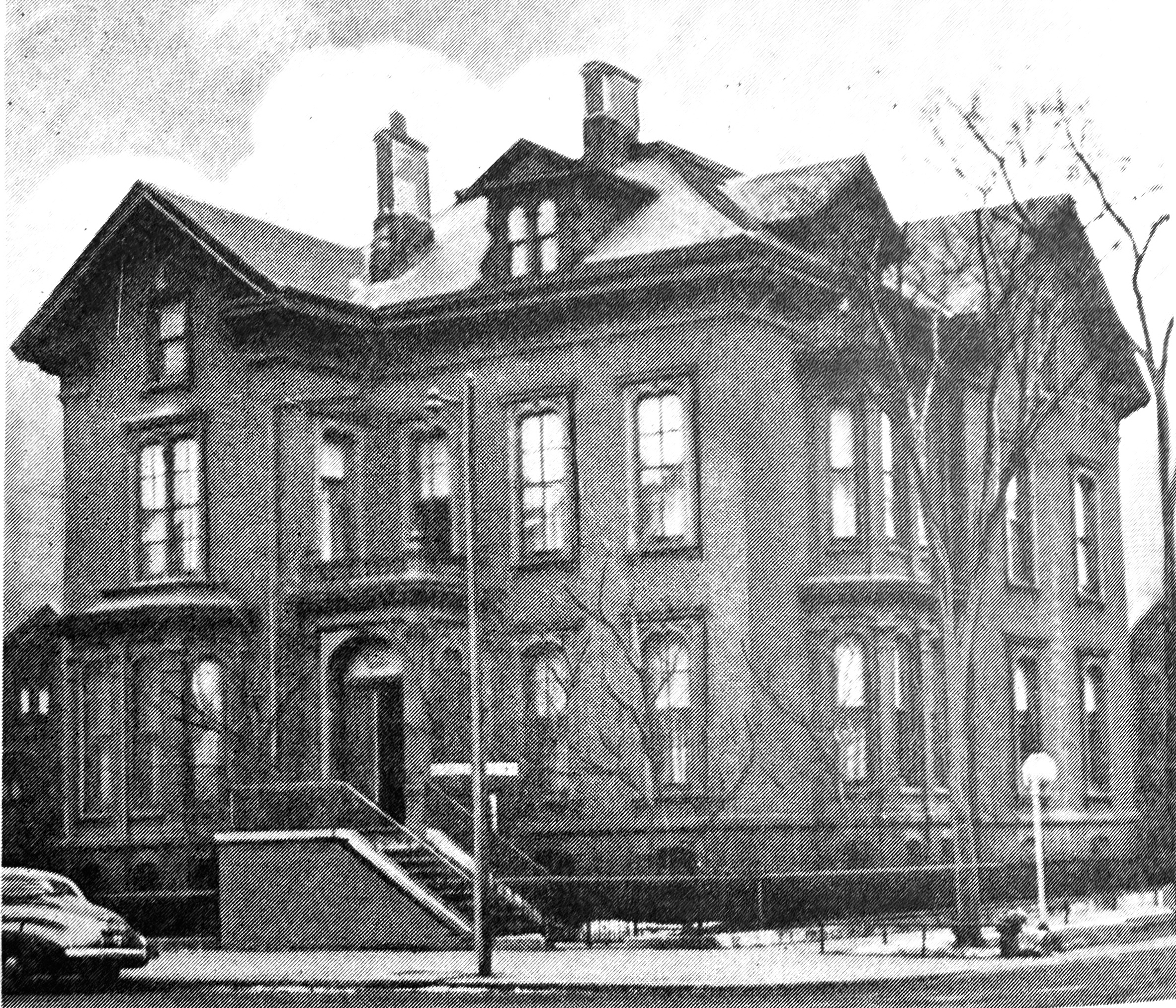
- O. B. Green Mansion
1149 N. La Salle Street
1940
When the house was completed in 1873, Oliver Bourne Green was one of the city’s leading citizens. As a dredging and general harbor contractor he organized the Green Dredging Company and supervised many improvements in the Chicago River and along the lake front. He first began this type of work in 1858, three years after his arrival in Chicago. In addition to his business activity, he took part in civic and philanthropic work.
“Mr. Green,” says a newspaper account the day after his death, “was interested in educational and philanthropic work in Chicago and elsewhere and was a liberal contributor to such causes. He was a member of the New England Congregational Church, and as chairman of its board of trustees for many years showed his interest in its welfare.”
From The Book of Chicagoans we learn that O. B. Green was born January I, 1826, at Green Hill, his ancestral home at Worcester, Massachusetts. This estate is now a park in the Massachusetts city. One of Green’s ancestors was General Timothy Ruggles, officer of the Colonial Army. After being educated in his native city, O. B. Green became a civil engineer and as such engaged in the first surveys for the New York Central Railroad from New York to Albany.
Attracted to Chicago, which was then rapidly expanding with the introduction of railroads and lake shipping, Oliver Green arrived here in 1855. That same year he married Emily Louise Pomeroy, a Canadian-born girl. The couple afterward acquired the original La Salle Street house, and here were born three children—Mary, Olivia, and Andrew Hugh. The last named was the youngster who was four years old when the Greens occupied their new mansion for the first time.
In the years that followed Mrs. Green was just as active as her husband in civic and welfare projects. She was, says an old newspaper account, an elderly woman with a kindly, motherly character, who has always taken the deepest interest in works of charity, especially that connected with the home for young women which was erected by the association (Y.W.C.A.).”
The master of the La Salle Street house died in it in 1906 at the age of eighty. His widow survived him for a few years, and then, with her passing, it was taken over by the daughter, Miss Green, and her brother. Subsequently, Andrew Green acquired a plantation in the West Indian island of Dominica, and there he lived until his death a few years ago.
What makes this residence unusual today is that the original interior has been preserved by Miss Green. But there is no overcrowding of bric-a-brac such as characterized many Victorian interiors. Here the visitor finds everything chastely arranged. Many of the articles of furniture are family heirlooms dating from early New England days and saved from the Chicago Fire. One who appreciates antiques would find this dwelling a treasure-house.
The main rooms on the first floor, with their tall windows, inside shutters, parquet floors, and fine woodwork, are enhanced by fireplaces of various kinds of marble, and over these are suspended great mirrors. From the ceilings hang the original brass chandeliers, now wired for electricity. In the dining-room stands a large buffet containing family china and other heirlooms.
This house was the scene, a few years ago, of a fashionable gathering. This was when Miss Green’s grandniece, Katherine Dole Baird, was a debutante and Miss Green gave a tea for her. The old mansion, on that occasion, was filled with the social élite of the city, and all marveled at the way Miss Green had maintained her dwelling in a world of rapid change.
New York Times, January 1, 1904
ANDREW H. GREEN’S WILL.
Property in This State Valued at about $490,000.
All of This, with Exception of $11,000, as Well as Illinois and Massachusetts Estates, Left to Relatives.
The will of Andrew H. Green was filed for probate in the office of the Surrogate yesterday. Oliver B. Green of Chicago, a brother of the testator, in the petition accompanying the will, says that the estate in New York State amounts to about $940,000, of which $900,000 is personal property. With the exception of $11,000 the entire estate is left to relatives of Mr. Green. To the American Antiquarian Society and Clark University, both of Worcester, Mass., $5,000 each is given, and $1,000 bequeathed to the Isabella Heimath of this city.
The will was executed on Feb. 7, 1903, and a codicil, which makes no material change in the document, on April. 1, 1903. The executors are Mr. Green’s brother, Oliver B. Green of Chicago, and four nephews, Timothy Ruggles Green, William Ogden Green, Samuel Martin Green, and Nathan Williams Green.
Besides the property here Mr. Green owned real estate in Illinois and elsewhere, including an extensive estate and mansion known as Green Hill, Worcester, Mass., a portion of which had been owned by Mr. Green’s ancestors for more than a century.
To each of the four nephews who are executors of the will $5,000 is left. Julia Elizabeth, Lucy Maria, and Mary Ruggles Green each receive a similar bequest. Andrew Hugh Green, a nephew, and Mary Pomeroy Green, a niece, receive $2,500 each, and Oliva Green Baird, a niece, $1,000. The Rev. Leighton Williams of this city receives $2,000. Eight children of Mr. Green’s nephews are willed $1,000 each.
Book of Chicagoans, John W. Leonard, A. N. Marquis & Co., 1905
Green, Oliver Bourne, civil engineer and contractor, retired; b. Green Hill, Worcester, Mass., Jan. 1, 1826; s. William B. and Julia (Plimpton) Green; ed. public schools (infant, primary and classical) of Worcester; m. Chicago, Aug. 28, 1855, Emily Louise Pomeroy; children: Mary Pomeroy, Olivia Pomeroy, Andrew Hugh. Was school teacher in rural districts, 1844-45; engaged in general practice as civil engineer, 1846-58; dredging and general harbor contractor in Chicago, on the Great Lakes and in adjacent waters, 1858-98; and during same time built the Sturgeon Bay Ship Canal; in 1898 retired from active business. Mem. Western Soc. of Engineers. Eclectic in politics. Congregationalist. Club: Chicago Literary. Residence: 403 LaSalle Av.
Chicago Tribune, December 31, 1906
 Oliver Bourne Green, -a retired civil engineer, who would have been 81 years old tomorrow, died yesterday at his residence, 403 La Salle avenue. He had been ill for two years.
Mr. Green was president of the Green Dredging company, which built the Sturgeon Bay ship canal and many other lake and river improvements, and was a brother of the late Andrew H. Green of New York, known as the “father of Greater New York.” For many years he had been chairman of the board of trustees of New England Congregational church.
He was born and educated in Worcester, Mass., and was civil engineer on the first surveys of the New York Central lines and the Mississippi Central rallroad.
Mr. Green came to Chicago in 1855 and for several years carried on his business alone. Later he organized the Green Dredging company and remained its active head until 1898, when he retired from business. He left a widow and three children-Miss Mary Pomeroy Green, Andrew Hugh Green, and Mrs Wyllys W. Baird.
The funeral will be held at 11 o’clock tomorrow morning at New England Congregational church.
Inter Ocean, December 31, 1906
 Oliver Bourne Green died at his home, 403 La Salle avenue, at 9 o’clock yesterday morning of general breakdown, due to his advanced years. Next Tuesday, New Year’s day, would have marked the close of his eightieth year, he having been born at Worcester, Mass., Jan. 1, 1826.
For forty years, from 1858 to 1898, Mr. Green was prominently identified with dredging and general harbor work in Chicago and the great lakes. During that period there was little work of any importance here or on the chain of lakes with which he was not identified. His most pretentious work was the building of the Sturgeon bay ship canal, several miles long, connecting Green bay with Lake Michigan and shortening the distance between Menominee and Marinette and Lake Michigan points. Mr. Green oparated a number of dredges under the firm name of the Green Dredging company.
Much Given to Charity.
In spite of his extensive engineering operations, Mr. Green left only a moderate fortune because of his liberality. He gave freely to charities and to educational and philanthropic institutions. He was especially interested in minor institutions. His method of giving corresponded with his manner of living. He’ was a modest man and endeavored to avoid notoriety of any kind.
During the entire period of his residence in Chicago Mr. Green was an active member of the New England Congregational church. He was also a member of the Western Society of Engineers.
Taught School In Youth.
Mr. Green had the educational advantages of the infant, primary, and classical schools of Worcester, Mass. Before he engaged in engineering work he taught school for two years in the rural districts.
On Aug. 28, 1885, he married Emily Louisa Pomeroy of Chicago, who survives him. Three children were born to them, all of whom are still living—Mary Pomeroy Green, Mrs. Willis W. Baird, and Andrew Hugh Green.
Funeral services will be held at the New England Congregationa) church at 11 o’clock Tuesday. The place of interment has not yet been decided upon.
Chicago Tribune, March 6, 1945
Miss Mary Pomeroy Green.
Services for Miss Mary Pomeroy Green, 88, one of Chicago’s pioneer residents, will be held at 2 p. m. Thursday in the family home at 1149 N. La Salle st. The daughter of the late Oliver Bourne Green, she was active in social service work in the city. Miss Green, who died Sunday, was a member of the Woman’s club and identified with the Art institute and Chicago Historical society. A niece, Mrs. S. W. Treat, and a nephew, Warner G. Baird, survive.
Chicago Tribune, May 6, 1957
NEW CENTER READY FOR “SENIORS”
By Joan Beck
When the Mary Pomeroy Green center for men and women over 60 opens at 1149 N. La Salle st. Wednesday, it will mark the first big step toward filling what has been called “the greatest unmet social need in Chicago.” This is to be the first of several full time centers devoted to the 700,000 senior citizens in the metropolitan area.
To celebrate the center’s dedication, Mayor Richard J. Daley has proclaimed May 5 to 11 to be the first Senior Citizens week in city history.
Ten Year Study
The new center is the culmination of a 10 year study (under Welfare Council guidance) of the increasing needs of the city’s growing number of elderly persons. Located in the near north side area where surveys show one of the greatest concentrations of people over 60, it also is headquarters for the new, nonprofit agency called Senior Centers of Metropolitan Chicago. Executive director is Miss Mary A. Young.
To house the first senior center, the new agency has repaired and redecorated the traditional, old La Salle st. mansion once owned by Mary Pomeroy Green. Her nephew, Warner G. Baird Sr., will present a golden key to a representative senior citizen during the ribbon-cutting ceremonies at 2 p. m. Wednesday.
After Philip E. Ringer, president of the Senior Citizens Board of Directors, opens the massive mansion doors, the public is invited to inspect the new center at a 2 to 7 p. m. open house. It will then operate on a regular Monday-thru-Friday schedule.
Many Craft Rooms
Craft rooms with facilities for all kinds of creative activities fill the spacious garden floor of the old mansion. There is a ceramics room, a weaving room with 10 rooms, space for wood-working, metalcraft, photography, leatherwork, jewelry making, and fine art.
The garden, to the rear of the mansion, has been planted with annuals and perennials by the Friendly Garden club group of the Garden Club of Illinois, Inc. It’s planned to be in bloom from early spring to late fall and to provide interesting, outdoor work for seniors.
Overlooking the garden is a large porch for the center’s rocking chair brigade,” and dubbed” whittlers’ paradise.” There’s a patio, too, with space for seniors to work with plants.
Two Parlors
On the main floor of the new Green center, the massive doors open into a big entrance hall, and wide, winding stairway. Flanking the hall are a library [equip-ped with radio-phonograph, a small book collection, and period furniture to match the mood of the old man-sion] and two parlors which will be used as reception and meeting rooms.
There’s a dining room and kitchen to the rear with facilities for preparing hot drinks to go with sandwich luncheons which seniors are invited to bring from home.
Upstairs are more craft and meeting facilities, office space and rooms for counseling.
“Each day will offer opportunities for members to learn new skills, to make new friends, and to be of service,” officials of the Green center said. “Improved health, better family relations and recognition of their share in the community will be the resuit.”
Chicago Defender, May 18, 1957
The Neighborhood Center for Older People on the near Northside is in the home at 1149 N. LaSalle, formerly occupied by Mary Pomeroy Green who, for years, was a member of the Urban League and gave generous financial support to that and other worthy institutions. Miss Green was a very wealthy woman a working philanthropist in the truest sense.
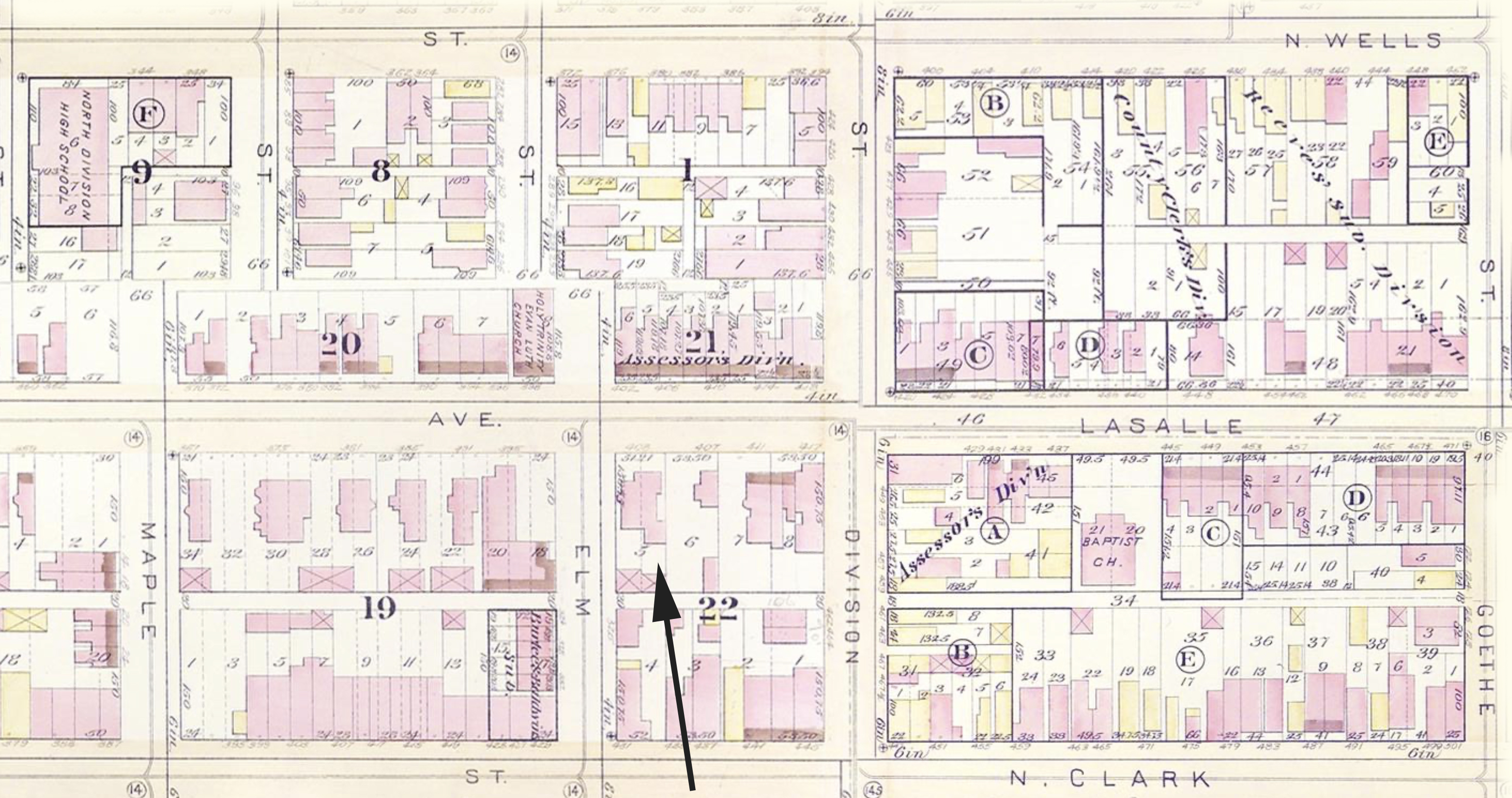
- O. B. Green Mansion
403 N. La Salle Street
Robinson Fire Insurance Map
1886
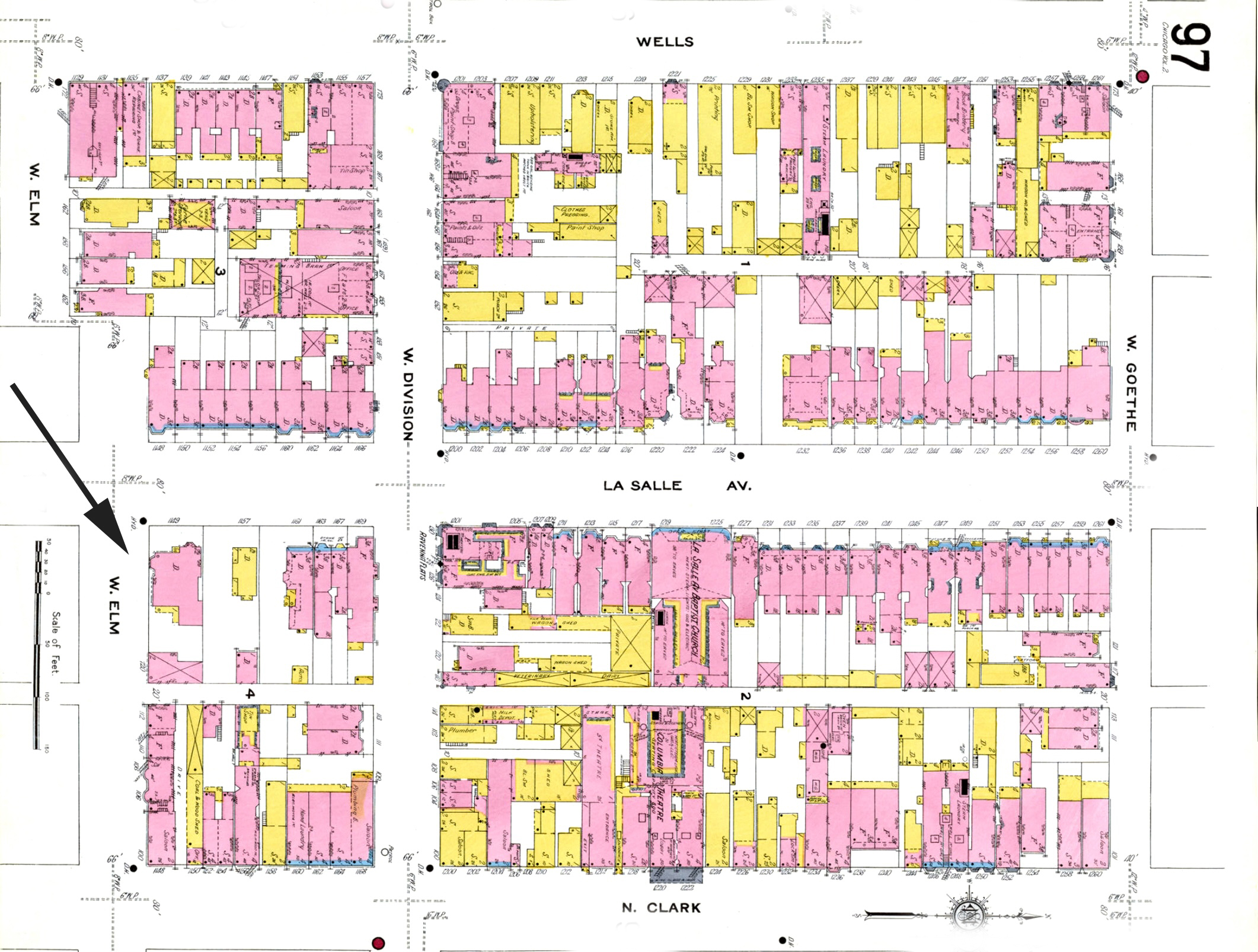
- O. B. Green Mansion
1149 N. La Salle Street
Sanborn Fire Insurance Map
1910
The O. B. Green Fleet.
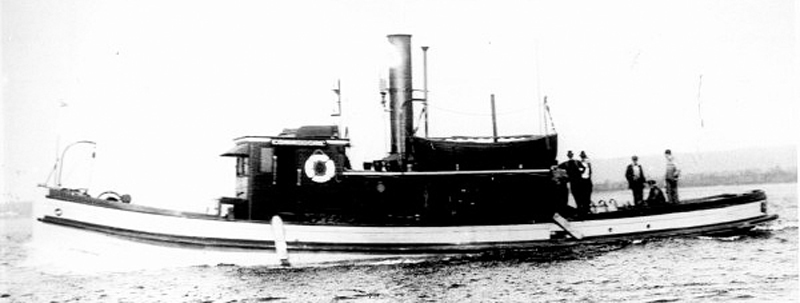
- The O. B. Green was the one of the first tugs built for Oliver B. Green by shipbuilder John Gregory in 1865. In 1881 the name was changed to the Commodore after the second O. B. Green tug was built. The tug, which became affectionately known as “The Old One,” was in use until it was moved into a boneyard in Thessalon, Ontario, Lake Huron about 1945.
The Martin Green (US No. 90018) was the second tug built for Oliver B. Green by shipbuilder John Gregory. She was launched on June, 12 1869 and was named after Mr. Green’s brother and partner, Martin Green.
Chicago Tribune June 12, 1869
TUG LAUNCH—The new tug Martin Green is also to be launched this afternoon, at the yard of O. B. Green, in the North Branch, of this city. She was built by John Gregory, for O. B. Green, and is of the following dimensions: Length of keel, 41 feet; over all, 49 feet; breadth, 13 feet; depth, 6 feet 6 inches; tonnage, 50 tons; cost, $10,000. Her engine is from Vulcan Iron Works, and she is the only tugboat in this harbor which has a single engine.
Chicago Tribune, February 22, 1881
O. B. GREEN’S NEW TUG.
At the yard of Oliver B. Green, the well-known contractor, John Gregory, the popular designer and master builder, is superintending the construction of a new tug for Mr. Green, of the following dimensions: Length of keel, seventy feet; length over all, eighty feet; breadth of beam, sixteen and one-half feet; depth of hold, nine feet. Mr. Gregory is introducing several improvements in this tug which are calculated to give her greater strength than most boats of her size possess. One of these improvements is the notching of the keelsons so as to let them down over the frames, thus forming the whole into one solid mass of timber from the bottom of the keel to the top of the keelson. This is only one of several innovations that may bear mention later on, when the tug is launched. The newcomer will carry an 18×18 engine, and a boiler seventeen feet long, with a shell six feet three inches in diameter. The design is to have her ready for launching by the 1st of April. The estimated cost of the tug, complete, is about $15,000.

- O. B. Green II
Chicago Tribune, March 31, 1881
UNION LINE OF TUGS.
The list of tugs that will form the Union Line the present season is now about complete. As will be seen by the array of names appended, the combination is a formidable one:
- Pool:
Owen (new), Commodore (old Green), Constitution, J. H. Martin, Mary McLane, R. Prindiville, J. G. Campbell, Tom Brown, Success.
Independent.
O. B. Green (new), F. R. Crane, Monitor, Red Jacket, Alert, A. Ransom, C. D. D. Co.’s new iron tug.

Leave a Reply