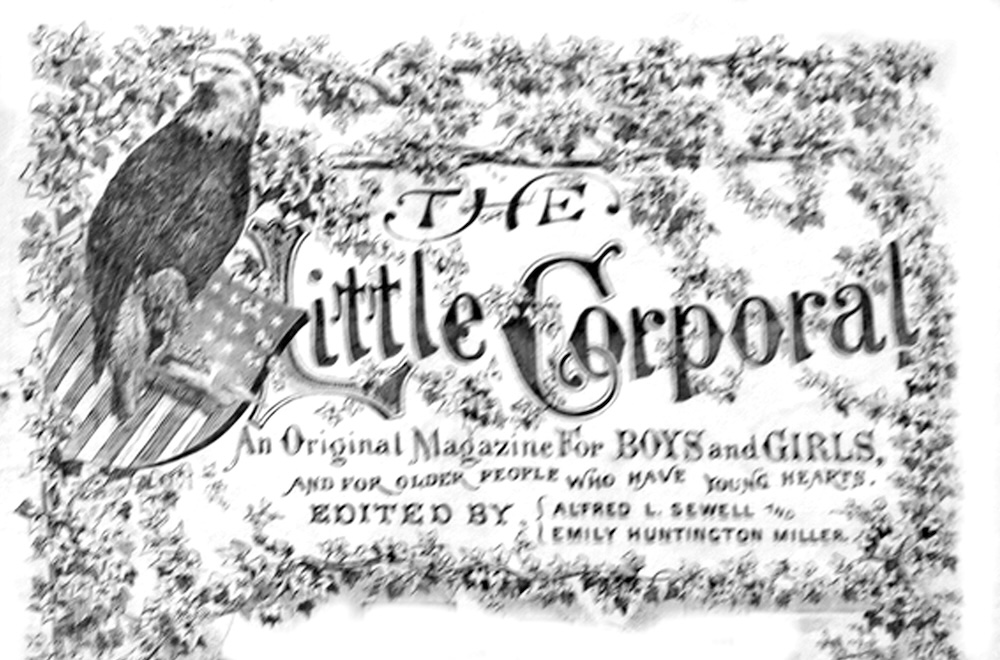
The Little Corporal
Life Span: 1865-1875
Location: Various
Architect: NA
- Halpin & Bailey’s City Directory for the Year 1863
Dunlop, Sewell & Spalding, (Samuel Dunlop, Alfred Sewell and J. J. Spalding,) printers and stationers, 49 Clark.
Halpin’s Chicago City Directory for 1864
Dunlop, Sewell & Spalding, (Samuel Dunlop, Alfred L. Sewell and Joel J. Spalding,) printers and stationers, 49 Clark.
John C. W. Bailey’s Chicago City Directory for 1867
Little Corporal (monthly) office 138 Lake
Garden City Printing and Blank Book Co., A. L. Sewell, pres, J. J. Spalding, treas, office 138 Lake.
Edwards’ Annual Directory in the City of Chicago, for 1870
Little Corporal—Office, 6 Custom House place.Published monthly, by Sewell & Miller.
Sewell & Miller (Alfred L. Sewell and John E. Miller), publishers, 9 Custom House
Edwards’ Annual Directory in the City of Chicago, for 1873
Little Corporal, John E. Miller, publisher, room 15, 164 Randolph
Chicago Tribune, April 24, 1865
Boys and Girls.
I want you to join the army of the American Eagle!
I’ll tell you about it. The great Northwestern Sanitary Fair will open in Chicago on the 30th of May, to raise money for the sick and wounded soldiers. I have arranged a plan by which all boys and girls in the Union can do something to help this Fair, and at the same time do a favor to every one of their friends. The plan is this:
You have all heard of the celebrated Live Eagle of the 8th Wisconsin Regiment, a short sketch of which you will find below. We are preparing a great many thousand beautiful Album pictures in oil colors of this Eagle, ‘Old Abe.” And I want you to help sell these pictures for the Sanitary Fair.
I am organizing what I call the Army of the American Eagle.
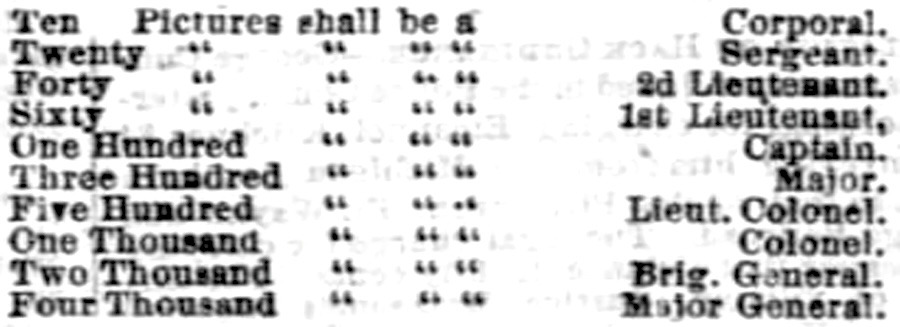
Every person who buys one or more of these pictures will be a private in this army.
Every boy or girl who sells a number of the pictures shall be an officer, and rank in proportion to the number of pictures he or she may sell. They sell singly for fifteen cents, but when you get up a club, I will send ten to one address for one dollar, or one hundred for nine dollars.
To get ten for one dollar the dollar must all be sent at one time; and to get one hundred for pine dollars, the nine dollars must all be sent at one time. In each case the pictures will all be sent prepaid to our address, and the commission in a separate letter to same address.
I hereby appoint every boy and girl who shall read this. a recruiting officer.
Now to work, every one of you!
As soon as you send me the money I will send you the pictures, post paid, and send you also a regular Commission handsomely printed, showing that you are an officer in the Army of the American Eagle.
Hurrah, Boys and Girls! Let’s go into this work like soldiers and let the Army of the American Eagle raise at least Ten Thousand Dollars for the Sanitary Fair. We can do it. Let’s say we will.
Our Eagle Army is succeeding so far beyond anything anticipated, that we have concluded to award two really elegant prizes to the boy and girl who shall sell the largest number of these pictures before the Fair opens. Each shall receive a GOLD MEDAL of honor.
There will be but two Gold Medals, unless the two highest boys or the two highest girls should sell the same number of pictures, in which case they will be rewarded alike.
Besides these gold medals there will be six Silver Medals for the girls and six for the boys. There will also be ten Bronze Medals for the girls and ten for the boys.
All these Medals will be inscribed so as to show the degree of honor intended to be conferred and will be awarded to those who have sold the most of these pictures for the Fair. The successful competitors will be telegraphed to as soon as the result is known, in time for them to attend the Fair, where the prizes will be publicly awarded to them in the presence of the Eagle himself, and the assembled dignitaries of the nation.
A great many of the chief men and women of our country will be here—we confidently hope for Lieutenant General and Mrs. Grant, General and Mrs. Sherman, and many other of the nation’s honored ones.
We offer these rewards not because the boys and girls of America need any other incentive then exalted patriotism to work for our soldiers, but because we think the hard workers should be honored.
We give below a short account of this noble bird, written by. a staff officer of that regiment:
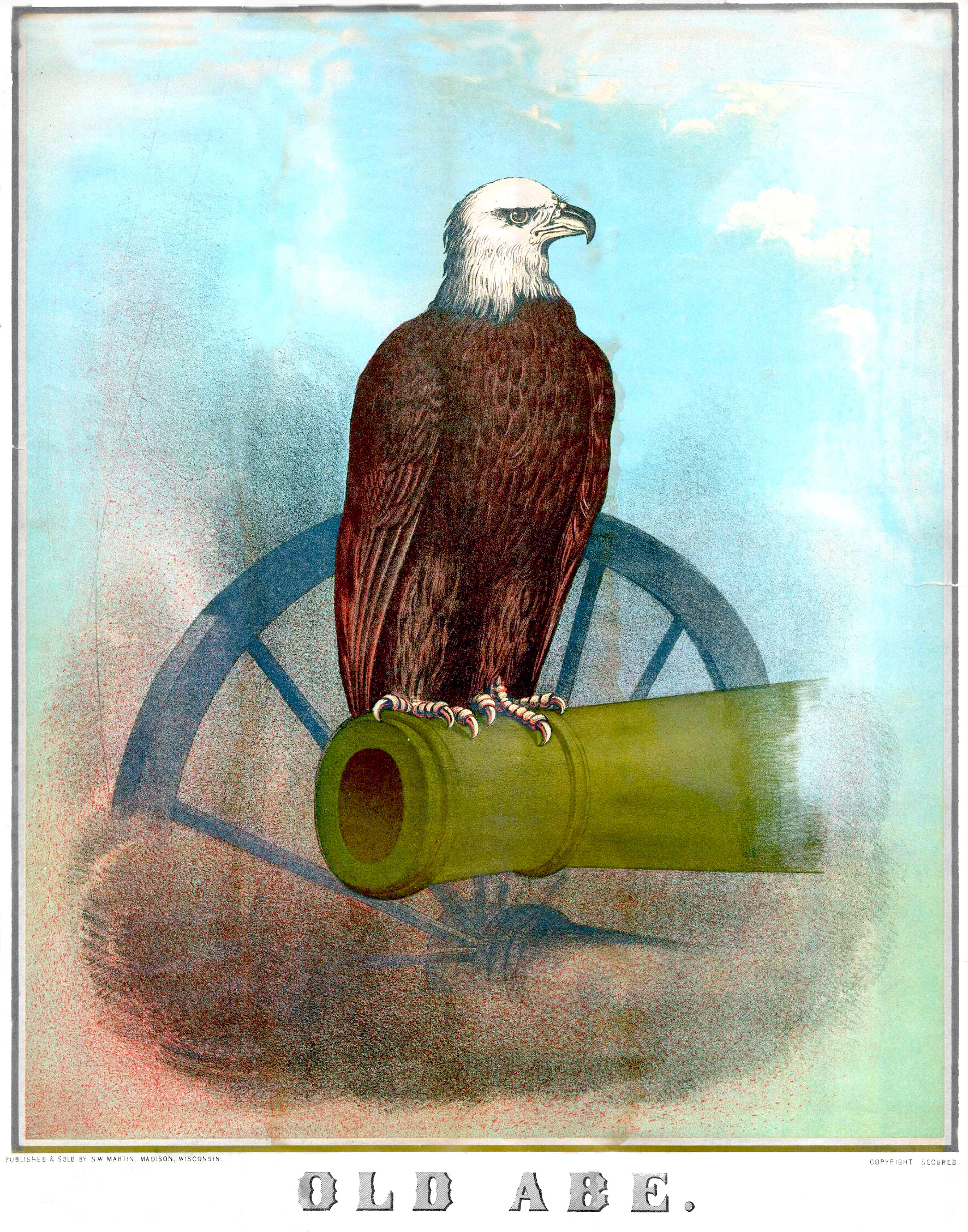
- Allow me to introduce to you an object of interest—the ‘Old Eagle.’ He may be seen a little above the heads of the soldiers, close by the flag. This position of honor is never disallowed him. The perch upon which he sits is borne by a young man in Company C, to whom his safe-keeping is exclusively intrusted. * * * He was taken from the nest in Chippeway county, Wis., July, 1861, by a Chippeway Indian, and by him presented to a farmer near by. He was subsequently bought by a citizen of Ean Claire, who presented him to Company C. 8th Regiment. The present excellent commander of that company, Capt. Wolf, gave him the name of ‘Abe,’ the name by which he is uniformly known among us, and to which only he deigns to answer. When the regiment march into Camp Randall, the instant the men began to cheer, he spread his wings, and taking one of the small flags attached to his perch in his beak, he remained in that position until borne to the quarters of the late Col. Murphy. Ever since he was mustered into the service, his wings have been instantly outstretched on the occasion of any cheering by the regiment. To similar demonstrations in adjacent regiments he pays no regard.
He has been in all the battles of the regiment, equally exposed with the troops. At the battle of Farmington, May 9th, 1862, the men were ordered to lay down. The instant they did so, it was impossible to keep him on his perch. He insisted on being protected as well as they, and when liberated, flattened himself on the ground, and there remained till the men arose, when with outspread wings he resumed his place of peril, and held it to the close of the contest.
At the battle of Corinth the rebel Gen. Price, having discovered him, ordered his men to be sure and take him if they could not kill him, adding that he had rather get that bird than the whole brigade. Upon the whole he is a magnificent bird, and, I opine, will ere long spread his wings in triumph over other sections of now disloyal territory.
Since this paragraph was written, our eagle has, with his regiment, served out his term of enlistment, and its close was presented to Gov. Lewis, of Wisconsin. He now rests on his laurels, living in apartments fitted up expressly for him in the State House Park at Madison.
Gov. Lewis has consented to his coming to our Great NorthWestern Fair in May, to exhibit himself for the benefit of the sick and wounded soldiers—his companions in arms.
Children will remember that we have no Agents of any kind for the Army of the American Eagle, or for our picture. Ail children may act as Recruiting Officers, but money must be sent to the undersigned, who alone can issue commissions.
Be sure to write plainly, your name, post office, county and State.
Alfred L. Sewell
Care of Dunlop, Sewell & Splding,
Chicago, Illinois.
Forney’s Philadelphia Daily Press, August 22, 1865
The Little Corporal.
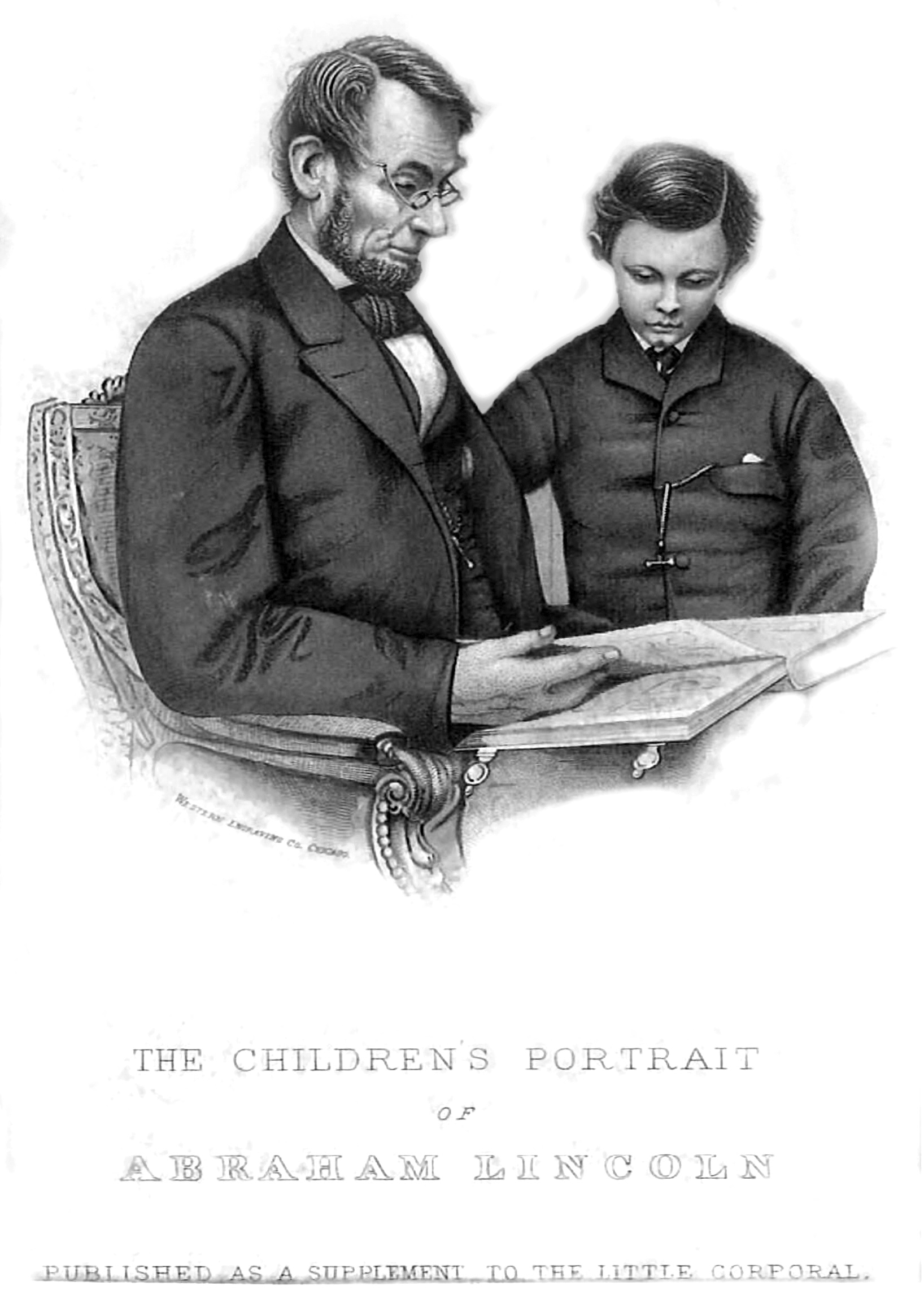
We have read the first two numbers of The Little Corporal, a new child’s paper, edited and published by Mr. Alfred L. Sewell, Chicago, Illinois. Judging from the appearance of the two numbers which are now before us, The Little Corporal is destined to become the great children’s paper of America. The portrait of our late President, Mr. Lincoln and his son Tad, which is presented to each subscriber, is a fine steel engraving, and generally acknowledged to be the best of the many likenesses of Mr. Lincoln.
Terms one dollar a year. Specimen copies ten cents.
Address Alfred L. Sewell, care of Dunlop Sewell & Spaulding, No. 138 Lake street, Chicago
Raftsman’s Journal, August 23, 1865
THE LITTLE CORPORAL.—Such is the title of a new monthly paper, for boys and girls, just started in Chicago, Illinois, by Alfred L. Sewell, at one dollar per year—specimen numbers sent on the receipt of ten cents. The “Corporal’ is printed in quarto form—16 pages—on good paper, and bids fair to be the best publication of its kind in the United States. We commend it to our juvenile friends. To show what others think of “The Little Corporal,” we append the following notice from the Chicago Tribune:
- The children’s “Eagle Army,” through its successful leader, Alfred L. Sewell, of this city, has paid into the Northwestern Sanitary Fair, from the sale of album pictures of the old bird, the magnificent sum of sixteen thousand three hundred and ten dollars and fifty cents ($16,310.50). Mr. Sewell has commenced the publication in Chicago of a first class children’s paper, The Little Corporal, which bids fair to be all that he claims it to be—the best children’s paper in America. The Children’s Portrait of Mr. Lincoln,” which is given as a premium to every subscriber, is one of the neatest steel portraits we have seen of our martyred President. The publisher sends a copy of the Corporal to any address for ten cents. We wish the paper the success it appears so richly to deserve.
Chicago Tribune, November 13, 1866
Oceans and Melodeons Given Away.- The attention of schools is directed to the last number of the Little Corporal, and the offer therein contained. The directions, if followed, will enable to obtain a fine parlor organ or melodeon A copy of the paper will be sent free on receipt of ten cents by Alfred L. Sewell, publisher the Little Corporal, No. 138 Lake street, Chicago.
Chicago Tribune, November 27, 1866
THE LITTLE CORPORAL.
The Pennsylvania Teacher says, “The Little Corporal is the most entertaining publication for the young we have ever examined. We cannot see how it possibly can have a superior, or if it could have, how the young folks could have anything better.”
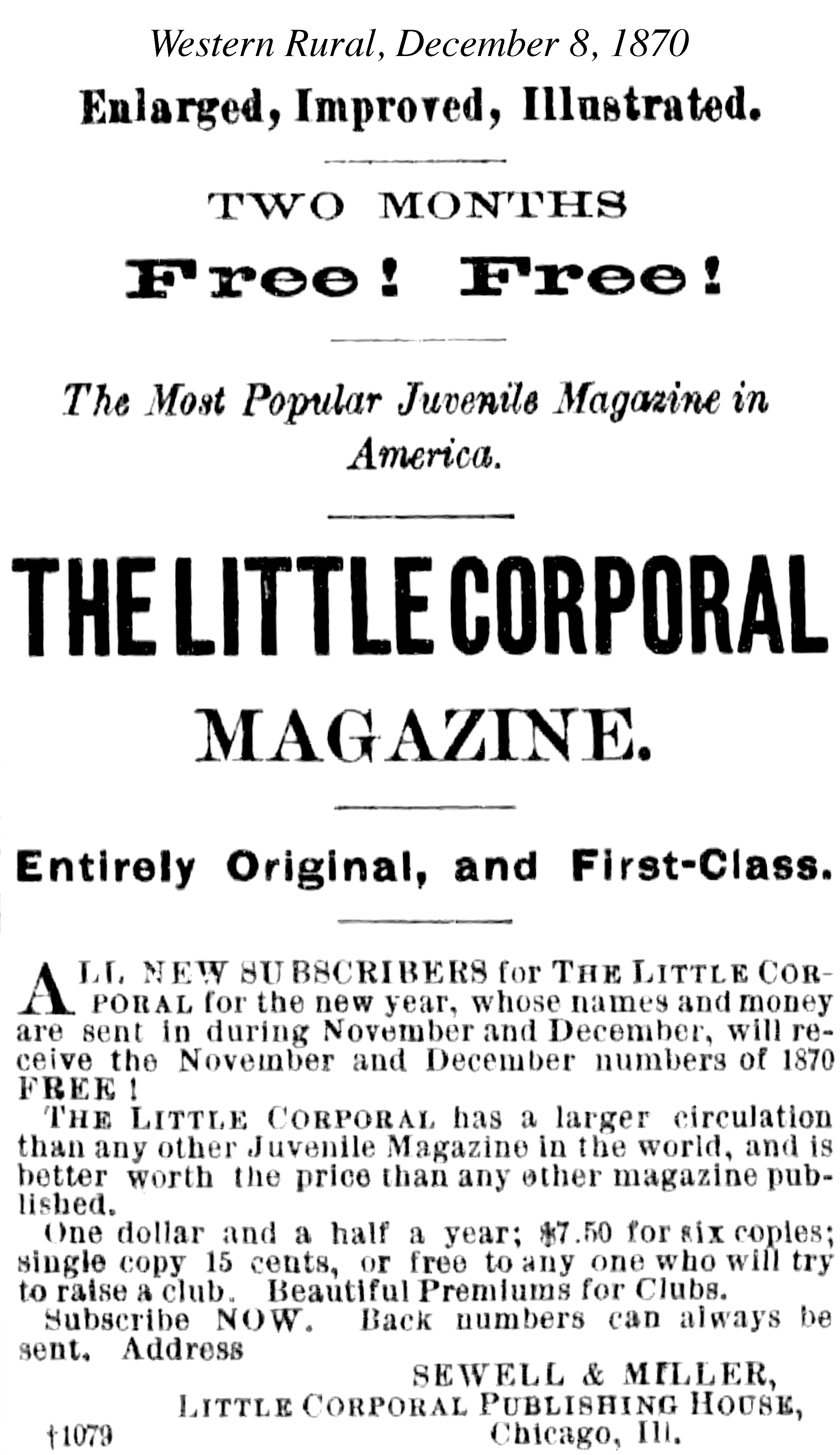
This notice is only a sample among thousands in the editor’e portfolio. We are informed by Mr. Sewell that his receipts for subscriptions are averaging considerably more than double those of the same time last year. Indeed there is a regular rush for the paper. The price of the Little Corporal is one dollar a year. Sample copies, showing a list of magnificent premiums for clubs, may be obtained of by enclosing ten cents to Alfred Sewell, Publisher, No. 138 Lake Chicago.
Chicago Tribune, December 19, 1866
THE PRESIDENT OF THE UNITED STATES, through his private secretary, yesterday subscribed for the Little Corporal. We may suppose that he intends to use it as a holiday gift to some one of his juvenile friends. The Little Corporal is universally esteemed, and is considered by many to be the best juvenile paper in the world. It is a most appropriate present for boys and girls. The price is one dollar a year. Address Alfred L. Sewell, publisher, No. 138 Lake street, Chicago.
Chicago Evening Post, January 9, 1869
The Little Corporal enters upon his eighth. semestre of service, fresh and hearty. Indeed, he is getting to be quite a veteran, and wears his new uniform of green with a careless grace such as would be entirely wanting in a raw recruit. There are many things in his knapsack which we would like to transfer to our more commodious satchel and carry home to The Post’s little ones; but then all the children see the Corporal, and it would be a supererogatory labor on our part. Good things are promised for the current year, one of which is the story, “A Year at Riverside Farm,” by Emily Huntington Miller, which commences in the January number, already issued. Alfred L. Sewell, publisher, Chicago.
Chicago Evening Post, November 27, 1869
The Little Corporal never taile to bring a generous supply of stories in poetry and prose, rich in entertainment and instruetion for the young. Chapter XII. of the popular serial, “A Year at Riverside Farm,” by Mrs.
E. H. Miller, is given in the December number.
Chicago Evening Mail, January 21, 1871
Mr. Sewell, who founded the Little Corporal magazine nearly six years ago, announces in the February number his withdrawal from the firm of Sewell & Miller, who have for some time been the publishers. He goes into the book manufacturing business, and will still conduct and publish the School Festival, which is devoted to Day and Sunday School entertainments. The Little Corporal magazine will hereafter be published by John E. Miller, Chicago, Mr. Sewell’e former partner, and edited by Mrs. Emily Huntington Miller, who has heretofore been Associate editor.
Chicago Tribune, December 4, 1871
The Little Corporal, who appears as a vigorous Phoenix from the ruins, still waving his sword and carrying his colors, and as fresh and handsome as the ever was before the fire. A very pleasant feature of this number is a sketch of the triumphant Corporal, which Nast sent as a donation.
Mr. Alfred L. Sewell, formerly publisher of the Little Corporal, has just issued, in a small. compact volume, a collection of the scenes and incidents during the late fire in this city. The work is published very neatly, and has a map of the burned district. It is furnished to the trade and general purchasers by the Western News Company.
Chicago Weekly Post and Mail, November 5, 1874
LITTLE CORPORAL.
This home production of mental and moral nourishment for children and young people and even older people, we feel especially proud of. We know the kindly, Christian ard able source from which it emanates, and commend it to bright boys and girls, or those who need brightening, with a warm good will. It is published by John E. Miler, 164 Randolph street, Chicago, and edited by Mary Huntington Miller, and will compare favorably with any of the monthly periodicals designed especially for younger readers. If the Little Corporal is less in size than St. Nicholas, its price, likewise, is only balf that of its rival. The November number is rich in matter and in illustration. We leave it with one warning to parents: If you let the children buy one number, they will surely make you buy it the year round.
Chicago Tribune, April 6, 1875
“The Little Corporal.”
The Little Corporal, juvenile magazine of this city, has been discontinued, and its subscription list merged Into the beautiful St. Nicholas, published by Scribner & Co., of New York,.
Chicago Tribune, April 11, 1875
A Rare Chance for Bargains at 164 East Randolph-st., Rooms 14 and 15.
Constable’s Sale on two Executions.
The entire outfit of the “Little Corporal,” consisting of numerous fonts of type, cases, presses, stands, furniture, galleys, etc., together with a large stock of Bibles, Books, Chromos, Steel Engravings, Picture-Frames, Chairs, Stoves, Desks, Safes (Hall’s), Tables. Lounges, and Office Furniture generally. A splendid assortment of original Wood-Cuts and Electrotypes of a juvenile character, suitable for any publication of the character of the ” Little Corporal.” Sale will commence at 10 o’clock a.m. April 12 (to-morrow.)
William O’Brien, Constable.
St. Nicholas Magazine, June, 1875
By Emily Huntington Miller
After ten years of service, the Corporal has been put upon the retired list. We have had a long, brave march together, and it is hard parting company. You will miss your leader, and we shall miss the words of courage and devotion that came from the gallant army, East and West, North and South. But remember, you are none of you mustered out of service. Your new leader, St. Nicholas, enrolls his soldiers by the same pledge under which you first enlisted – “For the Good, the True, and the Beautiful–and the Corporal feels safe and satisfied in leaving you to his guidance.”
NOTES:
The Little Corporal began as an octavo, 6 by 9 inches in size. In 1869 the magazine became a quarto, 9.5 by 12 inches in size.
The Little Corporal merged with the New York based Scribner’s St. Nicholas magazine in 1875, and after several ownership changes, its last issue was were issued in 1943.

Leave a Reply