Warner’s Hall and Block
Life Span: 1852-1871
Location: 122 and 124 Randolph, between Clark and Dearborn
Architect: NA
- Fergus’ Chicago City Directory, for the Year 1855
Warner’s Hall, 104, 196 Randolph
Johnson Wm. barber, 102 Randolph
D. B. Cooke & Co.’s City Directory for the Year 1859
Warner’s Block, 122 and 124 Randolph st.
Warner’s Hall, 122 and 124 Randolph
Halpin & Bailey’s City Directory for the Year 1863
Warner’s block, 122 and 124 Randolph
Warner’s Hall, in Warner’s Block 122 and 124 Randolph
Halpin’s Chicago City Directory for 1864
Warner’s Block and Hall, 122 and 124 Randolph
John C. W. Bailey’s Chicago City Directory for 1867
Warner’s Block and Hall, 122 and 124 Randolph street
Edwards’ Annual Directory in the City of Chicago, for 1869
Warner’s Block and Hall—122 and 124 Randolph street
Edwards’ Annual Directory in the City of Chicago, for 1870
Warner’s Block and Hall—123 and 124 Randolph street
Edwards’ Annual Directory in the City of Chicago, for 1871
Warner’s Block and Hall—123 and 125 Randolph street
Chicago Daily Tribune, September 14, 1853
To Citizens of Chicago.
Chicago, Sept. 5, 1853.—102 Randolph st.
It is assumed that Barber shops have been of kept the open on the Sabbath day through all ages of the world. Now granting this to be true, let us examine a little into the origin of this practice, and see whether it was necessary to do so in order to shave men, or the result of some other cause. It is well known to most men, that in olden times the Barber’s business consisted of four different branches,—namely: and Leeching, Bleeding, Tooth drawing and shaving; and hence, owing this connection, it became necessary to keep their shops open on Sundays, as public benefactors, to relieve the sick, &c.—They were, in consequence of this fact, compelled to be constantly at their post. A combination of these several branches rendered the profession a profitable one, and, of course, commanded the strictest attention. The shaving branch, however, was always of minor consideration, and but for the other branches barber shops would not have been kept open on the Sabbath day, any more here than a Blacksmith or Carpenter shop. And here I will say that the above mentioned connection of branches gave rise to the peculiar Barbers sign, the striped pole, and instead of paint they need a bloody red string their wrapped around a stick, to represent Leeching, Bleeding, Tooth drawing and Shaving. Now, since shaving and hair cutting has become a separate and distinct business, from that of the former, I can see no good reason why we, as a class, should not he allowed one day in seven, in common with the rest of men. I ask for the Sabbath day, because it is the day of rest, made so by the great moral law giver, and acknowledged by this, and all other enlightened nations; and so sacred so that our chief Magistrate dares not to take the oath of office on the 4th of March, should that day fall upon the Sabbath. Thus, sometimes for a day we are without a President.
The Sabbath is a day observed both by Christian and infidel, unless forced to work by circumstances.
In view of these facts, and believing that the public will sustain me in an honest effort, to reform this inexcusable to evil, I have determined give not to open my shop on Sundays, and therefore give those in my employ and ourselves an of opportunity to attend public worship, or dispose of our time as we may other wise wish. WILLIAM JOHNSON.
Chicago Daily Tribune, October 5, 1853
COLORED PEOPLE’S CONVENTION.
A State Convention of the Colored people of Illinois is to be held here to morrow. Warner’s Hall has been taken for the purpose, and preparations have been made for a respectable demonstration. Not the least interesting feature of the convention will be the presence of Frederick Douglas,—the slave, not the slave holder, Douglas. A telegraphic dispatch was received from him yesterday, announcing that he would be here this evening. We doubt not he will receive a warm welcome, not only from his colored brethren, but also, such of our citizens as are not afflicted with “color phobia.”
Chicago Daily Tribune, November 18, 1853
Concert, Supper and Debate at Warner’s Hall, under the direction of the colored people in this city.
Chicago Daily Tribune, June 26, 1855
THE PANORAMA AT WARNER’s HALL.—This exhibition, the finest of its kind that has ever visited this city, is still at the above Hall, and cannot too strongly advise our readers to satisfy themselves as to its merits. Every person who visits it expresses both wonder and delight at many beauties it unfolds.
Chicago Daily Tribune, June 27, 1855
THE PANORAMA.—This most artistic painting will he exhibited this afternoon at 3 o’clock at Warner’s Hall, affording a fine opportunity for families to see one of the most splendid and interesting pictures of the age. 11 has been attested by thousands to be a work of surpassing excellence, and a favorable opportunity is presented this afternoon to witness it The evening exhibition will commence as usual at 8 o’clock.
Chicago Daily Tribune, February 27, 1856
SHAVING SALOON.
William Johnson, the old and well tried Proprietor of the Bathing and Shaving Saloon, under Warner’s Hall, wishes to inform his old friends and the public in general, that he has taken a Basement Room, 153, Randolph Street, Second door west of Metropolitan Block, where he has fitted up a neat and commodious Shaving and Hair Dressing Saloon.
He will keep none but competent workmen, while at the same time his personal attention will be always given; and hopes, by a prompt attention to business, he will merit the patronage of the public.
No Shaving on Sunday.
William Johnson.
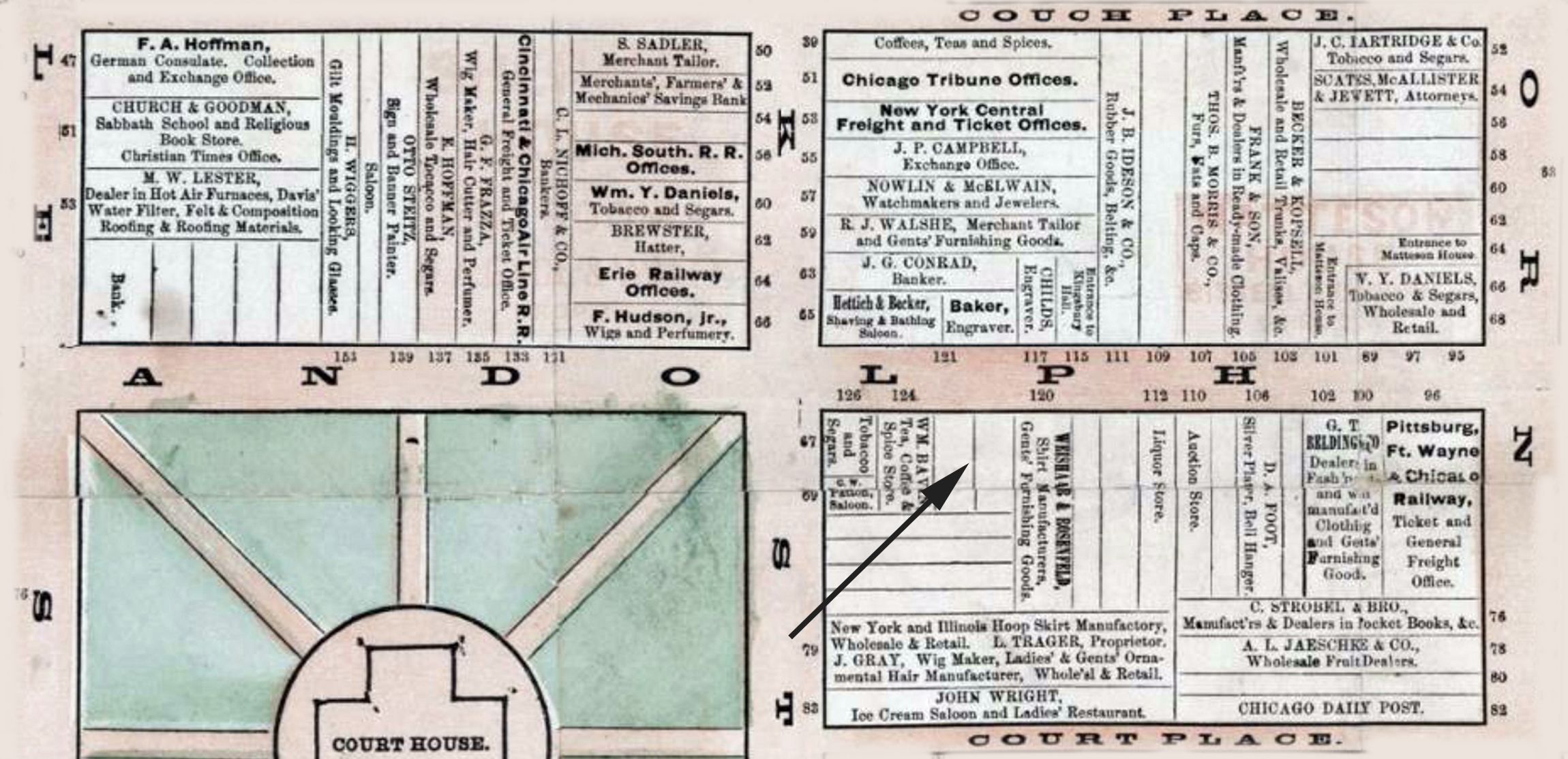
- Warner’s Block and Hall
1862
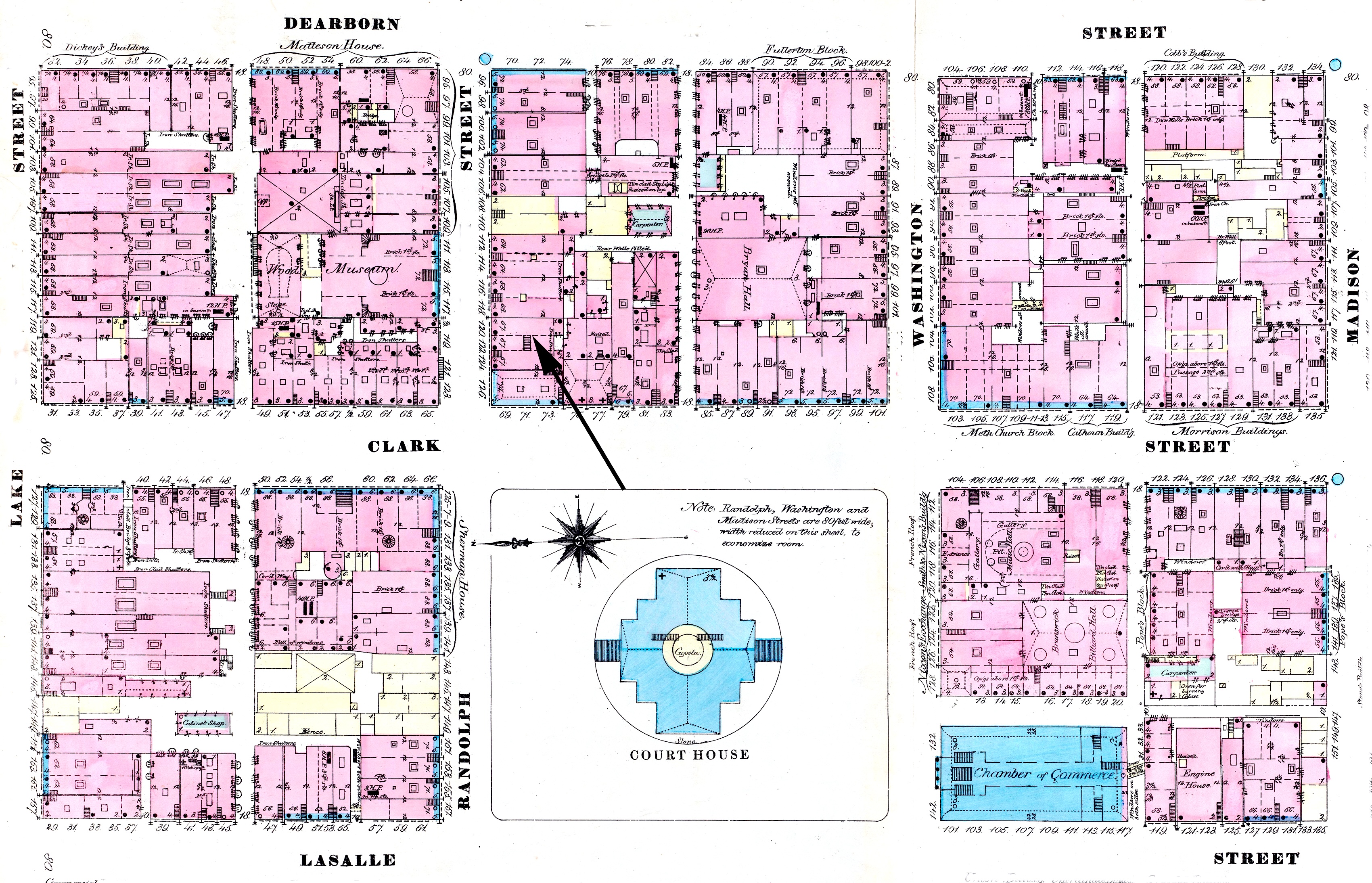
- Warner’s Block and Hall
Sanborn Fire Insurance Map
1869

Leave a Reply