Healy’s Slough—The original location of Ogden’s Slips was at Archer Avenue and Halsted Street.
Government Pier, Michigan Canal, North Pier, Ogden Slip
Life Span: 1868-Present
Location: Foot of Michigan Street (Hubbard Street)
Architect: Chicago Dock and Canal Company
- John C. W. Bailey’s Chicago City Directory for 1867
Ledlie & Corse, (James H. Ledlie and John M. Corse) contractors 25 Oriental bldg.
Ogden, Fleetwood & Co., (Mahon D. Ogden, Edwin H. Sheldon and Stanley H. Fleetwood,) Northwestern Land Agency 131 Lake. (See advertisement opposite page)
Edwards’ Annual Directory in the City of Chicago, for 1870
Chicago Dock and Canal Co. Mahlon D. Ogden, pres. E. H. Sheldon, treas. Chas. G. Ogden sec. office. 162 Lake
Dyer & Payne, wood and coal, N. Water, se. cor. Rush, branch office, 391 Clark
Peshtigo Co. Thomas H. Beebe, pres. Wm. E. Strong, sec. North Pier
Becker & Hipple, hardwood lumber, 460 N. Water
Rathbone John W. & Co. (John F. and Lewis Rathbone, Eben C. Beach and George Sard, jr.) stone and hollow ware mnfrs 98 and 100 Michigan av. warehouse, North Pier
Edwards’ Annual Directory in the City of Chicago, for 1873
Chicago Dock & Canal Co Mahlon D. Ogden, pres. Edwin H. Sheldon, treas. Charles. C. Ogden sec. Clark, sw. cor. Lake
Tyson, Sweet & Co., North Pier, nr. Rush street bridge, H. A. Work, agt.
Lakeside Annual Directory of the City of Chicago, 1884
Globe Warehouse, David Wylie, prop, North Pier nr. new I.C.R.R. bridge; storage, dockage and forwarding. This warehouse can be reached by all railroads centering here.
Lakeside Annual Directory of the City of Chicago, 1904
Chicago Dock and Canal Co Eugene H Fishburn pres; William O. Green sec; 201, 34 Clark
Lakeside Annual Directory of the City of Chicago, 1911
Chicago Dock & Canal Co Eugene H Fishburn pres: Wm O Green treas 201, 192 N Clark
Pugh Terminal Warehouse Co Jas A Pugh pres; Seyton H Martin sec 363 E Illinois
Chicago Evening Post, July 11, 1867
A NEW HARBOR.
The Chicago Dock and Canal Company Commences the Construction of an Immense Harbor North of the Present Pier.
Hitherto the business of the city has been mainly monopolized by the South Division. An enterprise has just been commenced which promises to give the North Side the finest commercial facilities in the city, and which may do much to revolutionize the tendency of the business of the city.
The present harbor consists simply of the river and its branches. It is advantageous because it presents a long extent of shore, but it is disadvantageous because it is so narrow and because it must necessarily be crossed by bridges, which are an obstacle to navigation on the river and to travel on the land.
The Government pier, on the north side of the entrance of our harbor, extends nearly half a mile from the natural shore at the mouth of the river; but the currents from the northeast have been washing the sand against it continually for many years, and have built a tongue of land which now extends nearly to the end of the pier. On this account the Government had decided to extend the pier 640 feet further into the lake,
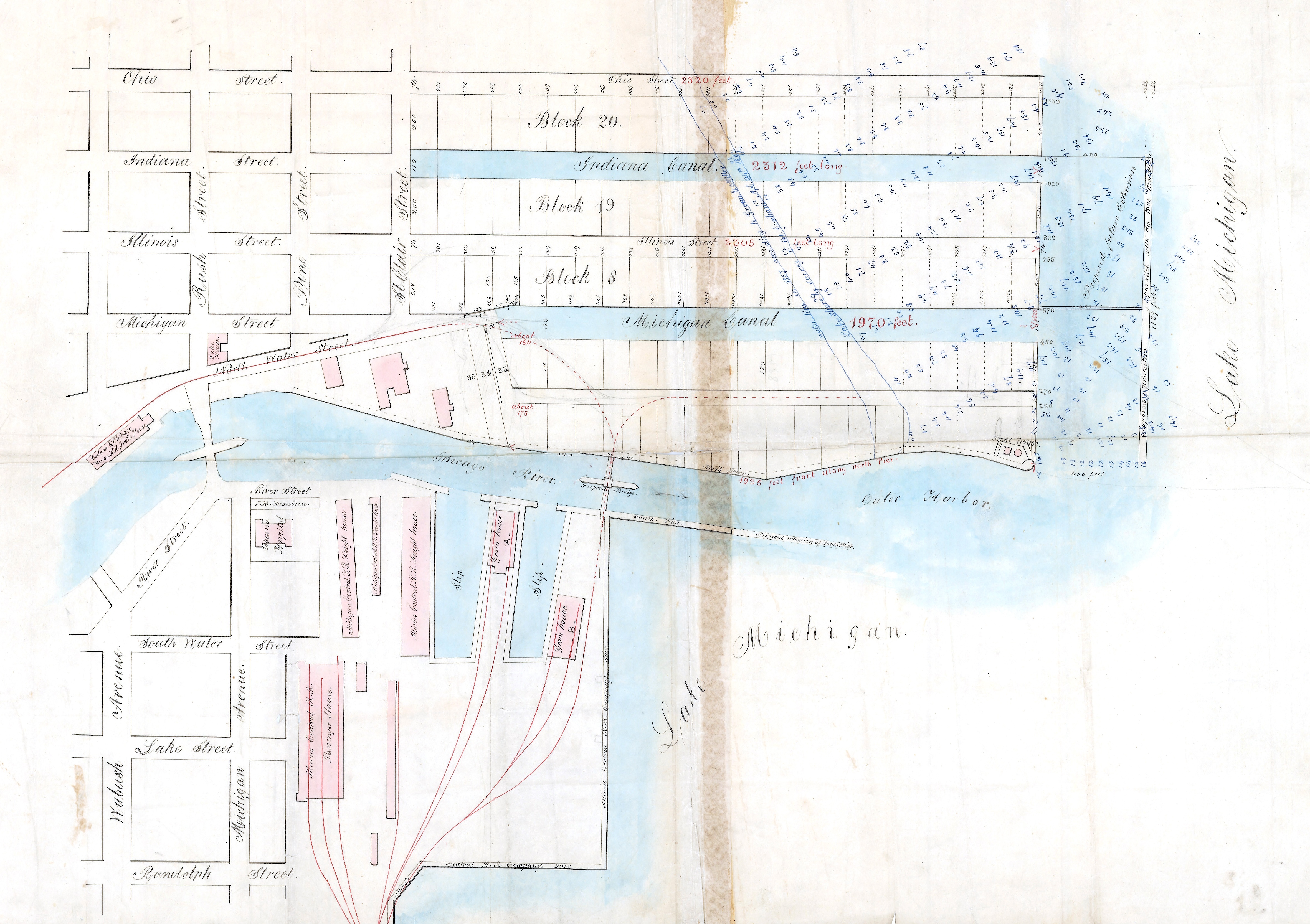
The Chicago Dock and Canal Company, which William B. Ogden is the head, and in which many of our wealthiest citizens and heaviest owners of North Side property are interested, has made arrangements with the Government, according to which the new Government pier will begin at a distance of 300 feet from the terminus of the present pier, and thus have its terminus 940 feet from that place. The Company will begin their breakwater at the outer terminus of the Government pier and extend it northward a distance of 500 feet, and thence westward to the lake shore to a point just north of Michigan street, a distance of 1,500 feet or more. There will be inclosed a basin of water 500 feet wide and about 1,500 feet long, but partly filled with sand along the south side for some distance from the shore. The entrance to this harbor will be through the space of 300 feet between the two sections of the Government pier. This basin, however, will not be left in this condition. It is to be filled up alongside of the Government pier for a distance of 390 feet, leaving a channel 110 feet wide on the north side, and an approach to this channel from the south. The improvement will thus consist of a tongue of land 390 feet wide extending into the lake nearly one-third of a mile with the present harbor on the south and a channel 110 feet wide on the north. The channel on the north will be lengthened by excavating Michigan street as far west as Sand street This will give a length of dock equal to that of the main branch of the river, and the channels on each side will be twenty-two feet deep, and will float the largest vessels on the lakes.
Down the center of this strip of land a street will be laid out, and all buildings on it will have at once a street front and a harbor front. A railroad track will be built upon the street, connecting with all the railroads in the city.
Already work has been commenced upon the piers, and it is intended to finish them this season. Ledlie & Corse, who are the contractors for the Government pier, are building them.
This work is but one section of the proposed harbor. It is intended to add similar works to the north until it reaches Chicago avenue, and the finest harbor on the lakes will extend nearly a mile along the shore of the North Division.
The effect of this improvement on the value! of real estate in the North Division cannot well be calculated. In that part of the city, especially near the proposed improvement, whole blocks of land are held by wealthy citizens, and these will spare no expenditures to complete a work which will be likely to treble the value of their estates, while it proves a profitable investment in itself.
Materials are already being received for the work, and it will be begun forthwith. The work will be under the supervision of Mr. H. A. Connolly, late Chief Engineer of the Chicago and Northwestern Railroad Company.1
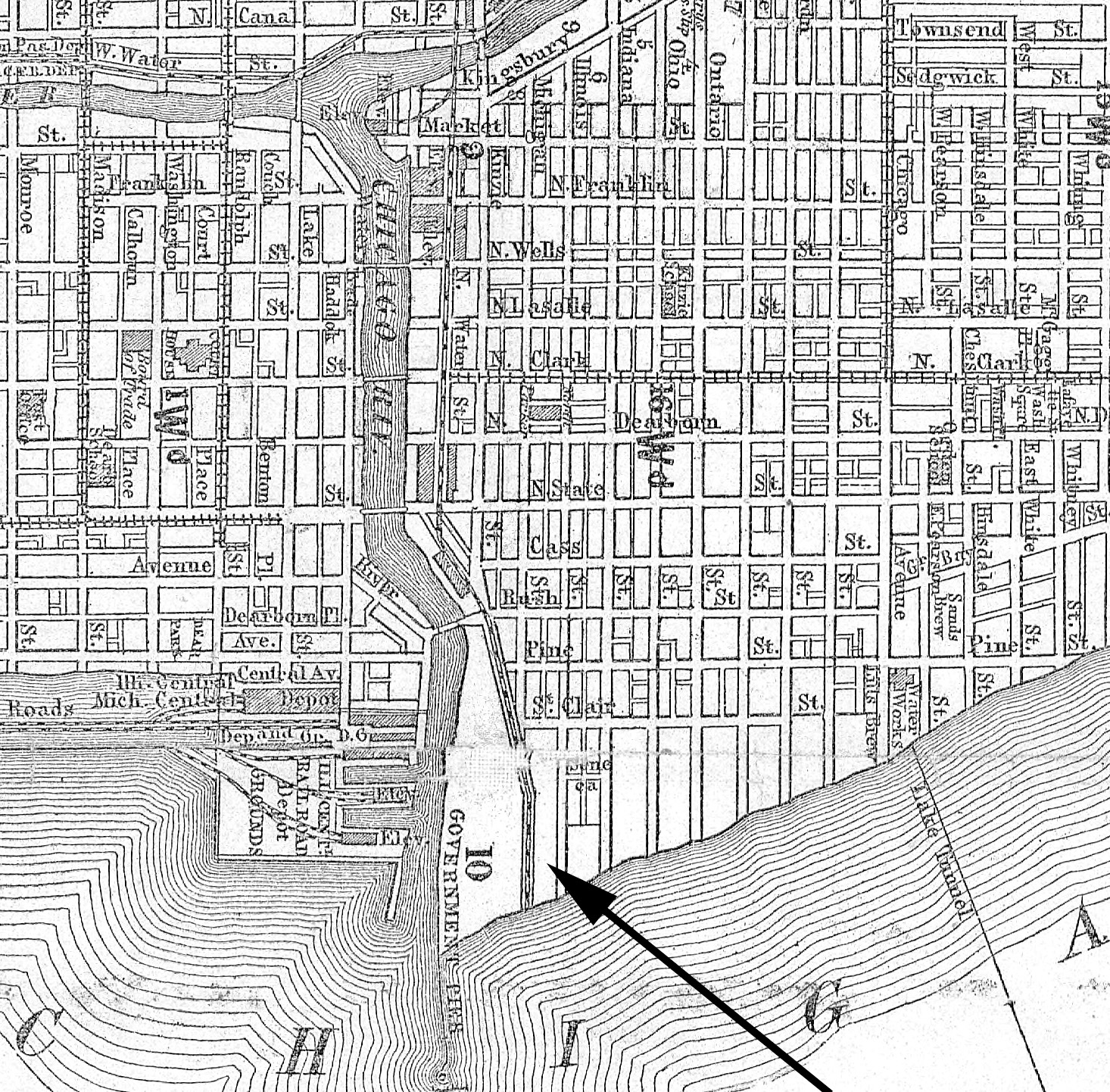
- Government Pier
Charles Shober & Co.
1868
Chicago Evening Post, May 14, 1868
OUR HARBOR.
The Project of the North Shore Dock Company—Seven Miles to be Added to our Shipping Accommodations—The Extension of the Government Pier.
Among the many great enterprises which are being carried on in this city, that of the North Shore Dock Company is one which deserves more extended notice than it has received, as it bears a most important relation o the commerce of the city. The work for which the company was organized is the increase of our harbor and dock privileges, which the astonishing growth of the city has ready begun to render too limited, by means of a system of outer docks along the lake shore north of the river mouth, and extending northward indefinitely, as far as should gradually be demanded. The enterprise was originally conceived by Hon. Wm. B. Ogden, as far back as 1855, but the work was not commenced until July, 1857, when a duly authorized company of Eastern capitalists, with a capital of several millions, and Mr. Ogden at the head, took hold of it, and have already made good progress.
At a point 300 feet beyond the end of the present Government pier, on which the lighthouse stands, they have begun to build a solid pier due north. From this, at proper intervals, piers will run into the shore, forming secure and commodious harbors for shipping, and giving dock privileges on three sides, with ready approach from the shore.
It is proposed eventually to divide the work into five sections, each section being five hundred feet in width, making the length of the outer pier 2,500 feet or nearly half a mile. The five piers running west to the shore will be some 2,000 feet long, so that the whole system being connected by broad channels near the lake side, will afford seven additional miles of dock privilege. The entrance to all will be through the 300 feet channel first mentioned, between the end of the light-house pier and the outer pier of the new works.
Section No. 1, the first of the system of docks and channels, was let the past season to Messrs. Ledlie & Corse; but owing to the late commencement of the work, the unusually boisterous season, the early close of canal navigation, and other unforeseen contingencies, these gentlemen were enabled to complete but partially five hundred feet of the outside protective breakwater, and a portion of the breakwater superstructure not being filled to the surface with stone, was carried away to a point below water line by the terrific storm of November last. Messrs. Ledlie & Corse’s contract expired on the 1st of January last, and the Company are prepared to continue the work themselves through the present season, with an extensive and entirely new outfit, hoping to complete section 1 at least, and as much more as the season or the elements will permit. But few are acquainted with the obstacles to be encountered in such works exposed to the treacherous and heavy winds prevailing on our lakefrom the northeast. The protective breakwater running northerly is sunken in twenty-four feet of water, is thirty feet broad with a superstructure seven feet above the water line, and entirely filled with stone from lake bed to top, making an immovable structure which can only be affected by time. The quantity of material which will be used in this mammoth structure is astonishing. The weight of stone sinks the side walls into the lake bed three feet, where it finds a clay foundation. Adding twenty-four feet to water surface and seven feet superstructure, with its ends, center, walls, crosstrees and bottom, make a grand total in five hundred feet of pier, of one and a half millions of feet of timber (broad measure), requiring 120,000 pounds of iron bolts to secure them together, and 3,000 cords of stone in filling.
Contrary to the heretofore in usual system adopted this kind of work, the Chief Engineer of this project has demonstrated the practicability of sinking 500 feet of cribs in one body instead of the short sixty feet cribs used in Government works. The successful sinking of this immense structure is very creditable to Mr. Conolly’s engineering skill. The completion of these capacious outside docks will give an abundance of room for our shipping which is now becoming greatly crowded in the river, though they are not intended to, and never can supersede the use of the river for shipping purposes, as that affords an entrance to the heart of the city and to its extremities and allows goods to be received and laid down where they are at once wanted. The new docks will, however, be very useful for a large class of cargoes, and there is little danger that both together will give too great facilities for the carrying on of our yearly growing lake commerce.
The following are the cflicers of the North Shore Dock Company: M. D. Ogden, President; E. H. Sheldon, Treasurer; W. H. Fleetwood, Secretary; R. A. Conolly, Chief Engineer.
Another extensive work, independent of, but in a measure important to, this enterprise, and very necessary to the protection of the present river mouth, is being carried on by the General Government. It consists in virtually extending the light-house pier nearly a thousand feet further out into the lake, though the interval of 300 feet, before mentioned, between the end of the present pier and the commencement of the extension, which will leave the length of the new pier to be built 640 feet. When finished it will afford a firm barrier against the sands that are now swept down by the northerly winds and currents toward the mouth of the harbor, forming bars which partially close the entrance, and compel vessels to swing around south of them before making the harbor. This, together with the new system of docks, will prove invalnable additions to our facilities for lake navigation.
Chicago Tribune, October 28, 1868
 Perhaps nothing so surely foreshadows the future wealth, greatness and extent of Chicago, as the preparation now being made to anticipate her progress. Sagacious and far-sighted capitalists must have unbounded faith and confidence in the future, or they would not invest their money in the enterprises that are to be seen in every side. And we are in advance of the East in most of ou undertakings, the boldness, variety and audacity of which have excited the envy, aroused the wonder, and commanded the admiration of the denizens of frontier cities like New York. For instant, the Lake Tunnel is an eighth wonder of the world, and while New York has been for years speculating and theorizing a to the best means at constructing a permanent crossing over, through or under the East River, which separates from the sister city of Brooklyn, we have taken the bull by the horns and knocked him down. Soon our tunnel under the Chicago River will be an accomplished fact. and since time within the ensuing twenty years, perhaps, or at least, before the dawn of the twentieth century, a New York commission of inquiry will come out here to report as to the success of our tunnel, will go home and report favorably of course, and then a company will send to this city for engineers to bore beneath the East River. We are never without something wonderful upon our hands. At present we have two elephants of considerable dimensions, which all sensible travelers who are fortunate enough to visit our city never leave without seeing. Mr. Horatio Seymour went and saw them last week. That is not surprising, however, for such things as the Tunnel are not to be seen in that one-horse town of Utica, nor are undertakings like the new docks, building at the north pier, to be seen every day at Deerfield farm, though no doubt they raise healthy roosters and juicy watermelons in that locality. Yes, Horatio went to visit the docks—not that the docks are any the better for that, but then he went.
The Original North Pier.
It will he remembered that the government determined to lengthen the original north pier by 700 yards, so as to protect the mouth of the river. Some enterprising man of money took advantage of the circumstance and projected a series of docks, which, when finished, will be the finest artificial structure of the kind in the world. This encroachment on the domains of nature has so far resulted in the reclamation of the turbulent waters of the lake, and has fully demonstrated the feasibility of the entire project.
A Survey of the Work.
To understand the progress now made, it is necessary to take a rapid survey of the undertaking. Everybody knows the lighthouse, and also that the original north pier ran out there from into the lake. It became necessary that this pier should be lengthened some 700 feet. Instead of continuing the pier, however, a gap of 300 feet was left, leaving only 400 feet to be constructed beyond . From the extremity of the north pier the Chicago Dock and Canal company, according to an arrangement with the government, ran a pier 378 feet in a northerly direction. They also agreed to run another pier in the same direction a distance of 500 feet from the inner extremity of the outside north pier. It must be borne in mind that the so-called north piers really run east, which makes the piers of which we have spoken as running at right angles to them run in a northerly direction. For convenience, and to make the explanation more clear, we will call things by their right names, and then the pier running east from the lighthouse will be the inner east pier, and the outside continuation the outer pier east pier. The piers running northerly, will be the inner north pier and the outer north pier or breakwater respectively. This latter, as we have said. runs runs 500 feet into the lake, and is thus connected with the shore by a pier running east and west for a distance of 2,600 feet. Immediately inside this pier will be the canal, 112 feet in width, and the space between the canal and the new east pier will be filled up and warehouses built thereupon. Now, the use of the 300 feet gap becomes apparent. It will be the entrance to the canal and can be approached directly from the lake. No harm can come to the river mouth on account of the gap. which is protected by the pier connecting the outer north pier with the shore. There are to be five sections of these docks, and as soon as each section is completed, an entrance will be made in the piers to correspond to the outer gap, and so as to allow vessels to sail into all the docks.
The Engines.
The work may have said to have been began in earnest in May last, for, although a beginning had previously been made, nothing worth speaking of was done. The outer east pier will be finished in a couple of weeks. The original contractors were Messrs. Leslie & Case, who en subsequently underlet the job to Mr. Connolly, Chief Engineer of the Dock and Canal company, and work to its present advanced state. Ninety feet of the pier was partially finished last year, and the remainder this year. It is now ready receive the outside covering of planks. This structure cannot be used as a landing place, as the least gust of wind sends the seas right over it sweeping everything away. The lighthouse will probably he removed from its present position to the outer end of this pier. The expense of this work paid for by the government amounts to $170.00.
Constructing the Cribs.
The outer northern pier of breakwater is about 500 feet long, 30 deep and 7 feet above water. It is a splendid piece of work, and differs from anything of the kind ever built before. Hitherto, in the construction of breakwaters, cribs 32 feet long were used, that length considered the limit of safety. When Mr. Connolly took hold of the work be proposed to build a crib 500 feet long. This proposition was considered so preposterous that he was laughed at by all the consulting engineers of the company. They said it was impossible to sink a crib of such dimensions. He had one friend, however, who had faith in him. and that was Mr. Wm B. Ogden. That gentleman sand if Mr. Connolly was willing to risk his reputation as an engineer on the success of the proposition, he was willing to risk his money. Accordingly. Mr. Connolly cast about him for a convenient place to build his 500-feet crib, but he could not find what he sought. Finally, he decided to build two cribs, one 230 feet long, and the other 270. He did so, and sunk them where they now lie, as firm as the rock of ages. It was a triumph of which the bold engineer may justly feel proud. He undertook it in the face of all opposition, and when even Mr. Ogden began to lose faith, he went on undaunted to success. Had be failed—well, he would be proscribed; but there’e nothing succeeds like success. This work is completely finished.
Construction of the Pier.
From the extremity of this breakwater a long pier runs to the shore, a distance of 2,600 feet. This work will be a breakwater to the canal until the work goes on further. It is finished for 300 feet, and the piles and a portion of the superstructure are laid 500 feet more, thence to the shore is still open. There is, outside this pier, a depth of twenty feet of water. A description of the manner in which it is built will give an idea of the work. First, a row of piles, from 14 to 20 inches thick, and placed eleven feet apart, are driven down deep into the bottom of the lake. These piles are fastened together by a “stringer,” which runs on the outside, two feet above water, and to which all the piles are firmly bolted. Outside this stringer is placed a row of piles as close as they can stand. Each inside pile is bolted to the stringer, with seven-eighth bolts, and to the inside row where they come together. A top timber is placed over the outside row of piles and fastened to each drift bolt. The two rows inside and outside are built as described, and kept together by griters and heavy iron rods going right through between the piles, and sunk with a block and tackle until they become tight in the timber. The inside is filled with rubble stone, making a compact mass. It is intended that each of these piers shall be 500 feet wide so as to give room for storehouses facing each dock. Tracks will be laid. and cars for the conveyance of merchandise be run upon them.
A Test House.
It is doubtful whether the outer northern pier can be used as a storehouse, as in a gale of wind the seas sweep clean over it. A test house is now being built at the usual exposed place at its junction with the canal breakwater. It will be built of heavy logs, calked outside, and if it stands this winter’s storms and waves, the entire
piers will next year be converted into a storenouse.
The Canal.
The inner east pier, running directly from the light house, will be cut down 1½ feet. It is built in the manner described above, as is, also, the inner north pier, which runs from its eastern end to the mouth of the canal. The canal will be 112 feet wide, 16 feet deep, and about half a mile long from the mouth to where the present sugar-house stands.
No work has yet been done on this canal, except sinking the inner row of piles. The stuff taken from the canal will be used for filling up inside. The canal will run up Michigan street, which will then stop at the end of the canal, and Water street, which comes into Michigan, will run to the end of the dock. The engineer believes he could excavate two-thirds of the canal before the frost could stop the work, but the company have not decided on commencing it this year. There are 91,000 cubic yards of earth to be excavated, which will cost about $60.000. This, added to $28.000 for pier and stonework, makes $88,000 the entire cost of the canal.
Estimate of the Cost.
The following estimate of the material used thus far will give some idea of the magnitude of the work:
Pine timber, 12 to 15 inches square…. 2,000,000 feet
Oak piles……………………………210,000 feet
Iron bolts…………………………..425,000 pounds
Stone-filling..,,,,,,,,,,,,,,,,,,,,,,,,,,,7,475 yards
Average number of men employed dally. 95.
There were also three steam engines in constant use, besides a feet of scows and other apparatus and machinery necessary to the prosecution of the work. The amount of money expended last year war $76,000; this, year, $95,000; total, $171,000. This added to $88,000 for the canal will make $259,000 about the cost of one section, and five times that, or $1,295,000, will be the amount expended on the five sections when complete. It is calculated that the profits of one section for one year will build one-half of the next section.
Seven Miles of Dock Front.
Very few persons know that this work will add no less that seven miles to the dock front of our city, as much as Liverpool the great commercial city of England possesses. When Chicago is as old as Liverpool is now. it is hard to say how many miles of docks she will have. Before then she will, in all probability, be the metropolis of the world, and when Macaulay’s artist, from New Zealand, sits on the broken arch of London bridge to search the ruins of St. Paul’s, he will compare the former glory ot London with that of her successor Chicago
.
The Builders.
Mr. Connolly, the Engineer-in-Chief, under whose supervision this great work has been brought to its present satisfactory state, was formerly connected with the Northwestern railway, and built that company’s docks at Escanaba, Wis. He led a forlorn hope here, where others had failed. Mr. Badger superintended the workmen. The other officers of the Chicago Canal and Dock Company are Mahlon D. Ogden, resident; Edwin H. Sheldon, Secretary: J. D. McCleod, Treasurer.
The Second Section.
It is with pleasure we record the fact that not a single life has been lost in this work of no little peril. One man cut his foot with an adze last week, and be was furnished with a pass to his home at St. Faul, Mion. The work will stop as soon as the cold and boisterous weather makes progress impracticable. The first section will be open to commerce next year, but the second section will not he commenced until the year a after, the interval being taken up in accumulating material.
Chicago Tribune, June 21, 1870
 Our tunnels, and our crib, and our Water Works and our river, and our Lord Chancellor Banyon, and our common council, and our east wing, and our Board of Supervisors, and our Board of Tradee, and our White Stockings and our Court House cupola, and our marble palaces, and our lovely women, and our energetic men, and our suicides, and our murders, and our divorce court, and our pig-killing machinery, and our Historical Society, and our one-horse cars, not to mention our widespread reputation of being the most remarkable city on this or any other planet, combine, one and all, to impress the mind of the stranger who comes amongst us to make observations, and perhaps to take “notes” and return to Europe, or wherever he came from, “prent ’em” that Chicago is a modern wonder, far greater than any of the “seven wonders” that astonished the people of ancient times. The stranger sets his mental machinery in operation to think out the problem of Chicago’s future, but bis imagination cannot conceive what the city, great in its youth will be when it reaches its prime.
Almost in the centre of the West, the headquarters of the commerce of the lakes, the nucleus of more that a dozen railroads, the natural enterprise into which the products of a dozen mighty and fertile States are constantly pouring, to be distributed alL over the world for the benefit of man, its trade keeping pace with the growth of the vast territory tributary to it; its merchants and capitalists full of money, wisdom, and enterprise, is it any wonder that the mind of man recoils from the contemplation of its future grandeur, and fails to forecast its coming greatness.
These and many other matters are of interest to every citizen of this city, as well as to the stranger who comes to observe and admire, and it is well to know and feel that our ambition is insatiable, and that we are forever projecting some improvement to meet the requirements of a future we may never see, but for which those who come after us will have reason to rise up and call us blessed.
The day is approaching when our sluggish river will be unequal to the demands of commerce, and when a more accessible harbor will be indispensable. As it is, the annoyance and delay caused by opening the bridges to very great—though that will cease when tunnels supersede the bridges—and the time and money consumed in towing vessels up the North and South Branches is felt to be a heavy tariff un our growing trade, so me look forward with pleasure while we anticipate the time when these evils will be modified, if not annihilated.
Mr. Mahlon D. Ogden saw these things, with almost a prophetic eye, thirteen years ago, and begun to prepare to meet them. In 1857, the idea of an outer harbor took hold of him, and he of it, and he went to work and, with a few others, bought the lake front from Erie street to the light-house. We did not do anything further for some years, as his future section depended upon the action of the National Government in extending the north pier beyond the mouth of the river, so as to protect the harbor from a bar that was being formed of the sand piled up by the waves. The government was slow in commencing the extension of the pier, and, as the sand was accumulating very fast, threatening to blockade the port, the city authorities, in 1866, extended the pier to a distance of 451 feet from the lighthouse. In 1867, the government woke up to the necessity of still further extending the pier, and orders were given to build an addition of 640 feet. In the meantime, Mr. Ogden had organized the Chicago Dock and Canal Company, whose aim was to carry out his original project, which, when completed, will be the finest and most extensive artificial harbor in the world, This bold encroachment on the domain of nature, has so far resulted in the reclamation of some of the turbulent lake, and the conversion of “water lots” into valuable real estate.
Few of the residents of Chicago have been aware of this great work that has been going on under their very noses for the past three years. Silently it has been prosecuted, and now that one installment of the vast undertaking is nearly completed, they should know about it, so that when the stranger or the traveller comes amongst us they may be able give him some idea of what has been done, and what is to be done, to meet the growing demands of commerce.
To understand the work, it is necessary to take a rapid survey of the undertaking. Everybody knows the old lighthouse which has done noble service at the mouth of the harbor ever since the commerce of Chicago became so extensive as to make a light necessary for its guidance and safety, The original north pier ran from the lighthouse out into the lake. It became necessary as was said before, in order to keep the mouth of river from being obstructed, that the pier should be still further extended some 700 feet. Instead of continuing the pier the entire distance, a gap of 300 feet was left, leaving only some 400 feet to be constructed beyond. This gap was left in the work in accordance with an agreement between the government and the Chicago Dock and Canal Company, by which the company was bound to execute its work as soon as possible, and by building an outside pier, obviate the necessity of filling up the gap. The work went on, and the company built a pier 375 feet long, running from the extremity of the outside north pier, They also agreed to run another pier in the sane direction to a distance of 500 feet from the inner extremity of the outside north pier. It must be borne in mind that the so-called north piers really run east, which makes the piers, of which we have spoken to them, run in a northerly direction. For convenience, and to make the explanation more clear and comprehensible, we will call things by their right names, and then the pier running east from the lighthouse will be the inner east peer, and the outer continuation the outer east pier, or, emphatically, the east pier. The piers running northerly will be respectively the inner north pler and the outer pler or breakwater. This latter, as we bare said, runs 500 feet into the lake, and is connected with the shore by a pier running east and west for a distance of 2,600 feet. Immediately inside this pier, and, of course, parallel to it, la the canal 110 feet in width, and the space between the canal and the new east pier will be occupied by warehouses built thereupon. Now the use of the gap is apparent. It will be the entrance to the canal and can be approached directly from the lake. No harm can come to the river mouth on account of the gap, which is protected by the breakwater connecting the outer north pier with the shore. There are to be five sections of these docks, and as soon as each section is completed an entrance will be made in the piers corresponding to the outer gap, through which vessels can sail into any of the canals.
The work may be said to hare been begun in earnest in May, 1868, for, although a beginning had previously been made, nothing worth speaking of was accomplished. The original contractors were Messrs. Ledlie & Course, who underlet the job to Mr. Connolly, then chief engineer ot the Canal and Dock Company, who superintended the work until all the piers were finished. As this work was really the most difficult and important, a sketch of the mode of constructing the piers cannot fail to be interesting.
The outer northern pier, or breakwater, is 491½ feet long, 80 feet wide, 30 feet deep, and 7 feet above water. In building it Mr. Connolly tried en experiment which succeeded, in spite of predictions of failure made by a large number of eminent engineers, who were consumed as to the feasibility of the project. Hitherto, in the construction of breakwaters, cribs 33 feet long were used, that length being considered the limit of safety. Mr. Connolly boldly defied the stereotyped rule by proposing to build a crib 500 feet long. He was laughed at, and some persons began to fear that be was non compos. His proposition was ridiculed as preposterous, and the notion that be could sink a crib of such dimensions was looked upon as absurd. Mr. William B. Ogden had faith in Mr. Connolly, and was willing to risk his money if the engineer would risk his reputation in the undertaking. Accordingly the doubting engineers were discarded, and Mr. Connelly was directed to go on into the construction of the crib. He could not find a convenient place to build so large a structure, and was compelled to build two cribs, one 230 feet long and the other 270. We did so, and sunk them where they now lie, as firm as the rock of ages. It was a signal triumph in this particular instance, but was especially important as establishing a precedent for the benefit of similar undertakings in the future.
From the extremity of this breakwater, a long pier runs to the shore, a distance of 2,500 feet. This work will be o breakwater to the canal until the work proceeds further, and another pier is built outside it. This splendid piece of work is nearly finished to the shore, and proves to be un excellent protection to the canal, which it separates from the lake.
There is outside this pier a depth of twenty feet of water, and when the sea is rough the waves beat against the pier with terrific force. Strength and endurance were looked to in its construction. and a description of the manner in which it was built will give an idea of the solidity and stability of the work. First, a row of piles, from 14 to 20 inches thick, were driven down deep into the bottom of the lake, at a distance of eleven feet apart. These piles were fastened together by a stringer running on the outside, two feet above water, and to which all the piles were firmly bolted. Outside this stringer was placed another row of piles, as close together as a regiment of soldiers on parade. Each of these outside piles was bolted to the stringer with seven-eighth inch bolts, and to the inside row, where they met at every eleven feet. A heavy top timber was put over the outside row of piles, being fastened to each by a drift bolt. The inner as well as the outer row of piles were treated in the manner described, and both rows were drawn together by girders and heavy iron rods going right through between the piles, and sunk by the aid of block and tackle until they became tight in the timber. The interior space between the rows of piles was filled with rubble stone, making a compact and immovable mass.
The inner east pier, running directly from the lighthouse, is built in the same manner, as is also the inner north pier, which runs from the eastern end of the latter to the mouth of the canal. These piers were finished last year. The following maerials were used in the work:
- Pine timber……2,500,000 feet
Oak piles………….200,000 feet
Iron bolts…………500,000 pounds
Stone filling………9,250 cords
The average number of men employed dally was ninety-five. There were also three steam engines, pile drivers, besides a fleet of scows, and other apparatus and machinery necessary for the prosecution of the work. There is now ready for use 2,740 feet of docks on the river front, 456 feet on the west pier front, at the entrance of the canal, and 1,400 feet at the canal front. Vessels load and unload at these docks with ease.
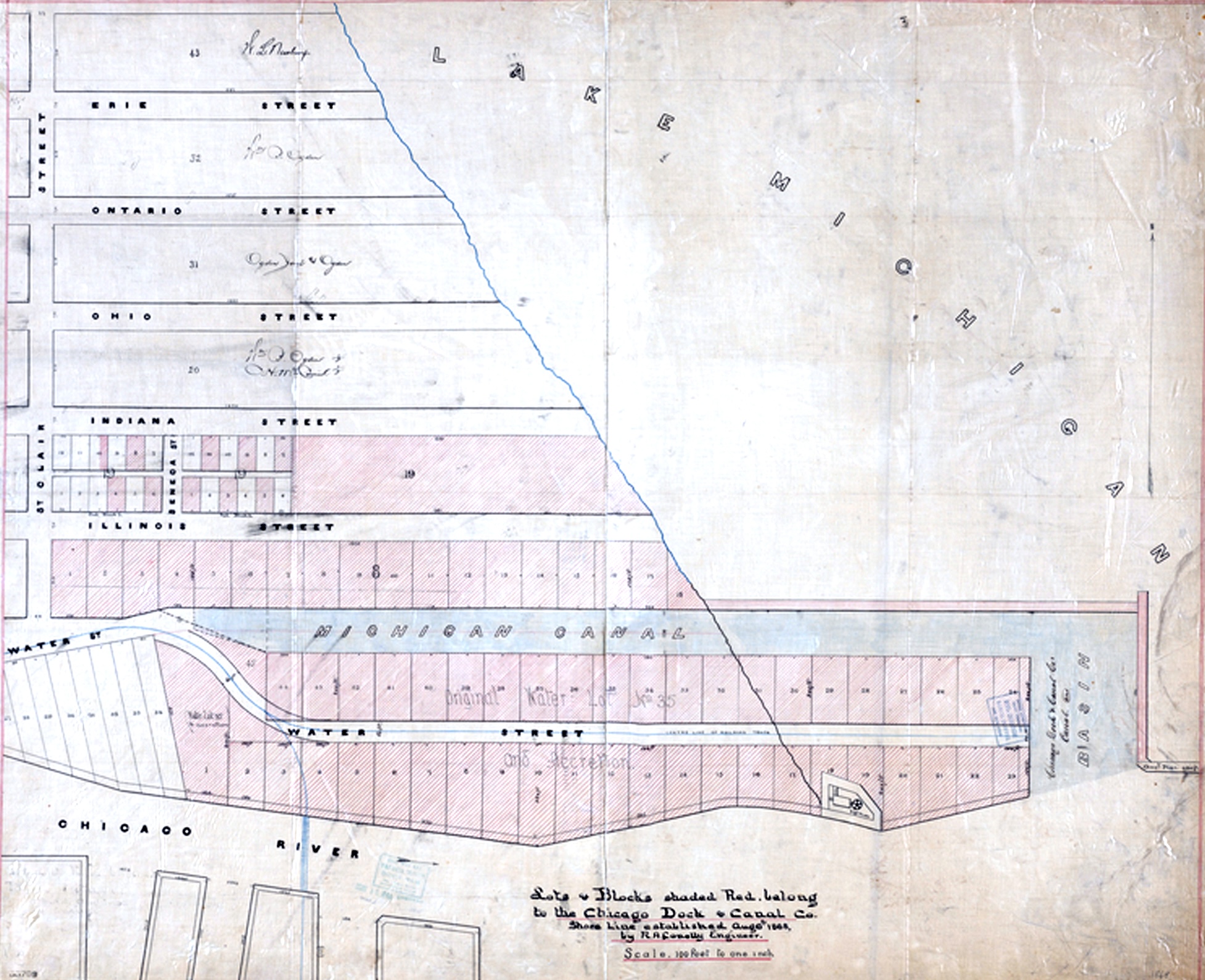
The next thing thing in order, after these barriers were erected against the waves, was to fill up the watery space between them, and make some valuable real estate. The canal was to be excavated to the depth of 16 feet, and the stuff taken out was to be used for filling up. The contract for both jobs was let to Mr. O. B. Green, who has two drudges and 140 men at work. His contract in to be finished in May next. Already 1,400 feet from the entrance have been excavated, and can be used for dock purposes. The balance of the work will he prosecuted as fast as possible. The canal will run up Michigan street, which will then stop at the end of the canal, and Water street, which comes into Michigan, will run to the end of the dock. The canal has been named after Michigan street, and the canals as they are dug will be named after Illinois, Indiana, Ohio and other streets of which they will be continuations. The amount of stuff excavated from the canal will, when it is finished, amount to over 100,000 cubic yards, and will cost about $70,000, which, added to $28,000 for pier and stone work will make the entire cost of the canal $98,000 or thereabouts. From this may be deducted about $30,000, realized from the sale of extra sand excavated. The canals will be 110 feet wide each.
The filling is the hardest part of the work, but Mr. Green gives it close attention, and so quickly in the material excavated and thrown in, that probably his contract will be completed long before the time to which he is limited. The newly-made ground is hard and and firm, as it will have to be to bear the immense pressure of storehouses that will be raised upon it. The piers will be nearly 500 feet wide each, and the lots fronting the docks will be 200 feet deep. It is intended that the storehouse shall be built fronting the docks, and close to the edge, and that between the storehouses and at the rear of them will be a street at least sixty feet wide. On these streets will be laid railroad tracks, so that cars can be loaded almost directly from tae vessels.
That the undertaking is a success is shown by the rapidity with which the newly-made lots have been leased by responsible merchants. Beginning at the sugar-house, which is in the line of the Canal and Dock Company’s property, the lots have been leased as follows:
- 400 feet frontage to Peshtigo Lumber Company:
300 feet to Dyer & Payne, coal and wood merchants;
160 feet to Hipple & Becker, lumber and hard wood establishment;
100 feet to Hawley & Gill, lumber and coal yard;
100 feet to Cleveland stone company;
370 feet to Thomas, Goodwillie, planing establishment.
The foregoing are double lots, twice the ordinary depth, and the following are single lots:
- 100 feet, A. C. Ashley, baled hay;
next 100 feet not yet rented;
next 100 feet to John Rathbone & Co,, of Albany N.Y., and Fuller, Weaver & Co., Troy, N.Y., wholesale dealers in stoves. These firms united in erecting a splendid brick building, at a cost of $50,000, and which is now occupied by both;
next 100 feet, Conlan & Brich, steam sawmill;
next 500 feet not rented.
The 400 feet from the lighthouse to the end of the inner pier, have been leased to Mr. Fulton, preserver of wood for street pavement and the 200 feet running the canal, near the entrance, to DeGolyer & McClellan, for another wood preserving establishment;
the next 50 feet on the canal bad been leased to the Lake Huron Stone Company, and the reminder is yet unoccupied.
The rental from these leases will be from $75,000 to $100,000 a year.
The amount expended on the work in 1867 was $76,000, in 1868, $95,000, making a total of $171,000, which will be increased before the end of 1870 to $300,000, which will be about the total coat of cost of this single section.
The government work cost $170,000. The experience acquired in building this first section will enable the company to build more cheaply to the future, and it is not likely that future sections will cont as much.
The real estate purchased by the company amounts to $350,000, only part of which has been used so far. Of this sum $162,000 was paid for the land running east from the sugar factory, a distance of 2,350 feet; $125,000 for Block 8, from St. Clair street to the lake, 1,700 feet, and $63,000 for Block 19. from Illinois to Indiana street, and from Seneca street east. The total expenditure, so far, has been $650,000. Of the value of the property, when the work is completed no correct idea can be formed: probably it will mount into millions.
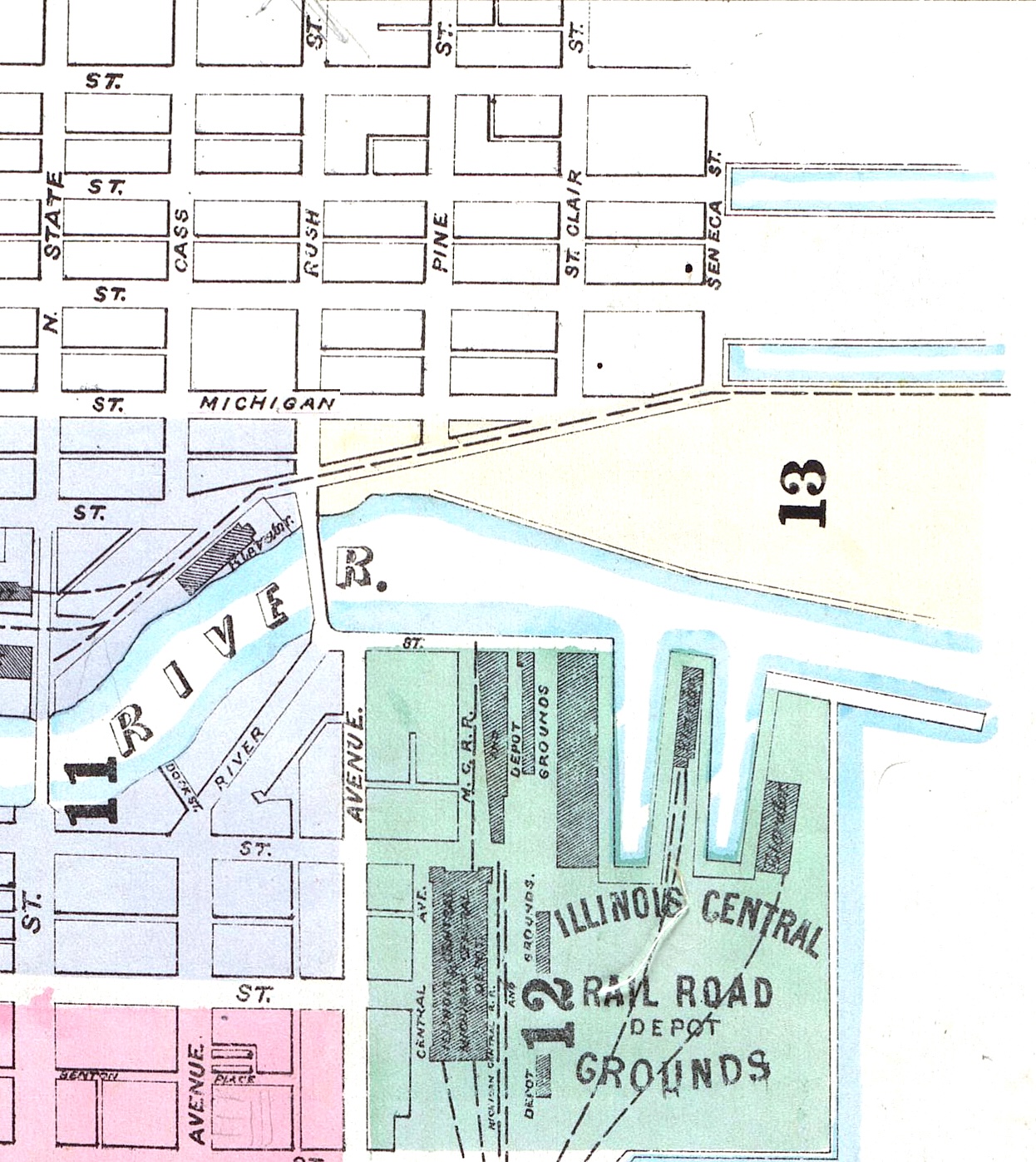
The other sections will be built jut as fast as they are needed. When the undertaking is complete, it will comprise some five miles of docks, and even then it can be extended almost indefinitely. The value of real estate on the North side will be greatly enhanced by this improvement, as it is expected that the business now scattered on the line of the river will be concentrated on these more convenient and accessible docks, It is believed that the saving in towage and time will attract the lumber trade to that vicinity. The railroads meeting in the Central Depot have guaranteed to build a bridge across the river, so that their freight cars can cross, and load, sod unload at the new docks, The Illinois Central, the Chicago Burlington & Quincy, and the Michigan Central Roads can reach the docks by that route, and the Northwestern can do so by extending its track eastward, or by striking the lake to the north, and thence into the docks.
The officers of the Canal and Dock Company are as follows:
President—Mahlon D, Ogden.
Directors—. William B. Ogden, Chicago; Samuel J. Tilden, New York: William A. Haines, New York; Mahlon O Jones, Chicago; Edwin H. Sheldon, Chicago.
Treasurer—Edwin H.Sheldon, Chicago,
Secretary—Charles G. Ogden, Chicago.
The South Pier.
The government is extending the south pier, so called, intending that it shall go as far out as the north pier, on which a small lighthouse has beed erected. The Illinois Central Railroad has the contract, but the money has given out, and unless the appropriations made by Congress pass the Senate it cannot go any further. Of course everyone knows of the projected docks, or outer harbor, which the Illinois Central Railroad Company has been enjoined from building, and which were to have extended from the south pier to Twelfth street. The company has the riparian right as far as Randolph street, and very likely docks will be built aa far as that anyway.
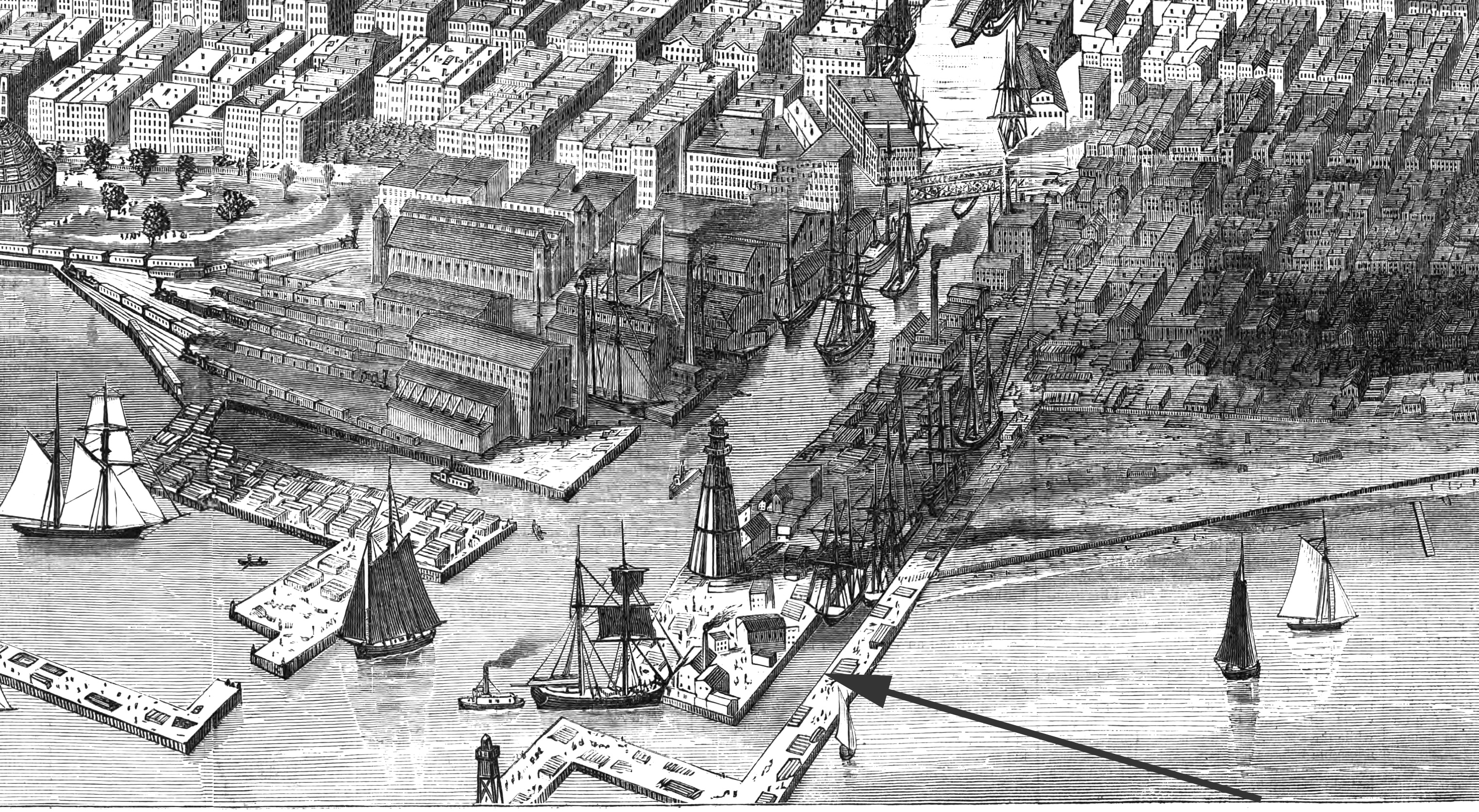
- North Pier and Michigan Street Canal
1874
Chicago Tribune, June 26, 1910
Chicago Without Dock for “Tramps.”
Practically every great port in the world has one or more puble docks at which “tramp” boats can put up when they drop into the harbor. Chicago has none. There is nothing about Chicago’s dock and harbor facilities to attract new business. In fact, the new business usually is done in boats that are too large to come up the Chicago river, around the treacherous bends, through the narrow channels and under the delaying bridges.
The conditions in Chicago, both with respect to harbor facilities and public interest in the question, are in a chaotie state. Half a dozen different interests are pulling against each other.
The Pugh Terminal company, operating under a lease from the old Chicago Dock and Canal company, wants to build private docks.
The harbor committee recommended to the city coun cil that the dock and harbor should be built and operated under municipal ownership.
The sanitary distriet has offered to finance the proposition for the city and build the outer harbor.
The River association doesn’t object to the building of an outer harbor, but it thinks the widening, deep-ening, and straightening of the river is the most important work. The railroads, owning about three-fourths of the boats that come into harbor, as well as about three-fourths of the dock space along the river’s bank, are not especially interested in seeing an outer harbor built, because at present they can get along well enough.
The backers of the Chicago plan are not especially enthusiastic about the outer harbor proposed by the harbor commission, lest it interfere with the beautification of the city.
The general public is apathetic on the subject, the city has no money, there are many legal questions involved which will have to be thrashed out, and the business interests, except those directly upon the river. are asleep to the necessity for concerted and coöperative action.

- North Pier Extension Site
Davie’s Atlas
James Van Vechten
Engraved and Printed by Charles Shober
1863
- Michigan Canal
1869
- Michigan Canal
Sanborn Fire Insurance Map
1869
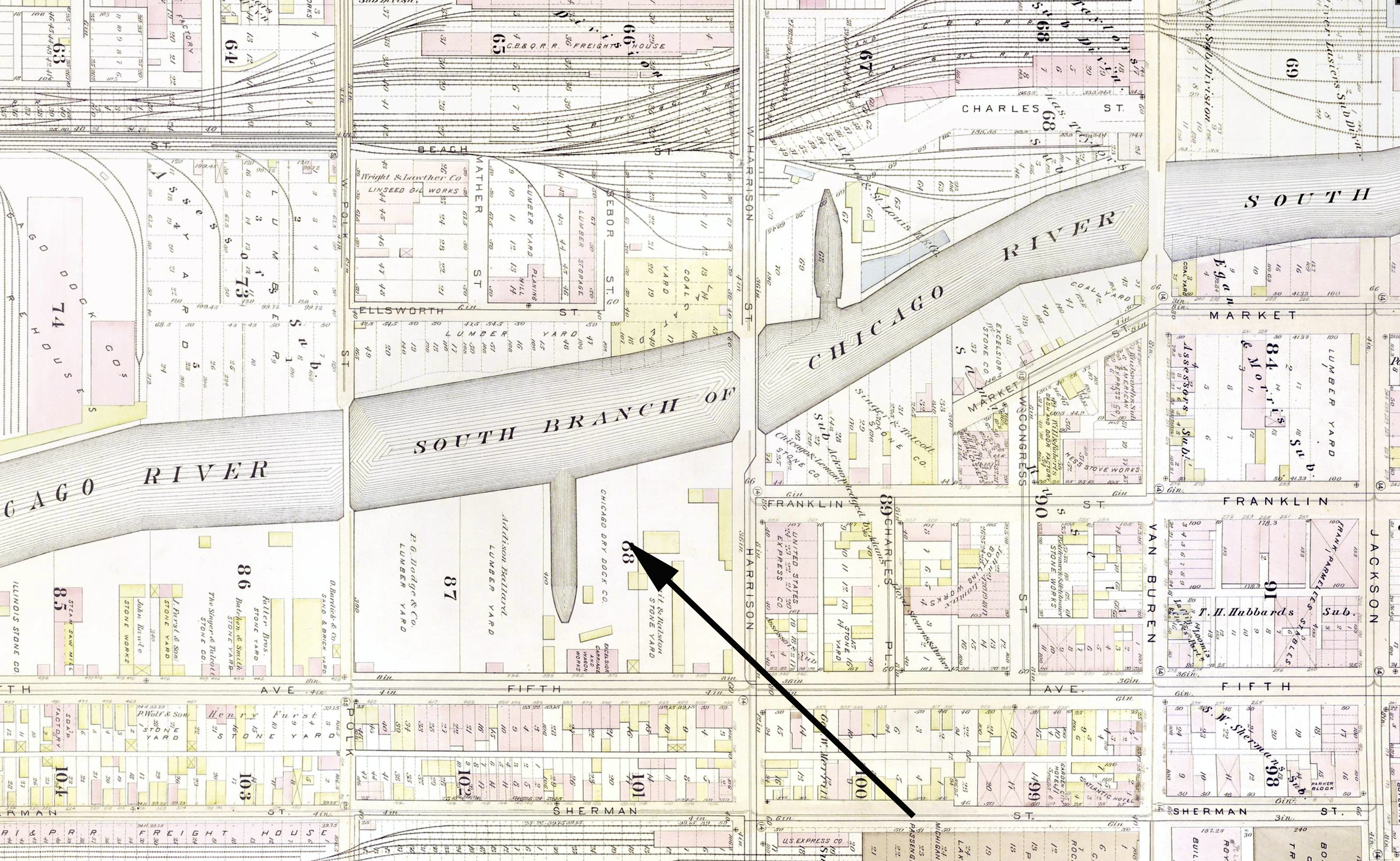
- Chicago Dry Dock Company
384 Wells Street
Robinson Fire Insurance Map
1886
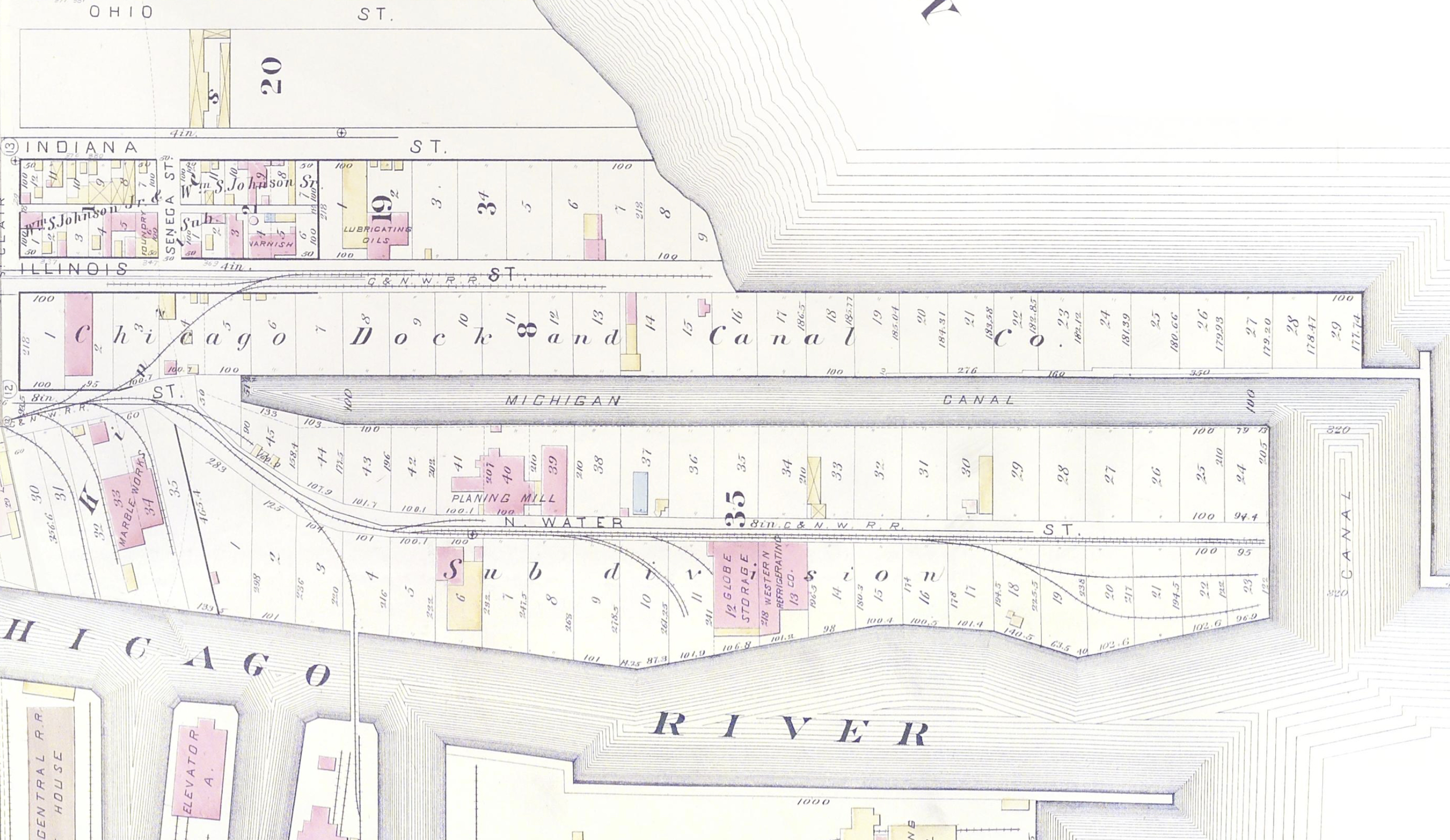
- Michigan Canal
Robinson Fire Insurancd Map
1886

- View northwest from the Lighthouse on the North Pier at the entrance of the Chicagp River. About 1888. Possibly Holy Name Cathedral in background.
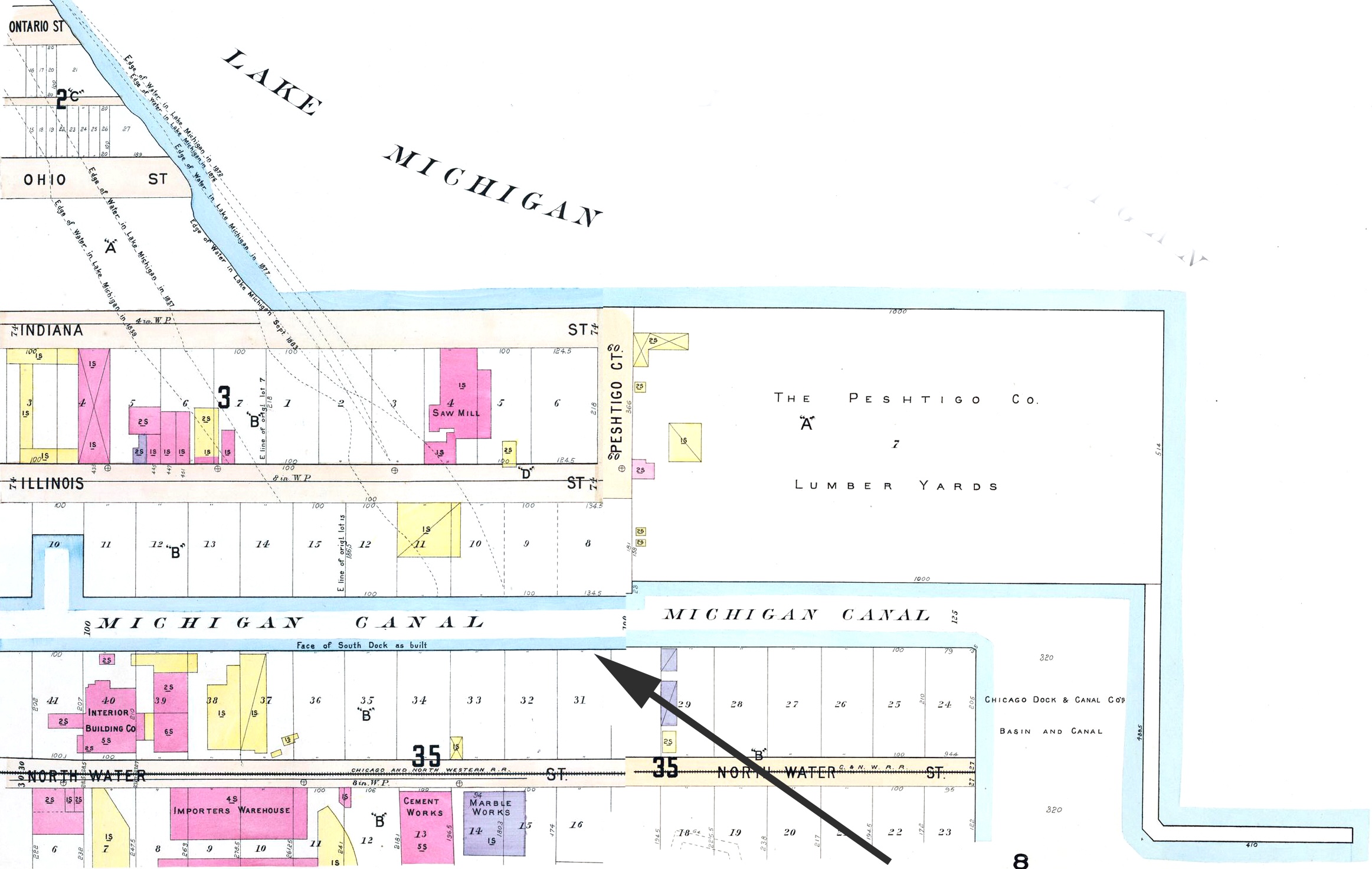
- Michigan Canal
Greeley-Carlson Atlas of Chicago
1891
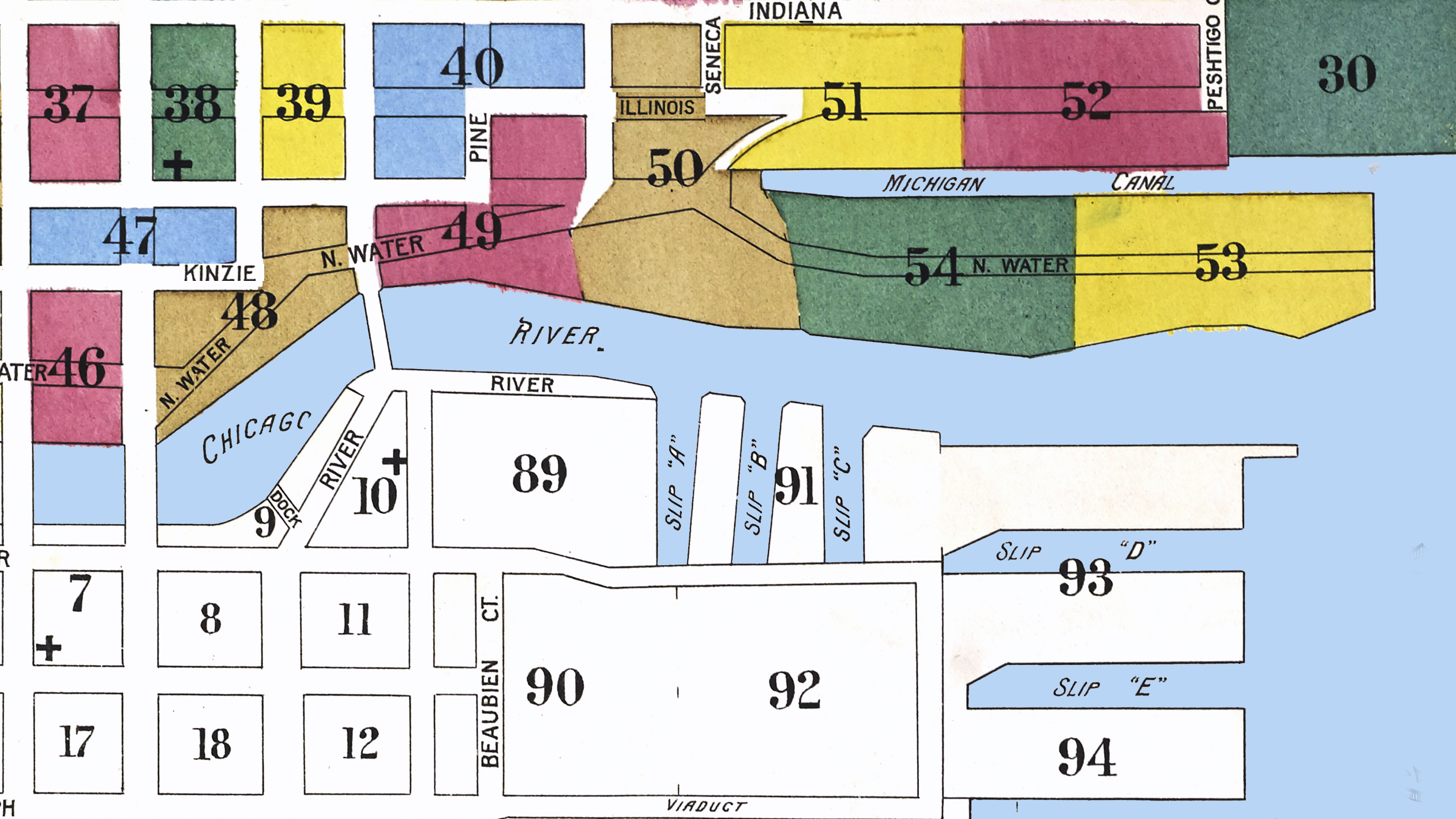
- Michigan Canal Overview
Sanborn Fire Insurance Map
1906
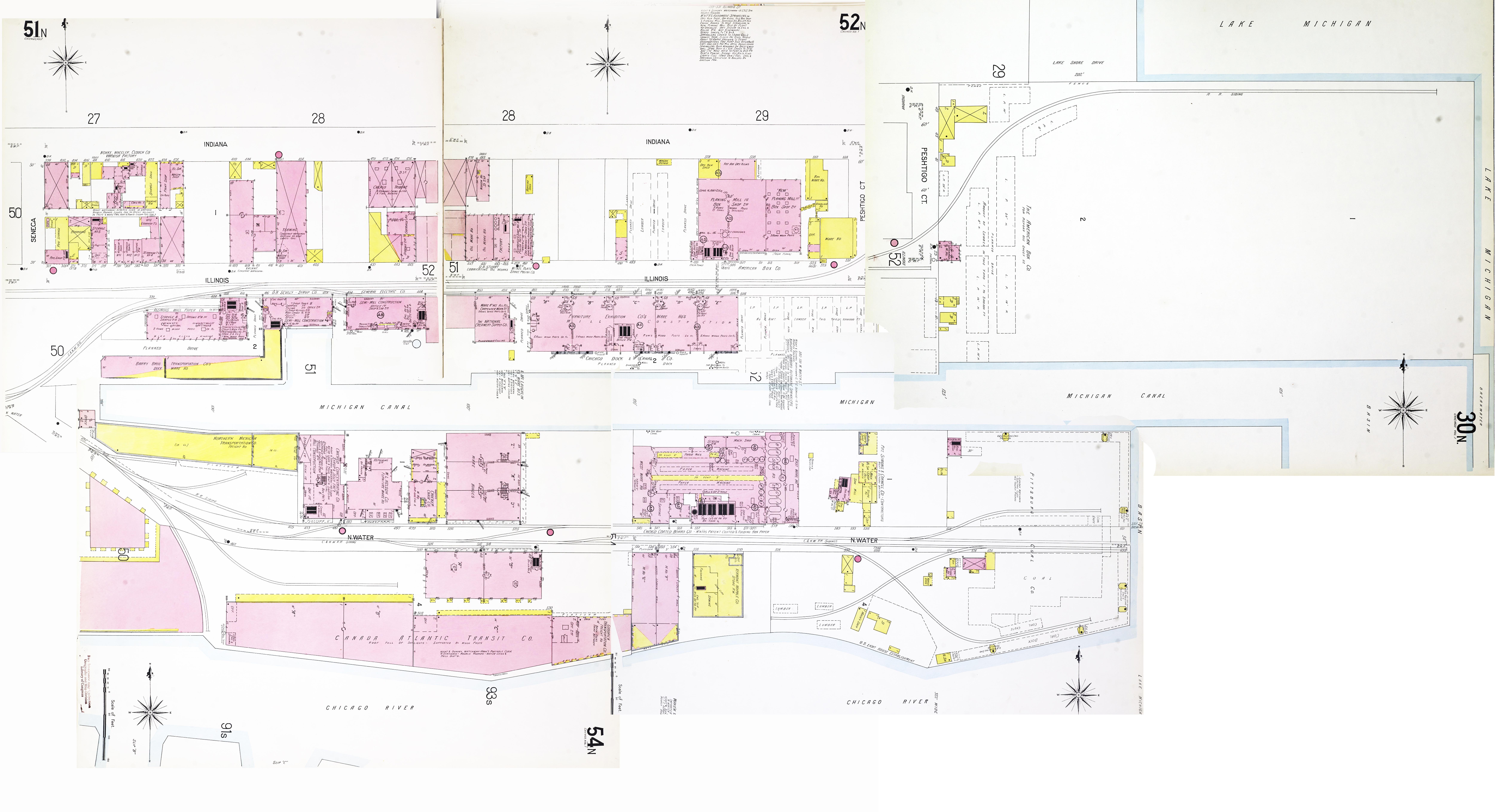
- Michigan Canal Detail
Sanborn Fire Insurance Map
1906

- Ogden Slip
Ross & Browne Real Estate Map
1928

- Ogden Slip
Apple Maps
2025
Chicago Tribune, June 22, 1930
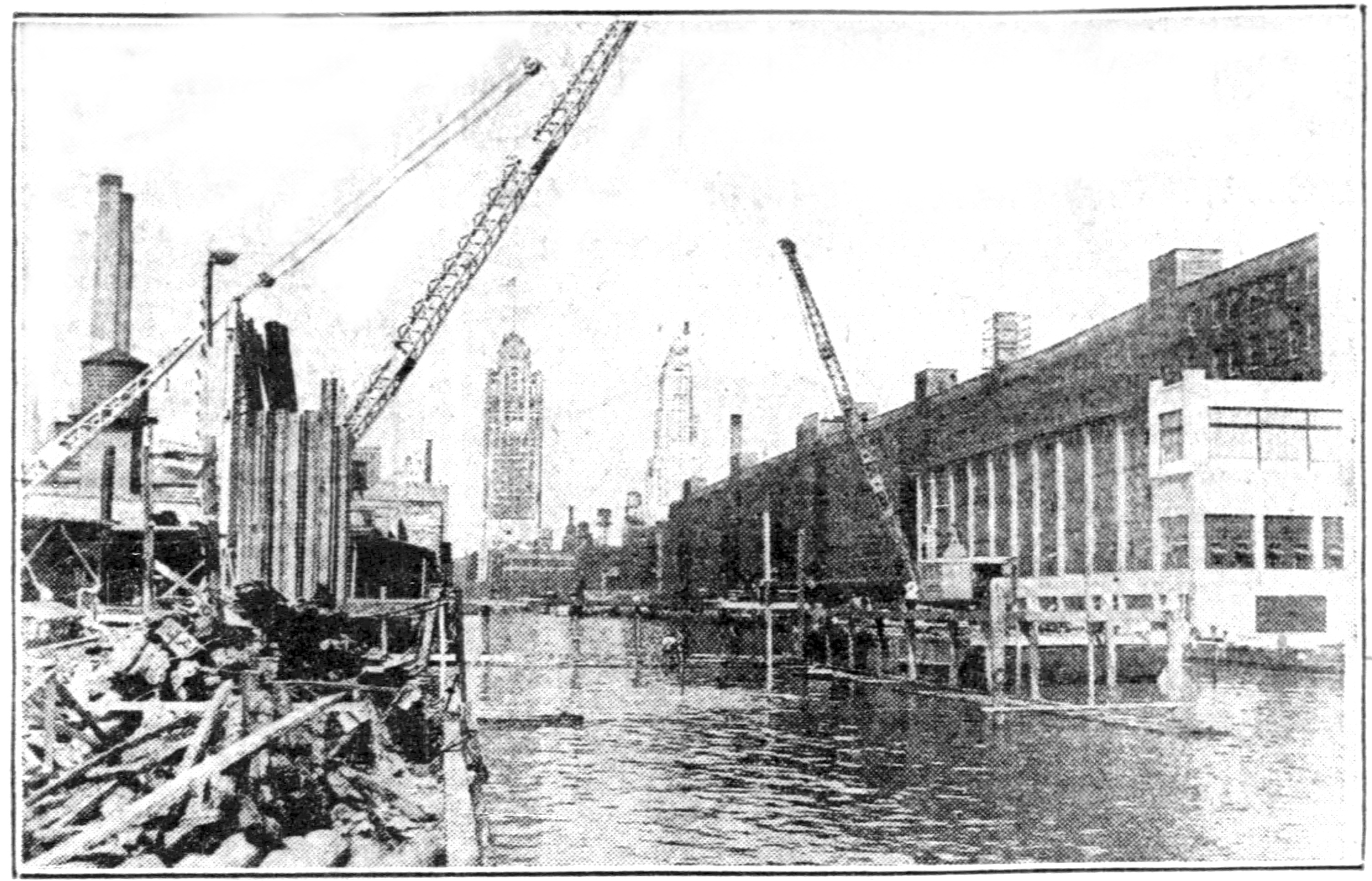
- View looking west toward Tribune tower and Medinah Athletic club showing progress on substructure of bridge over Ogden slip near mouth of river. This bridge, with the main one to be built across the river, will link the boulevard systems of the Lincoln and south park systems.
Chicago Tribune, September 21, 1930
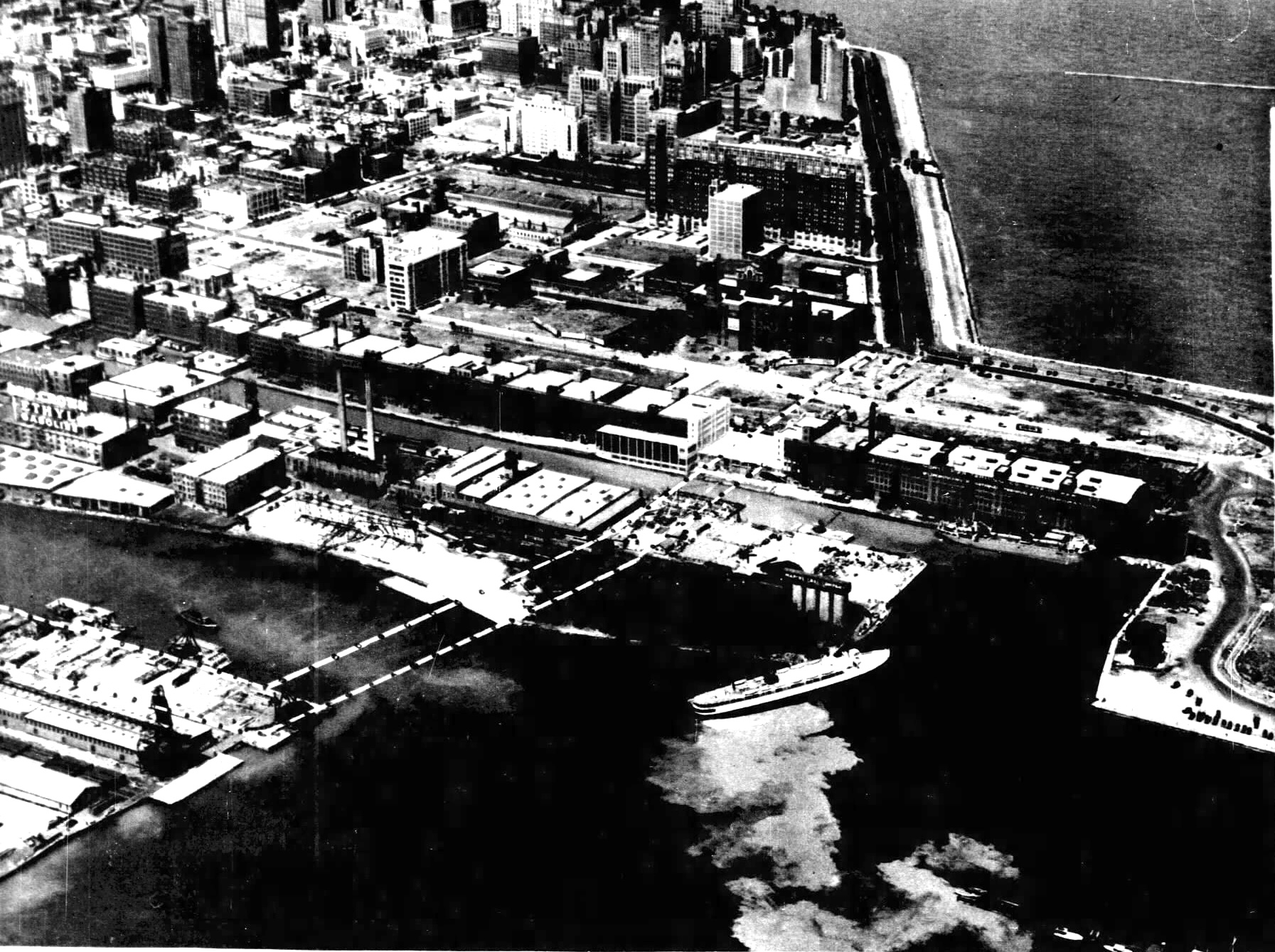
- THE AERIAL CAMERA REPORTS ON A $10,000,000 PROJECT—The aviator’s view of progress toward construction of Chicago’s greatest bridge, which is to connect the south park and Lincoln park boulevard systems at the mouth of the river. The river, across which the principal span will be thrown, is at left center. At the center a steamer puts in at Ogden slip; just around the “corner” from it will be noted the beginnings of the substructure for the secondary bridge across the slip, and across from that to the north a lane cut through a building to make way for the north approach. In the distance is Lake Shore drive, to which the approach will lead. The murky area about the steamer, it may be explained for the curious, is mud.
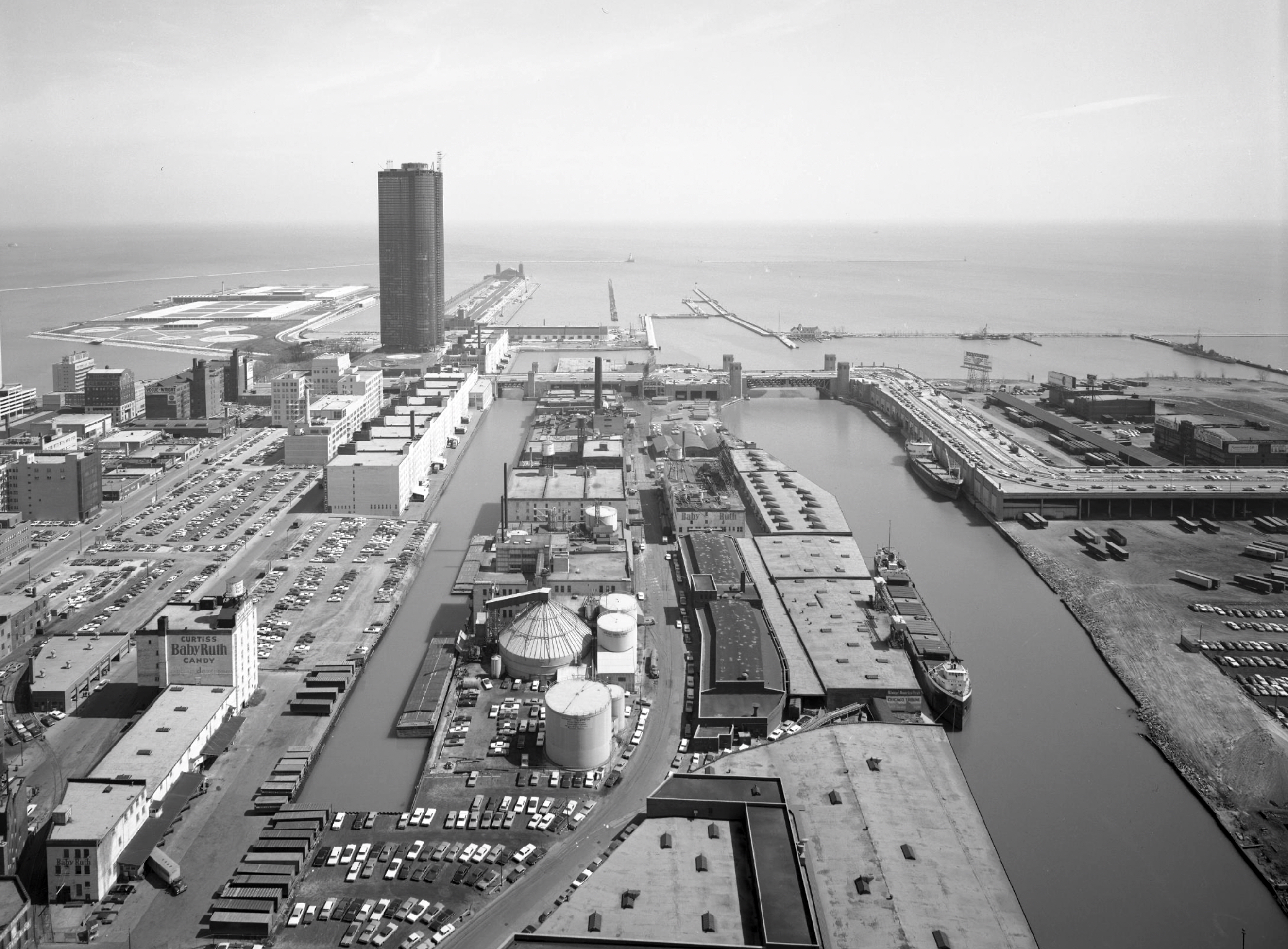
- Ogden Slip
1968
NOTES:
1 Chicago Tribune, July 11, 1867.

Leave a Reply