Chicago Evening Post, December 18, 1867
 Chicago is all places of healthy growth -vigorous, and is constantly showing her expansive power, both mentally and physically, in confirmation of which witness the progress of liberal ideas and the increase of business and of mercantile edifices, not omitting the many elegant dwellings of our merchant princes, both singly and in groups. Among the most noticeable of the lately erected mercantile buildings are:
The Commercial Building, situated at the southwest corner of Lake and LaSalle streets, with a front of eighty feet on LaSalle and forty on Lake streets, built in the Italian style of the Palladio school, and faced with Athens marble.
This building is four stories high, exclusive of basement, the upper stories made easy of access by wide and elegant halls and well adapted stairways, and lighted by a large skylight. The building is erected for and is the property of Mr. C. F. Gray, and will cost, when completed, about $50,000. It is nearly ready for occupancy. It is intended to be used for business places, and has four offices in the basement, two on the first story, thirty-two by forty feet each, six each on the second and third story, while the fourth story is finished off as one large room.
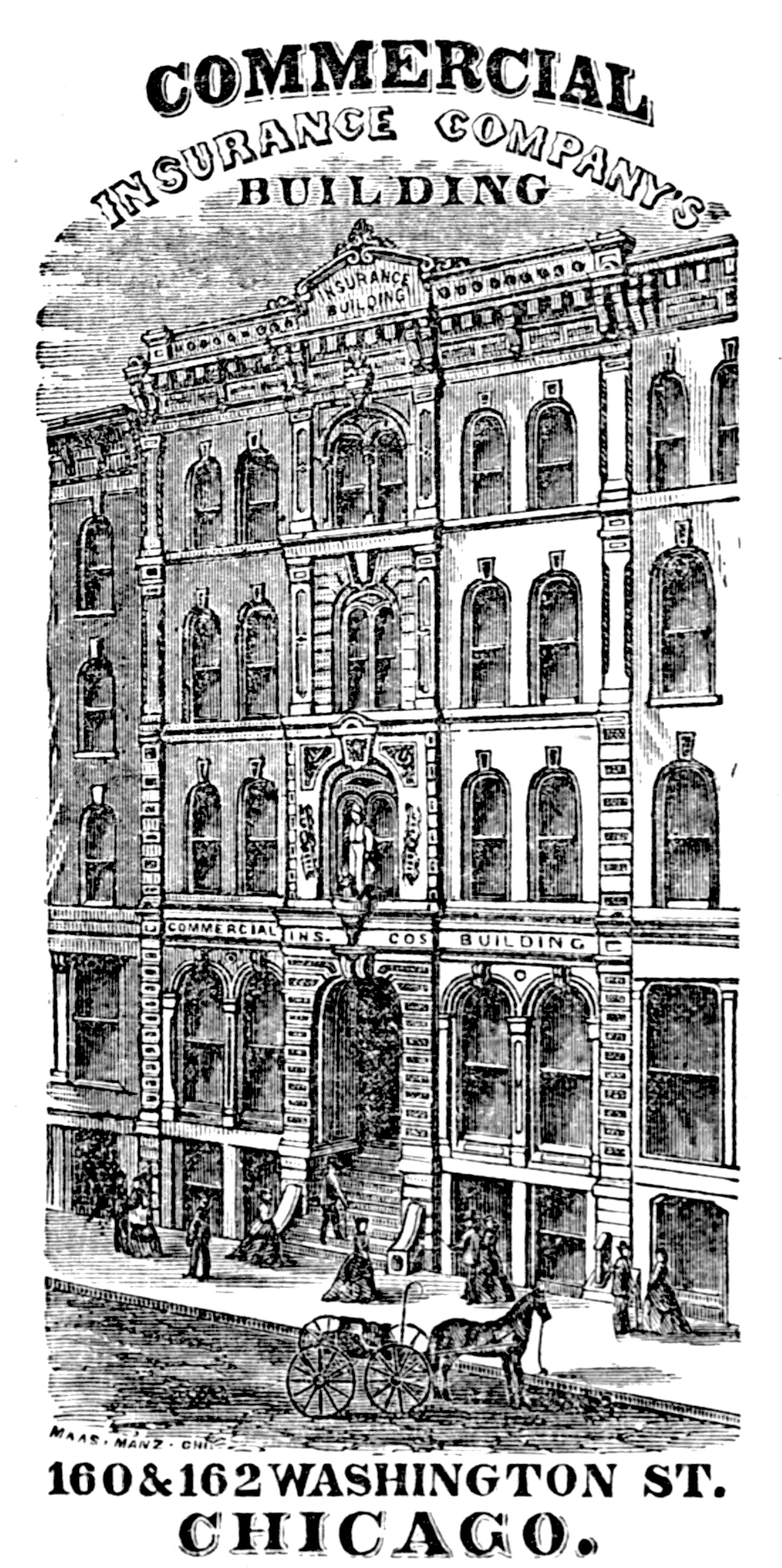
The Commercial Insurance Building, erected under the superintendence of the same architect, A. Bauer, Esq., of No. 47 La Salle street, built for the Commercial Insurance Co., and leased for offices only, stands on Washington street between LaSalle and Wells street, and is of the rich Venetian style, the front of white Athens marble from the quarry some forty miles from here, at the place of that name, and richly decorated with firemen’s and other appropriate emblems, the whole surmounted by a carved stone cornice. It has a front of forty feet six inches, is four stories high, omitting basement, with well constructed offices in the basement, seventeen by seventy feet each, with private offices fourteen by twenty. The first and second stories are the same, and the third and fourth are divided into five large apartments, thirteen by thirty four feet Square. It is heated throughout by an approved system of compressed steam, and furnished with fire-proof vaults in the basement and in the first and second stories. It has wide and well lighted halls, rendering the higher stories as accessible as the lower. The interior is finished with different kinds of hard woods, black walnut and ash predominating. It will cost $40,000.
Dore School
On the West Side Mr. Bauer has also erected for the city a solidly built brick school house, known as the Dore School, situated on the corner of Harrison and Desplaines streets. Its dimensions are eighty-seven by sixty-nine feet front, four stories high, containing fourteen class rooms, each twenty-seven by thirty-three, and an exhibition hall, thirty-nine by sixty-six feet. This school editice will cost in the neighborhood of forty thousand dollars.
Hastings’ Block.
On the North Side there is a handsome block of stores built by the same architect for Mr. John Hastings, at the corner of Chicago avenue and Wesson street, with a front of fifty-three feet on Chicage avenue and seventy-five on Wesson street, and three stories in height. The Chicago avenue side is faced with Athens marble and the Wesson street front with pressed brick with stone trimmings. The probable cost of the block will be about twenty-seven thousand dollars.
Union Building, built under the direction of Mr. Frederik Baumann, of Washington street, from white limestone, fronting one hundred feet on LaSalle and the same on Washington street, and consisting of four stories and a basement, the latter having twelve rooms, large and small, nine of which have vaults. The largest room being nineteen by seventy-three feet, has five rooms of different dimensions, three large and two small ones, the largest being thirty-four by fifty-six feet, and the smallest fifteen by twenty feet three inches. The block will be heated by tire places and stoves, and is expected to be complete by spring. The building is large and elegant, and will be an addition and a credit to the city. The probable entire cost will be $120,000.
Franklin School.
Mr. Baumann has also several other contracts on hand for the coming spring, among them the following: A school house for the city, to be known as Franklin School, situated on the corner of Division and Sedgwick streets, 90 feet by 70 feet 2 inches, four stories bigh, with fourteen class rooms and one large hall, heated by steam and to cost $20,000, and a block of four stores, four stories high, situated at the corner of Clinton and. West Lake streets, in the West Division.
The fine block of buildings known as the Potter Palmer Building, situated on State street, between Madison and Washington streets, and erected by the gentleman of that name, bids fair to eclipse any building of the kind in the city. Mr. Palmer claims that he will have the finest structure in the world—not confining himself to the United States. The block is in two parts, the larger being 135 feet front on State street, and the smaller 46 feet on the same thoroughfare. The plans for this structure are by the well known architect, Mr. Wm. Van Osdel, of Masonic Temple, and the building is, in style of architecture, somewhat Italianesque, being a combination of the Grecian-Tuscan and the Italian schools. The structures are to be five stories in height, flat roofed, with a French roof over the main building, giving it a total of six stories in height. They are intended solely for mercantile purposes, and are not divided into offices or suites of apartments, the same person or parties being expected to take the whole building, from “summit to foundation stone.” The front is composed of Joliet marble, and will be ormamented by brackets, and a handsome balcony in the center of the main building. The mason work is under the superintendence of Mr. Peter Button, and is progressing in a rapid and satisfactory manner. It is but a little over eighty days since the breaking of ground, and the smaller building is nearly done, baving reached its last story, and being ready for the roof. The average amount of brick layed per day is sixty thousand. The mortar for the use of the builders is hoisted in large tubs by a powerful little engine placed on the first powerful little of the unfavorable work goes on so rapidly, in spite floor; weather, that the owner hopes soon to see this fine addition to fine buildings complete our city’s already and ready for inspection and occupation.
The not probable cost of Mr. Palmer’s will be not less than $250,000, the whole being done by days’ works.
In addition to the above, and forming a part of the same concern, Potter Palmer is erecting another block on the opposite side of State street, which will be extended when the lease now held by Mr. Charles Tobey expires. These buildings will be six or seven stories high. The stone for the front is manufactured in New York and shipped here and will alone cost $92,000.
Many smaller blocks of business buildings as as several large blocks of dwellings and handsome single residences have sprung into existence within a short space of time, adding its much to the beauty of the city, and showing rapid growth, but they will be left for a second article in the Post.
Chicago Tribune, January 1, 1868
 BUILDING.
In no department of business was this anticipation felt mute generally than in that of real estate. Men who had realized largely in the former year began to put their surplus capital into real property, which, the prevailing high rents, and the demand that was constantly increasing by reason of the growing population, seemed to offer, prospects of a larger return upon investment. Many capitalists prepared to prosecute building operations with great vigor upon the opening of the season. Large quantities of lumber were sent thither and materials were abundant for a vigorous and busy season. But almost at the opening of the season the labor troubles, which had long been threatening, actually arose, and in the demands of the eight hour men was sounded the key-note of an obstinate and damaging conflict between labor and capital. Work vas abandoned altogether, and building operations being crippled, the disastrous effect of the untimely protest of the workmen extended to all branches of business, and were to be marked even at.the close of the year. Many, a large majority, of projected enterprises were postponed for another year, and only a small part were carried to completion.
It is estimated that the total number of buildings erected during the past season amounts to 7,000. It is believed that in the construction of there from $8,040,000 to $9,000,000 hate been expended.
During the year 1866, not less than 9,000 structures were erected in the city, at an aggregate cost of $11,000,000.
From these figures it will be ascertained to what extent building operations were affected by the eight-hour troubles during the past year, when it is considered that of the two seasons the past has been much more favorable for this work. During the year 1866 men were plenty, and true; but materials were exceedingly scarce. The season was very rainy, and brick-making was attended with great difficulty. Prices reached as high as $15 per thousand. Lumber, too, was held firmly at high rates.
During the past year the price of lumber had not materially declined, bat the dryness of the season filled the market to overflowing with other materials. Competition sprang up very lively, and, during the greater part of the season, bricks were plenty at $9 a thousand. It is computed that 40,000,000 of these were manufactured during the season.
The buildings erected during the year present this characteristic: Although the number is small as compared with that of the previous year, those constructed were of a much better class, uniformly. The appearance of many streets has been completely changed within one short season. A year ago LaSalle street was a muddy, uneven, little frequented thoroughfare. The appearance of its structures was unattractive indeed. Now, imposing edifices have bees reared like magic where, but a little while before, crouched gloomy and tumble-down tenements, rickety stables, and cheap cottages. Many other streets exhibit a degree of improvement a lot equally marked.
The coming season promises to be one of unparalleled activity. A great number of enterprises have been conceived, and preparations have been made for commencing operations different quarters of the city, at the opening of the next season, on a most extensive scale.
Among the most noticeable structures erected or contracted for during the pest season are the following:
Armour’s building, on the corner of Michigan avenue and Randolph street, was erected during the season, and is one of the most elegant and substantial blocks in the city. It comprises two store, each with a front of 43 feet, and a depth of 130 feet. It is six stories in height. The building is furnished throughout with the most modern improvements. Its total cost was $400,000.

- Armour Building (Pullman Car Company Building)
John Carbutt, photographer, 1869
There is now in progress of erection for Mr. Potter Palmer, on the corner of State and Washington streets, a new business block, which will cost, when completed, upwards of $140,000. The fronts will be of marble, and the style of architecture will be beautiful and imposing.
Messrs. Bowen Brothers have erected a block of four marble stores on Randolph street, 120 by 170 feet in size. The block is erected in the Italian style of architecture, and will cost $425,000.
Messrs. Armour, Dole & Co. have now in process of erection a monster grain elevator whose capacity will be 1,250,000 bushels. It wIll be 130 feet high, will have a depth of 880 feet, with a width of 84 feet, and will cost $400,000.
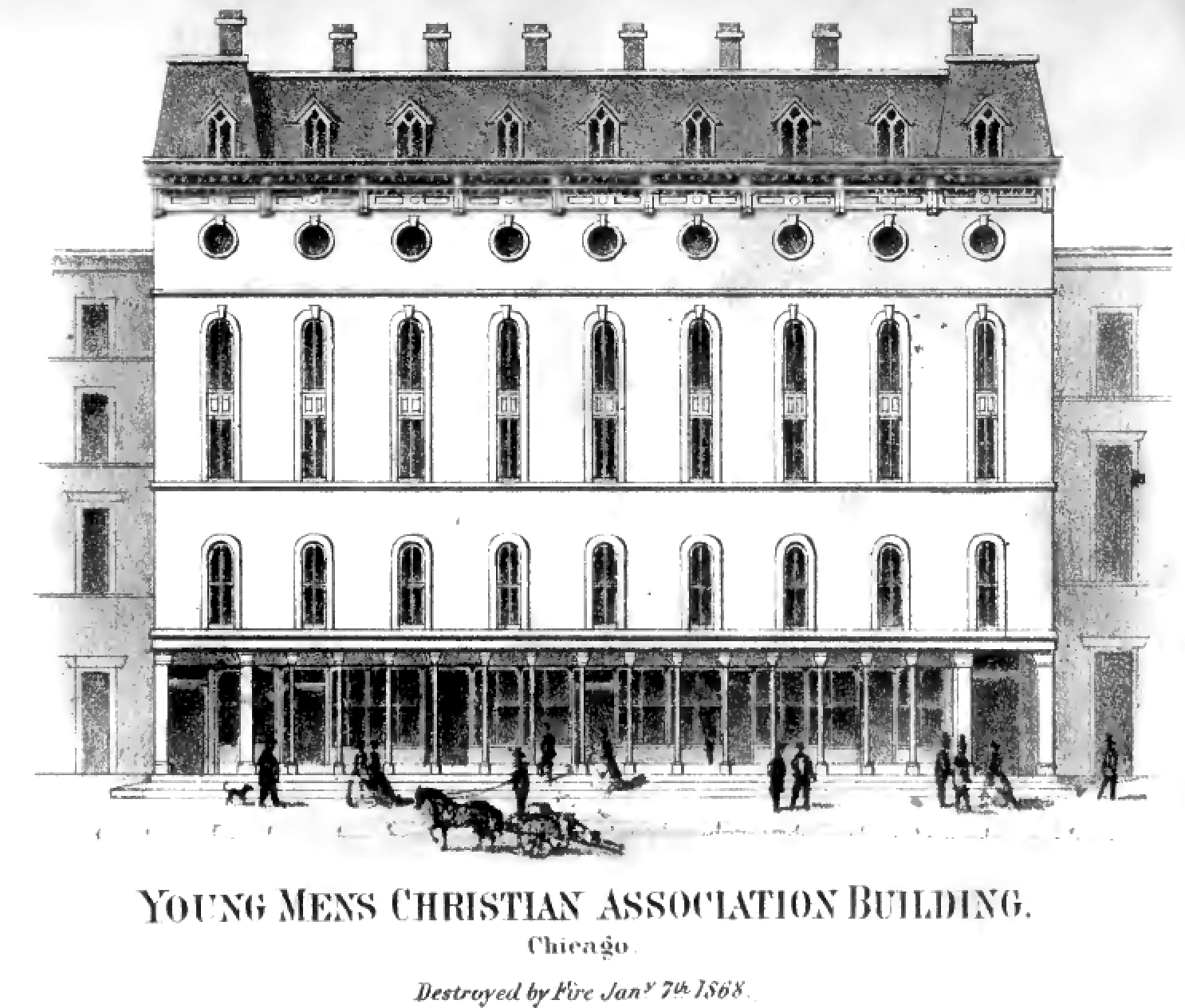
The magnificent building on Madison street, in which are completed. Farwell Hall and the Young Christian Association, was finished during the last year at a cost of $120,000.
The Union depot of the Michigan Southern and Rock Island Railroads, on Van Buren street, having a front of 200 feet, with a depth of 600 feet, was completed during the past year. Its aggregate cost was $200,000.

Leave a Reply