Wholesale District—Sears Tower Site
Willoughby Building
Life Span: 1887-1964
Location: NW corner Franklin and Jackson (Sears Tower site), 234 S. Franklin
Architect: George H. Edgebrooke
- Lakeside Business Directory of the City of Chicago, 1899
Willoughby Bldg.—Franklin nw. cor. Jackson
Lakeside Annual Directory of the City of Chicago, 1904
Willoughby Bldg.—238 to 242 Franklin nw. cor. Jackson.
Lakeside Annual Directory of the City of Chicago, 1911
Willoughby Bldg.—234 S. Franklin nw. cor. Jackson.
Chicago Tribune, November 25, 1888
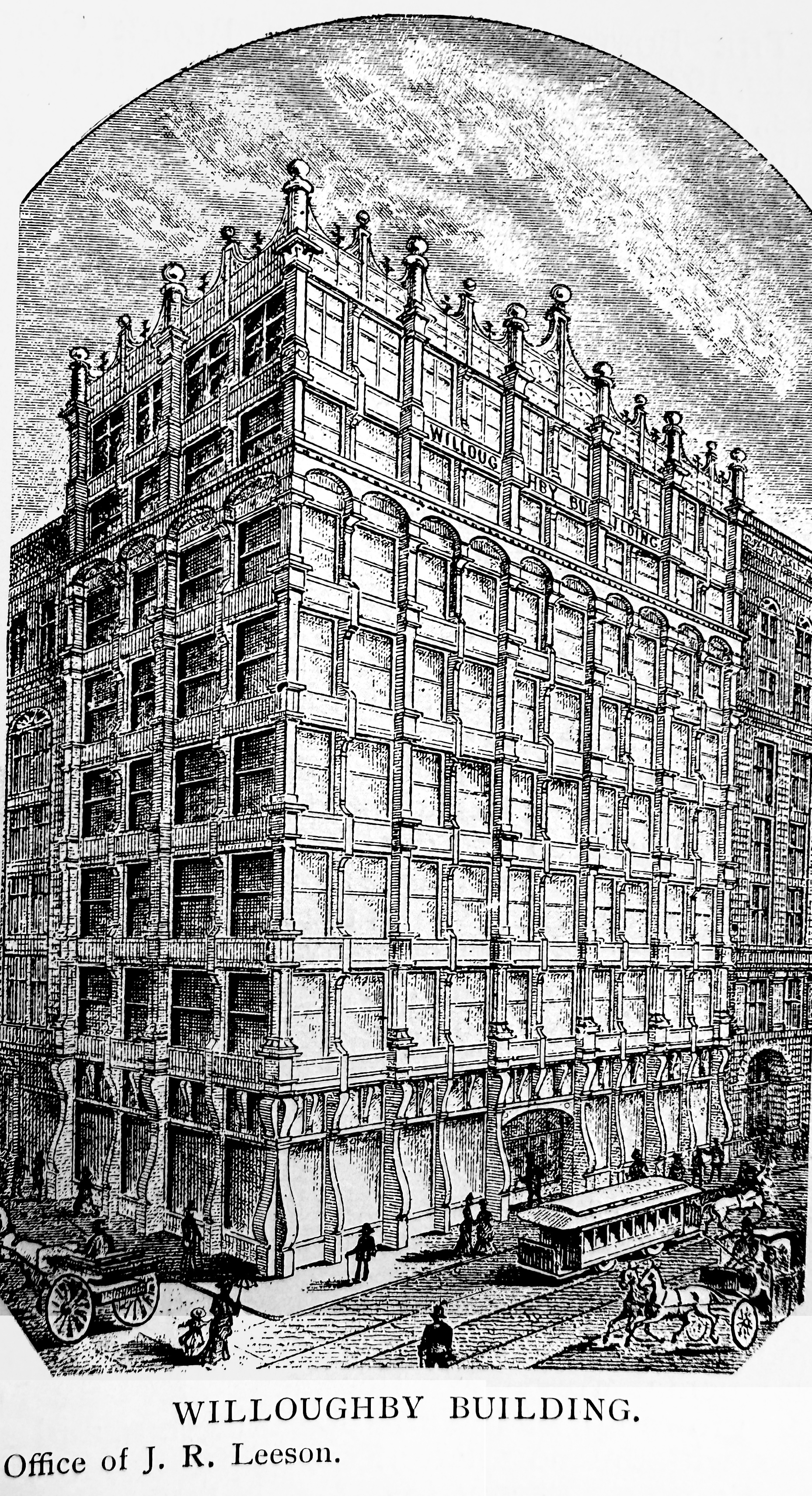
POINTS ABOUT NEW BUILDINGS.
Chicago bids fair to have and to deserve a National if not a worldwide reputation as a city of remarkable buildings. Viewed esthetically there are doubtless numerous defects even in some of the most costly structures. It must be admitted that it was truly as well as wittily said of the architecture of one of our new buildings that the first story was Roman, the second Graeco-Roman, and all the rest catch-as-catch-can. Yet this same building is so perfectly adapted to its purpose that it compels admiration in every visitor and thoroughly satisfies its occupants. So in the case of other buildings; no matter what their impression upon the artistic eye, the important problems involving utility, convenience, and safety have been successfully solved, and in many cases uniquely. Buildings like the Auditorium, the Rookery, the Insurance Exchange, Mr. Field’s wholesale building, the new Owings, and the Tacoma will attract the gaze of visitors and the study of builders for a long time to come. They are the kind of structures which strangers go home to talk about as among the wonders of the great metropolis of the West. The men who have put their capital into them have the given free advertisements to the city as well as aided numerous smaller development. There are numerous smaller and less striking buildings which exhibit similar improvements over the old. One of these, about which little has been published, is Mr. Willoughby’s new block at the corner of Franklin and Jackson streets.
A notable feature of this building is the fact that with the exception of the doors and floors it is made wholly of iron. Externally it is simplicity itself. There is no straining after impossible effects, no juggling with half a dozen different styles of architecture, no pretentious attempt to appear anything but what it is—a well-lighted, convenient, and substantial business block. The iron of the exterior is painted white and will receive a fresh coat every year. The interior was designed for the special purpose of accommodating out-of-town wholesale houses and manufacturers. The eight floors are alike in every respect and Mr. Willoughby places same rental value, $2,100 a year, upon each. As the building has a frontage of eighty-two feet on Franklin and thirty-two on Jackson and has large plate-glass windows every part is finely lighted. Mr. Willoughby expects to have the building filled shortly with the representatives of Eastern concerns. Four New York houses, among the largest manufacturers and dealers in clothing, buttons, etc., in the country, have their samples and representatives there, and others have applied for space. The plan of the building is practically Mr. Willoughby’s own, and he is to be congratulated on its success. A man who conceives a new idea in building and has the apply it must be considered a public benefactor. Happily Chicago has many such men, and a large number of the opposite class of self-seekers, who keep their real estate idie and useless so long as they see a chance to profit by the energy of their neighbors. Chicago does not love the real estate miser.
Inter Ocean, October 15, 1899
Tenants, Secured for the Willoughby Building on Franklin Street.
The eight-story Willoughby building, at the northwest corner of Franklin street and Jackson boulevard, has been leased through Keebler & Co. for Charles Fargo to various tenants at an annual rental of $14,700. The ground-floor store, with basement, has been leased to Gustav Riehl and the Columbia Knitting company, at $5,400 per annum. The other leases closed are: The second floor, to the Celluloid company of New York, at $1,800 per annum; the third floor, to L. Heller & Co., at $1,500 per annum; the fourth floor, to Henry Sonneborn & Co. of Baltimore, at $1,400 per annum; the fifth floor, to the Brown-Bourgeois company at $1,200 per an-num; the sixth floor, to H. L. Stanton & Co., at $1,200 per annum; the seventh floor, to Sylvan Schey and D. Feibleman, at $1,200 per annum, and the eighth floor, to Frank J. C. Borwell and Alexander White, at $1,000 per annum.
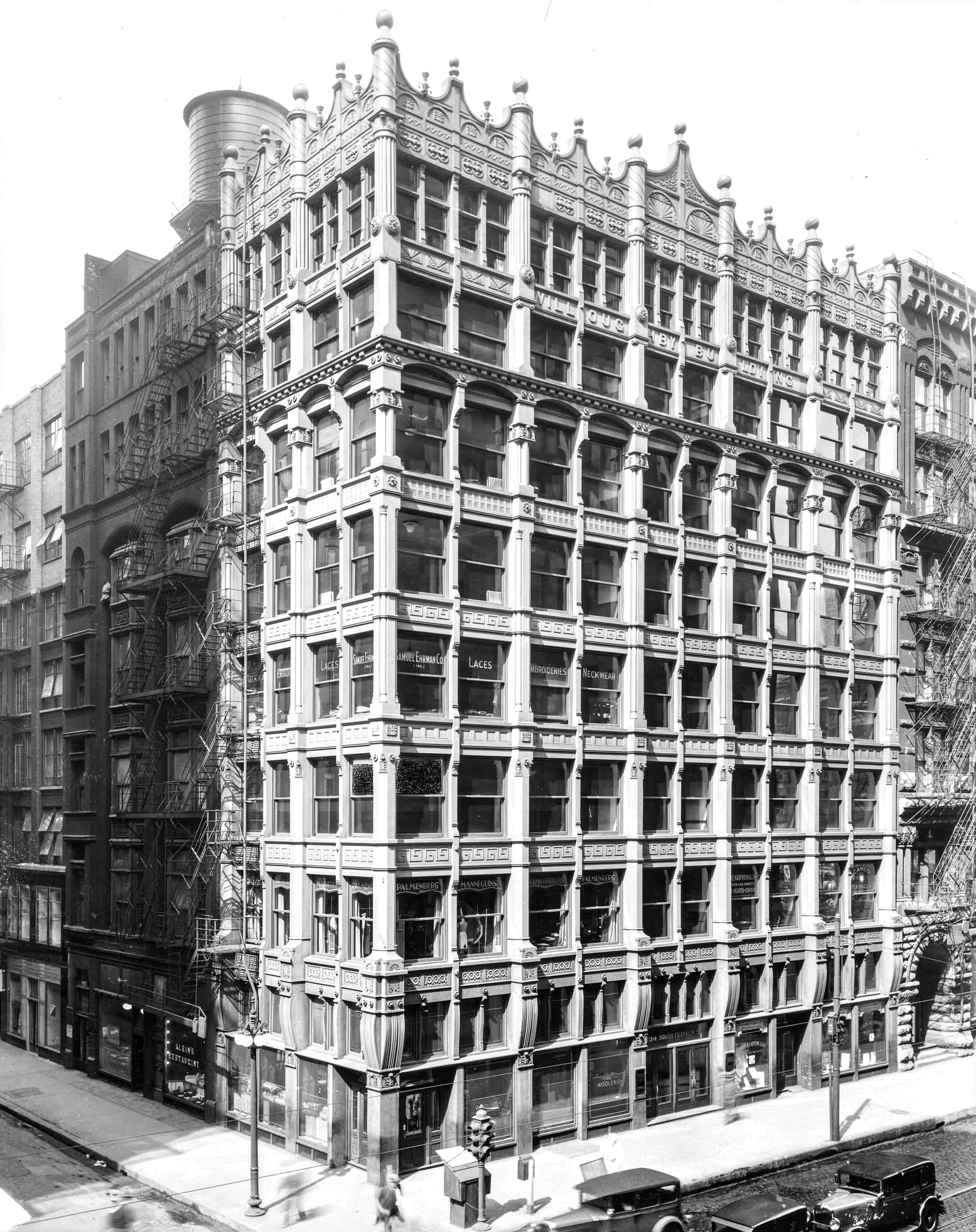
- Willoughby Tower
About 1912.
Rand, McNally & Co.’s Bird’s-Eye Views of Chicago
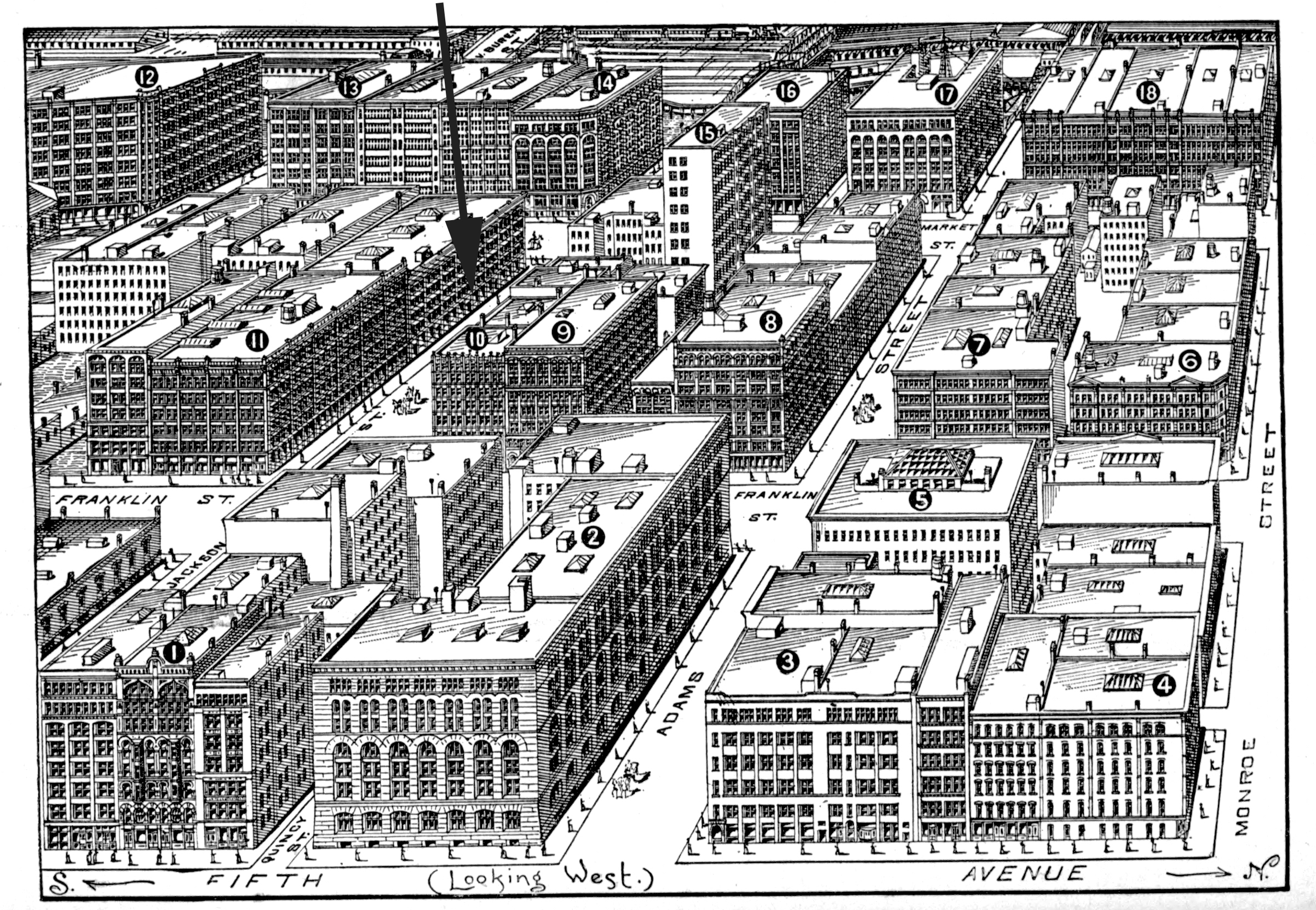
⑩ The Willoughby Building:
Fronts 30 feet on Jackson and 75 feet on Franklin Street, at the northwest corner. It is 100 feet high, with 8 stories and basement; 1 passenger elevator; cut-stone and iron exterior. Occupied by wholesale jobbers and importers. Erected in 1887.

- Willoughby Building
Sanborn Fire Insurance Map
1906
Chicago Tribune, July 28, 1970
 By Alvin Nagelberg
(Real Estate Editor)
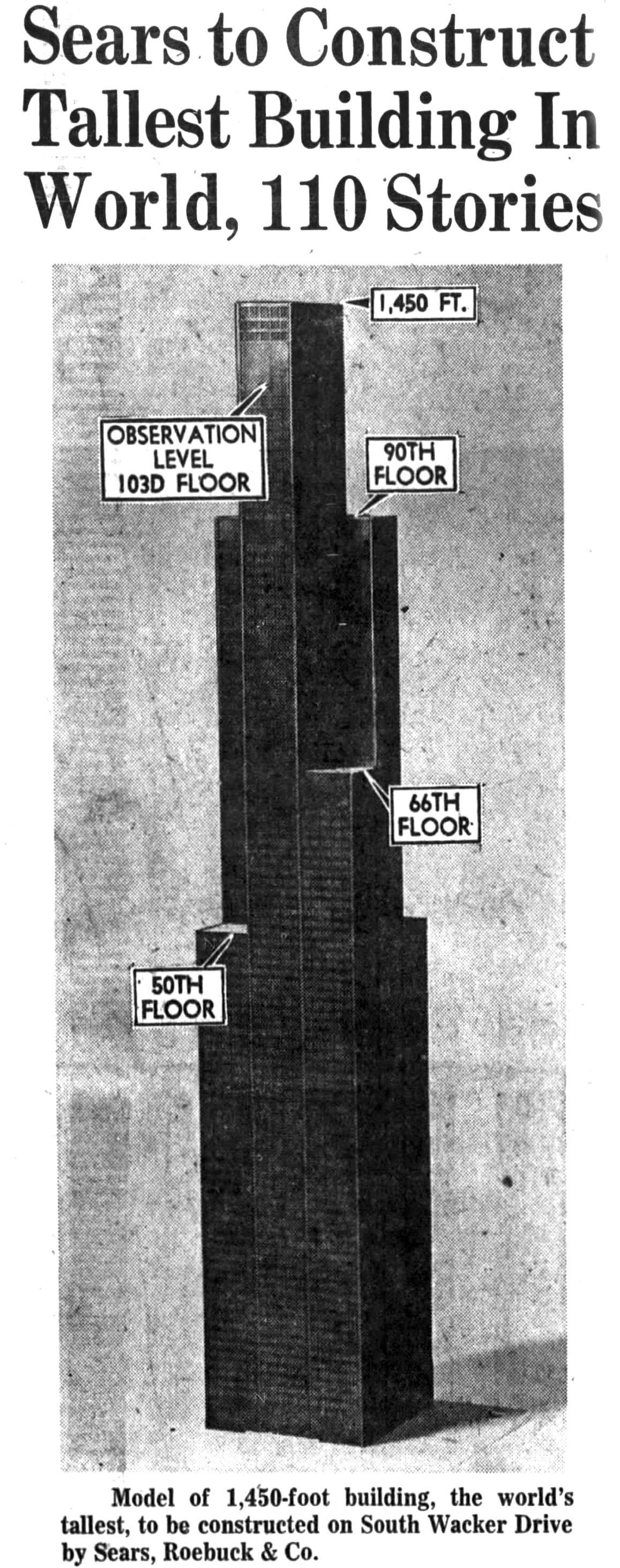
Sears, Roebuck & Co., the world’s largest retailer, said yesterday it will build the world’s tallest building—1,450 feet high with 110 stories – on South Wacker Drive be: tween Adams Street and Jackson Boulevard.
The $100 million building will have 4.4 million square feet of gross interior space, making it the world’s largest privately-owned office building. Work will start next week and be completed in 1974.
The Merchandise Mart has 4,023,000 gross square feet of space, but much of that is exhibit space for manufacturers.
The Sears building will be second in volume only to the Pentagon in Washington. It will be taller than the twin 110-story World Trade Center buildings in New York City, each of which is 1,350 feet high.
Gordon Metcalf, chairman and chief executive officer of Sears, said the building will be called Sears Tower.
It follows the tradition established in naming its first mail order store building at Homan Avenue and Arthington Plaza the Tower building. Tower also is used as the brand name for several Sears products.
Set for FAA Maximum
Metcalf said the building will be as high as the Federal Aviation Administration would permit. It will reach almost as high as the tip of the television antennas on top the 100-story John Hancock Center, 875 N. Michigan Av.
Altho the building will have 109 stories on the Wacker Drive side of the tower, Metealf said officials should use the figure of 110 stories on the Franklin Street side as the official listing so that it would be as high as the World Trade Center buildings.
Metcalf said the building will be financed with company earnings. The giant retailer had sales of $8.9 billion last year and net income of $441 million.
He said sales are expected to increase by $1 billion a year.
Will Lease Remainder
The building will have 3.7 million square feet of net rentable space of which Sears will initially occupy less than 2 million square feet and lease the remainder to outside tenants.
About 16,500 persons are expected to work in the building. It will have only 150 parking spaces but officials expect less than 10 per cent of the employes will drive to work.
Mayor Daley told-the late afternoon press conference in the Sherman House: “On behalf of the people of Chicago, I want to thank Sears for the confidence they are showing in the future, in planning and designing the building which will adorn the west side.”
Restaurants Included
Mayor Daley said he was particularly enthusiastic because there has been concern about firms moving out of the city.
“I want to thank Sears again for the confidence they are showing the city,” he said.
The building will have boutique shops, restaurants and other service stores on the Franklin Street side.
Metcalf said the building will not have a Sears department store.
“We have one on State Street,” he said. “Besides we own that building.”
Diesel Construction, a division of Carl A. Morse, Inc., general contractor, will start
initial work on the building.
Sears Tower was designed by Skidmore, Owings & Merrill, Chicago architect. Bruce Graham, who also designed the Hancock Center, was one of the partners in charge.
The structure will rise in a series of setbacks—a modified “wedding cake” style used in many New York City buildings. There will be setbacks at the 50th, 66th, and 90th stories, creating various floor arrangements as the height increases.
At the 103d floor, 1,350 feet above the street, there will be an observation deck. It will be higher than the observatory of the Hancock Center.
The exterior of the Sears Tower will be sheathed in black aluminum and bronze tinted glass.
The Sears building will be on a two-block tract assembled by private developers over a five-year period starting in 1964.
A jumble of 15 grime blackened bulidings, similar to those which once stretched the length of North and
South Wacker Drive, had to be purchased from 100 owners.
Sears bought the site last year for an undisclosed sum.
Quincy Street bisected the tract between Franklin Street and Wacker Drive. To consolidate its holdings, Sears paid the city $2.7 million for the street.
Sears is moving into one of the fastest growing sections of the Chicago central city. Altho the redevelopment of both banks of the south branch of the Chicago River is already underway, real estate men say the Sears building is generating new enthusiasm for the area.
Sears will be across the river from Gateway Center which started the redevelopment movement in the early 1960s. Tishman Realty & Construction Co. has built two 20-story office buildings and has a 35-story tower under construction.
Chicago Tribune, July 29, 1970
THE SEARS TOWER AND CHICAGO’S FUTURE
Big decisions are not made carelessly by the officials of Sears, Roebuck & Co., which helps to explain why the company is the world’s largest retailer, with annual sales of about $9 billion. In planning a new headquarters they considered many possible sites. They might have chosen to move to a suburb, as their own subsidiary insurance* companies have done. They might have decided to go to New York, which has a fascination for some corporation, executives in spite of its manifest disadvantages.
Instead, Sears Roebuck and Co. will build its headquarters in downtown Chicago and it will be the world’s tallest building as well as the largest private building in the world. Only the Pentagon will be larger.
The announcement of plans for the building is good news for Chicago at a time when good news is scarce. Along with other big cities Chicago has an array of staggering problems. The only encouraging development for the inner city in recent years has been the renaissance of the downtown area, which has compensated in large measure for the loss of manufacturing industries to the suburbs.
The new 110-story Sears Tower is another big step in this renaissance. It will strengthen the city’s tax base. It will stimulate other building on the west side of the Loop. It will confirm Chicago’s position as one of the world’s great business centers.
The site chosen for the new tower is on Wacker Drive between Adams Street and Jackson Boulevard. No other place in the city is more convenient to transportation.
The commuter trains at Union and North Western stations are within easy walking distance. The projected Franklin Street subway, where the Lake Street-Dan Ryan subway trains will run, will be at the back door. The distributor subway under Monroe Street will be only a block away. The expressway system is close at hand.
The Tribune has had a lot to say on this page about the importance of developing Chicago’s mass transportation system. The Sears Tower illustrates what we have been talking about. Sears Roebuck & Co. is investing $100 million at a place which was chosen largely because of the availability of transportation.
The company’s decision also reflects confidence in the future of the city where Sears Roebuck was born and where it has thrived. The company has great plans for its future, based not on hopes but on hard business experience.
If the city’s future is to be secure it will continue to be hospitable to such business enterprises and to maintain a climate of order.

Leave a Reply