Day, Allen & Co.
Life Span: 1872-after 1880
Location: 34 and 36 Randolph, SW corner Wabash
Architect:
- Edwards’ Annual Directory in the City of Chicago, for 1866
Day, Allen & Co. (Isaac C. Day, William T. Allen, Samuel P. Farrington and Charles Coryell), wholesale grocers, 34 and 36 Randolph
Edwards’ Annual Directory in the City of Chicago, for 1867
Day, Allen & Co. (I. C. Day, W. T. Allen, S. P. Farrington and C. Coryell), whol. grocers, 34 and 36 Randolph
Edwards’ Annual Directory in the City of Chicago, for 1869
Day, Allen & Co. (Isaac C. Day, William T. Allen, Charles Coryell and Ed. C. Allen), whol. grocers, 34 and 36 Randolph
Edwards’ Annual Directory in the City of Chicago, for 1873
Allen, Coryell & Co. (W. T. Allen, Charles Coryell and Freeman S. Rounds,) grocers, 34 and 36 Randolph.
Lakeside Annual Directory of the City of Chicago, 1874
Allen, Keith & Co. (Wiliam T. Allen, Abija Keith and Freeman S. Rounds) whol grocers, 34 and 36 Randolph
Lakeside Annual Directory of the City of Chicago, 1876
Allen, Keith & Co. (Wiliam T. Allen and Abija Keith) grocers, 34 Randolph
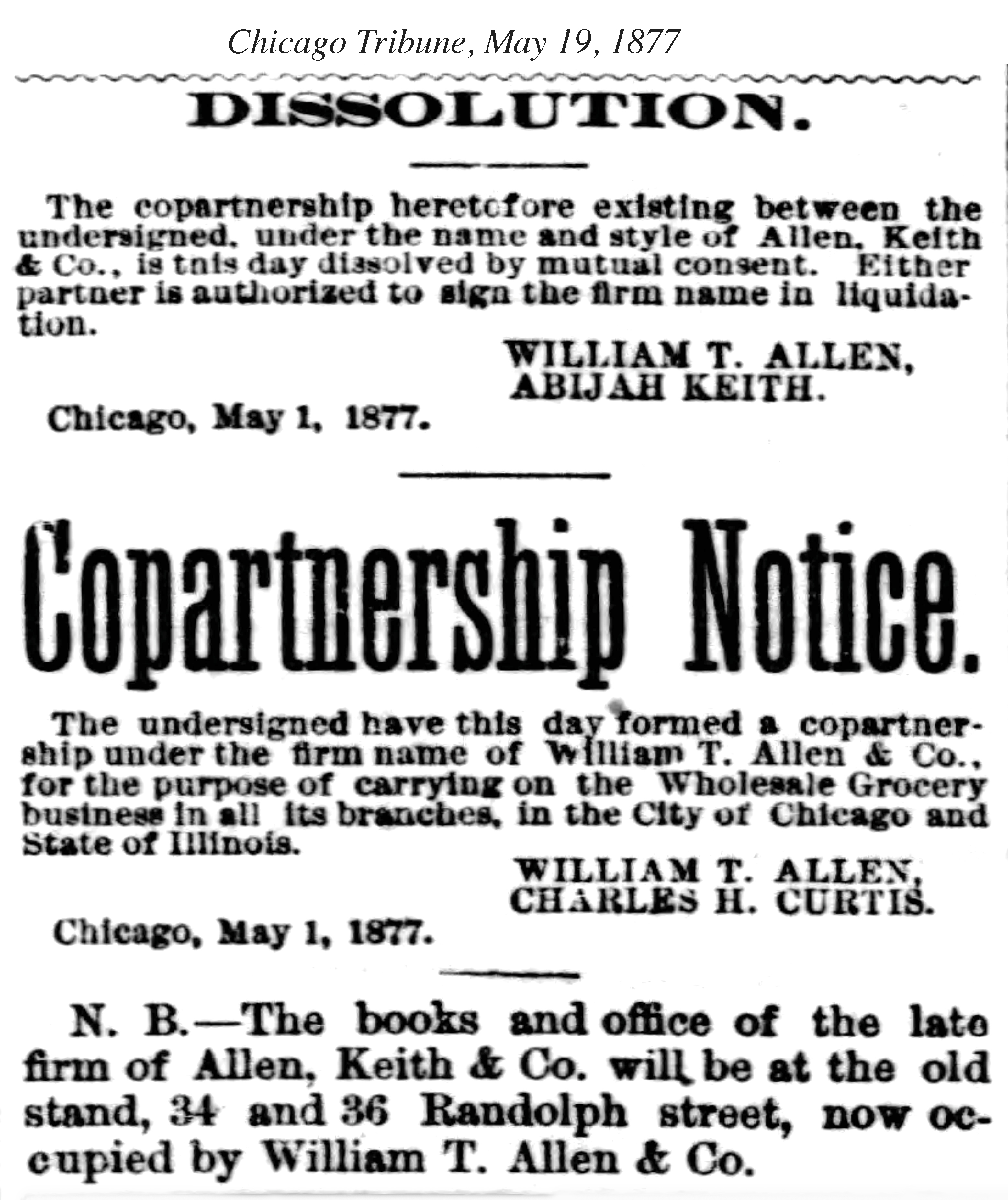
Lakeside Annual Directory of the City of Chicago, 1877
Allen William T. & Co. (Wiliam T. Allen and Charles H. Curtis) grocers, 34 and 36 Randolph
Lakeside Annual Directory of the City of Chicago, 1880
Allen William T. & Co. (William T. Allen, Charles H. Curtis and Erastus N. Bates) wholesale grocers, 56 to 62 Wabash and 27 to 33 Randolph
Allen William T. (William T. Allen & Co.) 27 Randolph, house Riverside
The Land Owner, March, 1872
DAY, ALLEN & CO.’S BUILDING.
Among the most notable structures erected by our merchants is the large building put up by Messrs. Day, Allen & Co., wholesale grocers, on their old site, corner of Randolph street and Wabash avenue, which we illustrate on page 37. This well known and highly reputable firm is the leading grocery house in the West, their annual sales amounting to millions of dollars. They did not stop after the fire, as a glanceat their imposing structure, put up in winter weather, w?th the thermometer below zero, will show. It seems almost incredible that so large and substantial an edifice could be built in so short a time, and against so many adverse causes. But their immense business demanded it, and customers desired to continue ordering from a house that had served them so long, so uniformly, so well, and so honorably, and hence this mercantile structure has arisen in obedience to the laws of trade.With such enterprise and energy displayed by our merchants, of which this firm are a notable example, does any one believe that the reputation of this market will suffer from the fire?
No grocery house in the West is better prepared to-day to supply the country tributary to Chicago, than Messrs. Day, Allen & Co. There remains no traces of the fire about them, their large business goes on, better accommodated and appointed than before, as this building has been erected throughout especially for their trade, and affords ample facilities for handling an immense stock.
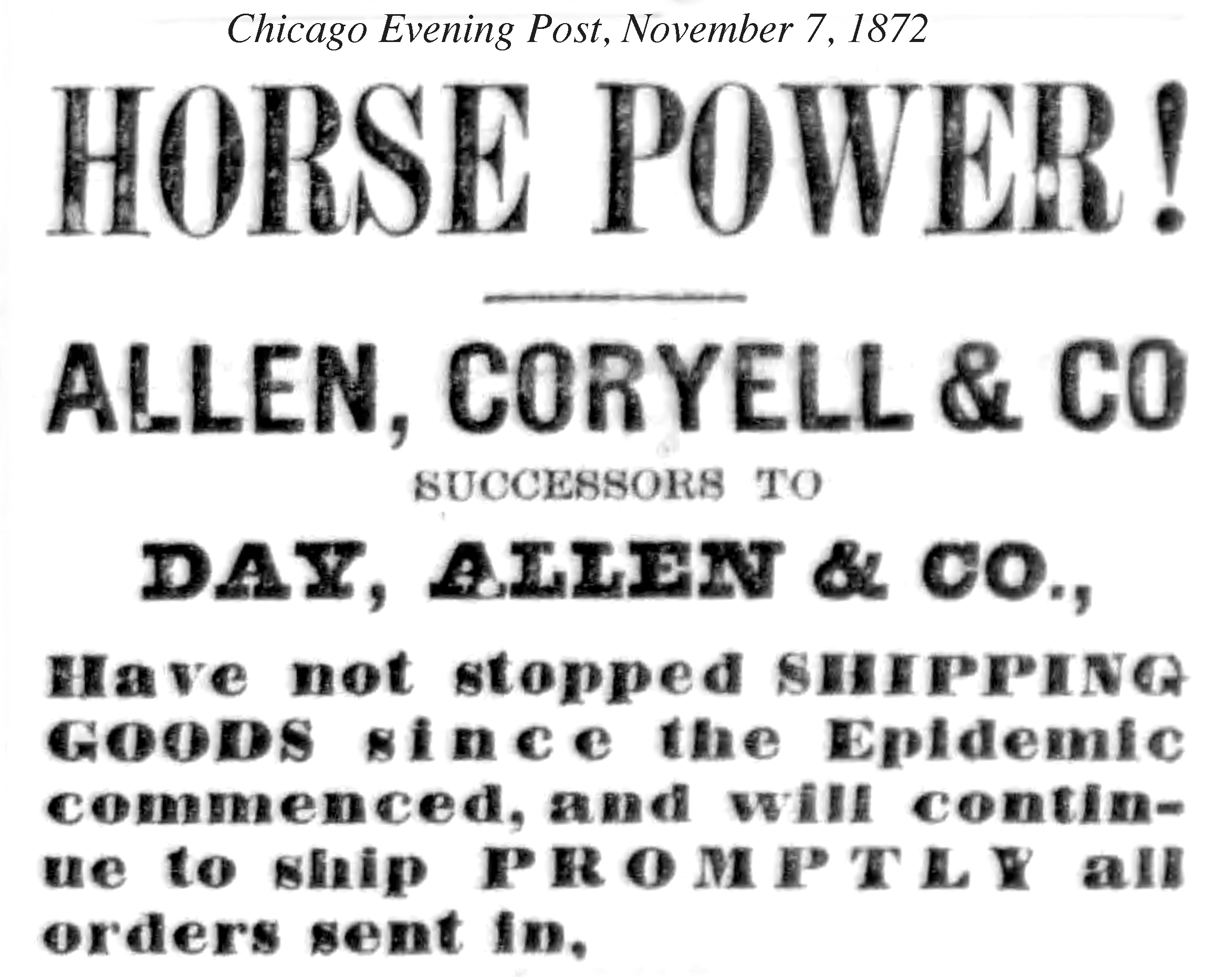
Coming through the fire without a moment’s suspension of payment, with unimpaired credit and capital, with more than former facilities, and with a determination to sustain the mercantile reputation of Chicago, this firm, by their speedy action in rebuilding, have both benefitted themselves, their customers, and the whole city.
This fine business block will tend to strengthen prices of realty in its vicinity. Forming a nucleus, other buildings are already arising around it, as if by magic. Thus will arise the entire South side, before the world gets through commisser-ating us for our great calamity.
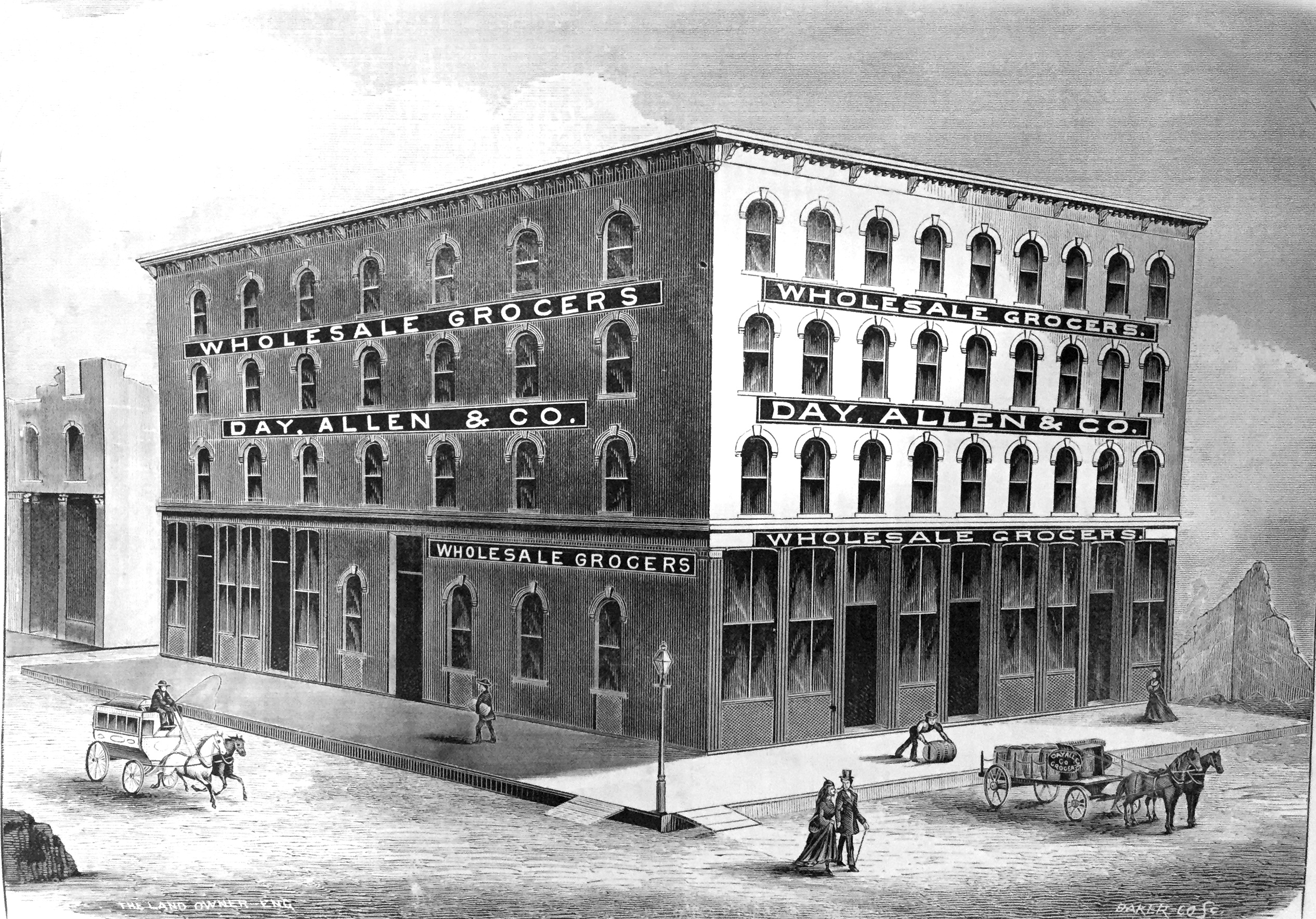
- Building Erected By Messrs. Day, Allen & Co., Wholesale Graocers, Corner Wabash Avenue and Randolph Street.
Chicago Tribune, February 29, 1876
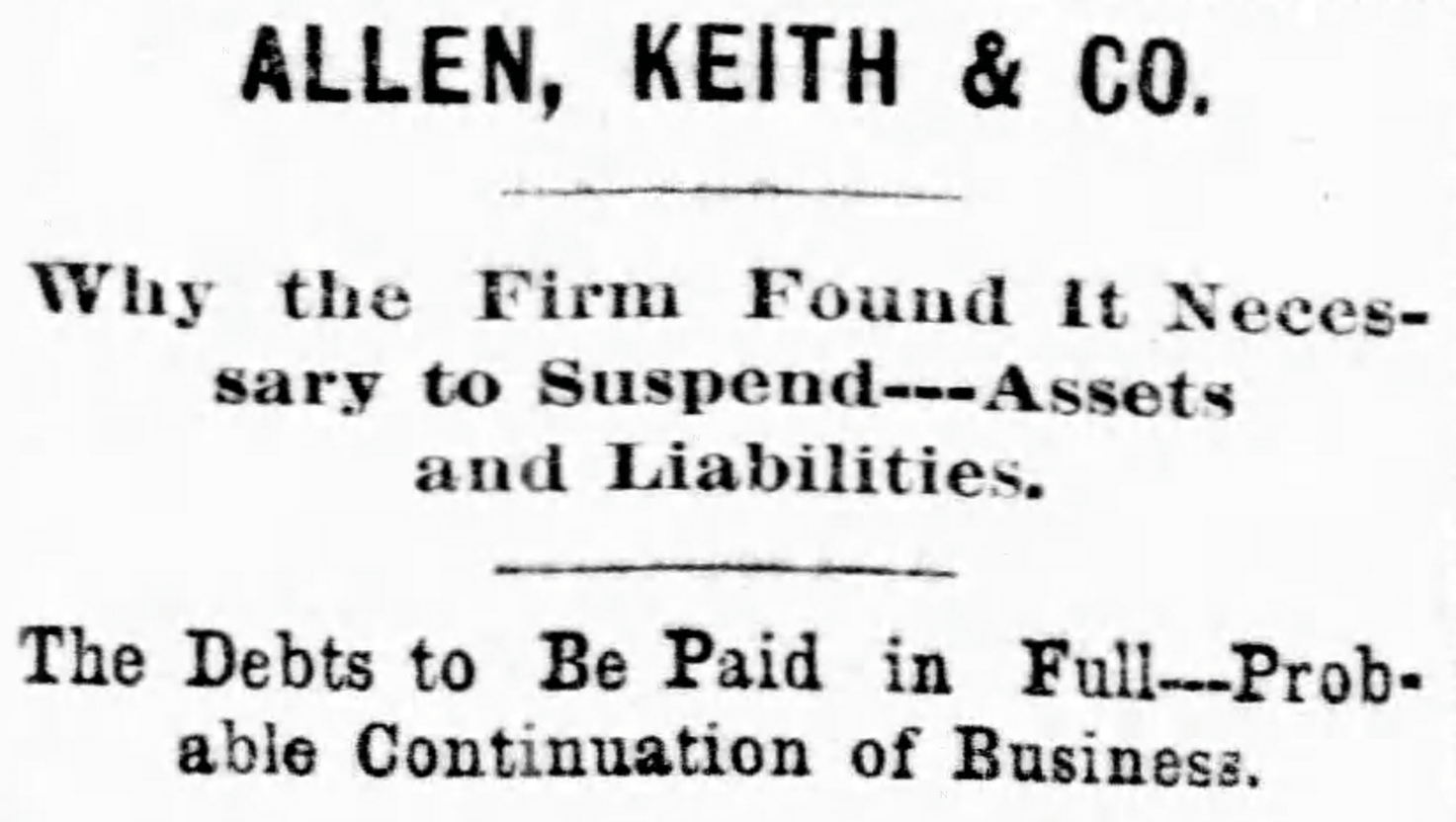 Saturday last rumors were set afloat that the well-known wholesale grocery house of Messrs. Allen, Keith & Co., corner of Wabash avenue and Randolph street, had suspended payment. Yesterday morning a Tribune reporter called on Mr. Allen, the leading member of the firm, who received him very courteously, and stated he would give any information desired, and that the firm had nothing in regard to their business which they had any desire to keep from the public or their creditors.
It should be borne in mind that the firm is one of the oldest in the city—the original house having been established in 1860, since which time Mr. Allen has been connected with it. From this time to the present it has always been held in high regard by the business community, and its credit was rated everywhere as first-class. Lately it was ascertained that their cashier, a young man named Blatchford, who was recently discharged, had embezzled funds of the firm, but it was not known to what amount.
The following information was given yesterday by Mr. Alien:
The statement given in Sunday’s Times in regard to the firm was untrue in many respects. The house never bought a dollar’s worth of fish in Boston. but, on the contrary, found it to its interest always to buv here. The young man who made such a statement lied. As to the embezzlement of Charles H. Blatchford, it had assumed very large proportions. The firm, up to 1874, had made money but there seemed a leak somewhere, and investigations were made from time which revealed some discrepancies, “but,” said Mr. Allen blandly, “we had implicit faith in Blatchford and his promises, but he sadly abused our confidence.” He came into the firm’s employ, shortly after the big fire, in December, 1871. The firm was then making arrangements to start anew.
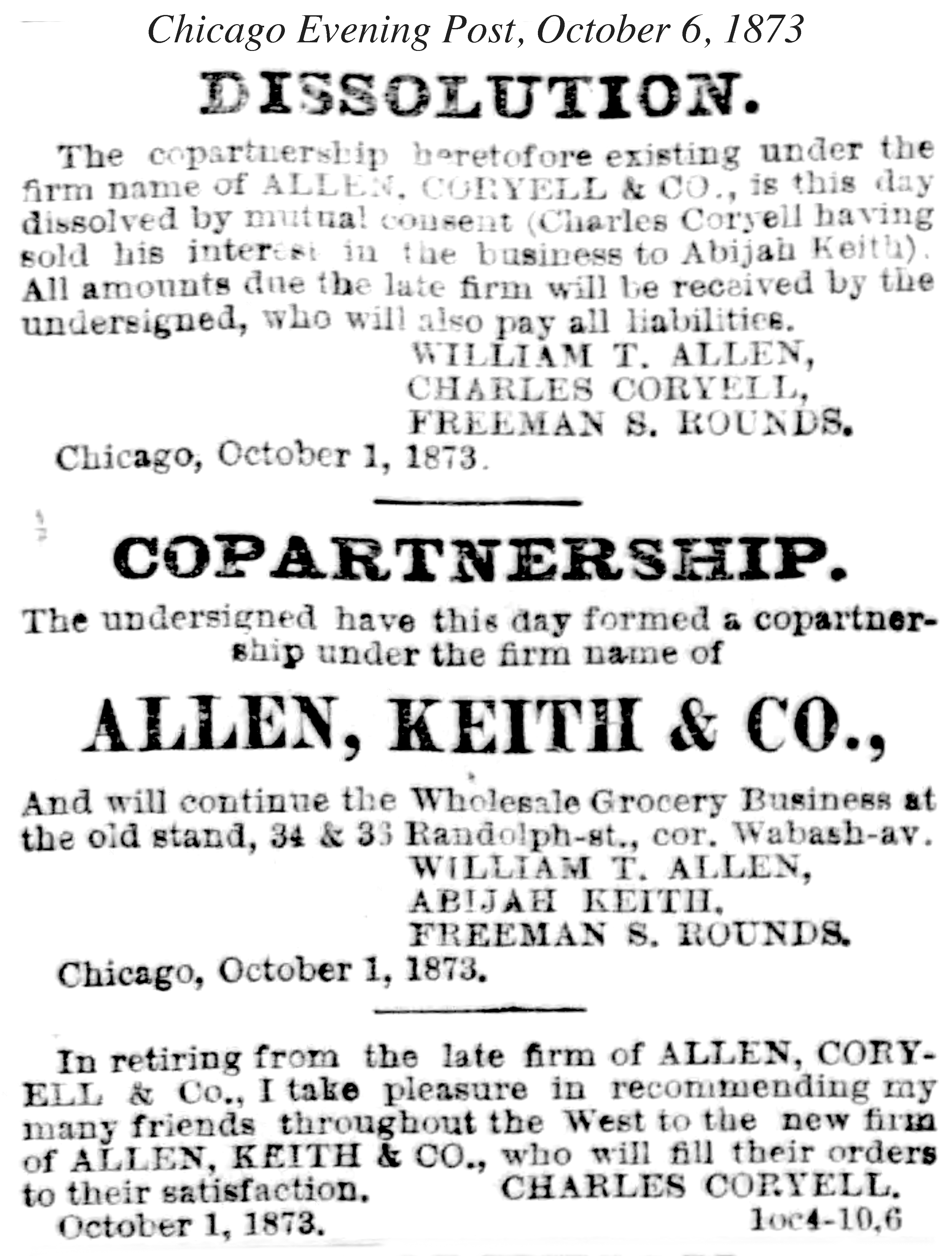
An examination by an expert named Bishop, shows that Blatchford commenced his peculatione immediately after he assumed his position. His accounts up to Oct. 3, 1873, at which time the firm of Allen, Coryell & Co., dissolved, were short $5,000. Col. Keith bought Mr. Coryell out and the firm was carried on under the name of Allen, Keith & Co.
It was stated in the Times that Mr. Allen had not as much money in the firm as Mr. Day, when the firm was known as Allen, Day & Co. Mr. Allen said he always had an equal interest in the house with Mr. Day. and at one time a greater. However, the death of Mr. Day did not affect the financial standing of the firm.
Despite Blatchford’s peculiar conduct. the firm of Allen, Keith & Co. employed him for a long time, during which he managed to take from $15,000 to $20,000 more. It was only last Friday that the firm discovered that Blatchford had drawn $1,000 of their New York bank account. Thus far Mr. Bishop has discovered but about $10,000, all told, short in the book accounts. But then there are erasure and scratches in the books which are very hard to make out. Besides these stealings, the firm did a large counter cash business, and they figure that at least $10,000 of this is unaccounted for. Blatchford is now under indictment for embezzlement and forgery. He forged the firm’s name to a check on Sibley, Endicott & Co. for $600, and got the cash thereon. The gentleman stated that as long as he had been a member of the firm, covering a period of sixteen years, they never had any paper discounted, and never exchanged checks. They owe their embarrassment to the fact that, Jan. 1, 1874, they entered into what is known as the specialty trade. They imported teas very heavily. and bought largely of tobacco and sirups, expecting to deal specially in these goods. They accumulated of these articles a very large stock, and, during the first six months, did a thriving business. Then commenced the battle.
Their goods shrunk greatly in value. Their tobaccos and sirups fell in price: they had on hand a heavy importation of teas, which underwent a marvelous decline. All their sales were at low prices, and their stock on hand had been kept up to its full assortment. Then, to cap the climax, a bad trade followed the shrinkage. In ordinary times, they could have sustained a specialty house in Chicago, but they found out their mistake. Friday the firm had money offered them, but they declined it until they knew exactly how they stood.
Mr. Allen further stated that before the great fire of 1871 he was worth $253,000, without one dollar’s incumbrance. It was his misfortune to get into the Riverside speculation, but thought he was secured for the money advanced. The bonds of the concern had been negotiated, but the paper had not been passed upon when the terrible fire came. Two months after he paid out $50,000 in cash on paper of the Company which be had indorsed, and upon which be thought he had been secured. but found the securities bad.

At that time he owned 80 by 185 feet corner of Wabash avenue and Harrison street, where he erected three buildings, which he afterwards sold to B. P. Hutchinson. It was valued in the aggregate at about $110,000. Mr. Alien also owns one-half interest in the lot corner of Randolph street and Wabash avenue, 50 by 104 feet.
This property before the panic was worth $110,000, for which it could have been sold, but to-day it would not bring over $60,000. Mr. Allen has his portion of this mortgaged for $15,000, which he has put into his business.
The liabilities of the firm including everything, will not exceed $180,000, though they could have bad their paper negotiated to the amount of $500,000, had so desired, but, since yesterday a week ago, they have refused to buy goods except for cash.
The assets consist of a large stock of groceries, valued in ordinary times at about $150,000, but which the firm figure at $100,000; bills receivable about $50,000; real estate, $15.000. The firm has placed a very low estimate upon its assets, and has called a meeting of creditors, which will be held in a few days. So far there is no probability that the firm will be forced into liquidation, as the creditors all seem inclined to act leniently, and to allow it to continue business. Mr. Allen says the debts shall be paid dollar for dollar, if it leaves him absolutely nothing.
Last week, when the embezzlements were discovered, the firm received a consignment of 500 bags of coffee from Baltimore, valued at $12,000. Fearing that there might be trouble, the bill of lading was sent back with reasons why. At that time there was only a bare possibility of financial embarrassment. There were also sent back large lots of other goods. The coffee market went up last week, but it was no inducement for the firm to act dishonorably.
There seems no donbt that the firm will continue business, and will be granted an extension, as it appears that in a little time it will be able to pay dollar for dollar of their indebtedness.

Leave a Reply