Building Name: Sauganash Hotel, Eagle Exchange Tavern (original name)
Life Span: 1831-1851
Address: SE corner of Lake and Market
Block and Subdivision: 15, Original Town
Architect: Mark Beaubien
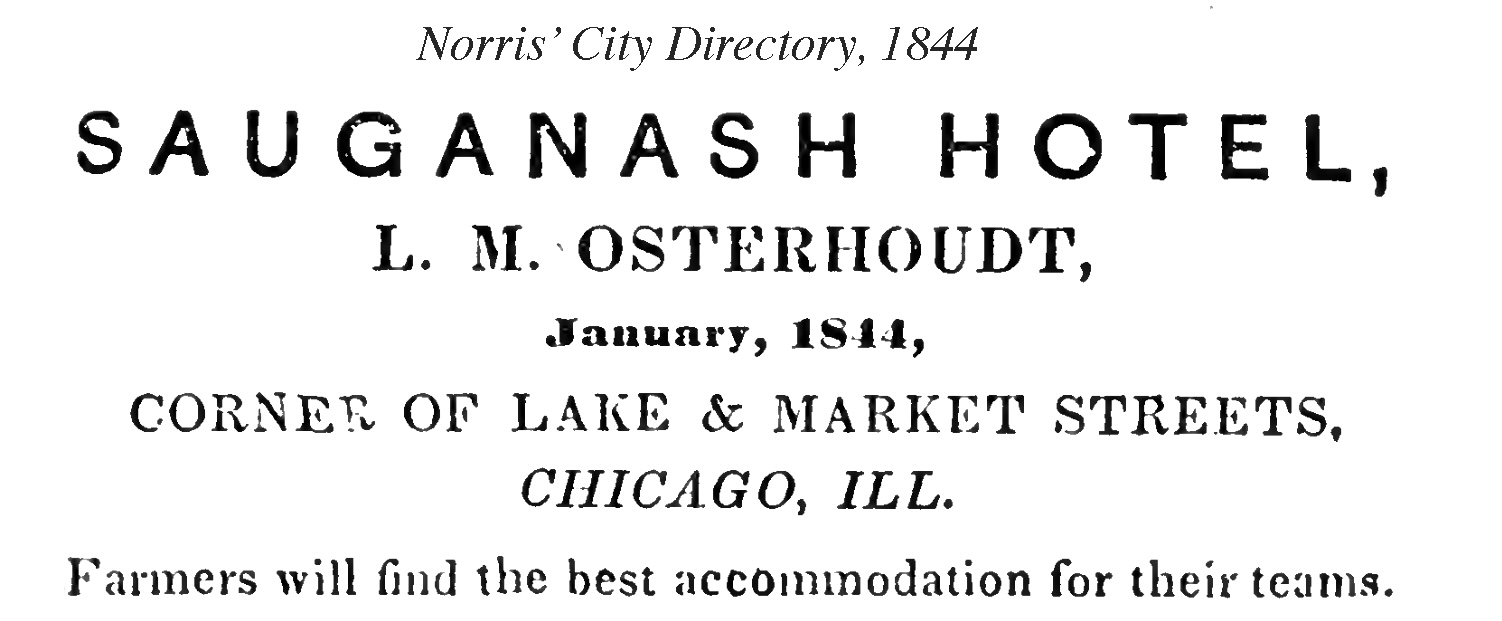
- Fergus’ Directory of the City of Chicago, 1839
Beaubien, Mark, hotel-keeper, Lake st
Sauganash Hotel, Market st, cor. Lake st
Houghton, D. F., hotel-keeper, Sauganash Hotel
Seymour, Jesse, Sauganash Hotel, Market st cor. Lake
Fergus’ Chicago Business Directory, 1846
Sauganash Hotel, Wm.W.Webster, prop., Market, s.e. cor. of Lake.
Fergus’ Directory of the City of Chicago, 1839
The dwelling of Mr. John Kinzie stood east of the Lake House. A log building at the corner of Dearborn and South Water Streets, and the once celebrated tavern of Mr. Mark Beaubien, on the site of the Sauganash, generally known as the eagle, together with a building on block 14, and a cabin, occupied by Robinson, the Indian Chief at Wolf Point, constituted all the buildings, except the Fort, to be found here in 1832. Sometime this year, however, Robert A. Kinzie built a store at Wolf Point, the first frame building in Chicago. In 1834, several brick buildings were erected.
Gem of the Prairie, March 8, 1851:
At about half-past three o’clock last Tuesday morning flames were discovered issuing from the roof of the Sauganash Hotel, B. S. Foster, on Market Street, between Lake and Randolph streets, and so rapid was their progress among the combustible materials in that vicinity that nine buildings were destroyed, before being wholly subdued by the firemen. The buildings destroyed were owned by the Garrett estate. It is supposed that the fire was the work of an incendiary. The supposition is strengthened by the fact that while the fire Monday evening was raging at the corner of Lake Street and Wabash Avenue, an unoccupied building adjoining the Sauganash Hotel was set on fire in an upper story, but was discovered and put out before making any considerable progress.
The lot on south-east corner of Lake and Market streets, (100 feet on Lake by 180 feet on Market,) known as the “Sauganash Corner,” and belonging the Garrett Estate, was recently leased for 100 years, on the following terms. The lot to be appraised every ten years, the rental to be 6 per cent on the valuation. The first appraisement is $115,000 hence the rent for the current ten years is $6,900 per annum.


- The Sauganash Hotel at Wolf Point in 1830

- Mark Beaubien’s Tavern. The Sauganash, in 1835
Chicago Tribune, April 15, 1857
The lot on south-east corner of Lake and Market streets, (100 feet on Lake by 180 feet on Market,) known as the “Sauganash Corner,” and belonging the Garrett Estate, was recently leased for 100 years, on the following terms. The lot to be appraised every ten years, the rental to be 6 per cent on the valuation. The first appraisement is $115,000 hence the rent for the current ten years is $6,900 per annum.
Chicago Magazine, June, 1857
Across the South Branch, on the east side, resided Mark Beaubien, brother of Gen. J. B. Beaubien, who also kept tavern. In 1831 his establishment had risen to a two story dwelling, painted, with green blinds, and soon attained to the title of the Saganash Hotel—which was the Indian name of Billy Caldwell—and so called in honor of that distinguished chief, and man of the times, for he was then one of the prominent residents of Chicago. It stood near what is now the south-east corner of Lake and Market streets. By this time there had been a place of amusement started in a little, low log shanty, where was set up a billiard table, at which citizens of leisure amused themselves in knocking about three cracked balls. Further up the South Branch was the residence of a French Indian trader by the name of Bou-rissa. In the South Division, near the “slough” that drained the marshes of the South Side, and emptied into the river at State street, was the trading house of Medert Beaubien—son of Col. Beaubien—a cabin of small pretensions. Upon the Lake Shore, a little distance south of the fort, Col. Beaubien resided in the cabin which he had purchased of the American Fur Company, in 1817—which he had elevated to the dignity of a homestead, and which was now familiarly known among the settlers by the name of the “Wigwam.” Near this residence was his store, in which the American Fur Company kept a stock of goods for the Indian trade. Further south, the old Dean house had started on the way to ruin; the water of the lake had gradually encroached upon the shore, until it had undermined the foundations of the cabin, and it had fallen backward down the bank, where it lay, a type of ruin, an emblem, in the estimation of the croakers (who existed at that time, as well as the present,) of the future of Chicago—but with the people generally, the subject of joke and laughter, as a little incident to vary the monotony of the settlement.
Chicago Tribune, April 10, 1860
THE HEADQUARTERS.—The frame of the great wigwam, the Republican Headquarters on Sauganash lot is going up rapidly. It is to finished in about three weeks.
History of Chicago, A. T. Andreas, Volume I, 1884
Mark Beaubien, whose name is inseparably linked with almost every chapter of Chicago’s early history, was a famous hotel-keeper in his day. He came here in 1826 from Detroit. In 1831 he built, as he claimed, the first frame house in Chicago, the Sauganash Hotel. It is related that while he was at work on his house, Billy Caldwell (Sauganash) one day said to Beaubien, “I suppose you will name your new hotel after some great man?” “I will. I shall call it the “Sauganash.” He kept his word; the house became famous, and its name has gone into history as for years being the largest and finest hotel in Chicago. Mark, as is well known, was a jolly host; after having given his guests the best his larder afforded, he would of evenings tune up his violin, on which he was, for those days at least, a skilled performer, and often, till late at night, amuse and entertain them with his melody. Dancing, too, generally formed no small feature of these sports; and so the Sauganash became popular through the character of its proprietor as a musician as well as for its excellence as a hotel. This house was situated on the south side of Lake Street, at the corner of Market, though one or two old settlers have given the impression that it fronted as much on Market as on Lake. The accompanying illustration of the building, showing it as it appeared in 1833, has been pronounced by Hon. John Wentworth and by Charles R. Vandercook, who were in that year boarders at the hotel, a most excellent representation of it as it then was. It seems, too, that the cabin which Mr. Beaubien built when he came here stood on the site where, a few years later, he built the Sauganash Hotel. Mrs. Harriet Murphy, whose husband John Murphy was at different times proprietor of the hotel, states that the frame part was an addition built on to the cabin; and a writer who was at the hotel in the winter of 1833-34 says this room in the cabin, which was then weather-boarded on the outside, was the warmest and most comfortable place in town.
Mr. Beaubien kept the Sauganash until 1834, when he left it, and in January, 1835, a Mr. Davis assumed control. Mr. Beaubien had meanwhile built a new house on the northwest corner of Wells and Lake streets. In August of 1834, Mr. and Mrs. Murphy took charge of this new hotel, which they christened the Exchange Coffee House. They remained there until 1836, when they removed to the old Sauganash, the name of which they changed to United States Hotel. Mr. Murphy continued business there until the following year, when he removed to the West Side, where he opened a new hotel under the same name he had given the old Sauganash, which was then converted into a theater—the first in Chicago. In 1839 the Sauganash was once more occupied as a hotel, being kept by Jesse Seymour until in 1840, when Mr. Murphy having leased his new West Side hotel, again became the proprietor of it. He remained there about a year and a half, when he again returned to the West Side to the United States Hotel, Mr. Smith having surrendered his lease. A man by the name of Davis next took the Sauganash but failing to make it pay, Mr. Murphy once more assumed its management, at the earnest solicitation of its owner, Augustus Garrett. Just how long he continued to run the house this time is not known, but it was probably in 1843 when he moved out. The next proprietor of the Sauganash was Jeduthan Brown, and he was succeeded in 1844 by L. M. Osterhaudt, who kept it for several years, when it passed into the control of M. & G. Wal-rod, who were its proprietors until 1848. From the directory of that year it appears that Newell Stratton had control, and in 1851 B. S. Foster was in charge at the time it was destroyed by fire. The conflagration which swept from existence, save in the memories only of those who had known for years this historic building, occurred at half-past 3 o’clock Tuesday morning, March 4, 1851.
Thus ends the history of this notable building, which for so long was a prominent mark of interest in Chicago’s early days.
Chicago Tribune, Auguste 13, 1899
Named for Billy Caldwell.
The Sauganash Tavern stood for many at the crossing of Lake and Market years The tavern, which vas one of the streets. first of Chicago’s hotels, was named after Billy Caldwell “The Sauganash.” He was a celebrated half-breed Pottawattomie who made Chicago his home antil 1835, when he migrated to Council Bluffs, Ia. It is now intended to mark the location with an appropriate tablet.
The dedication of the Fort Dearborn memorial set a precedent which the society is willing to follow. On that occasion John Wentworth delivered an address on Fort Dearborn, which the Historical society members say has never been surpassed as a contribution to the history of Chicago. But time of the erection of the new tablets at the northern fire limits, the Kinzie House and the Sauganash Tavern, is finally settled, the Historical society promises to have orators who will do full justice to their subjects.
Chicago Tribune, April 8, 1930
Tablet to Recall Making of the Village of Chicago
Kaskaskia chapter of the Daughters of American Revolution will dedicate a bronze tablet today as a memorial to the Sauganash hotel, built by Mark Beaubein shortly after his arrival here in 1826. The tablet will be placed on the southeast corner of Wacker drive and Lake street. It was in Beaubein’s hotel that the election was held making Chicago a village and electing the first village officers. Chicago became go a village in 1833, a city in 1837.
Chicago Tribune, April 11, 1930
Kaskaskia chapter, Daughters of the American Revolution, have presented the city with a bronze tablet commemorating the erection of the first hotel in Chicago. City Attorney William D. Saltiel received the tablet at a luncheon in the Hotel Sherman. It will be placed at Lake street and Wacker Drive, site of the Hotel Sauganash, under auspices of the Chicago Historical Society.
Chicago Tribune, November 29, 1961
POLICE ARREST MAN CARRYING 100 LB. PLAQUE Police stopped Jimmy Greer, 33, of 1110 N. Wells st., an unemployed laborer, yesterday while he was walking in front of 325 Orleans st. Greer was carrying a solid bronze plaque, weighing 100 pounds and measuring 4 by 3 feet.
“I bought it from two fellows for three dollars,” Greer told Policemen James Feely, Robert Price, and Charles Gunther, who took him and the plaque to police headquarters.
The plaque was inscribed to Mark Beaubein, who established the Sauganash hotel in 1829 at 333 W. Lake st. It was erected there in 1930 by the Chicago Historical society and the Kaskaskia chapter of the D. A. R. Police had received a call earlier that a man is walking down Lake street with Abraham Lincoln which he took from the 333 building.” A likeness of the Civil war president is on a matching plaque on the Jimmy Greer.
Chicago Tribune, February 8, 2002
Lincoln Park area gets landmark nod
A group of Lincoln Park streets that recall the heyday of Chicago’s 19th Century neighborhood commercial strips gained preliminary Chicago landmark designation Thursday. More than 80 percent of the buildings in the area near Halsted Street and Armitage Avenue date from the late 19th and early 20th Centuries, when the area developed around the Northwest Elevated Railway, now the CTA Brown Line.
The commission also gave interim landmark status to the onetime site of the Sauganash Hotel where Chicago’s first elections took place and, later, the convention hall where Abraham Lincoln was nominated for president. The Sauganash, at the southeast corner of Lake Street and Wacker Drive from 1831 to 1851, burned down in 1851, and in 1860, the Wigwam, a two-story woodplank convention building, was built to house the Republican National Convention.
November 6, 2017
Monuments to Chicago’s historic beginnings reinstalled at Wacker and Lake
A pair of historic plaques that commemorate the location where Chicago was incorporated as a town and Abraham Lincoln was nominated for president of the United States were rededicated today by Ald. Edward Burke and Department of Planning & Development Commissioner David Reifman. Gifted to the City in the early 20th century by the Daughters of the American Revolution, the 30- by 50-inch brass plaques honor the location of the Sauganash Hotel and, later, the Wigwam convention hall, on the southeast corner of Wacker Drive and Lake Street. The plaques had been in storage at City Hall for nearly two decades.
The wood-framed Sauganash Hotel was built in 1831 by pioneer Mark Beaubien as an addition to his log cabin. The white, two-story hotel served as the social center of the growing town and hosted monthly village board meetings from 1833 to 1835. Named for the Potawatomi-British fur trader Sauganash, also known as Billy Caldwell, the hotel remained in almost continuous operation, including an 1837 stint as the city’s first theater, until it burned down in 1851.
Nine years later, the Wigwam was erected on the same location for the 1860 Republican National Convention. Designed by Chicago Water Tower architect W. W. Boyington and financed by civic leaders, the two-story, gas-lit building was the first structure in the country to be specifically built for a presidential convention. It was also the country’s first presidential convention hall to have on-site telegraph equipment and to accommodate the public in large numbers, seating more than 10,000 people. Lincoln was nominated on the Republican ticket in the Wigwam on May 18, 1860, before being elected president 157 years ago today. Named for an Algonquin word for a dwelling made of tree poles and bark, the Wigwam was later converted to retail uses before likely being destroyed by fire in 1867.
“As a student of Chicago history, I am pleased to see these beautifully refurbished plaques rededicated at this historic site,” said Ald. Burke, the co-author of Inside the Wigwam, Chicago Presidential Conventions 1860–1996. “I was proud to champion the decision to once again place them on public display after a hiatus of many years. They now join other markers, statuary and memorials situated throughout our neighborhoods that reach out to all of us to tell the very important story of our City’s history.”
The site of Sauganash Hotel and Wigwam was dedicated an official Chicago landmark on this day in 2002.
The plaques honoring the buildings are today affixed on the opposite sides of a five-foot-tall, cast stone marker on the pedestrian median on Wacker near Lake. The marker was designed by Landmarks Commission staff and installed by the Chicago Department of Transportation.
“Thanks to the collaboration of city staff and our esteemed alderman, we’re pleased to help the public appreciate the location of these two significant buildings and their important roles at the city’s original crossroads,” Reifman said.
The plaques were previously displayed at the intersection before being removed in the late 1990s for a construction project.
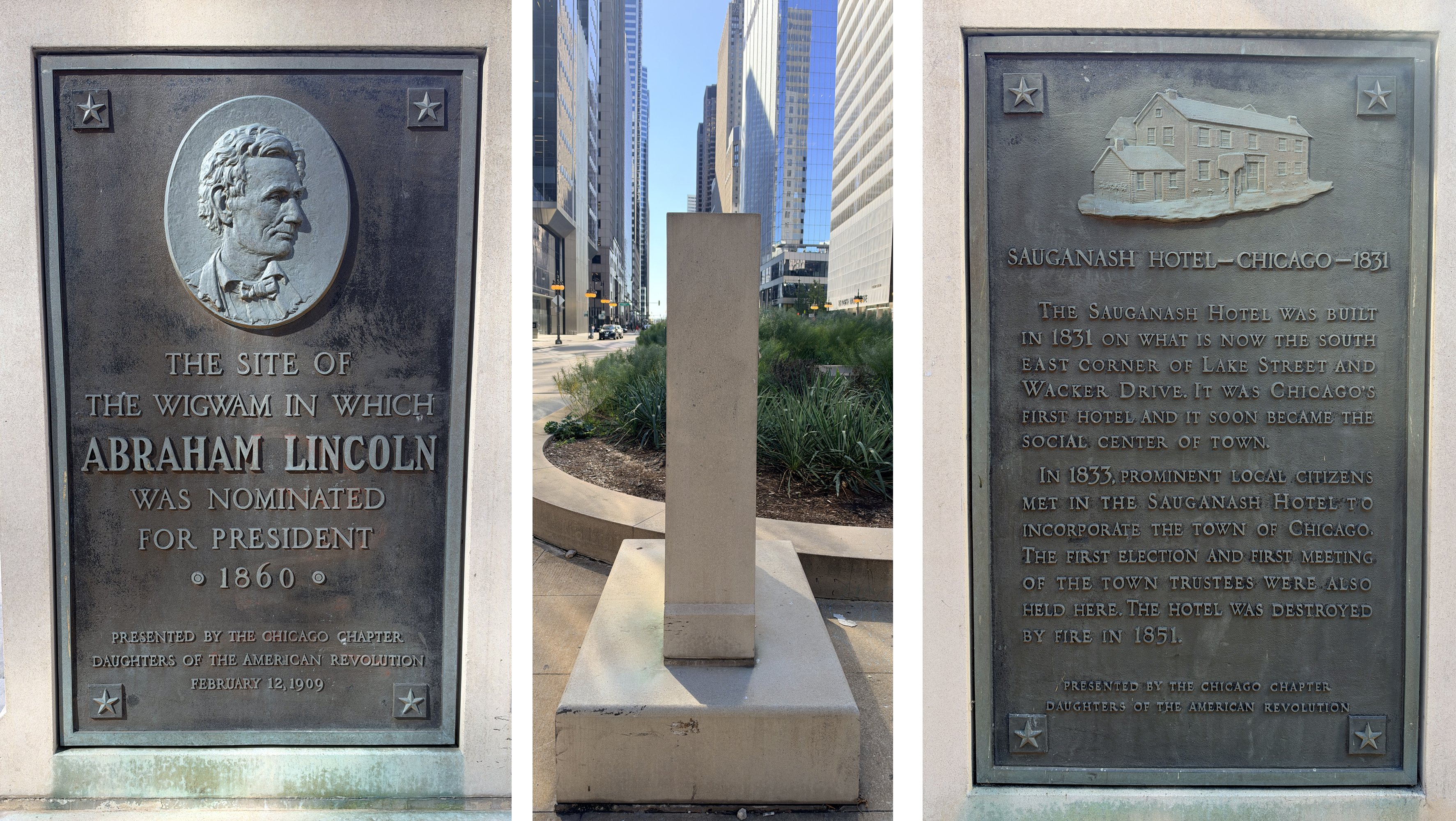
- Sauganash Hotel and Wigwam Plaques
Photographed by Chicagology
October 18, 2027
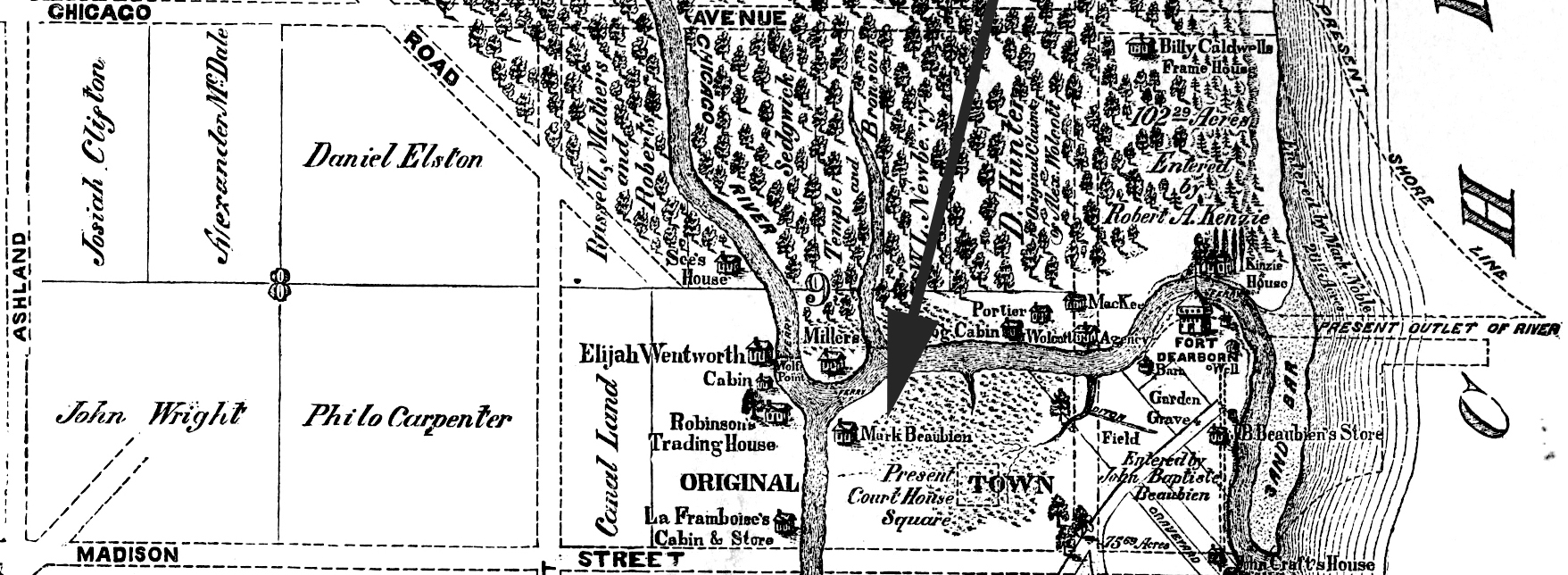
- Mark Beaubien’s Sauganash Hotel in 1830
The names given on various tracts of land are those of the primary patentees, or persons by whom entry was made, entered or patented between the years 1828 and 1836. The information is taken from “Book of Original Entry.” Streets are shown were laid out subsequent of 1830.

Leave a Reply