Chicago Tribune, February 18, 1868
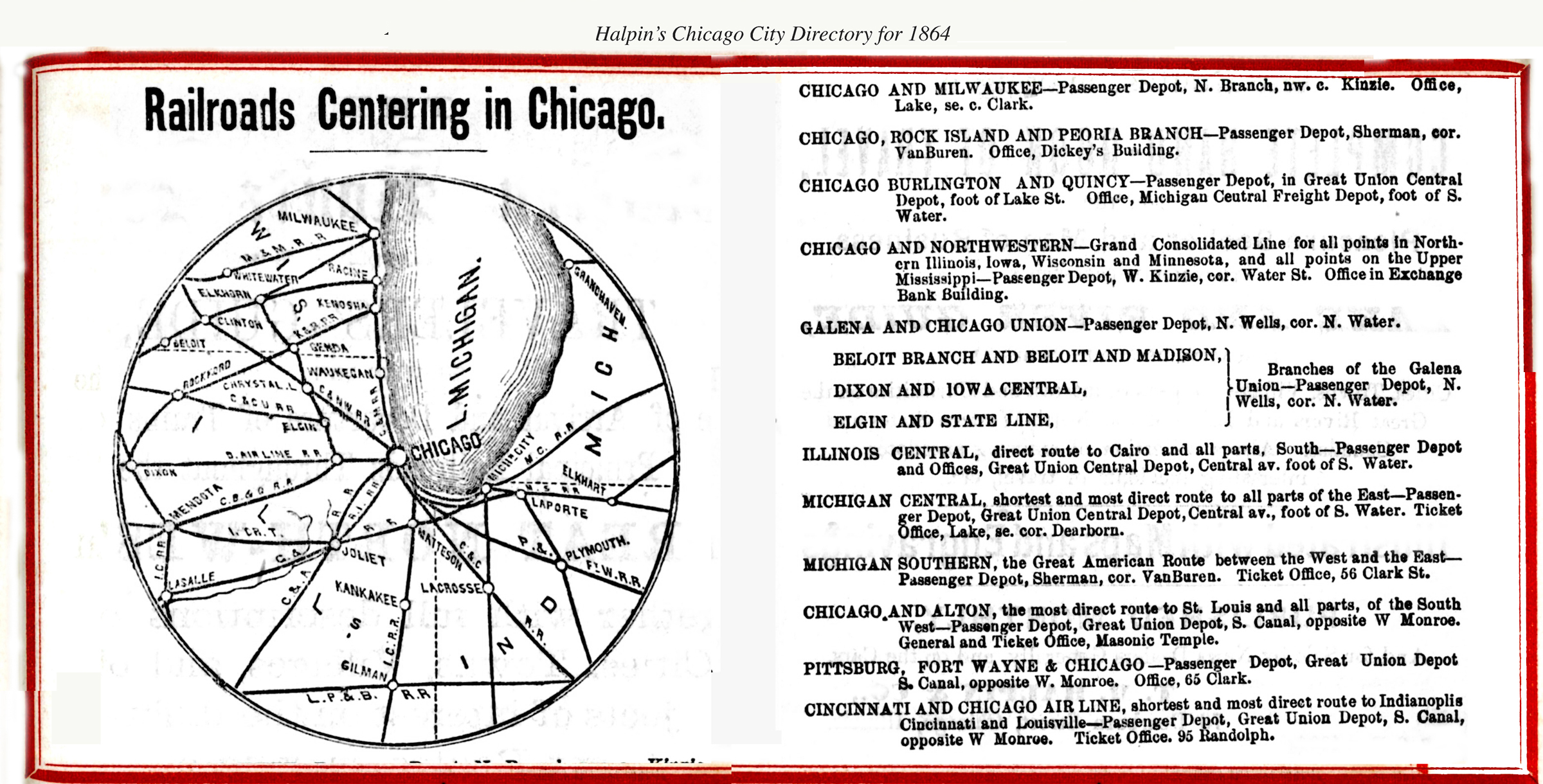
 Chicago is the centre of a great net-work of railway whose lines stretch out towards almost every point of the compass, and grasp, with their iron fingers, the trade and traffic of many degrees of latitude and longitude. The great chain of lakes and the long and sluggish canal are, in many respects, tributary to, rather than competitive with, the railroads, as the products which the former slowly collect are rapidly scattered abroad by the latter to other markets. And so great are the currents of business rushing into and out from this centre, that while lake and canal and river craft are all busted to their utmost, the railroads are alive night and day with their trains, which find scarcely room or time for passage; and yet new lines are being bait and projected, and existing lines extended still farther into the distance. Twelve distinct lines of road send out their own trains from this city daily. Many of them have branches which form distinct routes under different names, though they belong to our main lines, and should really be included in the enumeration, while several ether distinct roads have their offices here and run their cars here over other tracks; so that the number of railroads centering and represented here is much larger than that named, and the number which make direct connection with our lines at greater or less distances from this city, can scarcely be reckoned.
The past and future growth of Chicago are intimately identified with—in fact, dependent upon—her railway system, and a brief but careful review of the history of each of our main lines, and a glance at the business which they have done, will be found a very interesting document, both for perusal and preservation here and for sending abroad.
Our First Railroad.
The organization of the first line of our present magnificent railway system dates back thirty-one years, to 1836, when the Galena & Chicago Union Railroad—the pioneer road of Illinois—was incorporated by the Legislature. At that time there were only about 2,000 miles of railroad in the United States. The time proved a disastrous one for public undertakings, as the crash came in the year following, making it impossible to go on with the work. It lay dormant for ten years, when, in 1847, the first rail of strap iron was laid on the present line to Freeport. In 1850 it had reached Elgin, forty-two miles from Chicago, and from there it was soon built to Freeport, where it connects with the Illinois Central Road for Dunleith and Dubuque. About this time the company purchased the Mississippi & Rock River Junction Railroad and completed it as the Dixon Air Line Road, to the Mississippi at Fulton, in 1855.
In 1864 this parent road was purchased by its young and ambitious son, the Chicago & Northwestern, and absorbed in it, losing its old and honored name.
Although the road was projected from a little trading town back upon the almost unsettled prairie, its coming caused villages and farm houses to rise along the way with marvelous rapidly, furnishing to it, almost from the first year, a liberal and profitable business. In 1850 the dividends of the road were 10 per cent; in 1851, 15 per cent; in 1852, 15 per cent: in 1853, 20 per cent; in 1854, 21 per cent; in 1855, 17 per cent; in 1856. 29 per cent; and previous to its sale to the Northwestern Company, its stock was in demand at as high as 24 per cent above par.
Thus this parent road of Chicago, built as an experiment, and with much misgiving and doubt, proved to be very profitabie, returning handsome dividends to the men who had the courage to inaugurate the bold system of railways which has made Chicago what she is, and whose receipts from this city alone reached, in 1867, the immense sum of $12,038,000.
Our Railroads.
We shall speak now of our present railway system, beginning with the most extensive corporation of all.
The Chicago & Northwestern Railroad.
In 1848 a charter was procured by the officers of the Galena & Chicago Union Railroad Company for a branch of their road into Wisconsin, to be called the Beloit & Madison Railroad. Various changes and combinations took place, the Illinois & Wisconsin Railroad Company being incorporated in 1851 and merged in 1855 with the Rock River Valley Railroad (formerly the Beloit & Madison), into the Chicago, St. Paul & Fond du Lac. In 1857 this road was consolidated with the Wisconsin & Superior Railroad, which had received valuable land grants for a line to the great iron and copper regions of Lake Superior. In the revaluation of 1857 the Chicago, St. Paul & Fond du Lac Railroad was mostly ruined. It survived the storm, though badly shattered, and in 1859 was organized as the Chicago & Northwestern Railroad.
In 1864 the Chicago & Northwestern achieved a great step in obtaining control of the Galena & Chicago Union Railroad, then one of the best paying roads in the county.

- Galena & Chicago Union Railroad
1863
The Fulton branch, which was included in this consolidation, is, with its extension across Iowa, perhaps the most important branch of the great line, on account of the vast westward region which it will open up. It runs due west 135 miles almost on an air line to the Mississippi, at Fulton, where it crosses on a splendid bridge, erected in the rapid current, in some place forty feet deep, at a cost of $400,000, and pushes on across the rich fields of Iowa towards the Missouri River at Omaha, which place it reached early in 1867, being 500 miles west of Chicago. Here it connects with the Great Union Pacific Railroad, which is already built 540 miles westward over the plains towards the gold mines of the Rocky Mountains the rich valleys of the Pacific coast. When thie great enterprise is completed, which will be probably by 1871, the whole immense territory from Lake Michigan to San Francisco will be bound by a continuous line of rail.
In 1865 the Chicago & Milwaukee become a permanent part of the area. Chicago & Northwestern system by virtue of a perpetual lease. In 1852 the Peninsula Railroad was chartered by the Legislature of Michigan, to run from Escanaba, or Green Bay. to the great iron region at Negaunee, sixty-two miles, and thirteen miles south of Marquette, and in 1864 the Chicago & Northwestern Company obtained control of this also. The remaining link to Marquette on Lake Superior is supplied by the Michigan & Bay de Noquet Railroad. This line, in connection with the fine steamers which run between Escanada and Green Bay ore hundred miles, where the main line of the Chicago & Northwestern Railroad terminates, forms a delightful route for summer travel, and opens up the great lumber and mining regions of Wisconsin and Michigan.
An enterprise of scarcely less importance than any of those already mentioned now on foot to extend the Madison Division of the great Northwestern system to Winona, and thence up the Mississippi to St. Paul, tapping the immense far and other businesses of the Northwest. The distance from Madison to Winona is about 130 miles and from thence to St. Paul about 90 more—making 220 to be built. Negotiations are now pending in regard to the construction of this important line, which, it is hoped, will be successful.
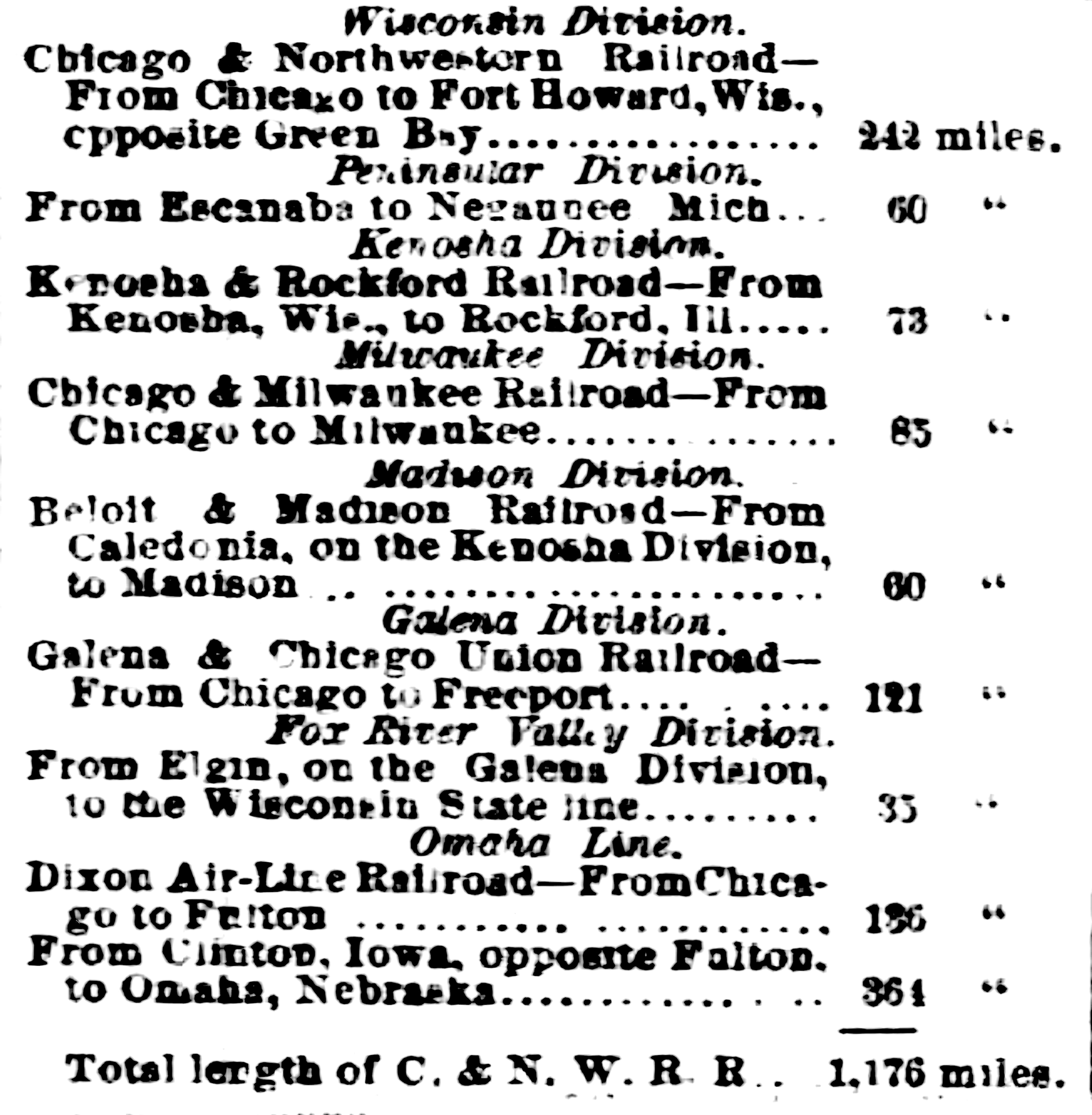
The following are the lines constituting the great system now known as the Chicago & Northwestern Railway:
The last annual report of this great consolidated line gives an idea of the amount of businees transacted by it. The gross earnings for the year ending May 31, 1867, of all the lines of road operated by this company, including the leased route in Iowa and the Chicago & Milwaukee Railway, were $10,161,735, being an increase of 81,035,663 over the previous year. The operating expenses were 69 91-100 per cent of the gross earninge, or $7,193,993; leaving the net earnings over operating expenses,
During the year there were purchased or built by the company 76 locomotives. 9 passenger cars, 18 baggage cars, 1,570 freight and way cars, and 197 ore cars. The present equipment consists of 248 locomotives, 133 passenger cars, and 5,556 other cars.
The earnings for passengers were $2,945,016; for reight, $6,649,589; and for mail, express, &c., $507,129.
The value of the property of the road is $45,864,322, being $5,857,226 more than the previous year. The total number of passengers carried during the year, each way, was 1,583,028. The number carried to Chicago was 345,182; from Chicago, 413,440.
- The principal officers of the Chicago & Northwestern Railway are: President, Wm. B. Ogden; Vice President, Perry H. Smith; Secretary, James R. Young Treasurer, Albert L. Pritchard; General Superintendent, George L. Dunlap.

- Chicago and Northwestern Railway Company.
1869
Next in order may be mentioned the
Chicago, Burlington & Quincy Railroad.
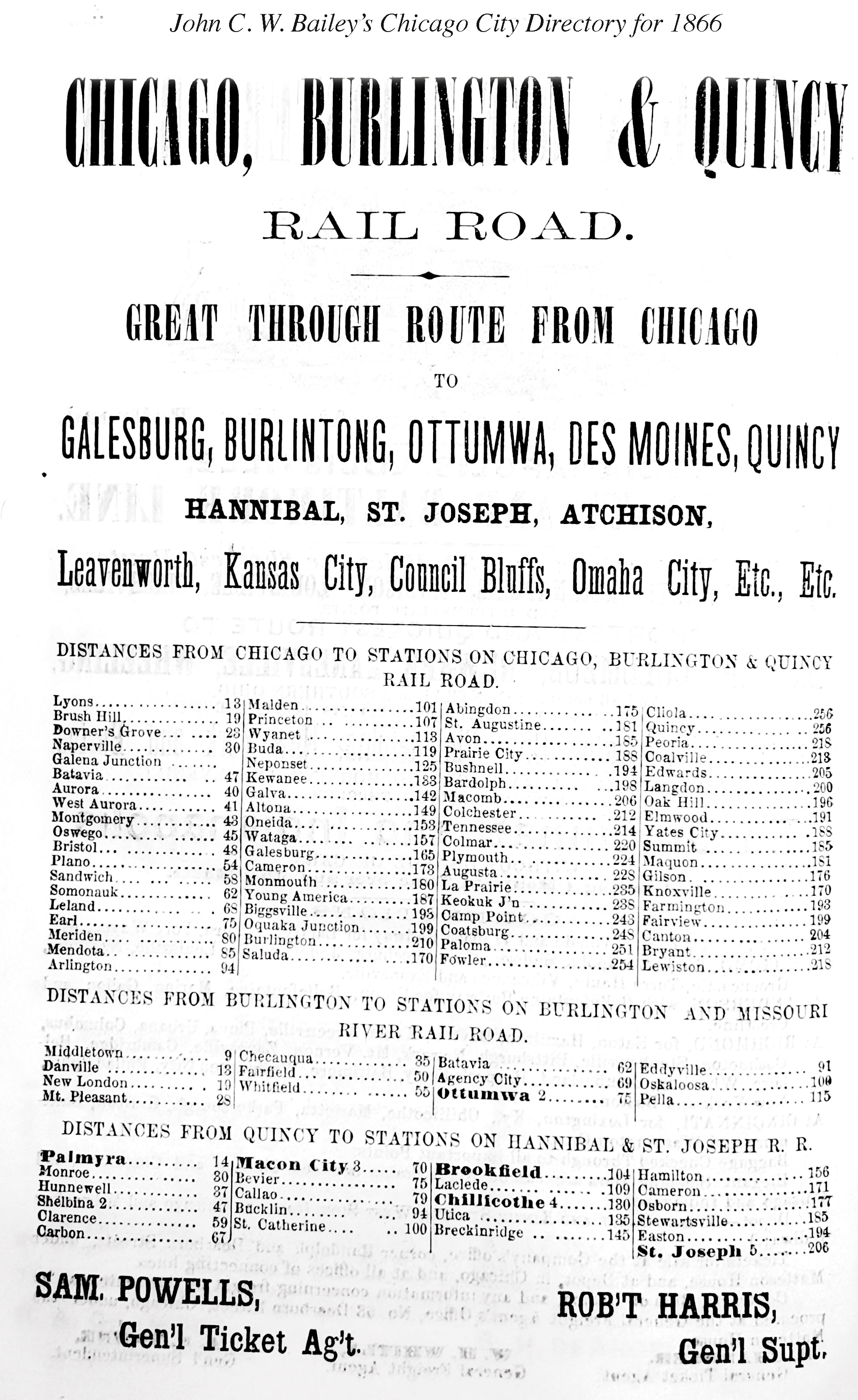
This road justly claims to be one of the best managed and most profitable roads in the West. and is one of the very few railroads in the West which is in the hands of the original stockholders, who, in this case, are receiving handsome dividends on their investments. Its friends are in the habit of saying that its initials, “C. B. & Q.,” properly indicate its characteristics as the “Cheapest, Best and Quickest.” The line runs southwest, through some of the finest and best developed agricuitural regions of the State, to Burlington, 210 miles from Chicago, with a branch of 100 miles, from Galesburg to Quincy, 269 miles from Chicago.
The part of what is now the Chicago, Burlington & Quincy Railroad which was first operated was the Aurora Branch Railroad, which in the fall of 1852 was completed thirteen miles, from Aurora to the Junction, on the Galens & Chicago Union Road. In the fall of 1853 it was completed southwest to Mendota, forty-five miles from Aurora. About 1856, the Chicago & Aurora Road was consolidated with the Central Military Tract Railroad, from Mendota to Galesburg. and with the Peoria & Oquawka Railroad, the western part of which was between Galesburg and Burlington. About the same time, a consolidation was effected with the Northern Cross Railroad, from Galesburg to Burlington, thus completing the Chicago, Burlington & Quincy Railroad. Until 1863, the trains of this road ran into the city over the GaJenn & Chicago Railroad track, from the Junction, thirty miles out, but in that year the company completed its own track, entering the city along Sixteenth street.
The road is now virtually extended into Iowa by a contract made with the Burlington & Missouri Railroad, which is already built 156 miles west of Burlington, forming a very important connection, as it taps the richest portions of Iowa, and is rapidly extending toward the Missouri, at or near Omaha. The Hannibal & St. Joseph Railroad, which runs across the is great State of Missouri, from opposite Quincy, is also a very important feeder, connecting with Atchison, and thence with the Central Branch of the Union Pacific Railroad. Costly and extensive bridges of some 1,200 feet in length are now being erected across the Mississippi at Quincy and Burlington, and their completion will greatly facilitate the business of the road.
The Council Bluffs & St. Joseph Railroad, which runs parallel to the Missouri, between these two clues, is being rapidly pushed from both ends, fifty-five miles being already in operation from Council Bluff. The entire road will probably be complete during the coming summer, will then prove a valuable feeder to the Chicago, Burlington & Quincy Railroad, through its immediate connection with the Hannibal & St. Joseph Railroad, and will undoubtedly attract a considerable share of business from the Union Pacific Rond at Omaha.
The earnings of the road for the year ending June, 1867, were; From passengers, from freight, $1,543,711: from freight, $4,124,691. The earnings ten years ago were but $117,049.
The equipment was enlarged during the year by the addition of 8 was locomotives, 1 passenger car, a baggage and express cars, and 118 other cars making the present rolling stock 119 locomotives 59 passenger, 27 baggage, and 2,285 freight and other cars. The capital stock and debts of the company is $15,991,260.
The number of passengers carried westward during the year, was 456,902; carried eastward, 450.918. Total, 917,820.
- The officers of the road are as follows: President, James Hall F. Joy; Secretary and Treasurer, Amos T. Hall; Superintendent, Robert Harris; Assistant Superintendents, A. N. Towne, H. Hitchcock and S. S. Greeley ; General Freight Agent, E. R. Wadsworth; General Ticket Agent, Samuel Powell.
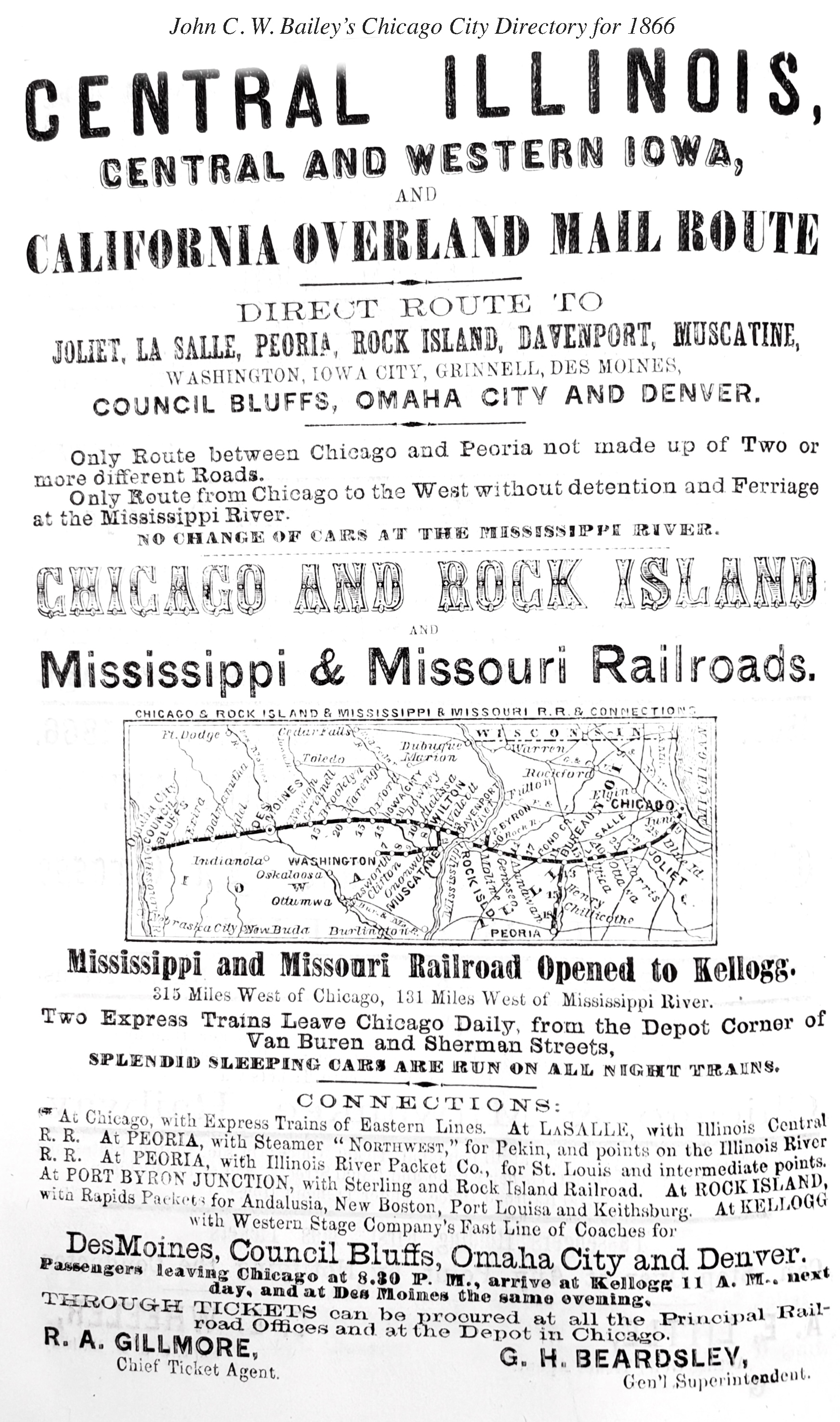
The Chicago, Rock Island & Pacific Railroad.
This road bears off in a southwesterly direction to Robert Island, on the Mississippi, at the mouth of Rock River, 82 miles from Chicago. It was commenced in April, 1852, and completed in February, 1854, being only one year and ten months. Here it crosses the river on a fine and costly bridge, and joins what was formerly the Mississippi & Missouri Railroad, with which the Chicago & Rock Island Road was consolidated August 20, 1865, the name being changed to the present one. The great consolidated line, therefore, will eventually reach from Chicago to the Mississippi, and thence directly across the broad and fertile State of Iowa to Council Bluffs, opposite Omaha, on the Missouri River. The road is already in operation to Des Moines, the Capital of Iowa, and is rapidly pushed northwesterly to Council Bluffs. Within a few weeks the directors of the road have issued additional stock to the amount of $4,900,000, for the completion of this important part of the line, and a large portion of it has been at nearly par value, the road ranking among the most prosperous roads in the West. When the line is completed it will be the shortest route from Chicago to the Missouri, and of course receive a large addition to their business. It is already graded about fifty miles beyond Des Moines. The company has now 169 miles of main line in operation in Illinois, and a branch of forty-six miles from Bairewn to Peoria, and by its consolidation with the Mississippi & Missouri, it now operates 450 miles of road.
The last annual report, dated April 1st, 1867, shows the following facts: The cost of the road, equipments, lands and all other property was $15,313,822. This includes the cost of the two consolidated lines, the Chicago & Rock Island and the Mississippi & Missouri. To aid the latter a large amount of land was granted by the acts of Congress and the Legislature of Iowa, of which there has been certified by the Government of the United States to the company $481,000.
There has been a large amount of rolling stock placed upon the line during the year, and a splendid depot in Chicago bas been built in common with the Michigan Southern Railroad. The receipts of the road last year amounted to $3,574,638; the expenditures, leaving as the net earnings $1,578,990. The company have 92 engines, 46 pasesnger coaches, 20 baggage and exprees cars, and 880 other cars. The amount of freight transported was 1,497,824,158 pounds.
During the year the company have built, about two miles south of the city limits, a large round house and very extensive car shops, which will probably employ nearly a thousand men, and quite a village has already begun to spring up there. Speculators have bought up tracts of land adjoining the works and divided them into lots, which they have sold, or said hold, at almost city prices, and when, as in due time will no doubt be the case, frequent “dummy” trains are run to this point, stopping at every street for passengers, a populous suburb will grow up along the line.
- The principal officers of the Chicago, Rock Island & Pacific Railroad Company are as follows:
President and General Superintendent—John F. Tracy.
Treasurer—E. W. Dunham.
Secretary—Francis H. Tows.
Assistant General Superintendent—P. A. Hall.
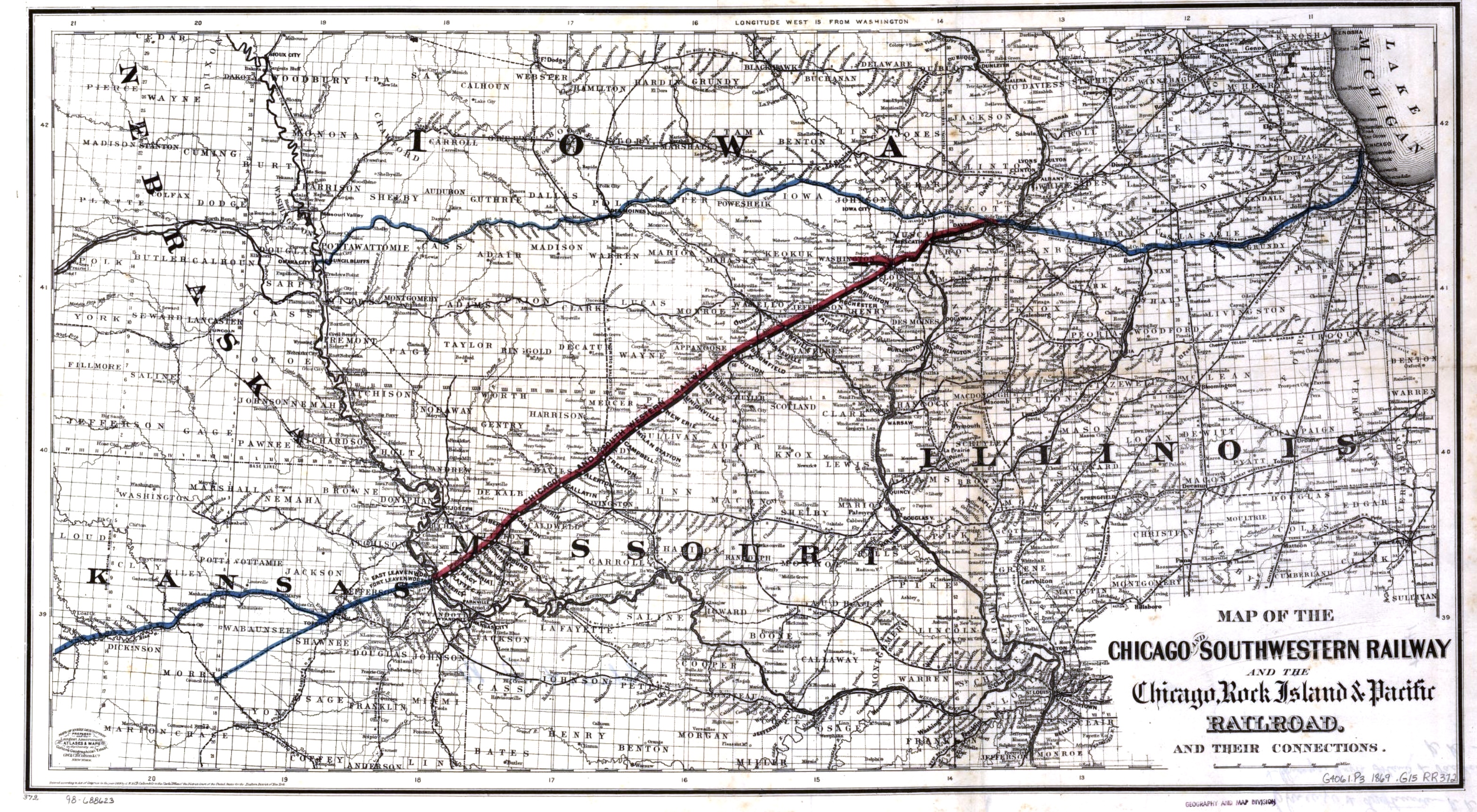
- Chicago Southwestern Railway and Chicago, Rock Island & Pacific Railroad Route Map
1869
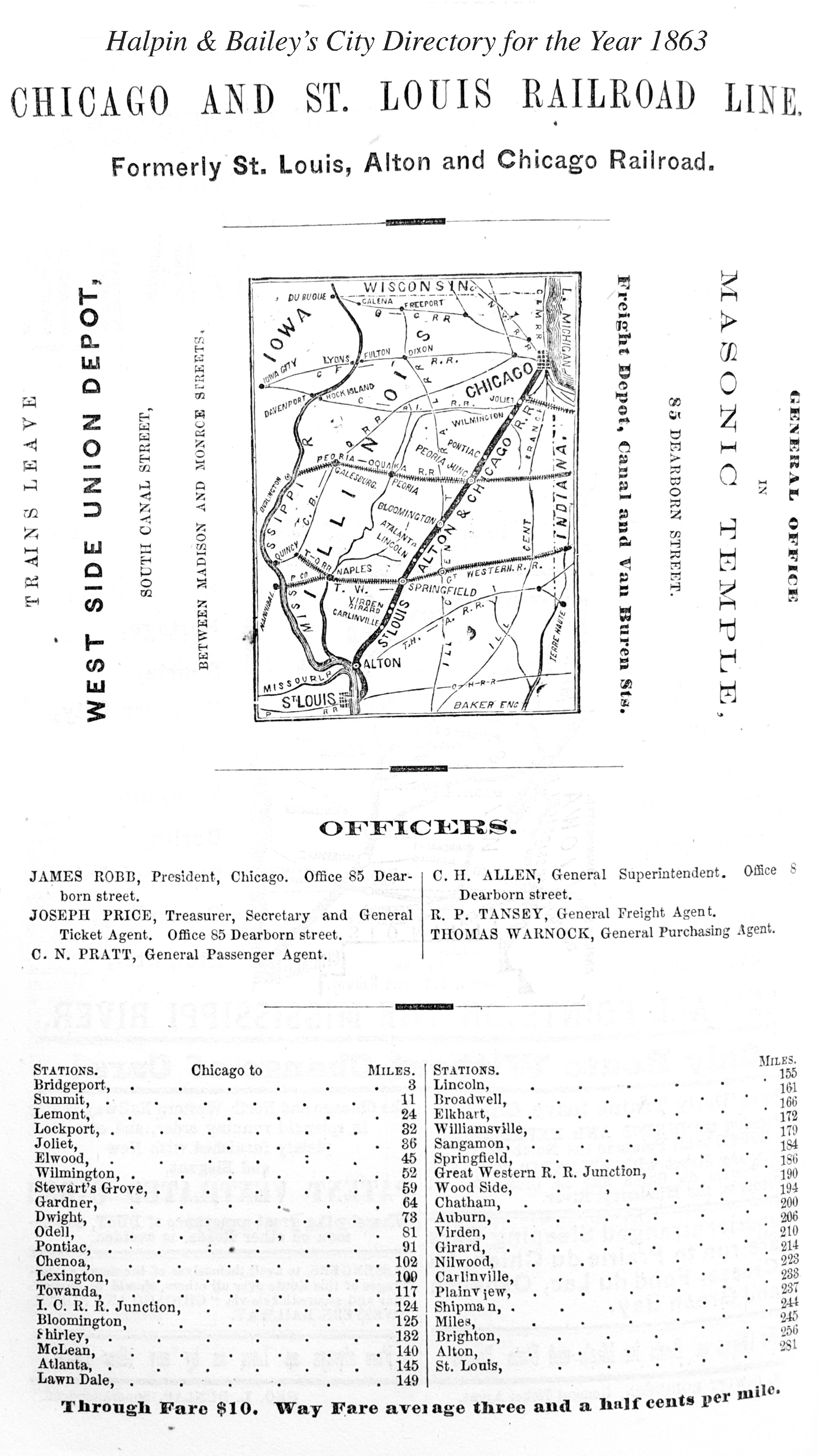
The Chicago & Alton Railroad.
This road bears off still further to the south then the one just mentioned and strikes the Mississippi at Alton, 275 miles from Chicago, where it connects with the Alton & St. Louis Railroad, which is operated and virtually owned by the same company, (the payments of $800,000 for its purchase being nearly completed) and follows the river to St. Louis, 282 miles from Chicago. Here connections are made with lines of steamers up and down the Mississippi and up the Missouri to the wilds and gold fields of the northern Territories, and with the Missouri and Kansas Pacific Railroads and other lines through the great State of Missouri. The road is formed by the consolidation of several distinct lines of which the first was the Joliet & Chicago, to which the right to enter the city on the Archer road was given January 5th, 1857. The earnings are reported below from the organization of the road in 1855.
The Chicago & Alton Railroad proper was built under two charters—the first to the Alton Sangamon Railroad. granted February 27, 1847, and the second to the Chicago & Mississippi Railroad, granted June 19, 1852. In 1835 the name of the road was changed to the Chicago, Alton & St. Louis Railroad; the company was again reorganized under the title of the St. Louis, Alton & Chicago Railroad in 1857, and again, for the third time, reorganized in October, 1859, as the Chicago & Alton Railroad.
The first portion of the present line that was constructed was the Alton Sangamon Railroad, from Alton to Springfield, which was completed in 1853. The Chicago & Mississippi Railroad, from Springfield to Joliet, was next built, in 1854, and arrangements which were made with the Chicago & Rock Island Railroad, from this city to Joliet, and with the Terre Haute, Alton & St. Lonis, between the two last named places, completed the line from Chicago to St. Louis. In 1857 the Joliet & Chicago Railroad was built under a separate charter, and the trains of the Alton Road run over it until January, 1864, when it was perpetually leased by the latter, and in the same year the Alton & St. Louts Railroad was purchased, completing the ownership of the present Chicago & Alton Railroad Company of the entire road from Chicago to St. Louis.
The road has passed through many financial vicissitudes since its organization, which seemed for a time to have utterly wrecked it. In December, 1859, its heavy mortgages were foreclosed, and it parred into the hands of a receiver. In September, 1862, the road was sold at Joliet, under a decree of the United States Court, Messrs. Samuel J. Tilden and S. H. Meyer becoming the purchasers for the bond holders. The road was then reorganized, the first mortgage bondholders receiving now bonds, the second mortgage bondholders receiving preferred stock, and the third mortgage bondholders receiving common stock. A large amount was spent in repairing and equipping the road, and it is row in splendid running condition, and is a first class road, running through some of the best farming country in the State, most of which is thoroughly improved, and connecting the two principal cities of the West, between which there is a large and increasing amount of travel and business.
The principal event of the year, in connection with the Chicago & Alton Road, has been the opening of the Chicago, Jacksonville & St. Louis Railroad, which runs from Bloomington, on this road, through Jacksonville, 150 miles, to Monticello, eight miles above Alton, where it connects again with the main line. This new line was opened September 23d, by very pleasant excursion from this city, and it has since proved a vers important feeder, as it taps a wide belt on splendid agricultural land which has been settled and developed for many years, but until this had no railroad communication. Although lying much nearer to St. Louis than to Chicago, by far the largest part of its grain and cattle are sent to this market, from which merchandise of all kinds are sent in return, to the profit of both seller and buyer. The fact that Chicago can draw trade from within forty or fifty miles of St. Louis, paying better prices for products and selling goods at lower rates, shows its superior as a market.
During the past season the Chicago & Alton Company had the fortune to lose, by fire, their extensive car and repair stops at Bloomington, Capable of turning out a car a day; the loss was estimated at nearly $200,000. Much effort was made by Springfield, Joliet end other places to finance the company to relocate them there, as their existence supports, directly and indirectly, three or four thousand persons and would be a great acquisition to any town: but it has been decided to rebuild them at Bloomington.
Among the numerous road improvements of the year is a splendid iron bridge over the Kankakee River at Wilmington, fifty-one miles from Chicago, which is built on a new and improved pattern, never before used in the West, and is 540 feet long and cost about $44,000, exclusive of abutments, which were previously erected. The structure was opened on January 2, and attracted much attention from railroad men.
The road is interested to the amount of $50,000 in the great Union Stock Yards, near this city, which is the largest stock market in the country, and has the effect of increasing the transportation of live stock over the line, by inducing shipments to this market which would otherwise be made by other lines to Eastern markets.
At the date of the last published annual report, the company owned 67 locomotives and 1,359 cars, of which 37 were passenger and 15 baggage and express. The total assets of the road were $12,290,904.
At the close of the year the efficient General Superintendent, Robert Hale, Esq., resigned his position.
- The principal officers now are:
President and General Superintendent—T. B. Blacketone.
Secretary and Treasurer—W. M. Latrabee.
Chief Engineer-K. F. Booth.
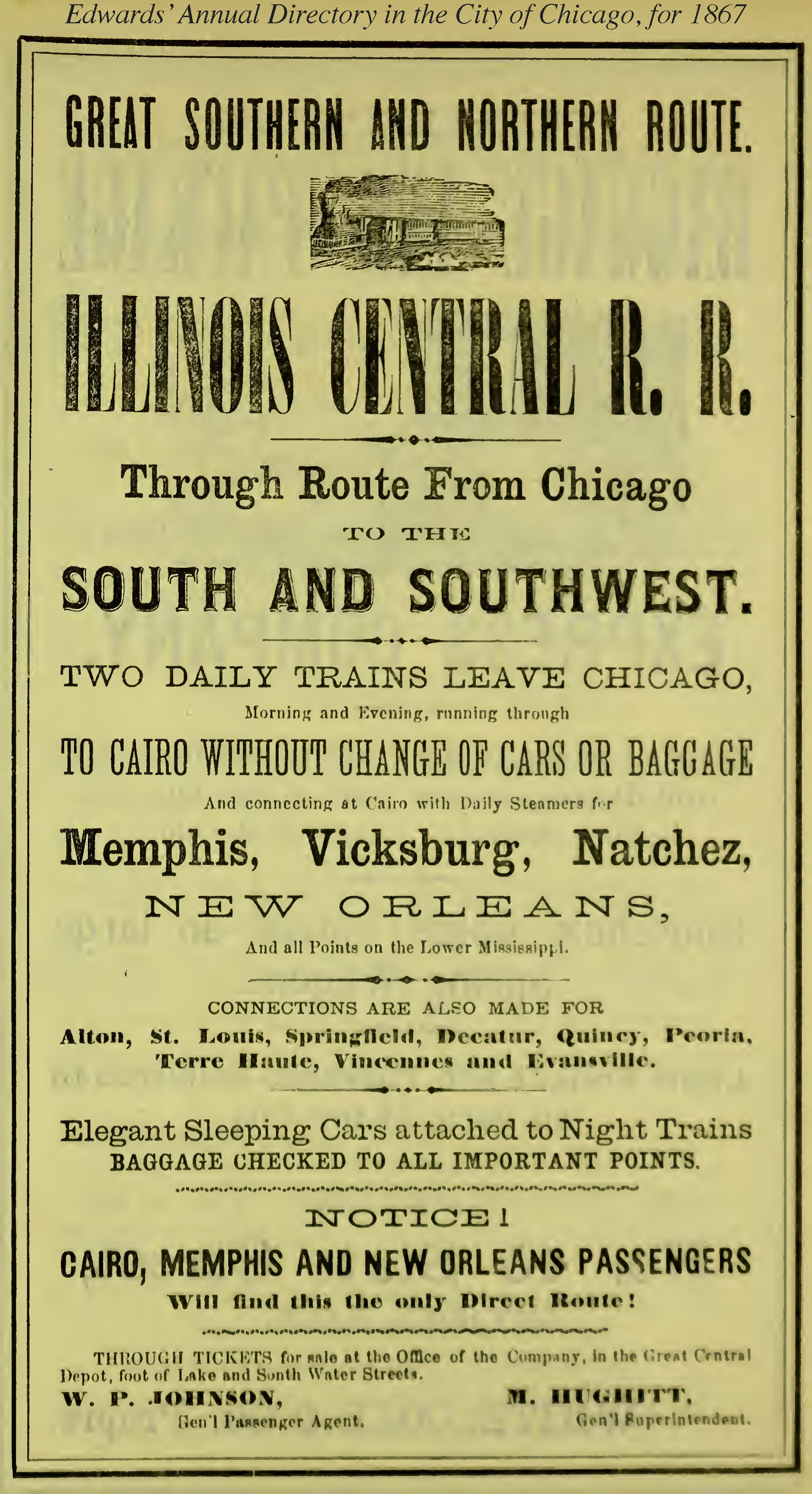
The Illinois Central Railroad.
This road had its origin in the year 1850, when Stephen A. Douglas and General Shields obtained from Congress a grant of alternate sections of land on both rides of the proposed route, through the richest portions of the Garden State, giving it an immense and increasing revenue from their sale, without which encouragement the road would not have been undertaken. In 1852 the officers of the road applied for permission to enter the city along the lake shore, which was granted, and the Illinois Central, fifteen years ago, was added to our railroad system.
This is our southern line penetrating the State from the west to its extreme limit at the point formed by the Ohio and Mississippi Rivers at Cairo 363 miles from Chicago. After perusing a south westerly direction from this city the road unites at Centralia, 253 miles distant, with the North Division, which starts at Dauleith, 343 miles away at the northern limit of the State, and thence runs due south to its terminus. The total length of this immense line is 706 miles, and, with its vast grants of government land, which are gradually being sold and settled, it is one of the most wealthy and important corporations in the country. The value of this road in opening up and developing the agricultural and mineral wealth of the State can hardly be overestimated. At Cairo connections are made with the trade of the great rivers and the Southern cotton and sugar fields, while the lower portion of this State, with their high temperature and varied productions of fruit and grains, pour in an unfailing supply of necessaries and luxuries to our Northern market. The Illinois Central very materially facilitated the speedy and safe transfer of fruit from this garden region by placing upon their road fast fruit trains in the strawberry and peach seasons, bringing these delicious products fresh from the garden and orchard, so that they could he in the hands of the dealers, and perhaps on the tables of our citizens, in the early morning, twelve er fifteen hours after they left the vines or trees. The amount of fruit chipped shipped the last season was 14,000 bushels of berries and 389,000, baskets of peaches, which, with small lots of other fruit and vegetables, made nearly nine millions of this vast aggregate Chicago received 12,500 bushels of berries and 289.191 boxes of peaches, the larger part of which were consumed in this city.
The Central effected an important extension on October 1, 1867, by leasing for twenty years, for a rent of thirty-five per cent of the gross earnings, the Dubuque & Sioux City Railroad, which is already completed due west from Dubuque 143 miles to Iowa Falls, with a branch fifty-three miles long running southwest from Farley to Cedar Railroad. Rapids, on the Chicago & Northwestern Railroad. It also connect at Cedar Falls, ninety-nine miles from Dubuque, with the Cedar Falls & Minneapolis Railroad, which is being built northward through Western Iowa and Minnesota. The Illinois Central thus gains large and constantly increasing amount of travel and trade from these two fine States. The company is now perfecting facilities for shipping freight across the Mississippi, between Dubuque and Dunleith without breaking bulk, and is building for this purpose barges capable of carrying five loaded cars each. The company has also contracted for a new first-class ferry steamer, to be delivered at the opening of navigation next spring. It is their intention to have facilities for transferring, both ways, two hundred and twenty freight cars a day, if necessary.
The original grant of land to this company was for 2,395,000 acres. These lands have been in the market for twelve years, during which time 1,885,000 acres have been disposed of. In the early days the sales were made upon long time and at a low rate of interest, to induce settlers of small means to start and bring the lands into immediate cultivation and production. For the last three years the terms of payment have been either cash or on short credit. No actual settler has ever been deprived of his home through harsh measures on the part of the company, and up to January 1 last, full title papers nave been passed for 907,365 acres. The number of deeds and contracts for farm lands deemed to the same time has been 37,144, for an aggregate of over twenty millions of dollars. The business of the last year has been 218,834 acres, sold to 2,633 settlers, at an average of $10.67 per acre. One Hundred and thirty-five thousand acres of these lands sold in 1867 lie on the Chicago Branch, in the great corn, cattle, hog and fruit producing in the districts directly tributary in business to the city of Chicago.
The lands are sold in tracts of forty acres and upwards, of from $5 to $12 per acre, and are being taken up by a thrifty class of settlers who soon cover the wild prairie with waving cornfields and blossoming orchards. The road is thus developing the country, which will in turn support the road.
The Land Department in itself furnishes an immense business, as the foregoing figures show, though the operations make but little noise. It has a handsome building on Michigan avenue, built by the Central Railroad Company for its use, at a cost of $8,000 and employs some twenty-five persons in the Chicago offices.
The Land Commissioner is John B. Calhoun, and the Salesman—C. P. Holden.
- The chief officers of the Illinois Central are:
President—John M. Douglas.
Secretary and Treasurer—M. K. Ackerman.
General Passenger Agent—W. P. Johnson.
Edwards’ Annual Directory in the City of Chicago, for 1867

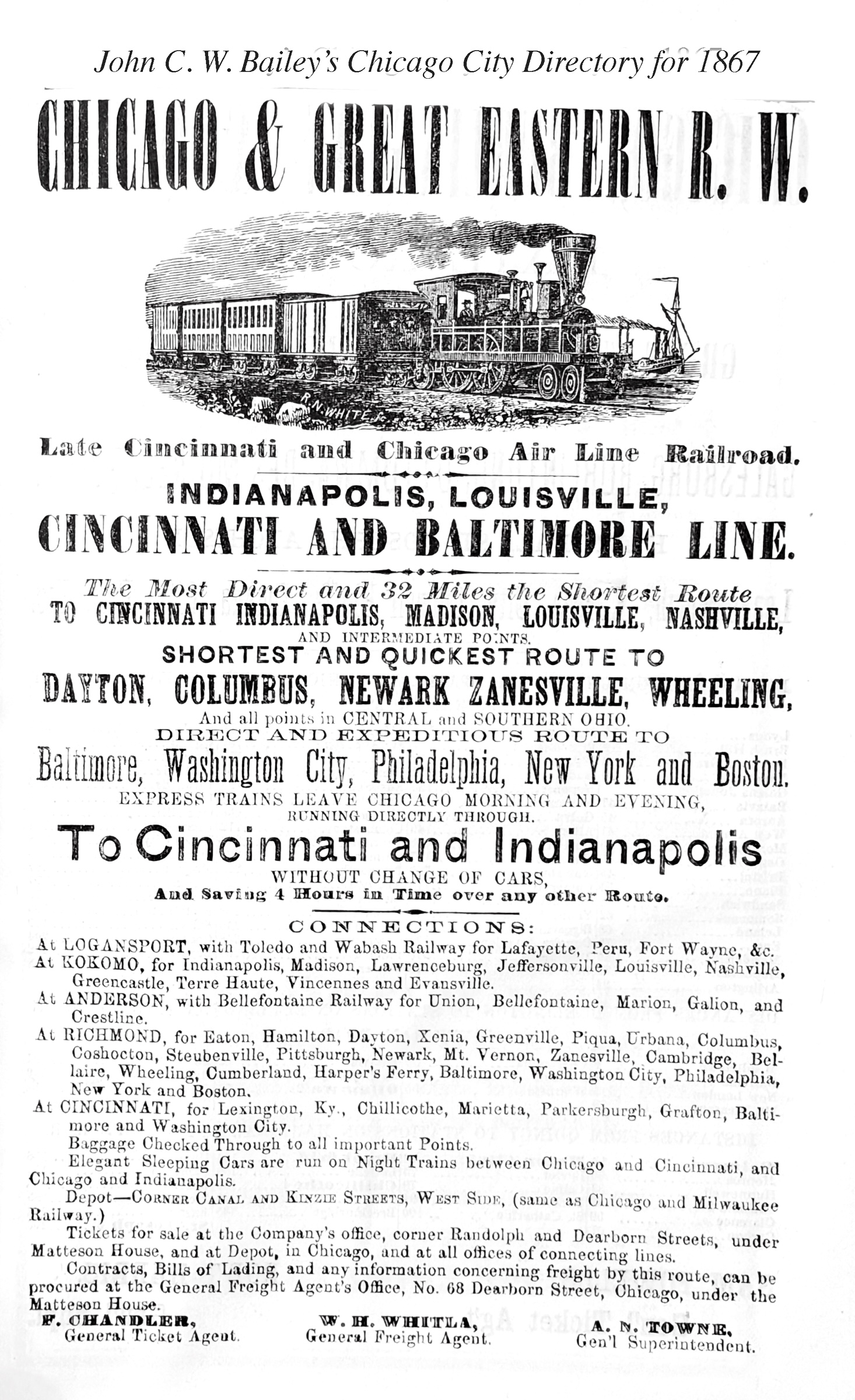
The Chicago and Great Eastern Railroad.
This is the most westerly of the road—radiating in the southeast, and is the most recent of the trunk lines of Chicago. It was formerly known as the Chicago & Cincinnati Air Line Railroad, and entered the city over the Pittsburgh & Fort Wayne Railroad from Valparaiso, forty miles distant. It now has its own track the entire distance from Richmond, Indiana, to Chicago, 214 miles, running parallel with and just west of the city limits to Kinzie street, and thence, using the track of the C. & N. W. R. R., to the depot on the corner of Kinzie and West Water streets. The company propose, eventually, a fine passenger depot in Carroll street. At a Richmond the road connects with the Cincinnati, Eaton & Richmond Railroad for Cincinnati, to which place it is the shortest route from Chicago, and where it connects with main lines for the West and South.
The Chicago & Great Eastern Road has passed through some vicissitudes. A considerable portion of the distance south of this city is not improved, and, consequently, unproductive; and the road has had to contend with greater difficulties than most of its competitors, but is gradually overcoming them. A strike on the part of some of the mechanics at Logansport, last call, interfered with the running of trains for a few days, but business is now uninterrupted. A large amount of money he been expended in ballasting the track and in other permanent improvements.
At a meeting of the stockholders on January 15th, it was voted to consolidate the road with the Columbus & Indiana Central Railroad, which runs from Columbus, Ohio, to Indianapolis, Ind., via Richmond, the terminus of the Chicago & Great Easter Road, and a branch which is just completed, running from Union, Ohio, through Logansport to the State line between Indiana and Illinois.
The stockholders of the Columbus & Indianapolis Central also voted, unanimously, on this, for the consolidation, therefore the directors of both roads will meet in Columbus on the 12th of February to elect Directors for the new company. which will be known as the
Columbus, Chicago & Indiana Central Railroad Company.
The name of the Chicago & Great Eastern Railroad thus passing out of existence.
The first rail of the Union & Logansport Railroad which forms part of the new line, was laid on the 16th of January, the connecting line for another and the next to the shortest route between Chicago and New York. It is expected that the road will be opened for passenger travel about the last of February. The new line will embrace 788 miles of track, as follows: Chicago and Great Eastern, 224 mlles; Indiana Central, 88 miles; Peoria, Logansport & Burlington, 183 miles; Union & Logansport 93 miles. The main shops of the new company will be located at Logansport.
- The Directors of the the new company are: W. D. Thompson, Frederick R. Fowler, W. D. Judson, Amos Tenney, Henry Morgan, James W. Elwell and Laurence Wells, of New York; Jos. T. Thomas, of Philadelphia; Jos. E Young, of Chicago: Join S. Newman of Indianapolis; J. M. Converse, of Union Cite: Benjamin E. Smith, Wm. Denneon and Join R. Hillard, of Columbus, and John Gardner, of Newark, Ohio.
The officers are: B E. Smith, President; W. D. Judson, Assistant President; J. E. Young, Vice President; James Alexander, Treasurer: G. Moodie, Secretary; J. M Lunt, General Superintendent; C. W. Smith, General Freight Agent.
It is the intention of the company to put the whole property in perfect order at the earliest possible moment. and to largely increase the equipment. The new portion of the line is being thoroughly ballasted, and, as soon as completed, will be open as a through line between Chicago and Pittsburgh, New York, Philadelphia, Baltimore and Washington.
The Directors are now in the city for the purpose of taking initiatory steps toward putting the whole of their long line of road, as well as their rolling stock, in the best possible repair. It is their intention, also, as soon as it is practicable, to erect depot buildings in the city, of a character that shall be commensurate with the importance of the line, and with Chicago as one of its terminal points.
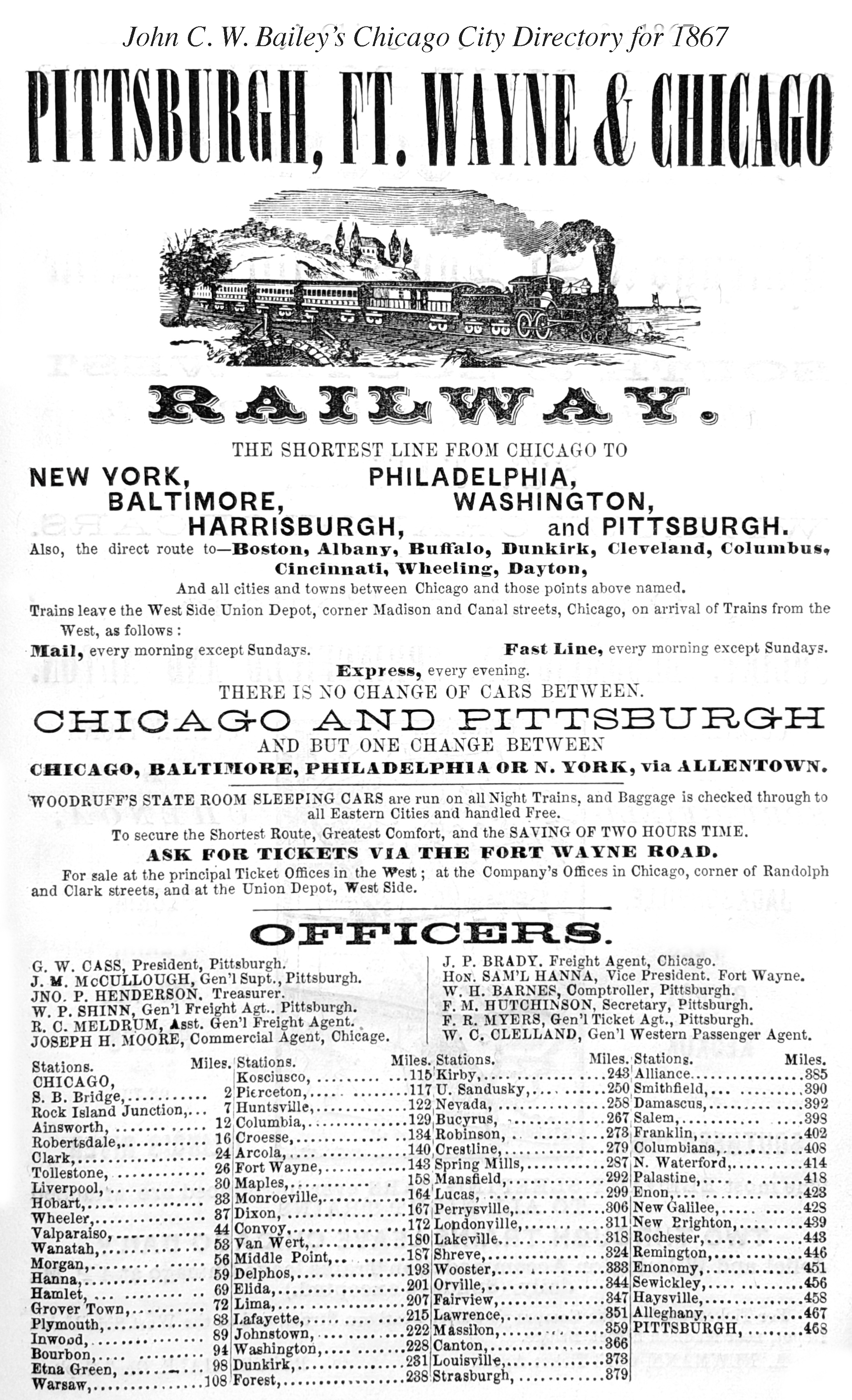
The Pittsburgh, Ft. Wayne & Chicago Railroad.
This line bears still further to the east and is one of the longest roads in the country, running from Chicago to Pittsburgh, 465 miles, where it makes direct connection with the Pennsylvania Central Railroad across the Alleghenies to Harrisburgh, Philadelphia, Baltimore and New York.
The road was incorporated in 1852 as the Fort Wayne & Chicago Railroad. The work progressed slowly, the company not being able to make a free sale of its securities. In 1856 it was consolidated with the Pittsburg Division under its present name and completed November 10th of the the same year. In 1861 it met the fate of many Western roads, and was sold by a decree of the United States Circuit Court; being reorganized and placed in the hands of Trustees in February, 1862. Since then it has been very prosperous, doing an immense through as well as local business.
The company has in contemplation the erection, in connection with the Chicago & Northwestern and the Chicago & Alton Railroad Companies, a splendid passenger depot, in the West Division near the river, and somewhere between Lake and Adams streets. The plans, which are already made, describe a massive stone structure thirteen hundred feet long, and costing nearly two millions of dollars, forming by by far the finest railroad depot in the world. It was thought when this work was planned that the Chicago, Burlington & Quincy, the Michigan Central, and one or two other roads. would unite in the project, forming one grand union depot, into which trains from ail directions should enter, obviating the great inconvenience and expense of omnibus and baggage transfer. Although the combination will not be as general as was thought of, it will at least include three prominent lines which, with their branches. cover all parts of the compass, and will prove a great convenience to the traveling public, as our two principal union depots now do. It may be some time before this immense work is commenced, but the three companies interested in it all need better depot accommodations, and will probably not defer it long.
At the date of the most printed report the assets of this great railway were $21,927,539. The rolling stock consisted of 189 engines, 101 passenger cars, 68 for emigrants, baggage, mail, &c., 2,381 for freight. The silver palace cars of this line run through from Chicago to Jersey City, opposite New York, without a single change—a convenience appreciated by family parties, and ladies and children traveling alone.
- The officers of the of the road mainly reside in Pittsburgh. They are: Geo W. Cass, President; J.N. McCullough, General Superintendent; J. P. Farley. Auditor; J. P. Henderson, Secretary. The passenger agent in this city is W. C. Cieland.
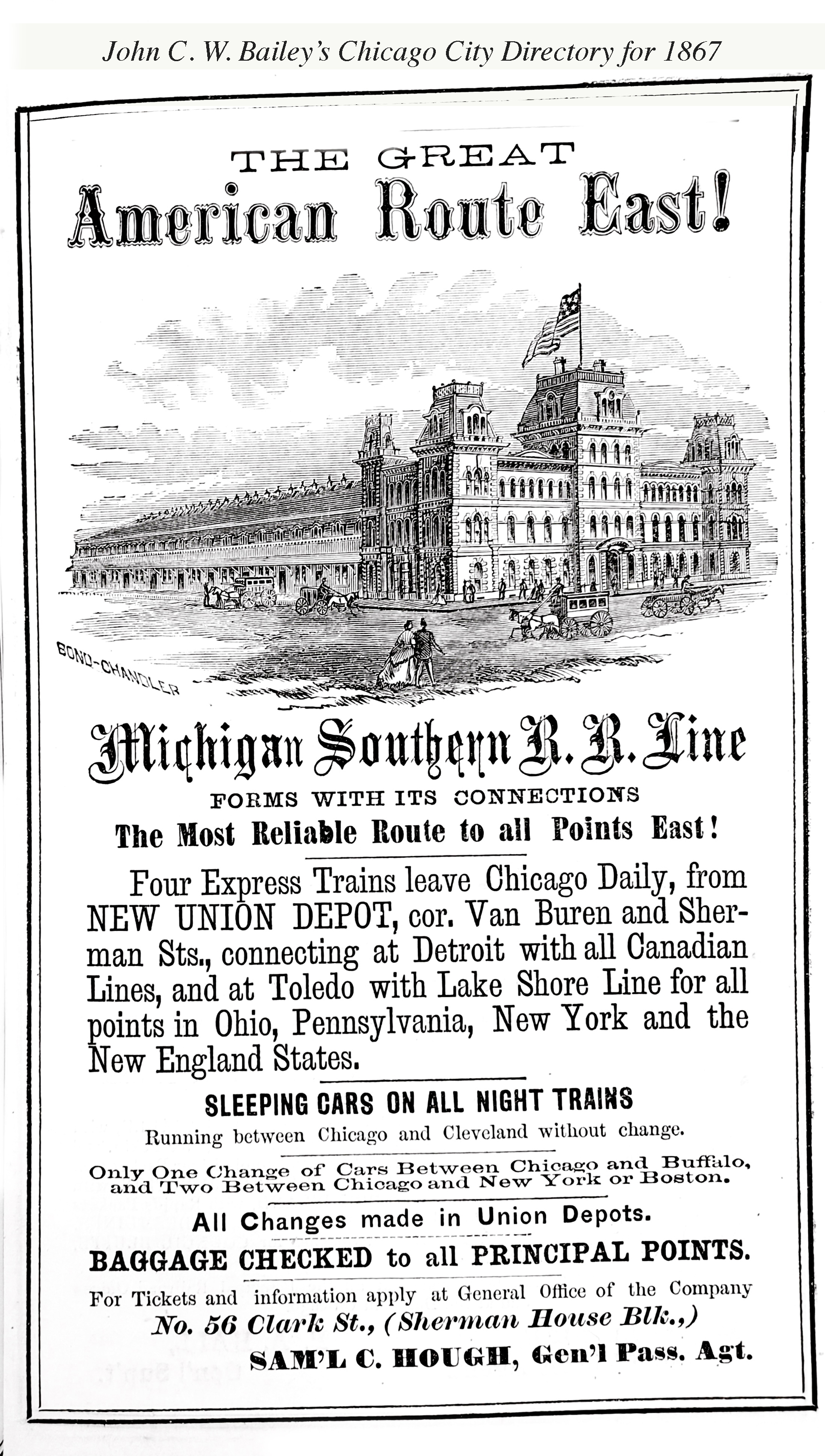
The Michigan Southern & Northern Indiana Railroad.
This was the second railroad opened to Chicago, that important event occurring on the 20th of February, 1852. Previous to that the Galens trains alone entered the city, and that road was completed only to Elgin, forty miles distant. This line, after running southeast around the bend of Lake Michigan. due east to Toledo. At Kikhart, 101 miles east of Chicago, the road forks, the “air line” branch continuing through the northern of Indiana and Ohio, and the other deflecting northward through Southern Michigan via Adrian to Toledo, whence the line ls continued northeast to Detroit. The distance from Chicago to Toledo is 244 miles, and to Detroit 284 miles. At these places connection is made wits the Lake Shore Road east and the Grand Trunk and Great Western Roads through Canada. The line is one of the most popular and successful of those leaving this city.
This company, in conjunction with the Chicago, Rock Island & Pacific Railroad completed, in May last, on Van Buren street, between Griswold and Sherman street, an immense and magnificent union passenger depot; the finest, it is said, in the whole country, in point of size and accommodations. It is of stone, in the Italian style, and cost $250,000 The length is 594 feet, the width 160 feet. The front section, which contains the general offices of both companies, is 52 feet deep by 160 feet wide, and three stories high. On the front are three towers, the middle one eighty feet high, and the two at the corners each 74½ feet high. The Michigan Southern Road bae also built during the year an immense brick freight depot, south of the passenger depot, on Griswold street, north of Polk, 51 feet wide and 603 feet long, containing standing room for twenty cars, storage room for two thousand tons. The front portion is two stories high and contains the freight offices. The building cost $47,000.
The general offices of the road were removed during the summer from Toledo to Chicago, this being found much the most convenient place for doing the business.
The equipment of the road at the date of the last report was as follows: First-class passenger cars, 64; second-class, baggage, &c., 39; freight, stock, &c., 1,405; locomotives, 10.
The number of miles of main tracks owned and operated by the company is 515, and of side tracks 62.
The Michigan Southern has always been one of the most popular and successful of our great lines. Its assets at the depot the last report were given at $21,478,991. The stock is divided into 98,135 shares of common and 7,877 of guaranteed, or in all 106,012 shares.
- The principal officers are:
President—E. B. Phillips.
General Superintendent—Chas F. Hatch.
Chief Engineer—Charles Paine.
The Michigan Central Railroad.
This great line completes the list of roads radiating from Chicago, of which it is one of the oldest. It was projected in 1851 and built in that year, from Detroit eastward to Ypsilanti, but did not reach Chicago until May 21st, 1852, previous to which time passengers between Chicago and Buffalo crossed the lake to St. Joseph, and traveled by stage until they reached its terminus. For more than twenty years this road has gone steadily on in prosperity, with hardly a change in its management. Its total length is 284 miles. Four through trains are run daily, besides a local between Detroit and Dexter, and the Cincinnati express, between Michigan City and Chicago.
In December last a party of business men from this city, and from places along the line of the excursion, celebrated the opening of the Jackson, Lansing & Saginaw Railroad, which now constitutes an important branch of the Michigan Central, and brings a large amount of business this city. It rune from Jackson, on the latter road, and 202 miles from Chicago, nearly north, through Lansing, the capital of Michigan. Owasso, on the Detroit & Milwaukee Railroad, and other growing towns, to Saginaw City and Bay City, near Saginaw Bay, tapping the great lumber and salt regions of the Saginaw Valley, which already contains many populous towns and cities, and looked to Chicago as its most advantageous market for the sale of products and the purchase of supplies. The naw road is one hundred miles long.
The Michigan Central is, with many, the favorite route to the East, being always splendidly managed, and connecting, as it does at Detroit, with the Great Western Railroad, through a fine portion of Canada, and at Niagara, where the traveller has an opportunity to view the watery wonder of the world, with the New York Central Railroad for the metropolis. Pullman’s celebrated hotel and sleeping cars take the passenger from Chicago to Rochester without single change, and it is intended soon to run them through to New York direct.
- The principal officers of the road are:
President—F. Joy.
General Superintendent—H. E. Sargent.
Assistant General—W. K. Muir.
The Passenger Agent at Chicago is H. C. Wentworth.
The Grand Trunk Railway of Michigan.
For a year or two it has been proposed to extend the Grand Trunk Railroad of Canada, Sarnia, Michigan, opposite Port Huron, south by way of Flint, Lansing, Battle Creek and LaPorte, and around the end uf the lake, to Chicago, thus opening to our trade the richest agricultural region of Western and Central Michigan and the forest and mineral wealth of the Saginaw Valley, and adding another to our, great through routes to the seaboard. A meeting was held at Jackson, in the latter part of December, 1866, which it was proposed to call the road the Grand Trunk Railroad of Michigan, and committees were appointed to prepare corporate open books and obtain individual and corporate subscriptions along the route. There is little doubt that this important enterprise will be carried out, when we shall have a continuous line to Montreal and Quebec. The Grand Trunk road has its office agents here, and secures a large share of the passenger and freight transportation eastward.
The grading of this road is well under way in different divisions, the road being virtually the consolidation of three or more distinct companies. The President of the Pensinsular Extension Railway Company has the recently advertised for proposals for doing earthwork between Creek and the Indiana State line, and, on
some parts of the remainder of the route, the grading is completed. This new route will shorten the distance from Chicago to the East twenty-eight miles over any other route.
The Northern Railroad.
In the early part of the year 1866 a movement was made to connect this city with the Racine & Mississippi Railroad, by a line tapping that road
a few miles west of Racine, and coming into Chicago along the east bank of the North Branch of the river. The road was decided on, and it is understood that a large of the two millions required to a commence operations which has already pledged. The owners along the proposed line are generally favorable to the project, and nothing seems to stand in the way of accomplishment. The road would undoubtedly constitute an important feeder to Chicago.
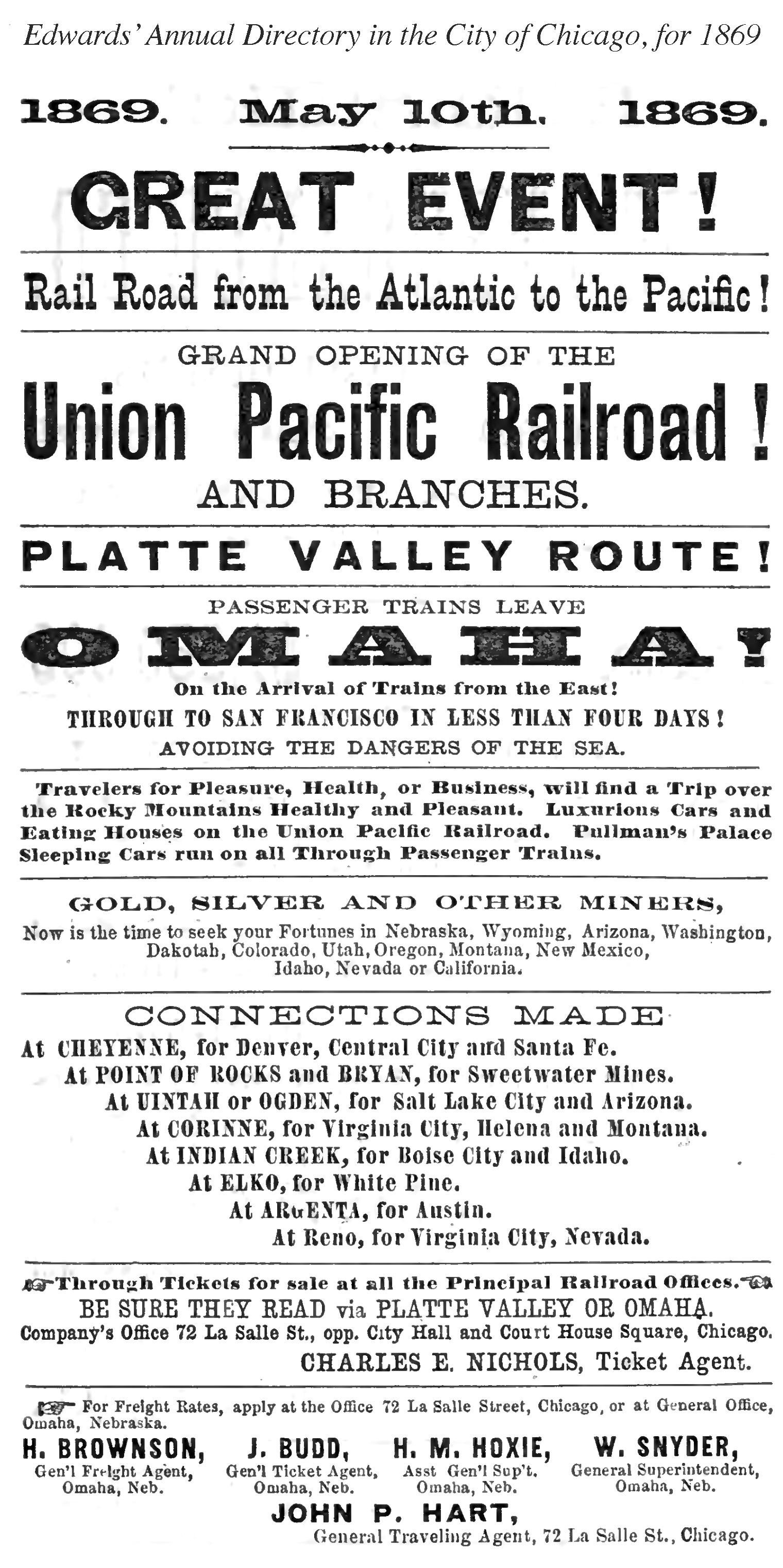
The Union Pacific Railroad.
In this great international highway which is pressing forward at a rate heretofore unknown in railway history. from the Missouri westward and from the ocean eastward over the mountains, Chicago bas an intense enterprise. Over the bridge just thrown across the Missouri at Omaha, the Great Fulton and Iowa line of the Chicago & Northwestern Railroad, 500 miles long, its cars now run straight through to this city, so that it might be considered in fact one of our great trunk lines. Already it is completed to a point more than 1,040 miles west of this city to the base of the Rocky Mountains, and next summer it will be a favorite route of summer travel for those desiring the pleasures of the chase and the invigorating air of the mountains. Already some of our citizens are planning summer residences among the cool gorges of the gold hills, and hundreds of Eastern pleasure seekers will turn from the familiar summer routes and pour through Chicago westward, not failing, and of course, to spend a few days in our own city of marvellous history.
A memorable event of the last season was the editorial excursion from this city in October last, over the Pacific road to the then terminus, a little this side of Cheyenne, to which place passenger trains now run. There were nearly one hundred and fifty gentlemen in the party, and the trip was a complete success.

Leave a Reply