Building Name: 137 De Koven
Life Span: About 1863-1880
Address: 137 DeKoven near Jefferson
Block and Subdivision: 38, School Section Addition
Architect: Unknown

- Halpin & Bailey’s City Directory for the Year 1863
Leary Patrick, lab., h. n. s. DeKoven, nr. Jefferson.
Halpin’s Chicago City Directory for 1864
Leary Patrick, r. DeKoven, bet. Clinton and Jefferson.
John C. W. Bailey’s Chicago City Directory for 1866
Leary Patrick, lab., h. 137 DeKoven.
Edwards’ Annual Directory in the City of Chicago, for 1867
Leary Patrick, lab. r. Polk, bet. Clinton and Jefferson
Edwards’ Annual Directory in the City of Chicago, for 1869
Leary Patrick, lab. r. 137 DeKoven
Edwards’ Annual Directory in the City of Chicago, for 1870
Leary Patrick, lab., h. n. s. DeKoven.
Edwards’ Annual Directory in the City of Chicago, for 1871
Leary Patrick, lab., r.137 DeKoven, nr. Jefferson.
Lakeside Annual Directory of the City of Chicago, 1884
Kolar Anton, lab. house, 666 W. 19th (property owner of 137 DeKoven)
Lakeside Annual Directory of the City of Chicago, 1900
Suchy Charles upholstr bds 137 Dekoven
Lakeside Annual Directory of the City of Chicago, 1903
Suchy Edward F h 137 Dekoven
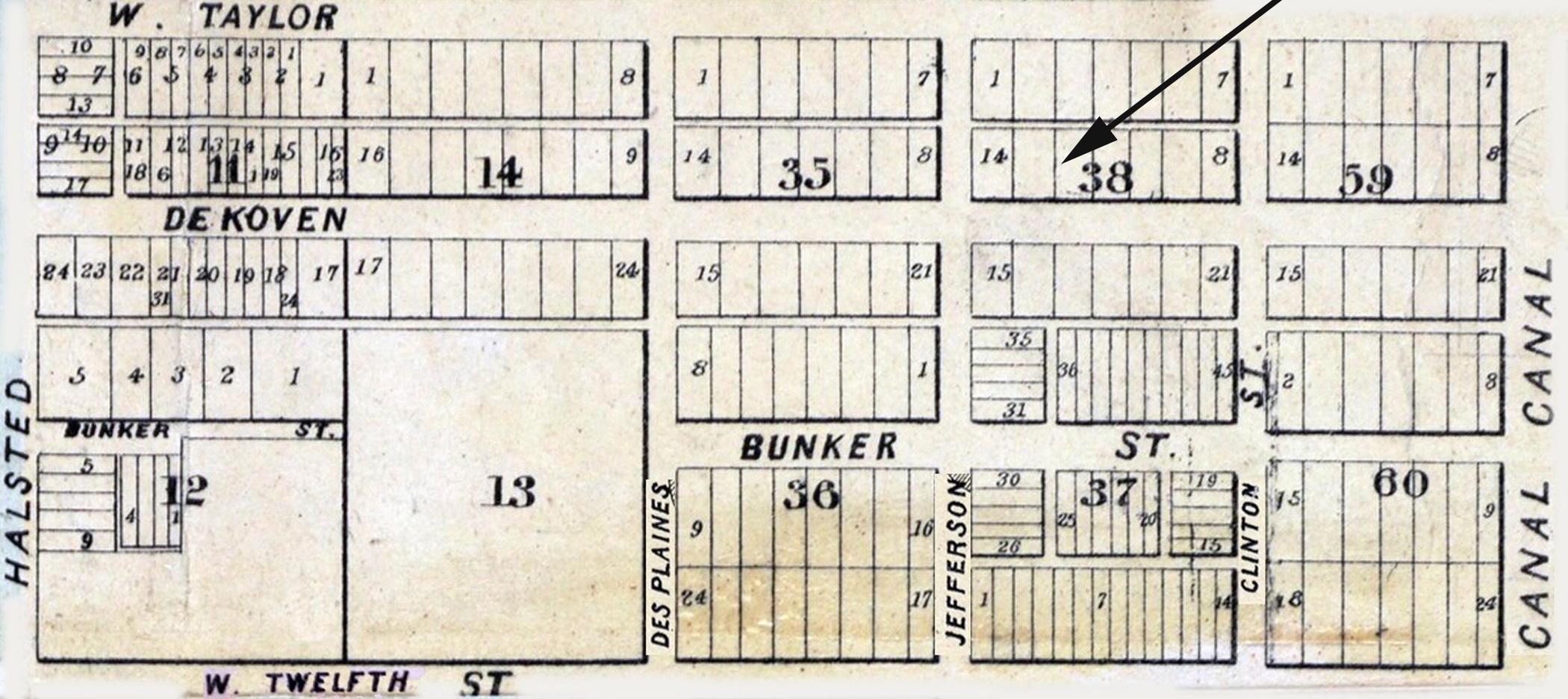
- 137 De Koven
1863
Chicago Tribune, October 20, 1871
HOW IT ORIGINATED.
Statements and Affidavits as to the Starting Point of the Great Fire.
To the Editor of The Chicago Tribune:
A great deal has been published respecting the origin of the great fire, which all reports have settled down on the head of a woman, or as the Times has it, an “Irish hag” of 70 years of age. Admitting for a moment that an Irish hag of 70 years was by an unforeseen accident the cause, yet there was a great want of charity in the epithets used by the Times of the 18th. The following facts are stubborn things, and will cause the public to look for the cause in other sources, and perhaps attribute it to the love of plunder, Divine wrath, etc.:
- On last Sunday. night I made my way to the O’Leary’s house. yet standing, and there, at No. 137 DeKoven street, on the east ½ of Lot 12, in Block 38, School Section Addition to Chicago, found Dennis Sullivan, of No. 134, and Dennis Ryan, of No. 112, both of DeKoven street. There and then I took the annexed affidavits. The parties have been known to me personally for several years as of irreproachable character. Mrs. O’Leary is neither haggard nor dirty.
Patrick O’Leary, and Catherine, his wife, being duly sworn before me, testify that they live at No. 137 DeKoven street, and own the lot and house in which they live; they had five cows, a horse and wagon, on all of which they had not one cent of insurance. She milked her cows at 4½ p. m. and 5 a. m., as Mrs. O’Leary peddled the milk. Mrs. O’Leary fed the horse beside the fence at about 7 o’clock p. m., and then put him in the barn. She had no lamp in the yard or barn that night or evening.
Patrick O’Leary testifies that he was not in the barn during that day or night; left the feeding of the cows and horse his wife and daughter: that both were in bed when awakened by Denis Ryan, of No. 118 DeKoven street; that they have lost their barn, coms, horse and wagon.
Subscribed and sworn before me this 15th day of October, 1871.
Patrick O’Leary,
Catherin O’Leary, .
Michael McDermott.
Notary Public for Chicago and City Surveyor.

Denis Sullivan being duly sword before me testifies that he was at Patrick O’Leary’s house, No. 137 DeKoven street, on Sunday night the 8th, of October, 1871, from about 8½ to 9 o’clock at night, during which time Mr. O’Leary and wife were in bed, that he went a few lots east of O’Leary’s on the opposite side of DeKaren street, until about half-past 9 o’clock, when he saw the fire. He went across the street and cried “fire” “fire,” and went into O’Leary’s barn. where he found the hay in the loft on fire. He then attempted to cut loose the cows and horse, but failed to save anything but a half burned calf. He then came to O’Leary’s and found them out of bed. Denis Ryan alarmed them during his time at the barn.
Subscribed and sworn to before me this 15th day of October, 1871.
Denis Sullivan.
Michael McDermott.
Notary Public for Chicago and City Surveyor.

- Symbolic of the general impression of pre-fire Chicago is the Leary cottage. This view was taken from the rear after the 1871 Fire.
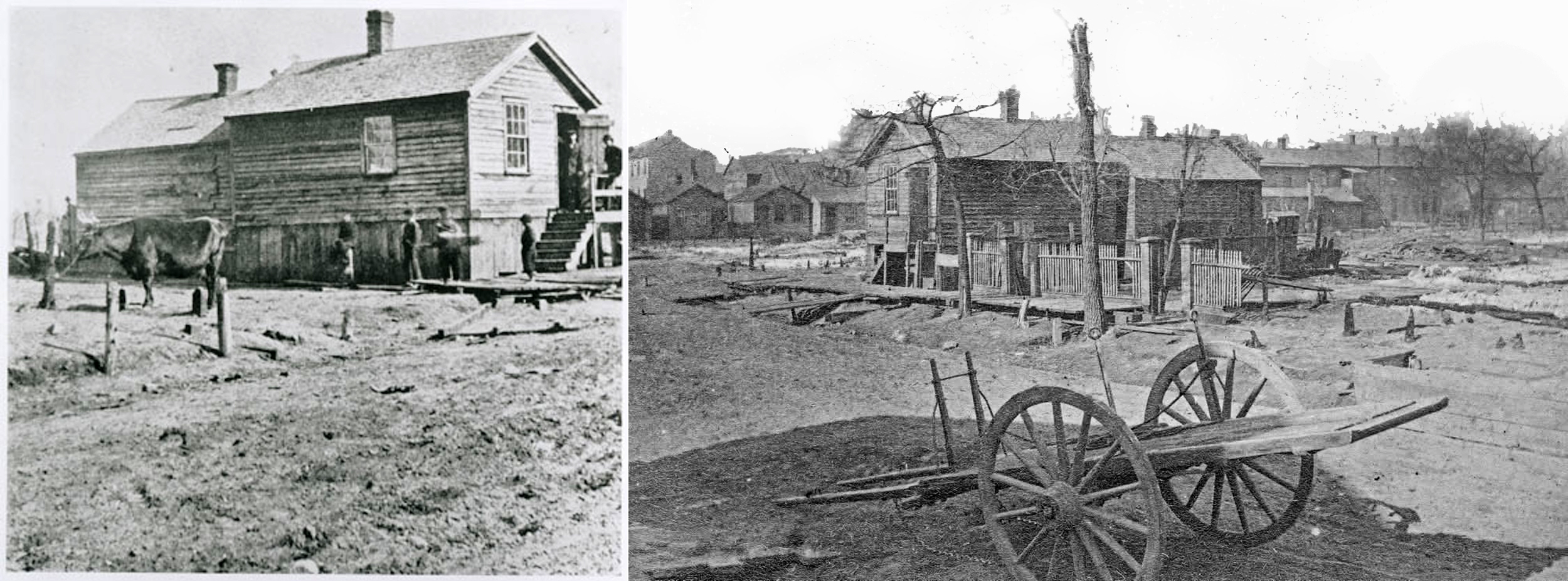
- The Leary property, after the Fire. At the time, farm animals were commonly kept within city limits to provide their owners with fresh milk, butter, eggs, and other products to eat or sell. Photograph by Joseph Battersby.
Chicago Evening Post, December 12, 1871
 The Board of Police and Fire Commissioners has made a report. Of course they have nothing new to disclose or even to suggest for this is an age when all valuable information of public affairs is first harvested and conveyed by that enterprising avant courier, the press The following is the official finding:
The Work Achieved.
The Board of Police as required by law have investigated the origin of the fire of October 8th and 9th. We have heard the sworn testimony of fifty-one witnesses and had the same taken down by a stenographer and subsequently transcribed. As written out it fills about 900 pages of foolscap paper. As a large part of this testimony was published in the daily papers as it was taken from day to day and as the original is on file for reference we deem it unnecessary to recapitulate the evidence to any great extent, but proceed to give the result of our investigation briefly and place it on record.
Where the Fire Started.
The Board find that the fire originated in a two-story frame barn in the rear of No 137 DeKoven street the premises being owned by Patrick Leary. The fire was first discovered by a drayman, by the name of Daniel Sullivan who saw it while sitting on the sidewalk on the south side of DeKoven street, and nearly opposite premises. He fixes the time at no more than 20 to 25 minutes past 9 when he first noticed the flames coming out of the barn.
Who Started It.
There is no proof that anybody had been in the barn after nightfall that evening. Whether it originated from a spark blown from a chimney on that windy night or was set on fire by human agency we are unable to determine. Mr. Leary, the owner, and all his family prove to have been in bed and asleep at the time. There was a small party in the front part of house which was occupied by Mr. McLaughlin and wife, but we failed to find any evidence that anybody from part of the house went near the barn that night.
Inter Ocean, May 18, 1881
The following was submitted:
Whereas, It is proper that the Historical Society should secure and preserve, as far as possible, the history, extent, and details of the great fire of 1871 and
Whereas, A new building is about being erected on the lot (137 De Koven street) where the fire originated; therefore,
Resolved, That a committee of three members of this society be appointed to take, that matter In charge, and use their discretion as to placing memorial tablet in the wall of this new buildIng on DeKoven street, with suitable inscription, and also to secure the erection of a suitably inscribed tablet or monument at or near the northern terminus of the great fire of 1871. The above was unanimously adopted, and Messrs A D. Hager. R. S. Critchell, and L. L. Coburn were appointed as the committee. The society then adjourned.

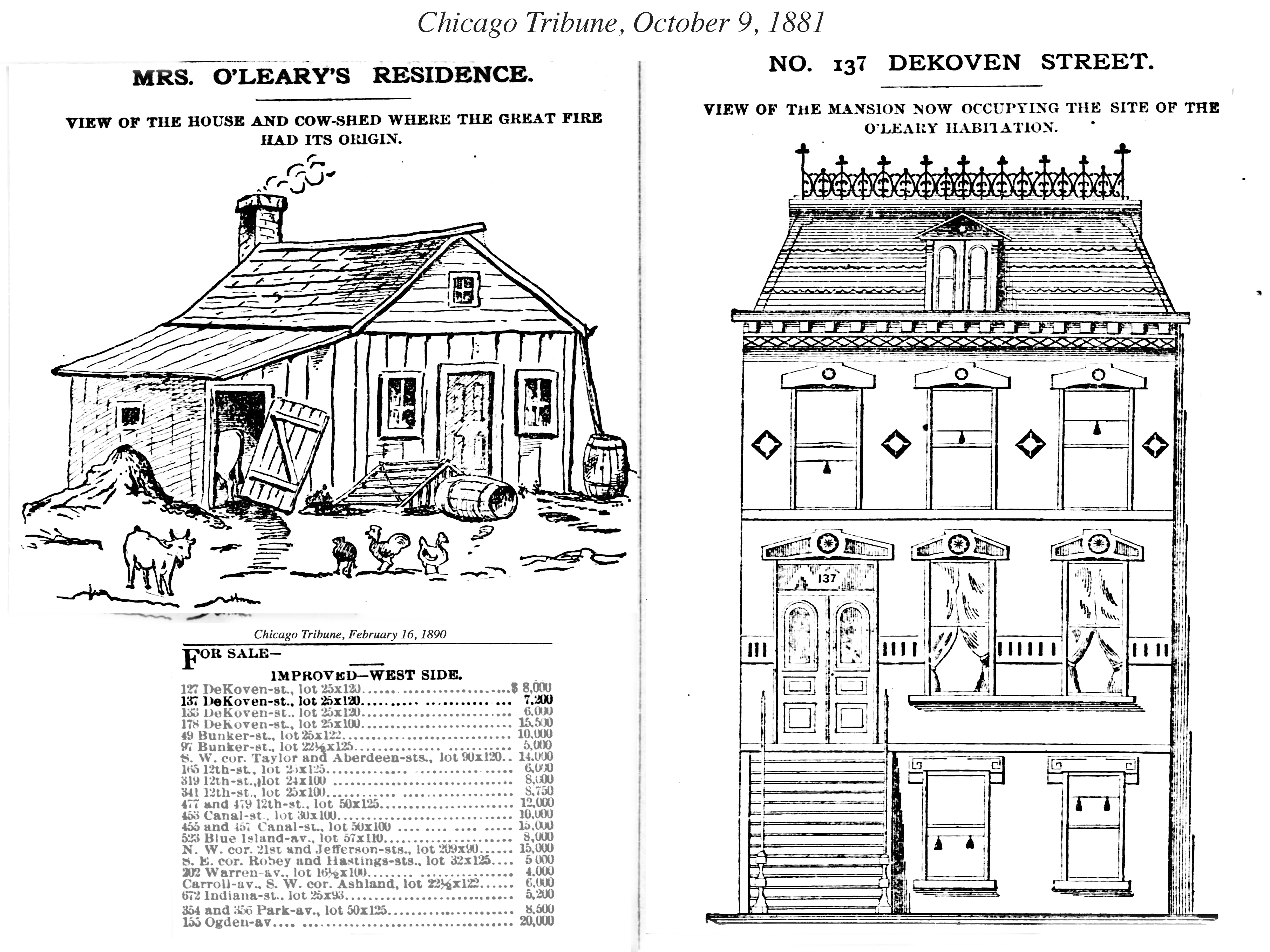
- LEFT: 137 DeKoven Street
Original Leary cottage from a stereograph by J. H. Abbott (1871),
RIGHT: Three story brownstone built in 1880
Chicago Tribune, May 25, 1894
FIRE ALLEY IS PAVED.
RENOVATING PROGRESS MAKES CHANGES IN AN HISTORIC SPOT.
On the West Side Where Mrs. O’Leary’s Cow Delivered Her Memorable Kick, Resulting in the Burning of Chicago, the City’s Workmen Spread Layers of Relic-Effacing Gravel of the Residents at the Presumptuous Alterations-The Tale of ’71.
One by one the historical landmarks of Chicago are obliterated by the soulless violence of the elements or the equally non-sentimental stride of civilization. The great cottonwood tree on Eighteenth street, which had been an object of almost idolatrous veneration to old settlers for over half a century, had hardly been prostrated by the winds when the city Street Department laid sacrilegious hands on the spot on which originated the great fire of 1871, and had the temerity to grade and pave the in the rear of Mrs. Patrick O’Leary’s historic residence on De Koven street.
This alley runs east and west between West Taylor street and De Koven, the next street south. Mrs. O’Leary lived on the north side of De Koven street midway between Clinton and Jefferson streets. She and her husband, Patrick O’Leary, came from Ireland and settled in Chicago away back in the ’50s. She came in a sort of Irish clan, including also the Markhams, the O’Briens, and the Whites, all of whom bought patches of land and erected cottages in the same neighborhood, and all whom eventually acquired considerable property. At that time their location was an open prairie, with only a house here and there.
Mrs. O’Leary’s location proved a good one and after erecting her cottage she built an annex to it, which was rented in 1871 to the family of Laughlins, who, with the aid of Mrs. O’Leary’s cow, burned the town down. After the fire Mrs. O’Leary rebuilt and lived on the same spot several years and then sold the property to Anton Koler, who built a fine stone front dwelling on the site and in 1890 sold it to Michael Suchy for $7,000. Both Koler and Suchy are Bohemians.
Geology of the Alley.
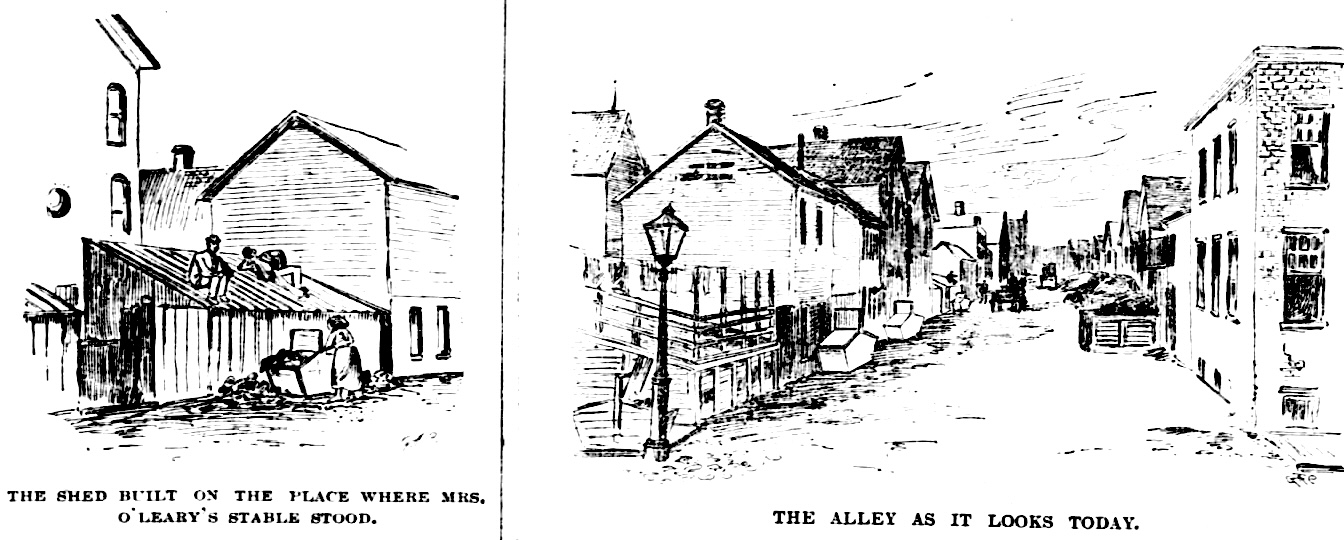
Since Mrs. O’Leary left the premises the adjoining streets and alleys have been graded three feet above the level of the lot. The grade of the alley was raised by the gratuitous and unsavory contributions of the abutting property-owners. Ashes, garbage, tin cans, and old garments for many years formed the top stratum of the geological formation.
This would probably have been the situation still but for the ravages of the small-pox in the Nineteenth Ward. But the pestilence set people to thinking about the filth of their streets and alleys and finally the city set work to grade, pave, and clean them.
It was with unfeigned grief that Mr. Suchy his neighbors contemplated any alteration in such a historic spot. The alley was last characteristic remnant left of 1871 civilization, and its very odors had become ennobled and consecrated in their estimation. The razing of a medieval castle would not affected them like the cleaning up and paving of this alley. But civilization, relentless and aggressive, trampled on their local sentiments traditions, and a nice block gravel pavement was finished yesterday. Mr. Suchy has to climb three steps to reach it his back-yard.
On the back end of the lot is a low-browed stable, which. though old, is only the lineal descendant of the stable in which the Laughlins and Mrs. O’Leary’s cow waltzed around the straw until the cow kicked over the kerosene lamp and sealed the fate of Chicago. Mr. Suchy looked at his stable with tears in his eyes yesterday as he conversed with a reporter for The Tribune, and said that he watched day and night lest this stable should start another fire.
The news of the paving of this alley will be pleasant reading for Mrs. O’Leary, who most people suppose to be in the heavenly world, but who is still a resident of the city which she gets the credit of having burned to the ground. Her home is in the neighborhood of the Stock-Yards, where she lives with her husband and her son at the good old age of 65, as happy as most people but extremely averse to notoriety.
Mrs. O’Leary’s Odd Traits.
Dr. Swayne Wickersham1 said to a reporter for The Tribune yesterday:
- I came to Chicago a short time before Mrs. O’Leary and was her family physician for fifteen or twenty years. She is a remarkable character and a typical Irishwoman. When I first knew her, and for years afterward, her business was peddling milk, carrying the milk-can in her hand. She was a strictly honest and afraid of debt. She kept her money in an old sock, and paid me for every professional visit I made before I left the house.
It would be impossible for me to describe to you the grief and indignation with which Mrs. O’Leary views the place that has been assigned her in history. That she is regarded as the cause, even accidentally, of the great Chicago fire is the grief of her life. She is shocked at the levity with which the subject is treated and at the satirical use of her name in connection with it. As she has told me a thousand times, she was in bed asleep when the fire broke out, and the blaze was occasioned by her tenants, the Laughlins, breaking into her stable and attempting to milk her cow. That she has been substituted for the Laughlins she attributes to the Chicago press, for which she entertains the bitterest hatred. She admits no reporters to her presence, and she is determined that whatever ridicule history may heap on her it will have to do it without the aid of her likeness. Many are the devices that have been tried to procure a picture of her, but she has been too sharp for any of them. No cartoon will ever make any sport of her features. She has not a likeness in the world and will never have one.
“When the cyclorama of the burning of Chicago was first opened here the proprietor made a determined effort to use Mrs. O’Leary as an advertisement, and I did what I could to help him. We rode to her house together in a carriage, but Mrs. O’Leary would not even admit the proprietor to the lot. She was glad to see me, however, and I laid the matter before her in the most seductive way I could. I told her the proprietor wished to employ her husband at a good salary to do odd jobs about the building on the condition that she should sit where she could be seen and sell her likeness for her own profit. I was also authorized to offer her a large sum of money, if necessary, to close the engagement. But the proposition only struck her with horror and disgust. She said she was not in need of money, but even if she was there was not money enough in the world to pay her to do such a thing. There was nothing left but for me to beat a retreat and nothing left for the cyclorama but to get along without her.
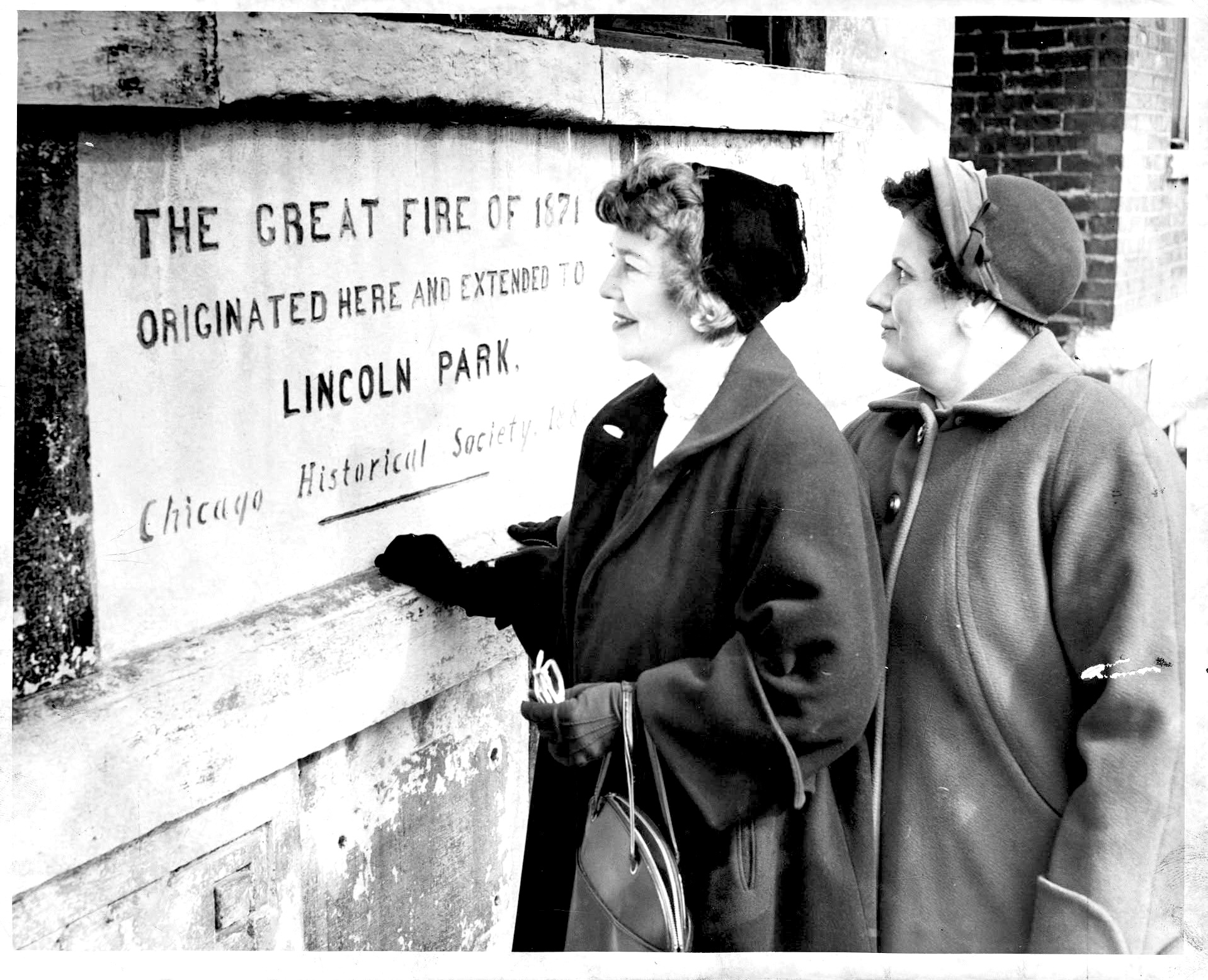
The spot on which Mrs. O’ Leary’s humble cottage once stood is now occupied by a handsome three-story, stone-front building known as No. 137. Between the window of the first and second stories is a large stone tablet, at which some one is always gazing, and on which is the following inscription:
THE GREAT FIRE OF 1871 ORIGINATED
HERE AND EXTENDED TO
LINCOLN PARK.
CHICAGO HISTORICAL SOCIETY, 1881.
Inter Ocean, October 19, 1881
The Committee on the Great Fire reported the placing a taolet in the new building erected at 137 De Koven street, the starting point of the pre, with the following inscription:
THE GREAT FIRE OF 1871 ORIGINATED
HERE AND EXTENDED TO
LINCOLN PARK.
CHICAGO HISTORICAL SOCIETY, 1881.
Chicago Tribune, April 26, 1891
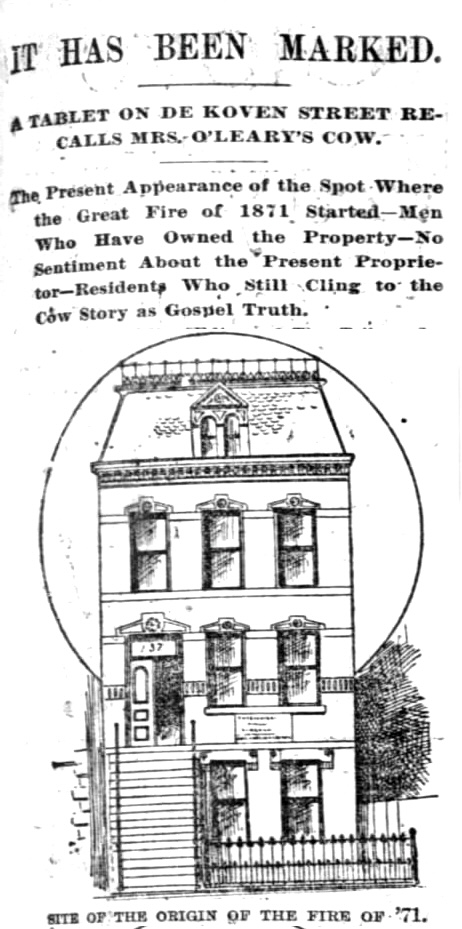
- CHICAGO, April 22.—(Editor of The Tribune.)—It seems to me that an explanatory tablet ought to be placed as nearly as may be on the site of the barn in which Mrs. O’Leary’s cow performed the feat of knocking over the this now historic lamp. As every one knows, great growth of this marvelous city began began from that hour. There will hardly be a visitor to the Columbian’ Exposition would not find of satisfaction in visiting the spot. The propriety of enabling visitors to “dilate with proper. emotion,” or in other words to make sure as that well as they were visiting the spot in question, as well as an expression of proper of the conduct cow that “builded wiser than she knew,” seems to me to alike suggest the erection of such a tablet. Respectfully, John De Will Miller.
The Tribune is enabled to comply in part with the above request. It herewith presents a cut of the house now standing on the site of the O’Leary cottage. A rear view of the premises is also given; the cut representing the barn is from a picture taken on the spot. The spot is the same on which stood the barn that contained. the cow that kicked the lamp that fired the City of Chicago. Whether there that is any place on which an explanatory. tablet such as that referred to by the correspondent could be located is a question for the directors of the World’s Columbian Exposition.
The house, a picture of which is given, stands at No. 137 De Koven street. It is a two story and basement brick, with gray stone front, and is occupied at present by four tenants. On the front of the building is a marble entablature containing an inscription, of which the following is a copy:
THE GREAT FIRE OF 1871
ORIGINATED HERE AND EXTENDED TO
LINCOLN PARK.
How many residents of Chicago, especially the new generation, have ever visited this spot? How many would know without inquiry how to reach it? The, shortest and most direct route by street-car is the Canalport. avenue line. The cars leave Randolph and State streets, and run west to Clinton street, south on Clinton to Harrison, east on Harrison to Canal, and south on Canal. The curious who may be in search of the site where the great fire originated will leave the car at De Koven street, provided he looks out for name of the street on the lamps or can induce the conductor to tell him when he arrives at that point. Having left the car the visitor walks west on De Koven street to No. 137, which is between Clinton and Jefferson streets.
If the visitor is familiar with German, Bohemian, Hebraie, or Italian he will have no difficulty in hearing all the gossip about the origin of the fire, Mrs. O’Leary, and the early incidents of a conflagration the light of which directed the attention of every nation on the face of the earth to Chicago.
The man who lives in the basement of this house, as well as the other tenants with whom the writer came in contact, was unable to understand the simplest query or to give any intelligent information concerning the historic spot. The dirty-faced children, whose only playground is the unswept street and the sidewalks, totter about and gaze with curious look upon a newcomer. If the newcomer stops to talk to them they stand still for a moment and then scamper away, hiding in the hallways or in the alley.
There is a butcher-shop on the corner of South Jefferson and De Koven the streets corner which has been standing there ever since the night the fire. It is owned and was established by Hynek Kleker. Mr. Kleker has retired from business and turned over the shop to his son. The latter speaks English and informs the tourist that he was 2 years old the very night on which Mrs. O’Leary’s cow kicked over the lamp. He says that he has no recollection of the event, but that his father, who is in bed up-stairs, knows all about it. The expedition in charge of The Tribune called The upon Kleker Sr., and was conducted to his bedside by his daughter, a typical German lass, who kindly acted as interpreter. Through her Mr. Kleker told the following story, a good deal of which is problematical, and will not be new to the old settler”
“The ground old on which the O’Leary cottage stood was purchased by Patrick O’Leary and wife from Cyrus Clark and his wife March 24, 1864, for $500. It was mortgaged by O’Leary the same year to Mr. Kerfoot. The 9th of December, 1879, O’Leary and wife sold and conveyed the property to Anton Koler and wife. The 23d of July, 1881, the Kolers sold the property to Joseph Smause, and two days after Smaus conveyed it to Koler and wife. April 15, 1890, Koler and wife deeded the property to the present owner, Michael Suchy, for $7,000.”
It is quite evident that no sentiment has entered at any time since it became famous. property of the which The owner his permission to is now Historical standing.The owner of the building, which is now standing, gave his permission to the Historical Society to place the tablet above mentioned on the front of the building in consideration of the payment to him in cash of $500.
Mr. Kleker’s Faith in the Cow Story.
Mr. Kleker was asked if he had any personal knowledge of the origin of the great fire among other things with which the world is familiar.
He entered with considerable interest as if he were telling the story for the first time, upon the events which took place in and about Mrs. O’Leary’s premises the night of the fire. He said that Mrs. O’Leary had arranged to give a party; that at a certain hour the alarming information was given out that the house was short on milk. A young lady who was present as an invited guest said, that as Mrs. O’Leary was a dairy woman she ought to have a cow. and that she, the guest, would go out and milk one. Mrs. O’Leary consented to this, and the young lady took a pail in one hand and a tin lantern in which there was a lighted candle in the the other and went out to the barn in the rear of the house. She put the lantern. with down near a pile of hay. Being unfamiliar with the modus operandi of milking, she approached the cow from the wrong side. It was this that caused the kick of the cow. The young lady was knocked over, and in falling struck lantern and the lighted candle ignited the hay. Before the young lady could recover her senses the fire was under headway, and the world knows the rest.
Mr. Kleker says that he is aware that Mrs. O’Leary denied this story, denied that Fire Marshal Bob Williams also denied it in his report, and that many others have sought to rob this story of its romantic beginning. But Mr. Kleker is positive that the cow started the fire. He was at the house of Mrs. O’Leary when arrangements were being made for the party, and the cow story was started that night.
The cow was destroyed in the fire, but her progeny, a young calf, escaped, although in doing so its ears and hair were burned off. On the following day after the fire, the calf having no means of sustenance, Mrs. O’Leary sold it to Mr. Kleker who slaughtered it and sold it as veal. Mr. Kleker’s great regret in life is that he did not save the hide of that calf and have it stuffed. He sees now where it would have made him independently rich. It must be admitted that the stuffed calf of Mrs. O’Leary’s cow, the one that kicked the lantern that started the fire, would prove a drawing card at the World’s Fair.
Mr. Kleker’s daughter informed The Tribune expedition that many strangers visiting the city daily to see the house in question. She said that as many as fifty a day stopped front of the house and then came over to in the butcher shop and asked all sorts of questions about the origin of the whereabouts of Mrs. O’Leary. The old lady is living near the Stock-Yards and is often seen about the place which her name has helped to make famous. She seems to take a pride in visiting the neighborhood and in being pointed out, but she always indignantly resents every allusion to the conflagration and especially that part of it in which her cow figured.
There are several persons living in the vicinity at the present time who were there at the time of the fire.. Their names are Schultze, Malai, a Mrs. Sullivan, and a Mrs. White.
The Man Who Started the Cow Story.
The reporter who started the cow story in connection with the great fire is said to be living in this city at the present time. On the occasion of the event of ’71 he was the Chicago correspondent of the New York Herald.
It is understood that he still maintains that cow story was correct. There was another correspondent, James Coulson, in Chicago the night in question. He wrote the story of the Chicago fire for the New York Herald. His clothing caught fire while he was on duty, and as water was scarce he had to jump into the lake to save his life. On coming out of his bath, he caught the first train from Chicago to New York, and presented himself to the New York Herald for work.
Being fresh from the scene, he was put to work writing an account of the fire. His story covered claimed a page of the New York Herald it is that his story was the first one of the event ever printed in the East. It was copied on the following day by the New York Sun, due credit being given the Herald. Coulson became connected with the Heraid city staff and died in New York twelve years ago.
Chicago Tribune, September 17, 1894
WAKE OF PATRICK O’LEARY SUGGESTS THE CHICAGO FIRE.
He Was 75 Years Old and Apparently Hale When Overtaken by Death, Saturday Evening—Mrs. O’Leary Survives in Regard to the Him-Both Sensitive and Dislike to Discuss It
There were many old-time “Kerry men” at the wake at No. 5133 Haisted street last night, where Patrick O’Leary, whose name will always be identified with the great Chicago fire of 1871, lay in his coffin. O’Leary died suddenly, on his own threshold, about 6 o’clock Saturday evening. He was 75 years old, but still hale and and hearty for a man of that age. He had been down-town and stepped off the car in front of his home at exactly 6 o’clock. He must have felt a warning of coming death, for instead of going around to the side door he started in the front, but fell on the stoop. His children, with whom he lived, came out and found him on the little stoop. He was still breathing but unable to speak. They carried him into the house, but he was dead before they placed him on the couch in the room behind the parlor.
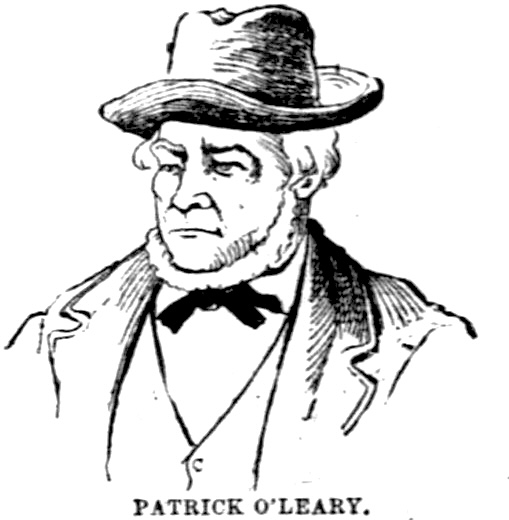
In this way went out the life of a man whose personal history is as inseparable from that of Chicago as is any part of the history the great fire of 1871. He lived at No. 137 De Koven street the eventful night of Oct. 9, and the fire that destroyed Chicago was started in the cow shed in the rear of his home. The family, cow was being milked, and, becoming restless, kicked over the lamp which was furnishing the light for the operation. In a moment the flames wrapped building and everybody in Chicago knows the rest.
O’Leary was of fine old Irish stock. He was born in County Kerry and raised as a laboring man. He married his wife, who survives him, in Cork about the year 1845, and moved at once to the United States, a few years after the birth of their first child. He was a soldier in the War of the Rebellion, having enlisted from his home at Harrisburg, Pa., where he first settled on coming to this country. Soon after the war he came ‘to Chicago, where the three children who survive him were born. They are James, Kate, and Patrick, all adults and all married. O’Leary moved from De Koven street soon after the great fire and had lived many years in the house where he died.
Mrs. O’Leary is 76 years old, and quite feeble. They were both very sensitive about the incident of the great fire with which they were connected, refusing steadfastly to discuss it with any one. Arrangements have been made for the funeral at Mount Olivet this morning.
Chicago Tribune, September 18, 1894
Funeral of Patrick O’Leary.
Patrick O’Leary was buried yesterday. Father McGuire celebrated high mass at the Visitation Church, Fifty-Fifth and Peoria streets, at 10 o’clock, after which the body was taken to Mt. Olivet. The pallbearers were: Thomas Finley, John Linksi, Michael Griffin, John O’Day, Joseph Griffin, John White, Philip Gleason, and Michael Godfrey. Mr. O’Leary lived at No. 5132 Halsted street, and was the husband of Mrs. O’Leary whose cow has been charged with causing the Chicago fire of 1871.
Chicago Tribune, July 4, 1895
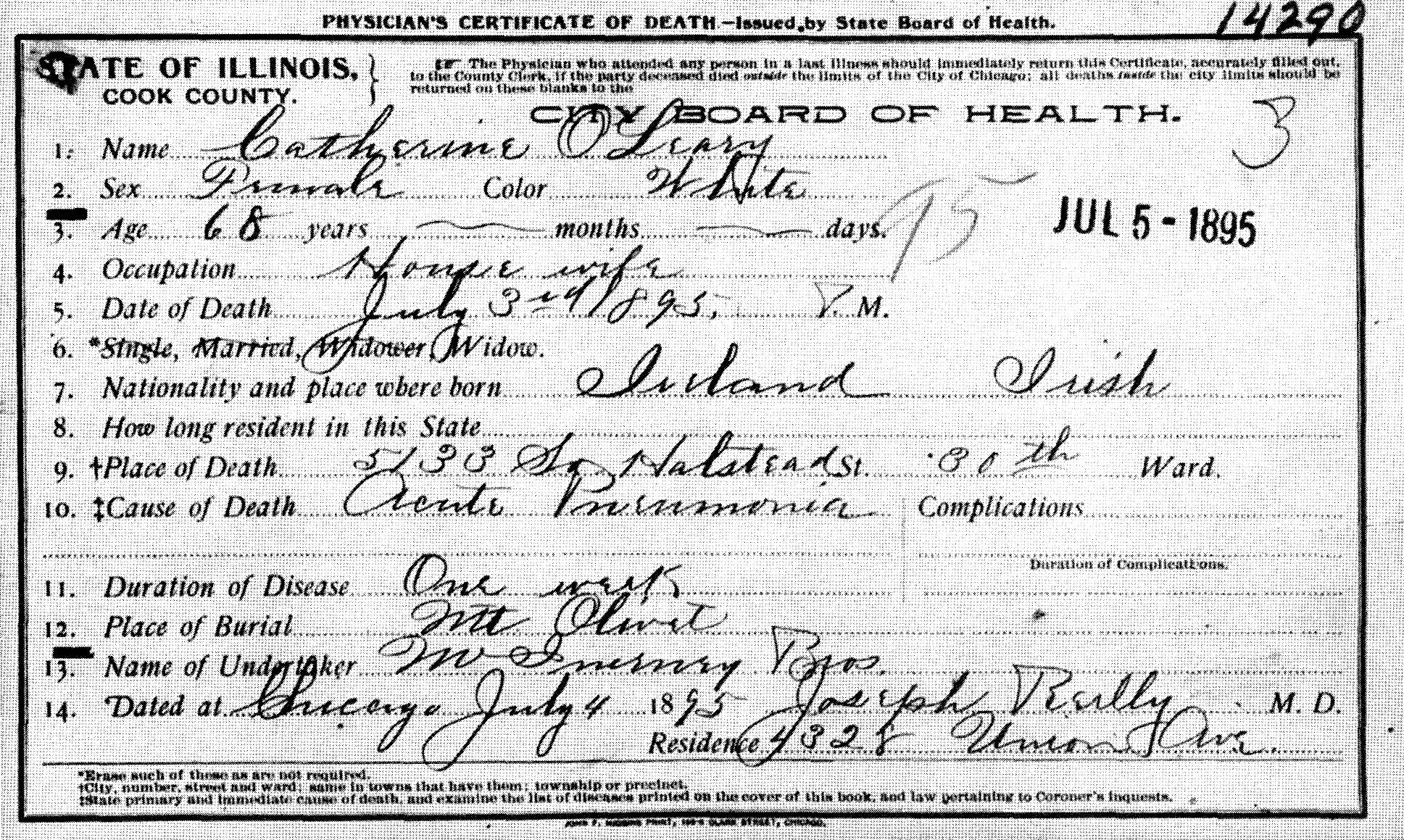
MRS. O’LEARY IS DEAD
She Was Noted Principally Because of Her Cow.
That Milk Producing Animal Caused the Fire That Devastated the City in 1871—Friends Try to Make It Appear That the Deceased Had No Connection with the Famed Bovine—Funeral to Take Place Saturday, the Interment to Be at Mount Olivet.
Death yesterday afternoon forever sealed the lips of Mrs. Catherine O’Leary, owner of cow that the night Oct. 9, 1871, kicked over the lamp which started the fire that devastated Chicago. She died at No. 5133 South Halsted street of acute pneumonia.
For the last three or four years she has been suffering from chronic bronchitis and has been for a greater portion of that time confined to her house. Four days ago she contracted a cold which developed into pneumonia and the end was sudden yet peaceful.
She will be buried Saturday morning from the Church of the Visitation, Fifty-fifth and Peoria streets, where requiem high mass will be celebrated. The remains will be interred in Mount Olivet Cemetery by the side of those of her husband, Patrick, who dropped dead Sept. 15 last.
Up to the time of the fire Mrs. O’Leary had never had her picture taken. After she was famous she steadfastly refused all inducements to let her portrait be made, though some of them must have been exceedingly tempting. Nor wouid she taik of the story even with her friends. To newspaper men her lips were sealed. She hated reporters. and so did all her kith and kin. Last night people at the house told a reporter for The Tribune that the Mrs. O’Leary who was dead had only been over from Ireland a few years. Undertaker McInerny and Dr. Joseph Reilly, who attended her, however. said she was the famous Mrs. O’Leary beyond question.
Chicago Chronicle, July 5, 1895
FAMOUS MRS. O’LEARY DEAD.
HER COW CAUSED CHICAGO’S FIRE.
Mrs. Catherine O’Leary, to whom history has ascribed the ownership of the memorable cow that was the cause of the great Chicago fire in October, 1871, is lying dead at 5133 South Halsted street. Wednesday afternoon acute pneumonia put an end to a life unsought notoriety had long embittered. A solemn requiem mass will be celebrated at the Church of the Visitation, Fifty-fifth and Peoria streets, Saturday morning and she will be laid to rest by the side of her husband at Mount Olivet. Mrs. O’Leary has been living at the house in which she died for eight or nine years. She was 68 years old.
“I have been in this parish only six years,” said Father J. B. Feely, acting pastor of the Church of the Visitation parish, yesterday, “but I have frequently heard Father McGuire speak of the dead woman as the innocent author of the historic Chicago conflagration. She and her husband—who died in September last—were a good and simple couple, and the newspaper notice to which her connection with the fire gave rise was always a most painful subject. It was a topic most carefully avoided and her fear of having her picture published made her absolutely refuse to have any photograph taken. She will be buried with all the honor and solemnity the Catholic church can give. Her sons are well off and can afford to do it.”
At the house where she died, which is a single story frame, with green shades and bath brick color blinds, all, of course, closely drawn, many friends of the family assembled yosterday, and amid the noisy celebrating and surroundings of Independence day, discussed the life and virtues of the dead. She leaves three children, two sons and a daughter, the latter and one of the sons being engaged in the restaurant and saloon business. Mrs. O’Leary always denied in the strongest terms the truth of the popular story that a cow that was being milked in a barn in the rear of 137 De Koven street had kicked over a lamp and so originated the $192,000,000 fire and its attendant loss of life. She even made a sworn statement denying it, but outside evidence and the force of public opinion have always been strongly against her denial. That being so, she refused to discuss the matter further, and has lived retired and silent. Now that Mrs. O’Leary Is gone, in recalling her name Chicagoans may remember that even if she were the innocent cause of that great fire, with the consequent immense loss of life and property, still it is also to her innocent instrumentality that the city owes an improvement in value a hundred times greater than what was destroyed in that awful conflagration.
The Day Book, June 29, 1912
Jerry Peters, 70, 558 DeKoven st., on site of Mrs. O’Leary’s barn, where the Chicago fire started, hanged himself. Desponden over lack of employment.
Chicago Tribune, October 19, 1921 and New York Times, February 21, 1927
Last of Chicago Fire Reporters Dies.
Michael Ahern, last surviving reporter of the famous Chicago fire of 1871, and who denied the authenticity of the story of Mrs. O’Leary’s famous cow which was credited with kicking over a lamp in a barn and starting the fire, died here tonight.
In 1921 Ahern, In writing an anniversary story of the fire said that he and two other reporters, John English and Jim Haynie, concocted the explanation of the cow starting the fire, and admitted that he afterward learned that spontaneous combustion of hay in the O’Leary barn probably was the cause. At the time of the fire Ahern was a police reporter for The Chicago Republican.
“I wish to state that the fire was not started by Mrs. O’Leary’s cow kicking over a lamp. Nothing of the kind occurred. That version of the origin of the fire was a concoction which the writer of these reminiscences confesses to a guilty part. In justice to the maligned animal and to Mrs. O’Leary, who died many years ago, I make this belated reparation.”
Chicago Tribune, October 9, 1936
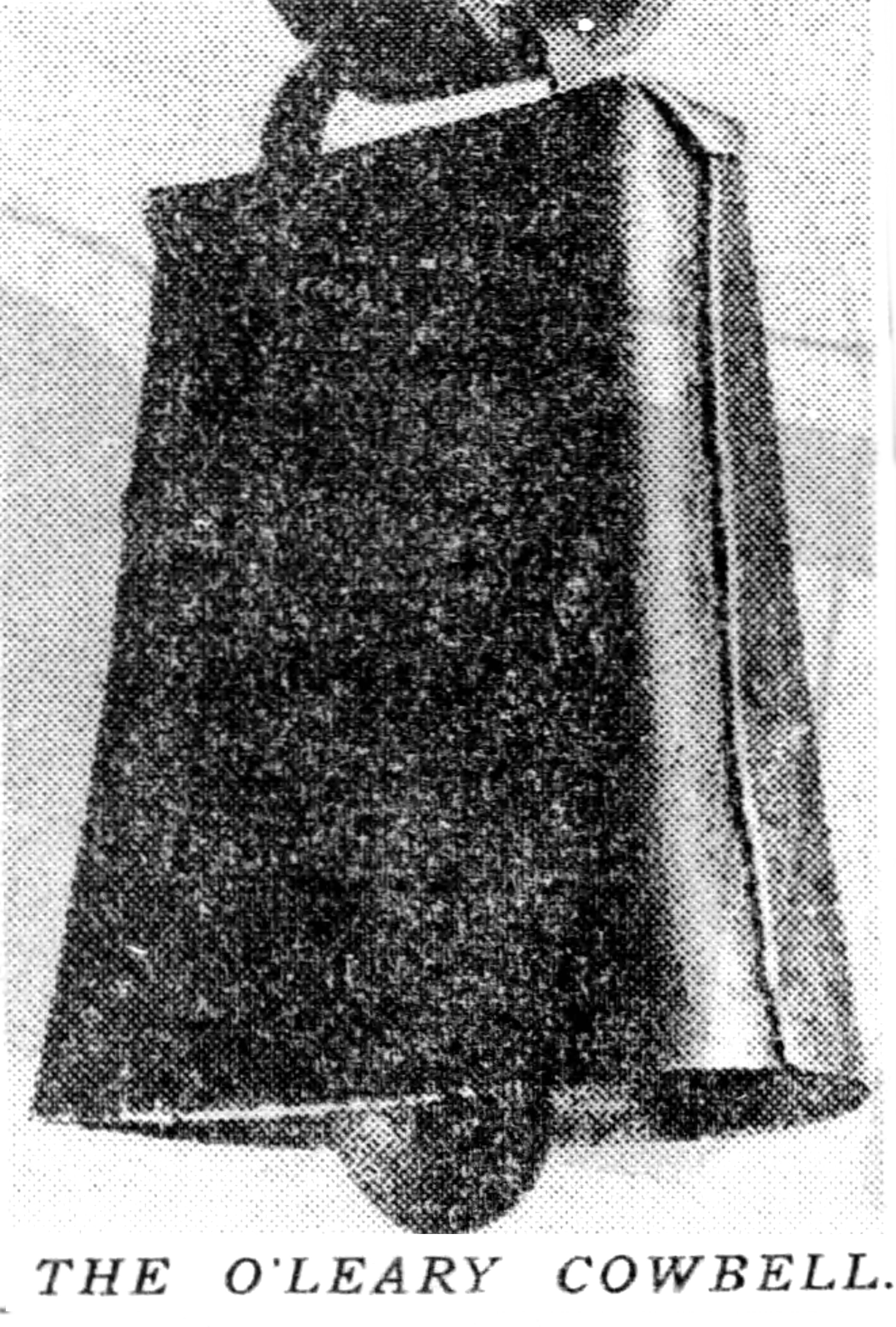
THE O’LEARY COWBELL.
A blackened cowbell, picked up in the ruins of the O’Leary stable back of 558 DeKoven street on Oct. 9, 1871, now is in possession of John D. Lamb, a Payne, O., merchant, it was learned yesterday. The bell is the one worn by Mrs. O’Leary’s much maligned cow—the first casualty of the great Chicago fire.
The relic of the conflagration was acquired two years ago by Mr. Lamb, after it had been in the family of Frank G. Pearson for 63 years. Mr. Pearson’s parents were neighbors of the O’Leary’s and purchased milk from them. On the night of Oct. 8, 1871, Mr. Pearson was spending a leisure hour in a fire station near State and Congress streets, and when the first alarm came in he accompanied the fire fighters to the O’Leary home. Being a collector of curios he went back the next day, found the bell and received Mrs. O’Leary’s permission to keep it.
A history of the souvenir, which Pearson wrote a few years later, contained the legend that the conflagration was started when the kicked over an oil lamp. Although generally believed at that time, the lamp theory has been disproved through research by the Chicago Historical society.
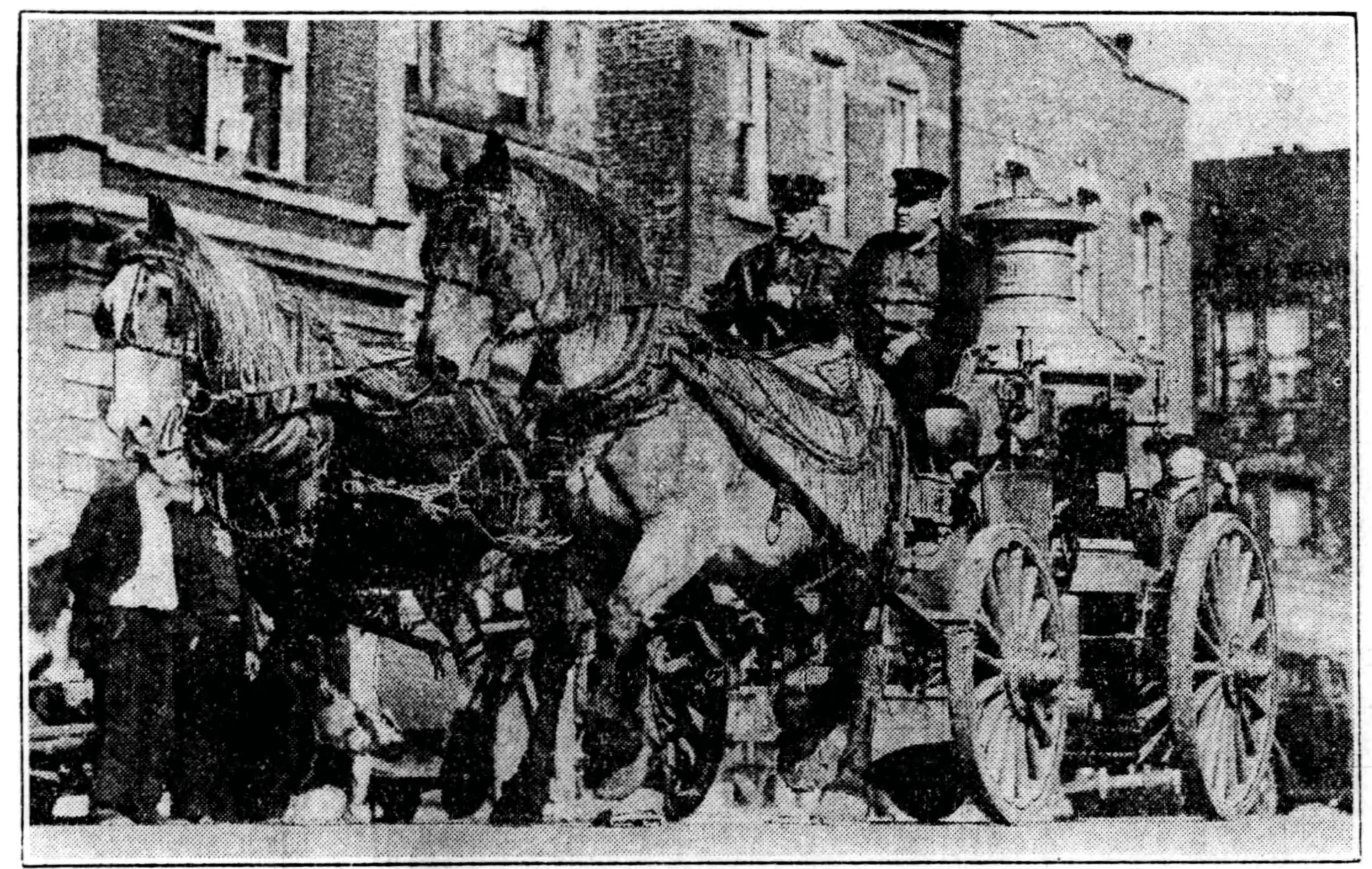
- CHICAGO OBSERVES 65TH ANNIVERSARY OF ITS GREAT FIRE
Horses and fire engine of the ancient type in front of 558 DeKoven strect yesterday, the 65th anniversary of the start of the great conflagration. The fire started at this address when Mrs. O’Leary’s cow kicked over a lantern. City and fire officials took part in observance.
Chicago Tribune, August 30, 1955
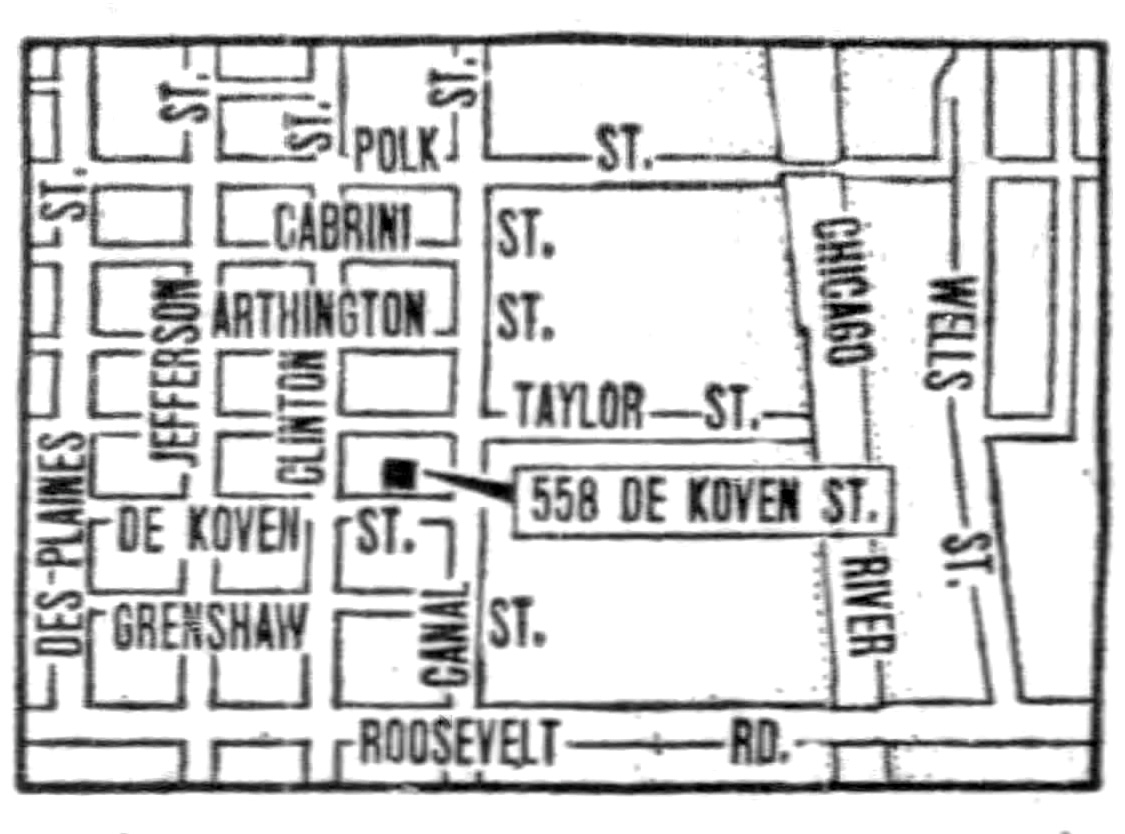
Daley Favors Holding Site Made Famous by ’71 Fire.
Mayor Daley said yesterday he hoped the city would retain property at 558 DeKoven st., where, Mrs. O’Leary’s cow is said to have kicked over a lantern that started the Chicago fire of 1871. He said some type of monument should be erected there.
This piece of property is in a 52 acre tract, bounded by Polk st., Canal st., Roosevelt rd., and the proposed south super-highway, which the Chicago land clearance is acquiring for resale for industrial development.
The city acquired 558 DeKoven st.
in 1928 for $36,000 and planned a memorial park there. But the park did not materialize and the property was sold to the land clearance commission last year for $6,500.
Willing to Return Land
Daley said he talked to members of the land clearance commission and they are willing to turn back the property to the city. The first thing to do is to obtain the property, then decide what type of monument is to be erected and how it will be financed. He invited suggestions as to the type of monument.
W. A. Keplinger, an attorney, has suggested a six sided monument with bronze plates containing names of Chicago firemen killed in action. He proposed a fire station be erected adjacent to the monument, possibly to replace an old station at 559 Maxwell st. He suggested that the firemen there could look after the monument. Tony Galente, retired Loop news dealer and for many years a resident at 723 DeKoven st., has proposed a garden with a monument in the center.
Likes Firehouse Plan
Daley expressed interest in Keplinger’s fire station proposal. He said the city might even construct a replica of the O’Leary home, and use it as a fire museum.
He said funds for the monument might be obtained from a million dollar trust fund left the Art institute for monument construction by Benjamin F. Ferguson, Chicago lumberman who died in 1905.
The land at 558 DeKoven st. is occupied by a two story building.
Chicago Tribune, October 5, 1961
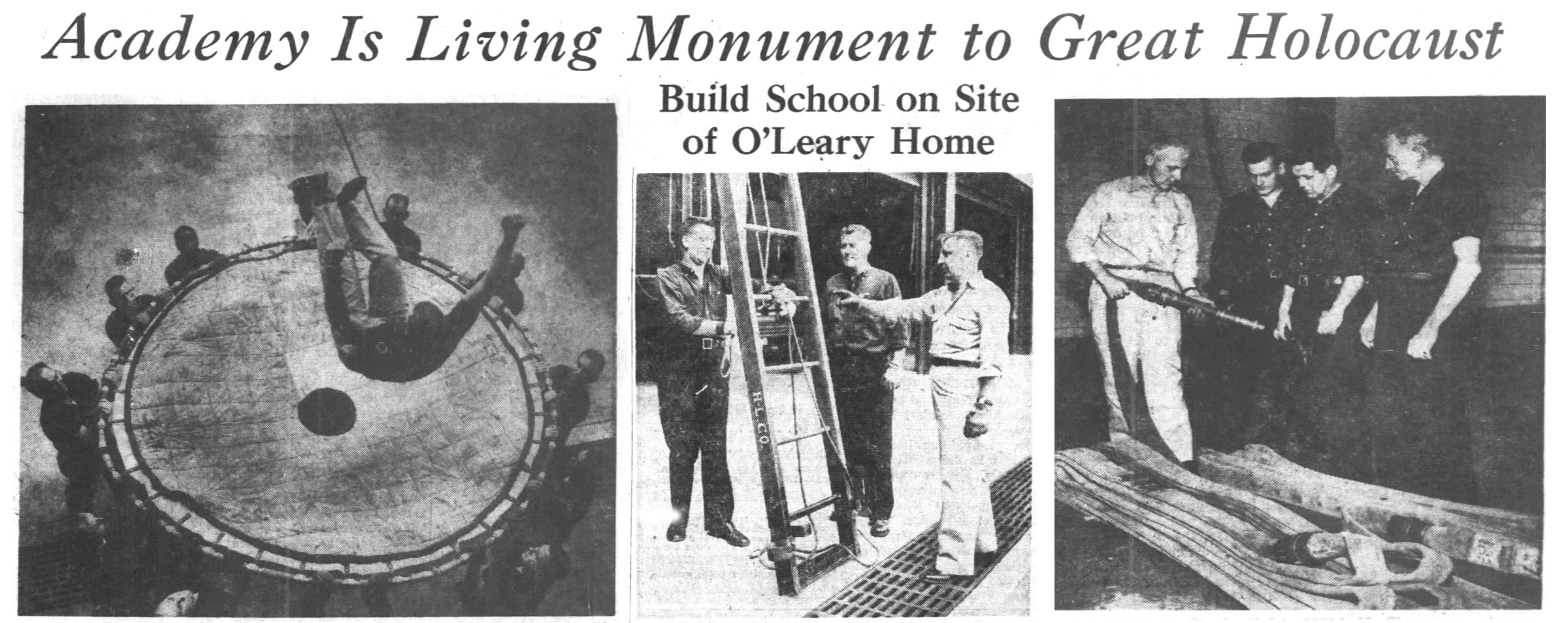
- LEFT: Dona d Woltas, 5149 Roscoe st.. a f\recruit, practices jumping from window into a life net. Net, used in many rescues, has 32 compression springs, is 9½ feet across, and has a bulls-eye in the middle.
MIDDLE: Alex Derzinski (right), 6804 Tripp av., academy instructor, drills Robert Bartlett (left), 3251 North av., and Arthur Court, 2719 Trumbull av., in how to tie a knot to hold the upper portion of an extension ladder.
RIGHT: Lt. Frank McGinnis (left), 6221A N. Cicero av., gives refresher course in hose evolution to Harry Farrell, 8219 Kimbark av.; Lee Malloy, 8201 Green st.; and Martin Durkin, 10192 Winston av. Firemen are participating in a program for veterans at the academy.
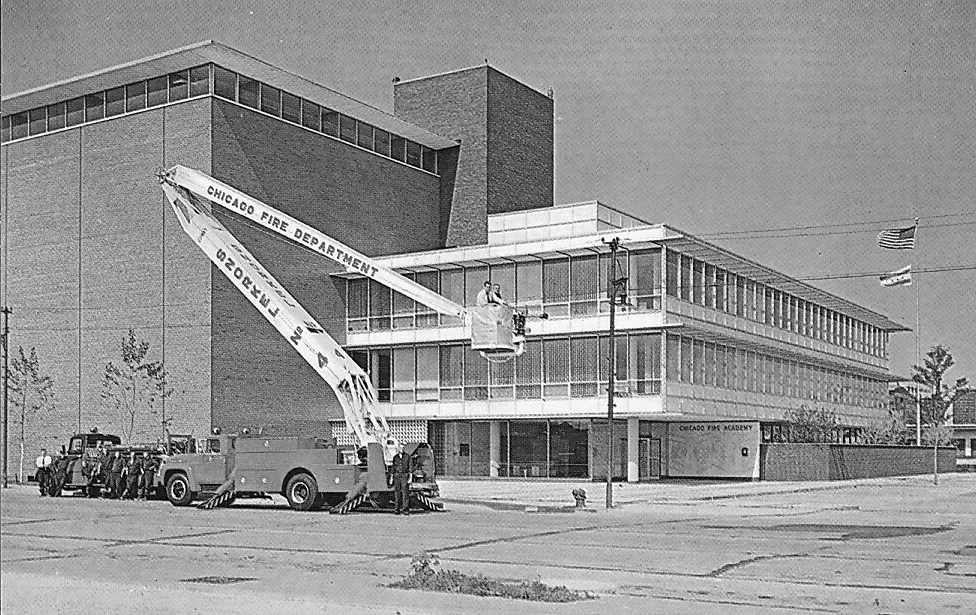
The finest of monuments stands at 558 DeKoven st. Neither an elaborate statue nor a meaningless tower of stone, it is a guarantee to the citizens of Chicago that the holocaust of 90 years ago never, again will be repeated.
This is the new Chicago Fire academy, built on the site once occupied by old O’Leary house where the family cow allegedly kicked over a lamp and started the Chicago Fire of Oct. 8, 1871.
City Reduced to Ashes
Ninety years ago Monday and for two days after, the city was reduced to ashes. A cautious estimate placed the damage cost at 192 million dollars.
At the time of the fire the city limits were Fullerton avenue on the north, 39th street on the south, and Western avenue on the west. Within this area, 17,450 houses were destroyed, 104,500 persons left homeless, and 2,104 acres burned.
Only 20 years after the fire, the fire department had a force of 917 officers and men, 65 steam engines, 21 chemical engines, 87 hose carts, 26 hook and d ladder trucks, three fire boats, 390 horses, and 90 apparatus stations. The department was reputed to be the best equipped and most efficient in the entire country.
3 Campus Buildings
The pride of today’s fire fighters is the 2 million dollar academy, called the most comprehensive fire training school built anywhere, with facilities for training recruits and teaching modern innovations to veterans.
The three buildings on the academy campus provide facilities for four phases of instruction. The recruit phase gives 60 days of basic indoctrination in ladder and hose drills, rope sliding, and rescue techniques.
In the second phase, companies in the field are brought to the academy at a rate of four a day for company drills and instruction in new fire fighting ideas.
Classroom Study
The third phase is an officers’ school which includes classroom study of electrical fires, petroleum fires, sprinkler systems, and radioactive materials. Some 30 officers at a time attend the five day school.
A fourth aspect is the school for engineers or pump operators. Some 20 a week are schooled in such areas as fire pumps and simplified hydraulics thru field problems and lectures.
Chief Curtis Volkamer, division marshal and drillmaster, said about 100 trainees could use the drill yard at one time while more than 80 men were engaged in classroom work.
Cite Dangers
In inclement weather, classes move into a large drill hall, five stories high and big enough to allow snorkel practice. Also inside the hall are actual water hydrants and fire escapes for practice sessions.
One of the most dangerous training periods is the drill using pompier ladders. Pompiers are used in rescue or entry and must be accomplished above the reach of aerial ladders.
Standing on one window sill, a fireman hoists the small pompier ladder to the next window and hooks it on the sill. By climbing the ladder and straddling each sill, he can reach extremely high floors.
Practice Jumping
Chief Volkamer said a good fireman is strong “but not necessarily a big brute of a man.” He said some of the best recruits are slender but agile.
One drill calls for the lifting and placing next to a window a 50 foot Bangor ladder, weigh- | ing 385 pounds. In a matter of seconds, six men can raise this extension ladder to the fourth floor. Firemen are trained to secure the extension with a special knot which keeps it from slipping when as many as three persons come down the ladder at one time.
Firemen also practice jumping into a life net. This net, used in many rescues, contains 32 compression springs with a bullseye in the middle. The men jump in sitting position from a window into the 9½ foot target.
Chosen As Monument
Before completion of the new academy, the men trained in a small building at 720 W. Vernon Park pl. As early as 1955, Mayor Daley announced the facility was inadequate for city the size of Chicago.
When plans for the South expressway were approved, the school lay in the path of the proposed superhighway. The new location was chosen as a monument to the great fire.

- 137 DeKoven Street
Robinson Fire Map
1886
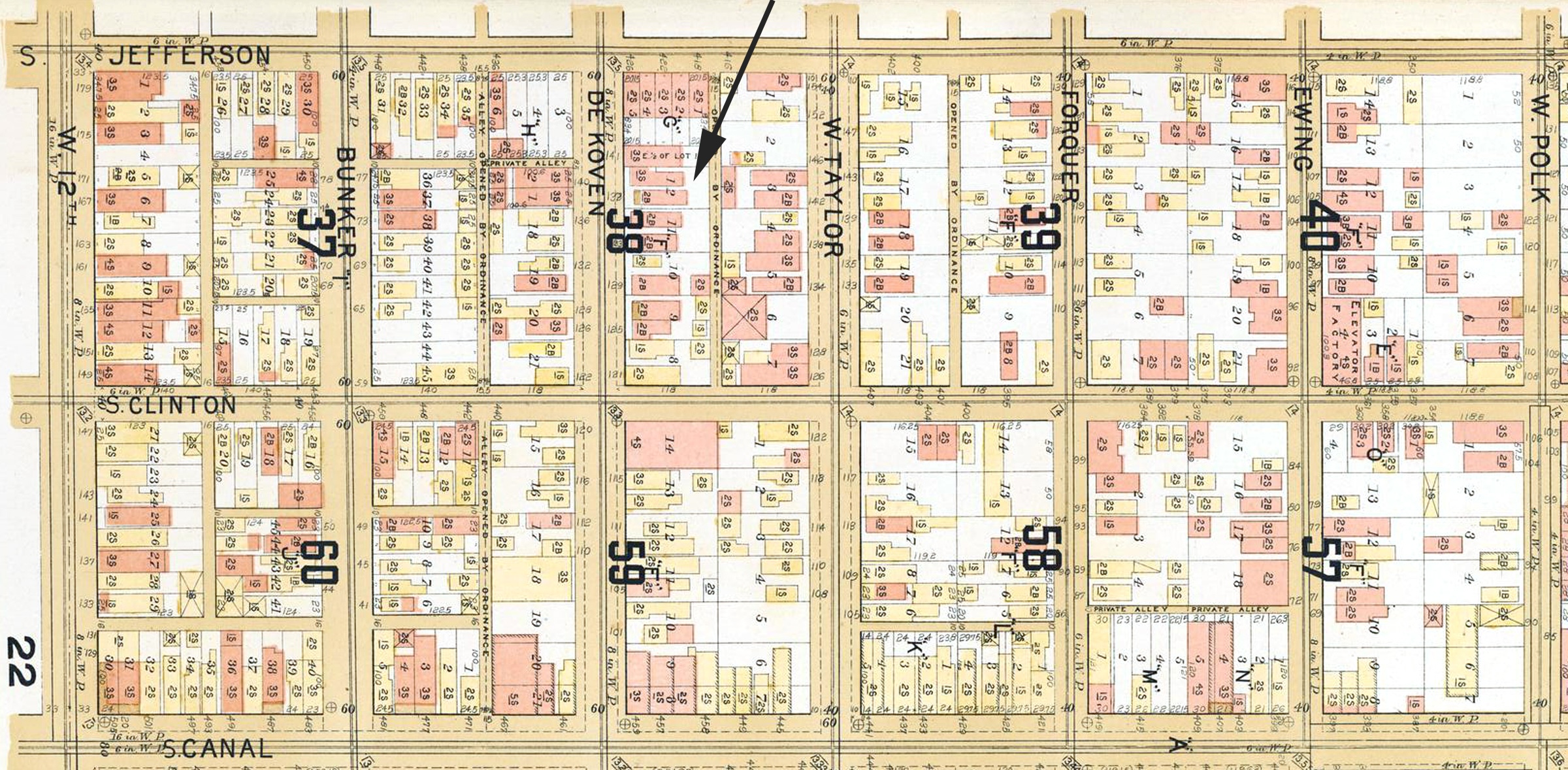
- 137 DeKoven
Greeley-Carlson
Atlas of Chicago
1891

- Chicago Fire Academy
558 DeKoven Street
Apple Maps
2014
NOTES:
1Halpin’s Chicago City Directory for 1864
Wickersham Swayne, physician, Clark, se. c. Monroe, bds. Orient House.

Leave a Reply