Sheldon House
Life Span: Between 1844 and 1856-1950
Location: 723 W Congress, (83 W Tyler st before 1872)
Architect:
- Chicago Telephone Directory October 1912
Bordegon Wm r 723 W Congress Haymarket 4798
Inter Ocean, September 3, 1872
Street Nomenclature.
Alderman Holden made another effort in behalf of Tyler street, moving to strike out recommendation to call it West Congress street, but leaving all east of the river Congress street.
Alderman Ogden said he did not like the name. He was an accidental President, and never would have been elected. He did not want the name of anyone who bore such a reputation as he did. It created confusion between Taylor and Tyler, and there was good chance to get rid of it, and take the name of a bad man from the maps of the city.
Old Chicago Houses, John Drury, 1941
The Sheldon House
A passer-by would hardly look at it twice. There is little to distinguish this dwelling from most of the other wooden cottages on the Near West Side that escaped the great fire. It appears to be only an old house in an old section—soot covered, a little down-at-heel, but still staunch and serviceable.
Yet, if the passer-by knew that plate drawings of this humble frame house, as well as detailed sketches of its interior and trim, are in the permanent files of the Library of Congress and the Burnham Architectural Library of the Art Institute, it is likely that he might stop and consider it with some curiosity. For, of the thousands of old houses in the city, this building at 723 West Congress Street was among three dwellings in Chicago deemed of sufficient historic or architectural interest to be included in the Historic American Buildings Survey undertaken by the W.P.A. federal architects’ project.
“It was chosen by our advisory committee,” explained Earl H. Reed of Chicago, director of the northern Illinois architect’s project, “because this dwelling is probably the finest remaining example of a type of early Chicago cottage. Its exterior and interior decorative detail are in the best Greek Revival style of architecture, a style that was fashionable in America during the forties and fifties.”
This Greek Revival influence cannot be noticed at first, quick glance. As Mr. Reed points out, “the average passerby might easily overlook the subtle beauty of this obscure little building.” But the classic touch is there. It shows itself in the simple and pleasant patterns of lintels, window frames, molding, cornice, door trim, and other woodwork.
“Though not measuring up to our modern standards of comfort, this little architectural gem can nevertheless teach us volumes about good taste in home design,” said Mr. Reed. “Its virtues of simplicity, dignity, and good composition are of the sort more often encountered in Lake Forest than in the blighted areas of the city.”
One might question the designation of this house as a “cottage,” since it is a tall two-story edifice. But it was not always so high. At some unknown date the cottage was raised about eight feet, and a brick basement was built under it. Originally, it was a one-family dwelling.
What is the history of this lowly West Side abode that escaped the Chicago Fire and remained to become one of the city’s distinctive architectural landmarks? When was it built? Who built it? Although research assistants, working under the direction of Mr. Reed, have sought answers to these questions in old records, very little definite information has been turned up.
Enough material has been gathered, however, to give it a name. The architects call it the “Sheldon House”-because it is believed to have been built by one Daniel H. Sheldon, an early resident of the city. Just when he erected it has not been determined, but it is believed to have been some time between 1844 and 1856. That this might be true is shown by the decorative detail, for the Greek Revival in American architecture was at its height in Chicago between those years. This makes the Sheldon House kin, architecturally, to the Widow Clarke’s House.
It is recorded in a deed that title to the property was transferred from the estate of one John Green to Daniel H. Sheldon in 1844, the sale price being $61. This was probably for the vacant lot. It is fairly certain that Sheldon built the present dwelling on the lot soon afterward. It is further recorded that in 1856 Sheldon sold the place to John Mehegan for $5,000.
Just who Green, Sheldon, and Mehegan were, early city directories and histories do not say. In any case, it is known that John Mehegan sold the place to another person. Then followed a string of different owners, some of whom made alterations adding a brick basement, building on a rear section, and putting in a marble fireplace of definitely mid-Victorian design. With all these additions, the living space in the cottage has been increased so that today there is enough room to house three families. Although the dwelling may be old, the plumbing and some other interior appurtenances are modern.
On entering the hallway, one immediately notes the simple but well-designed newel post and staircase leading to the second floor. Paneled doors open to the parlor, on the east wall of which the marble fireplace offers its now cheerless welcome. The parlor and dining-room are separated by paneled sliding doors. Two bedrooms are on the second floor.
The drawings on file in the Art Institute library contain detailed sketches of the door and window frames, front entrance, transoms, and moldings, as well as full-sized profiles of the newel post, balusters, and outside cornice. The original cottage was thirty feet long by twenty feet wide, the ground floor plan shows.
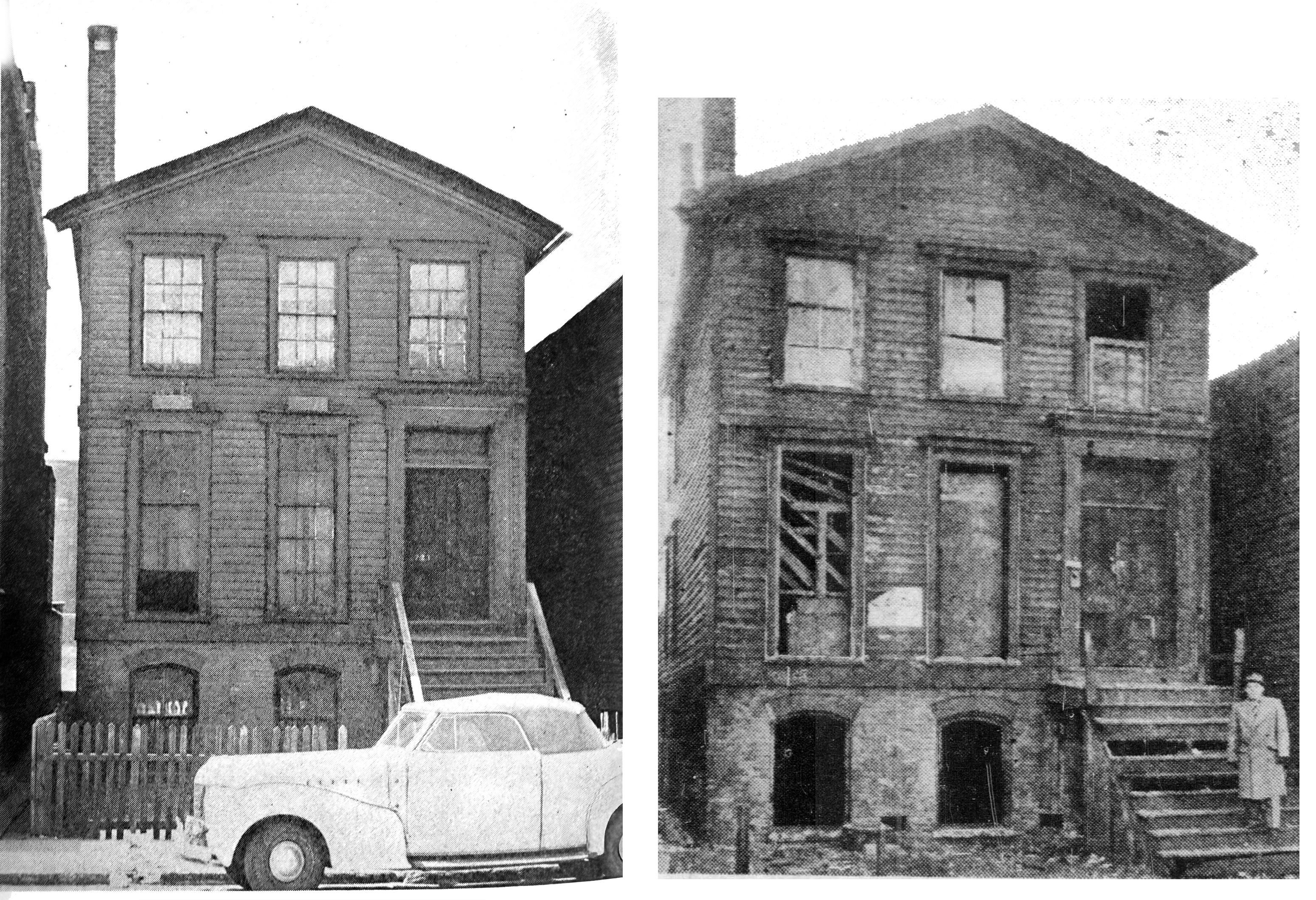
- Sheldon House
1941 and 1950
Chicago Tribune, January 19, 1950
Superhighway Claims Site of 100 Year House
The old Sheldon house, 723 Congress st., which managed to survive approximately 100 years of existence and the Chicago fire as well, will fall at the hands of wreckers this week to make way for the Congress st. superhighway. Known as the Chicago cottage type, the frame house was built sometime between 1844 and 1856 by Daniel H. Sheldon, an early resident of the city. Records show that Sheldon purchased the lot for $61 in 1844 from a John Green. He sold the house and lot for $5,000 in 1856 to a John Mehegan. After Mehegan, a string of own-ers, alterations and additions followed. The last owner was Leonora F. Ratliff, 1076 Harrison st.
Almost miraculously, the Chicago fire, which began near the Sheldon house, shifted its course and by-passed that block. The landmark has not been so fortunate in recent months. Since its last inhabitants moved, vandals have broken nearly all windows and carried parts of it away for firewood.
At one time, the Colonial Dames of America were interested in preserving the house, but the project was abandoned. A gavel made of cherrywood from a decorative stairway in the house has been preserved however, and presented to the Citizens Association of Chicago, 111 W. Jackson blvd.
A permanent record of the house in the shape of pictures and drawings showing exterior and interior architectural details is on file in the library of the Art institute, according to Virgil E. Gunlock. commissioner of the department of subways and superhighways.
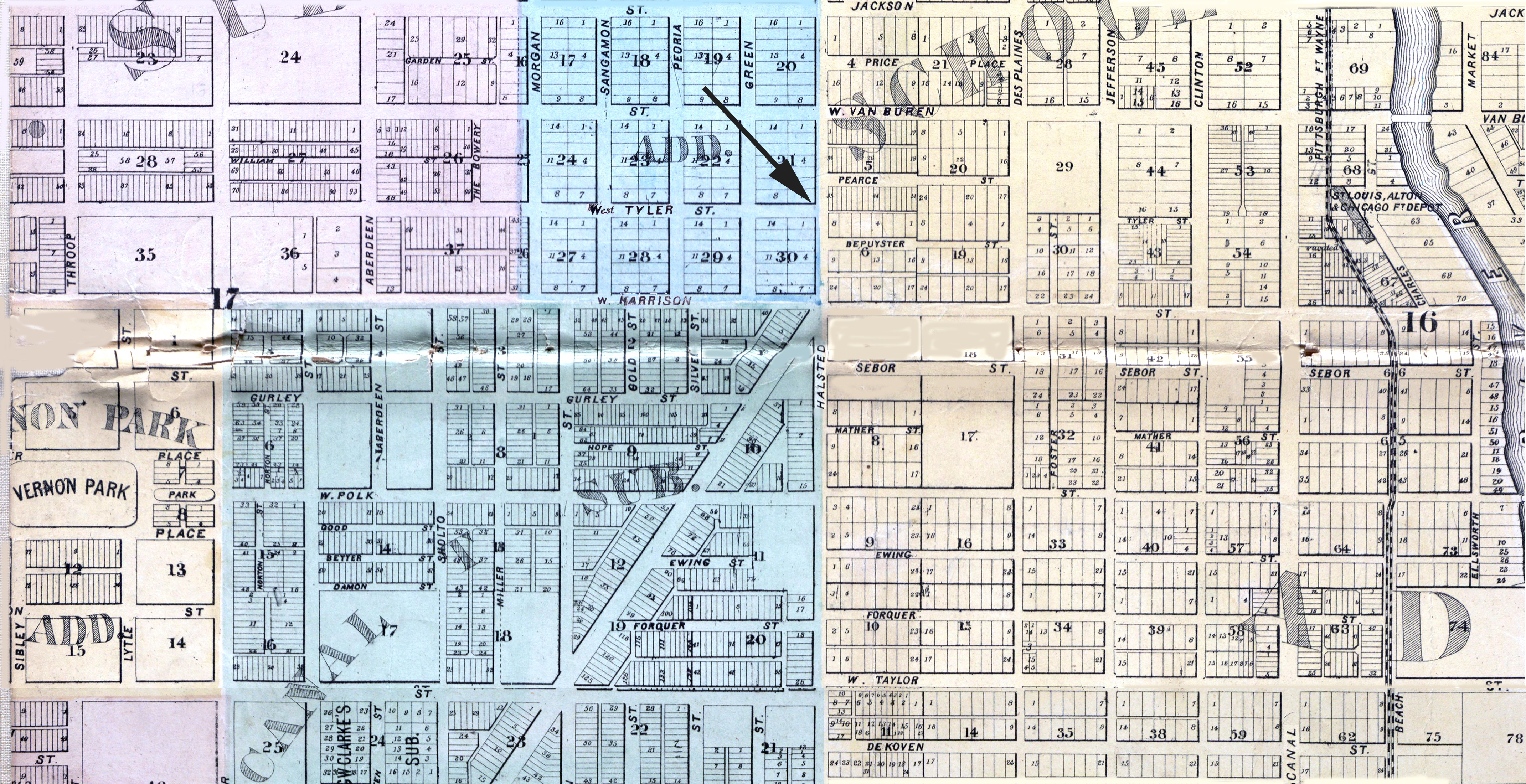
- Location of the Sheldon house at 83 Tyler street
Note the proximity to the Leary home at DeKoven and Jefferson.
Davie’s Atlas with the latest recorded Subdivisions by W. L. Flower and J. Van Vechten
1863
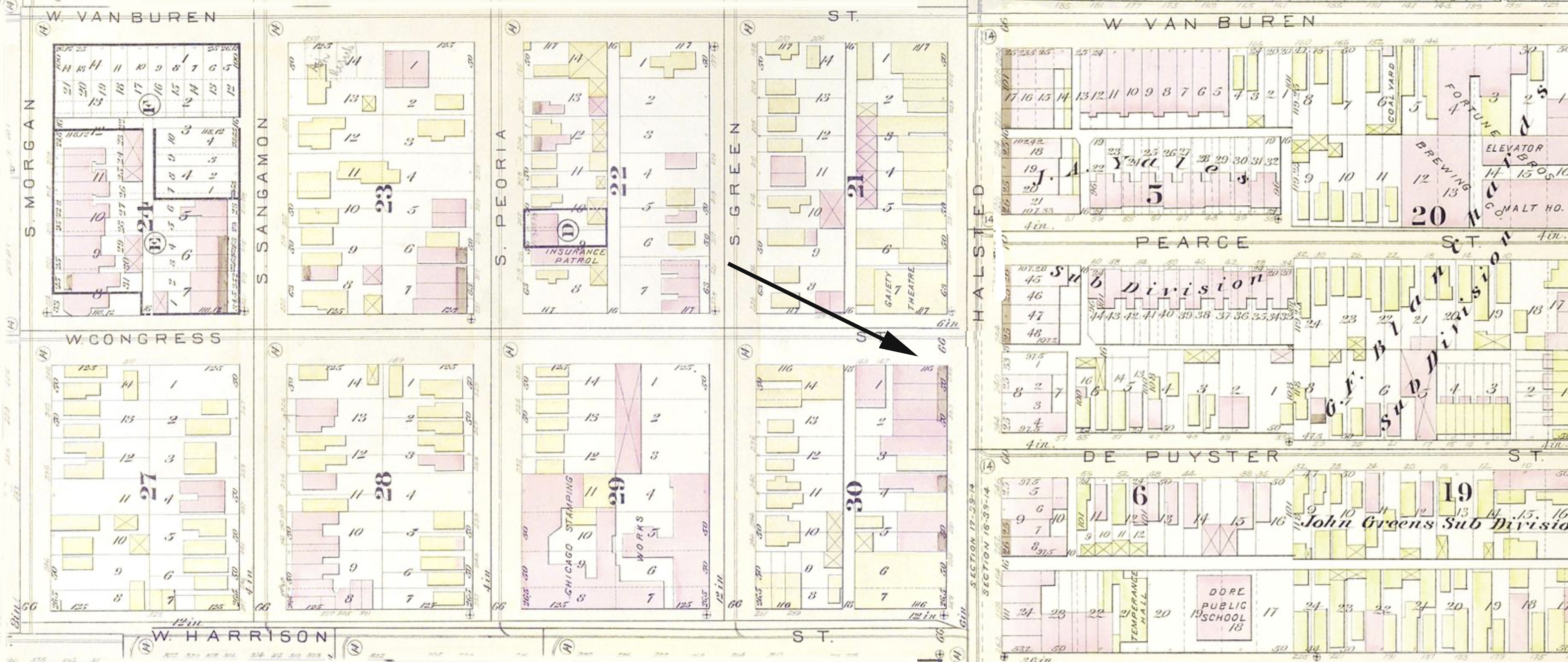
- Location of the Sheldon house at 83 Congress street
Robinson Fire Insurance Map
1886

Leave a Reply