Eleven-Mile House
Life Span: 1838-1961
Location: 9150 S. State
Architect:
Old Chicago Houses, John Drury, 1941
Eleven-Mile House.
Out at the south end of Chicago, where the prairies are wide and houses are few, there stands at 915° South State Street a two-story, gable-roofed, frame dwelling with a wide porch along its front and side. Other than the fact that it seems old, there is nothing else about its appearance to suggest that this is one of Chicago’s historic houses.
Students of the city’s early days, however, would recognize it immediately as the Eleven-Mile House, one-time country inn that played a commendable if humble part in the making of Chicago. Although the tradition is strong that this house is more than a hundred years old, a number of local historians are reluctant to accept this age figure until there is more definite proof.
Those who contend that it really is more than a century old turn for support to a book, The Wonders of the Dunes, written in 1923 by the late George A. Brennan. In dealing with early roads and trails through the dunes country that led into Chicago, Brennan tells of one Jonathan Perriam, pioneer settler on the banks of the Calumet River, who said that in 1840 there were but three houses between his own and Chicago and that one of these was the Eleven-Mile House.
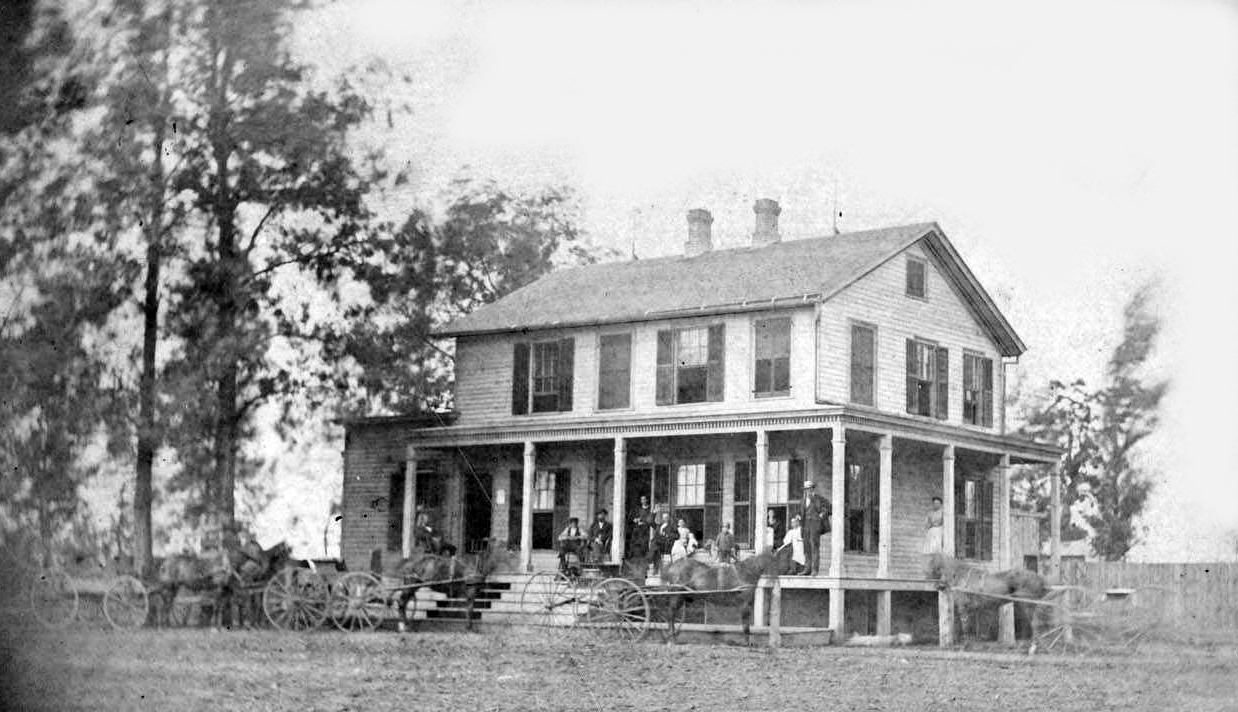
- Eleven-Mile House
1879
As further proof of its great age, Brennan, in a letter to a friend, says that the edifice “is built of logs, covered with siding.” The letter, written in 1927 to Gerrit Pon and printed in a booklet on the early history of Roseland, tells more of the South Side landmark.
In any case, it, as tradition has it, the tavern was built sometime in the late 183o’s, it stood eleven miles outside of Chicago, as its name indicated. At that time Chicago as a city was but a few years old and was bounded on the north by what is now Chicago Avenue, on the west by what is now Halsted Street, on the south by what is now Roosevelt Road, and on the east by the lake. The population was about five thousand persons.
Today, the Eleven-Mile House stands inside the city. In the years since it was built, Chicago has marched southward and westward and northward-until at present the city’s southern boundary is some ten miles beyond the old State Street caravansary. But prairies are still in its vicinity, and so the house stands in much the same setting as when the first covered wagon drew up before its spacious porch in the early days.
In an old history of the southern part of Cook County it is stated that the Eleven-Mile House was built by John Smith, early settler of the region, and that at first it was called “Smith’s Tavern.” Here, then, in those primitive days before the coming of the railroads, road-weary travelers on horses or in covered wagons-farmers, homesteaders, trap-pers, fur traders stopped to refresh themselves before making the last jump on the trek to Chicago.
If night was coming on, the dusty and tired way farers were put up by the hospitable innkeeper. Horses were given plenty of hay in the big barns next to the tavern, hearty meals were ready for the hungry travelers, and great, comfortable beds awaited tired limbs upstairs. In those faraway days when the Eleven-Mile House was in its prime there was too much danger of mischievous Indians for anyone but the most adventurous to be abroad on the lonely prairie road after nightfall.
In the years after the tavern was built, railroads came to Chicago, Lincoln was elected president, the Civil War was fought, and the great Chicago Fire occurred; but all during those eventful years the Eleven-Mile House continued in business as a refreshment house and stopping-place. When the township of Hyde Park was annexed to the city in 1889, the Eleven-Mile House was at last engulfed by the city that once had been miles away to the north.
Before all these things had happened, however, Innkeeper Smith had passed away. It is said that he died in 1847 at the age of forty-seven and that he was buried in the old cemetery at Blue Island. Despite this, there is a legend that Smith’s burial place was on the Smith property somewhere near the tavern and that it was marked by an apple tree.
When first built, the Eleven-Mile House was located across the street from where it now stands. John Smith afterward moved it to what he thought would be the opposite side of the road but which turned out to be the middle of State Street as it was laid out by surveyors. So the house was again moved, this time to its present location.
In addition to taking care of the daily guests in his hos-telry, John Smith also had his hands full with a brood of five children. One of his daughters, Eunice Sophia, married Merrill Kile, or Kyle, and this event is noted in the Chicago Daily American of Monday, December 6, 1841, in the fol. lowing words: “Married on 2nd inst. by F. A. Howe, Esq., Mr. Merrill Kyle to Miss Eunice S. Smith, daug. of John Smith, at his residence 10 miles south of Chicago.
The present owner of the old Eleven-Mile House, Alexander Fraatz, who lives quietly in it with his family, says that at one time this must have been long after the death of John Smith—the tavern was sold at a sheriff’s auction, the purchasers being one Henry Wendt, an innkeeper at Fiftieth and State streets, and two other men. These three hired a man by the name of Cosenbroh to operate it.
In 1880 the tavern came into the possession of Frederick Fraatz, father of the present owner. The elder Mr. Fraatz continued to operate it as a tavern. In those days it was a favorite gathering-place of Dutch farmers from Roseland, who stopped with their teams in the early morning on their way to South Water Street Market in the city.
A faded photograph of the Eleven-Mile House, taken some time in the 1890’s, shows a flourishing public house shaded by several big maple trees. Farmers’ wagons and teams are standing in front, and the horses are drinking from a long wooden water trough. A sign on one side of the entrance reads: “Wacker & Birk Lager Beer.” The men standing about are adorned with whiskers or mustaches and sport high-crowned derbies.
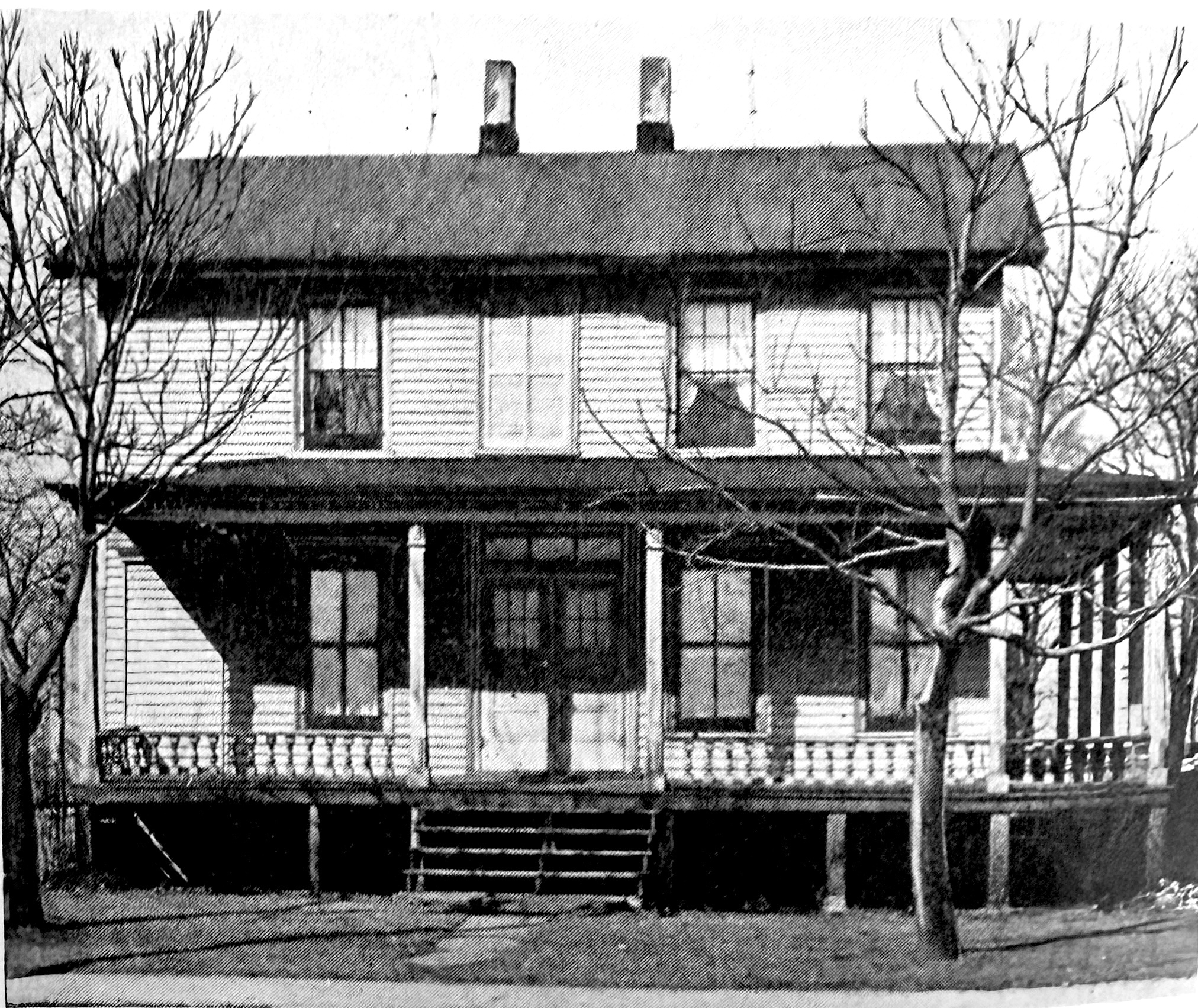
- John Smith Home
9150 South State

Leave a Reply