Vaudeville Theaters of Chicago
Dearborn Street Opera House, Varieties Theatre, Opera Comique
Life Span: About 1860-1868
Location: Dearborn between Washington and Madison
Architect:
- Halpin & Bailey’s City Directory for the Year 1863
Dearborn Street Opera House, William Van Fleet and Charles M. Chadwick, proprs., 115 and 117 Dearborn
Halpin’s Chicago City Directory for 1864
Variety Theatre, 115 and 117 Dearborn
John C. W. Bailey’s Chicago City Directory for 1867
Variety Theatre, C. M. Chadwick propr, 115 and 117 Dearborn
Chicago Tribune, January 15, 1863
CAMPBELL MINSTRELS—DEARBORN STREET OPERA HOUSE.—Mr. Geo. Gray, the exquisite ballad singer of this company, appeal to our citizens this evening for his benefit. Mr. Gray is a member of the New York Fire Department, and we doubt not his brother firemen of this city will respond to the call. An entire change is made in the programme. Mr. Gray will execute many new and thrilling ballads, never before sung in Chicago, and all will go “merry as a marriage bell.” Go early if you want seats.
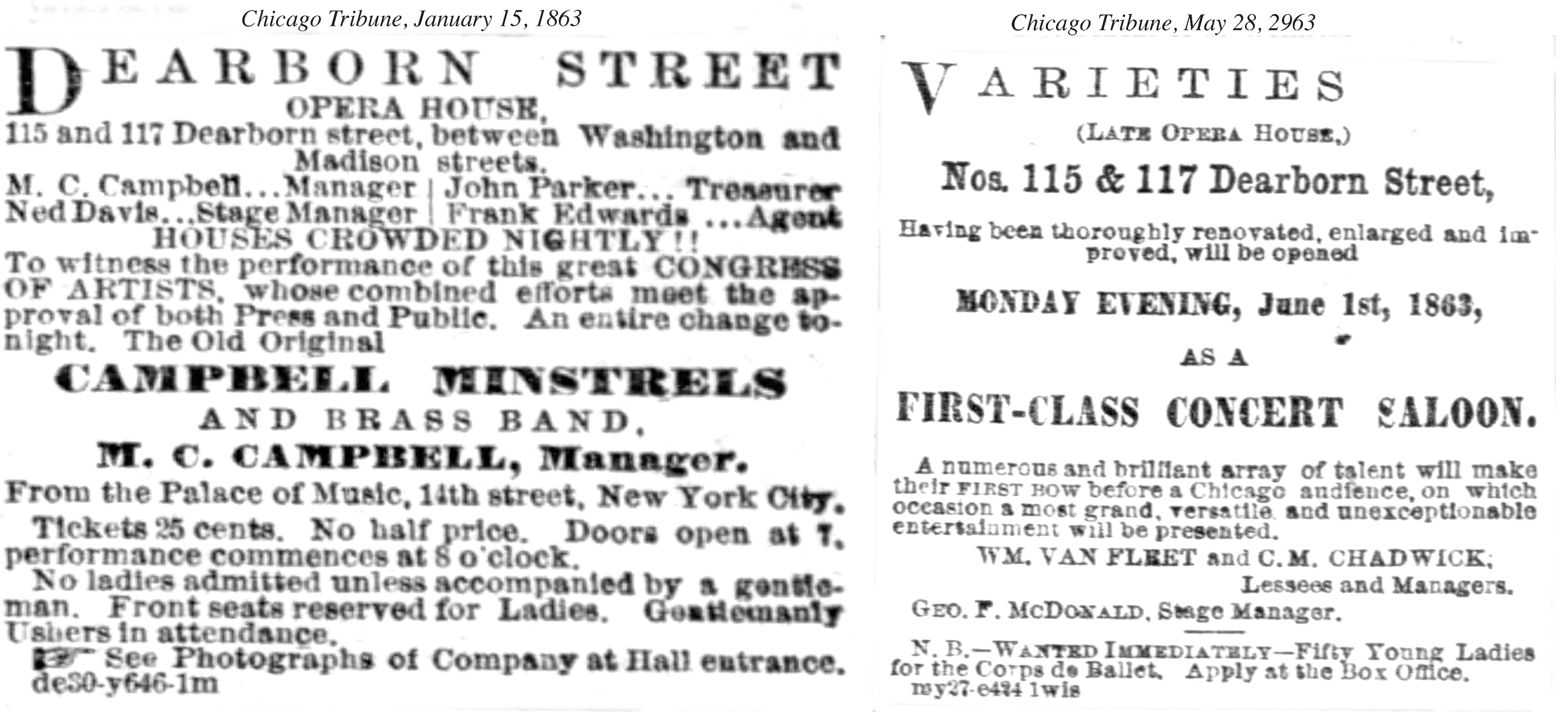
Chicago Tribune, May 18, 1864
New Theater.—It is understood that C. M. Chadwick, the proprietor of the Varieties Theater, is about to contract for the erection of an elegant building in which to give his entertainments.
Chicago Evening Post, September 18, 1867
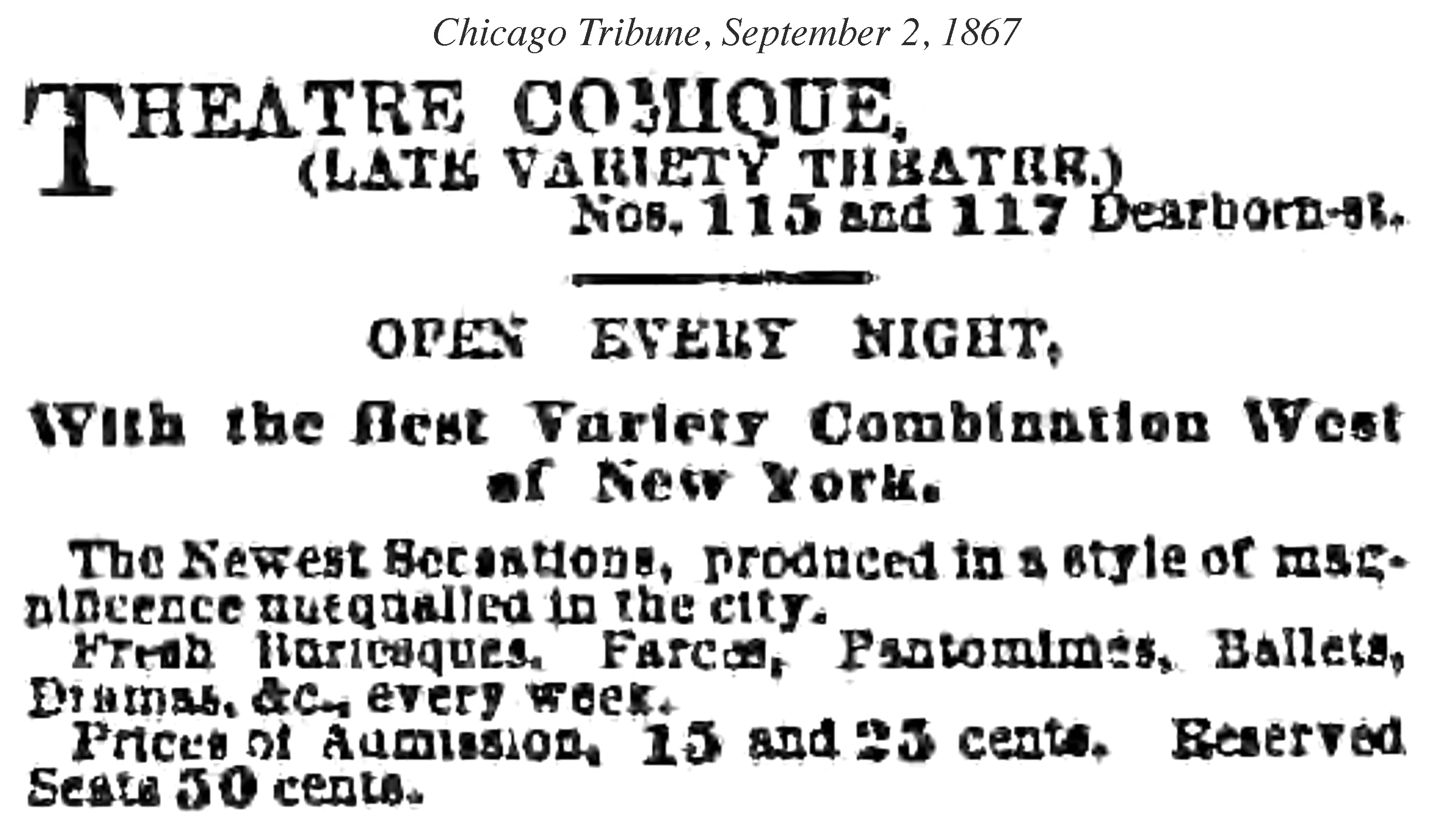
The Theatre Comique Closed., better known as the Varieties, and not very favorably known under either name, has suddenly come to an end. The proprietor of the building has for a long time been unable to collect his rent, and has for two years been trying to effect an ejectment of the occupants. The Supreme Court has finally given him possession, and the players and dancers, and—with joy be it said—the musicians are dismissed. James Parker, the proprietor, took possession of the building yesterday evening just in time to adjourn the performance sine die.
Chicago Tribune, September 19, 1867
The Theatre Comique Closed.
Charles M. Chadwick, for some time the managing force of the Varieties or Comique Theatre, was yesterday arrested under an indictment for keeping a gaming room. A bench warrant had issued, and some desire was manifested to bring him into court, as the grand jury which returned the bill had made his establishment the subject of a special recommendation, asking the Mayor to withdraw the presumption of sanction on the part of the city, by revoking the license to the Varieties as a theater, or its attendant saloon. The arrest of Chadwick brought into court his near neighbor-Ball Between these two parties there is an ancient feud. They have been respectively plaintiff and defendant in almost any number of cases, in every court in the county, and in several which have been traveling the precincts of the Supreme Court. Towards Ball, Chadwick expressed himself in rather strong language—such language an might be fairly expected to be uttered by a man long accustomed to a low order of companionship. At one time it seemed likely that the Court would hare to be appealed to in order to prevent the continued use of vile language as applied to the witnesses against him. When the case war called Chadwick pleaded guilty and set up in bar to the penalty that he has now closed up the business. Sentence was suspended on the payment of costs.
The institution. the Varieties, or the Theatre Comique, has, pending all the difficulties of its old proprietor, come to grief. The owner, Mr. John Parker, had made occasion for a suit to recover possession. and the judgement given in his favor having been affirmed by the court of last resort, there has been a complete vacation of the premices. The establishment no longer exists.
Chicago Tribune, January 13, 1868
A Narrow Escape From Death—The Incendiary at Work.
Fires, and alarms of fire, still continue the order of the day—and night. Conflagrations for the past day or two have not proved so destructive as those daring the week preceding, but they still continue to occur in sufficient numbers to cause a very state of mind. Among the fires yesterday, one had nearly proved very disastrous, the lives of four or five human beings being placed in great jeopardy; they were only saved through great presence of mind and personal bravery. It Was about half-past eight o’clock last evening, when a two-story frame building, No, 111 Dearborn street, immediately adjoining the Portland Block, was discovered to be in flames. The first floor was occupied as a boot and shoe store, and a fruit stand, but the upper portion was devoted to tenement purposes, and was then occupied by wife, child, and a Norwegian named John Lawson, his wife, child, and a boarder named Joseph Londell, all of whom, although still early in the evening, had already retired. The fact that house was on fire was not made known to them until the lower portion of the building was filled with smoke and flames, and every avenue of escape in that direction cut off. Only the roof was left by which to escape.
Mr. Lawson succeeded in and gaining the scuttle hole, and pulling his wife, child and Londell, through the aperture, next began to cry lustily for help. A number of bystanders arranged themselves underneath, and the people above were told to drop dawn and “trust to luck.” It was their only hope. Mother and child were held by the husband, until both hung between heaven and earth, and next they dropped safely into the arms of the men below. The men made the descent in a similar manner. Not one of them was attired in more than one garment—the one worn usually nearest the body. The rescue came none too soon: In another minute the flames burst through the roof. Mr. Lawson’s loss will probably reach $600. with no insurance. The south half of the establishment on the first floor was occupied by Mr. C. S. Yonberry. as a boot and shoe store. His loss from fire and water may reach $1,000. The other compartment was occupied by Mrs. M. E Blake fruit and candy store. Her loss will not exceed $300. The building is owned by Mr. P. W. F. Peck, and is injured to the extent of perhaps $500.
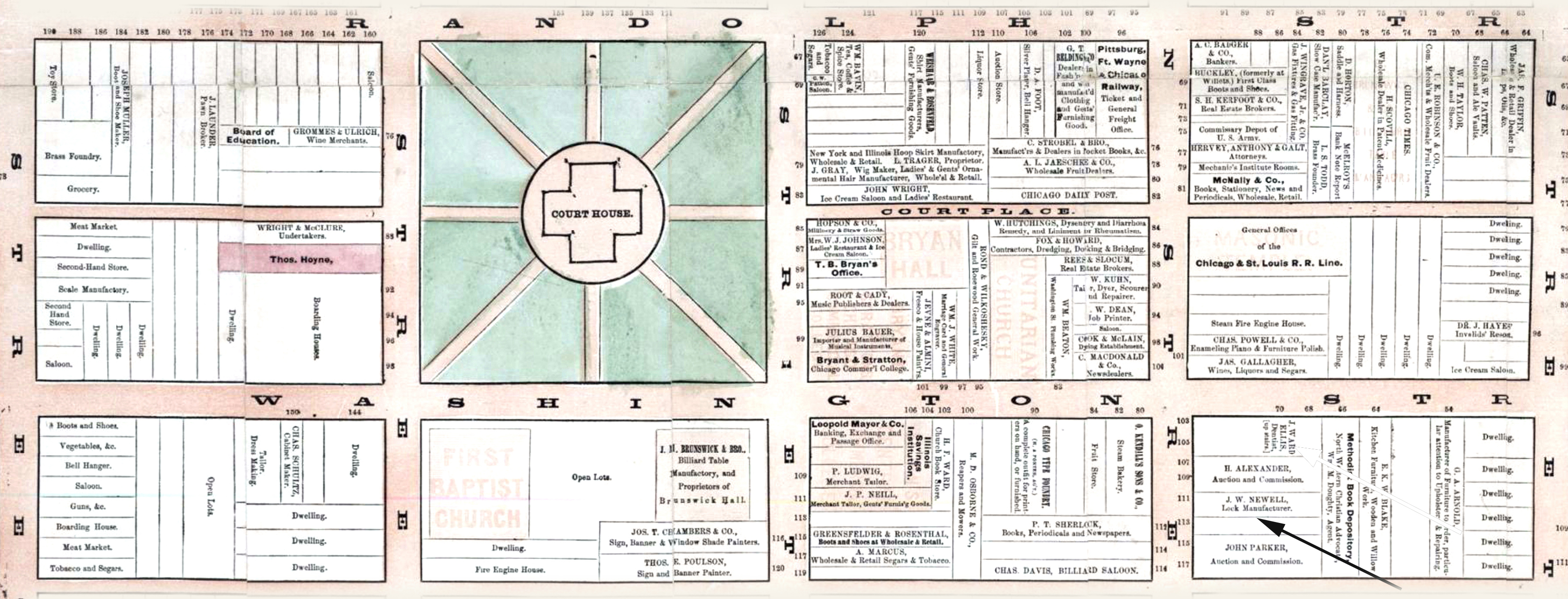
- Variety Theater
1862
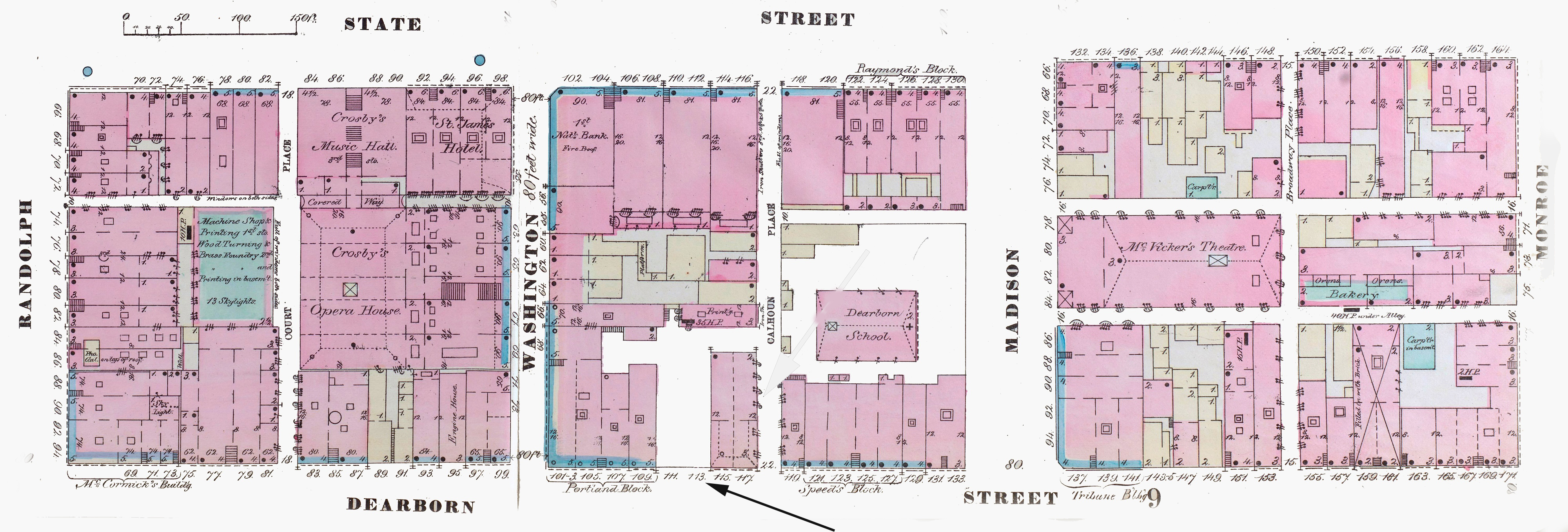
- Comique Opera Lot
Two-story wood-frame theater burned down in 1868 fire. A new block was built in 1870
NOTES
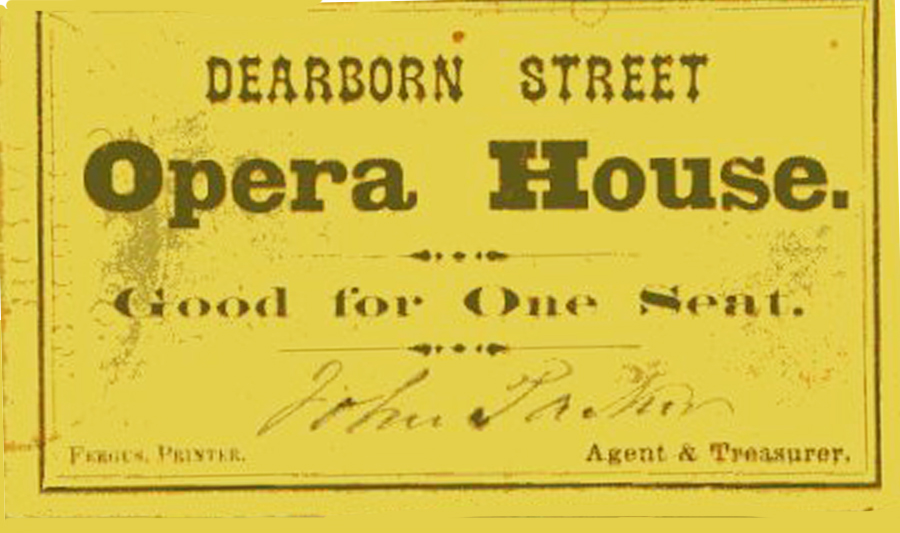
Rare, surviving ticket courtesy of Len Duszlak.
