INTRODUCTION
The actual origin of the name Kilgubbin, that identifies the early Irish settlements in Chicago, has been lost. The name seems to be associated with a townland in County Cork named Kilgobbin, located four miles west of the seaside resort town of Kinsale, twenty-two miles southwest of Cork city. The population of Kilgobbin, grouped with several other contiguous townlands, was approximately two hundred. The idyllic Kilgobbin encompasses almost 1,300 acres.
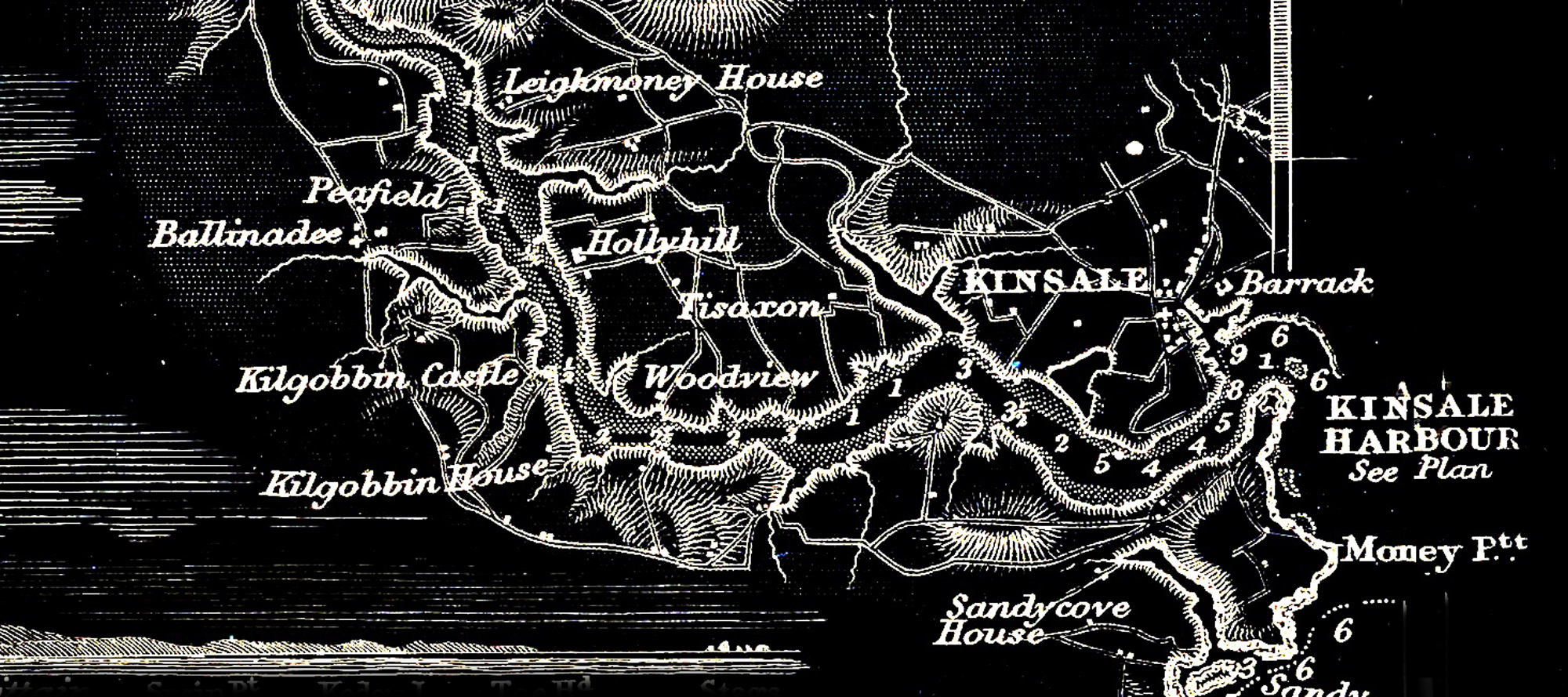
- Ireland, sheet XII, Mizen Head to Kinsale, showing the townland of Kilgobbin. Surveyed by Commr. J. Wolfe and Lieut. Church, 1849, the deep soundings by Commr. A.G. Edye assisted by Lieut. T.B. Horner, 1860; published according to Act of Parliament at the Hydrographic Office of the Admiralty June 10th 1850.
The Irish were the first immigrants to come to Chicago in large numbers. In the late 1830s and the 1840s more than 6,000 of them settled in the city. The 1850 census disclosed that they constituted more than 20 per cent of the city’s total population of 28,269 and 39 percent of the city’s foreign born population.
A majority of the early Irish immigrants found homes on the near north side, at Block 6, where the Merchandise Mart now stands. This settlement was named Kilgubbin, a collection of shanties resting on a swamp which had a lump of yellow rock they called Goose Island.1
Illustrated London News, Spring, 1851
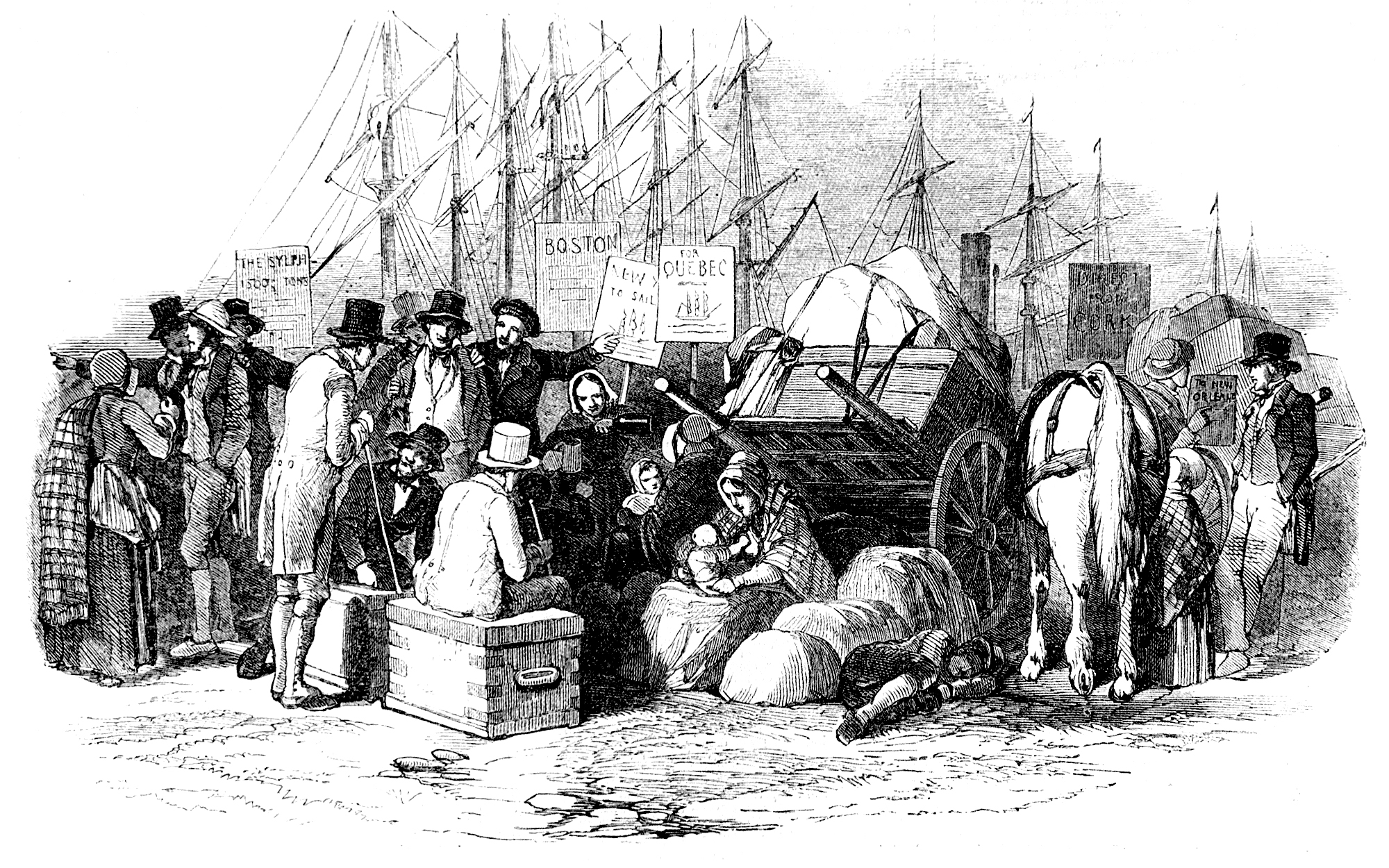
- Emigrants on the quay at County Cork, Ireland, which was hit the hardest during the potato famine. Between 1845 and 1855, it has been estimated that over 2 million people left Ireland, almost all bound for the United States or Canada.
Chicago Tribune, July 29, 1863
Squatters Dispossessed.—Twenty-four squatters on the south ninety feet of lot 4, block 6 in the original town of Chicago, were dispossessed by verdict of a jury, yesterday, at Justice Summerfield’s office, before whom as many suits for forcible entry and detainer were brought by Ebenezer Andrews, Joseph E. Otis and Hiram Wheeler, the owners of the property. We understand it is contemplated to erect a block of buildings on the ground.
Inter Ocean, August 28, 1863
The owners of the fragrant and classic region known as “Kilgubbin” brought suit some weeks ago against the squatters who for the last ten or fifteen years ago have held possession of the locality to oblige them to evacuate the premises. They refused to leave and today nine dwellings were demolished, being literally pulled down over the heads of the tenants, who were very angry at the eviction.
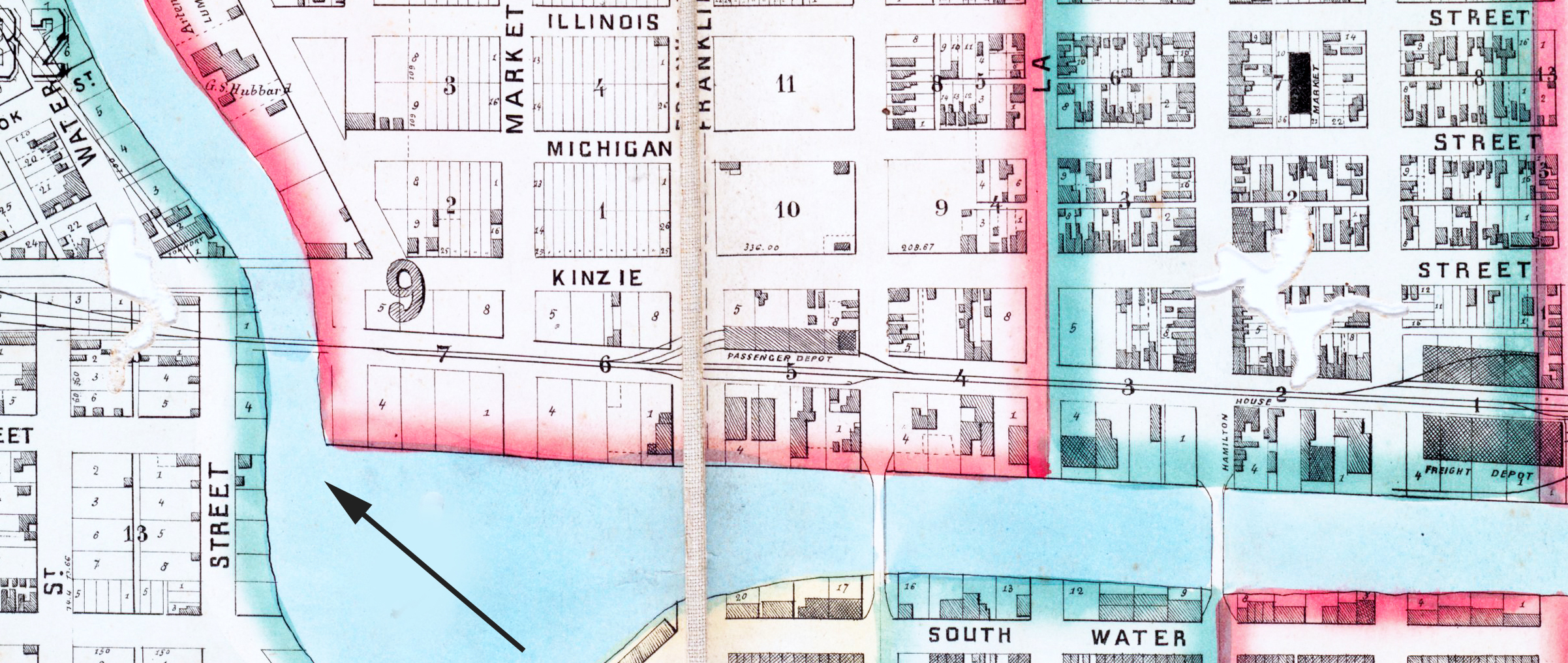
- First Kilgubbin Settlement
Also known as “Goose Island”
Blocks 6 & 7
Surveyed by Henry Hart
1853
Chicago Tribune, March 25, 1865
Board of Trade Meeting.
Mr. Morton deeired to hear the expressions of the members in relation to the removal, by the Board of Public Works, of Goose Island at the fork of the river. The island was a great nuisance and should be removed.
Mr. George Garrick had presented an extensively signed petition on the subject to the Board of Public Works, and met with a favorable response. The Board would do all in its power that to have the island removed. They stated last year they asked the Common Council for an appropriation to effect the removal, but that body had refused to grant it. They would ask for a similar appropriation of the new Council.
Mr. J. C. Dore moved that the Board of Trade recommend and make application to the Common Council to effect the removal based upon the estimates of last year.. Carried.
Mr. Dore then moved the appointment by the chair of a committee of three to urge the matter to the Council.
The motion prevailed; after which the meeting adjourned.
Chicago Tribune, May 17, 1865
Removal of “Goose Island,” and dredging at the junction of the north and south branches with the main river…$15,000.00
Chicago Tribune, August 7, 1865
 The Copperhead print in this city has long set itself up as the organ and special champion of the Emerald element in Chicago, and its principal circulation is obtained among that class. Strike out the patronage derived from the Irish, and the Chicago Times would die as speedily as a rat in an air exhausted receiver. It lives and breathes and has its being from the “Paddies and Biddies, and in torn it is their “family paper.” Its politics, principals and patriotism please them supremely. They gulp down its teachings with the avidity of young robing swallowing worms and flies furnished by the parent “red-breasts.” Its style, flavor, tone, sentiments, all suited them to perfection. And next to the teachings of the Church, in things spiritual, stand the teachings of the Copperhead oracle, in things temporal.
In its Sunday morning issue it draws a picture of the domestic life, manners, customs and civilization of a portion of its celtic worshippers and patrons, which to say the least can not be esteemed flattering, and may not be pleasing to them. As the Tribune is not generally supposed to posses the confidence or enjoy the acquaintance of this class of people to any remarkable degree, it has not ventured to describe their habits or social life, least its motives might be impugned and its sentiments set down as the offspring of distorting prejudice. But that task was left to their “family paper” to perform, and how faithfully the cartoon is limned the picture itself must bear testimony.
The article appears on the editorial page, and is prefaced with eighteen display lines, or sensation headings in job type tor the purpose of attracting attention.
The Chicago Times has long indulged in coarse and brutal invectives against the poor blacks, both North and South, and hounded on many an assault by the Irish in Chicago. One of its favorite assertions is the inferiority of the black to the white race. It descants long and loudly on the ignorance, filth, immorality and laziness of the negro race, end the immeasurable superiority of the “Democracy” to the African. We have never denied that there was room for improvement, socially, morally and industrially among its blacks. We have insisted on affording them opportunity and equal rights before the law with those enjoyed by the of whites and contend that with the possession of these, they would rapidly improve their condition. But we submit that the blacks in no part of the broad Union, whether in city or town, bond or free, poor or pauper, exhibits in equal degree the squalor, shiftlessness, filth, vice, quarrelsomeness, dishonesty, and vagabondism, is described by the Chicago Times, and attributed to large masses of white population in this city. And this white element possess the franchise in an eminent degree, most of the adult males voting more than once at our elections. They are in the enjoyment of abundance of opporturity to labor. Many of them earn four to eight dollars per day, and none of them less than two. The splendid free schools of the city are open to all of their children; they are in a land of abundance, and have every right and privilege of American citizens guaranteed to them, and many of them have been for a score or a dozen of years, until, as the Times describes it, “their shanties have grown grey and moss-covered from time.’
We ask in all seriousness, what right such people as described by the Times have to deny political and legal rights to the freedmen to the manor born? In what respect do they evince their claims of belonging to a “superior race.” or having attained a superior civilization? We allege nothing against the inhabitants of “Kilgubbin, or “Kansas.” or other “patches,” but simply take them as described by their own pet organ—their political monitor—and compare them with the colored people of this country who for centuries have been enslaved, abused, down trodden, disfranchised, and denied of their inalienable rights by a devilish system of tyranny in the South and Copperhead persecution in the North. Is it not time for the “Kilgubbin” democracy to cease prating about “negro inferiority,” and the superiority of their class and clan to the black Americans?
The following is the article referred to; we give it entire:
Chicago Times, August 6, 1865
Reprinted by the Chicago Tribune August 7, 1865, November 4 1866 and September 13, 1868
By John Mansir Wing2
Contrary to a prevalent opinion, Wells street does not contain all the wretchedness, poverty and vice in Chicago. Its crowded tenements and seething alleys of prostitution and crime are directly under the eye of the police, who never relax their relentless vigilance. There are other sources whence came frequent complaints, to annoy and puzzle the officers. These are the “patches” where the sons of the Emerald Isle have “squatted.” built their seven-by-nine shanties, reared their offspring and bred their extensive droves of geese, hens, cows, dogs and cats. The progress of civilization, the rapid growth of the city, and the consequent increase in the value of the property, do not seem to exert much influence upon these people. Wherever a block of land, or, perchance, a dreary sand hill along the lake, is in litigation, or of doubtful title, they find it out as if by instinct; up goes the shanty, which has perhaps been removed from some other locality upon the backs of joint proprietors, Paddy and Biddy. This single land mark having been erected, a village of shanties soon grown up, which can only be displaced by the whole police force united or by some action of the elements. A squatter clings to a piece of ground with bull-dog tenacity. The unlucky owner of the property might as well attempt to depopulate half the city as to get them off his land. They are no more to be exterminated than are flies and mosquitos. The shanty once erected, the pig sty built and the garden fenced in and planted, the squatter is as confident of his right of possession as if he held a deed to the land. If a proprietor or land agent tells him to get off the premises, he laughs at the idea, and insists that he himself owns the place. If his residence is interfered with, he claims damages for trespass, and a long legal quarrel ensues, which obliges the real owner of the land to hunt up titles and surveys, until the thing has cost more money than the property is worth. Consequently a self possessed squatter remains undisturbed on his patch. If the first to find out the doubtful title of the land, the settlement that grows up around him is governed a good deal by what he says and does. He invites emigration to his patch, and an endless tide soon sets in. Woe be to the real estate agent, when such hegira commences, and turns towards lands in his possession. His title is no longer worth the match to light it. As well might be attempt the conquest of the Brahmin empire, as to regain possession.
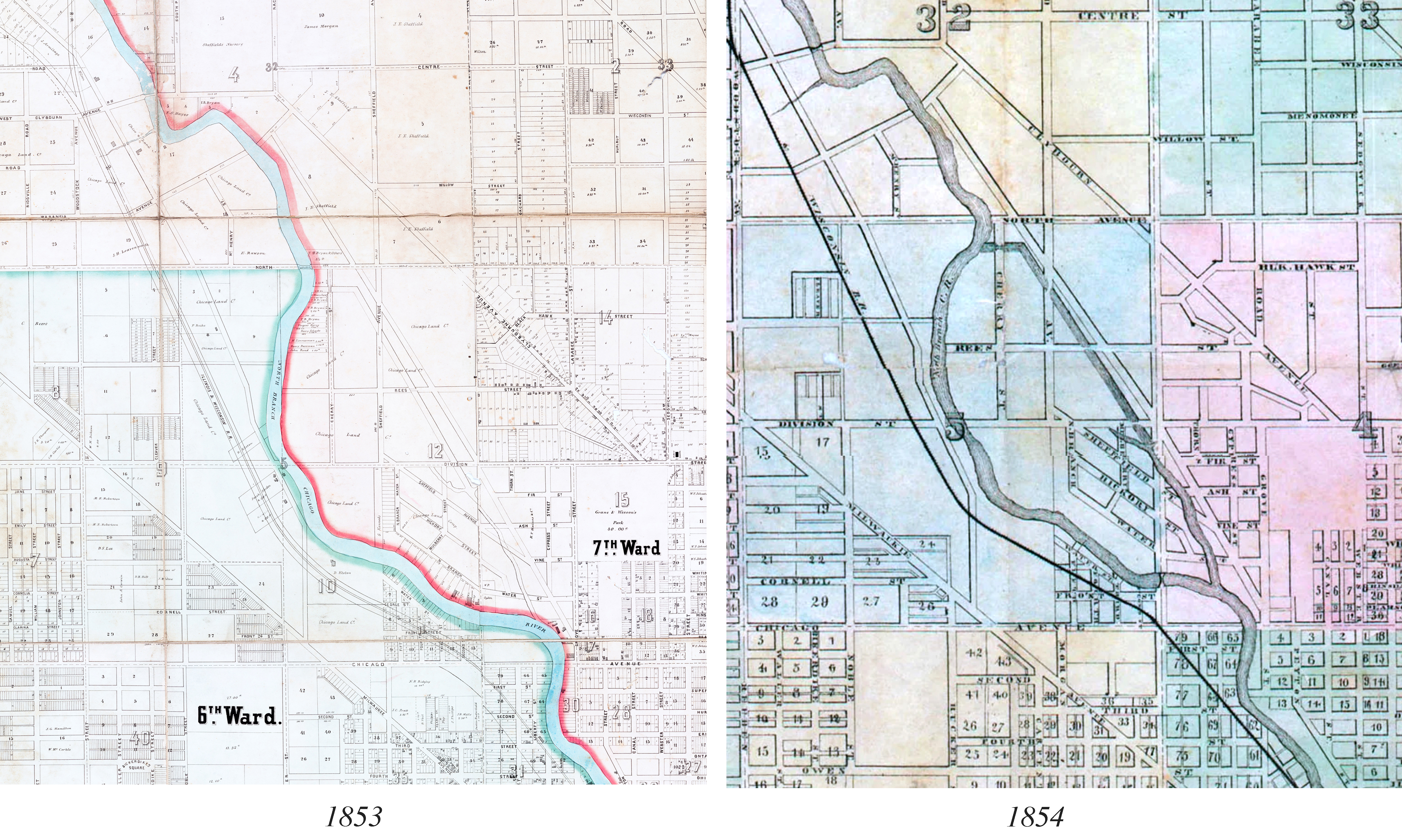
- LEFT: Before Ogden Canal, 1853
RIGHT: After Ogden Canal, 1854
Kilgubbin.
At the head of the list of the squatter villages of Chicago stands Kilgubbin, the largest shanty settlement within its limits. It has a varied history, having been the terror of constables, sheriffs and policemen in days that are past. It was, perhaps, the earliest settlement of the kind in Chicago, and at one time approached nearer to the squatter settlements of Gotham, than any other in the West. The advance of time and civilization has removed this classic locality several times. Its first site was on North Kinzie street, westward along the river ad infinitum. It numbered several years ago many thousand inhabitants, of all ages and habits, besides large droves of geese, goslings, pigs and rats. It was a safe retreat for criminals, policemen not venturing to invade its precincts, or even cross the border, without having a strong reserve force.
The oldest inhabitants tell strange stories about murder and arson that hatched in this retreat, and children were frightened into submission by threats of being “sent to the Kilgubbin.” The authorities finally got the better of them, and they gained more respect for the star of authority. Civilization pressed close in upon them, and the squatters emigrated slowly but surely westward. Rude land owners and sheriffs rushed in upon the shanties, and demolished them; building mills, dwellings and manufactories on the old site of Kilgubbin. The squatters soon settled on other lands, and reared other villages.
The locality now known by the euphonious name situated in the West Division, northward of Chicago avenue, to the point where Carpenter street strikes the river. It extends north, south, east and west, in so many offshoots that it is difficult to define the exact limit. Where the shanties are there is Kilgubbin; and where a landlord has been bold enough to erect a building, Kilgubbin is not, until its shadow is passed. The present patch contains from forty to fifty acres of land, most of which is of doubtful title, in actual litigation, or owned by Eastern capitalists, who care how it is occupied, so long as the growth of the city continues yearly to enhance its value.
A slight sketch of Kilgubbin society and of its private residences will convey an idea of squatter life generally. When the writer hereof visited the classic locality, on Saturday morning, the weather was damp, and the unpaved streets of the settlement anything but “beautiful to the touch.” The place was in possession of the women and children, the men having gone to their early labor, in all quarters of the city. Here and there were goose ponds were laid out in the streets, with great care as to effect. They were directly where a traveller wanted to stop, and it was a long and muddy distance around them. Large flocks of goslings inhabit these stagnant pools; to kill of stone one of which could be instant death to the intruder. The geese cackle and hiss as you pass, as if no one but a resident had any business there. They seem to fear a land owner whenever a strange footstep is heard, an instinct early instilled into all the chattels of the squatter. They spread their wings and run off to the door of the nearest shanty. This brings the mistress out of doors, whose appearance may be briefly described:
The genuine squatter’s wife is short and thick, with an abundance of red hair and flesh. She is never without a broomstick in her hands, and never can be thrown off her guard. Her face is exceedingly red, and tells of “potations deep,” and not of the best quality. She is attired in a tattered dress, with sleeves rolled up. Barefoot in the latest style for the extremities, and she is in the fashion. She at once takes you for an eastern land owner, and is prepared to call together all the women of the patch, if she ascertains such to be the fact. If, however, you succeed in making her believe that you are a chance visitor, she becalms her passions, especially if a greenback is placed in her itching palm. Then she will show you through her shanty, and introduce you to her neighbors.
The Shanties.
The shanties are generally divided into three apartments. In the first, which may be termed the parlor, are quartered the cow and pig. In the second apartment, or the dining room, the goslings and geese, hens and chickens roost, secure from prowling marauders of policemen. Further on is the kitchen, considered the most magnificent room in the house, by the mistress herself. If her cows, pigs, geese, goslings and hens are comfortably provided for, it does not matter any further. In this third apartment, separated from the others by a chinkless partition, are between ten and a dozen children, lying upon the floor in rows, in the most squalid rags and filth. A rickety bedstead serves for the proprietors of the establishment. This is the ultimatum of squatter desire. ‘Every thing under the same roof is secure,’ runs the proverb, which must have been well learned in Kilgubbin.
These shanties are almost boardless, or, at least, the majority of them. The elements find easy access, especially to the last mentioned apartment. They are sometimes enclosed by a low fence, and surrounded by a small patch of cabbages and potatoes, illy hoed and thriftless. How humanity can exist in such a place is a mystery.
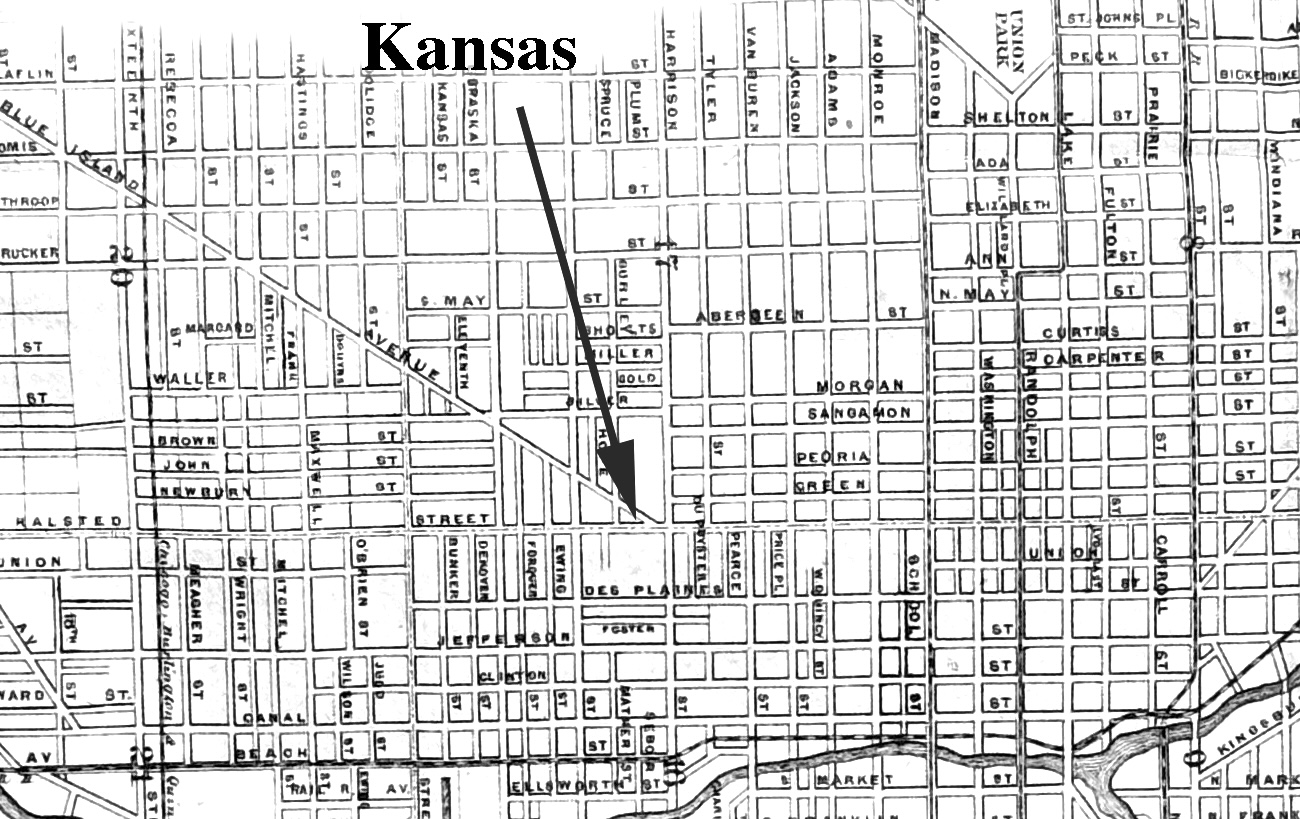
Kansas.
The region known as Kansas cannot be strictly called a squatter village, as most of the inhabitants pay a small rent for their shanties or the land upon which they are built. It is situated on the west side of the river, between Desplaines and Halsted streets, in the neighborhood of Harrison. The land was formerly owned by an Englishman, who is now dead. He has rented it to the squatters for a number of years. No citizen has been able to purchase it, although high prices have been offered for the land. The Morrison brothers, who own property adjoining, have often tried to negotiate for it, but the landlord preferred to remain the proprietor of a squatter village to selling his land for a fair price.
Like Kilgubbin, Kansas has been a place of terror to the authorities, but it is not now what it was in former years. The inhabitants are quite orderly in their habits, and many of the men industrious laborers. Civilization has had a good effect upon the squatters, and they are disposed to profit by its approach. This tract contains in the neighborhood of eighteen or twenty acres of land, whereon are erected several hundred shanties in close juxtaposition to each other. Like Kilgubbin, the manners and customs of its inhabitants are foreign in the extreme. But as a whole, the shanties are cleaner and more commodious. Some of them have creeping vines trained over the solitary window. The cows and pigs are in the rear. The front room is occupied as the residence. In one corner stands the bed, and its root the cupboard, whose shelves are filled with various colored crockery. In regards to actual comfort and neatness, Kansas is a century ahead of Kilgubbin.
Other Patches.
Besides these principal Patches, there are scenes of lesser ones, scattered all over the city, from its centre to the most remote boundaries. Wherever a block of land has remained unused for a short period, it has been appropriated, and now boasts of half a dozen shanties. Such a Patch may be formed on the West Side, between Milwaukee avenue and Union streets; another near North Rucker and Kinzie. A Patch of some squatters pretensions is located on the North Side, in the vicinity of Rees and Division streets, at the extreme limits of the city.
About one year ago, a village of several scores of Shanties, situated on the South Side, between State and Clark streets near Twelfth street, was cleared out by the Sheriff and a posse of police. The shanties were torn down over the heads of the occupied squatters and their pigs and cows driven to the pound. Since the frightful “massacre,” that locality has been completely free from geese and goslings, although in the vicinity of the quondam village the soil still shows the traces of other fertilizers other than lime and ashes. Here and there, all over the city, is an occasional squatter, quietly enjoying the appropriated land of some unthinking capitalist. Some of these shanties have grown gray with years of unmolested existence; hove stood there so long that the question of title is no longer mooted—a very desirable way, it is submitted, of acquiring a residence.
Squatter Feuds.
These squatters are a source of constant annoyance to the police and Justices of the Peace. Their appearance at the Police Courts is by no means infrequent. About a week ago a case was reported in this paper, where one squatter woman caused her neighbor to be arrested, because she allowed her geese to run on her patch and scratch up her garden. The Judge could do nothing with the aggrieved parties. They bundled fierce words in court, and swore at each other in squatter jargon. They were finally both dismissed and told to go home. When crossing the threshold of the door, they got into a hand to hand row and were called back and fined.
The females are extremely tenacious of their rights, and consequently fight and quarrel among themselves, pull hair and disfigure eyes. In this respect, a more turbulent race of people never existed. The women encourage their children to quarrel and fight, and learn them how it is done by animal combats with their neighbors. Every breeze blows dust in their eyes from somebody’s with whom they are at loggerheads, and a fierce conflict ensues. Thus these settlements are kept in a state of turmoil and intestine war.
Population.
The population of these patches cannot be correctly estimated. The census takers seldom attempts to enumerate the children and women there. In some of the shanties reside five or six families, each being possessed of at least a dozen dirty ragamuffins, At the door of a small shanty in Kilgubbin, no less than thirty hatless and coatless brats were counted, besides whom their were probably “children in arms” inside of the hut.
It is estimated by persons well informed in regard to these squatter settlements, that at least 15,000 people reside in them within the city limits. This does not appear from a casual observation to be too great an estimate.
Descriptions of Property.
The presence of these intelligent squatters in any locality, and the almost impossibility of getting rid of them short of a general extermination, has an injurious effect upon all kinds of property in their neighborhood/ They prevent raids of lots, discourage owners from building houses, they could tend ti relieve the overcrowded parts of the city, and make every one who owns property there anxious to to sell and compelling to make improvements. Men will not purchase property in that vicinity any more than they would build a residence in the neighborhood of a permanent gypsy camp. Every attempt to displace them is followed by violence and crime. The whole squatter neighborhood regard the appearance of a land owner, or well-dressed citizen in their midst as a carus belli and sound the war cry at once. In a moment an army of infuriated women emerge from their cabins armed with broomsticks and all manner of domestic implements of war. The venture-some person who dares invade their haunts is driven away at the height of his speed, barely escaping being ridden on a raft. The squatter, therefore, becomes quite as a cure in his shanty as the proprietor of a mansion on Michigan avenue, and feels his importance quite as much.
- With a pipe in his mouth sat Paddy so free.
No King in his palace is stronger than he.
Squatter Annoyances.
Persons so unfortunate as to reside in the vicinity of one of these settlements suffer the greatest annoyance from the flocks of geese and hens, cows and pigs that constantly trespass upon their premises. Leaving the troops of ragged, dirty, yelling ragamuffins out of sight, these animals fill the streets and take possession of the sidewalks with the utmost nonchalance. They rub against gates and force them open. Attempt to drive a squatter’s cow out of your yard, and straightaway there appears a score of infuriated urchins, set on by the women, who pounce upon you and rescue the animal from chastisement. The shrubbery of private grounds is thus browsed upon, and the yards defaced. Enter a complaint at the Police Station, and instantly upon the receipt of the news at the settlement, a squad of old harridans will pounce upon your premises and destroy everything within your reach. It is no wonder, in view of these inevitable consequences that property in the neighborhood of squatter villages depreciate in value.
Will They Finally Be Dispersed?
The history of Kilgubbin shows that, in due process of time, these squatter settlements will be entirely displaced. The yearly growth of the city encroaches upon them, and so their localities are constantly changing. A combined movement on the part of property holders might dispossess them; but such an organized movement is difficult and almost impracticable. The matter lies mostly in the hands of the land owners. When they ell their property, they will be obliged to bring to bear large force of police, else they can never give possession of it. Seven cases were recently entered in the Supreme Court in one day against these parties, by land holders who claim the land, upon which they are living. The squatters were notified at the time. The decision in three cases may be taken as precedent in the matter of dispossessing them finally.
Chicago Tribune, December 29, 1865
Goose Island, the hill of sand forming for some years past in the river, at the fork, where the two branches are thrown off from the main river, has years been dredged out during the year to a depth of fourteen feet below the ordinary water surface, or twelve feet below the standard low water.
Chicago Tribune, February 17, 1867
The only ice now to be seen in the river around what is termed Goose Island, a bank of land formed by the accretion of soil washed down from the North and South Branches where they join with the main river. There is a a patch of ice on that corner probably a hundred feet across, and in some places two or three lumps in thickness.3
Chicago Tribune, September 13, 1868
THE CHICAGO POST AND THE IRISH CATHOLICS,
The Chicago Evening Post is a paper edited with very considerable ability, spice and enterprise. It is independent in “politics and religion,” with Radical tendencies and anti-Catholic theology. It “sloshes around” considerably and fights on its own hook. No party is responsible for its peculiar notions on public affair and no church for its peculiar views on religion. Nevertheless it sometimes sacrifices cander and fairness for the sake of sensation, and says things that detract from its influence, for the purpose of making people stare or grin. An article of this character appeared in its columns on Wednesday evening, which is indefensible on any code of Christian ethics or political morality. It was too much in the style of the Kilgubbin articles of the Chicago Times. It is very true that the great majority of the Catholic Irishmen in the United States have attached themselves blindly to the Copperhead party and vote its ticket without a scratch and do its dirty work with shameful alacrity. It to equally true that a vast number of these people are poor and illiterate. Being victims of British injustice and oppression, how could they be otherwise? But they are not to be cured of their political errors by intemperate and vituperative attacks noco their theological opiniens or their lack of education and refinement.
Americans must exercise patience and charity. We must educate their children and Americanize their young men, and await the effect of truth and just principles upon the rising generation. Already we see good fruits from these influences. Where one Catholic Irishman voted for Lincoln in 1860, fifty will vote tor Grant in 1868, As Irishmen become educated and enlightened in the principles of free government they gravitate towards the great party of equal-rights, the parts of true democracy. In all parts of the United States, the best educated of the young Irishmen are enrolling themselves in the ranks of interest freedom, and this tendency will spread and increase with accelerating force just as it has done among the Germans. Let 500 young Irishmen of the better class take their stand for Grant and Colfax, Liberty and Union, this fall, in Chicago, and by the next Presidential election they will number 5,000 enthusiastic supporters of freedom and the right. It is the nature of Irishmen to be enthusiastic in behalf of any cause they espouse, whether of truth or error, for they are a hot-blooded, impulsive, earnest race. There are no more active and devoted members of the Republican party than the Irishmen who belong to it, and their numbers will rapidly increase.
The Republican party is not only a party of equal rights, but of broad toleration. It has no religious tests. Its membership is composed of Jew and Gentile, Protestant, Catholic and nothingarian, It is powerful enough to defend its principles, protect its constituents, defy error, crush slavery, overcome disloyalty, secure place and order, and hold and administer the government of the American Republic in the name and interest of universal liberty, justice and equal rights, irrespective of race, color or creed.
The Irish Republic, January 11, 1868
No Irish Need Apply!
The heading of this article, some years ago used to be a favorite mode of emitting the venom of senseless bigotry against our race, even here in America. It reached its culmination in the days of “Know Nothingism,” and was buried on the battle-fields of the Union. It is an English importation, transplanted from English soil, and carefully cultivated here by English gardeners. A nation like Ireland, that has the audacity to protest against being trampled beneath the car of English progress-laden as it is with bastard princes, bloated aristocrats, bald-headed shopmen who ape their betters and lay their souls at the foot of the throne, bibles, gibbets, famines, poorhouses and impudence—must be calumniated. In England, where their own working girls are treated like slaves, our Irish countrywomen are treated like dogs—they will not become slaves. Hunted from the land that should be their own, and from the demolished homesteads that should give them shelter, they come to America, and this hatred and spite of England rises up here in respectable newspapers, in such paragraphs as “No Irish need apply.” Apply for what? To work honestly and virtuously for a miserable pittance, subject to the contumely of men and women, who, for the most part, were lackeys to me lud Puddington, in Yorkshire, and who by chance find themselves elevated to the position of whip holders, even while their own persons show the marks of the master’s hand or boot.
The worst feature of the whole matter is, that America, the child of liberty and liberality, gets the credit or disgrace of this “no Irish need apply” nuisance. John Baldy Pudge wants a victim. He immediately advertises in some respectable American paper that, “A girl is wanted at No. 8, Victoria Place. American, English, Norwegian, German, French, Negro, Hottentot, Chinese, Japanese preferred. No Irish need apply.” Now, Baldy Pudge is careful to conceal his name, and, of course, it looks as though some Yankee, with the blood of three generations of freedom throbbing through his heart, is the advertiser. Pudge has had his revenge, he has cried “mad dog” to the Irish, and thrown the onus on the Yankee. Our race is insulted, and America is disgraced, for it would be a disgrace for an American man or woman to insult a whole people and injure a virtuous and industrious class of girls such as our Irish girls are.
When we say that we are not afraid to champion our Irish girls for virtue, honesty, industry and filial affection against the girls of any other nation on earth, we do not wish to hurt the feelings of others. Heaven knows we look upon the working girls of all nations with the greatest respect, and would not insult the humblest cheek that blooms with honest labor in the kitchens and workshops of the land. How heartless and brutal scoundrels can outrage the common feelings of humanity by insulting our whole race—for we are all insulted when the humblest girl who toils to live a virtuous life is insulted with such inexcusable and intentionally vicious bigotry as tacking on to their advertisements “no Irish need apply,” baffles our comprehension.
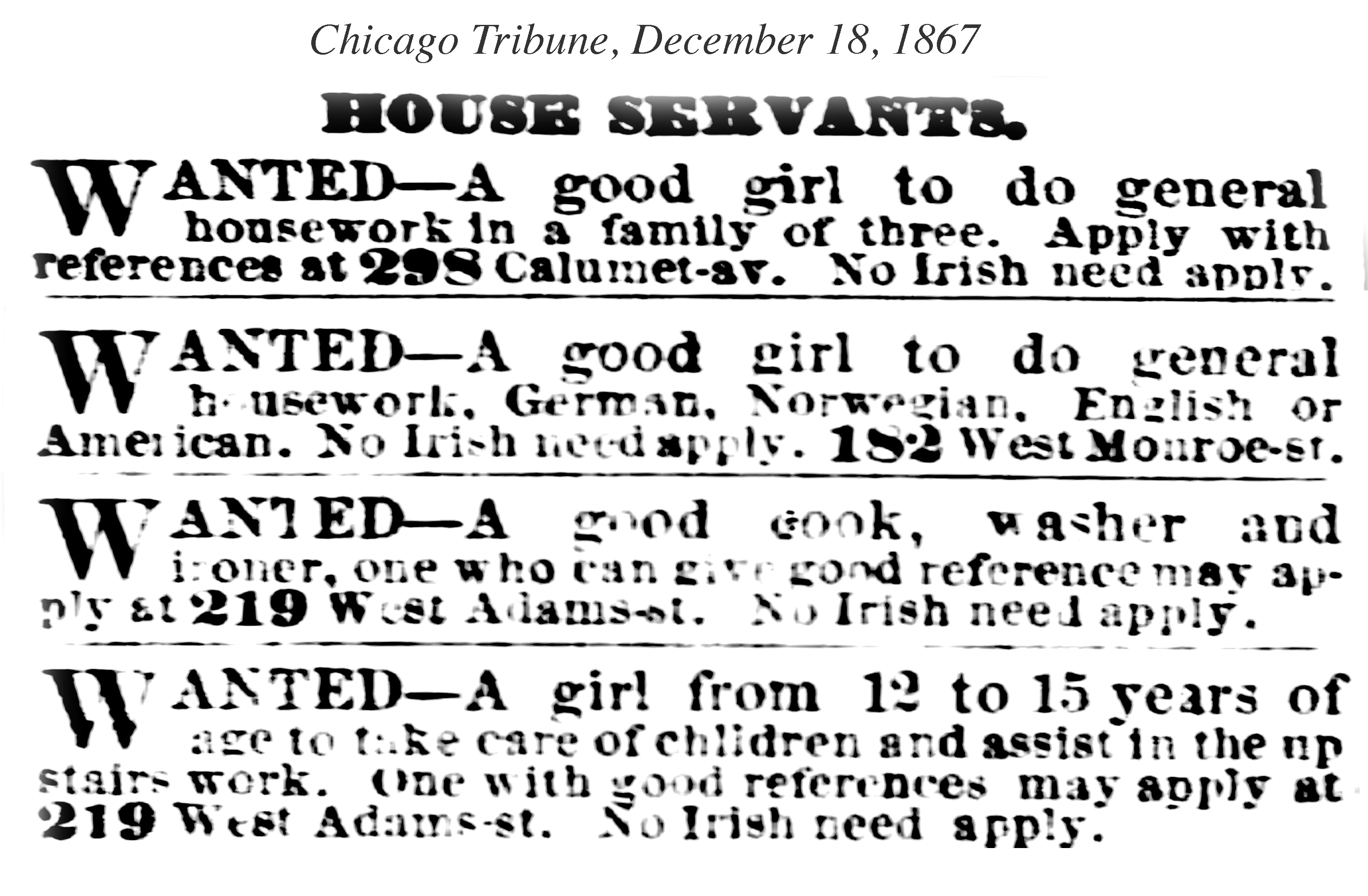
Last week a correspondent drew attention to a few of these advertisements from the Chicago Tribune of the 18th December:
- WANTED—A good girl to do general housework in a family of three. Apply with references at 298 Calumet av. No Irish need apply.
WANTED—A good girl to do general housework. German, Norwegian, English or American. No Irish need apply. 182 West Monroe st.
WANTED—A good cook, washer and ironer, one who can give good references may apply at 219 West Adams st. No Irish need apply.
WANTED—A girl from 12 to 15 years of age to take care of children and assist in the upstairs work. One with good references may apply at 219 West Adams street. No Irish need apply.
We have gone to some bother to find out who these advertisers were. We have the pleasure of assuring our Irish readers that, as we before surmised, those “no Irish need apply” style of people are not Americans. The “Calumet” establishment we have not visited as yet, but the other two are peopled as follows: 182 West Monroe street is kept by C. E. Lowell, a book-keeper; 219 West Adams street, by one Liverius DeGraff, who keeps a clothing store at the corner of Randolph and State streets. Liverius DeGraff, Esq., we believe, is an Englishman, and so is the book-keeper. As DeGraff does not keep the sign of “no Irish need apply” over his clothing house we trust our Irish friends will look on it as though it was there. We are going to open a column in our paper where we will publish the name, business and nationality of every “thing” who insults our country with such advertisements. We are sorry that newspapers of respectability, such as the Tribune, will sully their pages with such advertisements. They become a party to the insult, unintentionally, of course. We know the gentlemen who are connected with the Tribune too well to impute any anti-Irish feeling to them. Their advocacy of Ireland’s cause during the last year or two is proof enough of their liberality. We trust they will prohibit any further use of their columns to insult and traduce our Irish girls.
We shall pursue this question by all means in our power until we silence those venemous vipers who would poison the American mind against our poor country girls by such advertisements as we allude to.
Is it not enough for those requiring help to say who can apply, without winding up with this British fling, “no Irish need apply?” Everybody has a perfect right to hire whom they please; but they cannot insult our race with impunity any longer, and we now give them timely notice to that effect.
Chicago Tribune, September 13, 1868
The Democracy are circulating in hand bill form an article extremely offensive our Irish citizens, from the Chicago Evening Post. Lest they ran short this kind of ammunition before the election, we republish gratuitously an from the Chicago Times, purporting be a description of the Irish settlements Chicago.
Chicago Tribune, November 17, 1868
The Contract for the construction of Division street bridge (river) was yesterday awarded by the Board of Public Works to Fox & Howard, for the sum of $15,794.84 and sixty cents per cubic yard for filling the approaches on either side. The bridge to be similar in style and design to Clark street bridge.4
Chicago Tribune, June 28, 1869
FATAL AFFRAY.
Boy Stabbed by His Companion Daring aa Altercation, While at Play.
On Saturday afternoon, two boys, named F. Doud, aged 15, and Timothy Curley, 16 fears of age, while pinging on Division street, near Hurlbut, got into a quarrel, during which Doud drew a pocket-knife end stabbed his antagonist in the side. The affair created no excitement, even in the immediate neighborhood, owing, probably, to the fact that It was not considered of a serious nature. Young Curley managed to reach his home, but a little way off, on Hurlbut street, where Dr. Simpson was called, who pronounced the wound trifling, and sewed up the gash. The police were not informed of the facts, add, consequently, the assault went about unmolested.
Sporty after 9 o’clock, yesterday morning, however, word came to the North Avenue Sub-Station that a murder had been committed and it then transpired that the wounded boy had died, shortly before, of his injuries. An examination of the body disclosed the fact that the cut had entered one of the lad’s lungs, and, owing to the fact that the wound been closed, death was caused by internal hemorrhage. When the news of the murder reached Captain Fox he gave orders for the arrest of young Doud. The police paid a visit to his home, No. 945 Division street, but found not the lad. From information received they had reason to suppose that he had fled to the West Division. On crossing the river, after a protracted search, they found the culprit hid underneath an old barn, located on what is known as Goose Island, a little strip of land in the North Division. When ordered to vacate his place of refuge, be refused to comply, and until threatened with death, at the hands of sundry revolvers pointed at him, did he see fit to comply. He was then taken to the North Sub-Station, Doud is said to be the the driver of an express wagon. To-day Coroner Cleaves will hold an inquest over the remnants and the affairm in all its bearings, will no doubt be thoroughly investigated.
Chicago Evening Post, March 4, 1872
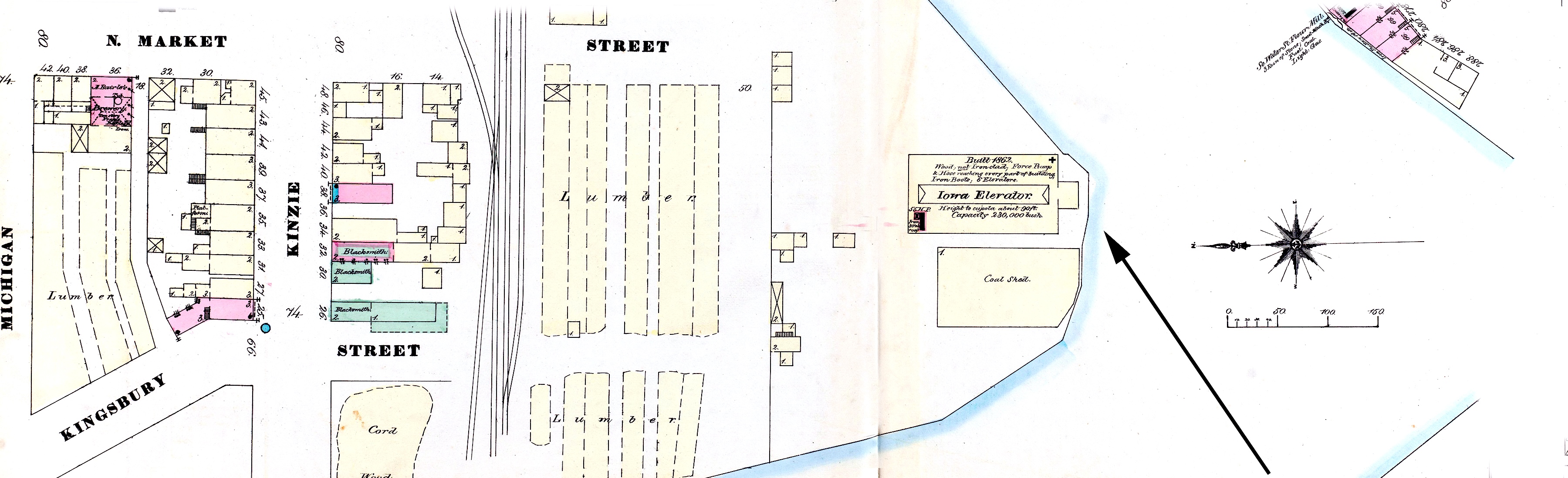
- WHO OWNS THE GOOSE ISLAND ELEVATOR?
On Goose Island, in the North Branch, is located the lowa elevator, recently occupied by Spruance, Preston & Co. Mr. Hugh Maber, however, claims the ownership of the elevator, and on Saturday noon, while the employes of the occupants were at dinner, Hugh. his son, and a number of men overpowered the watchman and took forcible possession. The men were armed, and refused to vacate. A riot warrant was obtained, but pistols were presented to Sergeant Lull and his men, and they were warned to break open the doors at the peril of their lives. The Sergeant consulted with his Superintendent; the latter officer advised with the Corporation Counsel, and that gentlemin consulted with the Mayor, and the result was that Huga Maher, up to this morning, held possession of the premises, in defiance of the firm of Spruance, Preston & Co., the police, the riot warrant, or any other earthly power. It is his boast that he knows his rights, and, knowing, dares maintain them.
1869 Sanborn Fire Insurance Map.
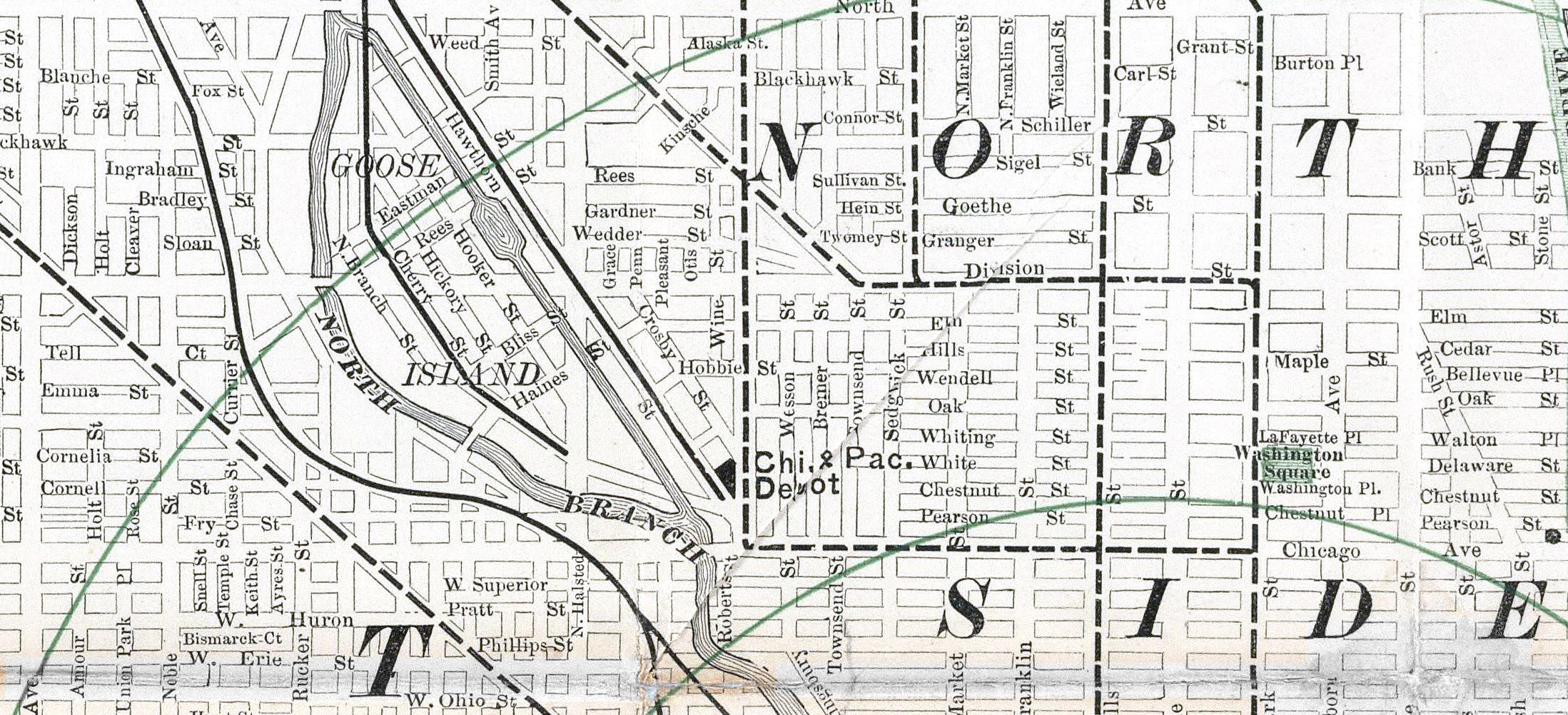
- Goose Island
1876

- Goose Island
Robinson’s Fire Atlas of Chicago
1886
Chicago Tribune, October 14, 1885
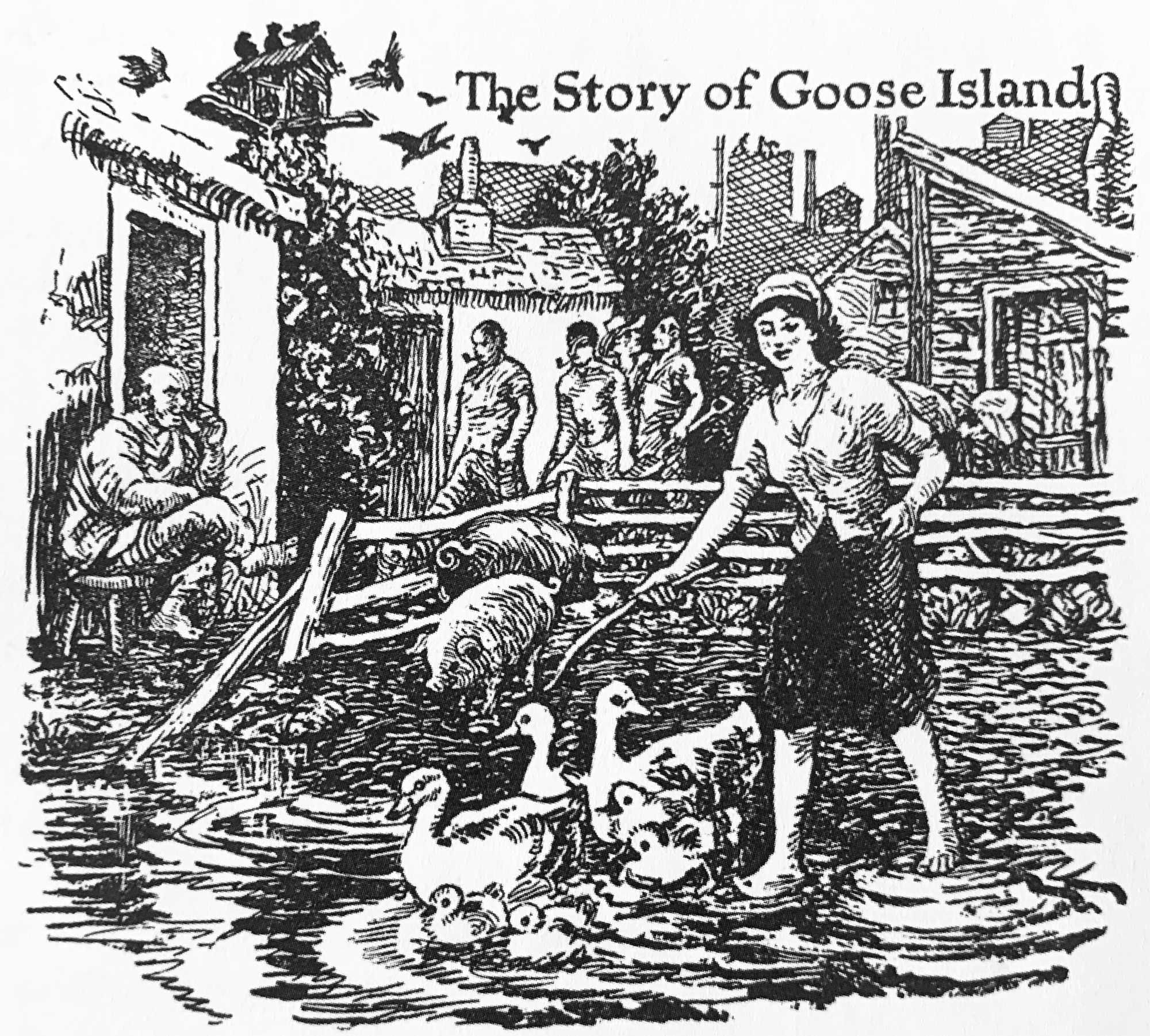
Goose Isand.
Something More Than Its Name Indicates.
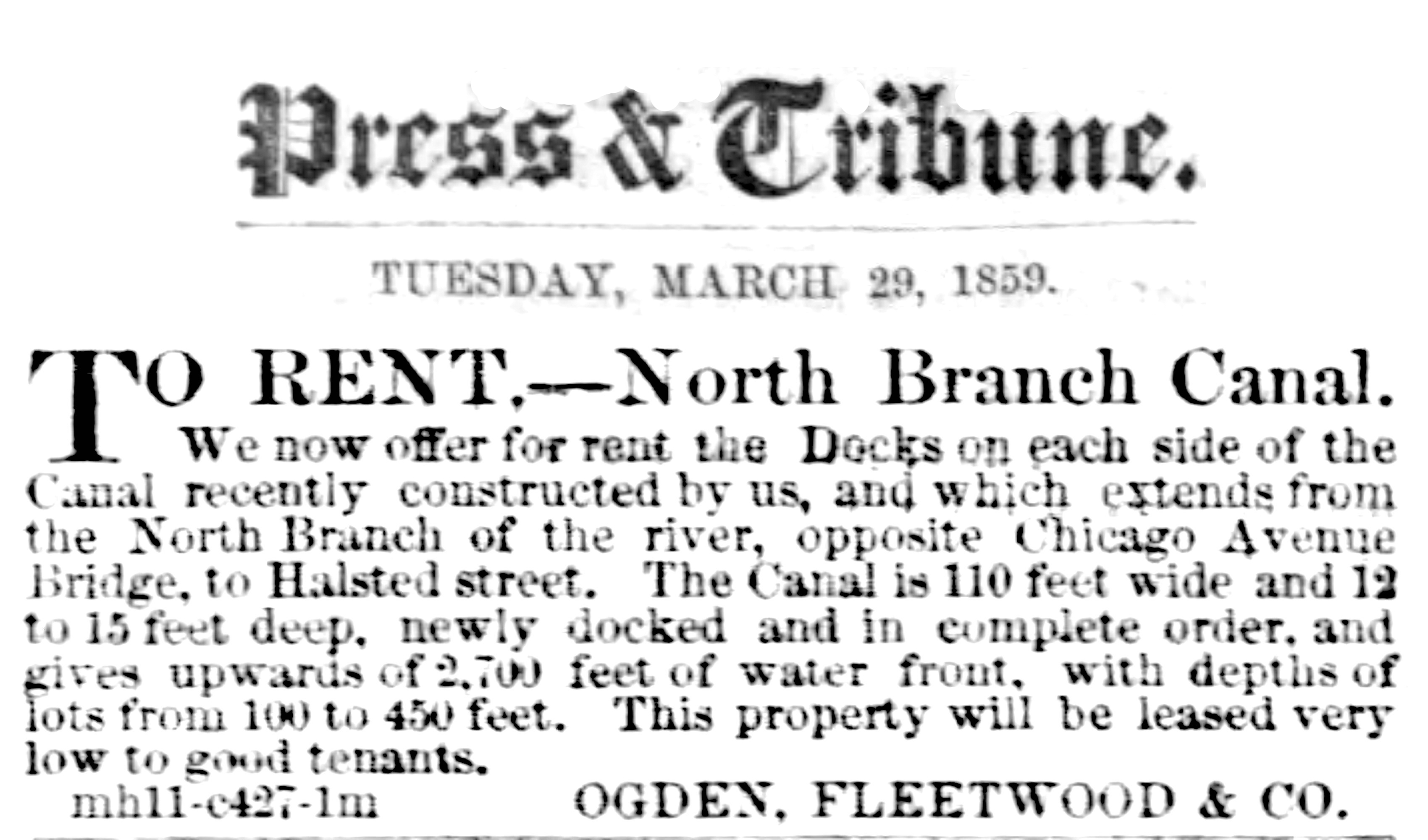
There are probably a good many people who have lived in Chicago for several years without having ever heard of such a place as “Goose Island.” It is a strip of land extending about a mile—from Chicago avenue to North avenue. big bend in the river towards the west forms one boundary, and the other is a canal on its eastern side, which was dug about the time of the War for the suppression of the Rebellion. At first the island was uninhabited, then tenanted by squatters, and as late as seven years ago it only contained one coal and one lumber yard. Now it is fairly covered with business plants, all except about four blocks, which were bought up by P. D. Armour a few days ago. It contains thirteen lumber, eleven coal, three stone, two slab, and two sand yards, besides two grain elevators erected by the Chicago & Pacific Elevator Company, the second of which is just finished. The two have a capacity for storing 1,750,000 bushels of grain, and are fitted with the most modern and best-approved appliances for handling it, including arrangements for turning it when needed to keep it in good condition.
The river itself and the canal above referred to have recently been dredged out to a depth sufficient to permit the passage of craft as large as can navigate other portions of the Chicago “creek,” and the stream is spanned by bridges at the principal thoroughfares, while the railroad tracks are crossed by viaducts which permit the free passage of teams to and from the different places on Goose Island, with even less of hinderance than is experienced at several other tracks in the city. It is already owned in part by the Milwaukee & St. Paul Railroad Company, and that corporation will probably occupy a large portion of its area in the near future. The grain trade of the city, especially, has in the recent elevator improvements on Goose Island a much needed addition to its facilities, which will probably be the means of materially increasing its hold on the great wheat-raising sections of the Northwest.
Chicago Times, Nov. 15, 1891
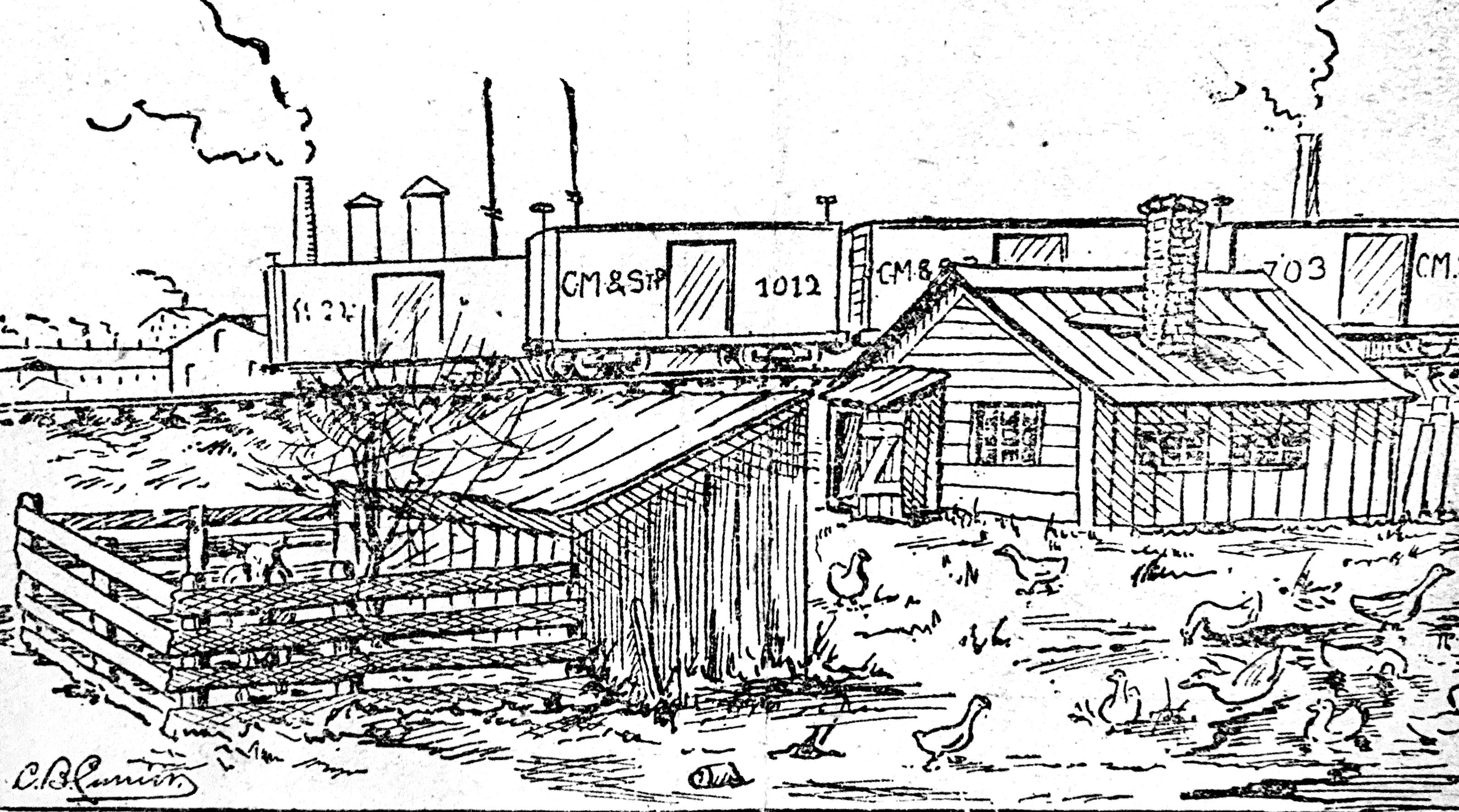
- A typical Goose Island residence.
Chicago Tribune, June 10, 1906

Members of the Chicago Geographic society yesterday paid a visit of “exploration” to Goose Island. To their surprise, they found that the inhabitants of Goose Island are far from being savages.
The party, sixty-three in number, made the trip on the gasoline launch American Eagle, leaving the south end of the Clark street pier at 9 a.m. The boat returned in the evening. The party was headed by R. E. Blaunt, and the novelty of the novelty of the trip proved an attraction.
Although the men of the party would not admit they experienced any fear when they approached Goose Island, they intimated they were prepared for happenings that would not be countenanced in a drawing room, so florid were the pictures of the character and habits of the people of Goose Island painted.
They found, however, that the popular impression of the place is unwarranted. The people there were too busy at their work or household duties to pay much attention to their visitors.
“We had heard so much of the inhabitants of Goose Island that we actually believed they had an independent government of their own, and were beyond the jurisdiction of the laws of Illinois,” said one member of the party. “It was with fear that some of us beheld the little island as we approached, for we thought that the natives might disturb the pleasure of our trip.”
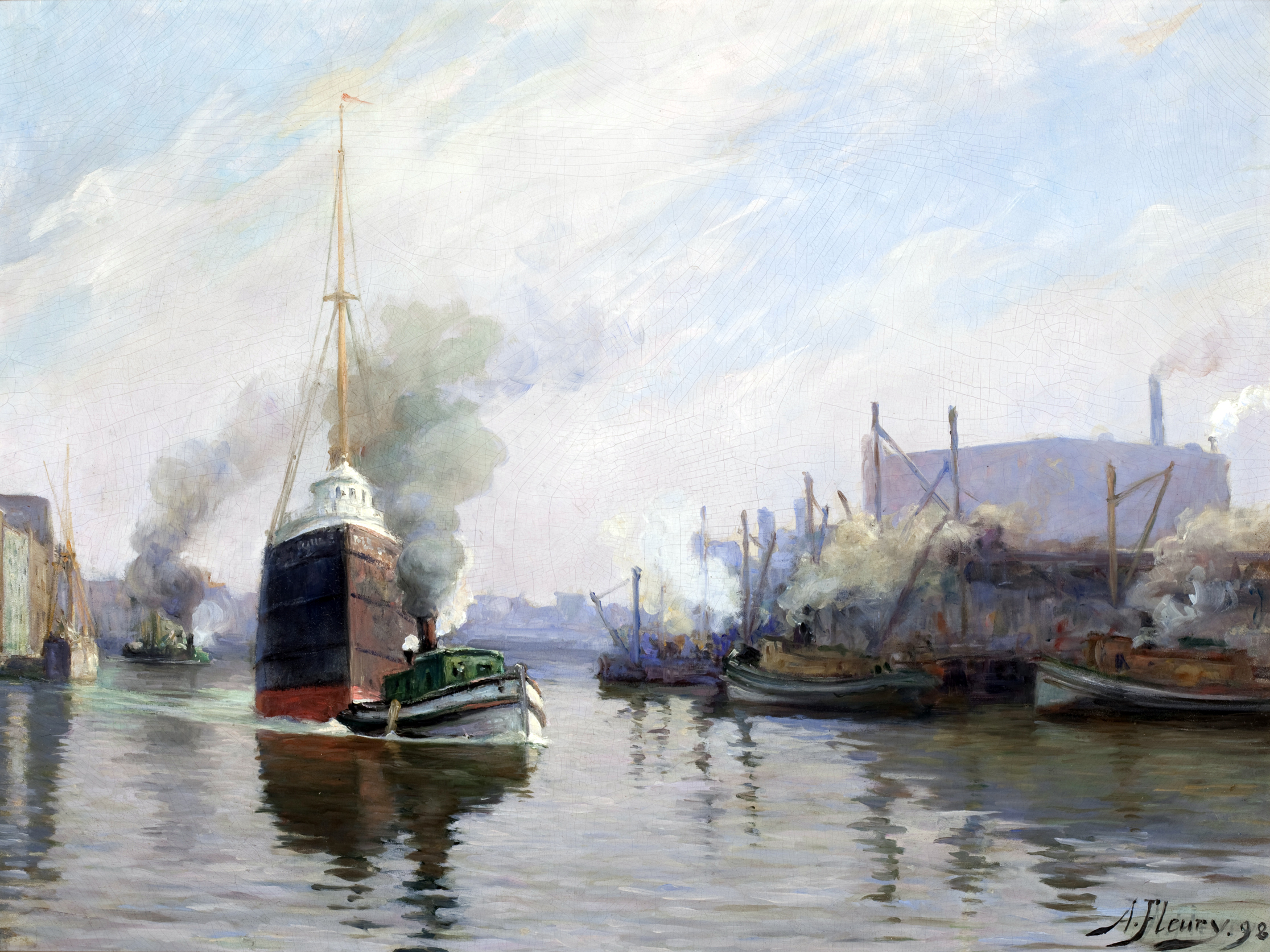
- Goose Island
Albert Fleury
Oil Painting
1898
Chicago Tribune, July 14, 1900
The Finance committee of the City Council yesterday agreed to recommend the placing of a fire engine company with equipment on Goose Island. George J. Brine of Armour & Co. said his firm would build the engine-house. The Chicago, Milwaukee & St. PAul road has agreed to donate the use of a site.
“There is $10,000,000 worth of property on the island without fire protection.” said Chairman Holmes of the Underwriters’ association. “Mayor Harrison and Chief Sweenie favor establishing an engine company there. I expect that the present attempt will be a success. The island is cut off whenever the bridges at Chicago avenue and Division street are out of repair.”
For some time the underwriters have considered increasing rates in the Goose Island district on account of the inadequate fire service. This will not be done if the places a fire company on the island.
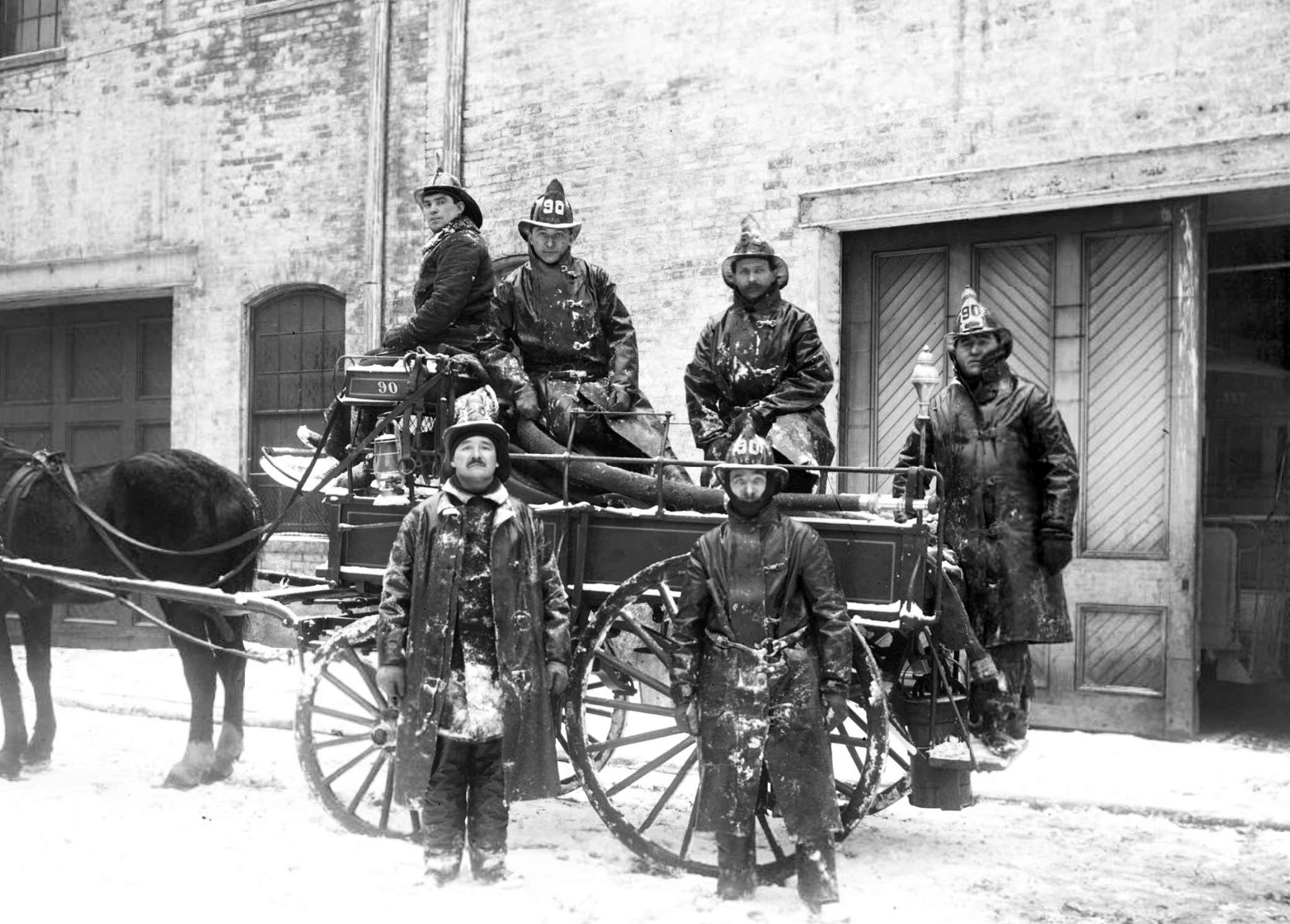
- Goose Island Fire Department
Engine Company 90
Chicago Daily News
February 11, 1907
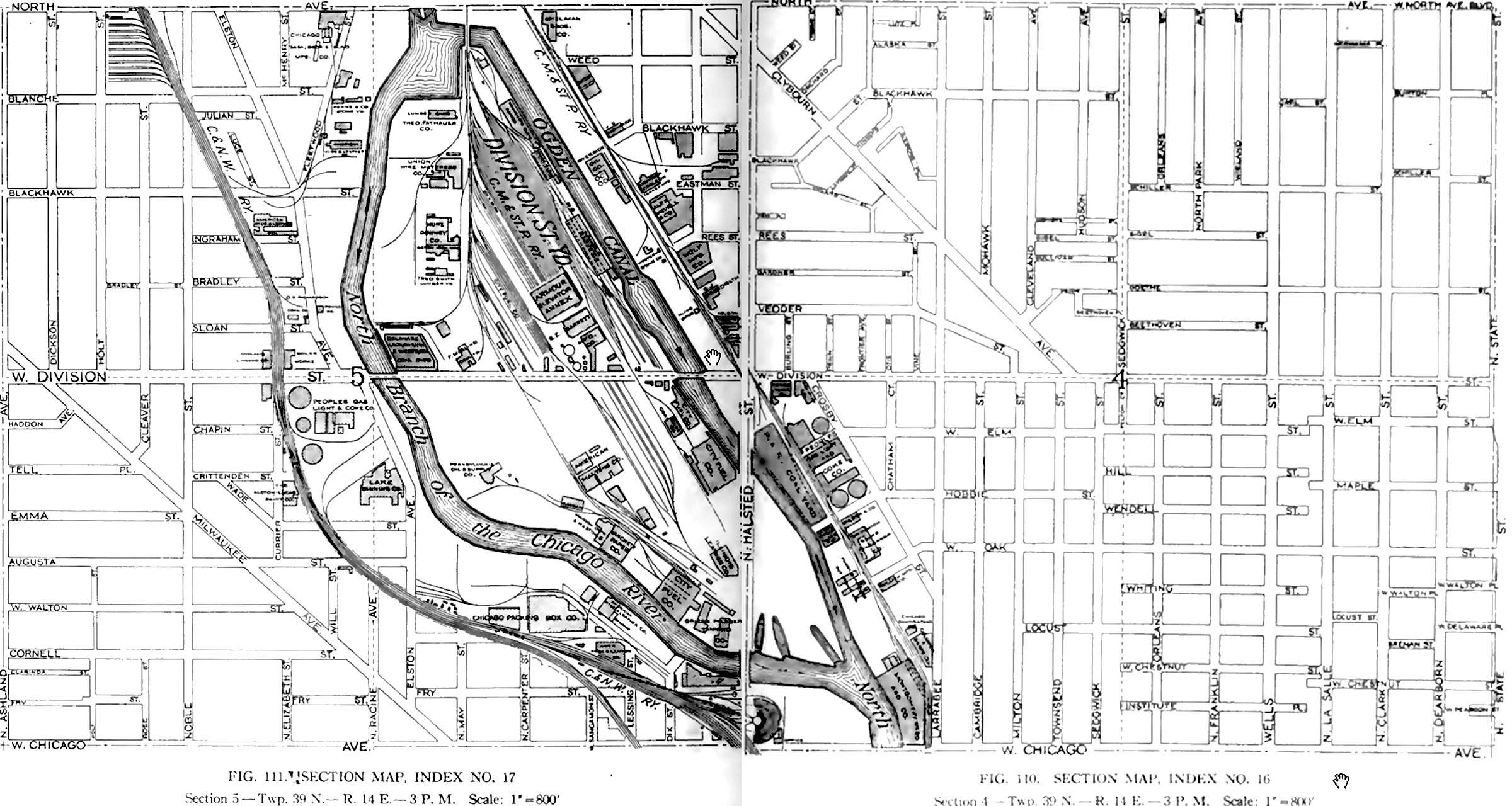
- Smoke Abatement Map
Goose Island
1915
Chicago Tribune, October 20, 1929
Kilgobbin Becomes Little Hell Then It’s Named Goose Island
This article is the nineteenth of series on names of streets, districts, and suburbs of the north side.
From geese and gas house to factory and railroad and from Kilgobbin to Goose island via Little Hell is the history in miniature of the 160 acre section that is surrounded completely by the waters of the north branch of the Chicago river and the Ogden, or north branch, canal.
When three Irish lords of the land evicted hundreds of their tenants and rallroaded them to the United States, a carload reached Chicago and settled on the island that stretches crookedly from Chicago to North avenue between Halsted street and Racine avenue. Ogden’s island 1t had been called when it called anything and there were tanneries and a small soap factories even then at the northern end.
But when the Irish came, they brought the name of Kilgobbin to it. Little Hell was added because of the nearby gas house with its nightly flames and smoke. And Goose Island it became and remained because of the geese they raised in the river channels.
Squatters Driven Out.
The a southern end of the island was grassy and pleasant and, although the houses that were put up were little more than shacks, it was considered for a time a good place to live. P. D. Armour put up his 2,500,000 bushel grain elevator and more more railroads came through; docks were built into the channel and factories began to wipe out everything else. A son of one of the squatters who persisted in staying on the island was killed and with that as impetus the rest were forced out.
Before that, however, at least one factory had left the island and under rather unusual circumstances. Charles Cleaver had a soap works there in 1835. Some time later he moved it to the south side. He had recently built several houses for his workmen conceived the bright idea of floating them down the river. There was a bridge, only one, in the way so, he writes: “I notified the city authorities that the bridge was obstructing public traffic and after a delay of a few days it was duly removed.”
Mayor Ogden an Early Owner.
Goose island has changed hands many times in its existence. William B. Ogden, first mayor of Chicago, owned most of it at one time. At the time the canal was dug the Illinois Land company was the owner, 1855 it was entered as Elston’s addition to Chicago. It was not until after the digging of the canal that the island was called that with propriety.
Before that time the north branch curved around to make two sides of the triangle and the third side was part swamp, part rivulet, and part pond.
Now there is no through street across it and, though streets are laid out on it, they run at angles different from the ones leading up to it. Ogden avenue leads up to it from the southwest and then jumps it to pick up again on the other side. Plans to build a bridge across the two channels and over the railroad tracks to connect the two links are still hanging fire..
Chicago Daily News, March 26, 1930
 “What puzzles me,” said Randolph Streeter, the debonair loophound, as he sat contentedly smoking his pipe—what puzzles me is why these people who look up remote parts of the world to explore don’t stay at home and explore their own backyard. There’s so much to be seen in your own neighborhood or city as in Timbuctu or Bangkok. It’s all in your point of view.”
Randolph Streeter, seated in the Wells street restaurant, was vehement.
“What’s your point, Randie?” some one in the group asked.
“Just this,” he replied. “I propose to get up an expedition to explore the fastnesses of Goose island, almost in the heart of Chicago—an island, gentlemen, that once loomed large in our local folklore and bore a race of people that did much toward building the great metropolis which enfold it.”
“But see here, what do you expect to find there today?” some one was asked.
“Wait a minute,” said Streeter. “Since hearing of J. G. Whosis’ expedition O have engaged in extensive research work into the history of Goose island. And now I want to show you the discovery upon which I shall base my own expedition.”
Putting his pipe down, Randolph Streeter reached intohis coat pocket and brought forth an old, tattered map of Goose island, He laid it in the table and explained things as the group crowded around.
“This map, Gentlemen,” explained Mr. Streeter, “was found among the effects of the late John Mullen, ‘mayor’ of Goose island in the ’70s. It gives a clear indication of the civilization that once flourished on the island—a civilization since scattered by the smoky march of industry. I located it in the possession of Sergt. James Mullen, a member of the constabulary in the metropolis on the mainland and a son of ‘Mayor’ Mullen. As a matter of fact, I have succeeded in locating scores of descendants of Goose islanders as well as native-born. They are scattered in all sections of Chicago.
“What do I expect to find there today? Well, there won’t be any tree-climbing fish, for one thing, and the geese are all gone. The region is mostly filled with prosperous manufacturing plants. But, would you believe it, gentlemen, there are still a few of the original natives on the island, as well as several of the ancient industries. Tale a look at this map. There is ‘Little Johnnie’s tavern on North Branch street. Conducted by John Langan, this inn was one of the most popular gathering places on the island. Prohibition has closed the tavern, but Joe Langan, a son of ‘Little Johnnie,’ still lives upstairs.
“And see this tannery across from Langan’s tavern, now known as Griess-Pfieger Tanning company? That’s the same one where the late William E. Dever, former mayor of Chicago, worked as a laborer to earn enough money to go to night school and study law. Among the natives still living there are John Connerton and his father, Paddy Gibbons, Jack Raymond, Walter Joyce and his wife, Mrs. Anne Cunningham, Mrs. Mamie Langan and Mrs. Anne Murphy. And up on Division street, the main shopping thoroughfare of Goose island in the old days, is the home of Mrs. Catherine Groves, now Mrs. Bert Bauman. Across the street is the ancient wooden fire barn, still occupied by a fire-engine company.
“I might say here, gentlemen, that a good deal of my information comes from John T. Gibbens, a retired policeman detailed to the county treasurer’s office, who was born and reared on Goose island. He tells how the early islanders were a God-fearing people, despite the fact there was no house of worship there. They had to go a long way over the mainland to a parish church. He goes on to describe hot summer nights among the lonely arc lights of the island, when folks would ‘rush the can’ to Johnnie Langan’s tavern or McCormick’s place up near Division street; he tells of the big swing the kids enjoyed—almost 30 feet high—at the juncture of North Branch street and Cherry avenue; of Jack Butcher’s saloon and the Saturday night dances in the basement of Mike Meyer’s place; of ‘Mayor’ John Mullen and his Irish wit; of the baseball diamonds and swimming holes at the north end, among the hot weedy prairies, and of the night the big grain elevator burned down.
“Oh—and another thing, my friends—Gibbons tells me that the father of Finley Peter Dunne, creator of the famous ‘Mr. Dooley‘ stories, worked as a ship’s carpenter in the shipyard of Fox & Howard on what they called ‘The Point,’ opposite Montgomery Ward’s. The northern tip of Goose island was a ship basin, as it is today. An old industry still active is the American varnish works, at Division street.”
“How dis Goose island get its name, Randle?” some one asked.
“Well,” he explained, “in addition to having cabbage patches back of their cottages, the islanders were noted for the large number of geese they kept. As a result, the newspaper wits of the time gave it the nickname of ‘Goose island,’ and many were the stories that told of the feats and prowess of the islanders. Officially it was known as Ogden island, named after William Ogden, the first mayor of Chicago.”
“Have you chartered a shop for your expedition yet?” one of the “round table” diners asked.
“Indeed, sir, I have,” replied Randolph Streeter. “I’m going to use that famous river vessel, the Sandmaster, because of the facility with which it negotiates the bridge-incumbered reaches of the Chicago river. We shall have to follow the Northwest passage, since the island is about 43 degrees north latitude and 36 degrees longitude due west of Greenwich and northwest of the loop. Since we cannot start until navigation is at its best I propose to occupy——”
But at this point Randolph Streeter was interrupted. Everybody looked up to see who was coming into the restaurant. It was no other than Robert J. Casey, who was about to leave for Easter island in the Pacific. The group lost no time in telling him about Randolph Streeter’s proposed expedition to Goose island. Casey laughed loudly.
“Why, say, I explored that island thoroughly last summer to get material for my murder mystery serial, ‘The Niblick Murders,'” said he. “Tell me of some island I haven’t explored, and what of it?”
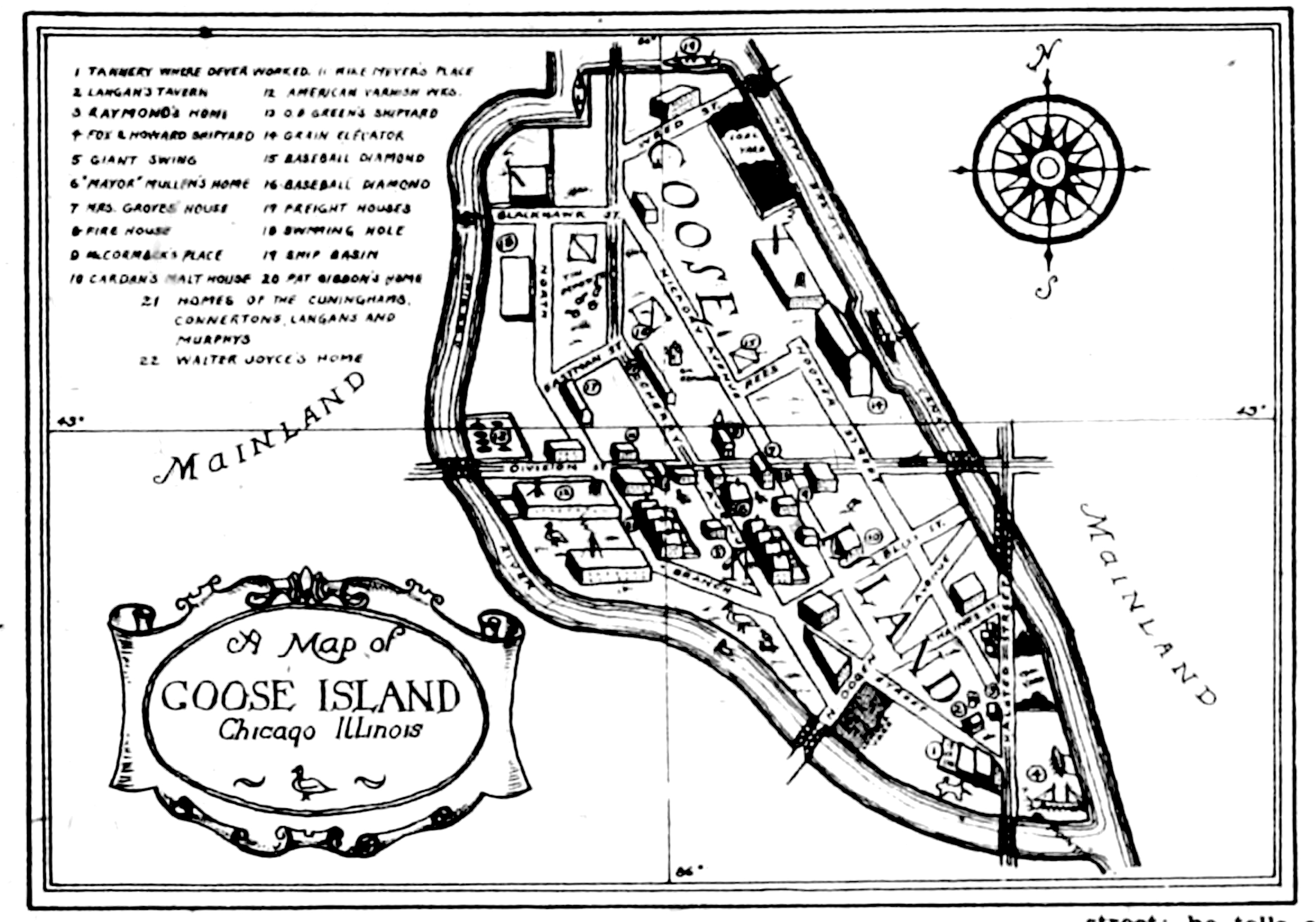
- John Drury’s Map of Goose Island
Chicago Tribune, May 15, 1930
Fire caused by spontaneous combustion of grain dust last night destroyed property valued at $750,000 on Goose Island, including a grain elevator and 200,000 bushels of rye. Sixty-five engines and trucks and the two fire boats, the Graeme Stewart and the Illinois, were called upon.
The fire started with an explosion at 5:30 o’clock in a seven-story structure known as the Minnesota elevator and owned by the Rosenbaum Grain corporate America. It is situated at 1325 Hooker street, just south of North avenue, alongside the river.
The elevator was one of a group built in 1898 by Philip D. Armour Sr., when Joseph Leiter was engineering his famous wheat deal which collapsed after he had cornered 40,000,000 bushels in an operation that cost the family $16,000,000. As the date approached for delivery Armour found he had no place to store the incoming grain. He hired carpenters and built three elevators on Goose Island in record time—30 days—and for years afterward these were known as the “Armour Thirty Day” elevators.
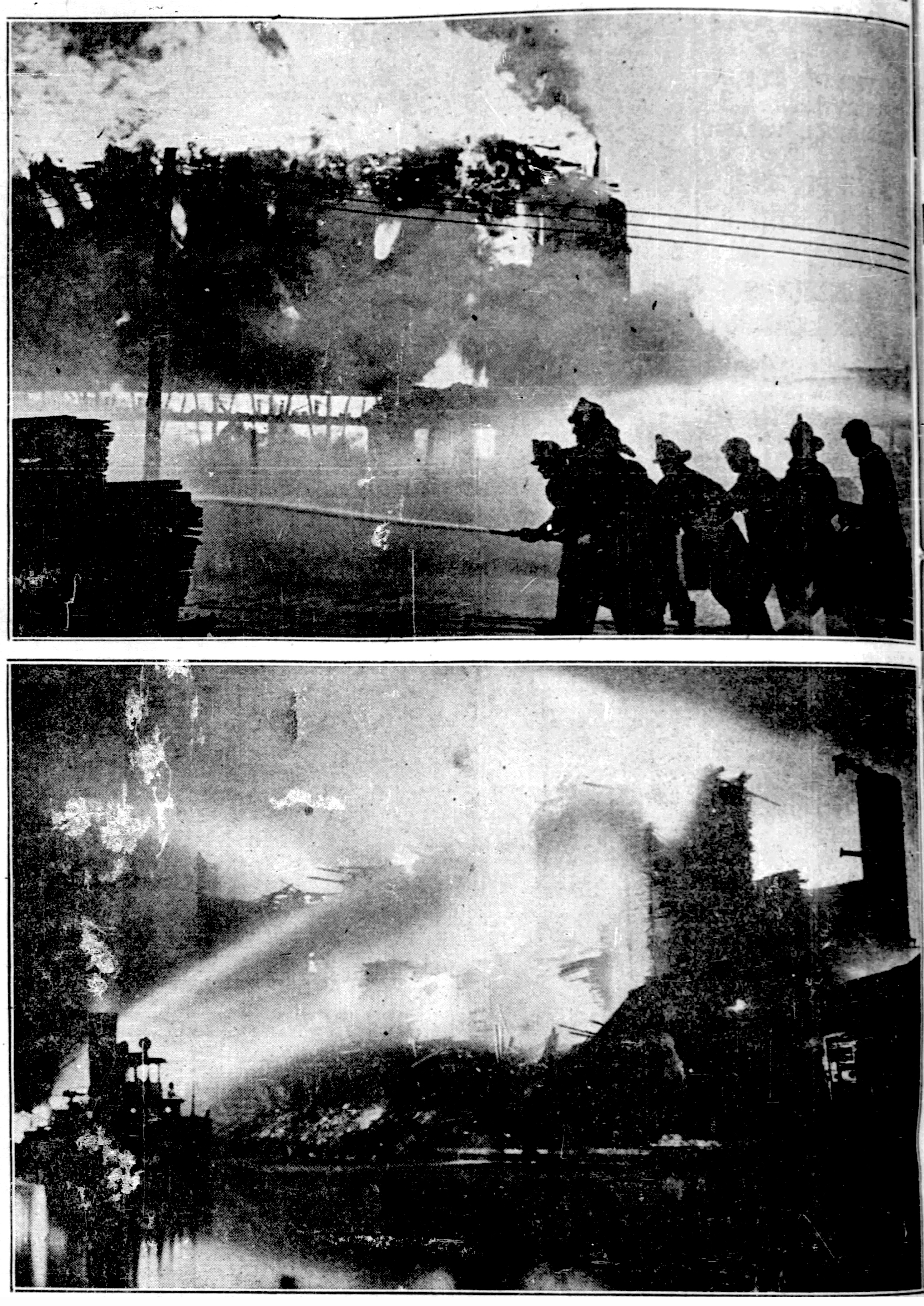
- Goose Island became more industrial after the turn of the century. This fire destroyed the last of the grain elevators built on Goose Island. By 1937 only 30 families resided on the island. By 1974 no more than six persons lived on the island.
NOTES
1 Chicago Tribune, February 1, 1951
2 The Times, a notoriously sensational newspaper run by publisher Wilbur F. Storey, had been considered a friend of Irish immigrants. Like the Times, the Irish supported the Democratic Party. But a day after the Times published Wing’s article—without a byline—1,000 Irish readers canceled their subscriptions.
“Irishmen rush into the office, and threaten to kill the individual who wrote it, if they can only lay hands upon him. The excitement is intense,” Wing wrote in his diary, which was published as a book in 2002.
The Tribune reprinted the entire Times article—and then published it a second time, on November 4 1866 and September 13, 1868, eagerly presenting it as evidence of the rival newspaper’s “Wholesale Slander and Vituperation of the Irish People of Chicago.”
John M. Wing started the real estate newspaper, The Land Owner under the name of Jack Wing, starting with the September, 1869 issue. In the October, 1869 issue his name was J. M. Wing.
4 Some Kilgubbin residents kept their geese on a mound of yellow clay in the river, which was called Goose Island — not to be confused with the larger Goose Island that today’s Chicagoans are familiar with. This early patch of land with the same name was only about 20 square yards.
4 The first bridge over the Chicago River at Division Street was opened in 1866, The first bridge over the Canal was opened in 1870. In 1902 a temporary bridge crossed the river at Blackhawk Street while a new bridge was being built at Division Street. This bridge was removed in 1910.

Leave a Reply