Chicago Tribune March 17, 1907
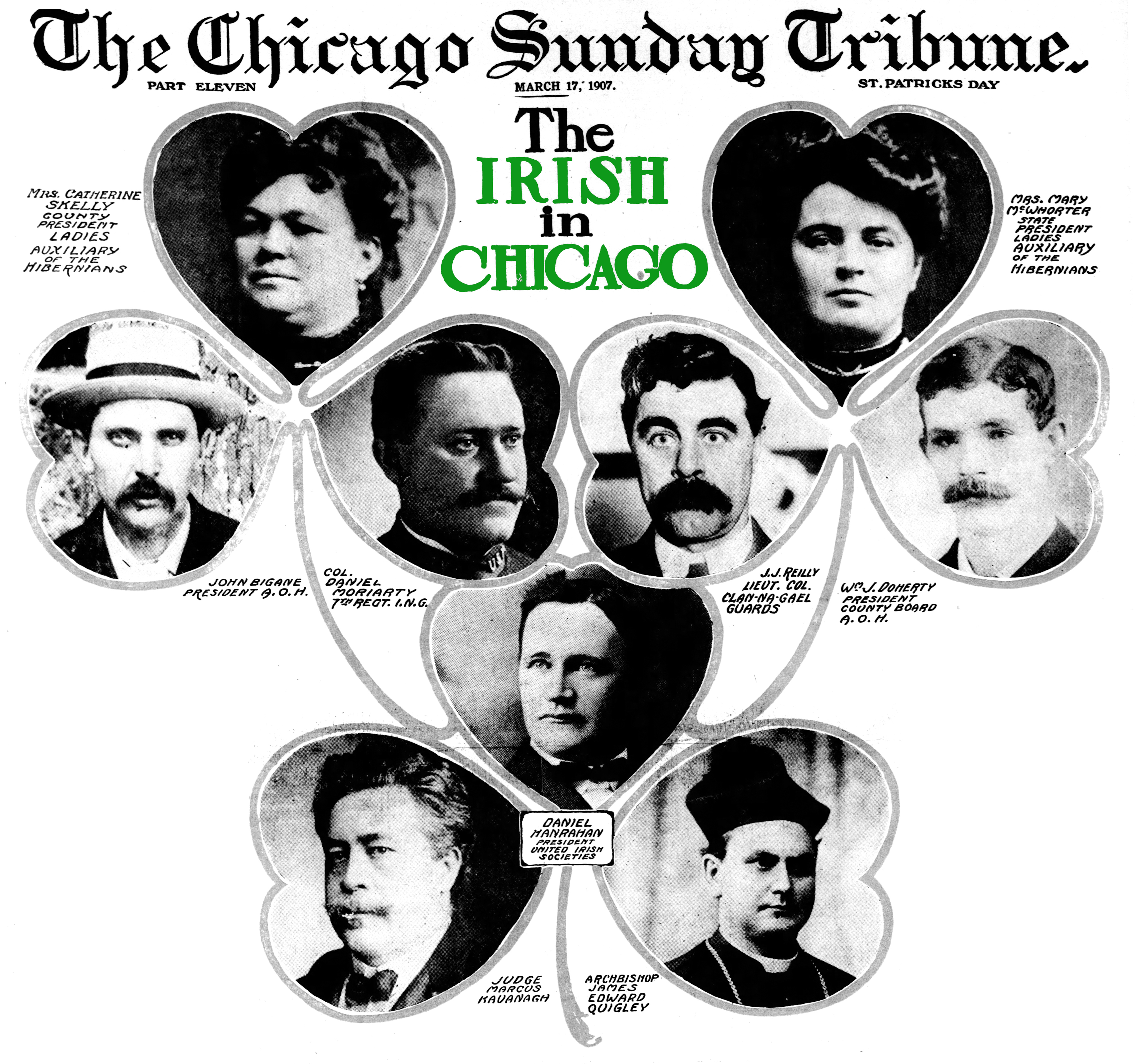
One-fifth of the people in Chicago are Irish, and proud of it. Nobody on the face of the earth is as proud of his nationality as the Irishman, and in the light of his achievements few prides are as pardonable as the one that fills the breast of every loyal son of the Ould Sod. Where would Chicago be today if the Paddies and Mickies had not come over to dig its ditches? Picture a police force without its Pats and Mikes, if you can. Who sits in the city’s council and makes the city’s laws but the Hon. Patricks and the Hon. Michaels? Hats off to the Irishman, who governs every country but his own; who pushes wheelbarrow and the pen to the everlasting honor of both, and who almost, but not quite, is as proud of his nationality as Chicago is to him.
No history of Chicago is complete without a record of the city’s Irish citizens. From the day of the last treaty of peace between the colonial French and English—negotiations which, by the way, are known to have been conducted by an Irishman on each side—the sons and daughters of Erin have done wonders toward the building of the west and to no small share of his work is due the present greatness of Chicago. The Irish helped to drive the Indians out of Chicago, and the city is thankful today that this people, with sturdy strength and perseverance, have been here ever since.
Past Master in Political Arts.
The Irishman in Chicago, like the Irishman in every other part of the world, presents a study in political contrasts. Primarily, the Irishman is a politician and his deftness to the arts and crafts of political manipulation always has been past the understanding of his fellow workers in the new republic. The trait of the Gaelic mind is based on the same cause that makes the Jew, deprived for centuries of the opportunity to earn money, the first to grasp commercial advantages when no restrictions are placed on his effort. In his own country the Irishman is denied many political benefits and that fact makes him the first to exercise them in a land that recognizes no civil distinctions.
The first politician in Chicago was the son of an Irish father and a Pottawatomie Indian mother. His name was “Billy” Caldwell, and it is recorded of “Billy” that his chief pride in life was in having an Irishman for a father. “Billy” was a justice of the peace for several years prior to 1826, and when Mark Beaubien built the first tavern that ever was erected within the present limits of Chicago it is said that he could think of a no greater man that “billy” to name it after. Caldwell rendered splendid service in the adjustment of difficulties that sprang up between the settlers and the Indians, and in recognition of this work the department of Indian affairs at Washington built him a fine house on the present corner of State street and Chicago avenue and gave him an annual pension of $1,000 until his death.
Chicago’s First Politician Was Irish.
While “Billy” Caldwell gloried in the fact that his father was an Irishman, he bore the Indian nickname “Sauganash,” meaning Englishman. This was the name that Beaubien gave to his tavern, and while Caldwell recognized the honor paid him by his fellow townsman, he never ceased to resent his nickname in the most approved Irish fashion. It stuck to him, though as long as he lived. “Billy” was Chicago’s first but hardly her last Irish politician, and while many of his fellow countrymen failed to live up to his high standard of political ideals it cannot be said that the average Irishman is without his love of good government and high citizenship.
The political activity of the Irish in Chicago has been marked ever since they have been a factor in the city’s population and at times this aggressiveness has been of sufficient proportions to make the city hall their nominal and actual headquarters. While at times Irish officeholders have been subject to just criticism, they more often have been found at the head of movements for reform and good government. The Irishman stands out as a credit to the city in the making of which he has played such a prominent part. His essentially tender nature and the warmth of his affections are things that in the past sometimes have made the son of Erin a prey to designing leaders in the game of politics or a follower in a cause unworthy of his loyal devotion.
City’s Irish No Longer Colonized.
There are no longer any colony limits for the Irish in Chicago. Thirty years ago most of these people had their homes in the old Bridgeport settlement out near the stockyards, or off to the southwest of the city along the Illinois and Michigan canal. Recently the whole Stockyards district has been changed in its racial complexion by the influx of immigrants from the countries of southern Europe, but in spite of this, the Irish still are to be found there in great numbers.
In former times the new arrivals from Ireland sought and usually found employment in the live stock industries at the yards almost as soon as they reached the city. Twenty-five years ago there were a dozen Irish laborers to one of every other nationality in the packing houses, but as the size of the plants increased there was an imperative demand for more workers, and as the American pilgrimage from the congested parts of southern Europe began about that time it was not until many years until the keener competition from this source drove the Irish laborers into other fields of activity. At present there are hundreds of Irishmen st work in the stockyards, but their numbers are rapidly decreasing.
Another Irish settlement that still remains much of its old identity is the one along Archer avenue, or the old “Archey” road, as it formerly was known. This territory for years was inhabited by Irish and many of them, and their descendants still live there. When the building operations of the Illinois and Michigan canal were in full force most of the laborers were Irish, and from the money they earned at that time many of the heads of families bought modest homes. These are still retained by the children of the canal workmen and are used either by them as dwelling places or rented to the later arrivals from the old country.
The Archer avenue settlement was centered around the old Holy Family church, and many of those who have prospered sufficiently to live in a more congenial part of the city, if they cared to do so, still make their home near the old church.
While politics always has been the Irishman’s natural field of activity, he has prospered greatly in nearly every line of commercial and professional pursuit. Many of the packing houses in which the members of his race once worked as laborers now are owned by Irishmen, and the foremen and superintendents in nearly all the houses still are of that persuasion. Along Halsted street, in the vicinity of the stockyards, where he once was a tenant, the Irishman now is a property owner and a tax payer and of most of the smaller business establishments in the vicinity of his old settlements the proprietor is of Irish birth or descent. Hundreds of men well up toward the top in the business world of Chicago trace their lineage to the Emerald Isle.
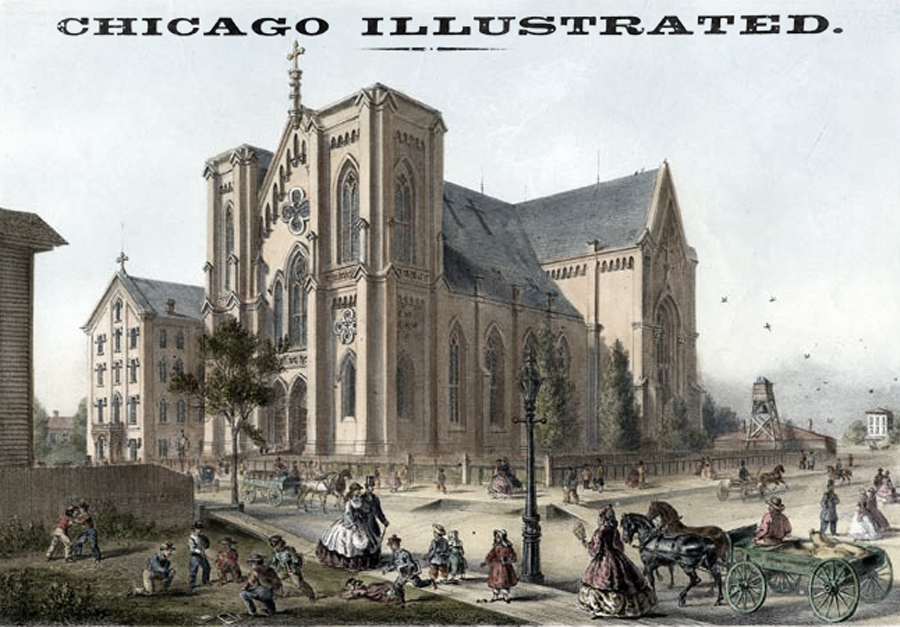
- Church of the Holy Family
On Twelfth Street, between Blue Island avenue and May street
Chicago Illustrated, March 1866
Louis Kurz, Artist
First Volunteers in Civil War.
In the military history of their adopted country the Irish have borne an important part and the members of the race in Chicago have been no less conspicuous on the field of strife than were their fellow patriots in other parts of the country. During the first year if the city’s incorporation an Irish military company was formed for the protection of life and property. This organization was known as the Montgomery guards and this name was changed later to that of the Robert Emmet guards. When the civil war broke out the name was changed again, this time to the Shields guards, and this body had the honor later of being the first volunteer military organization in the United States to offer its services to the government. This offer was made on Jan. 14, 1861, and in a letter to the president the little company made known its willingness to serve the country in whatever capacity the president might see fit to direct.
A few months later some of the leading Irishmen of the city, headed by Col. (afterwards Gen.) Mulligan and a few others, started out to organize and equip an Irish regiment for service in the war of the rebellion. Among those who assisted Gen. Mulligan in this effort were Ald. Comiskey and M. C. McDonald; Capt. M. Gleason, C. E. Moore, J. C. Phillips, Daniel Quirk, F. McMurray, Peter Casey, Daniel McElroy, John Tully, Philip Conley, and T. J. Kinsella. These men issued a call for a mass meeting, the announced purpose of which was to organize a regiment, and pursuant to the call there was a monster gathering at Bryan hall. The meeting was addressed by Mulligan, who told of the deeds of bravery for which Irishmen were famous and urged the formation of a regiment which would make the name of Ireland famous in the new world just as it was in the old.
Irish Regiment as Independent Fighters.
As a result of this meeting nearly 400 names were added to the list of those who already had volunteered to go to the front without delay and every arrangement was made to do so when word came from Washington that the Illinois quota had been secured. Mulligan was greatly disappointed at this, but was determined not to give up. After consulting with friends he went personally to Washington to see the president and after a long conference secured the latter’s consent to enlist the Irish regiment as an independent body of fighters.
Hastening back to Chicago, the distinguished Irishman set to work to drill his men and in a few months this regiment, afterwards known as the Twenty-third Illinois Volunteer infantry, went away to the front with more than 900 men. Of this number, a mere handful returned to Chicago four years later after the regiment had distinguished itself in a score of battles.
.
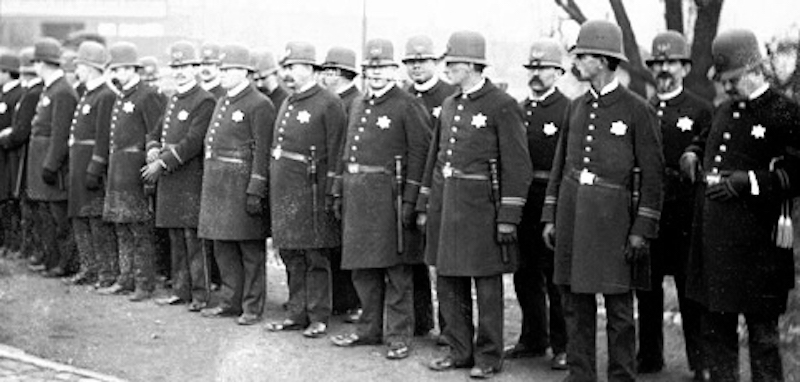
In the semi-military field the Irishman has no equal, as every one knows who is at all familiar with his record as a policeman. The Chicago police force, like the police force in every other American city, is composed almost entirely of Irishmen. Fitted by nature with a strong physique and an even temper, the Irish patrolman makes an ideal officer, especially in a city like this, where crossings must be watched and where criminals of a desperate nature often make their headquarters.
No criticism that year was ever made of the Chicago police department has been directed against the rank and file. Time and again the brave men on whom the city depends for protection have been called upon to lay down their lives in the performance of their duties and seldom has it been recorded that a man was found wanting when the great sacrifice was called for. In the many labor difficulties with which the city has had to grapple and during the stormy days when anarchy tried to rule, the Irish police officer stood ready to lose his life in the preservation of lives and property of his fellow citizens.
No proper estimate could be made of the influence of the Irish race on the development of Chicago. In every line of endeavor they have left their mark of constructive effort and still a mighty factor in the growth of the city. In the educational field no people have done so much as the sons and daughters of Ireland.
Essentially, the Irishman is a brain worker; it is to the credit of the race that so many of the teachers, ministers, lawyers, and other professional men in Chicago today are of Irish birth or descent. Of the 6,000 school teachers in Chicago it be given on the authority of members of the board of education that approximately half are Irish. One-third of the lawyers in Chicago can trace their lineage back to Ireland, and of the children in the public schools at least one-third are of Irish patronage. This percentage of school children would be still higher were it not for the fact that more than 75,000 Irish children receive their early education in the parochial schools.
Eager to Secure Education for Children.
Traditionally committed to the religion of Rome, the Irish parent prefer to educate his children at his own expense, if by so doing he can combine their religious with their educational training, rather than send them to public schools. The value of the parochial in Chicago, which are maintained almost exclusively by the Irish property owners must contribute to the support of the public school system, from which he often expects no benefits in return, it can be seen how eager the race is to secure the advantages of education. The Irish contributions to the ranks of the learned in Chicago are all out of proportion to the numbers of these people, and goes to show a condition of mind as healthy as the vigorous physical strength with which the Irish are endowed.
In connections with the educational advancement of the Irish it may be well to speak of the recent movement to revive the old Gaelic language, literature, and sports, which lately has been given much attention by the Irish in Chicago. Less than two years ago the Gaelic league was formed with less fifteen members, and from this start the organization has a membership approximately of 500 and is growing rapidly.
Mr. Dillon, who perhaps has done more than any other Irishman in the city to further the teachings of the league, firmly is convinced that the Irish, as a people, are destined to become the future, as they have been in the past, one of the greatest of nations and the Gaelic league, in his estimation, is the force that ultimately will lift his native country to this desired elevation.
Seven Irish Mayors in Chicago.1
Seven of the mayors of Chicago have been Irish. All but four of the superintendents of police have been of that race. With the exception of a few years the fire department has been ruled by an Irishman and if a list of all the aldermen that ever sat in the city council could be had it would be seen a few of them were of any other nationality. Put a dozen laborers, fresh from as many different European countries at work in Chicago and who will tell eleven of them how to cast their vote? Will Oscar, or Adolph, or Giuseppi, or Alphonse, or Don, or Isaac, or Ching? Not much. In a willing single file the whole bunch will be marched to the polls by the son of the Emerald Isle, and there they will be given their first lesson in the art if “voting right.”
Within the last few years the Irishmen of Chicago, having firmly established themselves in the new country, are turning their attention to the mother country and in the movement toward political freedom at home the Irish Americans of Chicago have wielded and are wielding no small influence. Every year an increasing number of Irishmen from this city pay a visit to the old folks at home, and much material support for the mother country is taken back each year by the travelers.
Comfort and Support for Mother Country.
Since the Irish land laws were revised with a view to giving the Irish an opportunity to purchase the soil on which they were tenants so many years there has been a revival of the hope for a free country in the breasts of American Irish. In Chicago it is estimated that nearly half a million dollars annually is given toward the support of the loved ones in the motherland, and as the prosperity of the Irish here increases there will be an ever growing fund for the redemption of Ireland.
The leaders among the Irish people in Chicago are convinced that the movement to restore Ireland to its former greatness must have a tremendous impetus from outside sources. Realizing as they do that immigration of the volume that formerly came to this country from Ireland irrevocably would drain the strength of the mother country, the Irish in this city to a certain extent have used their influence to keep the young men of Ireland at home. With the flood of newcomers from the south of Europe every year the local leaders among the Irish have seen the former opportunities of the immigrant from his own country dwindling from a certainty to a doubtful chance, and in the letters that go home every year there is an increasing tendency to advise against coming to America.
New Era Dawning for Ireland.
With the organization of the Gaelic league and the readjustment of political problems in Ireland, the thinking Chicago Irishmen sees the dawn of a new era, for his native country and for that reason he believes there shorty will be a great need of young Irishmen and women to act as a nucleus for the redevelopment he believes is at hand. While the Irish, unlike their brother immigrants from other parts of Europe, do not come here to replenish their fortunes with a view of returning to the old country to live in comparable wealth, it is their belief that a young Irish man at home has or shortly will have an opportunity equal to the one he would have in Chicago.
Conditions have changed greatly since the present leaders of the Irish in Chicago left their native country to try their fortunes in the new world, and these changes have not been to the advantage of the newcomer from Europe.
The strength of the Irish in Chicago is reflected in the development of their fraternal organizations. Of these the greatest, of course, is the Ancient Order of Hibernians. This society is one of the strongest of its kind in the country and has approximately 10,000 active members. Recently the order contracted for a magnificent new building, which soon is to be erected at Ogden and Leavitt streets. The new home of the order, when completed, will be one of the finest in the country and will add greatly to the prestige which the Hibernians already enjoy. The A. O. H. is divided into forty-one divisions, with as many local headquarters, and the field of the organization’s activities extends to every part of the city.
Societies Keep Irish United.
In many parts of the city the social life of the Irish citizens centers around the Hibernian order, and the number of picnics and balls that are given each year by the various divisions reaches into the hundreds. Every summer there is a Hibernian picnic, at which all the subdivisions meet for a trip across the lake or an outing in one of the neighboring summer resorts. These affairs have a powerful effect toward keeping the Irish of the city united, regardless of their geographical distribution or differences of political belief.
Next to the A. O. H. the strongest Irish organization in Chicago is the Clan-na-Gael guards. This is a semi-military society, social and educational in its aims, and has in the neighborhood of 1,000 members. The guards have a band of their own and in the annual St. Patrick’s day parades they cut no small figure.
All of the Irish organizations in Chicago are united under the general order of United Irish societies, which, taken together, make a strong force for the regulation of their policies. Within recent years there has sprung up in Chicago a difference of opinion concerning the attitude of the Irish toward the English government.
Questions of Peace and War.
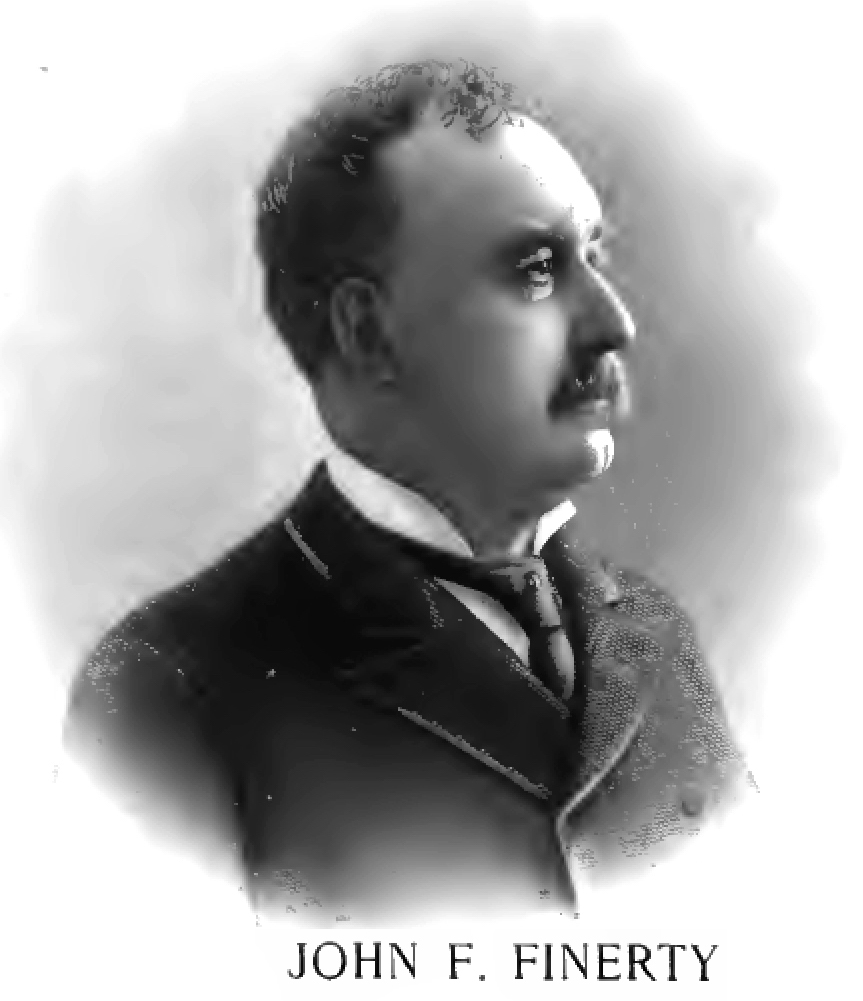
In Chicago there are the parliamentarians, headed by John F. Finerty and those who believe the wrongs of Ireland should be righted by physical force, of whom the leader is J. T. Keating. Finerty and his followers are convinced that Ireland could not successfully compete with England on a war footing, and prefer to seek redress for the political restrictions of the mother country by a stronger representation in parliament and other powerful means. Keating, on the other hand, thinks war is the ultimate remedy for the situation, and, with those who believe with him, is ready to shoulder arms.
While the average Irishman feels strongly on the questions of national policy at home, his beliefs are not sufficiently radical to the cause of any local disturbance beyond an honest difference of opinion. In Chicago the Irish are united in a strong central organization and are doing all they can quietly to help the mother country out of the political difficulties in which it has been enmeshed in for centuries.
In every field the Irish have done their full share and are continuing today the same work of empire building they helped to begin in the days of colonial hardship and struggle. In this city their influence has passed beyond any statistical estimate, and has become a part of the city itself. They are everywhere, into everything, leaving an indelible influence in every branch of industry and in every line of honorable endeavor.

The Irish are one of the most important and influential groups to settle in Chicago. In honor of St. Patrick’s Day, here is a timeline of some key Chicago Irish events,
1836: The Illinois and Michigan Canal opens, linking Lake Michigan and the Illinois and Mississippi Rivers. Much of the work was done by Irish laborers.
March 17, 1843: The first St. Patrick’s Day Parade in downtown Chicago.
1844: Bishop J. Quarter becomes the first bishop of the Chicago diocese.
1846: Old St. Patrick’s parish is founded; the famous church isn’t completed, however, until 1856.
1848: Hardscrabble, near the South Branch of the Chicago River, is renamed Bridgeport.
1857-1860: Holy Family Church, at Roosevelt Road and May Street, is built by Irish immigrants under the leadership of Father Damen.
1863: The first Fenian Brotherhood national convention is held in Chicago. The Fenians is a radical group, promoted Irish liberation from British rule. One branch of the Fenians, which included many Chicago Irish, advocated an invasion of Canada in the mistaken belief that such an invasion would result in an Anglo-American war and, ultimately, lead to Irish independence.
1865: Kilgubbin settlement near Kinzie street relocated to Goose Island.
1869: Chicago branch of the Clan na Gael is founded. It was an Irish-American nationalist group dedicated to an independent Ireland and led by Alexander Sullivqn.
Oct. 8, 1871: The Great Chicago Fire begins in a barn behind the cottage of Patrick and Catherine Leary at DeKoven and Jefferson Streets.
About 1872: First time island formed by Ogden Canal is referred to as “Goose Island.”
January 14, 1882: The Citizen, a weekly Irish newspaper, is founded by John F. Finerty.2
1889: Dr. Patrick H. Cronin, a critic of the Clan-ne-Gael, is murdered in his Lakeview cottage by followers of Alexander Sullivan.
October, 1893: Finley Peter Dunne’s “Mr. Dooley” column makes its debut in the Chicago Evening Post.
December, 1893: John P. Hopkins becomes Chicago’s first Irish Catholic mayor, narrowly defeating his Republican rival, George B. Swift.
March 17, 1896: The last St. Patrick’s Day Parade in the Loop until Mayor Dailey brought it back in 1956.
1900: Charles Comiskey, the son of an Irish immigrant, founds the Chicago White Sox.
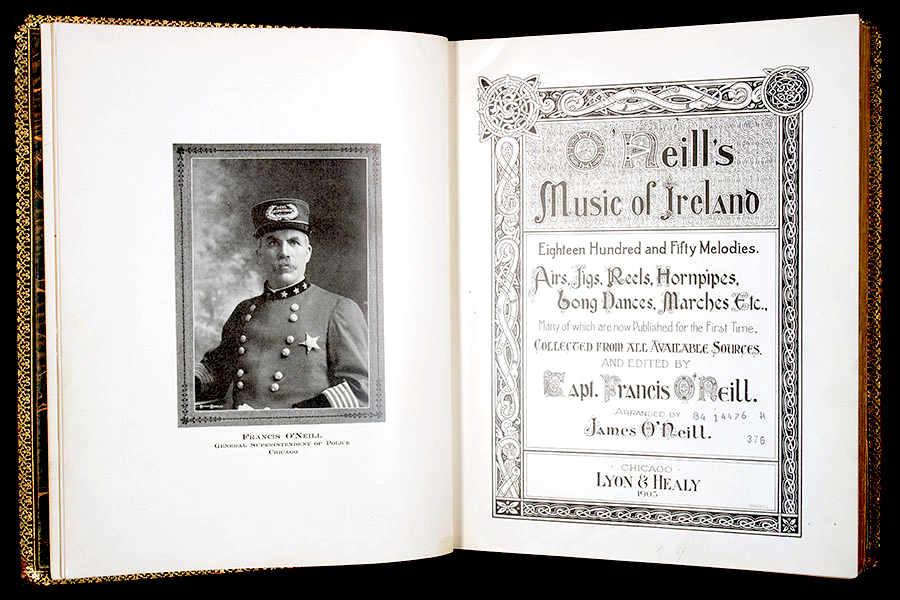
1910: Francis O’Neill, the retired superintendent of police, publishes his seminal book, Irish Folk Music: A Fascinating Hobby.
July 28, 1912: First Annual Chicago Feis
August 3, 1913: Second Annual Chicago Feis
1926: The Shannon Rovers Pipe Band is formed.
1932: Publication of James T. Farrell’s first novel, Young Lonigan.
1955: Richard J. Daley is elected mayor and stays in office until his death in December 1976.
1956: Chicago’s first modern St. Patrick’s Day parade in Loop. Florence Gallagher is crowned the first queen.
1962: Chicago River is Dyed green for the first time.
1979: The South Side Irish Parade is founded.
1984: Gaelic Park, South Side headquarters of Irish culture, opens.
1985: The Irish-American Heritage Center opens.
Timeline of Old St. Patrick’s Church:
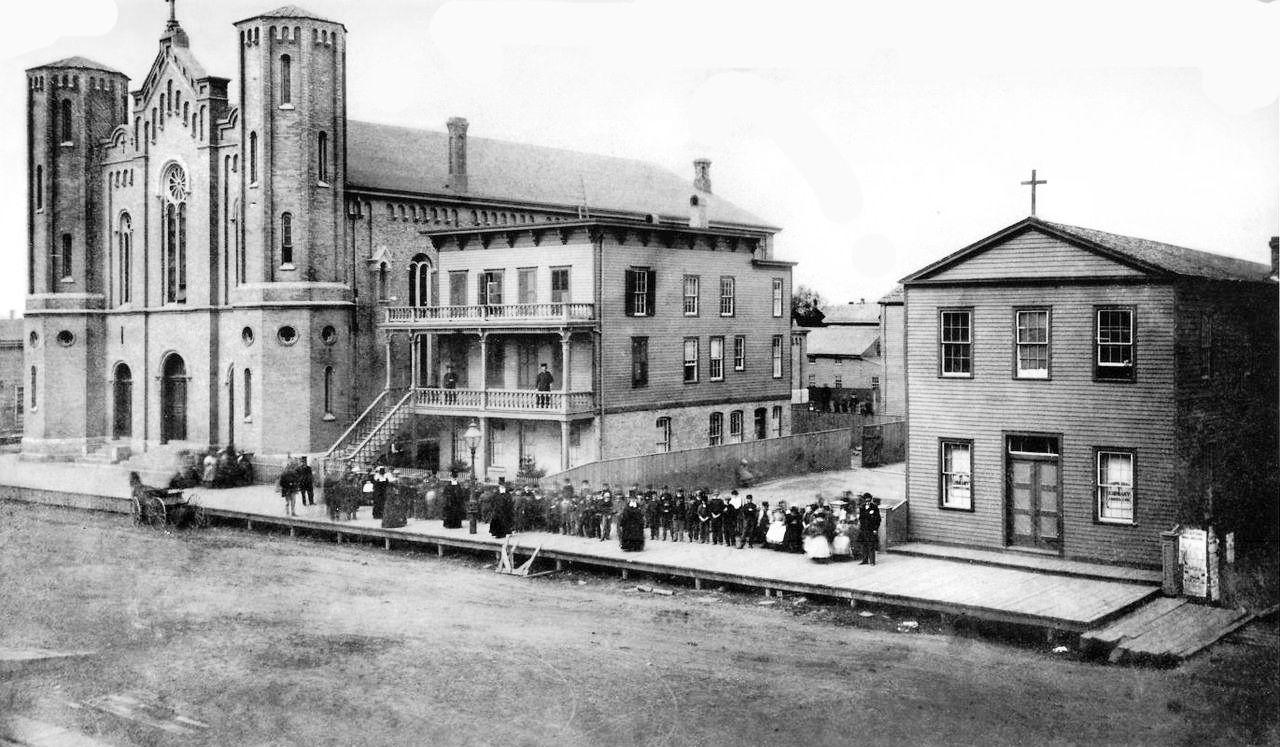
- St. Patrick’s Church Presbyterian and Schools. About 1880
1846: To relieve overcrowding at nearby St. Mary’s Church, St. Patrick’s congregation organized.
1853: Church cornerstone laid at 700 West Adams Street.
1856: Church dedicated.
1865: Kilgubbin settlement relocated to Goose Island
1871: Survives Chicago Fire, by two blocks.
1885: Twin spires (one Romanesque, one Byzantine) added.
1911: Thomas O’Shaugnessy is commissioned to decorate Old St. Patrick’s Church.
1912: Renovation begins, including work on new stained glass windows designed by Chicago artist Thomas O’Shaughnessy.
1922: Renovation and windows completed.
1950s-1960s: Neighborhood deteriorates; congregation dwindles.
1964: Church designated a historic landmark.
1983: Congregation drops to four members; Rev. John J. Wall takes over as pastor.
1985: The first Old St. Patrick’s “World’s Largest Block Party” draws 5,000 people to Des Plaines Street.
1992: Rebuilding and restoration project begins.
1996: Reconstruction and restoration of most of the church interior and exterior were completed.
2006: Old St. Patrick’s Church conducts a year long observance celebrating 150 years in this historic, sacred space and 160 years as a faith community.
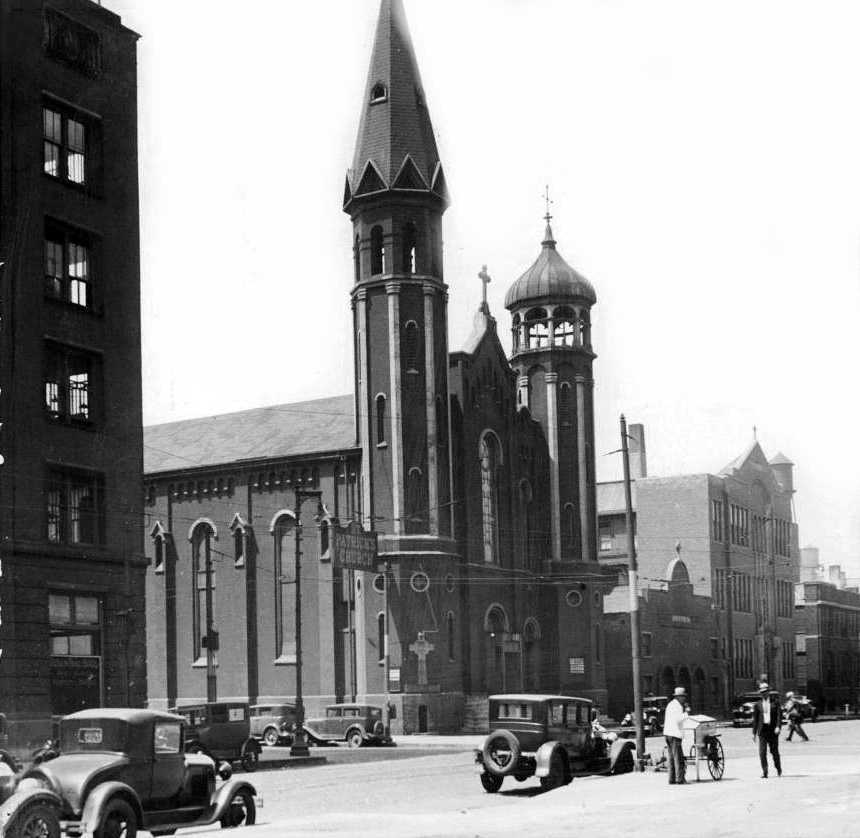
- Old St. Patrick’s Church
1931
NOTES:
1 Chicago’s twelve Irish mayors included: Alexander Lloyd (1840-1841), Harvey Doolittle Colvin (1873-1875), John Patrick Hopkins (1893-1895), Edward Fitzsimmons Dunne (1905-1907), Edward J. Kelly (1933-1947), Martin H. Kennelly (1947-1955), Richard J. Daley (1955-1976), Jane M. Byrne (1979-1983), Richard M. Daley (1989-2011).
2 The Citizen (1882-1897), The Chicago Citizen (1897-1919), The Irish News and Chicago Citizen (1919-1922)—”Official Newspaper of the A.O.H. of Illinois”

Leave a Reply