Chicago Tribune June 10, 1897
Time has many kindly functions, but perhaps the best of all is the generous atmosphere with which it surrounds all great achievements. The Chicago Tribune is no exception to the rule. An air of romance seems to hover over its early days, and this romance forms a pretty story.
In the year 1844, when Chicago was credited with having about 8,000 inhabitants, at least two of this number were hot-headed, full-blooded young sparks of a roystering, bellicose temperament, who partook in one affair which smacked a great deal of the days of the chevaliers. These two young men were Kiler l. Jones and a comrade in the social swim. Al Chapin by name. They were both ready to fight at the drop of the hat, whether there was involved the question of a lady’s honor or some other matter of personal difference. The young men loved the same lady, and, as Jones seemed to be getting the best of it, Chapin challenged him to mortal combat. It must be remembered in those days that the same odium did not attach to dueling as does at present. The “code” was then quite often called into play for the settlement of differences, and while these deadly affrays were not actually countenanced they were more or less winked at.
But the friends of these two fine young men were not disposed to see either of them uselessly sacrificed on the field of honor, and after a secret consultation an inglorious solution of the trouble was decided as the best way out of it. So one day, when the sun had just begun to shed the brightness of its morning rays on the lake front at the foot of Chicago avenue, Chopin and Jones faced one another with pistols in hand. The seconds were there, but, alas! the services of the latter were not needed unless for the purpose of applying a smelling bottle. The seconds in a scurrilous and most unmannerly fashion had failed to put bullets in the revolvers. The principals, however, were thoroughly impressed with the seriousness, of the affair. When the word was given to fire, two shots were exchanged. Some wag struck Chapin in the face with a wad from a peashooter and he fell to the ground yelling that he had been murdered. Jones, at the frightful outcome of the duel, fled at the top of his speed.
When the facts of the ludicrous affair became noised about it was the talk of the town for weeks. Jones and Chapin were so by their many acquaintances that Jones determined to put a stop to it by establishing a newspaper, by, means of which the encounter could be presented in a proper light. Entering into a partnership with James S. Beach he established the Gem of the Prairie, out of which The Tribune was finally evolved. This story In some may be legendary, but it is a fact that the duel took place and that immediately afterwards Mr. Jones went into the newspaper business. Whether there was any connection between these two facts cannot be vouched for at this time, though it was the popular belief for many years that such was the case.
First Issue of The Tribune.
There is strong foundation for the belief that the first newspaper which appeared under the now popular name of “Tribune” in any part of the world was a Chicago product. This was the Illinois Tribune, the first issue of which was published April 4, 1840, in the third story of what was known as the Saloon Buildings, at the corner of Lake and Clark streets—a favorite location for Chicago newspapers at that early day. It was printed by Charles N. Holcomb & Co. and was typographically a very handsome sheet for that time. The name of its editor was Edward G. Ryan, who was an Irishman by birth and a lawyer by profession. Ryan was of eccentric character, and, while confessedly of great ability, also possessed an irascible and, at times, a violent temper. This combination it was, perhaps, which made him an accomplished master of satire and polished invective, while capable at times of rising to the highest eloquence. The “chief object in life” of this Tribune during a part of its brief career appears to have been to make war upon Judge John Pearson, then Judge of the Circuit Court, by appointment of the Governor, for the district embracing Cook Coun- ty. The fact that Pearson was a resident of Danville probably made his appointment distasteful to members of the Chicago bar, but he had also made some rulings upon the bench which were regarded as extremely arbitrary and rendered him still more obnoxious. Ryan’s sharp satire and bitter invective found vent through the columns of his Tribune for a time in assailing the obnoxious jurist, but the paper did not live beyond its second year. A year or two later Ryan removed to Wisconsin, served in the first State constitutional convention in that State in 1846, and in 1874 was appointed Chief Justice, dying in office at Madison, Wis., Oct. 19, 1880. The late Kiler K. Jones, a brother of Fernando Jones of this city, who died in Quincy a few years since, was roller boy and carrier in the office of this early Tribune, and, although an uncompromising Republican, while Ryan was a Democrat, always maintained a high admiration for his former employer. Horace Greeley’s New York Tribune began its career a year later than its Chicago forerunner of the same name.
Another mile post was reached in Chicago journalism In 1844 in the establishment of the Gem of the Prairie, a weekly paper devoted to literary miscellany, and general intelligence, which was first issued on May 20 of that year. Its founders and early publishers were two ambitious young men— Kiler K. Jones (already mentioned as having been connected with the earliest Tribune) and James S. Beach. The paper soon acquired a sort of popularity on account of its sketches and other literary matter and attracted to it a number of young writers of both sexes, who became contributors to its columns. About the close of its first year the Gem passed into the hands of James Campbell and Thomas A. Stewart.
Campbell soon retired, being succeeded by James Kelly, and he and Stewart continued to be the publishers of the paper until its absorption by the newly established Tribune, of which it was maintained as the weekly edition until 1852. The population of Chicago at the date of the origin of the Gem was estimated at 8,000, while three years later, when its successor came into existence, the census tables show 10,839.
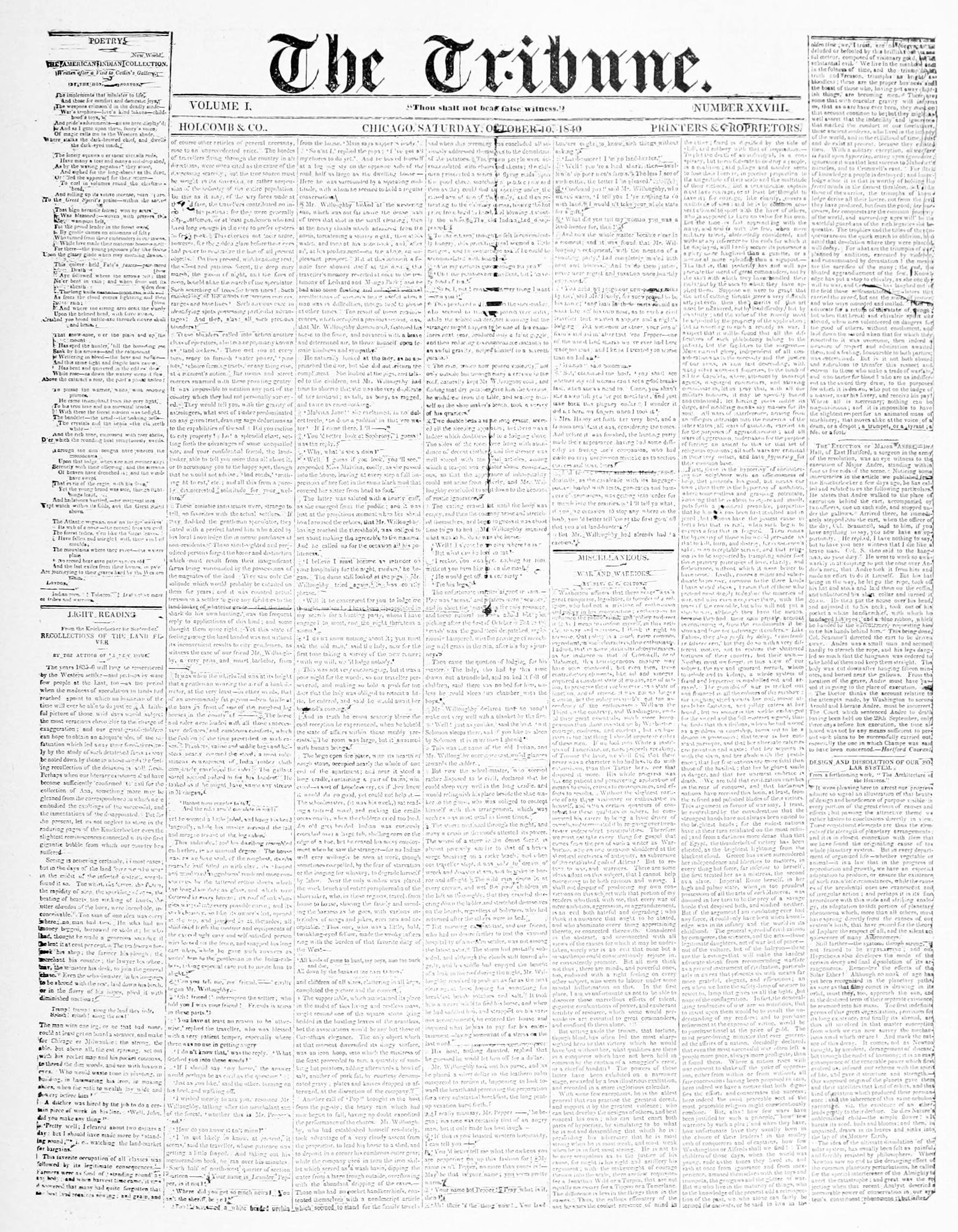
Holcomb’s Tribune
October 10, 1840
The Tribune of Today.
Owing to the fact that no copy of the first issue ot The Tribune is known to be in existence—the files having been destroyed in the great fire of 1871—some disagreeing have gone forth regarding the date of the establishment of the paper. There is no ground for further question on this subject, however, The Tribune first made its appearance as a morning daily on Thursday, June 10, 1847. Of this there is conclusive evidence in the following paragraph from the Chicago Daily Journal, then, as now, an evening paper—of the same date:
- The Chicago Daily Tribune—A large and well-printed with the above title was laid on our table this morning. Alessrs. Wheeler and Forrest are the editors of this paper, and the assures the public that The Tribune is to be ‘neutral in nothing—independent in everything.’
We have observed that the experiment of sustaining papers, except literary or religious, in this country has, almost without exception, failed; ordinarily In a few weeks after the first bow to the public they throw off the mask or deteriorate into the most dangerous species of partisan journals. The New York Sun, the Baltimore Sun. the Philadelphia Ledger, and papers that we could name have invariably made their assumed and professed neutrality a cover from to aim their poisoned arrows at the Whig party.
Our neighbors, however, have launched their bark upon the stormy sea of editorial life, proposing to observe a strict impartiality. We wish them every success in their enterprise and firmly trust they will shun the rocks upon which so many gallant vessels have been wrecked.
The mechanical execution of The Tribune is beautiful and reflects great credit upon the art.
As Told by a Founder.
The story of the origin of The Tribune, as told by one of the founders, the late Col. J. K. C. Forrest, mentioned in the above extract, embraces some points of both personal and newspaper history. It is reproduced from The Tribune of Jan. 4. 1891:
- The first number of The Chicago Tribune as a daily was issued on Thursday, July (June) 10, and 1847, in the third story of a building on Lake and La Salle streets. A single room sufficed for all the then requirements of the journal. The originators of the enterprise were James Kelly, John E. Wheeler, Joseph K. C. Forrest, and Thomas A. Stewart. (As previously shown, Messrs. Kelly and Stewart had been for some two years the publishers of the Gem of the Prarie.) The principal writers were Messrs. Wheeler and Forrest. Mr. Wheeler was a ripe scholar, an easy, fluent, and felicitous writer. and a most conscientious gentleman. He was an indefatigable worker. Unfortunately he had the seeds of consumption in his system and died at a comparatively early age soon after he had removed to New York City in 1859, where he was employed as an editorial writer off the New York Tribune. Mr. Kelly was the business manager of the enterprise. He was a gentleman of the strictest integrity, has ever been regarded as a man of most honorable ideas, inspirations, and motives, and still lives in a modest retiracy, after a prosperous business career in the wholesale leather trade, at Evanston, in this county.(Mr. Kelly died at Winnetka, Cook County, May 5, 1895.)
Adoption of the Name.
Of the manner in which the name Tribune came to be adopted, Col. Forrest gives the following circumstantial story:
- The name Tribune was selected for the daily paper by Col. Forrest after considerable opposition on the part of the other proprietors. They were desirous of publishing a journalistic ‘fad’ of the period, but Forrest objected. He pointed to the fact that the principal patrons of the paper would for a long time be Whigs; that the rising anti-slavery sentiment of the country, to which the new journal would appeal, was largely Whig; that, though Mr. Greeley’s venture in New York was of the same name, yet the name originally was a Chicago suggestion and product, and that to call the journal The Tribune was simply to rehabilitate an original enterprise.
[From this it would seem that the fear of the journal, expressed in its notice of the first issue of The Tribune, that the new paper was to be, in some sense, Inimical to the Whig party, was without foundation; that In fact, while opposed to the Institution of slavery, it looked for sympathy and-support in its anti-slavery views to the Whig rather than the Democratic party of that day. Accepting this statement of one of the founders of the paper as to the motives which then inspired himself and his associates in the new venture, it is a curious fact that, The Tribune of a later period, by its blows against the institution of slavery and its zealous service in behalf of the preservation of the Union, should have so fully carried out the intentions of its original projectors.]
According to Mr. Forrest a majority of his associates adhered to their preference for another name, and the fact that they were already the owners of a weekly, the Gem of the Prairie, induced them to favor that title. Mr. F. continues:
- So Mr. Wheeler wrote the prospectus of the venture, and he and Mr. Kelly sent it to Mr. Forrest, who was then a student in the Saloon Building on Lake and Clark streets, for approval. Forrest read the prospectus, made a few unimportant corrections therein, and then drew his pen across the name the Gem of the Prairie. In addition he wrote on the margin of the proof:
‘I We might as well call the paper the Yellow Flowers of the Prairie and have done with it.’ This was how he finally prevailed on his partners to name the journal The Chicago Tribune.
New Departure in Journalism.
Of the alms and expectations of the founders, as well as the results which have followed the establishment of The Tribune, Mr. Forrest at another time wrote as follows:
- The origin and establishment of The Tribune were the initiative of an entirely new departure in not only journalism but politics in Chicago and the United States. The creation of tho Republican party is as much due to the establishment of The Chicago Tribune as to any other cause. In 1846 the two great parties which divided the country were in a phenomenal and anomalous position. The Whig party had been defeated in the election in 1844. This defeat was mainly due to the disposition of its candidate, Henry Clay, to look in opposite directions—i. e., to compromise—in the issue between freedom and slavery, then gradually looming up on the political horizon, and which finally was precipitated upon the country in the shape of a vast and comprehensive national contention by the outcome of the Mexican war. The question of the annexation of Texas was also agitating the public mind. Such annexation, all far-seeing and patriotic Northerners contended, would erect a Gibraltar for slavery in the South. It was on the eve of this threatened political chaos—this bouleversement of parties and this unsettled condition of the public mind and of the minds of the leaders thereof—that Forrest saw the time was close at hand when a new political party would be in process of gestation. And so, as the nucleus around which such a party could rally, his idea was to create a journal and to name it with due regard to its quality and !ie scope nnd quality of the principles of which it was to be the advocate. In 1848 the revolution which overthrew thrones broke out in Europe. This cast thousands of radical Republican Germans on our shores. In the Northwest they had such exponents as Carl Schurz in Wisconsin nod George Schneider, Hecker, Brentano, Hoffman, Krelsmann, and others in Illinois. Since that date the Republican party has been carried on what may be truthfully called the ‘stream of providence’, which compels men and events in a direction often contrary to their desires and intentions to those ends provided by the infinite for the final resolution of finite things.
So much for Col. Forrest’s statement, which is interesting as the reminiscence of one identified with the paper in the initial period of its career and presumed to be acquainted with the purposes and anticipations of its founders.
Another Verslon of the Story.
The story, as gathered from another source, is to the effect that the persons connected with the original project for the establishment of the new paper were Kelly, Wheeler, and Forrest. To Mr. Kelly is given the credit of suggesting its publication—he having previously purchased the interest of Thomas A. Stewart in the Gem of the Prairie. His idea was to publish a daily and use the matter in mak!ng up the weekly edition. In consequence of failing eyesight he was compelled to retie a few weeks after the first issue of the new paper, Mr. Stewart taking his interest in both the Gem and The Tribune, thus beginning a connection with the latter which lasted eight years. The practical union of the two papers under the same ownership led to the adoption of the Gem as the weekly issue of the new publication; and, although the publication of a Weekly Tribune was begun on Feb. 1, 1840, the Gem was continued as a literary publication until 1852, when it was merged into the Weekly Tribune. A directory of the public institutions, newspapers, etc., in Chicago, published about the time of the meeting of the River and Harbor convention of 1847, evidently intended for the information of the delegates to that convention, speaks of the Gem as a “neutral weekly, published by The Tribune.”
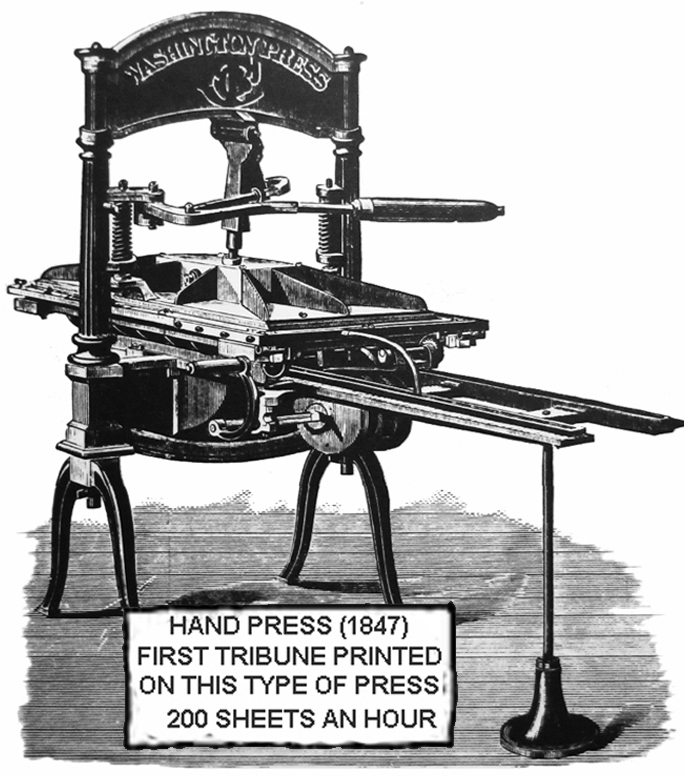
The first edition of the new paper consisted of 400 copies, “worked off” on a Washington hand-press, one of the proprietors in the capacity of pressman.
Two weeks after the date of the first Issue Mr. Kelly withdrew, his interest being taken by Mr. Stewart. Sept. 27 following Mr. Forrest imitated Mr. Kelly’s example, retiring with enough money to pay back the $600 he had borrowed from John Young Scammon to invest in the enterprise, though he asserted that he received nothing for his services and had finally to pay certain debts which his associates had to provide for. Mr. Wheeler, who had been previously connected With the New York Tribune and afterwards returned to that paper, was editor-in-chlef, while Mr. Stewart acted as business manager. In 1864 Mr. Wheeler was proprietor of the Dial at Kewanee, Henry County. Mr. Forrest, who had previously been employed on the Evening Journal, soon after leaving the Gem became associate editor of the Chicago Democrat, retaining that position until the absorption of the Democrat’s subscription list by The Tribune in July, 1861; subsequently served as correspondent of THE TRIBUNE at Springfield and Washington, and still later was connected with the Chicago Republican and Inter Ocean, and, after several years’ service as a writer on the Evening News, died in this city on June 23, 1896.
John L. Scripps Buys an Interest.
In August, 1848, Mr. John Locke Scripps became a partner in the concern by the purchase of a one-third interest, the firm becoming Stewart & Scripps. Later the names of the partners appear as editors in the following order:
Wheeler, Scripps & Stewart, with Thomas A. Stewart & Co. as publishers.
This order continued until June 30, 1851, when Mr. Wheeler retired, giving place to Thomas J. Waite, who became business manager. Mr. Waite lived a little over a year, dying of cholera on Aug. 20, 1852, when his interest was taken by Henry Fowler. During most of this period it is understood that Mr. Scripps was the principal editorial writer. He was born in Jackson County, Mo., in 1818, had been educated at McKendree College at Lebanon, Ill., where he served as tutor in mathematics for a time; had studied law and imbibed literary tastes,. He was a Democrat, with strong Free Soil proclivities, and, in the campaign of 1848, THE TRIBUNE supported Martin Van Buren (the Free Soil candidate) for President. On June 12, 1852, Mr. Scripps sold out his interest in THE TRIBUNE to a syndicate of Whig politicians, and In September following joined the late Lieut. Gov. Bross In the establishment of the Democratic Press.
The Trlbune’s First Fire.
During the first year of Mr. Scripps’ connection with the office The Tribune met its first disaster from fire. This occurred on May 22, 1849. and resulted in the entire destruction of the office but as its loss was for the most part covered by Insurance amounting to $2,100, the disaster was not so serious as it might otherwise have been. The issue of The Tribune was delayed two days, while the Gem (its weekly literary attachment) lost one issue. for which it apologized a week later. Publication was resumed through courtesies extended by the local press. It was on Dec. 6 of this year (1849) that the publishers of The Tribune completed arrangements for receiving news dispatches from New York, which marked a long step forward in Chicago journalism. For the next twelve months after the fire the paper was issued from a room over Gray’s grocery store on the northwest corner of Clark and Lake streets. In May, 1850. the establishment was removed to the Masonic Building at No. 173 Lake street, and about a month later the daily circulation was said to be 1,120 copies. The earliest copy of the paper known to be in existence was Issued in the latter part of this year, bearing date Dec. 128, 1850. It is a folio, 15¾ by 19½ to the page. (The size of the paper at its first Issue in 1847 is said to have been six columns to the page.) The press work of the paper at this time, as well as that for a number of The Tribune’s contemporaries, was done in the rear of the adjacent building on an old Adams press—the first “power press” ever brought to Chicago—the “power,” according to the statement of the late Lieut.-Gov. Bross, being furnished by an old black Canadian company. And it is even hinted that the feeding of the press performed bY the hand of the future Lieutenant-Governor himself. He was then the half owner of a religious paper called the Herald of the Prairies, but bettered lIs condition by selling out to his partner and for him at the rate of a dollar a day. Later Mr. Bross was associated with John L. Scripps in founding the Democratic Press, attained to the dignity Of Alderman and then Lieutenant-Governor, and finally to the presidency of The Tribune company, which he held until his death in this city, Jan. 27, 1890.
Tribune Under Whig Control.
By the sale of Mr. Scripps’ interest in June, 1852, and other changes occuring that year, The Tribune came under positive Whig influence, and, although retaining its free soil proclivities, supported Gen. Scott for the Presidency in the campaign of that year. William Duane Wilson, previously a resident of Milwaukee. but who had established the Dollar Weekly in this city in 1846—a literary paper which lived only three or four months-assumed tile position of leading political and editorial writer, while Mr. Stewart took charge of the city columns. Wilson was identified with Chicago interests in the fact that he served as President of a meeting in New York in September, 1846, which resulted In the River and Harbor convention in Chicago July 5-7, 1847. He afterwards removed to Iowa, where he became widely known as a prominent politician. For a few months of this year The Tribune issued an evening edition, but it was soon discontinued. An evening edition was also published in the latter part of 1850 and early part of 1851. The issue of a tri-weekly edition was begun in February, 1853. Gen. Wilson’s administration lasted less than a year, however, as it appears from the record that he retired March 23, 1853, his interest being taken by Henry Fowler. Timothy Wright, and Capt. Joseph D. Webster. The name of the publishing firm then became Henry Fowler & Co., and Mr. Stewart, who had been connected with the paper almost from its origin and with its predecessor (the Gem of the Prairie) from 1845, now became the editor. The next change occurred In July, 1854, when Mr. Fowier retired on account of failing health and T. A. Stewart & Co. were announced as the publishers. What were called the Associated Press dispatches, a sort of mongrel news service secured by the combined use of telegraph wires, stage coach, and a ferry across Lake Michigan, were taken by The Tribune in November of this year, and early in January following (1855) the paper was enlarged to ten columns to the page, making it (as the Chicago Democrat of that date announced) “the largest daily in the West except one or two in St. Louis.” This arrangement was only temporary, however, as it was reduced under a new management a few months later to the original size.
Tribune’s Home in 1852-’55.
The home of The Tribune at this time (1852-’55) was in the Evans Block, a building which had been erected by Dr. John Evans (afterwards appointed by President Lincoln Territorial Governor of Colorado, and now a resident of Denver). and Dr. Daniel Brainard, Dr. Evans becoming the proprietor of the whole by the purchase of Dr. Brainard’s Interest soon after. Its location on the east side of Clark street. just south of the alley between Randolph and Lake streets, and opposite the Sherman House. The street number was 53, the business and editorial rooms being up-stairs. The Postofflce was then in the building on the opposite side of the alley to the north. The space was limited, but so was its business, so that there was no trouble on this score.
A few months after the retirement of Mr. Scripps, in June, 1852. already alluded to, he and the late Gov. Bross began the issue of the Chicago Democratic Press on a borrowed capital (as Gov. Bross has said) of $6.000—the first number appearing Sept. 16, 1852. It was a neat sheet and displayed much enterprise and vigor in its management. As its name indicates the paper was Democratic in politics, and supported Mr. Buchanan for the Presidency that year, despite a strong leaning toward Free Soillism. In 1856 it was in full accord with the principles of the Republican party nnd supported John C. Fremont for the Presidency. The location of the Press office was on the opposite side of the alley, just north of The Tribune office.
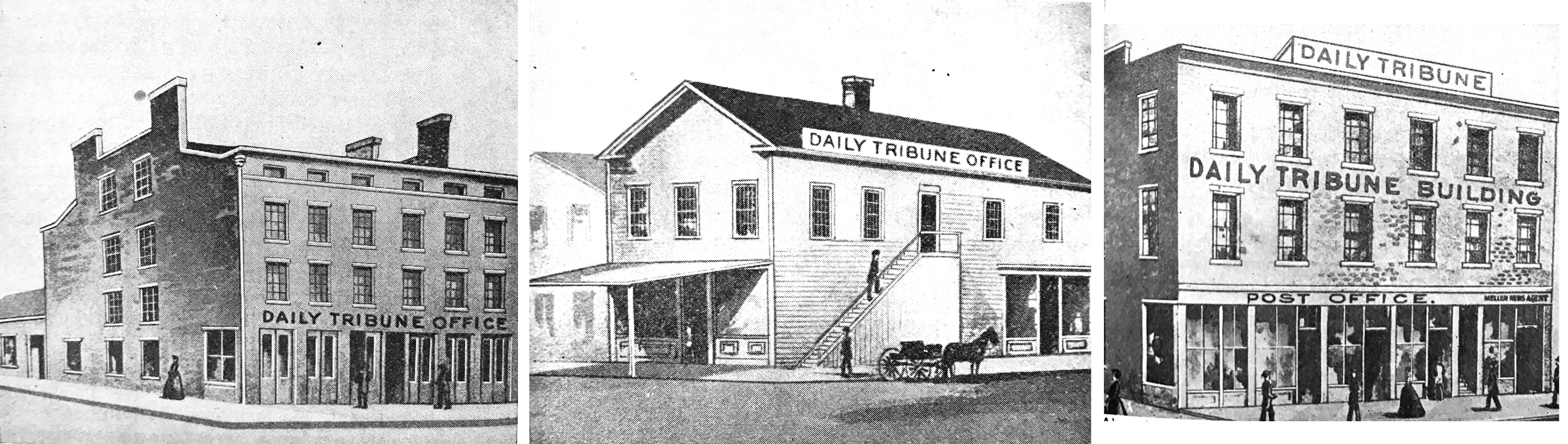
LEFT: At the southwest corner of LaSalle and Lake streets stood this quite splendid building, the first home of The Tribune—one room on an upper floor in 1847.
CENTER: The Tribune’s second home was above Gray’s grocery store on the northwest corner of Lake and Clark streets in 1849.
RIGHT: The third Tribune home in the old post office building in May, 1850..
Mr. Medill Comes to Chiengo.
The spring of 1855 found two men in Chicago from opposite points of the compass but bent on a similar mission. One was Joseph Medill, who, after having been connected with various newspaper enterprises in Ohio—including, is the last, the Cleveland Leader—had come to Chicago with a view to identifying himself with journalism in this city. He had already shown his fealty to the principles of the Republican party, then just coming into existence, by his opposition to the Kansas-Nebraska bill, which had been passed by Congress during the previous year, and by his advocacy of the organization of a new party based upon opposition to the further spread of slavery. The other of these men was Dr. Charles H. Ray of Galena, who, as editor of the Jeffersonian (a Democratic paper of that city), had given evidence of his independence and support of views, with reference to the Nebraska bill and slavery sim,il;ar to those which Mr. Madill had maintained at Cleveland. Ray had spent the previous winter at Springfield in the capacity of Enrolling :and Engrossing Clerk of the State Senate, incidentally, meanwhile, acting as the correspondent of the New York Tribune at the Illinois capital. His letters had served to extend the reputation he had won as an able and incisive writer on the new political issues which had begun to absorb the public mind. He also had come to Chicago to investigate the feasibility of establishing a penny Republican paper here, and for the time being, had found employment In the editorial department of The Tribune.
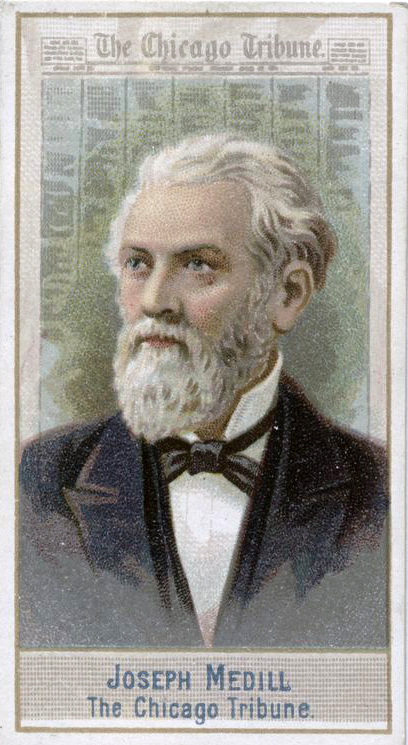
Armed with letters of mutual introduction from Mr. Greeley, Mr. Medill and Dr. Ray met in the rotunda Of the old Tremont House, and were made acquainted with each other by the late John H. Drake, then one or the proprietors of the hotel. A comparison of views led to a determination to invest in The Tribune. Mr. Medill being the first to purchase a one-third interest in the concern, while Dr. Ray took a fourth interest at a somewhat later date. Mr. Medill thus became the pioneer in the work of reorganization which followed—his connection with the paper as a ;ui dating frain June 18, 1855—with Dr. Ray a close second.
The process of “taking hold” on the part of Mr. Medill seems to have been a gradual one, as THE TRiBiUNE of Saturday, July 21—a month after his accession to the proprietorship—contains an editorial announcement of the retirement from the position of “editor and publisher” of Thomas A. Stewart, who had been connected with the paper also been associated with its predecessor, the Gem of the from Prairie, from 1845. The tenor of Mr. Stewart’s brief “valedictory” indicated a feeling of sadness at severing connection with an enterprise with which he had been associated for the last eight years, and on on which he had undoubtedly labored with high hopes and expectations, He also evinced a consciousness that the step was rendered necessary by failing health, which he hoped he might be benefited by engaging in rural pursuits. This hope was not realized, however.as he died of consumption in September, 1858.
Changes in the Firm.
Timothy Wright, who, up to beun a, silent it, the concern, now came to the front, and the samen of “Wright, Medill & Co.” appeared as the publishers of the paper. A few months later, John C. Vaughan, who had been with Medill on the Cleveland Leader, and who already had a wide reputation as an able writer, was added to the firm, which now took the name of Vaughan. Ray & Medill, with Vaughan and Ray as editors and Mr. Medill in a managerial. The late Alfred Cowles, who had been a clerk in the office of the Cleveland Leader under Mr. Medill, soon after this came into the concern as a clerk, later became a partner and cashier, finally business manager, and, on the incorporation of The Tribune company, was made its Treasurer, a position he until his death in this city on Dee. 20, 1889.
The year 1855 marked the beginning of a new era in national and State politics, as well as in the history of Chicago and The Tribune. Lyman Trumbull had been elected to the United States Senate at the preceding session of the General Assemblyas the precursor of the political revolution which was to follow. The population of the city, which was given at 16,000 at the date of the first issue of The Tribune in 1847, had, in the intermediate eight years been quintupled, being in 1855. according to the census of that year. a little over 80,000. In September of that year The Tribune introduced the first copper-faced type ever used in Illinois, and soon after put in a Hoe steam press in place of the slow Northrup press which the paper was printed at the time of the reorganization. The effect of these improvements and of the increased editorial vigor thrown into the columned the paper soon became manifest in its circulation and business. The circulation, which had been estimated on July 1, 1855, at 1,440 daily and 1,000 weekly, had risen in less than three months to 3,000 daily, 5,000 tri-weekly, and 4,500 weekly. These figures may seem small today, but they shored a relative growth which was deemed remarkable at that time and highly encouraging to the new proprietors. Another element which contributed powerfully to the growth of the paper In circulation and undoubtedly to be found In the political conditions already referred to, and the organization of the Republican party was then in progress, and in which The Tribune became an influential and leading factor.
Influence of Railway Development.
If the year was memorable for the beginning of the political reorganization, which culminated a year later in victory in this State for the newly organized Republican party. It was also one of unprecedented activity in the construction of rall-lines in which the City of Chicago was concerned, as the year which followed the original establishment of The Tribune (1848) had been rendered notable by the completion of the Illinois and Michigan Canal. The Galena and Chicago Union railway (now a part of the Chicago and Northwestern) and the Chicago and Rock Island (now the Chicago, Rock Island and Paciflc) already afforded two lines of communication with the Mississippi River, while the Chicago and Alton, with the use of a small section of other lines and twenty miles of river navigation, brought Chicago and St.Louis into direct communication with one another. During this year the Illinois Central, which had been begun in 1853, was opened from Cairo to Dunleith—as it was a year later to Chicago; the Chicago, Burlington and Quincy from Chicago to Burlington, Ia., and the Chicago and Miliwaukee between the two lake cities, while the Ohio and Mississippi and the Terre Haute and Alton were in course of construction across the State from west to east. Judging from the matter in the local press of that time, one of the “principal industries” of the people of Chicago would seem to have been participating in free excursions over the newly completed lines, or in banqueting and otherwise entertaining visitors from the cities with which Chicago thus brought into direct communication for the tirst time. Of ail these events THE TRIBUNE was an industrious chronicler, as it had been an active supporter of the enterprises themselves in their incipiency.
Another important event connected with the history of Chicago, this year, and which a great deal of attention on the part of the press and people, was the holding of the State Fair here—the third of the series—extending from Oct. 9 to 12, inclusive.
Eight Years of Activity.
The period between 1856; and 1864 was one of tremendous activities and far-reaching results. This period saw the completed organization of the Republican party and its first triumph in the State election of the year first mentioned: the memorable debates between Stephen A. Douglas and Abraham Lincoln, in which intellectual giants met upon the poitical rostrum and set in motion agencies which overturned the traditions of centuries and prepared the way for the purification of the land from the blight of slavery: the election of Abraham Lincoln to the Presidency in 1860 and the inauguration of civil war; four years of national agony and bloodshed, with the movements of vast armies and mourning brought into thousands of households; the final vindIcatIon nf the polIcy by the Republican policy by the re-election of Mr. Lincoln in 1864, followed by triumph of the of the Federal arms, the restoration of the Union with the wiping out of slavery—the great drama ending with the assassination of the man whose patriotic and sagacious pollcy had achieved all these beneficent consequences. No such momentous results van be enumerated within a similar period in the history of any other nation, and theIr mere recital would fill volumes. In this period, as a medium of laws, as an organ of public opinion, and as a supporter of the government in its efforts for the perpetuation of the Union and the preservatIon of the liberties of the people. THE TRIBUNE have a full and conspicuous part, and no more complete history of these great events can be found than that given within its files.
Editorial and Business Changes.
Among the personal and business changes which occurred in The Tribune office during the period just mentioned was the retirement or Mr. Vaughan the concern, h!s place in the company being taken by Mr. Vaughan, who became the cashier. The business firm then assumed the name of Ray, Merill & Co. Mr. Vaughan removed to Leavenworth, Kas., where he conducted the Leavenwortth Times—a free State paper—tor a considerable period, but later went to Cincinnati. dying in that city on Aug. 27, 1892.
Horace White, now of the New York Evening Post, become a reporter on THE TRIBUNE in 1856. assisted in reporting the Lincoln and Douglas debates in 1858, served as Washington correspondent of the paper and editorial writer, and in 1864 became a stockholder.
On July 1, 1858, The Tribune and the Democratic Press were consolidated under the joint and equal ownership of Ray and Medill of the former and Scripps and Bross of the latter, with Mr. Cowles as manager. The united paper took the name of the Press and Tribune. which was continued until Oct. 25, 18G0, when the word “Press” was dropped, the name becoming simply The Tribune. Simultaneously with the consolidation the issue of an evening edition was commenced. but this Was discontinued eight days later on account or the impossibility of securing the news under existing arrangement with the Associated Press. The location of the consolidated concern at this time at No. 45 South Clark street, the second door of the alley, adjacent to the – former off ice of the Democratic Press. Three months later it removed to the Evans Block, the number of the office being 51— one door north of the original Tribune office
In November 1858—four months after the consolidation—the Press and Tribune was forced by business reverses to make an assignment. This was occasioned by the hard times following the financial panic of the previous year and partly by burdens assumed in the consolidation of the two papers. The concern secured an extension of three years on its obligations. which it Was able to liquidate in the next twenty-one months.
Results of the Consolidation.
As the result of the consolidation, Mr. Scripps became the senior editor, so remaining until his appointment to the position of Postmaster of the City of Chicago by President Lincoln March 28, 1861. He retained his interest In the paper, however, until his retirement from office in 1865. Then, disposing of his stock to Horace White, he arranged to engage in the banking business as senior member of the firm of Scripps, Preston & Kean. His health having failed he went north in the summer of 1866 in the hope of being benefited by a change of climate. but died at Minneapolis Sept. 21, following.
“THE TRIBUNE company” was formally incorporated by act of the Legislature Feb. IS. 1861, the incorporators being John L. Scripps, William Bross, who had come in with the Democratic Press: and Charles H. Ray, Joseph Medill, and Alfred Cowtes. proprietors of original TRIBUNE stock, with William H. Rand as a stockholder. The capital stock was placed at $200,000—or 200 shares of a par value of $1,000 a share—and this has never been changed. In the organization of the Board of Directors following the act of incorporation John L. Scripps was elected President and Alfred Cowles Secretary. With the exception of the retirement (in November, 1863) of Dr. Ray. who had been editor-in-chlef, the official organization of the company remained until the withdrawal of Mr. Seripps in 1865. In 1864 it was as follows: President John L. Scripps; Vice-President, William Bross; Secretary and Treasurer, Alfred Cowles; Editorial Superintendent, Josep Medill; Mechanical Superintendent, William H. Band. Later Gov. Dross became President, Mr. Medill, Vice-President, and Mr. Cowles Secretary and business manager. On the death of Mr. Cowles in December, 1889, R. W. Patterson became Secretary and Treasurer. The office of President was vacated by the death of Gov. Bross a few weets later (Jam. 27, 1890), when 1Mr. Medill was chosen as his successor and Mr. Upton was elected Vice President. This organization has continued ever since.
John Wentworth’s Paper Swallowed.
Another event of 1861 was the transfer by John Wentworth, for twenty-nive years previous editor and proprietor of the Chicago Democrat, of the subscription list and good will of that paper to The Tribune company. The transfer took place on July, 24, 1861. Thus The Tribune became the direct successor to the first newspaper ever published tn the City of Chicago. As already shown, it had previously absorbed the Gem of the Prairie, the Democratic Press, and the Western Citizen, or Free West (Zebina Eastman’s paper)—the last having been consolidated with The Tribune’s weekly edition in 1856.
Dr. Ray became editor-in-chief on the retirement of Mr. Scripps in 1861. On Nov. 20, 1863, he sold out his interest and withdrew from the paper being succeeded by Mr. Medill. After being engaged in other pursuits of a speculative character some eighteen months Dr. Ray became associated with THE TRIBUNE as an editorial writer in May, 1865, but withdrew a few weeks later. About the beginning of 1868 he assumed the editorship of the Chicago Evening Post (not the present concern), remaining until his death on Sept. 23,18T0.
Mr. Mediill occupied the position of editor-in-chief from the retirement of Dr. Ray in November, 1863. until Aug. 1, l866, when he gave place to Horace White, his administration covering the last two years of the war and the first year in the period of reconstruction. In 1869 he was chosen a delegate to the State Constitutional convention which framed the Constitution of 1870; was appointed by President Grant, in 1871, a member of the first Civil Service Commission, and, in November of the same year (a few weeks after the great fire), was elected Mayor of Chicago, but resigned before the close of his term and spent the following year in foreign travel, chiefly in Europe.
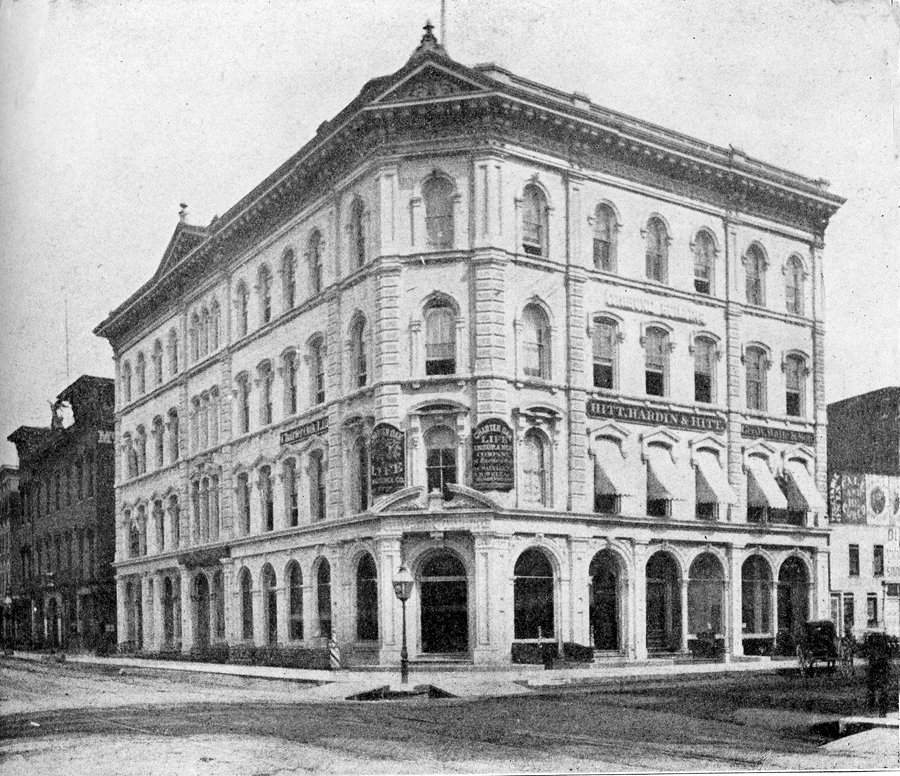
The Tribune Building
1868-1871
Southwest Corner of Dearborn and Madison
Administration of Horace White.
The administration of Horace White as editor-in-chief continued from August, 1866 to October, 1874. During this period (viz.: in May, 1869) the removal of The Tribune establishment from the quarters it had so long occupied in Clark street to a new four-story building. which the company had erected on the site of its present home at the southeast corner of Madison and Dearborn streets; also the great fire of 1871. Under Mr. White’s management the paper supported Gen. Grant for the Presidency in 1868, but in 1872, joined in the so-called ” Liberal Republican” movement, supporting Horace Greeley. It continued to advocate this line of policy until October, 1874. when Mr. White was succeeded by Mr. Medill.
While absent in Europe In 1874, Mr. Medill opened negotiations with White and Cowles for the purchase from them of a sufficient number of shares of stock to give him the controlling interest In THE TRIBUNE company, These having been successfully concluded. Mr. Medill resumed control of the paper as editor-in-chief almost immediately on his return from Europe, and this has remained unbroken to the present time.
Mr. Medill’s Line of Pollcy.
In announcing this step in the issue of The Tribune of Oct. 9, 1874. Mr. Medill says:
- The Tribune hereafter will be as it formerly was under my direction, an independent Republican journal. It will be the organ of no man however high, no clique or ring however influential or faction however fanatical or demonstrative. . . Looking at the individual composition of the two parties. . . and at their respective records and underlying principles. I cannot hesitate to give preference to the Republican party. Hence The Tribune will be conducted as a Republican journal.
How well this pledge has been kept may be left to the proofs in the files of the paper itself for the last twenty-three years.
It would be impossible in this article to name all who-during The Tribune’s half century of existence-have been connected, even prominently, with its editorial force. A few, however, not already mentioned in the body of this history, by long and conspicuous service are entitled to recognition here:
The scholarly and accomplished journalist, James W. Sheahan. for six years previous to 1860 the leading writer on the Chicago Times, and during the civil war the editor of the only organ of the patriotic war Democracy in Chicago (the Morning Post) came to The Tribune on the suspension of the Post early in 1865 and remained with it until his death on June 17. 1883. His articles had a clearness, a logical force, and a literary finish that commanded the attention of thinking men and won for him a high rank as a journalist, while they served to enhance the popularity and influence of The Tribune.
George P. Upton, after being identified with various Chicago papers, including the Evening Journal, assumed the position of city editor and dramatic and musical critic on The Tribune In 1860. Later, after serving as a war correspondent, he was transferred to the general editorial staff and since the death of Mr. Sheahan has been the leadIng editorial writer. He is also a stockholder in the Tribune company, and holds the position of a director and Vice-President of the company. Mr. Upton’s continuous service upon the paper covers a longer period than that of any other member of the edi- torial staff-amounting to nearly thirty. seven years.
Prof. Elias Colbert began his journalistic life as a reporter, being one of the earliest shorthand writers in Chicago. In 1863 he was made city editor of The Tribune in 1864 was assigned to the commercial department. for which his fondness for statistics eminently fitted him. In I1Xu he Ile- came Identified with the general editorial department, though accustomed. during the whole period of his connection with paper, to do much literary and work outside of his special field.
Frederick H. Hall joined the stuff of The Tribune as a reporter in November, 1867. In 1873 he became city editor, its successor to Samuel J. Medill. who had been detailed as Washington correspondent of the paper, remaining until ISSS, when lie was assigned to the general editorial depart- ment, where he is now engaged.
Samuel J. Medill, a younger brother of Joseph Medill. entered the service of The Tribune as a reporter in 1864, later was advanced to thie position of city editor, Washington correspondent, and finally to that of managing editor. He continued to fill the latter position until his death on Feb. 20, 1883.
Services of Capt. Webster.
Capt. Joseph Dana, Webster, who occupied the position of a sort of foster parent to The Tribune in the transitional period of its existence, was a public-spirited citizen whose name appears in connection with many of the enterprises which, about this period, assisted to build up the City of Chicago. Among other things he was one of the founders of the Chicago Historical Society in 1856, and of the Chicago Academy of Sciences in the following year. A civil engineer by profession he entered the service of the government early in 1861, and superintended the construction of the fortifications at Cairo and Paducah; later was commissioned Colonel of the First Regiment Illinois Artillery, and was promoted to the position of Brigadler-General, retiring wfth the rank of Brevet Major-General in November, 1865. In the second year of the war he was recalled temporarily from the field to make a survey of the Illinois and Michigan Canal. Gen. Grant, who had a high regard for his integrity and ability, during the first year of his administration appointed him Assessor of Internal Revenue. and on the abolition of that office In 1873 promoted him to that of Assistant United States Treasurer at Chicago. During the trials of the “whisky ring ” in 1875 he was transferred to Collector of Interrnal Revenue. but died before the close of his first year, March 12. 1876.
Tribune’s New Home in 1869.
In 1868 The Tribune company begun the erection of a new building on the southeast corner of Dearborn and Madison streets. It was of Joliet stone, foUr stores in height, was fireproof. and cost $225,000. This was occupied in May. 1869, the being removed from the quarters it had so long used on Clark street. In the great fire of October, 1871 the “fire-proof ” quality of the building was found to be a delusion and a snare. The building and its contents suffered the fate of thousands of others in that great conflagration, and for the next year the paper found a temporary home at No. 15 South Canal street. on the West Side, between Washington and Randolph streets. A new building of Lake Superior sandstone, five stories in height. was erected on the site of the fortner one in the following year, and was taken possession of on the first of the first anniversary of the fire in October, 1872. and this has continued to be the home of the paper ever since. The cost of the new structure wias $250,000, the outlay being diminished by the utilization of the old foundation.
While 1he paper has had to deal with many important questions since the fire, with the exception of the transfer of its editorial management into the hands of Mr.Medill, in 1874, and the death of two of its stockholders and officers, there have been no important changes in the organization. of the company or the general policy outlined by Mr. Medill on the assumption of his duties as editor-in-chief Nov. 9, 1874. For nearly half its of Difty years the paper has occupied the same home, and for nearly an equal length of time has remained under the same general management.
Chicagoan of Fifty Years Ago.
The history of The Tribune is, in large part, a history of the growth of Chicago. Prior to 1847 the city had experienced a spurt of development which was checked by the panic of 1837, after which there was a period of retrogression, followed by little progress, and the place for years seemed destined to deserve no higher appellation than that of the “Garden City,” which it had when just emerging from the village stage. Fifty years ago it was credited with a population of 16,859, and an area of thirteen and a half square miles—about one-fourth of that having been added by act of the Legislature in February, 1847. The following description of the city as it stood at that time, condensed from a lecture by the late Gov. Bross in this city in January, 1876. will be of interest here:
Gov. Bross visited Chicago in 1846, coming a second timc in May, 1848. The journey from New York to Chicago, on the latter occasion, occupied nearly a week—being made by steamer from Buffalo to Detroit, thence mostly by “strap-rail” on the Michigan Central railroad to Kalamazoo, Mlich., then by wagon to St. Joseph, and by steamer across the lake. The only two stone buildings in the city were constructed of blue limestone. brought as ballast by vessels from the lower lakes. They stood on Michigan avenue on the site of the buildings occupied a few years ago by the general offices of the Illinois Central railroad. There were a few brick residences and stores, but these were exceptions to the general rule of “balloon buildings” of wood, mostly dingy and weather-beaten. Stone from the Lemont quarries was not Introduced until some years later.
There were no sidewalks except for a few blocks in the vicinity of the river, and these were of wood and did not extend as far south as the corner of State and Madison streets. In most cases the planks lay on the oozy prairie soil, as the “string-pieces” soon sank into the mud after a rain, and, as one walked, the green and black slime would gush up between the cracks, to the great benefit of retailers of blacking.” The streets were simply thrown up as country roads, and in the sprIng portions of them would be impassable for weeks at a time. State street, from Madison southward, was a plank road as late as the spring of 1859. Not infrequently empty wagons and drays could be seen stuck in the mud along every block on Lake and Soutlh Water streets between Wabash avenue and the river. Of course there was little business doing at these seasons, for the of the city could not get about much, the people of the country could not get in to do it.
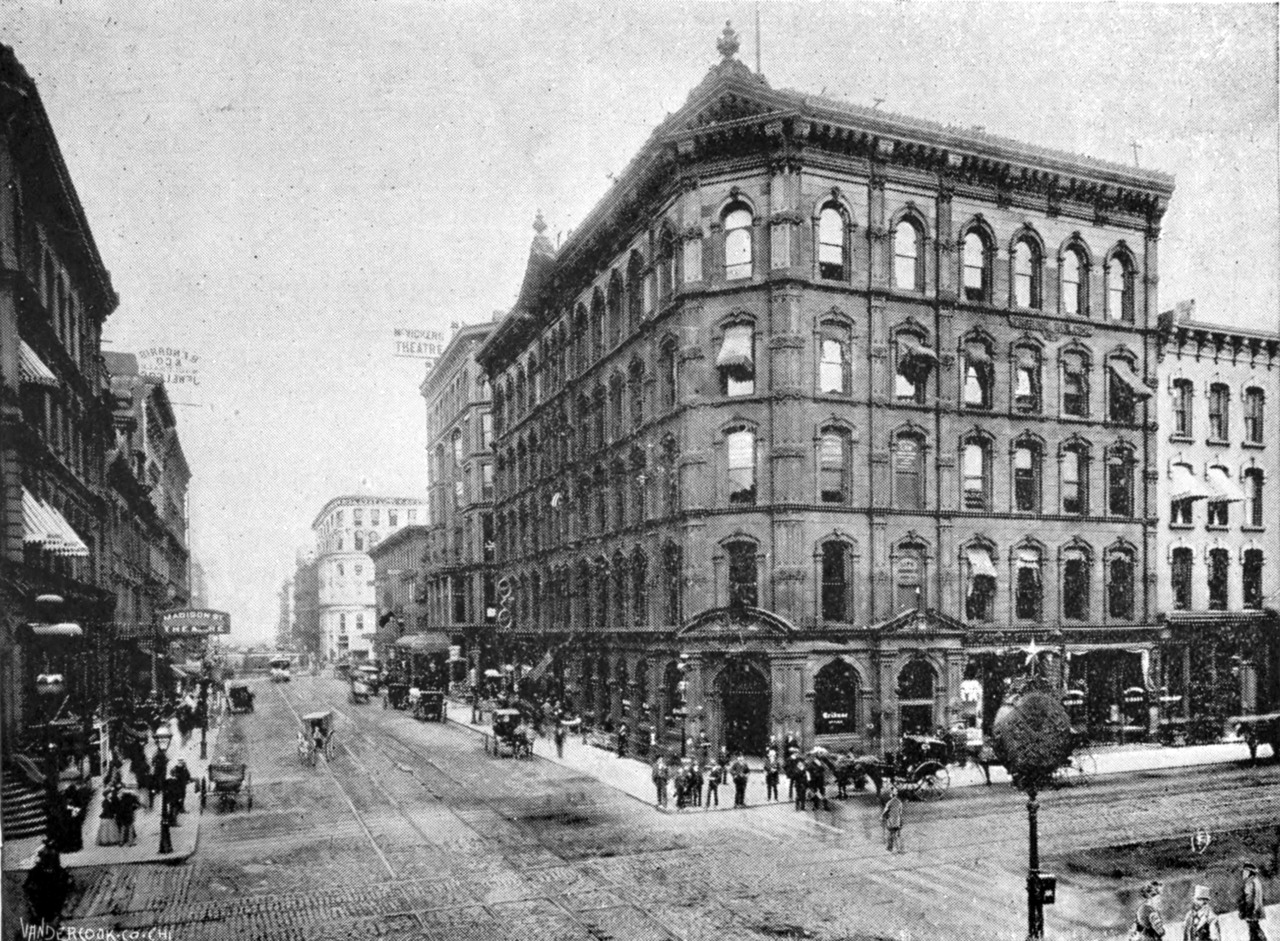
Tribune Building II
1872-1901
Engraved for the Standard Guide Company, 1890
Poor Buildings and No Sewers.
The Court-House was a small two-story structure of brick on the northeast corner of the present Court- House square, while on the northwest corner of the same stood the County Jail, built of logs bolted together. At night the pedestrians had to grope in the dark or use a lantern, there being no gas until September, 1850. The only water supply accommodated a very limited area through a series of log pipes, and many of the citizens had to buy waler for domestic use from carts by the bucket or barrel. There were no sewers, and the street grade in the heart of the business portion of the city was many feet lower than at present. Not a railroad line entered the city from any direction, and often the people were without news from the outside world for weeks at a stretch. There were no telegraph lines to furnish news from abroad, still less telephones for communication between residents and business-men. The Tribune had been an established institution nearly twelve years before the first public school building in Chicago was erected, and it was eighteen days old when the Rice Theater—the tirst regular show house in Chicago-—was opened; though the teaching of the young and dramatic entertainments had not been neglected. There was little business doing in the shipment of produce eastward by lake after it had reached the city by wagons from the surrounding country, and consequently but few sales of dry goods, groceries, lumber, etc., to the farmers who brought in the produce, although some packing was done. The first stock-yards—”The Bull’s Head”—was not opened until 1848, and then the only animals received for packing were those driven in on foot. The lake shipments of the year 1847 included 32.538 barrels of flour, 1,974,304 bushels of wheat, 67,315 bushels of corn, and 38,892 bushels of oats. At the beginning of that year there was not a bridge across the river at either Wells, Randolph. or -Madison street, though a few months later bridges spanned the stream at all these points.
Nursery of The Tribune.
Under such circumstances The Tribune of that period was a much more primitive affair than the crudest attempt at a newspaper now published in this city. And so it would have been if abundant capital and plenty of “journalistic talent” had been available—which was not the case. There then existed neither the demand nor the means for the publication of such a paper here—in the modern sense of the term. In fact, though the field widened each year from 1847 onward—the population increasing sevenfold in the next fourteen years, while the volume of commerce and manufactures grew at a still more amazing pace—the real newspaper, as the word is understood today, can scarcely be said to have existed or found a field. until the Southern States had undertaken to secede and volunteers began to rush forward to the defense of the Union. Then those of the people who remained at home wanted the news and wanted it at the earliest possible moment. In addition to the great interest they felt in the progress of the struggle as a whole they were Intensely anxious for the welfare of friends and loved ones Who had gone to the front. Each of many thousands of families in this section had a brother, a son, or a father in the ranks, and their members wished the fullest information obtainable in regard to the movements of small as well as 1a1rge bodies of troops. The Tribune furnished Its full quota for the struggle when it came, and brothers of two of its principal proprietors (Col. John A. Bross and Maj. William H. Medill laid down their lives in defense of their country.
The departure of Gen. R. K. Swift fronm Chicago for Cicero on April 21. 1861, was the signal for an immense expansion of The Tribune, as well as for a radical change in the methods of collecting news for its readers, and so it continued until the final triumph of Appomattox.
Against the picture of Chicago, us it stood in 1847—with its area of thirteen and one-half miles and its population of less than 17,0OO—the city of today with its area of 189 square miles (nearly fourteen times greater). Its population increased one hundredfold, its forty lines of railroads, its vast commerce, and Its loftY buildings rising out of the ashes of the conflagration of 1871, and some idea may be formed of the changes which The Tribune has lived to see in the half-century of its history which it has in its modest way helped to bring about.
IN CONCLUSION
After Medill gained full control of the newspaper in 1874 he guided it until his death in 1899. Medill’s two grandsons, Robert R. McCormick and Joseph Medill Patterson, assumed leadership of the company in 1911. Chicago’s WGN Radio (720 AM) went on the air in 1924, its call letters reflecting the Chicago Tribune’s renowned slogan, “World’s Greatest Newspaper.” The station was an innovator from the start. It was first to broadcast the World Series, the Indianapolis 500 and the Kentucky Derby, and broke new ground by introducing microphones in the courtroom during the famous 1925 Scopes “monkey trial” in Tennessee. Today, Tribune’s original broadcast property is a 50,000-watt Midwest powerhouse.
Also in 1925, the company completed a new headquarters and one of Chicago’s first “skyscrapers.” The 40-story building known as Tribune Tower is a Chicago landmark and perhaps best known for the many historic stones and artifacts embedded in its limestone exterior.
Tribune entered the infant television industry in 1948, when it established WGN-TV in Chicago, followed by WPIX-TV in New York. Years later, the formation of Tribune Broadcasting Company in 1981 signaled the growing importance of television in the company’s business mix. Since 1978, when WGN-TV became a “superstation,” the Cubs have been aired to a national audience via cable. Today, WGN America reaches about 75 million U.S. homes outside Chicago through cable and direct broadcast satellite.
In 1983, after 136 years of private ownership, Tribune became a public company with an initial offering of 7.7 million shares of stock valued at $206 million.
Tribune grew dramatically during the 1990s, spurred by a loosening of federal regulations restricting television and radio ownership. This resulted in rapid consolidation within the broadcasting industry and Tribune expanded its broadcast holdings in the country’s top 40 markets. Through a series of acquisitions and investments, the company emerged as one of the largest owners and operators of television stations in the nation.
In June 2000, Tribune acquired Times Mirror Company, effectively doubling the size of the company and adding seven daily newspapers to the Tribune fold, headlined by the Los Angeles Times, The Baltimore Sun and the Hartford Courant.
-
The Tribune Buildings
Tribune Building I
Tribune Building II
Tribune Building III
Tribune Building IV (Tribune Tower)
Chicago Tribune Tower Competition
Freedom of the Press Mural
From Trees to Tribune
Tribune Tour No. 1—Seeing the News Room
Tribune Tour No. 2—Printing the Chicago Tribune
Tribune Tour No. 3—The Sunday Tribune
WGN
WGN Transmitter
WGN FM
WGN Firsts
Tribune Exclusives
Chicago to Berlin on the Untin Bowler
Injun Summer
The Goodfellows’ Movement
First Color News Spot Picture
Newsboys’ Dinner
Tribune Comics
Chicago Tribune Syndicate
Sidney Smith—From Goats to Gumps
Dick Tracy
Gasoline Alley
Little Orphan Annie
Moon Mullins
Tribune Anniversaries
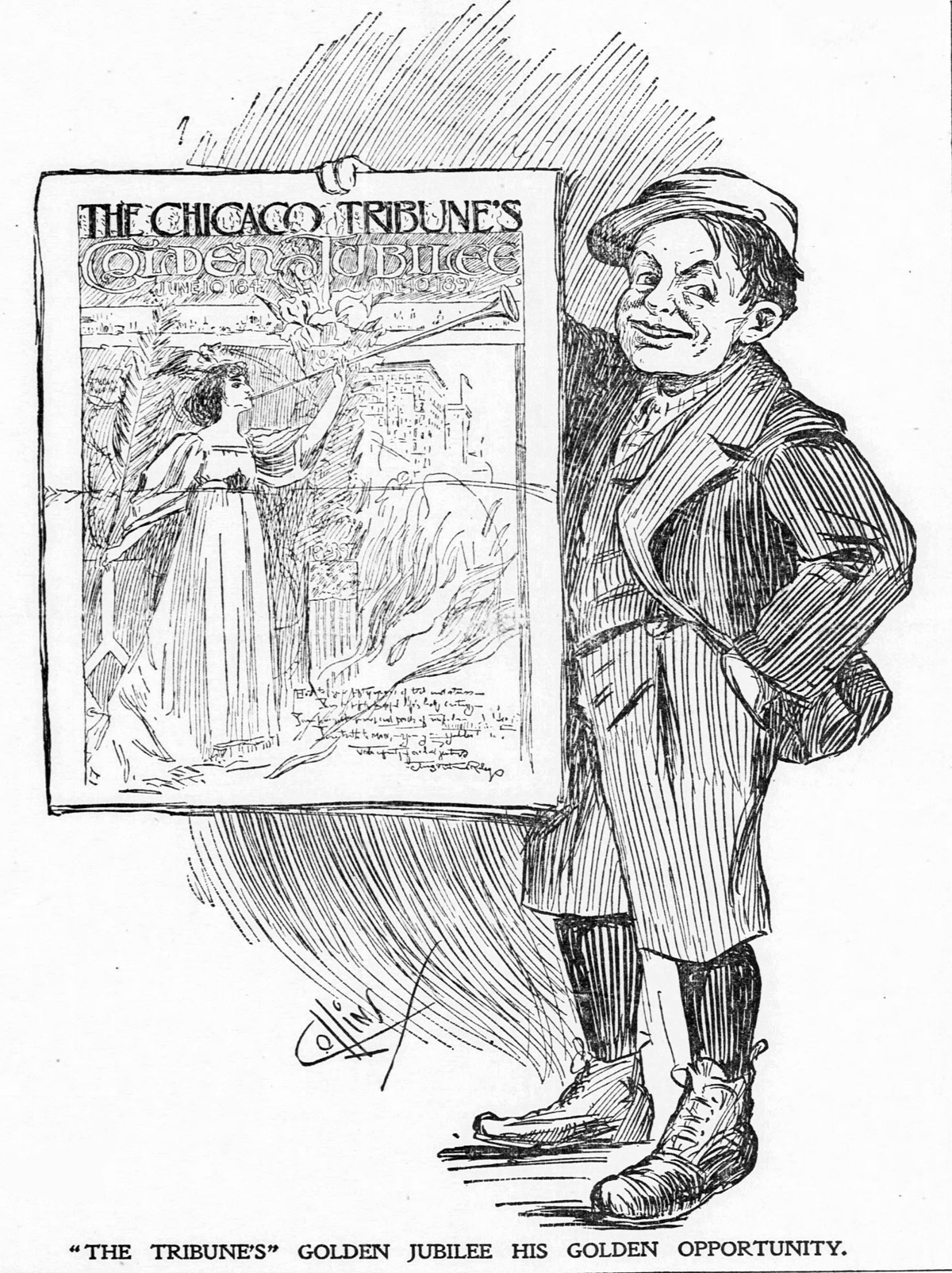
Tribune’s 50th Anniversary
Tribune’s 100th Anniversary
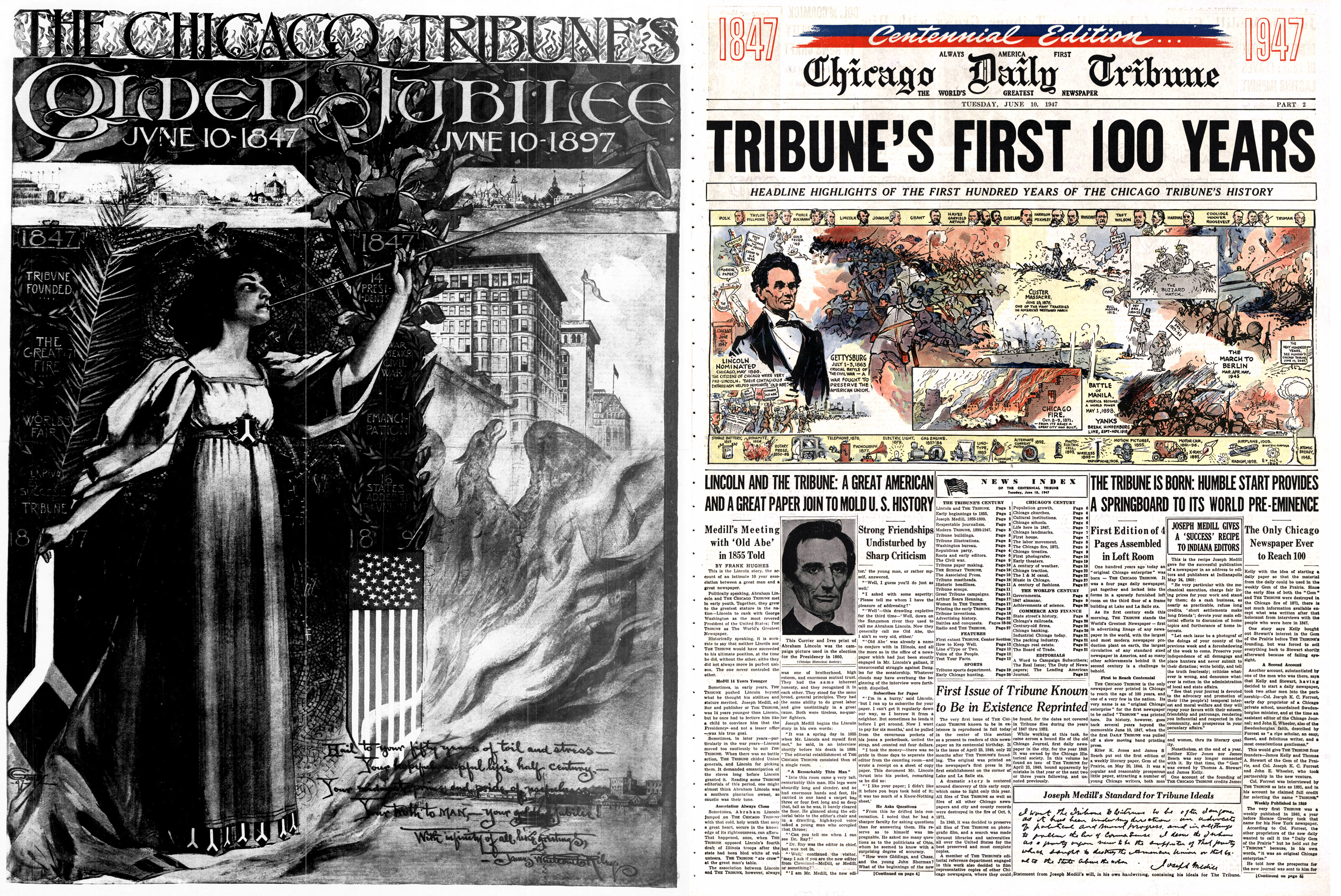
Chicago Tribune
50th and 100th Anniversary Editions
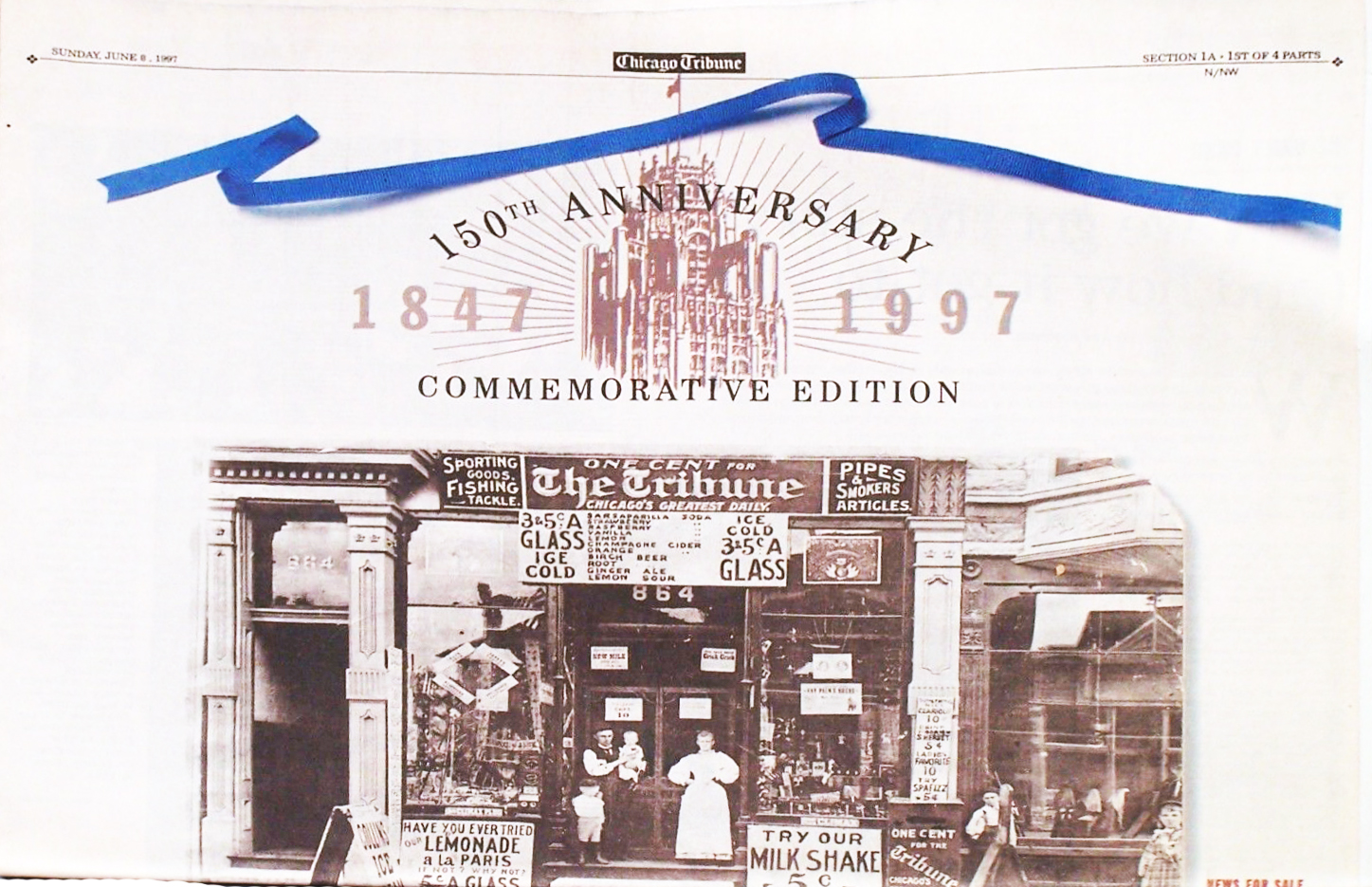
Chicago Tribune
150th Anniversary Edition
June 9, 1997
Does the Chicago Tribune have archives on issues of the Chicago Herald American Newspaper from 1957 (April thru December)?
No, but the Chicago Public Library and Chicago History Museum does.