Sears, Roebuck & Co. Headquarters
Life Span: 1905-Present
Location: 925 S. Homan Avenue
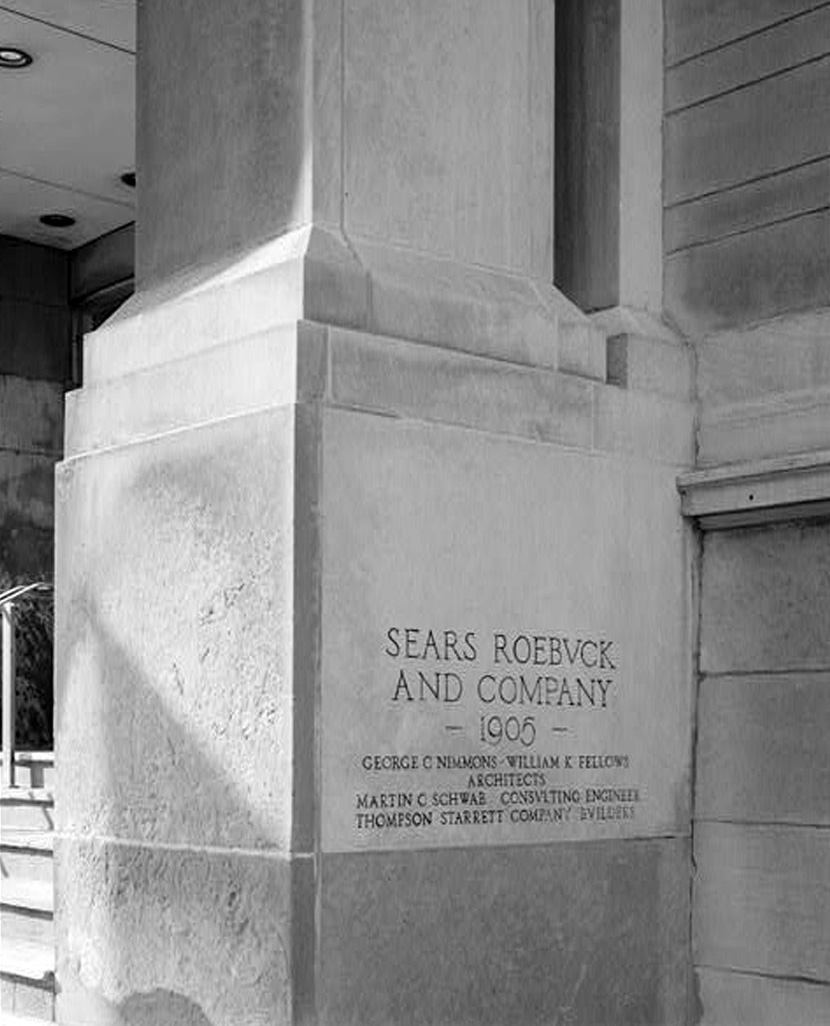
Architect: Nimmons & Fellows
- Lakeside Business Directory of the City of Chicago, 1906
Sears, Roebuck & Co Richard W Sears pres; Julius Rosenfeld v pres and treas; Albert H. Loeb sec; supply house Harvard st and Homan av tel West-2500
Lakeside Business Directory of the City of Chicago, 1909
Sears Roebuck & Co supply house Homan av and Harvard
Lakeside Business Directory of the City of Chicago, 1911
Sears Roebuck & Co Julius Rosenwald pres; Albert H Loeb v pres and treas; J Higgins sec; supply house Harvard st and Homan av tel Kedzie-2500

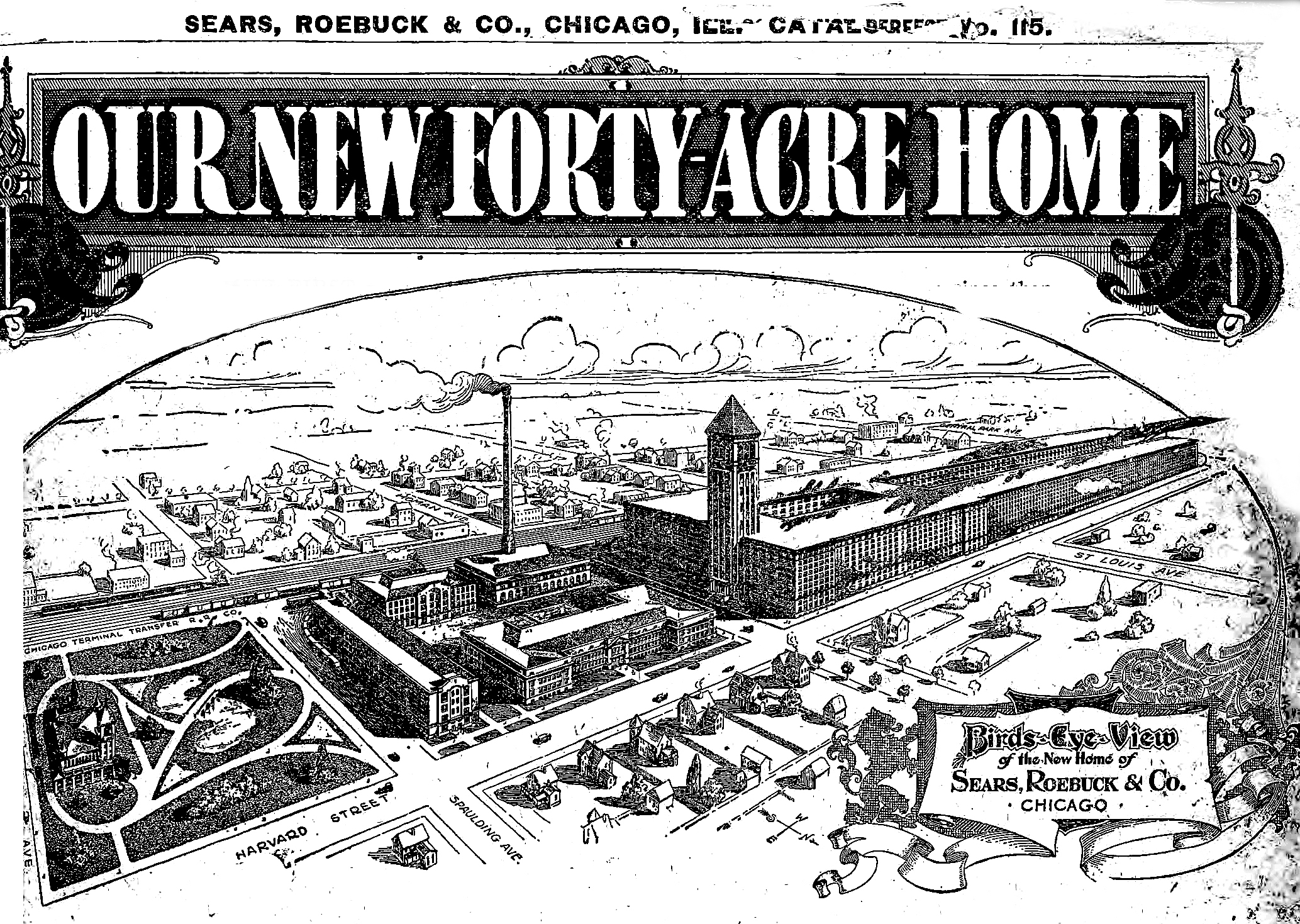
- This illustration gives a bird’s eye view of the buildings and grounds now occupied by Sears, Roebuck & Co., our new home is located in a populous residence district on the West SIde of the City of Chicago. While the pIcture can give you but a faint idea of the magnitude of these buildings and, of course, it can give you no idea of the labor saving facilities and the methods employed by us in handling the enormous volume of business sent us by our friends throughout the length and breadth of this broad land.
Letter from Richard Sears to Mr. Jno. A. Freeman, President of the Mutual Insurance Co. in Providence, Rhode Island, November 30, 1904.
- We have procured a piece of property about three miles directly west of our City Hall (Center of city). The property is 537 feet wide and one-half a mile long,…in one of the best residence districts of our city….We are planning to erect a building of mill construction, the main part of the building covering an area of about 300 to 400 feet, with a large court in the center, and adjoining each building will be two long two-story buildings.
Chicago Tribune March 4, 1905
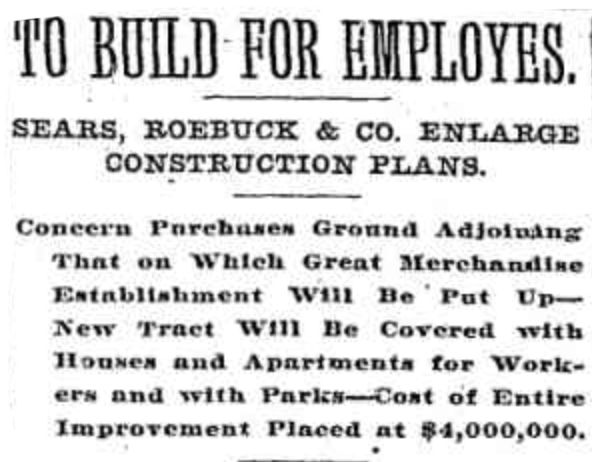 Sears, Roebuck & Co. have enlarged upon their original plans in connection with their proposed new model industrial establishment on the west side.
They completed yesterday the purchase of another half mile of frontage on the north side of Harvard street, from Central Park to Kedzie avenue, opposite their proposed plant. This tract they will devote to residence and park purposes solely, for the accommodation of the 5,000 persons they expect to employ in their new establishment.
Altogether the concern acquired approximately 457,000 square feet, at the rate of 40 cents a square foot, the total consideration being $183,742. The seller was Henry E. Vance of Wheeling, W. Va., and the negotiations were conducted by E. A. Cummings & Co. It is estimated that $1,000,000 will be required in the development of the firm’s plans in connection with the new purchase, so that, including their plant, their total investment will approximate $4,000,000.

Tentative Building Plans.
In a general way it has been decided to erect no house to cost less than $3,000, while a building line of at least fifteen feet probably will be fixed upon. It is possible that a few model apartment house also may be erected, but this has not been decided upon.
The work of improvement will not be undertaken until after the completion of the business plant, which, it is thought, will not be later than Aug. 1 of this year.
Only half the property acquired—that between Central Park avenue and St. Louis avenue and the block between the latter and Homan avenue—is a full block in depth. Between Homan and Spaulding avenues it is a half block deep, and the same is true of the block between Spaulding avenue and Kedzie, except the frontage on the latter, which reaches nearly to Polk street.
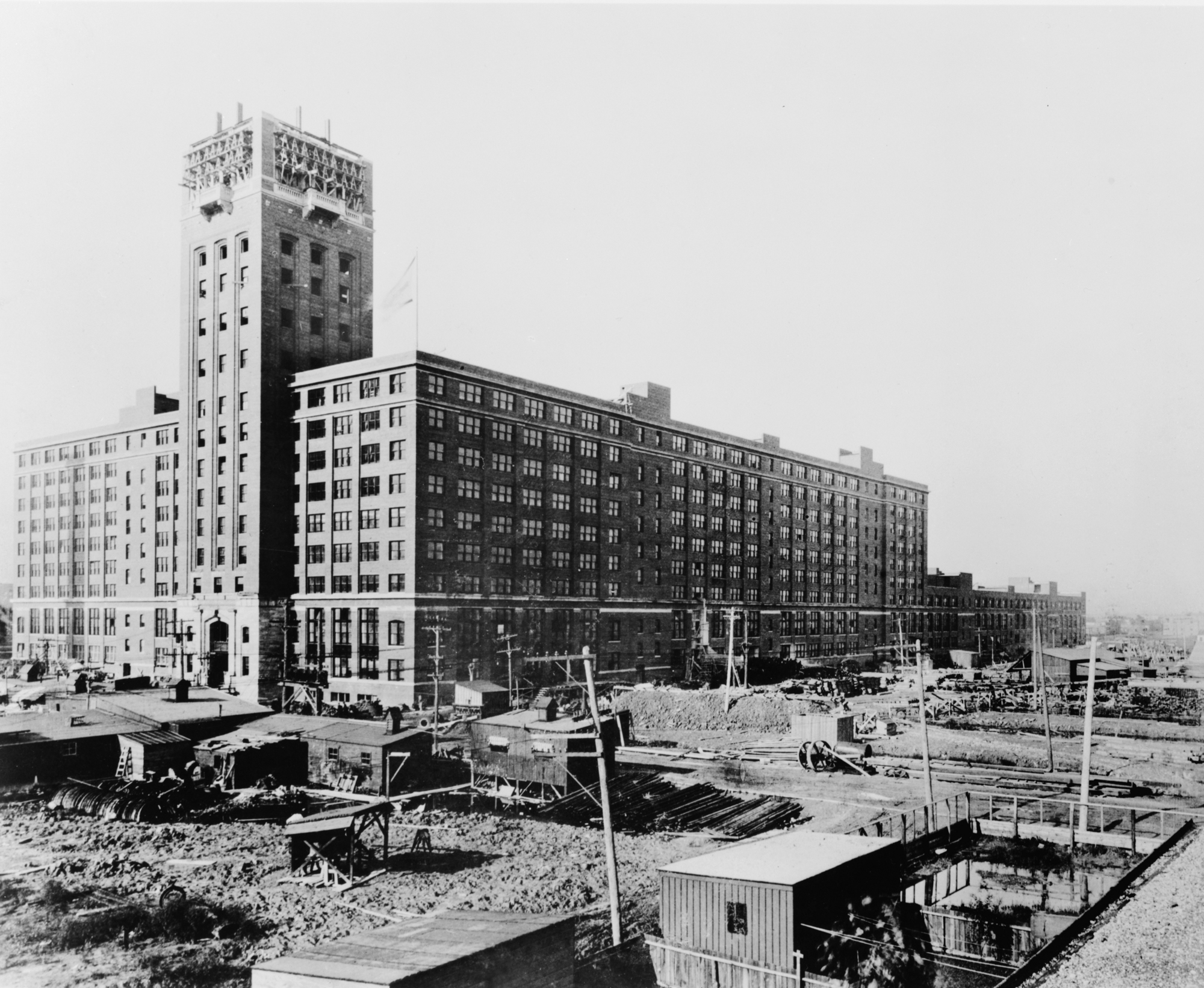
- Overall View of Merchandis Building
View to Southwest During Construction.
Sears, Roebuck and Company Fall, 1905 Catalogue.
Architectural Record, Volume XIX, Number 4, April, 1906
THE BUILDING OF A GREAT MERCANTILE PLANT
By Theodore Starrett
Have you ever read some stirring tale of heroic action, some story of a battle, for instance, and with bated breath and beating heart followed in your imagination a bloody charge like that of the Six Hundred at Balaklava half a league, half a league, half a league, onward, on through the valley of death? And have you ever sighed as you finished the story and thought of the good days and the brave days when money-getting had not become the modern fetish, and deeds of derring-do were not a memory or a fable?
If you did, let me tell you you were wrong. These heroes still live. The race has not died out, and in these glorious days of hypocrites exposed and rascals cleaned out perhaps their fame may be heralded as in the days when war with its horrors was the only theatre of heroic action.
The public is used to talk about the captains of industry who have succeeded the captains of war, but the trouble is that all the captains of industry seem to “be graduated from the quartermaster’s department. The field officers the fighters who take their lives in their “hands, and, mayhap, lose them, are often unknown to fame if not unwept and un- “honored, yet certainly unsung.
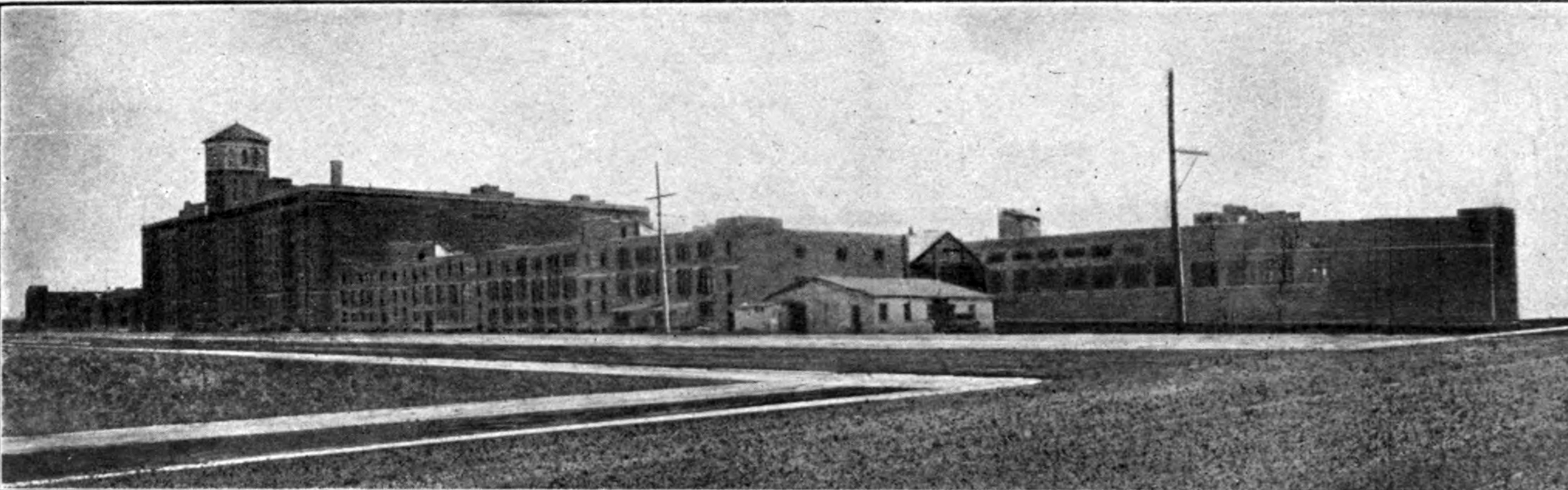
- Sears, Roebuck & Co. Buildings
General View From the West.
The temperament of the fighting leader is well illustrated by this story of Alexander the Great related in the words of Lord Bacon: When Alexander passed into Asia he gave large donations to his captains and other principal men of virtue; insomuch as Parmenio asked him,
“Sire, what do you keep for yourself?”
He answered, “Hope.”
Well, let the sutlers and camp followers have the money, but for goodness’ sake give at least some of the glory to the fighters. The quartermaster’s department has been stealing other people’s thunder, and it is high time that honors should be bestowed where they belong.
Who are the modern heroes, the real captains of industry? And where are they to-day? Within the walls of some packing house? A dozen thousand men are employed in one pig-sticking establishment, and the pork barons who pay their wages are the captains of a very profitable industry. There is bloodshed there, but glory hardly.
Or perhaps it is the army of clerks who present arms behind the counters of some merchant prince, a captain of industry from the quartermaster’s department in very truth.
Or perhaps it is the army engaged in manufacturing. That is too easy. A big army, it is true, but engaged in a stationary and more or less stable business with steady employment for the common soldiers year in and year out. What trouble is there about running such an army?
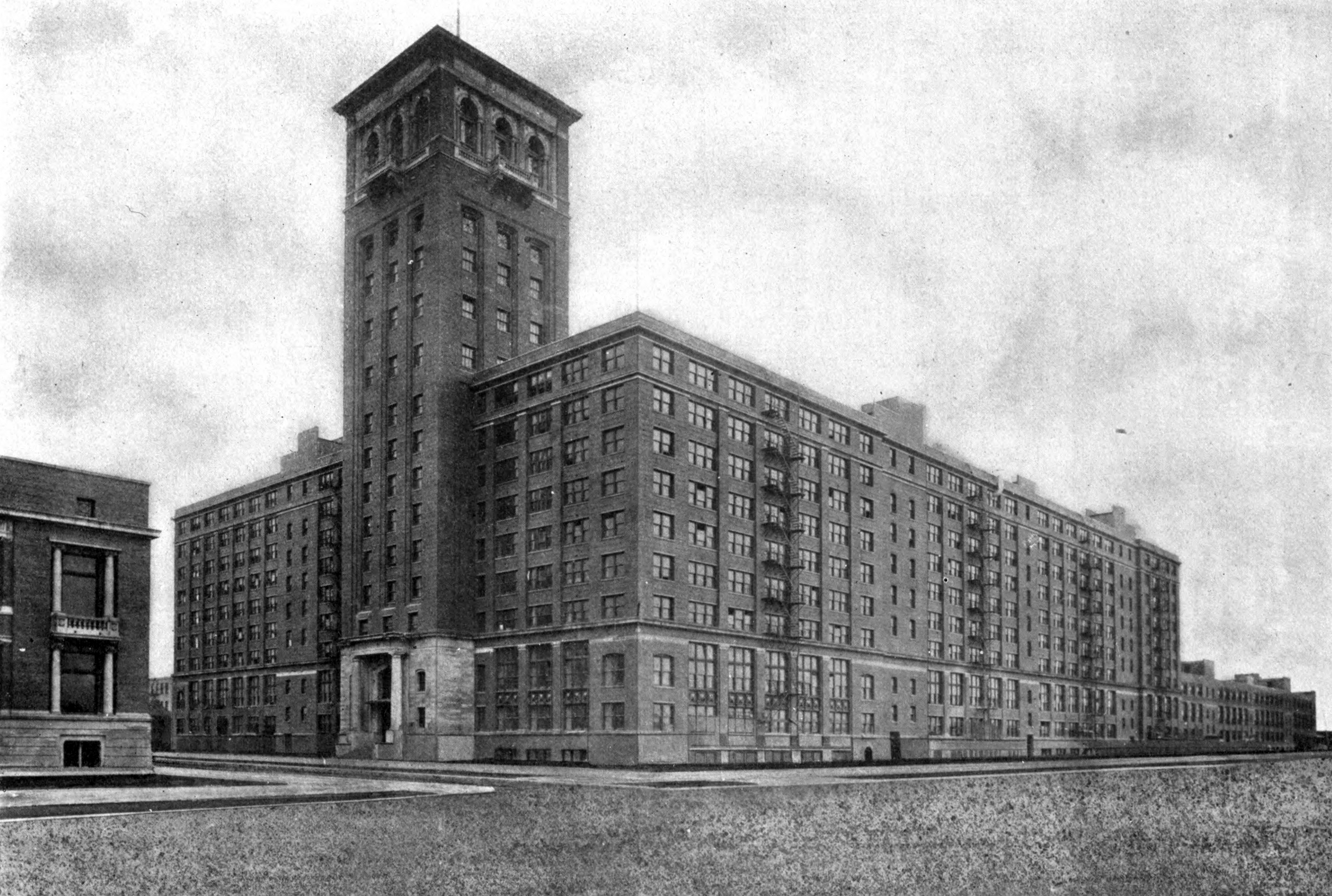
- Merchandise Building.
Railroading has its devotees, but the railroader will have to be his own chronicler.
No, the industry that it takes a real captain to run is the building industry. There you have work for the leader of men. There you have an army that it takes an Alexander to handle the freest product of our free civilization a host of trade unionists protected in their freedom, let me not say license, by something which the law has not as yet been able to curb more master than servant not to be driven, yet in their very freedom susceptible to leadership dare-devils who will steal a ride on a girder as it is lifted by a single strand of cable dangling from the end of a boom derrick to some dizzy height where the piece of steel is to be riveted in place to form a rib of that great thing of life, the modern skyscraper.
He who would command an army of such men must be a captain indeed, captain of a nomadic host, to-day at work on some great building operation where thousands are engaged, to-morrow divided or perhaps entirely disbanded. The kaleidoscope-changes, the corps of different trades, each corps marching to do its own particular part of the work a procession of craftsmen drilled and trained in the face of conditions that would be regarded as impossible in other industries, yet drilled and trained, nevertheless gathered from nowhere, andafter each corps has done its work scattered again to the four winds these things pass before the mind and, mayhap, in their very difficulty appeal to the imagination of the captain of the building industry a man unknown to fame.
Here is the man who does things. And I sometimes think that his doing is the more glorious because he is not spurred on to his work by the loud acclaim of popular applause. There are no laurels to adorn his brow, no poet to immortalize his fame. I often wonder what it is that keeps the great building hustler up to the mark, for few of the really great ones are known outside the circle of their intimate friends. It is something divine, I think, like the spark that makes the poet. The pure joy of hustling, the satisfaction of the thing accomplished is his principal reward of his arduous labors for of money he gets but little.
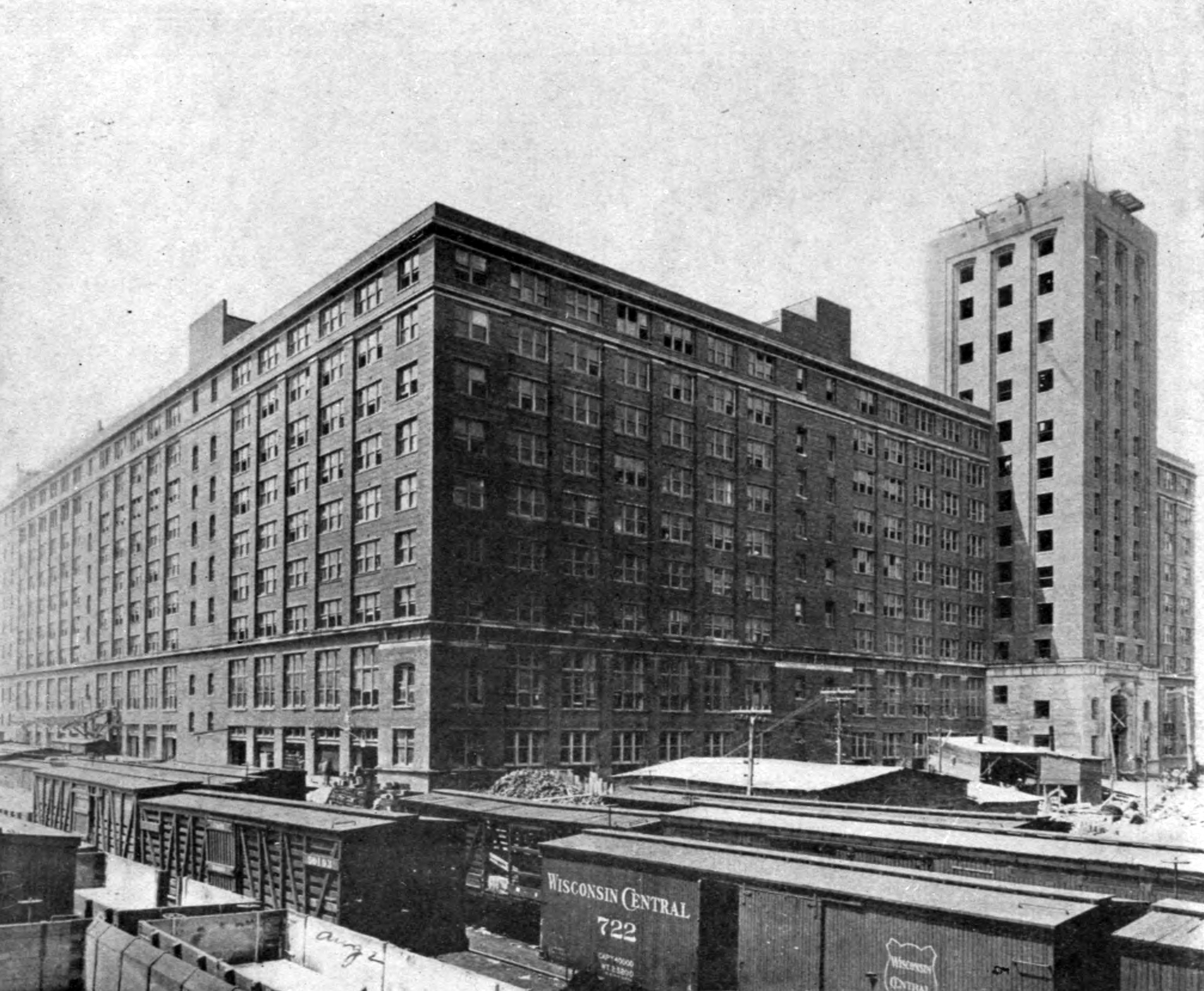
- Merchandise Building
Looking Northwest
The Sears-Roebuck buildings in Chicago, out on the west side, are said in their entirety to form the largest mercantile plant in the world. When George M. Pullman built the industrial town which bears his name in what is now the south side of Chicago, the operation was the talk of the entire civilized world. All kinds of stories were written about it, and its wonders in the way of bigness were on every tongue.
The great Corliss engine which was the star attraction of the centennial exhibition at Philadelphia, and which was supposed to be too big for practical purposes, was moved to Pullman and there found a suitable work in running the power plant of the Pullman Company. That engine, I remember well, had twenty-five hundred horse power.
In the Sears-Roebuck establishment the power plant is not engaged in manufacturing, unless printing be called such, and yet it is necessary to have seven thousand horse power to do the work of heating, lighting and ventilating the building. I believe it would be found that you could bundle the entire Pullman plant, including not only the factories but the workingmen’s houses, the town market and the theatre, into the single Merchandise Building of Sears, Roebuck & Company and still not fill it.
Think of an establishment whose mail exceeds in volume that of the city of Milwaukee, a town of 300,000 inhabitants, for, as I understand, in the first, third and fourth classes the mail of Sears, Roebuck & Company actually does exceed that of the city mentioned.
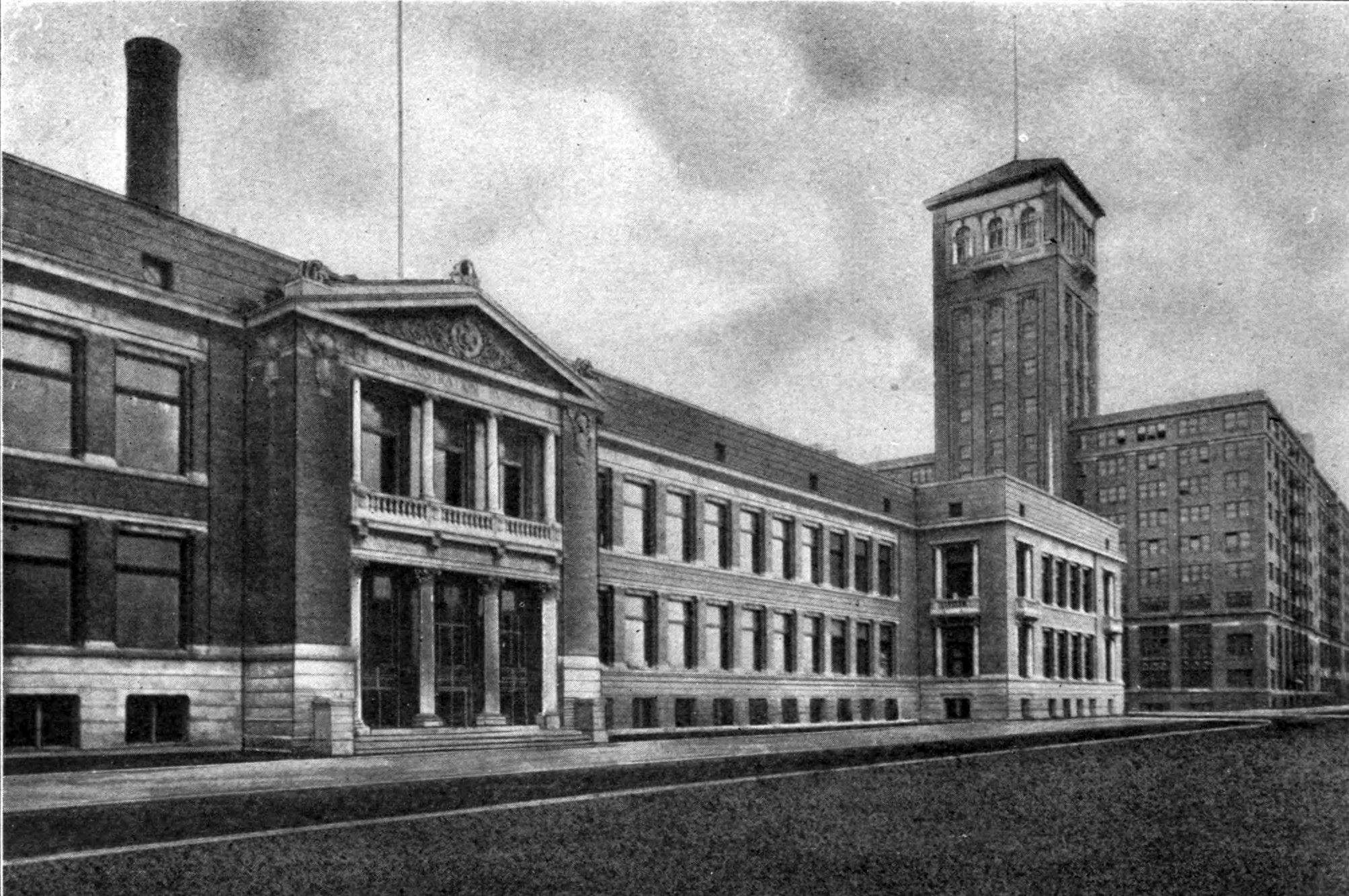
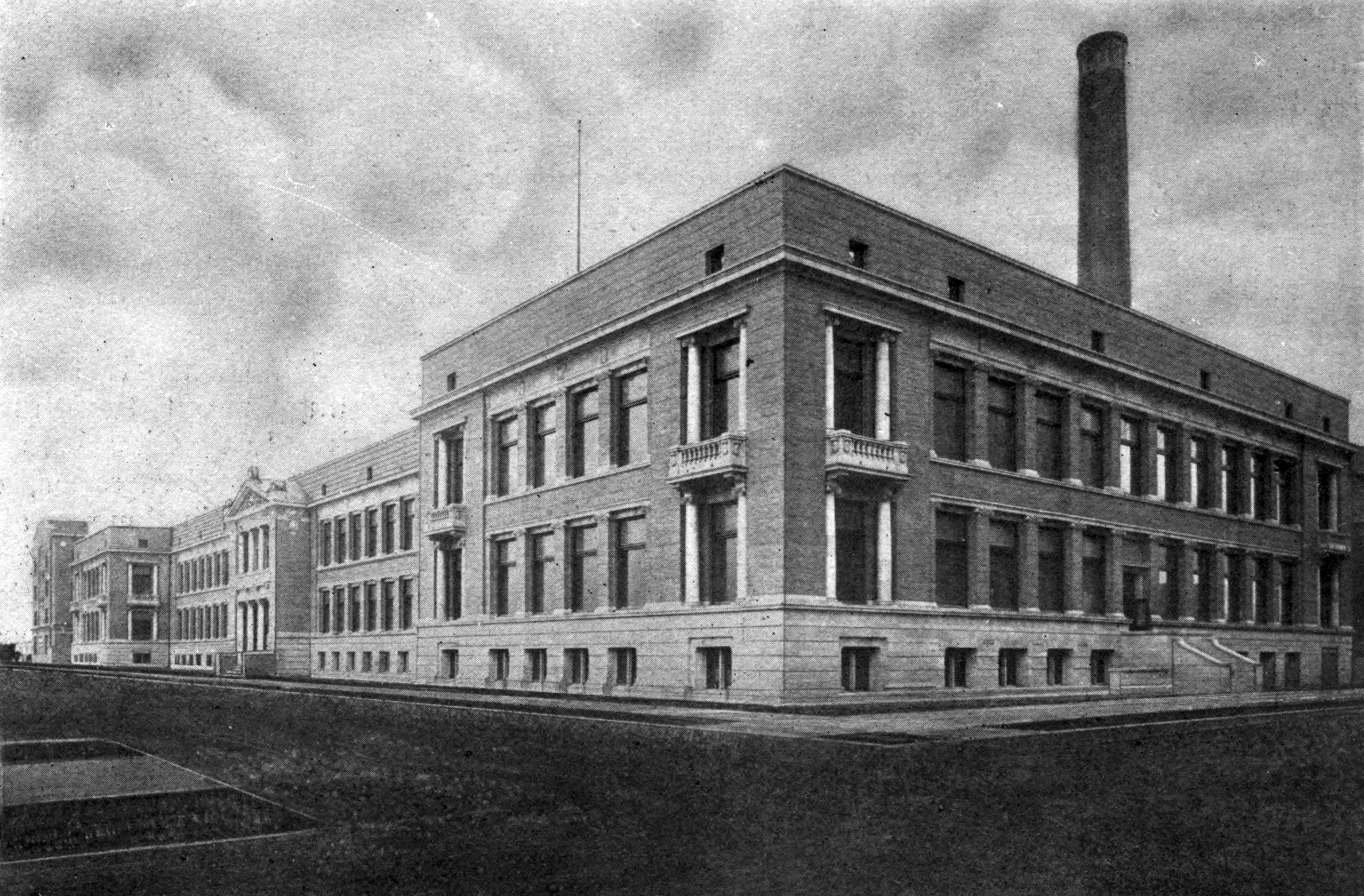
- Administration Building.
And this concern has a printing establishment housed in its own four-story building whose finished daily product weighs 80,000 Ibs., or forty tons, for here are printed every day in the year, except Sundays and holidays, 20,000 copies of a 1,200 page catalogue, each copy weighing when finished and trimmed four pounds.
And they have their own private fireproof office building, about two-thirds larger than the Broadway Chambers in New York City not a skyscraper, of course, but making up in length and breadth what it lacks in height. And this office building, or Administration Building as it is called, has marble floors and wainscoting and fine cabinet work, and, what to me is most remarkable, a heating and ventilating system for the benefit of all the clerks, mind you, so perfect as to remnid one of the special luxuries that heretofore have only been at the disposal of Croesuses.
All these buildings are connected by tunnels large enough to allow the passage of a two-horse wagon. These tunnels, 4,312 feet of them, are primarily intended for pipe galleries, but are so arranged that passage from one building to another may be made regardless of weather.
The foundations for the entire series of buildings are what are called caisson foundations; that is, they are carried clear through the clay to the underlying rock. There are 1,563 of these caissons and they run in depth from forty to ninety feet.
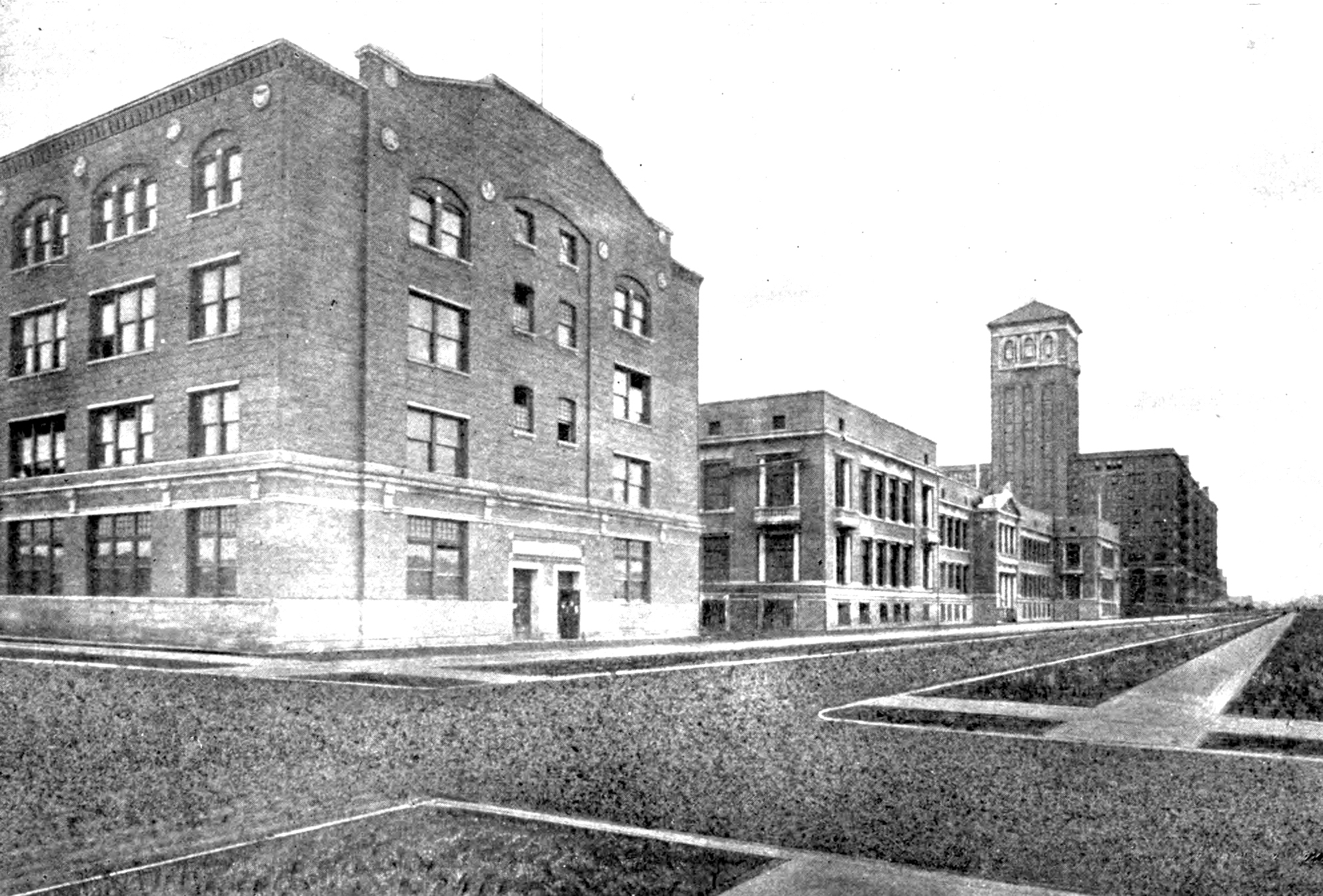
- Printing Building.
The buildings are good looking, too; not common brick factories, if you please, but so well studied and so tastefully decorated that I think the critics will congratulate the architects on their work.
An interesting book might be written about the buildings, but I will leave that task for others.
And the entire establishment was constructed, from the starting of the excavating until its complete occupancy by the owners, counting strikes and all, in less than twelve months. The exact dates are, start January 24, 1905; turned over to the owners January 15, 1906; occupied fully by the owners January 22, 1906.
But even that does not tell the story, for the Merchandise Building, with its 14,000,000 cubic feet and over, was built and occupied in six days less than eight months from the time the first spadefull of earth was thrown.
In building these buildings, 23,000,000 bricks were used, being laid in six months’ time because not all the time was taken with the bricklaying. There was one day when the gang laid 353,000 bricks in eight hours, and there was one week in which 2,350,000 bricks were laid. I know of one or two respectable little skyscrapers with no more bricks in them than were laid in- two days on this work.
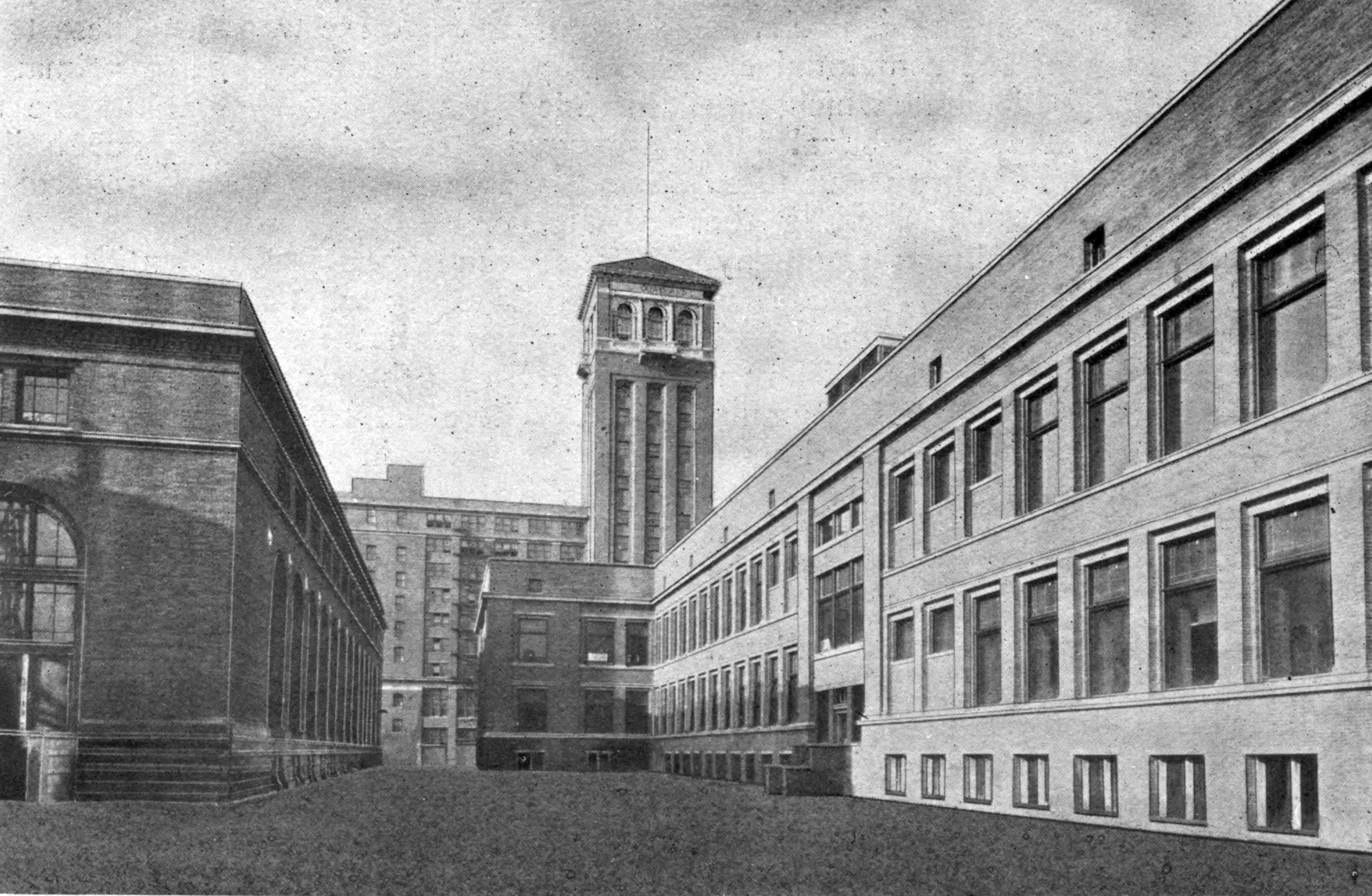
- Court, With Machinery Building on Left, Administration Building on Right.
Two of the buildings are mill construction, and the amount of lumber used is almost appalling. Long leaf yellow pine was specified because it is of slow combustion, and for this class of structure is said to be given preference by the insurance underwriters over steel construction. The order for the yellow pine timber was placed on January 11, 1905, and is said to be the largest individual contract ever given out in the history of the trade. A delivery of 12,000,000 feet within 125 days was called for. To secure this quantity of lumber in the time specified it was necessary to call into use seventy-five mills located in the States of Alabama, Mississippi, Louisiana and Texas, as the rainy season was just beginning in the South and the trees were growing in the virgin forests, for every piece of timber had to be cut specially to order and dressed to meet the requirement. The exact quantity of yellow pine lumber used was 13,545,576 feet, board measure. At one time there was a stock of 7,000,000 feet piled at the site. A saw mill was specially built to shape this material, and one of the sights of the job was this mill in action. The timbers were run in at one end, rolled under the machine, clamped in place, a lever was pulled and down came a great jaw which shaped and trued the ends and bored the holes in the twinkling of an eye; then the jaw was raised and the timber was pushed out at the other end of the mill, to be taken thence to its place in the structure.
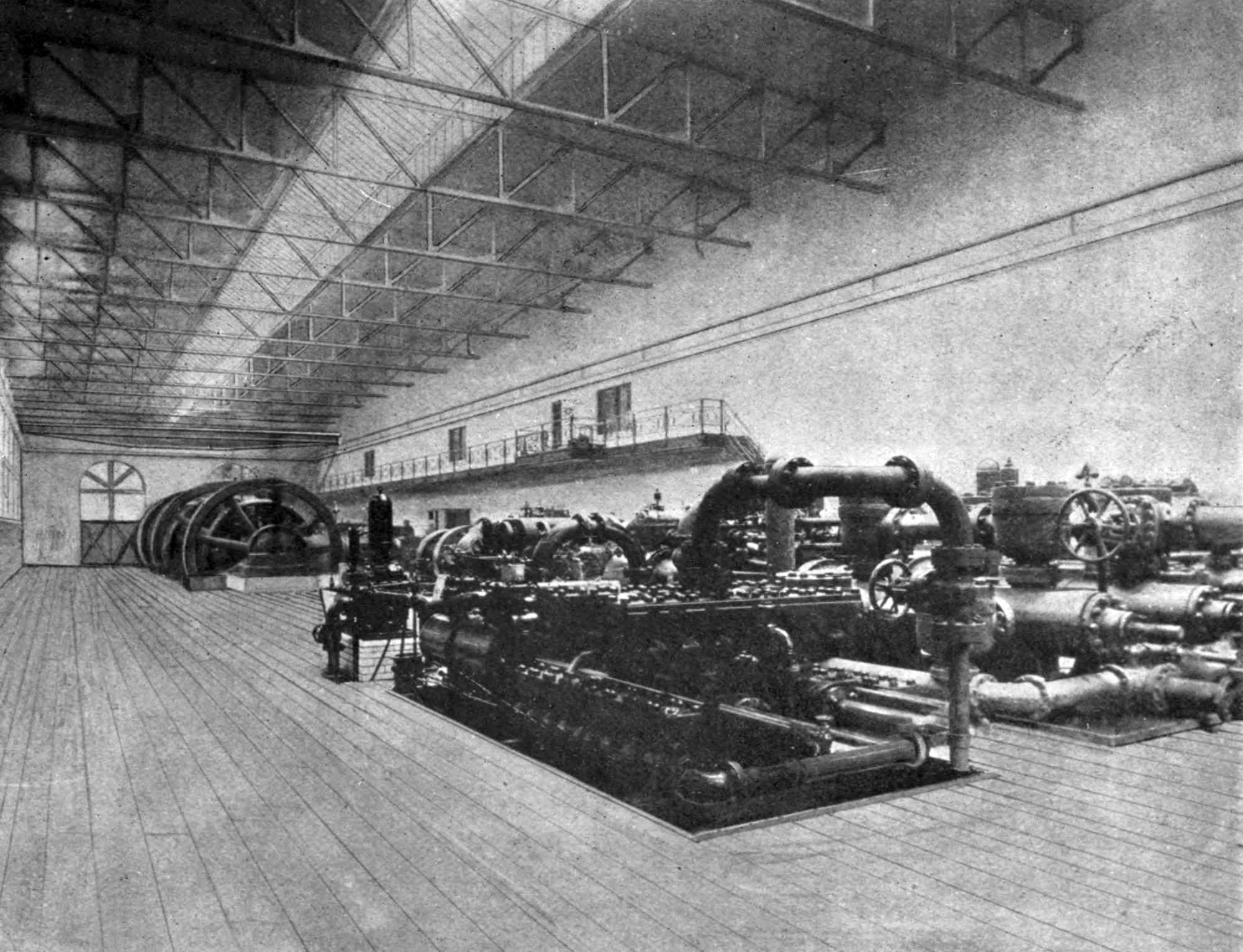
- Engine and Pump Room.
The lumber used for boxing the concrete foundations, tunnel forms and for miscellaneous jobbing around the work was 4,159,264 feet. One little item was 4,300 surveyor’s stakes.
The order for maple flooring on this job was 2,800,000 feet.
Four foundries made the castings for the work.
During the rush a day’s consumption sometimes ran as high as 30 cars of brick, 20 cars of lumber, 10 cars of sand, cement, crushed stone and miscellaneous material.
Imagine a train of 60 cars to unload each morning, and after unloading to be enwrought in a building before night, for that was the daily task. On the morrow 60 more cars would be waiting to be unloaded, and the day’s work must be done. Some pretty good management is required here, I assure you, for while on the one hand there was the task of setting all these materials in their final resting places in wall or floor, on the other hand new material for the next day’s work must be on the way ready to arrive at the right time, not too early, for that means loss through demurrage; not too late, for that is something worse still—stoppage of the work, loss of some of your army, perhaps demoralization and defeat, for not all these campaigns are victorious.
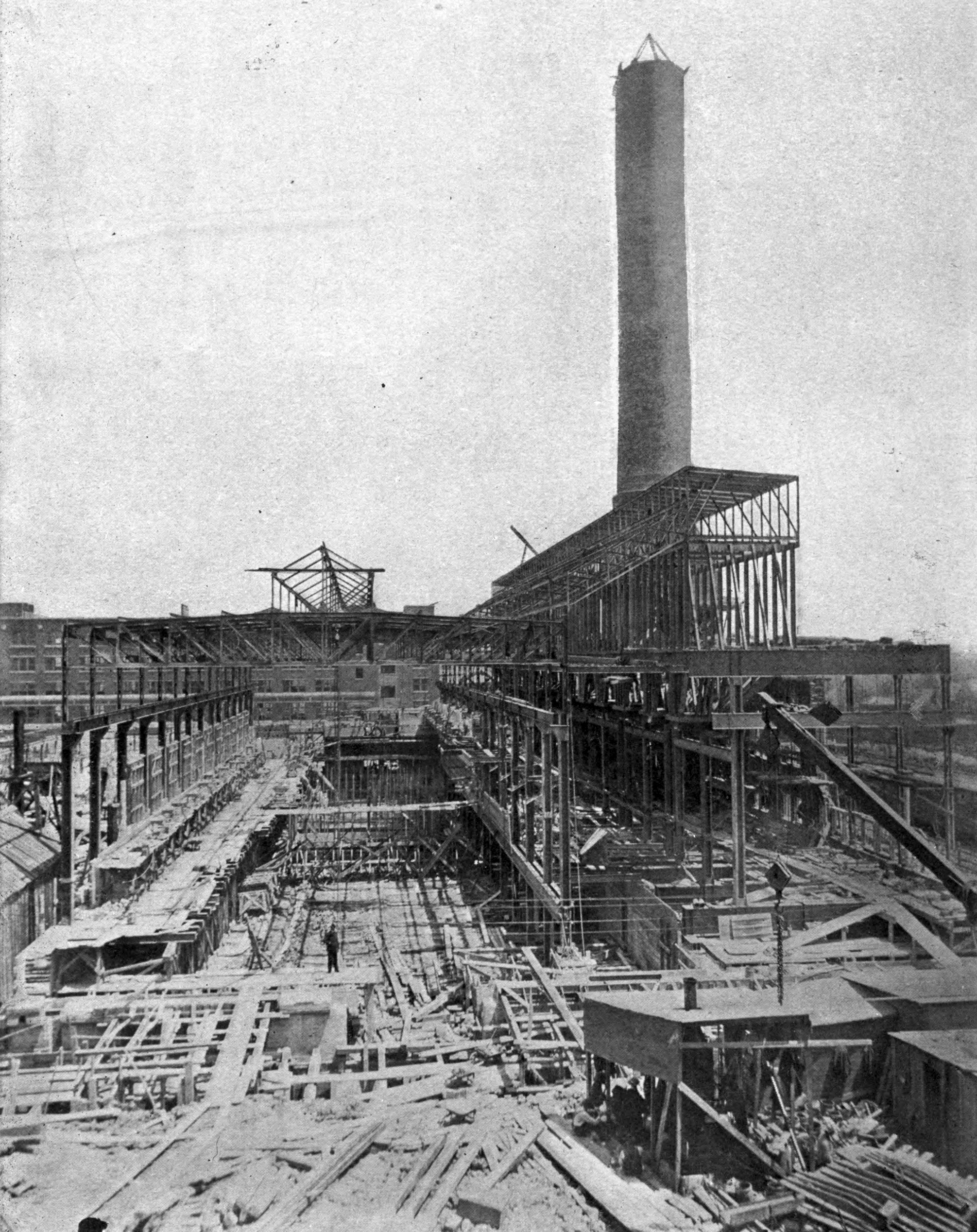
- Construction of the Power House.
No resting here! No sleeping at the switch! It’s up and at it, boys, or somebody will be swamped.
To the eye of the enthusiast there’s a romance about it all, and the men who take part in the game, this modern tournament—for that is how they seem to regard it are just as much heroes as any you ever read about.
They have some very expressive language, too. A great phrase was, “Go to it,” with accent on the middle word. It meant go to your work instead of letting it come to you. “Beat him to it” meant to get there ahead of the other fellow, and was the favorite word of the Major General who commanded in this particular campaign to some lieutenant who had come to him with a tale of some railroad crew that was slow, or when some particular stunt was to be done so as to be ready for the morning.
The enthusiasms of the army that is engaged in a work like this building of the Sears-Roebuck buildings is something thrilling. It is like the ardor of battle. The whole organization is like a troop of cavalry in a charge under a good leader. They do not care what is ahead of them. The watchword is “Get there,” and get there they do even if they are killed in the act.
I have a photograph of the leading men on the work taken on the occasion of the raising of the last timber of the Merchandise Building. This work was done in the rain. Some inglorious Milton has written on the picture:
- We raised the last post with many a shout,
As the rain in torrents fell,
And though our backs were soaking wet
Our breasts with pride did swell.
Nothing was allowed to stop the work. The sides of gondola cars were ripped off and thrown in the rubbish pile in order to get flat cars for use by the excavators (I wonder how some railroad men would like to read this). Once when they were nearly running out of material they confiscated an engine and ran without orders some fifteen miles to the transfer point where the cars of brick were waiting. Once a flat car ran off the track where a wall was to go, and the railroad crew delayed about removing it. The “officer” in charge asked if he should not brick it in. “Go to it” were the orders, and this was actually begun, but the subsequent arrival of the wrecking crew prevented the car becoming a part of the building.
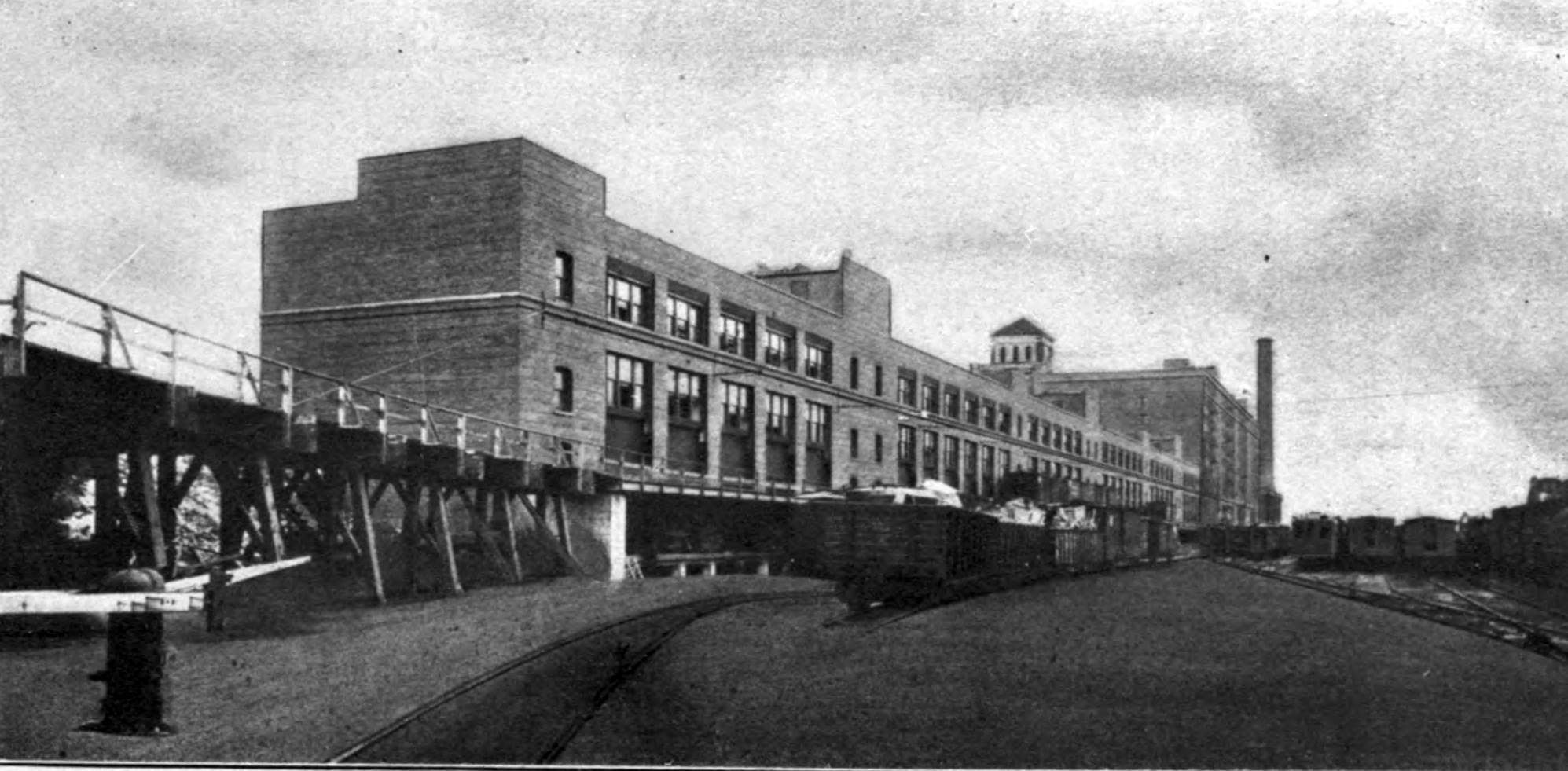
- Merchandise Building
From the Southwest
The labor agitator had to get in his work, too. When they were digging the caissons a job in the heart of the city\ was paying five cents an hour more than the union rate, and a delegation of agitators demanded that the Sears-Roebuck rate should be raised. This was refused. Four of the leaders, who were the regulation toughs, went through the building and made the others quit. This before it was realized what they were doing. The agitators were driven out of the building, but they adjourned to a neighboring tavern and drank beer for about four days. They were warned that they would have to keep away from the job, as they were intimidating the men who wanted to work. This they refused to do, so they were arrested and fined $100 and costs, which meant 90 days in the Bridewell. And all served their time, as the tavern-keeper had got all their money.
At one time an army of 7,000 artisans and laborers were at work on these buildings. This army has vanished. It is succeeded by an army of gay young women and serious faced young men but they belong to the quartermaster’s department.
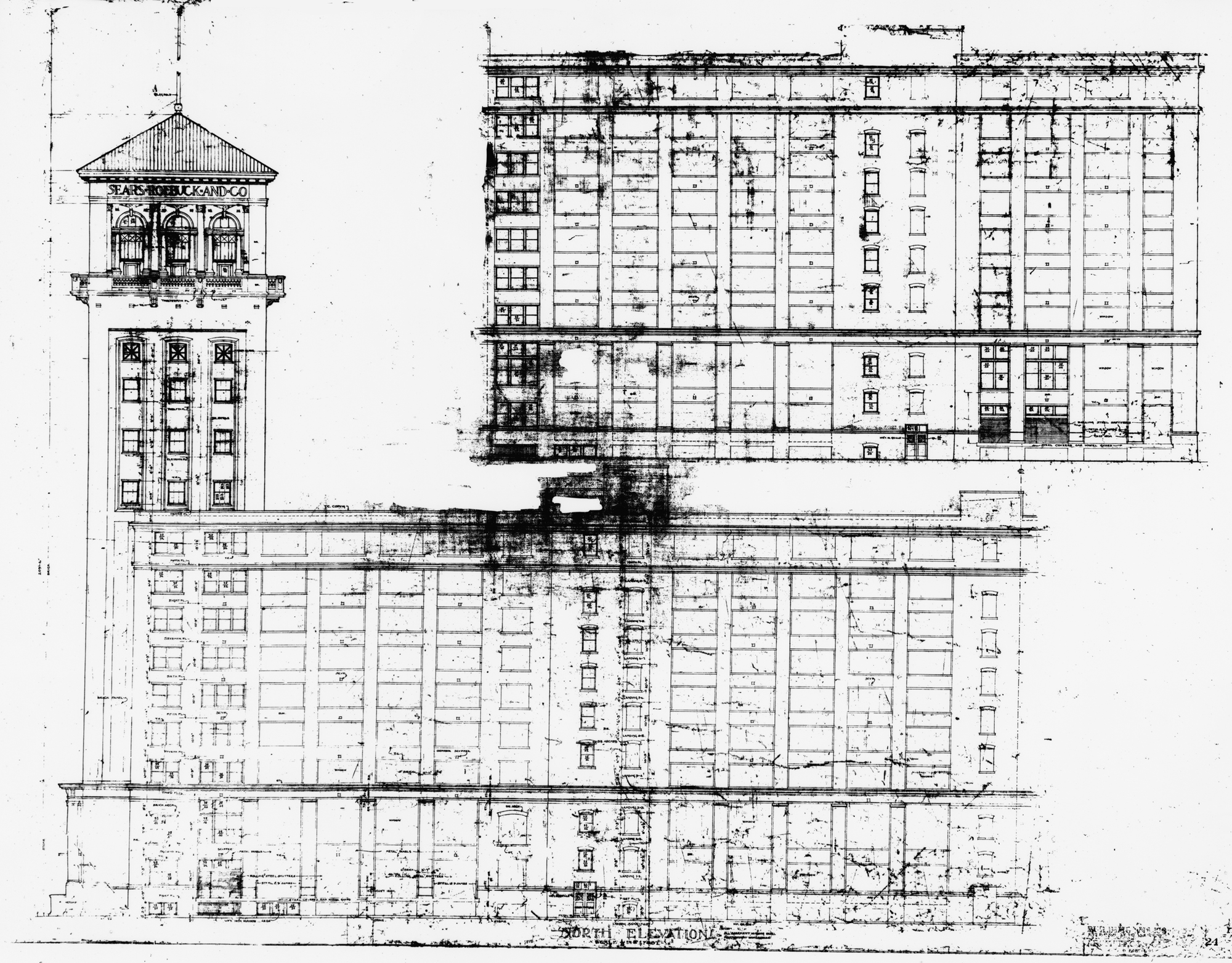
- North Elevation
Merchandise Building
February, 1904
Architectural Record, Volume XIX, Number 6, June, 1906
Designing a Great Mercantile Plant
By Nimmons and Fellows
Commerce as symbolized by sculptors and painters has usually been represented by some beautiful figure intended to inspire the admiration of the people.
The modern philosophers and critics, however, are busy- with their pens deploring the present tendency to an “all absorbing commercialism,” as if nothing were left either good or honorable in the pursuits of commerce. The strenuous business life, the graft and grind of our large cities, are subjects so well worn by recent writers that it seems as though the beautiful figure of the artist’s commerce were no longer appropriate to the subject.
Yet in spite of the modern philosopher and critic, there is much to inspire the architect to his best efforts in the problem of a great commercial building. First of all, the architect knows that the successful merchant has for the very basic principle of his business, fair dealing with the customer. He also knows that the great masses of the people are indebted to the merchant for their abundant supply of the necessities of life, and also for all those agencies of education and culture which have been placed within their easy reach.
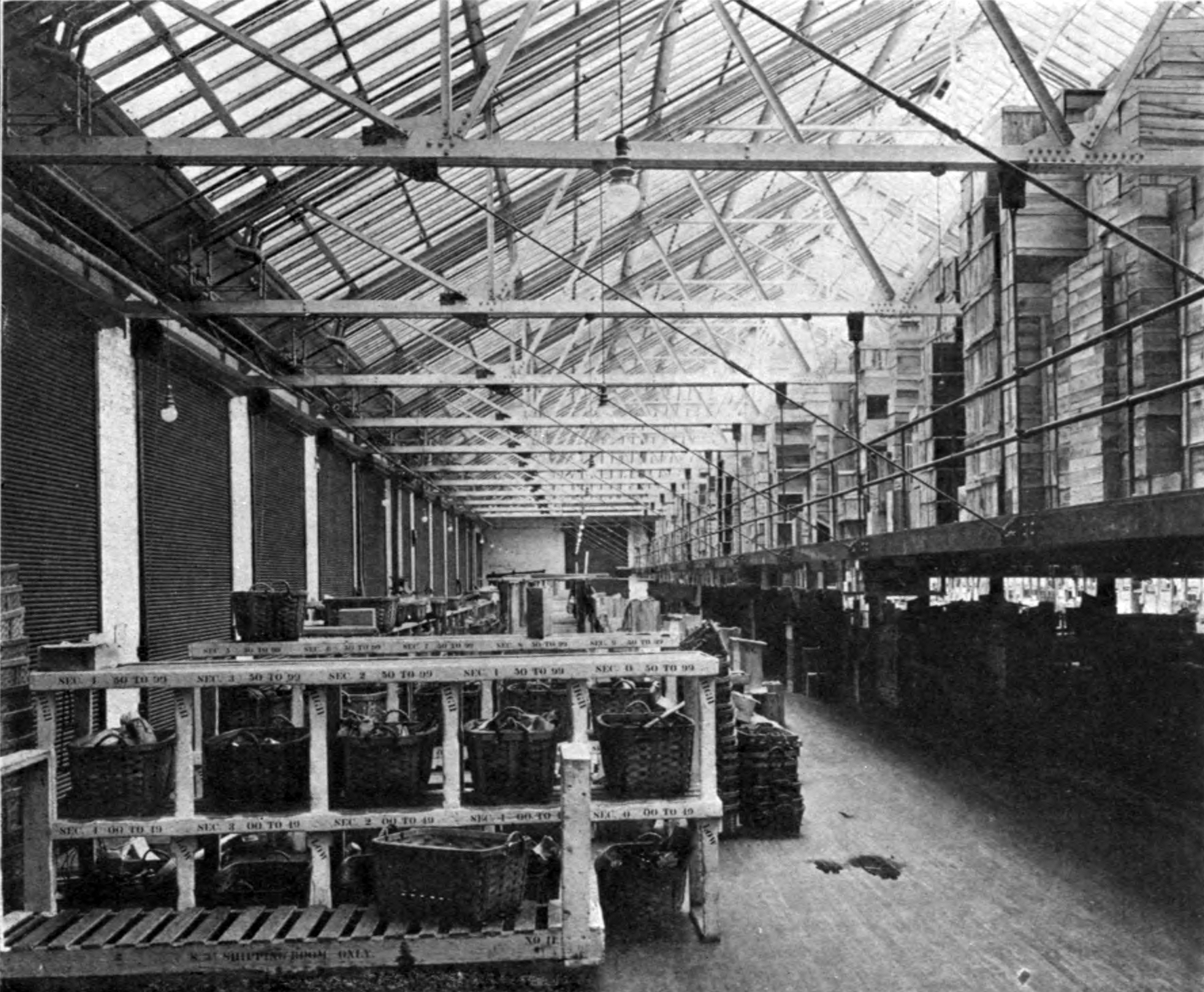
- Court of the Merchandise Building, Where the Shipping is Done.
The merchant in his dealings with his own people, the employees, is now doing more for them than ever was done before. The short working hours, the high scale of wages, the perfect arrangement and equipment of the buildings for the health, comfort and happiness of the employees, and the means provided even for their moral and mental development, are surely evidences of good faith in the aim of the merchant to improve the condition of his own working people.
The modern commercial building is no longer merely a warehouse with\ shelves to hold goods ; it is a great deal more, and in some instances presents all the problems of a small city.
Of the large, successful commercial houses, there are few which have grown to such a great size in so short a time as Sears, Roebuck & Company.
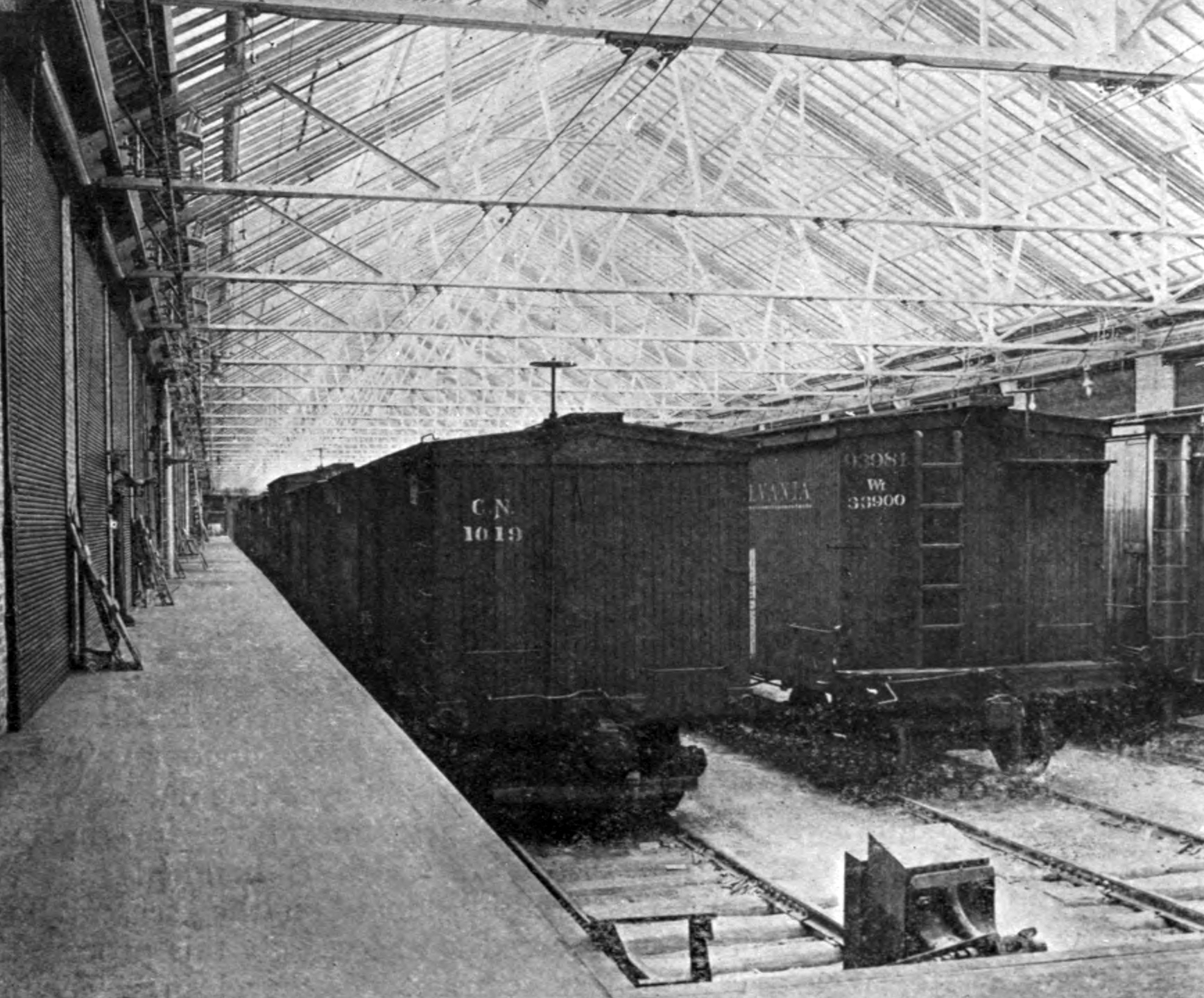
- Freight Railroad Depot, Between the Annexes of the Merchandise Building.
The firm was established ten years ago, and now sells sixty million dollars’ worth of goods a year.
Their new buildings occupy a good part of a site one-half mile long by seven hundred feet wide, with a total floor area of fifty acres, and cost, together with the mechanical equipment, five million six hundred thousand dollars.
The arrangement of their buildings and parts of their buildings, so as to secure the most economical handling of goods over these large areas, the provision for the best and most rapid shipping facilities, the care of employees, security from fire and injury in panics, were all questions given a great deal of consideration in designing the buildings.
In the consideration of this problem, it naturally divides itself into three groups of buildings, classified in accordance with the three divisions of the business:
- First: All orders are received by reason of advertising matter sent out in the form of a catalogue ; hence, the Advertising and Printing Departments.
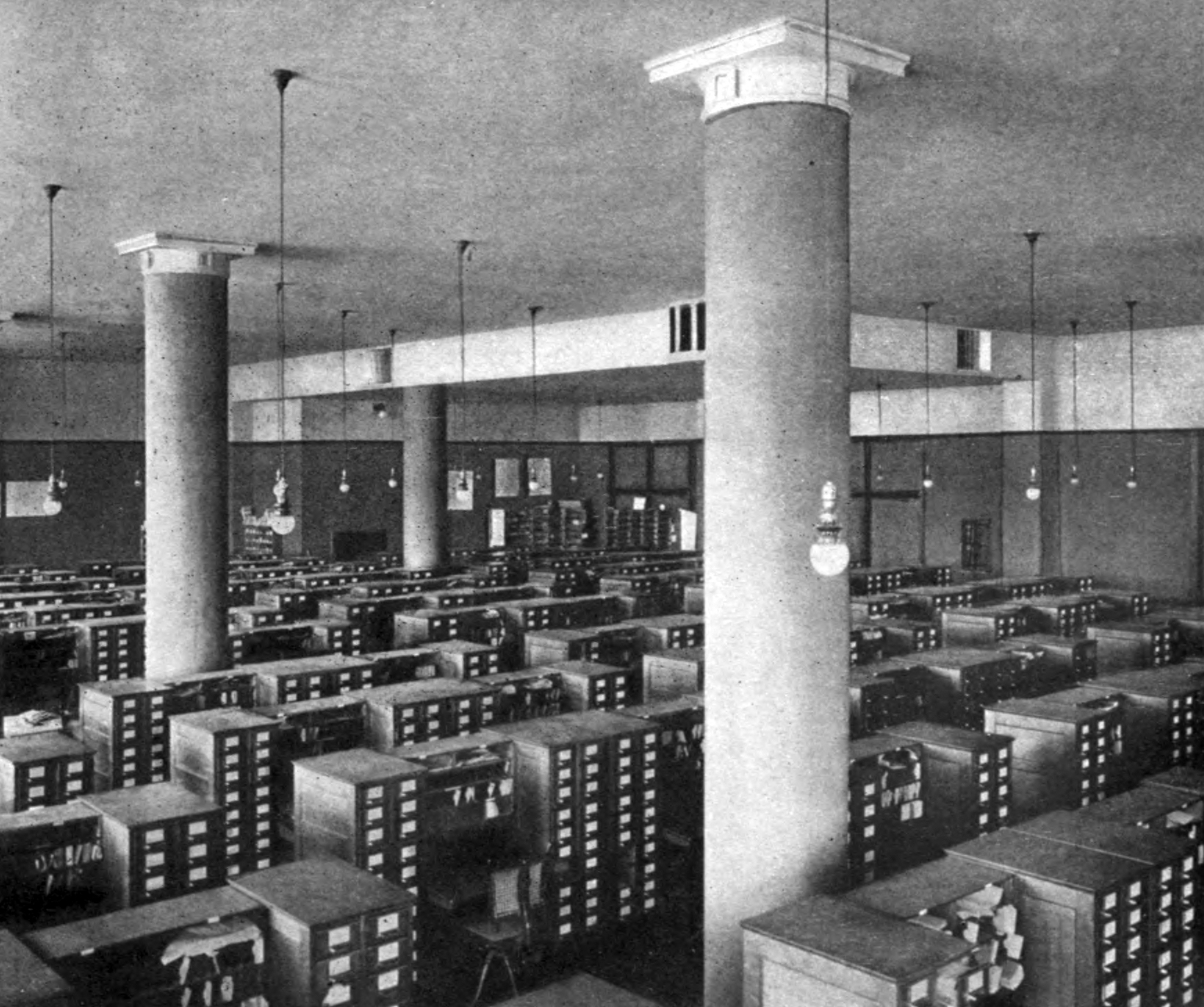
Second: The life of the business is dependent on an elaborate system of files and indexes, giving the name, address, and purchases of every customer, revised to date. As the loss of these files would result in a suspension of the business, this group occupies a building of the highest type of fireproof construction: The Administration Building. In this building are also housed all executive and administrative departments whose access to these records is desirable.
Third: The Merchandise Department, in which are stored all of the goods, implements and products imaginable, or to be desired. These are divided into some fifty-six different departments, each in charge of a manager and numerous assistants. In this Merchandise Building and its Annexes are received, stored and shipped goods in value amounting to more than sixty million dollars a year.
Independent of these divisions is the Power Plant and mechanical equipment. This mechanical installation was in charge of Martin C. Schwab, Consulting Engineer of Baltimore, and deserves a separate descriptive article. Power is developed here for heat, light, elevators, pneumatic tubes, refrigerators, ventilation, and for the numerous mechanical contrivances devised to facilitate the transaction of business.
The capacity of the boilers is six thousand horse-power.
E. C. & R. M. Shankland were the engineers engaged in the structural engineering.
Thompson, Starrett Co., of New York, were the builders.
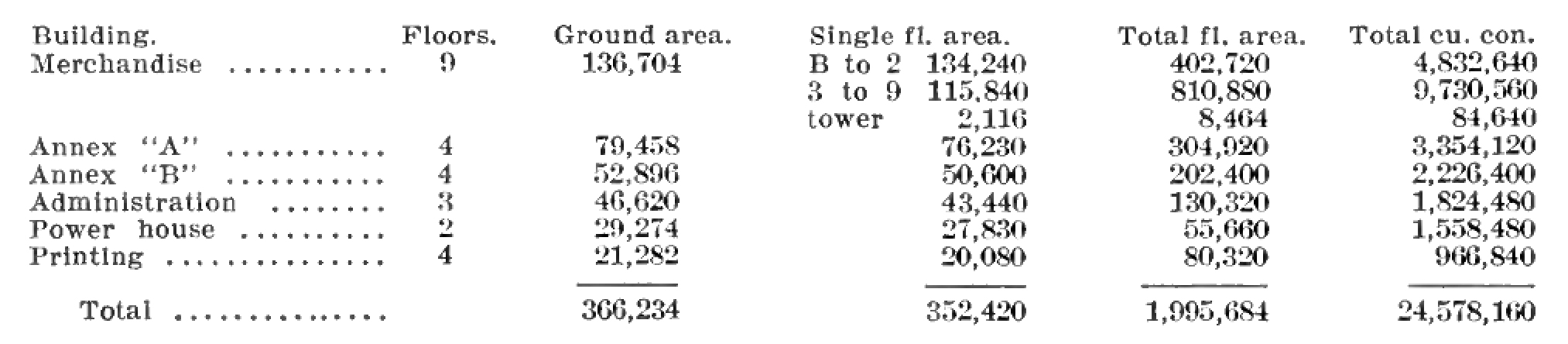
The following table gives the areas, floor space, and cubic contents, showing the relative size and importance of the buildings composing this group, and the block plan shows the final arrangement of the buildings:
An idea of the uses and design of the buildings can possibly be given best with a description of how orders for goods are filled.
All goods are sold through the medium of a large catalogue, which is sent to the prospective customer on application. The orders for goods are sent to the firm by mail; hence the name “Mail Order House.” The mail, amounting to about two carloads per day, is delivered to the building called “The Administration Building,” which is a fireproof building 450 feet long and over 140 feet wide. In this building are located the executive offices and the clerical force of about 2,000 people in all.
After the mail is opened, the orders are carefully recorded, and tickets made out for the goods, a separate ticket being made out for each department from which goods are to be taken. A single order may call for from one to twenty different articles. These tickets are sent next to the routing department, which determines whether the goods are to be shipped by mail, express or freight, and the kind of shipment is indicated on the tickets as well as the roads over which it is to be shipped. The tickets are then sent to the distribution department, from whence they are dispatched by pneumatic tubes to the various departments in the large Merchandise Building across the street.
The Merchandise Building is 1,100 feet long by 340 feet wide, half of which has nine stories and a basement. The great problem about the planning of the Merchandise Building was to adapt a plan best suited for handling goods over this immense area, and at the same time one which would have the best light at the second story, as the second story is a continuous expanse of floor over the entire ground area. This is the great shipping room floor where all goods are collected, packed and shipped; the railroad tracks being elevated, enter the building at this level.
The plan adopted for the main part of the building was a hollow square with a court in the center, 230 feet by 80 feet. To the rear of the main part of this building are arranged two wings, called “Annexes,” which are 60 feet apart, and between which is located the large railroad depot, where it is expected to handle as high as two hundred freight cars per day by means of electric engines. With the tickets or orders then delivered to the departments of this building from the Administration Building, by way of pneumatic tubes, the process of collecting the goods to fill each order goes on. The smaller goods are all located above the second floor, and the heavy goods on the second floor, or below that. Each department receives the orders or tickets, and all those above the second floor collect them in baskets, which are immediately taken by light trucks to spiral chutes located conveniently to all departments. These chutes are of steel about eight feet in diameter, with three spiral planes in each one, and three openings to each chute in each story. The baskets containing the goods are put in one of these three openings, according to whether they go by freight, express or mail. This process is very rapid, and goods are disposed of about as fast as if they were thrown out of the window. The centrifugal force in the chute causes friction against the sides, so as to regulate the speed of the heavy and light baskets in descending to the second story; even glass ware will go down without breakage.
- The Index Department.
When the baskets arrive at the bottom of the chutes, they slide out on horizontal traveling conveyors, which run all around four sides of the large court in the center of the building, and convey goods to the mail, express or freight shipping departments, there being a separate spiral plane for mail, express or freight in each chute, which is connected at the bottom with the corresponding traveling conveyor. The goods are thereby delivered automatically to the proper shipping room, as designated by the routing department on the tickets. The mail shipping room is comparatively small in area, being about twelve thousand square feet, the express about twenty-five thousand, and the freight about two hundred thousand square feet.
As the baskets containing the goods are received on a large receiving table in each shipping room from the conveyors, they are taken to rows of shelves divided into sections, where a separate basket is reserved for each order. As soon as a basket has received the last article to complete the order, the goods are checked, boxed and marked ready for shipment. In the large freight department the shelves for temporarily holding goods, while orders are being completed, are arranged around the court, so that the packing, checking and marking of packages all take place in the court under excellent overhead light; empty boxes are brought in overhead at the center of the court by a traveling conveyor. In the operation of packing the freight goods, they are worked backwards through the court during the operation, so that when completed they are near the head of the large freight depot.
- Entrances to the Merchandise & Administration Buildings.
The heavy goods, too large to be boxed, are assembled in freight pits, according to their destination, and moved from these directly into cars. The goods stored below the second story of the Annex Buildings are carried upward by means of inclined traveling conveyors. In addition to the spiral chutes and conveyors, large freight elevators are provided so that every department has access to at least one freight elevator.
There are two sets of railway switches installed, one for incoming freight on the south side of the building and one at the first floor level for the outgoing freight, which is handled in the large freight depot on the second floor, referred to above. By this process there’s no conflict of travel in receiving and shipping, and all goods are shipped within twenty-four hours after the orders are received. Some days the orders number as high as forty thousand, calling for one to twenty articles in each order.
The Merchandise Building, excepting the tower, is of mill construction, with floors six inches thick of solid wood. The amount of lumber usually put in floor joist is added to the thickness of the ordinary mill flooring, making the floors strong enough to span from one girder to the other without the need of joists. This gives additional head room and a smooth ceiling in each story, also a better opportunity for sprinkler heads to put out a fire. Fire-walls are built so as to divide the entire building into sections of twelve thousand feet. In the walls surrounding the court on the second floor, large openings provided with double steel shutters were accepted by the Insurance Underwriters, so that it is possible to have an almost uninterrupted space for the shipping room floor. Stairways, elevators, heating and ventilating ducts, dust chutes and wire shafts are all surrounded by brick walls with steel doors.
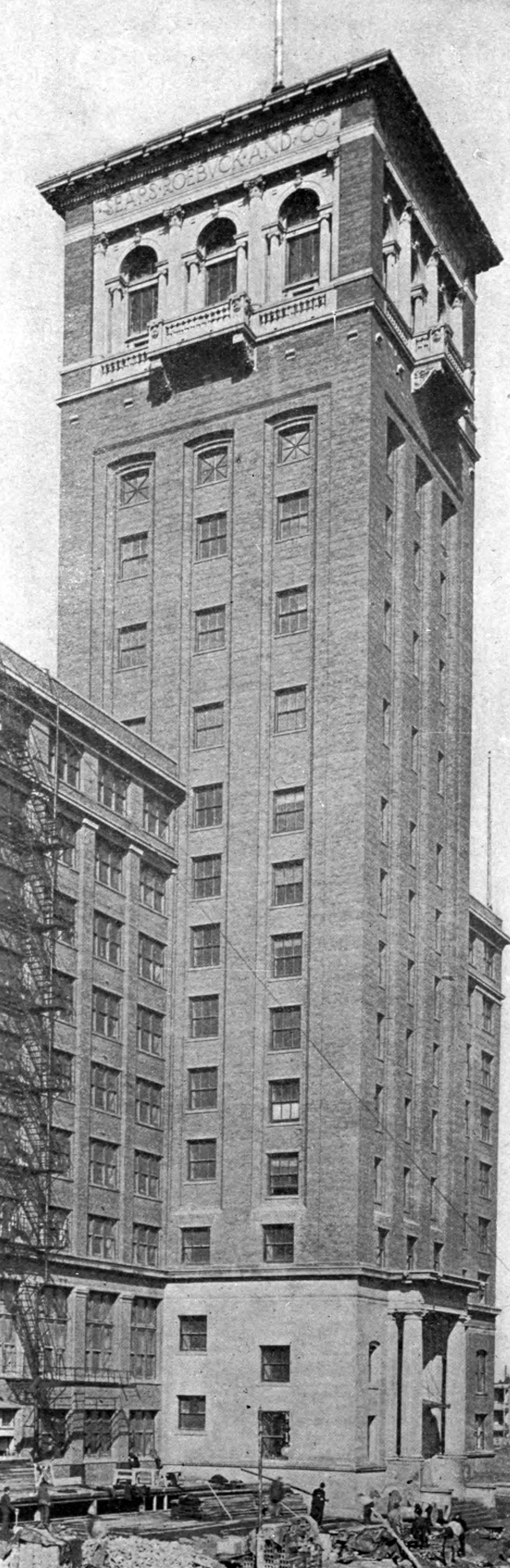
The tower, fifty feet square and two hundred and forty feet high, is built entirely of fireproof construction, and contains the sprinkler tanks and house tanks for water supply for the entire plant. The total capacity of the tanks is 200,000- gallons. At first the Insurance Underwriters advised placing separate tanks on the roofs of the various sections and buildings throughout the plant, but were finally .prevailed upon to allow the placing of all water supply together in the tower, provided it was made strictly fireproof. The water mains from the tanks are laid in the tunnels under the buildings.
The insurance rate finally fixed for the buildings and stock is the lowest ever given to a risk of this character.
The Printing Building located east of the Administration Building is devoted entirely to the printing of the catalogues. There are 2,000,000 catalogues printed and sent to the customers annually.
Nineteen large cylinder presses are employed to do the work. The binding and mailing of the catalogues is also done in this building.
After nearly a year spent in preliminary study and in the consideration of various sites with regard to the shipping\ facilities, space for additional buildings, extension of business and accessibility for employees, the present site was adopted. To make this site available for use, it was necessary to close a street to get space sufficient for the Merchandise Department. This gave a solid space 340 feet wide by 1,250 feet long.
The nature of the business is such that everything must be handled through one\ shipping room or endless complication results. Consequently, from numerous schemes the present scheme developed, giving two general divisions, the Merchandise Building and Annexes.
In the Merchandise Building is placed all of the small merchandise which goes through the shipping room. In the Annexes are housed the large or bulky articles which are shipped separately, or goods such as groceries, which are shipped in original packages.
The future elevation of all railroad tracks to do away with grade crossings was considered. This made it necessary to provide for present usage at grade level and for an elevation of thirteen feet in the near future. To solve this the receiving room was placed on present grade and the shipping room on second floor on future elevated grade. This scheme provides for the receiving of all goods on the first floor, whence they are trucked to the elevators located in the outside walls of the building, and thence to the different stock departments. The shelves of these departments are so arranged that the goods are received at the outside and are delivered toward the court in shipping where they go to the shipping room in the second floor by means of spiral conveyors. Thus the incoming merchandise never crosses or interrupts the progress of that going out.
After the general arrangement of the buildings was determined and the type of construction was fixed, it was discovered that the most important feature the foundations presented a large and puzzling problem. Numerous borings were made, and it was found that the nature of the soil was such that spread foundations were impractical. Again, the datum line was so far below the basement level that wood piles could not be considered. Concrete piles proved impractical on account of the difficulty of driving them in the clay. Finally it was decided to use concrete caissons, deep enough to reach a hard strata of clay and belled out at the bottom to sufficiently spread the load.
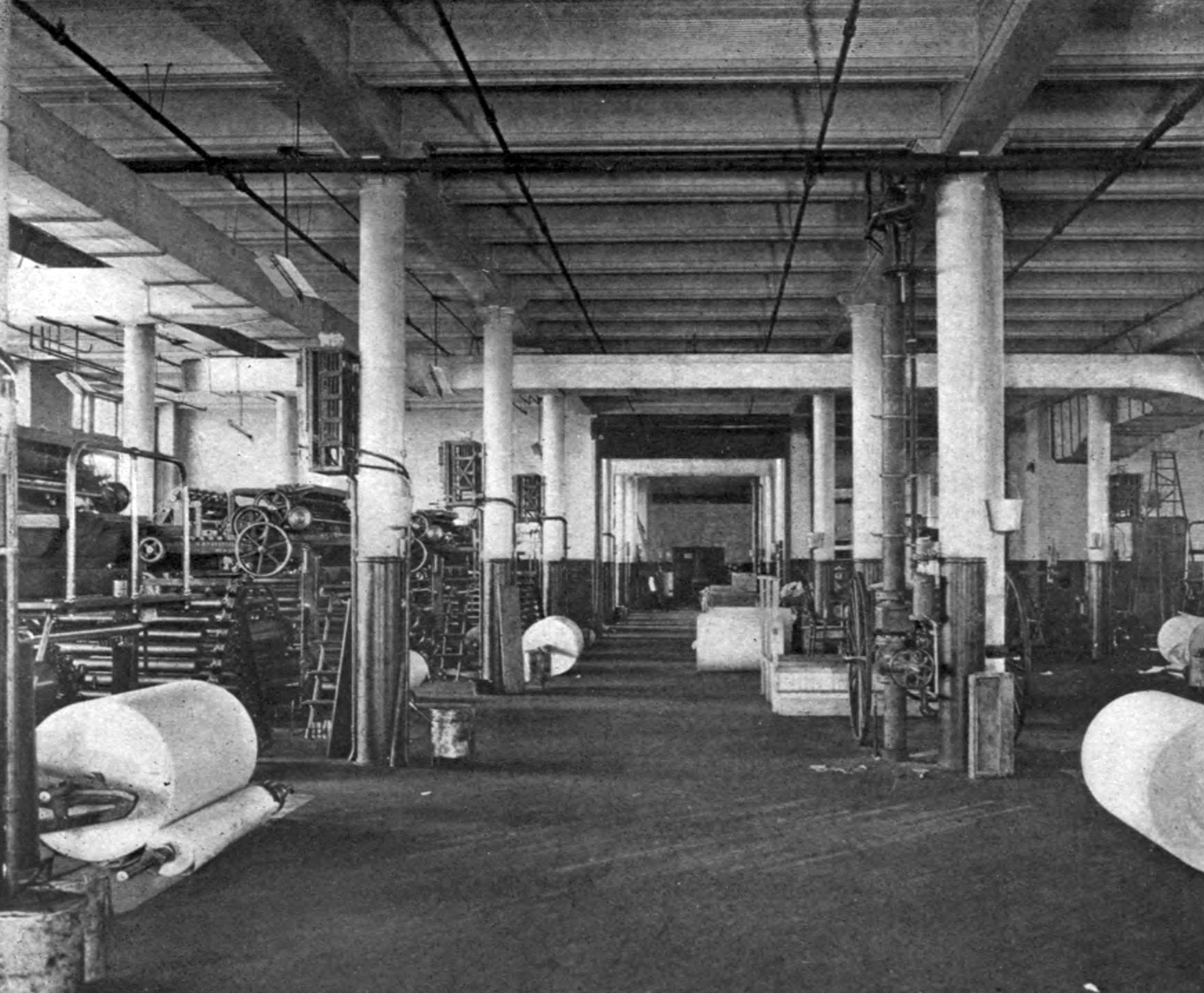
- The Printery.
In the structure of these buildings the architects strove to obtain the highest type of efficiency consistent with absolute economy of space and money. The composition was made subservient to structural requirements and such structural features developed to provide a pleasing composition. Space well lighted, ventilated and with the most approved arrangements for the storage of goods and the comfort of employees was the requirement. This with perfect communication between departments and the best systems for handling merchandise of all kinds, and with ample protection against risk by fire.
The floors are constructed of five by eight yellow pine flooring, laid with splines and spanning fourteen feet between girders, without joists. The top of each floor is protected by saturated roofing felt and with a maple floor; these floors being so arranged that water in case of fire will be drained to scuppers in the outside wall or pass down the stairs and elevator shafts. Wire glass and metal frames are used in all exposed windows, including the entire court and skylight.
All openings in fire walls are protected by double fire doors, including vent ducts, dust and wire shafts and heating ducts; in fact everything possible has been done to ensure the safety of the building and comfort of the employees.
The site of the building is in the midst of a residence district ; therefore, the appearance of the buildings would have a great effect upon the neighboring property.
Sears, Roebuck & Company are as much interested as is anyone in maintaining the character of the neighborhood. It will ultimately become the place of residence of their employees, and they are keenly alive to the effect of pleasant surroundings upon the moral and physical well-being of the people who work for them. They decided that within reasonable limits they would be willing to spend money to make the buildings appear attractive. A rich, brown paving brick was selected for all exterior brickwork, and terra cotta was decided to be the most suitable and durable material for trimmings.
Given the material at hand for construction and the structural features for decoration, the brick and terra cotta architecture of Tuscany naturally suggested itself as appropriate with such restrained use of brick patterns and terra cotta decoration as would be consistent. Furthermore, the use of terra cotta decoration suggested the addition of color for backgrounds to accent such decoration. Consequently, the lunettes and frieze of the Merchandise Tower are of glazed blue terra cotta; also the backgrounds of the book marks which decorate the Printing Building and the discs of the Power House are of white and blue glazed terra cotta.
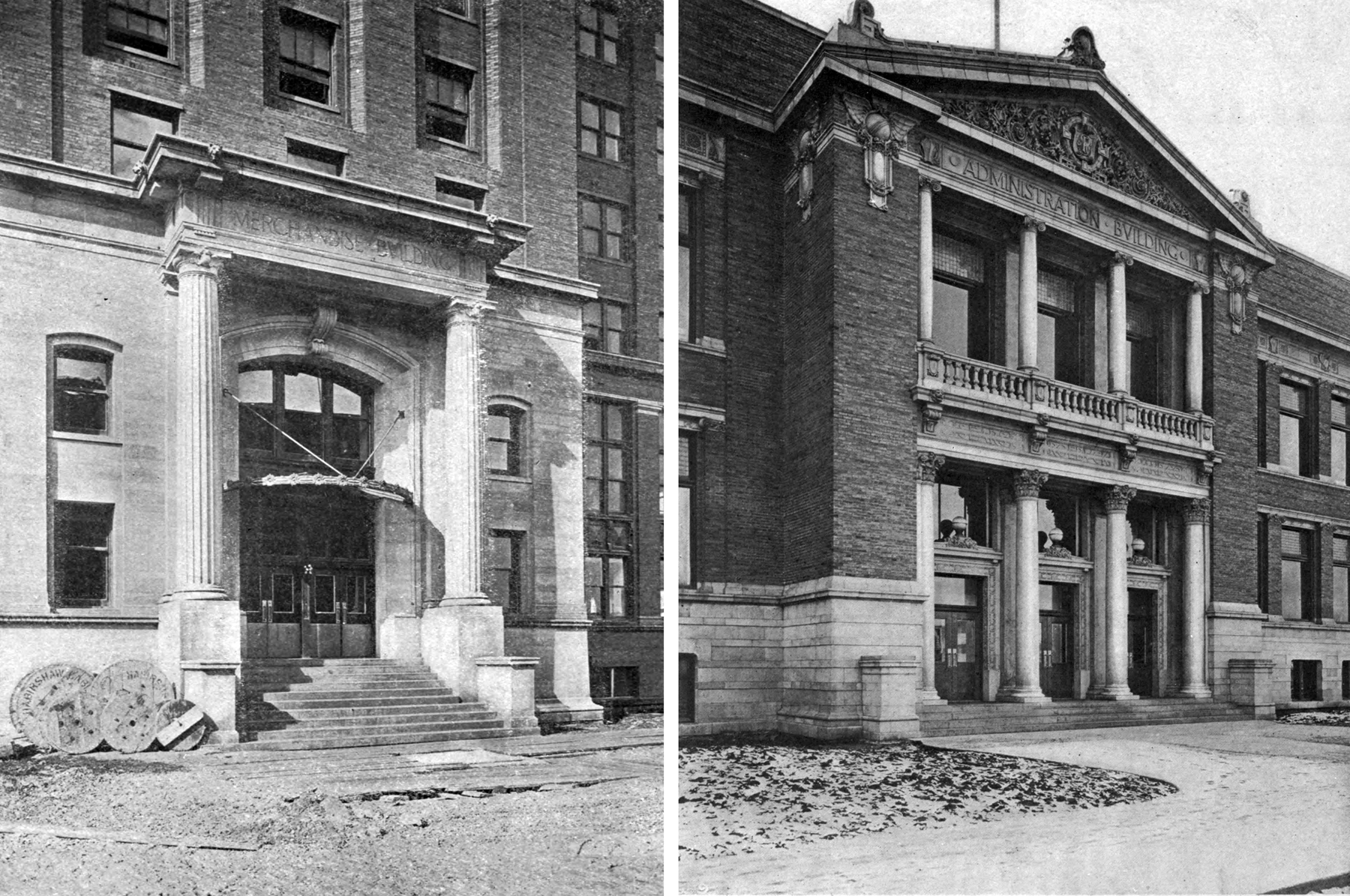
The frieze of the Administration Building is developed but not copied from the scheme of marble inlay of San Miniato at Florence, and blue is introduced in the backgrounds to bring out the geometric motif of the design. Decorated mouldings were avoided on account of expense and the ornamentation was so concentrated as to obtain the greatest value possible. The sills and lintels were necessarily of terra cotta, used as a fireproof covering for the steel, and these are made the chief features in the decoration; consequently, the horizontal lines are emphasized. The only place where an elaborate treatment in composition was permitted were the top of the tower and its entrance and the main entrance and vestibule of the Administration Building. When one considers that some seventy-five hundred employees pass through these entrances many times each day, the money spent to make them attractive is well invested.
Printers’ Ink, April 18, 1906
A GREAT MAIL-ORDER PLANT.
On January 1 the Chicago mail-order house of Sears, Roebuck & Co. have completed the work of moving its departments to the new plant that has been built for it on the West Side of Chicago, about five miles from the business district, on a forty-acre tract bounded by Kedzie avenue on the east and Harvard street on the north. This plant consists of four separate buildings, and is bounded by wide borders, drives, etc.. that are to be worked out in a scheme of landscape gardening summer, with a park and playground on the east, so that the whole resembles an exposition rather than an industrial establishment. Probably nothing so vividly expresses the importance of the general merchandise mail-order trade as some of the figures and dimensions of this establishment. These are not altogether mere statistics of bigness.
The object of moving such an establishment away from the business district was to secure shipping facilities. Downtown all merchandise received was hauled by teams to the company’s buildings, and all outgoing consignments hauled back again to the freight depots. In the new plant not a team is used. A belt railroad, distributing freight to every railroad entering Chicago, touches the plant. A complete system of rail. road tracks ramifies through the buildings, and is supplemented by underground tunnels which also carry steam and water pipes, electrical conduits. etc. Incoming freight is switched direct to the merchandise buildings. One of these has a freight annex into which a railroad train of sixty freight cars can be switched. The doors are then shut, the whole put under steam heat, and freight handlers work in their shirtsleeves. Every night the freight cars loaded with the day’s shipments are switched out and start on their travels to every State in the Union. Teamsters’ strikes, therefore, do not terrify the company.
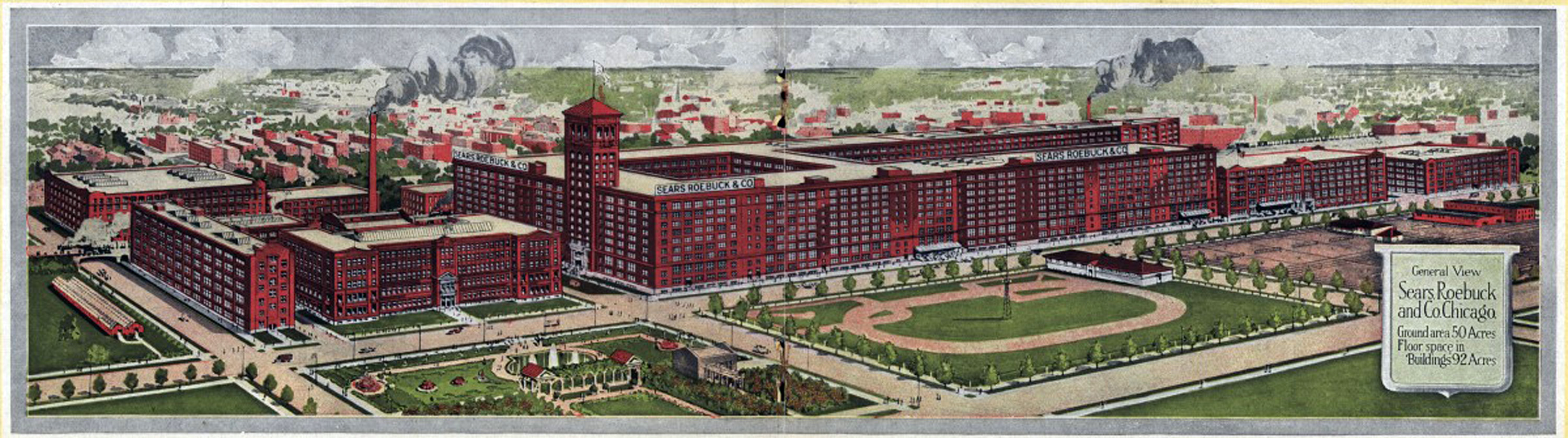
The plant consists of four buildings. The largest of these is the Merchandise Building, called “the works,” where all goods are received, kept and shipped. It is a block wide and a quarter-mile long. Its height at present is nine stories, but all the buildings hare been designed with a view to adding stories as needed. Railroad tracks run through and around it, and inside there are conveyors, chutes, moving sidewalks. pneumatic tubes, etc., for handling everything from a postal to a steel safe. The express companies, railroads, telegraph companies and postoffice all have branches in it. The Administration Building, 450x 80 feet, three stories, holds all the executive and clerical offices. In it 2,000 people are employed opening the mails, entering orders, answering correspondence, etc. In its basement is a restaurant for employees. The third building is devoted to printing and advertising, and the fourth is the power plane, second largest in Chicago, only that of the Edison Company being larger.
The Merchandise Building has a loading capacity of 200 freight cars daily. Its freight tracks outside are so arranged that cars are not only received on the ground story, but a chute permits a second string to be switched opposite the basement floor, and an elevated structure takes a third string at the second story. Around an enormous four-track train shed inside, covered with a glass roof. are grouped the packing and shipping rooms. That for freight occupies 200,000 square feet. another for express 25,000 feet, and a third for mail 12,000 feet. Automatic conveyors, spiral chutes, etc., lead to these rooms from every department. As soon as a customer’s order has been assembled it is put in a basket and goes whirling down to the packers. Heavy stock is kept on the lower floors and in annex buildings. Light stock is stored above. More than $6,000,000 worth of merchandise is carried in this structure. It is also used for manufacturing. The entire ninth floor is devoted to men’s clothing, and two clothing factories there produce practically all that is sold by the concern in certain lines—a ready-made factory and a tailoring establishment. The Merchandise Building has a square tower 240 feet high, used as an observatory for customers visiting the plant, and also as the container of three water tanks holding 225,000 gallons. This water is pumped from artesian wells, and supplies a system of faucets, fire sprinklers, etc. In the tower, too, is the company’s educational department. Employees submit to a regular civil service examination before they are engaged, and when they enter the service are put through another examination that determines the character of work each man or woman is best able to handle. Every new employee assigned to the detail and clerical departments is given a preliminary course of instruction in school-rooms in the tower, so that a girl sent to the mail or billing section is skilled in the work she is to do there, and no time is lost in instructing her when she begins active service. Employees are paid regular wages while attending these schools. More than 900 sacks of mail go out of the mailing department daily, and all shipments are assembled by a system of numbers. Every consignment made up to fill an order must go out on the stroke of a bell on the day the order is received. From this building ramifies a complicated system of railroad yards with miles of the company’s own track, equipped with its own engines and manned by its own yard crews. The latter insure low cost of handling and promptness.
In the Administration Building, which is notable for its beautiful exterior design and proportions, not a window can be opened The whole is equipped with a system of ventilation whereby warm air is supplied to every room in winter, and in summer air that is washed by being passed through sprays of iced water. Foul air is pumped out. More than 2,000 girls are employed here opening the mails, writing bills, etc., and the moment an order is copied it goes through a pneumatic tube to the Merchandise Building. One of the stock jokes of the business is the query of customers, “Does Mr. Sears open the mail himself?” In a general way it may be said that he does not. This work is performed by several hundred of his hand-maidens, assisted by one boy. The boy is cynical. He has two machines to help him. One of these takes a basketful of letters and growls “B-r-r-r-r-r-r!” The basketful is dated; this machine dates 500 postals or letters a minute. The boy gathers them up, squares them and applies the tops to the maw of his other machine, which says “Z-z-z-z-z-z!” The mail is then technically opened. The 90,000 letters and postals daily go to the girls, who take out of them $200,000 every ten hours. There are 8,000 to 12,000 postoffice money orders, 1,500 to 2,500 express money orders and a sprinkling of the new orders of the American Bankers’ Association. Ten banks in Chicago, New York, St. Louis, Philadelphia, Kansas City and other points are used as depositories. The gross business of the company last year was $38,407,498 and forty-one cents over. This year it will reach fifty millions. In the catalogue is printed an affidavit certifying to the annual turnover, and $10,000 will be given to a charity upon proof than any five other general merchandise mail-order houses combined do as large a business.
A Yankee visiting London once told a curious Englishman that the largest restaurant in Chicago was so very large indeed that the waiters brought in your order on horseback. The Sears-Roebuck restaurant in the basement of this Administration Building has not installed an equipment of this sort as yet, but is said to be the largest in Chicago. At eleven a. m. the employees begin eating lunch, and go in relays until one o’clock 7,000 out of the 7,500 being fed. There are really several restaurants. In one that corresponds to the dining-room of a great hotel there is a service of colored waiters, and the executives, department heads, etc., get an excellent meal for fifty cents to a dollar. In another, precisely the same food is served at tables to employees for cost price. A pot-roast with vegetables costs eight cents, coffee or milk two cents, pork and beans, a hot sandwich, or two cold ones, five cents. At a lunch counter still a cheaper meal may be had. Many of the employees also eat breakfast and dinner in the restaurant, and it is said the cost for a week’s ample board for one person can be kept down to $3. The company sells its employees clothes at a discount from catalogue prices, receives their money in a savings bank at five percent interest, and if anyone falls sick there are physicians and nurses on the premises to look after them. Bath-rooms are maintained in connection with the restaurants, and each day before going to work every cook, waiter, helper and waitress is required to bathe and don clean clothing. No employee is permitted to drink in a saloon within eight blocks of the plant. This regulation was established by a vote of the employees themselves, and keeps saloons at a distance. The Administration Building is also remarkable for the manner in which the architect has let daylight into every corner. The use of electrics is exceptional.
In the Printing Building the company now turns out its own catalogue. Formerly this work was given out on contract. Fourteen Cottrell rotaries are run day and night on the great book itself, with supplementary catalogues, and the printing department, one of the largest plants of its kind in the country, uses up two carloads of paper daily. About 15,000 copies of the big catalogues are printed a day to supply the annual demand for 5,000,000. The thirty-five folios are assembled, covers put on by a magazine binding machine, and a special cutter trims the books one edge at a time, singly, though four catalogues are put into it at once. The Printing Building is 25×90 feet, four stories high, and turns out all stationery, forms, etc., used in the business. The advertising department is also located in this build-ing. More than 400 people are employed within its walls. A present capacity of 30,000 catalogues daily is available if needed. More than 250,000 running miles of print paper go through the presses yearly for the big catalogue alone. All the work of addressing and mailing advertising matter is carried on here, too. The daily postage bill is over $5,000.
In the Power House is an installation equivalent to 12,000 horse-power, furnishing light, heat, ventilation, water, current for motors, elevators, carriers, conveyors, etc. Automatic stokers feed the boilers 250 tons of coal daily. Artificial ice is made, there is a complete firefighting installation throughout the buildings, and a specially designed crane capable of lifting twenty-five tons is used for the heavy work of the plant. The building has been beautifully fitted up with tiles, etc., and is one of the show places.
This great plant represents the present development of a business that began hardly eleven years ago in 1895. The beginning was small. Every other advertising solicitor in Chicago has his own recollection of R. W. Sears, president of the company, in the days when he occupied a single room in an office building, advertising and selling watches by mail. They remember that he always gave a dollar’s worth of watch for every dollar received, and a square deal Hard times killed the watch trade, and with a view to selling something people had to have instead of a luxury he went into the general merchandise field. Fair-dealing, advertising and aggressiveness seem to be the chief elements that have entered into the building of the business. Mr. Sears is a native of Minnesota, a quiet man, dividing his time between his business and home. Occasional fishing and hunting trips, with motoring, form his recreation. He is not prominent in the public or social life of Chicago. Around him have been gathered men of pretty much his own sort, young, aggressive and capable of working out the prodigious detail of a business chat has grown steadily out of its clothes since the day it was started. The company is incorporated, but has only $5,000,000 capital. Its plant cost in the neighborhood of $6,000,000, but has been largely paid for out of the business itself. The financing of the enterprise rests largely upon Mr. Sears’s right-hand man, J. Rosenwald, vice-president and treasurer, A. H. Loeb is secretary, and E. L. Scott general manager.
In addition to the main plant, the company owns or controls many factories throughout the country where it makes its own merchandise. Besides the clothing factories in the Merchandise Building there is a factory on the grounds for the preparation of paints and oils. There are a vehicle factory in Evansville, Ind., a stove foundry in Newark, U., a shoe factory in Littleton, N. H.. a camera factory in Rochester, N. Y., a saw factory in Southeastern Michigan, a safe plant at Newark. O. cream separator plants Bainbridge. N. Y.. and Central Iowa. a washing-machine factory in Minneapolis, an organ factory at Louisville, an agricultural implement works in Southwestern Wisconsin, an upholstered furniture plant in Chicago, a gun and revolver factory at Meriden, Conn., a wall paper mill in Chicago, a plant for making plumbing supplies in Wisconsin, and others where the company gets its supplies of boys’ clothing cloaks, skirts, waists, electrical apparatus, tents, canvas goods, gun implements, surgical instruments, typewriters, books, jewelry, stereoscopic goods, hardware specialties, mill work, radiators, etc. The vehicle plant turns out 75,000 buggies and carriages yearly. The paint factory has a capacity of 10,000 gallons daily. The output of the stove foundry amounts to $4,000,000 yearly, 60,000 rolls of wall paper are produced daily in the mill. devoted to that line. and everything else is on a similar scale. The keynote of the business is comprehensiveness. Everything is sold, and everything listed in the catalogue.
A curious advertising condition has lately arisen in the business. For ten years the company’s expenditure has been large, and every form of publication has been used to supplement the catalogue and mail publicity. But Mr. Sears now foresees a time in the near future when it will be wise to cut off nearly every form of periodical advertising.
“We have simply outgrown the circulation of mail order journals, farm and religious papers, magazines and similar mediums because long use of them to advertise our catalogue has given the book a wider distribution than any periodicals we can use,” he explained the other day. “What periodical has a circulation of 5,000,000 copies? Yet we put out that many catalogues a year. Every twenty-four hours 12,000 requests for the book come to us, and we are sending nut, at the same time, later editions to people already on the mailing lists. There is no duplication in this circulation. We take every precaution to see that no person gets two copies of the catalogue in the same year. Every name and address to which a copy is sent is filed geographically and every request is compared with this file. When the business was new we advertised the catalogue persistently, but now we do not advertise it at all. Yet we send out nearly 100,000 copies every week. Of the requests that come seventy-five per cent are from people who have an old catalogue. Only twenty-five per cent are new.
“Matters have gone on to a stage where periodical advertising no longer pays us, because there are not enough new prospects left in the country to make advertising profitable. A publisher comes to us and says, ‘I have 25,000 subscribers in the State of Iowa.’ Well, we have 300,000 customers in the State of Iowa, 200,000 of whom have our latest catalogue. There are only 240,000 farmers in Iowa, and we have 300,000 customers who have bought of us in the past year and a half, so it stands to reason we have reached nearly everyone in the State with whom we can possibly do business. These proportions hold for every other State and territory. With five persons to the family we are now in direct touch with 25,000,-000 people. The rural population of the United States is only 35,000,000. We can’t see how to spend any more money profitably in peri-odicals. We believe in them, and recognize that advertising has played an immense part in building up the business, and consider that periodical advertising is necessary to any business. It pays others. But it no longer pays us. The proportion of return is now so small as to make advertising too costly. We have grown beyond the periodicals. Our catalogue tells our story so effectively that no amount of newspaper space could produce the same advertising effect. It is in every home, and we can tell no advertising story in newspaper space that is not told better in the cata-logue. To illustrate; Just lately we spent $15,000 to advertise cream separators, taking full pages in a list of farm papers. The returns didn’t increase our business in that department five per cent. A few years ago it would have increased it fifty per cent. The fault lies not with the mediums employed, but in the fact that every farmer has our catalogue, and there our cream separator story is told fully and well. We got from the creameries in South Dakota not long ago a list of all the dairy farmers on their books. This list of thousands of names was sent to our catalogue record department for the purpose of separating the names of those who were not in possession of the catalogue. More than ninety per cent were customers who had bought of us within a year. We have every consideration for the newspaper and publishing world generally, for it has been kind to us, and our advertising has been profitable. But the business has grown so greatly that, first, there are no more periodicals that can reach new prospects tor us, and, second, as our whole story is told to the length of twelve hundred pages in the catalogue, there is nothing that we can say in periodical advertising.”
Chicago Tribune, February 6, 1910
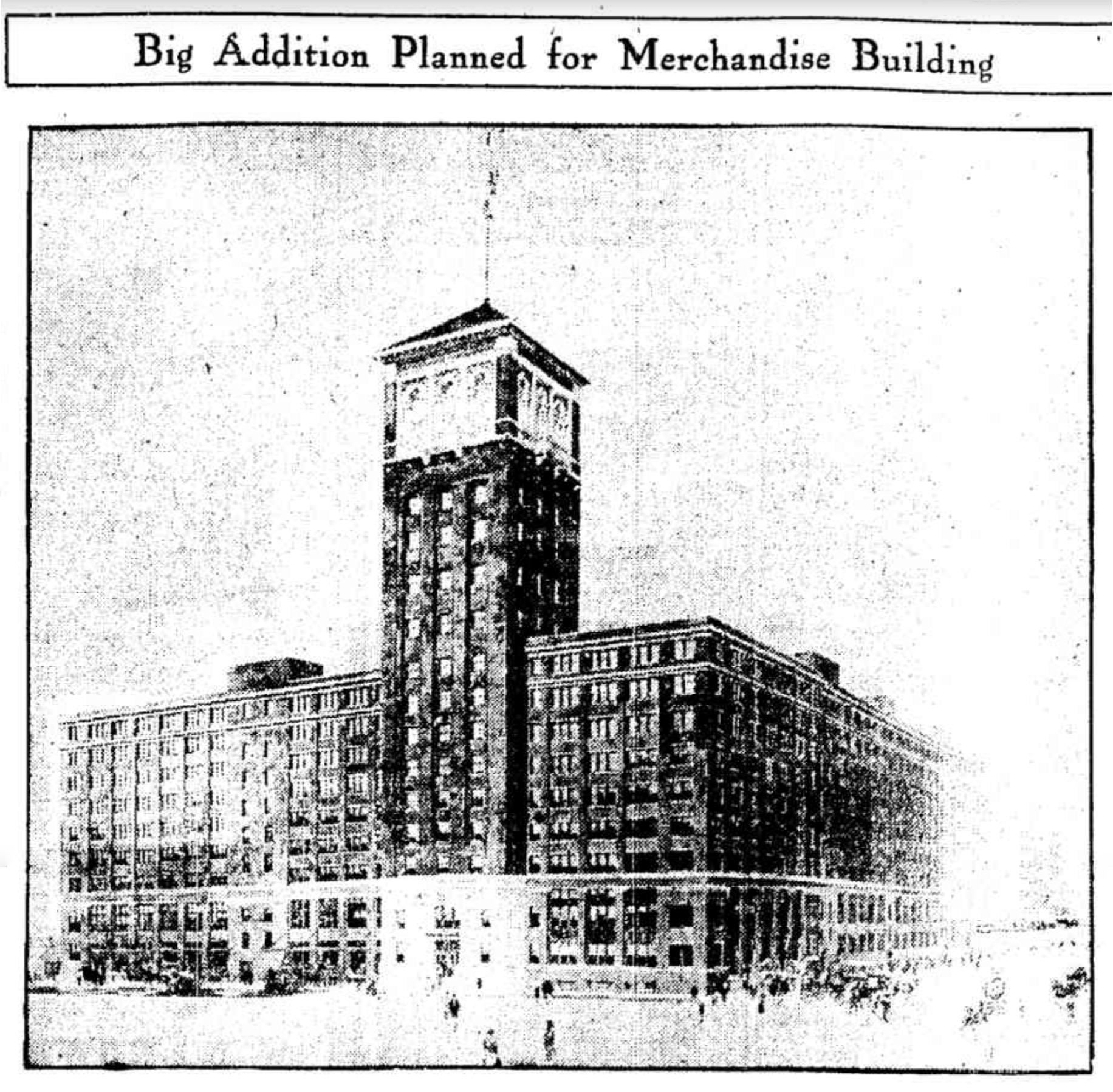
Contracts were let during the week for the addition of six stories to the two annexes to the big merchandise building of Sears, Roebuck & Co., in Harvard street, between Kedzie and Central Park avenues.
This will make the Merchandise Building of the uniform height of nine stories, and the 300,000 additional square feet of floor space to be provided by the additions will give the building a total floor area of 2,000,000 square feet, making it the largest building of its kind in the world.
It will be 1,200 feet in length and over 300 feet deep. The contracts for the additions were led by Architects Nimmons & Fellows, who designed the entire Sears, Roebuck & Co. plant, the five buildings of which cost over $5,000,000. The addition will cost about $400,000 and is expected to be completed about July 1.

History of Construction
1905 Construction
Merchandise Building – basement to ninth floor, Sections A, B, C, D, E, F, G, H, I
Merchandise Building Annex A – basement to third floor Sections J, K, L, M, N, O
Merchandise Building Annex B – basement to third floor Sections P, Q, R, S
1910 Construction
Addition to Annex A – fourth to ninth floors, Sections J, K
Addition to Annex B – fourth to ninth floors. Sections P, Q
1912 Construction
Grocery Building – basement to sixth floor, Sections 11 and 12
Box Factory – partial basement, first and second floors
1913-1916 Construction
Addition to Annex B – fourth to ninth floors. Sections R, S
1917 Construction
Addition to Annex A, fourth to ninth floor Sections L, M, N, O
The first Sears retail store opened in Chicago on February 2, 1925 in the Merchandise building.
1959 Construction
Alteration of entry area facade at first and second floors
SEARS, ROEBUCK & CO., 1915
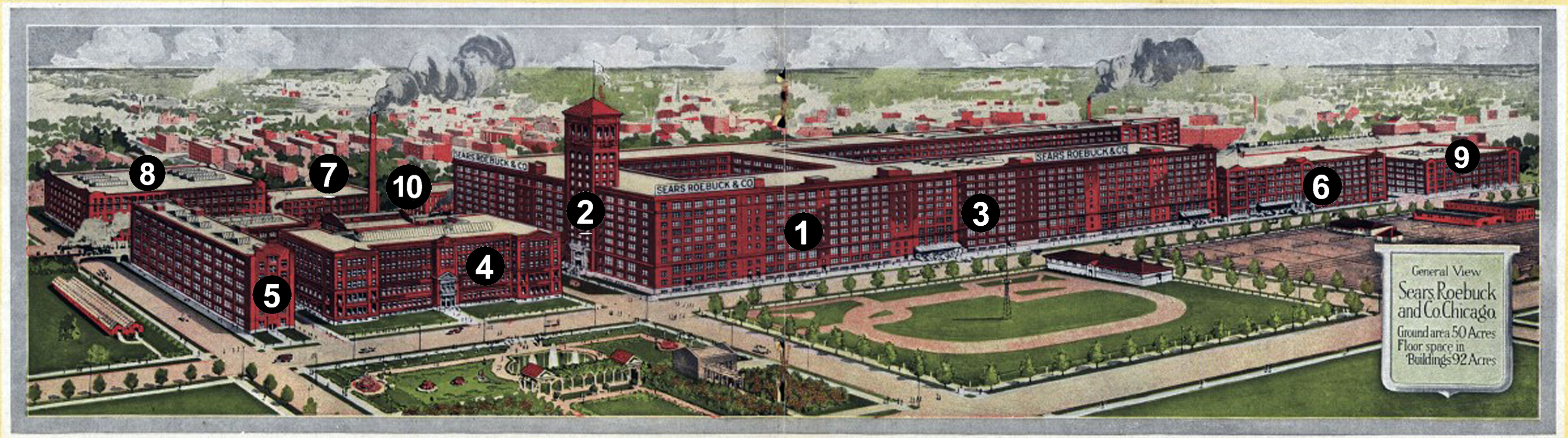
① Merchandise Building, ② Tower, ③ West Wings of Merchandise Building, ④ Administration Building, ⑤ Advertising & Printing Building, ⑥ Grocery Annex, ⑦ Paint Factory, ⑧ Wall Paper Mill, ⑨ Factory No. 1, ⑩ Power Plant.
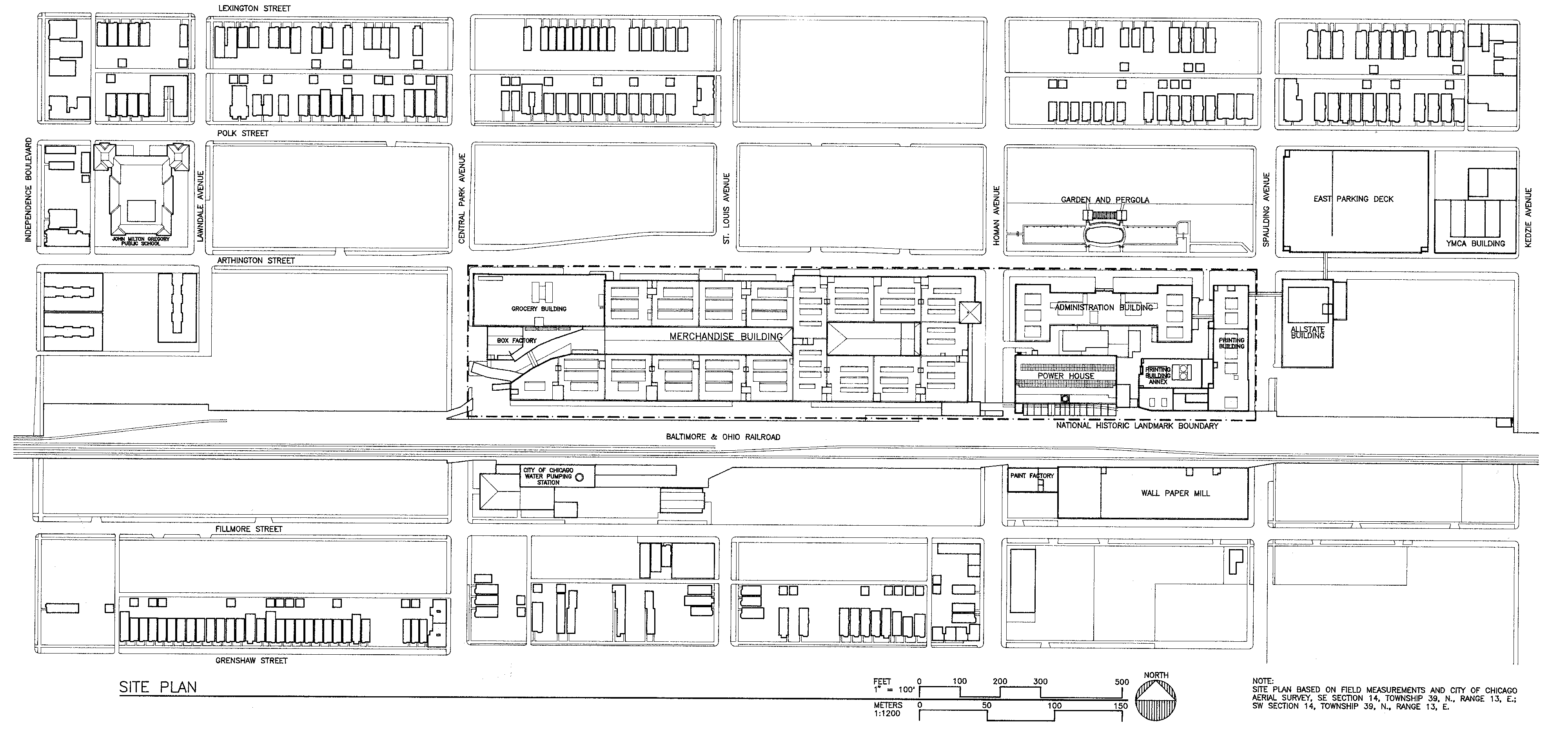
- Sears Complex and Environs
About 1990

- Sears, Roebuck & Co.
Spring, 1919 Catalog
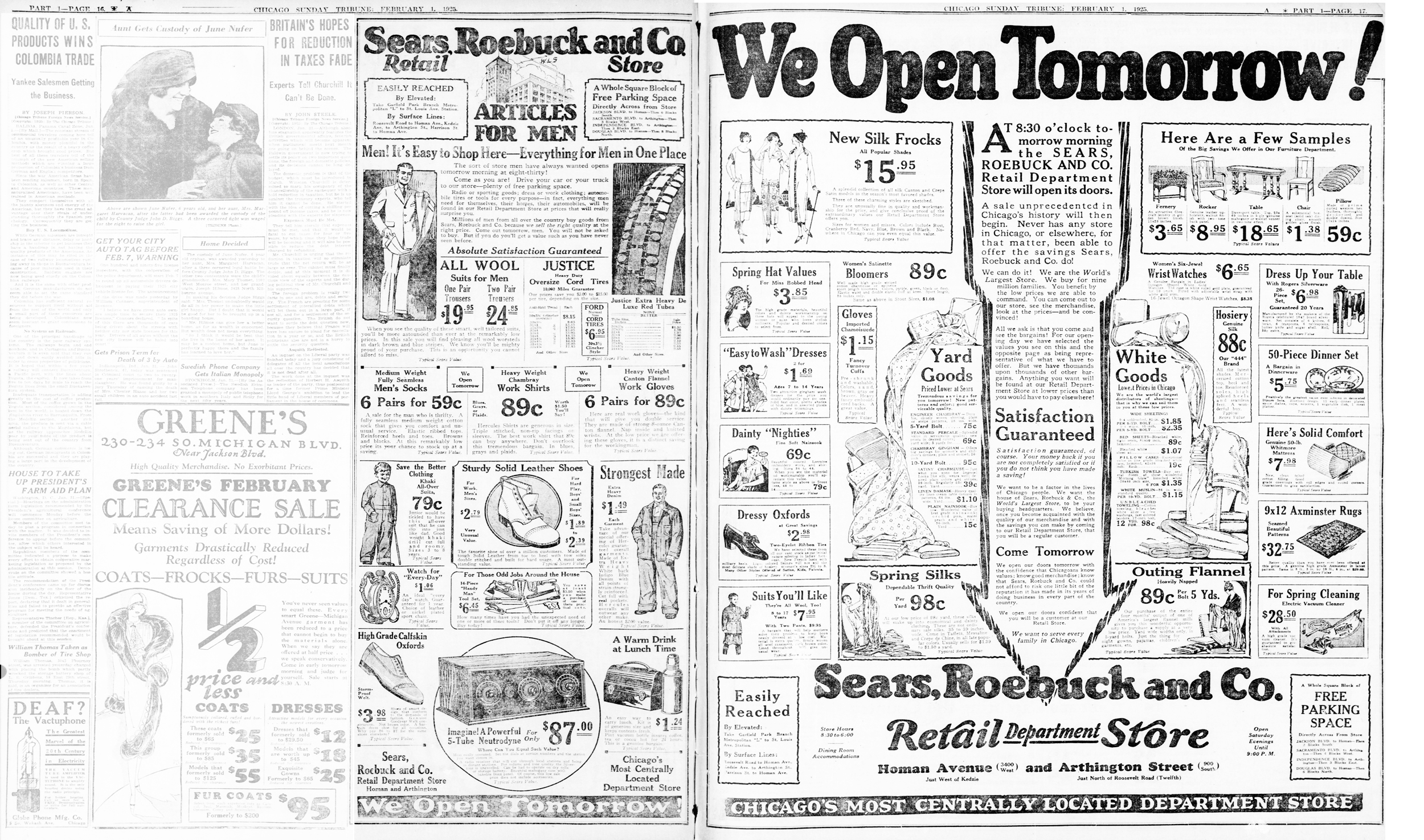
- Announcement of First Sears Retail Store
February 2, 1925

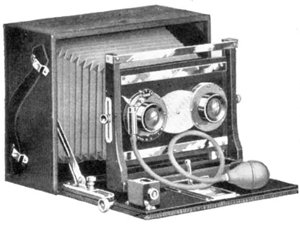
Chicagology is proud to present the entire set of the fifty stereoscope cards that were sold to flaunt Sears’ new Homan Avenue campus. It is believed that the photos were taken by Fred Conley and James Drake, vice president and general manager, respectively, of the Conley Camera Company, a supplier to Sears. One of the stereo cards from this series is used in later catalogs as an example of an image made with a Conley Model XVIII stereo camera (right). It is known that Conley and Drake traveled to Sears headquarters in Chicago in October, 1906, shortly before this series was released. The cards were first advertised in the 1908 Fall Catalog No. 118.
Take A Trip Through the “New” Sears Roebuck Headquarters.

- Sears, Roebuck and Co.
925 S. Homan
1938

Leave a Reply