Crystal Block, Hershey Hall, Inter Ocean Building, Hannah & Hogg
Life Span: 1875-1905
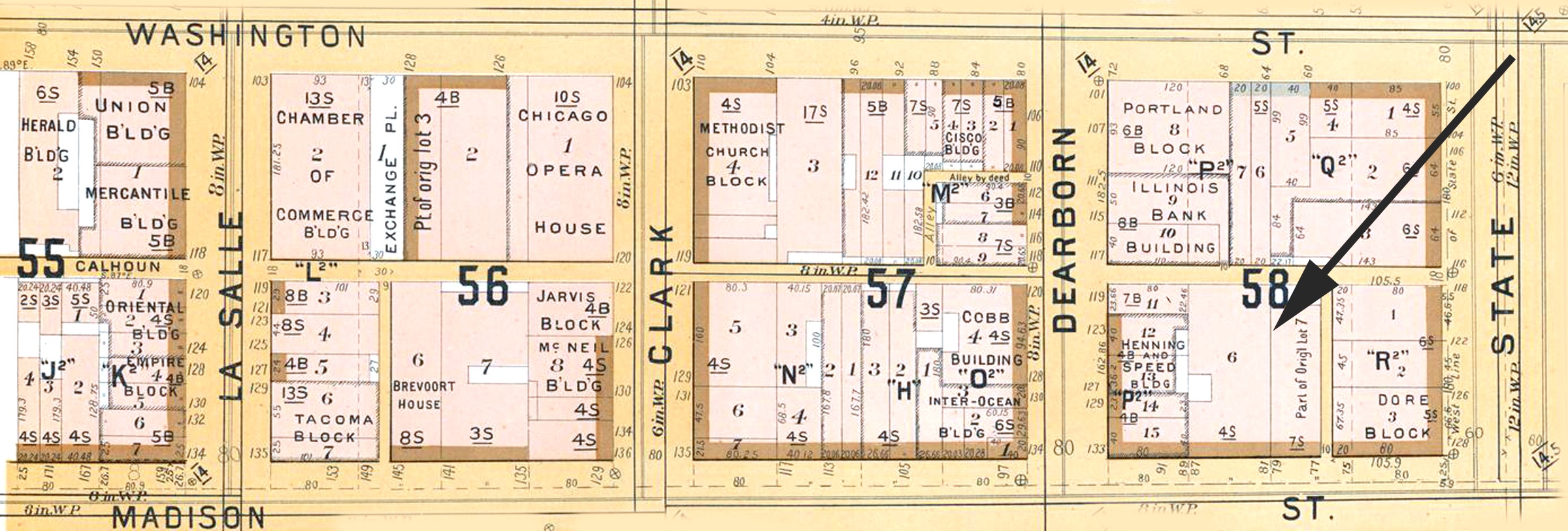
Location: 83 Madison, Near NE Corner Dearborn and Madison Street
Architect: TBD
- Lakeside Annual Directory of the City of Chicago, 1880
Hershey Music Hall.—83 Madison.
Inter-Ocean, (daily, weekly and semiweekly) The Inter-Ocean pub. cp. props. W. Penn Nixon, gen. manager; Col. G. A. Pierce, editor; 85 Madison
Lakeside Annual Directory of the City of Chicago, 1884
Inter Ocean (daily, weekly and semi-weekly) W. F. Nixon, gen. manager 85 Madison
Hannah & Hogg (Alexander D. Hannah and David Hogg) saloons 83 Madison, 146 Madison, 88 Lasalle. 151 Randolph, 220 Clark and 188 W. Madison
Chicago Tribune, December 5, 1875
All the stores on the ground floor of the new Crystal Block, on Madison street, opposite The Tribune office, have been rented, together with some of the upper offices. Rents are generally low and dull. There is some demand for small stores. House rents are quiet.
Chicago Tribune, December 31, 1875
THE HERSHEY MUSIC-HALL
now almost completed, bids fair to become the principal musical resort of Chicago. It will contain a great concert organ, teaching-rooms to accommodate several hundred pupils, and all the appliances of a first-class music school.
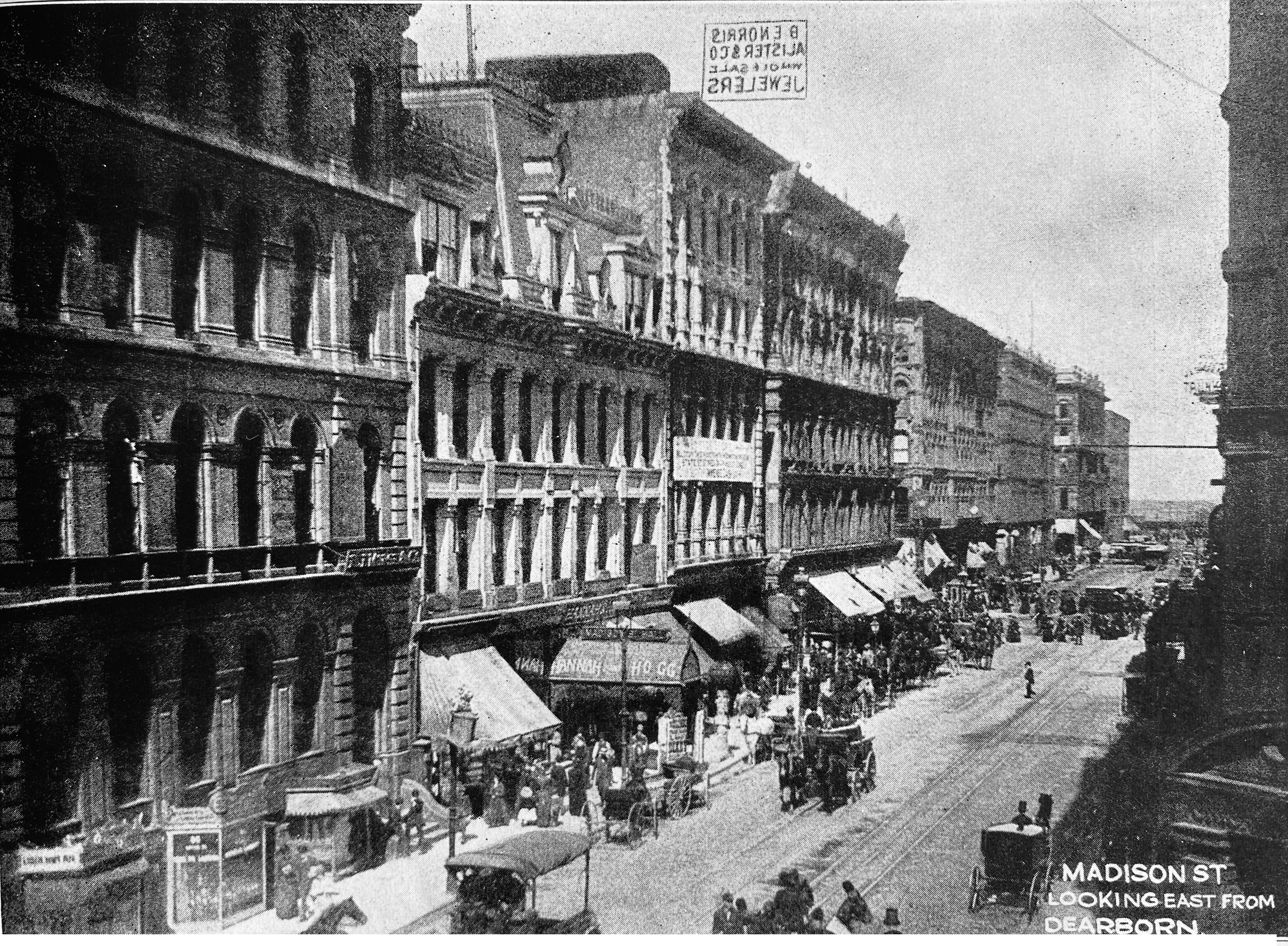
- Madison street looking east from Dearborn about 1885. Henry E. Dixie was playing at Madison Hall. The recently opened Hannah & Hogg’s saloon can be seen.
Chicago Tribune, October 15, 1876
Ground has been broken for the new music hall to be erected by the Hershey School of Art, in the rear of the Crystal Block, opposite McVicker’s Theatre.
Inter Ocean, May 29, 1880

The above cut represents the new Inter-Ocean Building, situated at 85 Madison street. It has been for some time the intention of the proprietors of the paper to remove the publication office from its old quarters on Lake street to some more desirable business location, and this removal has been the result of their deliberations. The present building is situated in the heart of the city, and, besides being one of the most convenient to the business men of of Chicago, and strangers sojourning therein, it is also one of the best adapted to the purposes of publication, being compact and well arranged for convenience. The business office is on the ground floor, at No. 85, having its own floor on a level with the sidewalk. It is uniquely and handsomely furnished in white maple, trimmed with cherry and ebony, and ornamented with colored glass panels. The work is from the famous manufacturing establishment of A. H. Andrews & Co., and is one of the most artistic that has come from their hands. The design is the work of Mr. F. L. Crosby, of that firm, who, besides being a cultivated gentleman, is an artist of excellent taste and judgment.
On the second floor is to be found the mailing rooms of the paper. On the third floor are the editorial rooms, which take up the space of half that flat. They all open upon a common vestibule, and are admirably situated so as to command the light. They are reached by two easy flights of stairs or by the elevator. It is on the fourth floor that the manuscript is prepared for the paper. On the floor immediately above is the composing room, occupying a space of about 72×80 feet. It has a high ceiling, is beautifully lighted, both by skylight and side windows, and is spoken of as one of the most convenient, best lighted, and best ventilated rooms for the purpose in the United States. Just off this room are the rooms for the proof-readers, the night and telegraph editors, also the stereotype rooms. The pages of the paper are made up in the composing room on trucks, and rolled from there directly into the stereotype room, where the matrices are made and the plates cast. The composing room is connected with the press-room, which is immediately in the rear of the business office, by one of W. E. Hale & Co.’s water-balance elevators, which has been approved by machinists as the best and safest now in use. The present press-room is in size 72×80 feet; it is fitted up with the latest and best of modern machinery and equipments, containing, besides boilers, engines, and other massive machinery, two Perfecting Bullock presses, with two of Scott’s Lightning Folders attached. Each press has a capacity for 15,000 papers per hour, so that they are capable of printing and delivering 30,000 papers each hour. The paper is printed from an endless roll of white paper, which enters the press at one end and comes out from the folding-machine at the other end cut, pasted, and folded, ready for the reader without having been touched by human hand. In the press-room also are rooms for the carriers, news-boys, and for the mailers and their attendants.
This description gives a bird’s-eye view of The Inter Ocean establishment, which is believed to be one of the most complete and compact and convenient in the country. The Daily Inter Ocean is printed at such an early hour in the morning that it would almost be a discourtesy to invite one to call at such an early hour to see our presses running, but on each Tuesday they are running all the forenoon, printing the weekly edition of The Inter Ocean, and we cordially invite our friends to call and see them in operation.
Inter Ocean, June 2, 1880
OUR REMOVAL.
The offices of The Inter Ocean have been removed to Crystal Block, opposite McVicker’s Theatre. It will be some days before everything can be properly settled and arranged, and our friends calling upon us will have to put up with some inconvenience. The removal was necessitated by our growing business and the demand for larger and more centrally located quarters. Crystal Block will hereafter be known as The Inter Ocean Building.
Inter Ocean, March 24, 1882
BAR AND BILLIARDS.
Elegant Headquarters Opened by Hannah & Hogg and the West Bros.
The advance of the age is showing itself in every department of enterprise; and business convenience is being constantly supplemented with the beauties of art. Any one who enters No. 83 Madison street will acknowledge this at once. The front, before entering, is itself an inducement to enter. Aesthetic signs, veritable works of art themselves tell that that here is the new domicile, and their central light, of Messrs. Hannah & Hogg, of whose ambrosial sips who have not taken? and that this also is the gate-way to the billiard parlors of West Bros., in the rear, who need no more recommendation than do the others, for excellence is fame. Look through that plate-glass window before entering. and also at the rear of the window division. What an ancient cathedral look: yet light with the lighter fancies of modern art, whose beauties all are created by F. D. Kinsella & Co., 85 Jackson street. Even the columns in the windows that serve as added supports to the ceiling are works of art in paper work; the choicest in material and design that F. D. Fazon’s establishment on State street can get out. But even this, beautiful as it is, does not equal the wall tapestry which they have done in the interior, and of which more hereafter.
Entering the door, then cigar department is seen. Back of the magnificent cigar-case, finish and crystal glass, resting against the wall, is the only thing of the kind in America—s Venetian mirror. Venetian in make and design, furnished by the Tobey Furniture Company, 195 State street, a marvel of artistic work, of clearest glass, and finest finish, the frame itself inlaid with mirror glass, but covered with quaint Venetian scroll-work, the whole costing $490. Two other mirrors serve as screens between this portico devoted to the fragrant weed and the sample-room in the rear. Look on the backs of these mirror screens: backs of mirrors, too, in same design and finish as the front, with dainty frames of cherry wood, furnished, as also the other mirrors in the sample-room, together with the balance of the furniture proper, by the Richard T. Hambrook Manufacturing Company, No. 219 South Canal street, who also did the splendid woodwork finishings of the room, all cherry and mahogany and rosewood, of which even the most trivial woodwork is made. The flooring of this room as that of the cigar-room, of which it is really a part, is of handsomely designed imported English tiling, smooth, ornamental, and beautiful, being done by Henry Dibles, 266 and 268 Wabash avenue. But look at the altar of this modern temple of Bacchus—the bar and its “fixin’s.”
Back of it, filling up the whole of its long length of rear wall, are three immense mirrors, furnished, as is also all the other mirror work, excepting the Venetian mirror already described, by Calvin F. Rice, No. 220 Wabash avenue. These three mirrors, all in the finest and richest cherrywood frames, with pediments of architectural design, and each surmounted with the aesthetic flower, Oscar Wilde’s favorite boutonniere, modeled in cherry and rosewood—from one general design, the central mirror being higher and broader than the others; being, in fact, 144 inches in length and 6½ feet high, the whole forming a very sea of reflecting surface. The counter or bar in front of this is a magnificent piece of woodwork, fit, by its costliness and finish, for the richest drawing-room, were such things in place there, with top of polished mahogany, and front of delicate panel work in cherry wood, with inlaid sections of lovely rosewood, soft to look upon and brilliant with high polish. This style of front, too, is used for that of the cigar stand in the front room. The working bar back of this is of copper planed down, and costing $150—splendid piece of work—by the Lonis Wolff Manufacturing Company, of 103 to 111 West Lake street, who have also fixed up the working bars of all of Hannah & Hogg’s other establishments throughout the city. To the right, at the end of the bar, is a mammoth, many-storied ice-box, of cherry wood, as artistically designed as any piece of furniture in a drawing-room. But the wall opposite, hung here and there with choice engravings, is a chef d’oeuvre of the paper-hanger’s art, which is indeed, in these modern days of aestheticism, an art in itself, and one giving abundant opportunity for artistic expression. This papering is done with dado divisions; the upper section length-wise, paralleled; the ground-work being of gold in flowered designs: the panels being in rich, dark-red velvet; the separate portions of the general design being separated by narrow strips of steel, glossy, and painted in ground-work of black with delicate floral tracery, in natural colors, climbing up them like mimic vines, suggesting those that Bacchus loved. Above the series of mirrors behind the bar, already described, is a transverse panel of paper. Above this, forming part ot the general design, with ground-work of flowers in gold, are exquisite representations of peacocks and birds of paradise. The whole of this paper work does the highest credit to Faxon, its doer. Every bit of painting, too, about the room is done in the most artistic manner, being the work of Harry J. Milligan, of No. 170 Randolph street.
Not the least noticeable features of the ornamentation of the room are the Chandeliers Pendent from the ceiling—the latter a chef d’oeuvre of ceiling design. These chandeliers, furnished by J. S. Bassett & Co., No. 215 State street, are rich, yet light and graceful, and artistic in design. There are hardly any prettier or more artistic in design, the contrasting color to the gold being green, worked in unique design. There are hardly any prettier or more artistic chandeliers to be seen than these in the city. The plumbing work was also, all of it, done by Bassett & Co. The beautiful work on the front windows, in stained glass, done by Harry J. Milligan, should not be forgotten.
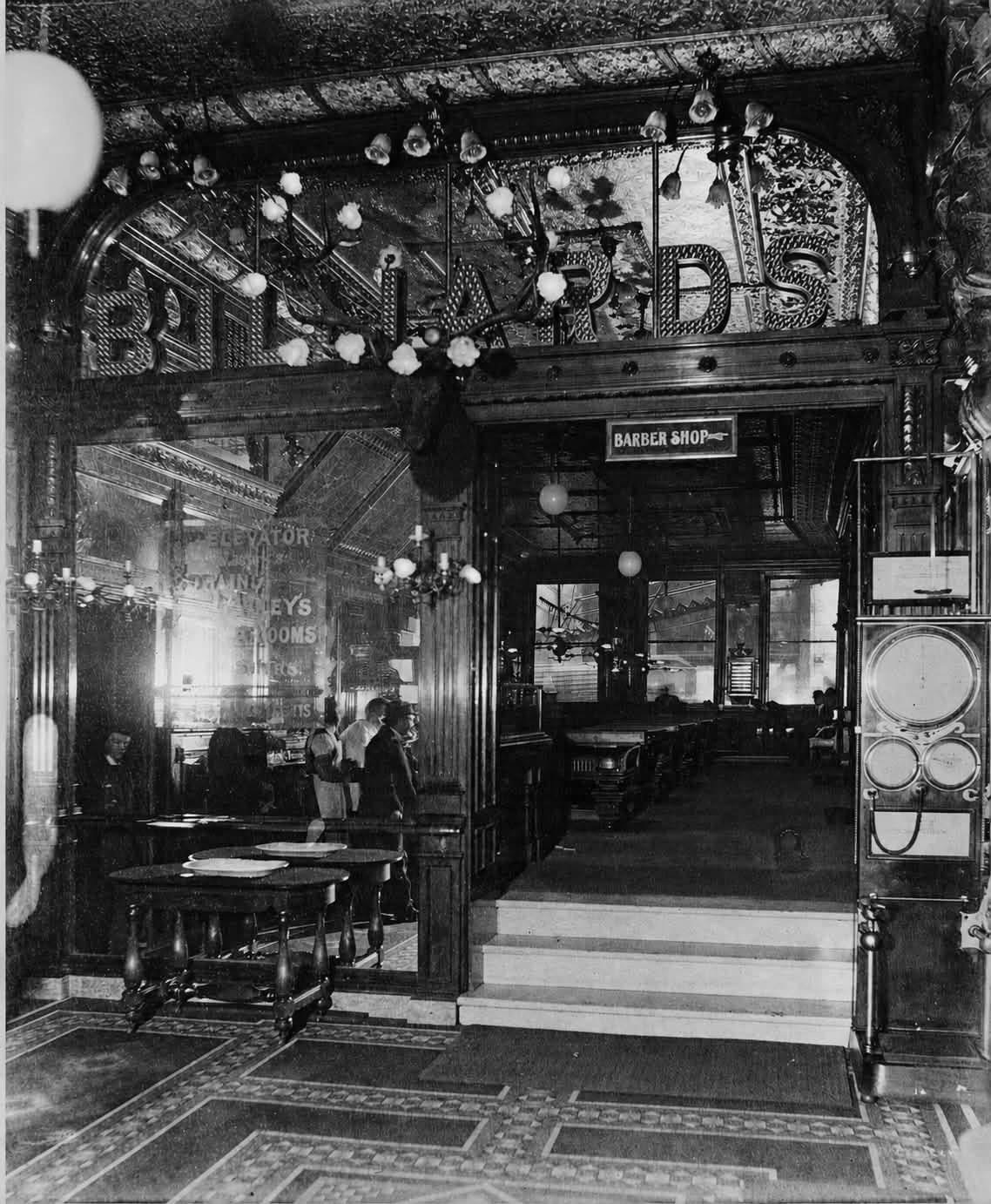
Entering in the rear, passing up three steps, the entrance arched with portieres of rich blue material, with red stripe finishing, the palatial billiard hall of West Brothers is entered. This room is 80×70 feet in dimensions, and contains sixteen billiard tables of the various makes of Balke, Brunswick, and Collender, to suit players, and all the best of their kind. The cue-racks surrounding the hall form artistic features to the handsomely frescoed walls; the fresco work being in the best style of the well-known firm of Otto Jevne & Son, No. 106 Clark street. The series of columns supporting the immense expanse of ceiling are also handsomely and tastefully frescoed by the same firm. A very noticeable and ornamental feature of the room is a mammoth central cue-rack, a very store-house of cues, but artistic in design and handsome in finish. The billiard hall will have two rear entrances in addition to the front one already described. This hall will also have its cigar stand handsomely furnished, and provided with all smokers accessories. To say a good word of the West Brothers is useless. Their character is already well known: their patronage large and ever growing: the result of constant and never-tiring endeavor to do their best, and by so doing to please their many patrons. Suffice it to say that it is their intention to do in the future as in the past, and to carry on such an establishment as shall win the favor and esteem of the better classes who patronize the noble and scientific game of billiards. They intend, in short, to make their hall the resort of gentlemen and gentlemen only.
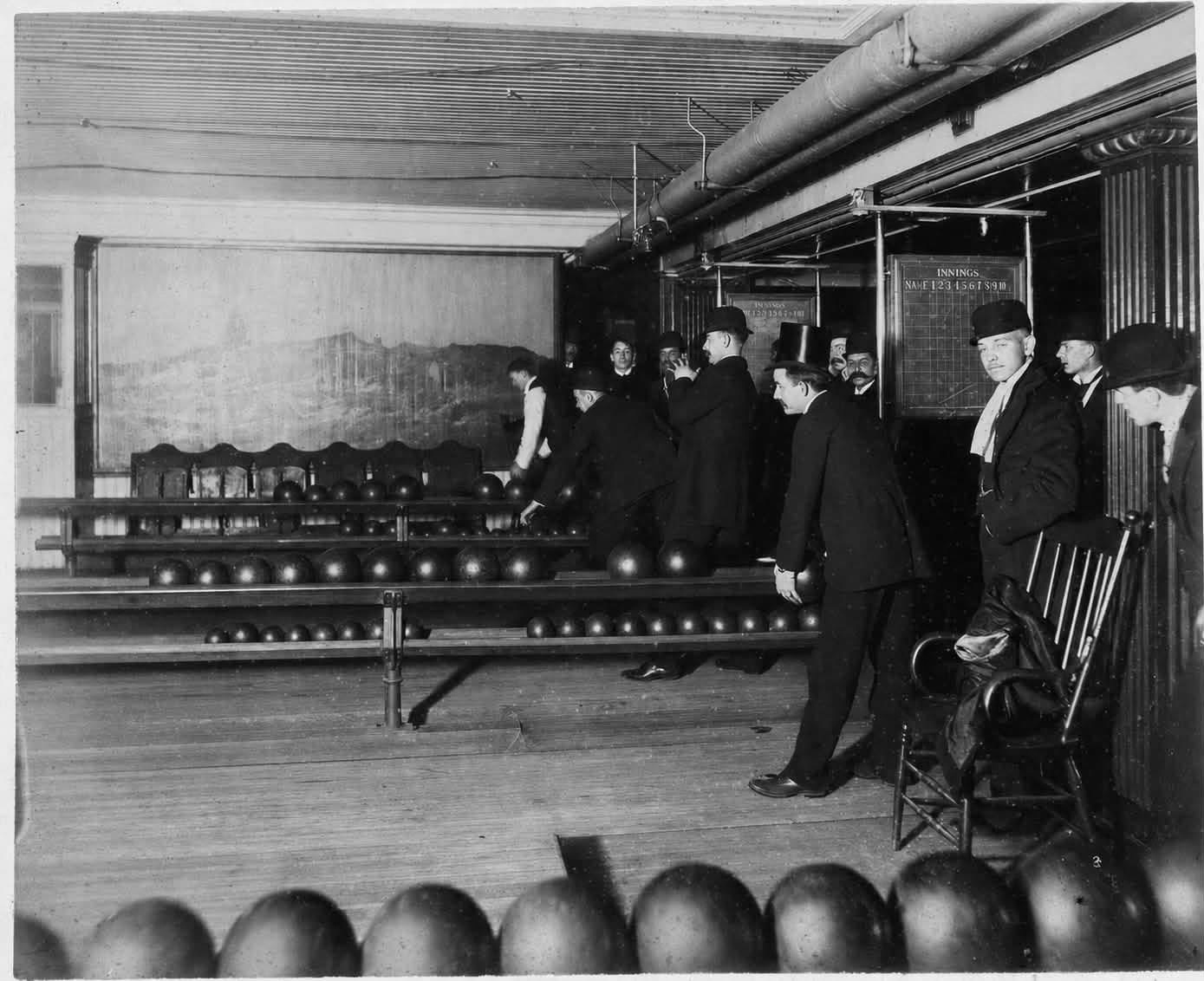
- Hannah & Hogg Bowling Alley
83 Madison
1889
Inter Ocean, April 5, 1905
Fuller Company Secures Contract for Construction of New Boston Store Building for Mrs. Charles Netcher.
The George A. Fuller company has been awarded the general contract for the construction of the Boston store for Mrs. Charles Netcher. As already announced, It will be a twelve story structure, covering the entire south half of the block bounded by Washington, State, Madison, and Dearborn streets, and will be built in five sections. The first of these includes part of the State street frontage and the premises 81 to 85 Madison street, the second section part of the State street frontage, on which half of the old building now stands; the third section the other half of the old building; the fourth section, remodeling the Champlain building, and the last section that portion of the block facing Dearborn street, extending from Madison street to the alley north. The complete structure is estimated to cost $3,000,000.
Chicago Tribune, November 9, 1895
HANNAH & HOGG BUILDING IS SOLD.
Boston Store Secures Madison Street Leasehold for $300,000.
Hannah & Hogg have sold to Charles F. Netcher the building and leasehold at Nos. 81 to 87 East Madison street. The property is owned by the Board of Education of the City of Chicago, and is to Hannah & Hogg for a period of ninety-nine years, expiring in 1985. The property was subject to revaluation every ten years, but under an agreement made with the School Board during the present year the rental is fixed at $24,000 a year for the next ten years and $25,200 a year for the remainder of the term. The property has a frontage of 80 feet and a depth of 160 feet, and is improved with a four-story stone-front building, which is divided into stores, halls, and lodge-rooms, and contains the Madison Street Opera-House.
Neither Hannah & Hogg nor Charles F. Netcher will say what the terms of the sale are. It is said, however, that Netcher pays $300,000 for the leasehold and building.
It is Mr. Netcher’s intention to use this building to give more room to the Boston Store, of which he is a part owner, and which adjoins the property on the east. Mr. Netcher has bought the property for his personal account, however. The leases of the present tenants of the building, with two exceptions, may be canceled on short notice.
One of the terms of the sale of the leasehold was an agreement on the part of Hannah & Hogg that they would give at any time. It is probable the new possession building will be begun within a few months.
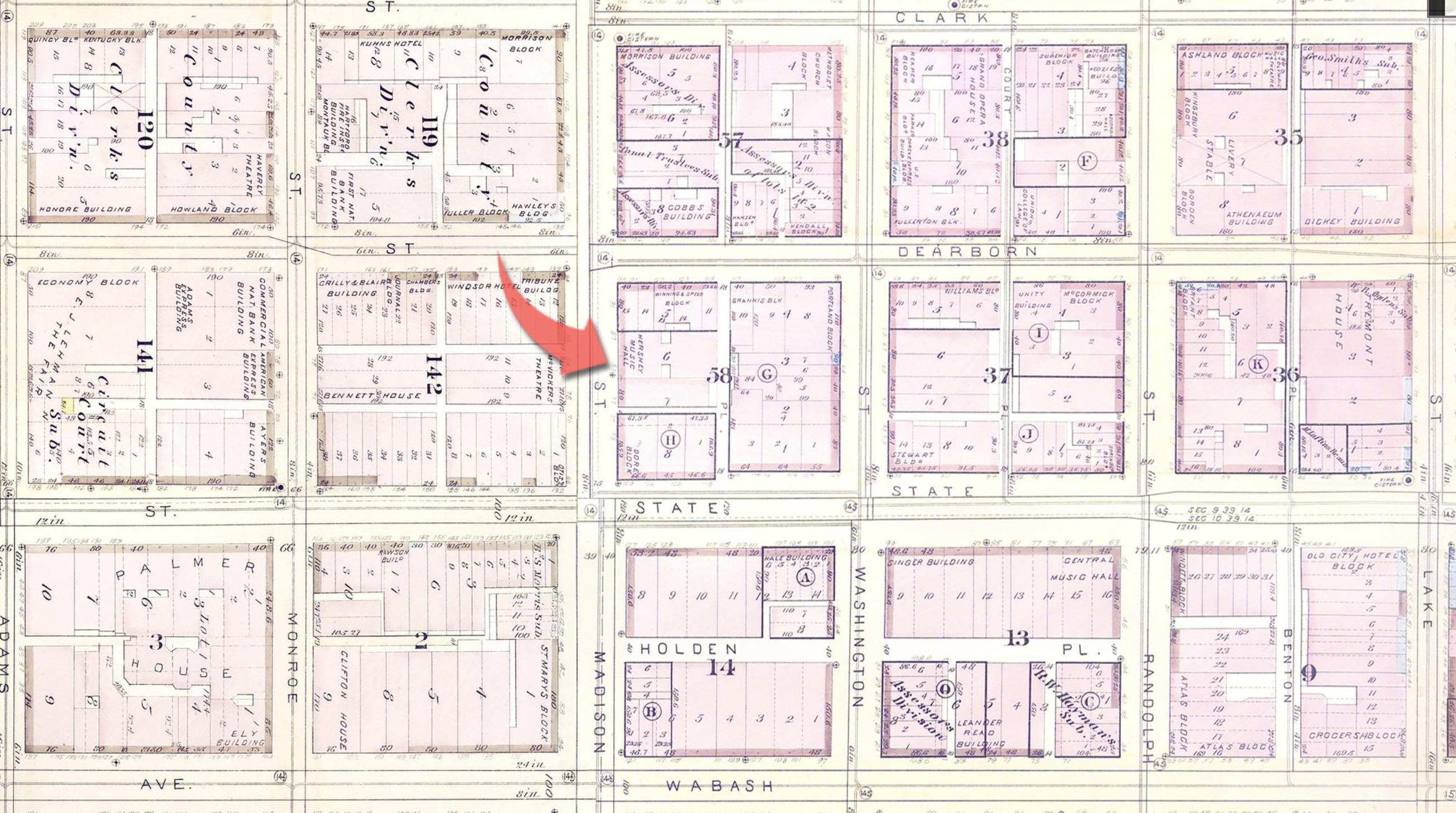
- Crystal Block
(Hershey Hall)
Robinson Fire Map
1886
- Hannah & Hogg’s Saloon’
83 Madison
1891

Leave a Reply