Major Block II, Roanoke Building I
Life Span: 1872-1914
Location: SE Corner W. Madison and LaSalle Streets
Architect: Dixon & Hamilton
- Edwards’ Annual Directory in the City of Chicago, for 1873
Major Block, 137 to 151 LaSalle
Treadway & Jewell, (George F. Treadway and Edward W. Jewell), ins. agts. 141 LaSalle
Francis John A. land agt 151 LaSalle, r. 743 Michigan av.
Bank of Montreal, William Richardson, manager, 154 Madison
Atlantic and Pacific Telegraph Co. John P. Towler, manager, Madison, sw. cor. LaSalle
Elko Silver Mining Co. P. L. Gibbs, sec. 151 LaSalle
Gross Samuel E. real estate, room 15, 145 LaSalle, bds. Woodruff Hotel
Lakeside Annual Directory of the City of Chicago, 1874
Major Blk.—LaSalle se. cor. Madison
Lakeside Annual Directory of the City of Chicago, 1885
Major Blk.—139 to 151 Lasalle
Lakeside Annual Directory of the City of Chicago, 1904
Roanoke Blk.—139 to 151 Lasalle
Chicago Tribune, April 7, 1872
Plans have been perfected for the rebuilding of the Major Block, at the corner or Madison and LaSalle streets. The foundations are now being laid. The building will have an entrance on each street, and will be substantially and elegantly built. The material is to be Ohio stone. A passenger elevator will be placed in the building for the convenience of tenants. The size upon the ground is 66×135 feet. The contracts for the sidewalks have only been let.
Chicago Tribune, April 14, 1872
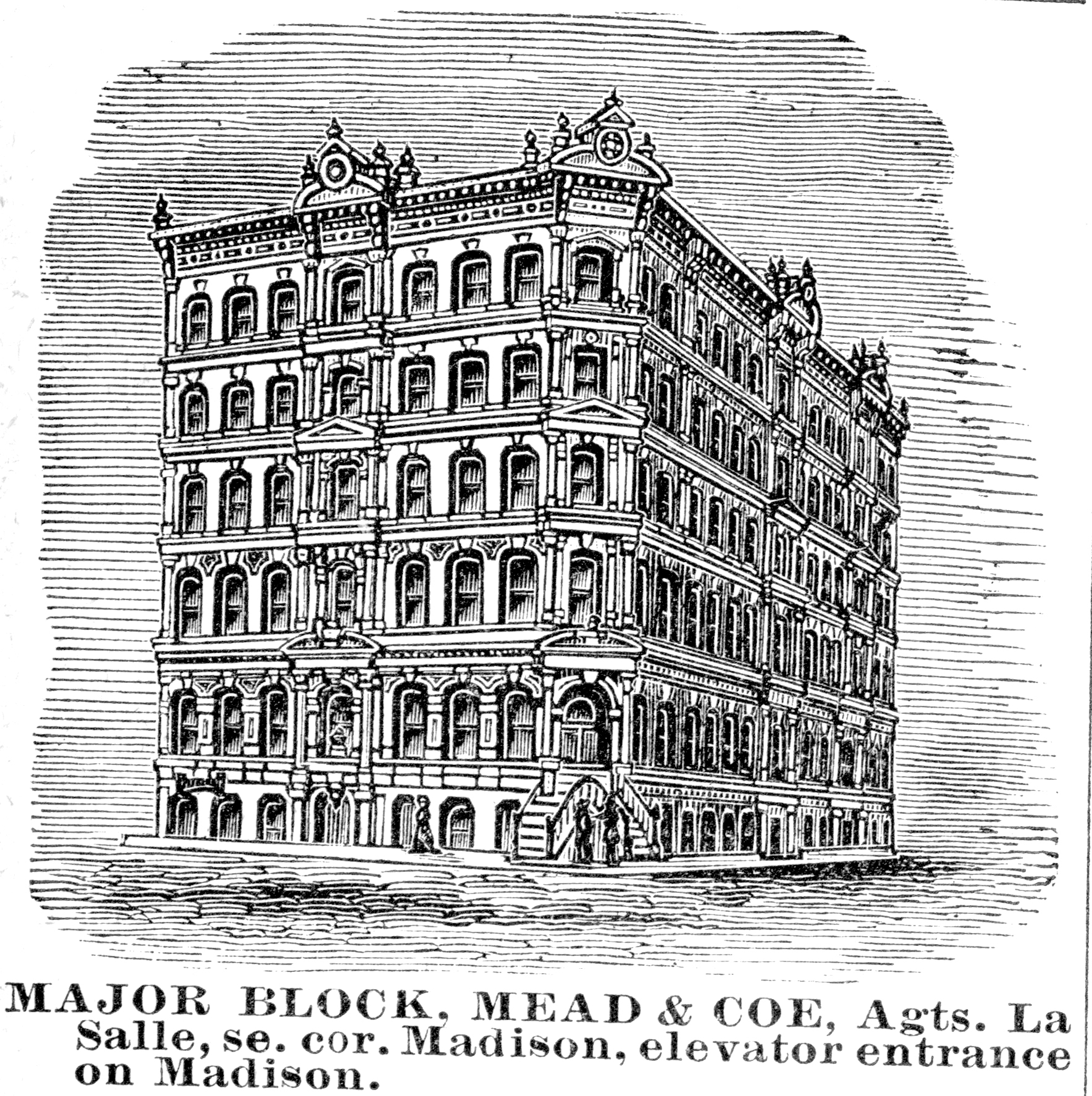
The Major Block.
From Dixon & Hamilton we learn the following particulars in regard to prominent buildings on Madison street, the plans of which they have in charge. The Major Block, on the southeast corner of LaSalle and Madison streets, will be the same size as the old building, which was 66 feet on Madison Street, and 185 feet on Lasalle street, and will be four stories above the basement. The building will have two entrances from LaSalle street, and one from Madison street, with corner entrance to banks in basement and principal story. There will be large, fire proof vaults to all offices. The stone for the exterior is yet undetermined. The basement and two principal floors above the basement will be finished in hard wood, and the second stories will be approached by a grand stairway, and also by a steam elevator from basement to upper floor. The foundations are now being prepared so as to have the building ready for occupancy by the 1st of October. All conveniences, such as water-closets, basins, etc., will be put in each office.
Chicago Evening Mail, May 17, 1872

The New Major Block.
Messrs. Dixon & Hamilton have kindly given us the following particulars concerning the new Major block, on the southeast corner of Madison and LaSalle streets, streets. It will be the same size as the old building, which was 66 feet on Madison street, and 135 feet on LaSalle street and will be four stories above the basement. The building will hive two entrances from LaSalle street and one from Madison street, with corner entrance to banks in basement and principal story. There will be large fire-proof vaults to all offices. The basement and two principal floors above the basement will be finished in hard wood, and the second stories will be approached by a grand stairway, and also by a steam elevator from basement to upper floor. The building will be ready for occupancy by the 1st of October.
Chicago Tribune, October 9, 1872
LA SALLE AND MADISON STREETS, where the Gallup & Hitchcock Building and Major Block are rivals, if not in design, at least in position. Both of the buildings are in the somewhat gloomy, but rich and handsome, Buena Vista stone, and are good types of the class of buildings which we have noticed above. The former is very elaborate, and the Chicagoan who remembers the building formerly occupying the site will scarcely regret the Old Chicago.
The Land Owner, July, 1873
REBUILT CHICAGO.—NEW EDIFICES IN THE BURNT DISTRICT.—THE MAJOR BLOCK.
(See Illustration, page 120.)
The Major Block, of which we present a fine illustration in the present number, is undoubtedly in all respects one of the finest buildings in Chicago. The property is owned by Dr. L. S. Major, under whose supervision the entire work was done, and no pains or expense have been spared to render the block a worthy illustration of the enterprise exhibited in our city. B. M. Davenport, Esq., is the superintendent of the building, and devotes his time to the matter of details. Mr. Davenport is in the real estate business.
The block is built of Buena Vista stone, is five stories in height, besides a basement and a sub-basement excavated to the depth of six feet. The structure is solid and enduring, and in every detail of construction great liberality has been displayed. The front on LaSalle street measures 136 feet, and on Madison street 66 feet. The cost of the building was about $250,000. The building is intended for offices exclusively, no sleeping rooms being allowed. Every office is admirably lighted and supplied with water and gas. Hose apparatus and fire extinguishers are placed upon each floor, and an iron tank is placed upon the roof, containing at all times 300 barrels of water. An elevator is in use, having a sustaining capacity of ten tons, and advantageously used for the conveyance of safes to upper stories. The vaults throughout are lined with Johnston’s celebrated hollow tiles. The vaults are also supplied with Hall’s patent doors; all the floors, except the fifth, are heated by steam; water-closets are placed upon each floor.
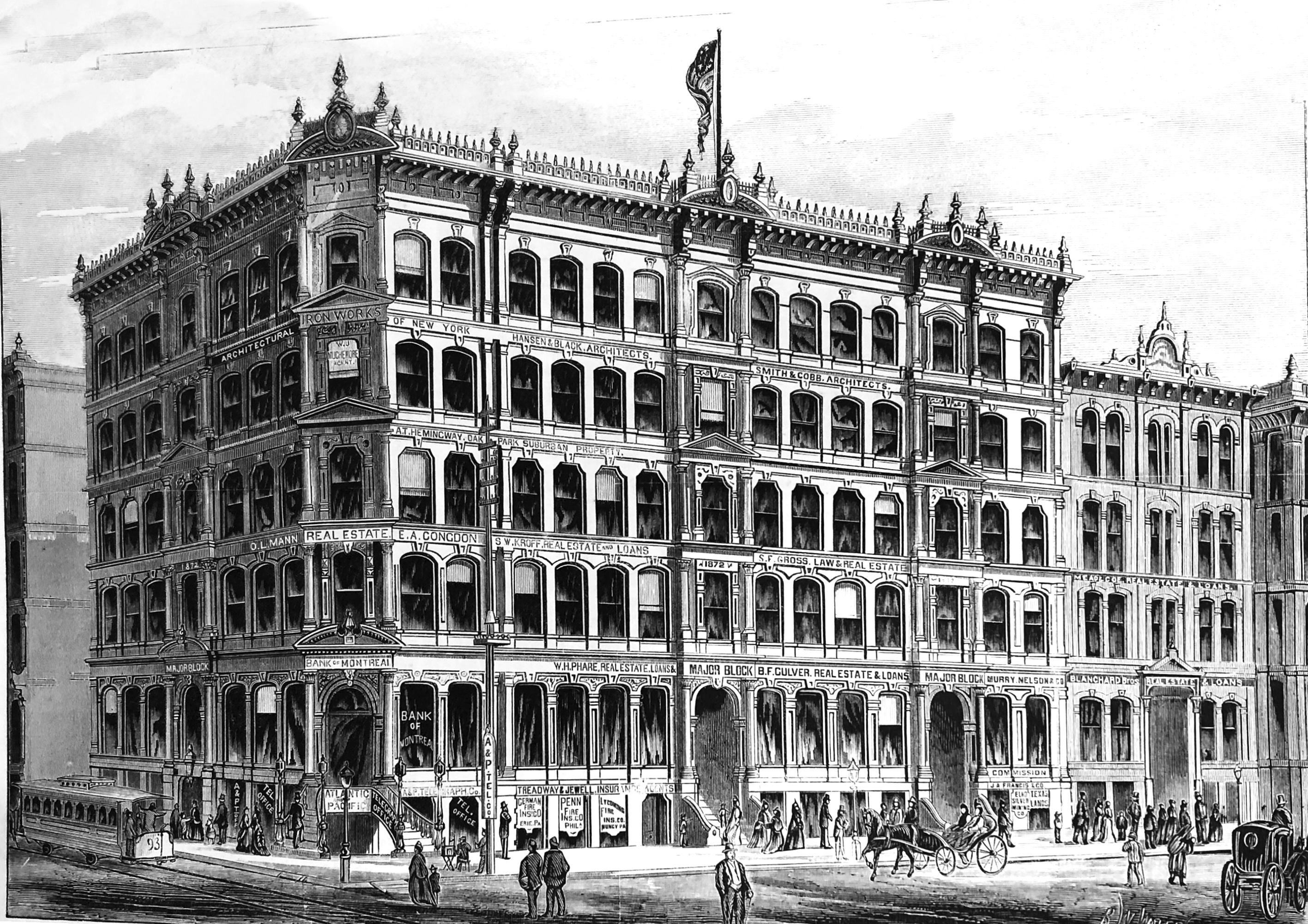
- Major Block II and Andrews Building II
Messrs. Dixon & Hamilton, the architects, may justly claim credit for the style and plans of the Major Block, and for the careful attention to the various details of construction. These gentlemen were the architects of Gallup & Hitchcock’s Fire-Proof Building, and of numerous other fine structures in this city. The offices are dono in hard finish, in light and dark woods, and present a handsome job from Holtslander Randall & Daniels, of Phonix Planing Mills.
Prominent among the occupants of the block may be noticed the
Bank of Montreal,
established in 1817. This is one of the most reliable banking institutions in the country.
The officers are David Torrence, President; R. B. Angus, General Manager, both at Montreal; and Wm. Richardson, Manager at Chicago. The bank statement for the year ending April, 1873, shows a highly prosperous condition of affairs.
The Atlantic and Pacific Telegraph Co.
occupy the basement corner with their main office, which, in its appoiutments and gen. eral arrangement is unexcelled both for convenience and adaptability. Under the present able and energetic management, the affairs of this company have been brought into a most prosperous and healthy condition. Its lines have been almost entirely rebuilt in a very substantial manner, and their efficiency insured. Over two thousand miles have been added to this company’s system of lines during the year past. The most notable and valuable addition being a new and duplicate route to New York, along the route of the Michigan Central Railroad to Detroit, thence through Canada and over the line of Oswego and Midland Railroad to New York, thus doubling and rendering more reliable the company’s facilities. Other important extensions are at present being constructed, and additional wires put up to accommodate the rapidly increasing business.
This company recently acquired control of the Franklin Telegraph Company, thus adding the New England States to the large area already covered by its lines, which already extend from the Atlantic to the Pacific coast, embracing all important points in the Western States and Canada.
Treadway & Jewell,
Fire Insurance Agents, occupy one of the most commodious of the basement offices.
They are one of our old reliable firms, and represent three of the oldest and staunchest of the Pennsylvania companies, the Lycoming Fire Ins. Co., of Muncy, Penn., established in 1840; assets, nearly $6,500,000 ; amount of losses paid in thirty-three years, nearly $4, 500,000; Chicago losses paid in four years, nearly one million of dollars;-the German Ins. Co., of Erie, Pean., assets, $377,000; the Penn Fire Ins. Co., of Philadelphia, Penn., assets, $352,000. The prestige of these companies is established by many years of successful effort.
J. A. Francis & Co.,
General Agents for the Texas Land and Emigration Company, are also in the basement of this block, and doing a fine business. having the agency for very superior Texas lands, and are prepared, we are told, to offer superior inducements to capitalists and settlers whose interests lead them to that “promised land.”
Murry, Nelson & Co.,
Commission Merchants, and Vincent, Nelson & Co., proprietors of the great National Elevator (an illustration of which appeared in our issue for February last), occupy a fine suite of offices upon the first floor. These old-established firms are so creditably known in the market as to render comment at our hands unnecessary. Their transactions are of great magnitude, and their career has been a series of uninterrupted successes.
W. H. Phare,
Real Estate and Loan Agent, is on the same floor and deals largely in choice lot and acre property. Many years’ familiarity with the real estate market places him in a position of credit and prominence. The same may be said of
Belden F. Culver,
who is dealing largely in real estate, and is interested in some of the choicest property at Evanston and along the north shore. Mr. Culver is eligibly located on the on the first floor.
S. E. Gross,
who occupies one of the finest front offices, is a gentleman well known in Chicago real estate speculation. He is one of the youngest aud at the same time most enterprising and successful operators. He is the owner of over a thousand feet on the avenues south,
near the great South Park, and of several very valuable acre tracts on the West Side.
As one of the rising young men of our Western Metropolis, we predict for him a brilliant and successful future.
The Elko Silver Mining Company.
The Elko Silver Mining Company, whose office is at 151 LaSalle, is organized upon a novel basis. It distributes the stock among one hundred persons, in sums of $35,000 each; every person to pay for his interest the sum of $500, viz.: $250 in cash, and the balance in ten equal notes of $25.00 each, payable the 15th days of June, July, August, September, October, November and December, 1873; and January, February, and March, 1874, respectively. This will a afford a cash capital of $50,000. The property will cost $25,000 in cash and $51,000 in stock, leaving in the treasury and provided for,
$449,000 in stock and $25,000 in money, with which to develop the mines. Its property includes six mines and four tunnel sites, all located in the Goose Creek Mining District, Elko County, Nevada, viz.: Mines—The John Ely, Toefil, Juliette, Imperial, Lilly, and Keystone. Tunnel Sites—The Michigan, Illinois, Germania, and Prairie Farmer. In all twenty-one thousand feet of good showing claims, lying 35 miles from Tacoma, the first station on the Central Pacific Railroad beyond the Utah line. Wood and water in abundance, and titles perfect.
Among its officers and directors are such well-known men as Hon. John P. Reynolds, W. F. Endicott, Joseph F. Bonfield, Samuel E. Wells, Hon. David A. Brown, J. McK. Sanger, Henry T. Thomas, P. L. Gibbs and others.
Operating in the same region is the Chicago Gold and Silver Mining Company, which is organized upon the same plan as the other. Its stock is all taken, and the company has already developed, since last December, about $100,000 worth of ore in simply proving its mines. There is every reason to believe that the Goose Creek District will prove as rich as the famous Comstock, and that the above two companies will achieve grand results. A ten-stamp mill will be in operation within the next ninety days in the Goose Creek region.
S. W. Kroff,
Real Estate and Loan Agent, is largely interested in choice park property and other real estate, and does considerable loan business.
Hansen & Black,
Architects. An excellent firm who are making good headway in their line of business.
Smith & Cobb,
Architects, are another very active firm. They make a specialty of fine residences, and have on hand some important contracts for business firms.
A. I. Hemingway,
Real Estate and Loan Agent, is largely interested in Oak Park suburban property, and doing a fine business therein. Mr. H. is favorably known as a man experienced in his business.
Messrs. O. L. Mann & E. A. Congdon
are a prominent and reliable Real Estate firm doing business on the second floor of this building. Their transactions in city property are large, while they are also agents for large tracts of suburban acres. They are also dealing largely in all kinds of brick, and manufacture the common brick in large quantities.
New York Architectural Iron Works,
This house, through their agent, W. J. Muchemore, are achieving a celebrity in iron work in buildings. The work on the Hawley Block, and upon numerous other fine buildings here, and almost innumerable public and business structures East, affords high evidence of their ability to meet every demand in their line. Mr. Muchemore has a beautiful suite of offices, and numerous books of designs and plans of their work are always open for inspection.
This building fronted 136 feet on LaSalle and 66 feet on Madison. It was seven stories high, with one basement, on spread foundations. This was one of the first buildings to be rebuilt after the Fire of 1871. It’s name was changed to Roanoke.
From June 8, 1873 to January 1, 1887 the original Roanoke building served as the Chicago location for the National Weather Service Weather Forecast official climate site. The building is mentioned in Saul Bellow’s More Die of Heartbreak but there it is referred to as a wealthy residence building and not as an office building
Chicago Tribune, January 18, 1914
Will Raze Roanoke Building.
Another important development of the week was the announcement that the Leander McCormick estate is preparing to wreak the old Roanoke building at the southeast corner of La Salle and Madison streets, preparatory to the construction of a great office building to be known as the Lumbermn’s exchange. Notices are being served to tenants in the Roanoke building to vacate by May 1, when the work of razing the building will begin.
The fact that the McCormick estate has had under consideration for some time the destruction of this building has been known. A year ago negotiations were begun between the estate and the Lumberman’s Association of Chicago, the estate being unwilling at that time, in view of the overbuilt condition downtown in an office building way, to undertake the construction without a rental guarantee from the association covering, it was said, about eleven floors of the floor. The association was for a time so successful in its labors that the erection of the building under this plan was assured. Later it was reported the association had not been able to secure guarantees covering the specified space, and that the construction of the building had been postponed. While representatives of the estate are unwilling to state the present arrangements with the association, it is evident they are of a satisfactory character.
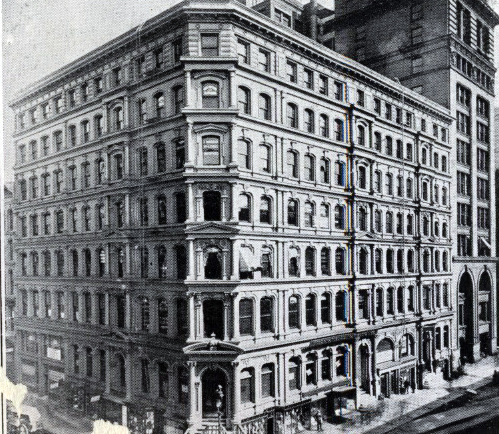
- Roanoke Building
At the right is the Y.M.C.A. Building which was built in 1893
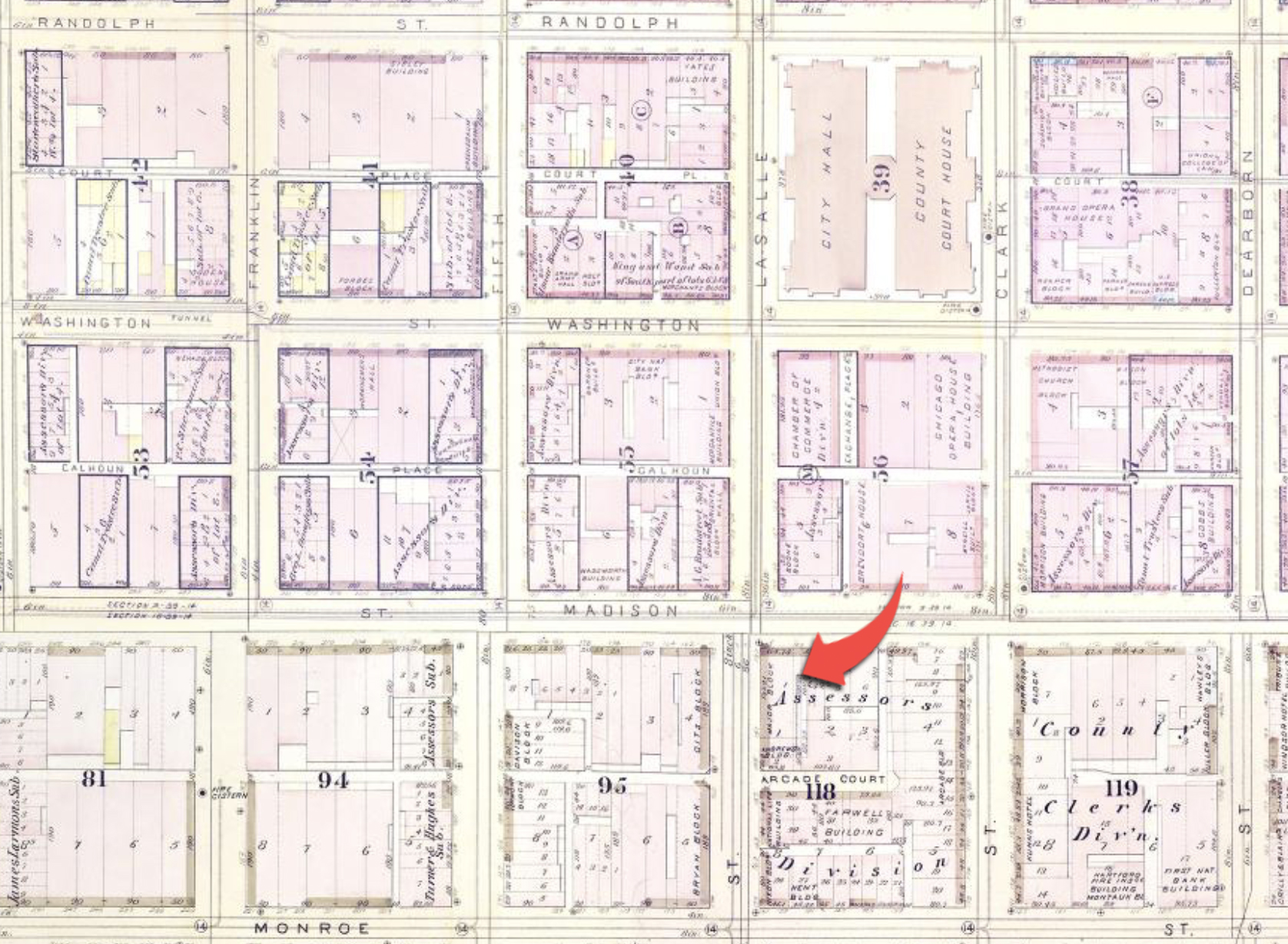
- Major Block II
Robinson Map
1886

Leave a Reply