Building Name(s): Cook County Insane Asylum
Life Span: 1870-
Address: Dunning, IL
Block and Subdivision:
Architect: L. B. Dixon
- Lakeside Business Directory of the City of Chicago, 1897
Cook County Insane Asylum—located at Dunning, Ill.
Cook County Poor House—Dunning P.O.
Chicago Tribune, December 2, 1870
COUNTY INSANE ASYLUM.
Visit by the Committee on Poor-house and Paupers
Description of the Building.
The Committee on Poor House and Papers of the Board of Supervisors, spent the day yesterday,. at the new Cook County Insane Asylum at Jefferson. The visit was made in anticipation of too removal of the insane patients from the old Poor House to the new building, which 1s now ready for their reception, but it was found that some of the interior arrangements had not been quite perfected, sad it is probable that a day or two may elapse before the new asylum can be put into running order. This circumstance, however, did not materially interfere with the object in view, the balding is now completed in every detail, so that the Committee were enabled to make a satisfactory examination of the work, which has been thus far successfully carried through.
The party left the Court House at 10 o’clock, proceeded in three carriages toward the asylum by the old Jefferson road. They were accompanied by L. B. Dixon, the Architect and Superintendent, and a few gentlemen who were induced to spend a few hours profitably among the poor and otherwise unfortunate. An hour’s ride over that rugged road brought the visitors within sight of the clump of trees through which glimmered the specious new brick edifice, presenting a notable contrast to adjacent cluster of shanties which consulate the old County Poor House. The approach from the road to the asylum is by a broad drive, which may very easily be improved into an excellent carriage way, by a few deposits of gravel over the turf. The surrounding grounds, when properly laid out and put under cultivation, will have quite an attractive aspect, and since the artesian well has paid an abundance supply of pure water at command, there seems to be nothing wanting to render the location one of the healthiest and most desirable that could have been selected for the purpose.
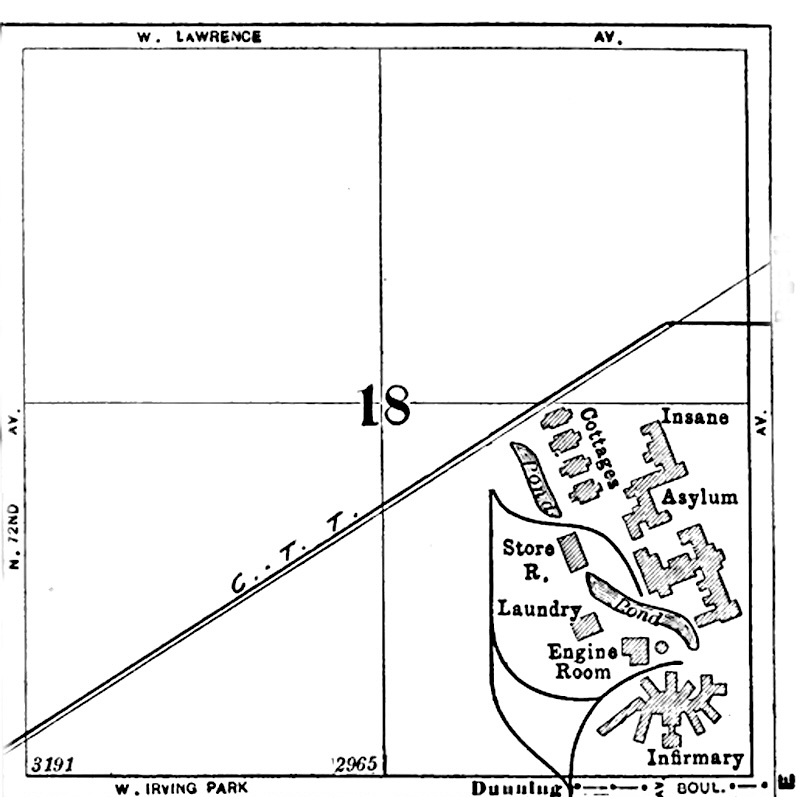
As the main purpose of the was to inspect the new asylum, it may be as well to present soma account of- the Dallding without further miles preface. to It la located on the county farm, ten the portheast of the city, on a site Immediately adj loing the old Con aty Poor House. The main boliding has an east frontage of 300 feet, and consists of three st ries sod a basement.
The architectural appearance of the excursionists was to inspect the new asylum, it may be as well to present some account of the building without further preface. It is located on the county farm, ten miles to the northeast of the city, on a site immediately adjoining the old County Poor House. The main building has an east frontage of 300 feet, and consists of three stories and a basement. The architectural appearance of the edifice is massive, but plain and unpretentious, consistent with the purpose to which it is devoted. It can hardly be said, to be modelled after any particular style. Strength, neatness, and convenience. appear to have been the aim of the builder, rather architectural grandeur, and these results have been successfully achieved in the construction. It is due to Mr. Dixon to state, by way of compliment, here, that the construction has been carried through, under his supervision, without a single blunder having been committed from the laying of the first brick to the last—a remarkable exception to the general rule in the erection of public buildings. The only ornamental parts of the edifice are the turrets on each corner of the wings, and the pilasters which adorn the walls.
The central part of the main edifice is eighty-two feet in front. It is subdivided into roams, offices, and dining halls for the use of wardens and attendants. The wings, extending north and of the central portion, are subdivided into wards for the inmates, with a corridor extending the with a spacious corridor extending the whole length of each wing. On each floor are bath rooms, water closets, and other accommodations, while each ward is furnished with a separate flue for the increase of hot air, by means of apparatus which will presently be described.
At the rear of the main edifice is a brick building, two-stories in height, with cellars, covering a space of 56 by 80 feet. It connected with the main building by a corridor 10 feet wide, built of brick, and is subdivided into a bakery, kitchen, dry-room, wash-room, and ironing-room. The apartments on the second floor are for the use of the help of the institution. The boiler-room and engine-room are on the north side of the corridor. The exterior walls of the building are solidly constructed, the bricks being 20 inches thick, with 2-inch air space. All the interior walls and corridors, as well as those dividing the wards, are also of brick 16 inches thick, in which all the hot air and ventilating apparatus are constructed. The floors in each of the stories are made of ash wood, that being selected as the hardest and most satisfactory for the purpose. So much far the general construction.
Perhaps the most important consideration in the of an asylum or hospital is the question of ventilation. Perfection, in this respect, would cover a multitude of architectural sins. The necessity for pure air, and appliances for its introduction throughout such a building, was strongly impressed upon the minds of the visitors, yesterday, by the condition of the old County Poor House. A fine opportunity was here afforded to the architect for drawing a contrast, and Mr. Dixon has evidently profited by the example. In the interior construction of the new asylum, he has availed himself of the best methods of ventilation, with results which are eminently satisfactory.
The entire building is heated by three tubular hot-water boilers, built by the Northwestern Manufacturing Company. These are located, as already mentioned, in the north side of the corridor. From the engine room, the visitor is taken down a narrow stairway to a tunnel under the basement, and extending each way under the corridors of the wings. For forcing there are two double eight-feet diameter iron fans, run by an engine, by means of which the air is taken from an opening over the fan rooms, and forced through the tunneL From this it is forced through a valve in the bottom of brick coal chambers, located in the basement of the main building, over the steam coils, and through flues connecting, by outlets from the chambers, with each of the wards and corridors. Each ward has its separate ventilating flue, extending up under the roof into a foul air reservoir, and is discharged into the exterior air through the cupolas surmounting the wings.
The kitchen is handsomely furnished with one of Wilks’ ranges, embracing all the necessary adjuncts, warming ovens, copper pans, etc. The oven in the bakery, is constructed with some of the best modern improvements. The wash room is fitted up with two machines, and four soap wash-tubs, and the ironing room and laundry has a large patent mangle, and excellent contrivances for drying. The linen is taken to the rooms from rooms attached to each ward, by means of well-holes, through which it is raised or sent down.
All the food is cooked in the rear balding, and is carried to the wards, first, by a car on a tram-way, and thence by dumb-waiters.
Attached to the engine, are two pumps far pumping water into the boilers from the and into the tanks under the roof of each wing. These pumps can also be used very effectively for throwing a stream of water up to any part of the building in case of fire. There are hose pipes on each floor, and on the outside, extending to the roof. A very satisfactory test of the efficiency of these pumps was made by the committee, two large streams being thrown clean over the cupolas. The engine, which is built by the Northwestern Manufacturing Company, is a 60-horse power, and is finely finished. It is capable of running all the machinery of the institution. The pumps alluded to were conceded to be much superior to the Blake pump, which was working along side of it.
The following is a statement of the accommodations: There are 160 wards above the basement, in which there are 20 extra wards now fitted up for the more retractory patients, while a number more will be completed by easy alteration of the lower corridors into cells. Besides these, there are six dining-rooms and six attendance rooms, a warden’s room, physician’s room, three chambers for the warden in the third story. and two dining-rooms to the basement. The building is calculated to accommodate, in case of necessity, about 510 patients.
All these things, and much more, the committee saw and approved of yesterday. They were hospitably entertained by the warden, Mr. Patrick Carroll, who took the visitors through the words in the old buildings, and showed them the “cases.” It was a sorry sight, and a rather queer appetiser for the excellent repast which was provided for them. Dr. D. B. Funds, whose humane influence and excellent mode of treatment was exemplified in the radical care of some, and the partial recovery of other cases, which had been given up as hopeless, was also present, The patients in the insane wards all seemed to manifest an eager desire for the approaching change of apartments and no wonder, for the impure air which pervades the chambers of the wretched old Poor House is enough to create insanity. It must be conceded, however, in Justice to Mr. Carroll, that the place has been kept in marvelous state of cleanliness, considering the condition of the building. The wonder is that he has been enabled to keep it in a condition of any kind.
The committee returned in the evening, after having beguiled a whole day with melancholy images among the poor and insane at Jefferson.
Chicago Tribune, January 11, 1885
 When the site of the Cook County Insane Asylum, Poor-House, and Infirmary was decided upon it is more than likely that some of the County Commissioners had land to sell or had friends who had land to sell. The location was ten miles from the city, on a bleak, wet prairie, and its only recommendation seemed to be that it was on a ridge of sand that cuts across the country from northwest to southeast. When these buildings were first put up a long, plain, two-story frame building, painted of a suggestive yellow, was the almshouse, and an apartment therein was dedicated to the uses of the pauper insane. The cell system was in vogue, and the poor unfortunates, chained band and foot, dragged on a miserable existence or died as best pleased them. Of the horrible abuses and atrocities committed there it is a shame to speak or think. Modern thought and modern improvements came, and, absolutely forced thereto by public opinion and a press then rapidly growing in power and influence, the county authorities then began to butld up, and improve, and provide a home for their charges that should be a little better at least than stables for beasts of burden. As a consequence there is today at Jefferson a system of county institutions—perhaps not the best, but which is palatial in comparison with the squalid huts formerly used for the dwellings of those who, by misfortune, vice, or disease, became a charge upon the county.
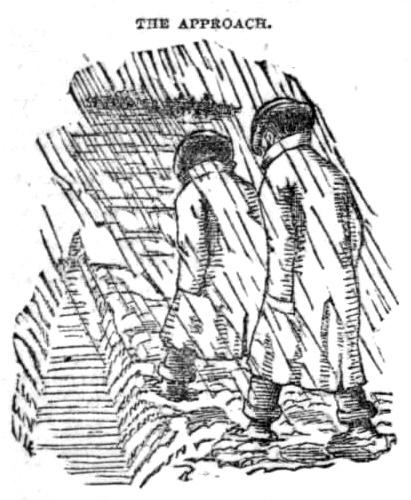
When these buildings were first established at Jefferson the only means of access was by the Northwestern Railway, that has a depot which is said to be one mile away. A wagon-road leads across the prairie, cornering around farms.The inhabitants and the railroad people say the asylum is “one mile” from the depot. This must be an air-line. A crow might fly there or a dog might run there in that distance, but a decent white man who undertakes to walk from the station known as “Plank-Road” will find that he must walk at least three miles before he reaches his destination. It is true that the St. Paul Road, with one of its comparatively new branches, has established a depot that is much nearer, but with a perversity that is simply exasperating the trains leave Chicago for Jefferson at the unearthly hour of 6:30 a.m., and at the inconvenient hour of 2 p.m. The first is too early, the second too late. Upon the Northwestern a train leaves Chiengo at 11 o’clock. The reporter for The Tribune and the artist decide to tempt fate and take passage. Upon the previous night, and for several days preceding, a rain has fallen. This makes but little difference in the city, where streets are paved and guttered, but on a flat prairie everything is in the condition known as “all afloat.” The country roads are coated with a mud-pudding about six inches deep. On each side there is a raging torrent ranging in depth from one foot to five or six. With a running jump an athlete can elear the space from bank to bank. The asylam looms up in the distance steaming through the mist and fog. The mile of prairie which separates the adventurers from their goal is covered with water, which forms ponds and lakes in hollows and depressions, but even on the sides of ridges the melted snow makes a sloppy puddle. The prospect is dreary, but having come thus far there is no backing out. The artist and reporter button their overcoats close to their chins as a protection against the driving rain and sleet, turn up the bottoms of their pantaloons, and strike bravely out across the prairie.

The three large brick buildings, with their appurtenances, make quite a show. There are the insane asylum. the infirmary, and the poorhouse. The insane asylum is the one of most general interest, and the business of this article will be to describe it and endeavor to give the people of Cook County an idea of what it is. The asylum is a place of great and promising possibilities. Plans have been adopted to make it one of the finest, most complete, and best in all its appointments in the United States. But this is largely veiled in the mist of the dim future. In looking at the paper plans of this future great institution it is seen that it will cover an enormous extent of land, perhaps equal to four city blocks. An approximate measurement gives it the dimensions of 850×700 feet, composed of modern brick buildings in the shape of an irregular square. Work has commenced, and one portion of the new system of buildings has been so far completed as to give ground for hope that it can be occupied by the 1st of next May. This will be but one more ward added to the present capacity of the asylum. It will be equipped with all modern improvements and seems to be built in the most substantial manner.
The present asylum is an antiquated and miserable structure. The idiocy of putting up a four-story building when land is so cheap as it is upon that bare and bleak prairie is surprising.
It is the worst fire-trap in the eity, county, or State. Should a fire ever start there, the inmates upon the top floors would be roasted, with no possible chance of escape. There is a craft upon every stairway that compels the writer to bold his hat on if he woula preserve it. The steam-beating apparatus is of the most primitive construction, and the clustered pipes make a deadly drait. Then there is a sinfully horrible system of what is known as “dust-holes.” These are simply holes in the floor for the convenience of the sweepers to get rid of their dust and dirt. The débris is supposed to fall to the ground floor, where it is removed with shovels. The upward draft in these holes is so strong that the dust and dirt cannot fall, but remain suspended or are blown through the cracks into the ceiling.
Within the last year or two there have been unfortunate political squabbles at the insane asyium that have not tended to promote its efficiency. As this article is merely descriptive and to show the institution as it is today, there will be no need of entering into the merits or demerits of the several cliques that are striving for control. The merest mention of the present administrative force of the asylum will probably be sufficient. Within a recent period the office of Warden bas been created and given to Mr. Harry Varnell, taking away the business control from the Medical Superintendent, who has heretofore bad supreme chargeand responsibility. This ought to be, whether it is or not, a welcome relief to the medical man.
The position of Medical Superintendent of so large an institution is one of great responsibility. Dr. Keirnan’s heart is in his work, and he brings a large experience gained in other asylums of America and Europe. Like all doctors, wardens, and superintendents, he thinks the great American publie is crying for statistics and figures. He is boiling over and bubbling with mathematical conundrums. While the artist deftly sketches his strongly marked face and that of his medical assistant the reporter is being flooded with cold facts, every one of which makes him shudder as if the ghost of Euclid were squatted on the desk.
The average number of patients throughout the year is 617.
The institution was established—O, away back, twenty years ago.
Its capacity was doubled in 1875.
It’s been built up by piecemeal.
In case of a fire? Well, the patients on the top floors couldn’t get out, that’s all.
No, there’s no restraint on a patient except by order of a physician. This is prescribed, the same as medicine.
The attendants? If an attendant has trouble with a patient it’s a sign that we don’t want him.
There need be no restraint if the institution were not overcrowded.
The diet? If anything is needed it is prescribed. The food is wholesome, as you will see when we go through.
Any injury to an attendant or patient is reported.
Every night the attendant brings the number of patients in his ward, which is recorded, and we know if any have escaped.
Today we have 527 patients. The place was built to accommodate 300.
The medical force ot the institution is myself, my assistant, and one woman doctor.
- Now, before we go through the wards, I’ll tell you about what they are.
Ward A, 1—The most violent and irritable. Sixteen of them.
Ward A, 2—Convalescent. Here are eighteen.
Ward A, 3—Reception ward for males. Forty-one are in here.
Ward A, 4—Workingmen’s ward. Fortyone are in here.
All of these are males.
Ward B, 1—Noisy male patients. Sixteen.
Ward B, 2—Quite female ward of epileptics. Thirty-nine.
Ward B, 3—Quiet convalescents. Forty.
Ward B, 4—Quiet male cases. Forty.
Ward C, l—Violent female cases. Eighteen.
Ward C, 2—Convalescent female cases. Thrty-five.
Ward C, 3—Reception-ward for females. Forty-one.
Ward C, 4—Quiet male patients. Forty-five.
Ward D, 1—Noisy female cases. Sixteen.
Ward D, 2—Convalescent females. Thirty-six.
Ward D, 3—Dirty females. Forty-two.
Ward D, 4—This will be dirty male cases. Forty-five.
Ward D, W—Demented male cases. Sixty.
These numbers vary from day to day. Let’s go and get some dinner.
Wait a minute,” said Mr. Varnell, the Warden. “Suppose we visit the dispensary.”
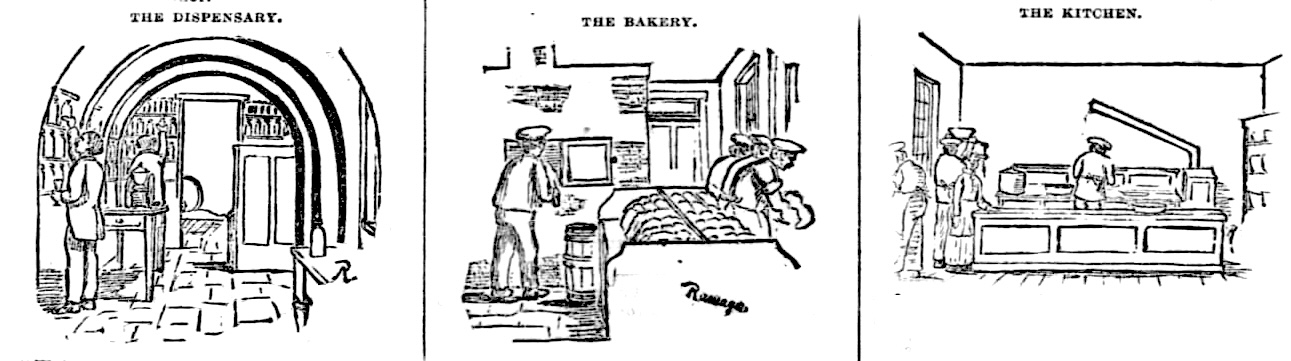
The drug store is well supplied with all medicines. The stock carried invoices, at cost prices, about $1,500. In this there are no tooth-brushes or hand-mirrors combined with perfumery cases. There are no articles of luxury. Everything in the way of medicine is of the purest and best quality to be obtained. Owing to the modesty of the druggist, his picture does not appear.
It’s a very good dinner that we get in the dining-room. The reporter and the artist have good appetites, as may be supposed. The roast beet and mutton are good, and so are Harry Varnell’s cigars, which come afterwards.
At last the tour of inspection is fairly commenced. Mr. Thomas Kavanaugh, the engineer, has charge of the basement. He admits that it is a four-story and basement building, and badly supplied with fire protection. Nevertheless he says as far as in his power lies be has made provision for the dread contingency. He says that upon every landing throughout this huge draughty building there is a reel of hose that needs but a turn to be in operation, and then be calls attention to the Babcocks scattered thickly about. He leads the way to the engine-room and we follow. He points to the extra fire pumps, and says that the capacity for throwing water is greater than that of any one fire-engine in Chicago. He shows us the fire-pumps and the extra engines all ready for use, but, though the engine-room may be as clean as my lady’s boudoir, in imagination we can hear the roar of the flames up the pine staircases, the “dust holes,” and the food elevators.
The building, the engineer informs us, is heated by both direct and indirect steam systems. There are six immense boilers in the boiler-room, and one is always held in reserve. Hot water is furnished for the laundry and kitchen. The water supply is derived from an artesian well, from a cistern holding 5,000 barrels which preserves the rainfall on the roof, and from the ponds and puddles about the institution, of which there is never a lack. In the winter, when there is a favorabie rainfall and a convenient freeze, there is a sheet of ice around and about extending for miles.
It is often the case that ice-boats are rigged up and navigated for amusement, the only drawback being the farmers’ gates and bars. The labor in the engine-room, the carrying in of coal and the carrying out of cinders, is mostly done by patients. Adjoining the engine-room is the repair-shop. It is quite extensive, as might be supposed from the large institution. Patients work bere, and to see them in their blouses one would never think them lunatics.
It takes about fifteen barrels of flour to make the bread for a day’s consumption of the which also includes the infirmary. The flour is winter and spring wheat. The bread is excellent. Here are employed a head baker and assistant and five men, none of whom are patients, for obvious reasons. The bread baked here is as good as can be purchased. It is never used upon the same day when baked. The rooms of the department are clean and sweet-smelling, filled with the scent of fresh-baked bread. The head-baker says there is no stint in the matter of bread. All get all they want to eat. He never heard of any certain amount being portioned out to each patieut.
The laundry is of course a very important part of so large an institution. Here the same ones work every day except Sunday, and it is more than likely that their troubled and bewildered brains would welcome the addition of that day to the others. The laundry proper is supplied with all improved machinery. There are huge washing-machines, and troughs with hot and cold water. When the visitors look in the work for the day is nearly done. Three or four men are scrubbing a refractory garment, otherwise work is suspended. The men look up with a broad smile of vacancy, but make no remark. Throughout the institution it is noticed that the men are much more taciturn than the women. Adjoining is a large ironing-room. Here is our first evidence that we are in an insane asylum. A babel of voices greets ours ears. A score of women are working, and all are talking to themselves with inconceivable rapidity. The advent of visitors seems to excite them. They are mostly incurable cases, though they do their work well.
“I’m not such a character,” insists one. “No, sir: I’m no such a person.” All the while she works away with great energy, occasionally getting a freshly-heated iron. “If you think I am you’re greatly mistaken. Any way I’m tired of you and don’t give a d—n.”
“You’re in the wrong shop!” exclaims another unfortunate. “Go and climb a fence!”
Miss Gallagher, who bas charge of this room is a little woman who is constantly smiling. and controls her difficult charges with ease, to all appearances returning the love they have for her. She never has any trouble, she says. Though the women are working with hot irons, and ironing clothing at times for the children of the officers, and doing work that requires much skill and dexterity, there seems to be no occasion or temptation to violence. The laundry in all its appointments seems to be a well kept sort of place.
The kitchen is clean and well regulated to all appearances. There is a long range and the usual kitchen appliances. A diminutive woman here, though quite good-looking, says her name is “Richard the Third.” She notices the reporter looking at the range and says it takes fire every night at 11 o’clock. “I dote on Byron and Shakspeare,” she says, “but don’t smash your heart for me. I am wedded to the stage.” The officers say she has been here a long time, and but little is known about her. That she became insane from studying for the stage is the theory. For all ber lunacy she is a prime vegetable cook. Perhaps the turned brain of a second Mary Anderson, Clara Morris, or Bernhardt is in the kitchen of the Cook County Insane Asylum. In a small room adjoining there are appliances for steam cookig. Large kettles are used for coffee and tea, rice, hominy, and mush. The head cook says they have for supper for the patients mush with sirup, bread and butter, and tea or coffee, while the workingmen get meat. For a change oatmeal is issued or cracked-wheat. For sauce there is prunes or dried-apples. For dinner they have boiled beef, soup, and vegetables. The meats are changed three or four times a week for variety. Friday they have fresh fish. When pork is given for dinner tea is added to the bill-of-fare. The vegetables comprise potatoes, beans, and hominy; sometimes onions and even celery. In summer all kinds of vegetables are added in their season. There is no allowance or ration, but a suflicient quantity is sent to each ward to supply the patients therein with all the food they wish. If more, than the first order is called for it is sent. Any surplus is saved for the next meal.
A vegetable store-room is reached, and the guides stop long enough to show a queer character. A man was once found on a wood-train that arrived at the asylum some twelve or fourteen years ago. He could give to account of himself, and nothing was ever learned about him. For years and years he has busied himself every day in peeling potatoes. He never speaks to any one, but smiles broadly when any remark is made to him. There may be in his history a romance that would make a modern novel-writer sick.
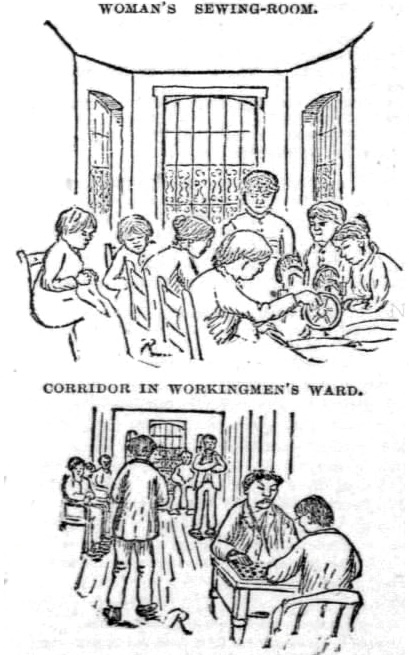
In the sewing-room there are from eighteen to twenty women employed in making bedding, quilts, asylum dresses, and clothing. The better class of female patients work here, and they all seem to enjoy the labor. One girl seemed to be afflicted with a happy type of insanity, for she was continually singing and laughing. None of them are compelled to work, but perbaps a lunch served at 9 o’clock is au inducement. This consists of fresh tea and coffee and what is left from the officers’ breakfast table. The dresses are substantial and of a dark calico, plainly made. The clothing for men is bought ready-made, and gives good wear. The women take great interest in the progress of the work and some of them chat together, though that is the exception rather than the rule. The sewing-room is situated in the front of the basement, where there is a pleasant outlook on the grounds. M’ss Van Tromp and Miss Daniel have charge of this important department.
The store-room is like a country store, except that all goods are in large quantities. Here are crockery, tinware, ready-made clothing, hats, caps, boots and shoes, barrels of sugar, sacks of coffee, and almost everything to be thought of.
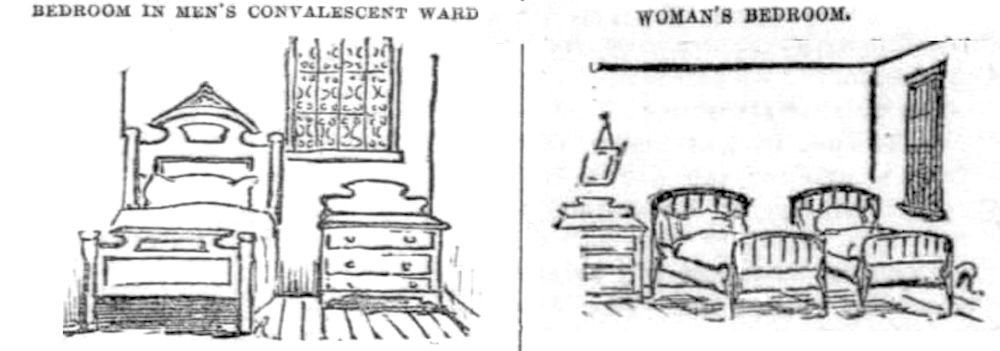
Dr. Kiernan here joins the visitors and we start in to look at the wards. There is a great similarity in their arrangements, and it is hardly necessary to go through all of them. The first one is that of which a view is given above. There is a long room or hall, not very well lighted, and small bedrooms open off upon each side. The men are uneasily walking about or listlessly sitting in chairs. This is one of the best-behaved wards in the institution, though the delusions of the patients are painfully apparent. One poor fellow wears a policeman’s star of tinfoil, and a club made of a short handle of a broom; another imagines himself a steam-engine, and works his hands and arms in imitation of valves and levers. The small bedrooms have two inmates, double their ordinary capacity. The grated windows make one think of a prison.
Here is a male convalescent ward. Dr. Kiernan introduces the visitors to a patient who for several weeks insisted tht he was dead.
“What did you do?”
“We fed him.”
The patient looks healthy, and says in a strong German accent that he ” vos baetter.” This man will probably got well and be able to make his own living at least.
“This is one of the rooms where we allow them to have knives and forks,” said the doctor.
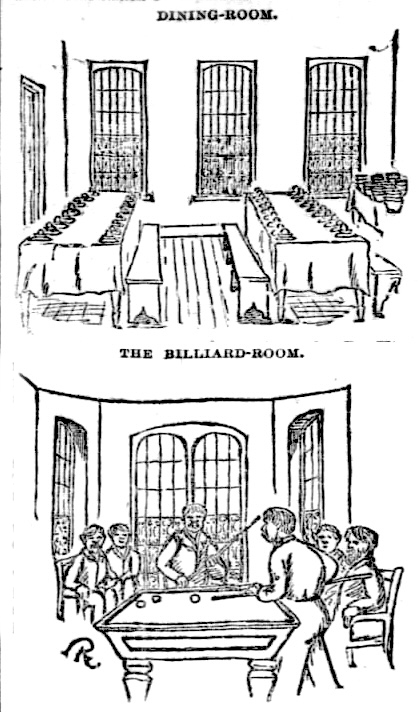
The dining-room contains two long tables. There is a cloth, and at each place is a plate, knife, fork, and cup. The dinner hour is past, so we are debarred the privilege of seeing the patients eat.
An alcove in one of the octagons is a billiard-room. The table is antiquated; the cloth is torn; the cues are crooked, and the tips are very queer. The doctor says any of the patients can play who choose. With no disrespect to the insane we hope they are not crazy enough to play on that table.
There are a number of styles of bedsteads in the rooms. The best looking, but the worst in a sanitary point of view, is the wooden affair shown in the cut. The best is the plain iron bedstead, which has of late years been adopted in hospitals the world over. The bedrooms have also a bureau with drawers, and sometimes the walls are ornamented with much taste and skill by the patients who have talents with a pencil or an eye for color, a pair of seissors, and the good will of the attendant. Dr. Kiernan thinks the plan of associated dormitories much better for the insane, and consequently the wards in the new building will be built upon that principle. “There’s a young man,” said Dr. Kiernan, “who came here convinced that be must cut his own throat. He is doing well now.” The young man was as pleasant in appearance as ever was a State-street masher. He is smoking, too.
“Do you allow your patients to smoke?” was asked.
“Under orders of the physician.”
Checkers seems to be a favorite amusement with these unfortunates.
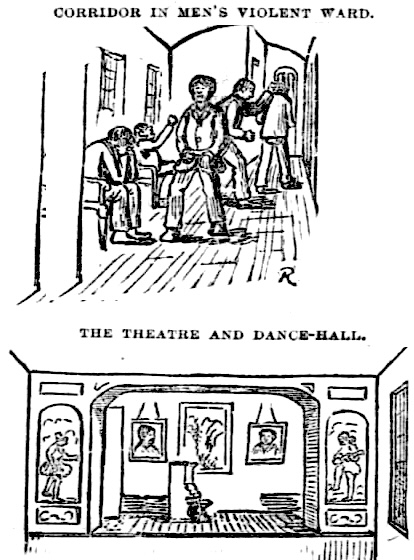
This is one of the sad sights of an insane asylum. Here are sixteen men with murder in their eyes and their hands only kept from our throats by fear. The attendant keeps closely at our side as we pass through. Those evil, cunning eyes have the devil in them and no mistake. There are sixteen patients. We glance in the dining-room: there are no knives and forks. The cups and plates are of tin. Two attendants are needed in this room. There is no noise, but a sort of desperate silence. The glitter of those dry eyes affects one like being in a den of beasts. For the first time we see a patient under restraint. He is wearing the wristlets. These are leather bands about the wrists drawn behind the back with a strong cord. With these on he can do no great damage, but should it be necessary a “muff” is added. This is simply a leather covering for the hands. Could the readers of The Tribune have seen the evil eyes of the lunatic who wore the wristlets they would not have objected to his wearing the “muff.” Who do you think it was? George Brown, the colored boxer. His head was wreathed about with a silk handkerchief, and, though quiet, his eyes were wells of liquid fire. “He will die inside of a year,” said the doctor.
We are shown the bath-room in the ward. So great is the fear of fire that the tubs are filled at night. The question was asked if the bath was used as a punishment. It was denied. An old habitue of the institution now engaged in other business was asked the same question. He said be had never heard of any cruel or unusual punishment. It was true that perhaps an exasperated attendant might on occasion strike a patient, but such cases were rare, and those who had to do with insane men might wonder if it was not of daily occurrence. The next visit was to a female ward where were domiciled chronic cases. Some, most of them in fact, were young women. A sparkling, black-eyed Italian insisted upon our accepting some chestnuts, and slyly slipped a button in the reporter’s hand. The doctor says her husband comes to see her every day. She is clean and handy, as is shown when she goes in her room. Others are singing songs to themselves. In the alcove a couple of women are playing dominoes, though probably not in accordance with the strict rules of the game. In this department, as in all others, the rule of associated dormitories will be adopted as soon as practicable. We pass through quiet male and female wards, thence through the female reception wards, and a convalescent female ward where there is an epileptic girl 1l years old. Here there is a piano, but fortunately no one seems to be playing.
“Are there any letters for me, doctor?” inquires a young woman.
“No.”
“Well, maybe they’ve been lost. Any way, you’ll be faithful and bring any to me that may arrive, won’t you?”
“Yes.”
“It is always best,” said the doctor to the visitors, “to tell the truth to the insane. A falsehood seems to make them wild.”
Here is a babel of tongues and a fluttering as we enter. The attendants are smiling little women who don’t seem to fear their surroundings. The visitors are insulted and berated in the vilest language. It is a sad experience. One woman is with difficulty prevented from making mince-meat of the reporter.
“She’s only trying to attract attention,” said the doctor. “She’s perfectly barmless.” Nevertheless the reporter would rather be out of reach of her talons.
Some of the bedrooms are fitted up with considerable taste, others are filthy, and the odor of carbonic acid is not very agreeable.
We pass through a ward of quiet female cases. Here is the youngest patient in the institution—a little boy 3½ years old—an epileptic. A woman comes to us dancing and singing a song in German. Others are playing dominoes and checkers.
As the doctor turned the key in a door he sighed and said: “We now come to the black spot that exists in every insane asylum and always at the top of the house—the demented ward.”
“Why demented?”
“Those who have lost all control of their persons and habits.”
It was a sad sight.
Some were lying on the floor and others in various outlandish attitudes. None seemed to have a vicious look. The attendants kept close to the visitors.
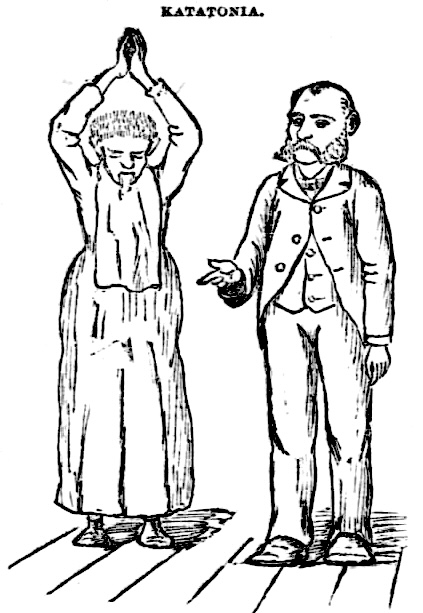
“This case is peculiar,” said Dr. Kiernan, as he gave his visitors seats and drew a girl from the wall to the floor in front of us. He placed her hands over her head at the extent of her arms. “You see the muscles remain where placed until the patient drops from fatigue.” The girl stood with dazed eyes and her clasped hands in the uncomfortable attitude as shown in the cut.
“Another thing you will notice,” said he, “is the dry, erect hair. This is a marked symptom of certain stages of insanity.”
We gladly leave this room and step into the amusement ball. Dances are held here every Saturday night. It is in contemplation to have plays upon the stage and various other amusements that may distract the minds of the patients from their troubles. As we are going Dr. Kiernan says: “Remember that you have seen in all the institution but two patients under restraint, and those only with wristlets.”
“How large a proportion of the inmates are paupers?”
“About one-thirteenth are ostensibly pay patients. But this is only nominally so. Very few who promise to pay expenses here do so. An order has been passed by the board that after next July all inmates shall be upon the same footing, and no charge will be made for their care or maintenance.”
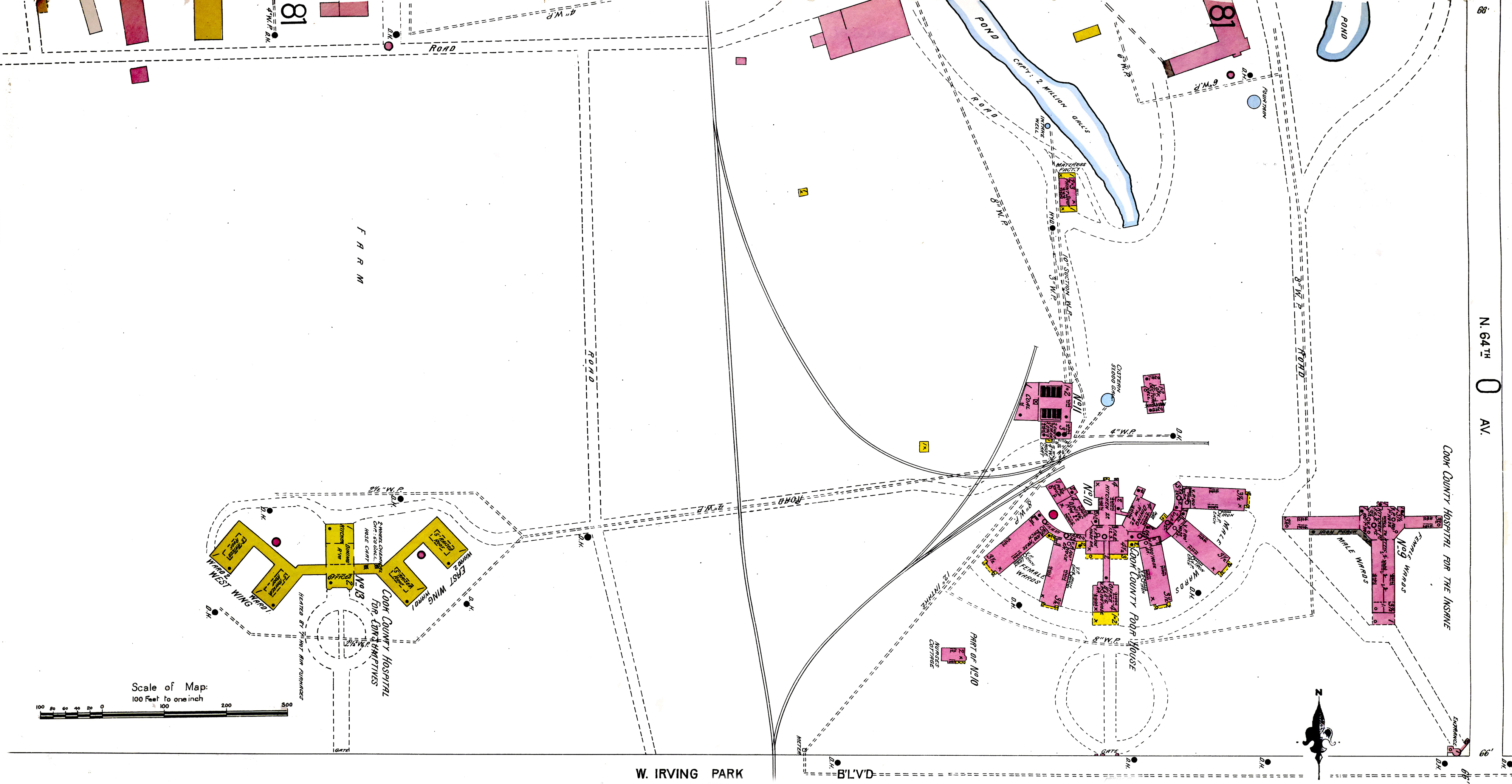
- Cook County Asylum
Sanborn Fire Insurance Map
1905
History of Cook County, A. T. Andreas, 1884
D. S. DUNNING, an old settler, came to Cook County in 1836 and laid claim to land eighteen miles west of Chicago, in what is now DuPage County, and after preparing some timber for a log cabin, returned to Canada, where he resumed his former occupation of school teaching, at which he continued until July, 1838, when he, with his wife, bade adieu to Canada, and reached their new home after a tedious trip of over a week around the lakes. He was the head of the Government surveyors, and resided on his claim two years before there were any boundaries to distinguish it from the great open prairies king around, except a furrow, which among settlers was sacred. In 1844 he sold out (as was the custom) to a German, and reinvested in a small farm near by, adding to the usual branches of farming vegetable gardening for the Chicago market, and a few years later commenced propagating the now noted early Richmond cherry trees, and became the most extensive grower of that fruit in the Northwest. In 1865 he bought a farm of eighty acres near the village of Jefferson, Cook County, and left a son in charge of the old place. The same year he sold a half-interest in the farm at Jefferson to his oldest son. A. Dunning, which partnership continues till the present time. They subsequently sold the first purchase in Jefferson to a Boston capitalist, and purchased one hundred and twenty acres, which they still own, and on which is located the new town of Dunning.
Since his residence here he has devoted his attention to horticulture principally. Mr. Dunning was born in Clinton County. N. Y.. May 19, 1812. He was brought up on a farm in his native county. From 1833 to 1838 he resided near Hamilton, in Canada, where he was married to Miss Hannah I. Nash, of the same place. June 18, 1834. They have seven children now to bless* them—Andrew, Mary A. (now the widow of John Miner), Samuel N., Freeman H., Russell O., James Mc. and Albert. Mr. Dunning is deacon to the Congregational Church, and has resided in the village of Jefferson since November, 1866.

Leave a Reply