Munn & Scott Northwestern Elevator,
Life Span: 1868-1871
Location: Canal, se. cor. Carroll
Architect:
- Edwards’ Annual Directory in the City of Chicago, for 1870
Munn & Scott (Ira Y. Munn and George L. Scott), props. elevator, Canal, se. cor. Carroll, office, 42 Lumber
The Land Owner, July, 1871
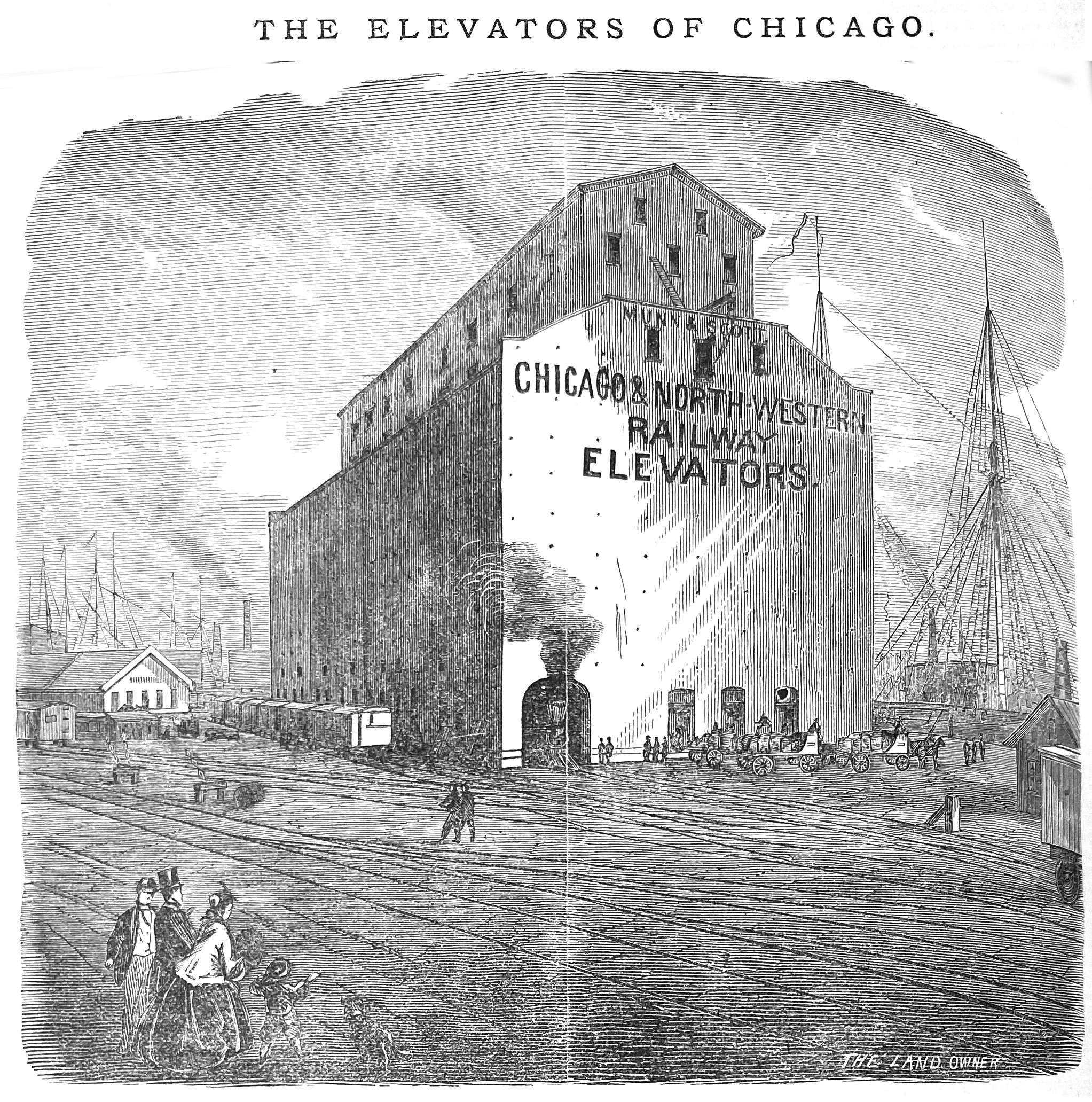
THE CHICAGO ELEVATORS-THE PRODUCTS OF THE PRAIRIES AND HOW THEY ARE HANDLED.
The value of farm land depends almost entirely upon what it will produce. It is rarely affected by speculative causes, but its enhancement goes on from year to year, in just such proportion as the country fills with inhabitants, improvements are made and railroads built. While it does not come within the province of The Land Owner to discuss agriculture, but land as an investment for money, we recognize the necessity of showing the general public how the products of the land are handled and manipulated, in finding a market, as the agricultural press of this city have neither the enterprise nor ability to do so. We therefore direct our artist to dissect one of our great elevators, and the accompanying illustrations are the result of his labors.
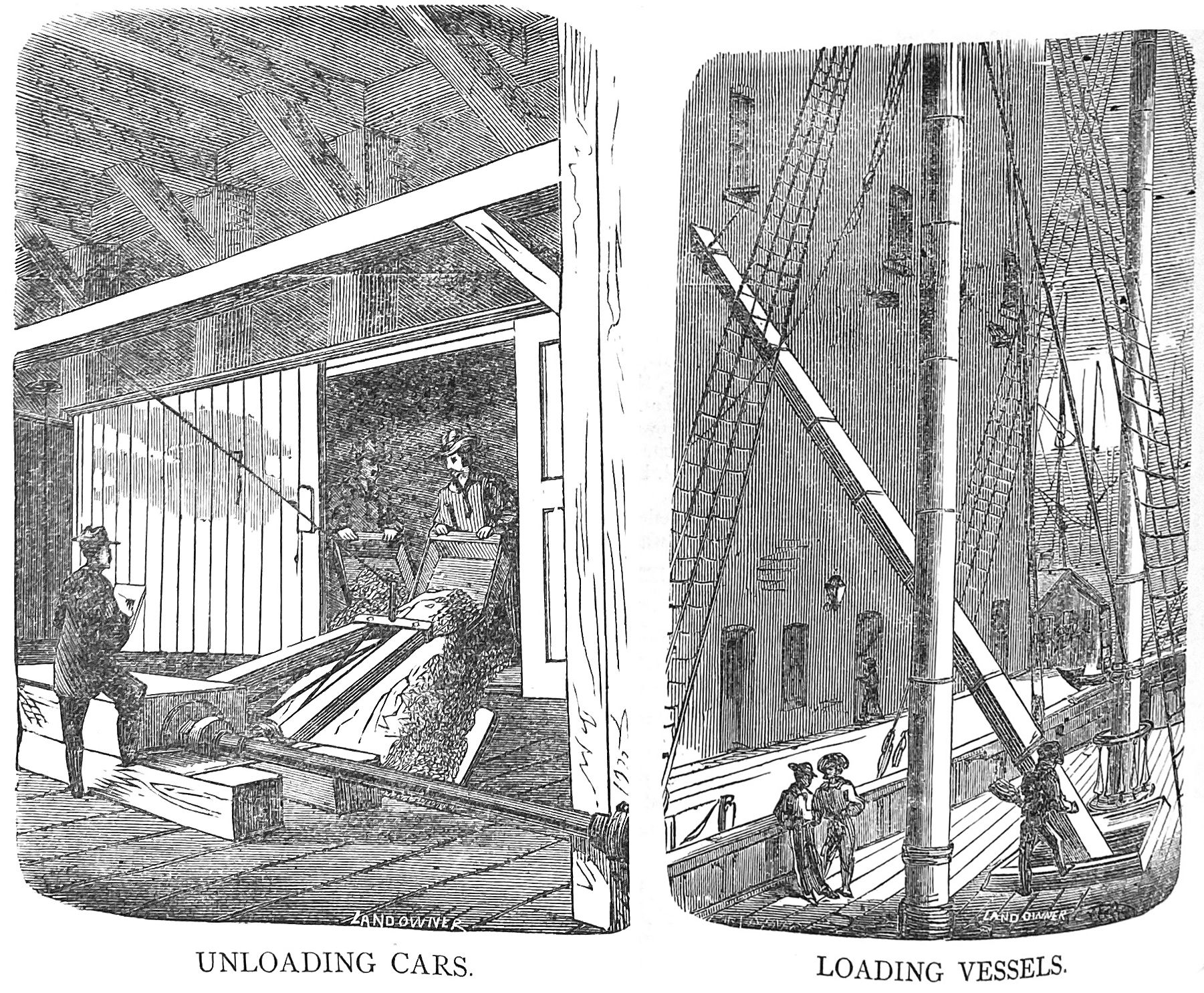
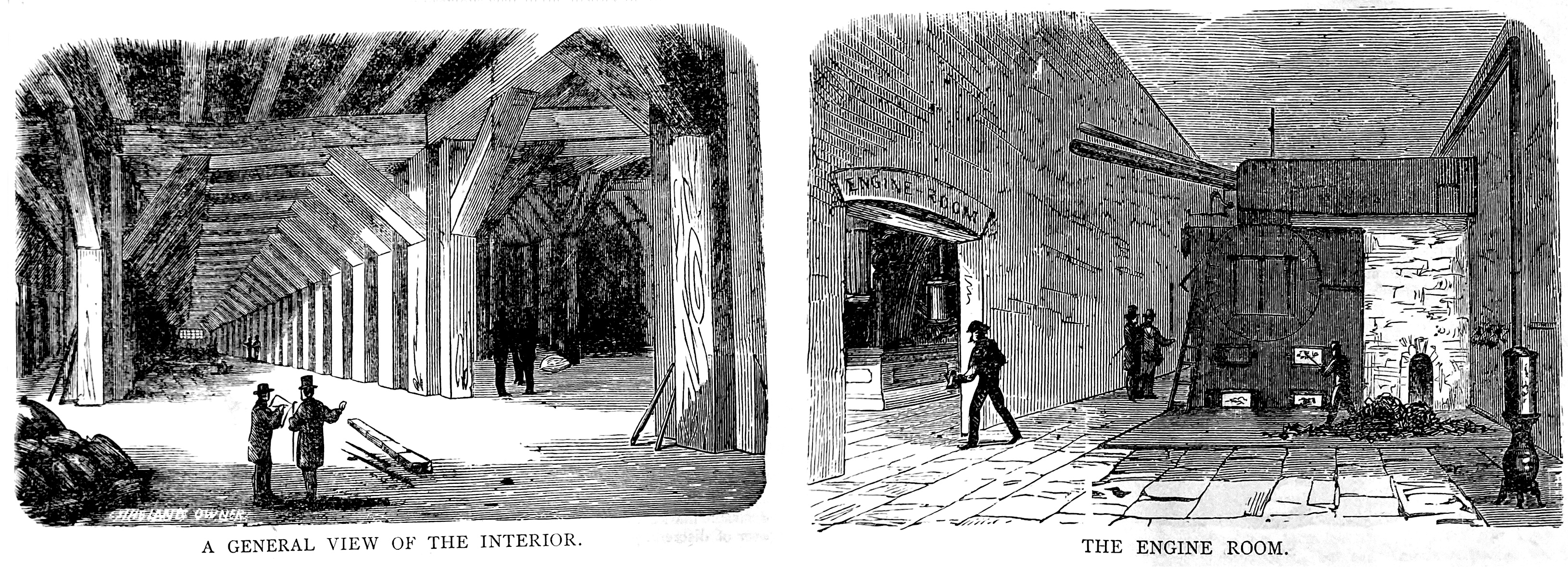
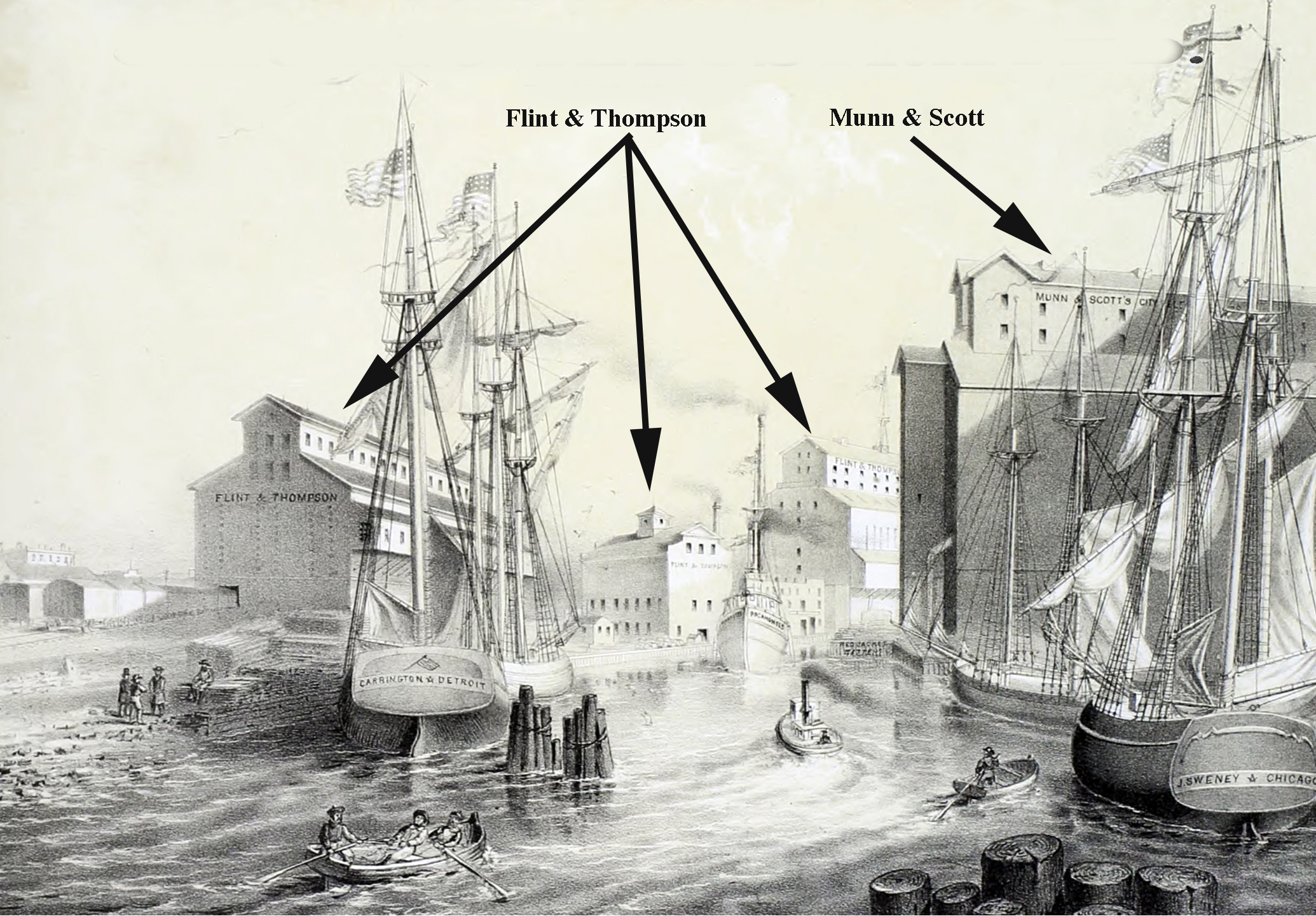
The main illustration gives an excellent view of the Northwestern elevator, surrounded by moving trains of cars, draymen, and its crowded river docks. It is a scene full of life and activity. The other engravings show the engine and boiler-rooms, a general view of the interior (ground floor), the weigh room, the process of loading a vessel and unloading a car, and the two miniature views show a scene on the wharf, and a view from the river. From this elaborate series of illustrations an idea can be easily formed of the entire detail workings of the elevator system, which has of late years attracted so much atten-tion, from a well-known habit the warehousemen have of making short weights, issuing bogus certificates of grain on hand, etc.
From the report of the Secretary of the Board of Trade, for 1870, it appears that the receipts of wheat for the year were 17,394,409 bushels, over 500,000 bushels in excess of 1869, and more than any previous year in the history of Chicago. The amount received from the crop of 1869, from January 1st to August 1st, was less than was anticipated a year since. The quality did not improve with the later deliveries, and in fact but a comparatively small percentage of the wheat received here, prior to the new crop, was in strictly sound condition. Large quantities were stored in the interior, especially at points on the upper Mississippi river, during the winter. This came forward in May and June, and proved to be in doubtful condition; much of it not actually damaged, but of a character likely to injure when stored in large quantities during the warm weather. Prices were maintained in this market at a point, considering the condition of the property, that caused buyers for shipment to act cautiously and slowly, hence the stock in store was kept up from 1,750,000 to 2,000,000 bushels, until alter the middle of July, and a large portion of this had remained in the bins for from six to eight months. About the middle of July some of the wheat in the elevators began to show decided signs of heating, and from time to time thereafter, considerable quantities of it were posted as being more or less damaged; the prices for such was greatly depreciated from the current price of that supposed to be in fair condition, and was finally worked off by degrees, in some cases at ruinous loss.
The crop of spring wheat for 1870, while probably not a large one, is, as compared with that of 1869, of very superior quality. The receipts since August 1st have been I0,209,044 bushels; corresponding time last year, 7,610,926 bushels. Many familiar with the facts, estimate that a larger percentage than usual was marketed during the autumn months, and hence conclude that our receipts hence to August 1st will be no larger than last year. The high character of the wheat received at this point since August has sensibly improved the reputation of Chicago as a desirable market in which to purchase; and whatever of discredit previously attached to our market in this regard has passed away. The winter wheat crop of 1870, in the West, was not equal to that of 1869, and many points that last year had a local surplus are now or are likely to be, purchasers in our market for consumption; and the depressing influence of the presence in the Eastern markets of large quantities of winter wheat is no longer felt. The export demand has been fair during a portion of the year, and in view of the necessary waste of the war just ended between the immense armies of two powerful nations in Europe, and the fact that European wheat crops were at best only moderately fair, it may be fairly inferred that a reasonably good demand is likely to exist for all the wheat the United States may have to spare until another harvest. The Agricultural Bureau at Washington estimates the product of the principal wheat producing States at considerably less than in 1869.
The following is a list of all the elevators in Chicago, with their respective capacity for storage:
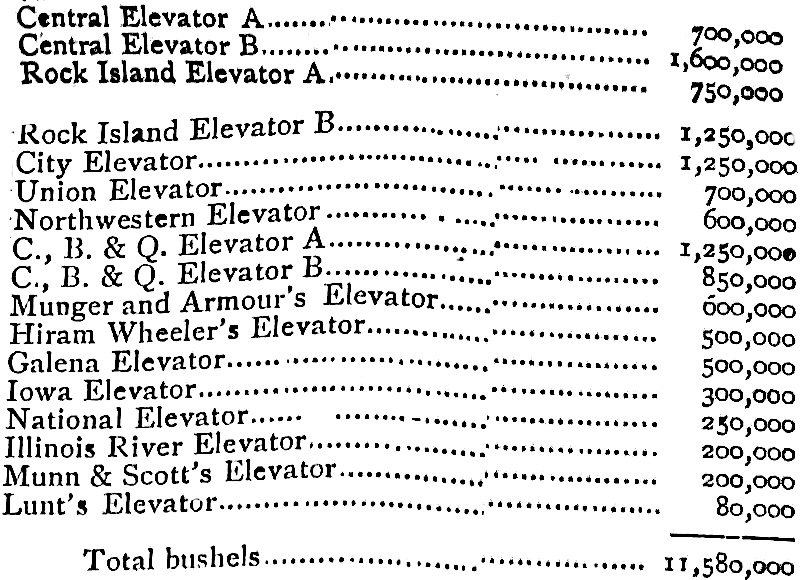
The grain trade of Chicago has been one of the prime causes of its rapid growth, and hence real estate here owes much to the elevators, and to the products of the prairies. In the immediate vicinity of the elevators, land is very valuable for railway side-tracks, docks and yard purposes.

Chicago Illustrated, March, 1866
Chicago Tribune, December 13, 1872
MUNN & SCOTT.
Another Act of the New Local Drama.
The Ex-Elevator Men Taken Into Custody to Prevent Their Escape from the City.
It having transpired that Ira Y. Munn and George L. Scott were about to leave the city, probably yesterday evening, steps were taken for their arrest just before the closing of the Courts. Between 3 and 4 o’clock, the following petition and affidavit were placed in the hands of Judge Drummond:
- Your petitioners, John P. McGregor and George D. Lincoln, respectfully represent that they are informed and believe that Ira Y. Munn and George L. Scott, two of said bankrupts, are about to depart from this State, with no certainty of their returning; that said bankrupts have yet been examined by said Assignees, except upon a few points, and their presence and testimony will be indispensable in many things relating to said estate, and to answering to such orders as the Court may hereafter make in this case. Your petitioners, therefore, pray that said Munn & Scott may be compelled to give bond, with sufficient security, for their appearance before the Register, in Court, whenever the same may be required by said Register, in such sum as the Court may determine.
George D. Lincoln’s affidavit, accompanying the petition, avers that within the past four weeks the said Munn told him that he was going to leave, yesterday, for some point on the Central Pacific Railroad, or in California; and that Mrs. Scott told him that as their exempt property was made over to them, she and her husband intended to go to some point in the Western Territories. In accordance with the petition and affidavit, the Marshal was ordered, at 4 o’clock yesterday afternoon, to arrest the said Munn & Scott, and to hold them until they gave bail, to be fixed by the District Judge, and as the Judge left for his residence shortly afterwards, these gentlemen will probably have been under arrest all night, and be brought up before the Judge to give the necessary bail this morning.
Petition of Jesse Hoyt.
On the petition of Jesse Hoyt, of New York, the yesterday filed in the bankruptcy side of District Court, praying for the sale of the property assigned to him by Ira Y. Munn, which has been the subject of so many examinations, the Assignees in the estate were, yesterday, ruled to show cause why the prayer of the petitioner should not be granted. The rule says that the depositions taken herein may be read by either party, and that either party may produce affidavits. The petition contains no facts not already made public in these columns. It will be remembered that the property principally mortgaged consists of the Munn & Scott elevator, and undivided three-fourths of the Northwestern elevator, and an undivided five sixteenths of the City and Union elevators. The petitioner alleges as the ground for an immediate sale that he is unable to place any insurance on the elevators in consequence of distrust occasioned by recent proceedings, and that the property is inadequate security for the money dne him, amounting to $350,000.

Leave a Reply