Chicago Magazine, August, 1857
DIRECT TRADE OF CHICAGO WITH EUROPE.
The all-engrossing topic, in monetary and commercial circles, for the day, is the intluence, prospective, on the fortunes of our city, likely to be exerted by the direct trade with foreign marts which has within the past season grown from a vague dream into a defined reality. The Madeira Pet has, by her appearance in our harbor, settled the matter, that our neighbors across the water, alive to the importance of the subject, have seized the first opportunity to reciprocate, “by a return of the compliment,” the enterprise of our own merchants, in proffering to them the offer of an interchange of fraternal and commercial intercourse direct, without the aid of our seaboard cities.
Eighteen months since, and those of our citizens who were bold enough to urge the practicability of opening with Europe a direct trade, with profit to ourselves, were looked upon by the more plodding portion of community as visionary enthusiasts—of the same class as those who recklessly claim that Chicago must, in a few years, rival in extent and importance New York city itself-they were jeered at and their project denominated an empty bubble. Discouraged, but not disheartened, they resolved to test the accuracy of their opinion by a venture of their capital, and accordingly the Dean Richmond laid her course for Liverpool, where, amid the warmest wishes of her capitalists and merchant princes, she soon arrived. Even after news of her successful trip—successful in every particular—had reached us, many still shook their heads, exclaiming— “A rash Yankee speculation turned up lucky. It’s all good fortune—nothing more. The more cautious Englishman will never follow her track with a keel.”
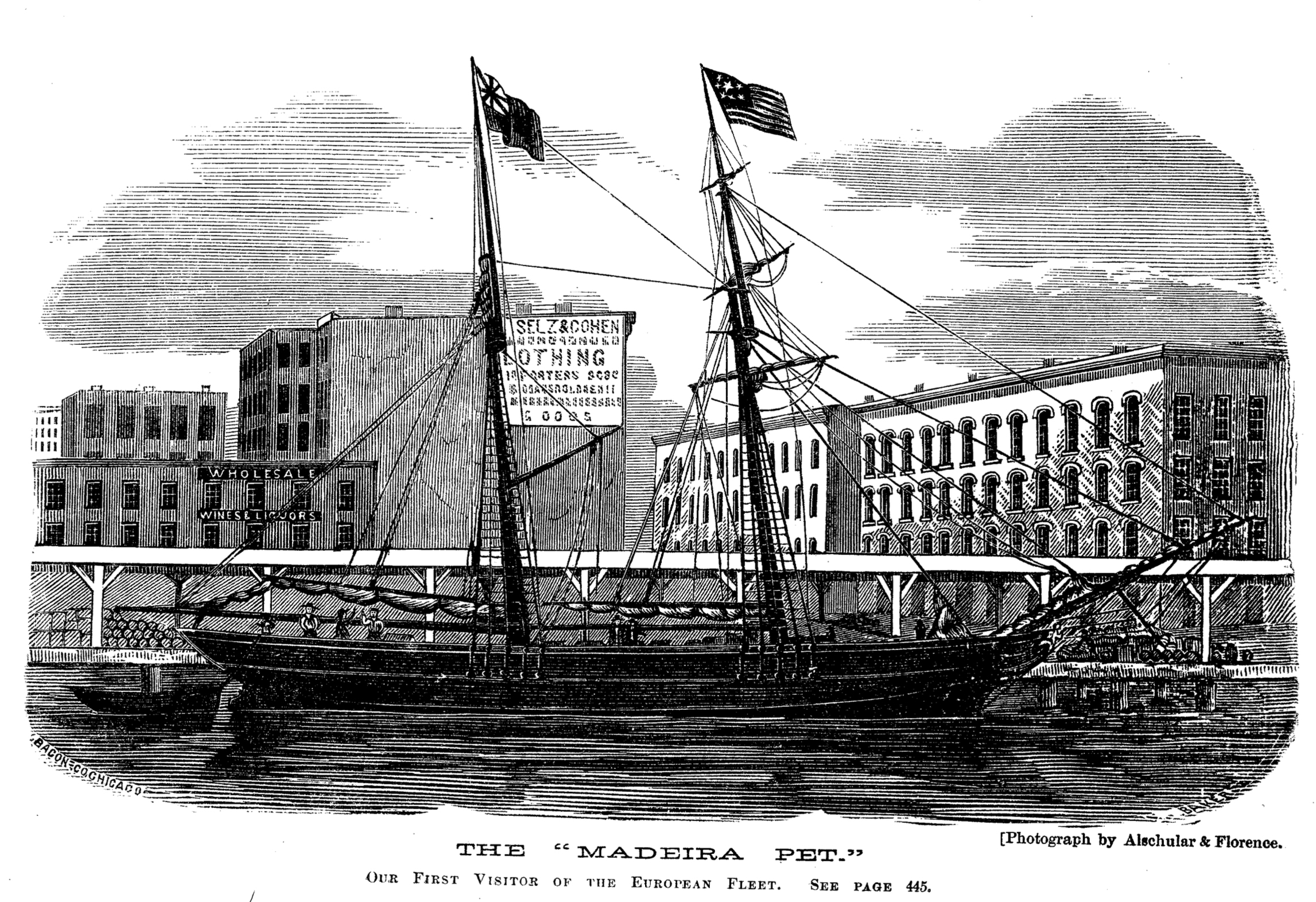
The Madeira Pet has given the broad denial to this—those poor sanguine souls have gladdened their eyes by an inspection, at their own doors, of an English vessel—English manned and officered, with an English cargo,—cleared from England’s greatest metropolis, direct for Chicago—her merchandise consigned to our Chicago market for its sale. Now, they say in answer to the “aside” looks of the “old fogies,” if we were crazy, more cautious men than you even imitate our folly; and they, too, will receive a reward of dollars for their foolhardiness.
“As to Europe,” said the Father of History nearly two thousand years ago, “no one in existence knows whether it is encircled by the sea.” We say now, that North America encircles the sea. Heroditus did not know that a ship had ever sailed around Europe; we know that a ship has sailed from the West of Europe to the State of Illinois—our own Prairie State. Though we are not, we are sorry to say, witty—not even funny-we claim to be very good natured, and on this occasion acknowledge feeling kindly to all the world, but preeminently so to Capt. Crang, the commander of the little British vessel that has just now sailed into Chicago harbor. Hearing of our commercial importance-present and prospective-he is the first of our cousins over the water who determined to show, by occular demonstration, that “some things can be done as well as others”—in short, that a direct communication can be profitably opened between the port of Liverpool and that of Chicago.
As was to be expected, Yankeedom was ahead in this matter. It has been duly chronicled, that last year Capt. D. C. Pierce successfully navigated the schooner Dean Richmond from Chicago to Liverpool; that the owners are well satisfied with that ven-ture, and sanguine that such undertakings will prove remunerative; but that was looked upon as only the American side of the question. The safe arrival of the Madeira Pet may be considered as the European demonstration. Moreover, Capt. Crang, the commander-a noble specimen of a Scotchman—who was received with great courtesy and hearty cheers by the Chicago Board of Trade, declared that no accident of any kind had occurred; he was convinced a much larger vessel could have been brought with entire safety. He announced, too, that he was building a larger craft, which, “God willing, he would bring to our waters next season.”
The Dean Richmond was the enterprise of our own citizens. For the present undertaking, we are indebted to parties not interested in our city’s progress. The originator of this project is W. J. Gilbert, Esq., of St. John, New Brunswick, who spent last season in our city and the north-west.
According to the log of the Madeira Pet, she left Liverpool April 24th. “July 14th, at 8 A.M., of Chicago harbor; sailed up channel, and came to at North Pier,”—thus consuming eighty days in the trip, only thirty-four of which were taken to reach Montreal; but owing to detention on the Welland Canal, to adverse winds and calms, she was forty-five in making the passage to this port. Under ordinary circumstances, not more than five or six days would be consumed in the passage from Montreal here. Vexatious delays occurred to her which will not interfere hereafter with the trip of foreign vessels to our port.
Chicago Press, July 18, 1857
DIRECT TRADE BETWEEN LIVERPOOL AND CHICAGO.
Yesterday morning the British schooner Madeira Pet, from Liverpool direct, dropped into our river, and modestly lay to at the north pier, near the mouth of the harbour. Intelligence of the arrival, however, soon reached the city, our and before 10 o’clock she was visited by large numbers of citizens, who were anxious to look upon the first British vessel that had made the passage from Liverpool to Chicago. The question of direct trade with Europe had, it is time, already been satisfactorily demonstrated by the trip last year of the barque Dean Richmond, from this port to Liverpool; but that was looked upon by many as merely the American side of the argument. The solution of problem in the arrival of the Madeira Pet, is considered as the European demonstration. If both are satisfactory to the public and the parties interested, we may at once consider the trade as permanently established. That the interest manifested by the citizens of Chicago was not mere curiosity, the action of the Board of Trade on the occasion proves. A soon as it was known on ‘Change that the schooner had arrived, there was evidently some sensation produced, ‘The Board of Trade met, and the following resolutions, on the motion of Alderman Bross, were unanimously passed:
- Whereas, The Madeira Pet, Captain Wm. Crang, has arrived at this port this morning with a cargo shipped at Liverpool direct for Chicago; and whereas this event is regarded as one of the most important and significant events in the commercial history of our city, therefore—
Resolved, That we hail the arrival at this port of the Madeira Pet direct from Liverpool, as the pioneer of an immense foreign trade soon to be opened between Chicago and Europe.
Resolved, That we congratulate Captain Crang, W. J. Gilbert, Esq., the originator of this enterprise, and T. R. Gordon, Esq., interested with him, in the successful voyage she has made, and that they have our best wishes that they may realise a liberal profit from their enterprise.
Resolved, That the successful voyage of the Dean Richmond last year from this port to Liverpool, and that of the Madeira Pet from Liverpool to Chicago, have fully established our confidence in the entire practicability of direct trade between Chicago and the ports of Europe, and that to facilitate this trade our Canadian neighbours will doubtless enlarge the Welland Canal, and construct the Georgian Bay and Ontario Ship Canal, with a capacity to pass vessels of a thousand tons burden at as early a day as practicable.
Resolved, That in our judgment the growing commerce of the north- -west will warrant the making of the above improvements, and that they be and are hereby commended to the eucouragement and the careful consideration of business men and capitalists of Canada, the United States and of Europe.
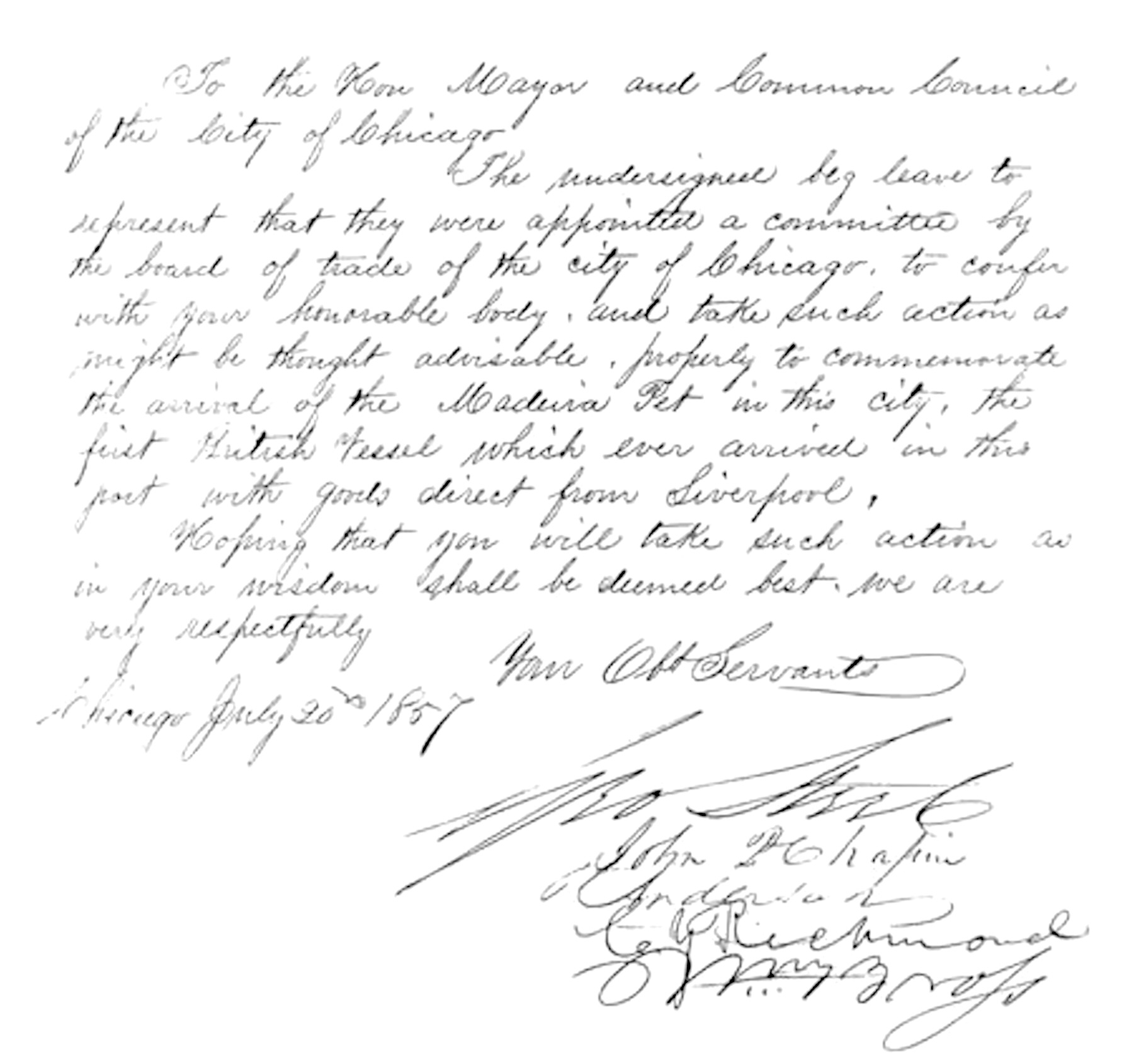
Resolved, That a committee of five be appointed by the chair to confer with the hon. mayor and common council to recommend a suitable celebration of the arrival of the Madeira Pet, and to testify to her officers our high appreciation of their enterprise.
The Madeira Pet is a small topsail schooner of 123 tons register, is only 97 feet long, breadth of beam 18 feet, hold 11 feet deep, drawing with her present cargo (240 tons) 9 feet of water.1 She is not what would be termed on these lakes a good model, but is by no means so tubby as the generality of English-built vessels. In fact, she has a trig and neat appearance not often found in vessels of her size. She sailed from Liverpool on the 24th of April, and in 35 days reached Montreal. From Montreal to this port she took 45 days; but she was delayed eight days in the Welland Canal, and had, between Detroit and here, quite a succession of adverse winds and calms. Capt. Crang states that he kept up with a fleet of about 30 sail of lake vessels which loft Detroit River with the Madeira Pet, and whenever it blew fresh he could pass them. Under ordinary circumstances the trip from Montreal to Chicago can be made in from fifteen to twenty days, and had the Madeira Pet got into Lake Huron two days earlier than she did, the prevailing winds since then would have brought her up at least ten days earlier. The Madeira Pet was built in 1850.
The Dean Richmond, as our readers probably know, was the enterprise of our own citizens, and was considered as partly an experiment. To the present undertaking we are indebted to parties not interested in our city’s progress; but to shrewd, intelligent, business men. The originator of the project is W. J. Gilbert, Esq., of St. John, New Brunewick, who spent last season in our city and the northwest. The cargo, which consists of hardware, cutlery, earthenware, paints, glassware, china, white lead, &c., was shipped by Messrs. Ker, Welsh and Co., of Liverpool—Mr. Ker having also spent a portion of last year among us—and is consigned to Messrs. H. Burch and Co., of this city. Mr. T. R. Gordon, of New York, now here, is agent of the comsignees.
Chicago Daily Tribune, September 3, 1857
HOMEWARD BOUND—The schooner Madeira Pet arrired in this harbor yesterday, on her return from Chicago to Liverpool. We fancy that her skipper will have something to say to his friends at home which will give occasion for the shaking of many a head doubtful of “travelers’ ales.” The St. Lawrence, gulf, river, canals, and inland seas from St. Paul’s to the head of Lake Michigan! When he tells the “old folks” at home of these, and that a voyage across the Atlantic is of the smaller account in a journey from Liverpool to Chicago, his narrative of the scinalities will hardly be credited. Land abead!” and yet nearly 2,500 miles to go! Impossible! will say ninety-nine out of a hundred has a the to hundred to the captain of the Madeira Pet, yet he has but the simple tact to stale either to the old sailors or marines.
We have a particular pleasure in advertising to the Pet’s trip, because that the enterprise in which she is engaged is one naturally following in the wake of the movement originated in Kingston. Some twelve or thirteen years ago the brigantine Lilia left this port for the ocean trade much later, the barks Cherokee and Arabia. These reels were built here, their tonnage ranging from 300 to 350 (double that of the Madeira Pet), and capable of passing through the Welland canal. The Arabia on her return from Liverpool, proceeded to Chicago, and here was the first ocean keel to divide the waters of that tar western, arbor, amp prove for practicability of a direct trade between the transatlantic and lake ports. The Pet has our best wishes for a speedy homeward voyage, and a profitable adventure.—[Kingston New, 27th.
NOTES:
1For comparison the Chicago schooner Bertha Barnes, was 151 feet long with a 30 foot beam.

Leave a Reply