Chicago Tribune, August 25, 1856
CHICAGO TO LIVERPOOL.—The Dean Richmond, with a full cargo from Chicago, direct for Liverpool, sailed from hence yesterday morning for Liverpool. When she arrives at the latter port, she will have made one of the most extraordinary voyages which any vessel has ever made. She will have passed through four immense inland seas—the largest in the world—from the bottom of Lake Michigan, through Lakes Huron, Erie and Ontario. She will then have descended a river for nearly five hundred miles, and will then have crossed about three thousand miles of the Ocean. But what is most worthy of remark is, that from fifteen hundred to a thousand miles of this navigation, for we are not referring to any authority for exact measurements, has been made in an inland navigation, separated from the Ocean by the most extraordinary natural barriers, including the falls of Niagara, all of which have been made capable of being passed by a vessel large enough to sail the Atlantic by artificial means, employed by a comparatively obscure colony of about 2,000,000 of population. Four great ship canals had to be passed before the fresh water craft could float on salt water.—Montreal Herald, Aug. 16.
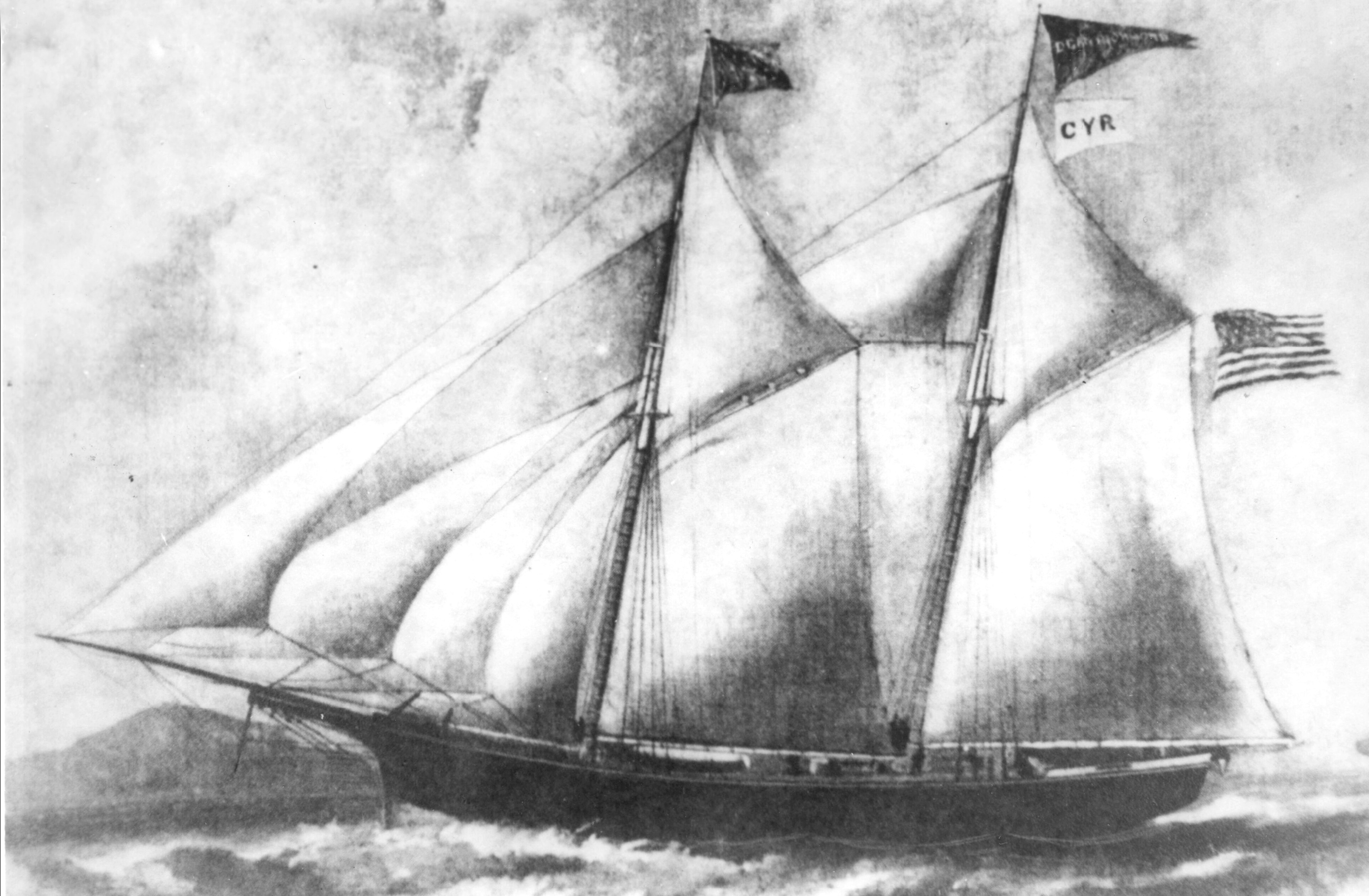
- Dean Richmond, 1855
London Times, December 3, 1856
The navigation of the lakes is suspended by the rigour of the winters, and such a feat as that of the Dean Richmond, which loaded at Chicago and delivered her cargo at Liverpool, is only possible during half the year. The rail way that connects the Far West with the ocean conquers this obstacle, and commerce can no longer be arrested by the severity of the climate.
Weekly Chicago Times, December 4, 1856
From the St. Paul (Minnesota) Advertiser.
Direct Transportation from Saperior to Liverpool
An article from the European Times recites the arrival at Liverpool, direct from Chicago of the Dean Richmond, whose departure we announced some three months ago. In this simple announcement is contained the initial fact of a new Era in commercial history and issues of startling and overwhelming significance crowd upon the calmest view of its relations with the future of the West.
It seems to us—we know not if we apprehend its bearings correctly—that the results of this experiment must be an eventual revolution of the internal traffic of the Western States. It virtually makes our inland lakes the Mediterranean Sea of North America, and Chicago becomes the Alexandria of modern times. It peels off the littoral rind of the New World at a stroke—and splits the ripe apple of the continent to its core. Ocean commerce will follow that entering wedge. Direct transportation will inevitably supersede the expensive and complicated machinery employed in conveying channels—which western grain through its present besides involving several expensive transhipments is attended with an important diminution of bulk. The Atlantic—the far Bosphorus, the Baltic and the hundred seas of the old hemisphere will flow in through the rent torn by the keel of the Dean Richmond and the majestic Commerce of the ocean overleaping the huge complications of human ingenuity—passing in triumph past the monuments of Clinton’s genius, past Railroads and Canals—through rivers and lakes—2000 miles into the interior will pleat its sea worn flag upon state the shores of Lake Michigan, in royal like another Queen of Sheba on the throne that western industry shall build for her in the chief city of the interior plain of North America. Nobody can doubt that tho demonstrated practicability of direct shipment from Chicago to Europe will eventually transfer the business of transportation to this channel. An inevitable consequence of this will be the enlargement of the Welland ship canal, the ring belt in the chain of communication from the ocean to the lakes, to a capacity sufficient for a ship of any required size. The application of steam will overcome the delays of navigation and the path opened by the Dean Richmond will be througed with the flags of every nation. But this is not all. What is true of Lake Michigan is true of Lake Superior. What is possible by the Welland canal is equally possible with the Sault Ste Marie. The splendid chain of inland navigation does not end with Chicago. It is complete to the extreme Western end of Lake Superior.
Here, at the uppermost limit of ship navigation, the town of Superior, some two years old, and containing not more than 800 inhabitants, is slowly rising on the shores of the Queen lake, from the that surround it, to meet the majestic destiny that is creeping with slow pace up the St. Lawrence and through the lakes towards her, and crown her with a diadem of ocean pearls.
Nor is this all—The ocean highway from the mouth of the St. Lawrence to the extending extremity of Lake Superior, will be the basis of the whole system of Western Railroads. A Northern Pacific Railroad with a terminus at Superior is the necessary supplement of the navigable highway we have described. The western terminus of that highway will be the Eastern terminus of the first Pacific Railroad ever built. The arguments in its favor are irresistible, unanswerable. It is a logical deduction from the whole law of Railroads.
The paramount purpose of the Pacific Railroad, we take to be, to facilitate the commercial intercourse between the Atlantic and Pacific coasts, in other words to facilitate transportation. Now transportation is impelled by an irresistible impulse in the cheapest route. Hence gravitation it self is scarcely more law than the tendency of Railroads to the nearest watercourse in the direction of their destination. They break off at once by a sort of physical necessity as transporting agencies, at the nearest navigable water communication. One always ends where the other begins. The commercial apparatus of the country is full of inland instances pertinent to this. By this long chain of inland lakes covering nearly half of the distance between the Atlantic and Pacific coasts, nature seems to pout with the force of a divine decree to a supplementary Railroad route to the Pacific, to connect at its nearest span the ocean navigation of the opposite sides of the continent, and there can be no doubt that other things being equal in feasibility of route west of the Mississippi the first road to the Pacific will abut on the shore of Superior.
NOTES:
Dean Richmond. Schooner, built at Cleveland, Ohio, 1855. The builder was Quayle & Martin. Launched in May, 1856, on July 2, left Chicago, for Liverpool, England; sold there; Final location, coast of Brazil.

Leave a Reply