INTRODUCTION.
British journalist Harriet Martineau (1802–1876) recorded her impressions of a lengthy journey through New England, the Midwest, and the antebellum South in her 1837 work Society in America. An ardent abolitionist, she is also considered to be the first female sociologist in the history of the field.
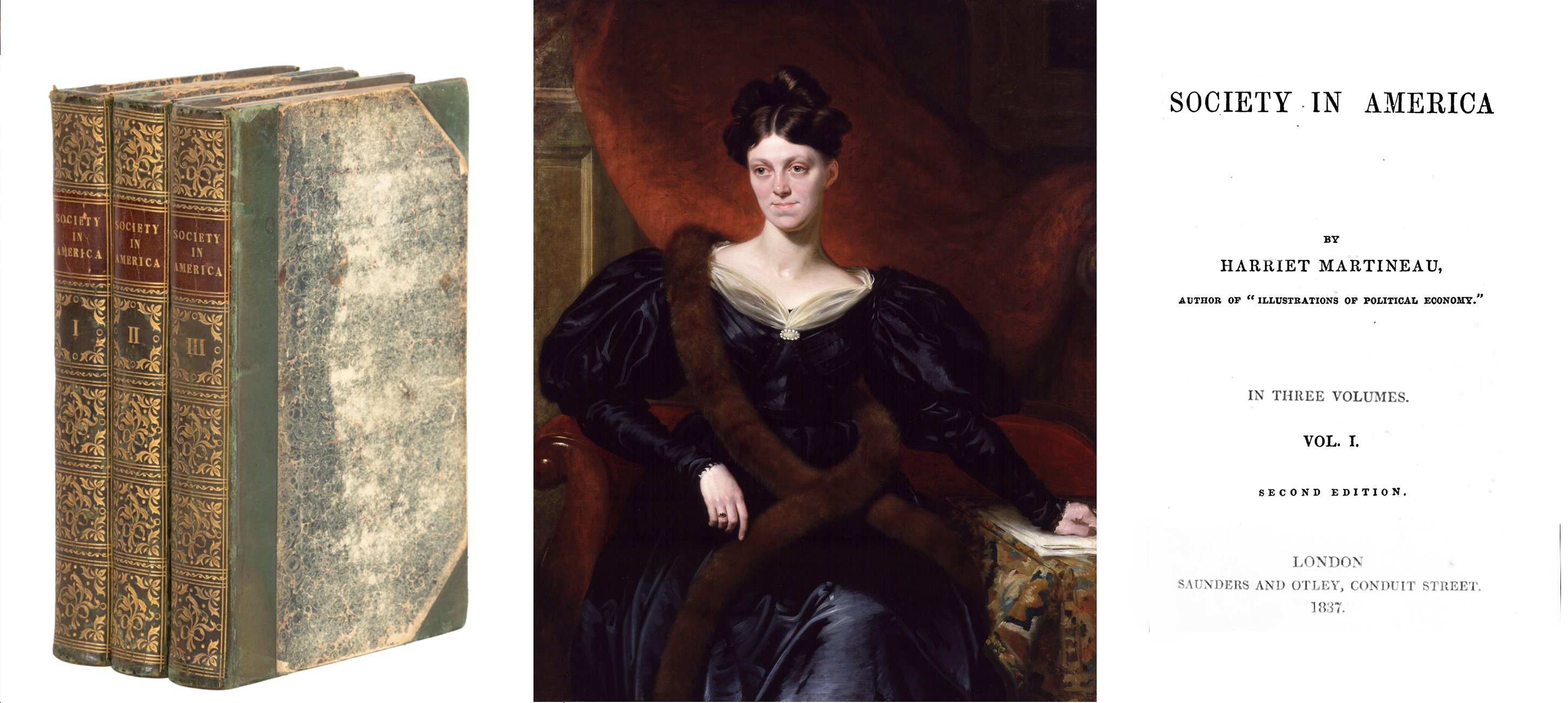
- Society in America, Harriet Martineau, 1837
3 volumes. 7½x4½”, green half-calf with marbled boards, spines stamped in gilt, morocco spine labels lettered in gilt.
Painting by Richard Evans, 1832
Society in America, Harriet Martineau, 1837
CHICAGO.
Chicago looks raw and bare, standing on the high prairie above the lake-shore. The houses appeared all insignificant, and run up in various directions, without any principle at all. A friend of mine who resides there had told me that we should find the inns intolerable, at the period of the great land sales, which bring a concourse of speculators to the place. It was even so. The very sight of them was intolerable; and there was not room for our party among them all. I do. not know what we should have done, (unless to betake ourselves to the vessels in the harbour,) if our coming had not been foreknown, and most kindly provided for. We were divided between three families, who had the art of removing all our scruples about intruding on perfect strangers. None of us will lose the lively and pleasant associations with the place, which were caused by the hospitalities of its inhabitants.
I never saw a busier place than Chicago was at the time of our arrival. The streets were crowded with land speculators, hurrying from one sale to another. A negro, dressed up in scarlet, bearing a scarlet flag, and riding a white horse with housings of scarlet, announced the times of sale.1 At every street-corner where he stopped, the crowd flocked round him; and it seemed as if some prevalent mania infected the whole people. The rage for speculation might fairly be so regarded. As the gentlemen of our party walked the streets, store-keepers hailed them from their doors, with offers of farms, and all manner of land-lots, advising them to speculate before the price of land rose higher. A young lawyer2, of my acquaintance there, had realised five hundred dollars per day, the five preceding days, by merely making out titles to land. Another friend had realised, in two years, ten times as much money as he had before fixed upon as a competence for life. Of course, this rapid money-making is a merely temporary eviL. A bursting of the bubble must come soon. The absurdity of the speculation is so striking, that the wonder is that the fever should have attained such a height as I witnessed. The immediate occasion of the bustle which prevailed, the week we were at Chicago, was the sale of lots, to the value of two millions of dollars, along the course of a projected canal; and of another set, immediately behind these. Persons not intending to game, and not infected with mania, would endeavour to form some reasonable conjecture as to the ultimate value of the lots, by calculating the cost of the canal, the risks from accident, from the possible competition from other places, &c, and, finally, the possible profits, under the most favourable circumstances, within so many years’ purchase. Such a calculation would serve as some sort of guide as to the amount of purchase-money to be risked. Whereas, wild land on the banks of a canal, not yet even marked out, was selling at Chicago for more than rich land, well improved, in the finest part of the valley of the Mohawk, on the banks of a canal which is already the medium of an almost inestimable amount of traffic. If sharpers and gamblers were to be the sufferers by the impending crash at Chicago, no one would feel much concerned: but they, unfortunately, are the people who encourage the delusion, in order to profit by it. Many a high-spirited, but inexperienced, young man; many a simple settler, will be ruined for the advantage of knaves.

- Original 1933 Plat Map of Chicago, which land was being sold and resold.
Others, besides lawyers and speculators by trade, make a fortune in such extraordinary times. A poor man at Chicago had a pre-emption right to some land, for which he paid in the morning one hundred and fifty dollars. In the afternoon, he sold it to a friend of mine for five thousand dollars. A poor Frenchman, married to a squaw, had a suit pending, when I was there, which he was likely to gain, for the right of purchasing some land by the lake for one hundred dollars, which would immediately become worth one million dollars.
There was much gaiety going on at Chicago, as well as business. On the evening of our arrival a fancy fair took place. As I was too much fatigued to go, the ladies sent me a bouquet of prairie flowers. There is some allowable pride in the place about its society. It is a remarkable thing to meet such an assemblage of educated, refined, and wealthy persons as may be found there, living in small, inconvenient houses on the edge of a wild prairie. There is a mixture, of course. I heard of a family of half-breeds setting up a carriage, and wearing fine jewellery. When the present intoxication of prosperity passes away, some of the inhabitants will go back to the eastward; there will be an accession of settlers from the mechanic classes; good houses will have been built for the richer families, and the singularity of the place will subside. It will be like all the other new and thriving lake and river ports of America. Meantime, I am glad to have seen it in its strange early days.
We dined one day with a gentleman who had been Indian agent among the Winnebagoes for some years.3 He and his lady seem to have had the art of making themselves as absolutely Indian in their sympathies and manners as the welfare of the savages among whom they lived required. They were the only persons I met with who, really knowing the Indians, had any regard for them. The testimony was universal to the good faith, and other virtues of savage life of the unsophisticated Indians; but they were spoken of in a tone of dislike, as well as pity, by all but this family; and they certainly had studied their Indian “neighbours very thoroughly. The ladies of Indian agents ought to be women of nerve. Our hostess had slept for weeks with a loaded pistol on each side her pillow, and a dagger under it, when expecting an attack from a hostile tribe. The foe did not, however, come nearer than within a few miles. Her husband’s sister was in the massacre when the fort was abandoned, in 1812. Her father and her husband were in the battle, and her mother and young brothers and sisters sat in a boat on the lake near. Out of seventy whites, only seventeen escaped, among whom were her family. She was wounded in the ankle, as she sat on her horse. A painted Indian, in warlike costume, came leaping up to her, and seized her horse, as she supposed, to murder her. She fought him vigorously, and he bore it without doing her any injury. He spoke, but she could not understand him. Another frightful savage came up, and the two led her horse to the lake, and into it, in spite of her resistance, till the water reached their chins. She concluded that they meant to drown her; but they contented themselves with holding her on her horse till the massacre was over, when they led her out in safety. They were friendly Indians, sent by her husband to guard her. She could not but admire their patience when she found how she had been treating her protectors.
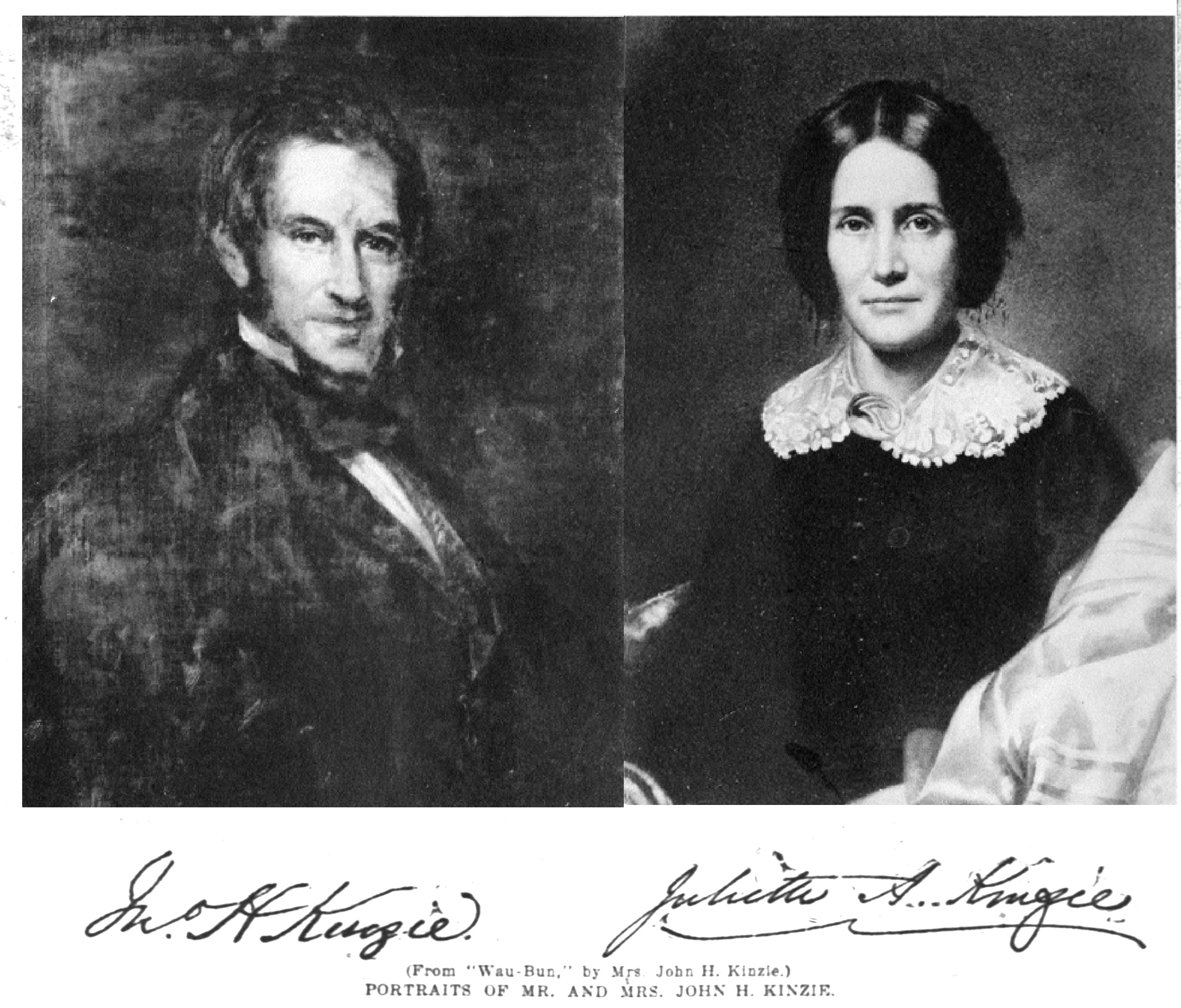
We had the fearful pleasure of seeing various savage dances performed by the Indian agent and his brother, with the accompaniments of complete costume, barbaric music, and whooping. The most intelligible to us was the Discovery Dance, a highly descriptive pantomime. We saw the Indian go out armed for war. We saw him reconnoitre, make signs to his comrades, sleep, warm himself, load his rifle, sharpen his scalping-knife, steal through the grass within rifle-shot of his foes, fire, scalp one of them, and dance, whooping and triumphing. There was a dreadful truth about the whole, and it made our blood run cold. It realised hatred and horror as effectually as Taglioni does love and grace.
We were unexpectedly detained over the Sunday at Chicago; and Dr. F. was requested to preach. Though only two hours’ notice was given, a respectable congregation was assembled in the large room of the Lake House; a new hotel then building. Our seats were a few chairs and benches, and planks laid on trestles. The preacher stood behind a rough pine-table, on which a large Bible was placed. I was never present at a more interesting service; and I know that there were others who felt with me.
From Chicago, we made an excursion into the prairies. Our young lawyer-friend threw behind him the five hundred dollars per day which he was making, and went with us. I thought him wise; for there is that to be had in the wilderness which money cannot buy. We drove out of the town at ten o’clock in the morning, too late by two hours; but it was impossible to overcome the introductions to strangers, and the bustle of our preparations, any sooner. Our party consisted of seven, besides the driver. Our vehicle was a wagon with four horses.
We had first to cross the prairie, nine miles wide, on the lake edge of which Chicago stands. This prairie is not usually wet so early in the year; but at this time the water stood almost up to the nave of the wheels: and we crossed it at a walking pace. I saw here, for the first time in the United States, the American primrose. It grew in profusion over the whole prairie, as far as I could see; not so large and fine as in English greenhouses, but graceful and pretty. I now found the truth of what I had read about the difficulty of distinguishing distances on a prairie. The feeling is quite bewildering. A man walking near looks like a Goliath a mile off. I mistook a covered wagon without horses, at a distance of fifty yards, for a white house near the horizon: and so on. We were not sorry to reach the belt of trees, which bounded the swamp we had passed. At a house here, where we stopped to water the horses, and eat dough nuts, we saw a crowd of emigrants which showed that we had not yet reached the bounds of civilisation. A little further on we came to the river Aux Plaines, spelled on a sign board “Oplain.” The ferry here is a monopoly, and the public suffers accordingly. There is only one small flat boat for the service of the concourse of people now pouring into the prairies. Though we happened to arrive nearly first of the crowd of to-day, we were detained on the bank above an hour; and then our horses went over at two crossings, and the wagon and ourselves at the third. It was a pretty scene, if we had not been in a hurry; the country wagons and teams in the wood by the side of the quiet clear river; and the oxen swimming over, yoked, with only their patient faces visible above the surface. After crossing, we proceeded briskly till we reached a single house, where, or nowhere, we were to dine- The kind hostess bestirred herself to provide us a good dinner of tea, bread, ham, potatoes, and strawberries, of which a whole pailful, ripe and sweet, had been gathered by the children in the grass round the house, within one hour. While dinner was preparing, we amused ourselves with looking over an excellent small collection of books, belonging to Miss Cynthia, the daughter of the hostess.
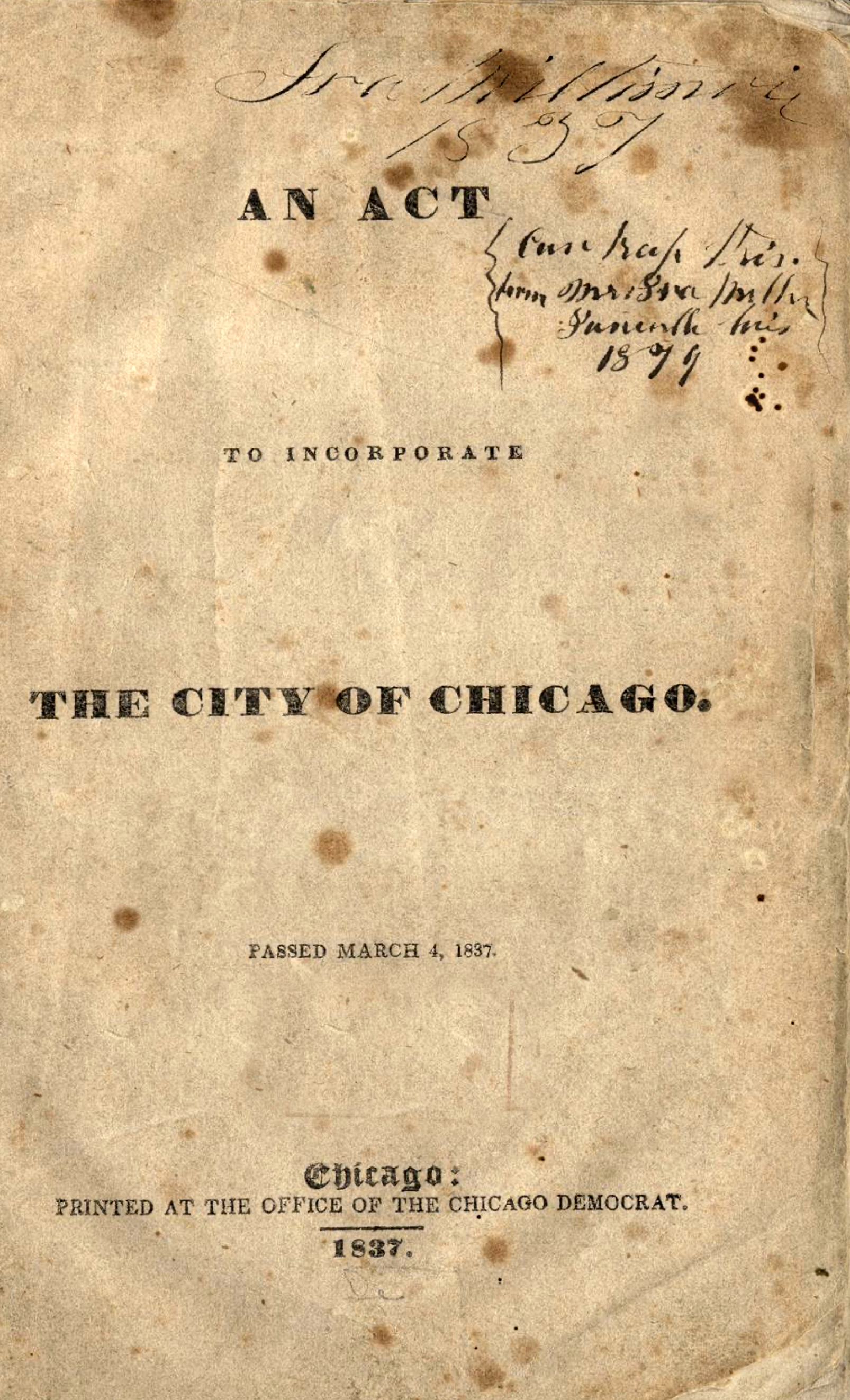
I never saw insulation, (not desolation,) to compare with the situation of a settler on a wide prairie. A single house in the middle of Salisbury Plain would be desolate. A single house on a prairie has clumps of trees near it, rich fields about it; and flowers, strawberries, and running water at hand. But when I saw a settler’s child tripping out of home-bounds, I had a feeling that it would never get back again. It looked like putting out into Lake Michigan in a canoe. The soil round the dwellings is very rich. It makes no dust, it is so entirely vegetable. It requires merely to be once turned over to produce largely; and, at present, it appears to be inexhaustible. As we proceeded, the scenery became more and more like what all travellers compare it to,—a boundless English park. The grass was wilder, the occasional footpath not so trim, and the single trees less majestic; but no park ever displayed anything equal to the grouping of the trees within the windings of the blue, brimming river Aux Plaines.
We had met with so many delays that we felt doubts about reaching the place where we had intended to spend the night. At sunset, we found ourselves still nine miles from Joliet;4 but we were told that the road was good, except a small “slew” or two; and there was half a moon shining behind a thin veil of clouds; so we pushed on. We seemed latterly to be travelling on a terrace overlooking a wide champaign, where a dark, waving line might indicate the winding of the river, between its clumpy banks. Our driver descended, and went forward, two or three times, to make sure of our road; and at length, we rattled down a steep descent, and found ourselves among houses. This was not our resting-place, however. The Joliet hotel lay on the other side of the river. We were directed to a foot-bridge by which we were to pass; and a ford below for the wagon. We strained our eyes in vain for the foot-bridge and our gentlemen peeped and pryed about for some time. All was still but the rippling river, and everybody asleep in the houses that were scattered about. We ladies were presently summoned to put on our water-proof shoes, and alight. A man showed himself who had risen from his bed to help us in our need. The foot-bridge consisted, for some way, of two planks, with a hand-rail on one side: but, when we were about a third of the way over, one half of the planks, and the hand-rail, had disappeared. We actually had to cross the rushing, deep river on a line of single planks, by dim moonlight, at past eleven o’clock at night. The great anxiety was about Charley; but between his father and the guide, he managed very well. This guide would accept nothing but thanks. He “did not calculate to take any pay.” Then we waited some time for the wagon to come up from the ford. I suspected it had passed the spot where we stood, and had proceeded to the village, where we saw a twinkling light, now disappearing, and now re-appearing. It was so, and the driver came back to look for us, and tell us that the light we saw was a signal from the hotel-keeper, whom we found, standing on his door-step, and sheltering his candle with his hand. We sat down and drank milk in the bar, while he went to consult with his wife what was to be done with us, as every bed in the house was occupied. We, meanwhile, agreed that the time was now come for us to enjoy an adventure which we had often anticipated; sleeping in a barn. We had all declared ourselves anxious to sleep in a barn, if we could meet with one that was air-tight, and well-supplied with hay. Such a barn was actually on these premises. We were prevented, however, from all practising the freak by the prompt hospitality of our hostess. Before we knew what she was about, she had risen and dressed herself, put clean sheets on her own bed, and made up two others on the floor of the same room; so that the ladies and Charley were luxuriously accommodated. Two sleepy personages crawled down stairs to offer their beds to our gentlemen. Mr. L. and our Chicago friend, however, persisted in sleeping in the barn. Next morning, we all gave a very gratifying report of our lodgings. When we made our acknowledgments to our hostess, she said she thought that people who could go to bed quietly every night ought to be ready to give up to tired travellers. Whenever she travels, I hope she will be treated as she treated us. She let us have breakfast as early as half-past five, the next morning, and gave Charley a bun at parting, lest he should be too hungry before we could dine.
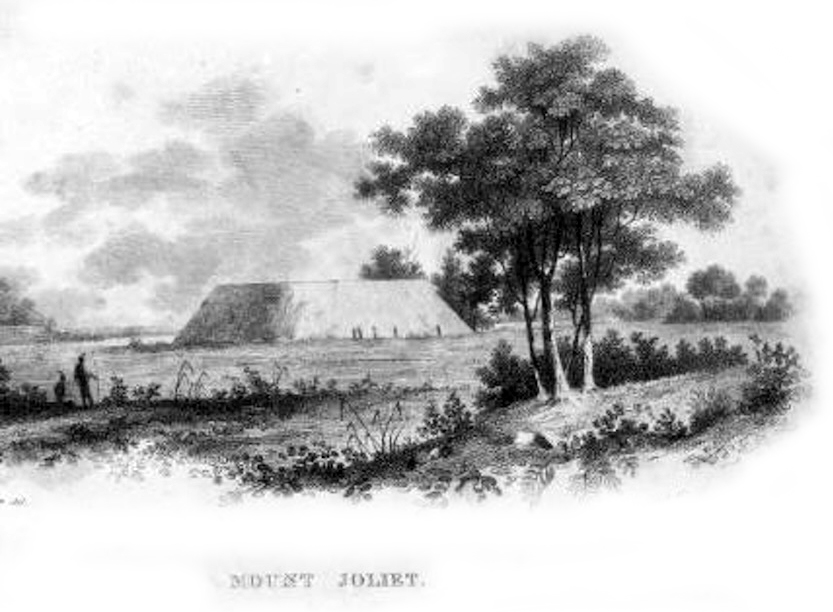
The great object of our expedition, Mount Joliet, was two miles distant from this place. We had to visit it, and perform the journey back to Chicago, forty miles, before night. The mount is only sixty feet high; yet it commands a view which I shall not attempt to describe, either in its vastness, or its soft beauty. The very spirit of tranquillity resides in this paradisy scene. The next painter who would worthily illustrate Milton’s Morning Hymn, should come and paint what he sees from Mount Joliet, on a dewy summer’s morning, when a few light clouds are gently sailing in the sky, and their shadows traversing the prairie. I thought I had never seen green levels till now and only among mountains had I before known the beauty of wandering showers. Mount Joliet has the appearance of being an artificial mound, its sides are so uniformly steep, and its form so regular. Its declivity was bristling with flowers; among which were conspicuous the scarlet lily, the white convolvulus, and a tall, red flower of the scabia form. We disturbed a night-hawk, sitting on her eggs, on the ground. She wheeled round and round over our heads, and, I hope, returned to her eggs before they were cold.
Not far from the mount was a log-house, where the rest of the party went in to dry their feet, after having stood long in the wet grass. I remained outside, watching the light showers, shifting in the partial sunlight from clump to level, and from reach to reach of the brimming and winding river. The nine miles of prairie, which we had traversed in dim moonlight last night, were now exquisitely beautiful, as the sun shone fitfully upon them.
We saw a prairie wolf, very like a yellow dog, trotting across our path, this afternoon. Our hostess of the preceding day, expecting us, had an excellent dinner ready for us. We were detained a shorter time at the ferry, and reached the belt of trees at the edge of Nine-mile Prairie, before sunset. Here, in common prudence, we ought to have stopped till the next day, even if no other accommodation could be afforded us than a roof over our heads. We deserved an ague for crossing the swamp after dark, in an open wagon, at a foot pace. Nobody was aware of this in time, and we set forward; the feet of our wearied horses plashing in water at every step of the nine miles. There was no road; and we had to trust to the instinct of driver and horses to keep us in the right direction. I rather think the driver attempted to amuse himself by exciting our fears. He hinted more than once at the difficulty of finding the way; at the improbability that we should reach Chicago before midnight; and at the danger of our wandering about the marsh all night, and finding ourselves at the opposite edge of the prairie in the morning. Charley was bruised and tired. All the rest were hungry and cold. It was very dreary. The driver bade us look to our right hand. A black bear was trotting alongside of us, at a little distance. After keeping up his trot for some time, he turned off from our track. The sight of him made up for all,—even if ague should follow, which I verily believed it would. But we escaped all illness. Tt is remarkable that I never saw ague but once. The single case that I met with was in autumn, at the Falls of Niagara.
I had promised Dr. F. a long story about English politics, when a convenient opportunity should occur. I thought the present an admirable one for nobody seemed to have anything to say, and it was highly desirable that something should be said. I made my story long enough to beguile four miles by which time, some were too tired, and others too much disheartened, for more conversation. Something white was soon after visible. Our driver gave out that it was a house, half a mile from Chicago. But no: it was an emigrant encampment, on a morsel of raised, dry ground; and again we were uncertain whether we were in the right road. Presently, however, the Chicago beacon was visible, shining a welcome to us through the dim, misty air. The horses seemed to see it, for they quickened their pace; and before half-past ten, we were on the bridge.
The family, at my temporary home, were gone up to their chambers; but the wood-fire was soon replenished, tea made, and the conversation growing lively. My companions were received as readily at their several resting-places. When we next met, we found ourselves all disposed to place warm hospitality very high on the list of virtues.
NOTES:
1The “town crier”—a familiar figure in the streets—has been recognized as “Darkey (Black) George,” or George White, whose office took the place of a newspaper in announcing land sales and auctions. Alleged to be the hangman at the city’s first hanging.
2This lawyer has been identified by Mr. Augustus H. Burley and by Fernando Jones as Isaac N. Arnold.
3The gentleman of an “Indian agent” and his lady was Mr. and Mrs. John H. Kinzie.
4Preserve the original name, which is that of the first French missionary who visited these parts. The place is now commonly called Juliet; and a settlement near has actually been named Romeo; so that I fear there is little hope of a restoration of the honourable primitive name.
The above article was reprinted in Reminiscences of Early Chicago, with an Introduction by Mabel McIlvaine, Lakeside Press, 1912

Leave a Reply