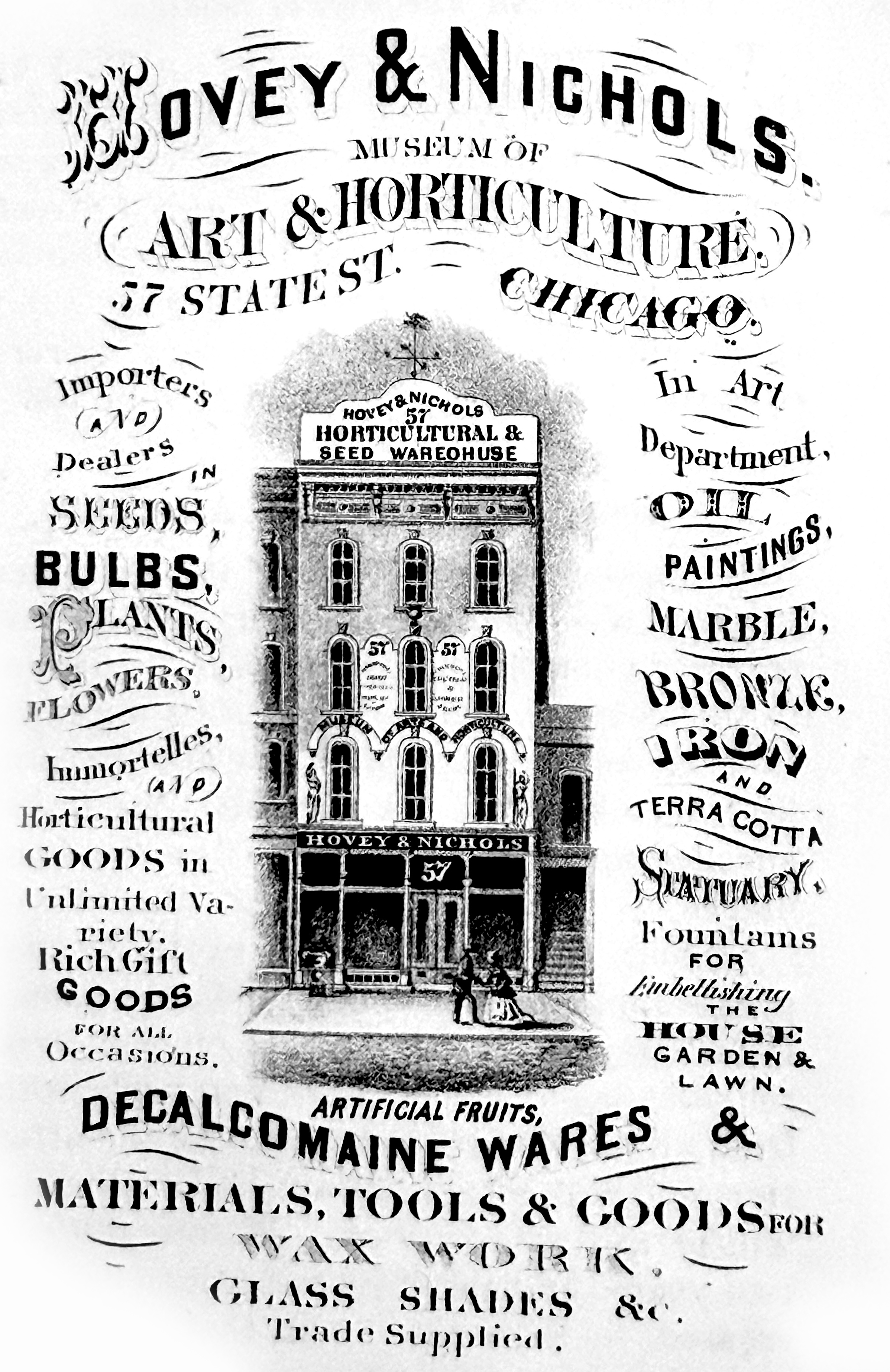
Hovey & Co., Museum of Art & Horticulture
Life Span: 1867-1871
Location: State street, near NE corner Randolph
Architect: TBD
- Edwards’ Annual Directory in the City of Chicago, for 1869
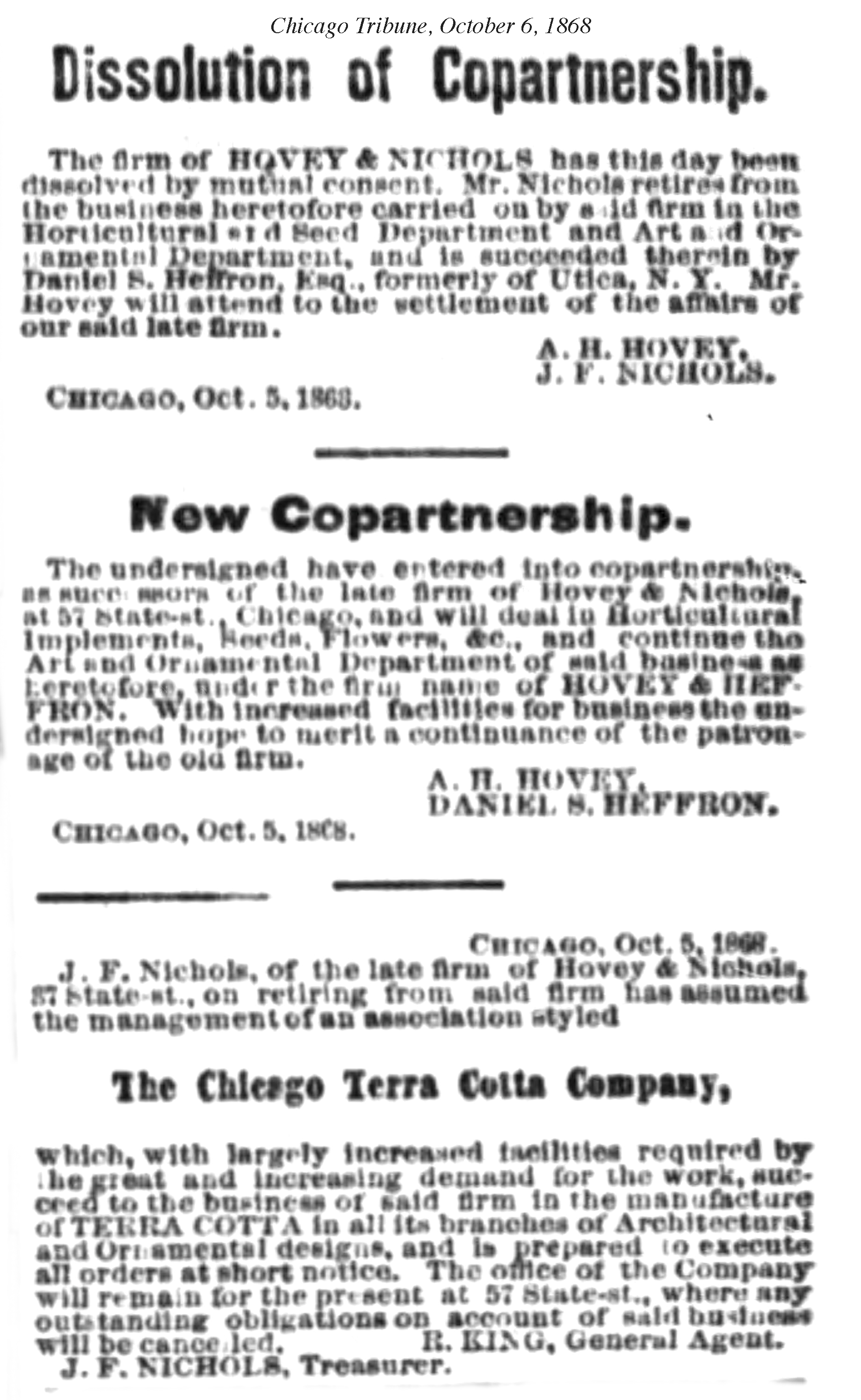
Hovey & Heffron., (Albert H. Hovey and Daniel S. Heffron), seed warehouse, 57 State
Edwards’ Annual Directory in the City of Chicago, for 1870
Hovey & Co., (J. A. Hovey and ————), horticultural and seed warehouse, 57 State
Edwards’ Annual Directory in the City of Chicago, for 1871
Hovey & Co., seed and horticultural warehouse, 57 State
Chicago Tribune, March 25, 1868
TERRA COTTA.
A Merited Testimonial to Messrs. Hovey & Nichols.
The following testimonial to the excellence of the terra cotta, whose manufactare is being extensively engaged in by Messrs. Hovey & Nichols, of this city, is from the pen of Signor Giovanni Mela, the distinguished Italian artist, who is now in their employ. Signor Mele has a world-wide reputation by his production in Parian and bronze of the most popular works of Canova, Tenarini, Gibson, Marshall, Foley, Thede, and Powers Greek Slave. His last original work, previous to accepting his engagement with Messrs. Hovey & Nichols, was the celebrated group of seven figures, entitled, “The Return of Vintage.” A commission from the Duchess of Sutherland. Signor Mele is now employed upon the reproduction of Miss Harriet Hosmer’s statue of “Zelobia,” which Messrs. Hovey & Nichole will issue in Parian and bronze. Signor Mele’s studio being at Messrs. Hovey & Nichols’ terra cotta works, he has had abundant opportualty to contrast the work produced there, with that he has been so many years familiar with in Europe:
- March 20, 1868.
Messrs. Hovey & Nichols :
It gives me pleasure to express my opinion concerning the adaptation of terra cotta for architectural decoration. The use of this material is coexistent with the foundation of the Roman Empire. All modern explorations in and about Rome and at Pompeii exhibit this work as used for the decorations of villas and public buildings—in their sacred urns, in vases, fountains, &c. In modern Italy and in Germany it is used much more than stone, for the interior and exterior embellishment of the grand cathedrals and other public and private buildings. I have seen much of it also in Great Britain. In Stoke-upon-Trent in Staffordshire, stands a splendid pile called Mintunis Memorial. This work is three stories in height, and the beautiful front is entirely in terra cotta. During my long connection with the celebrated Copeland Factory, in Staffordshire, I modelled many statues, vases, etc., for the use of terra cotta. The quality of terra cotta depends upon the nature of the clay used, and the burning of it. Since I have been in this country I have made the matter of clay a very serious study, both for my requirements as modeller, and for its uses for terra cotta. I can freely say that the clay you are using to burn, as well as that I am using on the model of the Zenobia, is much better than is generally found in any part of Europe, for either purpose, I hope this explanation will be satisfactory ae my best judgment in the matter of clay employed by you, and I may add, that every possible care seems to be taken by those in charge of your kiln in the burning of it into terra cotta.
(Signed)
“G. Mele.”
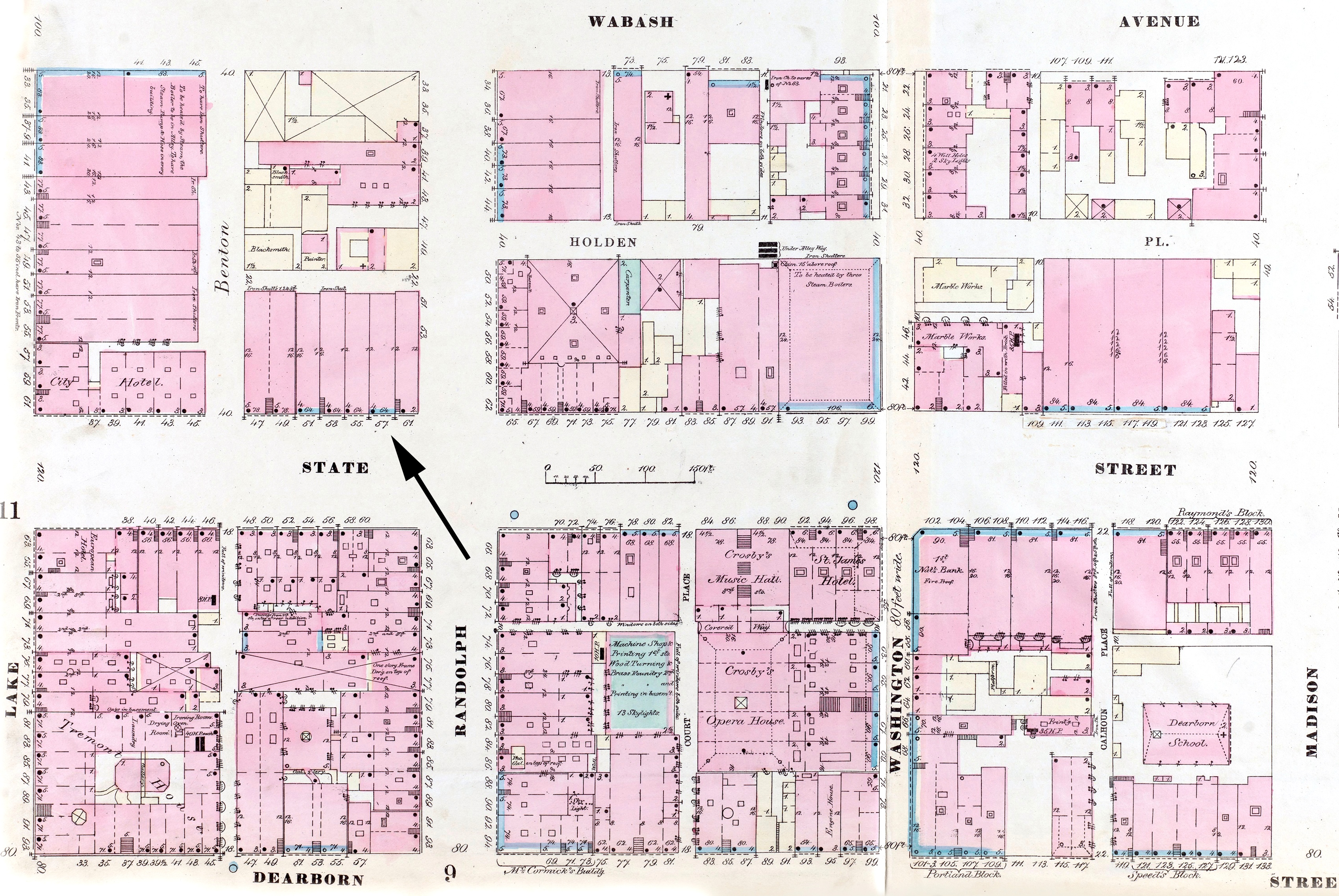
- Hovey & Nichols
Sanborn Fire Insurance Map
1869

Leave a Reply