Stephen Douglas Grave and Monument
Life Span: 1861/1881-Present
Location: 636 E. 35th St.
Architect: Lee Volk (Sculptor)
- D. B. Cooke & Co.’s City Directory for the Year 1859
Douglas Stephen A., U. S. Senator, h Cottage Grove av s of Ridgely pl, bds Tremont House
Chicago Tribune, June 5, 1861
THE ESTATE AT COTTAGE GROVE.
For a number of years Senator Douglas had been the possessor of a noble tract of land at Cottage Grove, immediately south of the limits on the Lake shore, beautifully wooded city and well elevated above the lake. This tract originally consisted of a little upwards of seventy acres. Of these, ten acres lying west of the road comprised his munificent donation to the Chicago University, and now ornamented by the fine edifice of that institution.
Of the residue, some years since a choice tract of from twelve to fifteen acres, the very heart of the property, deeded to Mrs. Douglas. This unincumbered, was property has only been improved by common fencing, and the only buildings thereon are a modest cottage and its outbuildings, usually occupied by the person in charge of the grounds. Without a precise knowledge of the plans of Mr.Douglas relative to this beautiful tract, the finest in precise in the suburbs of our city and the most valuable, has always been understood by our citizens it that here on that charming site the statesman was planning the erection of a home for his was planning retirement, when laden with the full honors earned in public duty, he should come home to pass the evening of his days upon the shores of our noble lake.
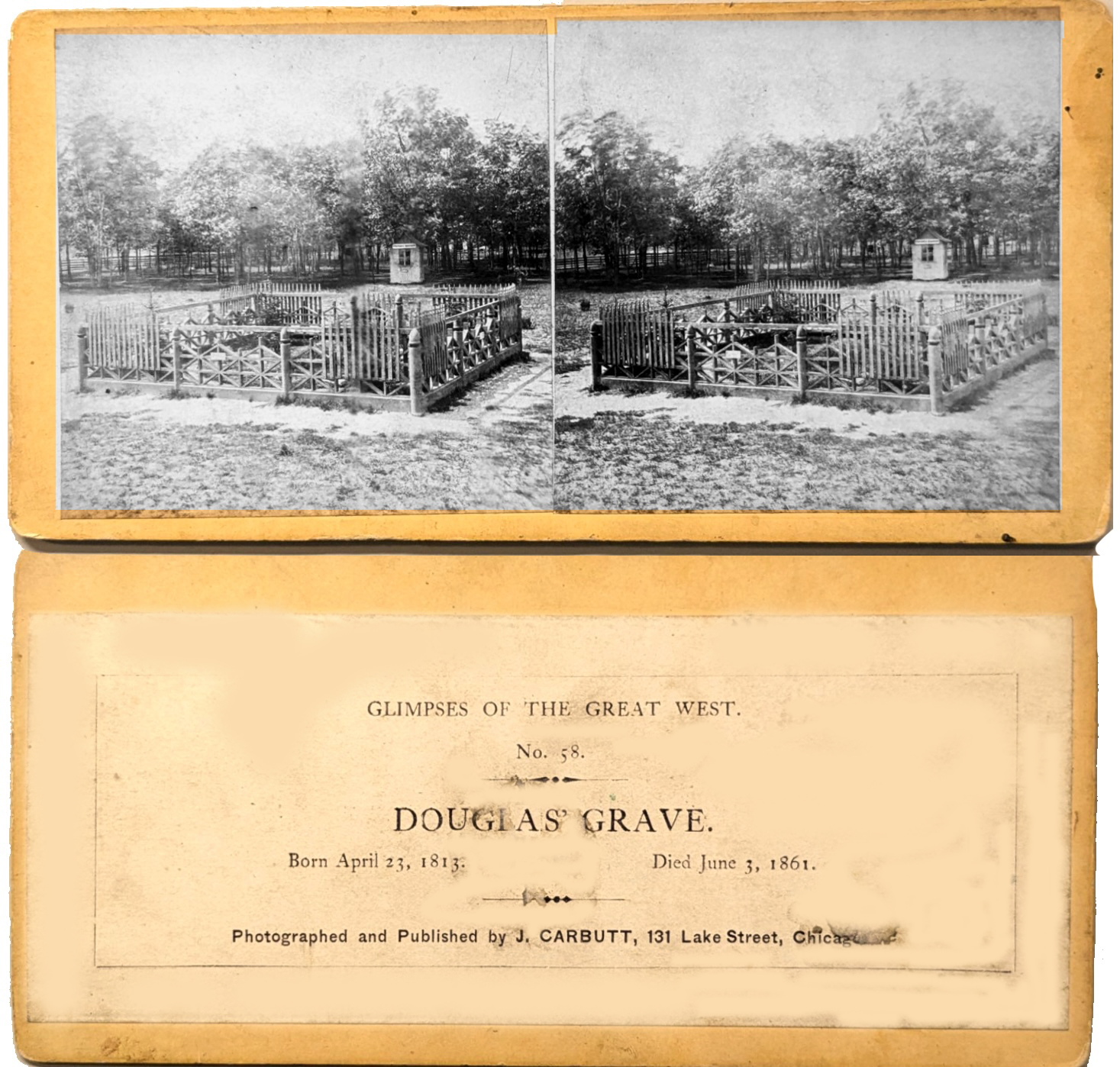
- Douglas’ Grave
John Carbutt
Glimpses of the Great West Series No. 58
1864
It is here that by the change in the plan for the disposition of the remains, all that is mortal of the illustrious Senator, is to be gathered to the dust, and Cottage Grove, never his home save prospectively, will be his last resting place. The love and affection of his city and State will see that nothing is lacking to do adequate respect to the honored remains, while the Tomb of Douglas will be visited by citizens and strangers through all the long years that will keep alive his name. By this change in plan are much modified the earlier plans of the citizens and Common Council. The latter which voted $2000 to suitably accompany and forward the remains to Washington, will liberally meet the modifications and requirements of the imposing obsequies to take place here. These are to be only delayed until the arrival of the lads Stephen and Richard, Mr. Douglas’ sons by a former marriage, who have been summoned from school at Georgetown, D.C., and will arrive here on Thursday morning. The funeral will take place on Thursday of Friday.
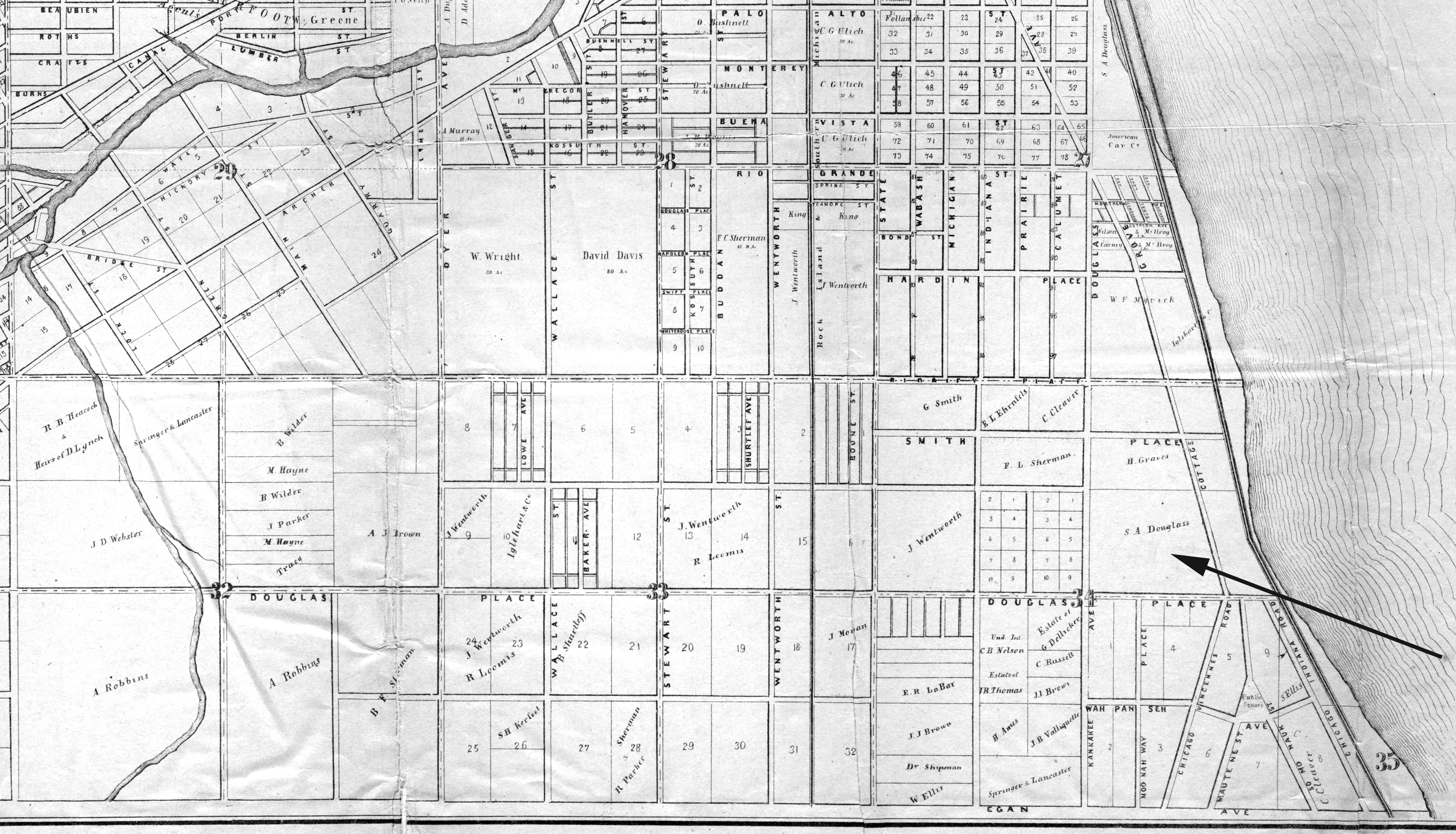
- Stephen A. Douglas’ Property
Cottage Grove Road, South of Ridgely Place (Unnamed street above property)
1855
Chicago Tribune, May 1, 1864
THE DOUGLAS MONUMENT.
Description of Lee W. Volk’s Design.
Mr. Volk, the well-known sculptor, has already finished the clay model of his design for the Douglas monument and is rapidly putting it in plaster. Probably it will be completed during the present weck and wilt then be ready for the Inspection of the public. The model is over four feet in height and made to a scale of half an inch to the foot thus making the monument, if accepted, one hundred feet in height, resting upon a circular platform, with a base of fifty-two feet in diameter, approached by four steps. Above this is another base carried inwards on the four sides with three steps giving some magnificent lines, and forming the foundation for a mausoleum twenty feet square. Above this is the pedestal and composite column surmounted by a colossal statue of the departed statesman. The statue is posted on a sphere the right hand resting upon the faces symbolical of Union, and the left holding the Constitution, The mausoleum is designed for the reception of a marble sarcophagus holding the remains, which will be easily visible from the grated bronze or iron door, Surrounding the sepulchral four pedestals stand out from corner connected with it by gracefully springing arches and holding four statues, Clay, Webster, Jackson and Cass, contemporary with Douglas, and representing different sections of the country.
On each side of the base of the pedestal, supporting the column, are bas relievos representing progress, especially as relative to the growth of America. The first is the wilderness, a wig wam in the foreground, with women and papooses at the entrance, Indians hunting a stalwart savage dragging a deer up to the door. The second represents agriculture. There is a cabin and a woman at the door. The hardy pioneer husband is felling tree. It is the first step in progress. The Indian has vanished, and the white man with the axe and the plow has invaded his ancient domain, which will bye and bye blossom like the rose. The next panel shows another advance. It is now Commerce and Science hand in hand. The former is represented by symbolical figure with the caduceus, and holding a flag. He is surrounded with bales and boxes and all the appointments of commerce. At the right of the panel is a locomotive and on the left a ship, Science is denoted by the telegraph wire, the lines stretching across from side to side. The last relief is education, the culmination of progress. The schoolmaster stands in the centre, book in hand, with children grouped around, some studying and some reciting. At the right is the church and the left the Capitol.
The pedestal on this base is ornamented with wreaths, festoons, scrolls, and inverted artistically disposed, with Donglas’ dying words on the front. From this springs up a rounded and graceful shaft, forty-two feet in height, composed of fluted sections separated by stars, indicating the number of States. The eagle, with drooping head and trailing wings, sits directly above the door way of the mausoleum, guarding the sacred dust below.
Thus much for the physical features of the design. To the artist it has been a labor of love, working both with reverence for art and for the memory of the departed, whose friendship he had shared in life: and it is a natural result of these feelings that he has most happily combined in his model the sepulchral end the monumental style. It is pot a sererely esthetic production, bat one that shows deep feeling Wile while it does not infringe the roles of art there has boon ample scope and the display most of the artistic-which Mr. Volk has employed admirably in the disposition of the carves on the circular plater and the arches, which will dire Ape effects of light and shade, and In the happy combination of masrireness and airiness -there is still noticeable a quietness and mourntal beanty. a solemnity and fanereal grandeur, which will admtrably accord with the memories of the spot, with the cadences of the waves, the of the leaves and the niching of the wind.
Thera nothing meretricions design, The statuettes -for statuettes they will be in comparison with colossal one–and the bas rellevos, narrating the march of progress, are in keeping with the life of Douglas. The ornaments are few bat appropriate. The wreaths are pendent and funereal, the books closed, the torches Inverted, the eagle drooping. giving beight as well as masel reness to the monument, Mr. Volt has very properly followed true artistic design. In addition to Atuess of details and general contour, the physical character of the country abould be studied. The ancients anderftood this well. The Greciane crowned their bills with temples, pot monuments, Rome and the Campagna are covered with monuments, but the seven hills carry monument shafts and obelisks.
A mountain neede no additional height. In Egypt, which is one vast sandy prairie, the level and blank monoteny de relieved by the Pyramide, minarets. obeheks and towers. So in this section of the Country, height is needed to break up the level. This quality, the model, if accepted, will give and will add to it strength and grace. Shoreward and lakeward it will first catch the eye. It will be a landmark to the traveler, a reminder to all of departed worth, and because it is a thing of beauty, go will it be a thing of joy forever.
Chicago Tribune, July, 15, 1864
DOUGLAS MONUMENT.
Meeting of the Trustees of the AssociationAdoption of Mr. Volk’s Design—Description of the Work.
A meeting of the Trustees of the Douglas Monument Association was held yesterday morning, at the Sherman House. First Vice-President T. B. Bryan occupied the chair, and D. A. Gage acted as Eecretary. There were also present Right Rev. Bishop Duggan, Rev. Wm. Barry, S. W. Fuller, John M. Douglas, W. C. Goudy, and F. C. Sherman.
The business of the meeting was the selection of a design for the monument. Two models only were presented for competition, one by L. W. V.lk, and the other by Schareman & Melick. They bad both been submitted to Mrs. Stephen A. Douglas for her approval, and a letter was read from that lady, expressing a preference for that of Mr. Volk.
After some discussion and mature deliberation, on motion of Mr. Barry it was resolved, by a majority of seven against one, to adopt the plan of Volk, and the Executive Committee was empowered to advertise for the execution of such portions of the work as are intended to be proceeded with at once, and report to an adjourned meting to be held on the 4th day of August next.
The foliowing minute description of the monument, which accompanied the model of Mr. Volk, will be read with interest:
- The design I have the pleasure of submitting, for the proposed monument to the late Senator Douglas, may be briefly and generally described as tollows: The scale upon which it is modelled is a fraction less than half an inch to the foot, making the entire height one hundred feet. The dismeter of the circular platform base is fifty-two feet, and two and a half feer high. Another base, with steps the same—the sides concave, or curved inwards, also two and a half feet high, is laid upon the circu ar base.
The sepulcure, with four projecting pedestals standing out from the four corners and connected by archways, is twenty feet square and eleven feet high, with walls five feet thick. It has an arched ceiling and a chamber within ten feet square. The floor is of mosaic or tiled work, and ie on a level with the circular platform base. In the centre of this chamber is a sarcophagus or receptac’e for the remains of Douglas, visible to the spectator standing on the ground outside the inclosure, through the open bronze or iron door, which would be six and a half feet high and three and a half wide. Durmg the inclement seasons, or at any time, a tight fitting door, could be closed to protect the interior from the storms and snows. Resting upon the sepulcure is a pedestal 21 feet high, with a base 15 feet square lapping upon, and supported by the walls of the tomb. A complete column, 43 feet in length. 6 feet at the base, and 3½ feet at the top, divided into five parts of or the sections and representing different varieties of the column, is placed upon the pedestal. A cap and spear 6 feet high forms the cap and base for a colosal bronze statue of Douglas 12 feet high.
The emblematic devices and embellishments may be thus described: Surrounding the sepulchre are four seated symbolical figures of life size, intended to be of light marble. One represents Illinois holding a medallion likeness of Douglas. By the side is a sheaf of wheat and the State Arms. The other are America with the Shield, History reclining upon a Tablet, and Fame with the wreath and Trumpet. An eagle stands over the entrance. On the base of the pedestal above are four bars-reliefs, one on each side. intended to represent the progress of civilization in the West—First the wilderness, with Indians hunting, and their wigwams in the distance; then the pioneer scene, with the cabinmen plowing and cutting down the trees. The others are Commerce and Science. The former is represented by a ship, bales and boxes of goods; and the latter by the locomotive, the railroad and telegraph. The fourth relief illustrates Education by a group of children and a schoolmaster, with the Capitol building of the nation and a church in the distance. The pedestal is likewise ornamented with books, scrolls. flambeaux, wreaths and festoons of flowers. Between the sections of the columns are stars indicating the several States.
The composition of the statue represents Douglas as standing by the Union and the Constitution, the fasces, or Union, by his right, and the Constitution in his left hand.
I consider it important to call your attention to the fact that this design can be carried to three stages of completion, including the last and final one, and at each stage present a complete and finished appearance. In the first place the tomb or sepulchre can be constructed to the base of the pedestal above, and the remains of Mr. Douglas placed within, which would, if nothing more was done, present a substantial and imposing structure, and could be completed at a small outlay, compared with the cost of the whole, The second stage can be carried to the foot or base of the column comprising the pedestal, and be surmounted with the statue intended for the top of the column, which would look complete and finished; and when the necessary funds was raised, the column could go up according to the design as now presented.
I do not deem it necessary or proper to give you estimates of costs, as it would be impossible to arrive at the truth, unless you had determined the quality of the marble, granite, or limestone to he used, and were ready to put the whole work under immediate contract at present rates of labor and materials, and go forward with it without stopping. But even then, considering the present fluctuating and uncertain condition of thinge, there would need de much unreliable gueesing. An estimate now would likely be wrong, if pot very absurd and fictitious in a few months or a year hence; before, perhaps, the work was even started.
I need say no more on the subject as you have pot yet invited proposals or estimates for the work. At the time I made the design, the sum proposed in your advertisement for plans, viz: $500,000, would have been ample for its full completion. In case you are pleased to adopt my design, I shall be ready to furnish estimates of the cost of such portions of the work as you may from time to time see fit to proceed with, or for the whole. The same design, measured at a scale of ¾ of an inch to the foot, would make the monument about seventy-five feet high, and would very much reduce the cost.
W. B. Scates, a memb r of the Board of Trusteen, having become a non-resident, John L. Wilson was appointed his successor. The meeting then adjourned.
Chicago Illustrated July 1866
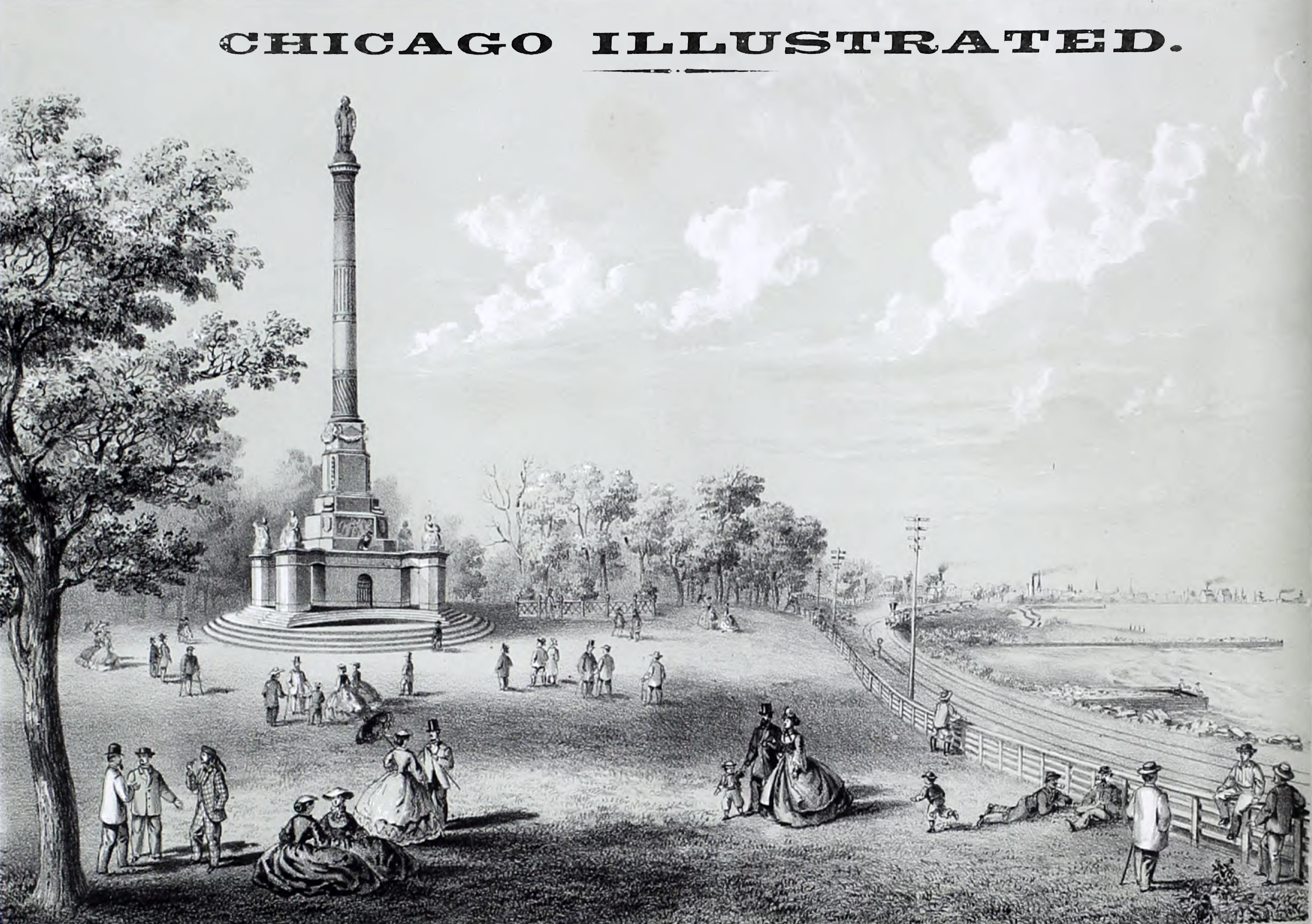

DOUGLAS MONUMENT—The artist has anticipated time to the extent of representing the Monument as it will be when completed. Otherwise, the scene is presented as it is. In 1848, or about that time, Mr. Douglas purchased several pieces of land outside of the then limits of Chicago. Among other pieces was that known since then as Cottage Grove, containing about 40 acres, and lying on the lake shore, and about three miles south of the Court House. With the exception of this south-east corner, this tract is covered with a thick growth of oaks, in the centre of which he lived in 1855 and 1856, while in Chicago. He prepared a plan of the land, subdividing it into building lots and parks, and selected that portion of cleared land, about three acres, for his future residence. In 1857, shortly after his second marriage, he decided this lot to his wife. When he died, in 1861, there was a great desire that he be buried in the State. Consent was obtained, and he was buried upon the spot enclosed, and which lies just northeast of the Monument. Subsequently, the State of Illinois purchased this lot from the widow of Mr. Douglas, paying therefor $25,000.
The Monument Society is an incorporated body, but the State has no connection with it further than to give its consent for the erection of the Monument.
On the 6th of September, 1866, the cornerstone of the Monument was laid with Masonic ceremonials, the Grand Master, P. H. Bromwell, officiating. An oration was delivered on the occasion by Major General John A. Dix. Andrew Johnson, President of the United States, and Hon. W. H. Seward, Secretary of State, also made addresses. The Hon. Gideon Welles, Secretary of the Navy, Ulysses S. Grant, General of the Armies of the United States, and Admiral David G. Farragut, of the navy, with a vast concourse of people, including many distinguished citizens, were also present on the occasion. Mr. Douglas’s sons, Martin and Stephen, and his brother in law and sister, the Hon. J. N. Granger and wife, were among the guests of the Monument Society.
The Monument itself is thus described by the Architect, L. W. Volk, Esq., of Chicago:
- The Monument will consist of a circular platform base 52 feet in diameter and 2½ feet high. Upon this will be placed a similar platform, but a little smaller, which will be surmounted by a sepulchre 20 feet square and 11 feet high, with walls 5 feet in thickness. It will contain a chamber 10 feet square. In the chamber will be placed the sarcophagus, containing the remains of the great statesman. The sarcophagus will be visible through a bronze door 6 ½ feet high and 3 feet wide. The sepulchre will be ornamented with projecting pedestals from the corners. Surrounding the sepulchre will be a pedestal 21 ft. in.height, having a base 15 feet squllre. On this will be erected a column 43 feet in length, 6 feet square at the base, and 31 feet square at the top. The column will be terminated by a cap 6 feet high, which form the basis for the colossal statue of Douglas.
Surrounding the sepulchre will be placed four seated symbolical figures, life-size, sculptured in light marble. One of these figures will represent Illinois holding in her hand a medallion likeness of Douglas. By her side will be a sheaf of wheat and the State arms. The remaining figurcs will represent America with a shield, History reclining on a tablet, and Fame with the symbolical wreath and trumpet. Over the entrance to the sepulchre will stand an eagle, and on the base of the pedestal above are four bas reliefs representing the history and progress of the West. These represent Indians and hunting scenes, pioneers building log cabins, plowing and felling trees; commerce is represented by a ship and packages of goods; and the sciences are represented by a locomotive, a railroall and a telegraph. Still another device represents education, a group of children, the State Capitol building, a church in the distance, etc. The statue will represent the great patriot and statesman as standing by the Constitution on one side, and by the Union on the other which is represented by the Roman fasces.
James W. Sheahan, Esq.,
July 1866.
Inter Ocean. August 13, 1881
THE DOUGLAS MONUMENT.
One of the finest examples of ornamental statuary in the United States is the monument erected at the foot of Thirty-fifth street to the memory of the late Senator Stephen A. Douglas. It is not only a plle intended to commemorate his political achievements and public benefactions, but it is likewise a mausoleum for the dead statesman’s remains. With the exception of the Lincoln monument at Springfield, and the Washington monument at Richmond, Va., there is not a more pretentious piece of monumental work in the country. Mr. Leonard W. Volk, the sculptor, is widely known, and takes rank with our best American sculptors. The monument is just receiving its finishing touches in the shape of the last bronze tablet medallion, representing “Legislation,” and which will be placed within a day or two in its place on one of the sides of the base.
It will be opportune, theréfore, at this time to give some facts connected with its erection and dedication. It was on the 22d day of October, twenty years ago, that a meeting of the citizens was held in the parlors of the Tremont House to discuss the “erection of a suitable monument in honor of the late Stephen A. Douglas, as a grateful recognition of the illustrious services rendered by him to his country.” This meeting was called by Messrs. J. W. Sheahan, S. W. Fuller, S. H. Kerfoot, W. C. Goudy, Thomas Drummond, David A. Gage, J. P. Clarkson, and Leonard W. Volk. At this meeting a committee was appointed to deliberate on the best methods of carrying out the object of the meeting. The eventual result was the incorporation of the Douglas Monument Association:
On the 23d of May, 1863, the Executive Committee of the association was authorized to procure a design for the proposed monument, the cost of which was not to exceed $75,000. These designs were submitted, and at a meeting held in July, 1864, they were discussed, and that of Mr. Leonard W. Volk adopted. In 1864 a bill was introduced into the Legislature by Colonel A. F. Stevenson, of this city, and passed, authorizing the Governor to purchase for use as a burying-ground for the body of the late Stephen A. Douglas a certain area of land, upon which the monument is now situated, for the sum of $25,000. This accordingly was done. In 1866 Mr. Volk was authorized by the trustees of the association to locate the site of the monument, and in the performance of that duty he fixed it as nearly as he possibly could on the precise spot which the Senator had pointed out to him in 1855 as the place whereon he intended to build his permanent residence. Work was’ begun at once, and the corner-stone laid on the 6th day of September, 1866. with the late Mayor John B. Rice as President of the day, and David 4. Gage as marshal. Among the distinguished men present were Andrew Johnson, President of the United States;’ General U. S. Grant, Major General George G. Meade, Brigadier General J. A. Rawlins, Admiral Farragut, Seo-retary Seward, Secretary Welles, Generals Steadman, Rosseau, Custer, Jeff C. Davis, Crook, George H. Thomas, and many other men well known throughout the country.
The proceedings were introduced by a brief address from Mayor Rice. That was followed by another address by J. B. Gavin, the Masonic Grand Master of Illinois, the monument being laid under the auspices of the Masonic fraternity, of which Mr. Douglas was an honored member. The Grand Chaplain then invoked the Divine blessing, when the ceremony of laying the cornerstone took place, according to the Masonite ritual. The orator of the day was Major General John A. Dix, who delivered an address of great strength and remarkable rhetorical beauty. President Johnson was called for at the close of General Dix’s oration, and responded briefly; likewise Secretary William H. Seward. Farragut and Grant received genuine ovations. June 3. 1868, the anniversary of Mr. Douglas’ death, his remains were taken from the ground and deposited in the sarcophagus, where they have since remained. The monument, as it stands, cost $71,500, of which $59,000 was appropriated by the Legislature, which was in addition to the $25,000 paid for the ground by the State.
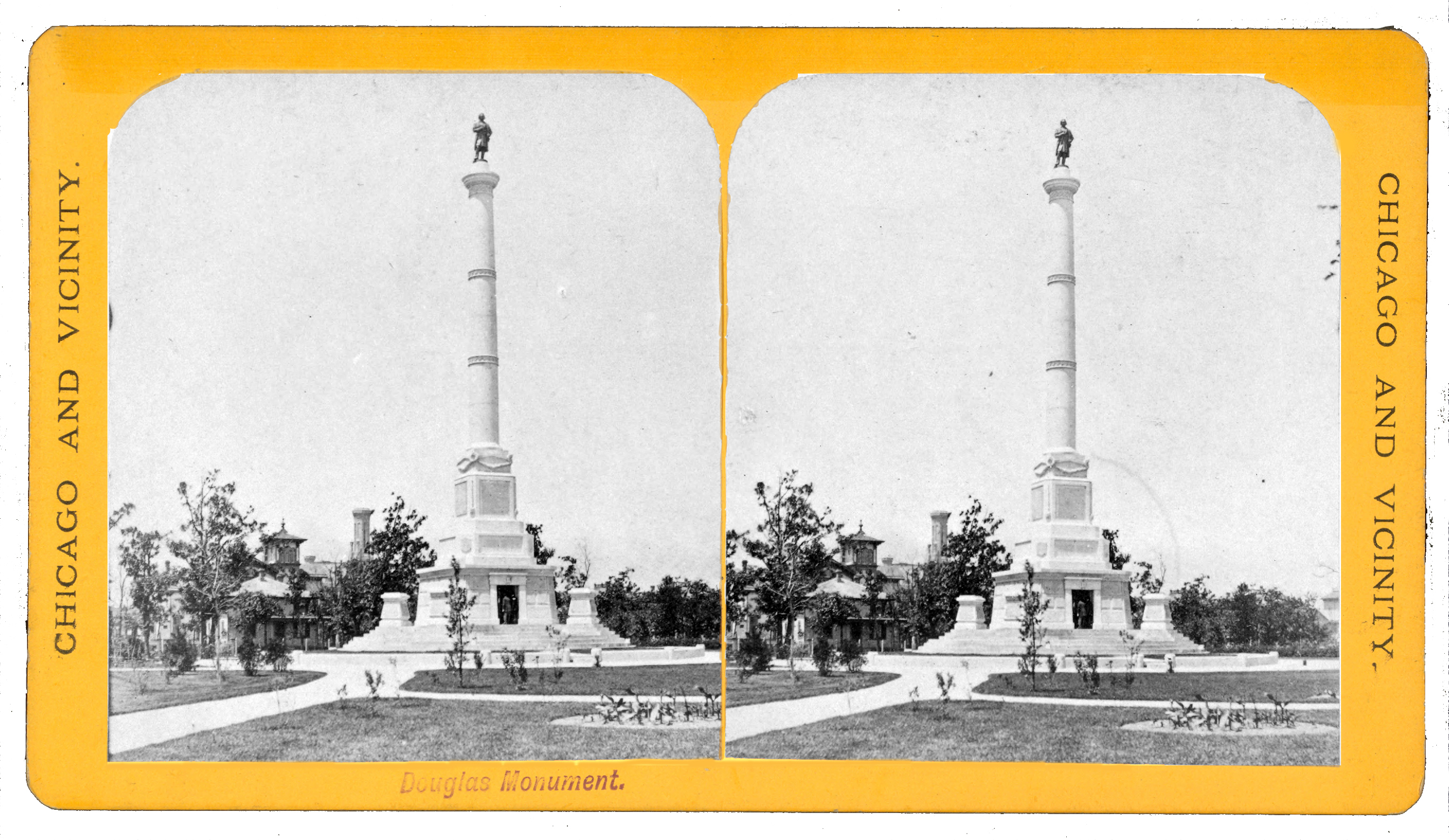
- Douglas’ Monument
1881
It is always interesting to read about these memorials which commemorate great lives or great events. Many people have seen the Douglas monument, and many more would see it were it in a more frequented locality For the benefit of eyes have not yet rested upon this impressive work, we here give a careful description: On a deep and firm foundation, prepared with the utmost care, there has been placed an octagonal base coping of Illinois limestone, 70 feet in diameter. The fret of the three circular bases of the tomb is 42 feet in diameter, and height of all 4 feet 3 Inches. The tomb is octagonally formed, 20 feet in diameter and 10 feet high to first base of the superstructure. Its chamber is 8 feet 9 inches square by 7 feet 2 inches high. The pedestal at each of the four corners of the tomb is 6 feet high, with a base 4 feet square. The octagonally formed pedestal of the structure above the tomb is 18 feet 10 inches high to the circular base of the column. Its plinth base is 15 feet in diameter. The length of the column, including its base, which is 2 feet thick, is 46 feet 5 inches, and is 5 feet 2 inches in diameter at base end, and 3 feet 6 inches at top end. The cap, including ornamented frieze, is 4 feet 6 inches high, and the statue base of granite above is 2 feet high, making the entire height of the monument, inclusive of statue, 95 feet 9 inches. The ornamentation cut on the granite consists of a wreath and the letter “D” within, and is on the lintel of the tomb door. There are raised shields on the corners of the main base of superstructure, the pedestal of which is ornamented with festoons and wreaths of laurel, with flambeaux on the corners. The two main sections of the column are marked by belts of raised stars indicating the States of the Union; and the frieze of the cap-stone is encircled with oak leaves. Within the tomb chamber repose the remains of Douglas, in an iron casket placed in a white marble sarcophagus, the marble from his native county of Rutland, Vermont, and surmounted by a white marble life-size bust of him. The following inscriptions are on the front side of the sarcophagus:
- Stephen A. Douglas
Born April 23, 1813
Died June 3, 1861.
Tell my children to obey the laws and uphold the Constitution
The tomb has a heavy Iron-grated door, with inner storm door, and combination lock. The bronze statuary consists of Douglas on the top, 9 feet 9 inches high, standing in repose, holding a scroll in the left hand and the right thrust under the lapel of his tightly-buttoned undercoat. The four pedestals at the base of the tomb are occupied by heroic size statues of Illinois, History, Justice, and Eloquence, in sitting attitudes. The former has her right hand placed on the State arms and holds in her left ears of corn, and wears upon her head a chaplet of wheat, and is supposed to be in the act of relating the story of the State to History on the opposite corner, who, with stylus in hand, is about to record it upon a scroll lying across her lap. Justice rests her right hand on sheathed sword, and holds the balances in her left. Eloquence points with her right hand toward the statue of Douglas, with her left hand resting on a lyrical instrument, all robed harmoniously in classic garments.
The four bas-reliefs in panels of the main superstructure represent the advance of civilization in America by the aboriginal Indians, in which appears two Indians about to embark in a canoe; wigwams, with squaws and papoose, and other Indians shooting with bows and arrows at deer among the trees.
The second represents the pioneer settlers building a log cabin, plowing, sowing grain, and a group of mother, children, and dog, and prairie “schooner” wagon.
The third shows commerce and enterprise, represented by trackmen, locomotive, vessels receiving and discharging merchandise, elevator, warehouse, and telegraph lines.
The fourth, and last, represents legislation by a group of American statesmen and contemporaries of Douglas, including Clay, Webster, Seward, Benton, Lincoln, J. Q. Adams, Douglas, Calhoun, and others, listening to a speech of Henry Clay, all arranged in the interior of a public hall of Doric architecture.
The monumental tomb of Stephen A. Douglas is a structure worthy the character of the statesman, and creditable to American art, and an honor to the sculptor.
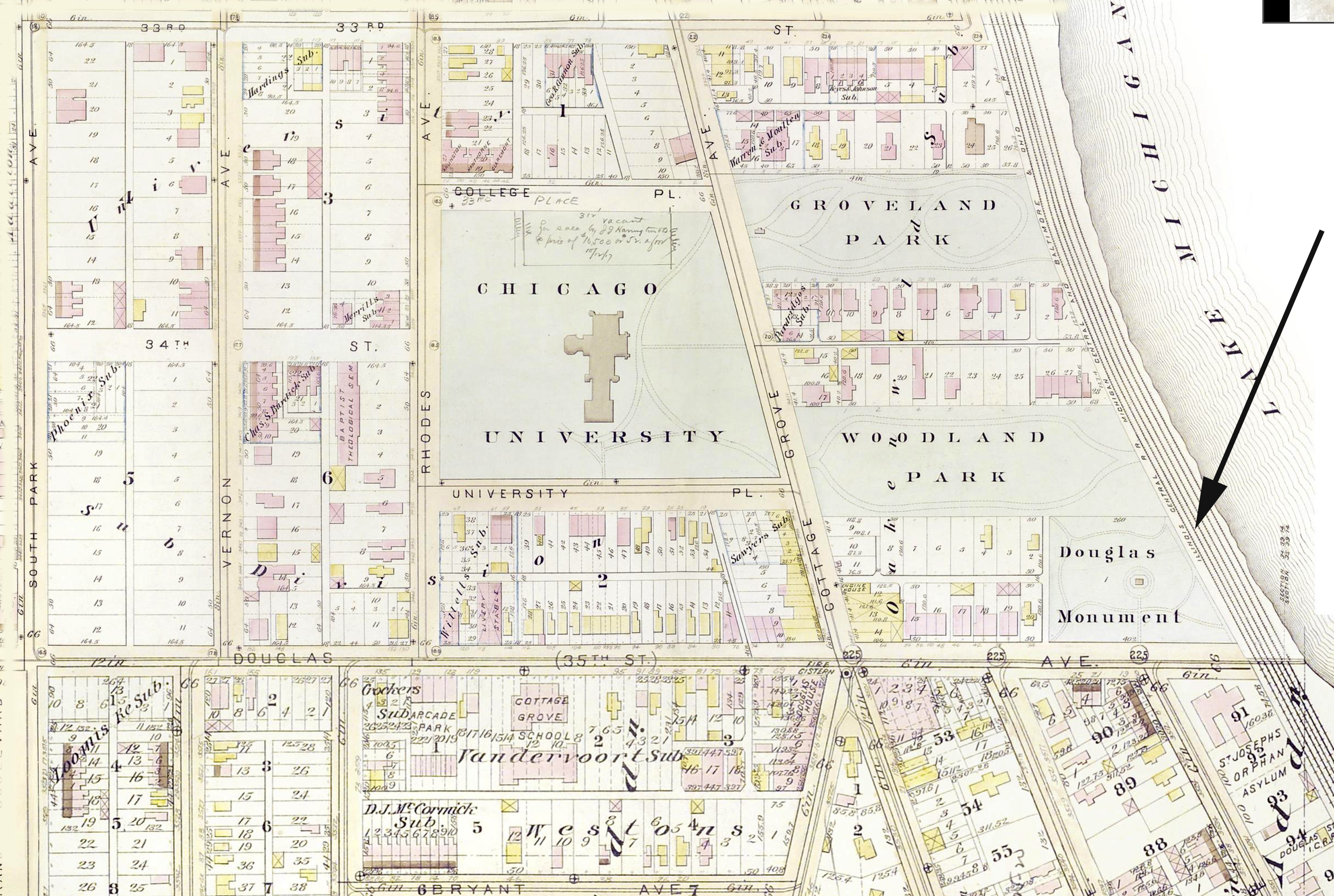
- Douglas’ Monument
Robinson Fire Insurance Map
1886

Leave a Reply