Lloyd’s Block. Fenian Hall
Life Span: 1858-1871
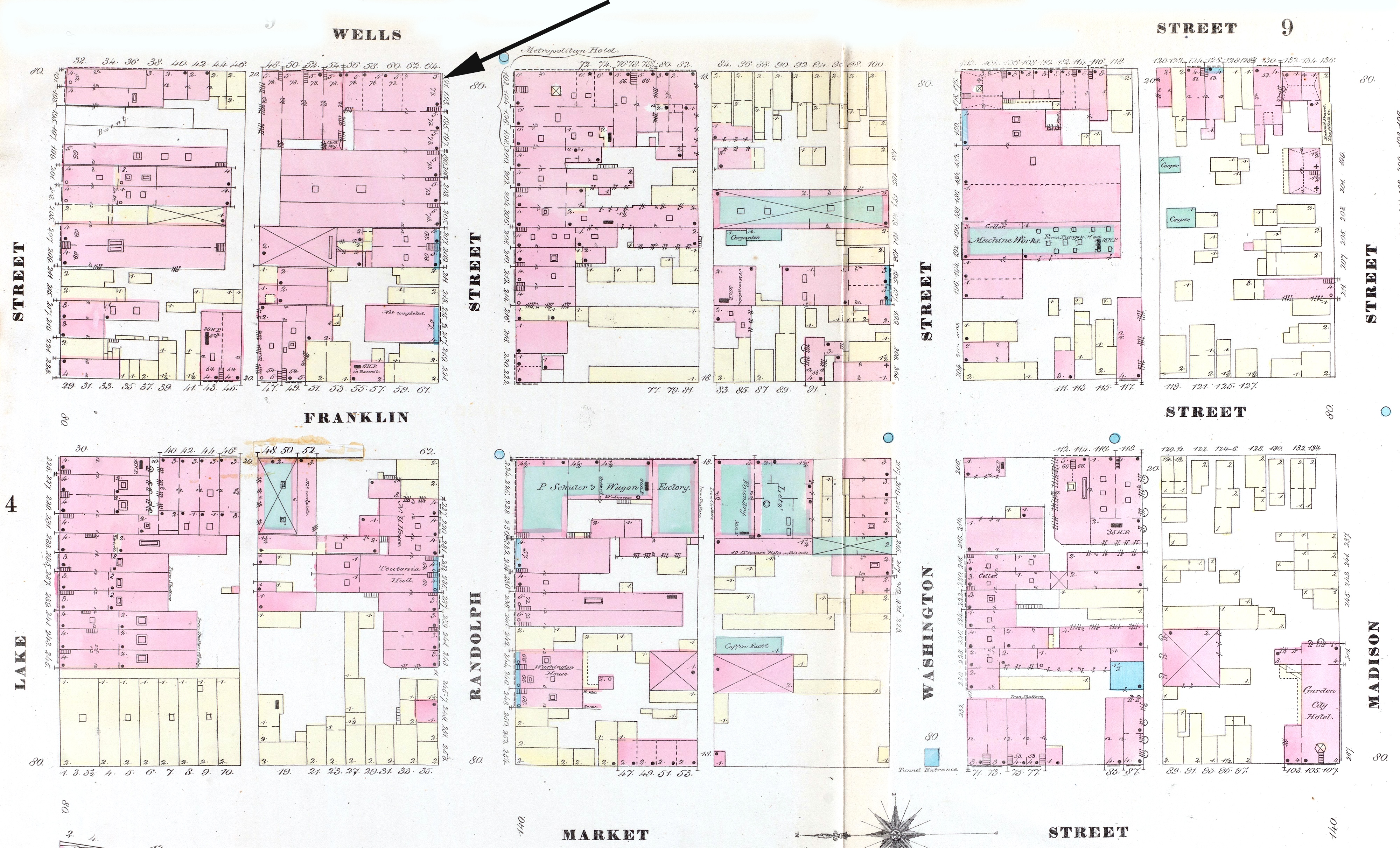
Location: Randolph street, northwest corner Wells
191-203 Randolph, 48-60 Wells
Architect: William Jones
- D. B. Cooke & Co.’s City Directory for the Year 1859
Taylor John, auctioneer, 50 Wells h 114 Monroe
Dickerson, Thomas S., tinplate and sheet iron, 45 Wabash av, h 608 Wabash av
Halpin & Bailey’s City Directory for the Year 1863
Fenian Hall, Randolph, nw cor Wells street
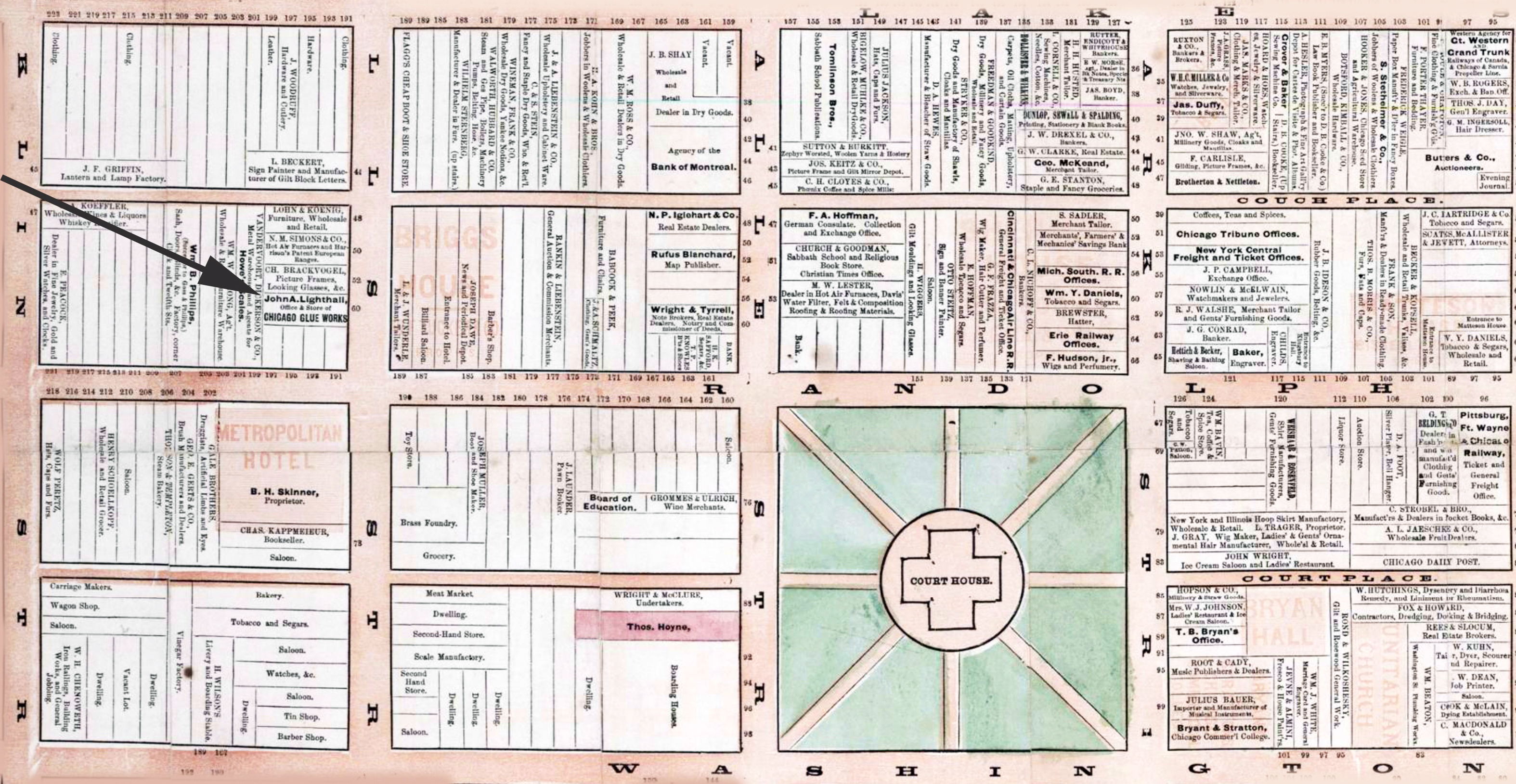
Lighthall John A.,, Chicago Glue Works, glue and neatsfoot oil, 60 Wells, Lloyd’s Block h. Evanston
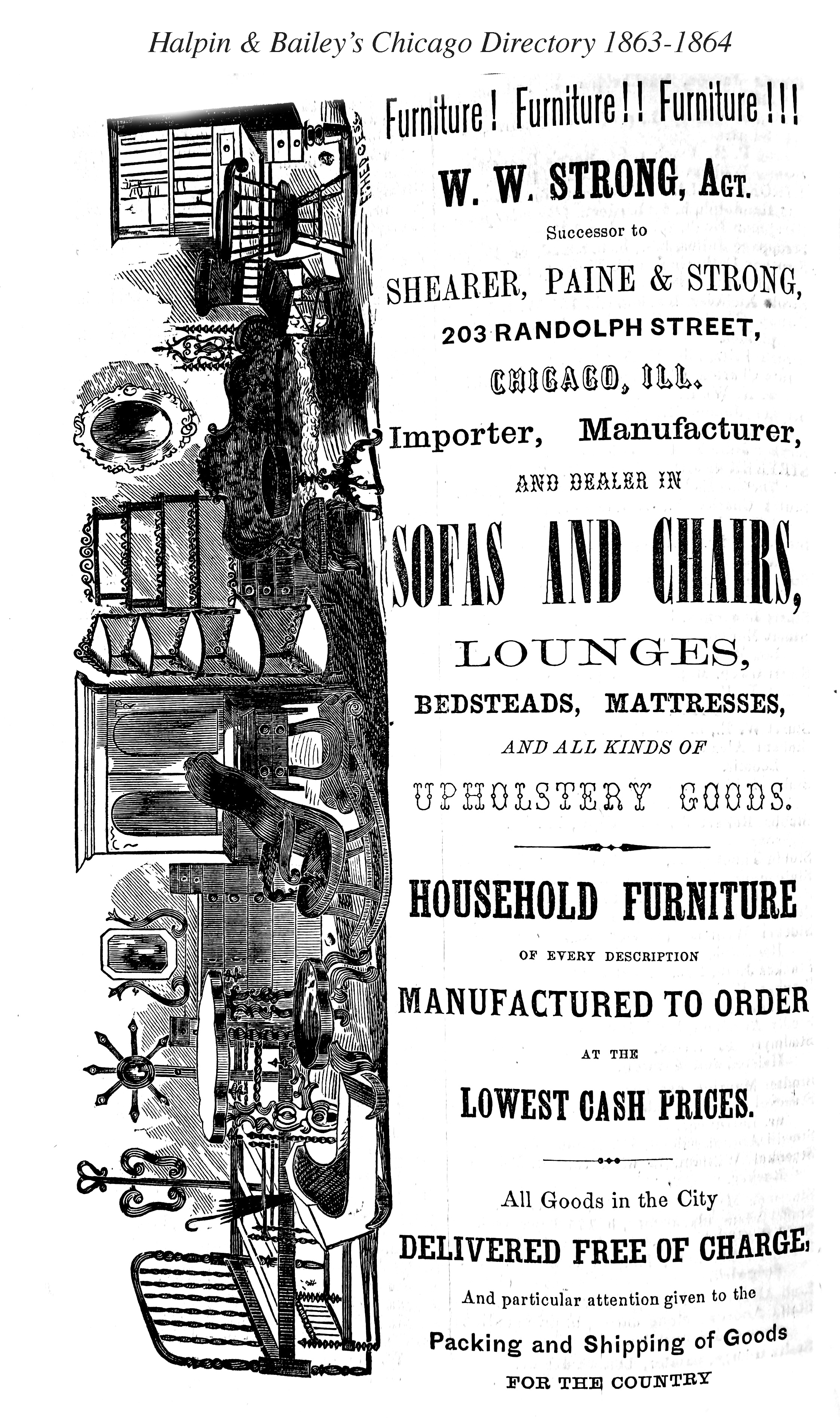
Strong William W.; agt., furniture, 203 Randolph, r. 4 Aberdeen. (See adv’t p. 440)
Halpin’s Chicago City Directory for 1864
Fenian Hall, Randolph, nw cor Wells street
Strong William W.; furniture, 203 Randolph, r. Washington, sw. cor. May
Vandervoort, Dickerson & Co., (P. H. Vandervoort and Thomas S. Dickerson) tin plate, sheet iron and metal, 199 and 201 Randolph
Halpin’s Chicago City Directory for 1864
Dickerson, Sturges & Co., (Thomas S. Dickerson and Frank Sturges,) tin plate, sheet iron and metal, 199 and 201 Randolph
John C. W. Bailey’s Chicago City Directory for 1867
Fenian Hall, Randolph, nw cor Wells street
Strong W. W., furniture, 203 Randolph
Sturges Frank & Co., (Frank Sturges, O. H. Lee, A. C. and W. S. Potwin,) whol dealers tin and japanned ware, 199 and 201 Randolph
Edwards’ Annual Directory in the City of Chicago, for 1867
Fenian Hall, Randolph street, northwest corner Wells
Edwards’ Annual Directory in the City of Chicago, for 1869
Fenian Hall, Randolph street, northwest corner Wells
Edwards’ Annual Directory in the City of Chicago, for 1870
Lloyd Block—Randolph street, northwest Wells.
Fenian Hall, Randolph street, northwest corner Wells
Harris U. P. firemen’s furnishing goods, 60 Wells, r. 91 Warren av.
Sturges Frank & Co., (Frank Sturges, Oliver H. Lee and William S. Potwin), importers of tin plate, metals, etc. and mnfrs. of tin and japanned ware, 199 and 201 Randolph
Edwards’ Annual Directory in the City of Chicago, for 1871
Lloyd Block—Randolph, nw. cor. Wells
Fenian Hall—Randolph, nw. cor. 5th. av.
Western Railroad Gazette, September 11, 1858
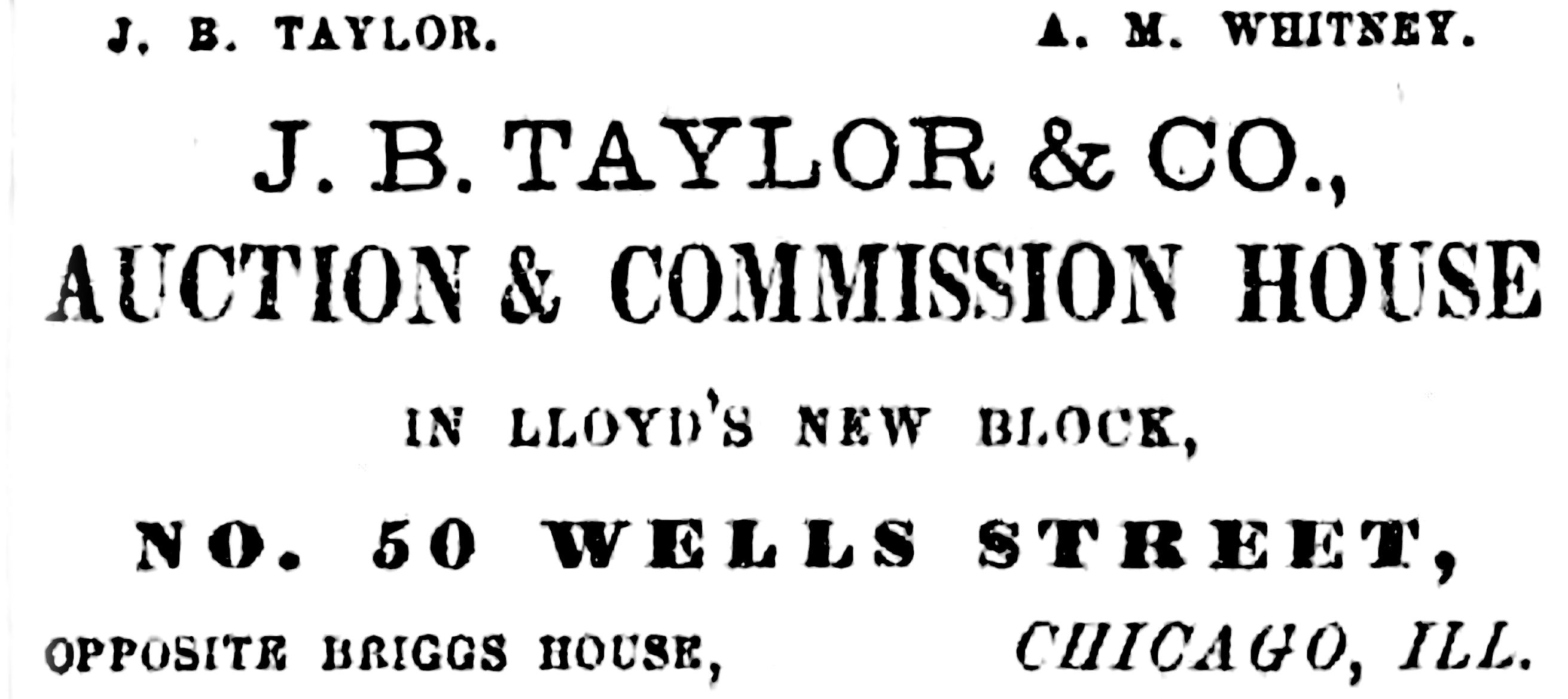 For the purpose of disposing of every description of property to be sold at Auction, for cash, on time, commission or exchanged; also, Real Estate, Lands, Lots, Stocks, Bonds, Cargoes, Mortgages, Furniture, Crockery and Hardware, Liquors, Boots, Shoes, &c. &c., sold and bought on commission or at auction. Having ample storage room and large sales room, a good inside or outside auctioneer, hope to give ample satisfaction to all who may honor us with their patronage and consignment—observing the strictest integrity and confidence in every in-stance. Will advance on consignment when required. Consignments solicited.
We beg leave to refer to the following gentlemen: Hon. John Wilson, Messis. Willard, Alexander & Co., bankers, Gov. MeComas, Messrs. Stevens Bro’s, Hon, T, L. Dickey, Chicago, Ill.; Cattle Bank, Hon. James Curtiss, Hon. M. L. Dunlap, West Urbana, Ill.; Alexander Ostrander, Esq., New York; Edgar Conkling, Esq., Cincinnati, Ohio; Wm. H. Haskell, Esq., P. B. Roberts, Esq., Peoria, In. ; G. G. Grubb, Esq., Philadelphia, Penn.; John W. Shaw, Esq., Boston, Mass.
Chicago Tribune, October 4, 1858
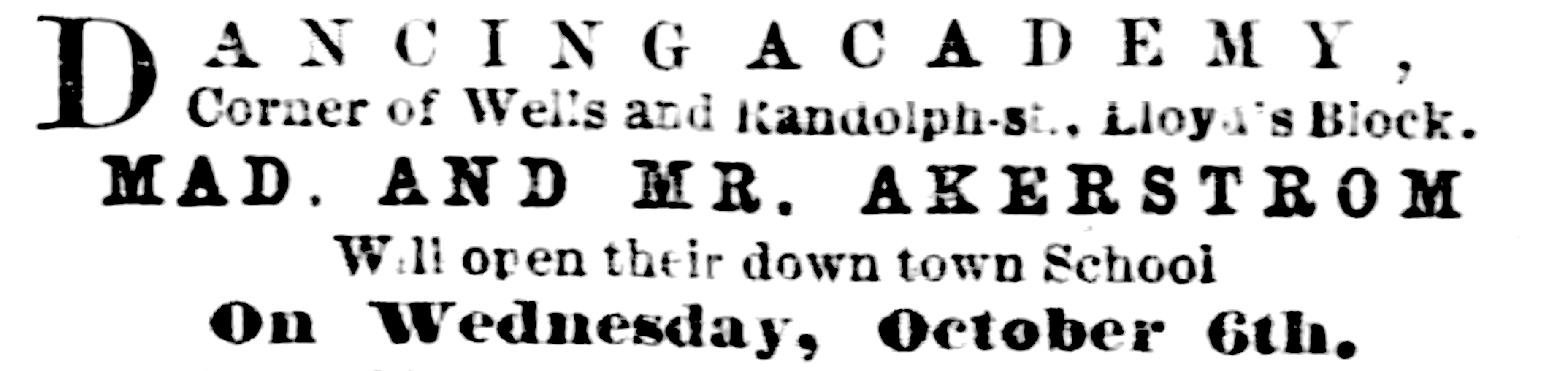 All the Fashionable Dances taught, and every variety of Waltzing. Also, every variety or Fancy Dancing. During the season the Lancier Quadrilie, and the entirely new quadrille Les Caledonians will be introduced.
Classes for ladies and children on Wednesdays and Saturdays, from 3½ to 6 P.M.
Gentlemen’s classes on Tuesdays and Fridays from 7 to 10 o clock P. M. Private lessons at all hours.
The first Assembly will take place at Monday the 11th inst. Tickets can be procured of Madame Akerstrom. The Hall has been newly painted and in complete order, and is to let to respectable parties on reasonable terms.
For particulars and terms apply at the rooms from 10 A.M. to 4 P.M.
Chicago Tribune, June 23, 1859
FIRST-CLASS FURNITURE,
At Auction.
Without Reserve, at No. 199 Randolph street, (Up-Stairs)
LOYD’S IRON BLOCK,
On Thursday Morning, June 23, At 9½ o’clock
John Rankin, Auctioneer.
Chicago Tribune, January 27, 1860
THE NEW CLUB ROOM.—The Young Men’s Republican Club have leased the fine hall in Lloyd’s Block, on the corner of Wells and Randolph streets, and propose to formally dedicate it next week, on which occasion all other Clubs in the city are to be invited to be present.
Chicago Tribune, February 7, 1860
REPUBLICAN CLUB READING ROOM—The Young Men’s Republican Club have opened a public reading room at their Head-Quarters, in the second story of Lloyd’s Block, on the corner of Randolph and Wells street, opposite the Briggs House. The room is supplied with all the best newspapers in the country, and everybody is invited to read them. The room is open all day and in the evening..
Chicago Tribune, May 24, 1861
MEETING OF GERMAN CITIZENS.—There was quite a numerous gathering of our German citizens at the Military Hall in Lloyd’s Block last evening, to take action on the currency. At times the debate grew quite excited. A proposit on was made to make up a common fund to protect the rights of depositors, by legal procesees to recover the par valas of deposits. Nothing definite was arrived at, nor can there be in any such manner as a public meeting, either to to sustain or to destroy the currency. It is taking its own course in what is evidently its “appointed time,” and the only proper and feasible method is a fair and quiet adjustment of losses, and then a turning over of a new leaf.
Chicago Tribune, January 11, 1862
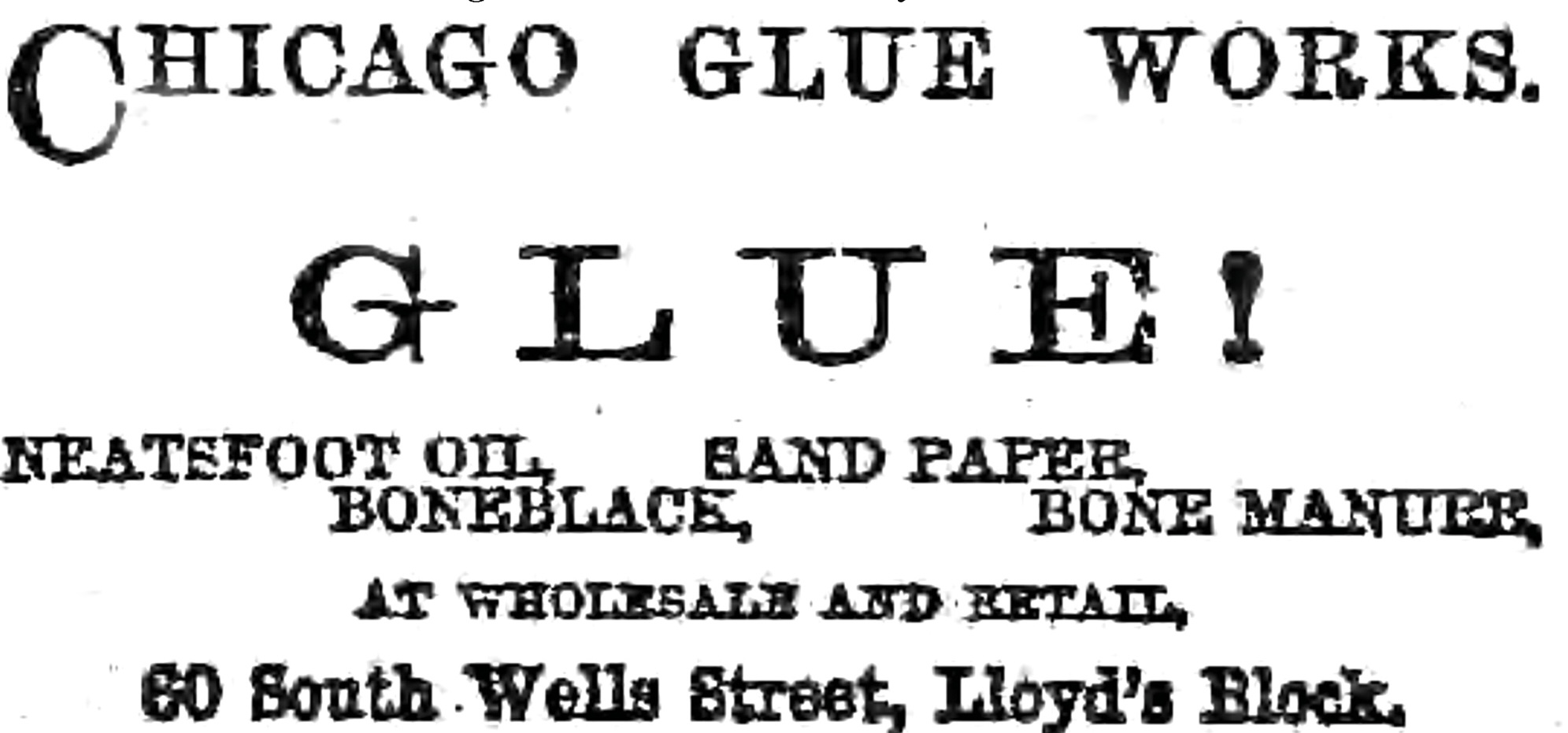 Having purchased the extensive Glue Factory of Wahl Bros, begs leave to to invite the Trade and consumers of Glue, Neatsfoot Oil, Sand Paper, Boneblack and Bone Manure, to his store, 60 South Wells street, where he offers the above articles, at wholesale and retail, at prices to suit the times.
A liberal discount made to Dealers. Cash paid for Glue Stock, Hide Cuttings, etc. etc
John A. Lighthall
(Successor to Wahl Bros.)
No. 60 South Wells st, Lloyd’s Block.
Chicago Tribune, June 7, 1862
FATAL ACCIDENT.—Thomas Brannick, the member of the Emmett Guards, who fell from the third story window of the recruiting office in Lloyd’s block, a day or two since, died at his residence No. 238 Adams street, at four o’clock yesterday afternoon..
Chicago Tribune, May 23, 1863
ANTI-HALLECK DEMONSTRATION IN CHICAGO.
Meeting of German Citizens.
A large and enthusiastic meeting of German citizens was held on Thursday night, at the rooms of the Chicago Working Men’s Association, in Lloyd’s Block. Stirring speeches were made by Caspar Butz, Wm. Rapp, Dr. Schmidt and Col. Knobelsdorff, and the following resolutions were adopted unanimously and applauded to the echo:
- WHEREAS, Gen. Halleck by his management of the military affairs in this war, which was equally without a plan and design, and without success, has sacrificed without any result thousands of our patriotic soldiers, and whereas, by his unjustifiable conduct towards the most patriotic and experienced generals, Fremont, Butler, Sigel and others, he has shown a want of patriotism and a criminal narrow-mindedness, and whereas, by the thoughtless and expensive administration of our army matters, and by the systematical neglect, to fill up the ranks of our decimated regiments, he has proved his incapability: We hereby declare and resolve, in view of our country’s danger, prompted by our unwavering devotion to the cause of our Union:
Resolved, That the people, and particularly the working classes, who hitherto have always furnished the principal contingent of our army, have no confidence in the military capacity of General Halleck, and demands that the welfare of the country imperatively his removal from the responsible position, which, to the misfortune of the country, ee has occupied too long already.
Resolved, That we most respectfully request the President of the United States, to confer suitable commands upon those tried and experienced Generals, Fremont, Sigel, Butler, Lew Wallace, and others, and that, in fact, he may give important commands only to those Geneaals who have proved their ability by their success on the fleld of battle.
Resolved, That a copy of these resolutions be forwarded to the President of the United States, to the Governor, and the Representatives in Congress of the State of Illinois, and to Generals Fremont, Sigel, Butler and Wallace.
Chicago Tribune, July 3, 1863
SALE OF THE LLOYD BLOCK.—On Wednesday, Hon. Mark Skinner, as master, sold the the large iron front building known as the Lloyd block, at the northwest corner of Wells and Randolph streets, and opposite the Briggs House, for $88,239.29. John Forsythe, Esq., was the purchaser. The terms were cash, and were immediately complied with. The building is an extensive one, fronting about 150 feet deep on Randolph street, and about the same on Wells street. The fronts on both streets are of iron.
Chicago Tribune, July 4, 1863
NOT SOLD.—In our notice, a day or two since, of the sale of Lloyd Block, we should have said that the eighty feet was owned by Wm. Jones, esq., and was not sold. Mr. Jones very naturally objects to be disposed of so unceremoniously.
- Lloyd’s Block
NW Corner Randolph and Wells
1862
Chicago Tribune, July 30, 1863
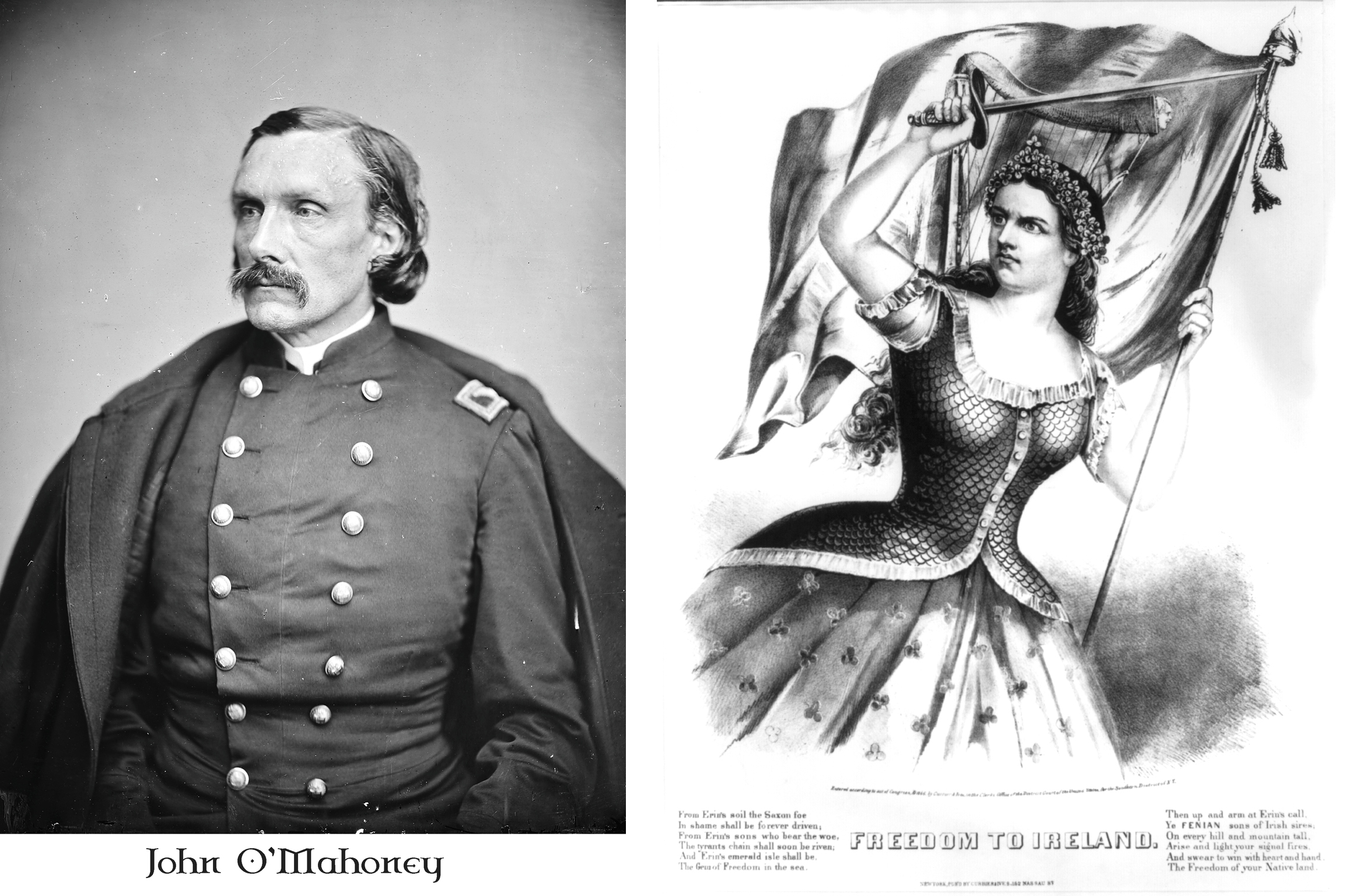
The Fenian Brotherhood—Donations of Books and Pictures Solicited.
The Fenian Brotherhood of Chicago have organized a free reading room and library, and request donations of books or pictures, such as may seem appropriate or fitting. A cabinet of Irish antiquities and Celtic articles of virtue is being made up, to which all ladies and gentlemen are invited to donate. Donors will receive gratuitously the pamphlet called
“The Fenian,” issued by this organization monthly.
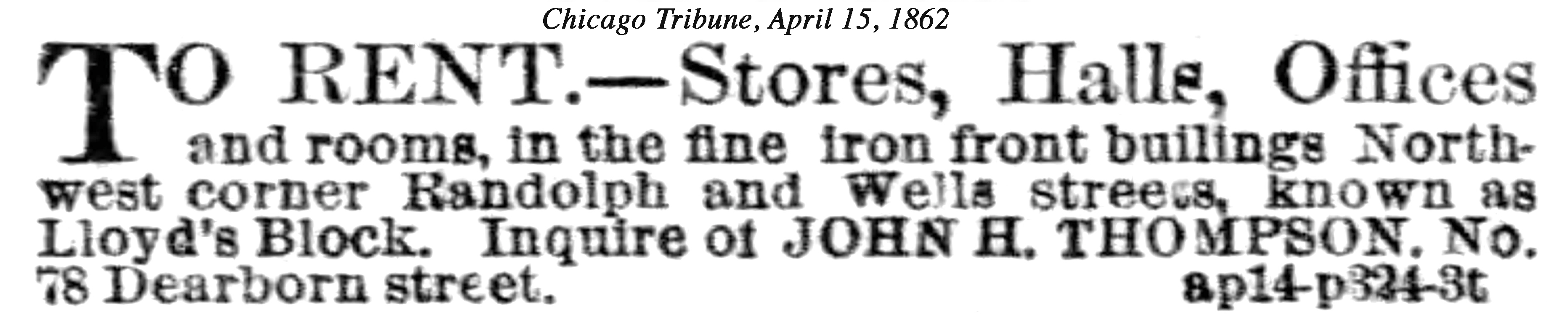
The Reading Room is one of the largest and most elegant halls in the city—situated on the northwest corner of Randolph and Wells streets—and is provided with the ordinary and extraordinary newspapers of the day. The Library, which is being largely increased by the generosity of friends, will soon assume ample size, and is made up of really excellent books. The room, papers and books, are all furnished by the Brotherhood gratuitously to the Irish people, who are not only welcome but pressed to avail themselves of the accommodations.
The purpose of the Brotherhood is patriotic. They desire to elevate their country people—to have their young men visit the library rather than the saloon. They desire to be among those who are laboring to extend the intelligence of the Irish people. They wish to cultivate independence of character and individuality of thought among them; to create other spheres than those of manual labor; to create and develop practical and useful ideas, which adapt Irishmen to this time and to this country, and which will prepare them for the “other” time and their own country. Any donation, however humble, will be received gratefully and officially acknowledged. Any persons who wish to communicate with the order will address “Library Committee, Fenian Brotherlood, care Box 2155, Chicago.” If advised, the committee will visit any portion of this city to receive such donations as are proffered, or donors may send to the rooms upon any day after 7 o’clock p.m.
Western Railroad Gazette, January 30, 1864
Dickerson, Sturges & Co.—This is the title of the new Firm—successors to the well-known “Vandervoort, Dickerson & Co.”—virtually the same firm, doing the same business, Mr. Vandervoort being replaced by Frank Sturges, Esq., son of the well-known Solomon Sturges, Esq., of this city, whose name, for the past twenty years, has been so closely identified with Western enterprise, growth and prosperity. Sturges, Jr., has become a member of the new Firm, infusing therein a large portion of the idomitable energy and go-ahead spirit of his honored father, with a liberal addition to the already large capital of the concern. That he will do credit to the name he bears and prove a most desirable partner and acquisition as a man of business capacity and aptitude, we have not the slightest doubt.
Under the new regime, the business at the old stand, Nos. 199 and 201 Randolph street, will be carried on with enlarged facilities, and greater success than ever. They represent one of the oldest Houses in the city, whose trade and business relations have extended and reach to the remotest sections of our western country. They deal exclusively in Metals at wholesale, and import everything embraced under that general head, such as Tin Plate, Block Tin, Zinc, Sheet Iron, &c., which they offer to purchasers at the very lowest market rates. They are also Agents for the celebrated “Howe’s Improved Standard Scales,” which have been adopted by Government in preference to any other in use, and are considered by merchants, railroad and business men of all classes, to be superior to any in the market. Their immense double store is completely stocked for the coming spring trade, and the characteristic promptness of this Firm in filling city or country orders and forwarding goods to their desired destination, is proverbial.
Any man requiring anything in their line will find it to his manifest advantage to open business dealings with this Firm, who will take pleasure in greeting cordially their old customers and new friends.
Chicag Tribune, April 6, 1864
IRISH NATIONAL FAIR.
The Sale To-day—Supper and Bill—The Lottery.
According to announcement, the Irish National Fair was continued yesterday in the Fenian Hall only, Bryon Hall being otherwise occupied. It is proper to say that the Committees desired to continue the Fair in Bryan Hall during the present week, and secured the use of that Hall on Monday night by paying to the German Working Men’s Asociation the sum of one hundred and thirty dollars, about the sum needed to reimburse them for their outlay.
But it was impossible to make the same engagement for the succeeding (last) evening as the Hall had been engaged by the Young Men’s Literary Association of St. Peter’s Roman Catholic Church (German), who would not give up their claim short of the modest little sum of five hundred dollars. This the committee did not feel justifed in giving, and therefore closed the proceed. inge on Monday by the sale of a portion of the articles on exhibition.
To-day, Wednesday, at 9 o’clock in the morning, will begin, at Bryan Hall, the sale of the elegant Limerick laces, collars and cuffs, shawls, handkerchief, Limerick gloves in shell and plain, bog oak ornaments, and various fancy goods of the Irish National Fair. A large catalogue of paintings and pictures are also to be sold, among which are two of Daniel O’Connell.
- “Madonna and Child, oil painting by an Irish test.
Irish landscapes in oil.
Brian Borehme in oil. Valuable.
Robert Emmett.
John Mitchell.
Owen Roe O’Neill. A splendid painting in oil.
Old and valuable.
Thos. P. Meagher.
Red Hugh, in oil. A fine painting.
Emigrant scene, in oll, by an eminent Dublin artist. Valued in Dublin exhibition at 50 guineas.
Blackthorn and hazel sticks.
Tabinet and popin dreeses.
Linens, cambric handkerchiefs, damask table cloths.
These will be a very large and varied assortment of goods on sale, covering every want. There are on exhibition at the Fenian Hall. northwest corner Randolph and Wells streets, various machines for sale, among which are
- One of McCormick’s best reapers.
One steam engine completely fitted up.
Two stoves.
One set steel carriage springs.
One box containing fulf set wrenches.
One water tank.
One churn.
One Herring patent safe, &c.
There is an extensive assoriment of fine laces etc., for sale to-day; those of the ladies who have an eye to the beautiful and appropriate in that direction will ind it to their interest to be present at the sale. The same may be said to connoiseurs in paintings; there are some real chef d’ ouvres in art on the catalogue of articles to be sold to-day.
All the ladies who are desirous of getting fine laces, &c., should be on hand at Bryan Hall this morning and afternoon, and those who prize fine pictures should also be there.
In the evening a ball will be given, for which elaborate arrangements have been made, among others a rich and rare sapper. We have no doubt as at the Fair, there will be a large and select attendance.
The Fenian Hall will be open during the day from 10 o’clock A.M., to 6 o’clock P.M., and will so continue until April 30, the day of the lottery drawing. The goods in Fenian Hall, with arms, antiquities, and curioeities, will be on exhibition alone. Sales will take place at Bryan Hall by auction, of which the public will be duly and properly notified.
Fenian Hall was closed last night because goode were being arranged for the auction at Bryan Hall this morning.
We are requested by the committee to atate that all persons holding claims against the executive committee are requested to present their bille for payment. P.T. Sherlock is charman of the committee.
Chicago Tribune, December 4, 1865
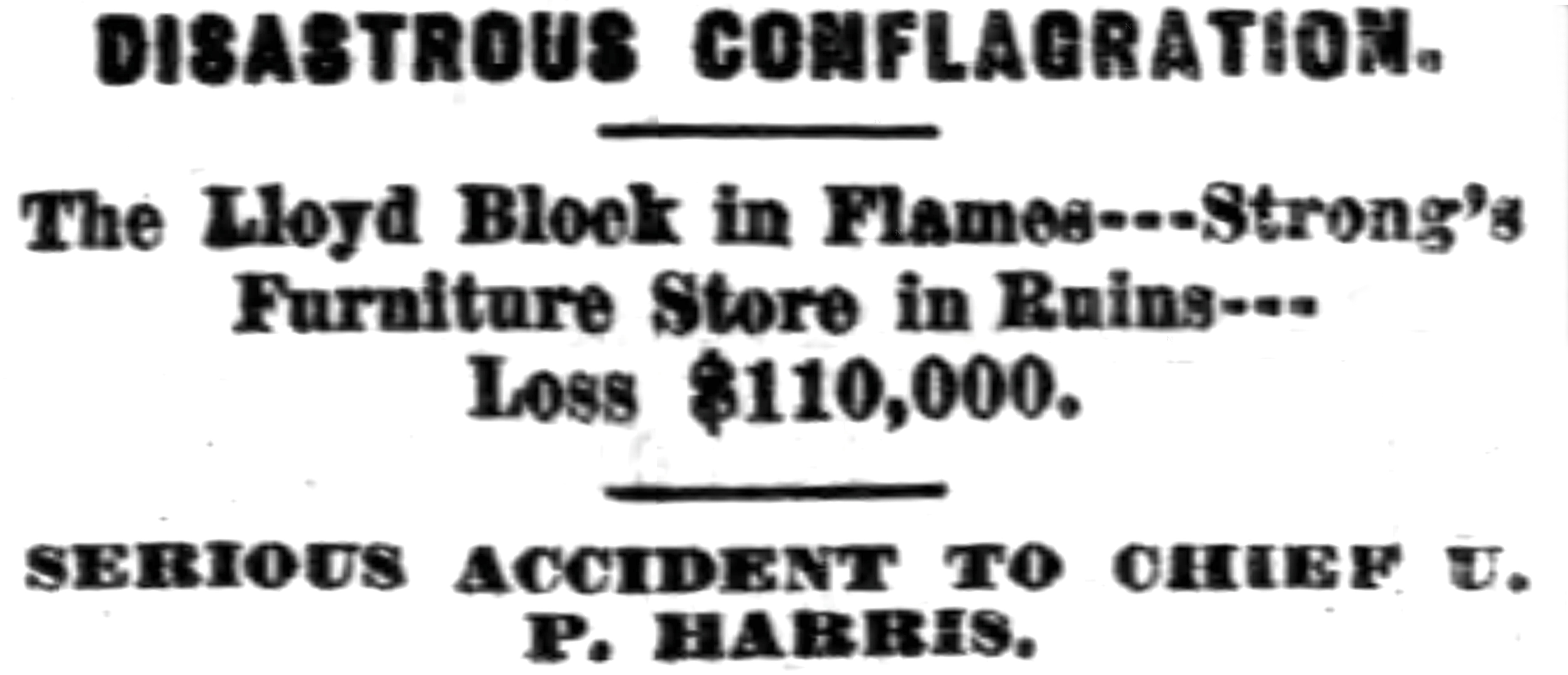 A fire of unusual magnitude broke out at 8 o’clock on Saturday evening in the Lloyd Block, northwest corner of Wells and Randolph streets. It originated to the rear of the fourth door of the furniture store of W. Strong, No. 205 Randolph street, which extends from the basement to the upper story of the building, and before fire department could be called out, the whole of the rear part of the upper rooms were enveloped in fames.
For some time the conflagration appeared to be making slow progress, but before half an hour had expired, the flames wore seen dickering skyward from the roof, and the whole street. Owing to great height of the building and the difficulty of gaining to the proper spot, was some time before the firemen could bring the hose to operate, and during the interval the fames had made considerable headway. The whale of the department were called out, and their united efforts resulted, after a fierce struggle, in bringing the racing element. under subjection. The crowds which had collected on the street were on the point of dispersing, in the belief that the show was over, when all at once a brilliant sheet of flame was seen to issue from the windows of the fourth story fronting Randolph street. The upper floors had given away, and the burning materials, falling through, communicated the fire to the third story. The establishment contained some very valuable articles of furniture, all of which fell prey to the flames. The fifth, or upper floor, was used as the manufactory, while the floor immediately below that was the varnishing rooms were stored with a quantity of benzine and other burning fluids used for varnishing purposes. It was here that the fire originated, although in what manner, could not be precisely ascertained.
Many of the employer of the establishment were enraged in the rooms at the time the disaster occurred. One of them, Mr. French, the bookkeeper, ran into the upper story at the commencement of the fire, and narrowly escaped so suffocation.. Becoming half frantic he rushed toward one of the rear windows which he broke into pieces, and was about to throw himself, out. when, fortunately for himself, a boy seized him round the waist, and forcibly dragged him back. There was every prospect that the flames would soon be brought under subjugation, when a sad calamity befell Chief Fire Marshal U. P. Harris, which bad well nigh terminated his career. Mr. Harris resides in the same block, and was upon the spot nearly as soon as the fire commenced. He had ascended to the roof of the building, and then went into one of the upper rooms which was filled with smoke. While in the act of making his way down to give orders to the department, he missed his footing in the darkness, and fell through the hatchway, which by some strange carelessness had been left open, down to the second story, a height of more than thirty feet. For some moments the Chief lay quite insensible, and it was feared that he was killed by the fall, but he soon recovered sufficiently to be able, with assistance, to reach his room. Two physicians promptly attended him and dressed his wounde. He is said to be seriously but not dangerouely hurt, the principal injuries being in the pelvic bone, and the base of the spine. In falling, he succeeded in breaking his fall by catching at the rope, and thus let himself down easily. Had it not been for the fortunate circumstance of the rope being there, he would in all probability have been killed on the spot.
This unfortunate occurrence had a bad influence on the efforts of the fire brigade. The men seemed to be all at sea after the lose of their chief, and twice, after the conflagration seemed to be extinguished, the flames broke out again in other portions of the structure. Five streams of water were brought to bear upon it from the alley. and another from the front, but not being properly directed, they failed to accomplish the desired effect. and not till nearly midnight did they succeed in reducing the fire.
The following is a statement of the damage sustained by the proprietors of the different stores Mr. W. W. Strong, and Philo Carpenter are the owners of the store No. 203, where the fire originated. The main store. or sale-room, was filled with every description of furniture of the richest and most expensive kind, including sofas, lounges, mirrors and some elegant chairs. On the same floor was the office, containing all the books of the firm, which were saved from destruction. The second floor contained a large variety of valuable mirrors, some of which were valued at from $1,000 to $1.500; rosewood, mahogany and walnut sets of furniture, marble topped dressing-cases, and valuable sofas lounges and chairs. All these were more or less damaged. partly from fire but to a still greater extent from water. The third floor contained furniture of a less expensive description, such as imitation walnut and oak sets, which were entirely destroyed by the water. The fourth floor was used as a paint and varnish room, and also for upholstering purposes. Everything in this portion of the building was completely destroyed by fire. The fifth floor was the manufacturing rooms which were filled with new and unfinished goods, all of which were consumed by the flames. The entire loss is estimated at $100,000, upon which there is an insurance of $45,000, the policies being about equally divided between Eastern and home companies. Mr. Strong’s stock was generally considered to be among the finest in the city, embracing articles of rare workmanship and great value. It has been utterly destroyed.
The stores adjoining that of Mr. Strong. Nos. 199 and 201, were owned by Dickerson, Sturgis & Co., dealers in tinner’s stock and tools. The contents of these stores have not been damaged by fire, but a considerable portion of it bas been destroyed by the water. Their loss, about $9,000, is fully covered by insurance.
The store to the west of the furniture store, No. 205, owned by S. H. Ransom & Co., containing stoves and hollow-ware, was damaged to the extent of $500. Fully insured. In the fifth story of this store some valuable geological specimens had been left by Prof. McChesney. They were all destroyed.
A. Schall’s house, Nos. 207 and 209, was damaged by water to the extent of about $500. Fully insured.
All of the three stores are owned by Mr. William Jones, of the firm of Ogden, Turner & Co. The loss sustained by him is estimated at $10,000. Insured for $30,000.
The entire loss may be estimated at about $110,000
New York Times, December 13, 1865
The Fenians in Chicago.
Chicago, Tuesday, Dec. 12.
A large and enthusiastic meeting of the Fenian Brotherhood was held at Fenian Hall this evening. Resolutions were passed indorsing the action of the Senate and recognizing Col. William R. Roberts as President of the Fenian Brotherhood.
Chicago Tribune, June 4, 1866
THE FENIAN COLLAPSE.
The Fenian invasion of Canada has ended as suddenly as it began. The raiders who crossed at Buffalo are all dispersed, captured, or killed. The greater portion of them are prisoners of the U. S. steamer Michigan, which intercepted them in their attempted flight, at three o’clock, Sunday morning. They retreated just in time to escape a Canadian force of 3,500 men, who were preparing to attack them at daylight. It appears that they got away with good appetites, having had nothing to eat since they left Buffalo, but what they picked up on the road. Nobody but an Irishman would have thought of sending an army into Canada without rations. Nobody but an Irishman would have thought of invading Canada by private subscription. If Gen. Sweeney had heeded the maxim of his great countryman, the Duke of Wellington, that “armies march on their stomachs,” he might have prolonged his stay in Canada by twenty-four or thirty-six hours. The net results of the raid are that the Fenians have murdered and robbed a few Canadians, spent their money, lost their army, and brought their cause to ruin. This is as much as a Fenian republie could expect to accomplish in so short a time. The 0’Mahoney faction exhausted their assets three weeks ago gazing at Campo Bello Island. The Sweeney-Roberts faction have now depleted their exchequer. Both treasuries being empty, they have no further occasion to quarrel with each other. Those who escape can now betake themselves to some honest calling, and reflect that they have postponed the day of Ireland’s independence a long time by their blundering and wicked raid upon a people who are in no way responsible for the wrongs of Ireland.
We give no heed to the theory that the movement at Fort Erie is a mere feint to draw off the attention of the British forces from St. Albans or Ogdensburgh, where the real movement is to begin. There has been no concentration of Fenians at either of these points of sufficient magnitude to create apprehensions at Montreal. The whole movement has collapsed, and the Fenians themselves should be thankful that the end has come before any more of them got into the scrape.
A perplexing question is raised by the capture of seven hundred of the fugitives by the steamer Michigan. Whether they are to be dealt with under the neutrality laws or under the extradition treaty, is a. question for the Courts to decide. It may be held that the neutrality laws contemplate a state of war between two belligerent powers, and that AS the Fenians represent no belligerent power, they have not rendered themselves liable to be proceeded against under that act. Moreover, the neutrality act applies only to officers, and persons engaged in enlisting others to serve in hostile expeditions against foreign powers or States. If, in view of these facts, they are not liable to be proceeded against for violation of neutrality, they are subject to the operation of the extradition treaty, which requires persons, who have committed 4 murder or assault with intent to commit murder, or piracy, or arson, or robbery, or forgery, or the utterance of forged papers,” on the territory of Great Britain, and have escaped to the United States, to be delivered up on the demand of the Government against which the offence was committed. The hearing of any case arising under the extradition treaty may be had before any Justice of the Supreme Court, or any Judge of the United States District Courts, or of the State Courts, or any duly authorized Commissioner of the United States Courts. The chances of a successful application under the extradition treaty in the present instance would be much greater if the Canadian Judges, Coursol and Smith, had not practically nullified it by discharging the St. Albans raiders from custody—an act which we know was sincerely regretted by the Canadian Government, but which was nevertheless the official act of the province. It is not unlikely that Sweeny and Roberts had enough method in their madness to count upon the exasperation on this side of the line, consequent upon the St. Albans raid, as one of the elements in their favor in the contingency which has happened. If the bad precedent, which Coursol and Smith established, shall become the common law of the two countries, and public law and solemn treaties shall be violated, and life and property thereby jeoparded, the mischief and demoralization will not have had their beginning en this side of the line.
Chicago Tribune, August 25, 1866
Commissioner Titsworth stated that he had been complained to by the proprietors of the Briggs and Metropolitan Hotel, in relation to a nuisance that exists in the shape of Sunday dancing in Lloyd’s Block, corner of Wells and Randolph street.
General Superintendent of Police said that the dancing mentioned would be stopped at once..
Chicago Evening Post, June 14, 1869
Carver’s Artesian Pump.
Among the many new inventions introduced into the West, one useful and meritorious is that of Carver’s double-acting artesian pump, doing the double duty of force or suction pump. It does its work well, is simple in construction, being or without the ordinary suction-valve, packing or stuffing-boxes bails using instead vulcanized rubber balls valves these placed at the bottom of the well render their being affected by frost impossible. They are likewise being not at all liable successfully used in the Pennsylvania oil wells, and are well adapted to railroads, factories, hotels and private families, and can with sufficient length of hose be made to throw a stream one hundred feet high, making a valuable fire engine as well as a good garden or farm pump. It has already taken first premiums in State fairs. Mr. U. P. Harris, at No. 60 Wells street has the agency of the pump it can be seen in operation at his room at any time.
- Fenian Hall
NW Corner Randolph and Wells
1869
Chicago Tribune, January 12, 1868
Death of William Jones, Esq.
At half-past two o’clock on Saturday morning died, at his residence, No. 190 Wabash avenue in thie city, Mr. William Jones, one of the oldest citizens of Chicago, in the seventy-eighth year of his age.
Mr. Jones came to this city in the year 1835 having emigrated from Buffalo, New York. He at once entered into the business of selling goods, connecting himself with two other gentlemen, the firm being known as Jones, King & Clark. The firm occupied a small frame building near the river, on what is now South Water Street. At the time he came here, Chicago was an insignificant little village; but Mr. Jones saw at once how admirably it was situated, and he became possessed of a firm belief in the future greatness and prosperity. Making safe investment, capital rapidly increased in value and at his death he was possessed of property valued at nearly a million dollars. Several years since he engaged in the banking business, in which he was remarkably successful. He invested largely in real estate, and constructed many large business blocks, among which were the Lloyd block, on Randolph near Wells, and the marble block on Clark street, now occupied by the offices of the Chicago and Northwestern Railway Company. He laid off the “Jones” addition to the city of Chicago, which he situated in the South Division, and comprises property of immense value. An showing the unwavering confidence be felt instanced by him in the growth of the city, him may for the passion that ever possessed investing in real estate here. He used to invest all his available means therein, and frequently ran largely in debt for land.
Mr. Jones felt a warm interest in the cause of public education. In 1840 he was elected President which of the first Board of School Inspectors which Chicago possessed. This position he retained tor eleven years. For several years he was President of the Board of Trustees of the University of Chicago, institution has received most material benefit from him. The Jones School, on the corner of Clark and Harrison streets, was named in his honor. In the year 1858, Mr. Jones established the Jones School fund of $1,000, the interest of which sum is devoted to the benefit of that school, to be used in the purchase of text books for indigent children, and other charitable connected with education. purposes He was essentially a self-made man. Upright and honest in all his dealings.

Leave a Reply