Building Name(s): , Link’s Block
Life Span: 1857-1871
Address: 162 and 164 Lake
Block and Subdivision: 19, Original Town
Architect: Otto H. Matz
- D. B. Cooke & Co.’s City Directory for the Year 1859
Link’s Block, Lake nw cor La Salle
Mendel Edward, lithographer, 19 Link’s bldg, h. same
Halpin & Bailey’s City Directory for the Year 1863
Link’s Block.—Lake nw cor LaSalle
Mendel Edward, lithographer, Lake, n.w.c. LaSalle, h. 32 Warren, (See adv’t. p. 42)
Coolbaugh W. F. & Co., Lake, n.w. cor. LaSalle
Halpin’s Chicago City Directory for 1864
Mendel Edward, lithographer, 162 and 164 Lake, r. 32 Warren, (See adv
Coolbaugh W. F. & Co., (William F. Coolbaugh and Francis W. Brooks,) bankers, nw. cor. lake and LaSalle
Bailey’s Annual Directory in the City of Chicago, for 1867
Link’s Block, Lake, nw cor LaSalle street
Mendel Edward, lithographer 162 Lake, h 1052 Wabash,
Hayes Samuel S., office rooms 7 and 8, 162 Lake, nw cor Lake and LaSalle
Union National Bank, Lake, nw cor LaSalle
Edwards’ Annual Directory in the City of Chicago, for 1867
Link’s Block, Lake street, northwest corner LaSalle
Union National Bank, Lake, nw cor LaSallee
Edwards’ Annual Directory in the City of Chicago, for 1870
Link’s Block.—Lake street, northwest corner LaSalle
Weekly Chicago Times, December 31, 1857
Lake Street.
The magnificent block of iron front buildings at the corner of La Salle street, 90×61 feet, and five stories hight, besides the basement; for John Link.
This block of buildings is the admiration and wonder of both citizens and strangers, and is universally acknowledged to be by far the most splendid building erected here this season. It will probably sustain this position for a long time to come, and alwavs be the pride of our city. The iron front is 60 feet on Lake street, and 90 feet on La Salle street, making an iron front of 160 feet by five stories high, besides an eight feet deep basement, dry and well lighted. The building is a noble structure of the Corinthian order of architecture. The insulated and fluted columns, rich capitals, embellished arches, keys and cornices, look massive, yet airy and tasteful, and are more plainly presented to the eye of the beholder by deep rustic joints, an imitation of Ashlar block work, inserted strongly and correctly in the piers, string courses and other flat surfaces. The top cornice has hand. some medallion blocks, and drops in the pannelled planceer. The frieze is decorated with circular wreaths, but is otherwise plain, thus throwing more effect upon the lower members. The openings throughout are well proportioned, the window arches counter beaded and finished with neatly carved mullions. The structure is a complete success in every respect, and far superior in architecture, appearance and finish, to any iron building in Chicago, perhaps even in the country. The exterior is painted in a soft yellow tint, a decided improvement on the white painted iron fronts in other parts of the city. The lower floor of the corner building is arranged for banking offices, the ceiling being panelled and adorned with ornamental stuees work. The upper floors are divided into airy offices. Cost $80,000. Otto H. Matz, architect.
Chicago Tribune, November 30, 1858
Architectural.—We call the attention of all who are interested in the erection and construction of buildings to the card of Otto H. Matz, Esq., Architect, who has removed his office to the corner of Lake and LaSalle streets, over the Chicago Bank, in Link’s iron block. Mr. Matz has since his residence here erected some of our noblest and wost substantial structures. Such magnificent buildings as the Central Union Depot, on the Lake Shore, the enormous freight and other depots, and John Link’s iron block, the richest building ever constructed of that material, are the pride of Chicago and lasting monuments to the skill of the architect.
Chicago Illustrated, January, 1867

Corner of La Salle and Lake Streets. This is a familiar scene to the people of Chicago. It is one of the busy street crossings. The view is taken from the south-west, looking east. On the extreme left is a portion of Link’s iron building in which Coolbaugh’s Union National Bank has its offices, and in the upper stories are the real estate rooms of Mr. S. S. Hayes. The central building is that of the Marine Bank, condtructed of Illinois marble. It is at the north-east corner of LaSalle and Lake Streets, and was one of the first of the large business houses built of stone.
In 1858-9, the grade of Lake Street having been raised, the entire block of buildings, of which the Marine Bank building was one, extending from LaSalle Street east to Clark Street, were raised from their foundations nearly six feet. The process was one that attracted general interest, and was watched with great anxiety by the public. The buildings were all of brick or stone, four or five stories high, were all occupied, and the work was accomplished without accident and without suspending business for an hour.
Chicago Tribune, January 15, 1865
A new National Bank has been organized in this city, under the name of the “Union National Bank of Chicago,” of which W. E. Coolbaugh, the well-known banker, is President. We will give particulars next week.
Chicago Tribune, January 20, 1865
A few days since we announced that a new National Bank had been organized under the title or the “Union National Bank.” We learn today that it will he opened for the transaction of a legitimate banking business about the 1st of February, in the office now occupied by W.F. Coolbaugh & Co., corner of Lake and Lasalle streets. The officers of the Bank are as follow: President, W. F. Coolbangh; Cashier, C. J. Connell; Directors: W. E. Coolbaugh, J. V. Farwell, Wesley Munger, D. Thompson, H. G. Powers, Clinton Briggs, and C. T. Wheeler. It is proper to say that this is one or the strongest Boards that could be possibly organized in this city; and the success of Mr. Coolbaugh as a private banker is a guarantee of his eminent fitness for the office of President. Mr. Connell, the Cashier, is well known to the business public as the present Cashier of Mr. Coolbaugh’s bank, and he is in every way well qualified for the office.
Chicago Weekly Tribune, February 9, 1856

LITHOGRAPHY, ENGRAVING, &C.
Lithography, as the word signifies, is writing on stone, from which impressions are taken. The stone used is a kind of lime-stone, and capable of an extremely fine polish. It is principally quarried in Bavaria, where it exists in large quantities, though it has been found in other parts of Europe, and even in this country, but of an inferior quality. The peculiarity of it consists in its power to absorb water and oil, which, with the mutual antipathy which these have for each other, constitutes the fundamental principle of the art. So susceptible is this stone, that to lay the hand upon it, and after passing it through the process of printing, the form and lines of the hand will be distinctly visible.
Edward Mendel, Lithographer, Map-Drawer and Engraver, 170 Lake street. This establishment has turned out some of the finest work in the city. Mr. Mendel is a superior draughtsman, and is largely engaged in the map printing. He has recently imported from Europe at considerable cost, a splendid machine, which can engrave all kinds of ruled and medallion work of every variety of complicated patterns. No figures.
H. Acheson, Lithographer, &c., 132 Lake st. No returns.
J. J. O’Shannesey, Bank Note and General Engraver, Copper-Plate Printer, &c., 148 Lake street. This establishment was commenced about a year since. It is a branch of the extensive graving house of Wellstood, Hanks & Haywood, in New York. Some beautiful specimens of engraving have been shown us from his hand.
MISSING LAST PARAGRAPH.
History of Chicago; Its Commercial and Manufacturing Interests and Industry, By I.D. Guyer, 1862
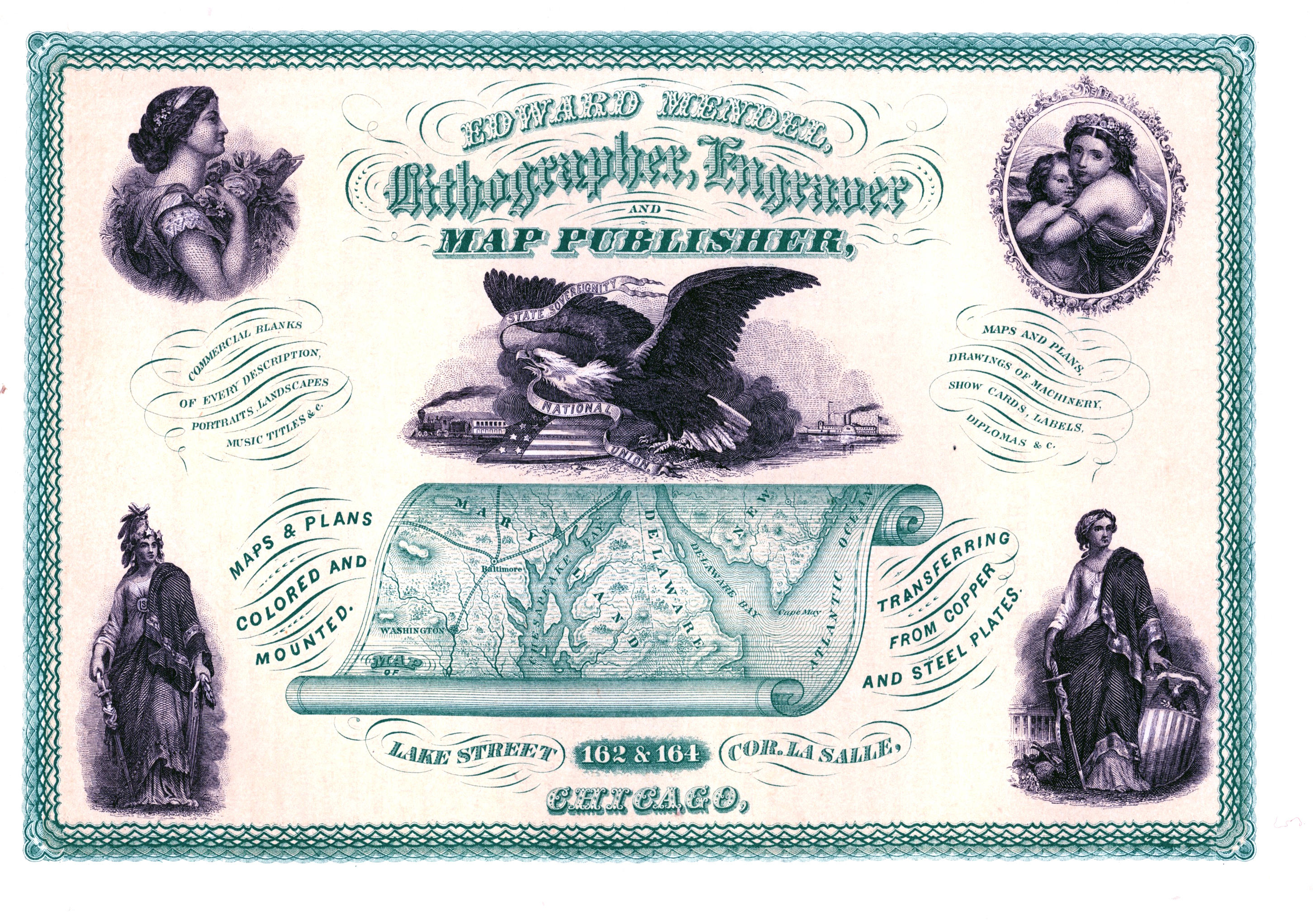
LITHOGRAPHY IN CHICAGO.
The discoverer or rather inventor of this beautiful art was Senefedler, an actor at the Theatre Royal, Munich. This ornamental art, of so much service to the useful arts, is so nearly allied to engraving, that it might be treated as a branch there of being, in fact, engraving on stone, or surface engraving. The stone used, possesses in a high degree, calcareous qualities similar to limestone, and absorbs to a certain extent the only substances that are used to give the drawings sufficient adhesiveness to resist the friction of printing. These are Lithographic chalk, and Lithographic ink. They are composed of tallow, virgin wax, soap, shellac, and colored with lamp-black. The principal styles in Lithography, are Linear and Crayon drawings, transfers on Stone from Steel or Copper-Plate engravings, Wood cuts, or from Lithographic drawings themselves.
The art of Lithography has in no portion of the world been brought to greater perfection than in the United States, or perhaps we might, with perfect propriety, say in Chicago. This we owe in a great extent to Mr. Edward Mendel, whose establishment occupies the two upper floors of Burch’s Bank building, corner of LaSalle and Lake Street, who has executed some of the most impressive, beautiful, bold, and artistic works that have ever been produced by this process.
This establishment has been in operation in this city for the last twelve years; and is perhaps one of the most complete in all its departments on this continent. Mr. Mendel employs a capital exceeding $50,000, including presses, material, etc., furnishing employment to some forty or fifty hands in the several departments. They produce every description of printing, in colors and plain, Show Cards, Music, Title Pages, Landscape views, Lakes, Portraits, etc.; also, all kinds of Commercial Blanks, such as Notes, Drafts, Certificates of Stocks, and Deposits; Railroad, County and State Bonds, Diplomas for Agricultural Societies and Colleges, in fact everything pertaining to the art, may be found in process of production in this representative establishment of Mr. Mendel’s. Having always employed the best art-talent in this department, he has produced work that has given to his name a popularity with Bankers, Insurance and Railroad organizations throughout the North-West, that is everywhere acknowledged and duly appreciated.
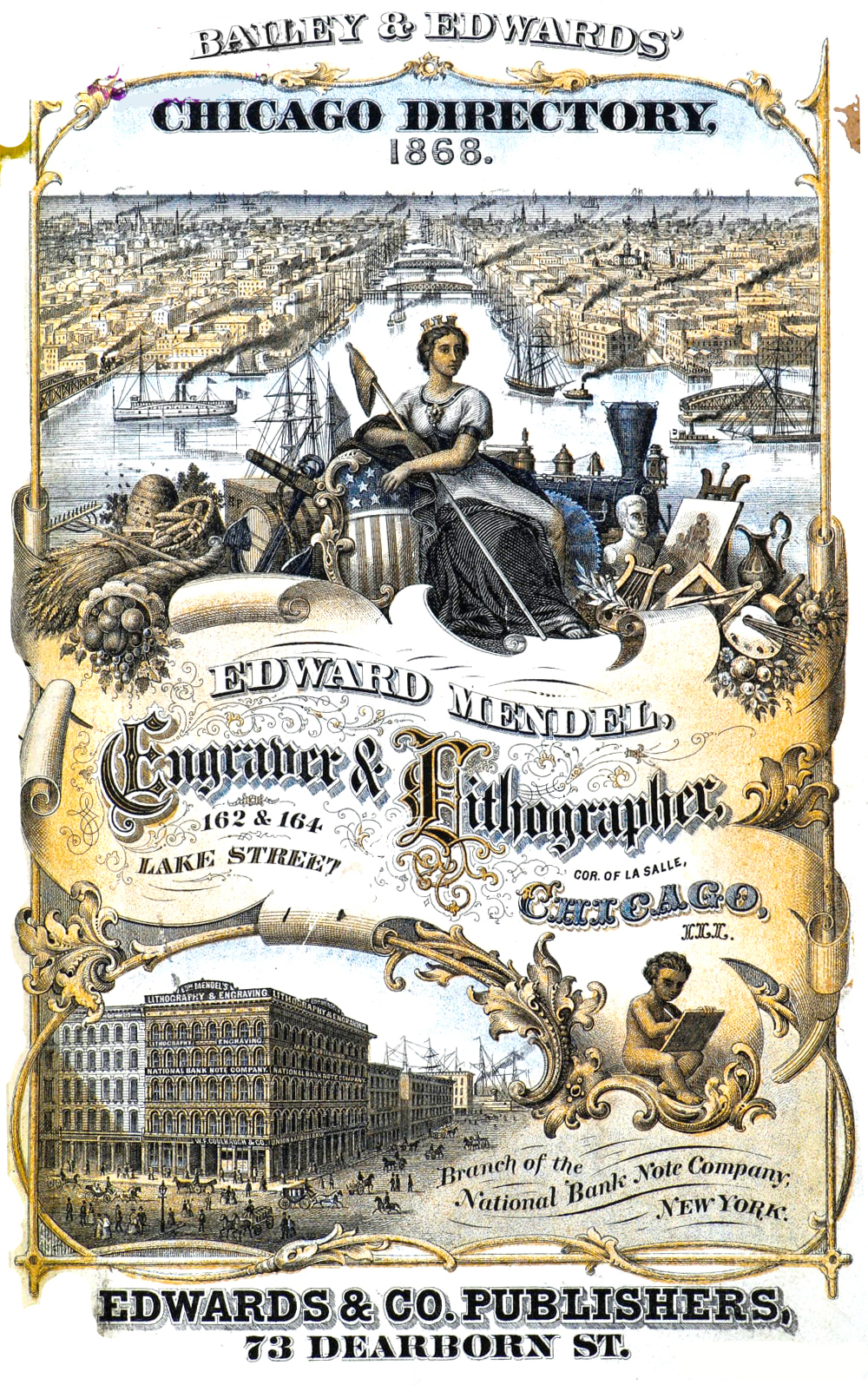
The great variety of specimens of Vignettes, and other embellishments, for every kind of bank and commercial purposes, renders it an easy matter for any person to select designs suitable for their purpose. As the cost of procuring new designs is expensive, it is a matter of consideration to have a choice selection to choose from, in point of expediency and economy.
There is, perhaps, no art which embraces within its range so great a variety of styles as Lithography. The productions of the pencil, the crayon and the graver, are all represented in the various methods of this useful and beautiful art. The word Lithograph, signifying writing upon stone, is a general term, including processes so entirely dissimilar as to require the employment of artists especially educated for the different branches or departments of the business; thus in the production of Commercial Blanks, the lettering, vignettes and other embellishments, are cut or engraved upon the stone by much the same process that is employed on copper and steel plate. The lettering for Maps is usually done by the same process. Other varieties of work are wrought upon the stone with a peculiar kind of pen, designed for the purpose; while large Pictures, such as Portraits, Landscapes, Views, and other varieties, are drawn with crayons upon the stone, and subsequently so affixed by a chemical process, that impressions of the designs are obtained with the same facility as from an engraved surface. The designs for subjects requiring a variety of colors, are sometimes produced in this way; although in the finer class of color work, the design is wrought with the pen. Impressions are produced by a peculiar kind of press, designed especially for this purpose. Our limited space will not allow us to enter into full detail of all the various processes employed in the art, which rivals in one department the best efforts of the pencil and the crayon; and in another, bids fair to contend for supremacy with the proudest creations of Steel Plate Engraving, at a great reduction of cost.
A visit to the rooms of Mr. Mendel, by those who may be interested in these matters, will make them acquainted with all the facts pertaining to this art of so much utility and beauty.
Chicago Tribune, October 8, 1855
NEW MAP OF THE CITY.—We have been shown a copy of the map of the city which is to accompany the new directory published by E.H. Hall & Co. It is neatly lithographed by Ed.Mendel, No. 170 Lake street, and appears to be unusually accurate in regards to names of owners of large lots. It is given on the scale of 1,200 feet to an inch, and will be a valuable addition to the directory.
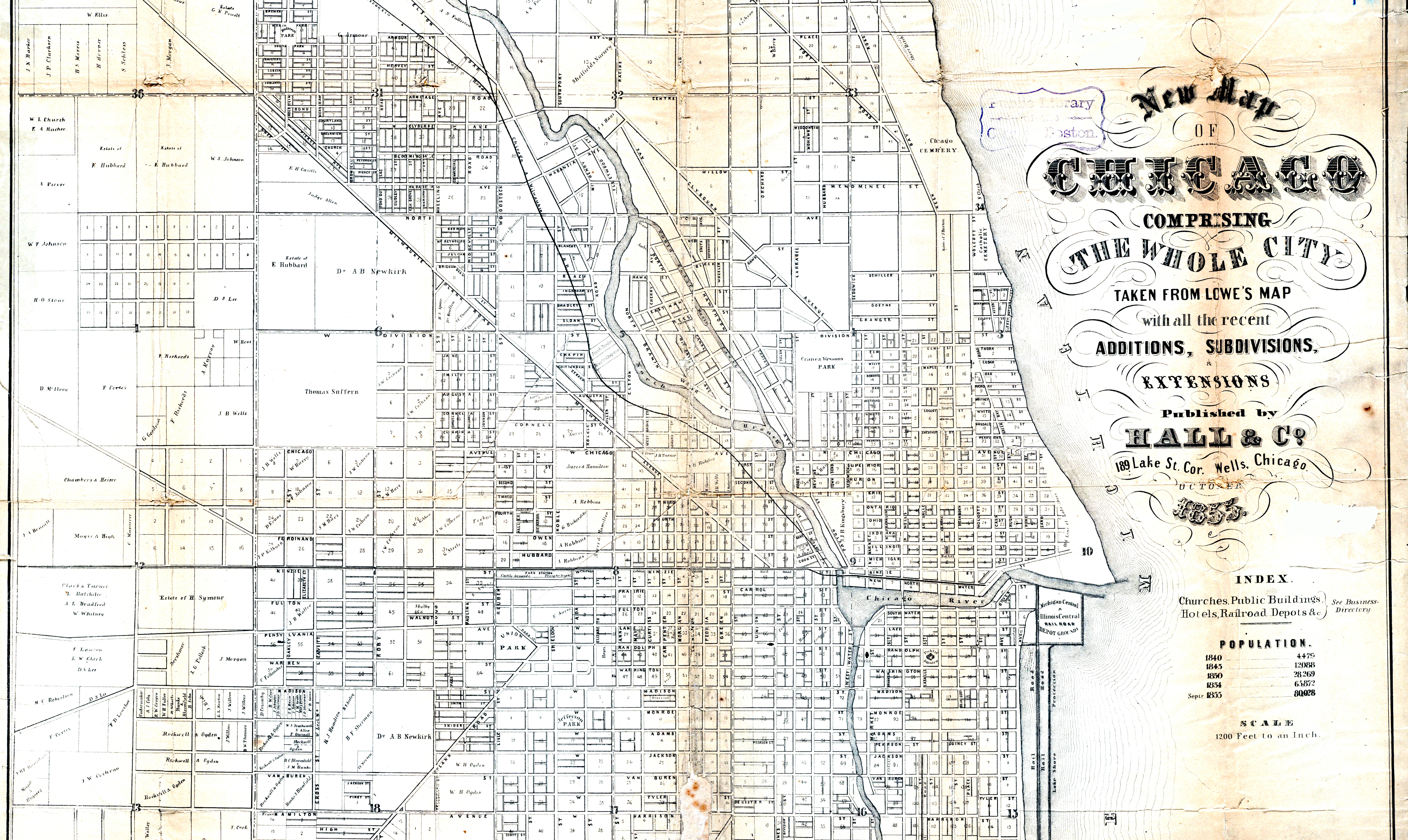
- New Map of Chicago (Excerpt)
Published By Hall & Co.
No. 189 Lake Street
Lithography by Ed. Mendel
No. 170 Lake Street
1855
Chicago As It Is. A Strangers and Tourists Guide to the City of Chicago, 1866.
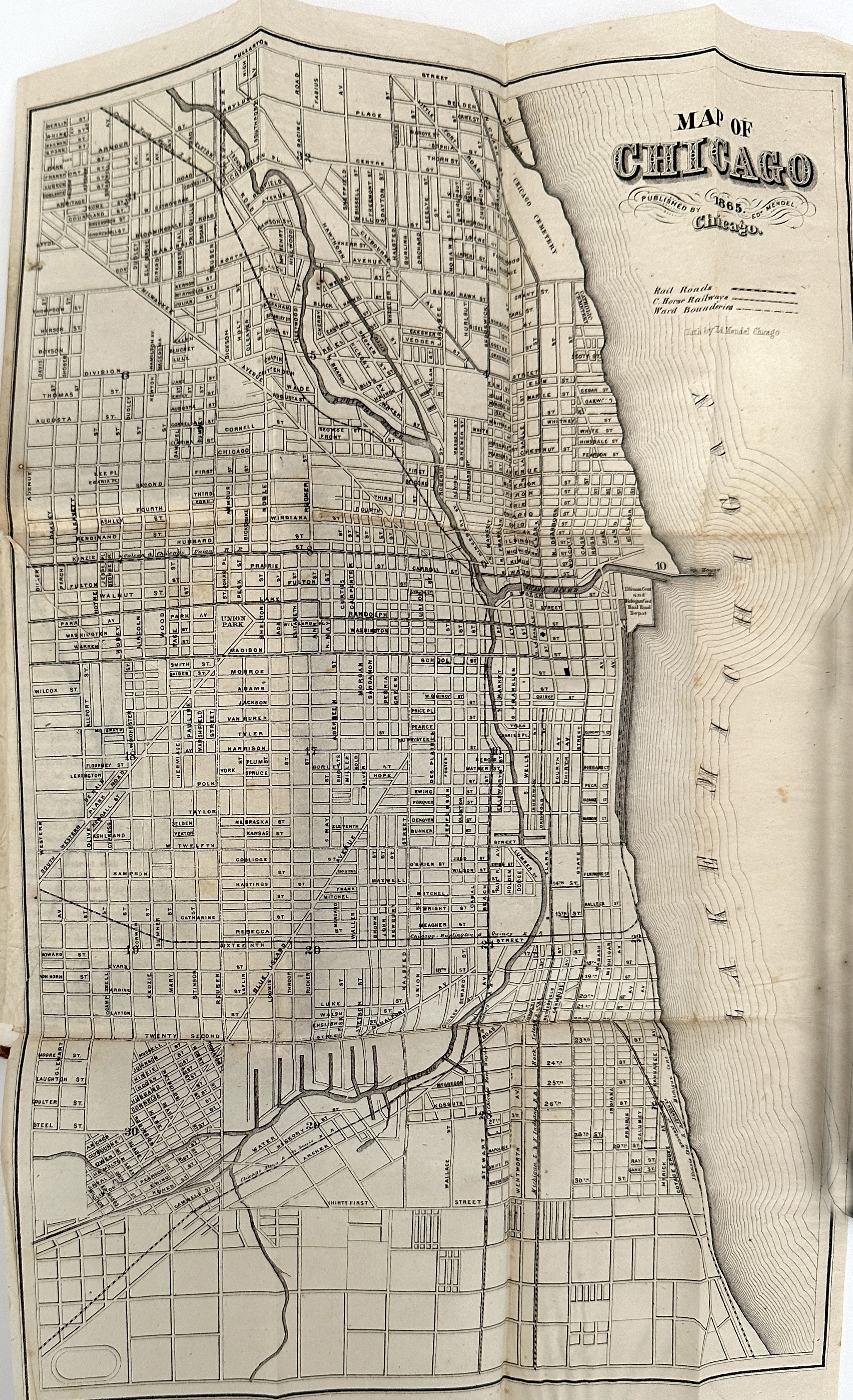
- Map of Chicago
Published By Ed. Mendel
1866
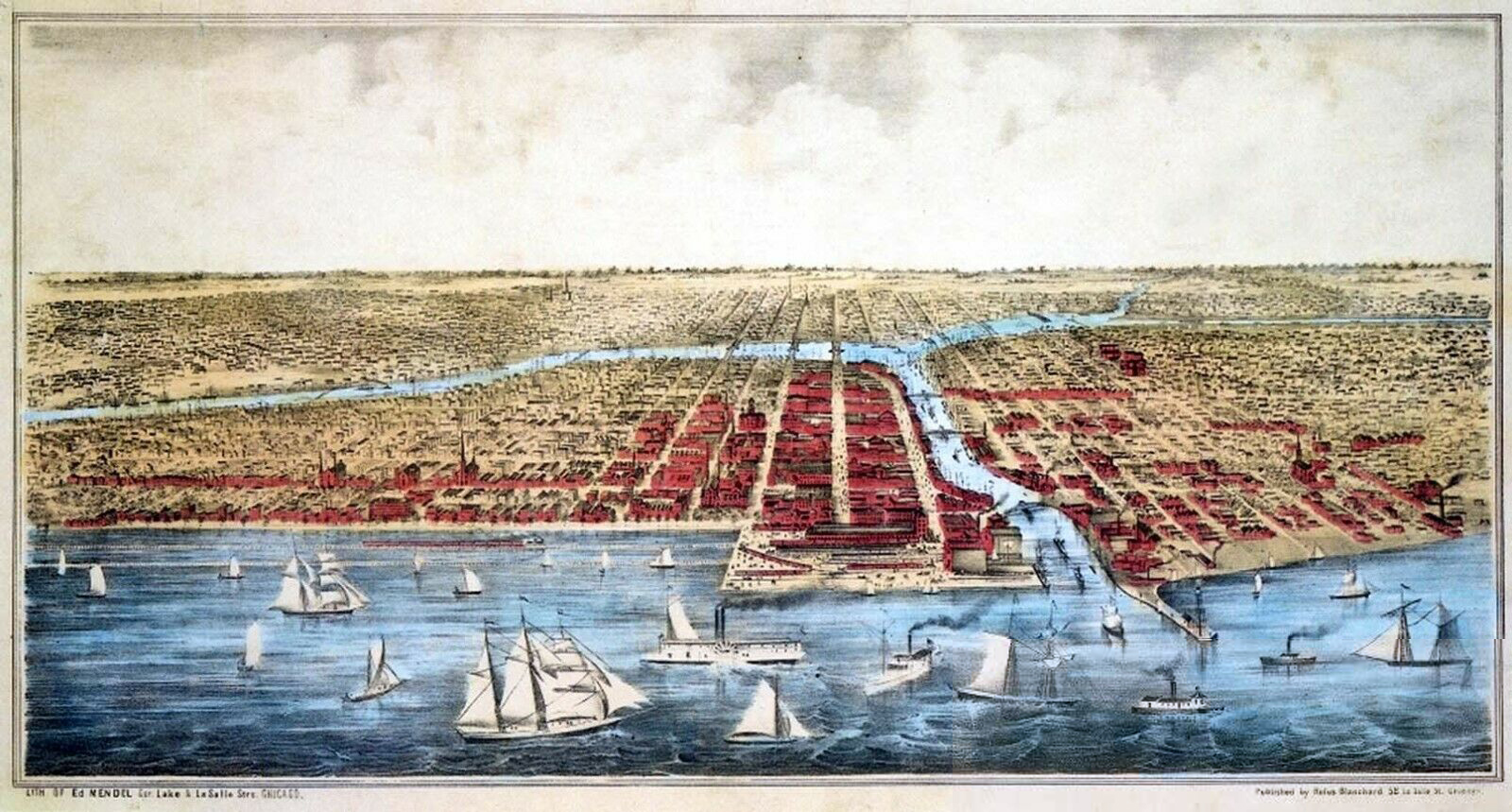
- 1857 Chicago
Rufus Blanchard
Lithograph by Edward Mendel
Chicago Tribune, May 12, 1860
The Great Building Raising.
When Chicago shall have been for a decade or more of years up to grade it will come to be a marvel and a doubt in many minds that the wonder was ever accomplished of raising to grade the entire front of three hundred and twenty feet, at one and the same time, and that of first class buildings filled with tenants, stores and offices.
But Messrs. Brown & Holligsworth, Pullman & Moore, and Ely and Smith, the contracting firms, between whom this work was accomplished, have wisely chosen to perpetuate the memory of their feat in a beautiful lithograph, from the lithograph establishment of Edward Mendel, No. 162 Lake street. It was well and homorably done for Chicago, both the work itself and this is perpetuation.
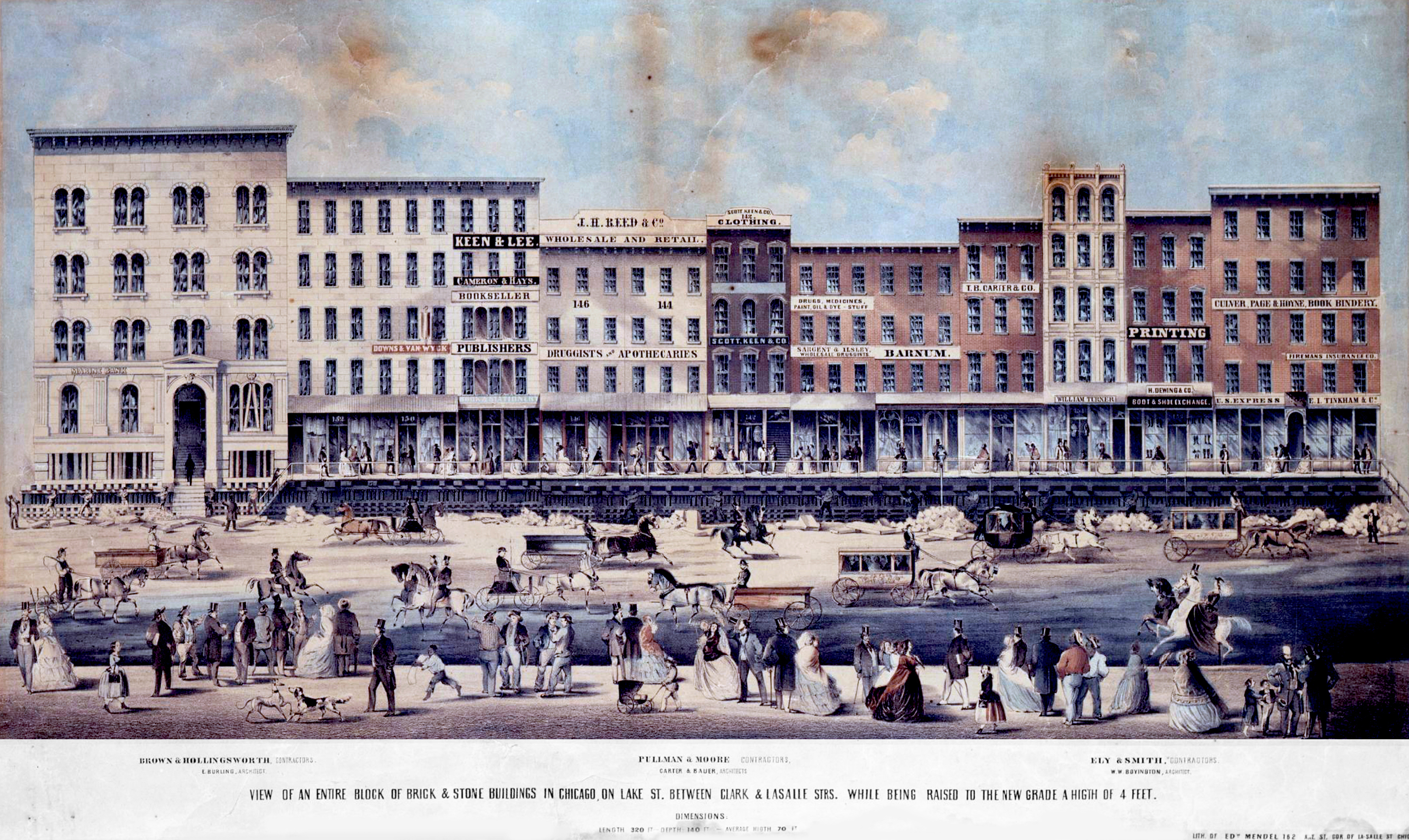
- View of an Entire Block of Brick & Stone Buildings in Chicago, on Lake St. Between Clark & La Salle Strs. While Being Raised to the New Grade a(s) High as 4 Feet.
Edward Mendel Lithograph
1860
Chicago Tribune, August 9, 1860
We have received from Jos. J. Kearney & Co., 29 Market street, a fine lithograph of the portraits and autographs of the signers of the Declaration of Independence, copied from the original in the rotunda of the capital at Washington, by the celebrated lithographer, Edward Mendel of Chicago. It is truly a fine work of art, and, as the publishers say, “one copy, at least, should be in every house in the country.”
Chicago Tribune, November 17, 1863
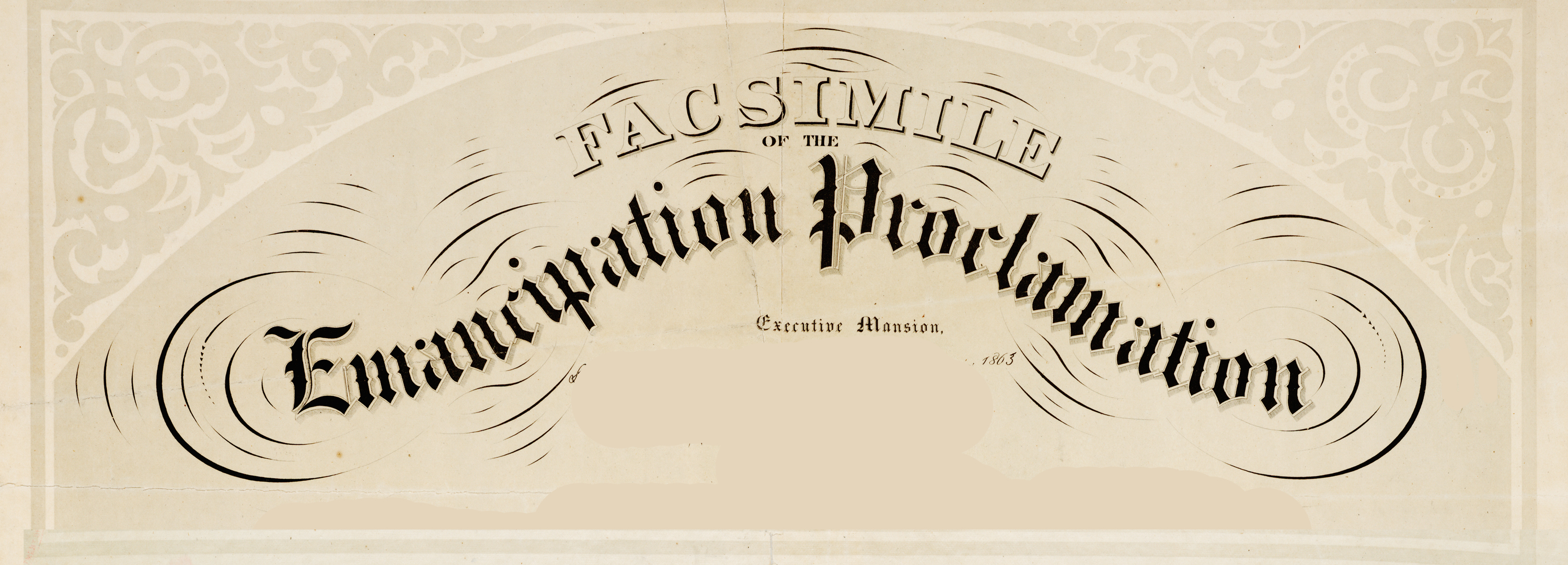
THE PRESIDENT’S EMANCIPATION PROCLAMATION PURCHASED.—We are gratified to be able to state that Thomas B. Bryan, Esq., has purchased the original manuscript of the President’s Emancipation Proclamation, having paid the managers of the Northwestern Fair the handsome sum of three thousand dollars for it, and having given the obligations that it shall not go out of the city.
Chicago Tribune, January 23, 1864
THE PRESIDENT’S EMANCIPATION PROCLAMATION.—This remarkable document has already been published in three different forms in this city, and we understand liberal sales are made by each publisher. A facsimile of the original draft, an exact copy of Mr. Lincoln’s manuscript, published under the auspices and for the benefit of the Soldier’s Home, by Thos. B. Bryan; another by Mr. A.P. Kidder, a fac-simile of his own manuscript copy of it; and a lithograph copy by Rufus Blanchard.
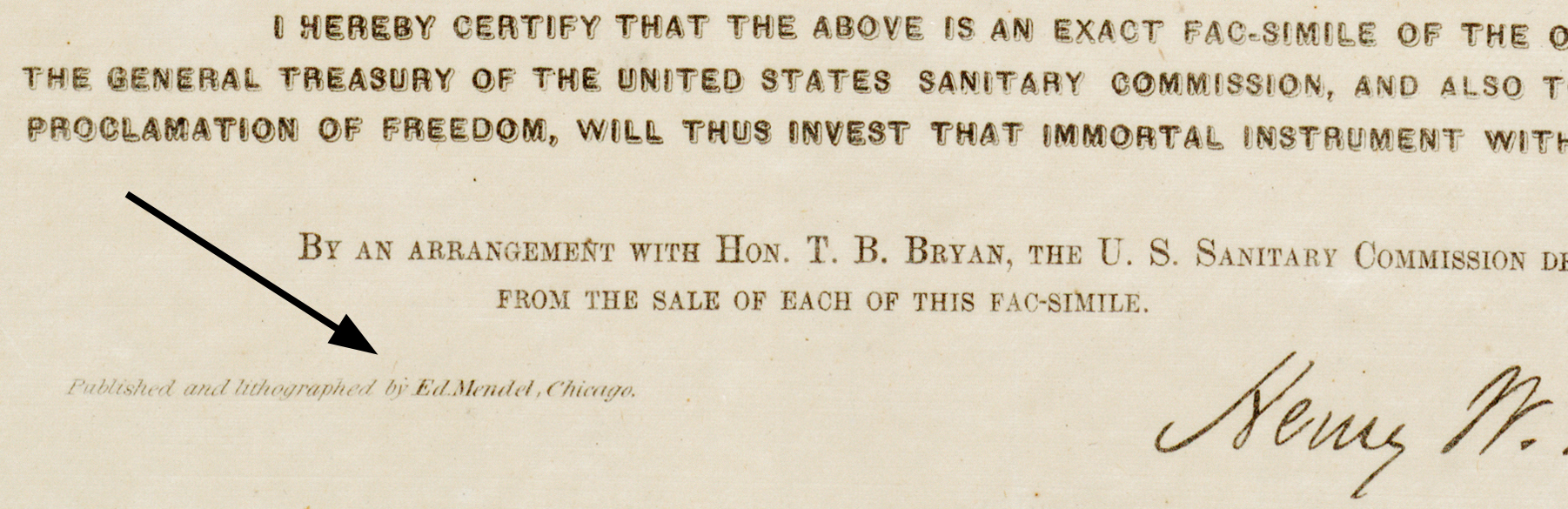
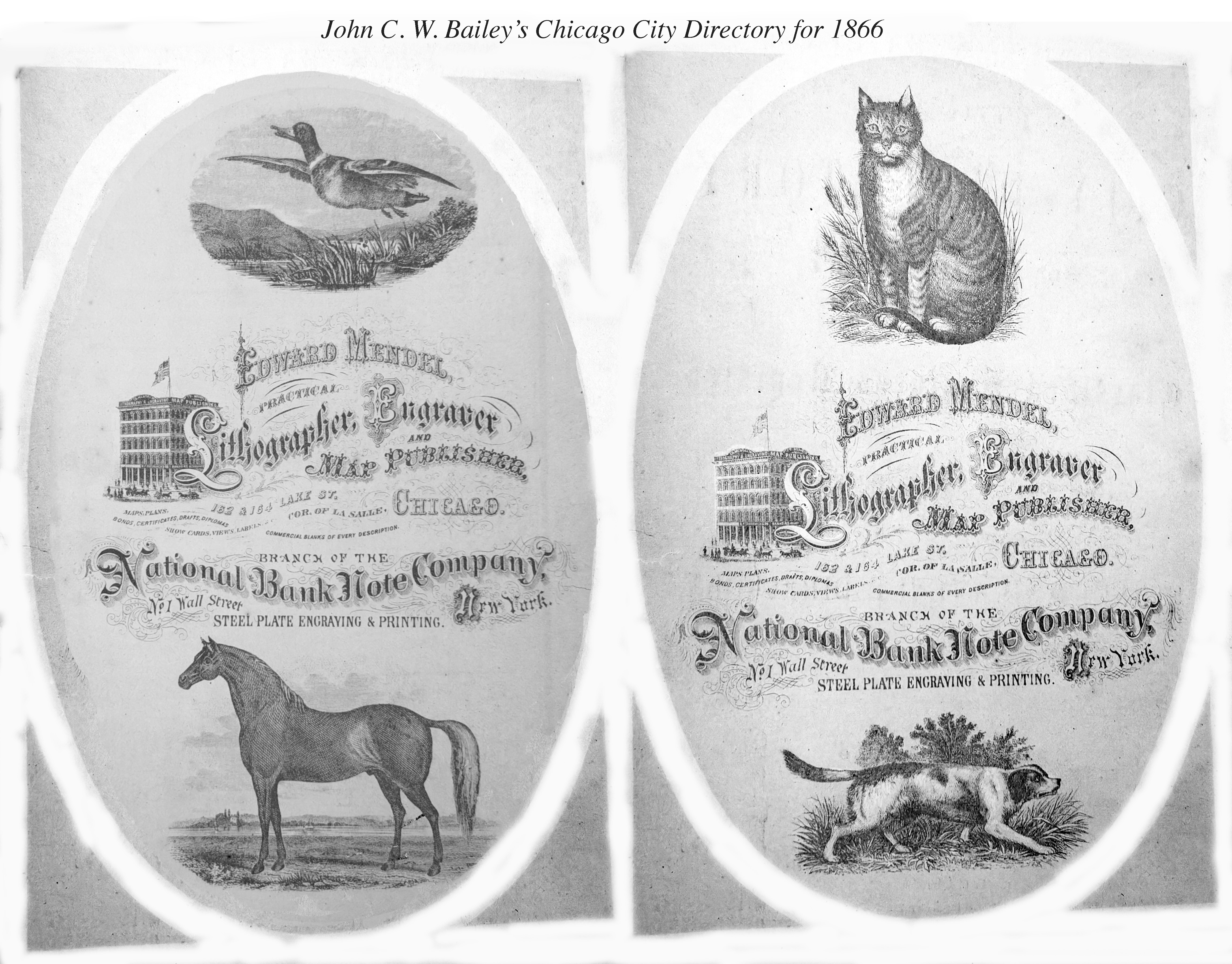
- Close-up of Mr. Mendel’s Facsimile of the Emancipation Proclamation lithograph.
Chicago Tribune, June 11, 1869
EDWD. MENDEL’S
Lithographic Office, Removed to First National Bank Building, southwest corner State and Washington.
Chicago Tribune, October 12, 1871
THE HISTORICAL SOCIETY’S BUILDING.
The loss of the Historical Building is irreparable. The library embraced 17,500 bound volumes, 175,000 pamphlets, and complete sets of dies of the Chicago newspapers. This collection embraced a complete record of the history of Chicago from its earliest days to the present. In addition to the library, the society owned the original draft of the Emancipation Proclamation by President Lincoln, a complete set of the Chicago battle flags, the Healy Gallery of three hundred paintings, Diehl’s Hamlet, Conture’s Prodigal Son. and Volk’s bust of Mr. Lincoln—the only one for which Mr. Lincoln had a life-sitting. The loss of these treasures of art and literature will be felt more keenly in the future than st present. They are treasures which cannot be replaced, and in their loss the history of the city is lost also.
Chicago Tribune, November 7, 1871
The New Orleans Picayne tells of a lady in that city who was reading to her servants an account of the Chicago fire. The incident of the burning of the Emancipation Proclamation arrested the attention of the old colored woman, a slave all her life, who viewed the proclamation much as the Israelites did the Ark of the Covenant. “what day,” she said, “burned up!” “Yes; aunty, burned up.” “Den what gwine come of us again!” “I don’t know; may be you’ll be slaves as before.” “Den chile gwine to die right now.”
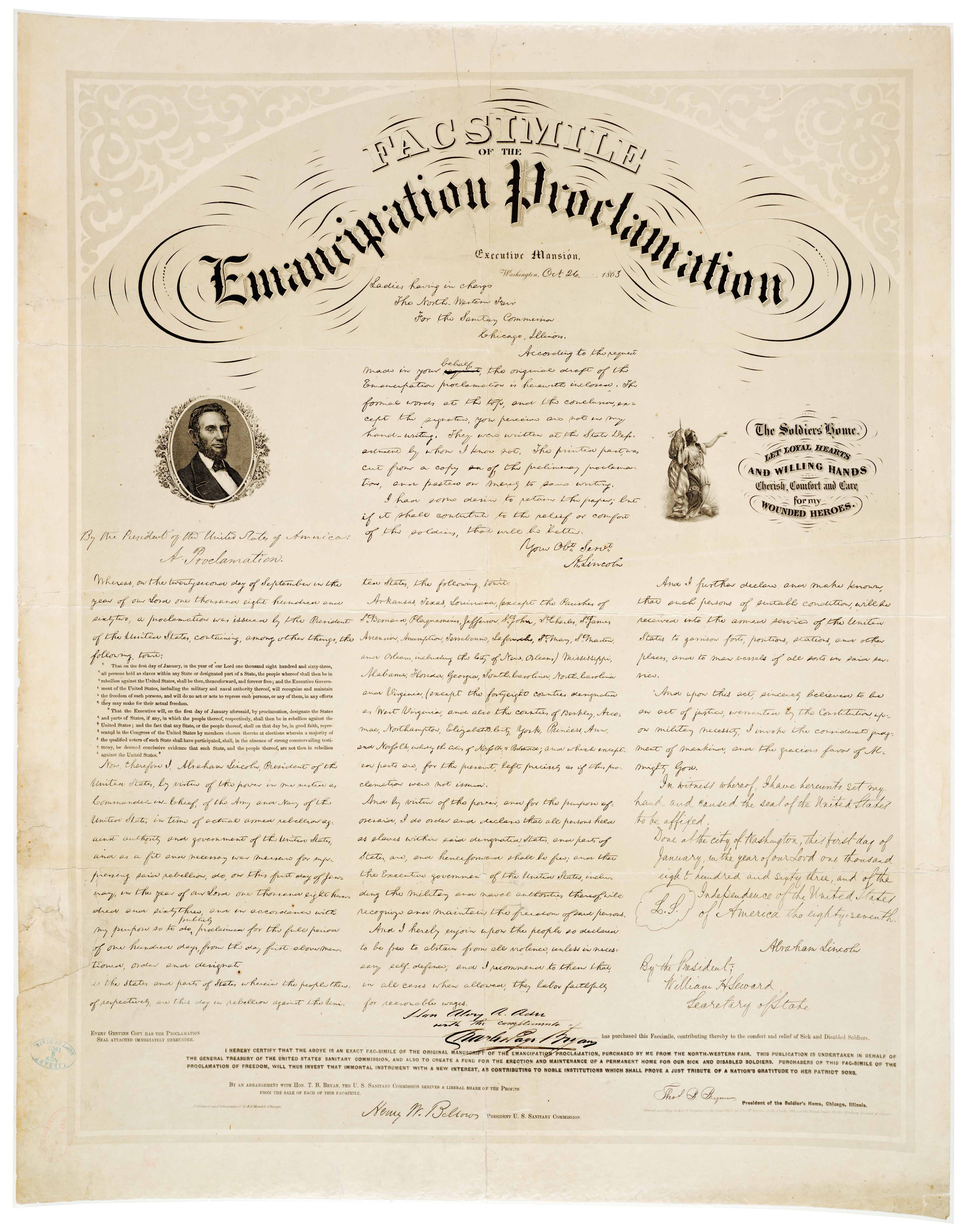
- President Lincoln signed the final draft of the Emancipation Proclamation on January 1st, 1863. Lincoln then donated the original final draft to the Northwestern Sanitary Fair in Chicago in 1863, to be sold to raise money for medical support of the soldiers. Thomas B. Bryan purchased the document for $3,000 and in turn donated it to the Soldiers’ Home in Chicago. Bryan commissioned lithographer Edward Mendel to create facsimile broadside printings of the original document. The sale of these broadsides funded the United States Sanitary Commission and the Soldiers’ Home in Chicago.
The original Emancipation Proclamation draft signed by Lincoln was later destroyed in the Chicago fire of 1871, thus leaving Mr. Mendel’s broadside printings as the only real, original records of the document. This final draft of the Emancipation, shown above, portrays the edits that were made on the original document. It also includes an engraved portrait of Lincoln with a facsimile signature at the bottom. It is detailed and intricate, but not overly elaborate that it strays too far from the original.
Beneath the Proclamation text is a statement detailing the intent for the sale of the facsimiles. The statement was signed by Thomas B. Bryan, President of The Soldiers’ Home, Chicago, Illinois and reads:
- This publication is undertaken in behalf of the General Treasury of the United States Sanitary Commission, and also to create a fund for the erection and maintenance of a permanent home for our sick and disabled soldiers. Purchasers of this fac-simile of the Proclamation of Freedom will thus invest that immortal instrument with a new interest, as contributing to noble institutions which shall prove a just tribute of a Nation’s gratitude to her patriot sons.
We have written proof to explain why these documents were produced and where and why they were sold.
Beneath the Proclamation is the statement of the purpose for the sale of the facsimiles signed by Thomas B. Bryan, President of The Soldier’s Home, Chicago, Illinois:
- This publication is undertaken in behalf of the General Treasury of the United States Sanitary Commission, and also to create a fund for the erection and maintenance of a permanent home for our sick and disabled soldiers. Purchasers of this fac-simile of the Proclamation of Freedom will thus invest that immortal instrument with a new interest, as contributing to noble institutions which shall prove a just tribute of a Nation’s gratitude to her patriot sons.
To the left of the statement is the official seal of authenticity with the statement above it reading:
- Every genuine copy has the Proclamation Seal attached immediately hereunder.
Chicago Tribune, December 28, 1863
MENDEL’S MAP OF ILLINOIS.—Edward Mendel, the well known engraver of this city, has just filled a long needed desideratum in the issue of an accurate and handsome map of Illinois which is just the size for business offices, and very well fitted for reference. It is extended, throughout, in the highest style of the lithographic art, and every county is finished carefully from official surveys. In addition to the map proper, admirable plates of the principal cities are given, as well as smaller maps illustrating the geological character of the State, and important statistics of population, etc. In all respects it is a finished piece of work, and reflects great credit upon Mr. Mendel. We have never before had a complete and reliable map of the State upon a large scale. This one furnishes the information desired at a glance, and has been so carefullu prepared that thorough reliance may be placed in it. Business men especially shoulkd procure a copy of it for reference, and every school in the city should be possessed of one or more copies.
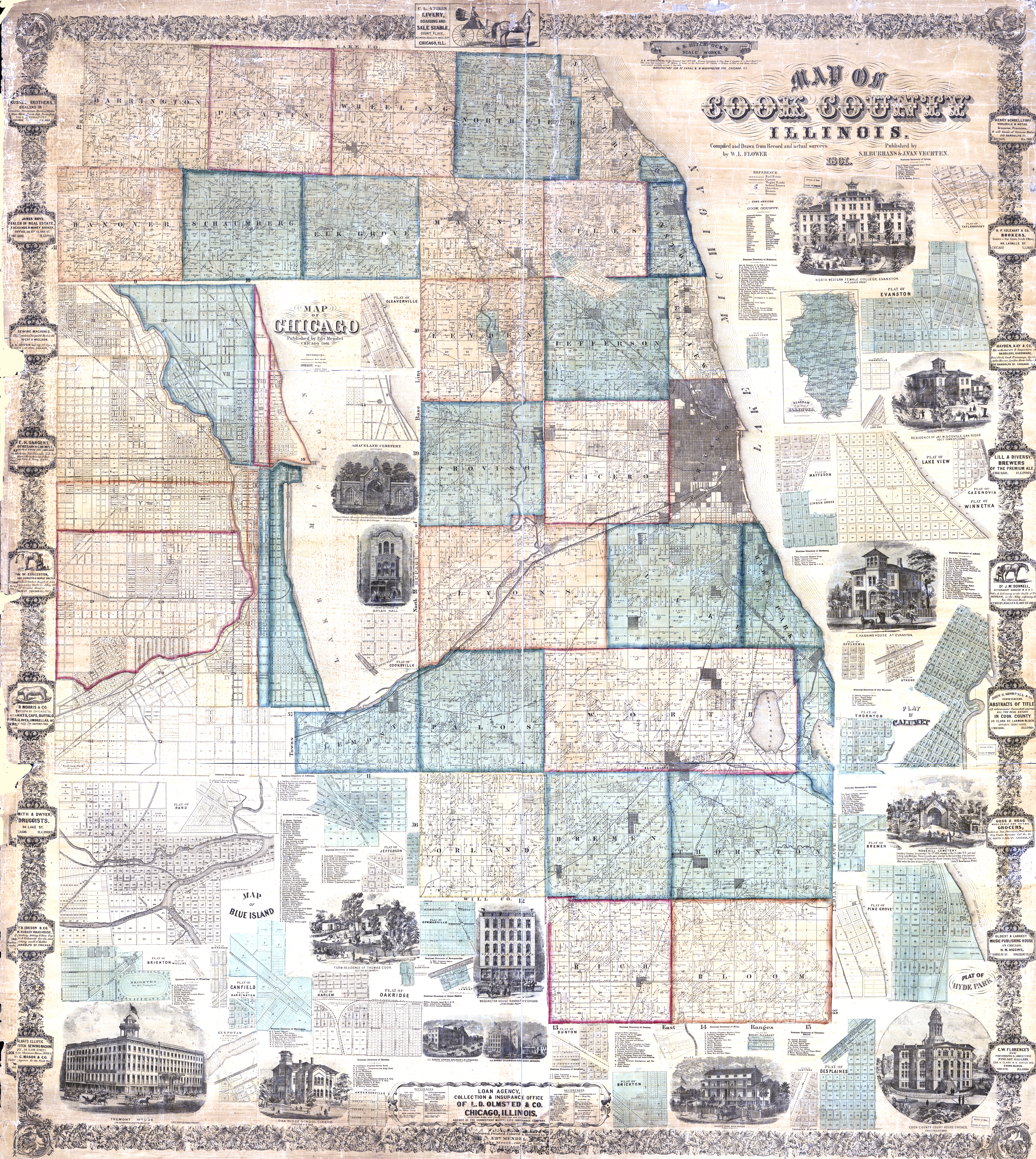
- Cook County, Illinois
Engraved, printed, colored, & mounted by Edw. Mendel.
1861
Chicago Tribune, October 26, 1871
Inter Ocean, April 5, 1884
OBITUARY.
Edward Mendel.
Edward Mendel, for many years a lithographer in this city, and known as a man who has been closely identified with Chicago’s business interests for over a quarter of a century, died at his residence, No. 2321 Wabash avenue, yesterday evening at 7:30 o’clock. For many months the insidious but deadly Bright’s disease had been assailing his system, and at last the foe became the victor. Mr. Mendel was born in Berlin, Germany, in 1828, receiving his education in that country and learning the trade of a mapcarver. When 22 years of agehe came to America. Engaged for a short time at his trade in Cincinnati, he soon came further West and ere long was at work in Chicago, and was also employed for a while on a surveying corps.
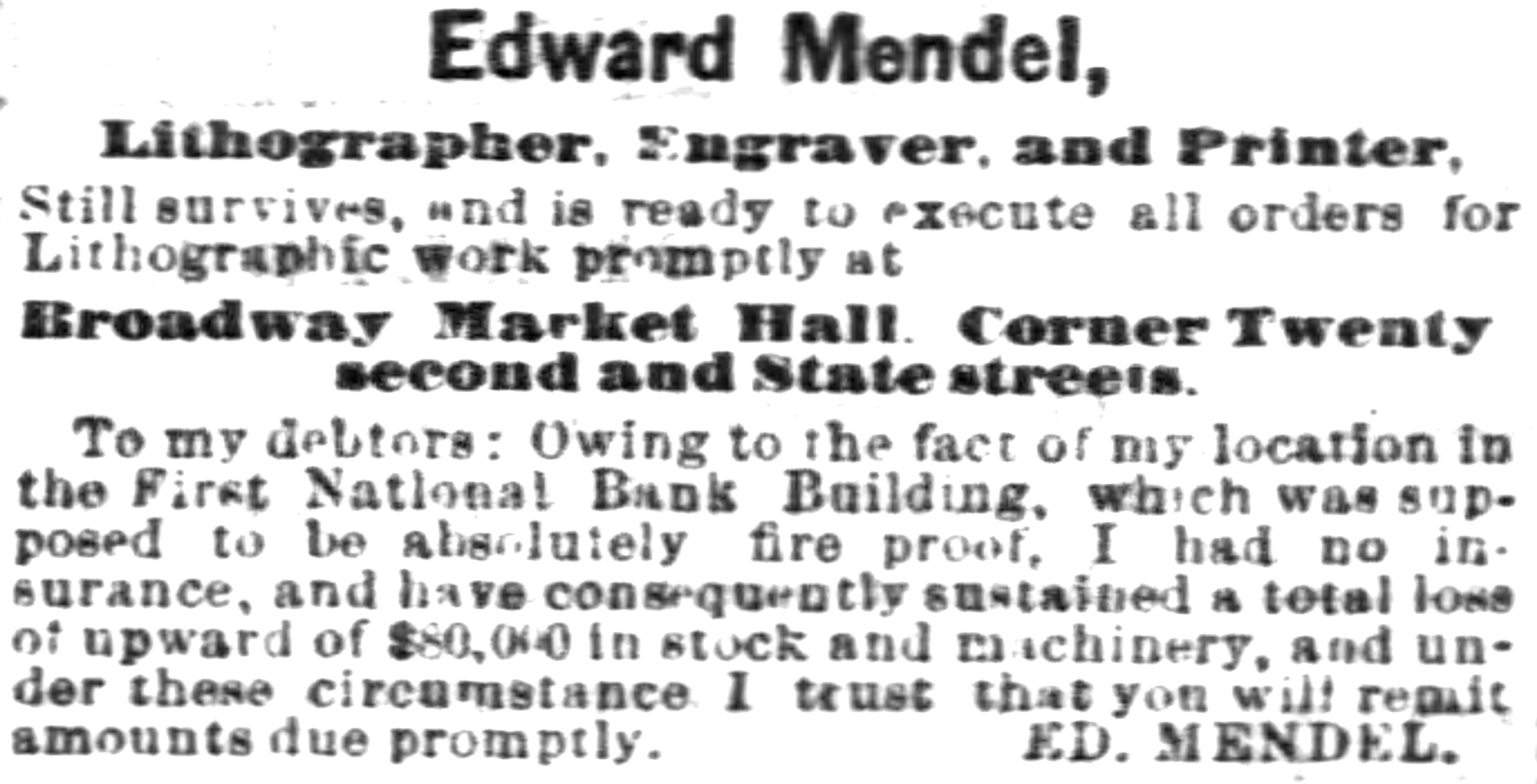
About the year 1853 be began the work of lithographing. He started in this business on Lake street; near La Salle, occupying the old John Link Building. His business began to enlarge, and about three years before the great fire he moved into the First National Bank Building, located at the southwest corner of State and Washington streets. There the fire found him and there the fire left him, well-nigh penniless at best, so far as his business interest was concerned. Not daunted by adversity, he again began business at the corner of State and Twenty-second streets, afterward moving down to the Hoffman Building on Fifth avenue, between Madison and Monroe street. He rapidly regained his former position and again moved, this tie to the fourth floor of the Times Building on Fifth avenue, which latter place he occupied up to the time of his death.
As a man of close attention to business, of industry, of loyal devotion to the work which claimed much of his time and talent, Mr. Mendel was known by a large circle of business friends. A man of native reticence and averse to courting society he yet left a strong impression of his own individuality upon those who knew him. Mr. Mendel had become the possessor of a good deal of valuable city property, owning the Mendel Block, on the northeast corner of Pacific avenue and Van Buren street, a number of houses on Wabash avenue aside from his residence, and other property which would perhaps bring his wealth close up to a half a million dollars. In 1863 Mr. Mendel was married in this city to Miss Sarah Joy, by whom he has had three children, Edward and Albert, two of them now living, the eldest on now nearing manhood. Thirty years of active business life in Chicago, conducted upon the careful and conservative principles which governed his life, could not but have won Mr. Mendel many friends, who will join their sympathy to the sorrow of the bereaved family.

- Link’s Block
1862
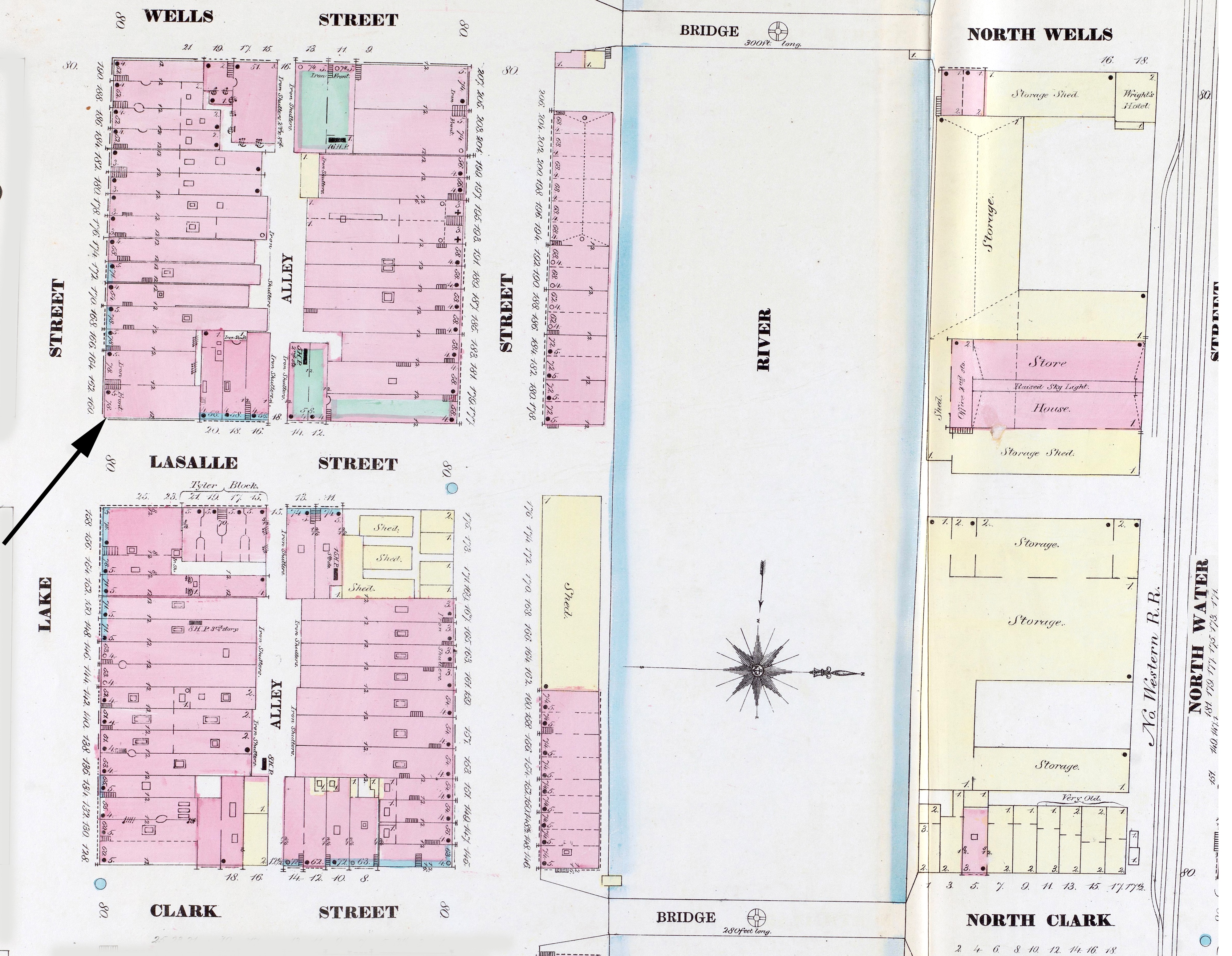
- Link’s Block
Sanborn Fire Insurance Map
1869

Leave a Reply